Selling Peace to Ukrainians, Russians
Around this time a year ago, Vladimir Medinsky, Vladimir Putin’s assistant and Russia’s then chief negotiator with Ukraine, told Wall Street Journal: “With Russia, it’s impossible to fight a long war.” He then cited Russia’s participation in a 21-year war against Sweden in the beginning of the 18th century as evidence of Russians’ ability to endure historically longer hostilities than the ongoing conflict in Ukraine. As is the case with many historical analogies, Medinsky’s was far from perfect if it was meant to convince Ukrainians that Russians would outlast them in combat, given that Ukrainians fought on Russia’s and Sweden’s sides of that 18th century conflict, better known as the Great Northern War. More importantly, while that war ended with Russia and its allies inflicting a military defeat on Sweden, no such defeat is in sight in the current Russian-Ukraine war that entered its fifth year on Feb. 24, 2026.1 In fact during that dark anniversary, the Russian armed forces were on the cusp of enduring their first monthly net loss of Ukrainian territory since October 2023, according to the Russia Matters project’s analysis of data from the Institute for the Study of War (ISW) (see Figure 1 below). And, while the Levada Center’s poll conducted in February 2026 continued to show that the majority of Russians supported the actions of their military in Ukraine, the share of Russians who support peace talks continued to exceed the share of Russians who favored continued hostilities. This robust support for peace talks and, more importantly, the absence of signs of triumph in the war that is already longer than the Soviets’ war against Nazi Germany in 1941–1945, can, perhaps, help explain why we have recently begun to hear suggestions from inside the Kremlin walls, as well as outside them, on how to convince common Russians to accept a perhaps not-so-distant end to the war as a victory, even if that end would not feature a clear Russian military triumph.2
Selling End of War as Victory to Russians...
One such “sales pitch” was reportedly made by members of Vladimir Putin’s administration, (of which, by the way, Medinsky is a member) in February 2026. It took the form of a presentation shown to deputy head of the presidential administration Sergei Kiriyenko, and said, “One must know when to stop. Overreach means defeat; continuing the SVO [special military operation] would amount to a Pyrrhic victory,” according to staff of exiled Russian opposition investigative outlet Dossier Center, who saw the document. The presentation ponders how to "sell" the end of the war to the public once (and if) Russian forces capture the rest of Donbas, according to Dossier, which revealed the existence of this document in a May 7 article. The presentation states that the continuation of the war in Ukraine may necessitate a revision of "fundamental positions"—namely, introducing general mobilization, according to Dossier.
Soon after the revelation of that presentation by Dossier, Kremlin-connected Russian commentator Aleksey Chadaev and pro-Kremlin ex-Ukrainian MP Oleg Tsarev weighed in with posts that appeared to play down the need for a military triumph over Ukraine, offering their own versions of what could constitute a victory. In particular, Tsarev asked in his Telegram channel on May 21: “Isn’t the liberation of a significant part of Novorossiya, a land corridor to Crimea, Russia having stood firm against the whole world and preserved and organized peaceful life in the returned territories—isn’t that a victory?” While listing these components of a Russian victory, Tsarev did not explicitly mention either Donbas as a whole or Donetsk and Luhansk oblasts, which constitute that region. Such references could not be found in Chadaev’s May 25 Telegram post either. Rather, Chadaev proclaimed that “if the war in Ukraine ended tomorrow, I would only be glad. I don’t have this attitude of ‘until victory and our flag over the Reichstag.’”
While insisting that full control of Donbas must be part of the Russian victory, Vasily Kashin of the Russian-state-funded Higher School of Economics expressed skepticism that this victory could include a military triumph over Ukraine. In particular, Kashin wrote in Russia in Global Affairs on May 21: “Can we achieve substantially better results if—as many prominent authors suggest—we demonstrate ‘will,’ ‘start fighting in earnest,’ ‘stop holding back,’ ‘unite for the sake of victory’ and so forth? No; we have no solid grounds to count on results of such a qualitatively different nature.” “The securing of territories for Russia under the terms of the [Trump-Putin] Anchorage agreements [which reportedly provided for Russia’s control of Donbas]—combined with a prohibition on Ukraine joining military blocs or hosting foreign troops on its territory, as well as certain restrictions on the Ukrainian armed forces—would, in this scenario, constitute a favorable outcome for us and a complete military victory,” Kashin wrote.
Other pro-Kremlin figures have tried to go even further in calls for moderating expectations of a Russian triumph, only to see their musings on how Russia could even benefit from its own defeat deleted.3 That, for instance, happened to a member of Moscow’s Public Chamber, Dmitry Krasnov, who argued in his late May commentary for pro-Kremlin MK daily that “geopolitical losses can be more beneficial than brilliant victories” and that in “Russia, it is precisely lost wars and humiliating truces that have regularly led to new surges, reforms and—astonishingly enough—to new victories.” "Every military defeat, every 'humiliating peace,' did not destroy Rus' or Russia, but rather made it stronger and, in the future, led to the expansion of its borders and the strengthening of its positions," Krasnov claimed. In his commentary, Krasnov argued that Peter I earned the title of "the Great" "because he was able to make the right decision following a defeat in a single battle [the Battle of Narva in the Great Northern War]—rather than in the war as a whole.” As of May 29, 2026, the page where Krasnov’s commentary had been now displays an error message.
Selling End of War as Victory to Ukrainians
Interestingly, the Russian side has not been alone in pondering whether and how the end of hostilities can be sold to the public. In conversation with students of the Serhiy Nyzhny Kyiv School of Government posted on YouTube in early May, Valerii Zaluzhnyi, former commander-in-chief of Ukraine’s armed forces and current ambassador to the U.K., offered his views on this subject. “So victory, for both Russia and Ukraine, is increasingly a question of how to sell the outcome as victory. Someone will gain territory and people and call that ‘victory’; someone will lose almost everything yet still try to sell it as ‘victory’ to their people. That’s the current problem.” Zaluzhnyi—who has led some of the recent Ukrainian polls on potential candidates for the next president of Ukraine—further explored what could be publicly framed as a victory even as a military triumph remains unattainable in his May 22 commentary for Ukraine’s NV.ua outlet. The general wrote: “such a war for survival on one side, and the imposition of achieving the goal of this war of destruction at the cost of enormous losses on the other, poses a threat to the existence of both Ukraine and Russia... This is a war of attrition, where survival means victory.”
Can Expanded Mediation Help Sell the Peace?
Thus, it seems that at least some Ukrainian and Russian officials believe it is time to think on how ending the war could be sold to their compatriots.4 That peace would have to be sold to respective publics follows from recent opinion polls that show while a majority of Ukrainians and Russians support talks on peace, they disagree on the conditions for it, with Donbas being the biggest apple of discord. For instance, a nationwide telephone survey of 1,600 respondents in Russia conducted by Russian Field on Feb. 5–14, 2026, found that majorities believe “mandatory” terms for a peace deal should include recognition of Donbas as Russian territory (75%), Ukraine’s refusal to join NATO (71%) and lifting of sanctions (70%). In contrast, a mid-January 2026 poll of Ukrainians by the Kyiv International Institute of Sociology showed 57% of Ukrainians categorically reject the withdrawal of Ukrainian troops from Donbas even in exchange for security guarantees from the U.S. and Europe.
How to reconcile Russians’ and Ukrainians’ views on these hard issues is something that experts such as Thomas Graham, Peter Slezkine and Joshua Shifrinson and Edward Joseph have recently pondered. Whether some of their ideas would be implemented depends, to a large extent, on the political will of Volodymyr Zelensky and Vladimir Putin,5 whose negotiators reportedly appeared to makeprogress earlier this year,6 and who have recently spoken of seeing the “beginning of the end” of the war and the conflict “coming to an end,” respectively. The chances that their visions of this end can be reconciled in ways both men can sell to their compatriots as a victory are slim, but not non-existent. Perhaps these chances could be increased if, given that the U.S. mediation of the conflict has stalled, EU mediators join the negotiating process under the leadership of someone who, unlike the current American mediators, is well versed in dealing with heads of state.7
Figure 1
| Table 1: Source: DeepState, research period: past year as of May 27, 2026 | |||
| Total temporarily occupied | Sq km | Sq mi | % of Ukraine |
| Total temporarily occupied as of May 28, 2025: | 113,042 | 43,646 | 18.73% |
| Total temporarily occupied as of May 27, 2026: | 116,886 | 45,130 | 19.36% |
| Difference | 3,844 | 1,484 | 0.6 |
| Table 2: Source: ISW, research period: past year as of May 26, 2026 | |||
| Total temporarily occupied | Sq km | Sq mi | % of Ukraine |
| Total temporarily occupied as of May 27, 2025: | 114,413 | 44,175 | 18.95% |
| Total temporarily occupied as of May 26, 2026: | 118,285 | 45,670 | 19.60% |
| Difference | 3,872 | 1,495 | 0.64 |
Endnotes
- The length of Russia’s war against Ukraine exceeded the length of the Great Patriotic War, in which the Soviet army fought against Germany from June 22, 1941, until Victory Day on May 9, 1945, (a total 1,418 days) in January 2026, and then marked its fourth anniversary in February 2026.
- Such a triumph presently looks unlikely, given the murderously slow rate of changes in Russia’s territorial control (see Figure 1 and Tables 1 and 2 above).
- Published on May 21 on MK’s site, the article could not be accessed, possibly after being deleted, as of May 28.
- That’s not unusual, as the need to sell the tentative deal to the domestic constituency is part and parcel of a typical international negotiation.
- Putin repeated his May 9, 2026, assessment of a pending end to the war on May 29. He said that battlefield dynamics now allow Russia to claim the war in Ukraine is nearing its end, but insisted it is impossible to give a timetable. “The situation on the battlefield is developing in such a way that this gives us the right to say that the situation is approaching completion,” he said, adding that naming specific deadlines in wartime is “not just rash, it’s something that is practically never done,” according to Vedomosti.
- Some Russians and Ukrainians have recently seen room for compromises, including one on Donbas. Also, speaking in April 2026 to BBC, Mayor of Kyiv Vitali Klitschko, who has engaged in rivalry with Zelenskyy at times, conceded that Ukraine may have to give up land as part of a peace deal with Russia. "One of the scenarios is… to give up territory. It's not fair. But for the peace, temporary peace, maybe it can be a solution, temporary," he said.
- One good candidate to lead the mediators is former Finnish President Sauli Niinisto, who, while on good terms with Zelenskyy, also knows Putin well and has significant experience in dealing with the Russian leader.
Opinions expressed herein are solely those of the author.
The author thanks Angelina Flood for editing this commentary and researching contents for Table 2 and Ivan Arreguín-Toft for co-editing.
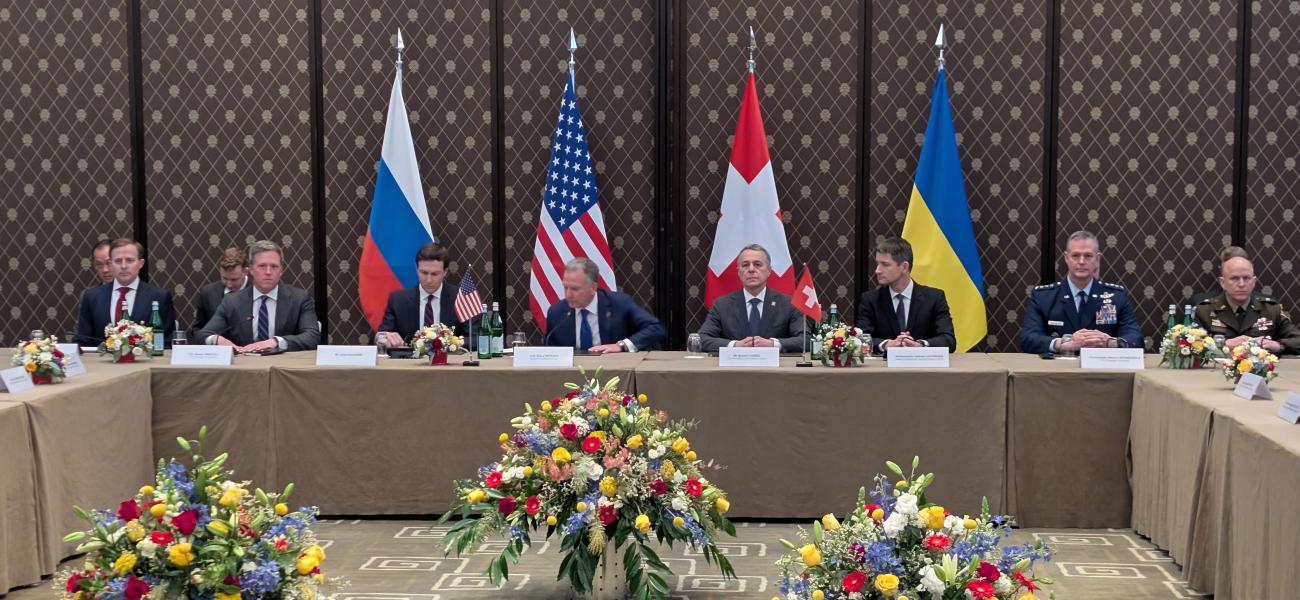
Photo: In this photo provided by the National Security and Defense Council of Ukraine press office, the U.S. delegation attends the next round of trilateral talks between the United States, Ukraine and Russia on Russia-Ukraine war in Geneva, Switzerland, Tuesday, Feb. 17, 2026. (Ukrainian National Security and Defense Council press office via AP)