In the Thick of It
A blog on the U.S.-Russia relationship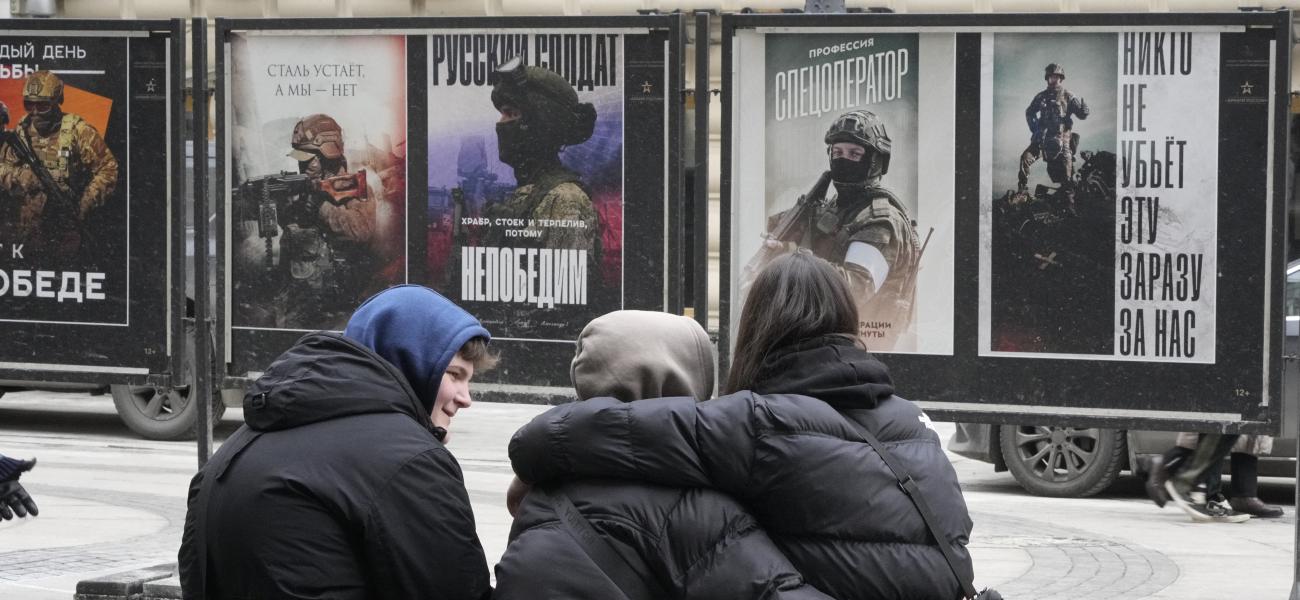
Levada Poll Shows Rising Support for Peace Talks, But Devil In Details
A recent survey by the Levada Center indicates that while a large majority of Russians express support for the actions of the Russian armed forces in Ukraine and for its strikes on Ukraine’s energy infrastructure, support for peace negotiations has reached its highest level to date.
Strong support for actions of Russian army in Ukraine…
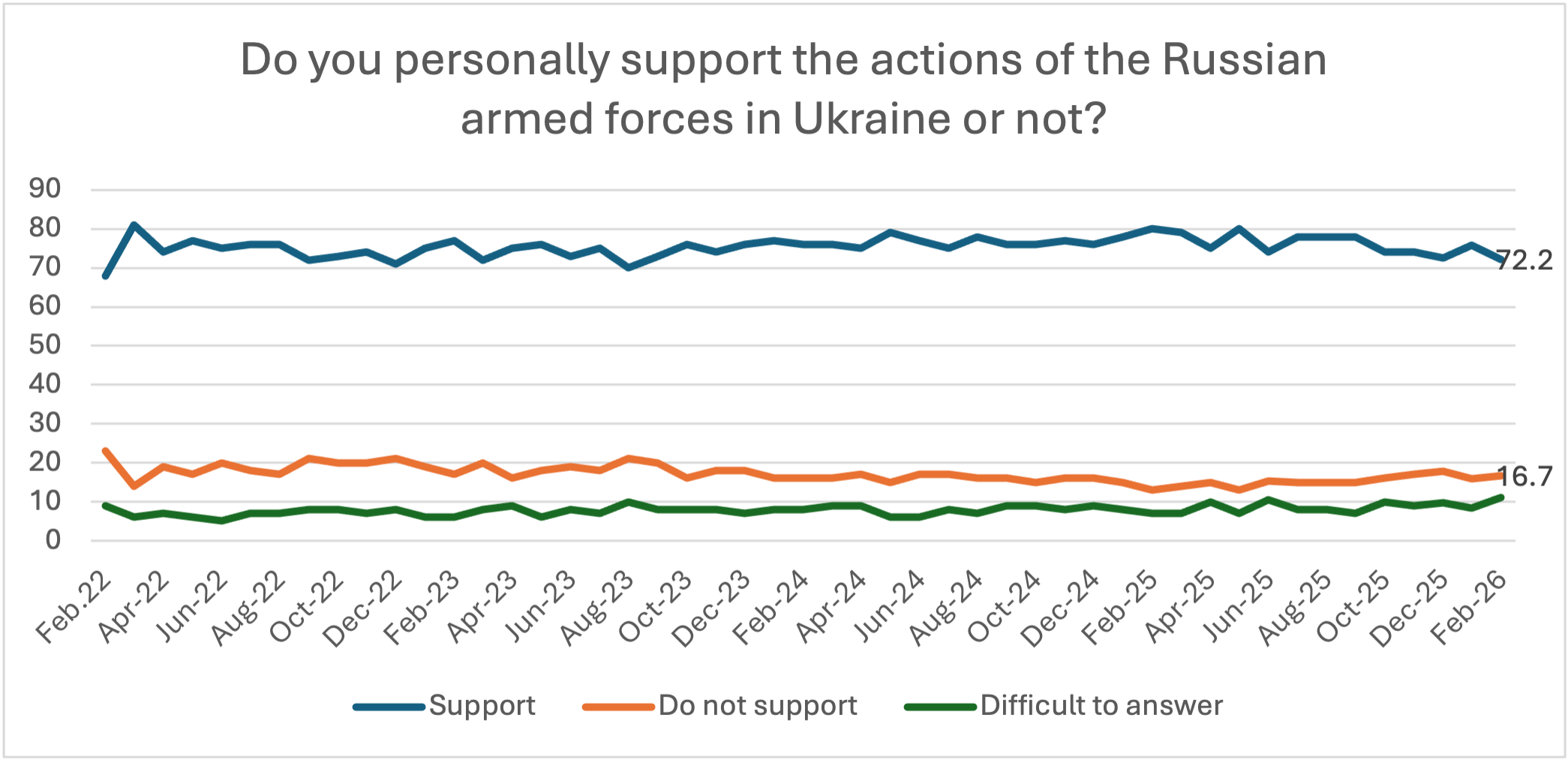
The survey, which Levada conducted on Feb. 18-25 and released on March 3, shows 72.2% of respondents support the actions of the Russian armed forces in Ukraine, down from 75.8% in January 2026. Opposition to these actions stands at 16.7%, slightly higher than 15.8% in Jan. 2026. Compared with most of 2023–2025 (typically 74–78% support), the latest figures suggest modestly declining support, although backing for the war remains above 70%, indicating continued majority approval.
Figure 1.
Majority also supports attacks on Ukraine’s infrastructure …
Another question in Levada’s latest poll on Ukraine addressed Russian military’s strikes on Ukraine’s energy infrastructure. Respondents were asked whether they consider such strikes justified or unacceptable. In February 2026, a majority of respondents—about 57%—said such strikes are justified, while around 20% said they are unacceptable.
Among respondents who consider the strikes on Ukraine’s energy infrastructure unacceptable, the most frequently cited explanation is the suffering and deaths of civilians, mentioned by about half of respondents (52.2%) in this group. Another commonly cited explanation is a general opposition to the war and a desire for peace, mentioned by 16.6% of respondents who consider the strikes unacceptable. Others pointed to the damage inflicted on civilian infrastructure, including hospitals, schools and other essential facilities, mentioned by around 13.3%.
Among respondents who consider the strikes justified, the most common explanation is that the attacks represent retaliatory actions, cited by 32% of respondents holding this view. Another frequently mentioned justification is that the strikes are intended to damage the economy, stop military production and weaken Ukraine’s military potential, cited by 15%. Some 12% argued that such strikes could accelerate the end of the conflict or compel Ukraine to enter negotiations, while 5% justified the strikes with the broader argument that war inevitably involves such measures. Some 4% said they trust the military leadership and believe the armed forces understand the situation better than ordinary citizens (see Table 1).
Table 1.
| Recently Russia has carried out strikes on Ukraine’s energy infrastructure (power plants, substations, etc.). Some consider such strikes justified, while others say such strikes are unacceptable. Which of these views do you personally tend to agree with more? | |
| Rather the first (such strikes are justified) | 57% |
| Rather the second (such strikes are unacceptable) | 20% |
| Difficult to say | 23% |
| Why do you think such strikes are unacceptable? | |
| People are killed; civilians suffer; ordinary citizens who have nothing to do with the war are affected | 52.2% |
| Opposed to military actions; no one needs war; peace is needed | 16.6% |
| Hospitals, schools and kindergartens are left without electricity and heat; people freeze | 13.3% |
| We will have to rebuild later—why destroy? | 6.9% |
| They will lead to trouble; they strike our territory because they give a mirror response | 5.7% |
| Other | 3.2% |
| Difficult to answer | 13% |
| Why do you think such strikes are justified? | |
| They are retaliatory strikes; we did not start this | 32% |
| To damage the economy, stop military production and weaken Ukraine’s military potential | 15% |
| To bring the conflict closer to an end so the war will finish; to force Ukraine into negotiations | 12% |
| To damage the army, win and achieve our objectives | 9% |
| They deserve it; so they see Russia’s strength; they are enemies, fascists | 6% |
| War is war; in war all means are acceptable | 5% |
| It is necessary; the military knows better; I trust the leadership | 4% |
| It is better than striking the civilian population | 2% |
| To defend Russia so fewer of our people die | 1% |
| To provoke dissatisfaction inside the country | 1% |
| Other | 6% |
| Difficult to answer | 12% |
...at the same time, record support for peace talks, though with caveat
Last but not least, Levada pollsters asked respondents whether military actions should continue or whether peace negotiations should begin. In February 2026, a record high of 67.2% said peace negotiations should begin, while 24.3% said military actions should continue, with the remainder unable to answer. At the same time, the 24.3% in support of military action recorded in February 2026 is the lowest level observed, while 67.2% supporting negotiations is the highest level recorded since the question was first asked.
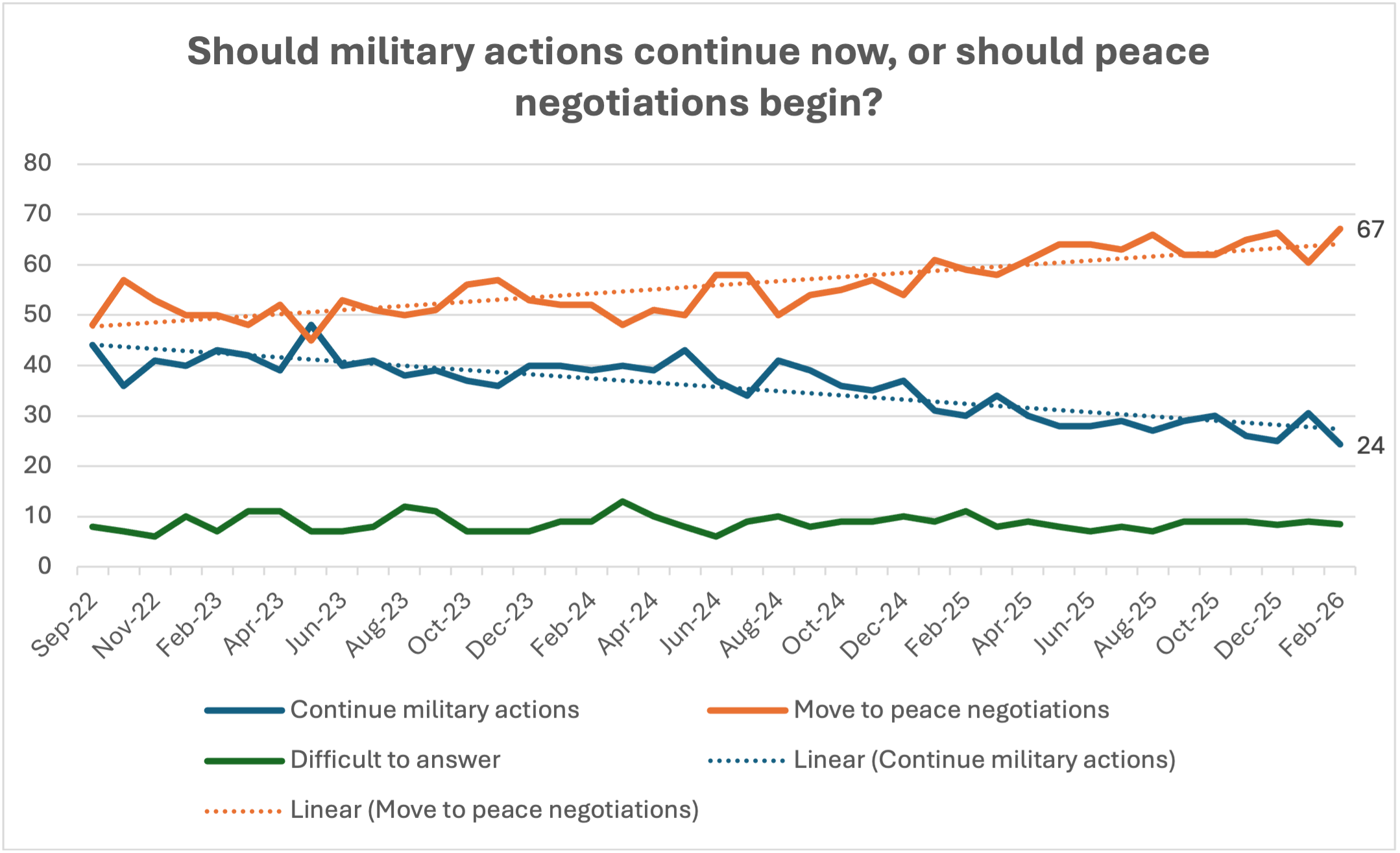
That said, as we have earlier noted, one should keep in mind that the devil is in details when it comes to Russians’ support for peace. While many Russians support peace talks, they want these talks to succeed in accommodating their visions of peace, which is mostly irreconcilable with the vision that Ukrainians have. For instance, a nationwide telephone survey of 1,600 respondents conducted by Russian Field from Feb. 5–14, 2026, finds 53% now favor transitioning to peace negotiations. Moreover, if Russian President Vladimir Putin signed a peace agreement, 83% say they would support his decision—a record high—while 12% would not; a ceasefire without preconditions would be backed by 56% and opposed by 38%. Majorities name as “mandatory” terms for a peace deal recognition of Donbas as Russian territory (75%), Ukraine’s refusal to join NATO (71%) and lifting sanctions (70%). In contrast, a mid-January 2026 poll of Ukrainians by Kyiv International Institute of Sociology shows 57% of Ukrainians categorically reject the withdrawal of Ukrainian troops from Donbas even in exchange for security guarantees from the U.S. and Europe.
Endnotes
- As stated in earlier blog posts on opinion polls in Russia, one should not forget that Russia’s slide toward a hard authoritarianism has led to the criminalization of freedom of speech on issues related to the war, among other things. This cannot help influencing what a Russian living in Russia says to others, including pollsters.
Young people sit near a street exhibition of military posters named 'Together to Victory' dedicated to Russian army in St. Petersburg, Russia, Monday, Feb. 24, 2025. (AP Photo/Dmitri Lovetsky)