Has the Russian-Ukraine War Reached a Turning Point Favoring Ukraine?
To hear multiple Western and some Ukrainian commentators say it, the Russian-Ukrainian war has reached a turning point in the past month or so, and it favors Kyiv. As early as April 1, 2026, Kateryna Odarchenko of the Atlantic Council saw “growing signs along the front lines of Russia’s invasion that the tide may finally be turning in Ukraine’s favor.” On May 28, and in bolder language, Christopher Miller and Max Seddon reported in the Financial Times (FT) how “Ukraine is turning the tables” on Russia in the war. Then Michael Froman noted “a turning point in Ukraine” in his June 6, 2026, commentary for CFR while Nick Paton Walsh of CNN described Ukraine's drone assaults on an oil facility close to the Kremlin as “a likely turning point in Russia's war on Ukraine.” Most recently, on June 26, Peter Frankopan warned in Foreign Policy (FP) that “the tide turns against Putin.” Having repeatedly come across such ‘turning’ claims (see nine more in this footnote1) when monitoring media outlets, analytical web sites, and other open sources for analyses of the Russia-Ukraine war, I could not help asking whether that war—which has already lasted longer than WWI—has, indeed, reached a turning point in favor of Ukraine.
To answer that question, let me first define turning point. A cursory search of the English language translations of writings by some of the foundational theorists and historians of war, such as Thucydides, Polybius, Sun Tzu, and Carl von Clausewitz, have revealed no ready definitions. Clausewitz did refer to the “turning point” (Wendenpunkt) once or twicein the German original of his “On War” volume,2 but I could not find an explicit definition of what that point was in his writings. Having found no ready-to-use definitions of a war’s turning point in writings of the aforementioned scholars, I turned to dictionaries, and have amalgamated entries from the Cambridge Dictionary, the Collins English Dictionary, Merriam-Webster, Oxford Learner’s Dictionaries, and Reverso English Dictionary into the following definition: Turning point in a war is a specific moment or a short period when a situation changes in an important, impactful way, shifting the overall direction or balance of fighting in what could mark the beginning of a decisive new phase of the hostilities.
With this definition of a turning point, my aim here is to ascertain whether the Russian-Ukrainian struggle has actually reached a turning point in Ukraine’s favor this year, per the aforementioned claims. To make that determination, I examine what constitutes the main characteristics of such a point and whether those characteristics have been present this year.
Armed struggle on land: Kto Kogo?
One obvious characteristic of a war’s turning point is significant alteration in the rate of changes in territorial control in a short period of time. To determine that, I compared the rate in the research period of May 1–June 20, 2026 (51 days, inclusive), with the preceding period of March 11–April 30, 2026 (51 days, inclusive). I also compared the period of January 1, 2026–June 20, 2026 (171 days, inclusive), with the period of July 14–December 31, 2025 (171 days, inclusive).
As demonstrated by Tables 1 and 2, which you can find below and which are based on my analysis of data provided by Ukraine’s Deep State (DS) OSINT group, the rate of Russia’s gains of Ukrainian territory has been decreasing in both of the two research periods. However, Russia still ended up with more Ukrainian territory this year, according to measurements of data mined from DS. (In fact, the last time Russia endured a net monthly loss of territory, according to DS, was in fall 2023 as Figure 1 below demonstrates). The U.S.-based Institute for Study of War (ISW, see Figure 2) —which has recently changed its methodology of calculating such changes to discount some of Russia’s land claims—shows Russia still making net gains in January–February, but then enduring net losses in March–May, 2026. More recently, The Economist estimated on June 29, 2026, that over the previous 30 days, Russia had captured 31 square kilometers (12 square miles). Thus, triangulation of territorial control data yielded inconclusive results with regard to whether changes on the ground constituted a turning point anytime in the first half of this year. DS shows monthly gains by Russia every month in 2026 so far, while ISW shows gains in two months and losses in three months in 2026.
Table 1: Changes in Russia’s territorial control of Ukraine in 2026. (data source: Deep State)
| Research periods | Square kilometers |
| Period A: Total area of Ukraine occupied by Russia as of March 11, 2026. | 116,564 |
| Date B: Total area of Ukraine occupied by Russia as of April 30, 2026. | 116,837 |
| Difference in territorial control between Date A and Date B. | 273 |
| Date C: Total area of Ukraine occupied by Russia as of May 1, 2026. | 116,840 |
| Date D: Total area of Ukraine occupied by Russia as of June 20, 2026. | 116,905 |
| Difference in territorial control between Date C and Date D. | 65 |
| Difference in territorial control by Russia between Dates A–B and Dates C–D. | -208 |
Table 2: Changes in Russia’s territorial control of Ukraine in 2025–2026. (data source: Deep State)
| Research periods | Square kilometers |
| Date A: Total area of Ukraine occupied by Russia as of July 14, 2025. | 114,001 |
| Date B: Total area of Ukraine occupied by Russia as of December 31, 2025. | 116,165 |
| Difference in territorial control between Date A and Date B. | 2,164 |
| Date C: Total area of Ukraine occupied by Russia as of January 1, 2026. | 116,171 |
| Date D: Total area of Ukraine occupied by Russia as of June 20, 2026. | 116,905 |
| Difference in territorial control between Date C and Date D. | 734 |
| Difference in territorial control by Russia between Dates A–B and Dates C–D. |
-1,430 |
Figure 1: Russian net territorial gains in Ukraine by month, May 2022–May 2026. (data source: Deep State).3
Figure 2: Russian net territorial gains in Ukraine by month, February 2022–May 2026. (data source: ISW).4
As explained above, when it comes to the armed struggle for the ground, Russia has been making tangible gains at the expense of Ukraine, according to DS. However, these territory gains were accompanied by losses of Russian armored vehicles. These losses were greater than those of Ukraine in absolute numbers, but they constituted a smaller share of Russia’s armored vehicles than those of Ukraine. Statistics on losses of military equipment, which are maintained (irregularly) by Oryx, show that the number of tanks and other armored vehicles that Russia lost in the war grew from 13,827 in early January 2026 to 14,044 in early June 2026 (a 1.6% increase). In comparison, the number of tanks and other armored vehicles that Ukraine lost went from 5,473 in early January 2026 to 5,884 in early June 2026 (a 7.5% increase), according to Oryx. Importantly, while these losses reduced Russia’s and Ukraine’s fleets of armored vehicles, I estimate that Russia and Ukraine still had more than 11,000 and 5,000 such vehicles, respectively, as of June 2026.5 That mechanized attacks have become rare in the Russia-Ukraine war also mitigates the impact of these losses of armor, diminishing the influence they may have on whether or not a turning point in a war has been attained. Moreover, the Russian army has been making progress in replacing losses of the equipment, according to two U.S. military experts. “Russia’s approach to reconstitution has generally been effective at refilling its army with personnel… [and the Russian army’s] materiel regeneration is… impressive,” Maj. Thomas Haydock and Maj. Jack Meeker of the U.S. Army National Guard wrote last year.
Altogether, while the rate of Russia’s net territorial gains did slow down this year, according to DS, and it continued to lose armor, neither of these developments appear to have shifted what the definition of turning point describes as the overall balance of the war, failing to mark the beginning of a decisive new phase in the armed struggle of Russia and Ukraine.
Armed Struggle in the Air: Kto Kogo?
Having failed to change the overall direction of the ground war in its favor this year, perhaps Ukraine has prevailed over Russia in the air? With the dog fights in this war extremely rare6 and the warplanes mainly employed to launch own munitions or to shoot down the adversary’s airborne munitions, I focused on how the sides fared in the battle of missiles and drones7 to answer that question. I found that while Russia has generally lagged behind Ukraine in procuring drones (Table 3), Russia has had numerical advantage over Ukraine in using attack drones. In fact, as a recent FT graph based on ACLED data shows, Russia launched around twice as many “air/drone strikes” as Ukraine between January and mid-May 2026.
Table 3: Overall number of drones received by the Russian and Ukrainian armed forces8
| Year | Ukraine | Russia |
| 2022 | 30,0009 (including at least 1,200 produced and 1,75010 imported) | 120,000 (including at least 20,00011 imported and at least 100,000 produced) |
| 2023 | 800,000 (at least 800,000 because 800,000 were produced in Ukraine in 2023)12 | 160,000 (including 140,000 produced and 20,000 imported)13 |
| 2024 | 2,210,000 (at least, including 10,000 imported from the U.K. alone and 2,200,00014 produced) | 1,500,00015 (including at least 480,000 produced)16
|
| 2025 (forecast and/or planned) | 6,000,000 (including 1,000,00017 to be imported and 5,000,000 to be produced)18 | 1,500,000 (at least, because Russia planned to produce 1,500,000 drones that year, so imports not included). |
| % change | 7,266.67% | 1,150% |
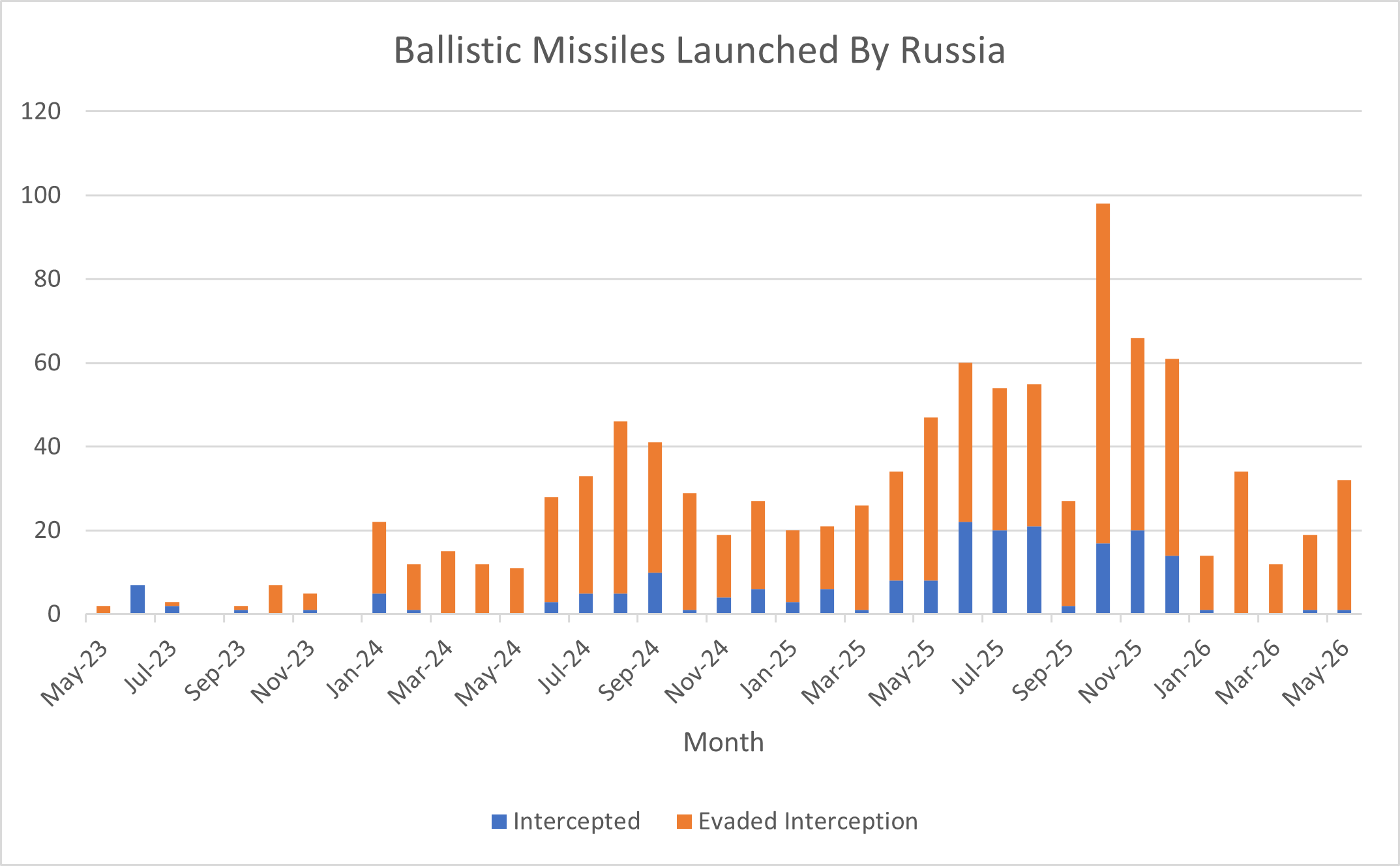
Presently, even though Ukraine appears to have regained an edge over Russia in use of medium-range drones—seriously hindering land transportation to Crimea and causing fuel shortages across Russia in June 2026—Russia still dominates in key categories of aerial military vehicles other than drones, with some of these vehicles able to carry greater payloads over longer distances. These include hundreds of operational ICBMS and SLBMs which Ukraine doesn’t have,19 and converting them into conventional payloads is not a mission impossible if push comes to shove. Russia also has thousands of conventional (and/or dual-use) land-launched, sea-launched and air-launched medium and short-range ballistic and cruise missiles, such as Iskanders and Kalibrs. In contrast, Ukraine has run out of Tochka short-range ballistic missiles and it is yet to scale production of indigenous cruise missiles, such as Flamingo, or to complete development of indigenous ballistic missiles. As importantly, Ukraine lacks means, such as U.S.-made Patriot interceptors, to shoot down Russian ballistic missiles as Figure 320 below demonstrates.21 Finally, Russia outnumbers Ukraine in warplanes designed to carry missiles (including MiG-31-launched Kinzhals), cruise missiles (such as Kh-69), and gliding bombs (such as UMPB-53),22 although Ukraine’s 4th generation U.S.-made F-16 warplanes are generally thought to be more capable than some of the early 4th generation Russian fighters, such as MiG-29 and Su-27.
All this compels me to conclude that, per the definition of the turning point, the Russia-Ukraine air war (use of airborne platforms and munitions) does not appear to have shifted “the overall direction or balance” of the war, or marked “the beginning of a decisive new phase” that favors Ukraine.
Figure 3: Ballistic missiles launched by Russia against Ukraine.23
Armed struggle on the seas: Kto Kogo?
When it comes to sea warfare, Ukraine can be credited with transforming the naval component of its war against Russia through asymmetric warfare rather than by trying (unrealistically) to rebuild and field a conventional fleet. The key component of this transformation has been Ukraine's effective use of unmanned surface vessels (USVs) and aerial drones against Russia’s Black Sea Fleet (BSF), in addition to the use of traditional anti-ship missiles. Ukrainian USVs, such as the Magura, damaged or sank numerous Russian vessels, including those moored in Crimea’s inlets and bays, eventually forcing much of BSF to relocate from Crimea’s Sevastopol to safer havens in the Novorossiysk area.
However, this transformation occurred prior to 202624 and its success does not amount to maritime dominance. Russia retains overwhelming conventional naval superiority, including submarines and hundreds of surface ships, some of which are armed with Kalibr cruise missiles. The Russian Navy continues to use these and other missiles against Ukraine. Ukraine has achieved greater sea denial in the Black Sea, putting BSF on the backfoot, but it is nowhere close to achieving dominance in this sea. Consequently, while Ukraine's innovative drone campaign has imposed significant operational costs on Russia, it has done so without fundamentally altering the overall strategic balance or marking a decisive new phase in the war, failing short of the definition of the turning point outlined above.
Other Factors
Casualties in all domains: When it comes to personnel losses incurred from fighting, Russian military ranks have bled significantly more than the Ukrainian ranks, according to most estimates of casualties reviewed by Russia Matters in its weekly Russia-Ukraine war card.25 Russia has suffered a total of about 1,000,000 Russian military casualties (killed and wounded), according to a 2026 estimate that a highly-informed former high-ranking Western official shared with the authors of RM’s war card. In comparison, there have been 250,000–300,000 Ukrainian military casualties (killed and wounded), according to this official.
Ukrainian and Western experts have continually claimed that Russia cannot call up enough new soldiers to compensate for the casualties, with the first of such claims made as early as in the first year of the war. Claims that Russia is running out of soldiers continue to be made not only by Ukrainian and Western experts, but also by opposition-minded Russian military experts.26,27 Not everyone has agreed with their claims, however. For instance, Maj. Haydock and Maj. Meeker of the U.S. Army National Guard wrote last year: “Russia’s approach to reconstitution has generally been effective at refilling its army with personnel… Despite hundreds of thousands of casualties, the Russian Army is now recruiting thirty thousand soldiers a month and actually growing.” Also last year, former Supreme Allied Commander Europe Christopher Cavoli testified that “Russia is not just reconstituting service members but is also replacing combat vehicles and munitions at an unprecedented pace.” More recently, in April 2026, opposition-minded Russian newspaper Novaya Gazeta Europe published an opinion by Bettina Renz and Charlie Walker concluding that “despite its massive casualties in Ukraine, Russia is unlikely to run out of soldiers anytime soon.”
For an armed force to establish firm control over territory, it requires presence of its personnel in that territory. Had Russia’s armed forces failed to replenish their ranks, they would not have been able to conquer territory every single month since fall 2023, as measured by DS (Figure 1). At the same time, Ukraine continues to field enough personnel, supported by large numbers of drones, to keep Russian armed forces’ advances slow, preventing them from maturing into true operational breakthroughs.
Given all this, I conclude that in terms of this study’s definition of the turning point, Russia’s personnel shortages are not insignificant, but they do not appear to have so far shifted overall direction or balance of the war in a way that would mark “the beginning of a decisive new phase.”
Russian economy suffering, but not imploding:28 There is no doubt that, economically, Russia has come under growing strain in the course of this war. While defense and security spending has expanded dramatically in Russia,29 fueling growth of the defense sector of the economy, it has done so at the expense of civilian investment. Moreover, both defense and civilian sectors of the Russian economy continue to suffer from Western sanctions as well as from shortage of workers.30 Ukraine's increasingly successful medium-range and long-range drone campaign has added another source of pressure on the energy-dependent Russian economy by repeatedly striking Russian oil refineries and fuel infrastructure.31 After cumulative real GDP growth of roughly 8% between 2022 and 2025, that growth in Russia decelerated to about 1% in 2025, with official and IMF forecasts placing 2026 growth at roughly 0.4–1.1%.Yet while these factors lead to underperforming of the Russian economy, the situation should not be mistaken for economic collapse. As editorial staff of The Economist, which has no love lost for Putin’s Russia, wrote on June 22, 2026: “Russia’s war economy has problems—but is not about to crash.”
Fiscal indicators likewise suggest strain without insolvency. Russia recorded a federal budget deficit of approximately 2.6% of GDP in 2025, while the deficit during the first five months of 2026 also stood at roughly 2.6% of GDP, to a large extent due to elevated military expenditures. However, while these deficits exceed the Russian government’s initial targets, they remain moderate by international standards. For instance, the U.S. Congressional Budget Office projects the U.S. federal deficit at about 5.8% of GDP in fiscal year 2026, while France's general government deficit exceeded 5% of GDP in 2025. In addition, Russia's general government debt also remains relatively low, around one-fifth of GDP, according to IMF estimates.
Russia’s performance against the world’s main reserve currency likewise does not suggest imminent collapse. In fact, the ruble appreciated substantially against the U.S. dollar during the first half of 2026, becoming the world's strongest-performing major currency in that period, according to Bloomberg. That strength, however, also reduces export competitiveness and depresses ruble-denominated energy revenues. Meanwhile, the Central Bank has maintained exceptionally high interest rates to contain inflation, underscoring policymakers' lingering concern about overheating and persistent price pressures rather than systemic financial breakdown.
None of this implies that Russia's economy is healthy. On the contrary, it is becoming increasingly militarized and increasingly dependent on defense spending, and it remains vulnerable to Western sanctions, labor shortages, and Ukrainian attacks on critical energy infrastructure. Nevertheless, these developments do not appear to satisfy the aforementioned criteria for serving as an economic component of a wartime turning point.
Internal support for regime and its war persists: Putin’s popularity among his compatriots has been declining this year, but, still, a total of as many as 79% of Russians questioned by the independent Levada Center approved of Vladimir Putin’s performance as president in May 2026, with only 15% disapproving. As important, in Levada’s May 20–28, 2026, survey, 74% supported Russian military actions in Ukraine. The same poll also showed that 60% of Russians favored moving to peace talks and only 30% wanted to continue fighting. One, of course, should keep in mind that the devil is in details when it comes to Russians’ support for peace. For instance, a Levada Center poll, conducted on Feb. 18-25, 2026, and released on March 3, 2026, showed that while many Russians supported peace talks, they wanted these talks to succeed in accommodating their vision of peace, which was mostly irreconcilable with the vision that Ukrainians have. For instance, a nationwide telephone survey of 1,600 respondents conducted in Russia by Russian Field from Feb. 5–14, 2026, found that majorities named as “mandatory” terms for a peace deal the recognition of Donbas as Russian territory (75%), Ukraine’s refusal to join NATO (71%), and lifting sanctions (70%). In contrast, a mid-January 2026 poll of Ukrainians by Kyiv International Institute of Sociology showed 57% of Ukrainians categorically reject the withdrawal of Ukrainian troops from Donbas even in exchange for security guarantees from the U.S. and Europe.
Even allowing for authoritarian-context bias, the figures cited in this section highlight Putin’s firm grip on domestic politics and execution of the war. And, there is no new Yevgeny Prigozhin in sight to serve as a domestic politics component of a wartime turning point.
External semi-isolation is shrinking: This year has seen Russia’s external position continue to shift from partial isolation, mostly enforced by the West, toward a looser, more fragmented environment. Despite expansion of Western sanctions after the beginning of Russia’s full-fledged invasion of Ukraine on February 22, 2022, Russia has preserved ties with China, India, and many other states in the Global South, limiting the impact of pressure by the EU, UK and U.S. Moreover, post-invasion UN voting patterns show that, although large majorities condemned Russia’s invasion, roughly a third of member states regularly abstained or opposed key resolutions, underscoring the limits of a global anti-Russian coalition. In addition, with Donald Trump back in the White House, U.S. policy has moved from isolating to engaging Moscow, as exemplified by the 2025 Alaska summit. European leaders are now divided on whether to continue trying to maximally isolate Russia. Some, like leaders of France and Germany, support renewed dialogue with Moscow, while others, especially in Eastern Europe and the UK, resist. In terms of this study’s definition of turning point, these external developments do not appear to have “shifted overall direction or balance” of the struggle between Russia and Ukraine (with its Western allies) that would “mark the beginning of a decisive new phase.”
Conclusion
Even if this were a turning point, it may be too soon to tell: Based on the evidence presented above, the Russia–Ukraine war does not appear to have reached a turning point in Ukraine's favor.
While Ukraine has achieved important successes—including slowing Russia's territorial gains, expanding its long-range drone campaign, and imposing increasing costs on Russia's economy—these developments have not produced a decisive, durable shift in the overall direction or balance of the war of the kind we arguably saw during the battle for Kyiv in Spring 2022.32
Moreover, even if recent developments had appeared to satisfy much of the turning point definition, it would still be premature to conclude that the war has entered a new phase. History too suggests that genuine turning points tend (though not always)33 to be recognized in retrospect. For instance, in a May 17, 1944 message to Joseph Stalin Franklin D. Roosevelt described the 1942–1943 Battle of Stalingrad as “the turning point in the war of the Allied Nations against the forces of aggression,” doing so more than one year after the end of that battle. More recently, General Kurt Zeitzler, who served as chief of the German Army General Staff September 1942–June 1944, reportedly gave his (unpublished) post-war account of the Battle of Stalingrad the subtitle “Der Wendepunkt des Krieges” (“The Turning Point of the War’).34
That the turning point of a war tends to be recognized in retrospect is something that some prominent participants in contemporary geopolitical struggles, such as Dmytro Kuleba, former Ukrainian foreign minister and Belfer Center senior fellow, have acknowledged as well. When asked by a NV Radio interviewer to comment on that “people say Ukraine is winning... the war has reached a turning point,” Kuleba said: “Claims that Ukraine has achieved a decisive turning point and is now heading straight toward victory are largely nonsense… Did Marshal Zhukov walk into Stalin's office after Stalingrad and announce: ‘Comrade Stalin, we've reached the turning point of the war’? Did Field Marshal [Erich von] Manstein call Hitler and say: ‘By the way, a turning point has occurred. Berlin will fall in two years’? Of course not. That's nonsense. Turning points are identified retrospectively.” “First, in November we'll probably return to discussing how to survive another winter. Second, no turning point in any war has ever been recognized in real time,” Kuleba said. I think he has a point.
Research on this evolving draft was completed on June 28, 2026. Substantive comments are welcome through July 10, 2026.
Footnotes
- In addition, Mike Martin contended in The Telegraph on June 8, 2026, that “Ukraine is turning the tide against Putin” and Jack Watling suggested in Foreign Affairs on June 1, 2026, that “Ukraine Turns the Tide: Why a Cease-Fire Is Now a Real Possibility.” On the same day, Fareed Zakaria argued in the Washington Post that “Ukraine could be a big win for Trump,” while Seth Stodder wrote in Foreign Policy “How Ukraine Has Turned the Tide.” Michael C, Horowitz, Erin D, Dumbacher, and Lauren Kahn argued in a June 13, 2026, Council on Foreign Relations article “How Ukraine’s Drone Innovation Reversed Russia’s Momentum,” and Liana Fix echoed this theme in her June 17, 2026, podcast, “Ukraine Turns the Tide. Reflecting this broader reassessment, European Commission President Ursula von der Leyen said on June 19, 2026, according to The New York Times, that “the tide is clearly turning for Ukraine” while Lithuanian President Gitanas Nausėda said, also according to The New York Times, that “What is happening right now in Moscow is a game changer in this war.” On June 25, 2026 Sergei Guriev wrote in Project Syndicate that “the tide is turning against Russia.”
- According to the English-language translation of his “On War,” Clausewitz (who coined the “culminating point” in this volume) wrote that “If we look at the exhaustion of forces, the defender is under a disadvantage. The assailant becomes weaker, but only in the sense that it may reach a turning point; if we set aside that supposition, the weakening goes on certainly more rapidly on the defensive side than on that of the assailant: for in the first place, he is the weaker, and, therefore, if the losses on both sides are equal, he loses more actually than the other; in the next place, he is deprived generally of a portion of territory and of his resources.”
- This figure was produced for the June 16, 2026 RM’s Russia-Ukraine war report card by RM’s managing editor Angelina Flood.
- This figure was produced for the June 16, 2026 RM’s Russia-Ukraine war report card by RM’s managing editor Angelina Flood.
- Russia and Ukraine had more than 12,000 armored vehicles, including tanks, and 5,727 armored vehicles, including tanks, as of last year, according to IISS’ Military Balance 2026. Given all this, Russia should have been left with 11,783 tanks and armored vehicles as of June 2026 compared to Ukraine’s 5,316 tanks and armored vehicles.
- Statistics on war equipment losses maintained by Oryx (but not regularly updated) show that as of early June, Russia had lost 380 aircraft. In comparison, Ukraine lost 200 aircraft. Most of these losses occurred prior to 2026, so could not constitute a recent trend.
- Looking at drones is particularly important, given that the UAVs account for 70% of all combatant casualties on both sides or more.
- All figures in tables providing estimates of drone numbers give the highest end of the range of estimates, with alternative estimates, if any, provided in the footnotes.
- I.V. Frolov provided an alternative estimate of 100-200 drones. (Wsem.ru, 11.14.23)
- Marcin Frąckiewicz writes that the more than 1,750 drones include 50 Bayraktar TB2s, 700 Switchblades, 300 Phoenix Ghosts, and 15 Primoco drones. (Tech Space 2.0, 05.29.25)
- Alexey Strelnikov puts the overall number of drones imported by Russia in 2022 at 20,000, according to comments made by Russian Deputy Prime Minister Andrei Belousov. (DW, 05.02.24) This figure includes 3,600 Iranian-made Shaheds, according to Military Watch Magazine. (RG.ru, 06.30.25)
- Bogdan Kuhanovich offers an alternative estimate of 300,000 drones. (Reformation, 10.13.24)
- Business-gazeta.ru offers an alternative estimate of 140,000 drones. (business-gazeta.ru, 09.19.24)
- At least 2,200,000 because 2,200,000 were produced in 2024, according to Zelenskyy. (Forbes, 03.12.25). Alternative estimates include 1,000,000, according to Sebastien Roblin or 1,500,000, according to Andrey Kuzakov. (Inside Unmanned Systems, 10.15.24, Current Time, 09.14.24)
- Alternative estimate provided by Krasnaya Liniya news outlet, based on comments made by Putin: 1,400,000. (Rline.tv, 09.19.24)
- Alternative estimate by Tadviser.ru: 16,400 civilian drones. (Tadviser.ru, 08.15.25)
- 1,000,000 to be imported from 20 NATO countries alone, according to Mark Boris Andrijanič. (Atlantic Council, 07.14.25). Viktor Volokita provides an alternative estimate of 297,000. (Ekonomicheskaya Pravda, 03.20.25). These include 127,800 drones from China, according to UA Wire, and 100,000 (FY2025) from the UK, according to the British government. (UAWire, 04.22.25, UK.gov, 06.04.25).
- 4,000,000, projected by the Ukrainian government, including 2,500,000 tactical drones. (Georgetown Security Studies Review, 05.15.25; Politico, 06.05.25) An alternative forecast for 2025 by researchers at the Center for Eastern Studies: 4,500,000. Alternative forecast for 2025 by “Ukrainian officials and analysts” cited by NPR: 4,000,000.
- In fact, Russia has more than 500 launchers, including ICBMs and SLBMs (and air-launched cruise missiles), assigned to its strategic nuclear arsenal.
- This graph is based on data supplied by CSIS, analyzed and visualized by Quinn Urich, researcher at the Belfer Center, and published in June 10 issue of RM’s war report card.
- In January 2026 the Ukrainians were reportedly almost out of Patriots, according to The Guardian. Ukraine has been promised or supplied around eight Patriot air defense systems as of June 2026, according to Euronews. CSIS estimates the U.S. has used 1,060 to 1,430 Patriotinterceptors during the conflict with Iran, which could take three years to replenish. Thus, expecting a rapid replenishing of Ukraine’s vanishing stock of Patriot interceptors is unrealistic.
- Russia is projected to launch more than 75,000 gliding bombs, which Ukrainians struggle to intercept, this year compared with about 60,000 in 2025, according to a report by a Ukrainian military research institute cited by FT.
- This graph is based on data supplied by CSIS, analyzed and visualized by Quinn Urich, researcher at the Belfer Center, and published in June 10 issue of RM’s war report card.
- Oryx’s data show that that Ukraine lost 42 warships in the war while Russia lost 29 naval vessels with the absolute majority of the losses on both sides occurring prior to this year.
- See The Russia-Ukraine War Report Card, June 24, 2026, for the recent history of such estimates.
- Russian contract recruitment has slumped sharply, with a Moscow source saying 1,708 people were sent to the front in April 2026 and 1,378 in May, about 1,000 fewer per month than in 2025, while nationwide Q4 2025 intake was 1.5 times lower than a year earlier. Researcher Janis Kluge estimates only 800–1,000 contracts a day in Q1 2026, roughly 20% down year-on-year. Units are often at 30–40% strength, prompting huge bonus hikes and talk of new mobilization after October 2026’s Duma elections, according to reporting by Verstka and Vazhnyye Istorii in June 2026.
- Various estimates in 2026 indicate that Russia needs on the order of several hundred thousand new soldiers per year to offset the losses of the existing personnel.
- For RM’s assessment of energy costs of the war, see this product.
- Russia is spending “the equivalent of 7–8% of GDP on the armed forces,” an increase of about “3–4% of GDP from the pre‑war norm,” according to The Economist.
- Official unemployment is extremely low at around 2%.
- Since March 2026, more than two dozen strikes on Russian oil refineries have knocked out some 20% of the country’s refining capacity, analysts estimate, according to Wall Street Journal.
- That battle came closest to meeting the definition of the turning point in the war, producing a decisive end to Vladimir Putin’s dream of a blitzkrieg that would conquer Kyiv and much of the rest of Ukraine. In addition, Ukraine’s fall 2022 counter-offensive, in which significant parts of the Kharkiv, Mykolaiv and Kherson Oblasts were recaptured by Ukraine, comes to mind. This counter-offensive was only partially reversed with the key southeastern city of Kherson remaining under Ukraine’s control to date.
- For instance, speaking on Nov. 10, 1942, Winston Churchill described the outcome of the second Battle of El Alamein as 'This is not the end. It is not even the beginning of the end. But it is perhaps the end of the beginning.” So even Churchill felt the need to hedge his claim by inserting “perhaps” in it.
- That he gave such a subtitle is also reported in “Ostfront 1941/42 Kampfhandlungen im Bereich der Heeres Gruppe Mitte (22.6.41-1.5.42) Notebook 9„Bibliographie / Historiographie / Notizen Miscellaneous“ Research Notes: Dr Craig W.H. Luther, October 2009. The Battle of Stalingrad is also described as “the turning point in the East” in Encyclopedia Britannica.
Analysis edited by Sharon Wilke and Ivan Arreguín-Toft.
Opinions expressed herein are solely those of the author.