
Clarifying Territorial Disputes in Ukraine
In the Trump Administration’s effort to negotiate a sustainable peace/ceasefire in Ukraine, the dispute about territory has proved to be one of two final sticking points. Putin has continued to demand that Ukraine leave the last chunk of Donbas his troops have yet to seize. Zelenskyy has continued to insist that Ukraine would not give up at the negotiating table what its troops have successfully denied Russia on the battlefield.
So: after nearly four years of war in which Ukraine has lost 12 percent of its territory, more than a fifth of its economy, and two thirds of its electrical infrastructure; suffered hundreds of thousands of casualties; and seen about a quarter of its citizens displaced, why the fuss about a piece of land the size of the state of Delaware?
Major news outlets have continued to misreport the issue. For example, again last week the New York Times reported that Ukraine still controls “14 percent or so of the Donbas.” Similarly, Axios repeated the same mistake, referencing “the roughly 14% of the Donbas region which [Ukraine] controls.”
In part, these mistakes reflect a failure to keep up with what has been happening on the ground—where every month Russian troops seize another 175 square miles or so. In part, it reflects confusion about “Donetsk” and “Donbas.”
Donetsk is an oblast (state) of Ukraine roughly the size of Massachusetts (10,238 square miles). As reported in last week’s Russia Matters' Russia-Ukraine War Report Card, Ukraine still controls about a quarter of this oblast (2,250 square miles).
Donetsk and its adjacent oblast of Luhansk (which is fully controlled by Russian troops) are known as the region of “Donbas,” a predominantly Russian-speaking region of Ukraine historically known for its coal mines and heavy industry.
For perspective, see this map from Russia Matters attached. The territory Russian troops have captured is colored pink. This includes essentially all of Luhansk; and 78% of Donetsk. The purple area highlights the 2,250 square miles of Donetsk still held by Ukrainian forces.
Summarized accurately today: 11% of the Donbas region (which is 22% of the oblast of Donetsk) remains under Ukrainian control.
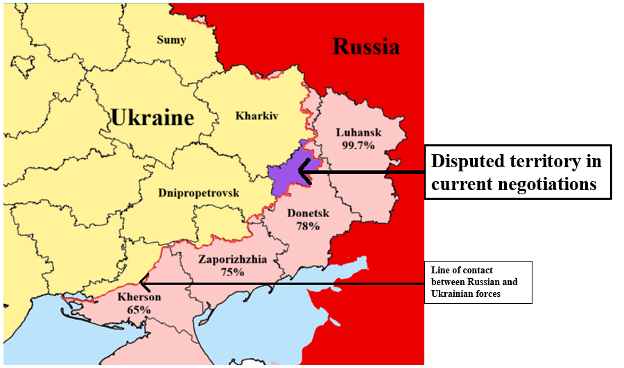
In exchange for these 2,250 square miles, Putin has offered to trade the roughly 500 square miles of Ukraine’s Kharkiv, Sumy, and Dnipropetrovsk oblasts that Russia has also captured.
If Ukraine and Russia are unable to agree on a ceasefire, and the fighting continues as it has for the past year, by this time next year Russian troops will likely have completed their seizure of all of Donbas.
In sum, operationally: Ukraine has already lost 89% of Donbas and will very likely lose the rest next year. Politically: whenever the war ends, Zelenskyy will face an uphill battle in the elections that will follow, in part because no peace/ceasefire agreement will reverse Russian occupation of a substantial part of Ukraine. Strategically: Ukraine’s challenge is to find a way to trade the remainder of Donetsk for stronger security guarantees of whatever peace/ceasefire can be achieved.
This is a version of a thread written by the author for his X account.
Opinions expressed herein are solely those of the author.