
The Russia-Ukraine War Report Card, Dec. 17, 2025
Find past issues in the Russia-Ukraine War Report Card archive.
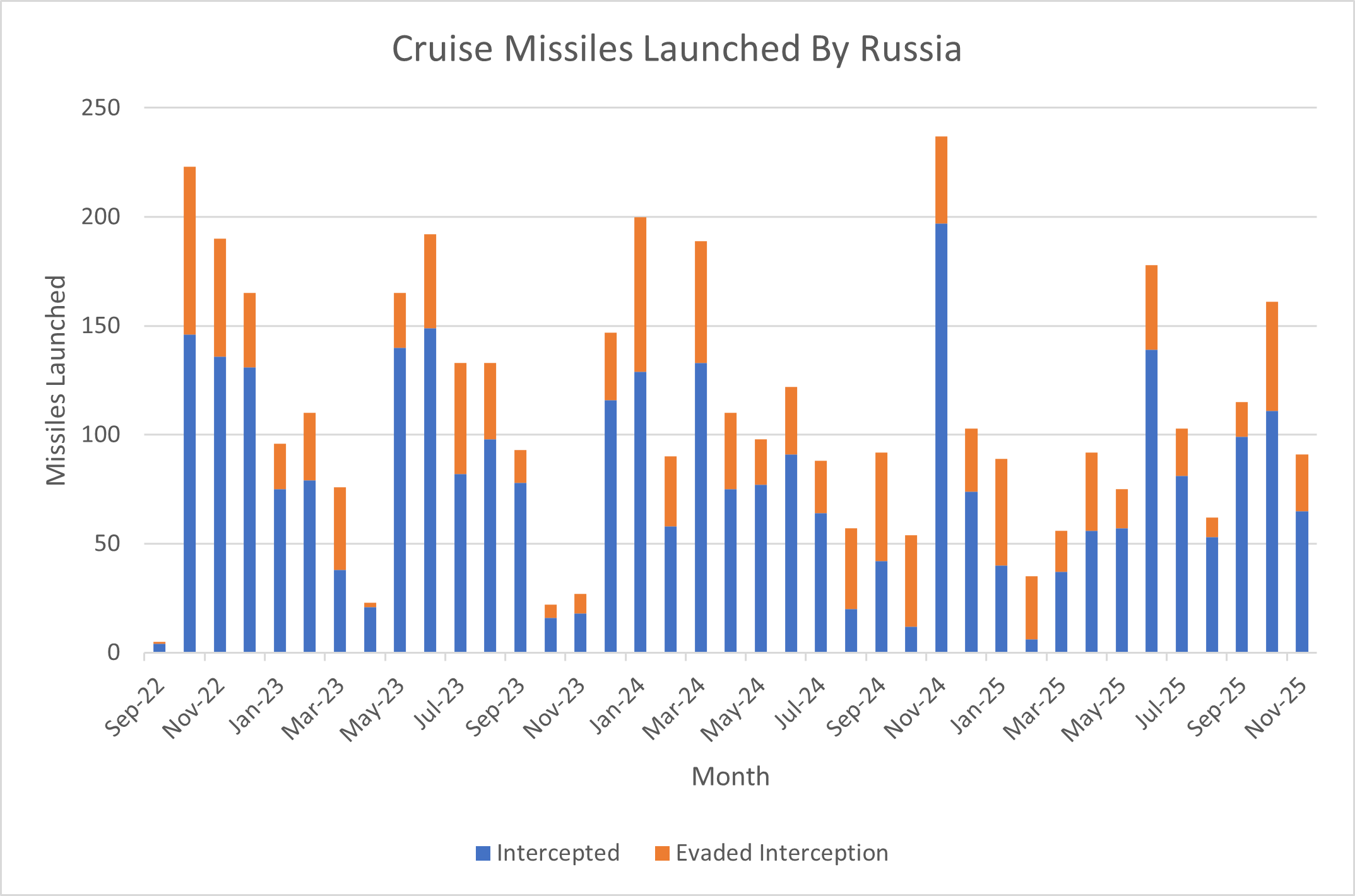
Dec. 16 update: RM’s analysis of ISW data for the past four weeks (Nov. 18–Dec. 16, 2025) indicates that Russian forces gained 215 square miles of Ukrainian territory in that period, an increase over the 169 square miles it gained over the previous four-week period (Oct. 21–Nov. 18, 2025). In the past week, Dec. 9–16, 2025, however, Russia has gained 9 square miles of Ukraine’s territory, a six-fold decrease from the previous week’s reported gain of 55 square miles. Since Jan. 1, 2025, Russia has gained an average of 176 square miles per month. Russia’s latest gain was reported by DeepState on Dec. 17: the settlement of Serebrianka. The Wall Street Journal reported earlier this week that multiple senior Trump administration officials assess that Ukraine is losing the war and would lose if the fighting continued. Meanwhile, the number of drones, ballistic missiles and cruise missiles Russia launched at Ukraine in November all declined somewhat compared to October, according to Quinn Urich’s analysis of CSIS data.
NB: The next issue of the Russia-Ukraine War Report Card will be published on Tuesday, Dec. 23, 2025.
Territorial Control (figures as of Dec. 16, 2025)

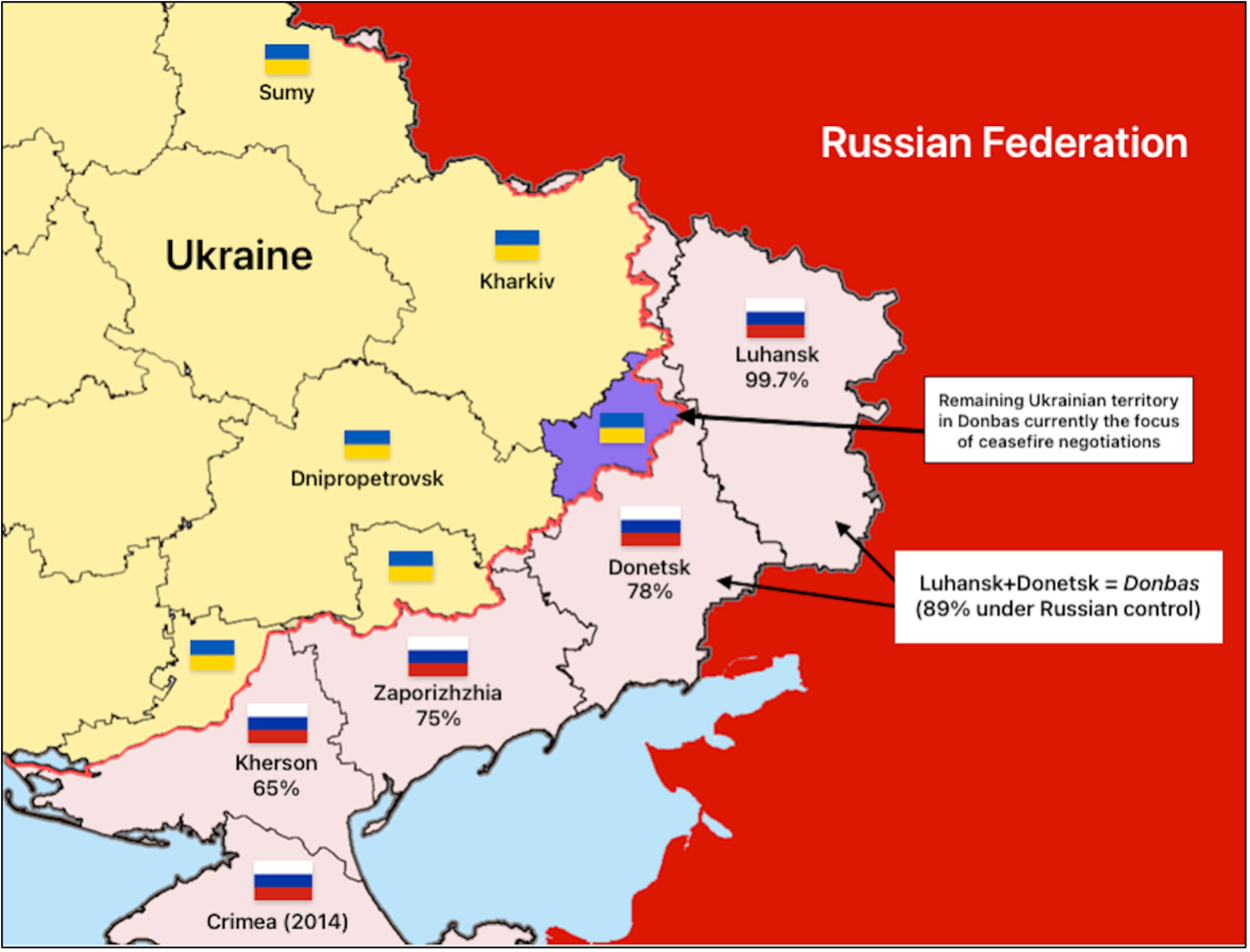
Donetsk: Ukrainian Territory at the Heart of Current Ceasefire Negotiations, as of Dec. 16, 2025
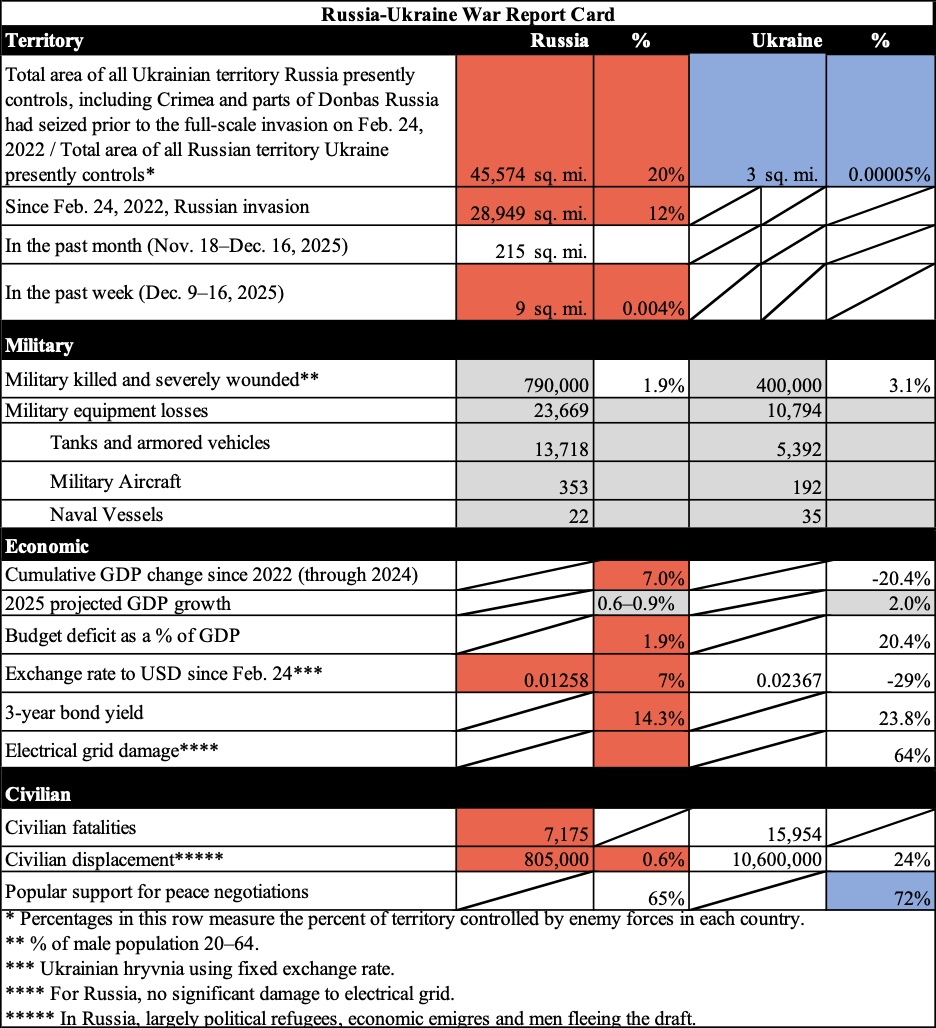
Report Card*
Change in Russia’s control of Ukrainian territory and change in Ukraine’s control of Russian territory
(Based on data from the Institute for the Study of War.)
- Since Feb. 24, 2022:
- Russia: +28,949 square miles. 12% of Ukraine. (Area roughly equivalent to half the size of the U.S. state of Iowa).
- Total area of all Ukrainian territory Russia presently controls, including Crimea and parts of Donbas, Russia had seized prior to the full-scale invasion on Feb. 24, 2022:
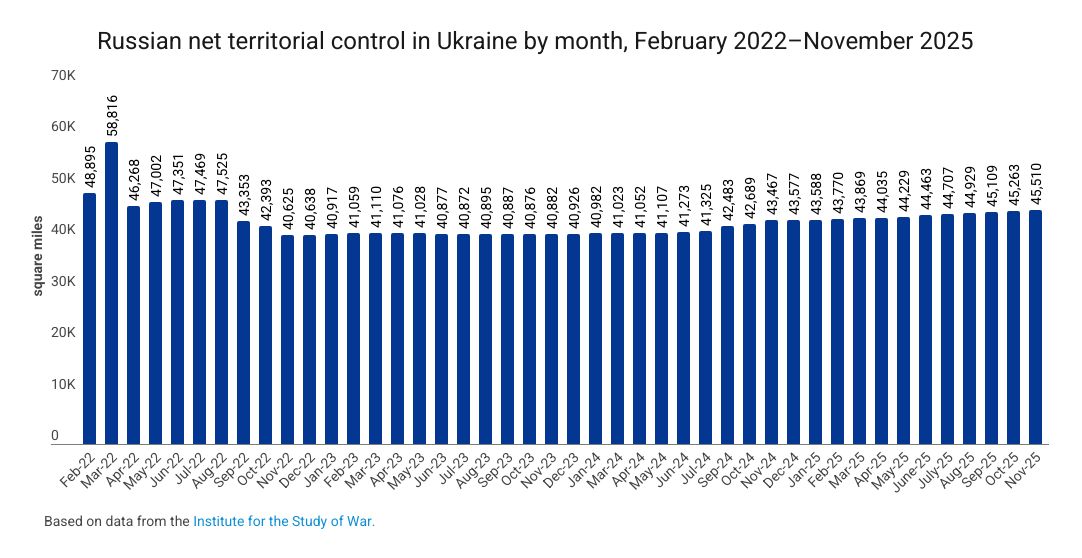
- Russia: +45,574 square miles. About 20% of Ukraine. (Area roughly equivalent to the U.S. state of Pennsylvania.)1
- In the period of Nov. 18–Dec. 16, 2025: Russian forces gained 215 square miles of Ukrainian territory, an increase from the 169 square miles it gained in the previous four-week period of Oct. 21–Nov. 18, 2025. Since Jan. 1, 2025, the average monthly rate of Russian gains has been 176 square miles.
- In past week (Dec. 9–16, 2025): Russia gained 9 square miles of Ukrainian territory (about one third the size of Manhattan island)—a sixfold decrease from the previous week’s (Dec. 2–9, 2025) gain of 55 square miles.
- In Russia, Ukraine’s foothold across the Kursk and Belgorod regions slipped to 3 square miles this week (Dec. 9–16, 2025), down from 4 square miles last week.
Russian net territorial control in Ukraine by month: February 2022–November 2025.(Based on data from the Institute for the Study of War.)
Military casualties (see footnotes for detailed source estimates)
- Russia: More than 790,000 killed or injured, according to an April 2025 estimate by then-SACEUR Cavoli.2 84,568 missing.
- Ukraine: 400,000 killed or injured, according to a December 2024 estimate by Donald Trump.3 35,000 missing.
Civilian fatalities
- Russia: 7,175 killed.
- Ukraine: 15,954 killed, including 13,145 killed in territories controlled by the Ukrainian government and 2,809 killed in Ukrainian territories controlled by Russia.
Military vehicles and equipment4
Russian aerial attacks and Ukrainian interceptions7
In November 2025
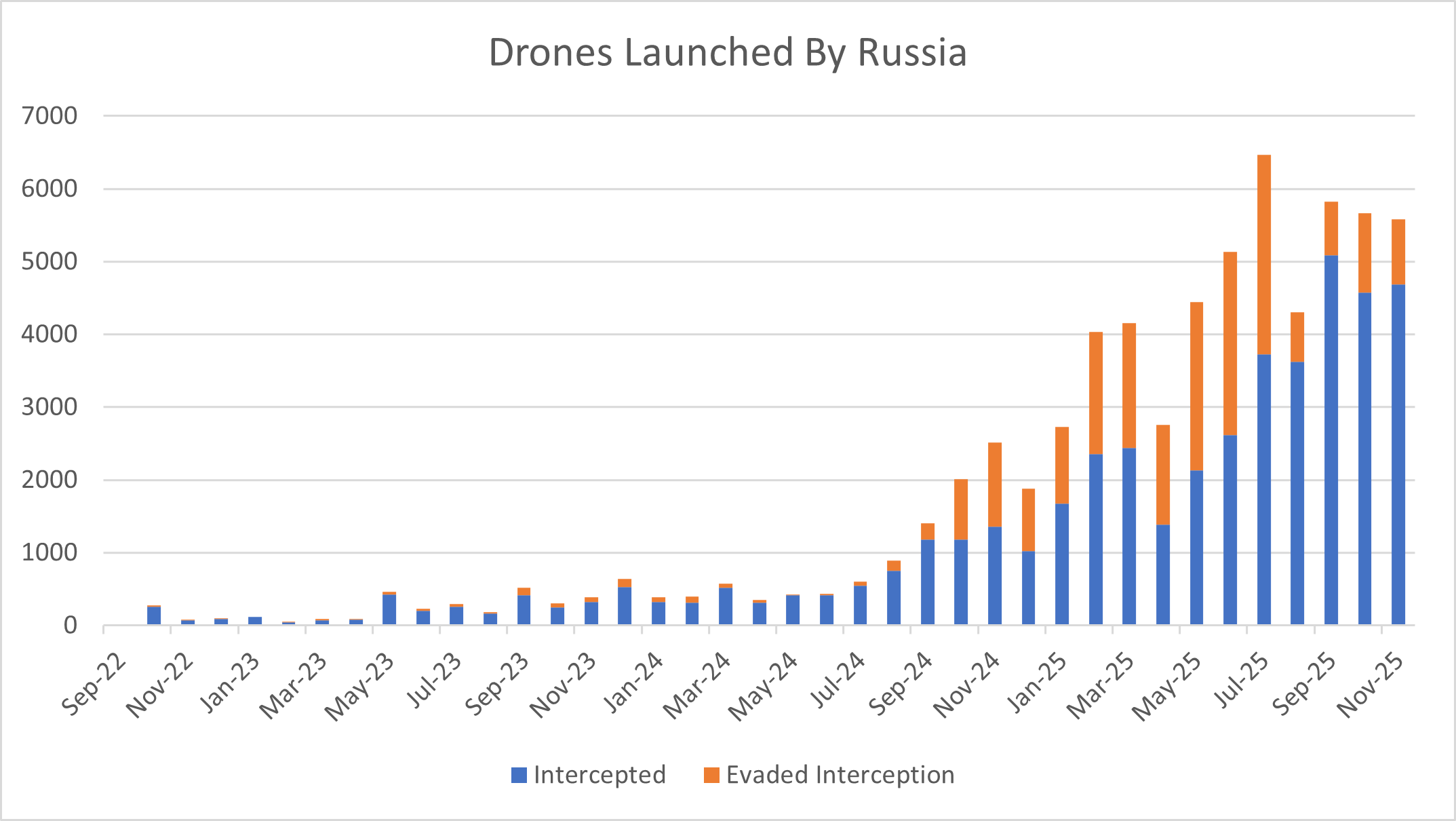
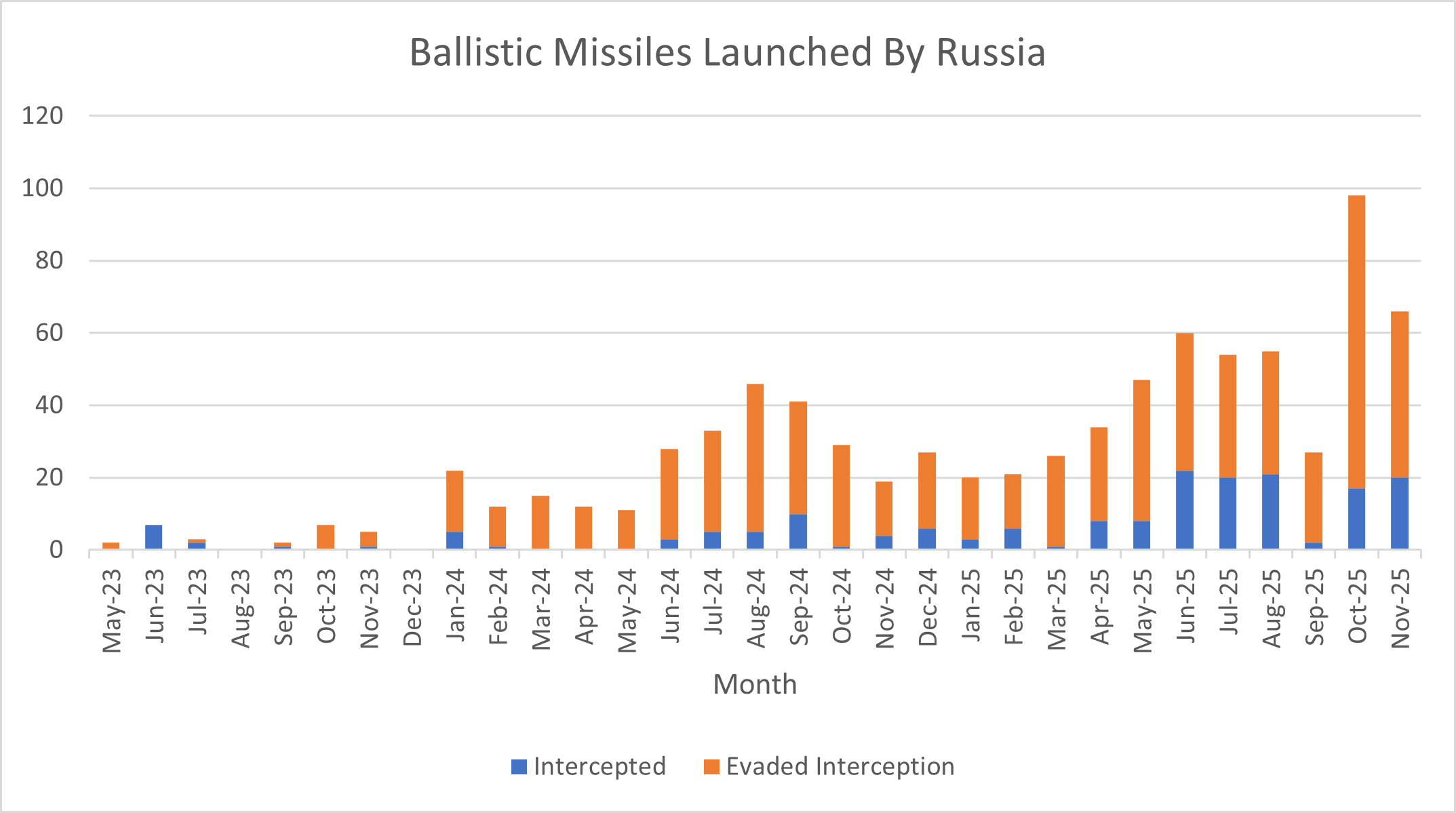
- Russia launched
- 5,585 drones
- 66 ballistic missiles
- 91 cruise missiles
- Ukraine intercepted
- 4,691 drones
- 20 ballistic missiles
- 111 cruise missiles
Since September 2022
- Russia launched:
- 66,826 drones
- 829 ballistic missiles
- 4,298 cruise missiles
- Ukraine intercepted
- 45,959 drones
- 179 ballistic missiles
- 3,043 cruise missiles
Citizens displaced
- Russia:
- Ukraine: 10.6 million displaced Ukrainians, 24% of Ukraine’s pre-invasion population of 44 million, including:
- Internally displaced: 3,700,000.
- International refugees: 6,900,000.
Economic impact8
- Russia’s economic growth: 7% GDP since 2022 (through 2024)
- Ukraine’s economic growth (negative): -20.4% GDP since 2022 (through 2024)
- 2% GDP growth forecast for 2025.
- Budget deficit in 2024: 20.4% of GDP, excluding grants.
- Ukrainian hryvnia: 0.02367 U.S. dollars. -29% since the invasion.
- 3-year bond yield: 23.8%.
Infrastructure
- Russia:
- A journalistic investigation by RFE/RL estimated in March 2025 that Ukrainian strikes on Russia’s energy sector had caused at least 60 billion rubles ($714 million) in damage.
- As of early October 2025, Ukrainian drone strikes were reported to have forced nearly 40% of Russia's oil refining capacity offline, with at least 70% of shutdowns directly linked to these strikes, according to Russian energy market data.
- According to Reuters’ Nov. 13, 2025, estimate, however, Russia's oil processing has actually fallen just 3% this year despite Ukraine's drone attacks.
- Ukraine:
- Some 64%, or 36 out of Ukraine’s 56 GW electricity generating capacity destroyed or occupied as of 2024.9
- Ukraine had lost 80% of its thermal capacity due to Russian attacks as of September 2024.
- Some 90% of Ukraine’s thermal power generation was destroyed as of May 2025.
- Some 50% of all of Ukraine’s hydropower installations were damaged and 40% destroyed as of May 2025.
- Ukraine's energy infrastructure was operating at only about one third of its pre-invasion generation capacity as of Fall 2025.
- In October 2025, Russia was reported to have destroyed 60% of Ukraine’s gas production ahead of winter of 2025-2026.
- Ukraine's overall electricity consumption has fallen by around 30% since the launch of the Russian invasion, according to an October 2025 estimate.
- ISW estimated in December 2025 that Russia’s strike campaign is close to splitting Ukraine’s power grid east–west, with eastern regions “at the brink” of blackout and Kyiv also at risk while Washington Post reported that Russian strikes since October have pushed Ukraine’s grid to the brink, with Kyiv residents facing up to 16 hours a day without power.
Popular support
- Russia: 65% support peace negotiations.
- Ukraine: 72% would approve a peace plan freezing the front lines with security guarantees and without recognizing occupied territories as Russian.
Other criteria which may be even more important (about which we continue to search for reliable indicators):
- Ammunition supply
- Foreign military aid
- Force generation
- Military leadership
- Training
- Morale
- Control of strategic locations
- Information war: with U.S./Europe; with world.
Endnotes
- According to Ukraine's DeepState OSINT group's map, as of Dec. 16, 2025, Russian forces occupied 115,966 square kilometers of Ukrainian land (44,775 square miles), which constituted 19.21% of Ukrainian territory and which is roughly equivalent to the state of Ohio.
- Here are more estimates of Russian servicemen killed and injured [in chronological order]:
- 600,000 killed or injured, according to Trump’s December 2024 estimate.
- Almost 1,000,000 killed, according to Trump’s January 2025 estimate.
- More than 750,000 killed or injured, according to a March 2025 estimate by DNI/U.S. intelligence community.
- 950,000 killed or injured, according to CSIS’s June 2025 estimate, including 250,000 killed and 700,000 injured.
- More than 1,000,000, including 250,000 killed, according to the U.K. Defense Ministry’s June 2025 estimate.
- 219,000 Russian soldiers killed in the Ukraine war, according to Meduza and Mediazona’s August 2025 estimate.
- Some 1 million in casualties, including 240,000 KIAs, according to British spy chief Richard Moore’s September 2025 estimate.
- Some 1,118,000 Russian soldiers killed and wounded, according to the U.K. Ministry of Defense’s October 2025 estimate.
- Here are more estimates of Ukrainian servicemen killed and injured [in chronological order]:
- 400,000 killed or injured, according to Trump’s December 2024 estimate.
- 43,000 Ukrainian soldiers have been killed and 370,000 injured, according to Zelenskyy’s December 2024 estimate.
- 700,000 killed, according to Trump’s January 2025 estimate.
- 100,000 killed, according to Zelensky’s April 2025 estimate.
- 400,000 killed or injured, according to CSIS’s June 2025 estimate, including somewhere between 60,000 and 100,000 killed and 300,000-340,000 injured.
- Oryx, “Attack On Europe: Documenting Equipment Losses During The 2022 Russian Invasion Of Ukraine,” Oryx (blog), https://www.oryxspioenkop.com/2022/02/attack-on-europe-documenting-equipment.html; “The Military Balance 2022,” IISS, https://www.iiss.org/publications/the-military-balance/the-military-balance-2022; Oryx, “List Of Aircraft Losses During The Russian Invasion Of Ukraine,” https://www.oryxspioenkop.com/2022/03/list-of-aircraft-losses-during-2022.html; Oryx, “List Of Naval Losses During The Russian Invasion Of Ukraine,” https://www.oryxspioenkop.com/2022/03/list-of-naval-losses-during-2022.html.
- Oryx is not updating losses of Russian warships as of January 1, 2025. According to a May 2025 estimate by the U.S. Defense Intelligence Agency, since the war’s start, Russia has lost at least 10,000 ground combat vehicles, including more than 3,000 tanks, as well as nearly 250 aircraft and helicopters and more than 10 naval vessels. More recently, Ukraine claimed to have sunk a Russian submarine off Novorossiysk on Dec. 15, 2025, with an underwater drone. Russia denied the claim.
- Oryx is not updating losses of Ukrainian warships as of Jan. 1, 2025. Thus, this number excludes the Ukrainian Navy's reconnaissance ship, Simferopol, which was sunken by a Russian naval drone strike in the Danube River estuary on Aug. 28, 2025.
- Jensen, Benjamin and Yasir Atalan, “Russian Firepower Strike Tracker: Analyzing Missile Attacks in Ukraine,” Center for Strategic and International Studies, December 17, 2024, https://www.csis.org/programs/futures-lab/projects/russian-firepower-strike-tracker-analyzing-missile-attacks-ukraine?f%5B0%5D=content_type%3Aarticle&f%5B1%5D=content_type%3Areport. Note that due to limitations associated with refreshing of attack and intercept data, this section of the scorecard is updated once a month.
- International Monetary Fund, World Bank, and Russian estimates. “Russia and Ukraine 3-Year Bond Yield,” Investing.com, https://www.investing.com/rates-bonds/russia-3-year-bond-yield; World Bank Group, “Europe and Central Asia Economic Update,” https://openknowledge.worldbank.org/server/api/core/bitstreams/94bdc078-9c64-4833-992a-fda7b3d1a640/content; World Bank, “Russian Federation MPO,” https://thedocs.worldbank.org/en/doc/d5f32ef28464d01f195827b7e020a3e8-0500022021/related/mpo-rus.pdf; Trading Economics, “Russia 3-Year Bond Yield,” https://tradingeconomics.com/ruge3y:gov ; World Bank, “The World Bank in Ukraine,” https://www.worldbank.org/en/country/ukraine/overview#3; https://www.exchange-rates.org/exchange-rate-history/rub-usd-2024-11-01. This count does not include the loss of the Ukrainian reconnaissance warship near the mouth of the Danube river where it was attacked by a Russian naval drone on Aug. 28, 2025.
- Combining the occupied, destroyed and damaged power capacities, Ukraine has lost a total of approximately 48% (27 gigawatts) of its pre-war installed capacity of 56.1 GW, according to an alternative estimate in a July 2025 report by CSIS.
* This card was produced by RM staff and Belfer Center Avoiding Great Power War Project’s researcher Quinn Urich.
 Russia-Ukraine War Report Card