In the Thick of It
A blog on the U.S.-Russia relationship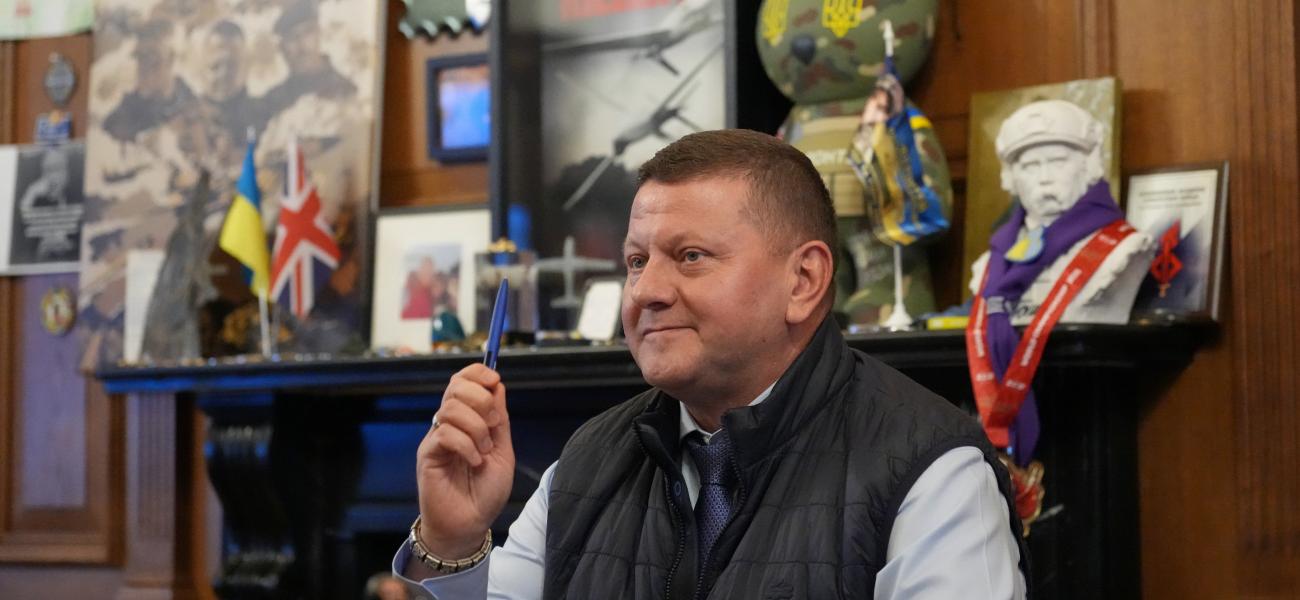
Zaluzhnyi: For Russia and Ukraine, It’s a Question of How to Sell Outcome as Victory
Ukraine’s goals and strategies, the current battlefield situation and how and when the war might end were among the key topics Valerii Zaluzhnyi, former commander-in-chief of Ukraine’s armed forces and current ambassador to the U.K., addressed in his latest extended Q&A. The wide-ranging conversation with students of Serhiy Nyzhny Kyiv School of Government also touched on the state of the world order, conflicts in the Middle East and Western cohesion, amid Russia’s war against Ukraine. Below is our selection of highlights from the hour and a half conversation.
On world order and AI
- “It was already obvious in 2008, when Russia attacked Georgia; it was obvious in 2014, when it first attacked Ukraine; and in 2022, when it launched a full‑scale aggression. Events in Venezuela and events now in the Middle East also show that we can no longer speak of a functioning world order.”
- “Every world order has been built after some large technological revolution. … AI is now the main game‑changer capable of transforming the world order. … Therefore, most likely the new world order will depend on how states and societies pass through this leap of technological revolution.”
On World War III
- “So, not as historians 50 years from now, but as witnesses of what is happening, let each of us answer for themselves: is this already a Third World War, just dispersed around the globe, or is it still a series of wars and conflicts caused by the absence of a world order? It’s a very rhetorical question; you can’t answer it unambiguously. … Around 17 or 18 countries support Russia, but they also are not fighting physically—except for mercenaries, which is not considered classical, regular warfare. So, theoretically, you could write '55 against 17 or 18' and call this a clash of global coalitions, but in practice these coalitions are not united ideologically, not united materially, only partly united financially. We receive financial help from everyone who can, and those who cannot still try to help. Yet these are still not formed wartime coalitions in the classical sense.”
On similarities between the Ukraine and Iran wars
- “[T]he Americans stepped on the same rake in the Middle East—they left the phase of escalation because they realized nobody wanted to play by their escalation rules, no one was reacting. So they turned to military action and suffered catastrophes, just like Russia. The situations are absolutely analogous: the same type of state management. There Russia acted and we did not respond; in the Middle East the U.S. acted, Iran initially did not respond, then gave a worthy answer during the aggression. And now it is a huge problem—it’s no longer escalation, it is war, and stopping it is very, very hard.”
On war aims
- “[D]oes anyone here know of a single official document clearly stating the goal of this war that has been going on for 13 years? … Ukraine does not know what it wants, because this is a sensitive issue.”
On the current battlefield situation
- “To be completely honest—as a practicing surgeon, no more—I would describe it as ‘stably bad.’ Let’s look at the current fighting not as a continuation of 2022 or even 2023. I tell everyone: in December 2023 we should put a period—close the chapter on WWII, the Iraq wars, and that WWII‑style war we had in Ukraine. Now it’s something else. ... On the map the front line looks stable—I see it on my electronic map, for months it barely moves—but inside the ‘stable’ line little enemy dots appear. We hold the front, we see it on paper, but in our rear there are Russian groups reporting to Putin that they’ve captured everything. That’s roughly the picture.”
- “There is some movement but it’s so minor that it’s absurd to cry catastrophe or ‘everything is lost.’ The real catastrophe is that a human being has no business being there now: drones—sometimes AI‑guided, sometimes piloted—fly in and kill people. That’s the first big problem of mobilization. People know there is no protection from drones.”
- “The Russians are, I think, moving faster technologically, scaling up attacks on our logistics and making it impossible for us to mass forces and go on the offensive. Talking now about us ‘recapturing’ something large-scale is naive; it’s practically impossible—unless with machines. Likewise, we hit their logistics so they cannot form a strike fist and be in Dnipro tomorrow.”
- “So it is ‘stably bad’ at the front. The key is that this stable badness not turn into stable despair in society and lead people to say, ‘Maybe they’ll spare us if we stop fighting.’ That would be the worst.”
On victory
- “Today our options are limited. The idea of building our own strength to defeat both Russia and China is unrealistic for now. So realistically we are between: continue fighting while improving conditions; get someone to pressure Russia; or some negotiated settlement.”
- “So victory, for both Russia and Ukraine, is increasingly a question of how to sell the outcome as victory. Someone will gain territory and people and call that ‘victory’; someone will lose almost everything yet still try to sell it as ‘victory’ to their people. That’s the current problem.”
- “I’m a complete realist and know war a bit. It is impossible to predict and set an end date for a war, especially one like Ukraine’s. … [W]ithout a clear goal, without strategy, our actions—losing people and the economy—won’t lead anywhere.”
- “The more we think and plan our future, the sooner we will find an answer as to how much longer we personally need this war, and then build a strategy to end it at that time with that result, so that we don’t have to sell it as victory.”
- “So, how long will the war last? Don’t believe anyone who gives dates. It depends on countless factors. Everything will depend on how much we ourselves want and are able to continue fighting.”
On future Ukrainian-Russian relations
- “It will depend on how this war ends. If it does not end in Russia’s defeat—and most importantly, if we again let ourselves be fooled, as in 1921 or 1991, and believe that our 2,600 km border is a border with sincere friends who mean us no harm—then everything will repeat.”
The interview, conducted in Ukrainian, was transcribed and translated using AI. Opinions expressed herein are solely those of the quoted speaker.
Photo: Valerii Zaluzhnyi, Ukraine's ambassador to the United Kingdom, speaks with The Associated Press in London on Feb. 2, 2026. (AP Photo/Frank Augstein)