Why an Unjust Peace Is Better Than More War in Ukraine
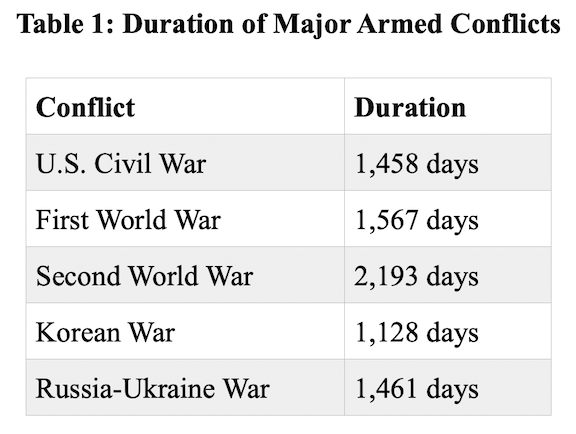
How long will this war go on? As we mark the fourth anniversary of Russia’s invasion of Ukraine, the most deadly war in Europe since World War II enters its 1,461st day (for comparison, see Table 1 below).
As I wrote on the first anniversary of the war: “While the average interstate war lasts less than two years, major Russian and U.S. wars since WWII have lasted over a decade, suggesting that the Russia-Ukraine War could last for many more years.”
Ukrainians have demonstrated remarkable—almost unbelievable—courage and resilience in defeating Putin’s attempt to erase their country from the map.
Tragically, this grisly conflict has left hundreds of thousands of Ukrainian soldiers dead or wounded, millions of civilians suffering under weekly missile barrages, drone attacks, and prolonged electrical blackouts, and Ukraine’s economy shrunken and struggling.
Moreover, as the 2025 DNI National Threat Assessment noted: “The resulting heightened and prolonged political-military tensions between Moscow and Washington, coupled with Russia’s growing confidence in its battlefield superiority and defense industrial base and increased risk of nuclear war, create both urgency and complications for U.S. efforts to bring the war to an acceptable close.”
In a recent piece in Foreign Affairs, my coauthor former JCS Vice-Chairman Sandy Winnefeld and I argue that “Many today believe that a great-power war is inconceivable—failing to recognize that this is not a reflection of what is possible in the world but of the limits of what their minds can conceive.”
With each day this war drags on, more Ukrainian soldiers will die on the frontline and more Ukrainian civilians will suffer in the cold. With each day this war persists, the risk that it could escalate to a great power war continues.
If the current push by the Trump Administration succeeds in bringing an end to the killing and destruction, it will not be the “just peace” that UN Secretary General Guterres and most Western commentators are calling for. It will not restore Ukraine’s territorial integrity by returning the 20% of Ukraine that Russian troops now control. It will not force Putin to pay reparations for the damage he has done.
But if it can succeed in creating credible conditions for a sustainable period without hot war, my bet is that President Zelenskyy will conclude that it is better than fighting on for another year.
This is a version of a thread written by the author for his X account.
Opinions expressed herein are solely those of the author.