In the Thick of It
A blog on the U.S.-Russia relationship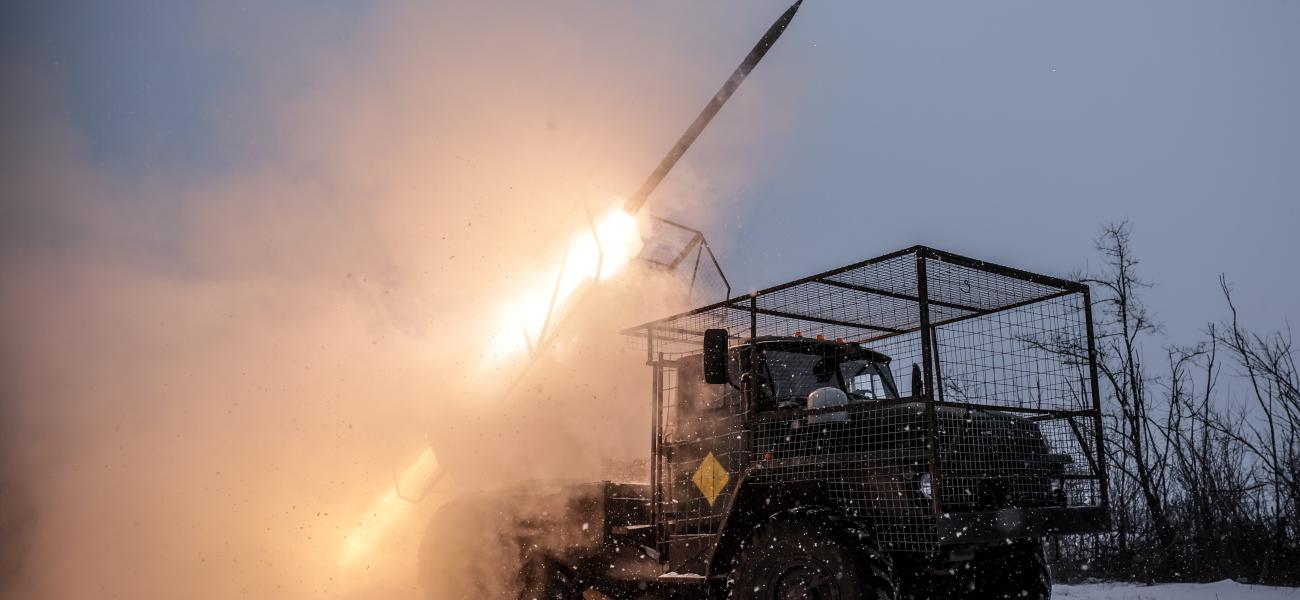
Most Russians Favor Escalation in Ukraine Over Concessions If No Peace Deal
The Levada Center’s latest polling on Ukraine indicates a notable hardening of the Russian public’s attitude toward the war in Ukraine. While the poll indicates support for immediate peace talks remained higher than support for continued fighting, if peace talks fail, the balance could shift toward greater acceptance of escalation, according to the center’s January 2026 poll. At the same time, while confident in Russia’s victory, the majority of Russians believe the war will last another six months or more, according to the poll. Together, these trends point to possible further normalization of a long war and reduced public appetite for compromise in Russia.
Support for Peace Talks Falls, But Still Greater Than Support for War
Levada released to RM a detailed dataset on the national poll conducted Jan. 15–23, prior to completion of the most recent round of talks between Russia and Ukraine with U.S. mediation on Jan. 23–24 in Abu Dabi.1 This data shows that the share of Russians who believe their country should continue military operations rather than pursue peace negotiations with Ukraine rose by as much as 25% (6 percentage points), increasing from 25% in December to 31% in January. Over the same period, the share of respondents who favor starting peace negotiations instead of continuing military operations declined by 9% (5.4 percentage points), from 66.4% in December to 61% in January.2 It is worth noting that this decline in support of peace talks in January comes after a record level of support among Levada’s respondents in December. That month saw the largest share of respondents in favor of peace negations (66.4%) and the lowest share (25%) in favor of continued military operations since Levada began polling on this question in September 2022.3 In comparison, in 2025, the average share of Levada’s respondents in favor of peace was at 62.6%, while an average of 28.9% of respondents favored continued military action in 2025.4
If Peace Talks Fail, More Russians Would Favor Escalating War Over Making Concessions
Interestingly, perhaps, for the first time since the start of the conflict, the Levada Center asked its respondents how Russia should act if achieving peace is not yet possible: Should it make additional concessions or intensify attacks? In response, 5% said Russia should definitely make additional concessions and 16% said it should probably do so, while 28% favored probably increasing attacks and 31% favored definitely increasing them; 20% were unable to answer. Overall, a clear plurality favors escalation in such a scenario: 59% believe failure to achieve peace should be met with greater use of force, compared with 21% who advocate concessions.
Also interestingly, a poll conducted by the Kyiv International Institute of Sociology (KIIS) during the period of Jan. 9-14, 2026, in Ukraine, shows 54% of respondents categorically reject concessions to Russia such as the transfer of all of Donbas to Russian control, even if it is done in exchange for security guarantees from the U.S. and Europe.
More Than Two-Thirds of Russians Believe Russia Will Win
As importantly, nearly three‑quarters of Levada’s respondents (74%) believed in January 2026 that the war would end with a Russian victory, which constitutes a slight decrease from two years ago, when 77% believed in Russian victory (the highest share since Levada began asking this question in April 2022). No respondents of the January poll expected a Ukrainian victory—unchanged from January 2024 and the smallest share since polling began in April 2022—while 17% thought neither side would be able to prevail. On average,74.1% of respondents have said they expect a Russian victory since Levada began polling on this question in April 2022. Since then, the lowest share who believed neither side would win, 14%, occurred in January 2024, while a year before that, January 2023, saw the highest share, 17.1%, expressing this view. On average, 15.6% of respondents have said they see neither side winning. January 2023 also saw the largest share, 1.3%, say they believed the war would end in a Ukrainian victory, with an average of 0.7% of respondents expressing this view since April 2022. In contrast, the poll conducted in Ukraine by KIIS revealed 77% of respondents believe that “although Russia is advancing on the front, it is slowly and with heavy losses, and Ukraine is able to continue its resistance, but 12% consider Ukraine’s resistance to be hopeless.”
More Than One-Third of Russians Expect War to Last More Than a Year
In addition, for the 14th time since the start of Russia’s full-scale invasion in February 2022, Levada asked respondents, “How long do you think the hostilities in Ukraine will last?” In January 2026, 1% said the fighting would last no more than another month (unchanged from August 2025). Another 1% (down from 3% in August) expected it to last another one to two months, 8% expected it to last two to six months (down from 12% in August) and 22% (up from 20% in August) expected it to last another six months to a year. The share expecting the war to continue for more than a year remained unchanged at 39% in August–January. Overall, respondents who believe the conflict will last more than another year constituted the largest group.
Fewer Russians Closely Following War Even as Support for Russian Military Rises
In the meantime, the share of Russians who follow the conflict decreased slightly from 82.1% in December to 81.4% in January, according to Levada. As for the share of Russians who personally support the actions of the Russian armed forces in Ukraine, it increased from 72.5% in December to 75.8% in January, constituting an increase of 4.6% (3.3 percentage points). Since Levada began polling on this question in February 2022, at the full-scale invasion’s onset, an average of 75.5% of respondents have voiced support for the Russian armed forces’ actions in Ukraine, while an average of 17.1% have expressed a lack of support. In 2025, an average of 76.7% of respondents expressed support, while an average of 15.1% said they did not support the armed forces’ actions in Ukraine. The lowest share of support was in February 2022, at 68%, while the highest level of support, 81% was expressed the very next month, March 2022. February 2022 also saw the largest share, 23%, say they did not support the actions of the Russian armed forces in Ukraine, with the smallest share, 13%, expressing this view in May 2025.
Taken together, the latest Levada data suggests that significant parts of the Russian public could support escalation vis-à-vis Ukraine if peace remains out of reach. While a majority still favors negotiations over immediate military continuation, growing support for more force, and a slight rise in support of the armed forces. Taken together, they indicate a possible hardening of Russians’ attitudes toward the conflict.5
Endnotes
- The talks in Abu Dabi are to resume on Feb. 1. If the talks generate outcomes that Russia can benefit from without using force, this could increase preference for peace in Russia.
- A poll conducted by the Kyiv International Institute of Sociology (KIIS) during the period of Jan. 9–14, 2026, in Ukraine shows 69% of Ukrainians do not believe that the current negotiations will lead to a lasting peace.
- The highest percentage in favor of military operations, nearly half of respondents at 48%, occurred in May 2023, and was the only time more respondents favored military operations over peace (45% in favor of peace negotiations).
- On average since polling began, 55.6% of respondents have been in favor of peace negotiations, while an average of 36% have been in favor of continued military action.
- One should also not forget that Russia’s slide toward a hard authoritarianism has led to the criminalization of freedom of speech on issues related to the war, among other things. This cannot help influencing what a Russian living in Russia says to others, including pollsters.
Simon Saradzhyan is the founding director of Russia Matters. Angelina Flood is the managing editor of Russia Matters. Opinions expressed herein are solely those of the authors.
Photo: In this photo provided by Ukraine's 24th Mechanized Brigade press service, declared to be taken on Jan. 24, 2026, an MRLS BM-21 "Grad" fires towards Russian army positions near Chasiv Yar, Donetsk region, Ukraine. (Oleg Petrasiuk/Ukraine's 24th Mechanized Brigade via AP)