How to Understand Donald Trump’s Nuclear Testing Remarks
November 07, 2025
This is a summary of an article originally published by The National Interest.
The author, the Douglas Dillon Professor of Government at Harvard University, writes:
- Graham Allison wrote, “Last week, President Trump announced that “because of other countries[’] testing programs,” he had “instructed the Department of War to begin testing our nuclear weapons on an equal basis.’ In the days that followed, headlines shouted: ‘mushroom clouds on the horizon,’ ‘Trump doubles down on Nuclear Tests,’ and ‘U.S. nuclear weapons tests can forever scar a nation.’ Amid the hype, many in the media struggled to decipher what the president could have in mind.”
- “Critics make a living taking his words and imagining the worst. However, when interpreting President Trump’s statements, one should begin with Peter Thiel’s insight. As Thiel put it way back in 2016: ‘…the media is always taking Trump literally. It never takes him seriously, but it always takes him literally… I think a lot of voters who vote for Trump take Trump seriously but not literally.’ Trump speaks in hyperbole—his unique combination of fact, fiction, and fantasy,” according to Allison.
- Allison asks, “So, how should we understand Trump’s recent threat to resume nuclear testing? How seriously should we take press claims that the United States is on the verge of exploding nuclear weapons—something that has not been done since 1992 and would violate the Comprehensive Nuclear Test Ban Treaty that it championed, which has constrained Russia, China, and others from detonating nuclear weapons? My answer is: not much.”
- “Informed observers know that there are many ways countries ‘test nuclear weapons’ to ensure that they have a credible deterrent. Test launches of missiles, like the one the United States carried out at Vandenberg Space Force Base in California this week, ensure that our delivery systems remain reliable, ready, and accurate. As part of our Stockpile Stewardship Program, the Department of Energy’s National Nuclear Security Administration (NNSA) carries out tests, experiments, and simulations weekly to ensure our nuclear warheads work as intended should they be needed. Furthermore, tests go far beyond our missiles and warheads. The United States also regularly tests its nuclear command and control systems. For example, last April, when the Air Force carried out a test of its airborne nuclear command and control system, it ensured that the United States has a reliable second-strike capability.”
- “Unlike the alarmists who have been the loudest voices touting President Trump’s tweet, when asked about this issue, the professionals in charge of managing our nuclear weapons have been reassuring. At his confirmation hearing last week, President Trump’s nominee to become the future STRATCOM commander—the individual responsible for America’s nuclear arsenal—was asked about the safety, security, and reliability of our nuclear arsenal. Vice Admiral Richard Correll, who is currently the Deputy STRATCOM commander, responded crisply: ‘I have absolute confidence that those systems will perform wherever we need them to perform.’ Similarly, when asked about the possibility of resuming nuclear testing last Sunday, President Trump’s Secretary of Energy Chris Wright asserted, ‘the tests we’re talking about right now are system tests. These are not nuclear explosions.’”
- “President Trump’s comment has excited interest in some parts of the U.S. government and expert community about the possibility that he could authorize ‘super-critical tests.’ The official position of former administrations has been that these are prohibited by the Comprehensive Test Ban Treaty. However, because the terms of the treaty are somewhat ambiguous on this point, Russia and China have both interpreted it in a manner that has allowed them to conduct super-critical tests—and they have done so,” Allison notes. “This may have been what President Trump was referring to in an interview with 60 Minutes last week, when he said, ‘They test way underground where people don’t know exactly what’s happening with the test. You feel a little bit of vibration. They test and we don’t test.’ Advocates of nuclear testing argue that engaging in equivalent tests could provide new, valuable information on the effectiveness of the U.S. arsenal,” Allison explains.
- “Despite his often imprecise rhetoric, Trump has a better understanding of nuclear perils than any other political leader on the national or international stage today. As he has frequently asserted, he really believes that ‘nuclear weapons are the biggest problem we have.’ With this in mind, my advice is: when listening to the president talk about nuclear issues, and even more when reading shrill claims about his words in the press, take Trump seriously—but not literally.”
Read the full article at The National Interest.
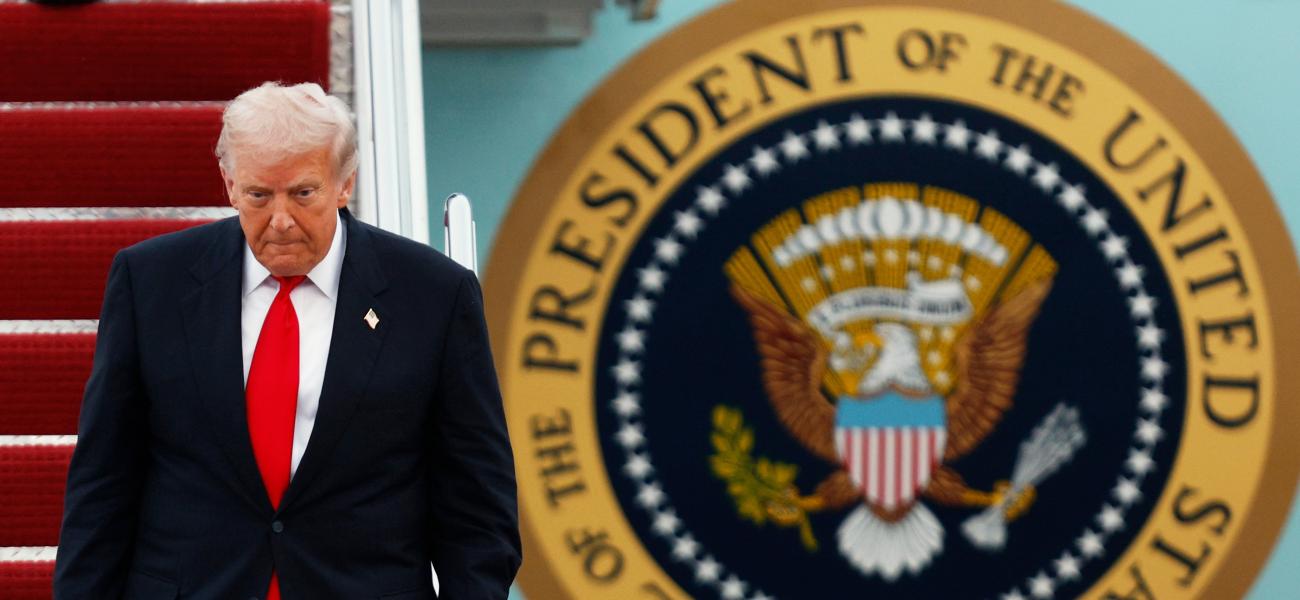
Opinions expressed herein are solely those of the author. Photo by AP Photo/Luis M. Alvarez.