In the Thick of It
A blog on the U.S.-Russia relationship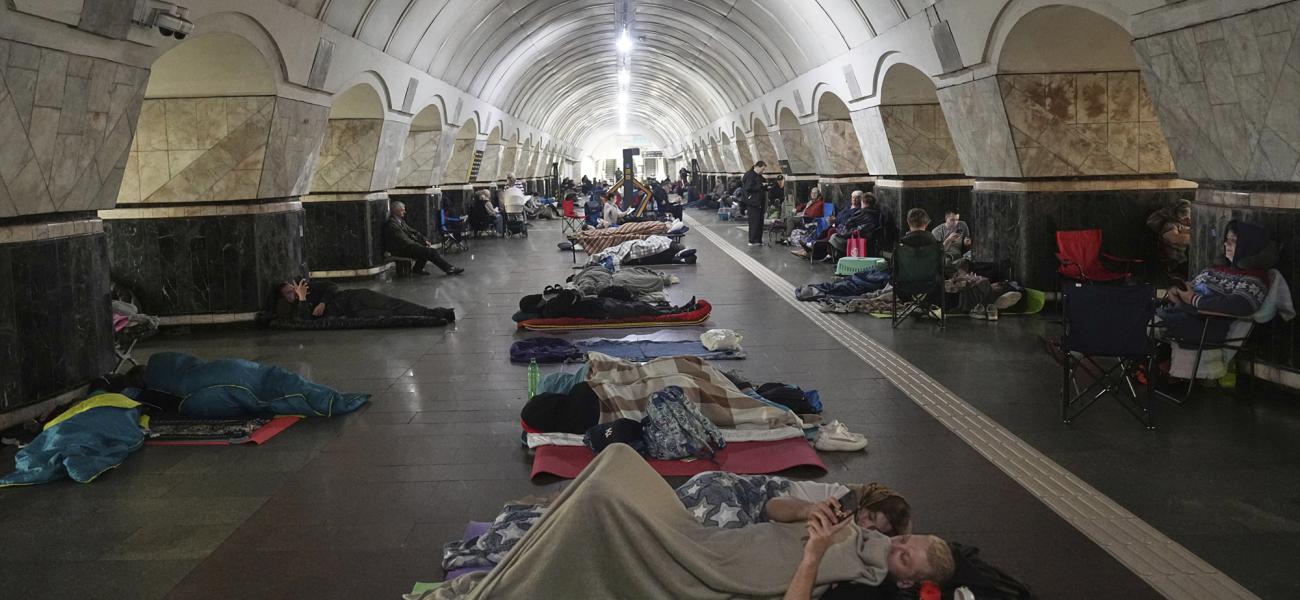
When Will This War End? Brig. Gen. Kevin Ryan Reports From Kyiv
On leave from the Kyiv School of Economics, where he has been helping to establish a new national security studies program, Brig. Gen. (ret.) Kevin Ryan sat down with the Belfer Center’s Russia Matters and the Harvard community at an event on Oct. 8 to share his reflections on the war in Ukraine and map possible endgames. In conversation with Graham Allison, the Douglas Dillon Professor of Government at Harvard, and Simon Saradzhyan, the founding director of Russia Matters, Ryan offered his candid views on life in wartime Ukraine, the war’s trajectory and the steps he believes are needed to bring the conflict to a negotiated settlement.
Ryan has had a long and illustrious career as a U.S. military officer, who served in air and missile defense, intelligence and political-military policy areas. He served in Russia, East and West Germany and in policy-making assignments at the Pentagon. From 1995 to 1996, he was head of the Moscow office of the POW/MIA Commission, and then served as senior regional director for Slavic states in the Office of the Secretary of Defense from 1998 to 2000, and then from 2001 to 2003, as defense attaché to Russia. He also served as chief of staff for the Army's Space and Missile Defense Command, and in his last duty assignment was responsible for army strategic war plans, policy and international affairs and coordinated U.S. Army policy in the domestic interagency area and with foreign allies. After military service, he was a senior fellow and executive director for Harvard Kennedy School’s Belfer Center, where he was also the founder and director of the Center's defense and intelligence projects.
Resilience of Ukraine and the Ukrainian people
Ryan painted a portrait of a country at war yet profoundly alive. In Kyiv, he noted, life continues amid danger: cars and trains run, restaurants and even the opera remain open, although only until the 10:00pm nightly curfew, when drone and missile strikes begin. These are often led by Iranian-designed drones, referred to as “mopeds” in reference to their whining engines. This “bifurcated world” of daily normalcy and nightly warfare has made Ukrainians remarkably self-reliant, according to Ryan. Around 60% of munitions and nearly all drones Ukrainians use in the war are now domestically produced, often through small, innovative units such as Ukraine’s 14th UAV Regiment, which coordinates deep strikes into Russia and partners with Ukrainian universities for training in management and entrepreneurship training, he said. However, both Ukrainian and Russian drones are heavily reliant on Chinese-made parts, Ryan said, noting that replacing a Chinese camera with a Western-made one on a Ukrainian drone triples the cost of producing that same drone.
Ryan described Ukraine as a clear-eyed nation that understands that the West will not “save” it and fights with ingenuity, morale and a pragmatic grasp of the situation. In the wry formulation of one Ukrainian Ryan had met, many remain “cautiously pessimistic.” He acknowledged the “life or death” severity of the situation in Kharkiv, Dnipro and other urban centers closer to the frontline, and when asked if Ukraine had already seen the worst of the war, Ryan offered the grim prediction that Ukrainians will “suffer more” before the war is over. This is a shift in Ryan’s thinking through living and working in Kyiv, as at the war’s beginning in February 2022, Ryan had originally predicted it would be over that May. 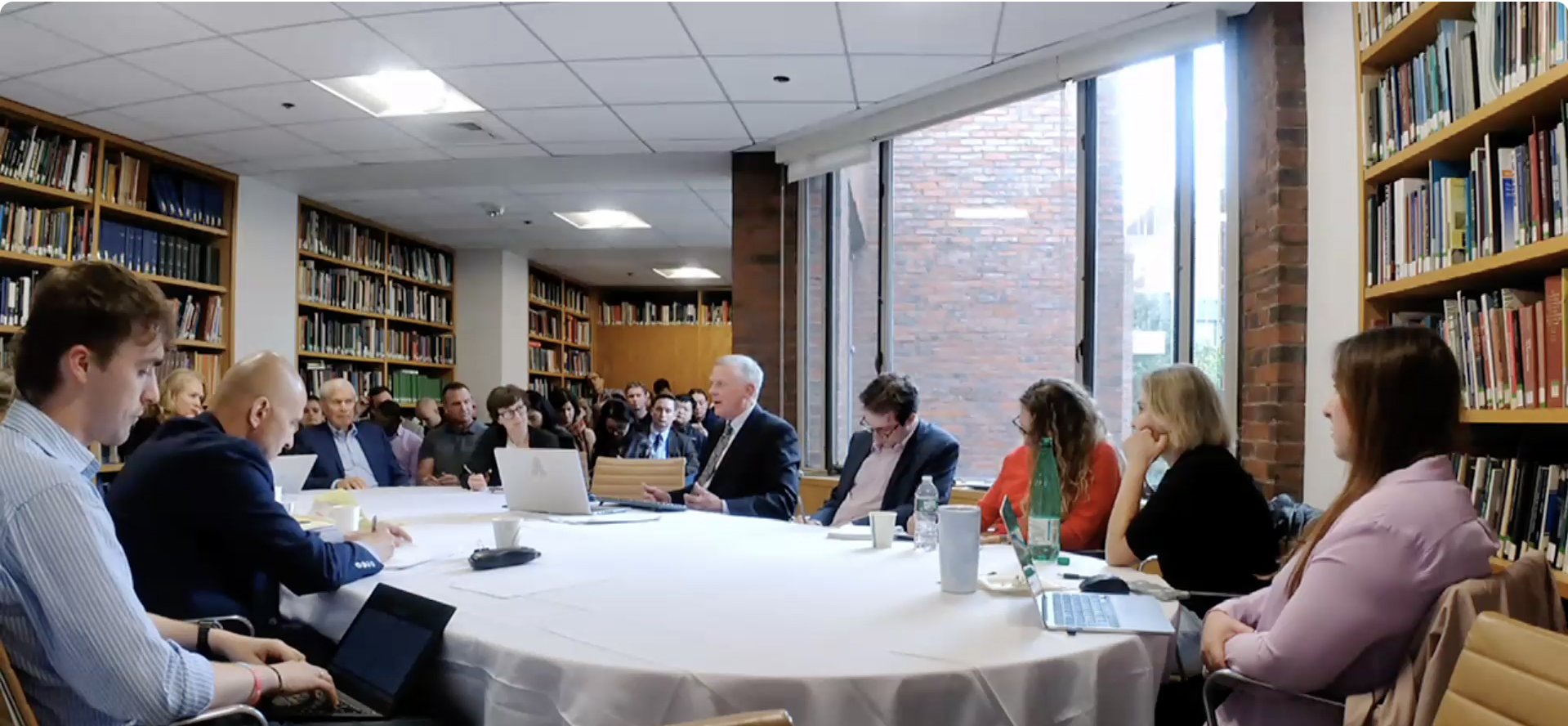
Tensions and asymmetries in ending the war
The discussion repeatedly returned to the political and military difficulties obstructing an end to the war. First, the imbalance between Russia and Ukraine in population, manpower and industrial base. Ryan asserted that Russian victories so far have been overwhelmingly pyrrhic, come at immense human and material costs and have been glacially slow, averaging about 169 square miles of territory per month in 2025 so far, according to Russia Matters analysis of ISW data. However, Ryan acknowledged that despite Russia’s unexpectedly poor military performance in the war’s early days, Russia has surprised him in its ability to learn from those mistakes and adapt. Ryan argued that Ukraine would be unlikely to dislodge Russian forces from Donetsk, Luhansk and occupied Zaporizhzhia. Meanwhile, Ukraine’s leadership and public remain unwilling to accept an offer demanding the surrender of territory Russia claims but does not control, nor one that restricts Ukraine’s military. When the conversation turned to Ukraine’s top command, Graham Allison highlighted then- commander-in-chief Valerii Zaluzhnyi writing in The Economist in the midst of fighting a war in order to get a message across to his boss, Ukrainian President Volodymyr Zelenskyy, as a signal of Zaluzhnyi’s potential frustration with not having Zelenskyy’s ear on what he saw as a stalemate on the frontline.
Still, as Ryan observed, Zelenskyy’s statements have become consistent in seeking a ceasefire along current lines of contact and with genuine security guarantees, though what form those guarantees might take remains open.
Ryan was also optimistic about opportunities to deepen the relations between the U.S. and Ukraine. Nevertheless, deep asymmetries characterize the two sides’ negotiating positions: Ukraine is unlikely to value limited commitments akin to those in the 1994 Budapest Memorandum, while a U.S. commitment to send troops to Ukraine appears equally unforthcoming. Somewhere in between is what we could hope for, he said.
American and NATO caution, born of fear of escalation with a nuclear power, has partially shaped the conflict’s tempo, according to Ryan. He agreed with Graham Allison and other participants who asserted that such caution—shared by senior U.S. officials in the Biden administration such as former CIA Director William Burns and former National Security Adviser Jake Sulliavn, who had intimate access to the thinking of Vladimir Putin and his inner circle before and during the war—was necessary to avoid catastrophic nuclear risk. The consensus was that caution may have cost opportunities, but when dealing with a nuclear superpower, the alternative risked unthinkable disaster.
Proposals and pathways to end the war
Ryan argued that it is clearly in America’s national interest to end the largest war since World War II through a stable peace in Europe that both engages Russia on the “fundamental causes” of the conflict (referred to more commonly as the “root causes” by Russian officials) and deters it from further aggression. In a claim that merited discussion, he argued that the U.S. does not have a proper seat at the negotiating table (“we have the cards, but no seat”) by avoiding open involvement in combat. To regain influence, Ryan proposed that the U.S. should give up its strategy of acting as a middleman and, sitting alongside Ukraine at the negotiating table, should engage in direct talks with Putin. These talks would include discussing what Putin has called the war’s root causes, acknowledging Moscow’s insecurity over NATO’s eastward reach while reaffirming Ukraine’s sovereignty.
Ryan noted that Russian leaders have made clear their requirement for a buffer zone between NATO and Russia—a demand that is broader than the current war in Ukraine. NATO could consider a new security architecture that provides assurances to Russia against attack: a form of buffer zone or demilitarized zone that would stretch from the Black Sea to the Baltic, policed multi-nationally by an organization such as the OSCE. Johns Hopkins Professor and NATO expert Mary Elise Sarotte, who was in attendance, engaged Ryan with a suggestion for a model akin to Norway’s Cold War compromise: what she termed “NATO membership without NATO infrastructure.” Russia’s revealed preferences throughout the Cold War, argued Sarotte, indicated that it might accept such a compromise, containing the added benefit of providing Ukraine sufficient guarantees to incentivize it to accept such a deal. Another thought-provoking proposal Ryan advocated was to deploy NATO integrated air and missile defense units around Kyiv, Lviv, Odesa and other western Ukrainian cities to enforce a limited no-fly zone, shooting down Russian missiles and unmanned aerial vehicles. Such presence, Ryan said, would signal commitment without escalating to direct combat and give the U.S. an indisputable place “at the table.”
The discussion also addressed NATO’s own missteps. Ryan and others accepted that the Alliance’s expansion eastward has contributed to Russian insecurity and thus to the current crisis. Acknowledging that Russian demands could be overblown, Ryan nevertheless stated that Russia sees NATO deployments toward its borders as existential threats. The conversation concluded that any durable peace in Ukraine and more broadly in Europe would have to accommodate these concerns without sacrificing Ukrainian sovereignty or critically undermining the NATO alliance.
Conclusion
The event underscored three intertwined realities. First, the value of a sovereign and independent Ukraine, a nation whose tenacity and fortitude has surprised both allies and adversaries. Second, fundamental political and military asymmetries would complicate any “simple” or “clean” end to the fighting; Ukraine cannot destroy Russia’s war capacity, while Russia appears unable to militarily defeat Ukraine. Third, serious proposals to end the war will require renewed Western engagement with Moscow. In Ryan’s view, the only path to peace lies in coupling credible military force with pragmatic diplomacy, preserving Ukrainian sovereignty while addressing Russia’s long-term security concerns.
Chris Conway is a graduate student at Harvard University and a student associate with Russia Matters. Opinions expressed herein are solely those of the speakers discussed.
Photo by AP Photo/Efrem Lukatsky. During his talk, Ryan described in vivid detail the experience of receiving an air raid alert via an app on one's phone, then checking a reputable milblogger's account for further information on the expected timing and location of the strikes and then deciding whether or not to move to a shelter.