Interview: Harvard’s Graham Allison on the second Trump administration and the international security order
This is a repost of the full text of an interview published with permission, by Bulletin of the Atomic Scientists.
When I first started thinking about an issue of the Bulletin focused on the changes the second Trump administration has wrought on the international order, the first expert who came to mind as a table-setter for the discussion was Graham Allison. He’s long been recognized as a top analyst of international security policy, advising or serving in the US Defense Department, State Department, and CIA, and leading and teaching at the Harvard Kennedy School for more than 40 years. His widely acclaimed book, Destined for War: Can America and China Escape Thucydides’s Trap?, has helped shape thinking about the confrontation of the world’s two leading powers since its publication in 2017. And his understanding of when history can and cannot be useful in crafting policy for the present and future is, to my way of thinking, unparalleled.
He and I spoke in July, when the vicissitudes of the Trump administration’s approach to international trade and security seemed to be approaching a zenith of unpredictability.
Editor’s note: This interview has been edited and condensed for readability.
John Mecklin: I’m going to start with a general question, and then we’ll go into specifics. It’s just my assumption, from looking from the outside, that most people would think Donald Trump in this term has actually changed the world order—how the major powers relate to one another—in some fairly significant ways. But how do you see it? I mean, that’s the popular view, but maybe you don’t agree.
Graham T. Allison: I would say mainly “yes,” but with a reservation. The question of the state of the international security order and the future of the international security order is one that was of great concern before Trump—and then Trump adds to the picture. But you need to kind of start with the big picture. To make this vivid, consider 80, 80, and 9. If you can identify the questions to which each of these numbers is the answer, you’ll have the big picture about the international security order during the whole of the lifetime of almost all Americans today.
We are going to celebrate the first 80 in September. The anniversary of Japan’s surrender on September 2 will mark the longest peace ever in modern history, the longest period without great power war. That is not natural. When you think of it in historical terms, it’s unbelievable. It is unprecedented. It is not a fact of nature. Instead, it is a remarkable achievement in the construction of an international order after World War II that was designed to prevent World War III. The architects—whom we now revere as the “wise men”—understood that if history continued in its natural course, the next generation would see a third world war as they had seen the second follow the first. And a third world war with nuclear weapons might indeed be the last. So to prevent that, they determined to build a new international order. That order is fragile. It requires constant strengthening. And this was already under great pressure before President Trump arrived. Metaphorically, I suggest students think of a dam holding back a natural set of events that would have happened otherwise. Indeed, if the Cuban Missile Crisis ended in World War III, survivors would likely have said, “Well, that’s just what happens every generation or two.”
The second 80 is very much in your wheelhouse. If you told anyone in 1945 that we’re going to see 80 years without another use of nuclear weapons in war, people would have said you’re out of your mind. That’s impossible. This is the absolute weapon. How could nations not use it to advance their interests? As you know very well, that’s not a natural fact. That has almost happened a number of times, a number of close calls.
Some now suggest that any use of nuclear weapons in war is “unthinkable”—because there is a “nuclear taboo.” But think about it: a taboo is just a convention. So, this achievement again is not to be taken for granted. If Putin had conducted a nuclear strike against Ukraine in the fall of 2022—which he was seriously considering—we would not be celebrating this 80.
The third number—9—again is in your space, and is probably the most remarkable of all. How can there only be nine nuclear weapon states, when there are 90 states that could have nuclear weapons if they wanted to? So, if North Korea can have nuclear weapons, who can’t? And how unnatural is it that I would trust my survival and security to you just because you told me you were extending your nuclear umbrella or giving me a NATO Article 5 commitment?
When in 1963 President Kennedy foresaw a world of 25 or 30 nuclear weapon states in the 1970s, that was conventional wisdom among national security strategists. States would acquire nuclear weapons when they had the capability to do so.
But that led to a great initiative that ultimately became the non-proliferation regime. Again, that regime is not an accomplished fact. Instead, it is a fragile institution that has to be maintained constantly. And after Putin’s successful coercive threats in his war in Ukraine, that regime was already under great stress—all before Trump arrived.
In what has been called the United States of Amnesia, most people have simply forgotten that there used to be great power wars. When I tell my students now that they have to be thankful for the fact that there’s not been a great power war—some imagine that this is equivalent to being thankful that a meteor didn’t hit the Earth. It’s just kind of totally out of mind. If you talk to people about the possibility of a nuclear war, as you know very well, most people today think, “John, this is over. That was history.”
Mecklin: That’s what my grandfather took care of.
Allison: Exactly. As my father used to say to me, “You’ve been talking about this as long as I can remember, and, you know, the Cold War’s over. So move on; think about something else.”
But think about it: How unnatural it is that states have been willing not to have their own nuclear arsenals, particularly after they see what happened to Ukraine and now to Iran. This means that all of these elements of the post-World War II order were under extreme pressure—before the arrival of the great disruptor.
Mecklin: So what has Trump done in those three realms you just talked about?
Allison: In a word association game, if you say “ally” to President Trump, he responds: “ripping us off, free rider, freeloader, taking advantage of us.” So the concept of allies that were a foundational part of this international order—NATO and Japan and South Korea and Australia and other relationships—is not central to his thinking. Rather than seeing it as a great achievement that allowed all of us to live in a world without great power war, he sees it through the lens of others taking advantage of us.
An alliance is not just a series of transactional, item-by-item deals. It consists of relationships and institutions, neither of which figure prominently in part of the great disruptor’s priorities. So I would say that the undermining of the alliances has been spectacular—from the point of view of the Chinese rival.
Consider Canada. If you ask [Prime Minister Mark] Carney—who’s been an extremely pro-American person for his whole life—about Trump’s US, he now sees it as a threat. How can this be? My bet is that if we continue along this path, a number of allies are going to look and say, “Well, if I have to take care of my own security, I know how I can do that.” Could you imagine Canada with nuclear weapons? It seems crazy—but we’re living in a pretty strange world.
Mecklin: They have nuclear reactors and nuclear power plants.
Allison: Indeed, this is an 80-year-old technology. There were many countries that had serious nuclear weapons programs earlier. That’s why the campaign that persuaded them to stop their programs and built a nonproliferation regime in which there are only nine nuclear weapons states is so amazing.
After allies, secondly, comes stability. The foundation of this international security system that gave us eight decades without global war was a leading power that was stable, predictable, and reliable.
So, when the leader of that country becomes the disruptor-in-chief and a constant source of instability and unpredictability, yikes. Recall Trump’s comment as he boarded the plane for the NATO summit. He said referring to the NATO mutual defense commitment: “It depends on your definition. There’re numerous definitions of Article 5. You know that, right?”
The meeting ended more successfully than anyone had expected, with NATO members marketing a verbal kabuki pledge to 5 percent defense spending by 2035—when they know they will all be gone. No one ever said NATO Secretary Mark Rutte didn’t understand the art of the show. But President Trump came late, left early, and showed little interest in his counterparts’ view of their challenges as they see them. So imagine what the German Chancellor or French President or Italian Prime Minister is now thinking about the US, its role in NATO, and their own future.
Third is the matter of rules and norms. The international security order has developed a set of rules, some of them written and some tacit. But as Trump has explained about himself, he enjoys violating rules. Indeed, he sees rules and norms as invitations to violation—if by violating the rules he can outrage his audience. In his book The Art of the Deal he explains how if by violating a rule or norm, he can outrage his target audience, they will be less comfortable and thus more willing to give him a better deal than he could get otherwise.
But again, if you’re old school as I am, rules—explicit and tacit—are the stuff of an orderly, predictable life. British politician and philosopher Edmund Burke called them the cake of custom. In the 80-year peace, they have been crucial to thinking about what states do and don’t do in the international security order.
In sum, I believe it is essential to recognize how extraordinary this post-World War II order has been; to appreciate how much pressure it was under before Trump arrived and now to see how it is being shaken to its foundations by a great disruptor.
Excuse me if I add one further point that makes the picture even more complicated. It is an “on the other hand.” Or to quote one of my heroes, the great post-World War II Secretary of State George Marshall—after he’d completed the presentation of his conclusion about a complex issue, he would turn to his staff and say: “Just one more thing. Tell me how I could be wrong.” So, on-the-other-hand, despite the fact that I’m old school and traditional about the international security order, I think it’s impossible to deny that Trump is simply not playing by the same rules we’ve become accustomed to. He’s overturned the whole chessboard. And if one didn’t know anything else about him, he would say this is for sure going to crash and burn.
But if we recognize that he’s already done so many extraordinary things that we would think were not possible, including managing the greatest political comeback in American history, it is possible that he will succeed in ways we would not imagine. Since I’m ultimately an optimistic person, I have at least a dream of how he might actually make something better in the international security order in the relationship with China.
Mecklin: You actually just jumped to the last question I was going to ask you, so let’s get to it now. If you were advising President Trump, he’s done all these disruptive things, but he wants to win a Nobel Peace Prize, it’s pretty clear. Given what he’s done already, what would you advise him to do?
Allison: I think his best hope for a Nobel Peace Prize is to make a great peace with China, a great Asian peace. I think the European piece of this is too complicated, because of the Russian angle. And who knows what’s going to happen in the Middle East?
But in Asia, the defining challenge today and as far as anyone can see into the future is the rise of China and the impact it is having on the US and the international security order, of which the US has been the architect and principal guardian. And as you and I have talked about before, and I’ve written, the relationship between China and the US is a classic Thucydidean rivalry. China is a meteoric rising power; the US a colossal ruling power. As Thucydides famously explained, when a rapidly rising power seriously threatens to displace a major ruling power, the result is typically war, even war that substantially destroys both parties.
If asked about what’s happening in US-Chinese relations, I suspect that Thucydides would say the two parties are right on script, almost as if they were competing to show who could better exemplify the role of the rising or the ruling power. Watching the past decade or two, he would say that he’s sitting on the edge of his chair anticipating the greatest collision of all times.
So Trump inherited from Biden and his own fits and starts in his first term and Obama before him a relationship that was on a normal Thucydidean trajectory that would, left to its natural course, lead to ultimately a catastrophic conflict.
Henry Kissinger, in the last couple of years of his life before he died in 2023, and I would have a phone call or Zoom every month. Among the topics we’d always discuss was the relationship with China. And repeatedly he would end that part of the conversation by saying: “Graham, I’m hearing louder and louder the echoes of 1914.” There the rapid rise of Germany and the fear it provoked in Great Britain created conditions in which an event as otherwise insignificant as the assassination of an archduke in Sarajevo became the spark that ignited a fire that within five weeks had all the nations of Europe at war—a war that became so destructive that historians had to create a new category: World War I.
So if you start with the proposition that nuclear war is bad, really bad; a nuclear war cannot be won. And secondly, I want to be a great peacemaker. And thirdly, where can I do this? Well, it’s with Xi Jinping and Asia. So could you have some version of a deal between the US and China?
So that was the hand Trump inherited. He came to office with several big ideas. First is that he is a great man; that he respects other great men of whom China’s Xi is one; and that great men can do things mere mortals like the rest of us can hardly imagine. Second is that he is a great deal-maker. Third, that he wants to be seen and known in history as a great peacemaker—with a Nobel Peace Prize and maybe even a place on Mount Rushmore. And finally, he understands nuclear war is bad—really bad—better than any other political leader on the scene today.
On what people like you and I remember as the “sword of Damocles” that hung over statesmen in the 1960s and 1970s and 1980s and that most political leaders today have forgotten or never learned about, he feels this in his bones. In his first term, he explained to a number of people who worked for him—including military officers who had grown up working with nuclear weapons— that nuclear weapons were much more dangerous than anyone recognized. His uncle, who was a professor at MIT, explained this to him when he was young, and he talks about what he learned with passion.
Mecklin: Okay.
Allison: So if you start with the proposition that nuclear war is bad, really bad; a nuclear war cannot be won. And secondly, I want to be a great peacemaker. And thirdly, where can I do this? Well, it’s with Xi Jinping and Asia. So could you have some version of a deal between the US and China?
If you ask Biden about China, he says competitor, strategic competitor. If you ask most people today, they say adversary or enemy. But I think you could imagine Trump saying, “No: the right word is partner.” As he has said repeatedly: “The US and China working together can solve almost any problem.” So could you imagine a Xi-Trump summit in which they create a framework for something called a partnership—maybe even a partnership for peace. If I put to the side what I don’t like about what he’s doing on other fronts and stretch my imagination, I think I could.
Mecklin: I think I’m right in saying you just got back from China. I don’t know who you visited with, but I’m curious. What is the Chinese view of Trump the disruptor? I have no idea what leaders in China would think of this.
Allison: I didn’t talk to the Supreme Leader, so I’m not sure what his views are. But I have had the opportunity to have conversations with some of the individuals who talk to him. And I study him and the people around them. Listening to what they say, I think they’re befuddled like the rest of us by the unpredictability of the man.
Since in their culture, order is the primary objective, and chaos the primary nightmare, unpredictability and disruption are bad. Uncertainty makes them uncomfortable. On the other hand, they’ve noticed that Trump certainly doesn’t appear to be a China hawk in terms of all the things he says about China and all the things he says about Xi Jinping. I think they believe that he means it when he says he respects Xi and China.
And they have some respect and understanding for him. On the trade front, they think that his trade war against everybody is nuts. So do most other informed observers. As the impact of the extreme 145-percent tariffs began being felt in the US, Trump quickly backed down. As we look forward to a summit between Trump and Xi, I anticipate further reductions.
When his administration began tightening export controls, it found that the Chinese were well-prepared for that fight, had a strong hand, and responded in kind, upping the ante to tit-for-tat plus. When the Trump team discovered that we’re dependent on them for more things than they are dependent on us, or things that we have to have that are essential for our functioning, they responded by cutting off magnets made from processed rare earths. Again, Trump backed down, and we got to the current stalemate. So, this looks a little bit like what people in the strategic community know as mutual deterrence in a framework for trade and critical items that are essential for the two economies. Can we imagine that in the not-too-distant future we’ll see something like in the first Trump term—the trade agreement phase one—that would be phase two, and that would basically have a framework that would be good enough for both parties? I think that’s where we’re going, if the Chinese wanted to do that deal, which I think they do.
And then what else? I think some normalization of the relationship might follow. Obviously, for the Chinese, Taiwan is the most important concern geopolitically, and I think they see Trump as likely to be the most accommodating president on that issue that they’ve seen.
Mecklin: I don’t want to jump too far ahead, but let’s suppose that we go through the four years of the Trump administration, and he’s disrupted the order but there hasn’t been a major power war, the world isn’t ended. The changes he’s made to the world order—are they something that could be reversed or easily reversed? Or do you see some of them in some sense as permanent?
Allison: That’s a good question. I think we all need to be modest about the fact that a lot of things are happening that we would not have anticipated, and that the consequences of what’s happened so far in the short run are not what we would have anticipated. So, we could be surprised again.
But on the other hand, the Biden team had a hard enough time going back to Germany or South Korea or Vietnam and saying, “We can be a reliable partner, and Trump [in his first term] was just an anomaly.” Now with the second round of Trump, I think a lot of this damage is likely to be permanent, and other nations will be thinking about how they can best provide for their own security. Is that necessarily bad? No. Could this lead to a renovation or reconstruction of a next phase of international order? The international security order we discussed earlier that gave us the 80-80-9 formula was not uniform through that period. It was constantly evolving and adapting and adjusting. So, if you imagine a post-Trump future in which Europe has taken the shock of Trump to take greater responsibility for its own security, that could be a solid block of international order that actually was quite positive. In fact, if there were a third major actor in addition to the US and China that could play a larger role in the international arena, and that was Europe—given its history and values, I think that could be constructive.
On the Asian front, the question for each of the parties is: what about the alternatives? And the alternatives are not very attractive. I can imagine a scenario in which one or more of the parties decides it’s going to have its own nuclear arsenal—let’s say South Korea. And if it did, then I suspect we’ll see two or three others like Japan and maybe Vietnam trying to follow in that path.
That could lead to a very different configuration. Would it be stable? In the course of their trying to build a nuclear arsenal, would nuclear weapons be used?
For the trading order, interestingly, the Chinese and the Europeans believe that the globalization of trade is not going to be reversed by whatever the Trump administration does. So, they’re going to continue building their own blocks of international economic order. And then you could imagine a next administration joining back into some of that, but again, which other countries would play a larger leadership role? So the answer is: I don’t know.
Mecklin: That’s a long time from now. We have three more years of the current guy, right?
Allison: Yes, exactly. Try to think of how many days that is; I think we’re on day 110 of the second Trump administration.
Mecklin: Yeah, and so much has happened.
Maybe my last question is a little more theoretical, but we have a president who seems to flip and flop and change his approach to things almost daily, right? And who lies like you and I breathe. I’m not criticizing him. I’m describing reality. He tells lots of…
Allison: He doesn’t use language the way you and I do. He speaks in Trumpian hyperbole, which is his unique combination of fact, fiction, and fantasy.
Mecklin: I’m just interested in your thoughts on—for example, former President Richard Nixon tried to use “I want him to think I’m crazy, that I might do anything,” as a strategy. It probably didn’t work that well.
But this is, I think, on another level. Do you think this is going to have some continuing effect on how world leaders deal with international relations? Here’s a guy just back and forth, back and forth; lie, fantasy, some truth, whatever. I like Ukrainian President Volodymyr Zelensky one day, next day I’m going to scream at him in the Oval Office. And then I’m going to like him again. What does that do to international discourse?
Allison: That’s a very good question. I’ve said to people, if you’re not confused, you haven’t been watching carefully. For any of us, like you or me, who start with normal—this is not normal. This is a genuinely abnormal case. If the individual in question had not already done some pretty incredible things, we would be quite confident in predicting crash and burn. For example, in the tariff world, I think his view of tariffs is delusional, and even the Wall Street Journal calls it mad. He seems to believe that tariffs are a magic wand he can wave to force others to bow to his command—and that this will persuade them to take actions that will enrich America and make our economy perform more successfully. Ninety-nine-plus percent of people in the world of finance and business and economics think this is nuts.
And interestingly, when he declared a “Liberation Day” with increased tariffs on most of the countries in the world, less than a week later, bond markets began to get rattled, and he did a quick backflip. So, he’s not irrational or incapable of reacting to reality when it bites him. When he runs up against something that he can’t deal with, he retreats and adapts, but he still holds to this view. And there’s no question whatever that he can dominate the news any day he wants to by putting a tariff on anybody arbitrarily unless they do something else that he wants. This morning the target was Brazil, and his demand was not about trade but about how they deal with a former President whom he likes. That kind of bullying may work with weaker counties—but with China? I don’t think so. So as we’ve seen and I suspect we’ll see more of in the near future, in dealing with China he will be much more careful and more deliberate.
Can this work in general in dealing with other countries, and can other countries behave like this? I don’t think so. If you or I had a group of people with whom we were friends, and one of them began behaving like this, if you invited me to have dinner with a group that included him, I’d say, “John, I don’t think I can; I’m busy that night. That’s too exhausting for me.” Or if your brother or son or daughter began behaving like this, you would be concerned, and you would counsel them that this is not a good way to win friends and influence people or get along with life.
I think I’ve discovered I’m more conservative than I than I thought I was, with a small “c”—because I like convention, institutions, normal, predictable. On the other hand, I don’t want to deny facts. The fact is that a person with this MO managed the greatest political comeback in American political history, almost like arising from the dead to the presidency. And what’s going to happen in the Middle East now, after he and Bibi have overturned that chessboard?
The answer is I don’t know. I’m nervous and concerned, but I can imagine it turns out better than I would have thought it would.
So, for people like you and me who come from the traditional foreign policy establishment, who appreciate the wonder of 80 years without great power war, 80 years without nuclear weapons being used in war, and just nine nuclear weapons states, Trump discombobulates us. When we see someone acting so contrary to what we’ve come to believe has created the international order that gave us these blessings, we’re confounded. But since I take solace in the belief that God looks after drunks, little children, and the USA, I still think maybe, somehow, out of chaos will come something good. That’s at least my hope.
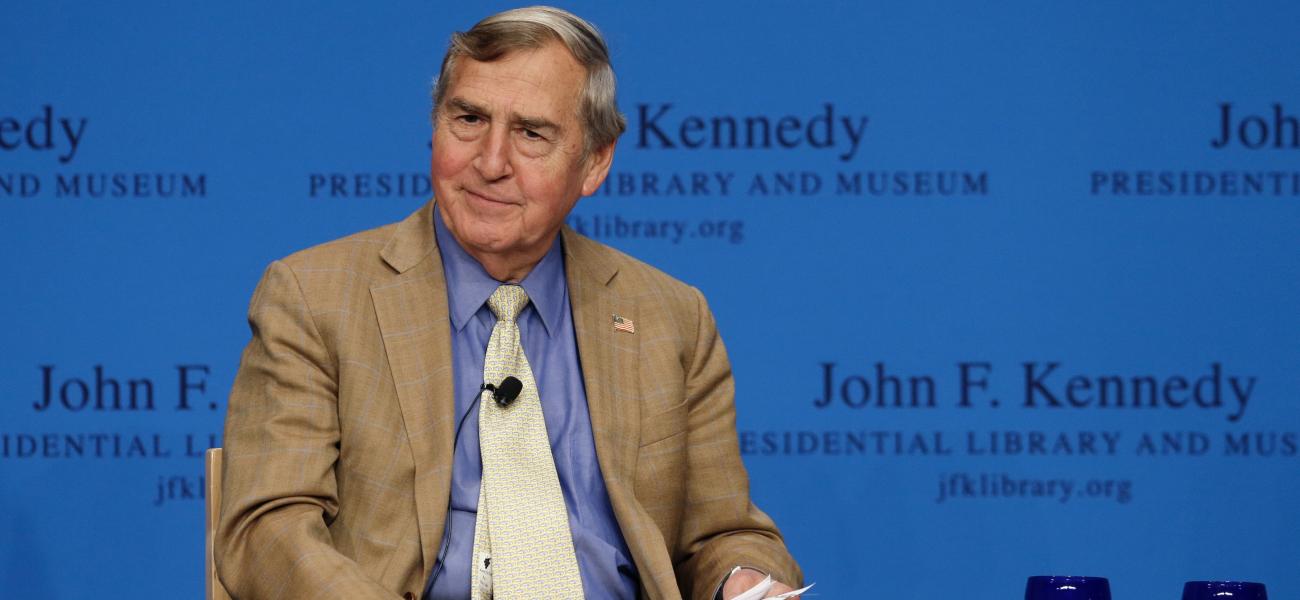
Opinions expressed herein are solely those of the interviewee. Photo by AP Photo/Elise Amendola.