
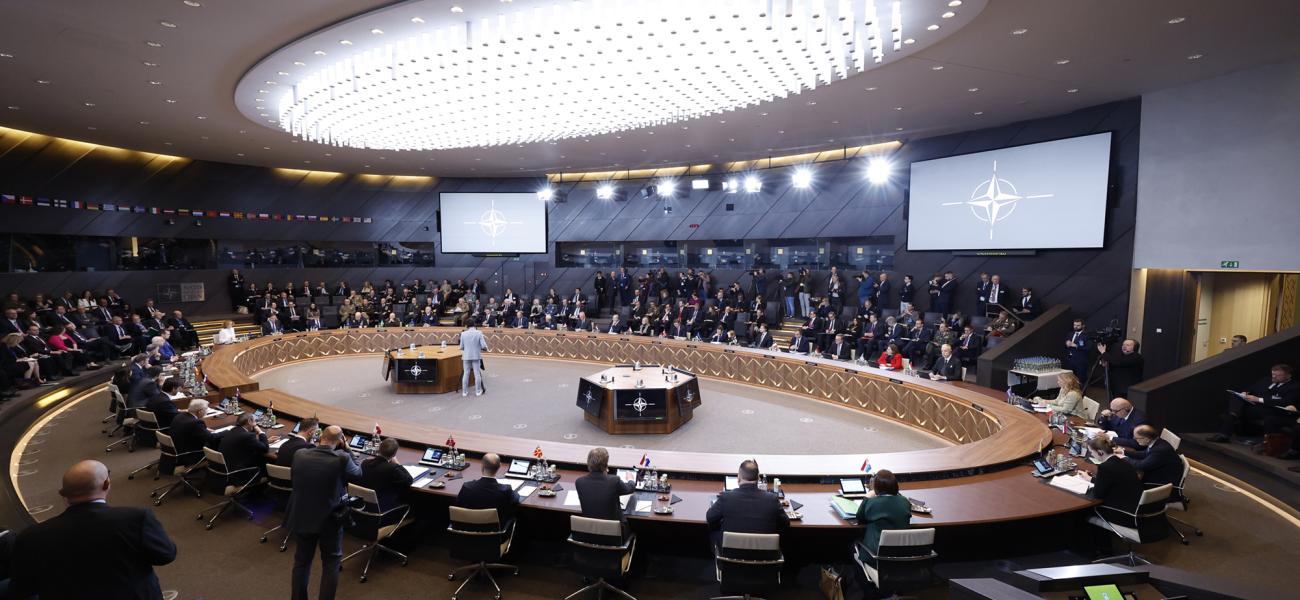
A New Transatlantic Bargain: The Case for Building a Strong European Pillar
This report was originally published by the Belfer Center for Science and International Affairs.
A New Transatlantic Bargain: The Case for Building a Strong European Pillar is a landmark report—co-authored by former senior government officials, national security experts, and policy leaders—presenting a bold strategy for rebalancing the transatlantic security relationship, strengthening Europe's defense capabilities, and redefining the U.S.-European strategic partnership in an era of shifting global threats.
The report argues that Europe must take on a significantly greater role in its own defense, both to safeguard the continent from Russian aggression and to ensure that NATO remains a viable and valuable alliance for the United States.
Introduction
Europe and America are at a crossroads. Faced with an increasingly dangerous global security landscape, new leaders on both sides of the Atlantic are reassessing the terms of their seventy-five-year-old alliance. In Europe, there is growing appreciation for the need to take on more of the burden and responsibility for the security and defense of the continent—and to contribute more to global security. In the United States, the Trump administration expects Europeans to take much more responsibility for their own security, in part to shift a more equal portion of the defense burden onto the Europeans and in part to reprioritize military and other resources to Asia and other parts of the world.
For Europe, the challenges could not be greater. Russia’s war in Ukraine poses an existential threat to European security. Yet Europe today does not have the military resources necessary to support Kyiv alone without the continuation of significant American aid, which the Trump administration has not committed to continue. Nor does Europe possess adequate means to ensure its own territorial defense—a need that would grow even more acute should the Ukraine war end on terms favorable to Russia.
The imperative confronting Europe is clear: It must invest much more in defense than it currently plans and deploy a military able to operate at high readiness levels and with requisite technical, operational, and strategic agility to defeat the military threats it now faces. It can no longer depend on the United States to underwrite its security. Washington’s willingness to do so is waning—a political reality not tied to any specific administration. A failure to invest sufficiently in defense and security now will leave Europe exposed to the rapaciousness of an expansionist Russia and to other threats—without any real guarantee of the United States coming to its rescue. Only a Europe that is willing and able to take on much of the burden and responsibility of defending itself and contributing far more to the collective defense of all NATO Allies has any hope of convincing Washington to remain fully committed to transatlantic security. Washington needs a true and more equal partnership on the continent and globally if it is to continue to see enduring value in its historic Alliances. At the same time, the seventy-five-year-old transatlantic alliance system has paid essential benefits for U.S. security, including a core of globally reliable political and military partners, extended deterrence, and vital basing and power projection platforms—all assets that our adversaries lack. A Europe that contributes more to its own and global security will strengthen the case that NATO is a good deal for America too.
We recognize that calling for greater investment by Europe in its own defense—and calling for continued but calibrated American investment in the transatlantic alliance—faces political and economic headwinds. In Washington, the new administration will reevaluate the place of Europe in a daunting global strategic landscape and will possibly differ with Europe on Ukraine, China, trade, climate, and many other issues. In many European countries, growth is slow, budgets are under strain, and their socioeconomic models and competitiveness need reform and modernization. The European Union needs to adapt to the new environment at a time when member states don’t necessarily agree on all strategic questions.
These challenges, though real, must not lead to inaction. With new leaders in Washington, in many European capitals, and in Brussels, both at NATO and the European Union, now is the time to review the terms of the traditional transatlantic bargain by building a true and strong European pillar within the transatlantic relationship.
Both sides of the Atlantic clearly want a relationship that is more balanced and equal. For Europe, the overriding interest is to be much more capable of handling its own security, both to enable it to defend itself and to convince the United States that the transatlantic security partnership with Europe remains fair, balanced and in its interest. For the United States, the capacity and willingness to maintain the disproportionate burden of common defense are diminishing—and could end, sooner rather than later. Europe’s reluctance to provide for its own defense threatens it with either strategic irrelevance or subjugation to superior military foes. Neither is acceptable. The time to avert this outcome is now. With focused effort, the United States and Europe can realize this new vision for rebalancing the transatlantic partnership.
Click here to read or download the full report.
Photo by AP Photo/Geert Vanden Wijngaert.