Gen. Zaluzhnyi on Ukraine’s War for Survival
BOOK REVIEW
“Moya Viyna”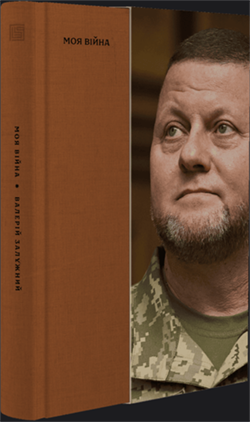
By Valerii Zaluzhnyi
Babylon Library, 2024
The challenge that faced Valerii Zaluzhnyi as commander of Ukraine’s armed forces (July 27, 2021, to Feb. 8, 2024) involved a kind of two-front war: first, a struggle to re-organize and equip Ukraine’s military for a threat it hadn’t anticipated, and second, a struggle to innovate the means to blunt and if possible reverse Russia’s military assaults on Ukraine. This follows from Zaluzhnyi’s book, which is entitled “Moya Viyna,” or “My War,” a copy of which Russia Matters has obtained to identify and share the general’s insights on the Russian-Ukrainian war. Throughout the book, Gen. Zaluzhnyi—who is now serving as Ukraine’s ambassador to the U.K.—is clear that what’s at stake is far more than the loss of Ukraine’s easternmost territories to Russia: it’s the very survival of even the memory of Ukraine as an independent nation.1
Zaluzhnyi’s first reference to the ongoing Russian invasion of Ukraine in “Moya Viyna” points to his assessment of Russia’s political objectives there. His view of Russia’s aims—which Russian officials tend to refer to in public statements as “root causes” is stark: “I was afraid that history could be rewritten. They [Russians] have been doing that for centuries and they’re doing it now. So I wrote. But I was wrong. Their goal is not only history. They came to destroy us physically and to prove that we never existed.”2 Zaluzhnyi adds that Russia’s efforts to control how the conflict is perceived by means of sophisticated disinformation have intensified the threat. As he puts it, “Cynical enemies, unable to achieve their aims on the front, unfortunately currently face no limits in the media space and on the Internet. They use administrative resources and conceptual distortion with a single aim—to kill our faith in ourselves.”3
Zaluzhnyi then argues that for Ukraine, the war is about nothing less than existential survival: “I understood that this was a large and terrible war… a war for survival. A war where we will be victorious. Otherwise—death.” It’s a critical comment, not least because the war has forced a reexamination of what “victory” means. As I read it, Zaluzhnyi’s attitude is that Ukraine’s survival is a sufficient condition for victory. If true, that would count as both a very low bar for “winning” as most observers define it, and it would underline the root of the widely publicized disagreement between Zaluzhnyi and Ukraine’s President Volodymyr Zelenskyy, who ultimately removed Zaluzhnyi from his post of commander-in-chief on Feb. 8, 2024.
Shifting to discuss operational problems that arose from his understanding of the shape the war would take, Zaluzhnyi notes that at the start of the war, Ukraine’s then military doctrine had left it woefully unprepared to fight this war: “The first thing that struck me… was the unpreparedness of the existing command system of the Armed Forces to manage operations and the entire armed struggle in the event of combat on several operational fronts.” Underlying this observation is the problem that all states organize their security forces and set aside key resources to meet specific contingencies: the political objectives shape the military preparations. Zaluzhnyi laments that he himself had had a hand in designing a system that could engage an adversary “on one or, at most, two fronts, and primarily for missions beyond our state’s borders.”
That said, it was Zaluzhnyi who led successful efforts at reform, so that by the time of Russia’s full-fledged invasion in February 2022, Ukraine’s armed forces had been sufficiently re-organized to engage Russian invaders along not one, but according to Duke Professor Gilbert Merkx’s analysis, six axes of attack: “from the Black Sea in the southeast; from Crimea in the south; from Donbas in the east; from Belgorod in the northeast (toward Kharkiv); from Kursk in the northeast (toward Kyiv); and from Gomel, Belarus, in the north (toward Kyiv).” It’s true that Ukraine’s successful defense was aided by Vladimir Putin’s obsession with secrecy (so assumptions underlying Russia’s invasion planning were not adequately vetted) and long-standing corruption in Russia’s military. But interestingly, despite the Russian military’s flaws, Zaluzhnyi has said he has learned from Russia’s top military figure, Chief of the General Staff Valery Gerasimov, telling Time magazine in September 2022 that “I learned from Gerasimov. I read everything he ever wrote… He is the smartest of men, and my expectations of him were enormous.”
Zaluzhnyi then describes an additional problem facing Ukraine’s armed forces early in Russia’s full-fledged invasion: a better operational doctrine would only “work” if the reorganized forces had access to ammunition and supplies that were, at the time, unavailable. As he notes without passion, “Based on the composition of enemy forces that we were tracking on various fronts, we calculated the ammunition, forces, and means required to repel the invasion. The conclusion was grim. Especially concerning the quantity of ammunition, fuel and lubricants, food supplies, clothing and equipment, and other materials and resources needed to conduct combat operations.”
Beyond material supplies needed to defend Ukraine, Zaluzhnyi cites perhaps the most critical shortfall—personnel. “Calculations and preliminary planning revealed an insufficient number of combat units to counteract the enemy’s axes of activity. The estimation of required forces immediately indicated a shortage of weapons and military equipment needed to equip the newly formed combat units,” he writes. Given that aiding Ukraine with armed forces would have been considered by Russia a major escalation, personnel were and remain more important even than weapons and ammunition, because Ukraine’s allies could (and did) ramp up the supply of highly effective defensive weapons. But without sufficient troops to wield them and replace losses, and following the failure of Ukraine’s counteroffensive of summer 2023, Zaluzhnyi’s best strategy was to wage an attrition war in which Russia was forced to lose substantially more personnel on a day-to-day basis than Ukraine.
Turning to the question of maintaining critical external support for Ukraine’s armed forces, Zaluzhnyi’s view of the core problem and the pressure it created was that outdated and impossible standards of victory were going to be used by well-meaning allies, and even Ukrainians themselves, to determine their degree of support. As Zaluzhnyi writes, “The main argument of those tired of the war in Ukraine, both in the West and in our own country, at that time was that, despite the overall and complete support for our army, the planned steps to liberate territory and quickly crush Russia had not succeeded.” When Zaluzhnyi says “tired of the war,” he reminds us that the war in Ukraine started in 2014, and still shows no signs of ending soon.
On the subject of the ongoing war with Russia, the remainder of Zaluzhnyi’s first book shifts to focus on civil-military relations—in particular his careful description of the escalating tensions between himself and Zelenskyy. Like many military leaders, Zaluzhnyi is wary of the opinions of civilians who “had never once been in battle.”
“Moya Viyna” will be of interest to a wide variety of readers who can read Ukrainian.4 Not, unfortunately, because it is beautifully written (few soldiers of any rank write well), but because it also contains a great deal of autobiography, lending itself to some understanding about how Zaluzhnyi’s childhood and early years informed his views and enabled his rise to the Ukrainian military’s highest rank. Students of leadership, both corporate and military, will also find much of interest in its pages.
“Moya Viyna” engages Zaluzhnyi’s views on the war and his challenges in leading Ukraine’s fight for survival against a much more powerful Russia, a Russia, which, according to the World Bank, in the last full year before the full-fledged invasion of Ukraine, had more than three times the population, and more than seven times the size of Ukraine’s GDP in terms of PPP (constant 2021 international $).5 At its core, the appropriately titled “My War” introduces a dedicated and talented Ukrainian officer’s struggle—not only with a Russia determined to subjugate Ukraine—but also with insufficient resources, out-of-date military doctrine and strategy, incompetent officers, timid allies and uninformed politicians.
Excerpts from “Moya Viyna” were translated from Ukrainian into English for this book review by former RM student associate Conor Cunningham.
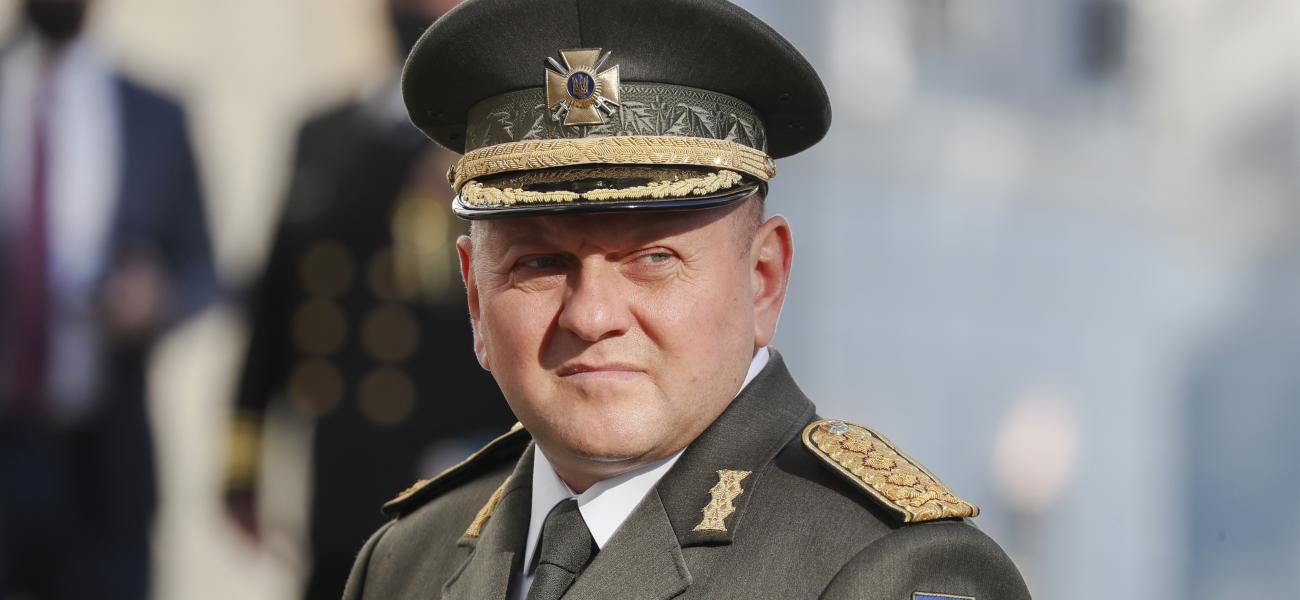
The opinions expressed herein are solely those of the author. Photo: Commander-in-Chief of the Armed Forces of Ukraine Valeriy Zaluzhnyi looks on before a meeting with U.S. Defense Secretary Lloyd Austin and other officials in Kyiv, Ukraine, Tuesday, Oct. 19, 2021. (Gleb Garanich/Pool Photo via AP)
Footnotes
- “Moya Viina” is the first of a planned multi-volume autobiography by a man who has been for manymonths leading polls on whom Ukrainians would like to see as their next president. It records both this four-star general’s views on Ukraine’s ongoing war with Russia (which he dates from 2014), and an account of how his background and education contributed to his views on strategy and leadership. This review focuses on the portion of Moya Viina that engages Zaluzhnyi’s views
- In his history of the aftermath of the Second Punic War, Richard Miles recounts how, after the military defeat of Carthage in 146 BCE, the Roman victors erased the very memory of Carthaginian culture and art, and replaced it with fantastical tales of Carthaginian barbarity and excess. Zaluzhnyi’s concern about Russia’s ultimate aims is analogous. See Richard Miles, Carthage Must Be Destroyed (New York: Viking, 2011).
- Zaluzhnyi’s argument is sadly incomplete on this count, in my view. Russia’s skillful use of disinformation, honed by over a decade of practice, is also intended to kill third-party support for Ukraine’s defense by advancing an alternate reality in which Ukraine’s defeat by Russia is inevitable, support of Ukraine is futile, and a dangerous waste of resources. See, e.g. ISW’s special “Primer on Cognitive Warfare” report, June 30, 2025.
- As of the date of this review, the publisher, Babylon Library, has not yet indicated if or when the book might appear in an English translation, or in any other language except Ukrainian.
- As of late January 2026, Russia controlled some 45,733 square miles or about 20% of Ukraine’s territory, according to RM’s war card.