Snapshot Analysis: Trump, NATO, Russia
As predicted, President Donald Trump’s summit with other NATO leaders on May 25 showed a White House focused on meeting its treaty commitments, but also determined to see its partners take on primary responsibility for countering threats that affect them, particularly in their own neighborhood. For Russia, Trump’s public comments sounded like a mixed bag: On one hand the president called Moscow a “threat” and expressed no interest in bringing it closer to the alliance; on the other, he made it clear that NATO needs to focus less on its eastern flank and more on the unconventional non-state threats coming from the south, which Russia would likely prefer. And, although the new administration in Washington is likely to keep the world guessing about many of its intentions, Trump’s day in Brussels served as an important reminder of America’s system of checks and balances: Whatever Trump personally may feel about Article 5 or U.S. guarantees of European security, there are lawmakers and national security officials who will also have considerable say on these matters.
Trump's remarks went in a markedly different direction than suggested by the advance "leaks" from senior U.S. officials. The latter sought to reassure jittery Europeans in their hope that Trump would end up endorsing the absolute guarantee Washington proffers for trans-Atlantic security, which has been a point of steady bipartisan consensus in the U.S., and that the new chief executive would, like his immediate predecessor, focus on the challenge posed by a resurgent Russia to the post-Cold War order in Europe. Now the U.S. national security establishment, governments in other allied capitals and the Kremlin are carefully perusing the president's talking points to determine if they represent a fundamental shift in how Washington conceives of NATO's focus and mission.
First, a quick note about what has proven to be the most contentious part of the speech—or, more accurately, its most contentious omission. Despite expectations, President Trump did not, in his public remarks, make any explicit reference to upholding the Article 5 guarantee in the NATO Treaty, which commits every member to view an attack on one as an attack on all. While such a reiteration would have had unquestionable symbolic importance, it’s important to remember that the president does not have the authority to unilaterally abrogate what is, after all, a constitutionally guaranteed treaty commitment. Moreover, no such intent was registered after the U.S. Senate ratified the documents bringing Montenegro into the alliance. That said, the popular interpretation of Article 5—that it commits the United States to automatically go to war with any country that attacks a NATO member-state—is not what the treaty language actually says. Here is what Article 5 requires of the United States: that "if such an armed attack occurs, each of them [the member-states], in exercise of the right of individual or collective self-defence recognised by Article 51 of the Charter of the United Nations, will assist the Party or Parties so attacked by taking forthwith, individually and in concert with the other Parties, such action as it [the member-state itself] deems necessary, including the use of armed force, to restore and maintain the security of the North Atlantic area." Thus, every U.S. president has had broad discretionary authority to determine the action he "deems necessary" to "restore and maintain" the security of the North Atlantic area. A number of European countries, especially those on Russia's borders, had hoped that Trump would acknowledge that the United States remains committed to their security, and feel that because the president did not make such a commitment explicit, he implicitly signaled that he is prepared to interpret America's Article 5 obligations in a far less expansive fashion.
When linked with Trump's comments about the failure of 23 NATO members to pay "what they should be paying and what they’re supposed to be paying for their defense," it suggests that the president has been influenced by those who argue that the "right" of Article 5 to collective security is conditional on states fulfilling their obligations under Article 3 (that every member-state, "separately and jointly, by means of continuous and effective self-help and mutual aid, will maintain and develop their individual and collective capacity to resist armed attack”). Trump did not go so far as to say that America will withhold its aid if another country has failed to meet the 2%-of-GDP threshold for defense spending, but that question is left hanging in the air after the president's Brussels speech.
In contrast to the Obama administration, therefore, Trump personally (although not all members of his national security team) is far less willing to ensure that the United States will guarantee it will continue to fill in any shortfalls in European security. How this will play out in the complicated tangle of U.S.-Russia-Europe relations is unclear. Will Moscow, for instance, view the president's stance as an opening bid to improve the climate—as a type of psychological breathing room that then gives Russia the space and security to respond, following the pattern identified by Amitai Etzioni in the so-called "Kennedy experiment" of 1963, which paved the way for an effort at detente following the Cuban Missile Crisis? Or will the Kremlin interpret Trump's remarks as a sign of weakness and try to press its advantage?
A theme that does appear to be percolating throughout the remarks is that European states, as a whole, must be doing more to acquire the capabilities and wherewithal for their territorial defense and security without assuming that the United States must be the provider of first choice. However, what remains unclear is what Trump envisions the U.S. role to be in the "gap years": Even if states like Germany begin massive increases in defense spending, it will take years before the new systems can be fielded. One can interpret the president's remarks to mean that for the years that Europe's rearmament is underway, the United States will still provide the necessary backstopping to regional defense. Or not. Again, that question is left hanging. Another open question concerns Moscow: Would it prefer to deal with a NATO still largely led and shaped by the United States? Or would having Germany, for instance, assume more of a leading role for European hard security be more or less advantageous for Russia?
Trump acknowledges that this transformation of the alliance must take place while NATO is confronting current challenges. The president explicitly did term Russia a "threat" and presumably the challenges that are posed to NATO's eastern borders are also understood to emanate from Moscow. There were no suggestions that Russia is a partner to the alliance or should be invited to return to its councils. In Trump's first major foray into his vision of European security, Russia appears to play no part. Moscow cannot be happy with that.
At the same time, Trump also called for reorienting the focus of the alliance away from the east toward the southern frontier, reconfiguring its capabilities from coping with the conventional/hybrid challenges of a resurgent Russia to the unconventional fight against the Islamic State and related movements in the Middle East. This aligns not only with Russian preferences but also with those members of NATO's southern tier who have long complained that their security interests were getting short shrift. If he follows through with this approach, it would shift the traditional east-west focus of the alliance toward a north-south one, in which naval, air and unconventional assets are more important than rebuilding land forces in the east.
Additionally, European Council President Donald Tusk, who has taken a relatively hardline position on Russia, said after meeting with the U.S. president that he was not sure “we have a common position, common opinion about Russia.” Recent reports of Trump’s stance on the Western sanctions against Russia have been far from definitive, with one of his economic advisors saying this week “I think the president is looking at it. … Right now we don’t have a position.”
Trump leaves Brussels with more questions than answers about his national security priorities, his sense of American commitments and where Russia fits in his hierarchy of threats and challenges. Undoubtedly, Brussels, Moscow and other capitals will continue to press for clarifications in the weeks to come. While the president has not “failed” NATO, since he has not reneged on any actual commitment, he certainly has called into question whether he accepts the consensus about NATO endorsed by his immediate Republican and Democratic predecessors.
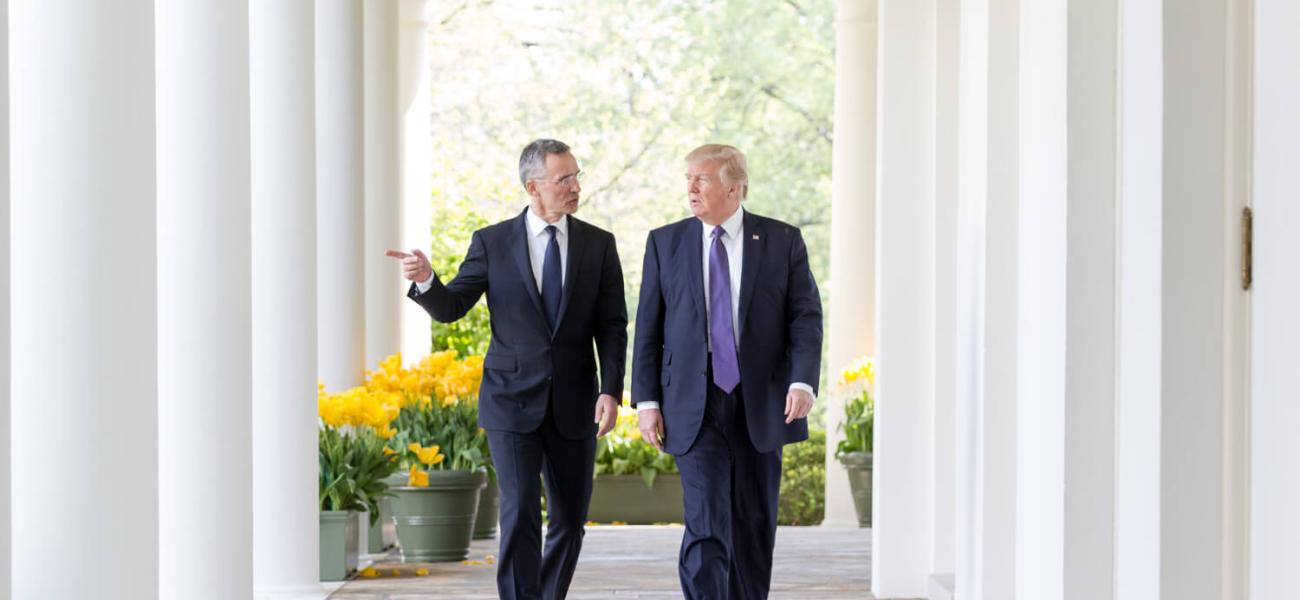
Official White House photo by Shealah Craighead.
The opinions expressed in this commentary are solely those of the author.