
Russia Analytical Report, July 13–20, 2026
3 Ideas to Explore
- Ex-SACEUR Christopher Cavoli argues the Russia-Ukraine war’s defining feature is scale. “The main thing that we see in the war in Ukraine is ... scale... just scale, scale, scale—the quantities of munitions consumed, the number of lives spent, the number of vehicles,” Cavoli said in a recent podcast. Human losses in this war are particularly stark, in Cavoli’s view, which he shared on the “Boots on the Ground” podcast. “Human wise, 600,000 people have died. I think 450,000—these are rough numbers—were Russian, which is incredible... it's more than twice … the Ukrainian losses,” Cavoli said. “So, the Ukrainians ... have been enormously, enormously, enormously successful” given that casualty ratio, the retired general argued. For alternate estimates of Russian and Ukrainian casualties, including fatalities, please see endnote 9 in the latest issue of RM’s The Russia-Ukraine War Report Card.*
- What Volodymyr Zelenskyy must have erroneously hoped last week would be just another cabinet reshuffle has exploded into a multi-day national affair, in the course of which thousands across Ukraine protested the president’s decision to side with old-guard commander-in-chief of the Ukrainian armed forces Oleksandr Syrskyi in the latter’s dispute with reformist-minded Defense Minister Mikhailo Fedorov. Since the announcement of firing Fedorov on July 15, Zelenskyy has tried to mitigate the resultant uproar by offering various jobs to Fedorov, but the 35-year-old reformist insisted he would accept nothing short of being reinstated in his old job, according to FT. Sensing the increasingly shaky ground under his feet, Syrskyi penned a column for “The Militarny” on July 20. In it, the 61-year-old commander—who could reportedly be out within days—apologizes to Fedorov, but rejects claims that he is so old guard that he “does not want to fight with drones.” “Ukraine is bigger than Fedorov, Syrskyi and any of us,” and “to reduce this war to a confrontation between two people is the greatest service we can do the enemy,” wrote Syrskyi, implicitly admonishing Fedorov, who penned his own column in NV.ua. In that July 17 column, Fedorov argued that Ukraine must fight so that “we will lose drones, not people,” but “in this construction [with Syrskyi], I personally don’t know how to win the war.” “I don’t need the position of defense minister to be defense minister. I need it to win the war,” wrote Fedorov, who has been lauded by the Ukrainian public for not only his vision for how to wage war, but also for his efforts to uproot corruption in military procurement.
- In a recent podcast with his former boss Jake Sullivan, Jon Finer wondered “what will happen if Ukraine actually stops making incremental progress and starts making more substantial progress on the battlefield?” “Does that lead Russia to contemplate again, as we believe they did at least contemplate in 2022, the use of a nuclear weapon, maybe a tactical nuclear weapon on the battlefield, maybe a nuclear test somewhere else to send the message? … I don't think that can be totally ruled out,” Finer said. “I guarantee you in the situation room and in NATO capitals, they are war gaming and scenario planning against … it would be, of course, the first use of a nuclear weapon since Hiroshima and Nagasaki at the end of World War II,” Finer told Sullivan. Sullivan also appeared to be concerned about the possibility of escalation by Russia vis-à-vis NATO. He said: “I find the idea that Russian troops … will actually conduct an incursion and hold territory, or that you will see a clear, unambiguous Russian strike on NATO territory that they don't immediately disclaim as an accident. … I think it's a real risk.”
I. U.S. and Russian priorities for the bilateral agenda
Nuclear security and safety:
- No significant developments.
North Korea’s nuclear and missile programs:
- No significant developments.
Iran and its nuclear program:
- Shah and Sherman write that while Russia has shared “intelligence with Iran that purportedly led to the targeting of U.S. soldiers” and “drone technologies that have given Iran a substantive asymmetric edge,” claims that Moscow has supplied Iran with extensive “cyber support” or formed hacker coalitions rest on a “thin evidence base.” They argue that “more evidence is needed before declaring that Russia and Iran’s cooperation in cyberspace reaches the heights of collaboration portrayed through media reporting,” and that “more nuanced language is needed in understanding the cyber threat and ecosystems of both states.”
- The authors stress that both countries’ cyber ecosystems are complex and varied, warning that a “Russian hacker” or Iranian actor “can in fact mean one of many different things.” Russia and Iran are “uneasy strategic partners,” they note, adding that mutual “risks inherent in sharing their best technical capabilities with a partner they do not fully trust” and episodes like Russia’s Turla “false-flag” operation make it “unlikely that Russia or Iran would be willing to share their most sophisticated cyber capabilities with a partner.”
- “It is clear that there is some degree of cyber collaboration,” the authors acknowledge, but insist “the existing evidence… does not substantiate a broader claim about Iranian-Russian cyber cooperation.” They warn that “overstating the degree and types of Russia-Iran cyber engagement risks overinflating their partnership,” potentially sending policymakers “down the wrong path,” and argue that U.S. and Western officials are “best served by clarifying the Russian and Iranian cyber entities in question” and focusing on “verifiable evidence rather than mirror-imaging.”
“Trump talks tough on Iran and Russia. For now,” Max Boot, The Washington Post, 07.14.26.
- Boot notes that at Ankara Trump executed “two head-spinning U-turns,” going from calling Iran’s leaders “nice to deal with,” “strong” and “smart people” who are “not radicalized” to labeling them “scum,” “sick people,” “liars,” and “vicious, violent people” and declaring the cease-fire “over,” while on Ukraine he shifted “from hostility to sympathy,” now praising Volodymyr Zelensky as having “done an amazing job” and promising to let Kyiv manufacture Patriot interceptors. “Trump’s rhetorical reversals are welcome,” Boot writes, but warns that “it’s difficult to know what to make of the pivots, because Trump could very easily revert to his earlier positions tomorrow,” and that “creating extreme uncertainty undermines global stability and makes it harder for the U.S. to deter adversaries and reassure allies.”
- On substance, Boot argues that Trump’s Iran and Ukraine policies “remain muddled,” predicting a “low-level conflict that alternates between periods of peacemaking and warfighting without achieving Trump’s stated aim of eliminating Iran’s nuclear program,” and stressing that Iran’s war is “adverse” for Kyiv because the U.S. and its partners “keep dipping into scarce stockpiles of missiles, including the ones used for air defense.” He calls Trump’s offer to license Patriot production for Ukraine “welcome, but it won’t provide immediate relief,” noting that Germany’s 2022 license won’t yield missiles until 2027 and that “Ukraine can’t afford to wait years.” If Trump is “serious about helping Ukraine,” Boot writes, he “will dig into the depleted U.S. Patriot stockpiles and urge America’s allies to do the same” and finally provide Tomahawk cruise missiles, arguing that by supplying Patriots and Tomahawks, imposing secondary sanctions on buyers of Russian oil, and backing use of $300 billion in frozen Russian assets, “the U.S. can readily ratchet up the pressure” on Moscow—while if Trump fails to match words with deeds, “U.S. credibility, already at a low ebb, will continue to deteriorate.”
See this link for more commentary/analysis on this subject:
- “U.S. teeters on all-out war with Iran after more troops are killed,” Karen DeYoung, Tara Copp, Dan Lamothe, Washington Post, 07.19.26.
- "The US, Israel, and Iran: Confrontation in the Name of "Ending the War,'" Zeev Hanin, The Moscow Times, 07.15.26. (In Russian.)
Humanitarian impact of the Ukraine conflict:
- Kramer reports that the recent conference in Gdansk, Poland, on Ukraine’s future reflected “a more upbeat assessment… of Kyiv’s prospects in the war,” shifting from donor aid to “private investment — a view of Ukraine not as a battered victim but as a large postwar market.” The pitch was to “invest in the dip in Ukraine,” as U.S. official Jeremy Lewin urged, betting that Ukraine will “deny Russia its broad ambitions in the conflict and remain an independent state,” even though “Russian missiles continue to streak into Ukrainian cities” and the front remains “a crucible of drone-fueled violence.”
- The conference “produced 160 agreements” worth “about $11 billion in private investment and aid,” the author notes, with the U.S. Export-Import Bank offering “up to $300 million” in credit for Naftogaz. Kramer highlights that Ukraine sits on natural gas reserves “with an estimated value of about $300 billion,” and that the EBRD has invested “about 10 billion euros” since 2022 and announced “more than 500 million euros” more, seeing opportunity in Russia’s destruction of coal plants as “a forced decarbonization in Ukraine.”
- Sustained support for Ukraine is still necessary
- “The EU should not become complacent.”
- “Ukraine will continue to rely on partners.”
- “Steadfast support by the EU, Ukraine’s key partner, will be essential.”
- Empowering Ukraine is a core European interest
- “Empowering Ukraine remaining central to that strategy.”
- “Ensuring that an empowered Ukraine is on its side… is one of the EU’s core strategic interests.”
- “Externalizing threats… shared by the community of European states is not a realistic option.”
- Ukraine’s defense industry should be integrated with Europe
- “Ukraine needs access to four things that Europe can provide: capital, production depth, access to key technologies and assured future demand.”
- “Joint ventures can bridge this gap.”
- “EU-based joint ventures can help Ukrainian companies gain access to European and NATO procurement markets.”
- Defense cooperation also supports Ukraine’s economy
- “It is also one of the most promising sectors for rebuilding Ukraine’s peacetime economy.”
- “Its overall production capacity could expand to USD 50 billion by 2028.”
- “A contraction of the industry could therefore undercut Ukraine’s economic recovery.”
- The Ukrainian diaspora is a strategic asset
- “They are also a strategic democratic constituency.”
- “Diaspora organizations have stepped in to fill this gap, acting as trusted intermediaries.”
- “Stronger EU-Ukraine civic resilience networks would help ensure that this engagement endures beyond a ceasefire.”
- Post-war elections will require major preparation
- “Out-of-country voting in future elections will not merely be a technical electoral exercise.”
- “It will likely be one of the largest cross-border democratic governance operations ever conducted.”
- “Building societal and electoral resilience takes time and requires early institutional preparedness.”
- Ukraine should be integrated into the EU before formal membership
- “Functional integration is not an alternative to membership.”
- “Gradual integration is the most politically sustainable way.”
- “Integration must be visible to citizens.”
- Reconstruction funding needs unified management
- “Ukraine should create a single ‘collector pipeline’ for reconstruction and recovery funding.”
- “The core infrastructure underpinning this collector pipeline should be a single, integrated digital platform.”
- “transparency is indispensable for building public trust.”
“Ukraine’s national recovery must go far beyond rebuilding what was lost,” Vitalii Kim, Atlantic Council, 07.16.26. Clues from Ukrainian Views.
- Vitalii Kim argues that “it is also vital to look beyond the battlefield and address the issue of Ukraine’s recovery,” stressing that “the objective should not be to repair and rebuild all that was lost or damaged during the war.” Instead, “Ukraine’s recovery must focus on creating a stronger and more economically competitive country,” and “the true measure of success will not be the amount of bridges repaired or buildings constructed, but the number of Ukrainians who choose to build their future in Ukraine,” the author writes.
- “Russia’s invasion has caused enormous damage to Ukraine’s industrial base,” yet Kim contends that the key task is “to move beyond the outdated industrial models of the past” and “plan to move up global value chains by localizing production.” Recovery, he believes, must also use the moment to “create a more modern, secure, and decentralized energy network” with “a far greater emphasis on renewable energy and distributed electricity production,” while leveraging “digital governance” so investors can “monitor project implementation in real time.”
- Ukraine’s “greatest single postwar challenge is likely to be demographic,” Kim warns, insisting that “bringing home the millions of Ukrainians who left the country” is a “strategic priority.” Ultimately, he concludes, “every initiative should be subject to the same simple question: Will it improve people’s lives?”
See these links for more commentary/analysis on this subject:
- “Inside the Race to Protect Ukrainian,” Sophia Smith Galer, Foreign Policy, 07.17.26.
- “A Portrait of a Beach City [Odesa] Defying Russia’s Attempts to Ensnare It,” Anastasiia Malenko, Wall Street Journal, 07.19.26.
- "Reflections from URC 2026: Ukraine’s Reconstruction Has Become Wartime Resilience," Sergiy Tsivkach, CSIS, 07.14.26.
Military and security aspects of the Ukraine conflict and their impacts:
“Boots on the Ground: Episode 4 (ft. GEN Chris Cavoli)” RRA Capital’s YouTube channel, 07.15.26; partially via Hyvla.net, 07.16.26.
- Cavoli argues that Ukraine has forced NATO back to large‑scale conventional war thinking after 35 years of “small, out‑of‑area operations.” Post‑Cold War, he notes, allies “optimized our forces for exactly that kind of warfare – which is literally the opposite of what you need to fight a large-scale conventional war.” NATO even went “35 years” without standing war plans. After Russia’s 2022 invasion, there was suddenly “a real large-scale war in Europe again,” and heads of state in Madrid ordered a strategy to “defend the territory of the entire alliance again.” Cavoli says his job became “rewriting the war plans,” producing for the first time since 1989 “a force structure requirement that was militarily sound and based on actual plans,” which he calls the true “shopping list” behind the 2% pledge—really “closer to 3.7%” of allied GDP for core defense over ten years, plus “a 1.5 percent add-on for training, logistics and infrastructure.”
- He insists the Ukraine war’s defining feature is “scale. Just scale, scale, scale – the quantities of munitions consumed, the number of lives spent, the number of vehicles.” Russia “has lost more than 4,000 main battle tanks in this war. Four thousand,” he emphasizes, contrasting that with “about 200” British tanks (going down to 150), “about 220” French, and “74” Canadian, concluding that “Russia has lost multiples of major allies’ entire inventory – and it has replaced those tanks.” Human losses are equally stark: “human wise, 600,000 people have died. I think 450,000, these are rough numbers, were Russian, which is incredible. You know, it's more than twice um, of the Ukrainian losses. So, the Ukrainians are have been enormously enormously enormously successful” given that casualty ratio. All this, he argues, takes us back to World War II, where “our military skill was just fine, but our industrial skill was fantastic,” whereas today “our production rates were designed for peacetime… we simply did not have the capacity to generate the kind of volumes… that a modern large-scale war demands.”
- Whisler and Kofman argue that “Russia’s force generation has failed to give Moscow the decisive advantage it expected,” even though the Russian General Staff likely believed the “correlation of forces” was shifting in its favor. The authors write that Russian troops, facing “a traditional prepared defense, Ukraine’s adaptation, and Western aid,” have been unable “to attain meaningful breakthroughs or create localized Ukrainian collapse.” Instead, the expansion of “mass precision on the battlefield” has “strengthened the defender’s advantage” just as “Russian force quality and ability to employ forces at scale declined.”
- By late 2025, “cracks in Russia’s current force generation model” appeared as regions had to “keep increasing bonuses to meet recruitment targets,” a trend the authors call “fiscally untenable.” If casualties keep rising, the force will “begin to contract,” suggesting Russia has passed its “high-water mark for offensive capacity.” Whisler and Kofman conclude that Moscow made a “profound miscalculation,” assuming quantity could offset Western support and Kyiv’s innovations; in reality, “how it employed force over time led to declining combat efficiency and effectiveness,” closing a “window of opportunity” that existed in 2024–2025.
- “What is clear is that the Russian military seems to have made a profound miscalculation, assuming that force quantity would eventually offset Western support and Kyiv’s innovations and wear down Ukraine. In reality, how it employed force over time led to declining combat efficiency and effectiveness, closing a window of opportunity that was open in 2024 and 2025,” the authors conclude.
“How Ukraine Brought the War to Russia,” Joshua Yaffa, The New Yorker, 07.15.26.
- Yaffa reports that Russia now faces “the same set of dilemmas that it had long forced on Ukraine,” as one Moscow defense source admits that “our great historic advantage, our strategic depth… has now become a huge disadvantage.” Ukraine has unified its drone forces so that “since March of 2025” Russian air-defense systems “have made up more than half of all targets destroyed by Ukrainian drones,” with attack drones “loitering up and down the main roads up to one hundred miles from the front, trying to hit every truck that drives down them,” Michael Kofman told the author.
- “Ukraine next targeted Russia’s oil and energy infrastructure,” Yaffa writes, noting Financial Times analysis that Ukraine has hit Russian refineries “nearly two hundred times” in 2026, “an elevenfold increase,” with “fifty million Russians, more than a third of the population,” affected by gasoline shortages. Kofman believes Ukraine now has “all the pieces of the puzzle… to seriously impede logistics and resupply” in Crimea, which could give Kyiv leverage toward “a ceasefire by the fall.”
- Yet “Ukraine still lacks reliable air defense at scale,” the author warns. In the July 6 attack on Kyiv, “all twenty-nine ballistic missiles… made it through Ukrainian air defenses,” suggesting Ukraine is “effectively running out of Patriot interceptors,” according to Kofman.
- Varenikova and Mozur report that “battalions of ground robots — tracked and wheeled machines that deliver supplies, haul ammunition, evacuate the wounded, lay mines and, increasingly, hold land — now conduct thousands of missions every month,” making them “an indispensable tool for Ukrainian infantrymen who spend monthslong rotations in buried bunkers hiding from flying drones.” At the cutting edge, “unmanned ground vehicles are doing what once seemed a generation away: assaulting and capturing enemy trenches,” and in April Zelensky said Ukrainian forces “captured a Russian-held position using only land and aerial drones, without putting a single soldier on its own side in direct danger.” Because “we simply cannot afford to lose personnel,” Maj. Oleksandr explained, his K‑2 Brigade—with “more than 500 soldiers and over 600 robots”—uses them so that once they had enough machines, they “covered up to 80 percent of tasks without people — all transportation and deliveries,” and a recent evacuation saw a robot hit by “three mines” but still bringing out a wounded soldier that “would have been impossible to save” otherwise.
- The authors say Ukraine plans to build “50,000” ground robots in 2026, more than double last year, and quote Maksym Vasylchenko that “for the price of one armored infantry vehicle… a brigade can buy 77 ground robots,” giving “77 attempts to complete a mission without loss of life.” Beyond logistics, they describe how in December 2024 the Khartiia Corps carried out “the first all-robot assault,” and how today “robots with, for example, guns or bombs are taking prisoners on their own,” while near one village a tracked robot with a .50‑caliber gun “stood watch, alone, for 45 days” and “the Russians never learned it was a machine.” New “automated turrets to shoot down airborne drones” have already “worked dozens of times,” with each kill “saving the lives of three or four Ukrainian soldiers,” and Sgt. Ivanov sums up the constant tinkering—swapping cameras, adding Starlink, airless tires, extra batteries—by saying, “War has no fixed tactics… Everything works through the ability to assess, think ahead and improvise endlessly. Every day is different.”
“Russia is losing its grip on Crimea,” The Economist, Graphic Detail, 07.16.26.
- The Economist writes that “Crimea has been a bridgehead for Russia since it seized the territory from Ukraine in 2014. But the peninsula is now looking vulnerable,” as Ukraine has “stepped up its drone campaign, targeting strategic infrastructure including electrical substations, bridges, oil depots and airfields.” Citing ACLED and the magazine’s war tracker, it notes that of 692 attacks on Crimea since 2022, “more than half have been in the past 12 months and a fifth since June,” and that drones are “severing the roads, railways and waterways that connect Crimea to Russia,” giving Kyiv “a strong hand in any future negotiations.”
- The article reports that the Kerch bridge is now “too dangerous to cross with hazardous materials such as fuel,” heavy lorries are banned, and “connections by sea have been severed, too,” as Russia’s Black Sea Fleet has been forced out of Sevastopol and on July 13 Moscow “suspended shipping through the Sea of Azov,” which handles “a quarter of its grain exports.” Russian forces are thought to have reserves, but “replenishing them will now happen more slowly,” while civilians “stock up on long-life food and queue overnight for petrol—when it’s available.”
- The Economist stresses that Ukraine’s drone war “extends far beyond Crimea,” with ACLED logging “more than 100 attacks deep inside Russia’s borders” in June alone, and strikes on refineries and distribution “hurting export revenues and causing fuel shortages across the country,” producing queues unseen “since the final days of the Soviet Union.” It credits former defense minister Mykhailo Fedorov with “increas[ing] the number and variety of drones available to commanders, by redirecting money that was earmarked for salaries,” and estimates Russian losses at “between 367,000 and 602,000” killed—1–2 percent of its pre‑war male fighting‑age population—while Russia recruits “roughly 27,000 soldiers a month” but loses “about 30,000,” so that restricting the Crimean supply route will make it “even harder to continue the fight.”
“The 20-Somethings Running Ukraine’s War Machine,” Constant Méheut, New York Times, 07.17.26.
- Méheut describes a generational shift in Ukraine’s defense sector, where “young men and women, many of them under 30, are gradually displacing a Soviet-era old guard.” A staffer in her early 20s spotted that Denmark was sending the “wrong kind” of artillery shells and, by “skipping the usual bureaucratic process,” secured 15,000 long‑range rounds—“These shells really could mean a thousand Russians dead,” her 24‑year‑old boss Oleksii Antoniuk said. Engineers in their 20s design sophisticated drones; entrepreneurs such as 26‑year‑old Mykhailo Rudominski created Himera, whose jamming‑resistant radios now equip “more than 10,000 Ukrainian soldiers” and have been tested by the U.S. Air Force.
- Méheut notes that this youth wave “was not universally welcomed.” Drone lobbyist Kateryna Mykhalko, 25, recalls that early in the war “the government didn’t see drones as real arms,” and lawmaker Oleksiy Honcharenko mocked her as “Beautiful — yes… But where’s the professionalism?” before a backlash rallied to her defense. Many credit dismissed Defense Minister Mykhailo Fedorov, 35, with “accelerating the generational shift” through the Brave1 platform, which “channeled hundreds of millions of dollars” into start‑ups and made defense gatherings feel “like a tech conference.”
- After Fedorov’s ouster, Méheut reports, those same young innovators joined street protests: crowds in Kyiv chanted and held cardboard signs, including 21‑year‑old Yeo Bondar’s “This reshuffle is a step toward defeat.” She told the Times that Ukraine’s embrace of drones “had been driven by young people like Mr. Fedorov” and warned, “We’re not excited to go back to the way the war was run previously… People want to move forward, and Fedorov was the symbol of moving forward.”
- Africk writes that “Ukraine is ratcheting up the tempo of drone strikes pummeling Crimea,” noting that Kyiv’s drones “continue to punish critical infrastructure” and have “pushed Russian ships and planes farther away from the front.” He recalls that in August 2022, rockets hit Saki air base in occupied Crimea, damaging “at least nine aircraft,” and that for three years Ukraine “repeatedly destroyed aircraft with drone attacks” while Russia lagged in building shelters.
- Kyiv’s campaign against the Black Sea Fleet has “driven” much of the fleet “from the Crimean Peninsula,” forcing Russia to devote helicopters to coastal patrols that are “hunted themselves,” and Ukraine is now targeting “bridges, oil refineries and railroads” as well as pioneering “unmanned systems that travel completely submerged,” the author notes. He stresses that “swaths of Crimea are without power, gas stations have long lines, and ferry crossings used by the Russian military are under attack,” even if Ukraine “does not take back Crimea anytime soon.”
- Africk argues Ukraine’s strikes on “Russian energy sites and transportation routes in Crimea” show how to disrupt an adversary’s logistics and highlight for the U.S. the need to harden air and naval bases and build resilient supply chains before facing similar large‑scale drone attacks.
“Why Ukrainian liberals love conscription,” Marta Havryshko, UnHerd, 07.20.26.
- Havryshko argues that Ukraine’s mobilization system has turned into “busification”: draft officers “snatch military-age men off the streets” and deliver them to recruitment centers, where they are pushed “through threats, intimidation, and physical abuse” to sign papers. Men with “HIV, tuberculosis and even cancer are routinely declared fit for service.” Ukraine now mobilizes “around 30,000 men each month,” yet by autumn 2025 “roughly 300,000 servicemen had gone AWOL or deserted,” so “coercion has moved from the margins to the very center of national life.”
- She contends this is “increasingly… an army of the poor,” as elites use connections, exemptions and bribes to avoid serving, while many intellectuals and academics are shielded but expected to provide “ideological loyalty and intellectual labor in support of the war effort.” This includes “justifying coercive mobilization as a necessary instrument of national survival,” promoting “decolonization” narratives, and ignoring “the deep penetration of far-Right groups into the military.” Historian Yaroslav Hrytsak, for example, calls for reinforcing mobilization with “fear and moral condemnation,” citing Britain’s WWI white‑feather campaign without criticism.
- Public shaming of “ukhyliant” draft evaders is now “normalized, routine,” Havryshko writes, from singer Alyona Alyona mocking “Mama’s little boys” to MP Oleksandra Ustinova demanding criminal penalties—despite her own husband leaving for the US. She notes the irony that many women denouncing draft dodgers “enjoy unrestricted international travel,” while men are trapped by martial‑law bans and “their bodies have become instruments in a larger geopolitical project: bleeding Russia.” Liberal and feminist elites, she concludes, help silence critics of conscription even as grassroots resistance grows, from women blocking buses to villagers attacking recruitment teams, fueling “growing resentment and social anger.”
See these links for more commentary/analysis on this subject:
- "A Tale of Two Strategic Attacks: The Race to End the War in Ukraine," Benjamin Jensen and Yasir Atalan, CSIS, 07.15.26.
- “Russia Shifts Its Focus to the Black Sea,” Alexandra Sharp, Foreign Policy, 07.15. 26.
- “Ukraine’s War Enters a New Phase,” The Duran, 07.17.26.
- "Five Ways Putin Is in Trouble Over His War in Ukraine," Bloomberg News, Bloomberg, 07.14.26.
Military aid to Ukraine:
“The Ukraine-Russia War Reaches a New Phase,” Serge Schmemann, The New York Times, 07.14.26.
- Schmemann argues that what began as a fight for “artillery shells and tanks” is now “a decisive ‘battle in the sky,’” as Volodymyr Zelensky put it, with the ground war “at a stalemate” and Russia advancing only “at a snail’s pace and extraordinary cost.” Citing the Institute for the Study of War, he notes that Ukraine claims “almost 40,000 Russian dead and wounded in June,” or “about 1,300 casualties per square kilometer ‘seized or infiltrated’… an attrition rate 19 times what it was a year earlier,” while Russia “is pummeling Ukraine with salvo after deadly salvo of drones, cruise missiles and ballistic missiles” and Ukraine responds with deep‑strike drones that produce “long lines for gas in Moscow and black smoke billowing from a refinery in distant Omsk.”
- The core problem, Schmemann writes, is that “Ukraine simply doesn’t have enough Patriots to do the job,” quoting Zelensky’s complaint that it is “simply absurd that, in the modern world, production has still not been scaled up to the level actually required to protect people from ballistic terror,” even as Russia produces “about 60 Iskander missiles… per month.” He notes that each $3.9 million interceptor “takes about two years to make,” that the United States burned through about half its stock in 39 days over Iran, and that even a Trump‑promised production license would take years to bear fruit, so “it makes it imperative for Ukraine… to find ways of surviving the dearth of Patriot missiles while it hammers away at Russia.” Ukraine’s “adaptation warfare”—from drones that “shoot the archer, not the arrow” to new electronic‑warfare systems—shows, Schmemann says, that “victory in this war belongs to whoever is smarter,” but he insists it is “imperative for the United States and Europe to do what they can to help Ukraine protect itself,” including quickly advancing Lindsey Graham’s oil‑sanctions bill, accelerating Patriot production and sharing air‑defense missiles, to send Putin “a powerful message… that his time is fast running out.”
- “Trump promised he could end the war between Russia and Ukraine in a single day,” and with “battlefield momentum now shifting in Ukraine’s favor, Trump finally has a real opportunity to end the war,” Alexander Noyes and Richard Bennet write. They argue that “Ukraine has been an all-too-rare U.S. military assistance success story,” born of a need to respond forcefully to Russia’s invasion while avoiding “American boots on the ground,” leading Washington to “waging war at arm’s length through the use of military assistance.”
- The authors stress that “military assistance is now at the forefront of America’s grand strategy,” and that success hinges on “interest alignment between Washington and its partner, and the often-overlooked institutional capacity of the partner’s defense sector.” In Ukraine, “interest alignment during the onset of the war was clear,” and reforms after 2014 meant that when lethal aid scaled up, “Kyiv had the governance structures in place to receive and employ new capabilities,” according to the authors.
- To “finally end the war and keep Trump’s campaign promise,” the authors argue that his administration “would be wise to… drastically ramp up support,” “lift nearly all remaining restrictions on U.S.-provided weapons,” “tighten sanctions,” and even “deploy U.S. military advisors directly to Ukraine.”
“Interview of Russian Deputy Foreign Minister Andrei Rudenko with TASS,” Russian Foreign Ministry, 07.19.26. Clues from Russian Views.
- Rudenko criticizes the growing U.S. military role in Northeast Asia, warning that Japan’s decision to host U.S. Typhon missile systems—part of a series of U.S.–Japan–South Korea exercises—“has a seriously negative impact on stability and security in the Asia‑Pacific region and creates a direct threat to Russia’s Far Eastern borders.” He says Moscow has “repeatedly” warned Tokyo and promises that such steps “will not remain without our compensatory measures aimed at strengthening national defense capability,” adding that if South Korea were to host Typhon, Russia would regard it “as a threat to the security of the Russian Federation, which will entail an appropriate reaction.”
- On Ukraine, he condemns U.S.-backed efforts to expand Kyiv’s drone program in Asia, saying Moscow views Japanese–Ukrainian cooperation on UAV production as “an openly hostile action” given “systematic terrorist provocations of Ukraine using UAVs against civilian facilities on Russian territory.” He asserts that “Ukrainian drones kill ordinary peaceful citizens of Russia, and Tokyo contributes to this,” and pointedly states that any weapons “posing a threat to our country, as well as any production facilities creating them in Ukraine, are legitimate military targets for the Armed Forces of the Russian Federation.” Rudenko also praises China’s “balanced” stance on the “Ukrainian crisis” and says if Beijing can influence “Brussels bureaucrats and leaders of individual European countries” who seek in “Russophobia and escalation… a way to divert attention from internal problems,” it will help achieve “a sustainable peace.”
Punitive measures related to Russia’s war against Ukraine and their impact globally:
- The authors report that the EU is “facing a collapse in support for new economic sanctions,” as Greece, France, Italy, Germany, Austria, and Portugal have all demanded carve‑outs or blocked measures, even though “the EU cannot impose sanctions without unanimous support.” One diplomat warned that “around the table, the moral imperative is functioning less and less,” while another called it “a major crisis for the whole sanctions approach,” arguing that “if everyone demands derogations and loopholes, then… each package of sanctions is just an empty box.”
- Greek objections center on LNG shipping: Dynagas has carried “more than 30mn tons of LNG from the Arctic Yamal project” since 2022, worth “more than 24bnofcargo,"”" including"“" morethan4bn” on the Fedor Litke alone, the FT notes. Portugal and Germany oppose a ban on Russian fish; France and Italy want a visa ban on Russian soldiers “watered down”; and Austria wants €2bn in Russian assets unfrozen to compensate Raiffeisen Bank, according to the authors.
- “We are close to peak [Russia] sanctions,” Jacob Kirkegaard, senior fellow at Brussels-based think-tank Bruegel, argues, saying leaders now feel the “crown jewels are at risk.” A second diplomat notes that earlier sanctions already cost firms like Carlsberg and Fortum “billions in losses,” and that now “we’re actually going after those industries because those are the big earners still left… this is where the money is . . . so let’s hit them where it hurts.”
- Rappeport explains that a new Russia sanctions bill, “the brainchild of Senator Lindsey Graham,” would impose mandatory sanctions on Russia and its allies and could extend penalties to “tariffs on buyers of Russian energy,” with the White House saying the scope could broaden to “include Iran and Hezbollah.” The bill comes as the Trump administration is simultaneously “overhauling its sprawling sanctions program” out of concern that heavy use of financial warfare might erode the dollar’s supremacy, even though sanctions have been a central tool since “Russia’s invasion of Ukraine.”
- The author notes that the U.S. has recently “eased sanctions on Venezuela” and granted temporary exemptions for sales of “Russian and Iranian oil,” while also quietly pruning the OFAC list. Yet financial warfare remains “a critical tool”: after a cease-fire with Iran faltered, Washington “reimposed sanctions,” and Treasury just targeted the IRGC’s “weapons procurement network” and shipping. Treasury Secretary Scott Bessent warned that sanctions left in place for years “with no visible and tangible changes in behavior” can have “generational impacts” that are hard to predict.
- A working paper cited by Rappeport finds that in heavily sanctioned banking systems such as “Russia, Belarus, Kyrgyzstan and Myanmar,” banks have notably “shifted toward the renminbi,” but globally the dollar still accounts for “57 percent of foreign exchange reserves.” Bessent insists “dollar dominance is essential” and even suggested “Russia would return to the dollar system after the war in Ukraine ended,” while the administration explores expanded dollar swap lines and pushes to retain presidential flexibility to “suspend or decline to impose sanctions” in negotiations.
- Harrell argues that while “Congress is right to increase pressure on Russia,” Lindsey Graham’s sanctions bill “would give President Trump a new legal tool to continue his destructive trade wars.” The “centerpiece” is authority to raise tariffs “up to 100% on the countries that buy the largest quantities of Russian oil and natural gas,” which he says Mr. Trump would “almost certainly use… as a legal pretext to threaten tariffs on American friends, allies and adversaries alike” rather than narrowly to squeeze Moscow.
- The author notes the bill’s “vague language” on countries facilitating “oil sanctions evasion” could let Trump hit jurisdictions that do only “a small amount of business with Russia’s energy sector,” then use those residual imports to justify “sweeping tariffs on goods that the U.S. imports from these countries,” even if the real reason is some unrelated feud. He recalls that last year Trump used IEEPA to impose “25% tariffs on India, purportedly over its imports of Russian energy,” while never imposing similar energy‑related tariffs on “much larger importer” China.
- Harrell contends “there is a better way to squeeze Moscow”: “mandatory sanctions on large-volume purchasers of Russian energy, primarily in China, and to a lesser degree in India and in U.S. allies, as well as the banks… shippers, insurers, and other companies that facilitate Russia’s energy flows.” Such targeted financial sanctions “would cut into Russia’s export earnings much more effectively than tariffs” and be “far harder for the president to repurpose as leverage in an unrelated trade fight,” Harrel writes.
- The authors argue that Lindsey Graham’s Sanctioning Russia Act—“perhaps soon to be renamed the Lindsey Graham Act”—could “at last, end Vladimir Putin’s bloody and imperialistic invasion of Ukraine,” noting it would impose “500% secondary tariffs” and “property‑blocking sanctions on any financial institution owned by Russia or by individuals within the Russian government.” They contend that “the West has had the power to end this war long ago… had it possessed the consistency to match its spirit with its actions,” and that while sanctions have been inconsistent, “the private sector has fought this war with greater consistency and greater courage than many of the governments now praising one another,” pointing to their Yale‑led campaign that helped spur “the historic withdrawal of more than 1,200 companies from Russia,” representing “roughly 40% of Russia’s prewar GDP.”
- They criticize “loosening of enforcement of energy sanctions,” arguing that Treasury waivers in early 2026 let Russian crude exports rise from “4.9 million barrels per day in February to six million by May,” undoing pressure that had driven Urals crude “below $40 per barrel” and left oil and gas at “their smallest share of Russia’s budget in two decades.” Europe is faulted for “outright contradictory” behavior: France becoming “Europe’s largest importer of Russian LNG,” Airbus resisting titanium sanctions as “sanctioning ourselves,” Austria allowing Raiffeisen to earn “roughly half” its profits in Russia, and Greece’s shipowners feeding the “shadow fleet.” Beyond Europe, India’s refiners now source “as much as 40% of their imports from Russia” before selling products back to the West.
- Browder’s research, they note, shows Russia’s A7 payments network moves “an estimated $90 billion annually, more than half of Russia’s entire military budget,” yet its A7A5 stablecoin “has inexplicably remained beyond the reach of government sanctions.” The authors’ prescription is to “deploy a far more complete and comprehensive set of economic sanctions,” dismantle shadow financing “by cutting off the enablers operating within Kyrgyzstan and other intermediary countries,” sanction the shadow fleet “vessel by vessel,” and “stop accommodating European companies—Total Energies, Airbus, and Raiffeisen among them.” Citing Desmond Tutu’s recollection that apartheid ended only when “the private sector joined in with a stampede of some 200 firms exiting the country,” they conclude that “more than 1,200 companies did their part” against Russia and now “governments must step up and show the same determination and courage in applying more comprehensive sanctions.”
“Whose Economic Growth is the Weakest?” Graham Allison, X account, 07.20.26.
- The author writes “1/ Whose Economic Growth is the Weakest? 2/ In a Google search on ‘underperforming economy,’ China ranks No. 1. 3/ What press stories on China’s underperformance fail to ask is: compared to whom?”
- “4/ In our era in which narratives are king, too few pause to look at the numbers,” according to the author. “5/ The chart below summarizes the facts about real economic growth in each year of the past decade—comparing the US, China, the UK, Germany, Russia, and Japan.”
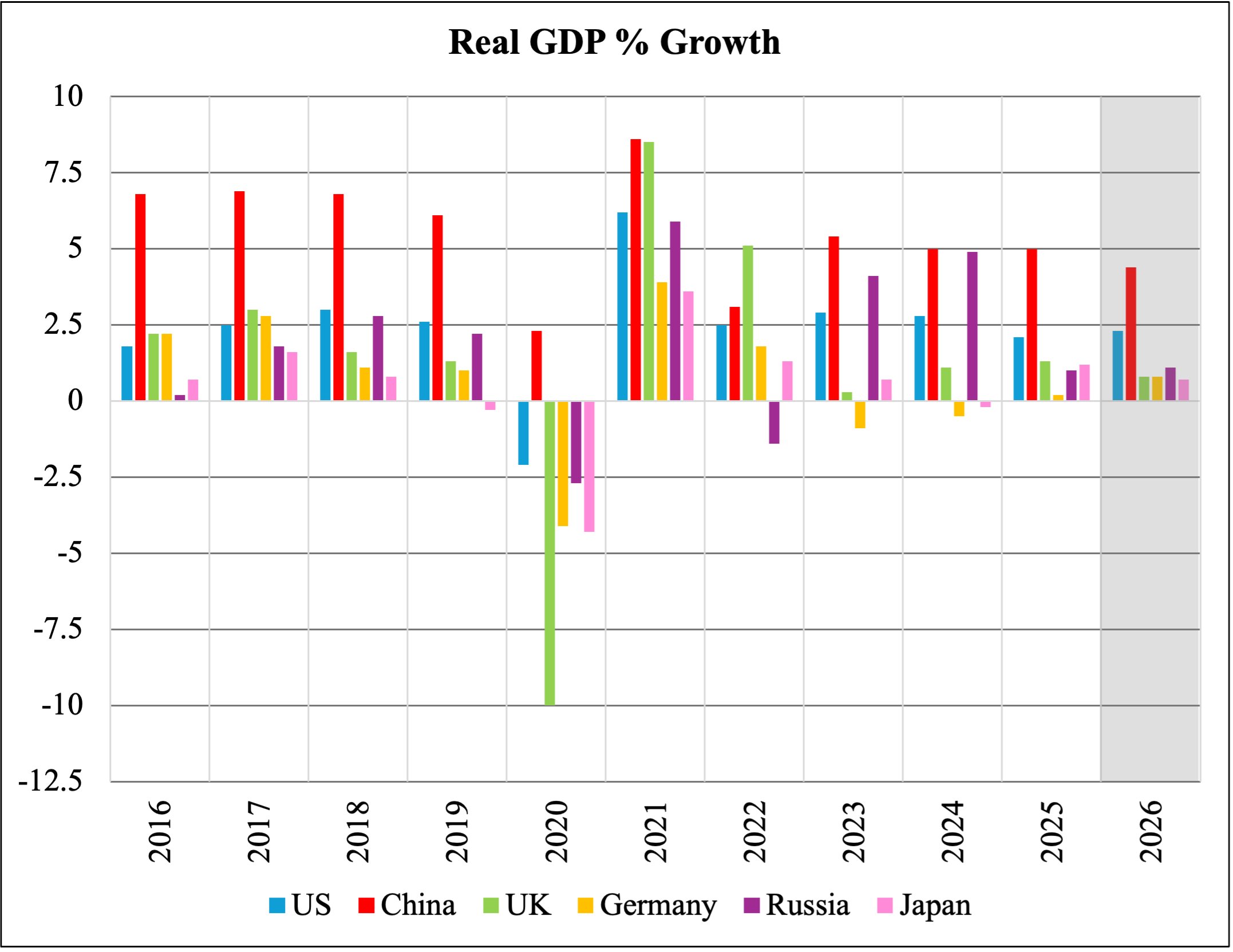
- “6/ This week’s Wall Street Journal took China’s announcement that its economy grew at 4.3% in the second quarter of this year to publish a headline: ‘China’s Economy Grows at Weakest Pace Since 2022,” the author writes. “7/ Nowhere in the story did the author pause to ask: when was the last time the US economy grew 4.3% in a quarter?”
- “8/ Other than in quarters rebounding from recession, the US has not achieved a 4.3% real growth rate (year over year) in any quarter in more than two decades,” the author notes.
- “9/ P.S. a bonus question. Amid press reports about a failing Russian economy, consider: since Putin’s invasion of Ukraine in February 2022, how has Russia’s economy performed in comparison with the economies of Germany or the UK or the G7? The chart above makes it easy to compare Russia with the US, UK, Germany, and Japan. The uncomfortable bottom line: despite its struggles, the Russian economy has grown faster than the economies of Europe, the US, and the G7,” the author concludes.
See this link for more commentary/analysis on this subject:
Ukraine-related negotiations:
- Notte argues that any future cease-fire in Ukraine would be for Vladimir Putin “war by other means,” drawing on the precedent of the Minsk accords, which “did not solve any core problems” but allowed Moscow to entrench in occupied territory and work to destabilize Kyiv and divide the West. Having failed to turn Ukraine into a vassal and “maneuvered himself into a dead end” militarily, Putin still cannot risk total mobilization, bombing Ukraine into surrender, or striking NATO states without courting domestic unrest and Western retaliation; instead, she writes, he is likely to see a truce as a way to regain the initiative—using it to incite political turmoil in Ukraine, press “pro‑Russian factions in Europe” to resume business as usual, and let Donald Trump claim credit in hopes of widening U.S.–European rifts.
- In Notte’s view, Putin would pair a cease-fire with demands for Ukrainian elections, exploit any disorder to argue Kyiv is corrupt and unstable, and wage “endless, circular, embarrassing negotiations” to legitimize Russian control over occupied areas while pressing more pliant European capitals to sideline hawkish states like the Baltics and Poland. She warns that Moscow will assume Europe’s resolve will fade once “visible violence” recedes, and that Putin will use the breathing space to shore up Russia’s global position and look for chances to “divide and conquer” in Kyiv, Europe, and Washington. A mere halt in fighting, she concludes, “would have little chance of ending the broader conflict” unless Russia’s will to dominate Ukraine is broken—which is unlikely as long as Putin is in power—so Ukraine and its partners must treat any cease-fire not as an endpoint but as a potential prelude to the “next phase of the war.”
- Ragozin writes that Trump, who once vowed to end “Biden’s war” in 24 hours, has “put on his predecessor Joe Biden’s hat,” trying “to coerce Vladimir Putin into accepting peace on Western terms by raising the stakes to new, insane levels.” He argues that past Western attempts at coercion—from “the crude attempt to reframe the 2014–2015 Minsk agreements” to “ditching the Istanbul framework agreement”—“invariably ended in fiascos” and that today’s “tide is turning” PR campaign rests on “a constellation of dubious assumptions” about Russian weakness and Western ability to manage escalation.
- One assumption, Ragozin says, is that fuel shortages will “make the war untenable for Putin,” a view he derides as imagining Russians “as snowflakes who will turn against Putin as soon as they have to wait a whopping 20 minutes” at the pump. He contends that “Russian resilience is just beginning to be tested” while “Ukraine’s society and economy have worn down to a dangerous level,” and that Moscow is “inching towards total war,” knocking out petrol stations, food-processing plants and farm equipment, so that “Ukrainians are bracing for another horrific winter in unheated apartments, while Russians are merely at the stage of making an extra effort to fuel their cars.”
- Ragozin argues that Russians largely “buy into the Kremlin’s narrative,” seeing the conflict as “existential” and themselves as underdogs against a “Western military and economic machine,” an impression reinforced by Trump’s Iran campaign and by “rabidly xenophobic, even genocidal, anti-Russian propaganda” from some Ukrainian and Western figures. He claims that each time “peace becomes a realistic prospect, the pro-war lobby derails it” by promising that “just few hundred billion more dollars and the next technological magic wand” will defeat Russia, producing instead “hair-raising escalation” and leaving Ukraine with “far more disastrous terms of peace.” Strategic planners seeking to “weaken Russia,” he concludes, have created “a Russia that’s increasingly adaptive, technologically advanced, ready for modern war, and genuinely hostile to the West,” while “it is the Ukrainians, above all, who are paying the price.
See these links for more commentary/analysis on this subject:
- "How to Push Russia to Negotiate on Ukraine," John McLaughlin, The National Interest, 07.14.26.
- “Both Kyiv and Moscow are now buying time—for different reasons,” Balázs Jarábik X Account, 07.16.26.
- “Fareed Zakaria GPS: Ukraine Takes the War to Russia [Mikhail Zygar interviewed],” CNN, 07.19.26.
Great Power rivalry/new Cold War/NATO-Russia relations:
- Emily Ferris writes that “NATO appears convinced that the next major war will be with Russia in Europe and is making plans accordingly,” even as “there is no plausible evidence beyond Moscow’s usual range of scenario planning” for ideas like a Russian land grab in Poland. She argues that in Moscow there are “three parallel conversations” about “its current war with Ukraine; its bilateral relationship with the Americans, and the potential for a future war with NATO,” which the Kremlin “understand[s] as entirely separate.”
- The author notes that the “spirit of Anchorage” has become a Russian catch‑all, a “vague ‘set of mutual understandings’” after the 2025 Alaska summit, with “nothing tangible to hang this understanding on.” She stresses that this ambiguity lets Russian media “weaponize it” either to praise U.S. willingness “to listen to the Russian point of view” or to accuse Washington of “betrayal of the essence of Anchorage.”
- Ferris highlights a “significant and seemingly escalatory” shift when Dmitry Peskov said the “special operation… had now morphed into a war” because of Western involvement, and warned that states “considered to be directing Ukraine’s military campaign… are legitimate targets.” Yet she concludes that “war is not inevitable” and that Russia is still “leaving the door open for the Americans,” even if “the topic of the dialogue may not be what the U.S. wants to discuss.”
“We are not on course for a NATO divorce—yet,” Constanze Stelzenmüller, Financial Times, 07.14.26.
- Stelzenmüller writes that the Ankara summit “went a lot better than feared,” with “strong support for Ukraine, recommitment to collective defense and nuclear deterrence, as well as recognition of Europe’s surging defense spending.” Yet she warns “this continues to be one of the most dangerous moments in decades,” as Europe faces “an aggressive Russia sustained by China, and a U.S. vacillating between support, disengagement and hostility.” There is “no prospect of a ceasefire,” she argues; Ukraine has “a significant advantage with drone operations and long-range deep precision strikes,” but remains “weak on recruitment,” while Russia “proceeds with indiscriminate bombardments of civilian targets and is expanding hybrid warfare in Europe,” with Putin clinging to “maximalist war goals.”
- Europeans, Stelzenmüller contends, “need to plan for two distinct scenarios: a ‘fight tonight’ contingency, or larger-scale military aggression in a few years,” where “U.S. support remains absolutely vital” in the near term but “the best possible case is some American support in the short term, and credible European rearmament over the next two to three years.” A future NATO “without the U.S.,” she writes, will need a distinct “European way of warfare… based on denial, defense, resilience, industrial planning and integrated coalition command,” even as transatlantic “dependence is mutual” and “we are not yet heading for a divorce,” since “Ukraine has become a key testing ground for American weapons, doctrines and tactics, while Europe is an indispensable market for U.S. arms.”
“Washington Shouldn’t Fear NATO Expansion,” Luke McGee, Foreign Policy, 07.13.26.
- McGee argues that Trump’s opposition to NATO’s open door “misunderstands what NATO enlargement has become,” insisting that “it no longer merely extends the alliance’s security guarantees; it increasingly strengthens NATO itself.” Trump portrays aspirants as “security burdens looking for others to defend them,” but “increasingly, the opposite is true,” he writes: the newest members are “among its most serious contributors, bringing advanced defense industries, innovative military thinking, and cultures of ‘total defense’ that strengthen NATO from within.” Citing expert Keir Giles, McGee notes that “for the front-line states, the discussion is not theoretical but existential,” and that more agile Nordic and Baltic procurement systems let them “make faster progress than some of their hidebound counterparts west of Warsaw.”
- Using Sweden as an example, McGee highlights firms like Sweden Ballistics, whose TNT plant “will double the number of major factories producing NATO‑grade TNT in Europe,” and Nordic Air Defense, whose Krueger interceptor offers a cheap way to counter Shaheds; former foreign minister Tobias Billström warns that burning Patriots and fighter sorties on such drones “is not sustainable in a world where aggressors can send hundreds or thousands of these at once.” Enlargement, McGee concludes, is now about “importing military capability, industrial capacity, and strategic culture,” so “blocking future enlargement—particularly for countries such as Ukraine—would weaken rather than strengthen NATO,” because “the debate over enlargement is still often framed as though NATO were taking on new liabilities. Increasingly, it is acquiring new strengths.”
- Urbanski argues that Iran and Ukraine show “cheap mass defeats expensive platforms,” warning that Western procurement has created “serious capability gaps when… confronted with the asymmetry of today’s conflicts.” In Iran, he notes, Gulf and U.S. air defenses “expended hundreds of Patriot interceptors, at roughly $4 million each, against Iranian Shahed drones costing, at the top end, tens of thousands of dollars,” so that the United States “expended roughly half its Patriot inventory, more than 850 Tomahawk cruise missiles and over 1,000 air-launched stand-off weapons,” and concludes that “when every incoming weapon costs the attacker a fraction of what its interception costs the defender, the defender can win every engagement and still lose the war of stockpiles, available funding and public patience.” Ukraine, he writes, is “running the same play in reverse against Russia,” as “cheap, domestically produced drones” and uncrewed surface vessels costing “a few hundred thousand dollars each” have frozen the front and “knocked out around a third of Russia’s Black Sea Fleet,” proving that “air defense must be cheap to produce and deep in its layering” with “large stocks of low-cost counter-drone effectors” while scarce high‑end systems are reserved for true ballistic and cruise‑missile threats.
- A second lesson, Urbanski says, is that “autocratic regimes do not primarily aim at Western forces. They aim at the political and economic system of open societies,” citing Iran’s ability to cut crude exports “by 95% and liquefied natural gas by 99%” using “sea mines, short-range missiles, swarming fast boats and… demonstrated resolve,” and Russia’s campaign of “arson, sabotage, GPS jamming… and repeated damage to undersea power and communications cables” whose aim “is not destruction at scale; it is to impose costs, sow doubt and persuade European voters that supporting Ukraine carries the risk of escalation.” With NATO’s new 5-percent-of-GDP pledge, he warns “the danger is that taxpayers’ money flows overwhelmingly into familiar platforms and programs rather than the innovative solutions needed to avert—or win—an asymmetric exchange,” and lays out a “concrete, fundable agenda”: “invert the cost curve of air defense with cheap, layered, mass-produced counter-drone systems,” “build offensive, long-range strike capacity at low unit cost,” recapitalize mine countermeasures and undersea‑infrastructure protection, and “fund resilience: hardened, redundant nodes in energy, transport and telecommunications.” “The 5% pledge supplies the means,” Urbanski concludes; “whether that money buys civilian resilience and asymmetric advantage will decide whether Europe can hold the ambitions of autocratic regimes in check.”
- Kaushal and Savill argue that debate over “rebalancing” NATO still fixates on “a single scenario: a limited Russian seizure of territory in the Baltic states,” driving calls for “up to 300,000 additional troops and 1,400 main battle tanks,” but failing to ask “how the wider strategic context that reduces U.S. involvement changes the problem Europe is trying to solve.” They stress that Russian officers envisage any regional war as one that “escalates rapidly, is decided primarily in the rear and in which the initial period of conflict is critical,” meaning that “the theatre wide balance—particularly deep strike and integrated air and missile defense (IAMD)—is of far greater consequence than the local balance of capabilities at any point on the front.” In a U.S.–China crisis, they write, “Russia’s best options… might not be in Europe but rather in ensuring a Chinese victor,” so the key role for European forces would be “whether Russian capabilities most relevant to the Pacific balance could be pinned in European Russia,” requiring pressure on the Northern Fleet and “deep precision strike capabilities to hit targets deep within Russia,” which “currently, Europe has relatively little.”
- The authors propose shifting from a pure denial posture toward “cost imposition and risk manipulation,” saying Europe’s objective “need not be to convince Russia that it can defend every inch of soil under all circumstances,” but rather “to increase the risks of intervention to the point where neutrality appears the safer course.” They advocate investing in long-range strike, IAMD, sea denial, special operations, and persistent pressure on “industrial and military assets most critical to Russian power” that lie “within several hundred kilometers of Finland in the north and Ukraine in the south,” arguing that such instruments are “considerably less expensive than recreating a purely denial-orientated force model sans the U.S..” Europe, they conclude, “risks preparing for the wrong war:” if a U.S.–China confrontation defines the context, “European deterrence cannot simply consist of recreating America’s contribution to today’s NATO plans,” but must “shape Russia’s incentives within a wider global contest,” because deterrence “need not depend upon the ability to defeat Russia outright. It need only convince Russian decision-makers that action would leave Russia worse off than restraint.”
“Closing Europe’s dangerous missile gap,” The Economist, 07.19.26.
- The article notes that as “America’s withdrawal from the continent is accelerating,” European NATO members agreed in Ankara to speed up “deep precision strike” capabilities, with “a dozen NATO members… sign[ing] a commitment to invest $50bn to develop missiles jointly over the next decade,” and a related program for ground‑launched missiles. The Pentagon meanwhile cancelled a planned Tomahawk/Typhon deployment to Germany, after having used “more than 1,000 Tomahawks, about a quarter of its stockpile” in the opening days of the Iran war.
- Germany secured Trump’s approval for an order of “400 Tomahawk missiles, to be delivered by 2029,” but analyst Nico Lange said, “I do not believe 2029 for a second,” arguing that replenishing U.S. stocks “could take up to four years” and Berlin “cannot wait.” Many European deep‑strike projects (a German‑British >2,000 km missile, the Stratus successor, MBDA’s 1,000 km Land Cruise Missile) are “not scheduled to enter service until the 2030s,” the author writes.
- Germany now wants missiles with “production… in Europe,” deployment “next year,” and no components that let America restrict their use. Contracts are expected “within weeks” for systems such as Destinus–Rheinmetall cruise missiles “from 300 kilometers to 2,000 kilometers,” with industrial‑scale production “later this year,” as Europe races for cheap, mass‑produced stopgaps.
- Germany’s land forces chief Christian Freuding tells the FT that Ukrainian troops are now “not only ‘the most combat-experienced’ but also ‘quantitatively the strongest’” in Europe, with an 800,000‑strong force, and that “what we learn from the war in Ukraine must have an influence on the way we fight and therefore also on the way we organize ourselves, procure equipment and arm ourselves.” He says several dozen Ukrainians have come to German ranges to share expertise on “the use of drones and defense against unmanned systems,” calling the experience “extremely valuable” and saying “there were many new aspects that we would not have understood in the same way without the Ukrainians’ support.”
- The article notes that after initially shying away from arming Kyiv, Germany has “emerged as one of Kyiv’s staunchest supporters,” last year surpassing the U.S. as “the single largest provider of military aid” and now treating the relationship as “a two-way exchange” as Berlin rebuilds the Bundeswehr with a €700 billion five‑year budget. Freuding says it is “very difficult to assess” whether the tide has turned, but admits “it’s fair to say that there is positive momentum behind Ukraine,” since it can “maintain its air defenses, albeit with gaps” and “damage Russia’s war machine through these deep strikes.” He dismisses escalation fears, arguing Russia has “in effect, been escalating this war for the past four years,” and insists German troops “would not hesitate to engage in direct combat with Russian forces if necessary,” declaring, “Germany and the German army can be relied upon absolutely,” even as he acknowledges a “shifting relationship with the U.S.” but says he has “no doubts” the transatlantic alliance will function regardless of “individual people or… administration”
See these links for more commentary/analysis on this subject:
- For the schedule and speakers of the July 14-19 Aspen Security Forum, follow this link. To watch the panels from the forum, please follow this link.
- “The Lost Art of Coercion,” Reid Pauly and Matthew Cebul, Foreign Affairs, 07.16. 26.
- “A Dangerous Game in the Arctic: Trump’s Demands Could Derail Progress on Allied Defense,” Heather A. Conley, Foreign Affairs, 07.17.26.
- "How NATO is preparing for war," Igor Istomin, Russian International Affairs Council (RIAC), 07.16.26. (In Russian.) (This organization is affiliated with the Russian authorities.)
China-Russia: Allied or aligned?
- Wei and Grove argue that “four years of war and economic isolation have reduced the Russian president to a supplicant in a relationship growing more imbalanced—and at times tense.” They stress that “there are no signs the strategic partnership between Beijing and Moscow is about to break apart—if anything, China’s support for Russia has only deepened since its invasion of Ukraine.” Yet the power balance has flipped. In 2013, Xi “expressed his admiration for the Russian leader, calling him his ‘role model.’” Now, they write, Putin’s war “handed Xi the leverage to finish a structural power shift that was already underway, turning what was once a partnership of near equals into a relationship China now dominates in almost every dimension.”
- Economically, the authors note that when Xi and Putin first met, “China accounted for roughly 10% of Russia’s overall trade.” Today “that figure stands at nearly 40%,” and “China accounts for around a third of Russia’s export revenues,” while “Russia represents less than 4% of China’s overall trade.” A “flood of Chinese goods into Russia” has “inundated domestic producers” with cheaper, often better-quality products. Some analysts predict Beijing may never sign the Power of Siberia 2 gas deal; Alexander Gabuev says “it’s better to still marinate the Russians… wait for the Russian economic situation to deteriorate even further—the Russians really on their knees—to subscribe to terms that are beneficial to China.” The relationship, branded as having “no limits,” is instead shot through with asymmetry and “signs of strain,” feeding talk of a “Reverse Nixon.”
- Wei and Grove also highlight political and security frictions. Russia has “increasingly discovered Chinese espionage attempts among midlevel government officials.” Beijing is “uneasy about Russia’s deepening military entanglement with North Korea,” worried that technology transfers could “immediately push South Korea and Japan closer to the U.S.” They report that China asked Putin in 2024 to separate his Beijing and Pyongyang visits to avoid an “axis of authoritarians” image, and that Beijing “declined” Putin’s push for a Russia–China–North Korea summit. Instead, Xi went to Pyongyang himself “to reassert that Beijing, not Moscow, remains North Korea’s principal patron.” As Gabuev puts it, “China really has a very good chance to turn Russia into a kind of giant Laos, giant Pakistan… much more dependent on China, much more looking up to China as a model and as a source of modernity.”
“Thinking in Terms of a Russia-China ‘Civilizational’ Tandem,” Sergei Lavrov, Kommersant, 07.16.26. Clues from Russian Views.
- The author hails Russia‑China cooperation as “an example of building interstate communication on the principles of equality, balance of interests and mutual benefit,” rooted in the 2001 Treaty of Good‑Neighborliness, Friendship and Cooperation signed by Vladimir Putin and Jiang Zemin. The treaty, he writes, “completed the transition” from mere normalization in the late 1980s to “a fundamentally new stage of forming a strategic tandem,” giving both states “an exceptionally important role… for maintaining peace, security and stability on a global scale.” Compact but “deep and organic,” the “Big Treaty,” as diplomats call it, is praised for codifying “the absence of mutual territorial claims and the determination… to turn the common border into a belt of eternal peace and friendship,” along with mutual support for “state unity and territorial integrity,” non‑use of force, rejection of economic pressure, and bans on third states using their territory “to the detriment of Russia or China.”
- The op‑ed argues that the treaty created a “solid legal foundation” for a model of interaction “which does not imply limiting the sovereignty of either side,” giving it “advantages over ‘classical alliances’.” Relations are said to be “built on equal footing, not tied to ideological dogmas, not directed against third countries and resistant to external conjuncture.” The author cites a trade turnover that has grown “more than 30 times” in 25 years and “for three years in a row significantly exceeds $200 billion,” with Russia in China’s top five partners and almost all settlements now in national currencies so that “the share of the U.S. dollar and euro has fallen to the level of statistical error.” He stresses “strategic” energy ties—Russia as a leading supplier of oil and gas via expanding pipelines—and joint projects in nuclear power, space, navigation, agriculture, high‑tech and AI, alongside booming educational, cultural, tourism and sports exchanges that “strengthen the bonds of friendship and trust between our peoples.”
- Internationally, the article claims, Moscow and Beijing are “like‑minded” defenders of a “more just multipolar world order,” citing their May 2024 joint declaration on “the formation of a multipolar world and new‑type international relations,” built on “sovereign equality of states, equal and indivisible security, inclusive and mutually beneficial cooperation, and the supremacy of international law and the UN Charter.” The author says Russia and China “act with a single front” at the UN, co‑found and drive the Shanghai Cooperation Organization as “one of the supporting pillars of Eurasian security,” cooperate “just as fruitfully” in BRICS and the G‑20, and jointly oppose the West’s “confrontational Indo‑Pacific project” while supporting an “ASEAN‑centric” order in Asia. Praising China’s “constructive, balanced position” on Ukraine and Xi Jinping’s Global Security Initiative as “harmoniously consistent” with Putin’s idea of an architecture of “equal and indivisible security in Eurasia,” the op‑ed concludes that the 2001 treaty has “successfully stood the test of time” and “fully meets the vital interests of our countries,” and vows “under the leadership of President Putin and Chairman Xi” to keep realizing its “creative potential.”
“The Russian-Chinese Treaty on Good-Neighborliness, Friendship and Cooperation Is Like a Bilateral Constitution,” interview with Konstantin Vnukov by Gleb Gryzlov, Russian International Affairs Council, 07.14.26. Clues from Russian Views. Machine-translated. (This organization is affiliated with the Russian authorities.)
- Konstantin Vnukov argues that by the mid‑2020s, “the People’s Republic of China has definitively consolidated its status as Russia’s key partner in politics and the economy,” and that relations of “all‑encompassing partnership and strategic interaction have reached the highest level in their entire history” and are “mature, self‑sufficient, and not subject to any external influence,” according to the author. He believes that this “comprehensive partnership and strategic interaction between two great powers—Russia and China—is one of the main stabilizing factors in the international arena” and “creates more favorable external conditions for a new stage in the development of our countries.”
- Looking back to the early 1990s, Vnukov recalls that after the USSR’s collapse, relations with China became “part of Russia’s internal agenda,” with some politicians calling to “break with communist China” and “decisively condemn Beijing,” while he and his Chinese counterparts feared for the hard‑won normalization of Soviet‑Chinese relations. He credits Ambassador Igor Rogachev with playing a “crucial role” in forming a “new type of relations between Moscow and Beijing,” often “smoothing sharp corners” and taking a principled line on sensitive issues such as Taiwan and the Dalai Lama, the author notes.
- Vnukov calls the 2001 Treaty on Good‑Neighborliness, Friendship and Cooperation “the basic document covering all spheres and directions of our relations” and says that “the Treaty is similar to a constitution of a bilateral character,” whereas the 1996 declaration mainly reflected the level reached at that time. He highlights Article 6 as “revolutionary,” because “for the first time in three hundred years of territorial demarcation Russia and China formally recorded the absence of territorial claims to each other,” and pledged to “turn the border between them into a border of eternal peace and friendship, passed from generation to generation,” a goal that, in his view, has been advanced enough that the treaty was recently extended for another five‑year term.
See these links for more commentary/analysis on this subject:
- “Who is the “key enabler” of Russia’s war in Ukraine?,” Graham T. Allison X Account, 07.16.26. Main points of this thread can be found in highlight 4 of the Russia in Review news digest of July 17, 2026.
- "China has found a corner in global trade for Russia," Sergey Shelin, The Moscow Times, 07.17.26. (In Russian.)
Missile defense:
- See this link for more commentary/analysis on this subject:
Nuclear arms:
- Jake Sullivan (JS): “I guess what I believe is that they will escalate every vector in ways that could be more damaging, destructive, and even deadly. ... I find the idea that Russian troops… will actually conduct an incursion and hold territory or that you will see a clear, unambiguous Russian strike on NATO territory that they don't immediately disclaim as an accident… I think it's a real risk… But if I had to put my thumb on the scale, I would say it is more likely than not that they will continue down and intensify the current course than take this step change.”
- JS: “I think there will be this intensification and it could cause actually a much more dramatic incident than we've seen so far… That to me seems a lot more likely than what has been reported in the Telegraph, than a more direct attack on NATO territory.”
- JS: “The one place where you could see them say, ‘Look, we may take some conventional strike because we see it is just directly defensive’ would be an attack on supply lines… [A]nother defensive move they could possibly consider is to say, ‘We are in fact responding to what we have seen as an attack originating from Finland or Poland or the Baltics or Romania.’”
- Jon Finer (JF): “I think the only other thing that we haven't covered… is what will happen if Ukraine actually stops making incremental progress and starts making more substantial progress on the battlefield. And what sort of escalation could that lead to up to and including and you know, we have to say it because this is a part of Russian doctrine, a major breakthrough in the Russian lines that leads to a threat on what Russia considers to be Russian sovereign territory either its own uh, territory or Crimea, which we consider to be a part of Ukraine but Russia doesn't.”
- JF: “Does that lead Russia to contemplate again as we believe they did at least contemplate in 2022, the use of a nuclear weapon, maybe a tactical nuclear weapon on the battlefield, maybe a nuclear test somewhere else to send the message… I don't think that can be totally ruled out.”
- JF: “I guarantee you in the situation room and in NATO capitals, they are war gaming and scenario planning against … it would be, of course, the first use of a nuclear weapon since Hiroshima and Nagasaki at the end of World War II.”
Counterterrorism:
- No significant developments.
Conflict in Syria:
- No significant developments.
Cyber security/AI:
- Kirichenko and Davis argue that “the mass of recorded data generated by the Ukraine conflict is strategically and tactically invaluable,” noting that Ukraine now has “one of the world’s largest repositories of real battlefield data—and the foundation for a new generation of military AI.” Ukraine “has built massive video databases since 2014,” Defense Minister Mykhailo Fedorov calls for a “logistics shutdown,” and Dmytro Zhmailo stresses that “Ukraine was the first country in the world to enable the training of artificial intelligence models for unmanned systems based on real combat data,” according to the authors.
- “Combat data is actively used to train neural networks” in systems like Delta, while “more than 200 companies are developing AI-powered drone technologies” and “over 70 AI and computer vision systems are in use,” the authors write. They highlight Brave1 Dataroom, “built on Palantir’s software solutions,” Prisma, Palantir’s strike-planning role, and practices where “drones are assigned tasks based on intelligence, sometimes changing targets mid-flight,” as Ukraine compresses the kill chain and turns data into faster decisions.
- The authors believe “this is a new arms race. Not nuclear, but technological,” and endorse Eric Schmidt’s warning that “the next phase of the war will be determined by software.” They contend that “Ukraine holds the data. America holds the compute power. Together they hold the advantage,” and conclude that “in the AI era, the decisive strategic resource is no longer firepower. It is the ability to transform information into decisions faster than an adversary.”
See this link for more commentary/analysis on this subject:
Energy exports from CIS:
- The board notes that “during the first six months of this year, E.U. countries bought 9.89 million tons of liquefied natural gas from Russian-owned Yamal LNG,” an “increase of 18% over the same period last year,” and that these purchases “have sent billions of euros toward Vladimir Putin’s war machine, undermining Ukraine’s recent battlefield progress.” It points out that the biggest importers are “France, Belgium and Spain—ostensible allies of Kyiv,” and that “many E.U. members remain hooked on Russian LNG four-and-a-half years into the full-scale Russian invasion,” rushing to import before bans on short‑ and long‑term gas contracts take effect.
- While acknowledging that “it was understandable that the E.U. could not turn off gas taps overnight,” the editorial argues that members “have made themselves more vulnerable with legally binding mandates for net-zero emissions by 2050” and “a raft of other regulations… constricting energy supply.” It cites Germany’s plea to suspend new methane‑import rules that “make it harder to get gas from the United States,” calling the 2024 restrictions “another proof point of Brussels’s delusion that it can go after fossil fuels without first getting realistic alternatives into place,” and labels Berlin’s closure of its last nuclear plant a “huge mistake.” Concluding that “it’s embarrassing and dangerous that the E.U. remains so dependent on energy from an enemy,” the board says that “after years of pretending that sustainable and reliable energy could be conjured out of thin air, the bloc’s precarious position is unsurprising.”
“Lindsey Graham’s Plan to Pressure Russia,” Editorial Board, Wall Street Journal, 07.15.26.
- The board frames the new sanctions-and-tariffs bill as a fitting tribute to Sen. Lindsey Graham, who “spent some of his last hours in life in Kyiv,” saying Congress is now set to take up legislation that “seeks to push Mr. Putin toward peace by increasing the pressure on the Russian economy and making it tougher for the Kremlin to finance the war.” With at least 56 co‑sponsors, the updated bill would give the president explicit authority to impose tariffs “of up to 100% on the top five countries buying Russian oil and gas,” targeting the energy revenues that fund weapons and compensation for “38,000 casualties in June alone in Ukraine,” according to one estimate. Earlier drafts envisioned 500‑percent tariffs; the current version narrows the list of eligible countries and exempts those whose gas imports are under 15% of Russia’s total and that are “making a substantial effort to wean off Russian energy”—a carve‑out China and India likely would not meet.
- The legislation also goes after the “shadow fleet” Moscow uses for “illicit energy sales,” mandating sanctions on more Russian tankers and “the shadow fleet’s foreign enablers, from the ports where those vessels dock to the companies that offer supplies and maintenance to its corporate and financial providers.” Citing an IISS report that links the fleet to damaged undersea cables and pipelines and to drone launches and surveillance of NATO sites, the board argues that “weakening Russia’s shadow fleet would strengthen Western security.” The bill further mandates sanctions on “Russian politicians, military leaders, oligarchs and their families,” state firms and banks, and bans new U.S. investment in Russia or its sovereign debt. Although the president can waive measures “in the national interest,” which the board concedes “could be a weakness given Mr. Trump’s record,” it argues that was “the price of getting Mr. Trump to support the bill” and concludes that “the fastest way to end this war is to make it too costly for Mr. Putin to continue.”
“Russian Energy Is Now at Ukraine’s Mercy,” Keith Johnson, Foreign Policy, 07.13.26.
- Johnson writes that “the scale, range, intensity, and impact” of Ukraine’s recent strikes on Russian energy infrastructure “most certainly are” new, noting that drones and some missiles have hit “oil refineries, oil depots, oil export ports, and fuel tanks,” including Omsk, “Russia’s largest oil refinery,” 1,200 miles from Ukraine. Former Russian central banker Sergei Aleksashenko calls the campaign “a game-changer,” saying, “The picture has changed, and it changed this spring,” and concludes, “The war reached Russian territory… Today, the whole country is affected by this crisis.”
- OIES argues that “greater geographical potential, multiple attacks and increasingly accurate targeting of more complex refining units… is putting pressure on both the Russia domestic market and products export sales,” while the Centre for Research on Energy and Clean Air reports that in June “Russia’s seaborne oil product loading volumes hit their lowest level on record,” meaning that “between not making stuff and not selling it, Russia is glum.”
- Johnson stresses that ordinary Russians now “wait in long gas lines,” with the country beginning rationing and “Russian state media… not taking it well,” while Ukraine can produce “as many as 8 million drones a year.” Aleksashenko insists, “This is a real crisis,” and Johnson links it to U.S. moves such as the Sanctioning Russia Act, noting that a version championed by the late Sen. Lindsey Graham “that the White House had accepted” would let Trump “levy tariffs on countries that buy Russian oil,” raising the question of whether “stepped-up strikes, and their impact on the Russian economy, will change the Kremlin’s calculus.”
“Putin’s Fuel Dilemma,” Petras Katinas and Natia Seskuria, RUSI, 07.17.26.
- Katinas and Seskuria argue that Ukraine’s refinery‑strike campaign is turning a previously “distant” war into a “daily economic burden,” forcing the Kremlin to choose between “export revenues and domestic stability.” They note that on June 28 Putin for the first time admitted that Ukrainian attacks were creating “problems” and “a certain shortage” of fuel, even as more than two‑thirds of Russia’s federal regions reported restrictions on gasoline and diesel sales and retail prices jumped 3% in a week. Since late May, intensified strikes have cut gasoline output “by roughly a quarter,” pushing jet‑fuel prices at Russian airports up 17%; Moscow has extended its jet‑fuel export ban through November, is considering a diesel ban, and is negotiating emergency gasoline imports from Kazakhstan. “By turning deep-strike capability into sustained pressure on Russia’s energy system,” the authors write, Kyiv has found a way to convert battlefield operations into “economic costs” that collide with “the structural trade‑offs of a war economy.”
- The fiscal impact is mounting. They highlight that Russia exported 0.72 mb/d of gasoil in May—about $2.9 billion, or “roughly 14%” of monthly oil‑export earnings—and that restricting such exports would shrink foreign‑currency inflows while domestic subsidies balloon. Fuel‑dampener payments to refiners supplying the home market rose from “roughly $220 million” in Q1 2026 to “more than $2.5 billion in May alone,” and recent tax changes allowing compensation for imported gasoline suggest “the Kremlin is preparing for even greater intervention.” If Ukraine sustains the pressure, the authors say, Putin will face a narrowing choice set: either recognize that deep strikes are “affecting Russia’s domestic political situation” and re‑enter talks “with fewer ultimatums,” or escalate via deeply unpopular mass mobilization that would trigger new emigration, worsen labor shortages, and possibly curtail costly compensation to soldiers’ families. Economic pain alone rarely reshapes Russian politics, they conclude, but Ukraine’s synchronized military‑economic strategy may eventually force Putin into “a negotiated retreat on far less favorable terms.”
- Evans‑Pritchard argues that “the four-year stalemate in Ukraine has suddenly broken” because Ukraine’s drone campaign is wrecking Russia’s energy system. For “the first time in modern memory, Russia is having to import fuel to keep its economy and society afloat,” he writes, noting that the “Magyar’s Birds” drone force “has struck 30 oil and gas tankers in the Black Sea region since Wednesday” and “hit 147 vessels linked to Russia in 10 days, effectively closing the Sea of Azov.” Quoting Sergiy Makogon, he stresses that “Russia no longer has a safe rear, and distance is no longer protection,” as drones now range “from St Petersburg to Siberia,” with S&P Global estimating “60pc of Russia’s refining capacity may now be offline, cutting supply by four million barrels a day.”
- The author contends that this energy shock is tipping Moscow into a full‑blown economic and fiscal crisis: oil and gas budget revenues “were down 23pc during the January-to-June period from a year earlier… They are now in free-fall,” he notes, while “the Kremlin has raised refining subsidies sixfold” even as queues “reach 12 hours” and some cities ration fuel to “20 liters.” He says “the liquid reserves of the Kremlin’s rainy-day fund are exhausted,” China has “refused” to host ruble bonds, and a leaked document titled “‘on the probability of a banking crisis in Russia in 2026’ warns that the banking system is buckling behind a veneer of illusory stability,” with rumors of a coming confiscation of savings recalling “deposits at the Soviet Sberbank in 1990.”
See this link for more commentary/analysis on this subject:
- “Asymmetric Counteroffensive: The Ukrainian Armed Forces are close to imposing a complete energy blockade on Crimea and have cut off the Azov transport route,” Re:Russia, 07.17.26.
- "The End of a Gas Superpower: How Russia Lost the European Market and Failed to Replace It," Igor Volobuev, The Moscow Times, 07.14.26. (In Russian.)
Climate change:
- No significant developments.
U.S.-Russian economic ties:
- No significant developments.
U.S.-Russian relations in general:
“Thank you, Mr. President, for fact-checking yourself,” David Ignatius, Washington Post, 07.19.26.
- Ignatius notes that the declassified documents “offer a rare window on how the intelligence community does its business” and that, instead of backing Trump’s claims, they “eviscerated Russia,” as the August 2020 assessment found that “President Putin and senior Russian officials are overseeing efforts by proxies… to spread claims about former Vice President Biden” that he engaged in criminal activity in Ukraine. This “delivered a gift to the Biden family,” Hunter Biden “crowed,” Ignatius wrote.
- Foreign interference “is indeed a serious problem, and Russia has been the leading culprit,” Ignatius emphasizes, recalling that Trump spent much of his first term calling the Russia investigation a “hoax” even as Moscow tried to “undermine confidence in U.S. democratic processes.” The National Intelligence Council warned in January 2020 that adversaries could make “wholly fabricated claims” about hacked voting machines, and Ignatius argues Trump’s own conspiracy-laden speech “was doing our adversaries’ work for them.”
See this link for more commentary/analysis on this subject:
II. Russia’s domestic policies
Domestic politics, economy and energy:
- The article notes that “the Kremlin has promised veterans of its war in Ukraine help in building careers in government and politics,” and that “more than a thousand veterans have secured public positions,” yet those “advancing the furthest are overwhelmingly apparatchiks who were already embedded in the state system before going to war,” according to the author. The war has served “as a career ladder less for ordinary soldiers… than for apparatchiks already embedded in the state system.”
- As of June 2026, Meduza found “1,305 people who had taken part in the Ukraine war and had either received or retained public positions,” but at least 848 already had careers in the state or security apparatus, the Russia.Post author wrote. The war has acted mostly as a “resume builder” for “current bureaucrats, elected representatives, municipal officials, siloviki and career soldiers,” while “tens of thousands of Ukraine war veterans remain unemployed,” officials have admitted.
- Veterans are “typically appointed to positions that do not involve serious fiscal or administrative responsibilities,” the author argues; their successes are “more symbolic than politically meaningful.” Overall, “the status of Ukraine war veteran is becoming a marker of loyalty to the regime and a pathway into politics and government,” but “the most meaningful career opportunities” still go to those with “prewar links to the state, the security services or regional elites.”
- The article argues that “the petrol crisis… has become the most significant social issue this summer” and is “pushing an already unbalanced Russian economy a step further along the path to crisis,” as Ukrainian strikes on refineries intensify. The “sharp increase in petrol prices has driven inflation markedly higher,” while “shortages represent a form of hidden inflation,” since regulated prices mask the fact that “fuel prices would almost certainly rise by several tens of percentage points” without controls, according to the author.
- The crisis in refining—“Russia's largest manufacturing industry”—is “highly likely” to push industrial output into contraction, the author wrote. Output fell by “13.5%” in May and “around 25% in June,” so refining alone cuts “aggregate manufacturing growth by approximately 4.4 percentage points” and overall industrial growth by “around 2.3 percentage points.” The refining crisis hits both “falling production of petroleum products and declining crude oil extraction,” making it “difficult to see” how defense output can offset losses.
- Ukrainian drone strikes have “dealt a substantial blow to Russia's prospects for macroeconomic stabilization,” the author argued. Rising inflation will “force the Central Bank to postpone” rate cuts, worsening a “latent banking crisis” in which “companies classified as financially vulnerable now account for 66% of total corporate debt,” while strike intensity in July has “approximately doubled,” suggesting the refining crisis “has probably not yet reached its peak.”
See these links for more commentary/analysis on this subject:
- Podcast: “Russia and Ukraine’s Race to Exhaustion,” Andrew C. Kuchins and Chris Monday, The National Interest, 07.16.26.
- “Putin’s War Comes Home to Russia,” Alexey Kovalev, Foreign Policy, 07.15.26.
- "Letting Russia Burn," Nina L. Khrushcheva, Project Syndicate, 07.13.26.
- "Productivity instead of welfare as the goal of economic policy?" Vladimir Dubrovsky, The Moscow Times, 07.19.26. (In Russian.)
- "Media in Exile and in Russia: Adapting to Reality During War," Kirill Kharatyan, The Moscow Times, 07.18.26. (In Russian.)
- "Are you waiting for a crisis? Here it is!" Tatyana Rybakova, The Moscow Times, 07.14.26. (In Russian.)
- "Russia’s fertilizer king addresses life after Putin," Denis Kasyanchuk, The Bell, 07.14.26.
Defense and aerospace:
- See section Military aspects of the Ukraine conflict and their impacts above.
Security, law-enforcement, justice and emergencies:
- No significant developments.
III. Russia’s relations with other countries
Russia’s external policies, including relations with “far abroad” countries:
- Grossman explains that Trump, at the Ankara NATO summit, announced his intent to resume F‑35 sales to Turkey and therefore “decided to” lift CAATSA sanctions imposed over Ankara’s purchase of Russia’s S‑400s. CAATSA, he notes, was designed as a “secondary sanctions regime” that lets Washington penalize entities engaged in “significant transactions” with Russia’s defense or intelligence sectors, as in 2018 sanctions on China’s Equipment Development Department and in 2020 on Turkey’s defense procurement agency. By removing those penalties, Grossman argues, Trump has “implications far beyond Turkey,” especially for India and other Indo‑Pacific customers of Russian arms.
- India, he writes, has continued buying S‑400s and other systems while Washington “deprioritized CAATSA enforcement” to keep New Delhi aligned against China, but “erroneously thought that Trump’s return… would usher in a golden era.” Trump has already hit India with tariffs “for the ostensible reason” of Russian oil imports, and Grossman warns that new S‑400 orders and Su‑57 talks could become leverage for future coercion. He says Indonesia and Vietnam—both wary of CAATSA while relying on or considering Russian kit—will “breathe sighs of relief” at the Turkish precedent, as will other users such as Malaysia, Bangladesh, and Sri Lanka.
- Grossman concludes that by signaling a more “permissive approach to CAATSA enforcement,” Trump has “reduced one of the few remaining political obstacles to future Russian arms sales in the Indo‑Pacific.” CAATSA was meant to force countries to choose between Russian weapons and U.S. ties, he argues, but Trump’s reversal suggests it is “not a fixed rule but a policy tool for applying selective leverage,” which may ease pressure on partners now but “risks weakening one of Washington’s most potent instruments for constraining Russia’s global military relationships.”
Ukraine:
- “The president met [Mikhail] Fedorov for roughly six hours over the weekend and has been in contact with him almost daily since his sacking on Thursday.”
- “The Ukrainian president proposed over the weekend to bring back Mykhailo Fedorov with an expanded mandate… Under the arrangement offered, Fedorov would have overseen defense technology programs and efforts to scale production of long-range weapons, the people said, allowing him to continue pushing reforms outside the defense ministry and military command. He would also have worked to attract foreign investment into Ukraine’s defense industry.”
- “Zelenskyy offered Fedorov several alternative positions to his past defense minister role, but he has declined them, those people said.”
- “A senior Ukrainian official and two other people familiar said that Fedorov wanted only to return to the defense ministry.”
- “Beyond the calls to bring back Fedorov, Zelenskyy is under pressure to appoint a younger generation of military leaders to replace his controversial top general, Oleksandr Syrsky, who had clashed with Fedorov over how Ukraine should fight the war.”
- “Leaving Syrsky in place now would mean not only ignoring the will of society but also demoralizing the army,” Dmytro Koziatynskyi, a military veteran and an organizer of the protests, wrote on X, threatening an ‘‘indefinite’’ protest unless Syrsky was removed this week. “The general must go.”
- “Among the military leaders he [Zelenskyy] met over the weekend were Mykhailo Drapatyi, commander of the Joint Forces of the Armed Forces of Ukraine, Volodymyr Horbatiuk, deputy chief of the General Staff, and Oleh Apostol, commander of the Air Assault Forces. All are among the contenders to take over the job of commander-in-chief, according to people familiar with the matter.”
- “Leaving Syrsky in place now would mean not only ignoring the will of society but also demoralizing the army,” Dmytro Koziatynskyi, a military veteran and an organizer of the protests, wrote on X, threatening an ‘‘indefinite’’ protest unless Syrsky was removed this week. “The general must go.”
- “Western partners have urged the president to settle the matters around the military as quickly as possible.
- President Volodymyr Zelenskyy shook up his wartime government, drawing thousands into the streets Thursday across Ukraine to protest the ouster of his youthful defense minister [Mykhailo Fedorov]—seen as an innovator of the country's successful drone technology but who clashed with the traditional military establishment.”
- “In making the changes, Zelenskyy cited friction between outgoing Defense Minister Mykhailo Fedorov and Gen. Oleksandr Syrskyi, the commander of Ukraine's armed forces. "I'm just showing that if the sides can't resolve an issue, I will have to resolve it," Zelenskyy said at a news conference... The moves threw Ukraine's military leadership into an unwelcome crisis.”
- “Fedorov said he was willing to work with Syrskyi, "but we encountered a situation in which all the initiatives we proposed began to be blocked." "Under this arrangement (with Syrskyi as commander), I personally do not know how the war can be won," he said.”
- “Fedorov, 35, is considered to be a vigorous modernizer whose technological expertise is credited in part with significantly improving Ukraine's military performance in recent months against Russia's bigger army… During his time in office, he secured restrictions on Russian forces' access to the Starlink satellite communications system, allowing Ukraine to better leverage its midrange strike capabilities giving Kyiv significant battlefield advantages.”
- “On social media, Fedorov highlighted what he called his major achievements: redirecting funds earmarked for salaries into midrange strike capabilities, fiber-optic drones, reconnaissance systems and other technologies. He pointed to expanded drone procurement, Patriot missile defense contracts, successful ballistic missile tests and sweeping changes to military procurement.”
- “The Ukrainian military has rallied under Fedorov, slowing Moscow's front-line advance to a virtual standstill and striking refineries and other energy sites inside Russian territory, causing widespread fuel shortages, Western officials and analysts say. Zelenskyy's decision to fire him despite that record has dismayed many people.”
- “Before becoming defense minister in January, Fedorov headed Ukraine's digital transformation policies… As minister, he moved to combat corruption, an issue that carries particular weight with Ukrainians who have repeatedly protested graft. Fighting corruption meant working against the interests of groups that had long profited from programs within the ministry, he said in interviews. He also sought to overhaul weapons procurement to make it more transparent. He had promised sweeping military reforms, saying it had faced about 200,000 desertions and draft-dodging by some 2 million people.”
“Zelenskyy erred. Ukrainians showed how a civil society works,” Max Boot, Washington Post, 07.20.26.
- Max Boot writes that while Volodymyr Zelenskyy “has been a profile in courage with few equals since the days of Winston Churchill,” “he is not infallible,” and “once a year he makes a boneheaded decision.” Firing defense minister Mykhailo Fedorov was such an error, according to the author, who notes that “those six months saw a marked improvement in Ukraine’s military fortunes” as Fedorov “oversaw a dramatic expansion of Ukraine’s drone war” and boasted, “We transformed Ukraine into a global tech leader and a defense powerhouse.”
- The author stresses that “long-range drones are taking the battle to Russia, blowing up Russian oil infrastructure,” while “midrange Ukrainian drone strikes are isolating Russian-occupied Crimea” and “short-range drone strikes have stopped the Russian advance in its tracks.” Citing CSIS data, Boot writes that “Russian forces are now losing more than 30,000 troops killed or wounded every month,” suffering casualties “nearly eight times the rate of their Ukrainian counterparts,” while CIA Director John Ratcliffe said Russian troops “survive only 20 to 30 minutes at the front.”
- Boot argues that the clash between Fedorov and Gen. Oleksandr Syrskyi, “a symbol of an older style of blood-and-guts ground war” known as “the Butcher,” led Zelenskyy to side with the general and sack the reformist minister, which he calls “an own goal.” Yet he believes the street protests show that “Ukraine remains a vibrant democracy,” contrasting this with Russia where “criticizing the Kremlin is a crime,” and concludes that “this episode should not shake anyone’s faith in Ukraine or Zelenskyy” because “there remain checks and balances on Zelenskyy’s decision-making.
- “Beyond the personal feud of Mykhailo Fedorov and Oleksandr Syrsky, the rift between the men has become a proxy for a generational struggle between Ukraine’s technology-driven reformers and an older military establishment whose command culture was forged in the Soviet era and has struggled to adapt to a war being reshaped by drones and automation.”
- “In the unprecedented public airing of grievances, the conflict also exposed a clash of visions over how a smaller military facing manpower constraints should adapt to a rapidly changing battlefield to fight its larger foe. Kyiv’s drone campaign against Russian energy infrastructure and shadow fleet tankers in the Black and Azov seas has spurred Russia’s worst fuel crisis in decades, while its medium-range drones targeting Russian logistics in occupied Ukrainian territory have helped slow Moscow’s ground offensive into a costly and incremental advance. But the public rupture among the top of Ukraine’s wartime leadership has cast doubt over whether Kyiv can sustain its success.”
- “Fedorov’s central argument for change was that Ukraine’s military needed to adapt faster to a battlefield increasingly shaped by drones, robotics and rapid technological advances. “The war has changed completely,” Fedorov said. Drone technology now evolves several times a year, he argued, requiring faster procurement, shorter decision-making chains and a military more willing to experiment. “We cannot go on what worked then,” he said.”
- “One problem is Syrsky hasn’t got a sense of how he’s going to win,” one senior Ukrainian defense official said. “Syrsky’s theory of victory is simply to hold out as long as you can and mobilize more people.”
“I Didn’t Say ‘It’s Me or Syrskyi.’ But I Can’t Stay Silent,” Mykhailo Fedorov, NV.ua, 07.17.26. Clues from Ukrainian Views.
- In an article for NV.ua, Fedorov says his work on defense began with the full‑scale invasion—“the Starlink story with Elon Musk, the Army of Drones”—and that for seven years he “built the digital state” without corruption scandals. He lists key achievements since 2022: opening one of the world’s most favorable markets for drone companies; launching United24 and Army of Drones when “the Ministry of Defense at that time did not buy drones;” financing sea drones that “started striking Russian ships;” rescuing the Delta battlefield‑management system “from all commanders‑in‑chief;” creating strike‑drone companies that evolved into the Unmanned Systems Forces; inventing the “e‑points” system—“an Amazon for war”—letting units buy drones with rewards for confirmed kills; and persuading Elon Musk to cut off Russian Starlink after “the first Shahed with Starlink flew over central Kyiv.”
- Fedorov describes structural problems he says he could not fix: corps that “we don’t even know how many brigades are there,” brigades unable to count their own battalions, commanders constantly rotated so that “nobody is responsible for anything,” supplies distributed “manually—loyal gets, disloyal doesn’t,” and systemic blocking of initiatives so that “you can’t implement a single systemic project.” He laments that decisions on whom to reinforce are made “on the basis of loyalty,” not data from the new loss‑tracking system.
- On his conflict with Commander‑in‑Chief Oleksandr Syrskyi, Fedorov insists, “I didn’t set conditions: either me or Syrskyi,” saying he accepted Zelenskyy’s decision to keep him but that “all initiatives we propose started being blocked” and that Syrskyi was “ready to walk personally to meetings, weave intrigues” instead of discussing problems openly. Fedorov argues that “the war has completely changed” and Ukraine must fight so “we will lose drones, not people,” but “in this construction [with Syrskyi] I personally don’t know how to win the war.” He says people protested “not for Minister Fedorov” but because “the trajectory has changed,” and concludes, “I don’t need the position of defense minister to be defense minister. I need it to win the war.”
“My Job is War,” Oleksandr Syrskyi, Militarnyi, 07.20.26. Machine-translated. Clues from Ukrainian Views.
- Syrskyi says he is breaking his usual silence because “my silence has begun to be interpreted as agreement” and because a “whole mythology about conflicts and sabotage” has grown up around the army and General Staff. He insists that with Defense Minister Mykhailo Fedorov he saw relations as “working… with difficult questions, with different positions. That’s how it should be between two institutions during a big war.” If he offended anyone, “Mykhailo Albertovych, I’m sorry,” he adds, but urges everyone to “focus not on the personal, but on the global. On victory.” The key point, he writes, is that “Ukraine is bigger than Fedorov, Syrskyi and any of us,” and that “to reduce this war to a confrontation between two people is the greatest service we can do the enemy.”
- He then lays out institutional roles. “The Ministry of Defense is logistics, procurement, policy and civilian control over the Armed Forces,” he writes; “the minister does not have to be at the front line and is not supposed to be the strategist of the war.” By law, “the strategy of the war, the planning of operations, the situation at the front — this is my responsibility to the Supreme Commander-in-Chief.” Strategy “is not a public document and not a social media post… it is reported to the Supreme Commander-in-Chief, and its result is visible at the front, where a million-strong army has been holding off a superior enemy for a fourth year.” Those who demand that he “present the strategy” publicly are in fact asking him “to present it to the enemy.” On “hand‑on” command, he stresses that “a million-strong army is not commanded in WhatsApp,” but through “headquarters, orders and responsibility of commanders,” noting that he has delegated more authority to corps commanders.
- Responding to claims he “does not want to fight with drones,” Syrskyi counters that “the Unmanned Systems Forces as a separate branch of service were created by me,” and that he personally proposed major “Madyar” to lead them, an “unpopular decision” he took “fully under my responsibility.” “A person who ‘does not want to fight with drones’ does not create the world’s first separate branch of unmanned systems,” he argues. But he adds that for drones to work, “we need artillery, mortars, engineers, air defense, electronic warfare… procurement has to cover everything, not just what is trendy.” Turning a million‑strong army “onto drones in two months” would be “an obvious adventure… paid for with our land and our people.” He also criticizes recent contract and pay decisions, warning that “a soldier’s salary is not a reserve for reallocation but an obligation of the state,” and that “decisions about billions cannot be made without calculating the consequences for a million people.” He closes: “I am not at war with the ministry. I am at war with Russia… My job is war. Strategy, the front, people… Ukraine will endure if everyone does their job in their place.”
- Kobzová notes that for “the second July running, a controversial decision from President Volodymyr Zelenskyy has sparked protests across Ukraine,” this time over the firing of “popular young defense minister, Mykhailo Fedorov, after just six months on the job.” She writes that Zelenskyy blamed a breakdown between the defense ministry and military leadership, but Fedorov was “blunter,” accusing Commander‑in‑Chief Oleksandr Syrskyi of “choosing loyalty over performance, sticking to outdated ways of war fighting, and sabotaging necessary reforms,” and warning that “instead of working out how to asymmetrically defeat Russia, [Syrsky] has worked out how to split the country.” Those accusations, Kobzová argues, “call into question whether Western military assistance for Kyiv is being used in the best possible way.”
- Zelenskyy has proposed Yevhen Khmara, “a respected military commander and the acting head of Ukraine’s security service,” to replace Fedorov, but Kobzová insists parliament must decide not only if Khmara is a good commander but also “a trustworthy manager in the job.” She reminds readers that by the end of the second quarter “defense accounted for roughly 80% of Ukraine’s annual budget, with almost a third of this coming from external partners,” mainly the EU and European states, so “how these funds are spent matters for Ukraine’s success.” Ukraine’s partners, she argues, should not back a specific candidate, but should make clear that whoever is chosen “must be a credible, competent and trusted partner” able to continue reforms, tackle mobilization, civil–military relations, and corruption, and remain “committed to continuing to build up the country’s defense technology base.” With rumors about Fedorov’s political ambitions and protests suggesting many see “political preference at the expense of competence,” Kobzová concludes that “the onus is now on Zelenskyy to convince everyone that Khmara is the man for the job” and that Ukraine needs a defense minister who commands “the trust of the military, society—and international partners.”
“Ukrainians riot as draft turns ugly,” Jack Clover, The Times, 07.18.26.
- Clover notes that “more than 50,000 of the city’s residents” from Lviv are already serving in the Ukrainian armed forces, according to Mayor Andriy Sadoviy. He reports that after draft officers in Sykhiv detained one man and “threatened to take two others,” about “200 people, mainly other young men, confronted them,” overturning a draft officer’s car and defying the midnight curfew, the author wrote.
- The author stresses that official incidents of violence against recruiters have surged: “In 2022 there were only five reported instances of attacks on draft officers in Ukraine. Last year… there were 341,” Clover reports. He adds that one funeral described in the piece is part of a grim routine: “almost every day a funeral for a fallen soldier is held” at Lviv’s St Peter and Paul Garrison Church.
- Clover writes that protests erupted nationwide after Mykhailo Fedorov, aged “35,” was sacked as defense minister. Fedorov argued that Ukraine “simply cannot gather as many people through mobilization as the Russians can” and condemned the current system as offering “lies, chaos and irresponsibility,” insisting that units with strong recruitment campaigns “did not have manpower shortages but waiting lists,” according to the author.
See these links for more commentary/analysis on this subject:
- “Zelenskyy Seeks to Quell Growing Discontent Over Ouster of Defense Minister,” James Marson, Wall Street Journal, 07.21.26.
- “Volodymyr Zelenskyy sacks Ukraine’s popular defense minister,” Christopher Miller, Financial Times, 07.15.26.
- “Ukraine’s self-defeating reshuffle,” Editorial Board, Financial Times, 07.15.26.
- “Zelenskyy’s Cabinet Reshuffle Sparks Public Outcry in Ukraine,” Alexandra Sharp, Foreign Policy, 07.16.26.
- “Cabinet of Yulia Svyrydenko Lasted Only a Year. Along With Her, Zelenskyy Sacked Defense Minister Mykhailo Fedorov. Why Are Ukrainians Criticizing These Decisions?,” Konstantin Skorkin, Meduza, 07.17.26.
- “Corruption Takes Center Stage in Ukraine’s National Conversation,” War on the Rocks (The Ukraine Compass), 07.20.26.
- “Ukraine’s rift over battlefield strategy breaks into the open,” Christopher Miller, Financial Times, 07.17.26.
- “Ukraine’s defense minister walked into Zelenskyy corruption buzzsaw,” Mark Episkopos, Responsible Statecraft, 07.17.26.
- “Is sacking his defense minister Zelenskyy’s biggest mistake yet?,” Dominic Hauschild, The Times (UK), 07.18.26.
- “Ukraine’s Top General Becomes a Target of Protesters’ Anger,” Andrew E. Kramer and Cassandra Vinograd, The New York Times, 07.18.26.
- "How to bring Ukraine closer to the EU at speed," Hugo Dixon, Reuters, 07.20.26.
Russia's other post-Soviet neighbors:
- Umarov argues that Kazakhstan’s new constitution, parliament (Kurultai) and ruling party Adilet are less a true “new era” than another rebranding of the old system: “the ‘new Kazakhstan’ still stands on the old foundation,” he writes. The key signal is the Constitutional Court’s ruling that allows President Kassym‑Jomart Tokayev “to reset his presidential terms and run again in 2029,” despite earlier statements that he would leave after one seven‑year term, a move the author calls a “favorite scenario of autocrats worldwide.”
- The author contends that Tokayev has used successive “updates”—first the post‑January 2022 “de‑Nazarbayevization,” now a deeper refit—to consolidate a super‑presidential system in which “the president still controls all branches of power,” parliament “remains under presidential control,” and the new ruling party “has simply swallowed the old one along with most of its administrators.” Nazarbayev’s clan has been pushed into the shadows but largely spared: relatives and key businessmen avoided serious punishment, while “only” ex‑security chief Karim Massimov received a heavy 18‑year sentence.
- Umarov describes a generational shift to young technocrats “without their own political capital or financial empires,” loyal to Tokayev and focused on building an efficient state‑capitalist model “on the Singaporean or Chinese pattern,” not on limiting presidential power. He argues that Tokayev’s real “plan is the absence of a concrete plan, at least publicly:” by legally enabling a term reset, restoring the vice‑presidency, and keeping succession options open, he sustains elite uncertainty—yet time and age work against him, and his careful preservation of Nazarbayev’s legacy, including naming the main mosque after the first president in 2026, is meant to signal to his own future successor how he expects to be treated.
See this link for more commentary/analysis on this subject:
- "Anschluss in Romanesque," Ksenia Smertina, Russian International Affairs Council (RIAC), 07,17.26. (In Russian.) (This organization is affiliated with the Russian authorities.)
The cutoff for reports summarized in this product was 10:00 am Eastern time on the day this digest was distributed. Unless otherwise indicated, all summaries above are direct quotations.
AI was used in production of this digest.
*Here and elsewhere, the italicized text indicates comments by RM staff and associates. These comments do not constitute a RM editorial policy.
Slider photo: FPV drones are seen in a storage of the workshop of "General Cherry" company in Ukraine, on Dec. 4, 2025. (AP Photo/Evgeniy Maloletka, File)
 Russia Analytical Report