Russia Analytical Report, May 27-June 2, 2025
2 Ideas to Explore
- “Astonishing” is the adjective Economist and Politico writers used to describe Ukraine’s operation to smuggle some 150 drones into Russia and launch them in a June 1 attack on Russian long-range bombers and early-warning aircraft at bases across Russia, including one base 2,500 miles away from Ukraine. “Today’s operation is likely to be ranked among the most important raiding actions in modern warfare,” the Economist proclaimed in reference to the June 1 attack, in which an estimated record of 11 to 12 Russian long-range bombers were damaged or destroyed within one day.1 “The Ukrainians rewrote the rules of warfare again,” claimed Max Boot in his Washington Post column. Ukrainian leader Volodymyr Zelenskyy lauded the attack, calling it “brilliant,” and even some of Russia’s pro-war commentators conceded Ukrainian creativity in this instance. The June 1 attacks showed “the enemy is strong, cunning, technically savvy,” editors of the pro-war Russian telegram channel Dva Mayora wrote. Notably, both pro-Kremlin commentators, such as Georgy Bovt and Aleksey Zhivov, and opposition-minded Russian commentators, such as Alexander Baunov, discussed whether the June 1attacks could increase the probability of a nuclear strike by Russia. Pro-Kremlin commentator Sergei Markov warned against a nuclear response to Ukraine’s attacks, warning that “this would lead to real political and economic isolation in the world,” while “tactical nuclear weapons would not significantly change the military situation in Russia's favor.” It should be noted that the June 1 strikes on Russian long-range bombers, which form the air leg of Russia’s strategic nuclear triad, could theoretically satisfy the criteria for Russia’s use of nuclear weapons per its 2024 Basic Principles of State Policy of the Russian Federation on Nuclear Deterrence.”2 That said, however, even if all of the estimated seven Tu-95 bombers damaged or destroyed in the attack could not be repaired, that would still leave Russia with an estimated total of 45 such bombers and 15 more advanced Tu-160 bombers, meaning the air leg of the Russian strategic nuclear triad would still have 60 aircraft. Thus, while the tactics used in the June 1 attack contain innovations, such as mass launches of UAVs against multiple targets from trucks, the losses this attack has caused are unlikely to have a decisive impact on either the Russian strategic nuclear triad (which mostly relies on ICBMs), or on Russia’s ability to launch cruise missiles at Ukraine.*
- “Ukraine and Russia agreed to hold a new prisoner exchange and swapped memorandums on a possible ceasefire to end Vladimir Putin’s three-year war,” but remained “far apart on terms for a lasting ceasefire after a second round of peace talks in Istanbul” on June 2, Financial Times reported. Ukraine should pursue a peace deal in earnest because it is losing in the war of attrition, according to George Beebe, while Moscow should follow suit because “although Moscow can break Ukraine, it cannot fix it.” “Only Trump can deliver the kind of deal that can secure Ukraine, stabilize Europe and still address Russia’s core concerns,” Beebe writes in a commentary for Responsible Statecraft. See the texts of both memoranda in the section on “Ukraine-related negotiations” to compare Russia’s and Ukraine’s negotiating positions.
I. U.S. and Russian priorities for the bilateral agenda
Nuclear security and safety:
- No significant commentary or analysis in monitored publications.
North Korea’s nuclear and missile programs:
- “Kim Jong-un.... found a solution to his country’s decades-old problem. He courted Russia after it invaded Ukraine three years ago and ran into a dire shortage of both troops and conventional weapons, like artillery shells. North Korea had plenty of both to provide.”
- “In return, Moscow has revived a Cold War-era treaty of mutual defense and cooperation with Pyongyang, supplying North Korea not only with fuel and food, but also with materials and technologies to modernize its military, according to South Korean officials and analysts. They warn that the growing expansion of military cooperation between Russia and North Korea, if left unchecked, could threaten a delicate military balance around the Korean Peninsula.”
- “There remains doubt over how much sensitive technology Russia is willing to share with North Korea. North Korea has repeatedly failed to launch military spy satellites. And to build a nuclear-powered submarine, the country would need a small nuclear reactor.”
Iran and its nuclear program:
- “For Russia, the unexpectedly dynamic negotiations between Washington and Tehran pose something of a dilemma. Overall, the lifting of sanctions against Iran is not in the Kremlin’s interests. The current situation, in which Iran is being forced to strengthen its relationship with Russia due to being isolated from the West, suits Moscow very well.”
- “The ideal scenario for Russia... would be for negotiations between Tehran and Washington to go on endlessly without yielding any concrete result. In a sense, that is what is happening now, but the situation could swing one way or another at any time.”
- “Despite all the costs that an end to sanctions against Iran would entail for Russia, making Moscow into an indispensable mediator between Tehran and Washington would give it a sense that it had escaped its isolation. It would also give the Russian side real leverage over U.S.-Iranian relations. Ultimately, however, endless and fruitless negotiations would still be preferable for Russia, avoiding both the prospect of a military attack on Iran and of sanctions being lifted.”
- “Iran and Russia are deepening their political and military relationship through intermediary companies that facilitate their defense collaborations and flout global sanctions regimes. This report examines the case of Iran’s role in developing Russian unmanned aerial vehicle (UAV or drone) production capability, which Russia is using to wage its war in Ukraine. Leaked records indicate that the Iranian company Sahara Thunder led an extensive collaboration with the Russian company Alabuga JSC to provide the latter with the technology and know-how to produce a variant of the S-136 UAV.”
- “Key aspects of the partnership include the following:”
- “Close Ties to the State”
- “UAE Intermediaries”
- “Mixed Payment Systems”
- “Relationship Development”
- “As the United States and other countries seek peace in Ukraine and consider their strategies, policymakers should not consider Russia or Iran within a vacuum but instead as interdependent actors.”
Humanitarian impact of the Ukraine conflict:
- No significant commentary or analysis in monitored publications.
Military and security aspects of the Ukraine conflict and their impacts:
"An Astonishing Raid Deep Inside Russia Rewrites the Rules of War," The Economist, 06.01.25.
- “Ukraine’s main security agency, the SBU ... said at least 41 Russian aircraft were destroyed or damaged [by Ukrainian drones] across four airfields, including rare and extremely expensive A-50 early-warning planes (Russia’s equivalent of the AWACS) and Tu-22M3 and Tu-95 strategic bombers.”
- “Commentators close to the Ukrainian security services suggest that as many as 150 drones and 300 bombs had been smuggled into Russia for the operations. ... The drones used Russian mobile-telephone networks to relay their footage back to Ukraine, much of which was released by the gleeful Ukrainians. They also used elements of automated targeting, the accounts claim.”
- “Russia has relatively small numbers of strategic bombers—probably fewer than 90 operational Tu-22, Tu-95 and newer Tu-160s in total. The planes can carry nuclear weapons, but have been used to fire conventional cruise missiles against Ukrainian targets, as recently as last week. … The last Tu-22M3s and Tu-95s were made more than 30 years ago—and their replacements, the Tu-160, are being manufactured at a glacial pace.” The June 1 attacks on Russia’s long-range nuclear capable bombers can be interpreted as creating one of the “Conditions for the Transition of the Russian Federation to the Employment of Nuclear Weapons” per its December 2024 update of its “Fundamentals of State Policy of the Russian Federation on Nuclear Deterrence.” “The conditions that enable the possibility of nuclear weapons employment by the Russian Federation are as follows: ... actions by an adversary affecting elements of critically important state or military infrastructure of the Russian Federation, the disablement of which would disrupt response actions by nuclear forces.” The June 1 attacks were not the first time Ukrainian drones attacked bases hosting Russia’s long-range nuclear capable bombers and damaged them. The bombers are part of Russia’s strategic nuclear triad, but are also used to fire conventional cruise missiles at Ukraine. Ukrainian drones also attacked Russian early warning radar.
- “Today’s operation is likely to be ranked among the most important raiding actions in modern warfare. According to sources, the mission was 18 months in the making.”
- “A Ukrainian intelligence source … described the operation as a multi-stage chess move, with the Russians first encouraged to move more of their planes to particular bases by Ukrainian strikes on other ones. Three days before the attack, dozens of planes had moved to the Olenya airfield in Murmansk province, according to reports published at the time. It was precisely here that the most damage was done.”
- “Western armed forces are watching closely. ... America’s own strategic bombers are visible in public satellite imagery, sitting in the open. ‘Imagine, on game-day,’ writes Tom Shugart of CNAS, a think-tank in Washington, ‘containers at railyards, on Chinese-owned container ships in port or offshore, on trucks parked at random properties … spewing forth thousands of drones that sally forth and at least mission-kill the crown jewels of the [U.S. Air Force].’ That, he warns, would be ‘entirely feasible.’”
"Ukraine Just Rewrote the Rules of War," Max Boot, The Washington Post, 06.01.25.
- “The Ukrainians rewrote the rules of warfare again on Sunday. .... [P]resident Volodymyr Zelensky claimed that Operation Spiderweb, as the Ukrainians are calling it, destroyed or disabled a third of the bombers Russia has been using to launch long-range cruise missiles against Ukraine. Among the Russian planes that were hit, reportedly, were Tu-95 and Tu-22 bombers and A-50 airborne early warning and control aircraft, akin to the U.S. AWACs.”
- “Little wonder that Russian military bloggers rushed to compare Sunday's attack to the one on Pearl Harbor 84 years ago.”
- “The Ukrainians revealed a vulnerability that should give every general in the world sleepless nights. If the Ukrainians could sneak drones so close to major air bases in a police state such as Russia, what is to prevent the Chinese from doing the same with U.S. air bases? Or the Pakistanis with Indian air bases? Or the North Koreans with South Korean air bases?”
- “During the infamous Trump-Zelensky argument in the Oval Office in February, the U.S. president told his Ukrainian counterpart: ‘You don't have the cards.’ Well, Zelensky just played — if you will pardon the phrase — his trump card: Ukrainian ingenuity.”
- “While signaling Ukrainian resolve, Sunday's attack could also undermine nuclear stability, because the same bombers that launch conventional cruise missiles against Ukraine are also designed to launch nuclear weapons.”
- “The drone strike, while raising the strategic stakes and no doubt provoking Russian retaliation, is exactly the kind of high-pressure tactic needed to persuade Putin to negotiate in earnest.”
“Playbook: Russia’s Pearl Harbor,” Jack Blanchard with Dasha Burns, Politico, 06.02.25.
- “The facts are astonishing: More than 100 drones were smuggled deep into Russia by Ukrainian spies and hidden in the rooftops of specially constructed wooden cabins. These roofs then opened remotely at the moment of attack, with the drones swarming out and striking more than 40 bomber jets parked at Russian airfields across the country. One of the targets — the Belaya airfield in Siberia — is 3,500 miles from Ukraine (the same distance as D.C. is from your author’s house in south London). Yet Russia never saw it coming.”
- “Experts agree: This is a game-changing moment in modern warfare, with repercussions for every serious military on the planet, including here in America. At relatively little expense — although with jaw-dropping audacity — a small-ish nation has delivered a major strategic setback to one of the most powerful militaries on earth, deep inside its own territory. The U.S., China and others will be intently watching. Russian pro-military bloggers called it ‘our Pearl Harbor’ — though this was no unprovoked attack.”
- “Speaking to the WSJ, defense analyst George Barros likens yesterday’s attacks to ‘killing the archers, instead of intercepting the arrows.’”
- “Ukraine conducted a large-scale and simultaneous series of drone strikes against multiple air bases in Russia on June 1.”
- “Ukraine continues to innovate its drone technology and tactics to achieve operational surprise and successfully target Russian military infrastructure in the rear.”
- “Ukraine's drone strike operation against strategic Russian aircraft may at least temporarily constrain Russia's ability to conduct long-range drone and missile strikes into Ukraine.”
- “Russia will likely struggle to replace the aircraft that Ukrainian forces damaged and destroyed.” If Russia were to replace those, it is unlikely to try to build more Tu-95s or Tu-22s as construction of both were discontinued decades ago.
- “Russian officials and milbloggers continue to blame Russian leadership for failing to defend Russian military infrastructure from Ukrainian drone strikes — a widespread complaint throughout the war after successful Ukrainian strikes.”
- “Russian state media and milbloggers attempted to frame Ukraine's strikes against legitimate Russian military targets as undermining Russia's nuclear stability and as grounds for a Russian nuclear response – mirroring the Kremlin's repeated nuclear saber-rattling throughout the war that has aimed to prevent Western support for Ukraine.”
- “Russia recently conducted its largest air attack on Ukraine, targeting Kyiv and other regions in the country and killing over 15 people and injuring dozens. The attacks, which occurred over the weekend of May 25 during stalled negotiations, were an order of magnitude higher and more deadly than previous salvos. Russia launched a record number of Shahed drones, with 355 deployed on May 25 alone. Alongside these low-cost, long-range loitering munitions, there was a significant increase in the number of Iskander ballistic missiles fired at Ukraine. Typically averaging 1–2 launches per week, 23 were reportedly fired over just two days, accompanied by more than 60 reported air-launched cruise missiles, including models like the X-101 and X-555. In total, approximately 1,000 drones and missiles were launched during this roughly three-day period, demonstrating the use of air and missile power to coerce Ukraine.”
- “The record number of Shahed drones signals Russia’s concept of coercive airpower: overwhelm Ukraine’s air defenses and attack civilian targets and infrastructure to compel Kyiv to end the war.”
- “Russia managed to scale up its drone launches primarily through expanding its domestic production of Shahed-type drones, sometimes called ‘Geran’ in Russia.”
- “Blunting Moscow’s drone blitz requires more than patchwork fixes—it demands a layered, offense-defense strategy.”
"Is a Large-Scale Russian Offensive Imminent in Eastern Ukraine?", Nikolay Mitrokhin, Russia.Post, 05.30.25. Clues from Russian Views.
- “Russian troops are a stone’s throw from the border of Dnipropetrovsk Region in at least two areas. There is little doubt that by end-June, Russian troops will have reached the border, and not only there. The real question is whether this will become a new defensive line or the offensive will roll on.”
"The Delusions of Peacemaking in Ukraine," Dmytro Kuleba, Foreign Affairs, 05.30.25. Clues from Ukrainian Views.
- The author writes that “Kyiv could certainly hold better cards, but the country is not so desperate that it must fold now.”
- “The country supposedly holding all the cards has gained just 1,650 of Ukraine’s 233,030 square miles over the last 16 months. Put differently, Moscow has gone from occupying about 18 percent of Ukrainian territory in late 2023 to roughly 19 percent today,” according to the author.
- If Putin attacks a NATO country, then “Unlike in Ukraine, his initial goal would not be to subjugate the country but simply to expose Europe’s weakness and the falsehood of NATO’s commitment to collective security. But the following few years could be his best shot at actually seizing a piece of NATO territory,” Kuleba warns. “Moscow is capable of opening a new front while still battling Kyiv,” he claims. “Putin, then, may be preparing to fight simultaneous wars of different scales.”
- “The war in Ukraine is much more likely to continue than it is to stop,” he writes. Thus, “the best Europeans can do now is accelerate their efforts to arm Kyiv—and themselves,” according to Kuleba.
Pro-Kremlin and Opposition Russian Commentators React to Ukraine’s Attack on Russian Strategic Bombers, a review of commentaries in Russian Telegram channels, compiled by Simon Saradzhyan, 06.02.25. Clues from Russian Views. Machine-translated.
- Pro-war Russian blogger Roman Alekhin described the attack in his Telegram account as “Russia’s Pearl Harbor.” (Alekhin’s Telegram channel)
- Exiled Russian commentator Alexander Baunov wrote: “A deterrent factor for continuing support for Ukraine, especially by the United States, is Russia's possession of nuclear weapons and delivery systems. .... The strike [by Ukraine] against [Russia’s] means nuclear deterrents should demonstrate to doubters that this [Russian] nuclear threat has limits... and can be reduced and even eliminated. Moreover, to some extent, this strike should show that Russia is bluffing. Even if the operation was carried out purely by Ukraine, the intelligence data on the airfields is most likely Western. ... This means that Western countries are involved in striking elements of the Russian nuclear triad, and Russia will not dare to respond against Western countries. ... Ukraine, apparently, is ready to suffer some kind of retaliatory strike (of course, non-nuclear, since it also used non-nuclear means), so that it can demonstrate that an attack even on such important assets of Russia as the nuclear triad will not lead to retaliatory strikes on the territory of Western countries. ... restoration of strategic aviation will require huge funds that will have to be diverted either from the war or from the civilian budget." (Baunov’s Telegram channel)
- Pro-Kremlin commentator Georgy Bovt wrote in his Telegram channel:
- “The reaction [by Russia] seems quite moderate so far, but I think that the situation will develop further, since not only the blowing up of bridges took place, but also a series of attacks using drones on the facilities where the strategic forces of the nuclear triad are based. ... The previous time this had happened, it caused a rather sharp response from the Russian leadership, albeit verbal, and a warning that the next attack against the nuclear deterrent forces would cause a harsher reaction. And I think that in this situation, consultations with the United States are objectively necessary, since an attack against the strategic nuclear deterrent forces using conventional weapons more than falls under Russia's nuclear doctrine, which allows the use of nuclear weapons.” (Bovt’s Telegram channel)
- “Today's enemy attack turned out to be well-planned from the point of view of information warfare. ... A blow was dealt to the components of the nuclear triad. ... An epic failure of the special services and the traditional air defense system. ... The response must be verified, effective and adequate to the situation. You can't give one like that ‘off the cuff.’” (Bovt’s Telegram channel)
- Pro-war Russian telegram channel Dva Mayora wrote: “A cold shower. ... Today’s sabotage by Ukrainian special services on the railway and against our strategic aviation, showed that the enemy is strong, cunning, technically savvy and carries out such acts of direct action on our territory that the existing system cannot immediately respond to, even in terms of informational coverage of the events.” (Dva Mayora Telegram channel)
- Fighter Bomber pro-war Telegram channel (allegedly ran by ex-Russian warplane navigator Ilya Tumanov) wrote: “Today will later be called a black day for Russian long-range aviation. And the day is not over yet. The air base personnel were put on alert, but I can't really imagine what they can do now.” (Fighter Bomber Telegram channel)
- Pro-war Russian Telegram channel “Reporter Filatov” wrote: “In Russian law, terrorism is defined as an ideology of violence and the practice of influencing public consciousness, decision-making by state authorities, local governments or international organizations, associated with the use of force, intimidation of civilians and/or other forms of illegal violent actions.... Blowing up bridges is a terrorist act. I agree. It is not selective and civilians suffer. Attacking enemy airfields... is intimidation of military personnel.” (Reporter Filatov’s Telegram channel)
- Pro-war Russian journalist Yury Kotyonok’s wrote in his Telegram channel: “I believe that they [the Ukrainian attacks] will not affect the course of military operations in any way. Terrorism and sabotage are closer to acts of intimidation, demoralization, creating panic and disbelief in victory, plus, of course, a specific task - to disable our missile carriers. But the enemy is clearly exaggerating the success, stating that over a third of the Russian strategic aviation was disabled. This is disinformation within the framework of the information war.” (Kotyonok’s Telegram channel)
- Pro-war Russian blogger Anastasia Kashevarova: “Is Russia behaving like a country at war? No. Only a small part of Russia is fighting. It's a disgrace when the military films burning planes with a grin.” (Kashevarova’s Telegram channel)
- Exiled Russian commentator Vladimir Pastukhov wrote: “The smartest thing Putin could do now is to skip a move and not respond immediately. In fact, Putin doesn't have many spectacular ‘good’ moves in the current situation.” (Vladimir Pastukhov’s Telegram channel)
- Pro-Kremlin commentator Sergei Markov wrote in his Telegram channel wrote:
- “Zelenskyy and the West would be very happy if Russia used tactical nuclear weapons in Ukraine.
- This would lead to real political and economic isolation in the world. Because almost all neutral countries friendly to Russia are non-nuclear countries and they really do not like a strike by a nuclear country on a non-nuclear country.
- And in general, the idea of starting a nuclear war is seen as a challenge to all of humanity.
- And tactical nuclear weapons would not significantly change the military situation in Russia's favor.
- And the destruction of the Russian population of Kyiv, Kharkiv, Odesa would be politically advantageous to Russia's enemies.” (Markov’s Telegram channel)
- "Russia has lost not part of the army of the future, but part of the army of the present.” (Markov’s Telegram channel)
- Pro-Kremlin Ukrainian/Russian politician Oleg Tsarev wrote: “For some reason, many people think that we will definitely respond with a powerful blow now, because our strategic aviation has suffered serious damage. They say that this is our Russian ‘Pearl Harbor,’ and the same harsh reaction will follow, as once after that attack. But I don't think so. Our Black Sea Fleet has already suffered colossal damage - it couldn't be worse. So what? Did we ‘hit’ then?” (Tsarev’s Telegram channel)
- Pro-war Russian military commentator Aleksey Zhivov wrote in his Telegram channel:“According to the [Russian nuclear] doctrine after an attack by elements of the nuclear triad, Russia should strike Ukraine with nuclear weapons. After which Kyiv will be reduced to a puddle sparkling with glass and crackling with a Geiger counter. ... Another question is why we do not do this. That is, we ‘rewrote’ international rules by allowing the enemy to do this.” (Aleksey Zhivov’s Telegram channel) He also told a Russian media outlet: “We have every right to deliver a limited or unlimited nuclear strike against the aggressor. The range of responses is anything from declaring war to delivering a devastating nuclear strike.” (360.ru)
- Mikhail Zvinchuk’s pro-war Rybar Telegram channel wrote: “[This was] a strike on the nuclear shield. Ukrainian forces carried out the largest strike on nuclear triad facilities at strategic aviation airfields in several regions. In some cases, FPV drones hit the targets, in others, fortunately, this was prevented. ... [T]he strike was very sensitive, and talk about the opposite is self-deception on the verge of sabotage. Perhaps the losses could have been even greater if several trucks had not exploded en route. As we have already written, it is impossible to restore these losses - it is worth saying ‘thank you’ to those who were indifferent to covering airfields with air defense systems, building protective shelters and implementing other necessary measures along the line of special services.” (Rybar Telegram channel)
See these links for more commentary/analysis on this subject:
- "Ukraine Stages Audacious Attack on Airfields Deep in Russian Territory," Christopher Miller, Fabrice Deprez and Max Seddon, Financial Times, 06.01.25.
- "Ukraine's Stunning Assault Roils Russia's Global Military Strategy," Daniel Michaels and Jane Lytvynenko, The Wall Street Journal, 06.02.25.
- “In Russia Airfield Attacks, Ukraine Aims for Strategic and Symbolic Blow,” Marc Santora, Devon Lum, New York Times, 06.02.25.
Military aid to Ukraine:
- No significant commentary or analysis in monitored publications.
Punitive measures related to Russia’s war against Ukraine and their impact globally:
- “It is clear that Putin does not want peace; he has to be forced to end the war. To do that, Trump needs greater leverage. Congress can give it to him by passing the Sanctioning Russia Act, a bipartisan effort led by Sens. Lindsey Graham (R-South Carolina) and Tom Cotton (R-Arkansas),” the author argues.
- “The bill, which has a whopping 82 co-sponsors in the Senate, would impose ‘bone-crushing’ sanctions on Russia. Right now, Russia is suffering double-digit inflation, skyrocketing interest rates and catastrophic labor shortages. The only thing keeping the country’s economy from collapse is revenue from oil and gas exports.”
- “This would give Trump the power to effectively drive Russian energy sales from the global market, which would crush the Russian economy and deny Putin the funds to continue his aggression against Ukraine.”
- “If Trump is not comfortable making that determination, there is another option: He does not have to sign the bill immediately after Congress approves it. … Indeed, after it is approved in the House and the Senate, Senate Majority Leader John Thune (R-South Dakota) can hold the bill at the desk indefinitely rather than sending it to the White House — giving Trump as much time as he needs before signing it.”
“Ukraine Still Isn't Defeated," Editorial Board, The Wall Street Journal, 06.02.25.
- “Ukraine's daring weekend drone attack on military bases deep inside Russia is a brilliant example of creativity and resolve. ... The drone raids won't alter the course of the war, but they show the ability of Ukraine to strike far from its border with Russia.”
- “It's time for Sens. Lindsey Graham and Richard Blumenthal to move their bill sanctioning countries that buy oil and gas from Russia. Republicans want to defer to Mr. Trump, but Senators aren't potted plants. Sooner rather than later, they need to show they mean what they say about helping a desperate ally fight for its freedom against a marauding dictator who won't stop if he succeeds in Ukraine.”
See these links for more commentary/analysis on this subject:
- "Sanctioning Russia Will Send a Message — and Not Just to Putin," James Gibney, Bloomberg, 05.28.25.
- "Lindsey Graham's Russia Bill Is a Test for 18 Senators," George F. Will, The Washington Post, 06.01.25.
- "Trump’s Appetite for Punishing Putin Is About to Get a Key Test," Jamie Tarabay and Natalia Drozdiak, Bloomberg, 05.31.25.
- "The Contradictory Impacts of Western Sanctions on Economic Relations between Russia and Sub-Saharan Africa," Thierry Vircoulon, Institut français des relations internationales (Ifri), 05.28.25.
- “The IOC’s policy on Russia takes a complex issue and muddles it further,” Barry Svrluga, The Washington Post, 05.28.25.
Ukraine-related negotiations:
- “Ukraine and Russia agreed to hold a new prisoner exchange and swapped memorandums on a possible ceasefire to end Vladimir Putin’s three-year war.”
- “After talks Kyiv’s and Moscow’s delegations said they had agreed to swap all seriously wounded and sick prisoners, as well as prisoners of war under 25.”
- “But the two delegations did not shake hands and suggested they had made little progress on any potential deal.”
- “Vladimir Medinsky, the head of Russia’s delegation, said the upcoming exchange, set to involve ‘1,000 to 1,200’ prisoners, would be the largest since the war began, adding that Russia was ‘satisfied with the results’ of the talks.” “Medinsky said Moscow had offered a ceasefire for ‘two to three days’ on ‘specific areas of the front’ that would allow the sides to pick up the dead.”
- “Ukraine’s delegation said that Russia had rejected its proposal for an unconditional ceasefire and for the US to be more involved in the talks after Trump suggested he might attend to bring Putin and Zelenskyy together.”
- “Kyiv also said Russia only handed over its memorandum on a possible path to end the war at the meeting and declined to comment on it further.”
- “Kyiv’s delegation gave Moscow a list of several hundred Ukrainian children who were deported to Russia during the war ... Medinsky said Russia would work to reunite stranded children.”
- “Turkish President Recep Tayyip Erdoğan said the meeting was ‘great’ and added that he would move to organize a summit involving Putin, Ukraine’s President Volodymyr Zelenskyy and US President Donald Trump.”
| Ukrainian memorandum: “Ukraine-Russia Negotiations Framework”3 | Russian memorandum: “RF Proposal (Memorandum) on resolution of the Ukraine crisis"4
|
• Full and unconditional ceasefire in the sky, on land and at sea at least for 30 days (with the possibility of rolling extensions every 30 days) as a necessary background and prerequisite for peace negotiations. • Ceasefire monitoring, led by the US and supported by third countries.
IV. Confidence-building measures
| Section I: Basic Parameters of Final Settlement
Section II: Conditions for Ceasefire Option 1. Option 2. "Package Proposal":
Section III: Sequence of Steps and Timeframes for Their Implementation
|
- “Opting to sustain or even increase current levels of U.S. military and intelligence aid to Ukraine would delay defeat, but not prevent it. Many point to the slow pace of Russia’s advance along the front line as a sign that Ukraine can sustain a stalemate with sufficient Western political will. But gauging Ukraine’s fortunes by tracking Russia’s progress on the map is misleading. In a war of attrition, progress is measured not by battlefield breakthroughs, but by how many well-trained and well-equipped troops each side can put in the field.”
- “By this metric, Ukraine is in big trouble. Russia’s defense industry is greatly outproducing U.S. and European military factories in such critical munitions as artillery shells, and it is assembling attack missiles at a faster rate than the West can produce air defense missiles. At least a million Ukrainians have been killed or wounded on the battlefield; many millions more have fled the fighting for Europe, Russia, and beyond. Although Russia has also suffered great casualties, it has five times Ukraine’s current population and has employed sound approaches to training and replenishing its forces. These trends point not to a long-term stalemate, but to a World War I-style Ukrainian implosion sooner or later, probably during Trump’s term in office.”
- “Although Moscow can break Ukraine, it cannot fix it. Its territorial expanse is too vast and its war-stricken population too anti-Russian for military occupation beyond Ukraine’s east and south to be viable. Only Trump can deliver the kind of deal that can secure Ukraine, stabilize Europe, and still address Russia’s core concerns.” To test Russia’s interest in peace, Trump’s negotiators should press Moscow directly to agree to a settlement framework that codifies the key geopolitical compromise — Western assurance that Ukraine will not join NATO in return for Russia’s support for Ukraine’s EU membership — and establishes a roadmap for resolving the range of complicated issues required for a stable peace.”
- “[Isaac Chotimer] recently spoke by phone with Sergey Radchenko, a professor at Johns Hopkins School of Advanced International Studies.”
- IC: “Trump has been in office now for more than four months. What has his return told us about the war in Ukraine and the actors involved?”
- SR: “I don’t think we have learned all that much about the war. But we have learned something about what Trump wants to accomplish, and we have perhaps learned why he’s not going to be able to accomplish it… I think he ignored the complexity of the conflict. The people he appointed to run his Ukraine portfolio—people, in particular, like Steve Witkoff… don’t seem to have the necessary experience to understand the underlying issues… Also, Trump is very impatient, and Putin is playing a long game.”
- IC: “And the reason you think Putin can hold out is that the war is going better for him?”
- SR: “For two reasons: First, when you’re negotiating with someone who’s desperate to make a deal, you feel like you would effectively stand to get better conditions by waiting. [Second, Trump might not impose sanctions at all]. There’s also no clarity about what Trump means by “walking away.” It’s been very interesting to watch the Kremlin’s reaction to Trump’s threats, saying he’s becoming too emotional or he’s not getting enough information, or he should be more patient, and so on—the way that you would perhaps talk about a child or someone deeply incompetent. And maybe they are right, frankly.”
- IC: “Obviously the status quo is not great…”
- SR: “But the question is really: Is Zelensky ultimately willing to make concessions? In his steps since Istanbul, you can see that he has been willing to entertain certain ideas. For example, the notion that Ukraine will not try to reclaim the territories that are internationally recognized as Ukrainian from 1991. He has basically acknowledged that Ukraine will not do that, but he has been insisting on security guarantees… Ukraine needs real security guarantees.”
- “One of the things that the former Israeli Prime Minister Naftali Bennett asked Zelensky during one of their meetings, back in 2022, was: Why do you want those security guarantees? Do you think the Americans will actually come to your rescue? You have to use the Israeli model. But, of course, the thing that Naftali Bennett omitted from his discussion with Zelensky was, first of all, Israel is not surrounded by enemies that are as powerful as Russia. And, second, Israel has nuclear weapons. So Ukraine finds itself in an absolutely impossible predicament.”
- IC: “Just to bring the story up to the present day, I saw you tweet recently that Trump saying that Putin is ‘playing with fire’ while not actually providing Ukraine aid is ‘painfully bad diplomacy.’”
- SR: “It’s painfully bad because it’s so different from the well-known method, which is to tread softly and carry a big stick, right? Trump shouts very loudly, and there is no real stick there. The stick that has been discussed is economic sanctions, but this threat doesn’t seem credible. Where the United States could make a difference is that it could actually provide weapons to Ukraine. Is Trump willing to go that way? He’s not even talking about that. If he actually did it, he would get much better results with Putin. The way you negotiate with an adversary like Putin is, basically, you indicate that you have a greater commitment to defend Ukraine than Putin has to carry on with this war. And because you have greater economic resources, military resources, by making this commitment, you will prevail in negotiations, because Putin will understand that time is not on his side.”
- “The outlines of a likely deal are clear enough. Russia would keep territory that it controls in Ukraine's east and south, including the Crimean Peninsula. It would also receive promises from the West to lift economic sanctions and not to admit Ukraine to NATO. For Ukraine, the West could commit to military and economic support if Russia attacks again and, more immediately, to integrate Ukraine even more closely into the European economy. Ukraine's resilient, talented population would then have an opportunity to thrive.”
- “Rather than expressing actual policy and intent, the Kremlin’s cease-fire offers operate largely as tools in the information war—with the goal of shaping narratives and opinions at home and abroad. Understanding the political logic behind Russia’s cease-fire rhetoric helps explain the lack of progress toward actual de-escalation,” according to the author.
- “First, Putin’s insincere cease-fire proposals serve a domestic purpose. By signaling a willingness to pause hostilities, the Kremlin reinforces internal narratives—aimed at the Russian population—of moral restraint and political legitimacy.”
- “The second objective of Russia’s repeated but insincere cease-fire proposals is to shape international opinion. This tactic has been most effective with U.S. President Donald Trump, who has promised to end the war. For Putin, who appears to have no intention to stop fighting, talking about cease-fires he does not plan to uphold has been a highly effective way to string Trump along.”
- “Russian cease-fire rhetoric also aims to sway opinion in the global south. … [T]he Kremlin’s carefully crafted narrative of a peace-seeking Russia gives various governments room to justify their neutrality, maintain trade relations, and refrain from joining the sanctions regime.”
- “The challenge for Ukraine and its allies will be to differentiate between the Kremlin’s symbolic messaging and any signs of substantive engagement—and to respond accordingly with diplomatic efforts and coordinated pressure on Russia. So far, other approaches have produced no meaningful results.”
See these links for more commentary/analysis on this subject:
- "Putin Is Stalling, but Trump Should Stay the Course in Ukraine," Andrew Day, The American Conservative, 05.31.25.
- "Trump's Emcee Act Fails in Ukraine," Holman W. Jenkins, Jr., The Wall Street Journal, 05.28.25.
- "To End the War in Ukraine, Trump Should Treat Putin the Way He’s Treating Harvard," Renée Graham, The Boston Globe, 06.01.25.
- "Now Is the Moment to Pressure Putin, Not Appease Him," Editorial Board, Bloomberg, 05.28.25.
Great Power rivalry/new Cold War/NATO-Russia relations:
- “Four months into his term, Mr. Trump's preference for praising and excusing Mr. Putin has not stopped the bloodshed in a war he once bragged he would end in just 24 hours. After weeks of Mr. Trump claiming he could leverage his relationship with the Russian leader to bring peace, Mr. Putin's continued aggression has prompted even Mr. Trump to question whether he has been strung along.”
- ''We're going to find out whether or not he's tapping us along or not and if he is we'll respond a little bit differently,'' Mr. Trump told reporters in the Oval Office on Wednesday. ''I'm very disappointed at what happened, a couple of nights now where people were killed in the middle of what you would call a negotiation.''
- “It is unclear [if there is] fundamental breach between Mr. Trump and the Russian president.”
- “Mr. Trump at times has approached Mr. Putin as if they have a shared bond… The result is a more emboldened Mr. Putin with little incentive to end the war, according to foreign policy experts, an outcome they argue Mr. Trump should have anticipated.
- “Representative Gregory Meeks of New York, the top Democrat on the House Foreign Affairs Committee, said Mr. Trump's recent comments about Mr. Putin represent a ''change of words, not a change of actions.'' ''There are things he can do right now—sanctions is one, but also giving the Ukrainians what they need to defend themselves,'' Mr. Meeks said. ''He's been played by Putin for a long time. He's been played by Putin from the very beginning.''
- [Trump]”Administration officials offered a deal that seemed to meet Putin's minimum goals: If Russia agreed to a ceasefire, it could keep the territory it occupied in Crimea and four other regions. Moreover, Ukraine wouldn't be allowed to join NATO after the war, and sanctions against Russia would be eased. Rather than a pariah, Putin would become an economic partner for the United States.”
- “But an arrogant Putin rejected Trump's deal. He refuses to accept a ceasefire until after negotiations about the war's "root causes," where Russian sources say he plans to demand limits on Ukraine's military and political independence. Putin's version of a peace deal would give him control over Ukraine that he hasn't been able to win on the battlefield.”
- “"Putin got greedy. He thought he could get more than what was on the table," explained Eric Ciaramella, a former top Russia analyst for the CIA who's now with the Carnegie Endowment for International Peace. Now, Putin might get nothing. Russia plans to submit its terms for settlement next month, but this diktat is likely to be rejected by Ukrainian President Volodymyr Zelensky.”
- “Tatyana Stanovaya, probably the best Putin-watcher outside Russia, explained his current goal in a May 19 post on X: "What he truly wants is for Ukrainians to accept that they cannot win, that there is no point in continuing to fight against Russia, and that Moscow is prepared to persevere regardless of the cost because it views the conflict as existential."”
- “Putin's mistake, now as in 2022, is that he underestimates Ukraine's will to fight… The only way Trump can stop the carnage is to significantly raise the cost for Putin and alter the Russian president's decision calculus. Otherwise, the missiles will keep flying.”
- CA: “First, let me ask you, do you agree with Putin's assessment that they're winning? I mean, yes, you can look at the battlefield at any given day and there's maybe a foot here and a kilometer there, but in the big picture, how do you assess the Russian war gains now?"
- FH: “Well, look, in the big picture, Putin isn't winning. I mean, if we look at it from our perspective, of course not. I mean, enormous slaughter of people, which is what makes President Trump so incredulous about all of this. You know, we're approaching a million casualties on the Russian side. And despite the fact that they have a huge population, I mean, this is going to have multi-generational effect. Of course, the casualties are not just people killed, the people seriously wounded and obviously traumatized by this war. He's made some gains in terms of territory, but he hasn't been able to affect the complete surrender of Ukraine. He thought it would be much easier. He's created the largest war in Europe since World War II. He's completely transformed the Russian economy into a militarized war economy. He's done an awful lot of damage. But at the same time, from Putin's perspective, you know, he has achieved a great deal in terms of actually rattling Europe and, you know, basically having a kind of an impact in proving, you know, for him that he is the country to be reckoned with. But again, you know, if we go on the other side of the ledger, we've seen Sweden and Finland join NATO. We've seen Europe, you know, step up, you know, in response to what the Russians have done. And, you know, this is now beyond just any kind of engagement and rapprochement or negotiation that he's having with Trump. He's completely transformed, I would say, not just European security, but global affairs by what he's done. And over the long term, that may not be a win and is likely not to be a win for Russia.”
“How to make time work against Putin in Ukraine,” Michael E. O’Hanlon, Brookings, 05.28.25.
- “Trump should lead a combined effort between NATO and the European Union to make Putin see that the longer the war goes on, the more Russia will suffer. Here are the chief elements of such a change in strategy:”
- Ask Congress for a new aid package for Ukraine
- Get specific on sanctions.
- Persuade European bankers to start seizing frozen Russian assets.
- Change the narrative on NATO membership for Ukraine.
- “Some of this agenda may seem to run counter to Trump’s long-standing view that the Ukraine war should not be a top U.S. priority. But Trump himself has already shown how much he does in fact care about this war—including on humanitarian grounds—and he is right to have come to that conclusion. It would be a shame to see him give up on the effort just when he is poised to establish a creative and promising new strategy toward the conflict.”
- “The goal should be to make Mr. Putin understand that Mr. Trump and European leaders will not abandon Ukraine. The war will remain a slog in which Russia gains small amounts of territory at a very high price.”
- “Mr. Trump likes to cite the ancient military principle of peace through strength. Ronald Reagan popularized the idea in modern times, and he used it to great effect against the Soviet empire that shaped Mr. Putin’s approach to power. Mr. Trump now has an opportunity to display strength and push Russia and Ukraine toward a settlement that would allow him to claim success and, far more important, end this gruesome war.”
- “It would not be the outright defeat that Russia deserves. It would not be a victory, however. Mr. Putin set out to conquer Ukraine and install a puppet government, and he has failed. Instead, Ukraine’s young democracy has survived and sent a message to other would-be conquerors: Wars of aggression rarely result in the thorough victories that aggressors like to imagine.”
- “I hear the narrative and most of the time what is shared is a sort of equidistance between Ukraine and Russia and the fact that it is a European conflict and that we are clearly spending too much energy, too much time, and creating too much pain for the rest of the world with what is happening in Ukraine. Allow me to say this is a total mistake, because if we consider that Russia could be allowed to take a part of the territory of Ukraine without any restriction, without any constraint, without any reaction of the global order, how would you phrase what could happen in Taiwan?”
- “What is at stake in Ukraine is our common credibility, to be sure that we are still able to preserve territorial integrity and sovereignty of people. No double standard.”
- “When Ukraine, the country that renounced nuclear weapons in 1991, is the one that Russia is repeatedly invading, how could there not be a second thought?”
- “When the Democratic People’s Republic of Korea (DPRK) is developing a massive nuclear arsenal unconstrained by China and is now entering an alliance with Russia, a nuclear-weapons state, permanent member of the UN Security Council, supposed to act responsibly, how are regional countries threatened by the DPRK supposed to act?”
- “But what is happening with North Korea being present alongside with Russia on the European soil is a big question for all of us.”
- “We built this coalition of the willing regarding the Russian war in Ukraine. And the message was very clear: we will work together to the very end to provide security guarantees to the Ukrainians, to build a robust peace in this region of the world and to reinvest in our own defense and security because Russia will remain an existential threat for us.”
- The authors argue that “Trump’s actions reflect his belief that interdependence enhances U.S. power. The massive U.S. market and military force give Washington leverage. This aligns with a nearly 50-year-old argument: asymmetric interdependence favors the less dependent actor. Trump complains about the U.S. trade deficit with China but sees it as a source of leverage.”
- “Yet, even as he recognizes U.S. strength, Trump uses it in counterproductive ways, undermining interdependence—the very source of both U.S. hard and soft power. Over the last 80 years, American influence has rested not just on force but on attraction. Undermining this dual strength weakens U.S. leadership and accelerates the decline of the international order built after WWII,” according to the authors.
- “Order depends on power distribution, legitimizing norms, and institutions. Trump has rocked all three. The world may be entering a disorderly phase that won’t settle until Washington changes course. His misguided effort to boost American power could end “the American century,” the authors warn.
"Trump Always Chickens Out on Foreign Policy Too," Gideon Rachman, Financial Times, 06.02.25.
- “When it comes to Ukraine, Trump is likely to be even more wary than the Biden administration of anything that risks escalation with Russia. Despite last week’s warning from Pete Hegseth, the U.S. defense secretary, that a Chinese attack on Taiwan could be “imminent”—it also seems unlikely that Trump would risk a war over Taiwan, whatever China does.”
- “What sets Trump apart is not his reluctance to go to war—but the striking contrast between his tough-guy rhetoric and his real-world caution.”
- “It is rarely a good idea to mock a bully. Countries that suspect Trump’s ferocious threats won’t amount to much, would probably do best to keep that thought to themselves.”
"Trump ‘Watches His Mouth’ When Talking to Putin," Fyodor Lukyanov, Business Online, 06.02.25. Clues from Russian Views. Machine-translated.
- “[When asked: Does Trump respect Putin as a strong leader?] Yes, as a strong, decisive and consistent person who gets his way. Plus there is another point that I would not discount. By the way, this has been a leitmotif throughout Trump’s life. He is genuinely afraid of a nuclear war. Trump spoke about this in various interviews back in the 80s and later too. He always said that we cannot behave this way with a country that can destroy us.”
- “The question is, what kind of war will there be if, God forbid, it happens between Russia and NATO? Will mass armies be needed then or will it immediately, very quickly, go to the nuclear level? We have Sergei Aleksandrovich Karaganov, whom you mentioned. He believes that in the event of a direct escalation, it is necessary to go to the nuclear level without any discussion. And this, they say, will cool down and stop the Europeans. There are people who have a different point of view. Be that as it may, there is an idea that Europe will not be able to fight without America.”
- “Trump is a fuse in the sense that Europe understands that they cannot cope without America. And America under Trump may not want to interfere. In principle, this situation is unlikely, but if Europe and Russia clash for some reason, it is unlikely to be an attack by someone on someone. Rather, it will be some kind of crisis, an incident. For example, in the Baltic Sea. And the Americans say: “Oh, what a disaster, you should stop this.” And they distance themselves. I don’t think this is likely, but under certain conditions it is possible.”
See these links for more commentary/analysis on this subject:
- "Dismissing Putin as Crazy Is Deluded and Dangerous," Marc Champion, Bloomberg, 05.28.25.
- "Putin Worries NATO Much More Than You Think," Marc Champion, Bloomberg, 05.30.25.
- "Ensuring Stability in a Competitive World," Sir John Chipman, General Phan Van Giang, Kaja Kallas, and Nakatani Gen, International Institute for Strategic Studies, Shangri-La Dialogue, International Institute for Strategic Studies, 05.31.25.
- "Cross-Regional Security Interlinkages," Sir John Chipman, Phumtham Wechayachai, Dovilė Šakalienė, and Gilberto Teodoro Jr., Shangri-La Dialogue, International Institute for Strategic Studies, 06.01.25.
- "A foreign policy debrief with Jake Sullivan," Gideon Rachman, Financial Times, 05.28.25.
- "What Europe Needs to Lead: American Self-Sabotage Calls for European Self-Help," Theodore Bunzel and Elina Ribakova, Foreign Affairs, 05.30.25.
China-Russia: Allied or aligned?
"Speech by Russian Deputy Foreign Minister A.Yu. Rudenko at the 10th International Conference 'Russia and China: Cooperation in a New Era,'" Ministry of Foreign Affairs of the Russian Federation, 05.30.25. Clues from Russian Views. Machine-translated.
- “First of all, I would like to thank the leadership of the Russian International Affairs Council and the Chinese Academy of Social Sciences for the opportunity to speak at the 10th anniversary conference “Russia and China: Cooperation in a New Era.”
- “Today we are witnessing a global geopolitical transformation, accompanied by turbulence in the international environment. The Western community is plunging into a deep systemic crisis.”
- “Attempts to slow down or reverse the process of strengthening new centers of power are leading to the opposite effect. The main trend of strengthening a multipolar, more just world order based on the priority of international law is becoming increasingly evident. Objective factors are accelerating the processes of redistribution of development potential in favor of new points of economic growth and geopolitical influence, contributing to the democratization of international relations.” “Today, the center of global activity is shifting to Eurasia, primarily to the Asia-Pacific region. The Euro-Atlantic region has lost its status as the main driving force of global development.”
- “In conditions of increased geopolitical turbulence, strategic interaction between Russia and China plays an important stabilizing role… Our countries have a common vision of the lack of alternative to the formation of a more just and sustainable multipolar world order.”
- “Russia and China are united in their opposition to the actions and plans of the United States and its Asian satellites to militarize the Asia-Pacific region, drag elements of NATO into the region, create threats to military security near our borders, deploy medium- and shorter-range land-based missile systems here, modernize the fleet and deploy weapons on ships.”
- “We positively assess China’s constructive and balanced position on the situation around Ukraine...Russia is interested in a speedy resolution of the conflict around Ukraine.”
“US Unlikely to Unravel Robust Russia-China Ties,” Sergey Radchenko, RM, 06.02.25.
- “For all of Russian President Vladimir Putin’s strategic blunders (none more harmful to Russia’s long-term interests than his decision to invade Ukraine), his sustained support for a closer relationship with China stands out as a singular success story. This policy has in fact proved so successful that it will likely persist even after Putin’s eventual departure regardless of whatever changes his successor might make to repair Russia’s broken relations with the West.”
- “This does not mean that the United States has no leverage in this relationship. But Washington needs to decide whether it would benefit more from seeing the Russians forced into the Chinese embrace, or from tempting Russia away from China through political and economic incentives.”
- “Does this mean that the relationship is friction-free? No. Frictions remain. … The real question is how they are managed. The Chinese and the Russians have so far managed their frictions well—much better, it should be said, than America is currently managing its own alliances (though this is indeed a very low bar).”
- “Where does all of this leave the United States? It is unlikely that the U.S. will succeed in driving a wedge between Moscow and Beijing. The commonality of interests between the two is too great to permit it. Yet it is possible that by offering political and economic incentives to Russia—for instance, by effectively giving up on Ukraine and normalizing relations with Russia—the Trump Administration could encourage the Russians to at least stay neutral in any future Sino-American confrontation.”
- “The alternative would be to abandon the idea of ‘incentivizing’ Russia and focus instead on driving Moscow further into China’s embrace on the reasonable premise that the Russians will not be happy with such a situation and may therefore consider concessions on their part to re-engage with the West. The result would be the same, but the costs to America’s interests and reputation would probably be considerably lower.”
- “Chinese leader Xi Jinping was the guest of honor at Russian President Vladimir Putin’s May 9 Victory Day parade, celebrating the 80th anniversary of the Nazi defeat in World War II… This was their first in-person meeting since the Trump administration came back to power, however, and Putin and Xi were determined to display the resilience of their strategic partnership despite the U.S. imposition of tariffs on China and efforts to induce Putin to negotiate an end to his war on Ukraine. This may explain why, in a departure from previous joint statements, their May 8, 2025 agreement failed to specify that the Sino-Russian partnership was not an alliance, stating instead that it had “unique strategic value.” Nearly identical language can be found in China’s White Paper on National Security, published a few days later on May 12: “China-Russia relations have strong endogenous driving force and unique strategic value. They are non-confrontational and not directed against any third party, and are not affected by any third party, nor are they interfered with or coerced by external parties.”
- “Since 2023, Sino-Russian joint statements have all included the “Three Noes”—no alliance, no confrontation, no targeting third parties—a PRC formulation attributed to the Deng Xiaoping era. As recently as April 1, China’s Foreign Minister Wang Yi repeated this formulation in an interview with RT during a visit to Moscow. The omission of “no alliance” in the latest joint statement may indicate a further deepening of the partnership in the face of increased international pressure, but is more likely an effort to create some strategic ambiguity for deterrence purposes, as the two leaders seek to cope with a highly changeable international environment.”
- “As in previous agreements, Xi and Putin went into great detail in their shared security narratives, glossing over areas of disagreement. They issued a separate statement on strategic stability providing very detailed criticism of Western military alliances, forward deployment, missile defense, and extended nuclear deterrence. Although they claimed to be committed to avoiding escalation by nuclear states, their joint statement did not mention China’s oft-repeated admonition (in the context of Ukraine) against the use of nuclear threats. Neither did Russia’s transfer of tactical nuclear weapons to Belarus appear to count as “provocative actions taken by some nuclear states” in their estimation.”
See these links for more commentary/analysis on this subject:
- "United States’ New Ambitions for Indo-Pacific Security," Pete Hegseth, Shangri-La Dialogue, International Institute for Strategic Studies, 05.31.25.
- "Speech at the Opening of the 10th International Conference 'Russia and China: Cooperation in a New Era," Igor Ivanov, Russian International Affairs Council, 05.30.25. Clues from Russian Views. (In Russian.) (This organization is affiliated with the Russian authorities.)
- "Multipolarity and Multilateralism: ‘Split Unity’ or ‘Two in One’," Andrey Denisov, Russian International Affairs Council, 05.30.25. Clues from Russian Views. (In Russian.) (This organization is affiliated with the Russian authorities.)
Missile defense:
- “U.S. should… use the Golden Dome plan as leverage to launch renewed arms control diplomacy. Washington should use the proposal to reinitiate dialogue with other major powers, including Russia and China, on mutual restraint, transparency, and the governance of emerging missile and space-based technologies.”
- “This is especially urgent given the deterioration of existing arms control frameworks. The last major arms control agreement between the U.S. and Russia, the New START Treaty, was suspended by President Vladimir Putin in 2023. It is set to expire in 2026 with no successor in place. Despite China’s growing arsenal, arms control talks between the U.S. and China were also suspended in July 2024 over U.S. arms sales to Taiwan.”
- “At a time when arms control frameworks are crumbling and global tensions are rising, the announcement of the Golden Dome should be seen as a strategic opportunity to initiate renewed discussions on space security. Framing the proposal as a starting point for dialogue, rather than a signal of unilateral ambition, could help to stabilize a dangerously volatile moment. Otherwise, the project risks pushing the world one step further towards a more contested, militarized, and insecure future.”
"Trump’s ‘Golden Dome’: A Bridge Too Far," Vivek Mishra and Rahul Rawat, Observer Research Foundation, 06.02.25. Clues from Indian Views.
- “The feasibility of the Golden Dome project—and the scale of its technological challenges—are reminiscent of the not-so-successful history of missile defense in the U.S. The project may likely outlast Trump’s presidential tenure, and given its enormous costs, it may place a sustained burden on the U.S. annual defense budget for years.”
- “The realization of the Golden Dome faces several challenges, including bureaucratic hurdles, high costs, and questions of technological feasibility. The U.S. strategy of reducing vulnerability by bolstering its missile defense has already raised questions about the peaceful uses of the Outer Space Treaty. Ultimately, the modernization of the American missile defense is likely to entrench Washington in a game of one-upmanship with its great power rivals—China and Russia.”
See this link for more commentary/analysis on this subject:
Nuclear arms:
"America’s Latest Problem: A Three-Way Nuclear Race," Eric S. Edelman, Foreign Policy, 06.02.25.
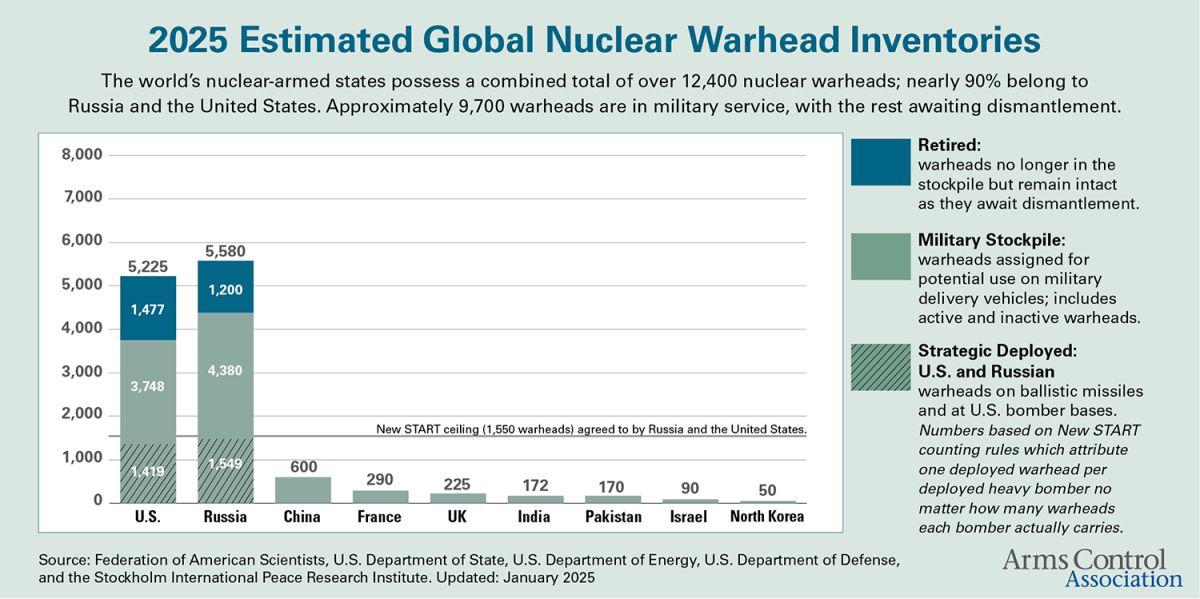
- “We will soon be in a world where Russia and China each possess nuclear arsenals on par with the United States’—and where the probability of great-power war is growing.” Russia’s nuclear arsenal is already on par with that of the U.S., according to ACA and SIPRI among others.
- “Further complicating this complex situation is tightening cooperation between Russia and China… Of particular concern is the fact that both China and Russia are developing—and in some cases deploying—capabilities that could threaten the United States’ nuclear command, control, and communications (NC3) system. These capabilities include anti-satellite systems, cyberweapons, and hypersonic delivery vehicles that have been designed to evade U.S. missile defenses.”
- “These emerging capabilities raise a specter that the U.S. government has not had to face for at least 35 years: the prospect of nuclear decapitation… Failure to fully fund ongoing efforts to modernize the U.S. NC3 system could encourage the illusion among the United States’ nuclear adversaries that a decapitating first strike might succeed.”
- “The challenge of deterring two nuclear peers simultaneously will continue to bedevil the United States for years to come. But the first order of business is to ensure that NC3 remains robust, the programs to support it are fully funded, and upgraded capabilities are delivered on time.”
- “Conceptualizing a self-reliant European nuclear deterrence remains a task stretching the strategic imagination, but the old concept of “reasonable sufficiency” offers several useful guidelines. This concept, which underpinned Mikhail Gorbachev’s decisions to deeply cut the vast Soviet nuclear arsenal, refers to how countries can economize the resources spent on countering strategic threats by focusing on asymmetric responses rather than building both symmetric offensive systems and robust defenses.”
- “The most obvious guideline of this kind is that European numerical parity—mirroring U.S. or Russian nuclear capabilities—is both impossible and unnecessary… Even if the Trump administration were to decide to withdraw U.S. tactical warheads (about 100 B-61 gravity bombs) from five bases in Belgium, Germany, Italy, and the Netherlands (plus one in Turkey), there is no need for France and the U.K. to increase their inventories of nuclear munitions.”
- “Another “reasonable sufficiency” consideration is about the limited effectiveness of missile defense, which remains the strategic reality for Europe, even if the U.S. “Golden Dome” design (fiercely opposed by Russia and China) progresses to implementation. Russia doesn’t have delivery systems exclusively designated for executing non-strategic nuclear strikes, but it has invested enormous resources in the development and deployment of dual-use capabilities that have been used in conventional combat and could also carry out nuclear missions. Therefore, the numbers and variety of naval, air, and land platforms from which different types of subsonic and hypersonic missiles can be launched are so high that the task of intercepting these projectiles is impossible.”
- “Yet another dilemma for European strategy-making comes from the need to assure Ukraine’s non-nuclear status—and to dissuade Russia from escalating its aggression using nuclear means. The only way to address both needs is to integrate Ukraine into the reconfigured European security system, not necessarily by granting it NATO membership, but with a big leap in expanding defense-industrial ties… Upgraded conventional capabilities as well as upgraded resilience against unconventional attacks remain the best European shield against the multipronged Russian threat. The resources necessary for these upgrades can only be found if European nuclear deterrence policy, clarified through extensive debates, is based on the guidelines of an updated reasonable sufficiency.”
- JS: “And we [suppled Ukraine what it needed] through thick and thin. We did that for every nuclear threat. Through the entire period where there was a raised potential for the potential use of tactical nuclear weapons in Ukraine…”
- GR: “And I think I read that you were told at some point that there was a 50% chance that…”
- JS: Well, I think that is slightly simplified. The analysis was that if there was a collapse of the Russian lines or the Russians felt that Crimea was under direct threat, 50-50 chance they would use nukes to respond to that.”
See this link for more commentary/analysis on this subject:
- "Europe's Nightmare: How Trump's ‘peacemaking’ is bringing Russia closer to conflict with NATO countries and increasing the threat of nuclear escalation," Re: Russia, 05.23.25.
- "The U.S. Military Needs to Relearn Nuclear Signaling," Philip Sheers, Foreign Policy, 05.27.25.
Counterterrorism:
- No significant commentary or analysis in monitored publications.
Conflict in Syria:
- No significant commentary or analysis in monitored publications.
Cyber security/AI:
Energy exports from CIS:
- No significant commentary or analysis in monitored publications.
Climate change:
- No significant commentary or analysis in monitored publications.
U.S.-Russian economic ties:
- No significant commentary or analysis in monitored publications.
U.S.-Russian relations in general:
- “The only route forward is to impose enough of a cost on Russia to bring Moscow to the table. That would be a sharp break from recent history… A truly revolutionary policy would require that Washington give Ukraine, Poland and the Baltic states priority over Russia. Such a policy would commit U.S.-led military staffs, intelligence and other support assets to a European-led military deployment on Ukrainian soil.”
- “This would guarantee Ukraine's sovereign independence and alignment with the West because it would create a red line for Moscow. It would make clear that Washington would meet further Russian military action with a full suite of U.S. military transfers to Ukrainian forces and actively support Ukrainian attacks inside Russia. There would be no slow-rolling of F-16s or HIMARS. The might of America's military materiel would rain down. Washington would also escalate intelligence activity against Russian spies in Europe and apply sanctions and intelligence pressure to Georgia, Belarus and even within Russia if Moscow doesn't negotiate in good faith.”
- “Mr. Trump was right when he said Mr. Putin has been "just tapping me along." The only answer is effective deterrence—or history, with its many failures, will repeat itself.”
II. Russia’s domestic policies
Domestic politics, economy and energy:
- “Strong wage increases and a tight labor market since Russian tanks crossed the Ukrainian border in February 2022 have been a critical factor in maintaining public support for the Kremlin, despite sanctions, high inflation and other economic troubles. But analysis of recruitment ads by the FT suggests that the booming salary growth for new hires weakened at the start of 2025,” the authors write.
- “Salaries for new posts rose by 4.2% between September and December 2024 in nominal terms, but only by 2.2% in the three months ending in April, according to the FT analysis,” according to the authors. “However, economists and recent consumer surveys suggest Russians’ sense of financial stability will persist, even though other data, including slowing GDP growth and falling oil revenues, point to President Vladimir Putin’s war economy losing steam.”
- “For the first time in more than a decade, the share of Russians with a positive view of their finances surpassed those with a negative outlook in mid-2024, according to the Russian pollster Levada,” according to the authors.
- “The IMF’s latest forecasts point to GDP growth slowing to 1.5% this year and 0.9% in 2026, down from over 4% in 2024. Other forecasts are more pessimistic. Much of the country’s reserves have been depleted, and new revenues are under pressure as oil prices remain low,” the authors write. “Still, it will probably be some time until most Russians feel a hit that could lead to a change in sentiment.”
See this link for more commentary/analysis on this subject:
Defense and aerospace:
- See section Military aspects of the Ukraine conflict and their impacts above.
Security, law-enforcement and justice:
- No significant commentary or analysis in monitored publications.
III. Russia’s relations with other countries
Russia’s external policies, including relations with “far abroad” countries:
- “Over the past decade, the Arctic has emerged as a strategic priority for Russia, second only to relations with post-Soviet countries, including Ukraine.”
- “Russia’s policy agenda in the Arctic is shaped by insecurities over its economic and military position in the region. ”
- “This agenda forms a “policy iceberg.” The Kremlin’s massive economic investment is the visible tip; its attempts to create a northern sea trade route buoy at the waterline with both visible economic and murkier military aims; while its militarization in the Arctic is submerged from view—and the most threatening to Western interests.”
- “On the world stage, Russia’s Arctic policy is fragmented and tactical. It cherry-picks from international law, clumsily balances relations with big powers, and flirts with alternative Arctic institutions.”
“Europeans need to situate Russia’s growing ambitions in the region within Moscow’s broader strategic aims, especially in Ukraine, and respond by rethinking their Arctic policy through closer international engagement.”
"The Man Putin Couldn’t Kill," Masha Gessen, The New York Times, 06.02.25.
- “Interpol had been looking for a disgraced finance executive for weeks when Christo Grozev, an investigative journalist, found him, hiding in Belarus. Grozev had become expert at following all but invisible digital trails—black-market cellphone data, passenger manifests, immigration records—in order to unmask Russian spies.”
- “The story of the resources that were marshaled to silence a single inconvenient voice is a terrifying reminder of what Putin, and beyond him the rising generation of autocratic rulers, are capable of. The story of how that single voice refused to be silenced—in fact redoubled his determination to tell the truth, regardless of the very real consequences—serves as a reminder that it’s possible to continue to speak and act in the face of mortal danger. But the damage that was done to Grozev’s own life and the lives of the people around him is a warning of how vulnerable we are in the face of unchecked, murderous power.”
See these links for more commentary/analysis on this subject:
- "Their War and Ours: What Russia Expects from the Conflict in Yemen," Ruslan Suleymanov, Carnegie Politika, 05.28.25. Clues from Russian Views (In Russian.)
- "Trump-Putin Talks Put Moldova’s Pro-EU Future in Doubt," Galiya Ibragimova, Carnegie Politika, 05.30.25.
Ukraine:
See these links for more commentary/analysis on this subject:
- "Rebuilding Ukraine’s Innovation Infrastructure," Salome Mikadze, Project Syndicate, 05.28.25.
- "The Gloves Are Off Between Zelensky and Mayor Klitschko," Maxim Tucker, The Times (UK), 05.30.25.
Russia's other post-Soviet neighbors:
- No significant commentary or analysis in monitored publications.
Footnotes
- The Ukrainian side estimated that 41 Russian aircraft were damaged or destroyed.
- Prior to the adoption of the new edition of the “Basic Principles” in December 2024, Ukrainian drones attacked a base hosting Russia’s long-range nuclear capable bombers and reportedly damaged some of them in April 2024. Ukrainian drones also attacked a Russian early warning radar in May 2024, again prior to the adoption of the new edition of the “Basic Principles,” which liberalizes the conditions for Russia’s use of nuclear weapons.
- As uploaded by FT journalist Christopher Miller on his X account.
- As uploaded by TASS, machine-translated.
The cutoff for reports summarized in this product was 10:00 am Eastern time on the day this digest was distributed. Unless otherwise indicated, all summaries above are direct quotations.
*Here and elsewhere, the italicized text indicates comments by RM staff and associates. These comments do not constitute a RM editorial policy.
Slider photo by Oleg Petrasiuk/Ukraine's 24th Mechanized Brigade via AP.
 Russia Analytical Report