
Russia in Review, Jan. 10-17, 2025
6 Things to Know
- This week saw Senate committees hold confirmation hearings for at least seven of Donald Trump’s nominees who would occupy secretarial-level posts, in which they would play key roles in shaping U.S. policies toward Russia.1 Of the seven nominees, only two explicitly referred to Russia or Ukraine in their opening statements. John Ratcliffe, the nominee for CIA director, in his opening statement warned that the Russian-Ukrainian war is “increasing the risk of the United States being pulled into conflict with a nuclear power.” In his turn, Secretary of State nominee Marco Rubio used his opening statement to accuse dictators in Moscow, Tehran and Pyongyang of sowing “chaos and instability and align[ing] with and fund[ing] radical terror groups.” Rubio then, in answer to questions from senators on the foreign affairs committee, called for an end to the war, asserting that it is “unrealistic” to expect Ukraine to recover all the land Russia has seized. In contrast to Ratcliff and Rubio, Secretary of Defense nominee Pete Hegseth did not mention either Russia or Ukraine in his opening statement, prompting one of the senators in the Senate’s armed forces committee to ask him whether the absence of Ukraine in that statement signaled a belief that Ukraine will stop receiving U.S. weapons. During the Q&A Hegseth said “the war needs to come to an end.” During his Q&A, Scott Bessent, Trump’s nominee for Treasury Secretary, told senators that he would support dialing up sanctions on the Russian oil industry to end the war in Ukraine. Trump’s pick for Secretary of the Interior, Doug Burgum, warned: “When energy production is restricted in America, it doesn’t reduce demand, it just shifts production to countries like Russia.” Trump’s Energy Secretary nominee Chris Wright said during the Q&A that he would be willing to grant waivers to importers of nuclear fuel from Russia only in extreme conditions. Finally, Pam Bondi, nominee for Attorney General, who, if confirmed would play a role in shaping responses to Russia’s subversive activities in the U.S., appeared before the Senate Judiciary Committee on Jan. 16. She did not mention Russia or Ukraine in her opening statement, and no references to these countries could be found in news reports on the subsequent Q&A.
- U.S. President-elect Donald Trump and Russian President Vladimir Putin are expected to hold a phone call “in the coming days and weeks,” Trump’s nominee for national security advisor, Mike Waltz, said Jan. 12. However, Putin’s foreign policy aide Yuri Ushakov, as cited by TASS, claimed on Jan. 17 that there have been no contacts “as of today” between Moscow and Trump’s team on the organization of his possible meeting with Putin. Ushakov also said Russia will be represented at Trump’s inauguration by its chargé d'affaires in the U.S. only if the Russian diplomat is invited to attend the ceremony.
- Ukraine and Russia are holding limited talks in Qatar about rules to shield nuclear facilities from being targeted, a person familiar with the Kremlin’s preparations told Bloomberg. A spokesman for the Kremlin declined to comment on Bloomberg’s report, but if accurate, the report raises the question of whether the rules would protect substations connecting nuclear facilities to the grid, which Russia has been targeting even as it was reportedly refraining from direct attacks on the three Ukrainian energy-generating nuclear plants. Ukraine has become dependent on these three plants for two-thirds of the country’s electricity generation, so the destruction of the substations that connect these three NPPs to the grid could cause significant pain, not only for the economy—including military-related production—but also for the population. In 2024, electricity outages in Ukraine lasted almost 1,951 hours (so 5.5 hours a day), according to Ukraine’s Dixi Group. Electricity outages lasted 226 hours in the period of Dec. 1–Dec. 13, according to this group.*
- In the past month, Russian forces made a net gain of 172 square miles in Ukraine (the rough equivalent of 7 1/2 Manhattan islands), according to the Jan. 15, 2025, issue of the Russia-Ukraine War Report Card that is based on data provided for that period by the Institute for the Study of War. As of Jan. 16, 2025, 18.55% of Ukraine’s territory was under Russian occupation, according to Ukraine’s DeepState OSINT group’s interactive map.
- The IMF’s latest World Economic Outlook anticipates Russia’s economic growth will slow from 3.8% in 2024 to 1.4% in 2025 and 1.2% in 2026. In comparison, world output grew by 3.2% in 2024 and is expected to grow by 3.3% in 2025 and then another 3.3% in 2026. As the table below shows, Russia’s rate of growth will be lower in 2025–2026 than that of China, India, the U.S., advanced economies as a whole and developing economies as a whole.
- Russia’s Vladimir Putin and Iran’s Masoud Pezeshkian signed a treaty on "comprehensive strategic partnership" between their countries on Jan. 17. The new treaty, which runs for 20 years, aims to strengthen Tehran and Moscow's "military-political and trade-economic" relations, the Kremlin said, according to RFE/RL. The signing of the Treaty on Comprehensive Strategic Partnership Between the Russian Federation and the Islamic Republic of Iran has been expected by officials in Moscow and Teheran, as well as by watchers of the relationship between the two countries, since at least last fall. But when Vladimir Putin and Masoud Pezeshkian inked the deal in the Kremlin on Jan. 17, it came as an anti-climax of a sorts for those in Russia and Iran that expected a significant strengthening of the two countries’ geopolitical alignment from the treaty. Even though last year saw Putin twice refer to Iran as Russia's ally at one and the same event in October 2024, while Pezeshkian did the same in July 2024, the text of the treaty, as published by the Kremlin, contains no reference to Russia and Iran being allied. Nor does it have a clause for mutual military aid of the kind that can be found in the 2024 Treaty on Comprehensive Strategic Partnership bbetween the Russian Federation and the Democratic People's Republic of North Korea. The names of both treaties use the same words to describe the bilateral relationship, but the level of military relationship that the two accords provide for differs. The 2024 Russian-DPRK agreement states: “In the event of an immediate threat of an act of armed aggression against one of the Parties, the Parties, at the request of one of the Parties, shall immediately engage bilateral channels to conduct consultations with the aim of coordinating their positions and agreeing on possible practical measures to assist each other in helping to eliminate the threat that has arisen.” In contrast, the 2025 Russian-Iranian treaty says: “In the event that one of the Parties is subjected to aggression, the other Contracting Party shall not provide any military or other assistance to the aggressor that would facilitate the continuation of aggression, and shall assist in ensuring that the differences that arise are settled on the basis of the Charter of the United Nations and other applicable norms of international law.” We have also gone through references to military and military-technical cooperation in the Russian-Iranian treaty and found none that would call for mutual military aid in the event of aggression. Neither does the treaty’s text refer to the signatories as allies or say they have allied relations, even though Iran is helping Russia's aggression against Ukraine by supplying hundreds of drones. It should be noted that the 2024 Russian-North Korean treaty did not contain such “allied” references either, but overall, Moscow and Pyongyang are considerably closer to being military allies than Moscow is with Teheran, if only because thousands of DPRK soldiers are presently engaged in direct combat on the Russian side against the Ukrainian forces in the Kursk region, shedding blood on the frontline. No other country does that for Russia, even though at least four countries have signed bilateral treaties or declarations that designate them as Russia's allies.
I. U.S. and Russian priorities for the bilateral agenda
Nuclear security and safety:
- Ukraine and Russia are holding limited talks in Qatar about rules to shield nuclear facilities from being targeted, a person familiar with the Kremlin’s preparations said. (Bloomberg, 01.15.25)
- Kremlin spokesman Dmitry Peskov on Jan. 16 declined to comment on a report by Bloomberg about limited talks between Russia and Ukraine in Qatar on protecting nuclear facilities from attacks. (Reuters, 01.16.25)
- Last year, U.S. President Joe Biden signed legislation into law that banned imports of enriched uranium from Russia. That legislation included waivers for plants to buy Russian uranium if no other viable supplier is available. Sen. John Barrasso asked President-elect Donald Trump’s Energy Secretary nominee Chris Wright, during the Jan. 15 hearings at a Senate committee on energy and natural resources if Wright would only issue those waivers in very extreme circumstances. Wright appeared to open the door to a wider swath of potential exceptions. Wright, a fossil fuel executive, has been one of the industry's loudest voices against efforts to fight climate change. Wright did not refer to either Ukraine or Russia in his opening statement. (EENews, 01.16.25, NPR, 01.16.25, RM, 01.16.25)
- Russia’s floating nuclear power plant generated the first billion kilowatt-hours for the isolated network of the Chaun-Bilibinsky power hub of the Chukotka Autonomous Okrug in Russia’s Far Northeast. (Rosatom, 01.16.25)
North Korea’s nuclear and missile programs:
- Around 300 North Korean soldiers have been killed and 2,700 wounded while fighting in Russia's war against Ukraine, a South Korean lawmaker said. (MT/AFP, 01.13.25)
- On Jan. 11, Ukraine's Security Service (SBU) stated that elements of the Ukrainian Special Operations Forces (SSO) captured a North Korean soldier in Kursk Oblast on Jan. 9 and that Ukrainian Airborne Assault Forces recently captured a second North Korean solider in the area. The SBU stated that Ukrainian authorities are working with South Korean intelligence to communicate with the POWs. Ukraine is ready to return the captured North Korean soldiers if leader Kim Jong Un can facilitate an exchange for Ukrainian soldiers being held in Russia, according to Ukrainian President Volodymyr Zelenskyy. (Bloomberg, 01.12.25, Bloomberg, 01.11.25, ISW, 01.11.25)
- The Kremlin said Jan. 13 that it could not comment on Kyiv's claim that it captured North Korean soldiers. (MT/AFP, 01.13.25)
- Since North Korea began aiding Russia’s war effort around mid-2023, there have been “unprecedented levels of traffic” observed in satellite imagery of customs areas between the two, says Victor Cha of CSIS. North Korea is also seeking designs for intercontinental ballistic missiles and re-entry vehicles, as well as submarine and satellite technology, are thought to be on the wishlist. Russia may be keener to use North Korean troops as cannon fodder than to involve them in sophisticated operations. (The Economist, 01.15.25)
- North Korean soldiers will take part in Moscow’s Victory Day parade on May 9, the Japanese public broadcaster NHK reported on Jan. 16, citing sources in Russia. (Meduza, 01.16.25)
Iran and its nuclear program:
- Iran and Russia, two of the most-sanctioned nations in the world, have signed a "comprehensive strategic partnership" treaty as Moscow and Tehran deepen cooperation that has steadily increased since the Kremlin launched its full-scale invasion of Ukraine three years ago. Russian President Vladimir Putin and Iranian President Masud Pezeshkian, on his first visit to the Kremlin since he won a presidential election last July, signed the pact in Moscow on Jan. 17 after meeting for talks that both leaders said would strengthen relations in a broad spectrum of areas. The new treaty, which runs for 20 years, aims to strengthen Tehran and Moscow's "military-political and trade-economic" relations, the Kremlin said. While details of the agreement are scarce, Russian Foreign Minister Sergei Lavrov said at a news conference Jan. 15 that the treaty “is constructive in nature and is aimed at strengthening the capabilities of Russia, Iran and our friends in various parts of the world." (RFE/RL, 01.17.25)
- The major cooperation treaty solidifies an alliance between two countries driven by mutual desire to challenge the West. The treaty was the latest Russia has signed with a country that is engaged in a conflict with Western states since Moscow invaded Ukraine, and represents an effort to improve its global standing before the start of the second Trump presidency. Iran and Russia have been subjected to numerous sanctions by the West, and trade and finance are at the forefront of the treaty signed Jan. 17. The published agreement covers military issues and specifies that in case either Iran or Russia are attacked, the treaty signatories would not give any military or other aid to the aggressor that “would facilitate the continuation of the aggression.” But in contrast to the accords that Moscow has signed with other allies, the deal with Iran stops short of including a mutual defense clause, according to Iran’s ambassador to Moscow. (NYT, 01.17.25)
- “Our country’s independence and security, as well as self-reliance, are very important,” Kazem Jalali, told IRNA, an Iranian news agency, according to TASS. “We are not interested in joining any bloc.” (NYT, 01.17.25)
- Speaking in the Kremlin ahead of the meeting, Putin called Pezeshkian’s visit “especially important” and said the signed agreement was “big, basic, comprehensive.” Iranian leaders have portrayed the trip as more than just a state visit, saying it represented a strategic turning point. (NYT, 01.17.25)
- “This treaty is not only a key turning point that strengthens our bilateral ties,” wrote Iran’s foreign minister, Abbas Araghchi, on the social media network Telegram. He added, “This is not just a political agreement, it’s the road map to the future.” (NYT, 01.17.25)
- Dmitri Peskov, the Kremlin’s spokesman, said that the timing of the treaty’s signing was not meant to divert attention from Donald Trump’s inauguration on Jan. 20. (NYT, 01.17.25)
Humanitarian impact of the Ukraine conflict:
- Russia and Ukraine held their first prisoner exchange in 2025. It was carried out according to the "25 for 25" formula. (Istories, 01.15.25)
- Ukraine’s KSE Institute’s newly released Ukraine Macroeconomic Handbook shows that renewed Russian attacks caused record electricity imports in 2024, but Ukraine projects recovery by 2025-26. Ukraine’s electricity imports hit a record 4.1 TWh in 2024 due to severe damage to energy infrastructure from renewed Russian attacks. Power shortages hindered economic recovery, with GDP growth slowing from 4.0% in September to 0.7% in November, according to the report. (KSE Institute, 01.15.25)
- Ukraine’s KSE Institute’s Macroeconomic Handbook shows that the G-7’s ERA assistance package helps to ensure the financing of Ukraine’s budget until 2027. $75 billion in loans and $18 billion in grants are expected for budget financing from partners through 2025-27, according to the report. (KSE Institute, 01.15.25)
- The European Bank for Reconstruction and Development sees its investments in Ukraine for the coming year at €1.5 billion ($1.54 billion) as Russia’s ongoing invasion continues to devastate the country. (Bloomberg, 01.16.25)
For military strikes on civilian targets see the next section.
Military and security aspects of the Ukraine conflict and their impacts:
- In the past month, Russian forces made a net gain of 172 square miles in Ukraine (rough equivalent of 7 1/2 Manhattan islands), according to the Jan. 15, 2025, issue of the Russia-Ukraine War Report Card that is based on data provided for that period by the Institute for the Study of War. (RM, 01.08.25)2
- On Jan. 17, Russia’s military claimed that its forces have reclaimed more than 60% of the territory occupied by Ukraine in the southwestern Kursk region. Following their surprise incursion in early August, Ukrainian troops seized control of 1,268 square kilometers (490 square miles) in the Kursk region, according to the Russian Defense Ministry. Since then, Russian forces have retaken 801 square kilometers (309 square miles), the ministry said in a statement. The DeepState military blog, which has ties to the Ukrainian army, estimates that Kyiv still controls over 420 square kilometers (261 square kilometers) in the region. (MT/AFP, 01.17.25)
- As of Jan. 16, 2025, 18.55% of Ukraine’s territory was under Russian occupation, according to Ukraine’s DeepState OSINT group’s interactive map. (RM, 01.10.25)
- As of Jan. 16, Russian forces controlled 19.2% of Ukraine, according to the Economist. In the past 30 days, 184 square miles (477 square kilometers) were gained by Russia, according to the Economist’s Jan. 16 estimate. (RM, 01.15.25)
- On the night of Jan. 9-10, Ukrainian forces struck a Russian ammunition and drone storage warehouse in Rostov Oblast. Sources within Ukraine's Security Service (SBU) said the target was a Russian military warehouse near Chaltyr, Rostov Oblast and it was struck with drones and Neptune anti-ship cruise missiles. (ISW, 01.11.25)
- On Jan. 11, Russia claimed the capture of the village of Yantarne in the eastern Donetsk region, around 10 kilometers (six miles) southwest of Kurakhove, a key logistics hub that Moscow claimed to have seized last week. On that day, Russia’s MoD also claimed its troops had also captured the village of Kalynove in the northeastern Kharkiv region. (MT/AFP, 01.12.25)
- On Jan. 11, drones crashed into two apartment buildings in the town of Kotovsk in the Tambov region of western Russia, injuring several people. (RFE/RL, 01.11.25)
- On Jan. 12, Russian forces were reported to be heading toward Ukraine’s Dnipro region, bypassing an anticipated heavy urban battle in the eastern Donetsk area. Russian forces pushing up from the south are now heading west of Pokrovsk and are just under 7 kilometers from taking the highway leading to the Dnipropetrovsk region, according to mapping group Deep State, which has ties to Ukraine’s defense ministry. (FT, 01.12.25)
- On Jan. 12, Russia’s ministry of defense announced the capture of Yantarnoye settlement in the Donetsk region, approximately 50km south of Pokrovsk, following “active offensive operations.” “The border of the Dnipropetrovsk region is now approximately 6.5km away,” Russian military blogger Voenkor Kotenok posted on his Telegram channel. The next major town inside Dnipropetrovsk is Pavlograd, a major Ukrainian military base. The region also includes Dnipro, Ukraine’s fourth-largest city. (FT, 01.12.25)
- Ukraine's last operational mine producing coking coal, near the frontline city of Pokrovsk, produced coking coal crucial for Ukraine's steel industry. It kept running until the very last moment, when Russian forces finally reached its gates. The mine provided essential fuel for steel production—it was vital to the country's steel industry and, ultimately, its war effort. (NYT, 01.16.25)
- On Jan. 12, Ukrainian forces conducted a high-precision airstrike on the command post of Russia's 2nd Combined Arms Army [CAA] (Central Military District) in Novohrodivka, Donetsk Oblast. (ISW, 01.12.25)
- On Jan. 13, Ukrainian soldiers were quoted as saying by NYT that the Russian forces have largely thwarted the assaults Ukraine launched last week in the Kursk region. (RM, 01.13.25)
- On Jan. 13, Russia's military accused Ukraine of launching a drone attack on infrastructure linked to the TurkStream gas pipeline, a critical route for Russian gas supplies to Europe via Turkey. (MT/AFP, 01.13.25)
- On the night of Jan. 13 to 14, Ukrainian forces targeted Russian military facilities between 200 and 1,110 kilometers deep in the Russian rear in Bryansk, Saratov and Tula oblasts and the Republic of Tatarstan.
- Ukraine's Unmanned Systems Forces and Ukraine's Main Military Intelligence Directorate (GUR) struck the Russian state-owned Kombinat Kristal oil storage facility near Engels, Saratov Oblast, which provides fuel for the strategic bombers at Russia's Engels-2 Air Base. Ukrainian forces notably struck the Kristal oil facility on the night of Jan. 7 to 8, causing a fire that Russian authorities did not put out until Jan. 13.
- Ukrainian forces also struck the Bryansk Chemical Plant in Seltso, Bryansk Oblast, which produces components for Kh-59 cruise missiles and ammunition for tube artillery, multiple launch rocket systems (MLRS) and TOS thermobaric artillery systems and repairs Russian MLRS systems.
- The GUR and SBU also struck the Kazanorgsintez Chemical Plant in Kazan, Republic of Tatarstan, causing a fire.
- Ukrainian forces and the SBU conducted a drone strike that started a fire at the Aleksinsky Chemical Plant in Tula Oblast. (ISW, 01.14.25)
- On Jan. 14, Ukraine carried out “massive” drone strikes on several regions of Russia overnight, local officials there said, in what appeared to be one of the largest recent assaults in Kyiv’s campaign to cripple Russia’s war machine on its home turf. The attacks, mostly in southwestern Russia, were the latest in a series that have demonstrated Ukraine’s ability to strike deep inside the country, even as Kyiv’s forces face setbacks on their own territory. Blasts were reported in the border region of Bryansk, and drones also targeted regions well beyond it like Saratov and Tula in western Russia, officials in those areas said. (NYT, 01.14.25)
- On the night of Jan. 14 to 15, Russian forces conducted a large series of missile and drone strikes against Ukrainian energy infrastructure. Russian forces launched 74 Shahed and other strike drones and 43 missiles at Ukraine, including one Iskander-M ballistic missile from Belgorod Oblast, seven Kh-22/32 cruise missiles from airspace over Tula Oblast, four Kalibr cruise missiles from ships in the Black Sea, 27 Kh-101/55SM cruise missiles from airspace over Volgograd Oblast and four Kh-59/69 cruise missiles from airspace over Belgorod Oblast. The Ukrainian Air Force reported that Ukrainian forces downed 23 Kh-101/55SM missiles, three Kalibr missiles, four Kh-59/69 missiles and 47 drones, and that 27 drones became "lost" and did not hit their targets. Ukrainian President Volodymyr Zelenskyy said that air defenses had shot down at least 30 of the more than 40 missiles that Russia launched in the barrage. (ISW, 01.15.25,. (NYT, 01.15.25)
- On Jan. 15, Russia claimed it damaged ground infrastructure of one of the largest natural gas storage sites in Ukraine’s Lviv region during a series of attacks with drones and missiles on the country’s energy sector. (Bloomberg, 01.16.25)
- On Jan. 15, a Russian missile hit an apartment building in the eastern Ukrainian city of Kramatorsk, injuring eight people, including a 6-year-old girl. (RFE/RL, 01.15.25)
- On Jan. 15, RFE/RL reported that Derrick Ngamana, mercenary from the Central African Republic (CAR) has died fighting for Russia in the country’s western Kursk region. (Novaya Gazeta Europe, 01.15.25)
- On the night of Jan. 15 to 16, Ukrainian forces struck an oil refinery in Voronezh Oblast and a gunpowder plant in Tambov Oblast. (ISW, 01.16.25)
- On Jan. 16, the Ukrainian military said its forces had captured more than two dozen Russian soldiers in the southwestern Kursk region. (MT/AFP, 01.16.25)
- On Jan. 17, four people were reported to have been killed and at least seven injured in a Russian ballistic missile strike on the central Ukrainian city of Kryvyi Rih. (Bloomberg, 01.17.25)
- Lloyd J. Austin III and Antony J. Blinken wrote in a commentary: “Russia is suffering huge losses—an average of 1,500 casualties a day—to seize small slivers of territory. Russia has suffered more than 700,000 dead and injured since Mr. Putin began his war. Now he increasingly faces a painful dilemma: either endure high casualties for minimal gains, perhaps order a mobilization that triggers domestic instability, or negotiate seriously with Ukraine to end his war.” (NYT, 01.14.25)
- A top aide in President-elect Donald Trump’s incoming administration signaled that Ukraine will be asked to lower the conscription age to 18 strengthen its battlefield position ahead of any settlement with Russia. Michael Waltz, whom Trump tapped as his White House national security adviser, suggested the expanded draft-age eligibility would help Ukraine overcome a shortage of troops. (Bloomberg, 01.13.25)
- According to a forthcoming investigation by Mediazona, an independent Russian media outfit, there have been 280 arson attacks in Russia to date since the beginning of the war. But if the early wave of attacks were easily identifiable as anti-war or anti-mobilization protests, that is no longer the case. The latest attacks, which peaked in the second half of December, appear more driven by manipulation and coercion. The perpetrators claim to have been tricked into transferring large sums of cash, before somehow being persuaded they must burn ATMs to recover the money. (The Economist, 01.13.25)
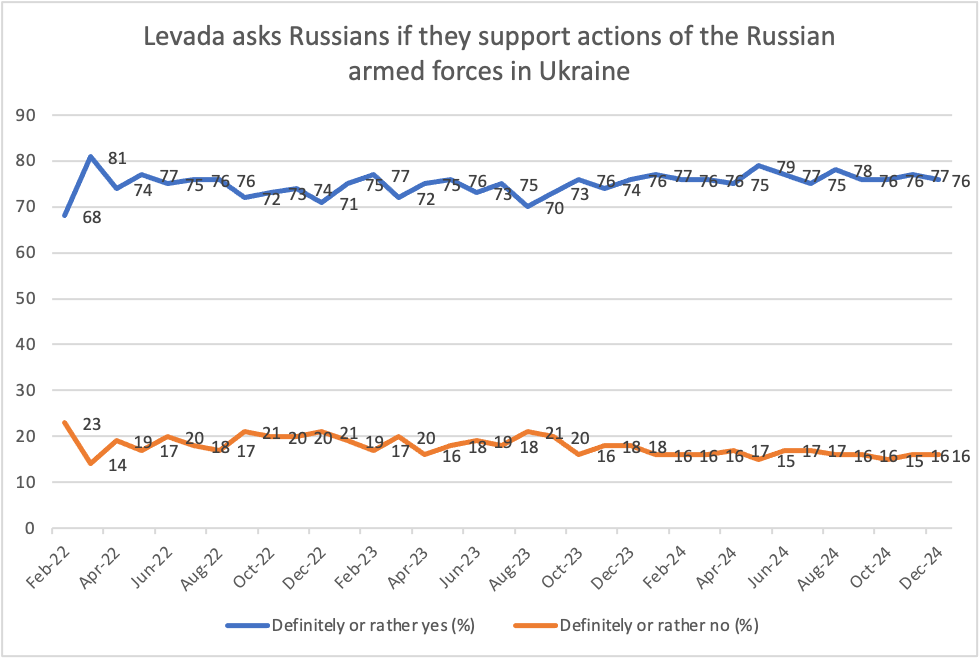
- The share of Russians who support Russia’s war in Ukraine decreased slightly from 77% to 76% in November-December, according to Levada. When asked what feelings they felt with regard to Russia’s war in Ukraine in December, 47% said pride, while 33% said anxiety or fear or horror. (RM, 01.13.25)
Military aid to Ukraine:
- U.K. Prime Minister Keir Starmer met with Zelenskyy in Kyiv on Jan. 16 to say that Britain would provide more military aid to Ukraine this year “than ever before.” A partnership agreement, which the two leaders signed, will include a particular focus on maritime security and promises to strengthen collaboration on technology, health care and education. The agreement is an expansion of a previous 100-year security agreement between Ukraine and the United Kingdom, signed by Zelenskyy and Starmer's predecessor, Rishi Sunak, almost a year ago. Zelenskyy and Starmer signed a landmark "Centennial Partnership Agreement" on Jan. 16 outlining Ukrainian-British cooperation for the next 100 years and continued U.K. support to Ukraine. (WP, 01.16.25, NYT, 01.16.25, FT, 01.16.25, ISW, 01.16.25)
- A loud explosion, linked to a Russian drone attack, sounded in the capital as Starmer and Zelenskyy met inside the presidential palace in Kyiv although the incident did not disrupt the talks. Ukraine’s air defense said Russian attack drones reached the capital and the surrounding region but were intercepted. Kyiv’s mayor Vitali Klitschko said drone debris had damaged a car but that no one had been injured. (FT, 01.16.25)
- Also see the section on negotiations.
- German foreign minister Annalena Baerbock has launched a thinly veiled attack on Chancellor Olaf Scholz for blocking additional military aid for Ukraine, accusing him of jeopardizing European peace to “quickly win a few votes” as elections loom in the EU’s largest country. Baerbock, whose Green party is pitching itself as the most robust supporter of Kyiv in campaigning for next month’s federal election, said it “really pains me” that Scholz was refusing to approve an extra €3 billion in support to buy weapons. (FT, 01.17.25)
- Scholz pushed back against accusations that he is casting Ukraine aside in an attempt to drum up support for his trailing Social Democrats ahead of a snap election next month. Speaking to reporters in Berlin, Scholz said he was ready to send an additional €3 billion ($3.09 billion) to Ukraine so long as the funds were generated through net new borrowing and not budget cuts. (Bloomberg, 01.17.25)
- Zelenskyy noted as a big positive of the Biden administration the fact that the U.S. and Europe acted together on issues regarding weapons for Ukraine, sanctions and political support. "This is what happened during Biden's term, and I am grateful for it," the president said: "I have not fully understood and will never understand when people are dying, and we have as many air defense systems as we have. And why we could not be reinforced by America with Patriot systems," he said. (Korrespondent.net, 01.16.25)
Punitive measures related to Russia’s war against Ukraine and their impact globally:
- U.S. President Joe Biden’s administration is seeking to “Trump-proof” its sanctions against Russia by giving Congress the ability to block any attempts to weaken measures against core parts of Moscow’s war machine. Under measures announced by the U.S. Treasury on Jan. 15, around 100 entities from the finance, energy and defense sectors are to be relisted under an unusual sanctions law which requires that Congress be given 30 days to consider any de-listings. The list of affected entities runs from military bodies such as the Tactical Missiles Corporation, which makes weapons, through to the Moscow Exchange, a major financial exchange. The new authority will give legislators an opportunity to head off any attempts by the new White House to reverse the Biden administration’s efforts to weaken Russia’s military-industrial efforts. (FT, 01.16.25)
- With just days left before handing over the keys to the U.S. government, the Biden administration is making a last-ditch effort to seize hundreds of billions of dollars in Russian assets as future negotiating leverage for Ukraine, according to two senior administration officials. Top Biden aides have been working to convince European partners to support moving some $300 billion of Russian money into a new escrow account that would be released only as part of a peace deal. The money belongs to the Russian Central Bank and was initially frozen three years ago after Russia invaded Ukraine. Most of that money is still being held in European banks, though a fraction remains in banks based in the U.S. (CNN, 01.14.25)
- The European Union is considering import restrictions on Russian aluminum and phasing out liquefied natural gas from the nation as part of a new package of sanctions targeting Moscow for its full-scale invasion of Ukraine. The draft measures, which would be part of the bloc’s 16th package of sanctions, include restrictions on dozens more vessels that are part of Moscow’s shadow fleet of tankers transporting Russian oil and further export controls on goods used for military purposes. The move could also see more banks cut off from SWIFT. (Bloomberg, 01.15.25)
- Aluminum rose as much as 1.4%, with the European Union considering curbs on imports from Russia and Chinese production growth expected to slow. (Bloomberg, 01.15.25)
- EU officials are drawing up fallback measures including the use of an 81-year-old law involving the Belgian king to safeguard the bloc’s sanctions against Russia after Hungary threatened to veto their renewal. Hungarian Prime Minister Viktor Orbán told the bloc’s other 26 leaders in December that he could block this month’s rollover of EU sanctions against Russia, which requires unanimous approval—a move that would lead to the expiry of the measures on Jan. 31. Orbán said he was awaiting the inauguration of Donald Trump as U.S. president on Jan. 20. If Trump eases U.S. sanctions on Moscow, Orbán said he would insist that the EU follows suit. (FT, 01.17.25)
- A telecoms group with ties to two sanctioned oligarchs plans to list its Ukrainian business in New York via a special purpose acquisition company, after its corporate rights in the subsidiary were unfrozen by authorities in Kyiv. Dubai-based Veon, whose largest shareholder is the LetterOne Investment Holdings company co-founded by Mikhail Fridman and Petr Aven, on Jan. 13 announced the signing of a letter of intent with U.S.-based Cohen Circle to list Kyivstar indirectly on the Nasdaq stock market. (FT, 01.13.25)
- Over the nearly three years since the start of the full-scale war, Russian airlines have removed 365 planes from Bermuda’s registry, addressing dual registration issues that had hindered international flights, Kommersant reported. According to Russia’s Federal Air Transport Agency (Rosaviatsiya), 745 Russian aircraft were registered in Bermuda when sanctions were imposed in March 2022 (the Russian Transport Ministry cited an even higher number — 768). Another 36 aircraft were registered in Ireland. Following the sanctions, airlines lost access to around 80 planes, but at least 665 remained in Bermuda’s registry. Now, Kommersant reports, only 300 aircraft operated by Russia carriers are still registered in Bermuda. (Meduza, 01.15.25)
- A billionaire ally of Roman Abramovich made a final attempt to lift British sanctions against him at the U.K.’s top court, arguing that the effect of the measures has been to “shatter his reputation.” Eugene Shvidler sought to challenge the sanctions at the Supreme Court on Jan. 15, and decried an earlier suggestion by a government minister that he was a confidant of Putin. (Bloomberg, 01.15.25)
- Russia designated the Canadian information management corporation OpenText as an “undesirable” organization on Jan. 16, claiming the company provides services to the United States and Ukraine against Moscow’s interests. (MT/AFP, 01.16.25)
- For sanctions on the energy sector, please see section “Energy exports from CIS” below.
Ukraine-related negotiations:
- Advisers to Trump are crafting a wide-ranging sanctions strategy to facilitate a Russia-Ukraine diplomatic accord in the coming months while at the same time squeezing Iran and Venezuela, people familiar with the matter said. There are two main approaches under consideration by the Trump team. One set of policy recommendations — if the incoming administration believes a resolution to the Ukraine war is in sight — involves some good-faith measures to benefit sanctioned Russian oil producers that could help seal a peace deal, said the people, requesting anonymity as the deliberations are private. A second option would build on the sanctions, ramping up pressure even further to increase leverage, they said. (Bloomberg, 01.16.25)
- On Jan. 15, Sen. Marco Rubio of Florida called for an end to the war in Ukraine, said Europe must decrease its reliance on Washington and declared America’s competition with China the defining question of the century during his confirmation hearing to be secretary of state. In his opening statement, Rubio made no references to either Ukraine or Russia, but much of the early questioning from senators focused on the war in Ukraine. Rubio said it is “unrealistic” to expect Ukraine to recover all the land Russia has seized since launching its full-scale invasion nearly three years ago. “There's no way Ukraine is also going to push these people [Russian forces] all the way back to where they were on the eve of the invasion just given the size dynamic,” Rubio said. Rubio said that the conflict “needs to end” and that “there will have to be concessions made” by both parties. Rubio said that the repeal of economic sanctions against Russia could be a bargaining chip in such talks, but he declined to offer further specifics. He did not say whether he would support a pledge by Ukraine’s government to remain neutral between Russia and the West. A notable omission from this hearing was any question about Rubio’s personal views toward Putin, whom the senator has branded “a killer” and a war criminal—labels that Trump firmly rejects. (NYT. 01.15.25, RFE/RL, 01.15.25, RFE/RL, 01.15.25)
- On Jan. 16, Starmer opened the door to a British troop presence in Ukraine in the event that a peace deal with Russia is reached. On his first trip to Kyiv to see Zelenskyy, which some Ukrainian officials feel is overdue, the U.K. prime minister said Britain would play its “full part in guaranteeing Ukraine’s security.” At a joint press conference, Zelenskyy said he was discussing the idea of an international force with French President Emmanuel Macron, but was also talking about it with Britain, Poland and the Baltic states. (FT, 01.16.25)
- On Jan. 15, Zelenskyy signaled the war that has ravaged his country is more likely to end this year because of Trump’s sway over Russia. Speaking with four Polish media outlets on Jan. 15, Zelenskyy replied in the affirmative when asked if he believes there is now higher chance of the hostilities drawing to a close in 2025. “Trump really wants to end the war—these are his words,” Zelenskyy said in Warsaw. “He’s able to put the pressure, influence Russia. I’m convinced that Russia is afraid of the U.S., China and united Europe.” (Bloomberg, 01.15.25)
- Russia’s foreign minister signaled that Moscow was ready to hear from Trump and advisers on proposals to resolve the Ukraine war, saying the incoming administration had "started to acknowledge the realities on the ground." The comments from Sergei Lavrov, made during an annual news conference on Jan. 14, were the latest in a series of remarks by Russian officials ahead of potential cease-fire proposals for the conflict, which will mark its third anniversary next month. (RFE/RL, 01.14.25)
- Russia will demand Ukraine drastically cut back military ties with the NATO alliance and become a neutral state with a limited army in any talks with Trump, according to people familiar with the matter. Increasingly confident he has the advantage on the battlefield in Ukraine, Putin is determined to achieve his goal that Kyiv never join NATO and that limits are placed on its military capacity, said the people with knowledge of Kremlin thinking who asked not to be identified discussing sensitive information. The Kremlin’s position is that while individual NATO members may continue to send arms to Ukraine under bilateral security agreements, any such weapons should not be used against Russia or to recapture territory, said one of the people. (Bloomberg, 01.15.25)
- Just over a year ago, Putin conveyed to senior U.S. officials via indirect channels that he could potentially consider dropping an insistence on neutral status for Ukraine and even abandon opposition to eventual NATO membership, two people close to the Kremlin said at the time. (Bloomberg, 01.15.25)
- Ukraine’s debt-management chief cautioned investors against betting on a quick and tidy resolution to the conflict with Russia based on Trump’s return to the White House next week. “If you look at our yield curve, people expect some quick, positive outcomes,” Yuriy Butsa, Ukraine’s government commissioner for public debt management, said on the sidelines of the Invisso CEE Forum in Vienna on Jan. 14. “I think the outcome will be a bit more nuanced.” Ukraine’s sovereign dollar bonds surged 58% last year as investors bet that Trump would carry through on campaign pledges to quickly force an end to the conflict. (Bloomberg, 01.14.25)
- Nikolai Patrushev, assistant to Putin, told Russian media outlet KP: “For the Biden administration, Ukraine was an absolute priority. It is clear that the relationship between Trump and Biden is antagonistic. Therefore, Ukraine will not be among Trump's priorities. He is more concerned about China. ... It is possible that in the coming year Ukraine will cease to exist altogether.” When asked to comment on discussions in Trump's team on annexation of Ukrainian territories by Russia, Patrushev said: “This is not even discussed. The territories that were once governed from Kyiv became part of Russia based on the expression of the will of citizens in accordance with international law, the laws of the Russian Federation and the legislation of these regions. ... It is important for us that the tasks of the SVO [special military operation] be achieved.” “I believe that negotiations on Ukraine should be conducted between Russia and the United States without the participation of other Western countries,” he said. “There is nothing to talk about with London and Brussels.” (RM, 01.14.25) Since his departure from the post of the secretary of Putin's Security Council, Nikolai Patrushev’s remit in his role as the assistant to Putin was supposed to be maritime issues. However, as this summary of his Jan. 14, 2025, interview with KP demonstrates, Patrushev continues to freely comment on a wide range of issues that are beyond that supposed remit, such as reaffirming Russia’s conditions for ending the war, assessing Trump’s priorities and whether Ukraine is one of them, as well as issuing threats that Moldova and Ukraine may cease to exist. His comments on conditions for ending the war demonstrates there is no softening of Russia’s official negotiating position.
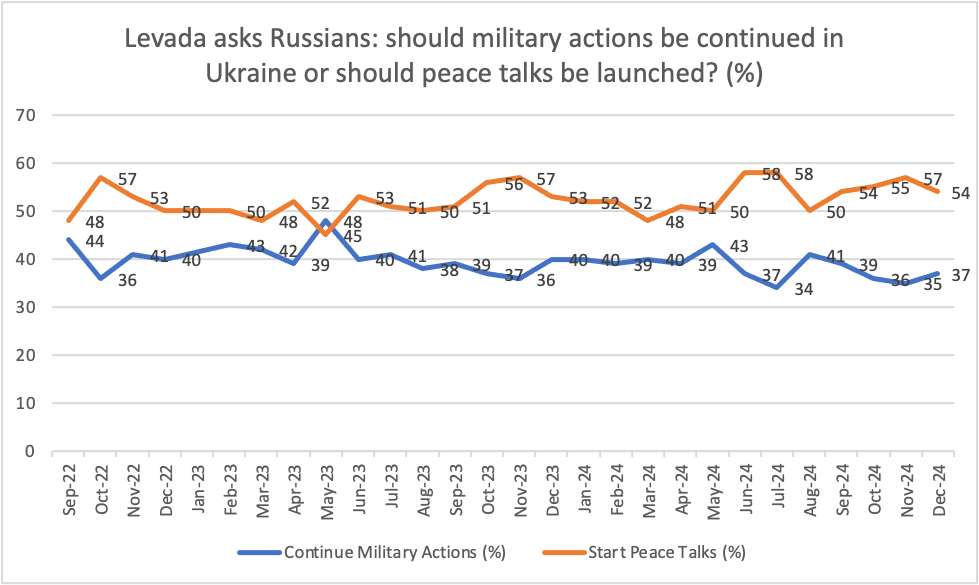
- When asked by Levada in December whether military action in Ukraine should be continued or whether negotiations should be launched, 37% of respondents opted for the former, while 54% opted for the latter. In comparison, 57% favored peace talks and 35% favored continuing the war in November. (RM, 01.13.25)
Great Power rivalry/new Cold War/NATO-Russia relations:
- The White House scrambled to get a message to Putin last year after U.S. intelligence agencies said a Russian military unit was preparing to send explosive packages on cargo planes. Biden dispatched his national security adviser, Jake Sullivan, and the CIA director, William Burns, to send a series of warnings to Putin's top aides. As one senior official recounted, many paths were needed to ensure the message reached Putin's ears, and sank in. The core of the warning was that if the sabotage led to mass casualties in the air or on the ground, the United States would hold Russia responsible for ''enabling terrorism.'' To this day the U.S. officials do not know if Putin ordered the operation, whether he knew about it or whether he only learned of it because of the American warnings. (NYT, 01.13.25)
- Russia plans to sow chaos with attacks on air transport in Poland and elsewhere, Polish Prime Minister Donald Tusk has warned. “The latest information can confirm the validity of fears that Russia was planning acts of terrorism in the air not only against Poland,” Tusk told a news conference alongside Zelenskyy in Warsaw on Jan. 15. (FT, 01.16.25)
- Richard Haass, the former president of the Council on Foreign Relations, said that it ''is all part of a larger pattern.'' ''Russia has turned into a revolutionary actor,'' he said. ''Russia has turned into a country seeking to undermine the international order. And the real question is: Can a Trump administration do something about that?'' (NYT, 01.13.25)
- During his confirmation hearing on Jan. 15 to be secretary of state, Rubio called NATO, ''a very important alliance'' and insisted that Trump was a NATO supporter. But he also backed Trump's argument that a strong NATO requires Europe to spend more money on its collective defense. The United States, he said, must choose whether it will serve as ''a primary defense role or a backstop'' to a self-reliant Europe. (NYT, 01.15.25)
- Aside from brief mentions of China and the war in Ukraine and Russia, senators did not ask Trump’s nominee for the secretary of defense Pete Hegseth specifically about current conflicts, and other potential military adversaries and strategic rivals. During the Q&A, Hegseth said “the war needs to come to an end” and that he would like to see the resolution favor Kyiv. His opening statement did not mention either Russia or Ukraine, however. As a result he faced a question whether the lack of mention of Ukraine in his opening statement signaled belief that Ukraine will stop receiving U.S. weapons and equipment. (BBC, 01.15.25, WP, 01.14.25, RM, 01.15.25)
- John Ratcliffe, Trump’s pick to lead the CIA, told senators during his confirmation hearing that he views China as America’s greatest geopolitical rival, with Russia, Iran, North Korea and drug cartels, hacking gangs and terrorist organizations also posing challenges to national security. “The Russia-Ukraine War wages on, spreading devastation and increasing the risk of the United States being pulled into conflict with a nuclear power,” he said in his opening statement. During Trump's first term, Ratcliffe issued public warnings about election interference in 2020 that drew attention to efforts by Russia, Iran and China to influence the vote. Ratcliffe also declassified some intelligence related to Russia's activities in 2016 over the objections of CIA. Republican allies of Trump had sought the material, believing it undermined the case that Russia had tried to interfere in the 2016 election on behalf of Trump. During the hearing Ratcliffe evoked the CIA's predecessor—the Office of Strategic Services—and said the ideal recruit for the agency would be a ''Ph.D. who could win a bar fight.'' (AP, 01.15.25, NYT, 01.16.25, Senate.gov, 01.16.25)
- House Speaker Mike Johnson has decided to remove Ukraine hawk Rep. Michael R. Turner as chair of the House Permanent Select Committee on Intelligence, Johnson confirmed Jan. 15. The change in leadership to the closely watched and powerful committee provides the latest evidence of a likely shift in how Republicans will approach Russia's invasion of Ukraine during Trump's second term in office and a GOP majority in both the House and the Senate. (WP, 01.16.25)
- Johnson has tapped Rick Crawford, an Arkansas Republican who has opposed Ukraine aid, to replace Turner atop the Intelligence Committee. (Bloomberg, 01.16.25)
- Based on an overview of Russian operations in the physical domain, excluding most cyber operations, Leiden University’s research highlights how Moscow is increasingly escalating beyond its long-standing campaigns of espionage and digital disruption. Even using a conservative metric for attribution, Russian operations against Europe have surged from 6 in 2022 to 13 in 2023 and 44 in 2024. (FP, 01.10.25)
- NATO is to deploy naval drones, submarines, ships and aircraft to help detect and prevent sabotage attempts against critical infrastructure in the Baltic Sea after several power pipelines and data cables were damaged in recent months. Mark Rutte, NATO’s secretary-general, on Jan. 14 announced a new mission called Baltic Sentry after Finland last month seized a vessel belonging to Russia’s shadow fleet of oil tankers that it suspected had damaged undersea electricity cables. The new security mission is dubbed Baltic Sentry. (FT, 01.14.25, Bloomberg, 01.14.25)
- Crew on board an oil tanker accused of sabotaging undersea power and communications cables in the Baltic Sea were poised to cut other cables and pipelines when Finnish authorities boarded the vessel last month, the head of the Finnish investigation said. On Dec. 26, Finnish authorities seized oil tanker Eagle S carrying Russian oil. They said they suspected the vessel had damaged the Finnish-Estonian Estlink 2 power line and four telecoms cables by dragging its anchor across the seabed for more than 100 km (60 miles). (Reuters, 01.14.25)
- The German government has approved a proposal to allow the armed forces to shoot down drones after a spate of suspicious activity near military bases, critical infrastructure and industrial sites. (FT, 01.15.25)
- Social media accounts linked to the governments of Russia and Iran and terrorist organizations like the Islamic State are contributing to the surge of false and exaggerated claims about the wildfires afflicting Los Angeles, according to researchers who monitor disinformation. (NYT, 01.16.25)
- For the past six months, several pro-war Telegram channels have been calling on Russian-speaking residents of Europe to spy on NATO military sites and report their findings through a special bot. Recruits are instructed to photograph military bases and purchase local maps, guidebooks and SIM cards to send to Russia. (Meduza, 01.17.25)
- Lithuania plans to increase defense spending to deter potential threats from Russia. President Gitanas Nauseda said spending would be raised to 5-6% of gross domestic product starting from next year as it finances a new army division to be created by 2030. (Bloomberg, 01.17.25)
- The Levada Center polled Russians in Fall 2024 for a joint report with the Chicago Council on Global Affairs to find that Russians are more likely to say military power (48%) has greater significance in determining Russia’s overall strength and influence in the world than economic power (39%). Majorities of Russians believe their country should strengthen its relations with Belarus (79%), China (76%), India (67%), North Korea (64%) and, to a lesser extent, Syria (59%) and Iran (56%), according to the poll. By contrast, majorities of Russians view the United States (59%), France (55%), the European Union (56%) and Israel (51%)—a Western ally in the Middle East—more negatively. However, they save the most damning ratings for Ukraine (74% negative). (Chicago Council on Global Affairs, January 2025)
China-Russia: Allied or aligned?
- Trade between China and Russia reached a record high last year, according to official data released Jan. 13. The total value of imports and exports between the two nations amounted to $244.8 billion, a modest increase from $240.1 billion in 2023, China’s General Administration of Customs reported. While trade reached an all-time high, the year-on-year growth rate slowed significantly compared to the 26.3% surge seen in 2023. (MT/AFP, 01.13.25)
Missile defense:
- No significant developments.
Nuclear arms
- President Biden argued in a speech at the State Department Jan. 13: "As I saw it, when Putin launched his invasion, I had two jobs—one to rally the world to defend Ukraine, and the other is to avoid war between two nuclear powers," Mr. Biden said. "We did both those things. Today, Ukraine is still a free, independent country, with a potential, a potential for a bright future." (CBS News, 01,13,25)
Counterterrorism:
- There were at least 93 terrorism-related incidents reported across Russia’s North Caucasus in 2024. Dagestan and Ingushetia were the epicenters of instability, accounting for 65% of all activity. The security services were the main drivers of violence, initiating 89% of all incidents, but rebel attacks were responsible for the majority of casualties. (Mark Youngman’s Threatologist, 01.15.25)
Conflict in Syria:
- No significant developments.
Cyber security/AI:
- President Joe Biden has signed an order to strengthen federal computer networks in the wake of damaging espionage intrusions by the Chinese government. The 53-page order issued Jan. 16 builds on steps taken by the White House and federal agencies over the past four years to impose cybersecurity regulations on rail, pipeline and other critical infrastructure sectors of the U.S. economy and develop federal standards for secure software. (WP, 01.16.25)
- Krzysztof Gawkowski, deputy premier of Poland in charge of digital affairs, told reporters on Jan. 15 that “there have been constant attacks for weeks and months from Russian surveillance services” as his country gears up for the vote in May. “Poland is the most frequently attacked country in Europe,” he said, adding that his government would soon offer more details on the Russian “cyber war against Poland” and how Warsaw planned to counter it. (FT, 01.16.25)
- A hacking group linked to Russia’s government tried stealing WhatsApp data of employees at non-governmental organizations offering assistance to Ukraine, according to Microsoft Corp. Attackers associated with Russia’s Federal Security Service, or FSB, sent emails to specific targets asking them to join WhatsApp groups, Microsoft researchers said in a blog post Jan. 16. (Bloomberg, 01.16.25)
Energy exports from CIS:
- Scott Bessent, President-elect Donald Trump’s nominee for Treasury secretary, said he would support dialing up sanctions on the Russian oil industry to end the war in Ukraine. “If any officials in the Russian Federation are watching this confirmation hearing, they should know that if I’m confirmed, and if President Trump requests as part of his strategy to end the Ukraine war, that I will be 100% on board from taking sanctions up, especially on the Russian oil majors to levels that would bring the Russian Federation to the table,” Bessent said during his Senate confirmation hearing Jan. 16. Bessent’s comments are some of the strongest yet by any incoming Trump cabinet pick in favor of ramping up sanctions pressure on Moscow, which have been discussed internally. Bessent said he was “perplexed” that Jake Sullivan, the current national security adviser, had raised sanctions on Russian oil “on his way out the door,” leading to higher prices. (Bloomberg, 01.16.25, Meduza, 01.17.25, FT, 01.16.25) There were no references to Russia or Ukraine in Bessent’s opening statement.
- Donald Trump’s pick for secretary of the interior Doug Burgum has warned the U.S. will lose the “AI arms race” to China unless it boosts electricity generation from fossil fuels and stabilizes its power grid. Doug Burgum told U.S. senators on Jan. 16 that the country had an “electricity crisis” due to weaknesses in the grid and “roadblocks” stopping companies from building fossil fuel plants that can supply round-the-clock power. “When energy production is restricted in America, it doesn’t reduce demand, it just shifts production to countries like Russia, Venezuela and Iran—whose autocratic leaders don’t care about the environment,” his opening statement said. (FT, 01.17.25, NYT, 01.16.25) Burgum’s opening statement contained no references to Ukraine and one reference to Russia.
- The latest U.S. sanctions have the potential to significantly disrupt Russia’s energy exports as they blacklist a tanker fleet that moved more than a fifth of the nation’s seaborne oil flows, the International Energy Agency said. The 160 tankers sanctioned last week shipped over 1.6 million barrels a day of Russian oil in 2024, around 22% of the country’s seaborne exports, the Paris-based agency said in its monthly report on Jan. 15. For now, however, the IEA kept its outlook for the nation’s oil supplies and will update it “as the situation evolves.” Previous rounds of sanctions on the shadow fleet that Russia has been using to deliver its barrels overseas have been “highly effective, reducing the activity of designated tankers by 90%,” the IEA said. (Bloomberg, 01.15.25)
- On Jan. 11 Moscow accused the U.S. of being ready to risk global energy instability with new wide-reaching sanctions on Russia's energy sector. The U.S. and the U.K. on Jan. 17 announced new sanctions against Russia's energy sector, including oil giant Gazprom Neft, just days before President Joe Biden leaves office. (MT/AFP, 01.11.25)
- At least 65 oil tankers have dropped anchor at multiple locations, including off the coasts of China and Russia, since the United States announced a new sanctions package on Jan. 10, ship tracking data showed on Jan. 13. (Reuters, 01.13.25)
- The cost of shipping Russian ESPO crude to China has more than tripled after the U.S. imposed aggressive sanctions on Moscow’s oil industry last week, with rates expected to climb even higher, according to traders. (Bloomberg, 01.16.25)
- Oil retreated from a five-month high as the market adjusts to new sanctions on Russian crude and on the prospect that President-elect Donald Trump will weaken the measures. West Texas Intermediate slid about 1.5% to below $79 a barrel after hitting the highest since July on Jan. 15. (Bloomberg, 01.16.25)
- An oil tanker sanctioned in Washington’s harshest round of curbs against Russia’s energy industry has become the first such vessel to dock at the Russian port of Kozmino, where it’s loading a cargo of crude. The Li Bai, a Panama-flagged Suezmax vessel, arrived at the Far Eastern port on Jan. 17, ship-tracking data from Bloomberg and Kpler show, a week after the restrictions were announced. It’s loading about 733,000 barrels of ESPO crude. (Bloomberg, 01.17.25)
- India has for the past few years cheerfully bought Russian oil for less than the $60-per-barrel price cap imposed by Western sanctions, becoming the world’s second-biggest buyer of the stuff after China. In 2021 just 2% of India’s oil imports came from Russia. Between April and October 2024 nearly 40% did. ICRA, a rating agency, estimates that discounted Russian oil has saved India at least $13bn since the war in Ukraine began. (The Economist, 01.16.25)
- German Foreign Minister Annalena Baerbock said a heavily loaded oil tanker that Germany's maritime emergencies agency had to secure on Jan. 10 in the Baltic Sea is part of the "shadow fleet" that Moscow uses to avoid sanctions on its oil exports. (RFE/RL, 01.11.25)
- EU shipyards are repairing Russian ice-class tankers and offering them dry dock facilities, enabling Moscow to continue moving gas through the Arctic despite western sanctions on its energy sector. (FT, 01.14.25)
- Tokyo will closely monitor the rollout of new U.S. sanctions on Moscow for any impact on shipments of liquefied natural gas from Russia’s Far East. Japan is a big LNG buyer and sourced about 8% of its imports from Sakhalin-2 last year, according to ship-tracking data compiled by Bloomberg. (Bloomberg, 01.17.25)
- Turkey has turned to liquefied natural gas imports to help meet peak winter demand as regional pipeline flows decline. The purchases are driven in part by a reduction in piped supplies from Azerbaijan. (Bloomberg, 01.17.25)
- The Czech Republic no longer needs to import Russian oil following the completion of an expansion to the Transalpine Pipeline (TAL) from Italy, Prime Minister Petr Fiala announced (MT/AFP, 01.14.25)
- Slovak Prime Minister Robert Fico sharply criticized Ukraine in an open letter to Ukrainian President Volodymyr Zelenskyy for his decision to let a contract for the transit of Russian natural gas through Ukrainian territory expire on Jan. 1. Fico emphasized the economic and political fallout of the move, which ended the flow of gas through the pipeline serving Slovakia and several other European countries." (RFE/RL, 01.14.25)
- Ukrainian President Volodymyr Zelenskyy hosted an increasingly popular Slovak opposition leader as Kyiv remains locked in a spat with the country’s premier over gas transit. Progressive Slovakia leader Michal Simecka, whose party recently surpassed that of Prime Minister Robert Fico in opinion polls, voiced support for Ukraine’s European Union membership, which he said was “crucial” to Slovakia’s interests. (Bloomberg, 01.17.25)
- Serbia can pay Gazprom Neft PJSC and Gazprom PJSC to exit the Balkan country’s only refiner in order to preserve local fuel production after it became ensnared in new U.S. sanctions on Russia’s oil industry. (Bloomberg, 01.11.25)
- Russia’s oil proceeds to the state budget increased by almost a third last year to the highest since at least 2018, spurred by higher crude prices as the nation adapted to international sanctions. Oil-related taxes rose to 9.19 trillion rubles ($89.4 billion) 2024, up from 7.04 trillion rubles a year ago, according to Bloomberg calculations based on finance ministry’s data published Jan. 13. Those proceeds from crude and refined products accounted for 83% of Russia’s total oil and gas revenue, which reached 11.13 trillion rubles last year. (Bloomberg, 01.13.25)
- Russian gas giant Gazprom PJSC is considering a plan to cut the headcount at its central office by almost 40% to trim expenses and accelerate decision-making, according to 47news. Gazprom needs to reduce numbers at its St. Petersburg headquarters to about 2,500 from more than 4,100 now, Deputy Chief Executive Officer Elena Ilyukhina said. The energy group suffered its largest loss in at least 25 years—629 billion rubles ($6.9 billion)—in 2023 as gas sales more than halved after explosions damaged the Nord Stream pipeline to Europe. (Bloomberg, FT, 01.13.25)
Climate change:
- No significant developments.
U.S.-Russian economic ties:
- In 2018, Russian businessman Mikhail Shelkov acquired the American mobile app App in the Air, which had access to flight data for users across the U.S. and Europe. As a new investigation by iStories shows, Shelkov is a close associate of Sergey Chemezov, the head of the Russian state-owned defense conglomerate Rostec. Six years after the purchase, Shelkov sold the app for just $2,000, despite having paid millions for it. Since then, Shelkov has partnered with the app’s creator, Bayram Annakov, and the son of a senior FSB official to launch a similar service in Russia. Meduza shares an abridged translation of the outlet’s reporting. (Meduza, 01.13.25)
- In December 2024, VKontakte’s monthly audience in Russia surpassed YouTube’s for the first time, RBC reported, citing data from the media research firm Mediascope. The analysis included individuals aged 12 and older in the country who accessed the platform at least once during the month, either via the website or app. According to Mediascope, VKontakte’s monthly reach among Russian users was nearly 92 million, compared to YouTube’s 89.6 million. (Meduza, 01.15.25)
U.S.-Russian relations in general:
- U.S. President-elect Donald Trump and Russian President Vladimir Putin are expected to hold a phone call “in the coming days and weeks,” Trump’s nominee for national security advisor, Mike Waltz, told ABC News on Jan. 12. (Meduza, 01.13.25)
- The Kremlin has been in direct contact with U.S. President-elect Donald Trump’s team in the lead-up to his Jan. 20 inauguration, Russian government officials told The Moscow Times. President Vladimir Putin and Trump’s teams were in contact in November and December 2024, two Russian government officials involved in Kremlin foreign policy told The Moscow Times. The officials also confirmed that Putin and Trump have spoken directly, despite the Kremlin’s denials of reporting by The Washington Post that the two spoke by phone following Trump’s Nov. 5 election victory. (MT/AFP, 01.14.25)
- There have been no contacts as of today between Moscow and the future administration of U.S. President-elect Donald Trump on the organization of his possible meeting with President Vladimir Putin, Russian Presidential Aide Yury Ushakov said. "No, there are none at the moment," he said in response whether any contacts were underway to prepare this meeting. Moscow is waiting for the Trump administration to take office. (TASS, 01.17.25)
- The Russian ambassador to the United States will not represent Russia at the inauguration ceremony of U.S. President Donald Trump, said the Russian head of state's aide Yuri Ushakov. "Nobody will represent Russia at the inauguration. Usually, the ambassador does. Well, that means if the chargé d'affaires is invited, he will be present," Ushakov told reporters. (Interfax, 01.17.25)
- A self-confessed veteran of Russia's Wagner paramilitary group arrested for crossing into the United States from Mexico was honored as a combat veteran weeks earlier by an organization established by Russian President Vladimir Putin, RFE/RL has found. Timur Praliev, 31, was detained by U.S. Border Patrol agents on Jan. 4 near the border town of Roma, Texas, after crossing the Rio Grande River into the United States and told the agents he was a citizen of Kazakhstan. (RFE/RL, 01.11.25)
II. Russia’s domestic policies
Domestic politics, economy and energy:
- IMF’s latest World Economic Outlook foresees Russia’s economic growth to slow down from 3.8 in 2024 to 1.4 in 2025 and 1.2 in 2026. In comparison, the world output grew by 3.2% in 2024 and is expected to grow by 3.3% in 2025 and then another 3.3% in 2026. As the table below shows, Russia’s rate of growth will be lower in 2025–2026 than that of China, India, U.S, and of advanced economies as a whole and of developing economies as a whole. (RM, 01.17.25)
| Category | 2023 Estimate | 2024 Estimate | 2025 Projections | 2026 Projections | Diff. from Oct. 2024 WEO (2025) | Diff. from Oct. 2024 WEO (2026) |
| World Output | 3.3 | 3.2 | 3.3 | 3.3 | 0.1 | 0.0 |
| Advanced Economies | 1.7 | 1.7 | 1.9 | 1.8 | 0.1 | 0.0 |
| United States | 2.9 | 2.8 | 2.7 | 2.1 | 0.5 | 0.1 |
| Developing economies | 4.4 | 4.2 | 4.2 | 4.3 | 0.0 | 0.1 |
| China | 5.2 | 4.8 | 4.6 | 4.5 | 0.1 | 0.4 |
| India | 8.2 | 6.5 | 6.5 | 6.5 | 0.0 | 0.0 |
| Russia | 3.6 | 3.8 | 1.4 | 1.2 | 0.1 | 0.0 |
- Russia spent almost a quarter of the national wealth fund’s available reserves last year to keep the economy on a war footing and finance its invasion of Ukraine. The National Wellbeing Fund remained largely unchanged in 2024 at around 12 trillion rubles ($117 billion), Finance Ministry data shows. However, its holdings of cash and investments that can be easily liquidated shrank by 24% to 3.8 trillion rubles as of Jan. 1 compared to the start of last year. It has declined by 57% from the 8.9 trillion rubles available at the beginning of 2022, before President Vladimir Putin ordered the full-scale invasion of Ukraine in February of that year. (Bloomberg, 01.16.25)
- Russian inflation accelerated further from the central bank’s goal last month as the invasion of Ukraine continued to drive up prices for nearly all goods and services. Annual price growth at the end of 2024 reached 9.5%, accelerating in December from 8.9% a month earlier despite historically high interest rates. That makes 2024 the fifth consecutive year that the central bank missed its target of 4%. (Bloomberg, 01.15.25)
- Apartment rental prices in Russia surged by 31.4% last year as inflation, rising borrowing costs and the end of state mortgage subsidies placed pressure on the housing market. (MT/AFP, 01.13.25)
- At the end of last year, Russia’s State Statistics Service (Rosstat) released data on the country’s agricultural performance in 2024. Rosstat released preliminary data on Christmas Day showing that Russia’s grain and vegetable harvest amounted to 125 million tons (including 82.4 million tons of wheat). That’s down 14% on 2024 when the yield was 144.9 million tons, including 98.2 million tons of wheat. Harvests were down for all crops except rice and soybeans. (Bell, 01.10.25)
- A court in Russia has upheld a scandal-plagued merger involving the country’s largest online retailer. The dispute was set off by Tatyana Kim’s decision last year to merge retailer Wildberries with billboard advertising group Russ Outdoor. Kim’s co-founder Vladislav Bakalchuk had asked the court to annul the deal that would transfer Wildberries’ assets to RWB—the company created as a result of the merger—claiming this intended to cause harm to him and Wildberries. Kim, who last summer said she had filed for divorce from Bakalchuk, was ranked by the local edition of Forbes as Russia’s richest woman with a fortune estimated at $7.4 billion before the dispute. (FT, 01.11.25)
- Antidepressant sales in Russia hit an all-time high last year, with 16.1 million packages of the medication sold between January and November, the Kommersant business daily reported Jan. 17. (MT/AFP, 01.17.25)
- Russian President Vladimir Putin said Jan. 15 that he signed a decree awarding 80,000 rubles ($780) to the country’s World War II veterans ahead of the 80th anniversary of the Soviet Union’s victory over Nazi Germany. (MT/AFP, 01.15.25)
- A Russian court sentenced three lawyers of Aleksei Navalny to lengthy prison sentences for carrying correspondence from the late anti-corruption crusader out of prison, prompting his supporters at the hearing to erupt into chants of "heroes." The court in the Vladimir region, just east of Moscow, convicted Vadim Kobzev, Igor Sergunin, and Aleksei Liptser on Jan. 17 of belonging to an "extremist group" for helping transport writings from Navalny that became the basis for his memoir, Patriot. (RFE/RL, 01.17.25)
- Russian law enforcement authorities on Jan. 17 announced criminal charges against Lev Shlosberg, one of the few remaining politicians in the country openly opposed to Moscow's full-scale invasion of Ukraine. Shlosberg, 61, used to head the Pskov regional branch of the systemic opposition party Yabloko. Under the "foreign agent" law, individuals labeled as such must include a lengthy disclaimer on all public statements, including social media posts. Authorities accuse Shlosberg of failing to comply with this requirement, an allegation he denies. (MT/AFP, 01.17.25)
- Russian police searched the Moscow apartment of opposition figure Ilya Yashin’s parents on Jan. 16 and briefly detained them for questioning, the exiled activist said on social media. (MT/AFP, 01.17.25)
- Russia has named regional media outlets Komi Daily and Asians of Russia as terrorist organizations, marking the first time such a designation has been applied to a publication. (MT/AFP, 01.13.25)
- Russia’s Federal Security Service (FSB) designated the “Belgorod People’s Republic,” a fictional entity born as an online meme, as a “terrorist organization,” Russian media reported Jan. 14. (MT/AFP, 01.14.25)
Defense and aerospace:
- See section Military aspects of the Ukraine conflict and their impacts above.
Security, law-enforcement, justice and emergencies:
- Two natives of Ingushetia have been detained in Siberia on suspicion of involvement in the murder of the head of the radiation, chemical and biological defense troops of the Russian Armed Forces, Igor Kirillov. (Meduza, 01.13.25)
- Vladimir Feshchenko, a Russian Federal Security Service (FSB) officer, has been found dead in a building in central Moscow, state news agency RIA Novosti reported on Jan. 14, citing law enforcement sources. “Preliminary information suggests he was murdered,” the agency quoted a source as saying. (Meduza, 01.14.25)
- A prison where the late opposition figure Alexei Navalny was held shortly after returning to Russia in 2021 is set to shut down, local media reported Jan. 16, citing prison authorities. (MT/AFP, 01.16.25)
- A Russian air defense officer was sentenced to nearly three years in prison for mistakenly shooting down a Russian helicopter after mistaking it for a Ukrainian drone, the Kommersant business daily reported Jan. 15, citing court documents. (MT/AFP, 01.16.25)
III. Russia’s relations with other countries
Russia’s external policies, including relations with “far abroad” countries:
- The Kremlin said on Jan. 16 that it hoped a ceasefire in Gaza would lead to "long-term stabilization" in the region and create the conditions for a "comprehensive political settlement" between Israel and the Palestinians. Qatar, a key mediator in the 15-month war, said Jan. 15 that Israel and Hamas had agreed to a ceasefire in Gaza starting on Sunday, along with a hostage and prisoner exchange. Kremlin spokesman Dmitry Peskov said Moscow "welcomed" the deal. (MT/AFP, 01.16.25)
- Russian-Israeli Alexander Trufanov is expected to be among the first group of hostages released by the Hamas militant group this weekend, according to a list of names published by The Times of Israel on Jan. 17. (MT/AFP, 01.17.25)
- Putin’s India trip in early 2025 has been presented as a routine exercise following the two leaders’ vow to meet annually. (The Economist, 01.16.25)
- Vietnam and Russia signed a non-binding agreement on nuclear energy and cooperation deals on maritime research and digital technology, during a visit by Russian Prime Minister Mikhail Mishustin aimed at deepening ties between the two nations (Bloomberg, 01.14.25)
- The president of the Central African Republic, Faustin-Archange Touadera, arrived in Moscow for talks on strengthening his country's partnership with Russia, the Kremlin said on Jan. 15. (MT/AFP, 01.15.25)
- Croatian President Zoran Milanovic won a second term as voters in the Balkan nation delivered a resounding election victory to a populist leader who has denounced NATO expansion and military aid to Ukraine. (Bloomberg, 01.12.25)
- Tens of thousands of Romanians angered by the cancellation of a presidential election marched through Bucharest on Jan. 12 to demand that the ballot should go ahead and that outgoing centrist President Klaus Iohannis should resign. The cancellation came after state documents showed frontrunner Calin Georgescu, a critic of NATO, had benefited from an unfair social media campaign likely to have been orchestrated by Russia, accusations Moscow has denied. (Reuters, 01.12.25)
- Private equity firm TPG Inc. and Russian state-run Transneft PJSC and Rosatom Corp. won a UK ruling to throw out a $13.8 billion lawsuit from a jailed Russian tycoon over the control of a strategically crucial port operator. Ziyavudin Magomedov, who was arrested in 2018 for embezzlement and later handed a 19-year prison sentence, sued the firms from jail alleging they were part of a sprawling conspiracy to take control of his assets including the critical commercial port in Vladivostok, which links Russia’s eastern seaboard to Asia. (Bloomberg, 01.17.25)
- With the outbound tourist flow from Russia increasing by 13% in 2024, the demand of Russian citizens for business and tourist visas has sharply increased, especially to Japan and China. The number of applications from Russians for Japanese visas by the end of 2024 increased by 2.7 times year-on-year, and for China by 37%, according to the Continent Express business travel agency. (Kommersant, 01.14.25)
- The Czech Republic’s beer exports increased year-on-year in 2024, the first spike in beer exports to Russia since a slump caused by Moscow’s 2022 full-scale invasion of Ukraine and the subsequent severing of business links to Russia. (MT/AFP, 01.17.25)
Ukraine:
- Poland will seek to accelerate talks on Ukraine’s membership in the European Union during its current six-month rotating presidency in the bloc, Prime Minister Donald Tusk said on Jan. 15. (Bloomberg, 01.15.25)
- The fifth president and leader of the European Solidarity party Petro Poroshenko said that in Feb. 2024, 75% of ministers and deputies, as well as the leadership of law enforcement agencies, fled from Kiev. (Ukrainska Pravda, 01.16.25)
- Steel production in Ukraine is projected to drop by more than half, from 7.5 million tons this year to less than 3 million next year, according to Oleksandr Kalenkov, head of Ukraine's steel makers' association. (NYT, 01.16.25)
- Russia has seized control of some of Ukraine’s prized lithium reserves since it launched its all-out invasion in 2022, potentially depriving Kyiv of a key economic resource. Russian forces captured a lithium deposit in the southeastern region of Zaporizhya in early 2022. Since then, Moscow has also overrun territory in the neighboring Donetsk region that is believed to contain lithium. (RFE/RL, 01.14.25)
Russia's other post-Soviet neighbors:
- The United States and Armenia on Jan. 14 signed a strategic partnership agreement expanding cooperation in security and several of areas as Yerevan seeks to distance itself from traditional ally Russia. U.S. Secretary of State Antony Blinken and Armenian Foreign Minister Ararat Mirzoyan signed the agreement at the State Department in Washington. The United States is "working with Armenia in the realm of security and defense, and in particular, to support its efforts to assert its independence and sovereignty over its own territory," Blinken said at the signing ceremony. RFE/RL, 01.15.25)
- The furor over the Dec. 25 crash of crash of an Azerbaijani passenger plane—and Mr. Aliyev’s willingness to challenge Mr. Putin in public—has revealed a remarkable breach between two post-Soviet rulers who had become close over more than two decades in power. Mr. Putin tried to enlist Mr. Aliyev in an apparent effort to keep quiet the cause of the crash; Mr. Aliyev, emboldened by Russia’s weakened influence in lands it once dominated, insisted that Russia publicly recognize its guilt. Interviews last week with Azerbaijani officials and people close to the government showed how the Dec. 25 crash of an Embraer 190, with 67 people aboard, has become a geopolitical milestone for the former Soviet Union. Rather than allowing Mr. Putin to dictate his response to the tragedy, Mr. Aliyev has repeatedly lashed out at Russia over its failure to accept responsibility. (NYT, 01.16.25)
- Nikolai Patrushev, assistant to Vladimir Putin, told KP: “I do not rule out that the aggressive anti-Russian policy of Chisinau will lead to Moldova either becoming part of another state or ceasing to exist altogether.” (RM, 01.15.25)
- Russian and Transnistrian authorities are reportedly discussing Russian purchases of European gas for Transnistria through an intermediary, likely to avoid having to gain various states' permission to use the TurkStream and Trans-Balkan pipelines to supply Russian gas to the pro-Russian breakaway Moldovan republic. (ISW, 01.16.25)
IV. Quotable and notable
- In his first speech to the European Parliament since taking office, NATO Secretary General Mark Rutte urged E.U. countries on Jan. 13 to increase their defense spending If European defense spending doesn’t rise, he warned, citizens might need to “get out your Russian language courses or go to New Zealand.” (Meduza, 01.14.25)
- JPMorgan chief executive Jamie Dimon warned that “geopolitical conditions remain the most dangerous and complicated since World War II.” (FT, 01.15.25)
V. Useful charts
The latest Levada poll on Russians' attitudes toward the Russian-Ukrainian war yield no surprises: as of December 2024, majorities favored peace talks, but also supported the actions of their armed forces in Ukraine (see graphs below). Would have seemed paradoxical if one were not to ask on what conditions Russians think the peace talks should be held. Levada didn’t ask that question in December, but it did ask related questions in September, which show the majority of Russians oppose concessions in talks (see RM’s blog post for those September answers).
Footnotes
- The following two nominees also testified before Senate committees this week: Scott Turner, nominee for Secretary of Housing and Urban Development, appeared before the Senate Banking, Housing and Urban Affairs Committee on Jan. 16. Lee Zeldin, nominee for Administrator of the Environmental Protection Agency, appeared before the Senate Environment and Public Works Committee on Jan. 16. However, these posts typically do not play major roles in shaping Russia policies.
- For FT’s latest update of Ukraine’s battle against Russia in maps and charts, click here.
Correction: No 1 highlight of this digest was amended to reflect the fact that Rubio referred to “Moscow” in his opening statement.
The cutoff for reports summarized in this product was 11.00 am East Coast time on the day it was distributed.
*Here and elsewhere, the italicized text indicates comments by RM staff and associates. These comments do not constitute an RM editorial policy.
Slider photo by AP Photo/Alex Brandon.
 Russia in Review