
Russia in Review, Oct. 3-10, 2025
4 Things to Know
- Russian strikes in recent days have wiped out more than half of Ukraine’s domestic natural gas production, according to Bloomberg.Oct. 5 saw Russia launch its largest air attack in weeks on Ukraine, firing 53 missiles—including two Kinzhals—and nearly 500 attack drones across nine regions, killing five and damaging energy facilities nationwide. Five days later, Russia unleashed one of its largest attacks on Ukraine, launching around 465 drones and 32 missiles, according to Ukrainian officials.1 The Oct. 10 attack caused temporary power outages for over one million people nationwide in Ukraine. Also this week, Russia reported a growing number of Ukrainian drone attacks deep inside its territory, with some reaching nearly 2,000 kilometers (1,200 miles) from the Ukrainian border, in the Ural Mountains and the oil-rich region of Tyumen.
- In the past week, Sept. 30–Oct. 7, 2025, Russia gained 34 square miles of Ukraine’s territory, up from the previous week’s gain of 13 square miles, which constitutes an increase of 162%. In the past four weeks (Sept. 9–Oct. 7, 2025), Russian forces gained 166 square miles of Ukrainian territory, a slight increase from the 160 square miles they gained during the previous four-week period (Aug. 12–Sept. 9, 2025), according to the latest issue of the Russia-Ukraine War Report Card. This week has also seen Vladimir Putin claim that Russian forces had captured almost 1,930 square miles (5,000 square kilometers) of land in Ukraine in 2025. According to data from DeepState, which is associated with Ukraine’s MoD, however, from Jan. 1, 2025, to Oct. 5, 2025, Russia gained approximately 1,217 square miles (3,152 square kilometers) of Ukrainian land.
- Donald Trump said Oct. 6 that he has “sort of made a decision” about selling long-range Tomahawk missiles to NATO countries in order for them to be supplied to Ukraine, Axios reported. Trump also said he wants to know what the Ukrainians plan to do with the missiles before he supplies them. Following Trump’s comments, Kremlin spokesman Dmitry Peskov warned that supplying Tomahawks, which he stressed could carry nuclear warheads, would constitute a “serious escalation.” Senior Russian lawmakers broadened the warnings: Andrei Kartapolov promised a “tough, ambiguous, measured and asymmetrical” response. Andrei Zhuravlyov suggested Russia should strike Poland’s Rzeszow air base, a key Western transit hub for arms, if deliveries proceed, while Leonid Slutsky claimed Trump risked a third world war. In his comments on Tomahawks, another senior Russian MP Alexei Zhuravlev referenced Russia’s recent military cooperation agreement with Cuba and implied that Russia can deploy missiles to Cuba close to the United States. Putin weighed in, too, asserting on Oct. 9 that Russia will strengthen air defense.
- Trump on Oct. 5 praised Putin’s proposal to extend New START’s limits for one additional year after its planned February 2026 expiration, describing the Russian offer as a “good idea.” Trump did not indicate if the U.S. would attach new conditions or whether it has formally responded to Moscow. Nevertheless, the Kremlin welcomed Trump’s positive remarks, with Putin’s spokesman Peskov calling them grounds for optimism and possible new talks that could sidestep the Ukraine conflict. Speaking on Oct. 10, Putin himself said it would be a shame if the United States declined to extend the warhead limits, but that such a refusal would not be critical for Moscow. Putin has not indicated whether he is open to restoring inspections or data sharing under the treaty, while his Deputy Foreign Minister Sergey Ryabkov emphasized that Moscow’s proposal is not to renew the treaty, but to maintain its quantitative limits for one year post-expiry, provided the U.S. does not take destabilizing actions in offensive or strategic air defense fields.2
I. U.S. and Russian priorities for the bilateral agenda
Nuclear security and safety:
- Russia’s State Duma has approved the termination of the 2000 U.S.-Russia plutonium disposal agreement, which required both sides to eliminate 34 tons of weapon-grade plutonium each. Deputy Foreign Minister Sergei Ryabkov said maintaining these obligations was now “unacceptable.” The government cited U.S. actions and national security threats as the reason for ending the deal. The agreement had already been suspended by Russia in 2016. (Korrespondent.net, 10.08.25)
- Russia’s state nuclear company Rosenergoatom claimed Ukrainian forces attempted a drone strike on the Novovoronezh Nuclear Power Plant’s cooling tower overnight, but the drone, though neutralized, detonated on impact with Reactor Unit 6’s cooling tower. The company reported no casualties, structural damage or disruption to plant operations—only a “dark mark” on the tower. Radiation levels remain normal, and law enforcement is investigating the incident. Russia’s Defense Ministry said air defenses shot down 18 Ukrainian drones over the Voronezh region the same night. (Meduza, 10.07.25)
- The Russian state nuclear power company Rosenergoatom said Oct. 7 that Ukrainian forces attempted a drone strike on the Novovoronezh Nuclear Power Plant the previous night, targeting one of its cooling towers. In a statement, the company said the drone was neutralized using “technical means” but detonated upon impact with the cooling tower of Reactor Unit 6. (Meduza, 10.07,25)
- The process to restore external power to the Zaporizhzhia nuclear power plant in Ukraine has started, the director-general of the International Atomic Energy Agency said Oct. 9. The process began after "intensive consultations" with authorities in Ukraine and Russia, Rafael Grossi said in a statement. (RFE/RL, 10.10.25)
North Korea’s nuclear and missile programs:
- No significant developments.
Iran and its nuclear program:
- No significant developments.
Humanitarian impact of the Ukraine conflict:
- Ukraine announced Oct. 9 it was ordering the evacuation of children and their guardians from towns and villages in and around the frontline city of Kramatorsk, citing an uptick in Russian drone attacks. Kramatorsk, which had a pre-war population of around 147,000 people, lies approximately 20 kilometers (12 miles) from the front line in the Donetsk region, where the Kremlin has concentrated its firepower since invading Ukraine in February 2022. (MT/AFP, 10.09.25)
- Russian drone attacks have turned the southern Ukrainian city of Kherson into a "kill zone," with operators targeting civilians and civilian vehicles daily, according to local authorities and human-rights groups. Since the start of the year, 30,000 drones have been launched, killing 90 and injuring over 1,300 civilians. Residents say the goal is to terrorize and depopulate the city through constant psychological and physical pressure. (Wall Street Journal, 10.09.25)
- Ukraine’s Security Service (SBU) identified Russian commander Andrey Syrotyuk as ordering troops to shoot three Ukrainian civilians evacuating Kupyansk Oct. 2. (ISW, 10.09.25)
- Ukraine’s energy sector has become a central battleground, with Russian attacks causing $20.5 billion in damage and reducing infrastructure to a third of pre-invasion capacity, according to Brookings. (Brookings, 10.07.25)
- Heading into their fourth winter of war, Ukraine is relying on a network of massive, U.S.-designed battery parks—at top-secret locations—to help keep the lights on as Russia escalates attacks on its power grid. With a combined capacity of 200 megawatts, the $140 million, six-site battery system can serve about 600,000 homes for two hours, buying crucial time to avoid blackouts after strikes. (Wall Street Journal, 10.07.25)
- Russian strikes in recent days have wiped out more than half of Ukraine’s domestic natural gas production, likely forcing the war-battered country to spend 1.9 billion euros ($2.2 billion) on fuel imports to survive the looming winter. (Bloomberg, 10.09.25)
- Switzerland will only grant refugee status to Ukrainians from regions that are occupied by Russia or where fighting is taking place, the government said after parliament passed a bill from right-wing lawmakers. (Bloomberg, 10.08.25)
- The First Lady of the United States, Melania Trump announced that Russian President Putin has responded in writing to her letter on Ukrainian children kidnapped by Russia. According to her, in the last 24 hours, the release of eight children has been secured, thanks to the negotiation efforts. (Status-6 X account, 10.10.25)
Putin’s special representative Kirill Dmitriev said that Melania Trump assisted in the return of a Russian girl from Ukraine. (Strana.ua Telegram, 10.10.25)
- For military strikes on civilian targets see the next section.
Military and security aspects of the Ukraine conflict and their impacts:
- In the past week, Sept. 30–Oct. 7, 2025, Russia has gained 34 square miles of Ukraine’s territory, up from the previous week’s gain of 13 square miles, which constitutes an increase of 162%. In the past four weeks (Sept. 9–Oct. 7, 2025), Russian forces gained 166 square miles of Ukrainian territory, a slight increase from the 160 square miles these forces gained during the previous four-week period (Aug. 12–Sept. 9, 2025), according to the Oct. 8, 2025, issue of the Russia-Ukraine War Report Card. (RM, 10.08.25)
Saturday, Oct. 4, 2025
- On Oct. 4, Ukraine’s DeepState OSINT group reported in its interactive map that Ukrainian Defense Forces cleared Sosnivka, Novoselivka, Sichneve and Khoroshe. Russian forces advanced near Sosnivka. (RM, 10.10.25)
- Ukraine continued its long-range drone campaign against Russian oil refineries, with a strike on Oct. 4 targeting the Kirishinefteorgsintez plant in Leningrad Oblast—one of Russia’s five largest refineries. The refinery has a processing capacity of 20.1 million tons per year, and this marks at least the third Ukrainian attack in 2025. The strike, coordinated with the insurgent group Chernaya Iskra, triggered fires. (ISW, 10.04.25)
- On Oct. 4, Russian forces launched 3 Iskander-M missiles and 109 drones, hitting 21 locations across Ukraine. One Shahed drone strike hit a train in Sumy Oblast, killing one and injuring 30. (ISW, 10.04.25)
- Russian drones struck two passenger trains in Sumy, northern Ukraine, on Oct. 4, killing at least one person and injuring dozens. (New York Times, 10.04.25)
- At least 30 people were injured on Oct. 4 in a Russian drone attack on a railway station in Ukraine’s northern Sumy region, according to Ukrainian President Volodymyr Zelenskyy. (Bloomberg, 10.04.25)
Sunday, Oct. 5, 2025
- On Oct. 5, Ukraine’s DeepState OSINT group reported in its interactive map that the Russian armed forces advanced near Novoivanivka, Olhivske, Vyshneve and Ternove. (RM, 10.10.25)
- On the night of Oct. 4–5, Russia launched its largest air attack in weeks on Ukraine, firing 53 missiles—including two Kinzhals—and nearly 500 attack drones across nine regions. Ukrainian air defenses downed most drones and dozens of missiles, but significant infrastructure damage occurred. Lviv was hardest hit, where four people died in a house strike and downtown power was knocked out; in Zaporizhzhia, one person was killed and 73,000 lost electricity. Damage to energy facilities was reported nationwide. At least five people were killed in total. (Washington Post, 10.05.25, ISW, 10.05.25, New York Times, 10.05.25)
- “Drones do most of the killing now,” writes Philip P. Pan, noting Russia has flown over 34,000 drones into Ukraine this year—nearly nine times last year’s total. Ukraine is rapidly training recruits in unmanned systems for battlefield support and Black Sea operations. Pan highlights the conflict’s new economics: cheap drones threaten expensive tanks and ships, forcing defenders to use costly missiles for protection, fundamentally reshaping warfare’s dynamics. (New York Times, 10.05.25)
- Ukraine has begun recruiting and training 18- to 24-year-olds via the new “18-24 Contract” program, offering €52,000 ($61,000) annual pay and benefits to address severe personnel shortages after more than three years of brutal conflict. All-volunteer, the program supplements the draft and allows rapid training to NATO standards. Some 1.5 million military-age men still avoid conscription, leaving Kyiv to seek both younger and older recruits. (El Pais, 10.05.25)
Monday, Oct. 6, 2025
- On Oct. 6, Ukraine’s DeepState OSINT group reported in its interactive map that the Russian armed forces occupied Maliivka and advanced near Novoivanivka, Vorone, Okhotnyche and Bila Hora. (RM, 10.10.25)
- On Oct. 5–6, Russia launched 116 drones at Ukraine, striking a maternity hospital in Sumy Oblast and sparking a fire, though the 11 children and dozens of staff were unharmed. Eighty-three drones were downed, but attacks damaged civilian and energy infrastructure across several regions as Russia intensified efforts to weaken Ukraine’s grid before winter. In Donetsk Oblast, Russian forces used a fiber optic FPV drone—immune to electronic warfare—for the first time near Kramatorsk, damaging a car and highlighting Russia’s growing drone production, now reportedly reaching 50,000 units monthly. (ISW, 10.06.25, ISW, 10.06.25)
- Ukraine intensified its long-range strike campaign on Oct. 6, targeting Russia’s Sverdlov explosives plant in Nizhny Novgorod, an oil terminal in occupied Crimea, and the Tuapse refinery. The Kirishinefteorgsintez refinery in Leningrad Oblast remains at just 70% capacity after a previous strike. Russian authorities reported downing 251 Ukrainian drones in one of the largest barrages to date. These attacks are worsening Russia’s gasoline shortages and inflation. (ISW, 10.06.25, Washington Post, 10.06.25)
Tuesday, Oct. 7, 2025
- On Oct. 7, Ukraine’s DeepState OSINT group reported in its interactive map that the Russian armed forces advanced near Novomykolayivka, Novoivanivka, Okhotnyche, Malynivka, Vyshneve and in Poltava. (RM, 10.10.25)
- Russian President Vladimir Putin claimed that Russian forces had captured almost 5,000 square kilometers (1,930 square miles) of land in Ukraine in 2025 and that Moscow retained complete strategic initiative on the battlefield. Russia's 2025 gains would amount to nearly 1% of Ukraine's land area, and the country controls nearly 20% in total. "This year, we have liberated nearly 5,000 square kilometers of territory - 4,900 - and 212 localities," Putin said. (Reuters, 10.07.25)
- Russian Army Gen. Valery Gerasimov, chief of the General Staff of Russia's armed forces, told the meeting of top commanders that Russian forces were "advancing in practically all directions." Ukrainian forces, he said, were focused on slowing the Russian advance. (Reuters, 10.07.25) As of Jan. 1, 2025 Russia controlled 43,180 square miles (111,836 square kilometers) of Ukrainian land, including areas captured prior to Feb. 24, 2022, according to DeepState’s data.As of Oct. 5, 2025, Russia controlled a total of 44,397 square miles of Ukrainian land (114,988 square kilometers) of Ukrainian territory according to DeepState’s data. Thus, Russia gained 1,217 square miles (3,153 square kilometers)—a 2.8% increase—so far this year.
- Ukrainian accounts say Kyiv's troops have made gains in the Donetsk region, particularly around Dobropillia, a town near the key logistics hub of Pokrovsk. Zelenskyy has also said Ukrainian forces have regained ground in the border Sumy region, where Russia has established a foothold. (Reuters, 10.07.25)
- Russian Army Gen. Valery Gerasimov, chief of the General Staff of Russia's armed forces, told the meeting of top commanders that Russian forces were "advancing in practically all directions." Ukrainian forces, he said, were focused on slowing the Russian advance. (Reuters, 10.07.25) As of Jan. 1, 2025 Russia controlled 43,180 square miles (111,836 square kilometers) of Ukrainian land, including areas captured prior to Feb. 24, 2022, according to DeepState’s data.As of Oct. 5, 2025, Russia controlled a total of 44,397 square miles of Ukrainian land (114,988 square kilometers) of Ukrainian territory according to DeepState’s data. Thus, Russia gained 1,217 square miles (3,153 square kilometers)—a 2.8% increase—so far this year.
- Newly leaked Russian casualty data, published by Ukraine’s “I Want to Live” initiative, reveals Russian forces suffered over 86,000 killed, 159,000 wounded and 34,000 missing in Ukraine from January to August 2025. Heavy losses were concentrated around Pokrovsk, Kupyansk and Lyman, yet Russian forces failed to seize any major objectives. (ISW, 10.07.25)
- Despite suffering an estimated 281,550 casualties from January to August 2025, Russian forces appear able and willing to sustain such losses, with recruitment averaging 31,600 new troops monthly. (ISW, 10.07.25)
- Russia’s Defense Ministry said Oct. 7 that its air defense systems destroyed nearly 200 Ukrainian drones in a second consecutive night of large-scale air attacks, with regional authorities reporting damage at several industrial sites. (MT/AFP, 10.07.25)
- Ukraine has launched at least 28 attacks on Russian oil refineries since the start of August. That compares with a total of 21 strikes in the first seven months of the year. During the recent period, domestic fuel making has slumped — and seaborne crude sales surged — by a similar amount. (Bloomberg, 10.07.25)
- Russian military command reportedly appointed Lt. Gen. Sergei Kisel, former Syria force commander, as deputy commander of the Northern Grouping of Forces under Col. Gen. Yevgeny Nikiforov. Kisel previously led Russia’s 1st Guards Tank Army but was suspended in 2022 after failing to seize Kharkiv and later served in Syria. The Northern Grouping currently directs operations in northern Sumy and Kharkiv oblasts. (ISW, 10.07.25)
Wednesday, Oct. 8, 2025
- On Oct. 8, Ukraine’s DeepState OSINT group reported in its interactive map that the Russian armed forces advanced near Vyymka, Novoselivka, Poltavka and in Sichneve. (RM, 10.10.25)
- Three people were killed in a Ukrainian rocket strike on the southwestern Belgorod region, authorities said early Oct. 8, the second deadly attack on the border region this week. (MT/AFP, 10.08.25)
- Russia has reported a growing number of drone attacks deep inside its territory, with some reaching nearly 2,000 kilometers (1,200 miles) from the Ukrainian border, further testing the country’s air defenses as the war expands. Drones were detected in industrial hubs in the Ural Mountains and the oil-rich region of Tyumen in Siberia. Ukraine said at the end of last year that its drones are able to hit targets in Russia at distances of up to 1,800 kilometers. (Bloomberg, 10.08.25)
- On the night of Oct. 8, Russian forces struck an energy facility in Nizhyn, Chernihiv Oblast, leaving 4,500 people without power, according to local energy company Chernihivoblenergo. (Istories, 10.08.25)
- Russia has shifted to a new air attack strategy against Ukraine, focusing on synchronized operations that combine mass drone swarms with fewer missiles. (Korrespondent.net, 10.08.25)
- The Russian military has redeployed most elements of the 41st Combined Arms Army from south of Pokrovsk to the Novopavlivka direction, likely improving command and control in both sectors. Remaining forces south of Pokrovsk are now mainly from the 2nd Combined Arms Army, further streamlining their operations. (ISW, 10.08.25)
Thursday, Oct. 9, 2025
- On Oct. 9, Ukraine’s DeepState OSINT group reported in its interactive map that the Russian armed forces advanced near Mykhailivka, Berezove and Poltavka. (RM, 10.10.25)
- Fires broke out at energy sites in the southern Volgograd region overnight Oct. 9, following what officials described as a “large-scale” Ukrainian drone attack. (MT/AFP, 10.09.25)
- Russia is increasingly using Shahed-type drones for frontline strikes in Ukraine, targeting supply lines and concentration areas up to 15 km from the front. Experts note Shahed drones are more precise and cost $20,000–$50,000, but carry smaller 90 kg warheads versus KAB glide bombs’ 250 kg. Despite this, Russia continues to use KABs for their larger payload, combining both systems to support advances. (ISW, 10.09.25)
Friday, Oct. 10, 2025
On Oct. 10, Ukraine’s DeepState OSINT group reported that Russian forces advanced near Mykhailivka, Berezove, and Poltavka. (RM, 10.10.25)
- Russia unleashed one of its largest attacks on Ukraine overnight on Oct. 10, launching around 465 drones and 32 missiles, according to Ukrainian officials. The bombardment targeted power and gas infrastructure, plunging at least 11 regions—including Kyiv, Sumy and Dnipro—into darkness. Residential buildings caught fire, and a 7-year-old child was killed, with dozens more injured. Authorities say up to 60% of Ukraine’s gas production was destroyed, forcing Kyiv to boost gas imports by 30% this winter. The Oct. 10 large-scale Russian attack on Ukraine’s energy system caused temporary power outages for over one million people nationwide. (RBC.ua, 10.10.25, Washington Post, 10.10.25, Wall Street Journal, 10.10.25, New York Times, 10.10.25, The Independent, 10.10.25)
- Zelenskyy condemned what he called a “cynical and calculated attack” by Russia early on Oct. 10 that triggered a fire in a high-rise apartment building in central Kyiv and hit Ukrainian energy sites. RFE/RL, 10.10.25)
As of Oct. 10, the names of 135,100 Russian soldiers killed in the Ukraine war have been identified, according to Mediazona, BBC Russian and volunteer researchers. Their casualty list is updated weekly based on open sources and official data, reflecting the heavy losses suffered by Russia since the start of the invasion. (Mediazona, 10.10.25)
- A Russian MiG-31 fighter jet crashed while attempting to land in the Lipetsk region near the Ukrainian border, according to the Russian defense ministry. (The Independent, 10.10.25)
Military aid to Ukraine:
- With a maximum speed in excess of 315km an hour, the Sting tears across Ukrainian skies with a shriek quite unlike the buzz or hum typical of other military drones. The bullet-shaped quadcopter is a drone killer, developed in a matter of months by Ukraine’s innovative defense technology sector. “We are expanding production at a dramatic pace,” said Alex Roslin of Wild Hornets, makers of The Sting. The company first successfully intercepted an attack drone less than five months ago and claims to have downed 600 drones since then. The AIM-9X interceptor missile for the NASAMS air defense system, for example, costs more than $1mn. The one-way Sting interceptor drone — which explodes on contact — costs $2,100. (Financial Times, 09.30.25)
Friday, Oct. 3, 2025
- Commander-in-Chief Oleksandr Syrskyi stated that Ukrainian counteroffensive actions are yielding results, especially on the Dobropillia front. Ukrainian forces repelled Russian attacks and inflicted significant losses—28,500 Russian casualties in September alone. Despite a difficult operational situation, Syrskyi reported Ukrainian units are containing the enemy and preventing further advances in key areas. (RBC.ua, 10.10.25)
Sunday, Oct. 5, 2025
- Putin on Oct. 5 called supplying Tomahawks to Kyiv a “qualitatively new stage of escalation,” arguing Ukraine could not use the missiles without direct U.S. participation—which would destroy any “positive progress” in U.S.-Russia relations. U.S. officials express concerns about controlling Ukraine’s use of the missiles after they are delivered through NATO partners. Putin warned that providing Tomahawk missiles to Ukraine “will lead to the destruction of our [Russia-U.S.] relations—at least the positive trends that have recently emerged.” (Axios, 10.06.25, Gazeta.ru, 10.05.25)
Monday, Oct. 6, 2025
- Trump said Oct. 6 that he has “sort of made a decision” about selling long-range Tomahawk missiles to NATO countries in order for them to be supplied to Ukraine, Axios reported. Trump said he wants to know what the Ukrainians plan to do with the missiles before he supplies them. (Axios, 10.06.25)
Wednesday, Oct. 8, 2025
- Kremlin spokesman Dmitry Peskov also warned Oct. 6 against the "new escalation" of providing Kyiv access to Tomahawks, even while asserting they would not help Ukraine's military position. "But here, of course, it is important to realize that we are talking about missiles that can also be nuclear, so this is indeed a serious escalation," he warned. (Washington Post, 10.08.25)
- Andrei Kartapolov, head of the parliament's defense committee and a former deputy defense minister, said Russia knew how to shoot these [Tomahawk] missiles down and would target any launchers it detected on Ukrainian soil. "Our response will be tough, ambiguous, measured, and asymmetrical. We will find ways to hurt those who cause us trouble," he told the state RIA news agency on Oct. 8. "The only problems will be for those who supply them and those who use them; that's where the problems will be." (Washington Post, 10.08.25)
- Deputy chairman of the Russian parliament's defense committee, Andrei Zhuravlyov, said if Ukraine was provided the missiles, Russia should attack the Rzeszow military air base in Poland — a hub for deliveries of Western weapons systems to Ukraine. (Washington Post, 10.08.25)
- Russian Liberal Democratic Party (LDPR) Head and Duma Deputy Leonid Slutsky claimed that Trump would greatly increase the risk of starting a third world war if the U.S. sold Tomahawks to Ukraine and that Russia would not be responsible for such increased risk. (ISW, 10.07.25)
- A new Harvard CAPS-Harris Poll indicates that a solid majority of voters support a firm stance toward Russia, even at the risk of further escalation. Sixty-eight percent believe the Trump administration should continue providing weaponry to Ukraine and impose further economic sanctions on Russia if it refuses to negotiate and the conflict continues, while just 32% think such actions should be avoided for fear of antagonizing Russia. Support for this approach remains steady, with results nearly identical to those recorded in August. (Harvard CAPS-Harris Poll, October 2025)
Thursday, Oct. 9, 2025
- The U.S. could deliver spare military capability to Ukraine to help the war-battered nation bolster its battlefield position against Russia and bring Putin to the negotiating table, a senior American diplomat said. Matthew Whitaker, the U.S. ambassador to NATO, said the weaponry could be deployed in Ukraine and have the potential to “change the calculation” in Russia’s war, well into its fourth year. (Bloomberg, 10.09.25)
- The Kremlin continued its reflexive control campaign aimed at deterring the United States from selling Tomahawk missiles to Ukraine, including by threatening to deploy Russian missiles to Cuba. First Deputy Chairperson of the Russian State Duma Defense Committee Alexei Zhuravlev also referenced Russia’s recent military cooperation agreement with Cuba and implied that Russia can deploy missiles to Cuba close to the United States. Zhuravlev’s statements come against the backdrop of similar Russian claims on Oct. 8 about Russia potentially supplying Iskander and Oreshnik ballistic missiles to Cuba in response to U.S. provisions of Tomahawks to Ukraine. (ISW, 10.09.25)
Friday, Oct. 10, 2025
- The U.S. Senate approved a defense budget bill for fiscal year 2026 totaling $925 billion, with security assistance to Ukraine proposed to increase to $500 million. This amount was approved after an earlier proposal of $400 million was passed by the House of Representatives in September 2025. (RBC.ua, Kyiv Independent 10.10.25)
- Ukraine will receive additional Skyranger 35 air defense systems worth hundreds of millions of euros, funded by frozen Russian assets and supplied by German firm Rheinmetall. Mounted on Leopard 1 chassis, each Skyranger 35 features a 35mm gun with a rate of 1,000 rounds per minute and up to 4,000m range, enhancing Ukraine’s ability to counter Russian drones. (Korrespondent.net, 10.10.25)
- Ukraine and the U.K. plan to start joint production of interceptor drones to combat the swarms of Shahed-type unmanned aircraft launched by Russia on a daily basis, causing severe damage to civilian and energy infrastructure. The project, called “Octopus,” is currently being negotiated and may be implemented in coming months. (Bloomberg, 10.10.25)
- Hundreds of air defense missiles have been delivered five months early to Kyiv from the U.K. following Ukraine's largest drone producer investing £200m to build drones in Britain. The delivery comes as the U.K. leads a trade delegation to Kyiv to increase military support for Ukraine. (Gov.uk, 10.10.25)
Punitive measures related to Russia’s war against Ukraine and their impact globally:
- Analysis of missile and UAV debris in Ukraine reveals that Russian, Iranian and North Korean weapons rely heavily on foreign commercial components, despite sanctions, reports David Hayes. Hayes notes that 57% of components in some Russian and Iranian systems are Western-made, with procurement networks exploiting complex global supply chains and weak enforcement. The Missile Technology Control Regime’s limited scope leaves enforcement gaps, underscoring the need for stronger end-use controls and better industry due diligence. (IISS, 09.25.25)
Friday, Oct. 3, 2025
- Citibank, the Russian subsidiary of U.S. banking group Citigroup, will wind down its remaining operations in Russia from Nov. 1, Reuters reported Oct. 3. The bank, one of the largest Western lenders on the Russian market, said it would stop paying interest and close support for all savings and deposit accounts from that date. (MT/AFP, 10.03.25)
Sunday, Oct. 5, 2025
- South Africa issued a flight permit to a Russian aircraft operator sanctioned by the U.S., saying it was unaware that the company had been blacklisted. An Abakan Air cargo plane, blacklisted last year by the U.S. for transporting Russian military equipment, landed in South Africa with a heavy load on Oct. 9, according to Rapport. (Bloomberg, 10.05.25)
Monday, Oct. 6, 2025
- Ukraine’s deputy finance minister called for flexibility in using the planned €140bn EU “reparations loan” derived from frozen Russian assets, not just for weapons but also to cover budget deficits, reconstruction, pensions, and public sector salaries. (Financial Times, 10.06.25)
- A Kremlin-backed cryptocurrency, A7A5, has enabled Russia to move at least $6 billion since August, circumventing U.S. sanctions imposed on its associated crypto exchange Grinex. The European Union has proposed imposing sanctions on A7A5, a ruble-backed stablecoin tied to sanctioned Russian actors, according to documents seen by Bloomberg News. (Bloomberg, 10.06.25, Financial Times, 10.06.25)
- EU governments have agreed to restrict the movement of Russian diplomats within the bloc in response to a spike in sabotage attempts and attacks attributed to intelligence operatives posing as diplomats. (Financial Times, 10.07.25)
Tuesday, Oct. 7, 2025
- Belgium is facing intense pressure from other EU countries to allow the use of €190bn in frozen Russian assets held at Euroclear for a €140bn "reparations loan" to Ukraine. (Financial Times, 10.07.25)
- U.S.-listed consumer data giant NIQ (formerly Nielsen IQ) is under scrutiny for its Russian subsidiary’s expanding research and business activity in Russian-occupied Ukrainian regions, including Crimea, Donetsk, Luhansk, Zaporizhzhia and Kherson. (Financial Times, 10.07.25)
- The European Union has proposed restrictions on three firms that have provided fake flags to sanctioned oil tankers in Russia’s shadow fleet, according to documents seen by Bloomberg. The entities have supplied false Aruba, Curacao and Sint-Maarten flags to at least eight sanctioned vessels. (Bloomberg, 10.07.25)
Wednesday, Oct. 8, 2025
- Putin last week signed a decree that appears to target the assets of foreign companies that continue to operate in Russia and that have not yet been seized by the government. The decree calls for the accelerated privatization of state property to ensure defense capability, but it refers directly to "unfriendly actions" of the United States and other countries and organizations aligned with them that aim to impose "restrictive measures against citizens of the Russian Federation and Russian legal entities.” (RFE/RL, 10.08.25)
- Austria is delaying the European Union’s latest Russia sanctions package, demanding the bloc unfreeze assets linked to tycoon Oleg Deripaska to compensate one of its banks, according to people familiar with the matter. Vienna wants the EU to lift restrictions on Rasperia Trading, a Deripaska-affiliated firm, so it can transfer a €2.3 billion ($2.7 billion) stake in construction firm Strabag SE to Austria’s Raiffeisen Bank International AG. The transaction, Austria says, would allow Raiffeisen to be reimbursed for €2.1 billion ($2.3 billion) in penalties it paid Rasperia due to a Russia court order. (Bloomberg, 10.08.25)
Thursday, Oct. 9, 2025
- The U.S. Office of Foreign Assets Control (OFAC) said sanctions against the Russian-owned Oil Industry of Serbia (NIS), Serbia's sole crude oil refiner, have taken force after several delays. (RFE/RL, 10.09.25)
- A new Harvard CAPS-Harris Poll shows that 77% of respondents back the idea of imposing additional economic sanctions on Russia, with only 23% opposed. In addition to supporting direct sanctions, most voters are in favor of measures that would penalize governments purchasing Russian oil and gas. According to the poll, 57% believe countries that continue to buy Russian energy should be punished with tariffs, while 43% think they should not face penalties. (Harvard CAPS-Harris Poll, October 2025)
- Russia’s leading dairy and baby food producer, formerly owned by Danone, announced on Oct. 8 a full rebrand to mark what the company called its final stage of localization. In its latest statement, the company said it was replacing the interim label Health & Nutrition with “Logika Moloka” (translated as “Milk Logic”). “The new name emphasizes the special quality of milk: it doesn’t require complex formulas to be healthy and tasty,” Milk Logic said on its new website. (MT/AFP, 10.08.25)
Friday, Oct. 10, 2025
- Swedish Finance Minister Elisabeth Svantesson said the European Union must move ahead with a proposal to deploy frozen Russian central bank assets for Ukraine, given a lack of other options. (Bloomberg, 10.10.25)
- South African authorities said they are investigating how electronic equipment made in the country ended up in Russian drones used to attack Ukraine. (Bloomberg, 10.10.25)
For sanctions on the energy sector, please see section “Energy exports from CIS” below.
Ukraine-related negotiations:
Tuesday, Oct. 7, 2025
- The Kremlin on Oct. 7 endorsed former German Chancellor Angela Merkel’s recent claim that Poland and the Baltic states had thwarted efforts to hold EU-Russia talks before the full-scale invasion of Ukraine in 2022. “On many foreign policy issues, the EU and Brussels are obviously held hostage by the Baltic states and Warsaw’s rabid policies,” Kremlin spokesman Dmitry Peskov told reporters.. (MT/AFP, 10.07.25)
Wednesday, Oct. 8, 2025
- Deputy Foreign Minister Sergei Ryabkov declared that the boost toward resolving the conflict in Ukraine provided by Trump's August meeting with Putin in Alaska had been "largely exhausted." In his remarks to journalists Oct. 8, Ryabkov also pointed out that U.S. personnel would be needed to operate the Tomahawk missiles. "As you understand, without software and launchers, the missiles themselves are just blanks. Accordingly, as has also been stated at a high level by the Russian side, the hypothetical use of such systems is only possible with the direct involvement of American personnel," Ryabkov said. He warned of "the depth and severity of the consequences" that supplying Tomahawks to Ukraine would have. "Naturally, we urge the U.S. leadership and the U.S. military to take a sober, reasonable, responsible approach to this situation," he said. (Washington Post, 10.08.25)
- Kremlin foreign policy adviser Yury Ushakov said Oct. 9 that efforts by Russia and the United States to reach a peace deal in Ukraine were still alive, directly contradicting comments from Ryabkov. (MT/AFP, 10.09.25)
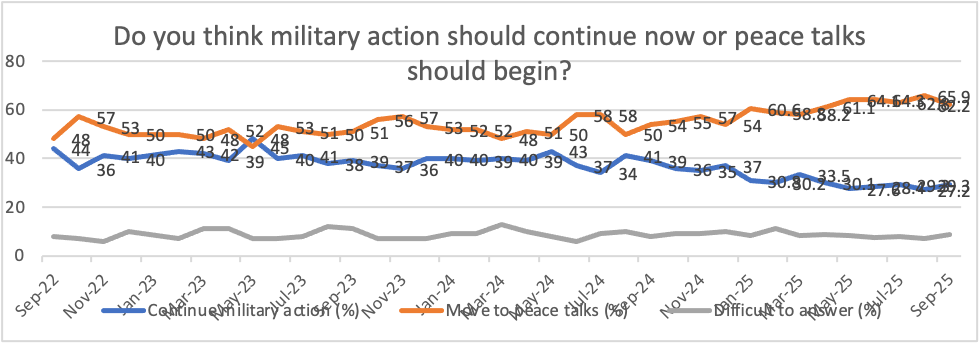
- The share of Russians who do not follow the Russian-Ukrainian war or pay “no particular attention” increased from 44% in August to 49% in September, according to the Levada Center. The share of Russians who support the actions of the Russian armed forces in Ukraine stayed at 78% in August-September 2025. The share of Russians who support the launch of peace talks over the continuation of hostilities declined from 66% in August to 62% in September. The share of Russians who support the continuation of hostilities over peace talks increased from 27% to 29% in the same period. The share of Russians who would support Putin’s decision to return annexed territories as part of immediately ending the conflict increased from 28% in February to 33% in September, according to Levada.[3] (RM, 10.08.25)
End the military conflict with Ukraine | ||
| Month | Will support, % | Will not support, % |
| May-23 | 62 | 29 |
| Oct-23 | 70 | 21 |
| Apr-24 | 71 | 21 |
| Sep-24 | 72 | 20 |
| Feb-25 | 75 | 17 |
| Sep-25 | 80 | 13 |
End the military conflict with Ukraine and return the territories, which have been added to Russia, to Ukraine | ||
| Month | Will support, % | Will not support, % |
| May-23 | 30 | 62 |
| Oct-23 | 34 | 57 |
| Apr-24 | 30 | 60 |
| Sep-24 | 31 | 60 |
| Feb-25 | 28 | 64 |
| Sep-25 | 33 | 58 |
- A recent Harvard CAPS-Harris Poll indicates that a substantial majority of voters remain unconvinced of Donald Trump’s ability to resolve key global conflicts, specifically the wars in Ukraine and between Israel and Hamas. According to the survey, 63% of respondents say they do not believe Trump will be able to bring an end to the war in Ukraine. This represents a four-point increase in skepticism compared to results from August, when 59% doubted his ability to solve the conflict. Breaking down the results by political affiliation, the survey reveals a deep partisan divide. Among Democrats, only 18% think Trump could solve the Ukraine war, while 82% believe he could not. By contrast, 63% of Republicans express confidence in Trump’s ability to resolve the conflict, with 37% doubting him. Among independent and other voters, 29% believe he could succeed in Ukraine, while 71% do not. (Harvard CAPS-Harris Poll, October 2025)
Friday, Oct. 10, 2025
- Trump said Oct. 9 that Washington and NATO allies were "stepping up the pressure" to end the war in Ukraine, after his outreach to Putin failed to achieve a ceasefire. "Yeah, we are stepping up the pressure," Trump said in the Oval Office during a meeting with Finnish President Alexander Stubb when asked by an AFP reporter if he would increase efforts for a deal. "We're stepping it up together. We're all stepping it up. NATO has been great," he added. (AFP, 10.09.25)
- Stubb said he was confident that Trump would be able to push through a deal on Ukraine following the Gaza deal between Israel and Hamas. "I think this one will be the next big one," Stubb told reporters. (AFP, 10.09.25)
- Putin stated that Russia remains committed to the agreements on Ukraine reached with Trump during their Alaska meeting, saying: “We remain within the framework of the agreements of Alaska. We do not change anything for ourselves — we believe that both sides need to work further, but in general, we remain within the framework of the Alaska agreements.” No further details of the Anchorage talks were made public. (Ukrainska Pravda, 10.10.25)
- Kremlin aide Yuri Ushakov stated that during the Alaska talks, Putin was prepared to make concessions regarding a Ukraine settlement: “We made certain concessions there, I’ll say directly. Our president is ready for this. The concession, or rather, our step forward is connected with the fact that the Americans need to get something from the Europeans and Ukrainians.” He did not specify what the concessions could have been. (Kommersant, 10.10.25)
Great Power rivalry/new Cold War/NATO-Russia relations:
Saturday, Oct. 4, 2025
- Russia is reportedly jamming U.K. military satellites weekly and tracking German Intelsat satellites using Olymp-K spacecraft, according to British and German officials. U.K. Space Command and German Defense Minister Boris Pistorius say Russia and China also test anti-satellite weapons and can jam, blind, or kinetically disrupt space assets. (ISW, 10.04.25)
Monday, Oct. 6, 2025
- European officials continue to report suspicious drone activity in their airspace. Norwegian authorities delayed flights and temporarily closed Oslo’s Gardermoen airport after three to five unidentified drones were sighted on Oct. 5–6, though the sightings remain unconfirmed and unattributed. (ISW, 10.06.25)
- German officials have attributed recent drone flights over Munich Airport to Russia. German Chancellor Merz said Russia was likely behind most of the drones that closed the airport on Oct. 2–4, claiming the incursions were intended for espionage and spreading fear. (ISW, 10.06.25)
- On Oct. 6, Russia’s Foreign Intelligence Service (SVR) falsely claimed the U.K. is planning a pro-Ukrainian Russian attack on a ship in a European port, intended to look like it was done under Moscow’s orders and to implicate China. Such false flag claims have increased against European states in recent weeks, amid a rise in Russian covert and overt attacks—sabotage, EW, drone incursions—targeting NATO. This campaign seeks to foster fear in Europe, divide NATO, and justify any future Russian escalation. (ISW, 10.06.25)
- German Chancellor Friedrich Merz’s claim that Russia was behind a series of drone sightings in the skies above Germany last week is “baseless,” the Kremlin said Oct. 6. (MT/AFP, 10.06.25)
Wednesday, Oct. 8, 2025
- An unidentified drone conducted reconnaissance Oct. 8 evening over NATO’s main AWACS base in Geilenkirchen, Germany, near the Belgian and Dutch borders, according to Spiegel. The incident triggered a security alert, but army and police could not locate the drone or operator. German law does not yet permit the military to shoot down drones; new reforms will allow only police to do so. (Istories, 10.10.25)
Thursday, Oct. 9, 2025
- NATO allies are considering a stronger response to Russia’s hybrid warfare, including arming surveillance drones, easing restrictions for pilots to fire on Russian aircraft, and holding military exercises near the border. The talks, driven by drone and jet incursions, also address updated rules of engagement and greater air defense coordination. EU measures include funding anti-drone systems and restricting Russian diplomatic movement. (Financial Times, 10.09.25)
- Zelenskyy revealed that Russia’s “shadow fleet” of over 500 tankers is being used for recent drone incursions into European airspace. (ISW, 10.09.25)
- Trump floated the idea that Spain could be removed from NATO in his latest swipe against a chronic under-spender on defense. (Bloomberg, 10.09.25)
- The U.S. Army is planning to deploy the Pentagon’s first hypersonic weapon by the end of the year, even though the Defense Department’s own test office said the weapon hasn’t yet proven it would be effective in real-world combat. (Bloomberg, 10.09.25)
Friday, Oct. 10, 2025
- Trump announced a $6.1 billion deal for the U.S. Coast Guard to partner with Finland to acquire four Finnish-built icebreakers and construct up to seven more in U.S. yards, creating an 11-ship fleet by 2028. The move aims to counter Russian and Chinese Arctic ambitions and will generate thousands of U.S. shipbuilding jobs while leveraging Finnish Arctic expertise. (Firstpost, 10.11.25)
- The European Union should pool its resources on defense spending and consider a common budget financed by jointly-issued debt, according to European Central Bank Governing Council member Martins Kazaks. (Bloomberg, 10.10.25)
China-Russia: Allied or aligned?
- Beijing has censured the Trump administration for threatening to ban Chinese airlines for flying over Russia. (Presstv, 10.10.25)
Missile defense:
- Putin said Russia will strengthen its air defense systems in response to reports that the U.S. may supply long-range Tomahawk missiles to Ukraine. Putin also claimed that Russia will soon introduce new types of weaponry, stating testing is underway. (RBC.ua,10.10.25)
Nuclear arms:
- Trump on Oct. 5 praised Putin’s proposal to extend the New START treaty’s long-range nuclear weapons limits for one more year after its scheduled expiry in February 2026, saying, “Sounds like a good idea to me.” Trump’s team hasn’t formally responded to the Russian offer. In his comments Oct. 5, Trump didn’t say if the U.S. was coupling its acceptance of the Russian idea with proposals of its own or whether it had formally responded to the Kremlin offer. (Wall Street Journal, 10.05.25)
- Speaking to reporters at a summit in Tajikistan on Oct. 10, the Russian leader said it would not be critical for Moscow if the United States declined to extend the warhead limits set out in the New START. Putin said it would, however, be a shame if nothing remained of the arms control framework between the two countries. “Will these few months be enough to make a decision on an extension? I think it will be enough if there is goodwill to extend these agreements. And if the Americans decide they don’t need it, that’s not a big deal for us,” Putin told reporters. (Al Jazeera, 10.10.25)
- Putin’s spokesman welcomed Trump’s stated support for extending limits on long-range nuclear weapons. Kremlin spokesman Dmitry Peskov called Trump’s response grounds for optimism and a possible basis for new U.S.-Russia negotiations outside the war in Ukraine. Putin has not said whether he would be amenable to reviving the inspections and data-sharing elements of the treaty. An extension of the caps could help Russia avoid an expensive nuclear arms race at a time when its war against Ukraine, and the resulting international sanctions, have put the country under intense economic pressure. Keeping the warhead limitations in place could also offer the Kremlin a track for negotiating with Washington matters unrelated to Ukraine. (New York Times, 10.067.25)
- Russia can do without reaction from the United States if Washington has no interest in Moscow’s initiative regarding the New START Treaty, Russian Deputy Foreign Minister Sergey Ryabkov told reporters. "There is no discussion, and I emphasize this, about the proposal to renew the treaty. The idea is to maintain the key quantitative limits outlined in that agreement for a year after the treaty officially expires, that is, starting on Feb. 6 of next year, strictly provided that the United States does not, for its part, take actions that may disrupt the existing parity and balance in strategic stability," he explained. Ryabkov clarified that the United States must avoid destabilizing moves in the field of offensive strategic weapons and steps in the sphere of strategic air defense that, he added, Russia "could interpret as an attempt to weaken our nuclear deterrence capabilities." (TASS, 10.08,25)
- NATO’s annual nuclear deterrence drills will begin on Oct. 6, Secretary General Mark Rutte said — a routine event with added significance as the U.S. mulls scaling down its military presence in Europe. The exercises, called Steadfast Noon, will take place in the Netherlands, Belgium, the U.K. and Denmark just weeks after a wave of drone incursions and cyberattacks rattled several northern European countries. The two-week program includes 14 members of the military alliance. (Bloomberg, 10.10.25)
Counterterrorism:
- Russia’s Federal Security Service (FSB) said Oct. 6 that it had thwarted planned attacks on Jewish religious sites in the Krasnoyarsk and Stavropol regions. Two men from Central Asia were arrested in Krasnoyarsk on suspicion of plotting to detonate a homemade bomb at a local synagogue, the FSB said. (MT/AFP, 10.06.25)
Conflict in Syria:
- No significant developments.
Cyber security/AI:
- No significant developments.
Energy exports from CIS:
- Seven EU countries increased Russian energy imports in 2025 despite an overall 90% EU reduction since 2022, Reuters reports. France’s imports rose 40% to €2.2 billion ($2.5B), the Netherlands jumped 72%, and Hungary saw an 11% increase, with Hungary and Slovakia accounting for €5 billion. LNG now makes up nearly half of EU oil and gas purchases from Russia, as long-term contracts continue. (Kyiv Independent, 10.10.25)
- Putin acknowledged Ukraine’s intensified long-range strikes on Russian oil refineries, which have led to severe gasoline shortages and price spikes in Russia and occupied Ukraine. To cope, Russia quadrupled gasoline imports from Belarus in September. Kremlin-linked milbloggers warn Ukraine’s expanded strike range threatens critical energy infrastructure, urging stronger defenses against attacks targeting refinery “hearts.” (ISW, 10.08.25)
- OPEC+ has shifted to a more cautious approach after months of increasing oil production, announcing only a modest rise of 137,000 barrels per day for November—the same as October’s increase—as concerns over a global oil glut grow. (Financial Times, 10.06.25)
- Russia has been gradually raising its oil production and was close last month to meeting the output quota agreed by the OPEC+ group of leading oil producers, Deputy Prime Minister Alexander Novak said on Oct. 8. According to OPEC, Russian oil production increased in August to 9.173 million barrels per day, up 50,000 bpd from July. (Reuters, 10.08.25)
- Indian refiners are expected to boost oil imports from Russia in the coming months, as trade talks with Washington drag on and discounts widen amid ample supplies. Discounts on Urals crude loading in November are $2-to-$2.50 a barrel to Dated Brent, making it attractive, according to people familiar with the developments. (Bloomberg, 10.08.25)
- Russia has ramped up imports of gasoline from Belarus to ease mounting fuel shortages caused by Ukrainian attacks on its oil refineries, Reuters reported Oct. 7, citing industry sources. Imports of Belarusian gasoline surged fourfold month-on-month to 49,000 tons in September while diesel deliveries reached 33,000 tons, the sources said. Belarusian refiners continued to export their own fuel abroad through Russian ports, with transit shipments rising by around 1% in September to 140,000 tons. (MT/AFP, 10.08.25)
- Russia will need at least a decade to significantly increase its gas exports to China via the planned Power of Siberia 2 gas pipeline, Reuters reported. The two sides have been unable to agree on gas prices, investment conditions or the timeline for launching deliveries, Reuters reported. Even if a deal is finalized next year, construction would take at least five years and another five would be needed to reach full capacity, two industry sources told Reuters. (MT/AFP, 10.07.25)
- At least five tankers from Russia’s so-called “shadow fleet” — vessels used to evade Western sanctions — have leaked oil into European waters over the past year, an investigation by Politico and the journalist group SourceMaterial has said. (MT/AFP, 10.06.25)
- A new Harvard CAPS-Harris Poll finds strong voter support for reducing European reliance on Russian energy and for maintaining pressure on Moscow through both sanctions and military aid. According to the survey, 79% of respondents think Europe should stop buying oil from Russia and instead purchase it from the United States, if doing so were practical. Only 21% are opposed to switching Europe’s supply away from Russia. (Harvard CAPS-Harris Poll, October 2025)
Climate change:
- No significant developments.
U.S.-Russian economic ties:
- U.S. Congresswoman Anna Paulina Luna said she will meet with Putin’s economic cooperation envoy later in October, as officials in Moscow blamed the United States for a breakdown in bilateral relations. “I have officially confirmed a meeting with Kirill Dmitriev, Special Envoy to the President of Russia, for later this month,” Rep. Anna Paulina Luna, wrote. “Our two countries do not need to be enemies. Allies in trade benefit everyone,” the lawmaker wrote. Dmitriev, who also heads Russia’s sovereign wealth fund, confirmed the meeting and thanked Luna for what he called her “courageous stand for peace and dialogue.” (MT/AFP, 10.09.25)
U.S.-Russian relations in general:
- Putin on Oct. 10 praised Trump’s efforts to broker a ceasefire in the Middle East and criticized the Nobel Committee for awarding its peace prize to people he claimed did nothing to deserve it, remarks that appeared aimed at currying favor with Trump, who has grown increasingly cool toward Moscow amid stalled efforts to end the war in Ukraine. (MT/AFP, 10.10.25)
- The number of international students arriving in the U.S. in August 2025 fell by 19% compared to last year—the largest non-pandemic drop on record, the New York Times reports. While arrivals from Britain rose slightly and from Spain and Germany dipped, the biggest decline among European countries came from Russia, where relations with Washington have remained strained. (New York Times, 10.06.25)
- David Slater, a retired Army officer who worked as a civilian for the Air Force has been sentenced to nearly six years in prison for conspiring to transmit classified information about Russia’s war with Ukraine on a foreign online dating platform. (AP, 10.10.25)
II. Russia’s domestic policies
Domestic politics, economy and energy:
- Russia’s economy is heading toward stagnation rather than a “managed slowdown,” the World Bank said in its latest forecast, cutting its growth outlook and warning that output is unlikely to rise more than 1% per year through 2028. The lender now expects Russia’s GDP to grow 0.9% in 2025, down from 1.4% in its June forecast, 0.8% in 2026 and 1% in 2027. It also projects a 0.4% decline in investment this year and a further 0.2% fall next year before modest recovery in 2027. The World Bank cited falling oil prices, weaker exports and high interest rates as key drags on growth. The bank expects Russia’s budget deficit to widen to 2.9% of GDP this year — higher than the Finance Ministry’s 2.6% forecast — and to remain near 2.7% in 2026-27. Inflation, however, is seen easing from 7.5% this year to 4.5% in 2026 and 4% in 2027. (MT/AFP, 10.08.25)
- Russia’s Finance Ministry has unveiled a draft federal budget for 2026 that includes new tax hikes aimed at sustaining steady wartime spending. The biggest change is a planned increase in value-added tax (VAT) from 20% to 22%, designed to help plug a widening deficit caused by soaring defense spending and shrinking oil and gas revenues under Western sanctions. More businesses will be required to pay VAT. The minimum annual revenue threshold for businesses to make payments is set to fall from 60 million rubles ($732,000) to 10 million rubles ($122,000). The government also plans to target the betting industry with a 5% tax on wagers and a 25% levy on betting companies’ profits. (MT/AFP, 10.07.25)
- Russia’s stock market suffered its steepest single-day decline in three years on Oct. 8 after a senior diplomat said that progress toward a potential peace deal to end the war in Ukraine had largely stalled. The Moscow Exchange (MOEX) Index, which tracks 40 of the country’s largest publicly traded companies, fell 4.05% to 2,563.3 points, its lowest level since December 2024 — marking the sharpest single-day drop since September 2022. The selloff accelerated after Deputy Foreign Minister Sergei Ryabkov said the “strong momentum in favor of reaching agreements” that followed Putin’s meeting with Trump in Alaska had “been exhausted.” (MT/AFP, 10.08.25)
- Russian elites are growing concerned over the Kremlin’s asset nationalization drive, with the Central Bank ruling that shareholder rights were violated in recent seizures—including a majority stake in Uzhuralzoloto. Reuters reports backlash from market-friendly technocrats as authorities have seized $50 billion (2% of Russia’s GDP) in assets since 2022, fueling worries of a “Soviet-style command structure” and harming Russia’s economy amid sanctions. (ISW, 10.09.25)
Major Russian factories are cutting labor costs due to falling demand for civilian goods. Automakers GAZ, VAZ and KamAZ have switched workers to four-day weeks, while agricultural machinery giant Rostselmash cut to three-day weeks, reflecting deepening challenges in the non-military sector. (Istories Telegram, Reuters, Vedomosti, 10.09-10.10.25)
- Russian economist Natalia Zubarevich describes the Russian economy as worsening, with civilian sectors flat or declining and a prolonged crisis in coal—where production is down for three consecutive years and key regions like Kemerovo face a 34% budget deficit. By mid-2025, 67 regions reported deficits, while federal support has shrunk. Food service, however, rose 17% in Moscow, and Zubarevich warns new tax hikes will push more small businesses into the shadows. (RTVI, 10.05.25)
- Putin spent his 73rd birthday working and taking calls with foreign leaders, the Kremlin said Oct. 7. (MT/AFP, 10.07.25)
- The independent digital rights group Roskomsvoboda said on Oct. 9 that it would shut down after 13 years of advocating against and monitoring government restrictions on the internet. (MT/AFP, 10.09.25)
- A Moscow court on Oct. 10 ordered the seizure of assets belonging to the arrested deputy chairman of the liberal Yabloko party as part of a criminal case against him for spreading “fakes” about the military. Maxim Kruglov faces up to 10 years in prison on the charges, which are connected to two Telegram posts from April 2022 in which he spoke out against the full-scale invasion of Ukraine. He has denied the charges, calling them “absurd.” (MT/AFP, 10.10.25)
- According to Levada’s September 2025 survey, 70% of Russians say the country is moving in the right direction—unchanged over the past year—while 17% say it’s on the wrong path. Putin’s approval rating remains steady at 87%. The “right direction” view is most common among those with higher education (71–72%), higher income (73%), Muscovites (83%), those who trust television for news (82%), Putin supporters (79%) and respondents in a “good mood” (83%). (Levada, 10.03.25)
Defense and aerospace:
- Putin announced that Russia will soon unveil new weapons, stating: “I think we will have an opportunity in the near future to announce new weapons that we once talked about. They are emerging and undergoing tests.” Putin added that Russia’s nuclear deterrent systems are “more advanced than any other state’s.” He also hinted that the military may soon receive hypersonic weapons. (Kommersant, 10.10.25)
- The share of Russians fearing a general mobilization due to the war in Ukraine has risen to 51% as of September 2025, up 17 points since February 2024, according to Levada. Those not afraid of mobilization fell to 43%, down 16 points. The current level remains below the 2022 peak, when two-thirds expressed concern after “partial” mobilization was announced. (Levada, 10.10.25)
- See section Military aspects of the Ukraine conflict and their impacts above.
Security, law-enforcement, justice and emergencies:
- Russian authorities will launch thorough inspections of regional airlines amid a growing number of aviation accidents and fatalities in recent years, the pro-Kremlin newspaper Izvestia reported on Oct. 9. Authorities say commercial aviation accidents increased from eight in 2023 to 17 in 2024, while the number of deaths more than tripled from 12 to 37 over the same period. So far in 2025, 53 people have died in major incidents, exceeding the fatalities in both previous years combined. (MT/AFP, 10.09.25)
- A Russian nuclear engineer has been sentenced to 18 years in a maximum-security prison for donating to Ukraine-based paramilitary units of Russian citizens, the Kommersant business daily reported Oct. 8, citing court records. Ruslan Shadiyev, a research engineer at the Russian Federal Nuclear Center in Sarov, Nizhny Novgorod region, was convicted of treason and aiding terrorist activity by the Second Western District Military Court. (MT/AFP, 10.08.25)
- Russia has begun enforcing a 24-hour blackout on mobile data and text messaging for all foreign SIM cards that connect to its networks, authorities in neighboring Belarus said this week. The move follows Russian Communications Minister Maksut Shadayev’s proposal in August to introduce a so-called “cooling-off period” for foreign SIM cards entering the country, a measure aimed at preventing automated or unmanned systems, like drones, from using the mobile network in Russia. (MT/AFP, 10.08.25)
- Russian police arrested four men accused of defrauding soldiers out of their military salaries and bonuses meant for deployment in Ukraine, the Interior Ministry said Oct. 10. (MT/AFP, 10.10.25)
III. Russia’s relations with other countries
Russia’s external policies, including relations with “far abroad” countries:
- Russian President Vladimir Putin has given a cautious welcome to President Donald Trump's peace deal in Gaza on Oct. 9. “We very much hope that these initiatives of the U.S. President will actually be implemented in practice," the Putin said at a Russia-Central Asia Summit. "This initiative was, from the very beginning, generally received positively both in the Arab and Islamic worlds." Russian Foreign Minister Sergei Lavrov told Reuters that Trump's 20-point plan was "the best solution we have on the table." (Newsweek, 10.09.25)
- The Russian leader and Israeli Prime Minister Benjamin Netanyahu had discussed Trump's peace deal for the war in Gaza during a phone call on Oct. 6. (Newsweek, 10.09.25)
- The Russia-Arab conference was postponed due to a lack of confirmations from Arab leaders, with only a few leaders confirming their participation as of Oct. 7. The debut Russia-Arab conference was scheduled to be held in Moscow on Oct. 15. (Bloomberg, 10.10.25)
- Indian Prime Minister Narendra Modi sent a warm birthday message to Putin just hours before U.K. Prime Minister Keir Starmer’s arrival, providing an awkward start to a visit meant to be focused on trade. Modi said in a tweet on Oct. 7 that he had spoken with “my friend President Putin” and wished him well, praising the Russian leader’s commitment to deepening ties. Putin is to visit India in December. (Bloomberg, 10.08.25, RM, 10.08.25)
- Russia held its first official meeting with Afghanistan on Oct. 7 after recognizing the Taliban government earlier this year, with Russian Foreign Minister Sergei Lavrov using the occasion to denounce Western sanctions and urge international support for the country’s postwar recovery. Speaking at the opening of the “Moscow Format” consultations on Afghanistan, Lavrov praised the Taliban for fighting the regional chapter of the Islamic State and combating drug trafficking while blaming the West for its “confrontational policy,” including the continued freezing of Afghan state assets and restrictions on its banking system. (MT/AFP, 10.07.25)
- Former Czech Prime Minister Andrej Babis, after scoring a dramatic political comeback in the Oct. 4 parliamentary elections, looked to reassure the West over his commitment to the EU and NATO, but he may be forced to partner with even-more Eurosceptic partners to form a government. (RFE/RL, 10.05.25)
- A court in the Far East Primorye region on Oct. 9 upheld the detention of Sofiane Sehili, a French endurance cyclist arrested last month while attempting to set a world record for cycling across Eurasia. Sehili, 44, faces up to two years in prison on charges of illegally crossing the Russian border. (MT/AFP, 10.09.25)
Ukraine:
- Ukraine faces a massive funding gap, with the IMF forecasting it needs $65 billion through 2027 to stay afloat. (Washington Post, 10.03.25)
- Ukraine’s pivot to domestic weapons production is shrouded in secrecy and raising questions about accountability. Internal audits reveal that since early 2024, Kyiv’s Defense Procurement Agency repeatedly awarded contracts to higher-bid companies—at a cost difference of at least $129 million—while some vendors missed deliveries or failed to supply pre-paid items. The agency, created after scandals like the “egg procurement” crisis, says it rejects low bids for reasons like poor quality or bad payment terms, but critics cite a lack of transparency and lingering risks of corruption as Ukraine becomes self-reliant for nearly 60% of its arms. (New York Times, 10.06.25)
- Ukraine’s defense minister Denys Shmyhal this month said Ukraine would “in the near future” be able to deploy 1,000 drone interceptors a day. (Financial Times, 09.30.25)
- Ukrainian Ambassador to the U.K. Valerii Zaluzhnyi warned of a Russian cognitive warfare campaign spreading disinformation about Ukrainian elections. On Oct. 8, Zaluzhnyi denied supporting wartime elections or planning a presidential bid, stressing that Russian propaganda aims to split Ukrainian society by targeting the domestic information space with false narratives. (ISW, 10.09.25)
- Ukraine's Security Service (SBU) and the country's top anti-corruption agency (NABU) are entangled in an escalating confrontation involving raids and arrests. The SBU, which is seen as loyal to the President's Office, has arrested NABU employees, accusing them of having ties to Russia, and portrayed the crackdown as an attempt to counteract Moscow's alleged influence on the bureau. But anti-corruption activists see it as an effort to stop the detectives who have investigated President Volodymyr Zelensky's inner circle from doing their job. (Kyiv Independent, 10.04.25)
- In Kherson region of Ukraine, officials from the Henichesk district military administration, including the head, his deputy, and the chief accountant, were charged with systematically extorting bribes totaling over 930,000 hryvnias from subordinates between March 2023 and October 2024. Authorities detained the suspects, who face pre-trial detention or bail. (Korrespondent.net, 10.10.25)
- Ukrainian authorities uncovered four new draft-dodging schemes in Kyiv region and Bukovina, arresting five organizers—including a doctor, a priest, and a former bodyguard of Medvedchuk’s ally. For up to $20,000, they provided fake disability documents or smuggled men abroad to evade mobilization. One suspect was caught receiving payment for organizing a border escape. (Korrespondent.net, 10.10.25)
- Ukraine’s High Anti-Corruption Court ordered the detention of a prosecutor from the Office of the Prosecutor General, accused alongside two lawyers of soliciting a $3.5 million bribe to close a NABU case. The court set bail at over 4 million hryvnias. Anti-corruption agencies released video evidence and flagged potential conflicts of interest in the investigation. (Ukrainska Pravda, 10.10.25)
- Zelenskyy has issued a decree dismissing Serhiy Lyamets from the post of chairman of Ukraine’s State Customs Service. The decision was announced on Oct. 8 following a series of high-profile personnel changes in Ukraine’s customs and law enforcement agencies amid ongoing anti-corruption efforts. The reasons for Lyamets’s dismissal were not specified in the official statement. (Ukrainska Pravda, 10.08.25)
- In Odesa, city council officials and a private firm were exposed for causing the community more than seven million hryvnia in losses. According to The National Police, the former Capital Construction Department official once signed several contracts with a firm and an entrepreneur working in the architectural field to develop projects for the restoration of a hospital, architectural monuments, and the reconstruction of water supply, sewerage, and gas supply networks. (Ukrainska Pravda, 10.10.25)
Russia's other post-Soviet neighbors:
- Putin on Oct. 9 urged the leaders of five Central Asian states to boost their trade with Russia, as Moscow seeks to build back its influence in a region that is also being courted by China. Russia's total trade turnover last year with Kazakhstan, Uzbekistan, Kyrgyzstan, Turkmenistan and Tajikistan was over $45 billion - a "good result" but well short of the level of its bilateral trade with Belarus, which has a fraction of their combined population, Putin said. (Reuters, 10.09.25)
- Putin publicly admitted for the first time that Russian air defenses shot down an Azerbaijani passenger jet last December, killing 38 people. Putin reiterated his apology to Azerbaijan’s president and said Russia was prepared to pay compensation after a legal assessment, citing “tragic” confusion with Ukrainian drones. The rare admission comes as relations between Moscow and Baku have deteriorated sharply since the incident. (New York Times, 10.10.25)
- Azerbaijan released the local bureau chief of Russia’s state-owned news outlet Sputnik following high-level negotiations with Moscow, the Kommersant business newspaper reported on Oct. 9, citing Kremlin foreign policy adviser Yury Ushakov. Editor-in-chief of Sputnik Azerbaijan, Igor Kartavykh, had been moved from police detention and placed under house arrest in Baku. (MT/AFP, 10.10.25)
- Eurasian leaders on Oct. 10 signed a document on creating an expanded format of the Commonwealth of Independent States (CIS) during a summit in the Tajik capital Dushanbe. According to a Kremlin statement, a total of 19 documents were signed following a meeting of the CIS Heads of State Council in Dushanbe, including decisions on establishing a “CIS Plus” format, and giving the Shanghai Cooperation Organization (SCO) observer status within the organization. (AA.com, 10.10.25)
- Georgian riot police fired tear gas and used water cannons during clashes with protesters in the capital, Tbilisi, late Oct. 4 that followed municipal elections shunned by opposition parties. Police dispersed demonstrators who attempted to enter the presidential palace after thousands of opposition supporters attended an anti-government rally in the city center, the Interfax news service reported. As many as 32 police officers were injured in the clashes, the Interior Ministry said. Six protesters were also hurt, according to the Health Ministry. Five people who helped organize the rally were arrested and face as much as nine years in prison. (Bloomberg, 10.04.25)
- The European Union is set to approve new rules that would make it easier to suspend visa liberalization for third-country nationals traveling into the bloc, a measure aimed in large part at Georgia amid signs Tbilisi is drifting away from democratic reforms and back toward Moscow's sphere of influence. (RFE/RL, 10.06.25)
- A soldier from Estonia’s voluntary defense organization was sentenced to nearly five years in prison for spying for Moscow after he was caught handing over information about the military presence in a city near the border with Russia. Ivan Dmitrijev, an Estonian citizen, operated drones for the country’s Defense League. (Bloomberg, 10.07.25)
- Uzbekistan’s Navoi Mining & Metallurgical Co., which is considering a potential London listing, plans to boost output by 30% over the next five years, strengthening its position among the world’s leading gold producers. (Bloomberg, 10.07.25)
IV. Quotable and notable
- No significant developments.
Footnotes
- Other sources: Washington Post, 10.05.25, ISW, 10.05.25, New York Times, 10.05.25, The Independent, 10.10.25.
- Sources: Wall Street Journal, 10.05.25, New York Times, 10.06.25, TASS, 10.08.25, Al Jazeera, 10.10.25.
- “As part of the September survey, a previously repeated experimental poll was conducted again by Levada. Using a random number generator, participants were divided into two equal groups, each of which was asked a question in one of two formulations. In the first case, respondents were asked whether they would support or not support a decision by the president to immediately end the military conflict (without any conditions). In the second case, respondents were asked whether they would support or not support the same decision, but on the condition that the newly acquired territories be returned. The majority of respondents (80%, an increase of 18 percentage points since May 2023) said they would support a decision by Vladimir Putin if he were to ‘end the military conflict with Ukraine this week’ (a steady rise of 13 percentage points since May 2023). However, if Putin were to ‘end the conflict this week’ on the condition of returning the annexed territories, significantly fewer Russians—one-third of respondents, or 33% (an increase of 5 percentage points since February 2025)—would support such a decision.”
The cutoff for reports summarized in this product was 10:00 am East Coast time on the day it was distributed.
*Here and elsewhere, the italicized text indicates comments by RM staff and associates. These comments do not constitute an RM editorial policy.
Slider photo by AP Photo/Efrem Lukatsky.
 Russia in Review