
Russia in Review, May 22–29, 2026
4 Things to Know
- Ukraine’s war has entered a new phase in which “the frontline is stabilizing, Europe is delivering cash and the country is carving out a role as a defense power,” with drone‑led forces stymieing Russia, according to The Economist. This May 26 assessment is echoed by a May 28 FT report, which asserts that “Ukraine is turning the tables.” In particular, the mass production of UAVs—at a scale and speed hard to imagine just a year ago—allows Kyiv to wage the long-range drone war and maintain a shorter-range “kill zone” along the front line, according to FT. In an evening address this month, Volodymyr Zelenskyy sought to capture the sense that the war is shifting. “Our long-range capabilities are significantly changing the situation and, more broadly, the world’s perception of Russia’s war,” he said, according to FT. He then went on to assert: “Many partners are now signaling that they see what is happening and how everything has changed—both in attitudes towards this war and in the reachability of Russian targets on Russian territory.” Yet, according to The Economist, the Ukrainian rear is “hollowed out:” blackouts have cut economic growth by an estimated 2.5 percentage points this year, and an unpublished poll shows society splitting into 46% “patriots,” 36% “skeptical moderates” and 18% “demotivated,” with anger over corruption and coercive mobilization. If we use net changes in control of territory in the past year as the proxy for estimating whether the frontline is indeed stabilizing per The Economist’s reporting, then we would conclude that this is indeed the case. According to Ukrainian OSINT group DeepState’s data, analyzed by RM, Russia expanded its control of Ukrainian territory by less than one percentage point in the past year, with Russia’s net gain of Ukrainian territory in that period equaling 1,484 square miles (see Endnote 1).1 RM’s analysis of ISW’s data for the past year yields similar results (see Endnotes 1 and 2).2 However, Zelenskyy’s claim citied in FT that Ukraine has turned the tables on Russia with increased reachability of Russian targets for Ukrainian drones is on much shakier ground. FT’s own graph shows Ukraine conducted about 2,000 air/drone strikes in a recent month, while Russia conducted almost twice as many of these air/drone strikes that same month.*
- On May 29, Vladimir Putin said battlefield dynamics now allow Moscow to claim the war in Ukraine is nearing its end, but insisted it is impossible to give a timetable. “The situation on the battlefield is developing in such a way that this gives us the right to say that the situation is approaching completion,” he told reporters after a visit to Kazakhstan, adding that naming specific deadlines in wartime is “not just rash, it’s something that is practically never done,” according to Vedomosti. Putin’s comments were meant to clarify his May 9 observation that “the matter is coming to an end,” which provoked a debate on whether he was referring to the Russian-Ukrainian war.
- RM’s analysis of ISW’s data for the past four weeks (April 28–May 26, 2026) indicates that Russian forces saw a net loss of 100 square miles (about the total area of Nantucket) of Ukraine’s territory, according to the latest issue of the Russia-Ukraine War Report Card. In contrast, during the previous four-week period (March 31–April 28, 2026), Russian forces lost a net 26 square miles of Ukraine’s territory.3 In the past week (May 19–26, 2026), Russia lost 38 square miles of Ukraine’s territory—its largest weekly loss this year, according to ISW data.4
- Romania accused Russia of a “serious and irresponsible escalation” after an armed Geran‑2 (Shahed‑type) drone, which Romanian authorities suspect originated from Russian overnight strikes on Ukraine, crossed into Romanian airspace and crashed into the roof of an apartment block in the border city of Galati, about 10 miles from Ukraine’s border, setting the roof on fire, injuring at least two residents and triggering evacuation of the building. Radars detected drones in Romanian airspace and two F‑16s were scrambled with “permission to shoot,” but had only about four minutes from entry into national airspace before impact, in what President Nicușor Dan called the “most serious incident” on Romanian territory since the Ukraine war began and the first such strike on a Romanian residential building. Bucharest convened its security council, briefed EU and NATO allies, requested accelerated extra anti‑drone defenses, ordered the closure of Russia’s consulate in Constanta and declared the consul persona non grata, drawing condemnation of Russia’s “reckless” behavior and pledges of “absolute solidarity” from NATO, the EU, the United States and Moldova, while Moscow vowed retaliation for the consulate closure.5 Putin said only an independent investigation can ascertain the origins of the drone, while Maria Zakharova, the spokeswoman for Russia's foreign ministry, claimed that “all the accusations we hear, particularly about drones somewhere in the European Union countries, are all unsubstantiated.”
I. U.S. and Russian priorities for the bilateral agenda
Nuclear security and safety:
- At a Russian Security Council forum, attended by senior officials from more than 120 countries (including 12 countries deemed “unfriendly,” among them a U.S. Embassy representative), delegates and nearly 1,000 journalists observed a minute of silence before Russian President Vladimir Putin addressed them by video. He said that “when the world is facing serious challenges, such high‑level global meetings and direct professional dialogue are particularly in demand,” and listed international terrorism, risks of uncontrolled nuclear proliferation, extremism, drug trafficking and cybercrime as common threats. Foreign intelligence chief Sergey Naryshkin warned Western “hawks” against declaring nuclear deterrence over and accused a militarizing EU and the U.K. of pushing Europe toward war. (Kommersant, 05.28.26)
- IAEA chief Rafael Mariano Grossi reported the longest communications outage at the Russian‑occupied Zaporizhzhia Nuclear Power Plant since the full‑scale invasion began, with all phone lines and internet down for about 12 hours amid shelling around Enerhodar. The agency warned this and repeated power disruptions near the plant violate its “indispensable principles” for nuclear safety and highlight Ukraine’s fragile external power supply, stressing the need to protect substations and maintain diesel fuel deliveries, including for Chernobyl backup systems. (Ukrainska Pravda, 05.29.26)
- Russia and Kazakhstan have signed an agreement for Russia to build Kazakhstan’s first post-Soviet nuclear power plant, near the village of Ulken by Lake Balkhash, with Moscow financing about 85% and launch expected around 2035–2036. The project, approved in a 2024 referendum, will be carried out by a Rosatom-led consortium and underscores what both sides call a strategic partnership, with 177 joint projects reportedly worth nearly $53 billion. (The Moscow Times, 05.28.26)
North Korea’s nuclear and missile programs:
- No significant developments.
Iran and its nuclear program:
- In discussing nuclear negotiations with Iran, U.S. President Donald Trump ruled out any new arrangement that would send Tehran’s enriched uranium stockpile to Russia or China, saying such a deal would not make him “comfortable.” Under the now-defunct 2015 accord, more than 11 tons of Iranian uranium enriched up to 20% had been shipped to Russia in exchange for sanctions relief. Trump said U.S. sanctions would not be eased and no frozen funds released until Iran “behave[s] properly.” (Wall Street Journal, 05.29.26)
Humanitarian impact of the Ukraine conflict:
Saturday, May 23, 2026
- Ukraine’s missing‑persons commissioner says more than 90,000 people are listed as missing in the national registry, as families protest a law they fear could allow courts to declare missing soldiers dead too soon. (Washington Post/AP, 05.23.26)
Thursday, May 28, 2026
- A new U.N. report blacklists 77 state and non-state parties in 12 countries for conflict-related sexual violence in 2025, up sharply in documented cases from 2024. For the first time, it lists Israeli armed and security forces and Russian armed and security forces. (Washington Post, 05.29.26)
Friday, May 29, 2026
- For military strikes on civilian targets see the next section.
Military and security aspects of the Ukraine conflict and their impacts:
- RM’s analysis of ISW’s data for the past four weeks (April 28–May 26, 2026) indicates that Russian forces recorded a net loss of 100 square miles (about the total area of Nantucket) of Ukraine’s territory, according to the latest issue of the Russia-Ukraine War Report Card. In contrast, during the previous four-week period (March 31–April 28, 2026), the Russian forces lost a net 26 square miles of Ukraine’s territory. (RM, 05.27.26)6
- Russia now controls about 20.0% of Ukraine’s territory, up from 7.2% before the full‑scale invasion and 12.7% gained since Feb. 24, 2022, according to The Economist’s latest satellite‑based war tracker. (The Economist, 05.26.26)
Friday, May 22, 2026
- On May 22, the Russian armed forces advanced near Minkivka, Ukrainian OSINT group DeepState reported. (RM, 05.27.26)
- Ukraine’s intensified mid‑range strike campaign is disrupting Russian logistics in occupied southern Ukraine: after repeated Ukrainian hits on military cargo, local occupation authorities restricted freight traffic on the key M‑14/R‑280 “Novorossiya” highway—Russia’s main land route linking its territory to Crimea—while geolocated footage shows Ukrainian forces also striking Russian trucks on the H‑20 Mariupol–Donetsk highway. (ISW, 05.22.26)
Saturday, May 23, 2026
- On May 23, the Russian armed forces advanced near Kostiantynivka, Illinivka and Pleshchiyivka, Ukrainian OSINT group DeepState reported. (RM, 05.27.26)
- Ukrainian drones struck key oil infrastructure in Russia’s Black Sea port of Novorossiysk, hitting Transneft’s Sheskharis terminal, which shipped over 544,000 barrels of crude per day last month, and the Grushovaya storage facility; regional officials said two people were injured and Russia’s Defense Ministry claimed its forces downed 800 Ukrainian drones. Ukraine also struck the Metafrax Chemicals plant in Perm Krai, >1,700 km from the front, forcing a production halt,, and reportedly damaged a Project 1239 missile corvette and the Kalibr armed frigate Admiral Essen at Novorossiysk Naval Base. (The Moscow Times, 05.23.26; Bloomberg, 05.23.26; Bloomberg, 05.23.26; ISW, 05.23.26; ISW, Meduza, 05.22–23.26; ISW, 05.23.26)
Sunday, May 24, 2026
- On May 24, the Russian armed forces advanced near Pokrovsk and in Rodynske, Ukrainian OSINT group DeepState reported. (RM, 05.27.26)
- Russia launched one of its largest air assaults of the war on the night of May 23–24, firing about 90 missiles and 600 drones at Kyiv and other cities, in a barrage that killed at least four people and injured more than 80 nationwide, Ukrainian officials said. Kyiv was the main target: explosions shook the capital for hours, burning a central market and damaging dozens of residential buildings, schools, emergency-service facilities and cultural sites, as well as the Foreign Ministry and Cabinet of Ministers buildings, which suffered their first wartime damage since World War II. The attack included Russia’s hypersonic, intermediate‑range Oreshnik ballistic missile, capable of carrying nuclear warheads, which struck the area of Bila Tserkva south of Kyiv in the weapon’s third use against Ukraine and closest strike to the capital so far. Moscow said the barrage targeted military and intelligence facilities and was retaliation for a Ukrainian strike in occupied Luhansk. (RFE/RL, 05.24.26; iStories, 05.24.26; Korrespondent, 05.24.26; RBC-Ukraine, 05.24.26; Bloomberg, 05.23.26; New York Times, 05.24.26; Wall Street Journal, 05.24.26; Washington Post, 05.24.26; Financial Times, 05.23.26)
- Open‑source investigators say one of two Oreshnik hypersonic missiles Russia launched overnight on May 24 appears to have malfunctioned and fallen near Russian‑occupied Donetsk rather than reaching Ukraine. (iStories, 05.25.26; ISW, 05.25.26)
- Ukrainian officials say they intercepted 91.5% of the 600 drones launched in the May 23–24 attack, but only 36.7% of Iskander‑M/S‑300 ballistic missiles and 81.5% of cruise missiles. (ISW, 05.24.26)
- Ukraine is increasingly relying on its homegrown Lima electronic warfare system to blunt Russian strikes, jamming and spoofing satellite navigation so missiles and drones miss their targets. Developer Cascade Systems says more than 400 Lima units are in service; each costs up to 3 million hryvnias (≈€58,000), with 30–100 needed to protect a major city—roughly the price of a single Patriot PAC‑3 interceptor. The company claims Lima has jammed about 20,500 Shahed drones and misdirected dozens of ballistic and cruise missiles in the last 18 months. (Politico, 05.24.26)
Monday, May 25, 2026
- On May 25, the Russian armed forces advanced near Riznykivka, Ukrainian OSINT group DeepState reported. (RM, 05.27.26)
- The Kremlin on May 25 condemned a Ukrainian strike on a college in the Russian-occupied town of Starobilsk in eastern Ukraine, calling it a “barbaric terrorist attack on young people.” Russia said at least 21 people were killed in the overnight strike, which hit a college dormitory housing 86 teenagers aged 14 to 18, and described it as one of the deadliest Ukrainian drone barrages in months. Ukraine denied targeting civilians, saying it had hit a Russian drone unit stationed near the town. (MT/AFP, 05.25.26)
- On May 25, Russia’s Foreign Ministry warned that its forces will strike “defense enterprises, decision‑making centers, and command posts” in Kyiv in retaliation for the May 22 strike on occupied Starobilsk. (Meduza, 05.25.26)
- Russia’s foreign minister Sergei Lavrov told U.S. Secretary of State Marco Rubio that Moscow plans “systematic and consistent strikes” on Ukrainian military sites and “decision‑making centers” in Kyiv, advising the United States to evacuate diplomats and citizens; Ukraine’s Foreign Ministry called the warning “shameless blackmail,” while Rubio confirmed that U.S.‑brokered peace talks with Moscow and Kyiv are currently frozen. (RFE/RL, 05.25.26)
- Russian missiles and drones hit Odesa and the surrounding region on the evening of May 25, killing one resident and wounding three others, regional military chief Oleh Kiper said. The strike damaged the glazing and facade of an infrastructure facility and nearby buildings. (Meduza, 05.26.26)
Tuesday, May 26, 2026
- On May 26, the Russian armed forces advanced near Minkivka, Ukrainian OSINT group DeepState reported. (RM, 05.27.26)
- The Economist says Ukraine’s war has entered a new phase in which “the front line is stabilizing, Europe is delivering cash and the country is carving out a role as a defence power,” with drone‑led forces stymieing Russia. Ukrainian commanders estimate they are killing or seriously wounding about 35,000 Russian soldiers a month while roughly 95% of long‑range systems are now domestically designed and built. Yet the Ukrainian rear is “hollowed out”: blackouts have cut growth by an estimated 2.5 percentage point this year, GDP is forecast at 1.5%, and an unpublished poll shows society splitting into 46% “patriots,” 36% “skeptical moderates,” and 18% “demotivated,” with anger over corruption and coercive mobilization. Despite internal strains and criticism of Ukrainian President Volodymyr Zelenskyy’s leadership style, officials say Kyiv is preparing for “another two to three years of war.” (The Economist, 05.26.26)
- In response to intensified Ukrainian long‑range drone strikes and poor air‑defense performance, Russia will ban most civilian flights below 5,100 meters across the vast Moscow air zone from June 1, and for the first time temporarily shut Kaliningrad’s airport over a drone alert. ISW notes the restrictions highlight Moscow’s difficulty defending its own airspace as Ukrainian drones increasingly reach deep‑rear targets, including around the capital. (ISW, 05.26.26)
Wednesday, May 27, 2026
- On May 27, Ukraine’s DeepState OSINT group reported in its interactive map that the Russian armed forces occupied Berestok and advanced near the town. (RM, 05.29.26)
- Ukraine launched fresh long range strikes overnight on May 27, hitting Russian-controlled Sevastopol with drones and Storm Shadow missiles—damaging the southern branch of Russia’s central bank and nearby housing. Ukrainian drones also targeted facilities in Voronezh, Taganrog and Tuapse: in Taganrog, debris set cars ablaze and injured two women, and in Tuapse a fire broke out at a marine terminal in Krasnodar region after drone debris fell on the facility, following multiple recent strikes. (Meduza, 05.27.26; RFE/RL, 05.27.26; Bloomberg, 05.27.26)
- Nearly 500,000 Russian soldiers are estimated to have been killed in Moscow’s full-scale invasion of Ukraine since it began in 2022, Anne Keast-Butler, top British intelligence official has said, as the conflicts grinds to a near stalemate. (RFE/RL, 05.27.26)
- Brig. Gen. Andriy Biletsky, commander of Ukraine’s 3rd Army Corps, told Reuters he believes the next 6–9 months, and especially the next six, will be a turning point in the war. If Ukraine can maintain and build momentum—using mid‑range strikes and cautious advances to seize key positions around cities like Sloviansk—he says Kyiv can force Moscow to abandon plans to capture more of Donetsk region and eventually talk “from a position of strength” about a stable ceasefire. (Ukrainska Pravda, 05.27.26)
- There is anxiety in European capitals that, as Russia’s offensive stalls in Ukraine, Putin may seek to “reshuffle the cards” by expanding the war beyond Ukraine’s borders. EU commissioner Michael McGrath says Moscow’s “aim is to destroy the European Union,” and German lawmaker Norbert Röttgen warns that, despite the enormous risks of striking NATO territory, “we also have to calculate that Putin behaves irrationally and in an escalatory way.” (Wall Street Journal, 05.26.26)
- Russia has adopted new measures to protect infrastructure from Ukrainian drone attacks, with the Duma passing a bill requiring banks to install electronic jammers and authorizing selected bank staff to intercept or even shoot down drones threatening their premises, extending air defense duties beyond the military and security services. The central bank, Sberbank and the Russian Cash Collection Association will be able to equip themselves with jamming devices and other air defenses, while their staff will be permitted to carry weapons, under legislation a lawmaker said would not be state-funded. Separately, Russia has authorized private companies to purchase heavy weapons for drone defense, including anti-aircraft artillery, turrets, radars and electronic warfare systems, to equip “mobile fire groups” of reservists, volunteers and enterprise staff guarding infrastructure, though business leaders have raised financing concerns. (Financial Times, 05.27.26; Meduza, AP, 05.29.26)
- Russia’s FSB said Russian divers found NATO‑made magnetic limpet mines attached to the hull of LPG tanker Arrhenius in Russia’s Baltic port of Ust‑Luga. (Washington Post/AP, 05.27.26)
Thursday, May 28, 2026
- On May 28, Ukraine’s DeepState OSINT group reported in its interactive map that Ukrainian Defense Forces have liberated the area near Novoselivka and are clearing the Russian forces near Voronne, Sichneve, Piddubne, Tovste, Novokhatske and Zelenyi Hai. (RM, 05.29.26)
- Three organisations that track battlefield developments in Ukraine—Deep State, Black Bird Group and the Institute for the Study of War—all report Russia’s territorial gains have slowed, although the groups’ assessments differ slightly in the amount of territory gained or lost. Last month, according to Black Bird Group data, Russia’s gains were a mere 94 sq km, one of the lowest totals of the past two years; in February it lost ground. (Financial Times, 05.28.26)
- An interactive Economist analysis using twice‑daily satellite data estimates that, as of May 28, 2026, Russia controls 20% of Ukraine’s territory (up from 7.2% before the full‑scale invasion, an extra 12.7% since Feb. 24, 2022). Over the past 30 days, Ukraine has retaken about 307 km². (The Economist, 05.28.26)
- On the night of May 28, Russian forces attacked Ukraine with one Kinzhal aeroballistic missile and 147 attack drones of various types. Ukrainian air defenses shot down or neutralized 138 drones, but the missile and nine UAVs hit seven locations, with debris from intercepted drones falling on six more sites. Russian rocket artillery hit a playground in Kherson’s Korabelnyi district, killing a man and wounding his 36‑year‑old wife and their daughters aged 3 and 6, as well as another local resident. (Ukrainska Pravda, 05.28.26; Meduza, 05.28.26)
- Ukraine’s Defense Forces struck the Tuapse oil refinery in Russia’s Krasnodar region overnight on May 27, causing fire and smoke at one of southern Russia’s largest plants, which processes about 12 million tons of oil annually and supplies fuel to the Russian military. Air Force units also used Storm Shadow missiles against Russian Air Force reconnaissance automation facilities near Voronezh, Taganrog and Sevastopol, and hit command posts, logistics depots, a drone facility, radar and a Buk‑M2 command vehicle in occupied territories. Separately, a Ukrainian drone struck the regional court building in Nizhny Novgorod, causing minor damage but no casualties, as local authorities reported air defenses engaging drones over Nizhny Novgorod and nearby Kstovo. (RBC.ua, 05.28.26; Meduza, 05.28.26)
- Ukrainian military officials and western experts agree that the country’s military is stronger than at any time since Trump’s return to office. In particular, the mass production of UAVs—at a scale and speed hard to imagine just a year ago—allows Kyiv to wage the long-range drone war and maintain a shorter-range “kill zone” along the front line. This has largely compensated for Ukraine’s shortage of troops, slowing Russian offensives many feared would accelerate last year and this spring. (Financial Times, 05.28.26)
- Ukraine and Russia have sharply escalated their use of air and drone strikes, with both reaching record levels in 2025–26, according to Acled data visualised by the Financial Times. Ukraine’s monthly strikes rose from near zero in 2022 to around 1,000 in late 2024 and roughly 2,000 by spring 2026. Russia’s campaign has been larger throughout, climbing from a few hundred strikes per month in 2022 to over 1,000 in 2023, frequently above 2,000 in 2024–25, and peaking at more than 3,000 in early 2026, according to FT. In the first four months of this year, the Ukrainian defence ministry has reported exponential growth in the production of reconnaissance drones (up 441 % on the total for all of 2025), mid-strike drones (up 312 %) and deep-strike systems (up 53 %). (RM, 05.28.26; Financial Times, 05.28.26)
- Kyiv, which estimates that Russia enlists an average of 29,500 new soldiers a month, says that for five straight months its foe has lost more personnel than it can mobilize. (Financial Times, 05.28.26)
- In the first four months of this year, the Ukrainian defence ministry has reported exponential growth in the production of reconnaissance drones (up 441% on the total for all of 2025), mid-strike drones (up 312%) and deep-strike systems (up 53%). According to the figures provided by the ministry, which cannot be independently verified, the output of fiber-optic first-person view drones has increased by 179%. (Financial Times, 05.28.26)
- Some intelligence reports indicate that a staggering 1.2 million Russian soldiers have been killed or wounded since February 2022, a casualty figure no major power has suffered in a single conflict since the second world war. (Financial Times, 05.28.26)
- The Russian leader believes his forces can capture the rest of the Donbas by the autumn, after which he intends to escalate his territorial demands, according to people who speak to him. (Financial Times, 05.28.26)
- Ukrainian forces have probably suffered somewhere between 500,000 and 600,000 casualties, according to western estimates. Neither Moscow nor Kyiv publishes official figures of the dead and wounded. (Financial Times, 05.28.26)
- Russian forces are reinforcing air defenses in Moscow City as Ukraine’s long‑range drone campaign increasingly penetrates one of Russia’s densest air-defense networks. Geolocated footage shows a Mi‑26 helicopter installing a Pantsir‑SMD system, with up to 48 mini‑missiles for intercepting small drones, on the Nordstar Tower, near key military and intelligence sites. An insider source says the Defense Ministry installs the systems while Moscow’s city government is forced to finance them via Almaz‑Antey contracts. (ISW, 05.28.26)
- Three crude-oil tankers sanctioned for being part of Russia’s shadow fleet were attacked by drones off Turkey’s Black Sea coast overnight, according to a local port agent. (Bloomberg, 05.28.26)
Friday, May 29, 2026
- Three people were killed in a wave of Ukrainian drone attacks across Russia overnight May 28–29, with strikes targeting a chemical plant and reportedly setting fire to a major oil refinery. Ukraine’s Defense Forces and Special Operations Forces said they struck Lukoil’s Volgograd oil refinery—processing about 15 million tons of crude a year—igniting fires, forcing a shutdown and damaging primary distillation units AVT‑1, AVT‑3, AVT‑5, AVT‑6 and secondary processing units, while regional officials reported debris igniting fuel and energy sites and a synthetic fiber plant in Volzhsky. Ukrainian drones also hit the Yaroslavl‑3 pumping station on the Surgut–Polotsk pipeline, setting ablaze two giant crude tanks, and targeted multiple Russian air defense, command and logistics sites in occupied Ukraine and Russia’s border regions. (The Moscow Times/AFP, 05.29.26; RBC.ua, 05.29.26; Meduza, 05.29.26; Ukrainska Pravda, 05.29.26)
- Yevgen Karas, who commanded some of the first Ukrainian experimental longer-range drone missions in 2022, has watched the number of deep-strike drones Ukraine launches each month grow 20 to 30 times since then. Even more critically, the monthly number of mid-strike drones has expanded by more than 1,000%, Karas estimates. Ukraine launched 7,000 in March alone, the first month in which the country fired more drones into Russia than Russia sent into Ukraine, according to data reviewed by ABC News. Ukraine’s show of strength does not mean it is on the verge of prevailing, analysts say. The front line, if largely unmoving, remains white-hot. Ukrainian officials recorded 233 combat engagements on a single day last week. (Washington Post, 05.29.26)
- Zelenskyy said intelligence indicates Russia is preparing a new massive missile strike on Ukraine. (Ukrainska Pravda, 05.29.26)
- Russian President Vladimir Putin said on May 29 battlefield dynamics now allow Moscow to claim the war in Ukraine is nearing its end, but insisted it is impossible to give a timetable. “The situation on the battlefield is developing in such a way that this gives us the right to say that the situation is approaching completion,” he told reporters after a visit to Kazakhstan, adding that naming specific deadlines in wartime is “not just rash, it’s something that is practically never done,” according to Vedomosti. (RM, 05.29.26)
- U.S. intelligence is examining debris from a Russian Oreshnik ballistic missile fired at Ukraine, material that Congressman Jim Himes said is now in the hands of both Ukrainian and American specialists. Himes argued that using a missile capable of carrying a nuclear warhead is itself an escalation but will ultimately backfire by revealing its capabilities, while a Ukrainian presidential adviser confirmed Kyiv shares certain post‑expertise data with the U.S. but declined to give details. (RBC.ua, 05.29.26)
- Russian authorities issued simultaneous “Missile Danger” alerts in nearly 20 regions on May 29, including all six regions of the Ural Federal District, for the first time since the February 2022 invasion. Warnings began at 2:25 p.m. Moscow time, grounding flights at several airports until about 4:40 p.m., and included Arctic Yamalo‑Nenets some 2,300 km (1,400 miles) from Ukraine. No missile strikes were reported; the alerts followed overnight Ukrainian drone attacks that killed at least three in Volgograd and Bryansk. (The Moscow Times, 05.29.26)
Military aid to Ukraine:
Saturday, May 23, 2026
- A bipartisan group of U.S. senators pressed Defense Secretary Pete Hegseth to release a delayed $600 million security package—$400 million for Ukraine and $200 million for defense programs in Estonia, Latvia and Lithuania—warning that further holdups, combined with planned U.S. troop cuts in Europe, could undermine deterrence against Russia. The money was appropriated last year, and lawmakers say the Pentagon missed its own May 15 deadline for submitting a spending plan. (Washington Post/AP, 05.23.26)
Tuesday, May 26, 2026
- Czech President Petr Pavel says a Prague‑led coalition that has supplied more than 4 million large‑caliber artillery shells to Ukraine since 2024 has shrunk from 18 participating countries last year to “about nine” now, even though the scheme has delivered up to 50% of all such ammunition to Kyiv; the pullout of some states, following the return of Prime Minister Andrej Babiš on a pledge not to spend Czech money on Ukrainian arms, is raising concerns over burden‑sharing ahead of July’s NATO summit in Ankara. (Financial Times, 05.26.26)
- Baltic states have approached Ukrainian defense firms and civil‑protection experts for help designing and building bomb shelters, Politico reports, with Ukraine’s defense‑industry council saying it has held talks on protecting civilians from drones and missiles. Metinvest CEO Yuriy Ryzhenkov confirmed preliminary discussions on shelters, noting that “anyone can build” structures but that Ukraine’s real export is “tactical know‑how” drawn from years of large‑scale attacks. (Meduza, 05.26.26)
Wednesday, May 27, 2026
- Zelenskyy has sent an urgent letter to Trump and Congress warning of a “critical deficit” in Ukrainian air defenses, saying Kyiv “almost exclusively” relies on the United States to counter Russian ballistic missiles and that current deliveries under the PURL program “no longer match the reality of the threat.” He appealed for continued U.S. participation and specifically asked for Patriot PAC‑3 missiles and additional systems to protect Ukraine’s airspace amid escalating Russian mass strikes and threats of further attacks on Kyiv. (RBC‑Ukraine, 05.27.26)
Thursday, May 28, 2026
- The U.K. and Latvia co-lead the Drone Coalition—delivering 45,000+ FPV drones, 150,000+ interceptors and 20,000+ long-range strike drones to Ukraine. At the Drone Summit in Riga, Latvia, Minister for the Armed Forces @AlistairCarns met with British companies at the forefront of drone technology. (U.K. MOD X Account, 05.28.26)
Friday, May 29, 2026
- Ukraine has sealed a deal with Sweden for 36 Gripen fighter jets—16 older C/D models to be donated and 20 newer E/F models purchased for €2.5 billion via an EU loan—with first deliveries possible in early 2027. The jets, optimized for dispersed operations, quick turnaround, and European-made missiles such as Meteor, are expected to strengthen Ukraine’s air defenses and push Russian bombers farther from its borders, though not decisively change the war. (The Moscow Times, 07.29.26)
Punitive measures related to Russia’s war against Ukraine and their impact globally:
Saturday, May 23, 2026
- Apple removed 1,213 apps from the Russian App Store in 2025 at Roskomnadzor’s request, a record since it began reporting such data: up from 171 removals in 2024, 12 in 2023, and 7 in 2022. Apple says 1,210 of the apps were on Russia’s list of banned information resources, two violated Central Bank rules, and one was linked to Jehovah’s Witnesses, while investigative outlet iStories notes many are likely VPN services, as Google received demands to delete 801 anti‑censorship apps the same year. (iStories, 05.23.26)
- Hungary’s new government has withdrawn its notice to leave the International Criminal Court, reversing Viktor Orbán’s 2025 decision, but simultaneously reinstated a national ban on imports of Ukrainian agricultural products after a brief lapse caused by a procedural error, saying Ukrainian grain must not “threaten the existence” of local farmers. (Meduza, 05.23.26)
Tuesday, May 26, 2026
- In late 2024, an aircraft-parts trader in Luxembourg organized what appeared to be a pair of routine transactions, selling two secondhand jet engines stored in Canada to a buyer in India. But unbeknownst to Vallair Asset Solutions S.a.r.l., the machines traveled on to a Russian airline covered by a blanket of international sanctions. (Bloomberg, 05.26.26)
Wednesday, May 27, 2026
- The U.K. has sanctioned Huobi/HTX—a major crypto exchange tied to billionaire Justin Sun—along with Russia’s A7 payments network and other entities accused of helping Moscow’s financial sector evade sanctions by using stablecoins and “dark networks” to move money across borders. A7, set up by defense‑sector lender Promsvyazbank in 2024, claims to handle up to 19% of Russia’s foreign‑trade transactions, according to its own materials, though that figure is unverified; London said these channels are now central to the Kremlin’s efforts to bypass SWIFT bans and fund its war in Ukraine. (Financial Times, 05.27.26)
- In a move targeting dissent abroad, the Duma has passed a law allowing Russian authorities to prosecute emigrants for administrative offenses “against the interests of the Russian Federation” committed outside the country and to freeze their assets at the moment an offense report is drawn up, rather than after bailiffs start enforcement. Speaker Vyacheslav Volodin said those who “fled abroad” and, on “Western sponsors’ money,” call for extremism or “insult” Russian troops “must understand that they will be held accountable.” (Meduza, 05.27.26)
Friday, May 29, 2026
- A Paris appeals court has upheld the seizure of the Maïgrana villa on France’s Côte d’Azur, finding it belongs to former Russian industry minister Viktor Khristenko and linked through offshore chains to him, his son and firms tied to Deputy PM Tatyana Golikova. Judges said the complex schemes justified the 2022 freeze and backed a principle that owners must prove the legal origin of funds. (Meduza, 05.29.26)
- No new foreign brands entered the Russian market in the first five months of 2026, consulting firm CORE.XP reports, a situation unseen even during COVID-19 or early 2022. Analysts cite foreign investors’ reluctance amid a weak macro environment, falling consumer confidence and shrinking mall traffic, while many Western firms have already scaled back or left, with gaps partly filled by “parallel imports.” (Meduza, 05.29.26)
For sanctions on the energy sector, please see section “Energy exports from CIS” below.
Ukraine-related negotiations:
Wednesday, May 27, 2026
- The European Union should take the lead in talks with Russia to end its full-scale invasion of Ukraine, Bulgaria’s newly-appointed prime minister said, as member states discuss whether to directly engage with the Kremlin. Rumen Radev said the EU was already late in taking the initiative and called for “a real change” in the bloc’s “overall policy” regarding the war in Ukraine. (Bloomberg, 05.27.26)
- Russia’s U.N. ambassador Vasily Nebenzya said no peace deal with Ukraine is possible without Kyiv abandoning NATO membership and making sweeping internal changes, again portraying Ukraine’s “NATO aspirations,” its alleged “neo‑Nazi nature,” and the treatment of Russian speakers as the “root causes” of the war. Ukrainian officials say the Kremlin’s unchanged list of maximalist demands amounts to a call for capitulation, underscoring the gap between Moscow’s position and Western efforts to restart meaningful negotiations. (RBC‑Ukraine, 05.27.26)
Thursday, May 28, 2026
- The European Union risks walking into a Russian trap by discussing the possible appointment of a special envoy to negotiate with President Vladimir Putin, the bloc’s top diplomat said. “It’s a trap that Russia wants us to walk into that we discuss who talks to them,” EU High Representative Kaja Kallas said as she arrived at a meeting of EU foreign ministers in Limassol, Cyprus. “They are already picking who is suitable, who is not — let’s not walk into that trap.” Though some EU countries have floated the idea of a special envoy to negotiate with Moscow as Europe seeks to play a role in securing peace between Ukraine and Russia, it remains controversial. (Bloomberg, 05.28.26)
Great Power rivalry/new Cold War/NATO-Russia relations:
Friday, May 22, 2026
- Czech President Petr Pavel, a former NATO military chief, said Europe must develop its own plan to replace U.S. military assets rather than “wait for Donald Trump to announce some deadlines,” warning that confusing recent U.S. troop‑cut announcements risk capability gaps and urging joint European investments in critical enablers such as surveillance and communications satellites to reduce heavy dependence on American systems. (Financial Times, 05.22.26)
Saturday, May 23, 2026
- U.S. Secretary of State Marco Rubio ended a tense round of NATO talks in Sweden with a blunt message to European allies: Washington’s military footprint on the continent will shrink over time, but the U.S. insists its commitment to NATO’s collective defense remains intact. (RFE/RL, 05.23.26)
- An Insa poll for Bild finds deep public skepticism about Germany’s defenses: only 17% of Germans surveyed say they are confident the Bundeswehr could adequately protect the country in the event of an attack, while 72% partly or fully disagree. Asked about the risk of a Russian attack, 38% say they are concerned and 50% are not. Fears are higher in the digital realm: about two‑thirds worry that cyberattacks, sabotage or disinformation could seriously affect life in Germany, while 22% are little or not at all concerned. The survey questioned 1,005 people on May 21–22, 2026. (European Pravda/Insa, 05.24.26)
Sunday, May 24, 2026
- Amid Trump’s decision to withdraw 5,000 of the roughly 35,000 U.S. troops stationed in Germany and cancel a planned long‑range missile deployment, German politics are split: far‑left BSW, Die Linke, far‑right AfD, and parts of the SPD are openly welcoming a full U.S. pullout, while mainstream parties warn it could weaken deterrence. A recent Bertelsmann poll cited in the article found 73% of Germans consider the U.S. “untrustworthy” and 76% say Europe should “go its own way,” even as critics argue that negotiating with Russia “without any military backing is an illusion.” (Wall Street Journal, 05.24.26)
Monday, May 25, 2026
- Ukraine’s Foreign Ministry has denied that the U.S. Embassy left Kyiv after Russian threats to strike the city, correcting an earlier remark by EU foreign policy chief Kaja Kallas, who had implied the Americans departed while other embassies stayed. Presidential adviser Dmytro Lytvyn called the situation “strange,” while the U.S. Embassy stated it is operating normally and that reports of its withdrawal are false. The EU later amended Kallas’s statement. (RBC.ua, 05.28.26)
- An RAF Dassault Falcon 900LX carrying UK Defence Secretary John Healey flew for about three hours without GPS or internet after its navigation signals were jammed near Russia’s borders as it returned from Estonia, in what officials called “reckless Russian interference.”. (Financial Times, 05.25.26)
Tuesday, May 26, 2026
- European Commission President Ursula von der Leyen called for unified alert systems and improved cross-border coordination after a string of Ukrainian drone incursions into Baltic airspace exposed gaps in Europe’s defenses. (Bloomberg, 05.26.26)
Wednesday, May 27, 2026
- UK’s GCHQ director Anne Keast‑Butler will warn in her first public speech that the UK is at a “moment of consequence” as Russia “relentlessly” targets British critical infrastructure, democratic processes, supply chains and public trust in what she calls an undeclared hybrid war. Citing a long record of suspected Russian operations—from the polonium poisoning of Alexander Litvinenko in 2006 to the Novichok attack on Sergei Skripal in 2018—she says GCHQ is working with intelligence and defence partners to counter cyberattacks, sabotage and assassination attempts and to “degrade and reduce the Russian threat.” (BBC, 05.27.26)
Thursday, May 28, 2026
- Estonia is weaving war preparedness into daily life as it braces for a possible future confrontation with Russia, expanding civil defense training, planning shelters for 100,000 people, and running large NATO exercises with 12,000 troops. With defense spending headed to 5.4% of GDP and a shift from heavy armor to drones and air defense, Tallinn aims to show Moscow that any attack would be costly and resisted with strong allied backing. (Wall Street Journal, 05.28.26)
Friday, May 29, 2026
- Romania accused Russia of a “serious and irresponsible escalation” after an armed Russian Geran‑2 (Shahed‑type) drone from overnight strikes on Ukraine crossed into Romanian airspace and crashed into the roof of an apartment block in the border city of Galati, about 10 miles from Ukraine’s border, setting the roof on fire, injuring at least two residents and triggering evacuation of the building. Radars detected drones in Romanian airspace and two F‑16s were scrambled with “permission to shoot,” but had only about four minutes from entry into national airspace before impact, in what President Nicușor Dan called the “most serious incident” on Romanian territory since the war began and the first such strike on a Romanian residential building. Bucharest convened its security council, briefed EU and NATO allies, requested accelerated extra anti‑drone defenses, ordered the closure of Russia’s consulate in Constanta and declared the consul persona non grata, drawing condemnation of Russia’s “reckless” behavior and pledges of “absolute solidarity” from NATO, the EU, the United States and Moldova, while Moscow vowed retaliation for the consulate closure. (RFE/RL, 05.29.26; The Moscow Times, 05.29.26; Wall Street Journal, 05.29.26; Washington Post, 05.29.26)
China-Russia: Allied or aligned?
Friday, May 22, 2026
- When Xi Jinping hosted Vladimir Putin in Beijing less than a week after welcoming Donald Trump, China signalled different priorities in the two visits. Putin received a more standard protocol welcome and banquet, but his talks with Xi produced a lengthy 9,900-word joint statement and some 20 cooperation documents focused on energy, banking, and strategic partnership. Trump’s visit featured higher ceremony, a business‑heavy delegation, but no major deals and only separate brief readouts. (Reuters Graphics, 05.22.26)
Thursday, May 28, 2026
- Russia has issued a second batch of yuan‑denominated sovereign bonds, offering 10 billion yuan ($1.5 billion) in 10‑year notes with a 7.65% coupon, shortly after Vladimir Putin’s visit to Beijing. Around 70% of the issue will be settled in yuan, the rest in ruble equivalent, with almost half bought by retail investors. Moscow is using local yuan bonds—20 billion yuan were sold last year—to plug budget gaps from war spending and weak oil revenues while deepening financial ties with China. (Bloomberg, 05.28.26)
- Relations between Russia and China are built on the principles of equality, mutual consideration of interests, and mutually beneficial cooperation. This was stated by State Duma Chairman Vyacheslav Volodin during a meeting in Moscow with Zhao Leji, Chairman of the Standing Committee of the National People's Congress of the PRC. "Relations between our countries are built on the principles of equality, consideration of each other's interests, and mutually beneficial cooperation. <...> Despite external challenges, we are growing closer. We are not only friends; we are allies and neighbors. All of this should serve as a solid foundation for our countries to develop their relations and for our peoples to foster friendship," noted Volodin. Zhao Leji, for his part, noted that Chinese-Russian relations are undergoing steady development thanks to the strategic role played by the leaders of the two countries. (TASS, 05.28.26) In contrast to Volodin, Zhao was not reported to have referred to Russia and China as allies.
Missile defense:
- No significant developments.
Nuclear arms:
Tuesday, May 26, 2026
- Russian Security Council Secretary Sergei Shoigu said the recent “successful trials” of the Sarmat intercontinental ballistic missile and last week’s nuclear‑forces exercises should “cool the ardor of Western strategists” and make them reconsider their “reckless policy toward Russia and its allies,” while calling NATO the main threat along the CSTO’s western borders.” (TASS, 05.26.26)
Wednesday, May 27, 2026
- Norway became the ninth country to join French President Emmanuel Macron’s initiative to spread France’s nuclear deterrence across more of Europe. Oslo will contribute to what the French leader called “forward nuclear deterrence”—his recent proposal for closer cooperation between France, the European Union’s sole nuclear power, and European allies willing to contribute to get some protection from French nuclear weapons. Norwegian Prime Minister Jonas Gahr Store, who traveled to Paris to meet Macron, confirmed late Wednesday that the two countries had entered a defense pact. (Bloomberg, 05.27.26)
Friday, May 29, 2026.
- Putin also issued a direct warning over what Russia’s Expert magazine described as threats to Russia’s exclave on NATO’s eastern flank, saying Moscow can annihilate any force that attacks its assets in Kaliningrad. “The Russian Federation has all the means to raze to the ground everyone who tries to do this,” he said, referring to possible strikes on military facilities and air-defense systems in Kaliningrad. (Expert, 05.29.26)
Counterterrorism:
- No significant developments.
Conflict in Syria:
- No significant developments.
Cyber security/AI:
- Lithuania is investigating a massive cyber‑intrusion that exposed more than 600,000 entries from national real‑estate and corporate registers, accessed using credentials of authorized institutions. The head of the state Registry Center resigned as prosecutors said they suspect a foreign state—widely speculated by opposition politicians to be Russia—of orchestrating the breach. Authorities have blocked suspect accounts and forced credential resets amid fears that addresses and personal data of intelligence officers, military personnel, diplomats, and politicians may have been compromised for espionage or coercion. (Washington Post/AP, 05.25.26)
- Russia’s Supreme Court will conduct its first nationwide review of court cases involving artificial intelligence to issue unified guidance on liability, damages, IP issues around data‑scraping for AI training, and the handling of deepfakes, chatbot scams, and AI‑generated defamation. The audit will also examine how lower courts admit AI‑generated documents, use automated facial recognition and video analytics as evidence, and assess government decisions based on AI recommendations, after which the court will publish binding clarifications for Russia’s civil‑law system. (The Moscow Times, 05.27.26)
Energy exports from CIS:
Monday, May 25, 2026
- Kazakhstan’s justice minister announced that Kazakhstan will not enforce a recent Astana International Financial Centre court ruling authorizing Ukraine’s Naftogaz to collect $1.4 billion from Gazprom, arguing the dispute has “no legal connection” to Kazakhstan and lies outside the AIFC court’s jurisdiction. (Meduza, 05.25.26)
Tuesday, May 26, 2026
- Russia is considering limiting exports of diesel and jet fuel, according to Interfax, as refinery run rates fall to multi-year lows amid Ukraine’s escalating attacks. If implemented, the ban will add pressure to global oil-product prices as Russia is a key exporter of diesel, selling roughly 40% of the produced fuel to foreign markets. (Bloomberg, 05.26.26)
Wednesday, May 27, 2026
- Russia’s crude exports are tracking near the highest levels so far this year, as the Kremlin continues to bank a dividend from the three-month-long war in the Middle East. Four-week average crude shipments were 3.66 million barrels a day in the period to May 24, little changed from 3.65 million in the 28 days to May 17, tanker-movements data compiled by Bloomberg show. Volumes so far this year are about 100,000 barrels a day higher than 2025 and exceed the annual averages for each year since Moscow’s troops invaded Ukraine in 2022. (Bloomberg, 05.27.26)
- Russia’s four‑week average crude exports have climbed to about 3.66 million barrels per day, roughly 100,000 b/d above 2025 levels and higher than any annual average since the full‑scale invasion, as Moscow cashes in on the Iran war and Trump’s sanctions waiver. Deliveries to India are set to average 1.85 million b/d this month, nearly 70% higher than in February, while the volume of Russian oil at sea has risen to 119 million barrels, about 20% above mid‑April, even as Ukrainian drones shift from export terminals to hitting large refineries such as Yaroslavl, Ryazan and Nizhny Novgorod. (Bloomberg, 05.27.26)
- Russia’s sanctioned tanker Universal, carrying about 270,000 barrels of diesel, failed to reach fuel‑starved Cuba and spent weeks drifting in the Sargasso Sea roughly 1,600 km (1,000 miles) northeast of the island before turning south toward Brazil, vessel‑tracking data show. The ship’s status is now “for order,” suggesting U.S. pressure blocked the delivery; only one Russian tanker, the Anatoly Kolodkin with 730,000 barrels, is reported to have successfully delivered oil to Cuba this year. (The Moscow Times, 05.27.26)
Thursday, May 28, 2026
- Leaders of ASEAN’s 11 member states are due to meet Vladimir Putin at a commemorative summit in Kazan on June 17–18 Several ASEAN members, including the Philippines Indonesia, Thailand and Vietnam, have either imported or expressed interest in purchasing Russian crude oil after global fuel prices soared after the U.S. and Israel attacked Iran in February. (Washington Post, 05.29.26)
Climate change:
- No significant developments.
U.S.-Russian economic ties:
- No significant developments.
U.S.-Russian relations in general:
- Russia said on Tuesday its government has warned U.S. Secretary of State Marco Rubio to evacuate diplomats and American citizens from Kyiv. Foreign Minister Sergei Lavrov was said to have “expressed regret” at the impasse over a Russia-Ukraine peace deal, according to Moscow’s foreign ministry. (CNBC, 05.26.26)
- Russia plans its first launch of a manned space mission from the Baikonur launch site this year with a crew that includes a NASA astronaut. A three-member crew, including two cosmonauts, is scheduled to take off on July 14, Dmitry Bakanov, the head of Roscosmos, told state-run broadcaster Vesti on Thursday. (Bloomberg, 05.28.26)
The United States has denied a visa to Russian Deputy Foreign Minister Alexander Alimov, who was due to attend open UN Security Council debates at China’s invitation, prompting Russia’s UN envoy Vasily Nebenzya to accuse Washington of violating its host-country obligations and showing “flagrant disrespect” for China’s council presidency. (Meduza, 05.27.26)
II. Russia’s domestic policies
Domestic politics, economy and energy:
Sunday, May 24, 2026
- Alexander Shokhin, long‑time head of Russia’s main business lobby RSPP, has been tapped as the new federal business ombudsman and will convert the office into an autonomous non‑profit “public‑state institution” rather than a standard government agency, the Kremlin said. The business ombudsman post, created in 2012 to protect entrepreneurs from arbitrary pressure by law‑enforcement and regulators, has been vacant since mid‑2022 when Boris Titov stepped down; Shokhin will retain his RSPP presidency while overseeing the revamped complaints body. (The Moscow Times, 05.26.26)
Monday, May 25, 2026
- Russian officials and bankers are privately floating three names to replace Central Bank chief Elvira Nabiullina when her current—and legally final—term expires on June 24, 2027: Kremlin deputy chief of staff Maxim Oreshkin, Promsvyazbank head Pyotr Fradkov, and VTB chief Andrei Kostin. Sources say Oreshkin “would rather be prime minister,” Kostin is content at VTB, and Nabiullina assumes she’ll serve out her term, though “the law can always be changed.” (Meduza, 05.25.26)
Tuesday, May 26, 2026
- Russian security services have launched a sweeping case against official Muslim clergy, detaining prominent muftis and imams in multiple regions on charges of involvement with the banned Muslim Brotherhood, in what experts say is a politically driven campaign against the pro‑Kremlin Spiritual Administration of Muslims (DUM) and its influential head, Ravil Gainutdin. Analysts interviewed by iStories argue the crackdown follows DUM’s defense of migrants and opposition to a new law effectively banning collective prayers in private homes, and reflects growing pressure from hard‑line “destructologists” and the FSB to marginalize independent Islamic leadership. (iStories, 05.26.26)
- The Russian government has once again failed to sell the country’s third-largest gold producer by auction, the RBC news outlet reported Tuesday, saying the only interested bidder in a second attempted auction was ultimately barred from participating. Authorities seized billionaire regional lawmaker Konstantin Strukov’s stake in Yuzhuralzoloto Group of Companies (YUGK) and affiliated firms last July on allegations that he had illegally taken control of the company by using his position in government (MT/AFP, 05.26.26)
- A Moscow judge on Tuesday upheld a lower court ruling designating tech entrepreneur Alexander Galitsky’s venture capital fund as an “extremist” organization and seizing 8 billion rubles ($97.5 million) worth of assets. (MT/AFP, 05.26.26)
Wednesday, May 27, 2026
- Russia’s State Duma has given first‑reading approval to government bills that would sharply increase fees for migrants, including a 12‑fold hike in the citizenship fee from 4,200 to 50,000 rubles, an 8‑fold rise for temporary residence permits (to 15,000 rubles) and entry invitations, and a 5‑fold jump for permanent residence (to 30,000 rubles). Single‑entry visas would double and multiple‑entry visas triple; the measures, expected to take effect July 1, are projected to add more than 15 billion rubles a year to the federal budget. (Meduza, 05.27.26)
- Online retail giant Wildberries & Russ (RWB) and state‑controlled VTB Bank have announced a strategic partnership under which VTB will buy an initial 5% stake in WB Bank, RWB’s in‑house financial arm, with an option to increase its share. VTB says linking its branch and ATM network with RWB’s pickup‑point network will create Russia’s largest physical presence, while RWB will help roll out AI and digital tools across VTB’s operations, giving the bank access to more than 80 million active marketplace customers amid an ongoing antitrust clash between banks and e‑commerce platforms. (The Moscow Times, 05.27.26)
Thursday, May 28, 2026
- Russia’s unpaid wages reached 2.9 billion rubles by late April, up 750 million rubles—or 35.2%—since March and nearly 94.3% higher than in April 2025, according to Rosstat data. Meduza reports that a guidance memo instructed state media to downplay the figures, which are at their highest since December 2019; more than half the arrears arose in 2026, with the rest dating to 2025 and 2024. (Meduza, 05.28.26)
- The Russian ruble has climbed to about Rbs71 per dollar, from Rbs115 on January 1 2025, gaining over 20% since March 19 and more than 60% since its early‑2025 low. High oil revenues and a 14.5% policy rate, despite inflation of 5.6%, are driving the surge. The strong currency is eroding non‑energy export competitiveness and could cut budget revenues by up to Rbs1.7tn. (Financial Times, 05.28.26)
- A Wall Street Journal investigation details Vladimir Putin’s $26 billion state‑backed “longevity” initiative, which treats anti‑aging science as a strategic priority. Projects include gene‑therapy drugs to slow cellular aging, 3D‑printed organs, growing human organs in “mini‑pigs,” and cryotherapy, overseen by his daughter Maria Vorontsova and physicist Mikhail Kovalchuk. Despite bold claims—such as aiming for human organ replacement by 2030—independent scientists note the lack of peer‑reviewed results and see the program as mixing genuine research, propaganda, and Putin’s personal quest to stave off decline. (Wall Street Journal, 05.28.26)
- Russian President Vladimir Putin and his purported partner, Alina Kabayeva, have hired at least 20 foreign governesses, tutors, and other caregivers to help raise the two boys widely believed to be their sons -- most of them from Western countries, including several citizens of NATO states deeply at odds with Moscow over its war on Ukraine. The family has spent hundreds of thousands of dollars a year to retain helpers to look after the children and teach them English and German, according to a trove of documents and correspondence examined by Systema, RFE/RL’s Russian investigative unit. (RFE/RL, 05.28.26)
Friday, May 29, 2026
- A leaked letter shows Russia is set to overspend on the Ukraine war by at least 2 trillion rubles ($28 billion) this year, possibly rising to 4 trillion rubles in a “negative scenario,” despite already allocating almost 40% of the 2026 budget to defense and security. Finance minister Anton Siluanov asked the cabinet to freeze trillions in non-war spending through 2028 as the deficit has already hit 5.9 trillion rubles in the first four months, warning that reserves are “not endless” and further cuts may be needed. (Financial Times, 05.29.26)
- The Russian ruble has strengthened to about 71 per dollar from 115 on January 1, 2025—more than a 60% gain from last year’s low and over 20% since March 19—driven by high interest rates (14.5%) and buoyant energy exports amid the Iran war. Officials and business leaders warn the “excessively” strong currency is “killing” non‑energy exports such as grain, iron and steel, and could cut budget revenues by up to 1.6–1.7 trillion rubles, even as it helps contain inflation at around 5.6%. (Financial Times, 05.29.26)
- Russia’s state pollster VTsIOM now puts Vladimir Putin’s approval rating at 67.5%, down 1.9 points in a week and continuing a slide since late March despite adding in‑person surveys to its phone polling. Rival pollster FOM reports trust in Putin rising slightly, to 73%. A strategist close to the Kremlin blames internet restrictions, rising prices and war fatigue for eroding support. (Meduza, 05.29.26)
- A nationwide Levada Center poll conducted May 20–28 finds 61% of Russians now believe the country is moving in the right direction, up 6 points from previous readings after a year of declines, while 25% say it is on the wrong track. Vladimir Putin’s presidential approval rating held at 79% for a second month, after a slow fall since September 2025; 15% said they do not approve of his performance. (Levada Center, 05.29.26)
- A Moscow court’s earlier nationalization of billionaire Vadim Moshkovich’s stake in Ros Agro has led to the agricultural holding being placed under the management of state‑owned Russian Agricultural Bank (Rosselkhozbank). The state now controls about 65% of Ros Agro after seizing shares from Moshkovich’s family and top managers, following fraud and illegal enrichment allegations tied to his time as a senator; prosecutors say abuses helped build assets worth over 551 billion rubles ($7.8 billion). (Bloomberg, 05.29.26)
Defense and aerospace:
Friday, May 22, 2026
- At a Russian banking conference, state-owned VTB chief Andrei Kostin said Russians should be “satisfied” with economic performance despite sanctions, citing banks’ capital growth, lending to the “real economy,” and high military spending, before closing his remarks with a crude joke about an 80‑year‑old man complaining to his doctor about a whistling sound during sex. (Meduza, 05.22.26)
Monday, May 25, 2026
- Russia will bar most civilian aircraft from flying below 5,100 meters (about 16,700 feet) across the Moscow air zone starting in early June, from the Belarusian border in the west to the St. Petersburg, Yekaterinburg, and Samara flight regions elsewhere, according to pilots’ group AOPA. Regular scheduled and charter flights, medical and evacuation flights, and certain utility operations are exempt (Meduza, 05.25.26)
- Russian media report that Deputy Defense Minister Oleg Savelyev has stepped down “due to a transfer to another position,” with police Colonel General Vitaly Shulika—who has served in both the armed forces and the Interior Ministry—named by sources as his likely replacement, in the latest shake‑up at the Defense Ministry since economist Andrei Belousov replaced Sergei Shoigu in 2024 and a wave of corruption arrests hit senior officers. (The Moscow Times, 05.25.26)
- Oleg Savelyev has stepped down as deputy defense minister, Russian media reported Monday, with sources identifying police Colonel General Vitaly Shulika as his replacement.. (MT/AFP, 05.25.26)
Tuesday, May 26, 2026
- Vladimir Putin signed a law canceling up to 10 million rubles (about $140,000) in unpaid debt for any Russian who signs at least a one‑year contract to fight in Ukraine after May 1, 2026, with the benefit also extended to spouses, adding to a growing package of bonuses and high salaries meant to boost troop numbers without another politically risky mass mobilization. (The Moscow Times, 05.26.26)
Thursday, May 28, 2026
- Russian state agencies TASS, RIA Novosti and Interfax have sharply reduced mentions of Vladimir Putin on their Telegram channels since early 2026, according to the outlet Agentstvo. References to Putin in TASS posts, for example, more than halved year‑on‑year in February and March. The drop followed reports of a Ukrainian drone strike on his Valdai residence and is accompanied by a sharp reduction in his domestic and foreign travel, amid tightened security and alleged extended stays in bunkers. (Meduza, 05.28.26)
Friday, May 29, 2026
- See section Military aspects of the Ukraine conflict and their impacts above.
Security, law-enforcement, justice and emergencies:
Monday, May 25, 2026
- Russia’s FSB says divers found magnetic sea mines attached to the hull of the gas tanker Arrhenius after it arrived in Ust‑Luga from Antwerp; investigators say the mines were manufactured “in one of the NATO countries” and could not have been placed in Russian waters. The tanker, which had been several days late, was due to sail on to Turkey’s Samsun port; Russian authorities opened terrorism and illegal explosives‑trafficking cases. Ust‑Luga is a key Baltic export hub for Russian oil and gas that has been repeatedly targeted by Ukrainian drones. (Meduza, 05.25.26)
Wednesday, May 27, 2026
- Prominent tech investor Alexander Galitsky has fled Russia to Belarus on a Dutch passport, prosecutors told a Moscow court, two days after a lower court branded him and his venture fund Almaz Capital Partners an “extremist organization” for allegedly supporting Ukraine’s armed forces and ordered the seizure of about 8 billion rubles in assets, including car marketplace Carprice, which has effectively been nationalized and handed to state conglomerate Rostec. (Meduza, 05.27.26)
Friday, May 29, 2026
- A Moscow-region court has sentenced Walt Disney manager Jugal Daterao to 2.5 years in a medium-security prison for drug possession and smuggling after customs at Sheremetyevo Airport found THC‑infused gummies in his luggage on a transit flight from Qatar. Daterao told the court the cannabis candies were legally prescribed in the U.S. after brain surgery. He was also fined 30,000 rubles (about $420). (The Moscow Times, 05.29.26)
III. Russia’s relations with other countries
Russia’s external policies, including relations with “far abroad” countries:
Monday, May 25, 2026
- President Vladimir Putin signed a law allowing him to deploy the military to foreign countries to aid Russian citizens who’ve been detained or face prosecution. (Bloomberg, 05.25.26)
Tuesday, May 26, 2026
- Moscow and New Delhi are in negotiations for additional deliveries of Russian S-400 long-range air defense systems, Russia’s Federal Service for Military-Technical Cooperation (FSVTS) said Tuesday. (MT/AFP, 05.26.26)
- Almost 50 countries condemned what they said were threats by Russia against embassies in Ukraine in a joint statement at the United Nations on Tuesday. (MT/AFP, 05.26.26)
- Czech authorities have released Russian Orthodox Metropolitan Hilarion (Grigory Alfeyev) and his driver without charge after their detention in Karlovy Vary, though tests confirmed that the “white substance” found in the cleric’s car trunk was a narcotic; his defense notes the search followed an anonymous tip and that Hilarion was not present, leaving how the containers got there “unknown” as the investigation continues. (iStories, 05.26.26)
Thursday, May 28, 2026
- Russia and Taliban-ruled Afghanistan have signed a military-technical cooperation agreement at a security forum in Moscow Region, according to Interfax. While details are undisclosed, such deals typically cover arms supplies, technology transfers, and joint developments. The signing followed talks between Russian Security Council chief Sergei Shoigu and Afghan Defense Minister Mohammad Yaqub, son of Taliban founder Mullah Omar. Shoigu urged the West to unfreeze Afghan assets and fund the country’s reconstruction. (iStories, 05.28.26)
Ukraine:
Tuesday, May 26, 2026
- Ukraine’s Specialized Anti-Corruption Prosecutor’s Office and National Anti-Corruption Bureau have filed an indictment with the court against the head of a parliamentary faction in the Verkhovna Rada… “A SAPO prosecutor, based on materials from NABU’s pretrial investigation, filed an indictment with the court against the head of one of the parliamentary factions of the Verkhovna Rada of Ukraine. She was exposed in January 2026 over an offer to provide undue benefits to Ukrainian lawmakers,” the office said. SAPO did not name the woman involved in the case, but it most likely refers to Yulia Tymoshenko. (New Voice of Ukraine, 05.26.26)
Wednesday, May 27, 2026
- President Volodymyr Zelenskyy has rejected German Chancellor Friedrich Merz’s idea of “associate” or partial EU membership for Ukraine, telling top EU officials in a four‑page letter that Kyiv will not accept “half‑measures” or a “half‑Union” and insisting Ukraine has “earned a place” as a full member because its forces are defending the whole bloc from Russia. In a separate letter to U.S. President Donald Trump, Zelenskyy warned that deliveries of U.S. air‑defense missiles purchased via the EU’s PURL program are “no longer keeping up with the reality of the threat,” especially after the Iran war, and urged Washington to accelerate Patriot PAC‑3 and other systems. (Bloomberg, 05.27.26)
Thursday, May 28, 2026
- Brussels plans to open formal EU accession talks with Ukraine and Moldova in June, EU enlargement commissioner Marta Kos told the Financial Times, with the first cluster of negotiating chapters to be launched then and the remaining clusters in July. She said reforms in Kyiv and Chisinau allow rapid progress once Hungary’s earlier veto is overcome, while Montenegro and Albania could close 19 chapters by end-July under the revamped push for enlargement. (Financial Times, 05.28.26)
- EU enlargement commissioner Marta Kos says the bloc must design a new accession system to handle Ukraine’s bid, warning the current decades-old model is inadequate as enlargement becomes a geopolitical necessity. She welcomed debate over ideas such as “associate membership” but insisted any reform must keep strict rule-of-law standards while allowing more gradual integration. Kos argued “Ukraine is too big to fail” and urged leaders to give clear political direction. (Financial Times, 05.28.26)
- Prosecutors in Kyiv region have completed an investigation into an armed gang led by two police colonels that allegedly extorted about $2.2 million from businessmen working with cryptocurrency. The group, including five serving officers and one civilian, is accused of kidnapping victims, holding them under threats of violence and firearms, and forcing them to hand over money and sign fake multimillion‑dollar debt notes. The ex-officers face up to 15 years in prison with asset confiscation. (Ukrainska Pravda, 05.28.26)
- Ukraine’s State Bureau of Investigation is conducting a separate criminal case against Lviv businessman Ihor Hrynkevych and his son Roman over alleged overpriced supplies of body armor and helmets to the Armed Forces, with state losses estimated at nearly 150 million hryvnias. A procedural decision in the case is expected soon. (Ukrainska Pravda, 05.28.26)
Friday, May 29, 2026
- DIU, SSU, and Navy liquidated a channel for supplying weapons from Abkhazia via the Black Sea. Through the Black Sea, disguised as cigarettes, an attempt was made to smuggle weapons and Russian drones. Among the cargo, a UAV with a warhead was found. The organizers planned to use resources of Ukraine’s security sector for logistics near Zmiinyi Island. During the final phase of the operation, the participants were detained on site. 1,800 boxes of counterfeit cigarettes, weapons, communication devices, and a Russian combat drone were seized. (Antikor, 05.29.26)
Russia's other post-Soviet neighbors:
Monday, May 25, 2026
- French President Emmanuel Macron held his first call with Alexander Lukashenko since 2022 to warn of the “risks” of deeper involvement. (Washington Post/AP, 05.25.26)
- French authorities have handed over the former owner of Lithuania's Snoras bank to the authorities in Vilnius. Russian businessman Vladimir Antonov, a former owner of English football club Portsmouth, was arrested in the Morbihan area of western France under a European arrest warrant in December last year. Antonov was convicted by a court in Lithuania in 2024 and sentenced to 10.5 years in prison for embezzlement, squandering of funds, fraudulent bankruptcy, handling illegally acquired property, fraudulent accounting and document forgery. (MT/AFP, 05.25.26)
Tuesday, May 26, 2026
- Belarusian Security Council Secretary Alexander Volfovich claimed Belarus has “recorded” 116 attempted Ukrainian drone incursions in a week, a narrative ISW assesses Russia may use to justify launching “retaliatory” drone strikes on Ukraine from Belarusian territory—potentially enabling Shahed‑type and cheaper Molniya drones to hit key western Ukrainian supply routes, including the M‑06 highway and rail links from Poland. (ISW, 05.26.26)
- U.S. Secretary of State Marco Rubio expressed support for Armenian Prime Minister Nikol Pashinian during a short stopover at Yerevan's Zvartnots airport on May 26, less than two weeks before parliamentary elections in the Caucasus nation. Rubio met with Armenian Foreign Minister Ararat Mirzoyan during a brief refueling stop as he was returning from multilateral talks in India. (RFE/RL, 05.26.26)
- The Kremlin says Vladimir Putin will raise Armenia’s EU ambitions at a three‑day visit to Kazakhstan for a Eurasian Economic Union summit, with aide Yury Ushakov warning that it is “impossible” to belong to both the EAEU and the EU. Armenia, which passed a law in 2025 to launch the EU accession process after feeling abandoned by Moscow in conflicts with Azerbaijan, still hosts a Russian base; Ushakov said the risks of Yerevan shifting West will be discussed with other EAEU leaders and that around 15 bilateral Russia–Kazakhstan agreements on energy, economics, and tourism are expected to be signed during the trip. (The Moscow Times, 05.26.26)
Wednesday, May 27, 2026
- Belarus is again under scrutiny as a potential escalator in Russia’s war on Ukraine. After joint Russian‑Belarusian nuclear drills last week, Volodymyr Zelenskyy warned that Minsk could provide a launchpad for a renewed northern offensive, as it did during Russia’s initial invasion on Feb. 24, 2022. French President Emmanuel Macron, in his first call with Alexander Lukashenko since the war began, “underscored the risks for Belarus of allowing itself to be dragged into Russia’s war of aggression,” while exiled opposition leader Sviatlana Tsikhanouskaya used a visit to Kyiv to condemn Lukashenko’s “hybrid attacks, nuclear blackmail and threats to the entire region” and argue that a Ukrainian victory is key to Belarus’s own future freedom. (AP, 05.27.26)
- Belarus’s exiled opposition leader Sviatlana Tsikhanouskaya visited Kyiv as the city cleared debris from Russia’s biggest missile attack of 2026, telling reporters that “Ukraine’s victory will open the way to Belarus’s freedom” and accusing Alexander Lukashenko’s regime of “hybrid attacks, nuclear blackmail and threats to the entire region.” (Washington Post/AP, 05.27.26)
- Russia has warned Armenia it may suspend or terminate a 2013 agreement that scrapped export duties on Russian gas, petroleum products and rough diamonds if Yerevan continues its push toward EU membership, a move that could hit a country that now relies on Russia for about 85% of its gas, at least 62% of its fuel, and 50% of its imported diamonds. Moscow’s pressure campaign comes ahead of Armenia’s June 7 elections and follows trade restrictions and reported Kremlin‑linked disinformation against Prime Minister Nikol Pashinyan. (Meduza, 05.27.26)
Thursday, May 28, 2026
- Russia has imposed a “temporary” ban on imports of tomatoes, cucumbers, peppers, herbs and strawberries from Armenia starting May 30, citing alleged phytosanitary violations after inspections found quarantine organisms in greenhouses and products from firms with “unknown ownership structures.” The move comes less than two weeks before Armenia’s June 7 parliamentary elections and follows Yerevan’s push toward closer EU ties; Moscow has already blocked imports of Armenian flowers, mineral water and some alcoholic drinks amid worsening relations. (Meduza, 05.28.26)
Friday, May 29, 2026
- Latvia’s Saeima has approved a new government led by Andris Kulbergs of the United List, shifting the cabinet in a more national‑conservative direction. The previous coalition collapsed after a political crisis triggered when two Ukrainian drones entered Latvian airspace from Russia, prompting the resignations of Defense Minister Andris Sprūds and then Prime Minister Evika Siliņa. (Meduza, 05.29.26)
- Russia, Belarus, Kazakhstan and Kyrgyzstan have jointly demanded that Armenia hold a nationwide referendum to choose between deepening integration with the European Union and remaining in the Moscow‑led Eurasian Economic Union. In a statement adopted at the EAEU summit, they warned that Armenia’s EU bid poses “significant risks” to the bloc’s economic security and said they will review possible suspension of Armenia’s EAEU treaty as early as the next summit in December 2026. (Meduza, 05.29.26)
- Russian President Vladimir Putin said on May 29 that Russia and Armenia have “special relations” that will not be ruined by Yerevan’s political moves toward the West, but warned that EU alignment would force a break in economic ties within the Eurasian Economic Union. “If Armenia starts switching to EU standards, we will have to roll back all economic integration with it,” he said. (Meduza, 05.29.26)
- Russian officials discussed flying up to 100,000 Armenians living in Russia back to Armenia to vote against Prime Minister Nikol Pashinyan in upcoming parliamentary elections, as part of a broader interference effort involving disinformation in favor of pro‑Russian candidates. According to Western intelligence sources, a Kremlin unit created in October 2025 coordinates these operations, which include bot networks and sanctioned consultancy Social Design Agency; Moscow’s preferred candidate is billionaire Samvel Karapetyan. (Ukrainska Pravda, 05.29.26)
- Russia’s consumer safety watchdog has blocked the sale of an additional 64.5 million bottles of Armenian mineral water, ramping up what appears to be an economic pressure campaign against Yerevan over its pursuit of closer relations with the European Union.. (MT/AFP, 05.29.26)
IV. Quotable and notable
- Kremlin spokesman Dmitry Peskov said his youngest daughter, Nadya, learned to speak Chinese before Russian thanks to the family’s Chinese nanny, whose accent has now impressed audiences in China. "You know, I didn't send her to learn Chinese. She started speaking Chinese first, and then Russian, because we have a Chinese nanny," said the Kremlin spokesman, commenting on how Nadya Peskov won over the Chinese with her flawless pronunciation. Speaking in Beijing, Peskov explained that the nanny, originally from a village about 200 kilometers from the Chinese capital, lived with the family for four years and worked closely with the girl, so “she started speaking Chinese first, and then Russian.” He added that he supports his daughter’s ongoing interest in the Chinese language and culture. (RIA Novosti, 05.20.26)
- Gen. Kyrylo Budanov, Head of Ukraine’s Presidential Office: “And unfortunately—though it’s unpleasant to admit—there are far from stupid people in the Russian leadership. They understand that if you keep insisting on ‘Kyiv in three days,’ well, maybe you can explain why it wasn’t three days but four years. But they already realize it’s unrealistic. ... In the same way, they are beginning to prepare society for the fact that the idea of simply ‘taking Donbas’ is not going to happen either. That, too, is unrealistic. So they start saying: ‘Well, at least we will achieve the goal of making them non-aligned, for example.’” (Russia Analyzed, 05.22.26)
Endnotes
- Table 1 and Table 2
| Table 1: Source: DeepState, research period: past year as of May 27, 2026 | |||
| Total temporarily occupied | Sq km | Sq mi | % of Ukraine |
| Total temporarily occupied as of May 28, 2025: | 113,042 | 43,646 | 18.73% |
| Total temporarily occupied as of May 27, 2026: | 116,886 | 45,130 | 19.36% |
| Difference | 3,844 | 1,484 | 0.6 |
| Table 2: Source: ISW, research period: past year as of May 26, 2026 | |||
| Total temporarily occupied | Sq km | Sq mi | % of Ukraine |
| Total temporarily occupied as of May 27, 2025: | 114,413 | 44,175 | 18.95% |
| Total temporarily occupied as of May 26, 2026: | 118,285 | 45,670 | 19.60% |
| Difference | 3,872 | 1,495 | 0.64 |
- Russian net territorial control in Ukraine by month, February 2022–April 2026
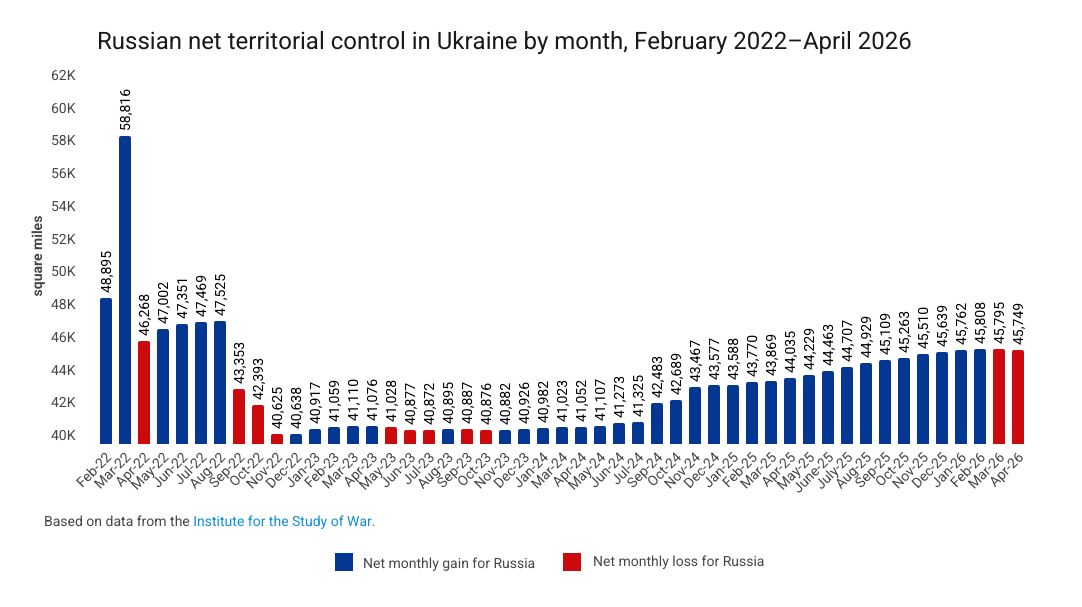
- According to DeepState, however, Russian forces made a net gain of 20.9 square miles (54 square kilometers) in the April 28–May 26, 2026, period: As of April 28, 2026, the total area “temporarily occupied” was 45,107.9 square miles (116,829 square kilometers), according to DeepState. As of May 26, 2026, the total area “temporarily occupied” was 45,128.8 square miles (116,883 square kilometers), according to DeepState.
- DeepState reported in the daily updates to its map during that same period of May 19-26, 2026, that the Russian armed forces advanced near or in 10 Ukrainian settlements, while Ukrainian forces cleared territory in Stepnohirsk and continued the clearing of Kupyansk.
- Sources used: RFE/RL, 05.29.26; The Moscow Times, 05.29.26; Wall Street Journal, 05.29.26; Washington Post, 05.29.26.
- According to DeepState, however, Russian forces made a net gain of 20.9 square miles (54 square kilometers) in the April 28–May 26, 2026, period: As of April 28, 2026, the total area “temporarily occupied” was 45,107.9 square miles (116,829 square kilometers), according to DeepState. As of May 26, 2026, the total area “temporarily occupied” was 45,128.8 square miles (116,883 square kilometers), according to DeepState.
The cutoff for reports summarized in this product was 10:00 a.m. East Coast time on the day it was distributed.
AI was used in production of this digest.
*Here and elsewhere, the italicized text indicates comments by RM staff and associates. These comments do not constitute an RM editorial policy.
Slider photo: A serviceman of Ukraine's defense intelligence prepares an An-196 Liutyi (Fierce) one-way drone against Russia in an undisclosed location in Ukraine late Thursday, May 28, 2026. (AP Photo/Efrem Lukatsky)