
Russia in Review, March 7-14, 2025
3 Things to Know
- In the past month, Russian forces made a net gain of 110 square miles in Ukraine (about 1 Nantucket island), according to the March 12, 2025, issue of the Russia-Ukraine War Report Card. In addition, the Russian army appeared on March 14 to be close to driving Ukraine from all the territory it had seized in Russia’s Kursk region, according to NYT’s March 14 report. The elimination of this salient, which Vladimir Putin discussed during his surprise visit to the Kursk region on March 12, would deprive Volodymyr Zelenskyy of a major bargaining chip in direct negotiations with Moscow if and when they would occur. Based data from ISW, RM’s War Report Card of March 12, 2025 estimates that Ukraine controlled only 79 square miles of the 470 square miles it captured at the height of its Kursk incursion in Sept. 2024: an 83% drop.
- During their March 11 meeting in Saudi Arabia, high-level U.S. and Ukrainian delegations endorsed the West’s proposal for an immediate 30-day ceasefire in the Russian-Ukrainian conflict contingent on Russia's consent to observe it. However, even before Steve Witkoff, a member of the U.S. delegation, could take the proposal for the unconditional ceasefire to Moscow, Vladimir Putin’s chief foreign policy aide Yuri Ushakov spoke against it. “This is nothing other than a temporary time-out for Ukrainian soldiers, nothing more. Our goal is a long-term peaceful resolution," Ushakov said March 13. Speaking later that same day, Putin gave a qualified approval of the proposal, conditioning its adoption on a number of Russian demands. “We start from the position that this cessation should lead to a long-term peace and eliminate the causes of this crisis,” Putin said. “Then there arise questions over monitoring and verification,” said Putin prior to meeting Witkoff, whom he reportedly kept waiting for eight hours. In the absence of Russia’s unequivocal support for the ceasefire proposal, both Putin and Trump took pains to avoid admitting a setback. Trump described Witkoff’s meeting with Putin as productive. “There is a very good chance that this horrible, bloody war can finally come to an end,” Trump claimed. A decision on a phone call or a meeting between Trump and Putin will be made once Witkoff has relayed to Trump the information from the talks, according to Kremlin spokesman Dmitry Peskov. Witkoff flew from Moscow to Baku upon completing his visit to the Russian capital, with Trump reportedly expecting his aide back in the U.S. so that Trump can “learn more” about the outcome of the talks with Putin on March 17.
- In addition to Witkoff’s visit to the Russian capital, several more government-to-government contacts have been reported between America and Russia this week as Moscow and Washington continue to explore normalizing the bilateral relationship. The head of Russia’s Foreign Intelligence Service, Sergei Naryshkin, and U.S. CIA Director John Ratcliffe agreed to maintain regular contacts during a phone call March 11 to discuss cooperation between their agencies, according to Bloomberg. Meanwhile, Russian and European officials say the U.S. is exploring ways to work with Russia’s energy giant Gazprom on global projects, according to Bloomberg. It has also been earlier reported that U.S. and Russian officials are already discussing issues ranging from the resumption of direct flights and the return of Russian diplomats’ missions in the U.S., to Russian-Ukrainian peace and Russian assistance to the U.S. in communicating with Iran over its nuclear program. Moreover, the Kremlin is exploring its options for a potential meeting between Putin and Trump in April or May in the Middle East, Russian officials told MT.
I. U.S. and Russian priorities for the bilateral agenda
Nuclear security and safety:
- In November 2024, trucks belonging to the 12th Main Directorate of the Russian Defense Ministry, which is responsible for handling Russian nuclear weapons, crossed Russia’s border into Ukraine, according OSINT data analyzed by the owner of the Unit Observer’s X account. The Russian top brass formed the 20th regiment from the military personnel of this directorate, so that they can be deployed to fight in the Toretsk city area in Ukraine, according to Unit Observer and Istories. (RM, 03.12.25)
- Belarus has formally requested Russia's assistance in constructing a second nuclear power plant (NPP) within its borders, President Alexander Lukashenko announced during an address to Russia's Federation Council in Moscow on March 14, TASS reported. (BNE, 03.14.25)
North Korea’s nuclear and missile programs:
- No significant developments.
Iran and its nuclear program:
- China and Russia joined Iran in denouncing U.S. sanctions and backed efforts to restore a landmark nuclear deal with Tehran that U.S. President Donald Trump abandoned in his first term and now wants to replace. The three countries stressed the need to end unilateral restrictions and urged the resumption of international talks over Iran’s atomic activities at a meeting in Beijing on March 14 at the level of deputy heads of the foreign ministries of Russia, China and Iran on, according to a joint statement. (Bloomberg, 03.14.25, TASS, 03.14.25)
- “While appreciating Iran’s adherence to its commitment to renounce the development of nuclear weapons, we fully respect Iran’s right to the peaceful use of nuclear energy,” Chinese Foreign Minister Wang Yi said following China-Russia-Iran talks on Iran’s nuclear program. (TASS, 03.14.25)
- Iran’s Supreme Leader Ayatollah Ali Khamenei said his country is not pursuing nuclear weapons and dismissed Trump’s calls for negotiations as a “trick.” Meanwhile, Iran’s foreign minister Abbas Araghchi said his country will enter direct U.S. talks if Washington ends “pressure and threats” against the Islamic Republic. (Bloomberg, 03.13.25, Bloomberg, 03.12.25)
- Russia began joint naval exercises with China and Iran in the Gulf of Oman, Russia’s Defense Ministry announced March 9. The drills, called Marine Security Belt 2025, aim to improve counter-piracy and terrorism operations at sea, as well as to ensure the security of maritime communications, according to a Russian military statement. (MT/AFP, 03.10.25)
Humanitarian impact of the Ukraine conflict:
- A Finnish court on March 14 sentenced Russian ultranationalist Vojislav Torden to life in prison for war crimes committed in Ukraine in 2014, including the mutilation of a wounded Ukrainian soldier. (MT/AFP, 03.14.25)
- A video of the probable execution of unarmed Ukrainian soldiers who were captured by the Russian military is being distributed on social networks, according to Ombudsman of the Verkhovna Rada of Ukraine, Dmitry Lubinets. The footage could have been filmed in Kazachya Loknya in the Sudzhansky district of the Kursk region. (Istories, 03.13.25)
- At least 18 Ukrainian journalists from the Russian-occupied Crimean Peninsula are imprisoned in Russian jails on what rights groups say are politically motivated charges. (RFE/RL, 03.09.25)
- At least 160 public hospitals were reportedly closed in Russia in 2024, including 18 maternity facilities and at least 10 children’s clinics. Russian civilians in small towns and villages have frequently been left with reduced or unavailable medical care as a result of the closures, including now limited pre-hospital services. Russia’s prioritization of funding the war in Ukraine has highly likely resulted in insufficient funding for healthcare… It is almost certain the scale of Russian casualties (over 500,000 Russian service personnel wounded so far) continues to strain the Russian Military Medical System at all levels of medical care, causing significant logistic problems and resulting in a shortage of military medical personnel. This negatively impacts care delivery and has likely led to the diversion of medical resource from the domestic civilian population to the military, further contributing to the large-scale impact to civilian hospitals. The numbers of healthcare professionals in Russian hospitals serving the domestic civilian population will likely continue to decrease throughout 2025. (UKMOD X account, 03.07.25)
- For military strikes on civilian targets see the next section.
Military and security aspects of the Ukraine conflict and their impacts:
- In the past month, Russian forces made a net gain of 110 square miles in Ukraine (about 1 Nantucket island), according to the March 12, 2025, issue of the Russia-Ukraine War Report Card.
- Russian strikes on Ukraine have killed at least 20 people. Ukrainian President Volodymyr Zelenskyy condemned the attacks, which included strikes on rescuers, as “vile and inhumane.” (AP/The Boston Globe, 03.08.25)
- Russian forces intensified their multi-directional campaign to eliminate the remaining Ukrainian salient in Kursk Oblast on March 7 and 8. Geolocated footage published on March 8 indicates that Russian forces recently seized Cherkasskoye Porechnoye (north of Sudzha). (ISW, 03.08.25)
- CNN reported March 8 that a Ukrainian official stated that Ukrainian forces may run out of artillery shells by May or June 2025—likely referring only to stockpiles of U.S.-supplied ammunition. A Ukrainian official also told CNN that Ukraine may exhaust its stockpile of Patriot air defense missiles, upon which Ukraine relies to shoot down Russian ballistic missiles, “in a matter of weeks.” (ISW, 03.08.25)
- Time reported on March 8 that five senior Western and Ukrainian officials and military officers stated that the suspension of U.S. intelligence to Ukraine has helped Russian forces advance on the battlefield. A source in the Ukrainian government stated that the suspension has impacted Ukrainian operations in Kursk Oblast the most. (ISW, 03.08.25)
- The loss of U.S. intelligence is already hurting Ukraine’s ability to strike Russian command centers, logistics hubs and concentrations of troops behind the front lines. Ukrainian soldiers said the lack of intelligence was especially problematic in the Kursk region of Russia. (NYT, 03.10.25)
- Russian forces had carried out more than 2,100 aerial strikes on Ukraine over the past week, Zelenskyy said March 9. (RFE/RL, 03.09.25)
- On March 9, the Russian forces captured Mala Loknya and Martynivka. Ukraine’s DeepState OSINT group reported in its interactive map. (RM, 03.14.25)
- Russia, with the help of North Korean troops and advanced drone warfare, has reclaimed two-thirds of the Kursk region territory that Ukraine seized last summer. Geolocated footage published on March 8 indicates that Russian forces seized Novaya Sorochina (northwest of Sudzha), Malaya Loknya (just south of Novaya Sorochina) and Lebedevka (south of Malaya Loknya), and the fields between the settlements. (ISW, 03.09.25, FT, 03.09.25, NYT, 03.09.25)
- Reports emerged that Russian troops had taken an unusual approach to trying to get behind Ukrainian lines in Russia’s Kursk region—crawling through a defunct section of a pipeline that once carried Russian gas to Europe via Ukraine. Soon after, the Ukrainian side confirmed the attack but said its forces had detected the movement “in time” and launched strikes as Russian troops tried to emerge. (Meduza, 03.10.25)
- A Russian commander involved in the operation who goes by the call sign Zombie claimed in a video that 800 Russian soldiers trekked for four days through a 15 kilometer tunnel that had been pumped full of oxygen and kitted out with ammunition, food supplies and even toilets. (FT, 03.13.25)
- Ukrainian forces have stalled the Russian offensive in the eastern Donetsk region in recent months and have started to win back small patches of land, according to Ukrainian soldiers and military analysts. However, Russia still holds the initiative, and conducts dozens of assaults across the eastern front every day, the soldiers and analysts say. (NYT, 03.10.25)
- On March 10, Ukraine claimed strikes on two oil refineries in Russia owned by Rosneft PJSC. Drones hit the Novokuibyshevsk refinery in Samara region overnight. That followed an attack a day earlier on the Ryazan refinery about 120 miles southeast of Moscow. (Bloomberg, 03.10.25, MT/AFP, 03.10.25)
- On March 11, officials in Moscow reported the biggest ever drone attack on the capital by Ukraine since Russia’s full invasion in 2022, with more than 90 drones targeting the city and 343 downed in total across the country. In the Moscow region, two people were killed and 14 others injured in the attack. The Ukrainian military said it had targeted Moscow’s oil refinery along with an oil production station in the Orel region. Neither claim could be independently verified. (NYT, 03.11.25, FT, 03.11.25, Meduza, 03.11.25)
- On March 11, Ukraine said Russia had launched ballistic missiles and 126 kamikaze drones at several of its regions overnight as part of a near-daily campaign of attack that has lasted several weeks. (FT, 03.11.25)
- Russia has reclaimed more than 100 square kilometers (38.6 square miles) of territory and 12 villages from Ukrainian forces in the southwestern Kursk region over the past 24 hours, the Russian military claimed March 11. (MT/AFP, 03.11.25)
- On March 11, commander-in-chief of Ukraine’s Armed Forces, Oleksandr Syrskyi claimed there was currently no imminent threat of Ukrainian troops being encircled in Russia’s Kursk region. (Meduza, 03.11.25)
- Pro-Kremlin military bloggers shared images apparently showing Russian troops at the edges of Sudzha, the largest settlement held in the Kursk region by Ukraine. (FT, 03.11.25)
- Amid Russia’s rapid advance in its western Kursk region, Ukrainian troops were reported on March 12 to have fully withdrawn from Sudzha—the only city they held there. (Meduza, 03.12.25)
- On March 12, Ukraine’s DeepState OSINT group reported in its interactive map that the Russian forces captured Makhnovka, Zamostia, Kozacha Loknya and advanced near Yasenove and Skudne. (RM, 03.14.25)
- Ukrainian Commander-in-Chief Gen. Oleksandr Syrskyi stated March 12 that he ordered Ukrainian forces to withdraw from some unspecified positions within the Kursk salient and move to more advantageous defensive positions in Kursk Oblast in order to save Ukrainian lives. (ISW, 03.13.25)
- Russian President Vladimir Putin and Valery Gerasimov, the chief of Russia’s general staff, made an appearance in Russia’s Kursk region March 12. “Overall, we have liberated over 1,100 square kilometers of our territory, or more than 86 percent,” Gerasimov told Putin during their joint visit. “Twenty-four population centers and 259 square kilometers of the Kursk Region territory have been liberated,” he claimed. “In accordance with Russian laws, we regard those who have invaded the Kursk Region, are committing crimes against civilians there and fighting against our Armed Forces, law enforcement and special services, as terrorists,” Putin said. (Meduza, 03.12.25, Kremlin.ru, 03.12.25)
- A Russian ballistic missile strike on the southern Ukrainian port city of Odesa overnight killed four people and damaged a Barbados-flagged cargo ship, Ukrainian authorities said. (MT/AFP, 03.12.25)
- A new telephone poll by Ipsos of 1,000 Ukrainians, commissioned by The Economist, shows that a huge majority of Ukrainians (74%) favor fighting on even without American support. A clear majority (59% vs. 21%) say they believe Ukraine can still win on the battlefield. Just 6% of Ukrainians would be willing to recognize Russian territorial gains since the full-scale invasion in 2022, though more might concede Crimea and the parts of eastern Ukraine which Russia seized in 2014 (11% and 27% respectively). Fully 80% oppose shrinking Ukraine’s armed forces, another probable Russian demand. A similar margin rejects drafting younger soldiers (70% vs. 17%), which might appear inconsistent with the resolve to keep fighting. (The Economist, 03.12.25)
- Russia’s defense ministry confirmed that its forces had retaken control of Sudzha and Ukrainian commander-in-chief Oleksandr Syrskyi also acknowledged that Ukrainian troops had pulled back from parts of the Kursk region and that Russian forces had entered Sudzha. (FT, 03.13.25)
- Ukrainian forces initially seized 1,376 square kilometers (531 square miles) of land in the Kursk region. As of March 13, the area under Ukrainian control had shrunk to 140 square kilometers (54 square miles), according to DeepState. (MT/AFP, 03.13.25)
- The Russians’ “goal is to cross our border and move as deep as they can to gain a foothold on our territory, expanding the zone of active combat,” Andriy Demchenko, a spokesperson for the Ukraine Border Guard Service said. (RFE/RL, 03.13.25)
- Commander of AFU’s Operational Command “North” Dmitry Krasilnikov was dismissed from his post. This decision is not related to the course of the fighting in the Kursk region. (RBC.ua, 03.13.25)
- Russia’s Defense Ministry said it downed 77 Ukrainian drones overnight. (MT/AFP, 03.13.25)
- On March 14, Russian troops appeared close to driving Ukraine from all the territory it had seized in the Kursk region, a battlefield success that would deny Zelenskyy a significant bargaining chip in any negotiations. (NYT, 03.14.25) Based data from ISW, RM’s War Report Card of March 12, 2025, estimates that Ukraine controlled only 79 square miles of the 470 square miles it captured at the height of its Kursk incursion in September 2024, an 83% drop. Its forces have withdrawn from the logistical hub of Sudzha, but there is as yet no evidence that Ukraine’s forces have been surrounded or collapsed.1
- Trump said March 14 he had appealed to Putin to spare the lives of thousands of Ukrainian soldiers who he said were surrounded by Russian troops. Trump said the troops were in a “very bad and vulnerable position” and said he “strongly requested to President Putin that their lives be spared.” “This would be a horrible massacre, one not seen since World War II,” he warned. (WSJ, 03.14.25, Telegraph, 03.14.25)
- "Reports about the enemy's alleged 'encirclement' of Ukrainian units in the Kursk region are not true and are created by the Russians for political goals and pressure on Ukraine and partners," the General Staff of the Armed Forces of Ukraine said in a statement. (Newsweek, 03.14.25)
- Putin said that Russia is ready to satisfy Trump’s request to spare the lives of Ukrainian servicemen remaining in the Kursk region. He made this statement before the start of the meeting of the Russian Security Council. (Meduza, 03.14.24)
- The Ukrainian Armed Forces have fulfilled their main task in the Kursk region, pulling Russian troops away from other sections of the front, said Zelenskyy. (Meduza, 03.14.25)
- Ukrainian drones targeted Moscow for a second time this week, with city authorities saying early March 14 that air defense systems downed four unmanned aircraft near the Russian capital. Also Ukrainian drone attacks triggered a massive fuel tank fire at Rosneft PJSC’s Tuapse oil refinery, one of the biggest in Russia. The area of the fire is more than 1,000 square meters. (Bloomberg, 03.14.25, MT/AFP, 03.14.25)
Military aid to Ukraine:2
- Based on analyzing historic NATO operations alongside doctrine for counterair missions, CSIS estimates that it will take 40–160 aircraft to protect the skies of Ukraine during a ceasefire and peace process. (CSIS, 03,.07.25)
- French Foreign Ministry Spokesperson Christophe Lemonde stated March 8 that European states discussed how to try to compensate for the intelligence that the United States "may stop providing" during the March 6 EU summit. (ISW, 03.08.25)
- On March 9, posts on X by Elon Musk renewed fears in Ukraine that Musk might cut off his Starlink internet system, which he called the “backbone of the Ukrainian army.” He added: “Their entire front line would collapse if I turned it off.” However, he later said “no matter how much I disagree with the Ukraine policy, Starlink will never turn off its terminals.” (NYT, 03.10.25)
- Washington has “just about” ended the freeze on intelligence sharing with Kyiv, Trump said March 9. “We just about have,” Trump told reporters aboard Air Force One when asked whether he would lift the pause on intelligence exchanges, Reuters reported. (Meduza, 03.10.25)
- U.S. deliveries of ammunition and weapons to Ukraine resumed on March 12. (RFE/RL, 03.14.25)
- U.S. weapons shipments to Ukraine through the Jasionka logistics hub in Poland have returned to previous levels, Polish Foreign Minister Radosław Sikorski said March 12. (Meduza, 03.12.25)
Thursday, March 13, 2025
- The Ukrainian military has run out of U.S.-supplied long-range ATACMS missiles, AP reported, citing an American official and a Ukrainian lawmaker. (Meduza, 03.13.25)
- The U.S. is poised to resume shipments to Ukraine of long-range bombs known as Ground-Launched Small Diameter Bombs (GLSDB), after they were upgraded to better counter Russian jamming, two people familiar with the weapon told Reuters. The glide-bombs were purchased under the U.S. administration of former President Joe Biden using the Ukraine Security Assistance Initiative. The U.S. has bought nearly $33.2 billion worth of new arms and military equipment for Kyiv directly from U.S. and allied defense contractors. (Reuters, 03.13.25)
Punitive measures related to Russia’s war against Ukraine and their impact globally:
- The EU has agreed to remove four individuals from its sanctions list against Russia after a delay from Hungary, AFP and Reuters reported March 14, paving the way for the bloc to extend restrictions on more than 2,400 others for another six months. Diplomatic sources told AFP that those set to have their asset freezes and visa bans lifted include businessmen Vladimir Rashevsky and Vyacheslav Kantor, Russian Sports Minister Mikhail Degtyarev and the sister of billionaire Alisher Usmanov. Reuters, which also cited diplomatic sources, reported that Rashevsky was "removed due to a weak legal case rather than pressure from Budapest." (MT/AFP, 03.14.25)
- Russian law enforcement agencies are facing a shortage of specialized equipment used to hack smartphones, RBC reported, citing sources with knowledge of the matter. According to those sources, the issue has worsened since the start of Russia’s full-scale war against Ukraine, due to sanctions and the withdrawal of foreign companies. In recent years, Israel’s Cellebrite, Sweden’s MSAB, and Canada-based Magnet have all left the Russian market. (Meduza, 03.11.25)
For sanctions on the energy sector, please see section “Energy exports from CIS” below.
Ukraine-related negotiations:
Sunday, March 9, 2025
- Ukrainian representatives planned to propose a partial ceasefire with Russia during talks with a U.S. delegation scheduled for March 11 in Jeddah, Saudi Arabia. The proposal would reportedly include a ban on drone and long-range missile strikes, as well as a halt to hostilities in the Black Sea. (Meduza, 03.10.25)
- A Swiss think tank released a detailed cease-fire plan for Ukraine, reflecting growing urgency on the issue. The plan suggests a monitored buffer zone and international troops, though Russia’s stance remains unclear. Confidential Geneva meetings between U.S., Russian and Ukrainian experts informed the proposal. (NYT, 03.09.25)
- U.K. Prime Minister Keir Starmer is planning a second meeting of allies considering sending peacekeeping troops to Ukraine as part of any postwar settlement, his spokesman said on March 10. The virtual meeting—expected March 15—will bring together leaders of NATO and Commonwealth countries who are prepared to contribute military forces toward a so-called “coalition of the willing,” the spokesman, Dave Pares, said. (Bloomberg, 03.10.25)
- On March 10, U.S. Secretary of State Marco Rubio told journalists on his way to high-level talks with Ukraine in Jeddah that “the Russians can’t conquer all of Ukraine, and obviously it’ll be very difficult for Ukraine in any reasonable time period to sort of force the Russians back all the way to where they were in 2014.” (FT, 03.10.25)
- On March 10, it was disclosed that Trump’s envoy to the Middle East, Steve Witkoff, plans to visit Moscow for a meeting with Putin. (Bloomberg, 03.10.25)
- The United States and Ukraine agreed on March 11 to an immediate 30-day ceasefire in Ukraine contingent on Russia's agreement, and the United States reportedly restarted intelligence sharing and military aid. U.S. and Ukrainian representatives met in Jeddah, Saudi Arabia on March 11. The U.S.-Ukrainian joint statement emphasized that Russia's reciprocity to this ceasefire proposal is the key to achieving peace and noted that the ceasefire can be extended if all parties agree. The joint statement also said the United States and Ukraine had also agreed to conclude ''as soon as possible'' a deal to develop Ukraine's oil, natural gas and mineral resources. That deal is intended to ''expand Ukraine's economy and guarantee Ukraine's long-term prosperity and security,'' the statement said. It added that the United States and Ukraine had also discussed humanitarian relief efforts that would take place during a cease-fire and the exchange of prisoners of war. ''Representatives of both nations praised the bravery of the Ukrainian people in defense of their nation and agreed that now is the time to begin a process toward lasting peace,'' the statement said. Mike Waltz, U.S. national security adviser, and Steve Witkoff, Trump’s special envoy for the Middle East, joined Rubio in the U.S. delegation to the talks. (ISW, 03.11.25, NYT, 03.12.25, State.gov, 03.11.25)
- Rubio said on the eve of the talks that Kyiv would need to cede some territory to Russia as part of a peace deal. (FT, 03.11.25)
- “Hopefully President Putin will agree to that also, and we can get this show on the road,” Trump told reporters at the White House March 11. “It takes two to tango.” (Bloomberg, 03.11.25)
- Western security officials said Putin has no intention to compromise on demands on land, peacekeepers and Ukraine’s neutrality in any peace talks, complicating Trump’s efforts to secure a credible settlement. Putin has made deliberately “maximalist” demands ahead of negotiations to end the war, which he knows will likely be unacceptable to Ukrainians and other Europeans, according to the security officials. (Bloomberg, 03.11.25)
- Trump again urged Russia to agree to the 30-day ceasefire, warning he would slap additional sanctions on the country if it refused the U.S. proposal. “Russia has no way out but cease-fire. If needed we will sanction it, but I hope we won't need to," Trump told reporters at the White House March 12. "In a financial sense we can do very unpleasant, very bad things, devastating for Russia, but I don't want to," he said. Trump added that if the Kremlin agreed to the ceasefire that "would be 80% of the way to getting this horrible bloodbath finished." “Hopefully we can get a ceasefire from Russia,” Trump said after meeting Irish Prime Minister Micheál Martin on March 12. “I’ve gotten some positive messages, but a positive message means nothing. This is a very serious situation.” (RFE/RL, 03.12.25, WSJ, 03.12.25, FT, 03.13.25)
- "If Russia says 'yes,' that's very good news, and we'll begin that process and do everything we can to move that process forward," Rubio said. "If they say 'no,' it'll tell us a lot about what their goals are and … what their mindset is." (WSJ, 03.12.25)
- The Kremlin said March 12 that it was waiting for U.S. officials to provide details on the proposed 30-day ceasefire in Ukraine after talks between U.S. and Ukrainian officials in Saudi Arabia the day before. Kremlin spokesperson Dmitry Peskov said it’s important not to “get ahead” of the question of responding to the ceasefire, which was proposed by Washington. The Kremlin has previously opposed anything short of a permanent end to the conflict and has not accepted any concessions. (AP, 03.12.25, MT/AFP, 03.12.25)
- Russia should work to weaken the U.S. negotiating position on Ukraine by stoking tensions between the Trump administration and other countries while pushing ahead with Moscow’s efforts to dismantle the Ukrainian state, according to a document prepared for the Kremlin. The document, written in February by an influential Moscow-based think tank close to Russia’s FSB, lays out Russia’s maximalist demands for any end to the conflict in Ukraine. It dismisses Trump’s preliminary plans for a peace deal within 100 days as “impossible to realize” and says that “a peaceful resolution of the Ukraine crisis cannot happen before 2026.” The document also rejects any plan to dispatch peacekeepers to Ukraine. It also calls for a further carve-up through the creation of a buffer zone in Ukraine’s northeast on the border with Russian regions such as Bryansk and Belgorod, as well as a demilitarized zone in southern Ukraine near Crimea. The latter would affect the Odesa region. The document, which was obtained by a European intelligence service, lays out ways in which Russia could boost its negotiating position by exacerbating tensions between the United States and both China and the European Union, and by proposing U.S. access to Russian minerals, including in the territories it occupies in Ukraine. The document proposes that Russia agree not to station its Oreshnik intermediate-range ballistic missiles in Belarus, on the border with the European Union, while in return the United States would agree not to place new missile systems on the continent. The document also dismisses any potential political concessions by Ukraine—such as Kyiv’s rejection of NATO membership and the holding of elections in which pro-Russian parties would be allowed to participate—as not being far-reaching enough. “In reality, the current Kyiv regime cannot be changed from inside the country. Its complete dismantling is needed,” it says. (WP, 03.12.25)
- Russian opposition outlet Verstka reported on March 12 that a source close to the Russian presidential administration stated that the Kremlin would "formally" give a "positive response" to the temporary ceasefire proposal but would also demand "impossible conditions" to which Ukraine cannot agree. (ISW, 03.13.25)
- A temporary 30-day ceasefire in the Russian-Ukrainian war is set to be discussed “next week,” between March 17 and 23, Andriy Yermak, the head of the Ukrainian president’s office, told reporters early on March 12 following U.S.-Ukrainian talks in Saudi Arabia, Ukrinform reported. (Istories, 03.12.25)
- French President Emmanuel Macron said that he and other European leaders believe security guarantees for Ukraine “should not be separate from NATO and its capabilities.” At a meeting with his European colleagues, Macron urged military leaders from roughly 30 countries to begin developing a “plan to define reliable security guarantees” for Ukraine in the event of a peace agreement with Russia. (Meduza, 03.12.25)
- A top Kremlin aide rejected March 13 the American proposal for a 30-day ceasefire in the Ukraine war. "This is nothing other than a temporary time-out for Ukrainian soldiers, nothing more. Our goal is a long-term peaceful resolution," Yuri Ushakov told Russian state television on March 13. "Steps that imitate peaceful actions are not needed.” (WP, 03.13.25, WSJ, 03.13.25, FT, 03.13.25)
- In remarks made after Ushakov’s comments and ahead of his meeting with Witkoff on March 13, Putin said he wants to discuss a proposed ceasefire in Ukraine with Trump, though he warned that any truce should lead to a long-term resolution of the war. “The idea itself is correct and we certainly support it, but there are issues that we need to discuss,” Putin said. “We agree with the proposals to stop hostilities, but we start from the position that this cessation should lead to a long-term peace and eliminate the causes of this crisis,” Putin said. “Then there arise questions over monitoring and verification” of any truce along an almost 2,000 kilometer-long (1,250 mile) front line, he said. (Bloomberg, 03.13.25)3
- Despite the ambiguity in Putin’s comments, Trump took an optimistic view. “We’re getting word that things are going OK in Russia,” Trump told reporters at the White House during a visit by NATO Secretary General Mark Rutte. The president added, though, that “it doesn’t mean anything until we hear what the final outcome is” and that if Russia doesn’t sign on to the truce “that’ll be a very disappointing moment for the world.” Trump described Putin’s comments as a “very promising statement” but “incomplete,” adding his team was having “very serious discussions” with Russia’s leader. “I’d love to meet with him and talk to him, but we have to get it over with fast,” Trump said. (FT, 03.13.25, Bloomberg, 03.13.25)4
- Zelenskyy March 13 called Putin's response "highly predictable" and "manipulative words" aimed at dragging out the process by setting unworkable preconditions. (WSJ, 03.14.25)
- Putin asked for messages to be relayed to Trump during late-night talks with Witkoff5 in Moscow, the Kremlin said. “Additional information was provided to the Russian side,” Peskov told reporters March 14. “Putin asked Witkoff to convey information and additional messages to President Trump.” A decision on a phone call between Trump and Putin or a meeting of the two will be made once Witkoff has relayed the information from the talks, and both sides understand the need for a discussion, Peskov said. There are reasons for “cautious optimism” about prospects for a ceasefire, he said, according to Interfax. “There is still much work to be done,” he added. (MT/AFP, 03.14.25, Meduza, 03.14.25, Bloomberg, 03.14.25, WSJ, 03.14.25) Witkoff reportedly had to wait for eight hours to meet Putin, who on March 13 hosted Lukashenko.
- Classified U.S. intelligence reports, including one earlier this month, cast doubt on Putin’s willingness to end the war against Ukraine, assessing that the Russian president has not veered from his maximalist goal of dominating his western neighbor, according to people familiar with the analysis. Some current and former U.S. officials said that the Russian leader, even if he agreed to a temporary truce, would use it to rest and refit his troops—and was likely to break the terms of the deal by creating a provocation that he would blame on Ukraine. Other officials said the reports were more cautious on what peace terms Putin might accept. But they acknowledged that there is no sign Putin has relented in his demand that Ukraine be brought into Russia’s security and economic orbit. “He has a long-standing desire to restore ‘Mother Russia,’” one official said. (WP, 03.13.25)
- Russian President Vladimir Putin said Thursday he didn’t support an immediate cease-fire in Ukraine, calling for more discussion on a permanent end to the war as Moscow’s army made rapid gains toward expelling Kyiv’s forces from its Kursk region. Putin said any pause in fighting at this point would be in Ukraine’s interest because Russia is gaining on the battlefield, and a host of issues would need to be resolved before a cease-fire could be reached. “The idea itself is good, and we of course support it, but there are questions we have to discuss,” Putin said, referring to a proposed 30-day cease-fire in the war, adding that Russia sought a lasting peace that would need to eliminate the “root causes”6 of the conflict. Many of the “root causes” of the war cited by Putin were set out in a draft treaty drawn up by Russian and Ukrainian negotiators in April 2022, weeks after Moscow’s full-scale invasion of Ukraine began. Russia justified its invasion that year as a defense against North Atlantic Treaty Organization expansion, and that document envisions a postwar Ukraine that is a disarmed and permanently neutral state unaligned with any military blocs. Moscow insists on keeping at least the 18% of Ukrainian territory it already controls, an area equivalent to Virginia in size. It wants to reverse policies that have sidelined Russian cultural influence in Ukraine and preclude the country’s membership in NATO. (WSJ, 03.13.25)
- The U.S. and Russia had productive discussions about a settlement to the war in Ukraine, Trump said, as the Kremlin said there were reasons to be "cautiously optimistic" about resolving the conflict. "We had very good and productive discussions with President Vladimir Putin of Russia yesterday, and there is a very good chance that this horrible, bloody war can finally come to an end," Trump wrote in a social-media post on March 14 referring to Witkoff’s meeting with Putin on March 13. Trump also added that the U.S. had requested that Putin spare the lives of “completely surrounded” Ukrainian troops. (WSJ, 03.14.25, France24, 03.14.25)
- Ukraine will not agree to limit the size of its armed forces or abandon its NATO membership aspirations as part of a potential peace deal with Russia. Ukraine’s delegation conveyed this position to the U.S. earlier this week at a meeting in Saudi Arabia, a source close to the negotiations told European Pravda. (Meduza, 03.14.25)
- French President Emmanuel Macron said March 14 that Russia must accept a proposed 30-day ceasefire deal put forward by the United States and Ukraine. (Reuters, 03.14.25)
Great Power rivalry/new Cold War/NATO-Russia relations:
Four major Baltic incidents, which damaged undersea cables and a gas pipeline, occurred over the past 16 months. They all involved ships that had been operating between Russian ports or were carrying Russian cargo. The Kremlin has denied wrongdoing. Across the world's 450 subsea cable systems, spanning almost one million miles, more than 150 technical faults and other problems occur each year globally, according to the International Cable Protection Committee, a trade group. Up to 80% of cable-damage incidents are caused by accidents linked to commercial fishing and ship anchors, the ICPC said. (WSJ, 03.08.25)
- The war in Ukraine has helped grow U.S. dominance of the global arms industry, according to a study released Sunday. U.S. arms exports between 2020 and 2024 were up by more than a fifth compared with the previous five-year window, reaching 43% of the worldwide total. According to SIPRI data, Russian arms exports have fallen sharply, dropping by 64% in the most recent five-year period (WP, 03.09.25)
- Almost two-thirds of the arms imported by European members of NATO over the past five years were produced by the U.S., according to new research that underlined the continent’s deep reliance on American-made weapons. (FT, 03.10.25)
- Rubio said March 10 that the United States would oppose “antagonistic” language toward Russia when G7 foreign ministers meet in Canada this week. “Ultimately, we can’t sign on to any communique that’s not consistent with our position to bring both sides to the table,” Rubio told reporters. Washington’s position is not about “taking anyone’s side, but because we feel like antagonistic language sometimes makes it harder to bring parties to the table,” he added. (MT/AFP, 03.10.25)
- Russian authorities said March 10 that they were expelling two British diplomats on suspicion of espionage, marking the latest incident in a string of expulsions that intensified late last year. The Federal Security Service (FSB) said it uncovered an “undeclared British intelligence presence” within the British Embassy in Moscow and accused the diplomats—identified as the embassy’s second secretary and the husband of the first secretary—of providing false information to obtain entry into Russia. (MT/AFP, 03.10.25)
- The U.K. said it’s revoking accreditation for a Russian diplomat and a diplomatic spouse in retaliation against Moscow’s expulsion of two Britons earlier in the week. (Bloomberg, 03.12.25)
- It may take more than ten years for European NATO members to bolster their defense sectors, as the continent rushes to reverse decades of underinvestment and deter future threats from Russia, according to a Bloomberg Intelligence analysis. The 15 largest European members of the alliance may need to ramp up investment by as much as $340 billion to $720 billion annually, Bloomberg Intelligence analysts wrote. (Bloomberg, 03.13.25)
- The G7 is offering its “unwavering support” for Ukraine and is threatening Russia with further sanctions if it does not back a U.S.-led ceasefire effort, it said in a joint statement. It also stressed the need for credible security arrangements to guard against Russian “aggression.” “G7 members reaffirmed their unwavering support for Ukraine in defending its territorial integrity,” the group said. The U.S. and its G-7 partners have also warned Moscow they could expand sanctions and use frozen Russian assets to support Ukraine. The G-7 statement said ministers had discussed possible measures against Moscow such as “caps on oil prices, as well as additional support for Ukraine, and other means,” notably using revenues from frozen Russian assets. (France24, 03.14.25, FT, 03.14.25)
- The issue of Ukraine's accession to NATO is no longer being considered. This was stated by NATO Secretary General Mark Rutte in an interview published on Friday, March 14. When asked whether Trump had really removed the issue of Ukraine's accession to NATO from the negotiating table, Rutte answered affirmatively: "Yes." (Korrespondent.net, 03.14.25)
- On March 14 NATO Secretary General Mark Rutte said relations with Russia should eventually be normalized once the fighting ends in Ukraine, while stressing the need to keep pressure on Moscow to ensure progress in ceasefire negotiations. “It’s normal if the war would have stopped for Europe somehow, step by step, and also for the U.S., step by step, to restore normal relations with Russia,” Rutte said. “But we are absolutely not there yet, we have to maintain the pressure on them” to guarantee that Russia takes the negotiations seriously, he said. Rutte met with President Donald Trump March 13 in the White House, where the two discussed a potential U.S.-brokered ceasefire in Ukraine. (Bloomberg, 03.14.25)
China-Russia: Allied or aligned?
- Russian President Vladimir Putin has thanked the leaders of China, India, Brazil and South Africa for their efforts to help resolve the Ukraine conflict. "We all have our own business to mind but many leaders, including the Chinese president, the Indian prime minister and the presidents of Brazil and the South African Republic, are working on the [Ukraine-Russia] issue, devoting much time to it, and we are grateful to them all because these efforts are aimed at achieving the noble goal of ending military operations and putting an end to the loss of life," Putin noted at a press conference following talks with Lukashenko. (TASS, 03.13.25)
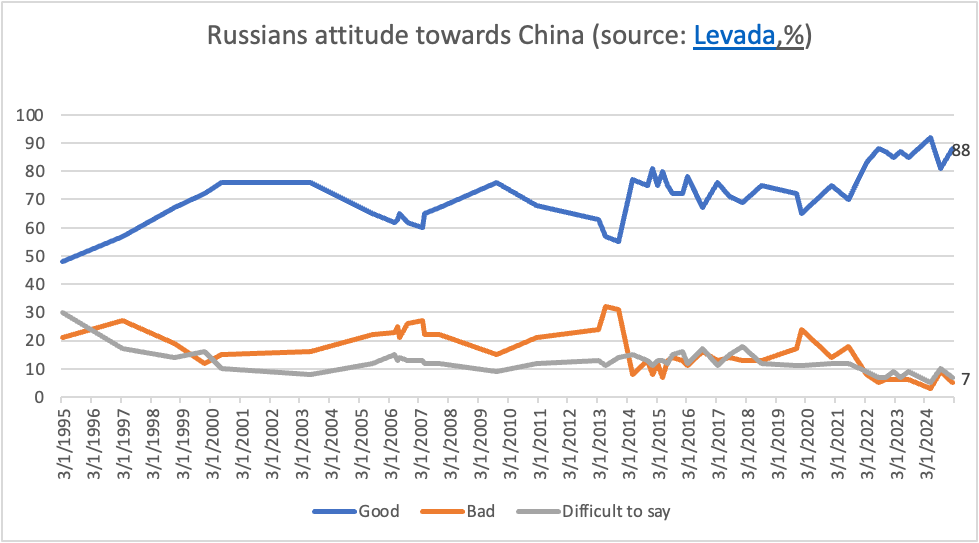
- Russia bought up more than 1 million Chinese vehicles last year, soaking up about 30% of its neighbor’s petrol car exports. The surge handed Chinese brands 63% of the Russian market, and sent local brands’ market share down to 29%, according to the CPCA. Russian authorities have begun to push back. In January, Moscow raised “recycling fees,” which function akin to tariffs, to 667,000 rubles ($7,500) for most passenger cars, more than double the level of last September. The charges are set to rise by 10–20% annually until 2030. (FT, 03.10.25)
Missile defense:
- No significant developments.
Nuclear arms:
- Poland’s president has called on the U.S. to transfer nuclear weapons to Polish territory as a deterrent against future Russian aggression, a request that is likely to be perceived as highly provocative in Moscow. Andrzej Duda said it was “obvious” that President Donald Trump could redeploy U.S. nuclear warheads stored in western Europe or the U.S. to Poland, a proposal the Polish president said he recently discussed with Keith Kellogg, U.S. special envoy for Ukraine. (FT, 03.13.25)
Counterterrorism:
- No significant developments.
Conflict in Syria:
- Following an eruption of violence in Syria, Russia and the U.S. jointly requested a closed-door meeting of the United Nations Security Council to discuss the developing crisis, according to Dmitry Polyanskiy, a top Russian envoy to the U.N. (Quincy Institute, 03.10.25)
- Russia is in contact with other countries regarding the recent wave of violence in Syria and wants the war-torn country to remain “united,” the Kremlin said March 11. Days of unrest in Syria’s Alawite heartland have posed the most serious threat to the country’s stability since President Bashar al-Assad’s fall in December. (MT/AFP, 03.11.25)
Cyber security/AI:
- A minister in Russia’s republic of Chechnya on March 10 slammed a federal government decision to block the Telegram messaging app in the region over security concerns, calling the move “irrational” and “prejudiced.” (MT/AFP, 03.10.25)
Energy exports from CIS:
- U.S. sanctions on Russia’s oil tanker fleet are showing signs of faltering, after a clutch of blacklisted vessels loaded cargoes for the first time in more than a year to drive up the country’s crude shipments. In recent days, three blacklisted vessels loaded cargoes of Russia’s flagship Pacific grade and sailed from the country’s main regional port. And satellite imagery suggests that more ships are leaving anchorages west of the port of Nakhodka. (Bloomberg, 03.11.25)
- The U.S. has rejected a Canadian proposal to establish a task force that would tackle Russia’s so-called shadow fleet of oil tankers, as the Trump administration re-evaluates its positions across multilateral organizations, according to people familiar with the matter. (Bloomberg, 03.08.25)
- Russian oil exports edged lower in February following the imposition of the latest round of U.S. sanctions, but widening price discounts curbed revenues, according to the International Energy Agency. Last month, the nation’s producers exported 7.28 million barrels a day of crude and petroleum products, a drop of just 100,000 barrels a day from January, the Paris-based IEA said in its monthly oil report. (Bloomberg, 03.13.25)
- The delivery of a two-million-barrel cargo of Russian oil to China took seven times longer than it would have done prior to a round of U.S. sanctions imposed on Moscow back in January. (Bloomberg, 03.14.25)
- Chinese buyers are back in the market for Russia’s ESPO crude, thanks to prices that have cooled as shippers and middlemen find workarounds to help blunt the impact of U.S. sanctions. April-loading cargoes shipped from Russia’s Pacific port of Kozmino to China are being offered at a premium of $2.50 a barrel to benchmark Brent compared with around $3 for March, according to traders handling the grade. (Bloomberg, 03.12.25)
- Hungary’s Foreign Minister Peter Szijjarto said March 11 that Russian oil supplies were temporarily suspended via the Druzhba oil pipeline, a key supply route for much of central Europe, following large-scale Ukrainian drone strikes overnight. (MT/AFP, 03.11.25)
- Putin on March 13 suggested the U.S. and Russia were negotiating over securing gas supplies for Europe, following a Financial Times report that his close friend Matthias Warnig is engineering a restart of Russia’s Nord Stream 2 gas pipeline to Europe with the backing of U.S. investors. (FT, 03.13.25)
- Russian and European officials say the U.S. is exploring ways to work with energy giant Gazprom PJSC on global projects, a step toward forging closer ties with the Kremlin while trying to broker a peace deal on Ukraine. European assessments suggest there have been preliminary contacts between U.S. and Russian representatives on the issue, but it’s not clear who’s leading the conversations or whether the Trump administration is directly involved, according to people familiar with the matter. (Bloomberg, 03.13.25)
- "Important Stories" has noticed several indirect signs that Russia is preparing to restore the Nord Streams. (Istories, 03.14.25)
- Turkey is seeking to extend a U.S. waiver from sanctions, which would allow it to continue buying Russian natural gas, according to Turkish officials with knowledge of the matter. (Bloomberg, 03.13.25)
Climate change:
- No significant developments.
U.S.-Russian economic ties:
- No significant developments.
U.S.-Russian relations in general:
- The Kremlin is exploring its options for a potential meeting between Putin and Trump in April or May, four current and two former Russian officials familiar with the discussions told The Moscow Times. Saudi Arabia, which hosted high-level U.S.-Russia talks last month, is the most likely. (MT/AFP, 03.12.25)
- The head of Russia’s Foreign Intelligence Service, Sergei Naryshkin, and U.S. Central Intelligence Agency Director John Ratcliffe agreed to maintain regular contacts during a phone call on March 11 to discuss cooperation between their agencies. (Bloomberg, 03.12.25)
- The Trump administration is negotiating the return of Russian diplomats to the U.S., a move that could restore Moscow’s espionage capabilities on American soil. Experts warn that Russia is likely to deploy spies under diplomatic cover, taking advantage of the U.S.’s open society. (NYT, 03.09.25)
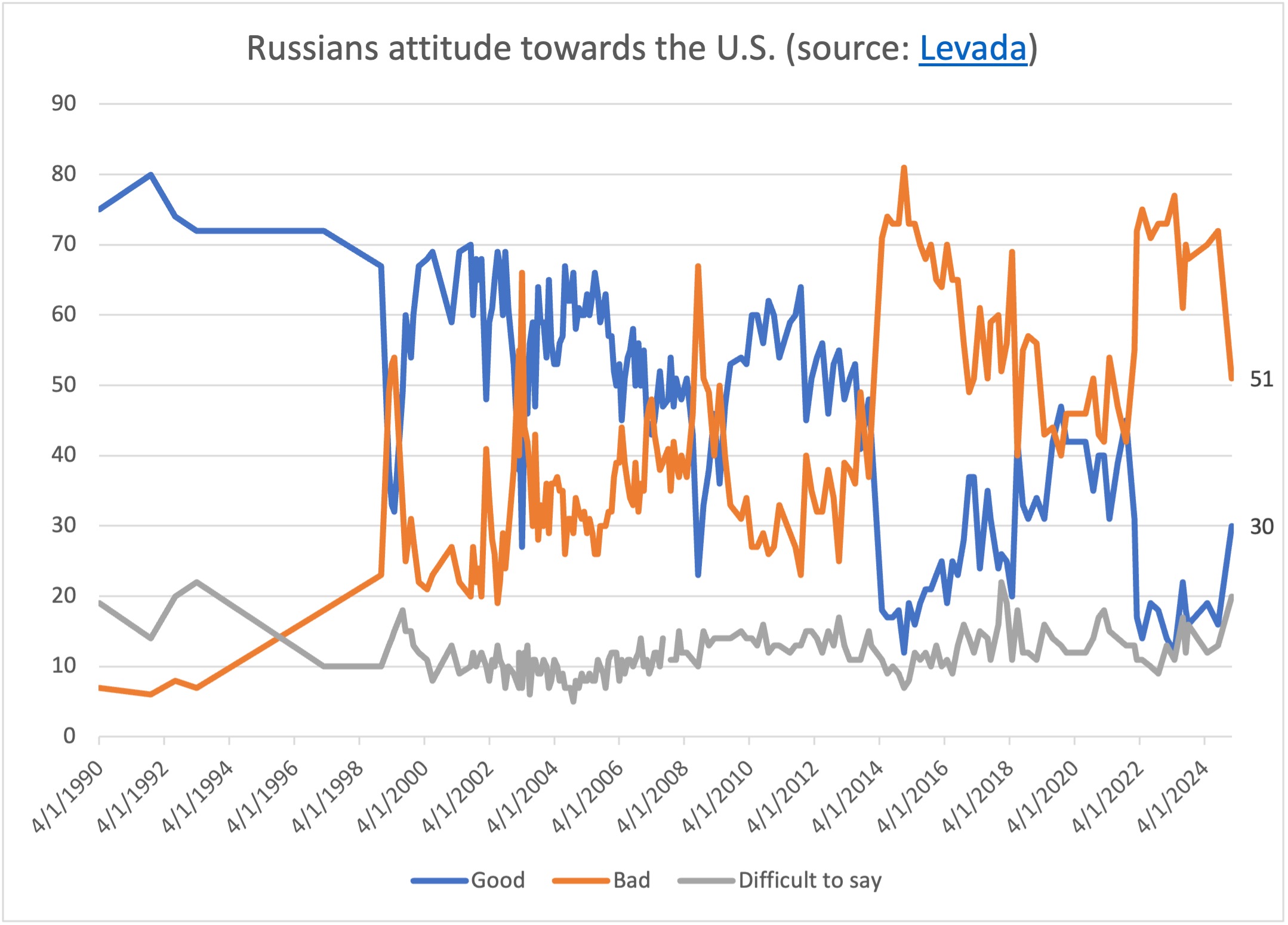
- Amid the start of negotiations to resolve the conflict in Ukraine (which most Russians view positively), attitudes toward the U.S. have significantly improved—reaching 30% (a 14-point increase since September 2024), according to Levada’s latest poll. However, half of respondents (51%) still have a negative view of America, including 21% who feel "very negative" and 30% who feel "mostly negative." The majority of Russians (63%) hold a negative view of current Russia-U.S. relations, although this figure has decreased by 24 points since May 2021. (Levada.ru, 03.12.25)
| Russians on their general attitude towards the following countries (source: Levada) | ||
| Good | Bad | |
| Belarus | 93 | 2 |
| China | 88 | 5 |
| USA | 30 | 51 |
| Germany | 28 | 56 |
| EU | 21 | 61 |
| Ukraine | 16 | 68 |
II. Russia’s domestic policies
Domestic politics, economy and energy:
- Russia recorded the lowest number of births last year in a quarter of a century, while the number of deaths increased for the first time since the height of the pandemic in 2021. In 2024, 1.22 million people, or 3.4% fewer than in 2023, were born—the lowest level since 1999—while deaths increased by 3.3% to 1.82 million, according to the Federal Statistics Service. The pace of the population decline accelerated by roughly 20% compared to 2023, due in part to the Kremlin’s three-year-old war on Ukraine. (Bloomberg, 03.08.25)
- Russia’s budget deficit for the first two months of 2025 reached 2.7 trillion rubles ($31.6 billion), driven by a 30.6% year-on-year increase in spending and more modest revenue growth, Finance Ministry data published March 11 showed. (MT/AFP, 03.11.25)
- Russian economic activity is showing a slowdown not only in manufacturing, but also in the service sector. The monthly PMI index—a closely watched indicator of business activity—recorded a slowdown in both the manufacturing and service sectors. On an index where scores above 50 indicate expansion and those below signify contraction, the service sector index for February was down to its lowest level in six months at 50.5. The reading for industry fell from 53.1 points in January to 50.2 points in February—just above the level which represents decline. (Bell, 03.14.25)
- Lending to individuals in Russia dropped by 47.8% in February compared to the same month last year, reaching 538.6 billion rubles, according to Frank RG. Mortgages fell by a third, car loans by 51%, and cash loans by 47.7%. Meanwhile, the Central Bank reported a slight slowdown in money supply growth, an inflation indicator, from 19.2% to 18.7% year-on-year. Russia’s budget deficit may exceed the planned 0.5% of GDP but will likely stay below 1% if oil prices remain around $60. The National Welfare Fund’s liquidity also declined, falling to 3.39 trillion rubles in February from 3.75 trillion in January. (The Bell, 03.09.25)
- In the wake of the Trump administration's dramatic pivot toward Moscow, Russia's influential ultra-patriots are scrambling to make sense of the sudden thaw with the nation's bitterest enemy. As negotiations between Russia, Ukraine and the United States slowly inch forward, Putin will have to keep careful tabs on this vocal (and well-armed) segment of society, which has grown stronger in the course of the war. (WP, 03.14.25)
- Russian State Duma Speaker Vyacheslav Volodin announced that the lower house of parliament has drafted several bills aimed at “enhancing control over the activities of foreign agents.” (Meduza, 03.13.25)
Defense and aerospace:
- See section Military aspects of the Ukraine conflict and their impacts above.
Security, law-enforcement, justice and emergencies:
Russia’s Federal Security Service (FSB) said March 13 it had arrested a man suspected of packages containing bombs to military personnel. The FSB said the suspect, a Russian citizen born in 2003, sent explosive-laden packages to military officials in the Moscow, Voronezh, Krasnodar and Saratov regions earlier this month. (MT/AFP, 03.13.25)
III. Russia’s relations with other countries
Russia’s external policies, including relations with “far abroad” countries:
- Putin on March 14 invited his Venezuelan counterpart and ally, Nicolas Maduro, to attend Russia’s annual Victory Day military parade on May 9, marking the 80th anniversary of the Soviet victory over Nazi Germany in World War II. (MT, 03.14.25)
- Mercenaries with Russia’s Wagner Group, fighting alongside Malian soldiers, have assaulted women, massacred civilians and burned villages in Mali, the displaced say—a campaign of wanton violence that is fueling a rapidly growing refugee crisis to the west in neighboring Mauritania. The Malian government pays about $10 million a month for Wagner’s service. ACLED estimates that at least 925 civilians were killed last year in attacks involving Wagner—more than double the 400 civilians the group estimates were killed by Islamist militants. (WP, 03.11.25)
- Three journalists in Chad were jailed pending trial on charges of colluding with the Wagner private military company, the public prosecutor and one of the journalist’s lawyers said March 10. (MT/AFP, 03.10.25)
- U.K. police have extended their detention of the Russian captain of a ship that collided with a tanker carrying U.S. military fuel, as Sir Keir Starmer said authorities must “get to the bottom” of March 10’s North Sea collision. Humberside Police will hold the man—who shipowner Ernst Russ confirmed was the vessel’s captain—for another 36 hours on suspicion of gross negligence manslaughter, it said on March 13. March 10’s collision left one mariner presumed dead and has seen an international investigation launched that has drawn in the U.S. Coast Guard. (FT, 03.13.25)
- Romanian far-right presidential frontrunner Calin Georgescu has been blocked from running in the May re-run of the country’s presidential election, the Central Electoral Bureau (BEC) announced Sunday. (MT/AFP, 03.10.25)
- A Russian diplomat recalled from Brussels amid a spy purge by Belgian authorities has been nominated to head the Belgrade mission of Europe's largest security body. Moscow has nominated Dmitry Iordanidi, a former deputy head of the Organization for Security and Cooperation in Europe (OSCE) mission to Bosnia-Herzegovina with deep experience in the Balkans, to lead the organization’s mission to Serbia, internal OSCE records obtained by RFE/RL show. (RFE/RL, 03.11.25)
Ukraine:
- President Donald Trump said Volodymyr Zelenskyy will eventually make a natural-resources deal with the U.S., while accusing the Ukrainian president of “taking candy from a baby” in maximizing U.S. military aid during the Biden years. (Bloomberg, 03.09.25)
- Slawomir Mentzen, who has been skeptical of providing support for Ukrainians living in Poland, moved into second place in the latest opinion poll ahead of the presidential ballot in May. (Bloomberg, 03.10.25)
- Former member of Ukraine’s Right Sector Demyan Gahul was shot dead in Odessa, Ukrainian media reported. (Istories, 03.14.25)
- A new telephone poll by Ipsos of 1,000 Ukrainians, commissioned by The Economist, shows more than seven in ten Ukrainians now say they approve of Mr. Zelenskyy’s work. The war has put competitive politics in Ukraine on hold, so the numbers are theoretical; they would shift in a real campaign. But they suggest Mr. Zelenskyy would get many more first-round votes than his closest potential rival, Mr. Zaluzhny (46% v 31%). (The Economist, 03.12.25)
- The Kyiv International Institute for Sociology released a poll showing that between Feb. 14 and March 4—when relations between Ukraine and the United States soured—the level of trust in Mr. Zelenskyy increased to 67%, from 57% in the first half of February. Another poll showed a similar jump, while two other recent polls showed similar approval ratings for Mr. Zelenskyy. (While approval and trust ratings aren’t the same as electoral ratings, they show how popular the country’s different leaders are.) (NYT, 03.10.25)
- Kyiv Mayor Vitali Klitschko announced further dismissals of top city officials on March 13 amid a widening corruption probe into land dealings in the capital. The dismissals follow revelations from Ukraine's National Anti-Corruption Bureau (NABU) and the Specialized Anti-Corruption Prosecutor's Office (SAPO), which released recordings of Kyiv officials allegedly involved in fraudulent land schemes.. The following officials are set to be dismissed: Ihor Dolinsky, director of the Kyiv Institute of Land Relations; Volodymyr Sharyi, director of the special housing fund; Viktor Pohrebnoi, director of the Financial Company Zhytloinvest; and Valentina Sviatina, deputy director of the Department of Urban Planning and Architecture, Klitschko said. (Kyiv Independent, 03.13.25)
Russia's other post-Soviet neighbors:
- Armenia and Azerbaijan have agreed on the language of a historic peace agreement that could mark the end of decades of conflict between the two neighboring South Caucasus countries. Months-long negotiations have now come to a close, said the two sides, which have fought several bloody wars since the collapse of the Soviet Union. But major sticking points remain and it is unclear when the agreement could actually be signed. (FT, 03.14.25)
- The United States has praised Armenia and Azerbaijan for concluding negotiations on a "historic peace treaty," marking a significant step toward ending decades of hostilities between the two nations. (RFE/RL, 03.14.25)
- Steve Witkoff, Trump’s special envoy, landed March 14 morning in the capital of Azerbaijan after an overnight visit to Moscow, in what appears to be a well-coordinated diplomatic move between Israel, the U.S. and Azerbaijan. Sources involved in Israeli-Azeri relations reveal that coordination for the visit became particularly intensive after March 5, when Israeli Prime Minister Benjamin Netanyahu emphasized his commitment to the trilateral partnership between the countries in the Knesset. (Jpost, 03.14.25)
- A court in Tbilisi has sentenced former Georgian President Mikheil Saakashvili to nine years in prison after finding him guilty of large-scale embezzlement of public funds. (Meduza, 03.12.25)
- Georgia’s government sparked an uproar by announcing that a port project on the Black Sea will be awarded to a company from China after canceling a contract with a consortium that included Western firms. For more than a year, pro-Western marchers in Georgia, a former Soviet republic that borders Russia, have been accusing their government of allowing Moscow to increasingly reassert its sway over their country. But driving around this nation of 3.6 million people in the heart of the mountainous Caucasus region, the influence of another ambitious power becomes apparent. China has been stepping up its activities in the region in recent years, building infrastructure and expanding trade routes that it hopes will boost its economy. (NYT, 03.13.25)
- Russia’s Foreign Ministry announced March 14 that it lifted a travel advisory for Abkhazia following protests over a controversial investment deal that led to the election of another pro-Moscow leader in the breakaway Georgian region. (MT/AFP, 03.14.25)
- French President Emmanuel Macron signed a letter of intent to promote cooperation between the country’s agency that tracks foreign digital interference and its Moldovan counterpart. (Bloomberg, 03.10.25)
- Belarusian-Russian integration should become irreversible, but unification will not happen in the near future, said Belarus’ Alexander Lukashenko. (Korrespondent.net, 03.14.25)
IV. Quotable and notable
- In a recent interview in Foreign Affairs, Fiona Hill, senior director for European and Russian affairs on the National Security Council during the first Trump administration, recounted how Vladimir Putin actually spoke to, and manipulated, Donald Trump during phone calls she listened in on “There was all kinds of menace in what Putin had said, he chooses his words very carefully,” she explained. “Many times when Putin and Trump are interacting, Putin’s actually making fun of him,” she continued.” (Huffpost, 03.14.25)
Footnotes
- For an analytical hot take on the Ukraine ceasefire (what is Vladimir Putin’s game?) see this FT piece.
- For “Visualizing Ukraine’s military aid after the U.S. freeze,” see this 03.11.25 story in The Washington Post.
- For the Kremlin’s transcription of Putin’s March 13 remarks at the joint press conference with Lukashenko in Moscow, see Kremlin.ru.
- For the Kremlin’s transcription of Putin’s March 13 remarks at the joint press conference with Lukashenko in Moscow, see Kremlin.ru.
- Keith Kellogg, Trump’s special envoy to Ukraine and Russia, was absent from recent talks aimed at ending the war in Ukraine at the Kremlin’s request, NBC News reported March 12. (MT/AFP, 03.14.25)
- For a recent comprehensive survey of the ‘root causes’ of Russia’s rationale for its 2022 invasion of Ukraine, see Barry R. Posen, “Putin’s Punitive War: The 2022 Invasion of Ukraine,” International Security, Vol. 49, No. 3 (Winter 2024/2025): 7–49.
The cutoff for reports summarized in this product was 10:00 am East Coast time on the day it was distributed.
*Here and elsewhere, the italicized text indicates comments by RM staff and associates. These comments do not constitute an RM editorial policy.
Slider photo by Russian Defense Ministry Press Service via AP.
 Russia in Review