
Russia in Review, Feb. 7-14, 2025
4 Things to Know
- This week, Trump has confirmed earlier reports that he and Putin will meet in Saudi Arabia, while also revealing that the two leaders may then visit each other’s countries. “In fact, we expect that he'll come here, and I'll go there, and we're gonna meet also probably in Saudi Arabia the first time, we'll meet in Saudi Arabia, see if we can get something done,” Trump said, according to Politico. A date for the meeting “hasn't been set," but it will happen in the "not too distant future,” Trump said of the summit with the Russian leader, whom his predecessor refused to meet or directly negotiate with after Russia’s full-scale invasion of Ukraine in 2022. Last week saw senior Russian MP Leonid Slutsky reveal the meeting could take place sometime in February or March, while Russia’s Kommersant reported that Russia is reportedly considering Saudi Arabia as a potential location for the meeting. Meanwhile, Trump and Putin have already chosen officials that will negotiate on their behalf on ending the Russian-Ukrainian war, preserving strategic stability and other issues. “I have asked Secretary of State Marco Rubio, Director of the CIA John Ratcliffe, National Security Adviser Michael Waltz and Ambassador and Special Envoy Steve Witkoff to lead the negotiations, which, I feel strongly, will be successful,” Trump said on Feb. 12, thus excluding his own envoy on the conflict, Keith Kellogg. In his turn, Putin is assembling what Bloomberg has described as “a heavyweight team with decades of experience in high-stakes negotiation.” They include Yuri Ushakov, the chief Kremlin foreign-policy adviser; his top spymaster, Sergei Naryshkin; and Kirill Dmitriev, a financier educated at Stanford and Harvard.
- The previously anemic process of key stakeholders in the Ukraine conflict slowly signaling their evolving negotiating positions has undergone a dramatic disruption by Trump and his team this past week. Trump personally launched the disruption by announcing on Feb. 12 an “immediate” start to negotiations to end the war after having a phone conversation with Putin. The Kremlin—which has previously been denying direct contacts between Putin and Trump—confirmed Trump’s claim this time, saying the Russian leader agreed with his U.S. counterpart to “work together” toward “a long-term settlement [that] could be reached through peaceful negotiations.” Speaking prior to the Feb. 12 phone call, Trump claimed to have developed a concrete plan to end the war. But even if he did have such a plan, Zelenskyy—whom Trump would refuse to grant the status of "an equal member" of the peace process and whom Trump didn’t warn of his call to Putin until after he’d made it—denied any knowledge of it on Feb. 14. Meanwhile, some of the statements made by Trump’ top aides also indicated that there is no firm plan yet. First, Hegseth announced on Feb. 11 that “we are not sending U.S. troops to Ukraine.” Then, JD Vance was quoted by WSJ as saying on Feb. 13 that the option of sending U.S. troops to Ukraine if Moscow failed to negotiate remained “on the table.” In addition to pledging not to send troops to Ukraine, Hegseth called Ukraine’s desire for membership in NATO and a return to its pre-2014 borders unrealistic and illusionary this week. Hegseth’s remarks made some of America’s European allies publicly wonder why the U.S. would “concede” on these issues ahead of negotiations rather than try to use them as bargaining chips. But even with Hegseth sending conciliatory signals to Moscow on Ukraine’s borders and NATO, it won’t be easy for Trump and his team to convince their Russian counterparts to first agree to a ceasefire and then, possibly, conclude a peace deal. For one, Putin has showed no signs so far of abandoning the conditions he has set for Russia to agree to a ceasefire.1 Moreover, the Kremlin says it will agree to a ceasefire only if it is used to negotiate a legally-binding agreement, which would include guarantees of NATO’s non-expansion to the east. Whether such a commitment can be obtained from the alliance, which operates by consensus, is an open question. If Putin does agree to Trump’s proposal for the ceasefire, it could be secured by one of two significant upcoming dates, according to European and Ukrainian officials interviewed by FT: Easter on April 20 or May 9, when Russia celebrates the Soviet victory over Nazi Germany. The key to successful peace talks could be having China join the U.S. in the peace efforts, according to Harvard’s Graham Allison. “I believe this terrible [Russian-Ukrainian] war will soon come to an end. In fact, I would bet that we will have a ceasefire within the next six months… with the help of a powerful partner: China,” Allison told Der Spiegel.
- Chinese officials in recent weeks have floated a proposal to the Trump team through intermediaries to hold a summit between Trump and Putin and to facilitate peacekeeping efforts after an eventual truce, people in Beijing and Washington familiar with the matter told WSJ. The Chinese offer, notably, envisions a U.S.-Russian summit without the involvement of Zelenskyy. Part of China’s proposal to assist a Russia-Ukraine peace deal involves Beijing acting as a “guarantor” by sending peacekeeping troops to the region, according to WSJ.
- Trump has proposed a three-way meeting with the Russian and Chinese leaders to discuss nuclear arms control, according to AFP. The chief motivation would be to find ways to save money, Trump said Feb. 13. “There’s no reason for us to be building brand new nuclear weapons, we already have so many,” Trump said. “You could destroy the world 50 times over, 100 times over. And here we are building new nuclear weapons, and they’re building nuclear weapons.” In response to Trump’s statement, Guo Jiakun, a spokesman for China’s foreign ministry, depicted China as a much smaller player among nuclear powers, compared to the United States. “As countries with the largest nuclear arsenals, the United States and Russia should earnestly fulfill their special priority responsibilities for nuclear disarmament,” Guo said. Trump has called for a trilateral ‘denuclearization’ before and Putin responded to this call by stating readiness to discuss strategic stability. China has been, however, consistently rejecting trilateral reductions.
- In the past month, Russian forces made a net gain of 151 square miles of Ukraine’s territory (6 ½ Manhattan islands), according to the Feb. 12, 2025, issue of the Russia-Ukraine War Report Card. Meanwhile in Russia’s Kursk Oblast, Ukraine gained 2 square miles. According to the Ukrainian OSINT group DeepState, Russian military advances in eastern Ukraine have slowed significantly since November 2024. In November, DeepState reports Russian gains of 280 square miles, and these have declined every month since: 152 square miles in December 2024, and 126 square miles in January 2025.
I. U.S. and Russian priorities for the bilateral agenda
Nuclear security and safety:
- On Feb. 11, Ukraine’s Parliament approved a controversial bill to purchase two unused Russian-made nuclear reactors from Bulgaria for at least $600 million, aiming to bolster the country’s energy grid amid ongoing Russian attacks. The reactors, to be installed at the Khmelnytskyi nuclear plant, have faced criticism for their high cost, lengthy installation timeline and potential for corruption, given recent bribery cases involving Ukraine’s energy ministry and state nuclear company. (NYT, 02.11.25)
- On Feb 12, Russia and Ukraine accused each other of blocking the rotation of staff from the International Atomic Energy Agency (IAEA) at the Zaporizhzhia nuclear power plant in southern Ukraine. (MT/AFP, 02.12.25)
- On Feb. 14, Ukrainian officials claimed that a Russian drone struck a protective shelter at Ukraine’s Chernobyl nuclear power plant. "Last night, a Russian attack drone with a high-explosive warhead struck the shelter protecting the world from radiation at the destroyed 4th power unit of the Chernobyl Nuclear Power Plant," Ukrainian President Volodymyr Zelenskyy wrote on social media. (MT/AFP, 02.14.25)
- Kremlin spokesman Dmitry Peskov denied the accusations that it was behind the attack, telling reporters Feb. 14 it was a "fabrication," Russian state news agency TASS reported. "The Russian military does not do this," he added. (Axios, 02.14.25)
- The IAEA confirmed an explosion at the New Safe Confinement, a massive steel and concrete structure built to contain radiation from the plant’s 1986 meltdown. The agency said radiation levels inside and outside the facility remain normal and "stable." (MT/AFP, 02.14.25)
- On Feb. 14, the European Union’s top diplomat said that any talks between the United States and Russia were now “obsolete” following a drone strike at Ukraine’s Chernobyl nuclear power plant that Kyiv blamed on Moscow. “It clearly shows that [the Russians] don't want peace,” EU foreign policy chief Kaja Kallas told journalists on the sidelines of the Munich Security Conference. (MT/AFP, 02.14.25)
North Korea’s nuclear and missile programs:
- North Korean leader Kim Jong Un on Feb. 8 vowed to maintain his country's support for Russia in its war against Ukraine and threatened to bolster his nuclear forces to counter U.S. military cooperation with Japan and South Korea in the region. "The army and people of [North Korea] will invariably support and encourage the just cause of the Russian Army and people to defend their sovereignty, security, and territorial integrity in keeping with the spirit of the treaty on the comprehensive strategic partnership between [North Korea] and Russia," Kim was quoted by state media as saying. (RFE/RL, 02.09.25)
- North Korea has supplied Russia with 200 long-range artillery systems as part of ongoing arms transfers, South Korea’s Defense Ministry said Feb. 11 in an updated report to lawmakers. (MT/AFP, 02.11.25)
- Hundreds of Russian soldiers wounded in Ukraine are undergoing rehabilitation in North Korean hospitals, Russia’s ambassador in Pyongyang said in an interview published Feb. 9. “The treatment, the care, the food—everything related to staying in North Korea was absolutely free,” Ambassador Alexander Matsegora told the government newspaper Rossiiskaya Gazeta. (MT/AFP, 02.10.25)
Iran and its nuclear program:
- No significant developments.
Humanitarian impact of the Ukraine conflict:
- Russia and Ukraine exchanged the remains of 802 fallen soldiers, officials from both countries said Feb. 14. Moscow received the bodies of 45 soldiers, Russian lawmaker Shamsail Saraliyev told the RBC news website. Kyiv, meanwhile, said the remains of 757 Ukrainian servicemen were returned. (MT/AFP, 02.14.25)
- Russian prison authorities approved the use of brutality and torture against Ukrainian prisoners of war weeks after the Kremlin launched its invasion of Ukraine, WSJ reported Feb. 10. Moscow planned and carried out “what United Nations investigators have described as widespread and systematic torture,” the WSJ reported, citing three former prison officials who have entered witness protection after giving testimony to International Criminal Court (ICC) investigators. (MT/AFP, 02.10.25)
- Thousands of Ukrainian civilians have vanished into Russia’s penal system since the invasion of Ukraine, with many detained illegally and subjected to torture, according to lawyers and activists. (WP, 02.09.25)
- Kyiv returned two sisters from Ukraine to Russia on Feb. 14, a day after Moscow repatriated eight Ukrainian children in a Qatari-mediated agreement, Russia’s presidential children’s rights commissioner said. (MT/AFP, 02.14.25)
- Over 100 Russian civilians, including severely wounded individuals, have been evacuated to Ukraine following a Feb. 1 airstrike on a bomb shelter in Sudzha, Russia, that killed at least five people. (WP, 02.12.25)
Authorities in Moscow and Kyiv are in discussions about opening a humanitarian corridor for civilians stranded behind Ukrainian lines in the partially occupied Kursk region, Russia’s Human Rights Commissioner Tatiana Moskalkova said. (MT/AFP, 02.11.25)
- European officials fear they will have to bear the cost of postwar security and reconstruction as they reel from being cut out of U.S.-Russia peace negotiations on Ukraine. More than half a dozen senior European officials told the Financial Times they expected the U.S. president to tell them they must pay for Ukrainian reconstruction and deploy troops there to maintain a peace deal in which they would not be involved. “The Americans don’t see a role for Europe in the big geopolitical questions related to the war. It’s going to be a real test of unity,” said one senior EU official. (FT, 02.13.25)
- U.S. President Donald Trump is starting to tell European Union leaders what they need to do if they want to secure peace in Ukraine. His demands are set to push the bloc to its limits. Bloomberg Economics calculates that protecting Ukraine and expanding their own militaries could cost the continent’s major powers an additional $3.1 trillion over the next 10 years. (Bloomberg, 02.12.25)
- For military strikes on civilian targets see the next section.
Military and security aspects of the Ukraine conflict and their impacts:2
- In the past month, Russian forces made a net gain of 151 square miles of Ukraine’s territory (6 ½ Manhattan islands), according to the Feb. 12, 2025, issue of the Russia-Ukraine War Report Card. Meanwhile in Russia’s Kursk Oblast, Ukraine gained 2 square miles. (RM, 02.12.25) According to the Ukrainian OSINT group DeepState, Russian military advances in eastern Ukraine have slowed significantly since November 2024. In November, DeepState reports Russian gains of 280 square miles, and these have declined every month since (152 square miles in December 2024, and 126 in January 2025). RM’s analysis supports that trend: Russia’s advance in Ukraine has slowed, remaining static last week around the strategically vital Ukrainian city of Pokrovsk.
- On Feb. 7, Ukraine’s First Deputy Defense Minister Lt. Gen. Ivan Havrylyuk stated that Ukraine has introduced over 1,300 new weapon models, most of which are drones and drone munitions, since February 2022 and that Ukrainian officials approved more than 250 new drone models for use by Ukrainian forces in 2024 alone. (ISW, 02.07.25)
- On Feb. 9, Russia said its forces had captured the eastern Ukrainian village of Orikhovo-Vasylivka, near the strategic military hub of Chasiv Yar that Moscow is attempting to seize. Orikhovo-Vasylivka is located around 10 kilometers (six miles) north of Chasiv Yar and near the road to the Ukraine-held city of Sloviansk. The latest advance comes as Russian troops are pushing further into the Donetsk region. (MT/AFP, 02.09.25)
- On Feb. 10, Russia targeted Ukrainian gas and power facilities in strikes overnight and early Feb. 11 as night temperatures in Ukraine fell below minus 10C (14F). “Another attack on Ukraine’s energy system is underway. At night, the enemy attacked the gas infrastructure,” Ukrainian Energy Minister German Galushchenko said. (Bloomberg, 02.11.25)
- On Feb. 10, Head of Ukraine's Center for Combatting Disinformation Lt. Andriy Kovalenko implied that Ukrainian drones struck Krasnodar City and the Afipsky Oil Refinery in Neftekachka, Krasnodar Krai just south of Krasnodar City. (ISW, 02.10.25)
- On Feb. 10, Ukrainian Defense Minister Rustem Umerov announced the “Drone Line.” The initiative will expand five existing drone regiments and brigades, combining infantry and drones into a unified strike system capable of creating kill zones 10 to 15 kilometers deep. (ISW, 02.10.25)
- On the night of Feb. 10 to 11, Russian forces launched 19 sea-, air- and land-based missiles against a gas production facility in Poltava Oblast and 124 Shahed and decoy drones against Ukraine from Millerovo, Rostov Oblast; Primorsko-Akhtarsk, Krasnodar Krai; and Oryol, Bryansk, and Kursk oblasts. The Ukrainian Air Force reported that Ukrainian forces downed 57 Shahed and other drones over Kharkiv, Poltava, Sumy, Kyiv, Cherkasy, Chernihiv, Kirovohrad, Zhytomyr, Dnipropetrovsk, Kherson, Mykolaiv and Odesa oblasts and that 67 decoy drones were "lost," likely due to Ukrainian electronic warfare (EW) interference. (ISW, 02.11.25)
- On the night of Feb. 10 to 11, Ukrainian forces struck an oil refinery and reportedly struck Engels Air Base in Saratov Oblast on the night of Feb. 10 to 11. The Ukrainian General Staff reported that Ukraine's Unmanned Systems Forces (USF), Main Military Intelligence Directorate (GUR), Special Operations Forces (SSO) and the Ukrainian military struck the Saratov Oil Refinery near Saratov City causing a fire. (ISW, 02.11.25)
- On Feb. 11, Russian forces launched a massive overnight attack on Ukraine, using missiles and drones to target energy infrastructure, including gas facilities in the Poltava region, causing temporary power outages. As the bombardment was ongoing, Ukraine’s state energy distributor Ukrenergo introduced emergency electricity outages in some of the country’s regions, which it lifted once the attacks ended and “the situation in the power system stabilized,” the company said on Telegram. Meanwhile, Ukrainian forces struck an oil refinery in Russia’s Saratov region, causing a fire that was later extinguished. (WP, 02.11.25)
- On the night of Feb. 11 to 12, Russian forces conducted a missile and drone strike mainly targeting Kyiv City and Kryvyi Rih, Dnipropetrovsk Oblast. The Ukrainian Air Force reported that Russian forces launched seven Iskander-M ballistic missiles/S-400 air defense missiles from Bryansk Oblast and occupied Crimea and 123 Shahed and decoy drones from Millerovo, Rostov Oblast; Primorsko-Akhtarsk, Krasnodar Krai; and Oryol, Bryansk, and Kursk oblasts. The Ukrainian Air Force reported that Ukrainian forces downed six missiles and 71 drones over Kharkiv, Poltava, Sumy, Kyiv, Cherkasy, Chernihiv, Kirovohrad, Zhytomyr, Dnipropetrovsk, Kherson, and Mykolaiv oblasts and that 71 decoy drones were "lost," likely due to Ukrainian electronic warfare interference. (ISW, 02.13.25)
- On Feb. 12, Ukraine was reported to have launched a military recruitment campaign targeting 18 to 24-year-olds as army chiefs try to address a manpower crisis on the front lines. Offering a one-year contract with a salary of about $24,000 and additional bonuses, the initiative comes as Kyiv faces high rates of desertion amid falling morale and heavy casualties. Russia’s stark numerical advantage has helped its troops to advance steadily on the eastern battlefield, as its full-scale invasion nears its fourth year. The new contracts offer a combination of one-time and monthly payments amounting to as much as 2 million hryvnia ($48,000). (FT, 02.12.25, Bloomberg, 02.12.25)
- On Feb. 12, Zelenskyy was quoted as saying: “Russia has 220 brigades, roughly consisting of 3,500-5,000 men each. Ukraine has 110; Europe just 80. Do you understand what is happening? Without Ukraine, Europe will be occupied.” Zelenskyy claims that his troops are holding their own against the Russian brigades, which remain focused on eastern Ukraine. Ukraine mobilized 30,000 a month over the last year, he claims. (The Economist, 02.12.25)
- On Feb. 12, Russian missiles hit the Ukrainian capital and the Kyiv region. Explosions were heard in Kyiv and air defenses were working, Mayor Vitali Klitschko said. One person was killed and four injured while fires broke out in four districts, he said. Six out of seven ballistic missiles fired by Russia in the barrage were downed, the country’s Air Force command said. (Bloomberg, 02.12.25)
- On Feb. 13, Ukrainian drones destroyed two Valdai radar complexes in Dolgoprudny, Moscow Oblast and noted that Russian forces used the radar complexes to detect and down drones over the airspace near Moscow City. (ISW, 02.13.25)
- On Feb. 14, at least one person was killed in a Ukrainian drone attack in the southwestern border region of Belgorod, Russian officials said, as dozens of unmanned aerial vehicles were shot down across the country. (MT/AFP, 02.14.25)
- On Feb. 14, Odesa governor Oleh Kiper said a drone strike had also damaged port facilities in the Black Sea coastal region early on Feb. 14. The air force said Russia had launched 133 drones at targets across Ukraine overnight. (FT, 02.14.25)
- Russia reportedly lost just over 5,000 tanks and armored vehicles during 2024 compared with 3,000 in 2023. The British International Institute for Strategic Studies (IISS) estimated on Feb. 10 that Russia lost 1,400 main battle tanks (roughly four tank divisions' worth) and over 3,700 infantry fighting vehicles (IFVs) and armored personnel carriers (APCs) — totaling 5,100 lost tanks and armored vehicles in 2024. (ISW, 02.13.25)
- In January 2025, Russia launched approximately 2,400 One Way Attack Uncrewed Aerial Systems (OWA UAS) into Ukraine, surpassing the December 2024 total of 1,700 as anticipated. Russian strikes primarily targeted energy infrastructure, as well as military targets. The January 2025 total is comparable to the November 2024 and October 2024 totals. It is likely that Russian monthly OWA UAS launch rates of at least 2,000 will continue to be the standard expectation through 2025. Impacting OWA UAS launch operations is challenging. However, on Jan. 26, 2025, and 06 Feb. 6, 2025, Ukraine launched its own attacks against known Russian OWA UAS operational sites, with damage noted at both sites. These attacks again highlight Russia's inability to protect military sites from Ukrainian UAS attack. (UKMOD X account, 02.14.25)
- Russia’s Foreign Intelligence Service (SVR) has accused Ukrainian intelligence agencies of planning “false flag attacks” with Western support, including an alleged plot to stage an explosion targeting a foreign vessel in the Baltic Sea using Russian-made naval mines. The SVR claimed the attacks are designed to blame Moscow, though it provided no evidence to support the allegations. (Meduza, 02.11.25)
- To recruit the head of the headquarters of the Anti-Terrorist Center of the Security Service of Ukraine Dmitry Kozyura, the FSB sent a group of two people to Vienna, according to data from the Russian border service analyzed by the Agency. (Agentstvo, 02.12.25)
- Many Russian regions are offering huge sign-on bonuses to find more recruits for the war in Ukraine. It seems to be working: data for regional budget spending on bonuses for over 20 Russian regions - while noisy - says that recruitment in Russia is accelerating. (Status-6 X account, 02.13.25)
Military aid to Ukraine:
- Since 2022, Ukraine had been getting far more U.S. aid than any other country, even when military assistance is excluded. (WSJ, 02.10.25)
- Ukrainian officials asked Trump’s administration to let them use frozen Russian assets worth $300 billion to buy U.S.-made weapons, according to European officials familiar with the matter. (Bloomberg, 02.12.25)
- On Feb. 8, Trump said he wants to strike a $500 million deal with Zelenskyy to access rare-earth minerals and gas in Ukraine in exchange for security guarantees in any potential peace settlement. (NY Post, 02.08.25)
- On Feb. 10, Trump said he wants to secure half a trillion dollars in rare earth metals from Ukraine, which he suggested "may be Russian someday," as part of negotiations over continued U.S. support for Kyiv in its defense against invading Russian forces. "I want to have our money secured because we're spending hundreds of billions of dollars," Trump said in an interview with Fox News. (MT/AFP, 02.11.25)
- During his Feb. 12 visit to Kyiv, U.S. Treasury Secretary Scott Bessent presented a draft economic partnership deal and discussed Ukraine’s natural resources. The Ukrainian side will quickly examine the partnership document to form an opinion ahead of the Munich Security Conference, Zelenskyy told reporters in Kyiv alongside Bessent. (Bloomberg, 02.12.25)
- U.S. Secretary of State Marco Rubio said he expected to reach a deal for Ukraine's mineral wealth that will in part compensate the United States for money that went to weapons to defend against Russia. (MT/AFP, 02.13.25)
- Talks between Zelenskyy and Vance ended in Munich on Feb. 14 without an announcement of a critical minerals deal that is central to Kyiv's push to win the backing of Donald Trump. Kyiv came back to the U.S. earlier with a revised draft agreement of the deal that could open up its vast resources of key minerals to U.S. investment, amid concerns in Kyiv over a U.S. version that was presented to Ukraine on Feb. 12. During the Feb. 14 talks, Zelenskyy also said his country wants “security guarantees” before any talks to end the Ukraine-Russia war. (AP, 02.14.25, Reuters, 02.14.25)
- Less than 20% of Ukraine’s mineral resources are under Russian occupation, and about half of its rare earth metal deposits, Zelenskyy said in an interview with Reuters. The Ukrainian president also expressed concerns that Moscow could open access to these resources for its allies, such as North Korea and Iran. (Meduza, 02.07.25)
- German Chancellor Olaf Scholz criticized Trump’s suggestion of linking continued U.S. military aid for Ukraine to guaranteed access to its raw materials, including rare earths. In an interview with Redaktionsnetzwerk Deutschland (RND) published on Feb. 8, Scholz said that with Ukraine under attack by Russia, Germany is standing by the nation without expectations of being paid back later. “That should be everyone’s attitude,” he added. (Bloomberg, 02.08.25)
- Scholz ruled out sending long-range Taurus missiles to Ukraine, opposing actions that would "deliver destructive weapons" deep inside of Russia, and hitting out at his conservative political rival, who has expressed more openness to delivering such weapons to Kyiv. (RFE/RL, 02.10.25)
- On Feb. 12, the U.K. led the 26th Ukraine Defense Contact Group, the first European nation to do so. Defense Secretary John Healey has arrived in NATO HQ along with over 40 partner nations demonstrating unwavering support for Ukraine in this critical year. (UKMOD, X account, 02.12.25)
Punitive measures related to Russia’s war against Ukraine and their impact globally:
- Trump signed a pair of executive orders on Feb. 10 imposing 25% tariffs on imported steel and aluminum, the latest salvo in his ongoing effort to overhaul the U.S. trading relationship with the rest of the world. Both China and Russia have exploited loopholes in the existing metals tariffs to ship their steel and aluminum to the United States via Canada and Mexico, the official told reporters Feb. 10. (WP, 02.10.25)
- Britain, the United States and Australia on Feb. 11 imposed sanctions on a Russian cyber firm and several of its employees, accusing them of "facilitating crippling ransomware attacks globally." The sanctions against Zservers and its staff are the latest in a series of coordinated actions by Western governments, which last year targeted the notorious ransomware groups LockBit and Evil Corp. (MT/AFP, 02.11.25)
- Washington could impose tougher sanctions on Moscow and send U.S. troops to Ukraine if Russian President Vladimir Putin fails to negotiate a Ukraine peace deal in good faith, U.S. Vice President JD Vance told the WSJ in an interview published Feb. 14. “There are economic tools of leverage, there are of course military tools of leverage,” Vance was quoted as saying. “I think there is a deal that is going to come out of this that’s going to shock a lot of people.” (MT/AFP, 02.14.25)
- Two days after Attorney General Pam Bondi ended a Biden administration program targeting wealthy Russians over the war in Ukraine, Justice Department lawyers argued to hold onto one of its most visible trophies, a $300 million superyacht seized in 2022. The U.S. has been fighting a claim that the 348-foot (106-meter) Amadea was wrongly seized as an asset of sanctioned billionaire Suleiman Kerimov. (Bloomberg, 02.08.25)
- Almost half of sanctioned Russian billionaires, chief executives and their relatives have successfully overturned Western sanctions, the RTVI broadcaster reported Feb. 14, citing court cases and publicly available data. Out of 88 legal challenges in the U.S., U.K., EU, Canada and Australia, 42 individuals have had sanctions lifted, while 39 cases were rejected and nine remain pending. (MT/AFP, 02.14.25)
- Dutch bank ING has agreed to sell its Russian business to a Moscow-based company, taking a €700 million hit to profits and ending its activities in the country nearly three years after the Kremlin’s full-scale invasion of Ukraine. ING said on Feb. 11 that it had sold the business to Global Development JSC, a company owned by a Moscow-based financial investor, for an undisclosed sum. (FT, 02.12.25)
- Switzerland followed the European Union in adopting a new package of sanctions the bloc has imposed against Russia, including measures against Russian courts. It is now prohibited to recognize and enforce certain Russian court rulings in which Russian courts claim exclusive jurisdiction over disputes between Russian and Swiss companies, the government said on Feb. 12. (Bloomberg, 02.12.25)
- Trump’s administration will reconnect Russia with the economies and energy networks of Western countries if the war in Ukraine, now nearly three years old, comes to an end, Hungary’s nationalist prime minister Orban said. (AP, 02.14.25)
For sanctions on the energy sector, please see section “Energy exports from CIS” below.
Ukraine-related negotiations:3
- On Feb. 7, Trump said he has spoken to Putin on the phone to try to negotiate an end to the Ukraine war. “I’d better not say,” said Trump when asked how many times the two leaders have spoken. But he believes Putin “does care” about the killing on the battlefield. “I hope it’s [a peace deal] fast. Every day people are dying. This war is so bad in Ukraine. I want to end this damn thing.” Trump said. “I always had a good relationship with Putin,” he said, unlike his predecessor. Trump said he has a concrete plan to end the war. (NY Post, 02.08.25) On Feb. 14, however, Zelenskyy reportedly claimed Trump still has "no plan" for how to end the war.
- On Feb. 8, Zelenskyy did not confirm that he will meet with Trump next week. Trump said on Feb. 7 that he is likely to meet with Zelenskyy next week. The site of the meeting "could be Washington," he said. (RFE/RL, 02.08.25)
- In an interview last weekend, Zelenskyy said he “would be ready for any format for talks” if there was “an understanding that America and Europe will not abandon us and they will support us and provide security guarantees.” (WP, 02.11.25)
- On Feb. 9, Trump again confirmed reports that he had spoken with Putin. "I've had it. Let's just say I've had it [a conversation with Putin]...And I expect to have many more conversations. We have to get that war ended," Trump said. "If we are talking, I don’t want to tell you about the conversations. I do believe we're making progress. We want to stop the Ukraine-Russia war," he added. (RFE/RL, 02.10.25)
- On Feb. 9, the Kremlin declined to confirm or deny that Putin had spoken with Trump. “Now that the administration in Washington is developing its work, many different communications happen, and these communications happen through various channels,” Putin’s spokesman, Dmitry Peskov, told Russian news services. “I personally may not know something, may not be aware of something. This is why I can neither confirm nor deny it in this case,” Peskov added. (Bloomberg, 02.09.25)
- On Feb. 10, Trump’s envoy for Ukraine and Russia was reported to be planning to present the president options in the coming weeks to end the war, according to people familiar with the matter. The envoy, retired general Keith Kellogg, will gather input from officials at the Munich Security Conference in Germany and during visits to Kyiv and other European capitals, said the people, who asked not to be identified as the plans aren’t public. While planning to visit Kyiv, Kellogg doesn’t plan to visit Moscow on this trip, the people added. (Bloomberg, 02.10.25)
- In an interviewed published Feb. 11, Zelenskyy said he was ready to negotiate, but wanted Ukraine to do so from a “position of strength,” and said he would offer American companies lucrative reconstruction contracts and investment concessions to try to get Trump on their side. If Trump does manage to get Ukraine and Russia to the negotiating table, Zelenskyy said he planned to offer Russia a straight territory exchange, giving up land Kyiv has held in Russia’s Kursk region since the launch of a surprise offensive there six months ago. “We will swap one territory for another,” he claimed. Zelenskyy said a softer peacekeeping mission in Ukraine would be unlikely to work unless it came with guarantees that it would stand against Russia if Moscow resumed hostilities. (Guardian, 02.11.25)
- On Feb. 12, the Kremlin said that it would not consider exchanging occupied territory with Kyiv as part of any future deal to end the war in Ukraine. "This is impossible," Kremlin spokesman Dmitry Peskov said. (MT/AFP, 02.12.25)
- In the absence of NATO membership, which he prefers, Zelenskyy has spoken of as many as 200,000 foreign troops on the ground in Ukraine. But that is nearly three times the size of the entire British Army and is regarded by analysts as impossible. A senior European official said that the continent doesn’t even have 200,000 troops to offer, and that any boots on the ground must have American support, especially faced with the world’s second-largest nuclear power, Russia. If not, they would be permanently vulnerable to Russian efforts to undermine the alliance’s political and military credibility. (NYT, 02.11.25)
- Military sources indicate that the "lower limit" of the peacekeeping force should be about 120,000 soldiers. Since the troops must rotate, about 40,000 soldiers will be deployed at a time. (RBC.ua, 02.14.25)
- On Feb. 11, the Trump administration announced the release of Marc Fogel, a U.S. schoolteacher imprisoned in Russia, calling it a step toward ending the war in Ukraine. Trump thanked Putin for releasing Fogel. “I think this … could be a big, important part in getting the war over,” Trump said. National security adviser Mike Waltz stated that the exchange signals progress in U.S.-Russia relations. Fogel was flown out of Russia on a plane belonging to Steve Witkoff, Trump’s special envoy to the Middle East, who reportedly negotiated the deal. (Meduza, 02.11.25, WP, 02.11.25)
- Witkoff had been secretly negotiating the deal, though his presence in Moscow became apparent when he flew there on his private jet, alerting online flight trackers. It remains unclear whom Witkoff met with in Moscow or whether discussions included matters beyond the release of Marc Fogel, such as Ukraine. White House officials declined to comment, and Kremlin spokesman Dmitry Peskov said he had “no information” about Witkoff’s arrival. (NYT, 02.11.25, FT, 02.11.25)
- Witkoff’s role extends beyond just a mission to release Fogel, according to multiple people briefed on the situation, who spoke on the condition of anonymity to describe sensitive arrangements. While Trump has appointed Keith Kellogg, a retired three-star general, as his special envoy for Ukraine and Russia, he has also assigned Witkoff a role in the peace process. Weeks ago, Trump secretly empowered Witkoff to expand his portfolio beyond the Middle East, with the aim of opening a negotiating channel with the Russians. (NYT, 02.11.25).
- According to Fox News broadcaster Sean Hannity, Witkoff, a real estate developer and longtime friend of Trump, had a 3½-hour meeting with Putin while in Moscow. (WP, 02.11.25)
- On Feb. 12, the United States was releasing Russian cryptocurrency kingpin Alexander Vinnik as part of an exchange deal that saw Moscow free Fogel a day earlier, a White House official said Feb. 12. Vinnik arrived at Moscow’s Vnukovo airport late on Feb. 13. (MT/AFP, 02.12.25, RFE/RL, 02.14.25)
- On Feb. 12, Trump said Putin and he agreed to begin negotiating to end the war in Ukraine. “We agreed to work together, very closely, including visiting each other’s Nations,” Trump said of Putin. “We want to stop the millions of deaths taking place in the War with Russia/Ukraine. President Putin even used my very strong Campaign motto of, ‘COMMON SENSE.’ We both believe very strongly in it.” Trump demurred when asked whether Ukraine was "an equal member" of the peace process: "I think they have to make peace," he said after a pause. “It’s an interesting question,” Trump said in when asked if he viewed Ukraine as an equal member of the process. (Bloomberg, 02.12.25, Axios, 02.13.25, RFE/RL, 02.12.25, The Hill, 02.12.25)
- The U.S. defense secretary, Pete Hegseth, on Feb. 12 defended Trump’s conversation about Ukraine with Putin, saying it was “no betrayal” of Kyiv even though no representative of that country took part. (NYT, 02.13.25)
- Putin agreed to “work together” with Trump and expressed readiness to negotiate peace in Ukraine in a phone call on Feb. 12, the Kremlin confirmed. Trump “spoke in favor of a swift cessation of hostilities and a peaceful resolution of the problem,” Peskov said. Putin "agreed with Trump that a long-term settlement could be reached through peaceful negotiations," the Kremlin said in its readout of the call, which it said lasted almost one-and-a-half hours. However, Putin also told Trump he wanted to “settle the reasons for the conflict,” indicating that Russia has not dropped its goal of stopping Ukraine’s ambitions to join the West and rolling back the post-Cold War security order. Moscow is also demanding that Ukraine cede control over four southeastern regions, none of which Russia fully controls and expects the West to lift all sanctions imposed since 2014. (FT, 02.13.25, MT/AFP, 02.12.25)
- On Feb. 13, Peskov said that Moscow considers the United States to be its main “counterpart” in negotiations to end the war in Ukraine. (Meduza, 02.14.25)
- Dmitry Medvedev, Deputy Chairman of the Security Council of Russia said: “The conversation between the presidents of Russia and the U.S. is very important in itself. The previous U.S. administration cut off all high-level contacts, wanting to punish and humiliate Russia. The result was a world balancing on the brink of apocalypse. Why did this happen? Because at some point, the U.S. appointed itself as the main country on our planet. This was a gross mistake.” (Meduza, 02.13.25)
- Leonid Slutsky, chairman of State Duma’s international affairs committee said: “The phone conversation between Putin and Donald Trump broke the Western blockade and began the process of unfreezing Russian-American official contacts. It is too early to talk about serious shifts, but the path out of the deadlock was clearly outlined. This is primarily about the role and scale of personalities in history.” (Meduza, 02.13.25)
- Russian state media, officials and prominent bloggers are celebrating the news that Trump would negotiate with Putin to end the war in Ukraine without pushing for Kyiv’s key peace demands to be met. (MT/AFP, 02.13.25)
- After speaking to Putin, Trump then spoke to Zelenskyy. "Just spoke with Donald Trump. Long conversation. About the possibilities of achieving peace. About our willingness to work together. About our technological capabilities, including drones and other modern manufacturing," Zelenskyy said following the call. "Ukraine wants peace more than anyone else. We are defining our joint steps with America to stop Russian aggression and guarantee a reliable, lasting peace," he added. It was "not very pleasant" that Trump spoke with Putin before calling him, Zelenskyy said. A person close to Zelenskyy said the Ukrainian president was unaware of Trump’s call with Putin until the American president called Kyiv. (Kyiv Independent, 02.12.25, MT/AFP, 02.13.25, FT, 02.13.25)
- On Feb. 12, Trump said: “I have asked Secretary of State Marco Rubio, Director of the CIA John Ratcliffe, National Security Advisor Michael Waltz, and Ambassador and Special Envoy Steve Witkoff to lead the negotiations which, I feel strongly, will be successful.” (VOA, 02.14.25)
- In an interview published on Feb. 12, Zelenskyy said he is “sure” Trump has no oven-ready peace plan. “How could there be when no one has been consulting Ukraine about it?” he said. “If Russia is left alone with America, Putin with Trump, or their teams, they will receive manipulative information,” the Ukrainian president warned. (Economist, 02.12.25)
- Ukraine and its European allies are shocked at Trump’s apparent eagerness to accommodate Putin. “Why are we giving [Russia] everything that they want even before the negotiations have been started?” One European official said: “It’s quite extraordinary that the president has chosen to play his hand like this. I don’t think there’s any negotiating position left — he’s laid it all out.” The mood among Ukrainian officials has greatly darkened. “I think it will all be decided without Ukraine,” says one. “Ukraine is fucked. And so is Europe, by the way.” (The Economist, 02.12.25. FT, 02.13.25)
- On Feb. 13, senior Ukrainian and Western officials were quoted as saying that Trump and Putin would probably try to secure a ceasefire by one of two significant upcoming dates: Easter, which the Orthodox and Catholic churches will both celebrate on April 20 this year; or May 9, when Russia celebrates the Soviet victory over Nazi Germany. (FT, 02.13.24)
- On Feb. 13, Chinese officials were reported have floated a proposal to the Trump team through intermediaries in recent week to hold a summit between the U.S. and Russian leaders and to facilitate peacekeeping efforts after an eventual truce, according to people in Beijing and Washington familiar with the matter. The Chinese offer, notably, envisions a U.S.-Russian summit without the involvement of Zelenskyy, according to the people in Beijing and Washington. Part of China’s proposal to assist a Russia-Ukraine peace deal involves Beijing acting as a “guarantor” by sending peacekeeping troops to the region, the people familiar said. Ukrainian officials, while recognizing Beijing’s sway over Moscow, have expressed wariness about any Chinese efforts to help end the war. (WSJ, 02.13.25)
- On Feb. 13, China said it welcomed direct communications between Trump and Putin, as Beijing supports efforts to find a political settlement to the war in Ukraine. “Both Russia and the U.S. are major countries with influence,” Chinese Foreign Ministry spokesman Guo Jiakun said Feb. 13 at a regular press briefing in Beijing. “China is glad to see enhanced communication and dialogue between Russia and the U.S.” (Bloomberg, 02.13.25)
- China’s foreign minister welcomed talks between the U.S. and Russia to resolve the Ukraine war, but said Europeans must be included. “China would love to see all its efforts to produce peace, especially if the U.S. gets to a common understanding with Russia,” Wang Yi said, adding: “This war is happening on European soil. Europe should play an important role in the process.” Asked whether China could apply more pressure on Russia by cutting gas imports, Wang said Beijing should put the interests of its own people first. (FT, 02.14.25)
- On Feb. 13, the Kremlin said that Kyiv will be involved in peace talks to end the three-year conflict "one way or another," a day after Trump held separate calls with the leaders of Russia and Ukraine. "One way or another, of course, Ukraine will participate in the negotiations," Kremlin spokesman Dmitry Peskov said in an interview on Russian state TV. He said there would be a "bilateral Russian-American track" and another track that would be "connected to Ukraine's involvement." He did not say whether this would involve direct talks between Russian and Ukrainian officials. (MT/AFP, 02.13.25)
- On Feb. 13, the European Union’s top diplomat slammed Trump’s administration for sidelining Ukraine and engaging with Russia’s Putin without consulting Kyiv or Europe.. Kaja Kallass aid the EU would continue supporting Ukraine if Kyiv refused to accept Trump's conditions. "It's not good negotiation tactics if you just give away everything before the negotiations have even started," Kallas told reporters, echoing similar comments by NATO defense ministers. "Appeasement will always fail." (Axios, 02.13.25, MT/AFP, 02.13.25)
- Kallas then had another blunt assessment of the Trump administration’s apparent willingness to give Putin, much of what he wants in Ukraine, even before negotiations to end the three-year war begin. “It’s appeasement,” the official, Kaja Kallas, declared at the Munich Security Conference on Feb. 14. “It has never worked.” (NYT, 02.14.25)
- On Feb. 13, the EU’s security commissioner Henna Virkkunen insisted Europe and Ukraine must be part of peace talks. “It’s important that when we are entering into peace negotiations that Europe and Ukraine are playing a crucial and central role there,” she told the Financial Times. “For Europe, of course, the U.S. is a very important ally when it comes to . . . security and defense. But now they have a new administration and we are engaging with them now.” (FT, 02.13.25)
- Emmanuel Macron, France’s president, told FT that only Zelenskyy can negotiate peace with Russia and warned against any settlement that amounts to “capitulation.” (The Economist, 02.13.24)
- On Feb. 13, German Defense Minister Boris Pistorius expressed regret that Washington had given concessions to Moscow before negotiations had begun with Kyiv. “What the negotiation results will look like is still unclear. It is unfortunate . . . that Trump has already made public concessions to Putin before negotiations have even begun,” Pistorius said ahead of a meeting of NATO defense ministers in Brussels. “It would have been better to talk about Ukraine’s possible Nato membership first at the negotiating table.” Europe should draw up a road map for shouldering more of the burden for security without leaving it exposed by a lack of U.S. support., he said. (FT, 02.13.25)
- On Feb. 13, Poland’s Prime Minister Donald Tusk wrote on social media that to achieve a “just peace” in the conflict “Ukraine, Europe and the U.S. should work on this together. TOGETHER.” (FT, 02.13.25)
- European stock markets rose on Feb. 13 while energy prices fell after Trump said talks with Russia would begin “immediately” to end the war in Ukraine. Germany’s Dax rose 1.4% and France’s Cac 40 was up 1.2% in morning trading, as investors bet that a ceasefire could boost European companies after a three-year long war that has curbed growth across the continent. (FT, 02.13.25)
- On Feb. 14, chairman of the Munich Security Conference Christoph Heusgen did not confirm the information that a meeting of representatives of Russia, the United States and Ukraine will take place in Munich. The day before, Trump stated that American officials will meet with representatives of Russia and Ukraine at the Munich Conference. (Meduza, 02.14.25)
- On Feb. 14, Putin was reported to be assembling a heavyweight team with decades of experience in high-stakes negotiations to face off against U.S. Trump’s representatives for a deal to end Russia’s war in Ukraine. They include Yuri Ushakov, Sergei Naryshkin and Kirill Dmitriev. (Bloomberg, 02.14.25)[4]
- The delegation Trump appointed to negotiate with Russia does not include his own envoy on the conflict, Keith Kellogg, who had been the most outspoken U.S. official calling to increase sanctions pressure on Moscow and maintain arms supplies to Ukraine. (FT, 02.13.25)
- Speaking on Feb. 14 ahead of his planned meeting at the Munich Security Conference with U.S. Vice President JD Vance, Zelenskyy said: “We are ready for talks with the U.S., allies — and then after we have agreed on a position, we will talk to Russians," said Zelenskyy. "If they provide us with specific answers to specific requests from us and a common understanding of the dangerous Putin, then, with our unified understanding, we will be ready to talk with the Russians," he added. (Bloomberg, 02.14.25, MT/AFP, 02.14.25)
- On Feb. 14, a meeting was held in Munich between the head of the Ukrainian Presidential Office Andriy Yermak and Trump's special envoy for Ukraine and Russia Keith Kellogg. "Putin never plays by the rules. Don't let yourself be fooled," Yermak said. (Meduza, 02.14.25)
- A January 2025 survey by the Levada Center found that 61% of Russians believe peace negotiations with Ukraine should begin, the highest level of support for talks since the war began. Meanwhile, 31% favor continuing military action, the lowest figure recorded. Support for the Russian military’s actions remains high at 78%, while 15% oppose them. Attention to the conflict has also increased, with 55% of respondents closely following developments. (Levada Center, 02.11.25) See tables with more data below.
Great Power rivalry/new Cold War/NATO-Russia relations:
- On Feb. 12 Defense Secretary Pete Hegseth drew firm limits on U.S. support for Ukraine in a speech to NATO allies on Feb. 12, spurning its aspirations for membership in the alliance and rejecting proposals that American troops be deployed to help guarantee a ceasefire in its war with Russia… Hegseth also said Ukraine’s desire for membership in the North Atlantic Treaty Organization isn’t a realistic outcome and that any demands to return Ukraine to its pre-2014 borders, before Russia’s invasion of Crimea, is an “illusionary goal.” While saying the U.S. remains committed to Ukraine’s sovereignty and to NATO, he challenged European nations to “step into the arena” and take more responsibility for the continent’s security. “The United States does not believe that NATO membership for Ukraine is a realistic outcome of a negotiated settlement,” he said. He also ruled out the deployment of U.S. troops in the country after the war with Russia ends. To help bring Putin to the negotiating table, Hegseth urged lower energy prices, “coupled with more effective enforcement of energy sanctions… A durable peace for Ukraine must include robust security guarantees to ensure that the war will not begin again. This must not be Minsk 3.0,” he said. (Defense.gov, 02.12.25, NYT, 02.12.25, Bloomberg, 02.12.25, FT, 02.12.25, Defense.gov, 02.12.25)5
- In a speech at the Munich Security Conference on Feb. 14, Hegseth warned that America’s military presence in Europe will not “last forever.” Washington recognizes the importance of U.S. troops in Europe as a deterrent and as part of alliance unity, but the future depends on American needs and Europe’s ability to “step up,” he said. (The Economist, 02.13.24, FT, 02.14.25)
- On Feb. 14, Defense Secretary Pete Hegseth doubled down on remarks he made at NATO this week about the terms of a potential Ukraine-Russia peace deal, saying his job was simply to "introduce realism to the conversation." (Axios, 02.14.25)
- "I don't know who wrote the speech—it is the kind of thing Tucker Carlson could have written, and Carlson is a fool," Sen. Roger Wicker (R-Miss.), chair of the Armed Services Committee, told Politico. (Axios, 02.14.25)
- On Feb. 13, Trump said he thinks Russia should rejoin the G7, reinstating the G8. It “would be helpful to have Russia be a part of that mix,” Trump told reporters, adding it was a “mistake” to have kicked it out of the group in the first place. “It’s very possible that if that was the G8 you wouldn’t have had the problem with Ukraine,” he said. (FT, 02.14.25)
- On Feb. 14, JD Vance said Europe’s “threat from within” is graver than that posed by Russia and China, in a confrontational speech that hit out at alleged infringements of democracy and provoked a furious response by Germany. (FT, 02.14.25)
- On Feb. 14, Zelenskyy said in Munich: "Today's America and President Trump—they are not ready to talk about NATO, that is, they openly talk about it… They believe that Ukraine cannot be in NATO, because this is an escalation with the "Russians." They believe that NATO in the Constitution is the main factor in the occupation of Ukraine," he said. (Korrespondent.net, 02.14.25)
- Ukraine's European partners announced new military assistance to Ukraine amid the Feb. 12 Ukraine Defense Contact Group (the Ramstein format) meeting. The United Kingdom (U.K.) pledged £150 million pounds (about $188 million) in military support, including drones, "dozens" of battle tanks and armored vehicles, and air defense systems, and confirmed plans to provide Ukraine with an additional £4.5 billion pounds (about $5.6 billion) worth of military assistance in 2025. (ISW, 02.13.25)
- Putin hasn’t abandoned his broader goal of redrawing the balance of power in Europe three years after the full-scale invasion of Ukraine, Estonia’s foreign intelligence service warned in a yearly report. A temporary ceasefire in Ukraine risks giving Putin a chance to “catch his breath” before resuming his war on Ukraine in pursuit of that goal, said the report, published Feb. 12. (Bloomberg, 02.12.25)
- Russia may pose a direct military threat to NATO countries approximately five years after the end or freezing of the war in Ukraine, according to the report “Forecast 2024,” published by the Danish Foreign and Military Intelligence Service. (Meduza, 02.12.25)
- Russian officials believe western pressure is hampering Moscow’s efforts to draw former Soviet nations closer into its orbit and build economic ties with the global south, according to a leaked government report. The internal presentation, shown at a strategy session led by Prime Minister Mikhail Mishustin last April, offers a rare insight into how Russia’s war in Ukraine has harmed ties with some of its closest allies. Moscow’s ambition, the report says, is to restore its access to global trade by putting Russia at the center of a Eurasian trade bloc that would aim to rival the U.S., EU, and China’s spheres of economic influence. (FT, 02.10.25)
- German authorities reportedly failed to down suspected Russian reconnaissance drones flying near a German military facility in Jan. 2025 where Ukrainian forces have undergone training. (ISW, 02.09.25)
- Norway plans to build a new undersea data connection with the Arctic archipelagos of Svalbard and Jan Mayen, partly to improve the national defenses of Russia’s Nordic neighbor. (Bloomberg, 02.14.25)
- A Russian underwater cable in the Baltic Sea has been damaged by an unspecified external impact, Tass reported on Feb. 8, citing the telecommunications provider PJSC Rostelecom. (Bloomberg, 02.08.25)
- Military spending in Russia, whose economy Putin has put on a war footing, now outstrips all of Europe’s defense budgets combined, according to a study. Total Russian defense spending soared last year by 42% in real terms to 13.1 trillion rubles. That is equivalent to $462 billion on the basis of purchasing power parity, which adjusts for what currencies can buy in their home countries. European defense budgets by comparison, including the U.K. and EU member states, rose almost 12% last year to $457 billion—slightly less than Moscow’s spending, the International Institute for Strategic Studies think-tank said in its Military Balance on Feb. 12. (FT, 02.12.25)
- Russia’s full-scale invasion of Ukraine pushed military spending worldwide to $2.46 trillion in 2024, representing a 7.4% rise, the International Institute for Strategic Studies said. In Europe, the last decade has seen a nominal spending increase of 50%, with some stark discrepancies emerging within the North Atlantic Treaty Organization, the London-based research group said in the 2025 edition of its Military Balance report, published Feb. 12. Notably, Germany now holds the biggest defense budget in Europe and the second in NATO after the U.S., after a significant uplift in its 2024 budget, the report said. The U.K. had previously been the largest spender in Europe and second largest in NATO for the last 30 years. With an increase in London’s defense budget offset by inflation in 2024, the report warned that new efforts may not be sufficient to remedy historic under-investment in the U.K.’s defense industry. (Bloomberg, 02.12.25)
- After meeting with U.S. Secretary of Defense Pete Hegseth, Polish President Duda announces that Poland will cooperate with the Trump administration on building Fort Trump—a key project to strengthen NATO’s eastern flank. (Status-6 X account, 02.14.25)
China-Russia: Allied or aligned?
- Chinese President Xi Jinping accepted an invitation to attend Victory Day celebrations in Moscow on May 9, marking the 80th anniversary of the end of World War II, the Kremlin said Feb. 10. “Such contacts and visits… serve as a reminder of key historical events, our countries’ contributions to the fight against Nazism and the state of our bilateral relations. These engagements are currently being actively arranged,” Peskov said. Earlier, Russia’s Ambassador to China, Igor Morgulov, told state broadcaster Russia 24 that Xi would visit Moscow for Victory Day celebrations. He said Xi had also invited Putin to China in early September, when Beijing will hold its own events marking the 80th anniversary of Japan’s defeat in World War II. Xi last visited Moscow in March 2023 for a three-day trip at Putin’s invitation. (MT/AFP, 02.10.25)
- China, Russia and North Korea have formed a “triangle of troublemakers” that threatens to transform the Pacific region, Admiral Samuel Paparo, commander of Indo-Pacific Command, said. (Bloomberg, 02.13.25)
- There are more Chinese language teachers in Russian schools. Their number has increased slightly more than twofold in the 2024–2025 academic year. The most active growth is in Moscow, where the number of teachers has increased from 29 to 136 people. The number of Moscow schools with Chinese has also increased over the past year. (Istories, 02.12.25)
Missile defense:
- No significant developments.
Nuclear arms:
- Trump unveiled an extraordinary vision of a shake-up to the world order on Feb. 13, eyeing a three-way summit with the Russian and Chinese leaders just a day after saying he had agreed with Putin to start Ukraine peace talks. "When we straighten it all out, then I want one of the first meetings I have is with President Xi of China, President Putin of Russia. Trump said he would like to hold nuclear arms control talks with Russia and China after conflicts in the Middle East and Ukraine are resolved. The chief motivation would be to find ways to save money, Trump said on Feb. 13. “There’s no reason for us to be building brand new nuclear weapons, we already have so many,” Trump said. “You could destroy the world 50 times over, 100 times over. And here we are building new nuclear weapons, and they’re building nuclear weapons.” (RFE/RL, 02.14.25, MT/AFP, 02.13.25)
- In response, Guo Jiakun, a spokesman for China’s foreign ministry, depicted China as a much smaller player among nuclear powers, compared to the United States. “As countries with the largest nuclear arsenals, the United States and Russia should earnestly fulfill their special priority responsibilities for nuclear disarmament,” Guo said at a regular news briefing. Guo noted that the United States had the largest military budget in the world, and, therefore, “should set an example in reducing military expenditure.” China is ready to support the U.N. multilateral framework on nuclear arms control, along with Russia and the United States, Chinese Foreign Ministry Spokesman Guo Jiakun said. (NYT, TASS, 02.14.25)
Counterterrorism:
- The defendants in the criminal case regarding the terrorist attack at Crocus City Hall will begin reviewing the case materials in the coming days, Kommersant reported on Feb. 9. The case comprises over 100 volumes, but investigators decided that the 27 defendants will not review all materials, focusing only on those directly related to them, significantly shortening a process that could otherwise take up to six months. (Kommersant, 02.09.25)
- Russian law enforcement agents shot and killed alleged members of a terrorist group who were plotting an attack on a train station in the northwestern city of Pskov, Russia’s Federal Security Service (FSB) said Feb. 13. (MT/AFP, 02.13.25)
Conflict in Syria:
- Putin spoke with Syria’s Interim President Ahmed Al-Sharaa on Feb. 12 amid Kremlin efforts to clinch a deal to keep its bases in the Middle Eastern nation. During the call, Putin confirmed Russia’s willingness to provide humanitarian aid, and also discussed trade, economics and “recent negotiations in Damascus” with his counterpart, according to the statement. Putin told his Syrian counterpart that Russia is ready to reconsider the agreements it made with the toppled regime of Bashar al-Assad. The Russian president has invited Syrian Foreign Minister Asaad al-Shaibani to visit Russia, without providing a date. Syria's interim leader Ahmed al-Sharaa emphasized the "strong strategic ties,” during the call. (Bloomberg, 02.12.25. MT/AFP, 02.12.25)
- A cargo plane from Russia delivered 300 billion Syrian pounds in cash (more than $23 million at the official rate and about $30 million at the "black" rate) to Damascus International Airport, Al-Hadas reported. According to Reuters and Al-Hadas, the Syrian banknotes were printed at Goznak in Russia for the regime of Bashar al-Assad. (Istories, 02.14.25)
Cyber security/AI:
- On Feb. 11, Vice President JD Vance promised that the Trump administration would prioritize U.S. leadership in artificial intelligence, delivering sharp criticism of the European Union's sweeping efforts to regulate the tech sector during a conference intended to foster international cooperation. The U.S. is winning the race to build the best AI-training chips and the most advanced AI algorithms, and "intends to keep it that way," Vice President JD Vance told a collection of world leaders—including French President Emmanuel Macron and Indian Prime Minister Narendra Modi—gathered Feb. 11 for an AI summit in the French capital. (WP, WSJ, 02.12.25)
Energy exports from CIS:
- The International Energy Agency has lowered its outlook for Russia’s oil production this year by only a narrow margin even with sweeping western energy sanctions, as the Paris-based organization expects the nation to come up with workarounds. As the U.S. restrictions on two major Russian oil exporters and a significant part of the nation’s so-called shadow tanker fleet come into full effect later this month, “new deceptive shipping practices to sustain these lucrative exports and collateral disruptions for global shipping could undermine these efforts,” the IEA said in its monthly oil-market report. Russia’s oil production in 2025 is now forecast at an average 9.25 million barrels a day, only 150 thousand barrels a day below last month’s outlook, the agency said. (Bloomberg, 02.13.25)
- Russia's oil and gas revenues increased by 16.9% year-on-year in January 2025, reaching 789.1 billion rubles ($8.6 billion), the Finance Ministry said last week. Revenue from the mineral extraction tax (MET), a key component of oil and gas revenues, grew by 19.4% compared to January 2024, reaching 1.05 trillion rubles ($10.9 billion). This included 840.4 billion rubles ($8.7 billion) from oil, which marked a 17.4% gain y/y, and 143.8 billion rubles ($1.4 billion) from natural gas, reflecting a 26.5% rise. Gas condensate contributed 64.9 billion rubles ($677 million), growing 32.4% from the same period last year. Export duties amounted to 73.2 billion rubles ($763 million), growing by 6.9% compared with January 2024 but declining 12.1% from December. Gas export duties reached 72.6 billion rubles ($757 million), marking a 20.6% annual increase but a 10.3% decline from the previous month. (MT/AFP, 02.11.25)
- Russian data show oil production in January slipped further below the nation’s OPEC+ quota, according to people familiar with the figures. Output fell to 8.962 million barrels a day last month, the people said, asking not to be identified because the information isn’t public. That’s 16,000 barrels a day below Russia’s target under the OPEC+ supply agreement. (Bloomberg, 02.10.25)
- EU member states are exploring legal avenues to seize Russian oil tankers in the Baltic Sea, Politico Europe reported Feb. 10, citing anonymous EU diplomats and government officials familiar with the matter. (MT/AFP, 02.10.25)
- Crude shipments from Russia’s Sakhalin Island projects aren’t being discharged after the tankers carrying them were sanctioned by the U.S.. About 6.3 million barrels of Pacific crude is being held on vessels that have been stationary for at least a week. (Bloomberg, 02.11.25)
- Chinese refiners are being offered Russian ESPO crude cargoes at lower prices as growing concern around U.S. sanctions increase logistical and administrative hurdles, putting off buyers. Shipments from Russia’s Pacific port of Kozmino delivered on a non-sanctioned tanker are being offered at a premium of between $2 and $3 a barrel to Brent, according to traders. (Bloomberg, 02.11.25)
- Russian gas supplies to Europe via the TurkStream gas pipeline set a new record last week, according to data from the European Network of Gas Transmission System Operators (ENTSOG), the state-run TASS news agency reported Feb. 12. Gas flows through the TurkStream pipeline reached a record weekly level between Feb. 3 and 9, with over 390 million cubic meters (mcm) pumped through the Strandzha-2 compressor station on the Turkish-Bulgarian border. This marks the highest weekly delivery since the pipeline's launch in January 2020. (MT/AFP, 02.12.25)
- Russia is in talks to use natural gas to pay for the construction of a nuclear power plant in Turkey, according to people in both countries with knowledge of the matter, as an alternative to cross-border transfers that are being held up by sanctions. (Bloomberg, 02.11.25)
- Turkey will import its first natural gas from Turkmenistan from March 1, according to Energy Minister Alparslan Bayraktar. (Bloomberg, 02.11.25)
- The three Baltic states disconnected their electricity systems from Russia's power grid on Feb. 8, the region's operators said. In doing so, Estonia, Latvia, and Lithuania have severed their link to a Soviet-era electricity transmission grid that connects Russia, Belarus, and the Russian exclave of Kaliningrad. (RFE/RL, 02.08.25)
Climate change:
- Russia's ongoing war in Ukraine led to the long-term diversion of so many global flight paths—with airspace restrictions requiring pilots to take longer routes to avoid Ukrainian and Russian airspace—that it has had a worsening impact on the climate crisis, a new study said. Around 1,100 flights were rerouted each day to avoid the airspace restrictions in 2023, the study found, leading to an estimated 1% uptick in the aviation industry's annual carbon emissions. Flying accounts for around 2.5% of global greenhouse gas emissions but about 3.5% of the human-caused warming every year, the result of how planes affect the chemical composition of the sky. (WP, 02.12.25)
U.S.-Russian economic ties:
- No significant developments.
U.S.-Russian relations in general:
- “We ultimately expect to meet. In fact, we expect that he [Putin]'ll come here, and I'll go there, and we're gonna meet also probably in Saudi Arabia the first time, we'll meet in Saudi Arabia, see if we can get something something done,” Trump told reporters in the Oval Office on Feb. 13. A date for the meeting “hasn't been set" but it will happen in the "not too distant future,” Trump added. He suggested the meeting would involve Saudi Crown Prince Mohammed bin Salman. "We know the crown prince, and I think it'd be a very good place to meet." Kremlin spokesperson Dmitry Peskov also said Feb. 12 that Putin had invited Trump and officials from his administration to visit Moscow to discuss Ukraine. (Politico, 02.13.25)
- Russia and the U.S. have resumed discussions on the operations of diplomatic missions, marking the first high-level dialogue on the issue since Dec. 2022. Russian Deputy Foreign Minister Sergey Ryabkov met with U.S. Ambassador Lynne Tracy to address the functioning of embassies, according to Russian Foreign Ministry spokesperson Maria Zakharova. The talks signal a rare diplomatic engagement amid strained relations between the two countries. (iStories, 02.11.25)
- The Kremlin on Feb. 11 dismissed unconfirmed media reports claiming a business jet en route from Washington to Moscow was carrying White House officials. “There’s no information on that, and no contacts are planned,” Kremlin spokesman Dmitry Peskov told reporters when asked about the reports, adding that Russian and U.S. officials are still engaged in talks about the war in Ukraine. (MT/AFP, 02.11.25)
- The Senate on Feb. 12 confirmed Tulsi Gabbard to be the next director of national intelligence in a 52 to 48 vote that demonstrated President Trump's political control over Republican lawmakers, and she was sworn in hours later in the Oval Office. (NYT, 02.13.25)
- Kash Patel, Trump’s nominee for FBI director, received $25,000 last year from a film company owned by Igor Lopatonok, a Russian-American filmmaker known for producing content promoting Kremlin-aligned narratives. (WP, 02.08.25)
- Sarah Linden is a new deputy assistant director out of the FBI headquarters. There, Linden has been placed in charge of Russian counterintelligence in the national security branch. In other words, Linden is now the top U.S. counterspy against the Kremlin. The FBI declined to comment. (WE, 02.14.25)
- Stephen James Hubbard, a retired American English teacher, has become an unlikely pawn in the Russia-Ukraine war after being arrested by Russian forces in Ukraine and sentenced to nearly seven years in a Russian penal colony. Hubbard, who turns 73 this week, was detained in April 2022 shortly after Russia’s invasion and accused of being a mercenary fighting for Ukraine. He has been moved between at least five Russian detention centers and subjected to torture. (NYT, 02.09.25)
- Russian State Duma Speaker Vyacheslav Volodin on Feb. 11 called on the U.S. Congress to disclose the names of individuals and groups that received U.S. funding in Russia so the country’s law enforcement agencies could investigate them. (MT/AFP, 02.11.25)
- An American was arrested in Russia last week after airport security found cannabis gummies in his luggage. The 28-year-old man, who arrived from Istanbul, was detained at Moscow’s Vnukovo International Airport on Feb. 7, according to Russian state media, after a sniffer dog discovered the contraband. (Politico, 02.14.25)
II. Russia’s domestic policies
Domestic politics, economy and energy:
- Surging financial flows in January 2025 suggest Russia’s economy is growing more strongly than recently indicated, the Russian Central Bank said. The volume of incoming payments processed through the Central Bank's payment system rose by 8.8% compared to the average level of the fourth quarter of 2024. When excluding sectors such as mining, petroleum products and public administration, the increase was even more pronounced at 11.4%. (MT/AFP, 02.10.25)[6]
- Foreign direct investment (FDI) in Russia has fallen to its lowest level in 15 years, with the total volume having decreased to $235 billion by October 2024 , according to data from the Central Bank of Russia (CBR), Ukrainska Pravda reported on Feb. 8. Pre-war Russia was attracting nearly $500 billion of FDI a year, which was still a low result compared to other emerging markets. In the first three quarters of 2024, foreign investors withdrew an additional $44 billion from Russia's real economy, following losses of $80 billion in 2023 and $138 billion in 2022. (BNE IntelliNews, 02.08.25, MT/AFP, 02.10.25)
- Russia’s state expenditures surged in January, pushing the month’s budget deficit to exceed the government’s target for the full year. Monthly budget expenses increased by 74% compared to the previous year to reach 4.4 trillion rubles ($45.8 billion), according to Finance Ministry data published on Feb. 11. That’s more than 10% of the total spending planned for the full year. The growth was mainly due to the strengthening of the U.S. dollar and an increase in gas prices, the Finance Ministry said in the statement. Total revenue grew by 11% compared to the same period of the previous year. (Bloomberg, 02.11.25)
- Russia’s central bank kept borrowing costs at a record high for the second meeting, though held open the prospect it could tighten monetary policy at its next meeting to fight persistent inflation. The Bank of Russia left the key interest rate at 21% on Feb. 14. (Bloomberg, 02.14.25)
- The Russian stock market extended its gains at the start of trading on the Moscow Exchange (MOEX) on Feb. 13, following a rally the previous evening sparked by news of a phone call between Presidents Putin and Donald Trump, Interfax reported. In the first minute of trading, the RTS and MOEX indices surged 6.6 % from the previous day’s close. Shortly after, the MOEX index adjusted to 3,224.38 points, and the RTS to 1,080.03. By 10:33 a.m., the MOEX stood at 3,148.14 points, and the RTS at 1,057.31. (Meduza, 02.13.25)
- The ruble surged to its strongest level against the U.S. dollar in five months on Feb. 12 as the release of an American teacher held in Russia bolstered investors’ hopes of an end to the war in Ukraine. The currency jumped almost 3% on Feb. 12 to 93.8 to the dollar, following the deal to secure the return of Marc Fogel, who had been detained since 2021. (FT, 02.12.25)
- United Co Rusal International’s Hong Kong-listed stock soared as much as 29% Feb. 13 after a phone call between U.S. Trump and Putin. (Bloomberg, 02.13.25)
- Russian nickel, copper and platinum group metals major Norilsk Nickel posted a 37% year-on-year decline in IFRS net profit to $1.8 billion in 2024, with EBITDA decline of 25% y/y to $5.2 billion, and revenues down by 13% y/y to $12.5 billion. Nornickel attributed the top-line decline to lower market prices for nickel and platinum group metals. (MT/AFP, 02.11.25)
- Prosecutors have opened dozens of nationalization cases since Russia’s full-scale invasion of Ukraine in 2022, with the state taking assets exceeding 2.07 trillion rubles ($21.5 billion), estimates compiled by Ilia Shumanov, the former head of the Russian branch of Transparency International, show. The pace of the crackdown has intensified so far this year, reaching almost half a trillion rubles, according to Shumanov, whose organization was declared “undesirable” by prosecutors in Moscow. He now leads the Arctida nonprofit group focused on investigations in the Russian Arctic. (Bloomberg, 02.12.25
- Russia is considering banning government employees from using foreign messaging apps for official communications or contacting citizens, the RBC news website reported Feb. 10. The proposed ban—one of dozens of planned legal and regulatory amendments ostensibly aimed at combatting phone and internet scammers—would tighten control over officials’ communications with independent and foreign journalists. (MT/AFP, 02.10.25)
- The European Court of Human Rights (ECHR) ruled Feb. 11 that authorities in Russia have engaged in "a coordinated effort to suppress dissent" over the full-scale invasion of Ukraine. According to the Strasbourg-based court, Moscow has imposed "a systemic and widespread pattern of reporting restrictions" over the war. The ruling follows complaints filed by the independent newspaper Novaya Gazeta, exiled broadcaster TV Rain and individual applicants against Russia over wartime censorship. (MT/AFP, 02.11.25)
- Russian Prime Minister Mikhail Mishustin announced new measures to combat phone and internet fraud, including mandatory call labeling to identify whether calls come from organizations or international/virtual numbers. The government also plans to ban state services, telecom operators, and banks from using foreign messaging apps to communicate with citizens. These measures aim to enhance cybersecurity and protect Russians from scams. (Meduza, 02.13.25)
Defense and aerospace:
- Russia is continuing to expand its military capabilities, signaling no immediate intent to pursue negotiations or a lasting peace with Ukraine, according to Ukrainian President Zelenskyy. Citing Ukrainian intelligence, Zelenskyy reported on Feb. 8 that Russian forces are forming new military divisions, constructing additional defense-industrial facilities, planning to increase military personnel by over 100,000 soldiers, and deepening military cooperation with North Korea. These developments underscore Russia’s ongoing commitment to its war effort despite international pressure. (ISW, 02.08.25)
- The Russian State Duma voted to remove Russian State Duma deputy and former Deputy Commander of the Southern Military District (SMD) retired Lieutenant General Andrei Gurulev from the Duma Defense Committee on Feb. 11. Russian Duma deputies submitted the proposal to remove Gurulev from the Defense Committee and transfer him to the Regional Policy and Local Government Committee on Feb. 7, and Gurulev expressed support for this move but did not claim responsibility for the initiative (ISW, 02.11.25)
See section Military aspects of the Ukraine conflict and their impacts above.
Security, law-enforcement, justice and emergencies:
A Russian soldier was sentenced to life in prison for fatally shooting four of his fellow soldiers, the independent news website Mediazona reported Feb. 10, citing the press service of the military court that handed down the sentence. A court in the southern Russian city of Rostov-on-Don found Corporal Nikita Posmetukhov guilty of murder and violence against military authorities during an armed conflict. (MT/AFP, 02.10.25)
III. Russia’s relations with other countries
Russia’s external policies, including relations with “far abroad” countries:
- Russia’s state-owned arms exporter Rosoboronexport revealed that total military exports to India have reached $80 billion, marking a significant milestone in decades of defense cooperation (MT/AFP, 02.11.25)
- Russia and Sudan reached an agreement on Moscow establishing a naval base on the Red Sea nation’s coast, TASS said, citing the North African country’s foreign minister. “We have agreed on everything,” the Russian news service said, quoting Ali Youssef Ahmed al-Sharif. The minister didn’t answer his mobile phone or respond to text messages when Bloomberg sought comment from him on Feb. 13. Moscow has long coveted a foothold on Sudan’s 530-mile (853 kilometer) coastline. (Bloomberg, 02.13.25)
- Since 2018, Wagner fighters have been operating in the Central African Republic, serving as military instructors for local forces and personal security for officials, while strengthening a lucrative business in exploitation of mineral resources. But a mountain of evidence points to crimes—murder, torture, execution, abductions, rape—credibly linked to Wagner forces and their successor entities. (RFE/RL, 02.09.25)
- Russian tourists are increasingly booking trips to Europe, with a sharp rise in hotel reservations for Spain, France and Italy, according to leading online travel aggregators. Overall, outbound tourism from Russia was up by a fourth in 2024 as more than 29 million trips abroad were made last year, including 11.5 million for tourism—a 25% increase on trips made in 2023, Interfax cited the FSB's Border Guard Service as saying. (MT/AFP, 02.13.25)
Ukraine:
- Ukraine has announced sanctions on former president Petro Poroshenko and four other oligarchs and political figures accused of undermining national security, including a close ally of Putin. A senior Ukrainian official close to Zelenskyy told the FT the move was related to future elections, suggesting the president was moving against political opponents. As well as Poroshenko, the sanctions target Viktor Medvedchuk, a Ukrainian political operative and close ally of Putin; Ukrainian oligarchs and former co-owners of PrivatBank Igor Kolomoisky and Gennadiy Bogolyubov; and Ukrainian businessman Kostyantyn Zhevago. (FT, 02.13.25)
- Ukraine’s Anti-Corruption Court has arrested MP Bondar, who failed to pay a 100 million hryvnia bail. The High Anti-Corruption Court (HACC) decided to take the MP into custody, who is suspected of involvement in the embezzlement of 140 million hryvnia during the purchase of cables for Ukrzaliznytsia. (Korrespondent.net, 02.14.25)
- Counterintelligence from the Security Service of Ukraine (SSU) and the National Anti-Corruption Bureau (NABU) have uncovered a scheme involving the embezzlement of budget funds at a former state enterprise under the Ukroboronprom defense conglomerate… The SSU reported that the embezzlement occurred between 2016 and 2019. The SSU revealed that four former officials and the head of the affiliated company, who are currently abroad, have been charged in absentia under several articles of Ukraine's Criminal Code. If convicted, they face up to 12 years in prison and confiscation of their assets. (Ukrainska Pravda, 02.11.25)
- NABU is investigating the possible abuse of power by Ukrainian Defense Minister Rustem Umerov, according to NABU Director Semen Kryvonos, Interfax Ukraine reports on Feb. 10. On Jan. 25, the Central Criminal Investigation Department reported it had filed a complaint with the National Anti-Corruption Bureau (NABU) over alleged abuse of power by Defense Minister Rustem Umerov. On Jan. 28, NABU confirmed that it had opened proceedings based on the complaint, concerning possible actions by Umerov that may violate Part 2 of Article 364 of the Criminal Code of Ukraine, which deals with abuse of power or official position. (New Voice of Ukraine, 02.10.24)
Russia's other post-Soviet neighbors:
- In an interview with the Economist published on Feb. 12 Ukrainian President Zelenskyy warned that Russia is preparing to deploy a significant number of troops to Belarus, which could be used for an invasion of a NATO country. Citing Ukrainian intelligence, Zelenskyy said Putin is forming 10 to 15 divisions, totaling about 100,000 troops, to be sent to Belarus for military exercises—just as they were in the lead-up to Russia’s full-scale invasion of Ukraine in 2022. (Meduza, 02.13.25)
- In separate remarks Zelenskyy said that in 2025, Russia is preparing to strengthen its military presence in the Belarusian direction. For this purpose, it is planned to form 15 divisions with a strength of 100 to 150 thousand troops. (Korrespondent.net, 02.14.25)
- U.S. officials said Feb. 12 they had secured the release of three "hostages" who had been detained in Belarus, including an American citizen, in a diplomatic success for Trump's administration. (MT/AFP, 02.12.25)
- Moldova’s breakaway region of Transnistria rejected 60 million euros ($61 million) in conditional aid from the European Union due to pressure from Russia, Moldova’s Prime Minister Dorin Recean said Feb. 10. (MT/AFP, 02.10.25)
- Moldova summoned Russia's ambassador on Feb. 13 after it said Russian drones crashed on its territory, while also announcing the closure of a Kremlin-funded cultural center in connection to the incident. (MT/AFP, 02.13.25)
- The Armenian National Assembly approved a draft law in the first reading on Feb. 12 to commence the process of joining the European Union (ISW, 02.13.25)
- Azerbaijan banned Russian State Duma lawmaker Nikolai Valuev from entering the country, Azerbaijan’s Foreign Ministry announced Feb. 10, a move that comes after he suggested the South Caucasian country uses diaspora groups to engage in criminal activities. (MT/AFP, 02.10.25)
IV. Quotable and notable
- No significant developments.
V. Useful tables and graphs
Levada’s latest publication of its polling on Russian-Ukrainian war indicates that:
In January a record-largest share of Russians favored initiation peace negotiations (61%) while a record-smaller share of Russians favored continuation of military actions (31%).
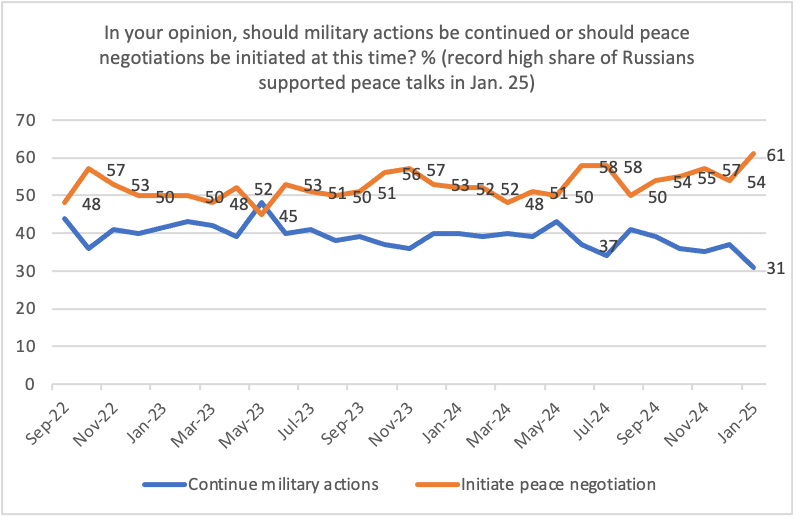
In January, 40% of Russians thought the war will last less than a year while 32% think it will last more than a year:
| How long do you think military actions in Ukraine will continue? | Less than a year, % | More than a year, % |
| May-22 | 60 | 21 |
| Jun-22 | 55 | 27 |
| Jul-22 | 51 | 28 |
| Aug-22 | 48 | 31 |
| Nov-22 | 40 | 41 |
| Jan-23 | 38 | 43 |
| May-23 | 37 | 45 |
| Jul-23 | 34 | 48 |
| Oct-23 | 33 | 46 |
| Jan-24 | 33 | 45 |
| Jul-24 | 40 | 32 |
| Jan-25 | 44 | 32 |
76% of Russians think military actions in Ukraine will end with Russia’s victory.
| How, in your opinion, will the military actions in Ukraine end? | Apr-22 | May-22 | Jan-23 | Jan-24 | Jan-25 |
| with Russia's victory | 73 | 75 | 71.3 | 77 | 76 |
| with Ukraine's victory | 1 | 1 | 1.3 | 0 | 0 |
| neither side will be able to prevail | 15 | 15 | 17.1 | 14 | 15 |
| difficult to answer | 11 | 9 | 10.3 | 9 | 8 |
67% believe involvement of intermediaries in negotiations between Russia and Ukraine will make achievement of a peace agreement easier.
| How do you think the involvement of intermediaries in negotiations between Russia and Ukraine will affect the achievement of a peace agreement? Will it make it easier or more difficult? | Nov-23 | Jan-25 |
| Make it easier | 44 | 67 |
| Make it more difficult | 37 | 13 |
In January, Russians named Belarus, China and the U.S. most frequently as potential mediators.
| Which country or countries could act as mediators in negotiations between Russia and Ukraine? (%) | |
| Belarus | 30 |
| China | 23 |
| USA | 20 |
| Turkey | 8 |
| Hungary | 6 |
| India | 6 |
| Germany | 4 |
| UAE | 3 |
| Kazakhstan | 3 |
| Saudi Arabia | 2 |
| No country | 7 |
| Difficult to answer | 21 |
Footnotes
- These conditions include withdrawal of Ukrainian forces from parts of Donbas, Zaporizhzhia and Kherson regions, and Ukraine officially notifying Russia that it has abandoned its intention to join NATO.
- To visualize changes in territorial control, see NYT’s Ukraine’s Borders in Maps: Pre-2014 Invasion to Now
- For analysis that is relevant for this section, see
- "Putin Scores a Big Victory, and Not on the Battlefield," Anton Troianovski, NYT, 02.13.25.
- "Donald Trump Starts ‘Immediate’ Talks With Vladimir Putin on Ukraine," The Economist, 02.12.25.
- "Donald Trump Opens the Door to Vladimir Putin’s Grandest Ambitions," FT, 02.13.25.
- "Ukraine negotiations: How Europeans can be at the table, not on the menu," Camille Grand, ECFR, 02.14.25.
- "U.S. Clarity Underscores Ukraine’s Peril," Dr. Jack Watling, RUSI, 02.14.25.
- For differences between Russia’s and Ukraine’s visions for peace, see this WP piece.
- For a profile of Kirill Dmitriev see: https://meduza.io/en/feature/2025/02/13/he-had-a-lot-to-do-with-this
- NATO allies are in a state of anger, denial and despair after U.S. Defense Secretary Pete Hegseth effectively declared an end to America's role as the primary guarantor of European security, particularly over Ukraine, according to Axios.
- Russia’s economy is expected to cool this year after months of overheating, with the pace of growth set to more than halve. (Bell, 02.12.25)
The cutoff for reports summarized in this product was 10.00 am East Coast time on the day it was distributed.
*Here and elsewhere, the italicized text indicates comments by RM staff and associates. These comments do not constitute an RM editorial policy.
Slider photo by AP Photo/Matthias Schrader.
 Russia in Review