
Russia in Review, Aug. 29-Sept. 5, 2025
6 Things to Know
- Speaking in China on Sept. 3, Vladimir Putin suggested that there may be a “certain light at the end of the tunnel” in negotiations to end the Russian-Ukrainian war but paired his hint of optimism by vowing that Russian forces would continue their fight if diplomacy failed to bring peace, according to MT. “If common sense prevails, it should be possible to agree on an acceptable way to end the conflict, that’s my assumption,” he told journalists. “All the more so since we see the mood of the Trump administration, and not just rhetoric but a genuine desire to find a solution,” he said, according to MT.
- On Aug. 29, Volodymyr Zelenskyy warned that Russia was poised to launch a new offensive in eastern Ukraine, according to RFE/RL and other outlets. In response to what he saw as an escalating threat he had warned against before, Zelenskyy sought an urgent meeting with Donald Trump and European allies, RFE/RL reported. By early September, reports emerged that Russian command had redeployed elite naval infantry and airborne units from the Sumy and Kherson regions to Donetsk—indicating a primary offensive targeting Dobropillya, Pokrovsk and Kostyantynivka, according to ISW. As many as 100,000 Russian troops have massed near Pokrovsk in Donetsk, raising concerns about a push to capture the city and pave the way for further advances, according to Bloomberg.
- In the period of Aug. 5–Sept. 2, Russian forces gained 222 square miles of Ukrainian territory, which marks a 2% decrease in the rate of gains from the 226 square miles these forces gained in the period of July 8–Aug. 5, 2025. Comparing shorter periods, such as the past week to the preceding week, shows that in the period of Aug. 26–Sept. 2, 2025, Russia gained 73 square miles of Ukrainian territory (a little less than one Martha’s Vineyard island), which marks a 52% increase from the 48 square miles Russian forces gained in the period of Aug. 19–26, 2025, according to the Sept. 3, 2025, issue of the Russia-Ukraine War Report Card. Meanwhile, Chief of the Russian General Staff Valery Gerasimov claimed on Aug. 30 that Russian forces have seized 3,500 square kilometers (1,351 square miles) and 149 settlements since March. Some Russian milbloggers and ISW disputed some of these claims, calling them exaggerated; ISW assessed Russian gains of 2,346 square kilometers (906 square miles) and 130 settlements captured. According to Ukraine’s MoD-associated OSINT group DeepState, in the period from March 1, 2025, to Aug. 30, 2025, the area of Ukrainian lands controlled by Russian forces increased by 2,332 square kilometers (900 square miles) from 112,345 square kilometers (43,377 square miles) to 114,677 square kilometers (44,277 square miles).
- Emmanuel Macron announced this week that 26 countries had pledged security guarantees for Ukraine, including possible troop deployments and military aid after a ceasefire. However, in reality, only France, Britain and Estonia have publicly pledged troops so far, according to The New York Times. Meanwhile, Putin warned that any foreign troops deployed to Ukraine—whether during or after the war—would be considered “legitimate targets” for Russian forces, according to Financial Times.
- The U.S. is to phase out so-called Section 333 security assistance program for European armies along Russia’s border, ending an effort that allocated $1.6 billion to Europe from 2018-2022, according to Financial Times. The so-called Baltic Security Initiative will be especially affected, according to Financial Times. At the same time, the U.S.’s separate Foreign Military Financing program, which provides funding to countries to buy big-ticket items such as fighter jets, ships and tanks, is not affected by the most recent decision, a person familiar with the matter told FT.
- At the Shanghai Cooperation Organization (SCO) summit in Tianjin, Xi Jinping positioned China as the architect of a new multipolar world order, urging Moscow, New Delhi and others to join Beijing in challenging U.S.-led global governance and promoting “sovereign equality” and multilateralism, according to Financial Times. At the summit, which was attended by more than 20 nations’ leaders, including Putin and Narendra Modi, Xi presented China as the champion of a Global South-led multipolar order, according to Yu Jie. In his turn, Putin declared “unprecedented” Russia-China ties and embraced further economic integration with China, even as energy deals like the Power of Siberia 2 reveal Moscow’s growing dependence on Beijing, according to Mikhail Krutikhin. Modi’s presence at the summit underscored a China-India thaw amid U.S.-India tensions, according to Meduza. While Modi chose not to attend the military parade that followed the SCO summit, 25 foreign heads of state or governments, including Putin, did. During the parade, China showcased its nuclear ambitions by debuting two new intercontinental ballistic missiles, the DF-5C and DF-61. At the parade, Xi stood alongside Putin and North Korea’s Kim Jong Un. Posting on Truth Social after the summit and the parade, Trump observed: “Looks like we’ve lost India and Russia to deepest, darkest, China. May they have a long and prosperous future together!”
I. U.S. and Russian priorities for the bilateral agenda
Nuclear security and safety:
- No significant developments.
North Korea’s nuclear and missile programs:
- In China, Russian and North Korean leaders held their own their meeting after traveling to the talks together by car1 from the parade grounds. "I would like to note that your soldiers fought courageously and heroically," Russian President Vladimir Putin said, sitting next to Kim Jong Un, referring to the thousands of North Korean soldiers deployed to Russia's Kursk region to help push back Ukraine's counteroffensive on Russian territory. Putin invited Kim to visit Moscow, according to Kremlin spokesman Dmitry Peskov. Peskov said Kim “would take advantage of the offer,” although no specific dates have been set and details will be agreed upon in the future. The invitation followed talks in China between the two leaders. After their meeting, Kim said farewell to Putin with “See you soon,” to which Putin replied, “We are waiting for you. Come visit.” (TASS, 09.03.25, RFE/RL, 09.03.25)
- Around 2,000 North Korean soldiers deployed to help Russia fight against Ukrainian forces are believed to have been killed, South Korean lawmaker Lee Seong-kweun told reporters Sept. 2 after a briefing from the National Intelligence Service. (MT/AFP, 09.02.25)
- Kim Jong Un unveiled a plan to develop a new intercontinental ballistic missile. (Bloomberg, 09.02.25)
- Also see the China section below.
Iran and its nuclear program:
- President of Iran Masoud Pezeshkian was among 20 world leaders at the Beijing military parade, including Russia’s Putin. The two leaders held a bilateral meeting while in China. (RM, 09.03.25)
Humanitarian impact of the Ukraine conflict:
- Russian forces executed seven Ukrainian POWs near Myrolyubivka, Donetsk. (ISW, 08.29.25)
- A Russian military officer accused of committing war crimes in Ukraine has been appointed to a cabinet post in the North Caucasus republic of Dagestan. Temirlan Abutalimov was named Dagestan’s acting minister for national policy. (MT/AFP, 09.03.25)
- OSINT analysis confirms at least 2,577 Ukrainian servicemen are currently held as Russian prisoners of war, according to Ukrainian official Artur Dobroserdov. Data on hundreds more, including 91 civilians, awaits Red Cross verification. A forthcoming OSCE report will highlight ongoing Russian violations of humanitarian law. (Ukrainska Pravda, 09.05.25)
- In Ukrainian front-line towns like Orikhiv, civilians are increasingly targeted by Russian explosive drones that strike any sign of movement, making simple acts like biking for groceries potentially deadly. (Wall Street Journal, 09.04.25)
- Russia’s deputy defense minister, Anna Tsivileva, declared Sept. 4 that the country has reached a “flagship level” in prosthetics since the invasion of Ukraine. (Meduza, 09.04.25)
- A group of prominent exiled Russian opposition figures is urging Canada to offer asylum to hundreds of anti-war activists who they say face the risk of deportation from the United States to Russia (MT/AFP, 09.03.25)
- For military strikes on civilian targets see the next section.
Military and security aspects of the Ukraine conflict and their impacts:
- In the period of Aug. 5–Sept. 2, Russian forces gained 222 square miles of Ukrainian territory, which marks a 2% decrease from the 226 square miles these forces gained in the period of July 8–Aug. 5, 2025. Comparing shorter periods, such as the past week to the preceding week, shows that in the period of Aug. 26–Sept. 2, 2025, Russia gained 73 square miles of Ukrainian territory (a little less than one Martha’s Vineyard island), which marks a 52% increase from the 48 square miles Russian forces gained in the period of Aug. 19–26, 2025, according to the Sept. 3, 2025, issue of the Russia-Ukraine War Report Card. (RM, 09.04.25)
- As of Sept. 3, 2025, Russian forces occupied 114,729 square kilometers (44,297 square miles), which constituted 19% of Ukraine’s territory and which is roughly equivalent to the state of Virginia, according to Ukraine’s DeepState OSINT group’s map. (RM, 09.04.25)
Friday, Aug. 29, 2025
- On Aug. 29, Ukraine’s DeepState OSINT group reported in its interactive map that the Russian armed forces were driven back in Myrne and Novoselivka. The Russian forces advanced near Komyshuvakha and Mirolyubivka. (RM, 09.03.25)
- Russian Defense Minister Anderi Belousov claimed forces are gaining 600–700 square kilometers per month, but ISW assesses gains are below this, with about 500 square kilometers taken in August and heavy daily personnel losses averaging 938 soldiers. (ISW, 08.29.25)
Saturday, Aug. 30, 2025
- On Aug. 30, Ukraine’s DeepState OSINT group reported in its interactive map that the Russian armed forces advanced in Zarichne and near Maliivka. (RM, 09.03.25)
- Chief of the General Staff of the Russian Armed Forces, General of the Army Valery Gerasimov, summed up the results of the spring-summer campaign of 2025, TASS reported Aug. 30. Gerasimov claimed that Russian forces have captured 99.7% of the territory of the Luhansk People’s Republic (LPR), with less than 60 square kilometers remaining under Ukrainian control, as well as 79% of the Donetsk People’s Republic (DPR), according to TASS. Russian forces have brought 74% of the territory of the Zaporozhzhia region and 76% of the Kherson region under their control, he said. In the Sumy region, 210 square kilometers of territory and 13 settlements have come under Russian control, according to Gerasimov. "Since March, more than 3,500 square kilometers of territory and 149 settlements have been liberated," Gerasimov claimed. (RM, 08.30.35)
- Russian milbloggers heavily criticized Gerasimov's Aug. 30 claims that Russian forces seized 3,500 square kilometers of territory and 149 settlements since March 2025 and rejected Gerasimov's claim that Russian forces have seized half of Kupyansk. The milbloggers characterized Gerasimov's figures as a "very big exaggeration.” ISW has observed evidence to assess that Russian forces had gained only roughly 2,346 square kilometers of Ukrainian territory and seized 130 settlements between March 1 and Aug. 30. Gerasimov asserted that Russia controls 50% of Kupyansk, while ISW finds only 6.3% is held. These inflated figures appear aimed at shaping Western perceptions, despite the incremental nature and high cost of actual Russian territorial advances. (ISW, 08.31.25, ISW, 09.01.25)
- Russia launched a combined aerial attack on Ukraine overnight Aug. 29–30, firing eight Iskander-M/KN-23 ballistic missiles from Rostov and Krasnodar; 37 Kh-101, Kalibr, Iskander-K, and Kh-59 cruise missiles from various locations; and 537 Shahed-type and decoy drones from several Russian regions. Ukrainian air defenses reportedly shot down 510 drones, six ballistic missiles and 32 cruise missiles, but remaining strikes damaged civilian and energy infrastructure across seven regions. The Russian overnight attacks killed at least one person. (ISW, 08.31.25, MT/AFP, 08.30.25, New York Times, 08.30.25)
- Ukrainian drone forces struck two major Russian oil refineries -- Krasnodar in southern Russia and Syzran in the Samara region -- overnight on Aug. 30, igniting fires and causing explosions in facilities key to supplying fuel for Russian military units. The Krasnodar refinery produces around 3 million tons of gasoline, diesel, and aviation fuel annually, while the Syzran plant can process up to 8.5 million tons each year. (RFE/RL, 08.30.25)
- A Ukrainian Main Military Intelligence Directorate (GUR) source reported to Ukrainian broadcaster Suspilne on Aug. 30 that the GUR destroyed a Russian explosives warehouse in Tula Oblast near the Aleksinsky Chemical Plant, which produces pyroxylin powder for small arms ammunition, artillery systems and rocket engines. (ISW, 08.31.25)
- Russia is poised to launch a new offensive in eastern Ukraine, Ukrainian President Volodymyr Zelenskyy said. "The concentration [of Russian troops] there is up to 100,000," Zelenskyy said on Aug. 29, referring to the front lines near the highly strategic city Pokrovsk. (RFE/RL, 08.30.25)
Sunday, Aug. 31, 2025
- On Aug. 31, Ukraine’s DeepState OSINT group reported in its interactive map that the Russian armed forces occupied Komyshuvakha and advanced near Maliivka and Novoukrainka. (RM, 09.03.25)
- Russian drone strikes damaged four facilities in the Odesa region early Aug. 31, cutting power to more then 29,000 customers, regional head Oleh Kiper said. (RFE/RL, 08.31.25)
- Over half of American companies in Ukraine have been damaged by Russian attacks, and the Flex factory alone paid $8 million in regional taxes last year. (New York Times, 08.31.25)
Monday, Sept. 1, 2025
- On Sept. 1, Ukraine’s DeepState OSINT group reported in its interactive map that the Russian armed forces occupied Voskresenka and advanced near Maliivka and Kamianka. (RM, 09.03.25)
- Ukrainian troops on the front lines are increasingly relying on drones to deliver supplies like food, water, ammunition and even comforts such as books and chocolate, as conventional resupply routes are too dangerous due to constant Russian surveillance and attacks. (Washington Post, 09.01.25)
- Ukraine is planning new long-range strikes deep inside Russian territory, Zelenskyy announced on Sept. 1. Zelenskyy did not specify what weapons would be used for these strikes. (Meduza, 09.01.25)
Tuesday, Sept. 2, 2025
- On Sept. 2, Ukraine’s DeepState OSINT group reported in its interactive map that the Ukrainian Defense Forces pushed back the Russian forces near Tovste. The latter advanced in Perebudova, near Maliivka and Sichneve. Fighting continues in Myrove. (RM, 09.03.25)
- The Russian command has reportedly redeployed elite naval infantry and airborne units, including several Pacific Fleet brigades, from Sumy and Kherson regions to Donetsk Oblast. These troop movements suggest the main Russian Fall 2025 offensive effort will target Dobropillya, Pokrovsk and Kostyantynivka in Donetsk. (ISW, 09.02.25)
- Ukraine reportedly conducted its first strike with the domestically produced FP-5 Flamingo cruise missile on Aug. 30, targeting a Russian border post near Voloshyne, Crimea. The Flamingo is estimated to have a range up to 3,000 kilometers and a 1,150-kilogram warhead. (ISW, 09.02.25)
- Russia has intensified missile and drone strikes against Ukrainian cities since the mid-August Alaska summit, nearly doubling daily drone launches to 141. (Wall Street Journal, 09.02.25)
- Authorities in Russia’s southwestern Kursk region said on Sept. 2 that two men were killed after they stepped on a mine near the border with Ukraine. (MT/AFP, 09.02.25)
Wednesday, Sept. 3, 2025
- On Sept. 3, Ukraine’s DeepState OSINT group reported in its interactive map that the Russian armed forces advanced near Stepova Novosilka, Derylove and Mala Tokmachka. (RM, 09.03.25)
- On Sept. 2–3, Russia launched 16 Kalibr and 8 Kh-101 cruise missiles, plus 502 drones, hitting infrastructure across multiple regions. Ukrainian defenses downed 430 drones and most missiles. (ISW, 09.03.25)
- Ukrainian forces recently advanced near Pokrovsk while Russian troops made incremental gains in the Kostyantynivka-Druzhkivka tactical area. (ISW, 09.03.25)
Thursday, Sept. 4, 2025
- On Sept. 4, Ukraine’s DeepState OSINT group reported in its interactive map that the Russian armed forces advanced near Sichneve and Krasne Pershne. (RM, 09.03.25)
- Ukrainian forces advanced near Kupyansk, Siversk and in the Kostyantynivka-Druzhkivka area, while Russian troops made marginal gains in northern Sumy Oblast and near Velykomykhailivka, highlighting ongoing fluidity on multiple sectors of the front. (ISW, 09.04.25)
- European leaders are increasingly worried that Russia is preparing a new offensive in Ukraine, as 100,000 Russian troops have massed near Pokrovsk in Donetsk, raising concerns about a push to capture the city and pave the way for further advances. (Bloomberg, 09.04.25)
- At their security council meeting in Toulon last week, German and French officials discussed the Russian troops massing outside Pokrovsk. Zelenskyy said on Sept. 5 that Russia had relocated 100,000 soldiers to the frontline outside the city, which the Kremlin’s forces have tried to encircle and seize without success for more than a year. (Bloomberg, 09.04.25)
- A Russian air attack on northern Ukraine Sept. 4 killed two people from the Danish Refugee Council who were clearing mines in an area previously occupied by Moscow’s forces, Chernihiv regional governor Vyacheslav Chaus said. (MT/AFP, 09.04.25)
- Since January 2025, Russia has carried out sustained, large-scale drone and missile attacks against Ukraine, with ISW documenting four major combined strikes each involving over 500 drones and missiles. The latest wave, on Sept. 2–3, included the launch of 16 Kalibr and eight Kh-101 cruise missiles along with 502 Shahed-type and decoy drones from multiple Russian regions and occupied Crimea. Ukrainian air defenses reportedly shot down 430 drones and most cruise missiles, but the attacks still struck civilian, residential, energy, and transportation infrastructure across at least eight regions, reflecting Russia’s continued campaign to undermine Ukrainian morale and energy networks ahead of winter. (ISW, 09.04.25)
Friday, Sept. 5, 2025
- Ukrainian drones struck one of Russia’s largest oil refineries overnight in the Ryazan region southeast of Moscow, Ukraine’s military said Sept. 5. Ryazan region Gov. Pavel Malkov confirmed the attack, describing the targeted site as an “industrial enterprise.” Russia’s Defense Ministry said nine of 92 Ukrainian drones launched overnight had been intercepted over Ryazan. The refinery processes between 13.7 million and 17.1 million tons of crude annually. The affected unit accounts for almost half the refinery’s throughput. Another unit is being restarted, but the refinery will operate at just 23% capacity until repairs are completed. (MT/AFP, 09.05.25, Korrespondent.net, 09.05.25)
- Russian forces admitted to striking a humanitarian demining mission in Chernihiv region with an Iskander-M missile, killing several people. Moscow tried to justify the attack by claiming it targeted Ukrainian drone launchers, but published footage and statements effectively confirm the hit was on a civilian target. (RBC.ua, 09.05.25)
Military aid to Ukraine
Sunday, Aug. 31, 2025
- European Commission President Ursula von der Leyen stated that European leaders have “pretty precise plans” for a multinational troop deployment to Ukraine as part of postwar security guarantees. The plans reportedly involve potentially tens of thousands of European-led troops, with the U.S. providing key backstop support—such as command, control, intelligence and surveillance. (Financial Times, 08.31.25)
Monday, Sept. 1, 2025
- Kyiv's European allies are working on “pretty precise plans” and a "clear road map" for a potential deployment of troops to Ukraine should a peace deal be struck between Kyiv and Moscow, European Commission President Ursula von der Leyen said. (RFE/RL, 09.01.25)
Wednesday, Sept. 3, 2025
- While in China Putin again claimed Russian forces are making gradual but successful advances “in all directions,” asserting the war can be won through attritional tactics and outlasting Western support. ISW assesses this signals continued refusal to consider genuine peace efforts. (ISW, 09.03.25)
- Kyiv aims to acquire U.S. Patriot systems through a new NATO-backed procurement mechanism, and is developing its own advanced weapons like the Flamingo cruise missile. (New York Times, 09.03.25)
- Military equipment maker Fire Point plans to open a facility in Denmark, becoming the first Ukrainian defense company to start production in a Nordic country following a governmental agreement reached in June, the Danish Defense Ministry said. (Bloomberg, 09.03.25)
- Ukrainian government officials have stated that Russia is conscripting young Ukrainians into the Russian military once they turn 18, significant numbers of which were abducted from illegally invaded and occupied Ukrainian territories as children. (UK MOD X Account, 09.03.25)
Thursday, Sept. 4, 2025
- The U.S. will phase out section 333 security assistance for European countries bordering Russia, ending a program with a global budget exceeding $1 billion and historically allocating $1.6 billion to Europe from 2018-2022—29% of all section 333 spending. Key recipients—Estonia, Latvia, and Lithuania—now face uncertainty as Congress has not approved further funding beyond Sept. 2026. (Financial Times, 09.04.25)
- The move may result in shaving off hundreds of millions of dollars worth of financial support for equipment and weapons training for armies across Europe but would hit one program, the Baltic Security Initiative, especially hard. One of the people said affected nations didn’t expect the change to have a critical impact but said they might take longer to get some weapons they need. (Bloomberg, 09.04.25)
- Senator Jeanne Shaheen, the top Democrat on the Senate’s foreign relations committee, described the cuts as a “misguided move that sends exactly the wrong signal as we try to force Putin to the negotiating table and deter Russian aggression.” (Financial Times, 09.04.25)
- The U.S.’s separate Foreign Military Financing program, which provides funding to countries to buy big-ticket items such as fighter jets, ships and tanks, is not affected by the most recent decision, according to a person familiar with the matter. (Financial Times, 09.04.25)
- French President Emmanuel Macron said 26 countries had pledged to provide Ukraine with security guarantees in the event of a ceasefire. The French leader hosted a meeting of the so-called coalition of the willing on Sept. 4, bringing together European leaders prepared to offer assurances to Ukraine, including possible troop deployments, after a ceasefire. The plan—discussed at a Paris summit with European leaders and U.S. envoy Steve Witkoff—includes troops, naval, air support, and rebuilding Ukraine's army. Trump, who joined a call with Macron and European leaders, urged a halt to Russian oil purchases and more pressure on China but offered no clear commitment to new U.S. sanctions or ground deployments. Over 10,000 troops could be involved under current plans. (Wall Street Journal, 09.04.25, Bloomberg, 09.04.25, MT/AFP, 09.05.25)
- Only France, Britain and Estonia have publicly pledged troops, while most EU countries remain cautious, questioning whether the U.S. would militarily back NATO if Russia retaliated. (New York Times, 09.05.25)
- Putin warned that any foreign troops deployed to Ukraine—whether during or after the war—would be considered “legitimate targets” for Russian forces. His remarks follow a Paris summit where over two dozen of Kyiv’s allies discussed multinational military deployments as postwar security guarantees, though without plans to send forces during active fighting. Putin also insisted any direct peace talks with Zelenskyy must take place in Moscow. The U.S. and Europe remain divided over concrete military commitments, and Putin highlighted growing ties with China during his recent trip. (Financial Times, 09.04.25)
- In just the last 50 days, the U.K. has contributed to Ukraine:
- - 4.7 million rounds of small arms ammunition for Ukrainian soldiers
- - 60,000 artillery shells, rockets, and missiles
- - Over 2,500 drones
- - More than 200 electronic warfare systems
- - 100 light weapons
- - 30 vehicles. (UK MOD X Account, 09.04.25)
Friday, Sept. 5, 2025
- The U.S. is discussing a $100 billion weapons deal with Ukraine, granting Kyiv access to American arms and giving the U.S. intellectual property from Ukrainian-developed military tech. Final security plans hinge on negotiations among Ukraine, Russia, and allies, with President Trump holding ultimate decision-making power. (NBC News, 09.05.25)
- Turkey is expected to guarantee open maritime trade routes, overseeing enforcement and surveillance in the Black Sea, Bosporus and Dardanelles to keep Russian blockades from choking off Ukraine’s economy, building on its earlier role securing Ukrainian grain exports. (NBC News, 09.05.25)
- MiG-29 fighter jet in Azerbaijani camouflage is now confirmed operational in the Ukrainian Air Force. Previously, three Azerbaijani MiG-29s were being modernized in Lviv before Russia’s full-scale invasion; their fate was unclear, but at least one is now serving in Ukraine. (Status-6/X, 09.05.25)
Punitive measures related to Russia’s war against Ukraine and their impact globally:
Monday, Sept. 1, 2025
- Brazil’s Luiz Inacio Lula da Silva is convening a virtual meeting of BRICS leaders Sept. 8 to discuss Trump’s trade policy, according to four people familiar with the plan. (Bloomberg, 09.01.25)
Tuesday, Sept. 2, 2025
- The U.S. has held back from imposing secondary sanctions on China over its support for Russia’s war on Ukraine because broader trade negotiations are continuing, U.S. Ambassador to NATO Matthew Whitaker told Bloomberg. (Bloomberg, 09.02.25)
- The United Kingdom on Sept. 3 imposed sanctions on eight Russian individuals and three organizations, accusing them of participating in the alleged forced relocation and “indoctrination” of Ukrainian children. (MT/AFP, 09.03.25)
Wednesday, Sept. 3, 2025
- Canada has amended its Special Economic Measures (Russia) Regulations, lowering the price cap on Russian crude oil exports from U.S.$60 to U.S.$47.60 per barrel. This move, following similar measures by the EU and U.K., aims to reduce Russian war revenues and aligns with Canada's G7 commitment to support Ukraine and pressure Moscow. (Global Affairs Canada, 09.03.25)
Thursday, Sept. 4, 2025
- Trump met with Polish President Karol Nawrocki at the White House on Sept. 3. During the exchange, Trump bristled at questions about why he had not yet moved forward with additional sanctions or tariffs targeting Russia, noting he had already ratcheted up tariffs on India over its purchase of Russian oil. (Bloomberg, 09.03.25)
- At least seven European Union member states have backed Russian billionaire Mikhail Fridman’s bid to overturn the bloc’s sanctions against him, the Spanish newspaper El Mundo reported on Sept. 4. (MT/AFP, 09.04.25)
- The U.K. has imposed sanctions on eight Russian individuals and three organizations—including the Akhmat Kadyrov Foundation and Kremlin-backed youth groups—accusing them of involvement in the forced relocation and “indoctrination” of Ukrainian children. London alleges these groups are central to moving around 20,000 children from occupied Ukrainian territories to “re-education camps” in Russia since 2022. (MT/AFP, 09.03.25)
Friday, Sept. 5, 2025
- The EU is sending a delegation to Washington to further coordinate sanction policy and prepare new restrictions on Russia, according to European Council President António Costa. Work has already started in Brussels on another sanctions package to raise pressure on Moscow. Costa reiterated that EU membership is “the best guarantee of security” and prosperity for Ukraine. The EU continues to support Ukraine’s reconstruction, reform process, and path toward full EU membership, seeing those as key to Ukraine’s future. (RBC.ua, 09.05.25)
- Ukraine’s allies are preparing a new round of sanctions against Russia, Canadian Prime Minister Mark Carney announced on September 5. He cited the need to maintain pressure on President Putin: “He is the cause of this war… he is not going to dictate the terms of the peace.” (Reuters, 09.05.25)
- Despite Xi-Putin talks, Russia’s Norilsky Nickel says Chinese banks still delay payments for Russian imports by up to four weeks after each new sanctions package, hurting company cash flow and increasing borrowing costs; over 50% of Nornickel’s sales now go to Asia, mostly China. (Reuters, 09.04.25)
For sanctions on the energy sector, please see section “Energy exports from CIS” below.
Ukraine-related negotiations:
Saturday, Aug. 30, 2025
- Zelenskyy said Kyiv is seeking a fresh meeting with Trump and European allies as soon as next week after telling reporters that Russia is poised to launch a new offensive in eastern Ukraine. (RFE/RL, 08.30.25)
Sunday, Aug. 31, 2025
- German Chancellor Friedrich Merz said he hasn’t given up hope that a ceasefire can be secured in Ukraine, but he’s “not under any illusions either.” “I am preparing myself inwardly for the possibility that this war could go on for a long time,” Merz said in an interview on Sunday with public broadcaster ZDF in which he also rejected a proposal by his coalition partner, the Social Democrats, to increase taxes in Germany. (Bloomberg, 08.31.25)
Monday, Sept. 1, 2025
- Putin said Sept. 1 that his meeting with Trump in Alaska last month could help pave the way toward peace in Ukraine. “We highly value the efforts of China, India and our other strategic partners aimed at helping to resolve the crisis in Ukraine,” Putin told a meeting of the Shanghai Cooperation Organization (SCO) in Tianjin, China. “I would also note that the understandings reached at the recent Russian-American summit in Alaska, I hope, are moving in the same direction, opening the path toward peace in Ukraine,” he added. (MT/AFP, 09.01.25)
- Speaking to other SCO leaders at the two-day summit in Tianjin on Sept. 1, Putin said the war in Ukraine came about “not as a result of a Russian attack” but because of a Western-backed coup in Kyiv, according to comments carried by the Russian news agency TASS. (RFE/RL, 09.01.25)
- Former Ukrainian President Viktor Yanukovych made a rare appearance in Russian state media on Sept. 1, accusing the European Union of “arrogance” in negotiations with Kyiv before he was ousted from power in 2014. (MT/AFP, 09.01.25)
- Kremlin officials have denied White House statements about prospective Ukrainian-Russian or U.S.-mediated trilateral meetings. Russian Presidential Aide Yuriy Ushakov reiterated on Sept. 1 that “there was no agreement” for talks between Zelenskyy, Putin or Trump, undermining Trump’s efforts to broker a peace settlement. (ISW, 09.02.25)
Tuesday, Sept. 2, 2025
- Ukraine urged China to pressure Putin to move toward peace as the Russian president arrived in Beijing following his participation in the Shanghai Cooperation Organization (SCO) summit. "Given the significant geopolitical role of the People's Republic of China, we would welcome a more active role [for Beijing] in bringing peace to Ukraine based on respect for the U.N. Charter," Ukraine's Foreign Ministry said. (RFE/RL, 09.02.25)
- Trump has given Russian and Ukrainian leaders a two-week deadline to make progress on peace talks or face possible U.S. retaliation, but negotiations remain stalled. Trump has increased tariffs on Indian goods over Russian oil imports, yet India has not backed down. The president says he will decide on further steps regarding Russia in two weeks. (Wall Street Journal, 09.01.25)
- At the SCO summit, Putin blamed the 2014 "coup" for the Ukraine war and insisted on “eliminating root causes” such as Ukraine’s NATO aspirations, echoing Kremlin calls to install a pro-Russian government in Kyiv. Putin said reaching consensus on security guarantees for Ukraine was possible, even as he reiterated Moscow would never accept Kyiv’s accession into NATO. (Bloomberg, 09.02.25, ISW, 09.02.25)
Wednesday, Sept. 3, 2025
- As Putin takes in a parade in China and as his forces continue to batter Ukrainian cities, Trump said he is “very disappointed” in the Kremlin leader and that he plans to do “something” in the coming days about it. "I'm very disappointed in President Putin, I can say that," Trump said. "We had a great relationship, I'm very disappointed." "Thousands of people are dying. They’re not Americans. They’re Russians and Ukrainians…And it’s a war that makes no sense,” Trump added. “We’ll be doing something to help people live…Seven thousand people are dying every week -- soldiers, mostly. And if I can help to stop that, I think I have an obligation to do it,” he added, without being specific. (RFE/RL, 09.03.25)
- Speaking in China on Sept. 3, Vladimir Putin:
- Suggested that there may be “light at the end of the tunnel” in negotiations to end the war against Ukraine, but paired his hint of optimism by vowing that Russian forces would continue their fight if diplomacy failed to bring about peace. “If common sense prevails, it should be possible to agree on an acceptable way to end the conflict, that’s my assumption,” he told a crowd of Russian journalists. “All the more so since we see the mood of the Trump administration, and not just rhetoric but a genuine desire to find a solution.” (MT/AFP, 09.03.25)
- Declared he does not consider Zelenskyy legitimate, but insisted he has never ruled out the possibility of meeting with him and has invited Zelenskyy to Moscow for direct talks, if Zelenskyy is willing to meet. However, Putin questioned the usefulness of such talks under current circumstances, stating, “In general, I have never ruled out the possibility of such a meeting. But is there any sense in such meetings?” His comments reflect ongoing doubts in Moscow about the prospects for meaningful negotiations with Kyiv amid continued conflict. Putin questioned Zelenskyy’s legitimacy and ruled out linking Ukrainian security guarantees to territorial exchanges. (TASS, 09.03.25, MT/AFP, 09.03.25. ISW, 09.03.25)
- Praised U.S. envoy Steve Witkoff’s role in negotiations on the war in Ukraine, saying he accurately reported the Kremlin’s viewpoint to Trump following meetings. (Bloomberg, 09.03.25)
- Said Russia is prepared to keep fighting in Ukraine if diplomacy fails: if agreement is reached, “we will have to achieve our objectives by military means.” (MT/AFP, 09.03.25)
- Said Russia will never tolerate a careless or dismissive attitude toward its national interests, particularly regarding security. Asked about the causes of the Ukraine conflict, Putin blamed those who, he claimed, ignored Russia’s security concerns, asserting that “we will never allow such things” to happen. He emphasized that Russia will not remain passive while its interests are disregarded, underlining Moscow’s uncompromising stance in defending what it sees as its core priorities. (TASS, 09.03.25, TASS, 09.03.25)
- Russian Foreign Minister Sergei Lavrov said Moscow expects its partners to voice support for Russian-U.S. dialogue on resolving the Ukraine conflict, welcoming constructive initiatives from the Global South and East. Lavrov cited recent diplomatic efforts by the Trump administration and the Aug. 15 Alaska summit, where Putin and Trump discussed Ukraine. Lavrov also noted proposals from Indonesia, African states, China and Brazil. (TASS, 09.03.25)
Thursday, Sept. 4, 2025
- Trump told CBS News he remains committed to brokering a Russia-Ukraine peace agreement, saying, “Something is going to happen, but they are not ready yet. But something is going to happen. We are going to get it done.” Trump described bringing leaders together for real-time negotiations as his preferred approach, while acknowledging the process requires patience. He expressed dismay over recent deadly Russian strikes in Kyiv but said diplomatic progress is still possible. Trump also pointed to his efforts in various global negotiations, though outcomes have drawn skeptical reviews from foreign policy analysts. (CBS News, 09.04.25)
- Ukrainian Presidential Office head Andriy Yermak and Security Council Secretary Rustem Umerov met in Paris with Steven Witkoff to discuss implementing security guarantees for Ukraine. They also held talks with senior advisors from the U.K., France, Germany and Italy. According to Yermak, discussions focused on practical, “strong and effective” guarantees across air, sea, land and cyberspace, as well as increased sanctions, the return of Ukrainian prisoners, and abducted children. (Korrespondent.net, 09.04.25)
- Zelenskyy rejected an invitation from Putin to meet in Moscow, calling the location choice a sign that Russia doesn’t actually want negotiations to happen. (Meduza, 09.04.25)
Friday, Sept. 5, 2025
- Ukraine does not view China as a potential security guarantor and urges Beijing to demonstrate its declared neutrality in practice, Foreign Ministry spokesperson Heorhiy Tykhyi said on Sept. 5. Tykhyi cited contradictions between China’s statements of non-interference and evidence of Chinese-made components in Russian drones and Chinese nationals captured by Ukrainian forces. He stressed Ukraine relies on the “coalition of the willing” for security guarantees rather than Russia or China, and called on Beijing to align its actions with its public position. (Korrespondent.net, 09.05.25)
- "Regarding the security guarantees for Ukraine—any agreements must be developed for both Russia and Ukraine. If the agreements are reached, rest assured, Russia will implement them in full," Putin said at the 10th Eastern Economic Forum. (Kremlin.ru, 09.05.25)
Great Power rivalry/new Cold War/NATO-Russia relations:
Sunday, Aug. 31, 2025
- The European Union’s new €150 billion ($175 billion) plan to accelerate investment in the bloc’s defense industry will benefit Poland most, Commission President Ursula von der Leyen said on Sunday. (Bloomberg, 08.31.25)
Monday, Sept. 1, 2025
- European Commission President Ursula von der Leyen’s plane was forced to land in Bulgaria using paper maps after suspected Russian GPS jamming disabled navigation systems near Plovdiv airport on Sept. 1. Bulgarian authorities confirmed the incident, calling it “blatant interference by Russia.” The Kremlin denied involvement. (Financial Times, 09.01.25)
- Swedish authorities on Thursday accused Russia of being behind a surge in GPS interference over the Baltic Sea. (MT/AFP, 09.04.25)
- Experts say Russian jammers can disrupt navigation for aircraft and weapons, hindering NATO aviation and U.S.-supplied guided munitions in Ukraine. (Financial Times, 09.03.25)
Tuesday, Sept. 2, 2025
- A new IISS report warns European nations could face up to a $1 trillion rearmament bill as the U.S. reviews its military posture and may shift up to 30% of its forces out of Europe. (RFE/RL, 09.02.25)
- Some 8,000 German soldiers will participate in the Quadriga 2025 exercise, which takes place in Germany, Lithuania, Finland and the Baltic Sea this week. (Bloomberg, 09.01.25)
Wednesday, Sept. 3, 2025
- “We have always opposed Ukraine’s membership in the North Atlantic Treaty Organization,” Putin told journalists on Sept. 3, 2025, during his visit to China, according to the Kremlin’s website. “But we have never questioned its right to conduct its economic and business activities as it wishes, including joining the European Union,” he said. (RM, 09.03.25)
- President Trump told Polish President Karol Nawrocki that the U.S. is ready to increase its military presence in Poland, reaffirming a strong security guarantee and the “tremendous relationship” between the two countries. Trump emphasized that U.S. troops would remain or be increased if requested. Nawrocki, who supports Ukraine but opposes NATO membership for Kyiv, highlighted unity among Polish and EU leaders on the Russian threat. Trump reiterated his readiness to respond if Putin does not move toward peace in Ukraine. (RFE/RL, 09.03.25)
- The U.S. has about 10,000 personnel stationed in Poland on a rotational basis and Trump said he was “very happy” with the arrangement. “We’ll put more there if they want,” he added. (Financial Times, 09.04.25)
- Norway decided to pick the UK as the supplier of its new navy frigates as the Nordic NATO member seeks to deter Russian submarines in the High North, according to the country’s defense minister. (Bloomberg, 09.03.25)
- A plane carrying Lithuanian President Gitanas Nausėda had to delay its landing at Vilnius Airport after reports of a drone sighting on Tuesday, presidential spokesperson Tomas Berzinskas told state broadcaster LRT. (Meduza, 09.03.25)
- Latvia’s defense minister said his country should start drafting women into the military in 2028 as part of an effort to expand the size of its armed forces. (Bloomberg, 09.03.25)
Thursday, Sept. 4, 2025
- NATO Secretary General Mark Rutte warned that Russia and China are preparing for prolonged confrontation and modernizing their militaries at a “remarkable, staggering rate.” Speaking after the Beijing parade, where Xi Jinping, Vladimir Putin, and Kim Jong Un showcased advanced weapons—including new intercontinental ballistic missiles—Rutte said the display signals intent to reshape the global order and threaten Western security. (Bloomberg, 09.04.25)
- U.S. President Donald Trump said the U.S. could increase its troop presence in Poland. the U.S. president met with Polish President Karol Nawrocki at the White House on Wednesday. (Bloomberg, 09.04.25)
Friday, Sept. 5, 2025
- German Chancellor Friedrich Merz voiced exasperation that Europe lacks the clout to force Russia to end its war in Ukraine after the U.S. continued to stall on providing security guarantees or agree on sanctions. “We are currently unable to exert sufficient pressure on Putin to end this war,” Merz said on Friday in an interview for his conservative party’s YouTube channel. “We depend on American help.” (Bloomberg, 09.05.25)
China-Russia: Allied or aligned?
Sunday, Aug. 31, 2025
- Prime Minister Narendra Modi used his first trip to China in seven years to reset relations with India’s powerful neighbor while also seeking to strengthen ties with Russia as President Donald Trump ratchets up tensions with New Delhi. Modi held talks with Chinese President Xi Jinping in Tianjin on Sunday at a regional security and economic summit, with both sides pledging to be partners, not rivals. Xi and Modi pledged to be “partners not rivals” They discussed border issues, resuming direct flights and increasing trade, according to official readouts. The Trump administration last week imposed 50% tariffs on Indian goods bound for the U.S., the highest in Asia, to penalize it for those energy purchases. (Bloomberg, 08.31.25, Financial Times, 08.31.25)
Monday, Sept. 1, 2025
- At the SCO Tianjin summit, Chinese President Xi Jinping, Russian President Vladimir Putin, and Indian Prime Minister Narendra Modi pledged cooperation, sending a strong message to Washington amid rising tensions. Xi and Putin also took turns at the event to swipe at the West during a gathering of Eurasian leaders aimed at putting Beijing front and canter of regional relations. Xi told some 20 participating leaders that the global situation was becoming more "chaotic and intertwined." The Chinese leader also slammed "bullying behavior" from certain countries—a veiled reference to the United States. (MT/AFP, 09.01.25)2
- Xi also said his country will increase investments and loans to partners while outlining a plan to bolster a China- and Russia-led security bloc and boost Beijing’s global clout. China will provide 2 billion yuan ($275 million) in grants to member states of the Shanghai Cooperation Organization this year and issue an additional 10 billion yuan in loans to lenders in the group’s interbank consortium over the next three years, Xi said Monday at the SCO summit. (Bloomberg, 09.01.25)
- Vladimir Putin said at the SCO summit:
- “We also consider it extremely important to sign today the agreements on establishing a universal SCO center in Tashkent, which will respond to the full range of modern challenges and threats, and on opening a separate anti-drug center in Dushanbe. We expect that these centers will begin operations in the very near future." (Kremlin.ru, 09/01.25)
- “The pace of cooperation development within the SCO is truly impressive. For example, last year the average GDP growth of member states exceeded 5%, and industrial production grew by 4.6%. Mutual trade continues to increase steadily. All of these figures are higher than global averages. The use of national currencies in settlements is also expanding.” (Kremlin.ru, 09.01.25)
- While no major agreements were reached at the SCO summit, the summit’s symbolism highlighted difficulties for President Trump’s attempts to break the China-Russia partnership and pull India away from Moscow. (Wall Street Journal, 09.01.25)
Tuesday, Sept. 2, 2025
- President Xi Jinping hosted the leaders of North Korea and Russia in Beijing for the first time, marking a historic show of united defiance against the U.S.-led world order. Not since the Cold War have leaders from all three nations stepped out together, with the last time being a 1959 march in Beijing when Mao Zedong hosted Kim Il Sung and Nikita Khrushchev. Xi’s tight embrace of both nations will likely worry many Western nations, whose leaders were largely absent from the parade, and have voiced concern over China’s military ambitions toward Taiwan. (Bloomberg, 09.02.25)
- Xi commented on the possibility of people living to 150 during a hot-mic moment with his Russian and North Korean counterparts. Audio of the exchange on longevity lasted less than a minute, dropped out at times and caught only snippets of the interaction. It picked up the conversation with Xi saying in Mandarin “these days” and “70 years old.” (Bloomberg, 09.03.25)
- Putin told Xi Jinping on Tuesday that relations between their countries were at an “unprecedented level,” as the two met in Beijing ahead of a large-scale military parade. “China-Russia relations have withstood the test of international changes,” Xi said in televised remarks, adding that Beijing was ready to work with Moscow to push for a “more just and reasonable” global order. Putin said their regular contact “reflects the strategic nature of Russian-Chinese ties” and stressed that “we were always together then, and we remain together now.” (MT/AFP, 09.02.25)
- China will launch a 30-day visa-free regime for Russian citizens with ordinary passports starting Sept. 15, according to the Chinese Foreign Ministry. The measure aims to boost travel and expands China’s visa-free list, which already includes EU states and now totals 75 countries. China reopened its borders to tourists in 2023 after the pandemic. (Istories, 09.02.25)
Wednesday, Sept. 3, 2025
- China’s Xi Jinping hosted leaders from 26 countries at the Beijing parade, including Indonesia’s Prabowo, and Iran’s Pezeshkian. Chinese President Xi Jinping stood alongside Russia’s Vladimir Putin and North Korea’s Kim Jong Un at a major military parade in Beijing Russia’s Vladimir Putin and North Korea’s Kim Jong Un headlined a thinner roster of nations that turned up for President Xi Jinping’s military parade. European guests included Serbia’s Aleksandar Vucic and Slovakia’s Robert Fico, alongside leaders from Belarus, Cuba, Zimbabwe, Myanmar, and the Republic of the Congo. (Financial Times, 09.03.25, Bloomberg, 09.03.25, Financial Times, 09.03.25, Washington Post, 09.03.25)
- China revealed the scope of its nuclear weapon ambitions to the world this week when it rolled two new gigantic intercontinental ballistic missile designs through the streets of Beijing during parade. In the extensive parade line-up, which showed off a variety of air-launched, sea-launched and ground-based nuclear weapons, the DF-5C and DF-61 stood out not just for their size but for what they say about China’s plans to build its nuclear arsenal, which the Pentagon estimated last year would reach 1,000 warheads by 2030. (Bloomberg, 09.03.25)
- China’s military parade featured new uncrewed systems, including autonomous drones, robodogs, and shipborne laser weapons, underscoring the intensifying U.S.-China tech race for dominance in future warfare. The PLA also paraded its new aerospace, cyber, and information warfare units, reflecting Xi’s restructuring drive and China’s advances in military technology. (Financial Times, 09.03.25)
- Putin praised the 80th anniversary celebrations in Beijing marking the victory over militarist Japan, calling the commemorative events and the large Tiananmen Square military parade "brilliant" and "held at the highest level." Speaking alongside North Korean leader Kim Jong Un, Putin emphasized the significance of the anniversary for both Russia and North Korea, noting that their countries “took part in the shared struggle against Nazism, fascism and militarism.” The event highlighted the historical and contemporary alignment between Russia, China, and North Korea. (TASS, 09.03.25)
- Xi told Kim that Beijing is committed to strengthening ties with Pyongyang, reaffirming the long-standing relationship between the two countries in their first bilateral meeting in six years. (Bloomberg, 09.04.25)
- Kim Jong Un’s participation alongside Xi and Putin at the Beijing parade marks his first multilateral summit and a major diplomatic elevation for North Korea. (Financial Times, 09.03.25)
- President Donald Trump took aim at Chinese leader Xi Jinping as he hosted foreign leaders at a major military parade in Beijing, a reminder of the lingering tensions between the two sides over trade, tech and other issues. “Please give my warmest regards to Vladimir Putin, and Kim Jong Un, as you conspire against The United States of America,” Trump said on his Truth Social site, referring to the leaders of Russia and North Korea, without elaborating. Trump also questioned whether Xi would credit the U.S. in a speech on Wednesday before the parade for the “massive amount of support” it provided to China during World War II. Trump added: “Many Americans died in China’s quest for Victory and Glory.” (Bloomberg, 09.03.25)
- Kremlin spokesman Dmitry Peskov responded to President Trump’s recent remark about Russia, China, and North Korea “conspiring” against the U.S., expressing hope that Trump spoke figuratively, not literally. Peskov emphasized that Russia’s partnerships with China, North Korea, and others—especially in multilateral formats like the Shanghai Cooperation Organization and BRICS—are aimed at constructive, mutual benefit, not hostility toward third countries. “No one is conspiring and no one has a wish or time to do that,” he said, stressing that cooperation is focused on improving life for their citizens, not on plotting against others. (Interfax, 09.03.25)
- Kremlin aide Yury Ushakov said he believes President Trump’s remark about an alleged conspiracy involving Russia, China, and North Korea was intended ironically. In an interview, Ushakov stated, “I believe Donald Trump was being ironic when he said that those three allegedly ‘conspire against the United States of America.’ I must say that no one has been conspiring or plotting anything.” China and North Korea, but Moscow insists there is no coordinated anti-U.S. plot. (TASS, 09.03.25)
Thursday, Sept. 4, 2025
- During his visit to China, in addition to holding talks with Xi and participating in the SCO summit and attending the military parade, Putin also held bilateral talks with President of the Socialist Republic of Vietnam Luong Cuong; President of the Republic of the Congo Denis Sassou Nguesso; Chairman of State Affairs of the Democratic People's Republic of Korea Kim Jong-un; President of Belarus Alexander Lukashenko; President of Uzbekistan Shavkat Mirziyoyev; President of Serbia Aleksandar Vucic; Prime Minister of Pakistan Shehbaz Sharif; Prime Minister of the Slovak Republic Robert Fico; President of Mongolia Ukhnaagiin Khurelsukh;3 Prime Minister of Nepal Khadga Prasad Sharma Oli; President of Iran Masoud Pezeshkian; President of Tajikistan Emomali Rahmon; Prime Minister of Vietnam Pham Minh Chinh; President of Turkiye Recep Tayyip Erdogan and Prime Minister of India Narendra Modi. (Kremlin.ru, 09.03,25)
- On a hot mic at Beijing’s military parade, Xi Jinping and Vladimir Putin discussed advances in organ transplants and biotechnology, joking about the potential to live to 150—or even “achieve immortality.” Both men, 72, have shown interest in extending their time in power and life spans, with Putin promoting medical innovations and Xi avoiding mention of any successor. Their lighthearted chat reflects both leaders’ ambitions for longevity—in health and in office—as they continue to shape global politics. Putin commented that advances in biotechnology, such as organ transplants, could make living younger—and even immortality—possible. Xi replied, “In earlier times, people rarely lived to 70, but now at 70 you are still a child,” predicting lifespans could reach 150 this century. Later, Putin told reporters rising life expectancy will have major social and economic consequences globally. (New York Times, 09.04.25, MT/AFP, 09.03.25)
Friday, Sept. 5, 2025
- "We are actively discussing logistics and transport corridors with our Chinese friends, not only by sea or railway, but also via Arctic projects. Any such cooperation would be mutually beneficial in both gas and oil," Putin stated at the 10th Eastern Economic Forum. (Kremlin.ru, 09.05.25)
- "The decision by Chinese political leadership on visa-free entry for Russian citizens was unexpected. Of course, we will respond in kind and abolish visas for Chinese citizens," Putin announced, welcoming deeper ties with China. (Kremlin.ru, 09.05.25)
Missile defense:
- No significant developments.
Nuclear arms:
- See the section on China above.
Counterterrorism:
- No significant developments.
Conflict in Syria:
- No significant developments.
Cyber security/AI:
- "Artificial intelligence and high-tech cooperation between Russia and China will shape the future of our economies. Russia is moving to deploy AI in many sectors, drawing on best practices including those pioneered by our Chinese colleagues," Putin said at the 10th Eastern Economic Forum. (Kremlin.ru, 09.05.25)
- Anton Nemkin, a member of the Russian State Duma’s Information Policy Committee, said the idea that the country’s new national messenger app, Max, will use AI technology to surveil and report citizens is false. (Meduza, 09.04.25)
- Max lacks end-to-end encryption and openly shares data with authorities, raising concerns among rights activists about surveillance and free speech. Max’s user base has soared to 30 million as officials, schools, and telecoms push adoption, illustrating Russia’s crackdown on digital freedoms amid the war. (Financial Times, 09.04.25)
- Russia has designated Max as the country’s “national messenger,” aiming to sideline foreign platforms like WhatsApp and Telegram, which together have over 90 million Russian users each. Max’s userbase soared from 1 million in early June to 30 million by September 2025, helped by school and government mandates. Unlike foreign apps, Max lacks end-to-end encryption and openly shares data with authorities, intensifying digital surveillance. The move comes amid wider crackdowns on VPNs, “extremist” content, and new requirements for migrant tracking apps. (Financial Times, 09.04.25)
- For the past two weeks, people across Russia have been reporting problems accessing Google Meet, the latest platform to face disruptions as the government pushes its own “super-app” called Max. (MT/AFP, 09.05.25)
- The Russian authorities have developed a program that uses AI to censor books for “drug propaganda,” Digital Development Ministry official Vladimir Grigoryev announced Thursday.” (Meduza, 09.05.25)
Energy exports from CIS:
- During Putin’s visit to Xi Russia and China have signed a legally binding memorandum for the Power of Siberia 2 gas pipeline, a project set to deliver up to 50 billion cubic meters (bcm) of gas annually via Mongolia for 30 years—potentially raising Russian pipeline deliveries to China from the current 44 bcm. Construction could take three years on the Russian side, but timelines and financial terms remain unresolved, with China holding leverage due to abundant LNG choices. Gazprom claims the gas will be cheaper than what it charges Europe, but Chinese state media have downplayed the deal. Shares in Gazprom fell 3.1%, erasing over $1.2 billion in value after the announcement. The agreement, seen as a diplomatic victory for Putin as Russia seeks to offset lost European customers, is part of a broader push to integrate Russian energy flows with China and shift Moscow’s export focus eastward, even as negotiations continue over key details.( Bloomberg, 09.02.25, Wall Street Journal, 09.02.25, Axios 09.03.25, MT/AFP, 09.04.25, Tatyana Mitrova writing in Financial Times, 09.04.25, Bloomberg, 09.02.25, Bloomberg, 09.02.25, MT/AFP, 09.02.25)
- Russia’s crude shipments rebounded, with China picking up the slack after U.S. President Donald Trump’s punitive tariffs on India choked exports to the south Asian nation. The amount of crude on tankers heading to India stuck below 1.3 million barrels a day in the four-weeks to Aug. 31, down by about one-third from the recent peak seen in March. Even if all the cargoes on ships yet to show a destination ends up in India, flows would still be down by about 550,000 barrels a day, or 28%, from the March peak. (Bloomberg, 09.02.25)
- India’s Finance Minister Nirmala Sitharaman said the country will continue buying Russian oil, signaling its intent to defy U.S. President Donald Trump’s persistent demands to halt the purchases. “Where we buy our oil from, especially a big-ticket foreign exchange item where we pay so much, highest in terms of import, we will have to take a call on what suits us best,” Sitharaman said. (Bloomberg, 09.05.25)
- U.S. tariffs of 50% on Indian imports spare energy products, including oil processed by Reliance Industries—India’s biggest buyer of Russian crude, responsible for about a third of India’s Russian oil imports. While two-thirds of India’s exports to the U.S. are affected, Reliance exports most energy products to Europe, and leadership touts growth amid U.S. pressure. India’s Russian crude imports have surged to nearly 40% of total imports, saving billions but drawing increasing scrutiny from Washington. (Wall Street Journal, 09.01.25)
- Russian Foreign Minister Sergey Lavrov said Moscow “appreciates” that India has resisted U.S. pressure to halt Russian hydrocarbon purchases, despite Washington raising tariffs on Indian goods to 50% over its Russian oil imports. Lavrov told Indonesia’s Kompas that New Delhi’s commitment to free trade principles underscores the strength of the Russia-India partnership. India dismissed Western criticism, noting that the U.S. and EU also continue some traded ties with Russia. (TASS, 09.03.25)
- The Coalition of the Willing discussed additional sanctions against Russia with U.S. President Donald Trump as part of coordinated Western efforts to deny Russia funding for its war against Ukraine. Reuters reported that a White House official stated that U.S. President Donald Trump spoke with the leaders of the Coalition of the Willing after the meeting and that Trump called on them to stop buying Russian oil as this helps fund Russia’s war machine. (ISW, 09.04.25)
- European Union countries are looking to ways to plug any remaining loopholes to ensure that Russian gas won’t be furtively mixed into the bloc’s supplies once a ban takes effect by the end of 2027. Denmark, which holds the EU’s rotating Presidency, has proposed changes that would require importers to provide national authorities with evidence to prove that the gas hasn’t been produced in Russia, according to a document seen by Bloomberg. (Bloomberg, 09.01.25)
- Ukrainian President Volodymyr Zelenskyy met with Slovak Prime Minister Robert Fico in Uzhhorod on Sept. 5. Fico, just back from talks with Vladimir Putin in China, raised the issue of Ukrainian strikes on Russian oil infrastructure during the meeting. He also conveyed messages from his hour-long, one-on-one conversation with Putin. The Slovak delegation included the deputy prime minister, economy minister, and foreign minister, while Zelenskyy was joined by Prime Minister Yulia Svyrydenko. (Korrespondent.net, 09.05.25)
- Fico told Zelenskyy in Uzhgorod that Slovakia supports Ukraine’s path toward joining the European Union and is ready to share its accession experience. Zelenskyy emphasized the importance of joint movement by Ukraine and Moldova toward EU membership. (RBC.ua, 09.05.25)
- During their Sept. 5 meeting, Fico delivered a message from Putin to Zelenskyy in what could be an indirect opening for talks between the Russian and Ukrainian leaders. The two discussed prospects for a peaceful settlement, postwar security guarantees and Europe’s energy independence. (Intellinews, 09.05.25)
- Also see the China section above.
Climate change:
- Russia’s wildfire season has been less intense this year, with blazes so far burning significantly less land than in 2024. From January through August, authorities registered more than 6,500 fires across 4.5 million hectares (11.3 million acres), or nearly one-third less than during the same period last year. That figure is also within the Russian government’s target of 4.68 million hectares of burned forest for all of 2025, according to the environmental news website Kedr. (MT/AFP, 09.01.25)
U.S.-Russian economic ties:
- No significant developments.
U.S.-Russian relations in general:
- "With President Trump, I have an open dialogue. We agreed we could call each other whenever needed. He knows I am open to talking, and I know he is as well," Putin said of U.S.-Russia talks at the 10th Eastern Economic Forum. (Kremlin.ru, 09.05.25)
- Trump officials moved to lay off 532 of the remaining Voice of America staff, leaving about 100 employees. The network, which once broadcast in 49 languages, is now limited to four. The layoffs set up a potential legal battle, as a judge has blocked previous restructuring attempts. (New York Times, 08.30.25)
- Russia’s Justice Ministry has labeled Harvard economist Oleg Itskhoki a “foreign agent,” adding him to its official register on Sept. 5, 2025. Others newly designated include blogger Anna Stepanova, journalist Vladimir Smolin, theologian Sergei Govorun, and the online projects Om TV and Kompromat 1. The ministry accuses them of collaborating with other “foreign agents,” spreading “false information” about Russian authorities, preparing materials for sanctions against Russians, or living abroad. (Meduza, 09.05.25)
II. Russia’s domestic policies
Domestic politics, economy and energy:
- At a press conference following his visit to China, President Vladimir Putin stated that Russia is now among the world’s four largest economies by purchasing power parity (PPP), along with major economies like India and China. "Yes, there are economic giants such as India and China. By the way, our country is also among the world's four largest countries in terms of purchasing power parity," he said, noting that "these are calculations by international organizations." (TASS, 09.03.25)
- President Vladimir Putin rejected a top banker’s warning that Russia’s economy is showing signs of stagnating, as he backed the central bank’s efforts to curb inflation by hiking interest rates to record highs. Herman Gref, head of state-owned Sberbank PJSC, Russia’s largest lender, said Thursday that the economy had slipped into “technical recession” in the second quarter and that “July and August show quite clear symptoms that we are approaching zero growth.” He urged a sharp rate cut to avert further damage from high borrowing costs. Putin replied “No” when he was asked at the Eastern Economic Forum in the far east city of Vladivostok on Friday if he agreed with Gref’s assessment of the economy. (Bloomberg, 09.05.25)
- The Russian economy entered a period of “technical stagnation” in Q2 of 2025, Gref said at the Eastern Economic Forum in Vladivostok on Wednesday. Sberbank estimates the rate, currently at 18%, will be lowered to 14% by the end of the year. But according to Gref, that’s not enough to revive the economy. (Meduza, 09.04.25)
- “Over the past 10 years, the gross regional product of the Far East has increased more than 2.5 times, from 4 trillion rubles to 11 trillion,” Putin said at the 10th Eastern Economic Forum. (Kremlin.ru, 09.05.25)
- Russia will eventually need to cut some spending as a budget gap threatens to surpass official plans and reserves continue to dwindle, the central bank said. The Bank of Russia warned of lower-than-projected revenue and spending that appears poised to overshoot targets in its medium-term guidelines for monetary policy released Tuesday. Taken together, that could push this year’s deficit to top the planned 1.7% of gross domestic product. (Bloomberg, 09.02.25)
- Russia’s economy is under mounting pressure, with inflation at 9% and interest rates at 18%. Oil and gas revenues have fallen 30% year-on-year; the official budget deficit has already surpassed 2.5% of GDP (about $62 billion) and could exceed 3%. Indian purchases now account for nearly a third of Russian oil exports. Meanwhile, Ukrainian strikes have knocked out more than 17% of Russian refinery capacity, driving domestic gasoline prices to record highs. (Washington Post, 08.31.25)
- Wholesale gasoline prices in Russia climbed to record highs this week, driven by a wave of Ukrainian strikes on Russian refineries that has coincided with peak demand during the holiday and harvest seasons. According to data from the St. Petersburg International Mercantile Exchange, the country’s main commodity exchange, the price of AI-95, a type of unleaded motor fuel that is standard at gas stations across Russia, reached a historic high of 82,380 rubles ($1,000) per ton on Wednesday. (MT/AFP, 09.04.25)
- Nearly one in three of Russia’s largest companies posted losses in the first half of 2025, the highest share since the Covid-19 pandemic, underscoring the toll of war and sanctions on the country’s economy, the pro-Kremlin newspaper Izvestia reported on Tuesday. According to figures from the state statistics agency Rosstat, some 19,000 companies collectively lost more than 5 trillion rubles ($62 billion) between January and June. Meanwhile, 43,000 businesses posted combined profits of 18.4 trillion rubles ($228 billion) for that same period. The data did not include small and medium-sized firms, financial institutions and state entities. (MT/AFP, 09.02.25)
- The Anti-Corruption Foundation (FBK), the nonprofit founded by the late Russian opposition leader Alexey Navalny, has a new director as of Sept. 1, Yulia Navalnaya announced on Monday. Vladislav Romantsov will replace Ivan Zhdanovr. (Meduza, 09.01.25)
- The exiled Russian legal rights organization Avtozak Live announced on Wednesday that it would cease operations by the end of 2025, citing chronic underfunding that has made its work unsustainable. (MT/AFP, 09.03.25)
- Russia’s richest man Vladimir Potanin lost a legal fight with his ex-wife, clearing the way for her to pursue a claim for a multibillion dollar share of his mining assets in one of the world’s largest divorces. His former partner Natalia Potanina won permission to bring a suit in London worth at one point as much as $9 billion. (Bloomberg, 09.04.25)
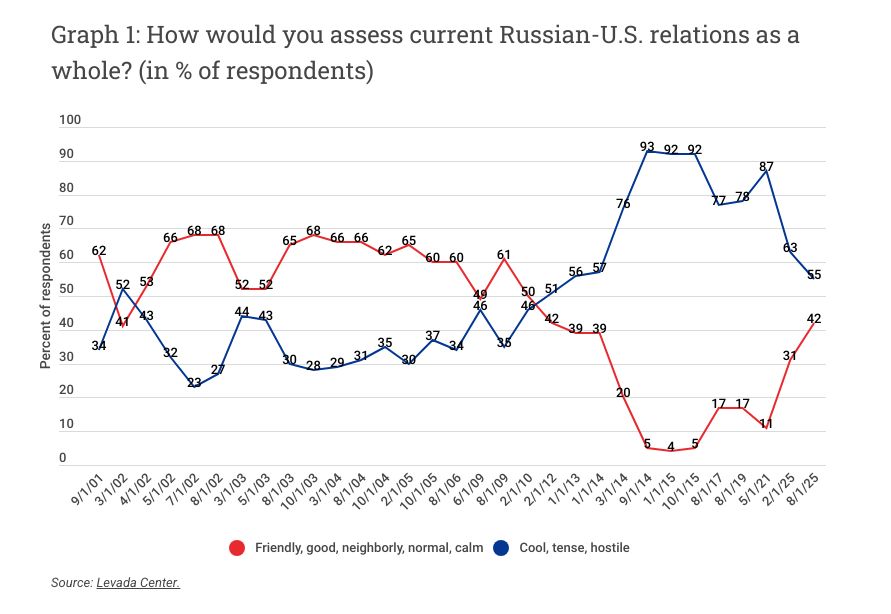
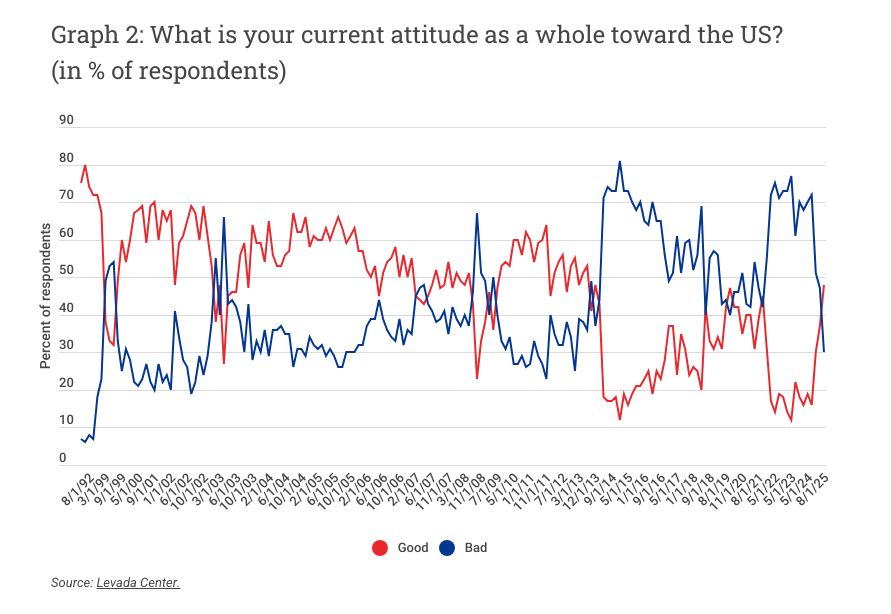
- In August 2025, 69% of Russians said the country was moving in the right direction, unchanged from July, while the share saying it was on the wrong path edged up to 18%. President Vladimir Putin’s approval rating rose to 87% (up from 86% in July), with disapproval falling to 11%. Among politicians, 47% named Putin as most trusted, followed by Sergey Lavrov (21%) and Mikhail Mishustin (20%), with other figures trailing in single digits. (Levada, 09.04.25)
- A Levada poll found 71% of Russians have recently faced mobile internet access problems, and 63% had issues with messenger apps; rates were higher among youth (82%) and residents of large cities (79%). About half support internet censorship to block dangerous sites, while a third oppose any censorship. (Levada, 09.03.25)
- In a rare display of state-authorized dissent, left-wing groups in several Russian cities are holding protests against government restrictions on voice and video calls through WhatsApp and Telegram. (MT/AFP, 09.03.25)
Defense and aerospace:
- The Russian military is shifting procurement towards light vehicles, with over 22,000 motorcycles, ATVs, and buggies already delivered, and is rapidly expanding drone production and digitalizing mobilization processes. (ISW, 08.29.25)
- Russia successfully launched an Angara 1.2 rocket from Plesetsk on Aug. 21, 2025, placing four suspected optical reconnaissance satellites into 319x327 km orbits at 96.59° inclination. The satellites, not yet given Cosmos designations, are listed by NORAD as OBJECTS A–D (65267–65270) and are likely similar to Cosmos-2577/2578. (russiaforces.org, 08.21.25)
- Russia’s first fully domestically built Superjet airliner completed its maiden test flight on Friday, the state defense and industrial conglomerate Rostec said. Friday’s test flight lasted around one hour, reaching speeds of roughly 500 kilometers per hour (310 miles per hour) and an altitude of 3,000 meters (9,800 feet), according to Rostec. (MT/AFP, 09.05.25)
- See section Military aspects of the Ukraine conflict and their impacts above.
Security, law-enforcement, justice and emergencies:
A Russian military court on Tuesday sentenced a former Defense Ministry general to nine years in prison for taking bribes worth nearly $150,000 in exchange for steering state contracts. Prosecutors said Alexander Ogloblin, who once served as the ministry’s communications chief, accepted payments from a telecom company between 2019 and 2023 while overseeing defense contracts valued at more than 1.4 billion rubles ($17.3 million). (MT/AFP, 09.02.25)
III. Russia’s relations with other countries
Russia’s external policies, including relations with “far abroad” countries:
- Prime Minister Narendra Modi declared India and Russia share a “special” relationship, standing by each other in difficult times, in a defiant show of ties as Washington criticized New Delhi over oil purchases. Modi used his opening remarks at a bilateral meeting with Russian President Vladimir Putin in China to signal that New Delhi’s ties with Moscow remain firm despite relentless pressure from the Trump administration. (Bloomberg, 09.01.25) Also see the energy and China sections above.
- South Africa’s defense department requested a postponement of joint exercises with the Russian and Chinese navies scheduled for November in the North Asian nation. The planned drills would coincide with South Africa’s hosting of the G-20 summit in Johannesburg, and the military wants to ensure that they “do not impact on the logistical, security and other arrangements” for that meeting. (Bloomberg, 09.05.25)
- A vehicle rammed the gates and drove onto the grounds of the Russian Consulate General in Sydney on Monday morning According to The Sydney Morning Herald, police received a report around 8:00 a.m. local time about a suspicious vehicle parked in the building’s driveway. The perpetrator, a 39-year-old man, was taken into custody. (Meduza, 09.01.25)
- The Taliban-led government in Afghanistan has appealed for Russia’s help with rescue and relief efforts after one of the worst earthquakes in recent years hit the country overnight, a senior Russian official said Monday. (MT/AFP, 09.01.25)
- Russian authorities banned entry to 39 Polish bikers accused of staging an unauthorized rally at a Polish military cemetery in the Tver region. (MT/AFP, 09.01.25)
Ukraine:
- The man accused of killing former Ukrainian parliamentary speaker Andriy Parubiy admitted in court on Tuesday that he committed the murder as an act of revenge against Ukraine’s authorities. During a hearing in Lviv, the suspect, identified as Mykhailo Stselnikov, confessed, saying he hoped to be exchanged for prisoners of war so he could travel to Russia and search for his son’s body. Stselnikov rejected claims that Russian agents blackmailed him using information about his missing son and said he chose his victim simply because Parubiy “was nearby.” According to RFE/RL’s Ukrainian Service, Stselnikov’s son was a serviceman with Ukraine’s armed forces who went missing near Bakhmut in 2023. The father’s attempts to learn more about his son’s fate reportedly led him to make contact with Russian representatives, who told him his son had died. (Meduza, 09.02.25)
- Ukraine’s balance of payments deficit hit a new record of $4.1 billion in July 2025, up 31% from June and 62% higher than July 2024. The National Bank of Ukraine attributes the deficit to increased spending abroad—on imports, debt payments, and capital outflows—outpacing inflows from exports, investments, aid, and remittances. Analysts warn this trend increases economic risks and stress the need for comprehensive state measures to address the growing imbalance. (Korrespondent.net, 09.04.25)
- Deputy Prosecutor General of Ukraine Ihor Mustetsa has submitted his resignation, set to take effect on Sept. 8. Mustetsa, in office since April 2020, has recently faced public scrutiny following media investigations into the property ownership of his family during the war. (Ukrainska Pravda, 09.05.25)
- The National Anti-Corruption Bureau of Ukraine (NABU) on Tuesday brought charges against the SBU's former cyber-security chief of illegal enrichment, alleging that he had obtained a Kyiv apartment at a knockdown price with illicit funds and had falsely declared it. (Reuters, 09.04.25, Kyiv Independent, 09.02.25)
- The Ukrainian parliament (Verkhovna Rada) is scheduled to debate a bill that could seriously hinder investigations into high-level corruption, the National Anti-Corruption Bureau of Ukraine (NABU) and Specialized Anti-Corruption Prosecutor's Office (SAPO) warned on Sept. 1. (New Voice of Ukraine, 09.01.25)
- In the Lviv region, five border guards were detained for facilitating the illegal departure of conscription-aged men through one of the checkpoints. (Antikor, 09.05.25)
Russia's other post-Soviet neighbors:
- Belarusian President Lukashenko said Belarus and Russia are “one country in principle,” highlighting ongoing moves toward deeper integration under the Union State Treaty, which formalizes political and legal ties. (ISW, 09.03.25)
- Belarus’s economy has rebounded from a 4.7% contraction in 2022, with GDP rising around 4% in both 2023 and 2024, though growth slowed to 2.1% in the first half of 2025. Despite a 32% jump in incomes fueling a property boom, public discontent has grown as staple potato prices rose by 10% and Belarus’s population fell by over 250,000 in five years, with analysts estimating as many as 600,000—about 10% of the workforce—may have left. Official data shows job vacancies vastly outnumber the unemployed. Political repression remains severe, with 1,184 prisoners, including Nobel laureate Ales Bialiatski, still jailed. (Financial Times, 09.04.25)
- Russia on Thursday expelled an Estonian diplomat in retaliation for Tallinn declaring a Russian diplomat persona non grata over alleged activities undermining the Baltic country’s constitutional order and violating sanctions. (MT/AFP, 09.04.25)
IV. Quotable and notable
- “Looks like we’ve lost India and Russia to deepest, darkest, China. May they have a long and prosperous future together!” President Donald J. Trump wrote on Truth Social. (Truth Social, 09.05.25)
- Harvard professor Graham Allison: “The non-proliferation regime.... is not an accomplished fact. Instead, it is a fragile institution that has to be maintained constantly. And after Putin’s successful coercive threats in his war in Ukraine, that regime was already under great stress—all before Trump arrived. In what has been called the United States of Amnesia, most people have simply forgotten that there used to be great power wars. When I tell my students now that they have to be thankful for the fact that there’s not been a great power war—some imagine that this is equivalent to being thankful that a meteor didn’t hit the Earth.” (Bulletin of Atomic Scientists, 09.04.25)
- Harvard professor Graham Allison: “I think his [Trump’s] best hope for a Nobel Peace Prize is to make a great peace with China, a great Asian peace. I think the European piece of this is too complicated, because of the Russian angle. And who knows what’s going to happen in the Middle East?” (Bulletin of Atomic Scientists, 09.04.25)
V. Useful graphs
Footnotes
- Putin has turned his bulletproof Aurus limousine into a setting for personal “limo diplomacy,” offering high-profile rides to leaders like India’s Narendra Modi and North Korea’s Kim Jong Un during this week’s summits in China. These rides, which have been heavily publicized by the Kremlin, highlight Putin’s efforts to show personal warmth and build global alliances despite Russia’s isolation since the Ukraine invasion. The Aurus has also featured in previous years for similar displays with the leaders of the UAE, Egypt and others, serving as both a diplomatic tool and a symbol of Russian prestige. (New York Times, 09.04.25)
- For summaries of Xi’s and Putin’s remarks see RM’s Russia Analytical Report, Aug. 25–Sept. 2, 2025.
- This was a trilateral Russia-Mongolia-China meeting.
The cutoff for reports summarized in this product was 10:00 am East Coast time on the day it was distributed.
*Here and elsewhere, the italicized text indicates comments by RM staff and associates. These comments do not constitute an RM editorial policy.
Slider photo by Korean Central News Agency/Korea News Service via AP.
 Russia in Review