
Russia Analytical Report, Dec. 22, 2025–Jan. 5, 2026
6 Ideas to Explore
- Pro-Kremlin Russian analysts surveyed by Kommersant see the U.S. raid in Venezuela as the Monroe Doctrine in action. These analysts expect neither Moscow nor Beijing to risk a direct clash, framing Venezuela as secondary to battles in Ukraine and as proof that spheres of influence are back. Russian pro‑war bloggers and veterans, whose posts have been surveyed by Meduza, condemn the raid as a violation of sovereignty but also say it should be studied closely—some giving credit to U.S. operation planning and execution. While the Russian Foreign Ministry has stated that it is alarmed by the raid and called for the release of Maduro, Vladimir Putin has remained mum as of 3 p.m. EST on Jan. 5, even as heads of other states, such as France's Emmanuel Macron and Chancellor Friedrich Merz of Germany have weighed in.
- FP columnist Michael Hirsh argues that by invading Venezuela, seizing Nicolás Maduro and vowing to “run the country” without U.N. or congressional authorization, Donald Trump “may well have shredded what little is left of international norms and opened the way to new acts of aggression from U.S. rivals China and Russia.” Defense analyst Brynn Tannehill contends in The New Republic that the U.S. actions signal a return to great‑power carve‑ups, with the U.S., Russia and China each consolidating spheres of influence run by authoritarian regimes. Brynn recalls Fiona Hill’s 2019 Congressional testimony that Russia was “signaling very strongly that they wanted to somehow make some very strange swap agreement between Venezuela and Ukraine.”
- This winter, Russian attacks have shifted from power plants to Ukraine’s roughly 3,500 substations, concentrating on major cities such as Kyiv and Odesa, according to The Economist. As a result of the Russian attacks, Ukraine’s available generating capacity has fallen from 33.7 GW at the start of the full‑scale invasion to about 14 GW today, according to Ukrainian energy consultant Oleksandr Kharchenko. The resulting outages have produced blackouts of up to four days, The Economist writes. If the next two months are very cold, national demand could reach 17 GW—around 3 GW more than the system can produce, The Economist warns. Citing Ukrainian railways, The Wall Street Journal reports that “Russia has carried out more than 1,100 attacks on its infrastructure this year, roughly equal to the combined total in 2024 and 2023,” and that attacks on the rail network “have caused $5.8 billion in damages since the start of the invasion,” with repair costs expected to be much higher.
Volodymyr Zelenskyy’s latest reshuffle is partially meant to manage a pre‑election “interregnum,” according to analysis by The New York Times, citing Oleksandr Merezhko, head of the Ukrainian parliament’s foreign affairs committee. Replacing Andriy Yermak with military intelligence chief Kyrylo Budanov as head of the presidential office elevates one of Ukraine’s most popular wartime figures, known for operations against Russia and close U.S. ties, which could be important in Ukraine’s peace negotiation, according to the NYT and AP. In announcing this appointment, Zelenskyy said that Ukraine “needs greater focus on security issues,” but also further progress on the diplomatic track of negotiations, according to NYT. Budanov has also maintained contacts with the Russian side as part of his mandate to negotiate prisoner exchanges—unique among Ukraine’s senior leadership, according to NYT. Parallel moves—proposing tech‑savvy Mykhailo Fedorov as defense minister, shifting Denys Shmyhal to the energy portfolio, rotating Serhiy Kyslytsya into the presidential office and naming special‑operations veteran Ievhen Khmara as acting SBU chief instead of Vasyl Malyuk—all aim to ensure tighter presidential control. Meanwhile, Chrystia Freeland’s appointment as economic adviser targets investment and reform credibility with Western partners, according to Financial Times.
- In an thread in his X account, republished by Russia Matters, Harvard professor Graham Allison identifies territorial control in eastern Ukraine as one of two final sticking points in Trump‑era peace talks. Vladimir Putin is demanding that Ukraine withdraw from the last part of Donbas his forces have not yet seized, while Volodymyr Zelenskyy refuses to surrender at the table what Ukrainian troops have held on the battlefield, he writes. Allison estimates that if the fighting continues as it has for the past year, by this time next year, Russian troops will likely have completed their seizure of all of Donbas. He argues that whenever the war ends, Zelenskyy will face an uphill battle in the elections that will follow. “Strategically: Ukraine’s challenge is to find a way to trade the remainder of Donetsk for stronger security guarantees of whatever peace/ceasefire can be achieved,” Allison writes.
- In his Washington Post column, Fareed Zakaria argues that Ukraine’s fate will likely be decided in 2026, with consequences that are “seismic” for the international order and for whether territorial conquest is again acceptable in global politics.
I. U.S. and Russian priorities for the bilateral agenda
Nuclear security and safety:
- Méheut reports that Zelensky says Ukraine and the U.S. are “90 percent of the way” to a peace deal, but the fate of the Zaporizhzhia nuclear power plant under Russian occupation since early in the war — sits inside the remaining “10 percent still in dispute.”
- The plant, with six reactors and a “six gigawatt” capacity that could power “a medium-sized country like Portugal,” is currently shut down and repeatedly at risk due to shelling that cuts the high‑voltage lines needed for cooling, forcing reliance on “backup diesel generators” and, since the 2023 dam explosion, on a smaller cooling pond and wells.
- For Ukraine, Zaporizhzhia is central to postwar energy sovereignty and reconstruction: before the war it supplied “roughly a quarter of the country’s electricity needs,” and the Kyiv–Washington peace blueprint envisions using its output for energy‑hungry infrastructure like data centers as part of Ukraine’s recovery.
- Méheut details competing control schemes: an earlier U.S.–Russia draft suggested I.A.E.A. supervision with shared output; the latest U.S. idea is a three‑way operation by the United States, Russia, and Ukraine “with the Americans acting as the chief manager,” which Zelensky rejects (“How can there be joint commercial activity with the Russians after everything that has happened?”) in favor of a U.S.–Ukrainian joint venture that would give Ukraine 50 percent of the electricity and leave Washington to decide how to allocate the rest — implicitly including potential transfers to Russia — a compromise Moscow is “unlikely” to accept.
North Korea’s nuclear and missile programs:
- No significant developments.
Iran and its nuclear program:
- Golkar and Brodsky write that the late‑2025/early‑2026 protests are driven by “economic collapse,” with the rial falling to “nearly 1.4 million” per dollar, inflation “surpass[ing] 52 percent,” and prices for basic goods “beyond the reach of ordinary citizens,” producing “the most significant unrest since the 2022 uprising following the death of Mahsa Amini.”
- They argue that, unlike 2022’s “Woman, Life, Freedom” revolt against compulsory veiling and moral repression, today’s protests began with bazaar strikes and have been “more geographically widespread…encompassing major urban centers such as Tehran, Isfahan, Mashhad, and Hamedan and extending into smaller cities and economically marginalized areas,” mobilizing “students, laborers, women, and ethnic minorities.”
- Golkar and Brodsky contend that regime responses—Khamenei’s ritual acknowledgment of grievances followed by accusations of a Western “soft war,” the resignation of the central bank governor, talk of dialogue, and feelers to Washington—are “cosmetic gimmicks” that “amount to rearranging deck chairs on the Titanic,” and conclude that the core rupture is unresolved: “The former [2022] shattered the regime’s moral authority. The latter [2025‑26] threatens its economic foundations,” with “accumulated anger, economic despair, and a persistent desire for dignity” now pushing more of society toward outright calls for the Islamic Republic’s downfall.
Humanitarian impact of the Ukraine conflict:
Saturday, Dec. 27, 2025
- Luxmoore writes that Lozova, a key hub in eastern Ukraine, “has become a primary target in Russia’s campaign to cut off a lifeline of the Ukrainian economy: the 15,000-mile network of railroads carrying more than 60% of the country’s freight, along with weapons and soldiers to the front.”
- Citing Ukrzaliznytsia, he reports that “Russia has carried out more than 1,100 attacks on its infrastructure this year, roughly equal to the combined total in 2024 and 2023,” and that attacks on the rail network “have caused $5.8 billion in damages since the start of the invasion,” with repair costs expected to be much higher.
- “It is a war on railways that is a deliberate, structured, well-planned and concentrated effort to stop the system from running,” Oleksandr Pertsovsky, head of Ukrzaliznytsia, tells Luxmoore, adding that “pretty much every link in the chain is being targeted.”
- Despite the damage and constant danger, Luxmoore notes that “the railway company won’t be cowed by Russia’s attacks,” quoting Pertsovsky: “It is a constant fight to preserve the country’s logistics, and that’s the commitment we made on day one. We’ll continue connecting the country, no matter how hard it is going to be.”
- The reporters find that Putin’s “war machine in Ukraine with an insatiable demand for men” is sustained by “a pattern of brutality and coercion,” with more than 6,000 confidential complaints revealing that commanders “exploit soldiers — even the gravely ill or injured — to keep them on the battlefield,” sending men with Stage 4 cancer, severe head trauma, stroke complications and other debilitating conditions back to the front.
- Coercion is central to filling the ranks: conscripts and mobilized men are pressured by psychologists and commanders to sign long‑term contracts and threatened with transfer to “assault companies, the most dangerous units,” if they refuse, while those who seek civilian treatment or leave their units are branded absent without leave and forcibly returned to combat, often still wounded.
- The investigation documents systematic internal abuse and extortion, especially in prison‑recruited formations: soldiers describe being “beaten, locked in basements, stuffed in pits or tied to trees,” commanders demand bribes to secure leave or avoid “sure-death” assaults, and some skim off state compensation payments or orchestrate “fictitious wounds,” leading one grandmother to describe officers as “werewolves in epaulets.”
- A particularly chilling practice, known as obnuleniye (“zeroing out”), appears in dozens of complaints and refers to commanders deliberately getting inconvenient soldiers killed—either by sending them on lethal missions without weapons or protection, or by direct execution—with a joint complaint from relatives of Unit 36994 alleging that more than 300 troops were murdered and their bodies buried in secret or blown up on antitank mines to destroy evidence.
Sunday, Dec. 28, 2025
"Russia is blasting Odessa to throttle Ukraine’s economy," The Economist, 12.28.25.
- The Economist reports that on the night of December 11–12 “Russia launched an unprecedented blitz, pummeling the city with a record 300 drones, bombs and missiles,” leaving the region “without electricity, water or heat,” and notes that in the days after “blackouts became routine, and many denizens relied on pop-up soup kitchens for meals.”
- The article stresses Odessa’s strategic role, recalling that “before the war, Odessa’s three deep-sea ports handled roughly 60% of all exports,” and that after Ukraine reopened a Black Sea corridor in 2023 “its share of Ukraine’s exports… had grown to 60–70%,” so that Russia’s blitz “puts much of that trade at risk,” with ports now operating at “just 30–35% of demand.”
- Despite the terror campaign, the magazine observes that “for now, the bombardment is doing as much to organize Odessans as to demoralize them,” with locals showing “a new sense of community spirit” as “businesses and homes with electricity are opening their doors to those without,” and concludes that “Ukraine’s long-term viability as a nation depends heavily on keeping the city and its ports running.”
Sunday, Jan. 4, 2026
“Ukraine’s power grid is struggling under Russia’s blitz,” The Economist, 01.04.26.
- The article reports that during the Dec. 26–27 strike “about 100 drones and missiles were aimed at [Ukraine’s] Vyshhorod, the majority targeting the power plant,” and cites energy consultant Oleksandr Kharchenko: when the full‑scale invasion began Ukraine had “33.7 gigawatts of generating capacity,” but is now “down to about 14 gigawatts”; if the next two months are very cold, “the country will need 17 gigawatts, three more than it can generate.”
- DTEK CEO Maxim Timchenko says “Russia has been hitting us harder than at any time since the full-scale invasion,” adding that “even with thousands of repair crews working flat out, the level of destruction is too great to recover everything,” so “our mission is to survive this winter”; the piece notes that almost four years into the war “many Ukrainians have stockpiled power banks” and that in regions like Vyshhorod residents endured a “four-day blackout,” far longer than usual scheduled cuts.
- The article explains that “this winter Russia has changed its tactics to target Ukraine’s 3,500 substations, rather than the power-generation plants,” with strikes concentrated on “big cities, such as Kyiv and Odessa,” and describes how heat supply depends on electric pumps in tall buildings, forcing residents to “club together to buy generators,” while people rely on 15kg household batteries (EcoFlow‑type units) that can keep a home boiler running for “about six hours.”
See this link for more commentary/analysis on this subject:
Military and security aspects of the Ukraine conflict and their impacts:
Thursday, Dec. 25, 2025
- The article details how rolling outage “queues” now structure daily life in Ukraine, with relatively lighter cuts in western regions and near‑blackout conditions in frontline and southern areas: by mid‑December, Odesa region had seen 20 substations damaged, 560,000 people (about “60% of the region’s population”) temporarily without power, five to six outage queues “in effect on a permanent basis” in the city, and the town of Artsyz projected to be without electricity for nearly two weeks.
- Ukraine’s pre‑war generation capacity of 38 GW has fallen to 17.6 GW, and although imports from the EU nearly tripled between September and November and ENTSO‑E has raised cross‑border capacity to 2.3 GW, transmission bottlenecks mean imports mainly ease shortages in the west; EU deliveries of 9,500 generators, 7,200 transformers, and a full Lithuanian thermal plant set “are insufficient to offset the losses caused by Russian strikes.”
- The article concludes that “the only adequate means of protecting Ukrainian infrastructure” is for Kyiv to acquire long‑range strike capability of its own to impose comparable costs on Russian infrastructure; achieving “parity in the energy war” would require roughly 100–150 missiles per month.
Saturday, Dec. 27, 2025
"President visited a command post of the Joint Group of Forces," Vladimir Putin, Kremlin.ru, 12.27.25. Clues from Russian Views.
- Opening the meeting with his commanders, Putin told them that he knew they had “results” to report and that there was “something to please our citizens,” saying that Russian forces were “creating a security belt in the border areas of Sumy, Kharkiv, Dnipropetrovsk regions at good speed” and that in Donbas and Zaporizhzhia “the offensive is going along the entire line of contact.”
- Summing up the battlefield situation, Putin declared that “the Armed Forces of the Russian Federation confidently retain the initiative” and are “continuing to carry out the tasks of the special military operation along the entire line of contact,” praising the “high tempo of the offensive” of the Center and East groupings and saying Russian units were advancing “practically on the enemy’s shoulders.”
- Concluding, Putin argued that in light of Russia’s current momentum “our interest in the withdrawal of Ukrainian military formations from the territories they still occupy is in fact reduced to zero,” and warned that “if the Kyiv authorities do not wish to end the matter by peaceful means, we will solve all the tasks facing us in the course of the special military operation by military means.”
Monday, Dec. 29, 2025
- “If you look at the fighting in 2025, you might think nothing will change radically in 2026,” Michael Kofman said, “but I wouldn’t rely on that. Not everything can be measured in kilometers captured or lost. In a war of this type it is much more important to assess what is happening inside the opposing forces, because changes in territorial control are a lagging indicator.”
- Characterizing the current phase, Kofman argued that “in general this is a war of attrition with positional fighting,” where “the spread of precision weapons and ubiquitous observation on the battlefield has made maneuver of any scale much harder for both sides,” and that the frontline has “turned into a much more blurred zone.”
- Kofman noted that “the ability of either side to achieve an operational breakthrough disappeared a long time ago,” with the partial exception of Ukraine’s 2024 incursion into Kursk, and said that today “the war is no longer defined by the amount of heavy armor and artillery as it was in the first years,” but by drones, mines, and firepower.
- He stressed that 2025 “was marked by a struggle for advantage in the drone zone between Ukrainian and Russian units,” which “determines the initiative and the relative balance of losses,” adding that Ukrainian defense “largely rests on the use of unmanned aerial vehicles in combination with mines and artillery,” while Russian forces try to “press the line of contact” through dispersed infantry and light mechanized assaults.
- On Russia’s offensive, Kofman observed that Moscow “bet on infiltration tactics and offensive actions with light motorized forces,” which means it “loses less armored equipment but very many people,” and that by December “we already see a slowdown because they have taken very heavy losses over the past few months.”
- He estimated that in 2025 “more than 90% of the contract soldiers Russia was recruiting each month went to cover losses,” saying that “Russia can no longer build up its forces as it did in the previous year,” and warned that “if current trends continue, they will have problems manning units and having a labor force next year,” raising the question “whether they are capable of fighting at this intensity with these losses for another 12 months.”
- Strategically, Kofman said that “in the short term Russia has an advantage in manpower and material resources,” and that its strike campaign is “focused on energy infrastructure, and now we have winter,” while “Ukraine’s strike campaign is focused on Russia’s economic resources and its ability to continue the war,” something that “will affect the next six-plus months.”
- On adaptation, he argued that “both armies are capable of adapting, with Ukraine applying innovations faster and Russia better at copying and scaling them,” and described the war as moving in “3–4‑month cycles, when one side applies new technologies or tactics and the other adapts and finds an answer.”
- Assessing the political context, Kofman said that in 2025 Putin made two bets: first, “if they keep pressing, sooner or later the front will collapse somewhere and there will be operational-level breakthroughs,” which “did not happen,” and second, that “Russian diplomacy could take the United States out of the game, and if that happens all Western aid leaves with the U.S. and the front collapses,” but “neither of these two bets played out in 2025.”
- Summing up, he concluded: “I would say the situation at the front is not so critical that Ukraine has to agree to any conditions,” pointing out that Europeans “have announced they’ve found a way to finance Ukraine’s needs for the next two years,” that Russia “will fight for a long time for that part of Donetsk region it wants to get without a fight on its own terms of peace,” and that “even after a withdrawal from Pokrovsk I do not see great chances that there will be a breakthrough on their side or that the front will crumble… things looked worse in autumn 2024.”
Tuesday, Dec. 30, 2025
“One Gray, One White: What Will Be the Consequences of the Drone Strike on a Presidential Site?” Ivan Timofeev, Valdai Club, 12.30.25. Clues from Russian Views. Machine-translated.
Ukraine denied targeting Putin’s residence in the December 2025 attack and U.S. national security officials arrived at the same conclusion with the latter support by CIA, according to WSJ. Trump himself then said Ukraine didn’t target Putin’s residence.
- Timofeev says the Ukrainian drone strike on a Russian presidential residence is not a Taleb‑style “black swan” but a “gray swan…an event that is given in practice, but the moment of its occurrence is weakly predictable,” and that the “obvious ‘white swan’” is Russia’s negative reaction; Moscow has already announced that “its positions will be revised,” though it does not plan to leave the talks with the United States.
- He argues the incident will harden Russia’s negotiating line, especially on territory, writing that the “territorial question, being the key stumbling block, risks becoming even more complicated,” and that Moscow had long warned failure to accept its parameters could “lead to a revision of its demands,” with issues such as “a security buffer in Kharkiv and Sumy regions” likely to “arise more sharply,” while “time in the matter of their expansion is on Moscow’s side.”
- On Western security guarantees for Ukraine, Timofeev warns that if they take the form of an analogue to NATO’s Article 5, then “any drone attack will lead to the involvement of the guarantors in a conflict with a nuclear power with the prospect of using all available weapons,” so any allied commitments “may be balanced by a clear and open protocol of retaliatory military‑technical actions,” and he concludes that the drone strike “only reinforces” Russia’s already “very principled” diplomatic position.
- MacDonald notes that Ukraine now fields “a military larger and with more recent experience than any of its European backers,” with Zelensky insisting on maintaining 800,000 active personnel — a figure European leaders have recently endorsed as part of funding discussions — even as Kyiv spends around 30% of GDP on defense, far above Russia’s Defense Ministry share of 7.3%.
- He reports that analysts such as Michael Kofman argue that, postwar, “Ukraine’s military will have to be based around capabilities that are more cost effective, like drones, like mines, and mobilization based on reserves,” warning that “big‑ticket elements like aircraft can easily consume much of Ukraine’s defense budget” and that “a lot of what Ukraine is doing now is not viable long term.”
- Several Ukrainian and Western experts tell MacDonald that air defense and long‑range missiles should be Ukraine’s top priorities.
- On force structure and economics, Mykola Bielieskov suggests Ukraine “should aim for 300,000 to 500,000 and maintain the rest as reserves,” noting that 800,000 active troops would both be costly and “take 800,000 people out of Ukraine’s economy,” at a time of demographic decline and uncertain Western funding once the war ends.
- The article highlights Ukraine’s ambition to become more self‑reliant in arms production — with over 40% of front‑line weapons already Ukrainian‑made and a target of 50% — and debates around expensive jets
Wednesday, Dec. 31, 2025
- Kuchins frames the analysis around the question komu vygodno? (“Who benefits?”), and answers bluntly that “at first and second glance, it clearly seems to be Vladimir Putin and certainly not Zelensky and the Ukrainians,” given that the alleged strike coincided “almost stranger than fiction” with the Trump–Zelensky meeting at Mar‑a‑Lago.
- He argues that Putin benefits: “Putin was motivated to pull this rabbit out of his hat…because he has no intention of ending the war and wants to make Zelensky look like the problem in Donald Trump’s eyes,” adding that in nearly a year of watching Russian state news, he has seen “no indication…that Vladimir Putin is ready to make any concessions to end this war.”
- The Kremlin also gains domestically, Kuchins suggests, by reinforcing its narrative of a besieged Russia: Russian media “pulls out all the stops to present the impression that Russia is winning the war and Ukraine is collapsing,” and the alleged attempt on Putin helps sustain that “Potemkin village narrative” while justifying continued “military-technical” measures and a harder line in talks.
- By contrast, he sees no rational benefit for Kyiv: “How could Zelensky and Ukraine benefit from trying to assassinate Putin? I do not see any plausible explanation, as the risks are too high for Kyiv. The West might lose its appetite for supporting Ukraine, and Russia would no doubt take brutal measures in response,” making an authentic Ukrainian operation “without question” against their own interests.
“Russian Offensive Campaign Assessment,” ISW, 12.31.25.
- ISW assesses that Russian forces seized 4,831 sq km in Ukraine and regained ~473 sq km in Kursk Oblast in 2025 — about 0.8% of Ukraine’s territory — compared to 3,604 sq km in 2024; based on Ukrainian General Staff data, Russia took 416,570 casualties in 2025, roughly 78 casualties per sq km gained, with an average advance of 13.24 sq km/day (peaking at 20.99 in November, falling to 15 in December).
- At the tactical level, Russia shifted away from highly attritional infantry‑led assaults from June 2025 toward infiltration tactics and “flag raisings” to make and sometimes falsely claim gains; this increased the apparent rate of advance but did not change the underlying pattern of high casualties for relatively small territorial gains, according to ISW.
- Operationally, Moscow prioritized seizing the remainder of Donetsk Oblast and creating buffer zones in northern Sumy and Kharkiv but failed to meet its stated aims: it pushed into Pokrovsk (controlling 67.63% by December), took Velyka Novosilka, entered Hulyaipole, advanced into Lyman and likely seized Siversk, completed the capture of Toretsk and began attacking Kostyantynivka, yet did not fully occupy Donetsk and Luhansk or establish the planned border buffer, according to ISW.
- The orientation and density of Ukrainian defenses significantly constrained Russia: south‑facing lines around Orikhiv and Zaporizhzhia City and the heavily fortified Pokrovsk–Myrnohrad “Fortress Belt” slowed advances to “footpace,” forcing Russia to seek flanking routes (e.g., toward Hulyaipole from the northeast/east) and illustrating that, despite faster 2025 gains, Russia has not restored operational maneuver and remains dependent on bad‑weather windows that degrade Ukrainian drones.
See these links for more commentary/analysis on this subject:
- "Another New Year at War: Ukraine’s Troops Doubt It Will Be the Last", Cassandra Vinograd and Oleksandr Chubko, The New York Times, 01.01.26.
- "Why Mechanized Warfare Will Still Be Decisive in the Next Land War," Scott Rutter and Matthew C. Paul, War on the Rocks, 01.02.26.
- “The Next Evolution in Ukraine’s Drone Defense,” David Kirichenko, The National Interest, 01.04.26.
- Podcast: “No End in Sight? The Russo-Ukrainian War at the End of 2025,” Dara Massicot, Michael Kofman, and Ryan Evans, War on the Rocks, 12.23.25.
- "This Ukrainian Soldier Spent More Than a Year on the Front Line," Cassandra Vinograd and Oleksandr Chubko, The New York Times, 12.27.25.
- "How to Secure the Sky: America Needs a Defense Against Drones," Theodore Bunzel and Tom Donilon, Foreign Affairs, 12.26.25.
- "Why Russia Is Equipping Its Drones with Starlink Terminals," Brandon J. Weichert, The National Interest, 12.28.25.
- "Putin’s Ukraine War Is Killing Russia’s Poorest," Stavros Atlamazoglou, The National Interest, 12.25.25.
Military aid to Ukraine:
Monday, Dec. 29, 2025
"Did Ukraine Target Putin’s Residence?" Editorial Board, The Wall Street Journal, 12.29.25.
- The WSJ editors point out that right after Trump’s seemingly successful meeting with Zelensky, Putin claimed Ukraine had launched a mass drone strike on his residence, leading Trump to say he was “very angry about it” and that “it’s not the right time to do any of that,” a reaction that risked undermining Trump‑Zelensky “bonhomie.”
- They note that Zelensky called the Putin “‘residence strike’ story a complete fabrication,” that Russia reported no damage or casualties while vowing retaliation and a review of its negotiating stance, and that, as analyst Grace Mappes observes, none of the usual open‑source indicators of a genuine Ukrainian deep strike — local reports, geolocated footage of drones or explosions — have appeared.
- The board argues that the episode fits a broader pattern in which “Mr. Putin has refused to stop fighting until Ukraine and its partners agree to every Russian demand” and is now looking for a way “to say no to Mr. Trump’s attempts at a peace deal while still portraying Ukraine as the obstacle,” suggesting that the timing of the claim is itself telling.
Punitive measures related to Russia’s war against Ukraine and their impact globally:
- No significant developments.
Ukraine-related negotiations:
Monday, Dec. 22, 2025
- “Our opinion surveys conducted in August 2025 indicate that U.S. summits with Russia, and those of Ukraine and the European Union held that month, significantly increased support among Ukrainians for a negotiated settlement and for partial territorial concessions, especially when packaged with NATO-style security guarantees,” Alexseev and Dembitskyi write.
- The authors report that after the August summits, “support for Ukraine ‘directing its principal effort toward stopping the war by means of negotiations’ increased by 9.2 percent,” and that “with 63 percent of respondents supporting a negotiated settlement after the summits, Trump showed the potential to get most Ukrainians aligned with his efforts.”
- At the same time, they stress that “Russia’s tactic of bombing Ukraine into surrender and U.S. threats to halt its support to Kyiv have not diminished Ukrainians’ commitment to defending their freedom and sovereignty,” and that Moscow’s demand for Ukraine to cede additional territory “is a poisoned chalice for Trump and his peace efforts.”
- On territorial outcomes, Alexseev and Dembitskyi note that “support for partial territorial concessions in the control group rose by 6.7 percent after the summits, reaching over 27.0 percent of the total,” while still “the absolute majority of respondents in our surveys remain committed to eventually regaining all territory under the internationally recognized 1991 borders: 54 percent in November 2024… 52 percent in July–August 2025… and 49 percent in August 2025.”
- They argue that “security guarantees—front and center at the U.S.-Ukraine/Europe summit and subsequent high-level meetings—are unlikely on their own to induce Ukrainians to accept territorial losses,” since “without major diplomatic moves at the highest level—particularly Trump getting tougher on Moscow—the option of NATO-style guarantees will not make much difference in terms of Ukrainian public opinion.”
- Summing up their findings, Alexseev and Dembitskyi conclude that “barring rapid and sustained Russian advances that would directly threaten the loss of big cities such as Kharkiv, Poltava, or Dnipro, Ukrainians’ resilience and opposition to wholesale territorial concessions akin to those demanded by the Kremlin will persist,” and that even in a worst case, “a wholesale sentiment shift in favor of territorial concessions is hardly a given.”
Tuesday, Dec. 23, 2025
“Clarifying Territorial Disputes in Ukraine,” Graham Allison’s X account/Russia Matters, 12.23.25.
- “In the Trump Administration’s effort to negotiate a sustainable peace/ceasefire in Ukraine, the dispute about territory has proved to be one of two final sticking points. Putin has continued to demand that Ukraine leave the last chunk of Donbas his troops have yet to seize. Zelenskyy has continued to insist that Ukraine would not give up at the negotiating table what its troops have successfully denied Russia on the battlefield.”
- “So: after nearly four years of war in which Ukraine has lost 12 percent of its territory, more than a fifth of its economy, and two thirds of its electrical infrastructure; suffered hundreds of thousands of casualties; and seen about a quarter of its citizens displaced, why the fuss about a piece of land the size of the state of Delaware?”
- “Major news outlets have continued to misreport the issue. For example, again last week the New York Times reported that Ukraine still controls “14 percent or so of the Donbas.” Similarly, Axios repeated the same mistake, referencing “the roughly 14% of the Donbas region which [Ukraine] controls.” In part, these mistakes reflect a failure to keep up with what has been happening on the ground—where every month Russian troops seize another 175 square miles or so. In part, it reflects confusion about “Donetsk” and “Donbas.” Donetsk is an oblast (state) of Ukraine roughly the size of Massachusetts (10,238 square miles). As reported in last week’s Russia Matters' Russia-Ukraine War Report Card, Ukraine still controls about a quarter of this oblast (2,250 square miles).”
- “Donetsk and its adjacent oblast of Luhansk (which is fully controlled by Russian troops) are known as the region of “Donbas,” a predominantly Russian-speaking region of Ukraine historically known for its coal mines and heavy industry.”
- “For perspective, see this map from Russia Matters attached. The territory Russian troops have captured is colored pink. This includes essentially all of Luhansk; and 78% of Donetsk. The purple area highlights the 2,250 square miles of Donetsk still held by Ukrainian forces. Summarized accurately today: 11% of the Donbas region (which is 22% of the oblast of Donetsk) remains under Ukrainian control.“
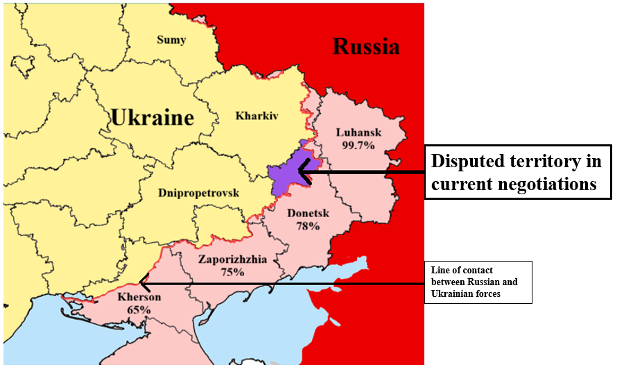
- “In exchange for these 2,250 square miles, Putin has offered to trade the roughly 500 square miles of Ukraine’s Kharkiv, Sumy, and Dnipropetrovsk oblasts that Russia has also captured.
- If Ukraine and Russia are unable to agree on a ceasefire, and the fighting continues as it has for the past year, by this time next year Russian troops will likely have completed their seizure of all of Donbas.”
- “In sum, operationally: Ukraine has already lost 89% of Donbas and will very likely lose the rest next year. Politically: whenever the war ends, Zelenskyy will face an uphill battle in the elections that will follow, in part because no peace/ceasefire agreement will reverse Russian occupation of a substantial part of Ukraine. Strategically: Ukraine’s challenge is to find a way to trade the remainder of Donetsk for stronger security guarantees of whatever peace/ceasefire can be achieved.””
- Bolton argues that “recent Western failures and mistakes have enhanced Russia’s chances of prevailing in its unprovoked aggression against Ukraine,” warning that “many Americans and Europeans seem intent on doing Moscow’s work.”
- On the EU’s failure to use frozen Russian assets, he writes that “concerted E.U. rhetoric to sugarcoat the outcome cannot conceal this collective failure,” calling the resulting €90 billion loan “less than half what was projected” and saying that “the larger resources — to defend and rebuild Ukraine — remain undefined and therefore uncertain.”
- Bolton criticizes Trump’s reported effort to block the EU reparations-loan plan, saying that “Trump’s intervention and the E.U.’s failure furthered Western disunity,” and concludes that “this was failure pure and simple by leaders Vladimir Putin had called little piglets just days before.”
- He stresses that “Putin showed no flexibility in his Ukraine war aims,” and notes that Putin “emphasized in his annual year-end news conference that Trump’s new National Security Strategy does not characterize Russia as an adversary,” mocking NATO’s Mark Rutte and reinforcing, in Bolton’s view, the Kremlin’s sense that “time is on his side.”
- Bolton concludes that “Ukraine and the West ....face a long winter,” arguing that with Trump’s “objectively pro-Russian behavior” and the EU’s “self-inflicted incapacity,” only unusually strong leadership from figures like Rutte might prevent the West from “losing Ukraine without losing a battle.”
- Farrell and Radchenko argue that both Putin and Trump are driven by status anxiety within a liberal order that treats them as inferior: Russia, dismissed by Obama as a mere “regional power,” seeks to be feared rather than ignored, while “Maga America” likewise wants to “act as spoiler, smashing the existing hierarchy of respect” that privileges Europe’s model of law‑based multilateralism.
- They describe the EU as “the greatest creation of the old order,” embodying U.S.‑promoted ideals of cooperation, law, and democracy more consistently “than America itself,” and say this makes Europe the prime target for Trump, whose national security strategy “spends so much energy and venom denouncing Europe” while trying to turn newer EU members into a wedge against liberal democratic norms.
- The authors contend that Trump, like Putin, wants the prestige and “soft power” benefits of a great power but is simultaneously hollowing out “the massive military, diplomatic, intelligence and foreign aid complex” needed to shape Europe, effectively “remaking the US into a regional power like Russia which invests its strengths in bullying the countries in its neighborhood”—a contradiction they say means he “can’t have both.”
Friday, Dec. 26, 2025
- Charap and Kavanagh note that Zelensky has confirmed Washington’s offer to “provide Ukraine with ‘Article 5-like’ guarantees” so that “if Russia invades Ukraine, a coordinated military response will be launched,” and that, under current discussions, this commitment “would be ratified by the Senate and made legally binding.”
- They argue that such a “platinum standard” guarantee “promises too much,” pointing out that “three successive presidents — Barack Obama, Joe Biden and Donald Trump — have declined to send American soldiers to defend Ukraine,” which they see as “a clear indication that they assess the U.S. stakes to be too low to warrant the costs and risks of war with the possessor of the world’s largest nuclear arsenal.”
- Questioning deterrent value, the authors write that “any commitment made to Ukraine that obligates the U.S. to act differently in the future than it has in the past would be a promise of questionable value,” warning that if Putin “perceives strategic gains from calling what he may see as a U.S. bluff, he just might do it.”
- Charap and Kavanagh stress that an Article 5‑style promise to Kyiv implies “a readiness to go to war with Russia over Ukraine,” arguing that if deterrence failed “the U.S. would be at war with Russia, an outcome that would include the potential for nuclear escalation,” and concluding that Washington should instead offer “narrow but credible commitments… over expansive ones that seem generous but are ultimately hollow and potentially dangerous.”
"Ukraine’s New Concessions for Peace," Editorial Board, The Wall Street Journal, 12.26.25.
- WSJ editors note that “under a new U.S.-Ukraine framework accord, Kyiv may be willing to cede some land it holds in the east as part of a demilitarized front line,” and call this “a major concession,” given that “Mr. Putin used [earlier Minsk] fighting pauses to build up his military in Crimea and occupied Donetsk and Luhansk to prepare for his 2022 invasion.”
- The board highlights Zelensky’s claim that “in return for Ukraine’s land concession, the West would offer Ukraine security guarantees akin to Article 5 in the NATO treaty,” but warns that “the details had better be explicit and firm, and in the case of the U.S. approved by a vote of Congress. Otherwise they won’t be worth much when Mr. Putin inevitably tests them.”
- Citing reporting that these guarantees would be “considered void” if Ukraine “invades Russia or opens fire at Russian territory without provocation,” the editors caution that “the Kremlin is notorious for its false-flag operations that blame Ukraine, and you can bet Russia will try to blow up a cease-fire with similar operations.”
- On force balances, they write that “the framework would cap Ukraine’s military at 800,000—an improvement over the 600,000 in the earlier U.S. proposal,” but point out that “Russia would have no such limits,” making it “more important…that the West could arm Ukraine while Kyiv expands its arms production.”
- The editorial concludes that “all of this is at least a plausible outline for a cease-fire, but Russia is unlikely to accept it,” noting that Russian commentators have already denounced the plan and that Putin’s holiday message “included a nasty missile and drone barrage on Ukrainian civilians,” and arguing that success will require Trump to “persuad[e] Mr. Putin that Mr. Trump won’t let the Russian win at the negotiating table what he hasn’t been able to win on the battlefield.”
Saturday, Dec. 27, 2025
"Foreign Minister Sergei Lavrov’s interview with TASS News Agency," Russian Foreign Ministry, 12.28.25. Clues from Russian Views.
- On Trump’s role, Lavrov said that “Russia appreciates efforts by President of the United States Donald Trump and his team to achieve a peace settlement,” adding that Moscow is “committed to continuing to work with the American negotiators to devise lasting agreements for addressing the conflict’s root causes.”
- He argued that “Vladimir Zelensky’s regime and his European curators are not ready to engage in constructive talks,” claiming that “after a new administration came to power in the United States, Europe and the European Union emerged as the main obstacles to peace,” since “almost all European countries with few exceptions have been pumping the Kiev regime full of money and weapons” and “are getting ready to fight it out with Russia on the battlefield.”
- Asked about Trump’s updated National Security Strategy, Lavrov noted “the fact that the strategy does not contain any calls to subject our country to a system-wide containment and deterrence policy” and said “some of the ideas set forth in this strategy are not at odds with efforts to promote dialogue between Russia and the United States,” while stressing that Moscow “will make our final decisions only by looking at what the US administration does on the international stage.”
- On Europe, he accused EU leaders of pursuing “Russia-hating and militarist sentiment,” saying the “European war party has been investing its political capital in inflicting a strategic defeat on Russia, and is ready to go the whole nine yards,” and warned that talk of sending a “coalition of the willing” to Ukraine means that “in this case our Armed Forces would view them as a legitimate target.”
- Lavrov insisted that “there is no need to be afraid of Russia attacking anyone,” but threatened that “should anyone consider attacking Russia, they would face a devastating blow, as President Vladimir Putin has been saying all along,” portraying Moscow’s nuclear-backed deterrent as aimed at would‑be Western intervention.
- On China and Taiwan, he reiterated that “Russia recognizes Taiwan as an integral part of China and stands against the island’s independence in any form,” calling the Taiwan question “an internal affair of the PRC,” and pointed to the 2001 treaty with Beijing, noting that one of its basic principles is “mutual support in defending national unity and territorial integrity.”
Monday, Dec. 29, 2025
"Ukraine and the battle for Trump’s mind," Ben Hall, Financial Times, 12.29.25.
- Hall writes that as fighting rages in Donbas, “their leaders are locked in another titanic if less murderous struggle: the battle for Donald Trump’s mind,” with each side “talking to Trump and his officials to ensure it is not seen as the obstacle to peace and then punished for being so.”
- He argues that “Putin has shown no sign of settling for anything other than his maximalist objectives, including the surrender of the remaining territory Ukraine holds in Donbas,” and that in Kyiv and European capitals “there is zero faith that Putin wants to end the war on terms other than Ukraine’s capitulation and permanent destabilization if not subjugation.”
- Zelenskyy’s “number one objective is to stop Trump from siding with Putin,” Hall notes, but “three times this year, Trump has turned on Zelenskyy and sided with Moscow only for Ukraine and its European allies to pull the US president back to a more reasonable position,” even after Ukraine worked to reshape the original 28‑point plan so it was “less favorable to Moscow.”
- He describes Putin’s “cognitive warfare,” pointing out that after the Russian leader made “exaggerated claims about Russia’s military advances,” Trump at Mar‑a‑Lago repeated that Ukraine would be “better off” ceding territory “than losing it on the battlefield in the coming months,” thereby “echoing the Russian narrative that its victory is inevitable,” and quotes analyst Mick Ryan’s remark that Putin has “successfully and thoroughly colonized Trump’s mind.”
Tuesday, Dec. 30, 2025
For a detailed account of how U.S.-Ukrainian interaction over the Russian-Ukrainian war in 2025 evolved, including peace negotiations and military aid, read “The Separation: Inside the Unraveling U.S.-Ukraine Partnership,” Adam Entous, New York Times, 12.30.25. The insights include:
- “On March 11, Mr. Rubio stood in a conference room at a hotel in Jeddah, Saudi Arabia, and spread a large map of Ukraine on the table. It charted the two armies’ line of contact — the line cleaving the country between Ukrainian- and Russian-held land. as the group stood peering down at the map of Ukraine, Mr. Waltz handed Mr. Umerov a dark blue marker and told him, “Start drawing.” Mr. Umerov traced Ukraine’s northern border with Russia and Belarus, then followed the line of contact through the oblasts of Kharkiv, Luhansk, Donetsk, Zaporizhzhia and Kherson. He then circled the Zaporizhzhia nuclear power plant. [It was] the breakthrough moment, one American official recalled — “the first time that Zelensky, through his people, said, in order to reach peace I’m willing to give up 20 percent of my country.” The Ukrainians, Mr. Trump’s advisers told one another, were now “in the box.””
- “As Mr. Trump saw it, according to a Trump adviser, that final third of Donetsk was just a sliver of land that “nobody in America has ever heard of.” “The real estate guys look at it as, ‘OK, we’ve agreed on all the other terms of the deal, but we’re fighting over the trim, we’re arguing over the doorknobs,’” another adviser said. “
- In June 2025, beleaguered U.S. military officers met with their C.I.A. counterparts to help craft a more concerted Ukrainian campaign. It would focus exclusively on oil refineries. The energy strikes would come to cost the Russian economy as much as $75 million a day, according to one U.S. intelligence estimate. The C.I.A. would also be authorized to assist with Ukrainian drone strikes on “shadow fleet” vessels in the Black Sea and the Mediterranean. Gas lines would start forming across Russia.”
- “In New York in September, according to three American officials, Mr. Lavrov had told Mr. Rubio that he believed Mr. Trump had made a commitment in Alaska to force Mr. Zelensky to give up the balance of Donetsk. Now, U.S. officials learned, Mr. Lavrov had the Russian embassy in Washington send Mr. Rubio a letter demanding that Mr. Trump publicly acknowledge that. (U.S. officials say that while Mr. Trump responded positively to Mr. Putin’s proposal in Alaska to end the war for Donetsk, he made no commitment to force it on Mr. Zelensky.) Mr. Trump and his advisers were perturbed. They were told that Mr. Putin had not authorized the letter; they saw it as a Lavrov power play.”
"6 Takeaways on the Unwinding U.S.-Ukraine Alliance," Adam Entous, The New York Times, 12.30.25.
- Biden refused to green‑light Trump’s early talks with Moscow.
- A Saudi‑brokered back channel sidelined the original Ukraine envoy.
- Vance and Hegseth quietly restricted key munitions to Ukraine.
- Trump overestimated his personal leverage over Putin.
- CIA and U.S. military officers found other ways to hit Russia’s war economy.
With Trump holding off on sanctions, many CIA and military officers who remained pro‑Ukraine “searched for other ways to choke off the Russian war economy.” Trump allowed them to keep providing intelligence for Ukrainian drone attacks on the Russian defense industrial base, including refineries. After a CIA expert identified a vulnerable coupler in the plants, “the drone campaign would take off,” with one U.S. estimate saying the strikes cost Russia “as much as $75 million a day”; the CIA later helped with attacks on Russia’s “shadow fleet” tankers. - Personal chemistry helped thaw the Trump‑Zelensky relationship. After an acrimonious Oval Office meeting in February, the two leaders had a warmer encounter in August, when Trump blurted out, “Ukrainian women are beautiful,” and Zelensky replied, “I know, I married one.” Trump then phoned his friend Phil Ruffin’s wife, a former Miss Ukraine, and put her on the line with Zelensky. “You could feel the room change,” one official said, adding, “It humanized Zelensky with Trump.”
"How to Read the Ukraine Talks," Holman W. Jenkins, Jr., The Wall Street Journal, 12.30.25.
- Jenkins argues that the real “big news” isn’t the noisy Trump–Zelensky peace choreography but the EU’s new $105 billion, two‑year funding package for Kyiv, which “wipes away an uncertainty about Ukraine’s staying power and upsets the hopeful timeline that was playing in Vladimir Putin’s head,” marking “halting but real progress toward European strategic adulthood.”
- He sees recent Russian behavior — exaggerated battlefield claims at a televised commanders’ briefing and Sergei Lavrov’s evidence‑free story about a 91‑drone strike on Putin’s residence — as “displays of weakness” and attempts to blame Ukraine for a lack of progress in the talks, even as Putin “flails after some plausible claim of victory that would allow him to begin cauterizing Russia’s deepening strategic losses.”
- Jenkins describes Trump’s current stance as a “paradoxical” Talleyrand‑style posture: the president “plays the neutral, disinterested mediator (and gets away with it) even while his administration supplies weapons, training and tactical intelligence to Ukraine,” with U.S. arms “laundered through Europe” and intelligence support “hardly hidden,” a reality Putin has thus far “swallowed.”
- He predicts that, over time, Ukraine will become “Mr. Trump’s war”: sooner or later Trump will “have to engage in an escalation contest with Mr. Putin, which Mr. Trump will surely win,” but at the cost of some MAGA support and without earning “strange new respect” from Democrats or never‑Trump Republicans, and that until Trump “bites the bullet” the conflict will “linger in stalemate.”
- The column emphasizes that “Ukraine’s rout is unacceptable to NATO or Europe,” that the West is making gradual headway in curtailing Russia’s vital energy revenues (helped by Ukrainian strikes on refineries and the Black Sea tanker fleet), and that China “fears the precedent of a Putin failure and overthrow, but… finds much to savor in Russia’s slow unraveling,” leaving Trump as “the pivot” whose eventual decision to take ownership of the war could accelerate its outcome once he judges that doing so serves his interests.
Wednesday, Dec. 31, 2025
"In Ukraine, Give War a Chance," Barton Swaim, The Wall Street Journal, 12.31.25.
- Swaim argues that Trump’s obsession with “ending” wars mistakes cessation for justice or victory: Trump “speaks only of ending the war in Ukraine, only of its ‘bloodshed’ and ‘killing’ and senselessness,” Swaim writes, noting that the president “places value on their cessation rather than their outcome” and is therefore “wrong to think peace is always better when it comes sooner.”
- Drawing on Edward Luttwak’s 2000 essay, he endorses the idea that “war can therefore bring about peace, by a process of exhaustion,” quoting Luttwak’s view that unless one side is annihilated, “leaders and nations eventually accept the compromises necessary for peace,” and applying that logic to Ukraine: Trump “can’t end this war because he can’t alter Mr. Putin’s worldview or soften his implacability. Only exhaustion can do that.”
- As a policy prescription, Swaim contrasts Trump’s “feverish pursuit of peace in Ukraine” with his more hands‑off approach in the Israel–Gaza war, where he “let the belligerents knock the hell out of each other,” and concludes that in Ukraine the U.S. should “continue arming one side of the conflict — the side that isn’t America’s avowed enemy — and let the two countries… decide for themselves when they can’t go on fighting,” accepting at best “a peace of separation rather than of reconciliation.”
Saturday, Jan. 3, 2026
- Vinograd and Méheut note that Kyiv’s demand for firm guarantees is driven by the failure of earlier pledges, writing that under the 1994 Budapest Memorandum Ukraine gave up its Soviet nuclear arsenal for vague “security assurances” from Russia, the United States, and Britain—assurances that “did not detail those guarantees and offered no promise of military support,” which Kyiv says “gave Russia free rein to invade” in 2014 and again in 2022.
- They report that a recent draft peace plan would see the United States, NATO, and European states provide “Article 5-like guarantees” alongside an 800,000‑strong Ukrainian peacetime army funded by Western partners and EU membership, but stress that “the Kremlin has vehemently rejected any plan for a Western troop presence in Ukraine, and it has shown little indication that it would agree to the peace proposal” Europeans and Americans are currently crafting.
- The article notes that a previous U.S.–Russian draft envisaged Ukrainian withdrawals and a demilitarized zone in parts of Donetsk still held by Kyiv, and describes Zelensky’s counter as a “compromise” that “builds on that idea” by requiring Russia “to also pull its troops from areas it controls in Donetsk,” underscoring how any deal on guarantees and territory directly collides with Moscow’s insistence on retaining its conquests and excluding Western forces.
See these links for more commentary/analysis on this subject:
- "Trump, Pressing Ahead on Ukraine-Russia Talks, Confronts Difficult Realities," David E. Sanger, The New York Times, 12.29.25.
- "Trump and Zelensky talk peace while Putin wages war," Max Boot, The Washington Post, 12.29.25.
- “Putin ‘attack’ bluster shows Russia is the one standing in the way of peace,” Editorial Board, New York Post, 12.30.25.
- "How Russia and Ukraine Are Fighting to Shape Trump’s View of the War," Constant Méheut, The New York Times, 12.30.25.
- "In plan for Ukraine, Trump faces fundamental differences with Russia," Siobhán O'Grady, The Washington Post, 01.01.26.
- "Why a Peacekeeping Force Won’t Help Ukraine," Andreas Umland, The National Interest, 12.29.25.
Great Power rivalry/new Cold War/NATO-Russia relations:
Monday, Dec. 29, 2025
“The End of the 20th Century: In the Departing Year, Changes in the World Order Reached a New Level,” Fyodor Lukyanov, Profile, 12.29.25. Clues from Russian Views. Machine-translated.
- Lukyanov contrasts Russia’s December 2021 draft treaty demanding NATO non‑expansion and a return to the 1997 military balance with Trump’s December 2025 U.S. National Security Strategy, which declares as a priority to “put an end to the idea of NATO as a constantly expanding alliance,” arguing that what Western elites mocked as Russian “impudence or a curiosity” has partly reappeared, in altered form, in U.S. doctrine.
- He contends that Moscow’s late‑2021 “memorandums” were a last attempt to show the West that “Russia’s patience had run out,” warning that ignoring its demands would lead to “military‑technical measures”; the West, he says, either did not believe in war or deemed it an acceptable outcome rather than discuss Russian complaints, assuming a Russian “paper tiger” would “break its teeth” trying to revise the rules.
- In Lukyanov’s view, Russia’s concrete goals (rolling back NATO, reducing threats) have not been achieved—instead NATO has militarized, expanded, and turned Ukraine into a “mercenary fighting against Russia”—but the war nonetheless became “a ferment of objective international changes,” exposing NATO’s lack of readiness for prolonged confrontation and tightening Europe’s dependence on the conflict far beyond what it wanted.
- He argues that U.S. policy has shifted in ways that would likely have occurred even without Trump’s return: Washington will “under no circumstances” risk nuclear war with Moscow, has already reaped key dividends (the EU–Russia rupture), and is now more focused on the Western Hemisphere (a Trump‑era Monroe Doctrine) and the Asia‑Pacific, treating NATO expansion as a liability that “provokes crises, distracting America from more important matters.”
- For Russia, Lukyanov writes, the war is driving its own “deconstruction of the 20th century”: the Soviet‑era administrative borders are “no longer dogma,” and drawing new lines between “ours” and “theirs” has become an act of national self‑definition; he concludes that creating a new world order now depends less on external expansion than on the “effectiveness and stability” of each power’s internal development model, and warns that mistakes in choosing Russia’s own path will be far costlier than foreign‑policy missteps.
Friday, Jan. 2, 2026
- Zakaria writes that “the fate of Ukraine” is likely to be decided in 2026 and that its outcome will be “seismic for the international system,” calling the war “a referendum on whether conquest is back—openly, unapologetically—in 21st‑century geopolitics.”
- He characterizes Trump’s second‑term approach as “a simple, if amoral plan: Pressure Ukraine to make concessions; package those concessions as the ‘realism’ necessary for peace; then present them to Russian President Vladimir Putin,” adding that the administration has been “withholding arms and intelligence, slow‑walking what supplies it does send, and always leaving the country uncertain and nervous about U.S. support.”
- On the proposed 15‑year security guarantees, Zakaria argues that “a time‑limited guarantee advertises its own expiration date,” telling Moscow to “bide your time, rebuild your forces and return when the clock runs out,” and warning that “who finances a power plant, a rail corridor, a semiconductor facility… if the country’s security is contractually uncertain by a certain date?”
- He stresses the distinction between cease‑fires and real peace, writing, “There is a profound difference between a cease‑fire and a peace deal… A cease‑fire is a pause in fighting… A peace deal is a new order—rooted in credible deterrence, political support, and a framework that reduces the incentive and capacity to resume war,” and notes of U.S. diplomacy in the Middle East that “a cease‑fire can be achieved by exhaustion, but peace requires structure.”
- Looking ahead, Zakaria writes that if Russia’s land‑grabs are ratified “after sufficient destruction… the rules‑based international order will not be abolished with a speech. It will be hollowed out by precedent,” whereas if Ukraine gains a genuinely defensible settlement, “the West will have shown that deterrence is still possible,” concluding that “the tragedy is that the choice is not between peace and war. It is between a peace that prevents the next war and a peace that schedules it.”
Saturday, Jan. 3, 2026
“Trump Sets a Devastating Precedent in Venezuela,” Michael Hirsh, Foreign Policy, 01.03.26.
- Hirsh warns that by invading Venezuela, seizing Nicolás Maduro, and vowing to “run the country” without UN or congressional authorization, Trump “may well have shredded what little is left of international norms and opened the way to new acts of aggression from U.S. rivals China and Russia,” setting a “potentially devastating precedent.”
- He highlights fears in Washington that Moscow and Beijing could now claim similar rights in their neighborhoods: Sen. Mark Warner asks, “If the United States asserts the right to use military force to invade and capture foreign leaders it accuses of criminal conduct, what prevents China from claiming the same authority over Taiwan’s leadership? What stops [Russian President] Vladimir Putin from asserting similar justification to abduct Ukraine’s president?”
- Hirsh notes that only hours before U.S. special forces seized Maduro “in the dead of night,” he met in Caracas with Qiu Xiaoqi, “the Chinese government’s special representative for Latin American affairs,” and that Beijing “fiercely condemned the attack,” with China’s Foreign Ministry saying, “Such hegemonic behavior by the U.S. seriously violates international law.”
- Hirsh argues that Trump’s latest move, combined with his unauthorized strike on Iran, is “a Trumpian hammer blow to the frail husk of international law that remains,” weakening “the already compromised U.S. ability to credibly make arguments about rules concerning use of force”—a loss that, as Dartmouth’s William Wohlforth puts it, has “zero cost to this administration since it does not care about such things,” but creates opportunities for authoritarian powers such as Russia and China to exploit the same lawless logic in Europe and Asia.
- Erlanger reports that Russia, “another ally of Mr. Maduro,” condemned the U.S. action as “an act of armed aggression against Venezuela,” with the Russian Foreign Ministry calling the attack “deeply concerning and condemnable” and declaring that “ideological hostility has triumphed over businesslike pragmatism,” while Moscow said it backed Venezuela’s leadership and demanded an urgent U.N. Security Council meeting.
- He notes that Iran—also recently threatened by Trump—issued a statement “condemning the U.S. attack and accusing the United States of violating the United Nations Charter,” while Mexico “condemned energetically” the unilateral action and warned of “regional instability,” and Brazil’s Lula said the bombings and capture “cross an unacceptable line” and represent “a grave affront to Venezuela’s sovereignty.”
- European reactions were more cautious: EU foreign-policy chief Kaja Kallas reiterated that “Mr. Maduro lacks legitimacy” but insisted “the principles of international law and the UN Charter must be respected,” Spain offered to mediate a “democratic, negotiated, and peaceful solution,” and Britain’s Keir Starmer said the U.K. would “shed no tears” over Maduro but wanted to “establish the facts” and seek a “peaceful transition,” even as European leaders remained primarily focused on Ukraine and efforts to shape a peace proposal acceptable to Trump.
- Friedman asks what other leaders will infer from Trump’s grab‑and‑go operation, writing: “What are the leaders of other key nations—Xi Jinping in China, Vladimir Putin in Russia, Volodymyr Zelenskyy in Ukraine and Lai Ching-te in Taiwan—thinking now?” and warning that China could see it as “one more precedent that would justify its toppling of the government of Taiwan” while also “celebrat[ing] the fact that the U.S. will be more preoccupied than ever with its own hemisphere.”
- On Russia and Ukraine, he argues that Putin is likely to see opportunity in U.S. distraction: “As for Putin, he is surely thinking that if the Trump administration gets bogged down trying to manage a post-Maduro Venezuela, it will have even less time, energy and resources to devote to Ukraine. Zelenskyy surely has to worry about the same thing today.”
- Friedman also highlights that “most of Venezuela’s oil is exported to China,” suggesting that Trump’s move could perversely complicate U.S.–China competition, and he questions whether Trump’s “strange hybrid” national security team can manage Venezuela “with the peace processes in Ukraine and Gaza still very much unfinished,” cautioning that if Venezuela becomes “a bigger boiling pot of instability,” Trump will have his name on that outcome “for a long time.”
“‘The overthrow of Maduro should show all of Latin America who is boss in the region’,” Elena Chernenko (roundup of Russian expert views on the U.S. attack on Venezuela), Kommersant, 01.03.26. Clues from Russian Views. Machine-translated.
- Dmitry Rosenthal, director of the Institute of Latin America of the Russian Academy of Sciences, argues Trump’s decision was driven primarily by U.S. domestic politics, saying Trump “needed to mobilize the electorate, enlist additional support from the Venezuelan and Cuban diasporas,” and that after escalating his rhetoric and moves, he “could no longer stop,” even though “Venezuela has always been perceived by the American establishment as a threat to [U.S.] national interests” and Washington seeks to “fully control the Western Hemisphere.”
- Fyodor Lukyanov, editor-in-chief of the journal *Russia in Global Affairs* and author of the eponymous Telegram channel, says Trump is turning the Monroe Doctrine from slogan into action: “Donald Trump decided to clearly demonstrate that the ‘Monroe Doctrine’ for him… is a guide to action,” with regime change in Caracas treated “not as an ‘endless war’ in the style of Iraq or Afghanistan, but as an issue of U.S. national security,” and that toppling Maduro “should demonstrate to all of Latin America who is boss in the region and how one should behave with him.” Lukyanov judges that “the Kremlin is unlikely to break the whole game with a fundamentally important partner [U.S.] for the sake of secondary issues,” and expects China likewise “will not undertake anything” despite its deeper material ties to Caracas.
- Maksim Suchkov, director of the Institute for International Studies at MGIMO and author of the Telegram channel “Post-America,” describes the operation as “risky, but not adventurist,” contending that Washington first “cut off any external support for Nicolás Maduro” by pushing Ukraine talks with Russia into a decisive phase and holding “intensive confidential negotiations” with China to mark a U.S. “sphere of influence,” and that Trump is clearly counting on a “blitzkrieg—but a blitzkrieg in Trump’s way” combining precision strikes on military, infrastructure, and symbolic targets (such as “the destruction of Chávez’s grave”) with a “massive information campaign” to “break the will to resist.”
- Alexei Naumov, expert at the Russian International Affairs Council and author of the Telegram channel “Vneshpol,” interprets events as proof that “spheres of influence are once again becoming a relevant part of international relations,” saying Trump’s National Security Strategy made clear that “the Trump Doctrine” is a continuation of the Monroe Doctrine and that, for Russia, “it was obvious that getting into an overly active struggle for [Venezuela’s] preservation today is not only futile, but frankly unnecessary,” since “fateful battles for Russia” are unfolding “far from the Latin American shores” and the emerging “cynical multipolarity” is one where “each holds his own domain and all adjoining territories.”
Sunday, Jan. 4, 2026
- Tannehill argues that the Venezuela invasion signals the start of a great‑power carve‑up: “This act has also sent a chilling message to the world that the United States is beginning the process of carving up the world into spheres of influence run by dictatorships (namely the U.S., Russia, and China),” with nuclear‑armed regimes “intent on amassing wealth, building buffers to their empires, and securing their own backyards.”
- She notes that Russia, “Venezuela’s benefactor and ally,” has been “strangely quiet,” and recalls Fiona Hill’s 2019 congressional testimony that Russia was “signaling very strongly that they wanted to somehow make some very strange swap agreement between Venezuela and Ukraine… in other words, the U.S. could have Venezuela if we let Russia have Ukraine,” which Tannehill says “strongly suggests that the price for letting the U.S. go after Venezuela without any protest was, and will be, Ukraine.”
- Looking to China, Tannehill warns that this logic “also suggests that Taiwan may already be on the table as a bargaining chip with China, in order to secure its acquiescence to further U.S. regional hegemony in the Americas,” fitting a pattern in which great powers silently trade off regions while dismantling the post‑1945 order.
- She argues that Trump’s 2025 National Security Strategy “has already put NATO and Europe on notice that they are the real enemy to Trump’s ambitions for empire and riches,” since in that document “Russia was no longer portrayed as an adversary, and China was barely mentioned,” while the focus shifted to treating NATO and the EU “as adversaries rather than our closest allies”—a shift that, in her view, clears space for parallel U.S., Russian, and Chinese spheres at Europe’s expense.
“Maduro’s Ouster Plays Right Into Putin’s Hands,” Masha Gessen, The New York Times, 01.04.26.
- Gessen argues that Trump’s abduction of Nicolás Maduro is “a victory for Putin,” not a setback, because it delivers “a blow—quite likely fatal—to the new world order of law, justice and human rights that was heralded in the wake of World War II,” replacing it with the sort of sphere‑of‑influence politics Putin has long championed.
- Gessen stresses the parallel between Putin and Trump rather than Maduro and Zelenskyy: Putin claims to be “liberating” Ukraine and defending Russia’s sovereignty, just as Trump claims to be acting for “democracy, justice, freedom” in Venezuela, but in both cases “illegality does not uphold the law,” and both leaders treat neighboring states as territory to be carved up and exploited.
- Gessen notes that Putin has “been asserting a vision of a world divided by a few powerful men into spheres of influence,” and says Trump instinctively shares this view; the new U.S. National Security Strategy’s “Trump Corollary” to the Monroe Doctrine (which Trump jokingly calls the “Donroe Doctrine”) codifies a claim to dominate the Western Hemisphere that mirrors Putin’s claim to a Russian sphere in Europe.
Monday, Jan. 5, 2025
“‘Maybe it’s time we started hiring American generals?’ Russia’s pro-war bloggers on the U.S. operation in Venezuela,” Meduza, 01.05.26. Clues from Russian Views. Machine translated.
- Zakhar Prilepin (ultranationalist writer) denounces the U.S. raid as “a violation of every conceivable norm of global coexistence,” mocking Washington for “bombing the capital of a neighboring state just because ‘I’m hungry.’” He laments that Venezuela’s army didn’t even manage to shoot down “one American helicopter over its own capital” and pointedly asks why “the progressive forces of the world—meaning us, China, North Korea, and all of BRICS”—have not “bared their diplomatic teeth” to defend Caracas’s sovereignty the way “white European, Canadian, Australian, and American gentlemen” defended Ukraine’s.
- Boris Rozhin (“Colonelcassad”) interprets the strike as a systemic escalation in the global struggle, writing that “an attack on Venezuela is a blow against the Global South. A blow to China’s interests. A blow to Russia’s interests,” and warning that “the war over the redistribution of the world order will only intensify—and it is, of course, not confined to the Ukrainian theater alone.” His focus is less on tactics than on how the operation broadens a perceived U.S. offensive against Russia and its partners.
- Yury Kotenok stresses the operational parallels with Russia’s own war, saying “the Americans in Venezuela are copying the actions of Russian special forces during the first hours of the ‘special military operation’ in Hostomel in 2022:” establishing and holding a forward foothold to expand the operation. The key difference, he argues, is that “unlike the Hostomel operation… the Americans are encountering no meaningful resistance from the security forces of the Bolivarian Republic—whether due to betrayal, paralysis, or both.”
- The Telegram channel Two Majors offers grudging professional respect, saying that “jokes aside, and without any unnecessary reverence for the yanks, they carried out the operation competently,” likely with inside help because “Maduro wasn’t exactly living in a bungalow.”
- Editor of the Rybar Telegram channel Mikhail Zvinchuk pushes back against simplistic comparisons, noting that many have rushed to say “this is how a special military operation should be conducted,” but acknowledging that “there were certain things the United States did in a textbook fashion—starting with the formation of a sufficiently large force and close attention to every aspect of combat support.” At the same time, the channel insists the two campaigns are “fundamentally different in almost every respect,” and argues that if Russians “really want things ‘done like the Americans,’ the first step is to understand exactly what we want—and what we are actually capable of doing in practice,” warning that without sober analysis “we’ll keep stepping on the same rake.”
- Vitaly Demidkin, a veteran of the FSB’s Alpha Group, calls the raid “illegal, inhumane, and in violation of state sovereignty—but, I suppose, it worked,” dismissing it as “nothing extraordinary” given the lack of resistance and suggesting the Americans “apparently bribed everyone” so “doors were opened for them.”
- Sullivan and Finer warn that Trump’s Venezuela raid strengthens Moscow’s worldview, writing that Russia and China “see opportunity in Trump’s ‘Donroe Doctrine,’ as he now calls his plan to impose U.S. dominance on Latin America,” because it “gives voice to their own preference for a world in which big countries dominate their neighborhoods,” a shift they say “augurs badly for the effort to end the Ukraine war on just terms.”
- They argue Trump’s pattern of “reckless and unnecessary wars” and open talk of seizing oil and territory makes it harder to counter Russian aggression: even if “China and Russia pursue their interests as they see them, regardless of what the U.S. does,” his actions “undermine what’s left of America’s ability to marshal other countries on behalf of our core interests — whether countering aggression by Moscow and Beijing, pursuing terrorists who actually threaten us or preventing the proliferation of nuclear weapons to hostile nations.”
- The authors stress that by normalizing resource‑grab interventions, Washington hands the Kremlin a ready-made justification for its own wars: Trump’s plan to “run” Venezuela and seize its oil, they write, will lead other powers to draw “damaging lessons from the precedents we set,” making it easier for Russia to claim that its invasion of Ukraine is just another great power carving out a sphere of influence.
See these links for more commentary/analysis on this subject:
- “Ian Bremmer: U.S. ending ‘own global order’,” Mike Allen, Axios, 01.05.26.
- “Trump, China and AI: Ian Bremmer's top risks for 2025,” Mike Allen, Axios, 01.06.25.
- “The Danger of Trump’s Flamboyant Violence,” Jake Sullivan and John Finer, New York Times (01.06.26).
- “The Illusion of Isolationism: Why No One Should Have Expected Trump to Retreat,” Michael E. O’Hanlon, Foreign Affairs, 01.05.26.
- “The Pillars of the Global Nuclear Order Are Cracking”, Rebecca Lissner and Erin D. Dumbacher, Foreign Policy, 01.05.26.
- “Trump’s Attack on Venezuela Is Illegal and Unwise,” The Editorial Board, The New York Times, 01.03.26.
- "‘The West’ Is Near Death. It’s Also Worth Fighting For," Marc Champion, Bloomberg Opinion, 12.30.25.
- “Don't Settle for Maduro 2.0,” Editorial Board, The Wall Street Journal, 01.05.26.
- “Why Trump’s Venezuela raid could push Russia and China together,” Roger Boyes, The Times, 01.04.26.
- "Year in a word: ‘Peace’," Alec Russell, Financial Times, 12.31.25.
- "How Multilateralism Can Survive: Global Institutions Are Declining, but Regional Cooperation Can Fill the Gap," Monica Herz and Selina Ho, Foreign Affairs, 01.02.26.
- “The New Arteries of Power: Subsea Cables Are This Century’s Hidden Battleground,” Lynn Kuok, Foreign Affairs, 01.02.26.
- “Baltic countries on alert after series of suspicious undersea cable outages,” Ben Hall and Richard Milne, Financial Times, 01.05.26.
- "A Middle Way for American Foreign Policy: Neither Overreach nor Retreat Can Win Domestic Support," Charles Kupchan and Peter Trubowitz, Foreign Affairs, 12.31.25.
- "The Baltic is becoming a battleground between NATO and Russia," The Economist, 12.23.25.
- "Where Drones Drop Dead and GPS Goes Haywire," Sune Engel Rasmussen, The Wall Street Journal, 12.27.25.
- "No, Russia Isn’t Planning to Invade Europe in 2029," Brandon J. Weichert, The National Interest, 01.02.26.
- Video: “Running Venezuela without Governing It,” Ivo Daalder’s interview to CNN, 01.04.26.
China-Russia: Allied or aligned?
- Higgins and Sabrié describe Enhe, an “ethnic Russian township” in Inner Mongolia with “birch trees, thick snow, Siberia-style log cabins, Cyrillic script and vodka” but “no actual Russians”: township chief Li Peng, a distant descendant of settlers, says that after generations of intermarriage and assimilation, “in a few years, we will be just like every other place,” calling the disappearance of a separate Russian identity “the happy result” of Beijing’s minority policy.
See this link for more commentary/analysis on this subject:
Missile defense:
- No significant developments.
Nuclear arms:
Tuesday, Dec. 23, 2025
"Possible Oreshnik Deployment in Belarus," Jeffrey Lewis, Arms Control Wonk, 12.23.25.
- Lewis, Michael Duitsman, and Decker Eveleth use Planet Labs imagery to identify the likely deployment site of Russia’s nuclear‑capable Oreshnik IRBM in Belarus as the former Krichev‑6 aerodrome, “five kilometers from the Belarus‑Russian border,” matching hints from Lukashenko (near Smolensk oblast, rapid construction, not near Slutsk) and unnamed Russian experts who pointed to sparsely populated, forested Mogilev oblast.
- They describe Oreshnik as “a two‑stage intermediate range ballistic missile (IRBM) comprising the first two stages of a Yars‑type ICBM and a special combat payload,” capable of carrying “up to six nuclear warheads or containers of flechettes” with an estimated range “around 3500 km,” and note that Russia fired an Oreshnik with 36 inert flechettes against the Pivdenmash factory in Dnipro in November 2024.
- At Krichev‑6, the key indicators are the complete rebuilding of the railhead “servicing the former airfield”—a signature of Strategic Rocket Forces (RVSN) basing—plus a new secure “technical area” built across the disused runway and other cleared zones that could host launch points or storage; the small footprint (about 0.035 km²) suggests a battalion‑sized element of 2–3 launchers rather than a full regiment, implying additional sites in Belarus and a larger home base in Russia.
- Strategically, Lewis argues the decision to base Oreshnik just 5 km from Russia’s own border “reflects political considerations, rather than an effort to seek some specific military advantage,” signaling support for Lukashenko but also marking “a significant departure” from post‑INF/START practice by placing a system capable of striking “Berlin, Paris, and London” outside Russian territory—likely violating New START’s ban on basing declared strategic systems abroad and undermining Putin’s claim to be informally respecting its central limits, while mirroring the very forward‑deployed NATO systems he denounces.
Wednesday, Dec. 24, 2025
"Interview with Russian Deputy Foreign Minister Sergei Ryabkov," Interfax via Russian Foreign Ministry, 12.24.25.
- Ryabkov says that on Ukraine, “the main attention is being paid and, I think, will be paid in the foreseeable future to the role of the United States,” and claims that “on this main track… the changes for the better are indisputable,” calling Trump’s shift from the Biden era “a radical and very important shift in priorities and an evolution in a constructive direction.”
- On nuclear and strategic issues, he stresses that they are outside the current “irritants” channel: “topics that fall into the category of hard security and issues related to nuclear weapons… are outside the field of work on the ‘irritants’,” and admits that “precisely on strategic stability, on nuclear arms, we do not have an established, fixed channel with the Americans.”
- Asked about Trump’s talk of resuming nuclear testing, Ryabkov says Russia has sought clarification but sees “a deliberate line to create such uncertainty”: “we asked the relevant questions to Washington when this topic first appeared on the radar… we are inclined to believe that this is a deliberate line,” while insisting that “our position is absolutely clear: we adhere to the long‑announced and still‑valid moratorium on full‑scale nuclear tests.”
- At the same time, he warns that Moscow will mirror any U.S. move: “If the Americans go down the path of conducting full‑scale nuclear tests, we will respond in mirror fashion,” adding that Russia is “in readiness for any scenarios” and is “internally getting ourselves together so as not to be caught off guard in this respect.”
- On Washington’s role in a Ukraine settlement, Ryabkov argues that “the prospects [for a settlement] largely depend on the line pursued by the current administration,” and asserts that “if it were not for the current administration, we would not have the opportunity today… to state that there are frameworks which for us, as President Vladimir Putin has said, are generally acceptable and which were fixed as understandings in Anchorage.” Comparing the situation with the pre‑Trump period, he says that “if we compare where we were before the Trump administration came to the White House with the present moment, this is a big movement forward,” and notes that even Western interlocutors concede that “the last 5% are the hardest, but after all, these are 5%, not 55%,” implying that only political will and “realism” now stand between the sides and a deal.
- Linking the war to NATO expansion and U.S.–Russian relations, Ryabkov reiterates that “there was no other way out than to move to a forceful solution of tasks in the sphere of our national security,” saying that the “special military operation will be effective, the goals will be achieved either by military means or, preferably, by political‑diplomatic means,” and adding that he thinks even in Washington they “realize that it was precisely NATO’s expansion to the east, the approach to our borders, that became one of the main root causes of what is happening now, of this entire crisis.”
Saturday, Dec. 27, 2025
"Oreshnik in Belarus?" Pavel Podvig, Russian Strategic Nuclear Forces blog, 12.27.25.
- Podvig notes that Belarus’s president claimed on Dec. 18 that Oreshnik had been delivered and “is ‘being placed on combat duty,’” but he cautions that “there are reasons to be skeptical.” “Yes, there is strong evidence of preparations for the deployment, such as the potential deployment site found by Jeffrey Lewis' team (and confirmed by U.S. intelligence). But there are also reasons not to read this evidence too literally, at least at this point in time,” Podvig wrote.
- Reviewing the missile’s origin, he recalls that “the name Oreshnik first appeared on 21 November 2024, when Russia used this missile to strike the Yuzhmash plant in Ukraine,” and that the strike was framed by Putin as “a test of a medium-range ‘non-nuclear hypersonic ballistic missile,’” even though it was clearly “indeed a medium-range missile.”
- Podvig notes that the Pentagon has assessed Oreshnik “was based on RS-26 Rubezh,” and that the U.S. was “pre-notified briefly before the launch through nuclear risk reduction channels,” adding that Russia chose to notify “to avoid potential misunderstanding,” since “if the missile is indeed based on RS-26, its signature during the boost phase would be very similar to Yars.”
- On Belarus’s role, he recalls that after a December 2024 summit Lukashenko “asked for the missile to be deployed in Belarus (with a condition, though—that ‘the targets for these weapons’ be determined by Belarus),” and that Putin replied such deployment “is feasible,” even suggesting that “it would be up to Belarus ‘to identify the targets’”—an arrangement Podvig says “does not look particularly realistic” and fits a pattern where “the Belarusian leader makes bold statements and Russia plays along.”
- Podvig contrasts Minsk’s rhetoric with Moscow’s more careful language: he points out that while Lukashenko has “constantly mentioned the deployment plan,” Putin “has been more reserved,” rarely volunteering details and instead limiting himself to confirming Belarusian statements, for example saying only that “a brigade has been formed equipped with a new medium-range missile system, Oreshnik,” which is “pretty far from ‘missiles have been delivered to Belarus where they are entering combat duty.’”
- Drawing a parallel to earlier talk of Russian nuclear deployments in Belarus, Podvig argues that “the ‘division of labor’ between Russia and Belarus regarding virtually all news about Oreshnik also makes me suspicious,” noting that Russia “lets Belarus make all kinds of statements” while providing “no confirmation of the deployment from the Russian side,” and concluding that “for the moment, it appears that both sides are involved in a rather strange political spectacle” that may never involve “actual movements of missiles (not to mention nuclear weapons),” even though the infrastructure “could become useful someday.”
See this link for more commentary/analysis on this subject:
Counterterrorism:
- No significant developments.
Conflict in Syria:
Cyber security/AI:
Monday, Dec. 29, 2025
- Dumbacher notes that AI‑generated deepfakes have already been used in the Russia‑Ukraine war—such as a fake video of Volodymyr Zelenskyy telling Ukrainians to surrender and a fake broadcast of Vladimir Putin announcing full mobilization—and warns that “in a more extreme scenario, a deepfake could convince the leader of a nuclear weapons state that a first strike from an adversary was underway” or that “a mobilization, or even a dirty bomb attack,” was in progress.
- She stresses that both U.S. and Russian forces are postured for “launch on warning,” leaving “just minutes for a leader to evaluate whether an adversary’s nuclear attack has begun,” and argues that if AI systems used to interpret early‑warning data were to hallucinate an attack, they could put U.S. officials in a position “similar to the one Petrov was in four decades ago” when a false Soviet alert nearly led to nuclear war.
- Dumbacher warns that deepfakes in open‑source media could cause an American president to “misinterpret Russian missile tests as the beginning of offensive strikes,” helping to “create pretexts for war, gin up public support for a conflict, or sow confusion,” particularly because research shows officials “tend to defer to machine outputs rather than checking for bias or false positives” without extensive training and safeguards.
- She urges that nuclear early warning and command-and-control systems be kept largely free of AI, that nuclear‑armed states “agree that only humans will make nuclear use decisions,” and that Washington update Cold War–era procedures so that, given robust U.S. second‑strike capabilities, “accuracy should take precedence over speed” in judging Russian (or other) actions and intent amid an AI‑saturated information environment.
Wednesday, Dec. 31, 2025
- Chivers reports that 2025 saw “the era of killer robots” begin to “take shape on the battlefield,” with systems like Eric Schmidt–backed “Bumblebee” and the NORDA Dynamics “Underdog” module enabling “last-mile autonomous targeting” so that, once a pilot “locked in” a target, the drone “swept down without further external guidance” and hit where human‑piloted quadcopters had failed, prompting one Ukrainian engineer, Nazar Bigun, to say, “I think we created the monster.”
- Chivers details a rapidly evolving A.I. arms race: Ukrainian firms like NORDA, Sine Engineering (Pasika swarming system), X‑Drone and U.S. start‑up Vermeer (a GPS‑free “visual positioning system”) are fielding drones that can autonomously take off, navigate, recognize, track and strike targets, sometimes even “attack Russian soldiers with or without a human in the loop,” while Ukraine’s deputy prime minister Mykhailo Fedorov says, “We need to develop and buy more autonomous drones,” and a Stop Killer Robots advocate, Peter Asaro, warns that “the capacity to autonomously select targets is a moral line that should not be crossed.”
See this link for more commentary/analysis on this subject:
Energy exports from CIS:
- No significant developments.
Climate change:
- No significant developments.
U.S.-Russian economic ties:
- No significant developments.
U.S.-Russian relations in general:
“Archive Lawsuit Opens Vladimir Putin Memcons/Telcons,” NSA, 12.23.25.
- “The verbatim transcripts of Vladimir Putin's meetings and telephone calls with U.S. president George W. Bush from 2001 to 2008 opened to the public yesterday as the result of a Freedom of Information lawsuit by the National Security Archive.” The documents show that Russian president Putin was Bush's close ally in 2001 with their shared anti-terrorism focus, Putin's on Chechnya and Bush's on Al-Qaeda, to the point that Bush exclaimed "You're the type of guy I like to have in the foxhole with me.”
- “But by the end of Bush's time in office, Putin had aired his severe criticisms of U.S. policies such as invading Iraq and expanding NATO in multiple venues including the famous Munich speech in 2007. Bush complained in a 2008 telcon that Putin "was very effective when you want to be in terms of being tough and hard" so please be "gentlemanly" in his comments at the NATO summit in Bucharest, so that Bush could visit Putin in Sochi afterwards.”
- “Today's publication includes three of the most consequential Putin-Bush conversations, from 2001, 2005, and their last meeting in 2008.
- Putin on his support for Israel: "If they need me to have a circumcision, that I can't do."
- Bush W. in 2001: "You're the type of guy I like to have in the foxhole with me."
- Bush W. in 2007: "I must confess I didn't realize the harshness of your reaction to the system [missile defense]. That's my fault."
- Putin on Chechens 2001: "They are Bin Laden's students. Bin Laden trained them. You would know if you could see the pictures. They even look like him."
- Putin in 2008: "A missile launch from a submarine in Northern Europe would only take six minutes to reach Moscow." Bush: "I understand." Putin: "And we have established a set of response measures—there's nothing good about it. Within a few minutes our entire nuclear response capability will be in the sky."
- Document 1: Memorandum of June 16, 2001. Conversation. Subject: Restricted Meeting with Russian President Vladimir Putin, NSA, published on 12.23.25: “In this first personal meeting at the Brno Castle in Slovenia Vladimir Putin and George W. Bush express respect for each other and desire to establish a close relationship. Putin tells Bush about his religious beliefs and the story of his cross that survived a fire at his dacha. In a short one-on-one meeting they cover all the most important issues of U.S.-Russian relations such as strategic stability, ABM treaty, nonproliferation, Iran, North Korea and NATO expansion. Bush tells his Russian counterpart that he believes Russia is part of the West and not an enemy, but raises a question about Putin’s treatment of a free press and military actions in Chechnya. Putin prefers to talk about the need to combat terrorism and security threats. He is assertive and dominates the conversation, deflecting Bush’s question on press restrictions. He gives Bush a brief history lecture on (his interpretation) of the breakup of the Soviet Union: “What really happened? Soviet good will changed the world, voluntarily. And Russians gave up thousands of square kilometers of territory, voluntarily. Unheard of. Ukraine, part of Russia for centuries, given away. Kazakhstan, given away. The Caucasus, too. Hard to imagine, and done by party bosses.” Putin raises a question of Russian NATO membership and says Russia feels “left out.””
“Putin meets the U.S. President in the Oval Office for a plenary that covers mainly issues of nonproliferation and U.S.-Russian cooperation on Iran and North Korea. The conversation shows impressively close positions on Iran and North Korea, with Putin presenting himself as an eager and supportive partner. Bush tells Putin “we don’t need a lot of religious nuts with nuclear weapons” referring to Iran. Putin gives Bush an extended presentation of the Russian understanding and concerns about Iran’s nuclear program as well as reasons Russia is engaged in the Bushehr reactor project. Putin asks Bush if the U.S. is developing a small nuclear weapon. After Rumsfeld’s detailed explanation of actual discussions of such a design, Bush says “Rumsfeld just gave away all our secrets.” Putin says he read all of them on the internet. Usual banter as seen in most Putin-Bush conversations. Moving to North Korea, Putin describes his recent visit to the country and suddenly gives Bush an insight into his own past commitment to communist ideology: “I used to be a member of the Communist Party. I believed in the ideas of communism. I was prepared to die for them. It’s a long road to inner transformation. People are limited to the cubicle they live in. And many are sincere in what they believe.””
- Document 3: Memorandum of Apr 6, 2008 Conversation. Subject: Meeting with President of Russia, NSA, published on 12.23.25. “This is the last meeting between Putin and Bush, taking place at Putin’s residence in Bocharov Ruchei in Sochi on the Black Sea. The tone is strikingly different from the early conversations, where both presidents pledged cooperation on all issues and expressed commitment to strong personal relationship. This meeting takes place right after the NATO summit in Bucharest where tensions flared about the U.S. campaign for an invitation to Georgia and Ukraine to join NATO. Putin is a gracious host and Bush is a polite guest, but they cannot avoid disagreements. Still it is impressive how they are still able to discuss substantive issues in a constructive manner. Putin gives a good explanation of the Russian perspective of missile defense deployments in Poland and the Czech Republic. Bush hears the Russian concerns but would not change his position. Turning to conversations in Bucharest, Putin states his strong opposition to NATO membership for Ukraine and Georgia and says that Russia would be relying on anti-NATO forces in Ukraine and “creating problems” in Ukraine “all the time,” because it is concerned about “threat of military bases and new military systems being deployed in the proximity of Russia.” Surprisingly, in response, Bush expresses his admiration for the Russian president’s ability to present his case: “One of the things I admire about you is you weren't afraid to say it to NATO. That's very admirable. People listened carefully and had no doubt about your position. It was a good performance.”
Thursday, Dec. 25, 2025
"Trump’s Inner Circle Sees Russia as an El Dorado for Business, but Pitfalls Abound," Marcus Walker and Georgi Kantchev, The Wall Street Journal, 12.25.25.
- Walker and Kantchev report that for Steve Witkoff and Jared Kushner, “Russia is a land of vast natural resources and rich business opportunities,” and that they believe “welcoming it back into the world economy will make money for American investors and stabilize Moscow’s relationships with Ukraine and Europe.”
- Many veterans are skeptical: Charles Hecker warns that “Russia is not the Emerald City or El Dorado,” arguing that “the size of the prize is smaller than some people think” and that “the general animus of Russia towards the West will stay as long as Putin is in the Kremlin and arguably even longer.”
- Former central bank official Alexandra Prokopenko tells the Journal that “for any ordinary foreign investor, Russia is still uninvestable,” while financier Michael Calvey cautions that although unique Arctic gas fields may tempt companies, “I’d be surprised if anyone starts sinking billions into real investments for years,” given the risk that sanctions could return and the “systemic risks” he himself experienced.
- The authors note that since the full‑scale invasion “the Kremlin has tightened its grip on Russia’s economy,” with some “$49 billion in assets… seized as of this summer,” and quote Pavel Khodorkovsky’s view that “Putin will honor his word only to the person he gives it to,” making any deals with U.S. investors contingent on Trump personally and highly vulnerable over time.
- On Russia’s underlying economic prospects, economist Elina Ribakova observes that Russia is “a midsized European economy that’s slowing down and dependent on arms spending,” asking pointedly, “as a foreign investor… why?” and emphasizing that the “motor petered out after commodity prices stopped growing,” even before sanctions and wartime nationalizations further darkened the outlook.
Monday, Dec. 29, 2025
“Strategy for the Transitional Period,” Konstantin Khudoley (on the new U.S. National Security Strategy), Valdai Club, 12.29.25. Clues from Russian Views. Machine-translated. (This organization is affiliated with the Russian authorities.)
- Khudoley writes that the new U.S. National Security Strategy sharply criticizes the foreign policy of all post–Cold War administrations and “symbolizes the beginning of a turn,” but notes that the United States is “too big a ship with a very complex control mechanism,” so “changing its course requires time.”
- He says the document acknowledges that “the structure of the modern world has become significantly more complex and diverse” and that there are now “several influential players,” yet the U.S. “does not intend to abandon its claims to leadership,” with the idea of “America First” “permeating the entire Strategy” rather than being a decorative slogan.
- According to Khudoley, the Strategy marks “a significant shift toward geoeconomics”: economic issues receive “much more space than others,” negotiations are increasingly entrusted to “people from business,” and the U.S. plans to give “primary attention” to science and technology (especially artificial intelligence) and energy, while a declared program of achieving “leadership in space exploration” is described as a natural component of this course.
- He notes continuity in a policy of “peace through strength,” arguing that “Donald Trump appears as an almost direct continuer of Ronald Reagan,” with plans like the “Golden Dome” echoing earlier Republican ideas; at the same time, Washington is “demanding increased military spending” from NATO allies as well as Japan and South Korea, funds that “in the current situation…will also go to the purchase of American weapons,” thus supporting the U.S. defense industry.
- Khudoley stresses that the Strategy reflects “a sharp decline of interest” in international organizations, as virtually “no international organization is evaluated positively” and many are not mentioned at all; instead, the U.S. has “clearly taken a course toward bilateral diplomacy, ‘deals’ with individual states,” while also signaling that it “does not seek confrontation either with Russia…or with China,” which, if implemented, “may become a positive basis for the normalization of Russian‑American relations,” especially given that “one should not underestimate the fact that Trump sincerely wants to end hostilities and settle the conflict in Ukraine.”
II. Russia’s domestic policies
Domestic politics, economy and energy:
Friday, Dec. 26, 2025
"Russia’s Vanishing Workforce," Lindsey Cliff, The National Interest, 12.26.25.
- Cliff argues that “the Kremlin has turned the far-flung, resource-rich regions of the Russian Federation into both its economic engine and its human reservoir,” noting that these areas “keep the Russian budget afloat through oil and gas production, yet they’re also suffering the highest per-capita battlefield losses,” which “now threatens the very industries that make Putin’s war possible.”
- She points out that before the war “oil and gas rents made up nearly half of the federal budget and roughly 20% of the country’s GDP,” and that casualty data compiled by Mediazona and Rosstat show “extractive regions experience higher death rates than non-extractive regions,” meaning that “the very regions that Russia relies on the most are losing men faster than anywhere else.”
- Russia was already facing a severe demographic crunch: Cliff recalls that even under the most optimistic official projections Russia needed “550,000 migrants every year just to keep the national population from shrinking,” yet by 2024 “73% of the country’s businesses were understaffed,” unemployment hit a record low of 2.2%, and job postings for oil and gas “rose 24%” year-on-year.
- She argues that the traditional safety valve of Central Asian labor is breaking down because xenophobic rhetoric has “increased 720% in 2024 alone,” new laws “make it harder to enter, live, or work in the country,” and improving Central Asian economies mean “fewer people need to leave them to earn a good wage,” leaving Russia “a self-inflicted crisis” with no ready source of replacement workers.
- Cliff concludes that “Moscow’s aggression in Ukraine is destroying the labor force in the very industries that make its ambitions possible,” warning that “oil and gas… cannot function without people,” and that “eventually, the Kremlin will be forced to choose between its military campaign and its economic base,” because it “cannot continue to bleed the periphery in a long war without hollowing out the regions that power its economy.”
"Kozak’s Return?" Andrey Pertsev, Riddle, 12.26.25. Clues from Russian Views.
- Pertsev writes that Dmitry Kozak’s leaked reform plan warned Putin of “the risks posed by complete trade isolation, which would inevitably lead to Russia’s technological lag behind advanced nations,” as well as the prospect of “heightened interethnic and interfaith tensions, the degradation of social and production infrastructure, and the impacts of climate change,” and proposed a “democratic model” including “decriminalization of non-violent offences… depoliticization of security agencies, greater judicial independence, and stronger oversight of the siloviki.”
- He writes that Putin “rejected the proposals and instead offered his associate the role of presidential envoy to the North-Western Federal District—a position with minimal influence on federal policy,” after which “Kozak submitted his resignation on personal grounds,” and argues that this shows the Kremlin has “no intention of fostering” the kind of hope for reform that Kozak’s image might represent.
- Addressing speculation that Kozak could re-emerge as a negotiator or political leader, Pertsev notes that “the role of negotiator with the West (primarily the United States) is already effectively handled by Kirill Dmitriev,” and that Kozak’s participation in parliamentary elections is “even less plausible,” since “United Russia maintains a firmly pro-war and statist stance, positioning itself as an anti-reform party,” while other parties are even more ultra‑patriotic.
- He argues that leaks about Kozak’s “purported anti-war stance and reform ideas are directed first and foremost at Vladimir Putin himself and the leadership of the security structures,” serving as “constant reminders that the former official holds views markedly at odds with the official Kremlin line—both on continuing the war and on the principles governing the security services, siloviki, and state apparatus as a whole.”
Tuesday, Dec. 30, 2025
"As Russia’s war grinds on, its society is fraying," Francesca Ebel, The Washington Post, 12.30.25.
- Ebel reports that while scenes of maimed, exhausted soldiers returning from Ukraine—one saying “our television is lying to us” and another that “this war will never end”—remain invisible to most Russians, “fatigue and resentment are festering beneath the suppression of dissent,” as a nearly four‑year war “is corroding the country from within and making society more dysfunctional, broken and paranoid.”
- She describes a stark divide between “warring Russia”—border regions like Belgorod, front‑line troops, their families, volunteers and arms‑factory workers—and the indifferent metropolitan majority, quoting a Belgorod volunteer who fumes that in Moscow “there are parties, people having fun,” while along the border “blood is being spilled,” even as donations and morale in the volunteer movement ebb.
- To sustain the war effort and stave off discontent, Ebel writes, the Kremlin has lavishly rewarded veterans and created a nationwide support apparatus, but at the same time has turned its repressive machine not only on traditional dissidents but also on ultranationalist “Z” bloggers and even teenagers and street musicians performing anti‑war songs, seeking to “cut off all these signs of dissent right at the root” in a society where, as one mother says, “young people who essentially have nothing to lose except their freedom are very dangerous.”
See these links for more commentary/analysis on this subject:
- “Breaking Up Russia Is a Dangerous Fantasy,” Brandon J. Weichert, The National Interest, 12.29.25.
- “Russia's economic crisis may fuel Putin's war drive to resolve domestic turmoil—historian,” Vitaly Portnikov interviews Serhii Plokhy, Espreso TV, 01.02.26.
- "'It's time to tighten your belt:' The second half of the 2020s may look like the second half of the 1980s," Tatyana Rybakova, The Moscow Times, 12.23.25.
- "What's in it for us, or Economics from a pocket perspective," Tatyana Rybakova, The Moscow Times, 12.29.25.
- "Two centuries ago, Russian revolutionaries tried to change the world," The Economist, 12.18.25.
- "3 Books Explain China, Russia and the Next Economic Collapse," James Stavridis, Bloomberg Opinion, 12.28.25.
- “Russia’s Year in Review: How the Kremlin Wants the World to See 2025,” podcast episode of Russia Decoded with Andrew C. Kuchins and Chris Monday, The National Interest, 12.30.25.
- "Not a Subject, but a Service: The Role of the Democratic Opposition in the Transition of Power after Putin," Boris Bondarev, The Moscow Times, 12.24.25.
Defense and aerospace:
Tuesday, Dec. 30, 2025
- Meduza reports that from Jan. 1, 2026, conscription offices will “operate year-round, rather than only during the country’s traditional spring and fall conscription campaigns,” but call-up windows for 18–30‑year‑olds remain April 1–July 15 and October 1–Dec. 31; outside those periods, men can be summoned only for “a medical examination or psychological assessment,” a change meant to ease workloads and, “if needed, make it easier to call up larger numbers of conscripts.”
- The piece details how the new electronic draft registry and law “On Military Duty and Military Service” allow authorities to bar conscripts from leaving Russia for 30 days once a summons appears online, and to impose further bans (on driving, loans, real-estate deals, registering as self‑employed, etc.) after 20 days of non‑compliance, but notes that, according to lawyer Artem Klyga and a Meduza reader, these restrictions are “effectively nonexistent” so far because “the rules for how they’re supposed to be activated simply haven’t been spelled out.”
- Meduza notes that Moscow is simultaneously shrinking key deferment channels: a government plan will eliminate 45,000 paid university places (about a 13% cut) for 2026–27, making student deferments harder, while IT‑worker deferments remain on paper but are misaligned with the new “annual” conscription schedule, and alternative civilian service still exists in law but in practice conscription offices can send draftees “to a completely different region for a job they know nothing about.”
- See section Military aspects of the Ukraine conflict and their impacts above.
Security, law-enforcement, justice and emergencies:
No significant developments.
III. Russia’s relations with other countries
Russia’s external policies, including relations with “far abroad” countries:
- No significant developments.
Ukraine:
Friday, Jan. 2, 2026
Balázs Jarábik on Budanov’s appointment as head of the Presidential Office, X thread, 01.02.26.
- Jarábik sees the move as part of a broader transition: “Kyrylo Budanov’s appointment as head of the Office of the President appears as continuation of the post-Yermak political transition,” linked to “preparing for the end game of the war and for what follows: elections, elite rebalancing, and a far more turbulent 2026.”
- He argues Budanov is being placed “in a strategic position at a moment of maximum uncertainty—settlement talks, Western pressure, and internal power shifts,” with the key question being “how much real power can Budanov muster inside OPU…as Yermak is believed to remain in a ‘back office’,” noting that Budanov “was hesitant to accept the post” and had to be courted “for months.”
- For Zelenskyy, Jarábik writes, the logic is to “strengthen his own position and legitimacy heading into 2026, while anchoring the security establishment to the political center,” since Budanov “bridges domains others do not” (backchannels to the U.S., Russia, and Belarus, labeled a war criminal by Moscow) and polls suggest “both Zaluzhny and Budanov would defeat Zelenskyy in a second round,” so the appointment is “not succession yet. It is positioning.”
Saturday, Jan. 3, 2026
- Novikov and Blann report that Zelenskyy has chosen Gen. Kyrylo Budanov, the 39‑year‑old head of military intelligence (GUR), as his new chief of staff, replacing Andrii Yermak, who resigned in November after anti‑corruption officials raided his apartment in a graft probe in Ukraine’s energy sector—“a blow to the president that risked disrupting his negotiating strategy amid a U.S. peace effort.”
- They note that Budanov is “one of Ukraine’s most recognizable and popular wartime figures,” a career military intelligence officer who “rose through the defense establishment after Russia’s illegal annexation of Crimea in 2014,” took part in special operations in eastern Ukraine and Crimea before 2022, and was “reportedly… wounded during one such operation.”
- As GUR chief since 2020, Budanov has become a prominent public face of Kyiv’s intelligence effort, appearing in interviews that “mix strategic signaling with psychological pressure on Russia” and repeatedly portraying the conflict as “an existential struggle for the country’s statehood,” while overseeing expanded GUR operations “targeting Russian command structures, logistics hubs, energy infrastructure and naval assets…deep inside Russian territory and occupied areas of Ukraine.”
- The article notes that Budanov has “reportedly… survived multiple assassination attempts by the Russian security services” and that in November 2023 his wife, Marianna, was hospitalized in Kyiv “with heavy metals poisoning,” underscoring how his role has made him a high‑value target for Moscow.
- His appointment, they write, “signals a shift at the heart of government to prioritize foreign policy, defense and security” as Zelenskyy says a peace deal is “90% ready” but that the remaining 10% “would ‘determine the fate of peace, the fate of Ukraine and Europe,’” and in his first reaction Budanov wrote on Telegram: “I continue to serve Ukraine… For me, it is both an honor and a responsibility—at a historic time for Ukraine—to focus on the critically important issues of the state’s strategic security.”
Sunday, Jan. 4, 2026
- Méheut writes that amid critical peace talks Ukraine briefly had “no energy minister amid rolling blackouts,” “no justice minister as a corruption scandal flared,” and “no presidential chief of staff to lead negotiations with the United States,” describing the current period as “one of the most consequential reshuffles of the war” as Zelenskyy moves to fill a “power vacuum.”
- Oleksandr Merezhko, head of parliament’s foreign affairs committee, calls the moment “a sort of interregnum,” saying “people are waiting to see how things will develop and unfold in each direction before making a decision,” while noting that with talk of elections after a peace deal, no one knows “how long this cabinet of ministers will last.”
- The article notes that Kyrylo Budanov, the popular military intelligence chief just appointed as Zelenskyy’s chief of staff, “had long been viewed as a potential rival” in future presidential elections; some analysts see the move as clipping his wings or “grooming a potential successor,” while Méheut adds that a more immediate goal may be to improve Kyiv’s position in talks since Budanov “was trained in a C.I.A.-backed program” and “has a strong relationship with the United States.”
- Méheut reports that Zelenskyy has asked Mykhailo Fedorov, his “trusted” long‑time ally and minister of digital transformation, to become defense minister and proposed moving former prime minister and current defense minister Denys Shmyhal to the energy ministry; former EU diplomat Balazs Jarabik comments that Zelenskyy’s team is trying “to keep domestic politics firmly under control,” managing “defense efforts, the peace track and internal political stability” at once.
- On the fallout from the scandal at the state nuclear company, analyst Volodymyr Fesenko says “all potential candidates” for energy minister “refused,” arguing that “nobody wanted the job” because of the burden of “managing a power grid under constant Russian attack” and fear of a ministry “long plagued by corruption issues,” while Méheut notes that amid new bribery accusations against lawmakers, “it’s no longer rubber-stamping” in parliament, as Zelenskyy must now secure approval from a more assertive legislature.
- Zelenskyy cautiously welcomed Maduro’s ouster—“If dictators can be dealt with in this way, then the United States of America knows what it should do next”—and Foreign Minister Andrii Sybiha praised Venezuela’s “freeing” from despotism, even as officials stopped short of explicitly endorsing the U.S. raid.
- Many Ukrainians see a troubling double standard: analyst Mykola Bielieskov warns that “the normalization of the right of the strong in international relations for Ukraine is a problem that prevails over all other issues,” and MP Mykola Kniazhytsky says the attack risks reviving spheres of influence that Russia could exploit to justify tougher pressure on Ukraine.
- Others argue the episode exposes Russian weakness: former foreign minister Pavlo Klimkin notes Moscow could respond by doubling down in Ukraine, but air force officer Anatolii Khrapchynskyi writes that the U.S. operation “strikes at the Kremlin’s most valuable asset, its reputation as a guarantor” of allies’ security, since Russia aided Maduro “only with rhetoric.”
Russia's other post-Soviet neighbors:
- No significant developments.
Footnotes
The cutoff for reports summarized in this product was 10:00 am Eastern time on the day this digest was distributed. Unless otherwise indicated, all summaries above are direct quotations.
Formatting and hyperlinking in this product assisted by AI.
*Here and elsewhere, the italicized text indicates comments by RM staff and associates. These comments do not constitute an RM editorial policy.
Slider photo: Protesters rally outside the White House Saturday, Jan. 3, 2026, in Washington, after the U.S. captured Venezuelan President Nicolás Maduro and his wife in a military operation. (AP Photo/Julia Demaree Nikhinson)