
Russia Analytical Report, Aug. 11-18, 2025
4 Ideas to Explore
“Nyet Yet,” the New York Post reported following Donald Trump’s summit with Vladimir Putin in Alaska on Aug. 15. In a rather abrupt pivot from his past statements, Trump abandoned his efforts to secure a temporary ceasefire1 and instead has now “dialed up Ukrainian President Volodymyr Zelenskyy and European leaders to see if a full peace deal was within reach,” this newspaper wrote of Trump’s Aug. 15 statements. While details surrounding security guarantees for Ukraine still need to be hashed out, the New York Post reported that Putin has warmed to the idea of British, French and Turkish soldiers serving as a peacekeeping force along the frozen frontline. Additionally, they noted that European leaders were wooed by Putin’s promise “not [to] attack additional countries in eastern Europe,” NY Post reported. On Aug. 18, Trump again held out the prospect of U.S. security guarantees and floated the proposal for a trilateral meeting with Putin and Zelenskyy while hosting the Ukrainian leader in the White House.2 “There’ll be a lot of help when it comes to security,” the U.S. president said during the bilateral meeting, according to Financial Times. In addition to the security guarantees3 and the trilateral meeting, the two also discussed the exchange of prisoners, according to Zelenskyy. The generally congenial bilateral meeting, during which Zelenskyy was careful not to iritate Trump, choosing not to repeat his refusal to concede territory4 while repeatedly thanking his host for efforts to resolve the conflict, was followed by a broader-format meeting, during which Trump and Zelenskyy were joined by several European leaders. During that multilateral meeting, France’s Emmanel Macron threw his weight behind the proposed Trump-Putin-Zelenskyy summit, praising it as “the only way to fix it,” The Washington Post reported. Trump must have also enjoyed Mark Rutte of NATO’s praise for U.S. for agreeing to participate in security guarantees for Ukraine, which the former Dutch PM described as a “breakthrough,” vowing “we could end this.” At the same time, during the multilateral meeting, Trump also had to contend with European leaders, such as Friedrich Merz of Germany, diverging from his Aug. 15 proposition of negotiating a peace agreement without attaining a ceasefire first, which has also been Zelenskyy’s position. Trump acknowledged that divergence at the meeting, saying “All of us would obviously prefer the immediate ceasefire while we work on a lasting peace,” according to CNN. Trump also reportedly interrupted the meeting to call Putin.
- Russian officials and pro-Kremlin pundits portrayed the Aug. 15 Trump-Putin summit as a major victory for Moscow, which, as commentator Sergei Markov has put it, resulted in a “breakthrough from isolation.” Another prominent pro-government analyst, Fedor Lukyanov, hailed what he saw as Trump’s adoption of Russia’s framework of prioritizing a comprehensive peace over an immediate ceasefire, shifting pressure onto Kyiv. Among top Russian officials, Dmitry Medvedev praised the restoration of the “full-fledged mechanism of meetings between Russia and the United States at the highest level,” while chairman of the Russian Senate’s Constitutional Legislation committee Andrei Klishas declared that "a new European and international security architecture is on the agenda." In addition, the Kremlin’s latest guidelines for its propaganda outlets instructed recipients to declare that “Putin restored Russia’s status as a great superpower.” In contrast, some of Russia’s pro-war bloggers, as detailed by The Moscow Times, feared the summit was a “humiliation” and a potential betrayal of Russia's war goals. Even opposition-minded analysts, such as self-exiled Alexander Baunov, acknowledged Putin’s gain, noting that Trump’s meeting with Putin is by itself a “diplomatic success” for the Russian leader. “The meeting demonstrated—or rather, it gave each side the opportunity to declare—that they want peace, while in reality, they’ll continue doing exactly what they were doing before,” according to another self-exiled Russian commentator and ex-Russian diplomat, Boris Bondarev.
- In the first year of Russia’s invasion, Ukraine’s military machine thrived on improvisation and flexible field decisions, but three years later it has reverted to rigid Soviet-style command, fueling frustration over avoidable losses and weakening both morale and recruitment, according to Marcus Walker and his Wall Street Journal colleagues. “Without overhauls, the Soviet-style habits could undermine Ukraine's ability to sustain its defense against Russia, which shows no sign of relenting in its quest to conquer the country,” the WSJ reporters warn. Because of his Soviet-style micromanaging of units, delaying retreats or ordering assaults, which lead to “morale-sapping casualties” that Ukraine’s chief commander Oleksandr Syrskyi remains unpopular among his troops, according to WSJ. Syrskyi has recently repeated his warning that his forces remain undermanned compared to Russian forces, arguing that Ukraine has “no other choice but to continue mobilization measures.” The personnel problems on the Ukrainian side have become so tangible that “Ukraine has just a tenth of the people it needs at some key locations,” Washington Post columnist David Ignatius quoted a retired Ukrainian general as saying.
- Ukraine’s wartime innovation story has been widely praised, but Vitaliy Goncharuk argues in his article for War on the Rocks that it is no model for winning the innovation war. Early in the war decentralization enabled rapid procurement and startup-driven creativity, bypassing bureaucracy and corruption in Ukraine, he writes. Yet by 2025, systemic flaws emerged: fragmented, incompatible solutions; corruption spreading to unit levels; and failure to counter new Russian drone technologies, the author writes. Russia’s centralized, coherent defense ecosystem, relying on major firms, proved more scalable and effective, according to Goncharuk. The lesson for the West is clear: agility and mobilization matter, but enduring advantage comes from integrated, standardized and resilient defense systems, as China and Russia increasingly demonstrate.
I. U.S. and Russian priorities for the bilateral agenda
Nuclear security and safety:
- No significant developments.
North Korea’s nuclear and missile programs:
- No significant developments.
Iran and its nuclear program:
- No significant developments.
Humanitarian impact of the Ukraine conflict:
- “Expectations are low that Trump’s summit with Russian President Vladimir Putin today in Alaska will resolve the many important questions that the warring parties must iron out, such as security guarantees for Ukraine and the future of the occupied territories,” Tanya Lokshina writes.
- “But the many thousands of Ukrainian prisoners of war (POWs) and captured civilians held in the occupied territories and in Russia proper… cannot wait for a negotiated end to the armed conflict that could take years to materialize,” she argues.
- “Releasing war captives may be the one thing that all parties can quickly agree on,” Lokshina notes.
- “In May [2025], Kyiv and Moscow agreed to the first large-scale prisoner swap of the war: 1,000 from each side… former POWs [returned to Ukraine] spoke of 'severe beatings, stress positions, electric shocks, dog attacks, sexual violence, prolonged standing or exhaustive exercising and humiliation,'” Lokshina observes.
- “For the Kremlin, a limited humanitarian concession would cost little and could improve relations between Moscow and Washington—a major objective for Putin… Washington should use the summit in Alaska and other channels to Moscow to help secure the release of war captives,” she concludes.
- For military strikes on civilian targets see the next section.
Military and security aspects of the Ukraine conflict and their impacts:
- “In the first year of Russia's all-out invasion, Ukraine's defenders repeatedly outmaneuvered a lumbering Russian army, relying on improvisation and the judgment of men in the field. Three years on, Ukraine's military has slipped back into a more rigid, top-down mode of fighting with roots in the Soviet era, creating mounting frustration about unnecessary casualties while hurting civilian morale and army recruitment. Without overhauls, the Soviet-style habits could undermine Ukraine's ability to sustain its defense against Russia, which shows no sign of relenting in its quest to conquer the country.”
- “Ukrainian officers and infantrymen complain of a centralized command culture that often punishes initiative and wastes men's lives. Generals order repetitive frontal assaults that have little hope of success, and deny requests from beleaguered units to carry out tactical retreats and save their men. Casualties accumulate on operations with little strategic value. "Our army is holding mainly thanks to the initiative of people up to the level of battalion commander," said Maj. Oleksiy Pasternak, a veteran officer who argues the higher echelons need urgent change. It isn't holding everywhere. In recent days, small groups of Russian troops have pierced Ukrainian lines at a critical spot in the eastern Donetsk region, taking advantage of Ukraine's infantry shortage. Kyiv is scrambling to stanch the advance.”
- “Russia's military suffers from far greater problems of an iron-fisted hierarchy that treats men as disposable. Its inefficiency helps explain why Russia has struggled to turn its advantages in numbers into a decisive breakthrough so far, instead inching forwards at great cost for the past two years. But the issue is more critical for Ukraine, which can't replace its losses as easily as Russia.”
- “The 60-year-old Syrskiy, who became chief commander of the military in 2024, remains widely unpopular with Ukrainian soldiers, many of whom see him as the epitome of the Soviet syndrome: a Moscow-trained career officer who micromanages units on the ground, delaying retreats or ordering assaults that lead to morale-sapping casualties for tree lines or other objectives with little strategic value.”
- “Ukrainian forces have suffered around 400,000 total casualties, including up to 100,000 killed, according to a recent estimate by the Center for Strategic and International Studies in Washington. Russian total casualties are approaching one million, up to 250,000 of them killed, according to the CSIS estimate. But Russia's total population is nearly four times bigger.”
- “For many soldiers, Kyiv's incursion into Kursk was emblematic of how lingering Soviet habits are costing lives. ... But Kursk soon turned into another attritional battle. Russia brought in reinforcements, including its best drone units and some 10,000 North Korean troops.”
- “When the Ukrainians finally retreated from Kursk, it was often desperate and chaotic. Units abandoned their vehicles. Men walked long distances on foot. The main road back to Ukraine, by now under intense Russian fire, was strewn with the smoldering corpses of Ukrainian soldiers and stricken vehicles with more dead servicemen inside, according to troops who retreated.”
- “Kyiv once hoped to trade the 500 square miles it occupied in Kursk for its own territory occupied by Russia. But after a long retreat, Ukraine is clinging to only four square miles of the region, just as President Donald Trump... is pushing for a peace deal that would almost certainly call on Ukraine to surrender land.”
- “The surprise August 2024 operation into Kursk stunned the Kremlin and proved to the world that Kyiv's soldiers—even exhausted and outgunned—could still put up a remarkable fight. ... It took a year and help from North Korean special forces to beat the Ukrainians back—a humiliation for Putin, who initially played down the incursion.”
- “The Kursk campaign ultimately came at a massive cost to Kyiv—in equipment and lives, with at best murky long-term results. The operation was intended, at least in part, to give Ukraine land to trade.”
- “A year later, Russia continues to advance on the eastern front and has now breached the border from Kursk south into Sumy.”
- “Still, commander in chief Syrsky, the mastermind of the operation, said its main goal—the diversion of Russian troops and equipment—was achieved. Without Kursk, he said, Russia would have used those resources to attack Ukraine. Keeping the Russians focused on Russia, he insists, helped save Ukrainian lives.”
- “Ukrainian commanders who planned the operation were stunned. Ukraine took more than 1,000 prisoners—whom it could trade to bring its own POWs home.”
- “By early fall, Ukrainian jubilance had worn off. ... Ukrainians began losing ground, in part because of rotations that brought in less-experienced units.”
- “In December, Ukraine watched in astonishment as thousands of North Korean troops appeared in Kursk, moving in large groups... The Biden administration then approved the use of... ATACMS to target the North Korean troop buildup.”
- “As the Russians gained ground, the skies were so saturated with drones that Ukraine, unable to organize evacuations, often left wounded soldiers on the battlefield for hours or even days.”
- “Operation Stream: Russia used an underground gas pipeline to ambush the Ukrainians from the rear... The mission also exacted a heavy toll on the Russians. Several fighters died of suffocation and other accidents before the assault even started.”
- “As spring bloomed and Pavlo returned to Sumy, the Russians were already spilling over the Ukrainian border and advancing toward the key village of Yunakivka, which would put them within artillery and small drone range of Sumy city.”
- “Even as fears mount over Sumy's fate, many Ukrainians regard the Russian advance as inevitable—and think the Kursk operation was a success that held Moscow off for a year.”
- “Meanwhile, Russia has cast the Ukrainian occupation of Kursk... as a heroic success that vindicated its war aims. ... The display includes NATO and U.S. military vehicles captured during Ukraine's incursion, including Stryker combat vehicles and M113 armored personnel carriers.”
- “Russia's message neglected a key detail: Ukraine never would have invaded Kursk if Russia hadn't invaded all of Ukraine.”
- “For a few years now, Western observers have breathlessly praised Ukraine’s successes in defense innovation, from AI to drones to decentralization and an ecosystem of defense startups. But all is not well in Ukraine.... by 2025, many observers acknowledge that Russia may have surpassed Ukraine in certain areas of innovation adoption.”
- “At the start of the active phase of the war, Ukraine ranked 122nd out of 180 countries in the Corruption Perceptions Index. The standard drone certification procedure took one year. The state budget for 2022 was reduced, while the budget for road construction in 2022 was increased threefold.... [During the war] “Viewed holistically, something very unusual occurred: due to the paralysis of the state procurement system, military units were allowed to procure everything they needed themselves.... this led to total de-bureaucratization and partial de-corruption of procurement, producing a very interesting phenomenon.”
- “Sounds like a success story? Probably, yes — but by 2025, this system revealed major systemic problems: Military units began procuring equipment independently with minimal oversight, and corruption spread down to the unit level as a result.”
- “Ukraine failed to respond effectively to emerging threats: specifically, short-range fiber-optic drones and long-range drones with autonomous navigation. In contrast, Russia has reportedly taken a more centralized approach, relying on a pre-selected group of major defense firms to develop core technologies and platforms... The Ukrainian model... produced a zoo of solutions — fragmented, often incompatible systems without standards or architecture.”
- “The war in Ukraine has undeniably exposed deep systemic problems in military production across the United States and Western Europe, while also clearly highlighting the technological development trajectories of China and Russia. These two countries are emerging as the primary benchmark players in future non-nuclear conflicts — with a focus on system coherence, scalability, and technological maturity.”
- “The decisive factor may not be the sheer number of startups or low-cost drones, but rather a nation’s capacity to develop deeply integrated, scalable, and resilient defense ecosystems. While the Ukrainian experience offers valuable lessons — especially in terms of agility and mobilization — it should be adopted with care.”
"Why Putin Wants All of Donetsk," Editorial Board, Wall Street Journal, 08.14.25.
- “As President Trump prepares to meet Vladimir Putin on Friday, one curiosity is why the Russian has proposed a land swap in eastern Ukraine. The answer betrays Mr. Putin's desire to resume the war even if he agrees to a temporary cease-fire,” The Wall Street Journal editorial board writes.
- “Leaks to the press suggest that Mr. Putin wants Ukraine to cede all of Donetsk oblast. Notably, he wants parts of the region that Ukraine still controls. In return, the leaks say, Russia may concede some less vital areas it now controls in Kherson and Zaporizhzhia,” the editorial notes.
- “The likely answer is that Ukraine created what essentially is a 31-mile fortress belt of heavily fortified cities, towns and defensive embattlements in Donetsk. The effort goes back to the first Russian invasion in eastern Ukraine in 2014.”
- “Russian forces have failed to break the Donetsk line despite years of effort. ... Mr. Putin is making a bid to achieve through negotiation with Mr. Trump what he's failed to achieve on the battlefield,” the WSJ explains.
- “As the Friday summit nears, Russian forces have also been accelerating efforts to take the city of Pokrovsk in Donetsk. Ukrainians are severely outnumbered there, and the Russians have used unjammable fiber-optic drones to interdict troops and supplies moving to the front,” the article notes.
- “It has taken Russia more than 17 months to close in on Pokrovsk... The Institute for the Study of War notes the Russians have lost 'well over five divisions' worth of armored vehicles and tanks' there since October 2023. They've also suffered as many as 14,000 to 15,000 casualties a month in the battle for Pokrovsk.”
- “If Mr. Putin gains full control of Donetsk with a cease-fire gambit, Russia will be better positioned to roll into the Kharkiv and Dnipropetrovsk regions. Ukraine would have to scramble to set up new defensive lines, including on terrain where they'd be more vulnerable.”
- “All of which is reason for Mr. Trump to beware of a Russian President promising concessions that are really bids for strategic advantage. That's also a reason to have Ukraine in the room where the negotiations happen,” the editorial concludes.
- “This report examines the evolution of Russian thinking about military strategy and conventional military operations after three years of conflict in Ukraine. It assesses Russian elite military thought on combined arms operations, naval surface warfare, and air dominance operations (including long-range precision strike).”
- “The report finds that despite significant technological advances, which in turn have led to major tactical changes in the character of armed conflict … Russian strategic and operational thinking on conventional military operations remains largely unchanged from approaches adopted before the war. … [F]or most Russian military elites, the war appears to confirm prewar conclusions regarding the character of armed conflict, despite the unexpected setbacks incurred by Russian forces during the war. Consequently, Russian views on the character of armed conflict have evolved little since the war, and there are no signs of any fundamental shifts in Russian strategic concepts or operational doctrine.”
- “While far-right groups in Ukraine have drawn significant attention since the 2014 Maidan Revolution, antiauthoritarian leftist groups—despite their growing role and transnational recruitment after 2022—remain unstudied,” Ratelle and de Franqueville write.
- “Russia’s full-scale invasion in 2022 spurred these leftist networks, who overcame fragmentation to unite under the banner of fighting ‘antiauthoritarianism’ in Ukraine and abroad,” the authors note.
- “Many groups joined the territorial defense forces, including the Antiauthoritarian Platoon, composed of activists with prior military experience and those with clandestine anarchist training; by summer 2022, the platoon had splintered into smaller units like the Kayfariki group,” the memo explains.
- “Russians, Belarusians, and Europeans were actively recruited; for these militants, their fight is not direct support for the Ukrainian state, but resistance against Russian imperialism,” the authors report.
- “Since 2022, Ukrainian anarchist organizations have successfully recruited within the EU, leveraging strong internationalist narratives of anti-fascism and anti-totalitarian revolution,” Ratelle and de Franqueville write.
- “Western antiauthoritarian fighters are estimated at 100–150 since 2022, with motivations ranging from humanitarianism and anti-Kremlin ideology to the pursuit of internationalist revolutionary struggle,” the memo notes.
- “Mobilization among militants from the former Soviet Union is driven by solidarity with Ukrainians and a desire for revenge against the Russian state; for Russian and Belarusian fighters, Ukraine is a launching pad against the Putin and Lukashenko regimes,” the memo states.
- “The harsh conditions of trench warfare have constrained both leftist and far-right fighters in Ukraine from active ideological promotion; both ends of the spectrum have subordinated ideology to the fight against Russia,” Ratelle and de Franqueville observe.
- “Postwar risks include disillusionment, social isolation, and a lack of meaningful reintegration, especially for those unable to return home; organized crime or illegal residence in Schengen may be the only alternatives for some,” the memo warns.
- “The anti-authoritarian leftist ideology encountered in Ukraine is opposed primarily to Russian imperialism but often includes critiques of Western states and politicians, emphasizing solidarity against state oppression,” the authors explain.
- “Upon returning home, some might disengage, while others could join anti-system protests, eco-sabotage, cyberattacks, or Palestine solidarity actions, creating murky challenges for intelligence services,” Ratelle and de Franqueville write.
- “Their fight in Ukraine has not been centered on Western liberal values or Ukrainian nationalism, but on anti-imperialism; their ability to align with existing causes makes it easier for them to network upon return,” the memo concludes.
Military aid to Ukraine:
"Europe lacks plan if Trump pulls Ukraine support," Pierre Briancon, Reuters, 08.18.25.
- •Pierre Briancon writes that European leaders are showing solidarity with Zelenskyy as they travel with him to Washington for high-stakes talks with Trump—but admit they lack a credible plan if U.S. support is withdrawn and Trump pressures Ukraine for territorial concessions.
- Briancon notes that at best, the Washington meetings might yield a draft truce outline with Russia, but even this requires Putin to agree to a ceasefire and Ukraine to accept that all issues, like Crimea’s status, are negotiable—an unlikely outcome.
- The author observes that while some Europeans like the UK and France are ready to send peacekeepers to guarantee a truce, the question is divisive in Europe and would not replace U.S. military presence; the U.S. also resists becoming a truce enforcer.
- Briancon explains that Europe could financially shoulder Ukraine aid and now provides more support than the U.S., but lacks the short-term military capability to help Kyiv resist Russia’s advances if America steps back.
- He warns that Europe must consider a scenario where the U.S. "washes its hands" of the war, which would require much more military help to Ukraine and potentially a renewed diplomatic strategy toward Moscow—forcing Europe to stop relying on U.S. unpredictability for its future security.
Punitive measures related to Russia’s war against Ukraine and their impact globally:
"Sanctions relief is ineffectual carrot for Putin," Neil Unmack, Reuters, 08.13.25.
According to Neil Unmack, even if President Trump offers sanctions relief, “it is likely to be a weak incentive for Putin, since Europe would need to join for it to have real impact—and Europeans aren’t eager to restore trade or banking ties with Russia.”
Unmack notes that while the Russian economy has stalled under Western sanctions, “Putin has mitigated damage by shifting oil and gas exports to India and China, keeping revenues more resilient than initially expected.”
As Unmack writes, “Europe plans to cut Russian fossil fuel imports to zero by 2027, and is unlikely to unblock Russian banks from SWIFT or unfreeze Moscow’s central bank assets—making any relief offered by Trump piecemeal and insufficient for economic recovery.”
The author contends, “The more effective ‘carrot’ would be the threat of harsher sanctions, such as cracking down on Russia’s ‘dark fleet’ of oil tankers or imposing wider sanctions on countries like India and China that buy Russian energy. Yet Trump has seemed reluctant to fully pursue these measures.”
Unmack concludes, “With Putin betting that the war is turning in his favor on the frontline, and Trump offering only a weak peace hand, Russia has little reason to concede—raising the risk that the war will drag on.” For sanctions on the energy sector, please see section “Energy exports from CIS” below.
Ukraine-related negotiations:
Prior to the Trump-Putin summit in Alaska on Aug. 15, 2025:
"The enduring allure of the summit," Sergey Radchenko, Engelsberg Ideas, 08.14.25.
- Summits have a magnetic appeal due to the drama and potential for historic change they offer—“a perilous encounter between two adversaries,” as David Reynolds describes, where leaders’ reputations are made or broken.
- The Trump-Putin Alaska summit is compared to three models from history: the nefarious deal (1944 Stalin-Churchill ‘percentages agreement’ dividing Europe), a complete fiasco (1960 Paris summit collapse over U-2 incident), and “reconnaissance by fire” (Vienna 1961, where Khrushchev tested Kennedy’s resolve).
- A nefarious deal is unlikely this time: unlike Stalin, Putin doesn’t have the leverage to demand a division of Europe and cannot offer Trump concessions of equal value.
- Full-blown summits ending in fiasco are rare, but with Trump’s volatility and sensitivity to public perception, there’s a risk if negotiations go off the rails and no agreement is reached.
- Most likely is a “reconnaissance by fire,” with Trump pressing Putin to abandon his war aims and threatening retaliation, while Putin presents proposals for Kyiv’s capitulation—resulting in a tense standoff.
- Radchenko sees superficial signs Trump may hold his ground: he’s criticized Putin’s intransigence and made symbolic gestures of resolve, like ordering submarines toward Russia in response to Medvedev’s rhetoric.
- Whatever the outcome, these summits—like mountain climbing—are perilous and unpredictable, their fascination endures, and their risks and drama play out before a global audience and history itself.
- David Ignatius wrote in his Washington Post column on Aug. 13: “Officials tell me Trump is ready to impose the sanctions he has threatened for months. ‘It will be a humiliation for him’ if Putin balks, argued the knowledgeable official. The Senate has already drafted a tough sanctions bill with strong bipartisan support. Trump will need to follow through and punish Moscow, something he has been reluctant to do.”
- Ignatius wrote: “The crucial issue for Ukraine and other European countries is the security guarantees that would follow a peace deal. Europe will provide the necessary weapons and training for Ukraine’s army. But several European officials tell me they expect the United States will have some ‘skin in the game,’ including satellite surveillance to monitor any Russian cheating.”
- Ignatius wrote that President Eisenhower didn’t just pressure his defiant ally (much as Trump has done with Zelenskyy); he squeezed the other side, too. “He warned North Korea and its Soviet and Chinese backers that if they didn’t end the war, the United States might use nuclear weapons. To sustain the peace after the armistice, Eisenhower crafted a mutual defense treaty for South Korea, explains Harvard professor Graham Allison,” Ignatius wrote.
- Ignatius wrote: “The front lines are so depleted that one retired four-star general estimates Ukraine has just a tenth of the people it needs at some key locations.”
See these links for more commentary/analysis on this subject prior to the Trump-Putin summit on Aug. 15, 2025:
- "How the president can win in Alaska," Marc A. Thiessen, The Washington Post, 08.14.25.
- "Mr. President, Stop Coddling Putin," Nicholas Kristof, The New York Times, 08.14.25.
- "What Putin wants from Trump in Alaska," The Economist, 08.13.25.
- "Not Unprecedented but Unprincipled," Sergey Radchenko, Foreign Policy, 08.13.25.
- "Trump's Drive-By Summit," Holman W. Jenkins, Jr., Wall Street Journal, 08.13.25.
- "Napoleon's Lessons for Trump," Walter Russell Mead, Wall Street Journal, 08.12.25.
- "Trump thinks he’s meeting Putin to broker a peace deal. Putin likely has other ideas," James Pindell, The Boston Globe, 08.12.25.
- "Trump and Putin Have Different Ideas of Success at Alaska Summit," Kate Sullivan, Natalia Drozdiak, Eric Martin, Bloomberg, 08.15.25.
- "Trump Is Not Likely to Hand Ukraine to Putin in Alaska," Hanna Notte, New York Times, 08.15.25.
- "The Trump-Putin Summit Could Actually Be Helpful," Emma Ashford, Foreign Policy, 08.14.25.
- The Fundamental Truth About U.S. Strategy That Putin Knows and Trump Ignores" M. Gessen, New York Times, 08.13.25.
- “Trump deserves the Nobel Peace Prize," John J. Miller, The Boston Globe, 08.14.25.
- "Is Putin Ready to Make a Ukraine Peace Deal?" Nina L. Khrushcheva, Project Syndicate, 08.14.25.
- "Here’s the Big Deal Trump and Putin Could Actually Reach in Alaska," Sahil Shah and Dmitry Stefanovich, Politico, 08.14.25.
Commentaries after the Trump-Putin summit in Alaska on Aug. 15, 2025:
“Russia x Ukraine ceasefire in 2025?,” Polymarket, Aug. 18, 2025: Yes : 37cents, No:– 64 Cents.
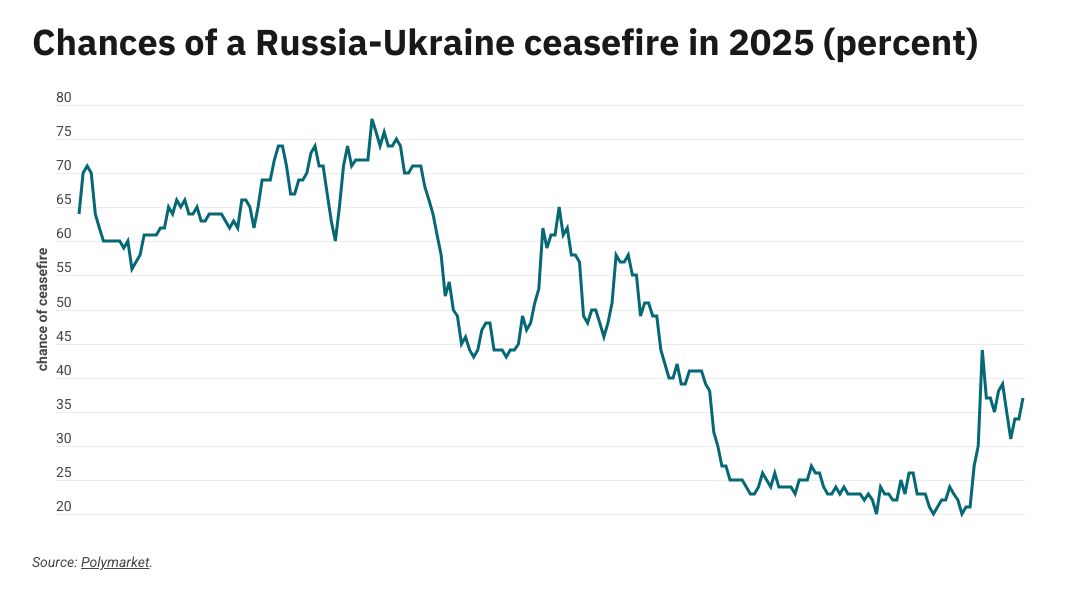
For interactive version of the above graph, click here.
Vladimir Putin: Clues from Russian Views.
- “We held our talks in a constructive and mutually respectful atmosphere, and they have proved substantive and productive.”
- “I said, ‘Good afternoon, dear neighbor. I am glad to see you alive and in good health.’”
- “We will always remember other examples from history when our countries stood together against common enemies in the spirit of combat camaraderie and alliance, rendering each other help and support.”
- “Obviously, sooner or later we had to remedy the situation, to move from confrontation to dialogue, and in this regard, an in-person meeting between the two heads of state was really overdue – of course, with serious and thorough preparations, and this work has been done.”
- “We acknowledge the commitment of the US administration and President Trump personally to help resolve the Ukrainian conflict, and the President’s willingness to understand the root causes and its origins.”
- “We are convinced that, for the conflict resolution in Ukraine to be long-term and lasting, all the root causes of the crisis, which have been repeatedly explained, must be eliminated; all of Russia’s legitimate concerns must be taken into account, and a fair security balance must be restored in Europe and the rest of the world.”
- “I agree with President Trump. He said today that Ukraine’s security must be ensured by all means. Of course, we are ready to work on this.”
- “By the way, under the new US administration, our bilateral trade has been on the rise. So far, it is a symbolic figure but still, the trade is 20 percent higher. What I am saying is that we have many interesting areas for cooperation. It is obvious that the Russian-US business and investment partnership holds tremendous potential.”
Donald Trump:
- “We had a very productive meeting. There were many-many points that we agreed on… but we have made some headway. So, there is no deal until there is a deal.”
- “I will call up NATO in a little while. I will call up the various people that I think are appropriate, and I will, of course, call up President Zelensky and tell him about today’s meeting.”
- “It is ultimately up to them. They are going to have to agree with [what] Marco [Rubio] and Steve [Witkoff] and some of the great people from the Trump administration…”
- “We really made some great progress today.”
- “I have always had a fantastic relationship with President Putin, with Vladimir. We had many tough meetings, good meetings.”
- “We were interfered with by the Russia, Russia, Russia hoax. It made it a little bit tougher to deal with, but he understood it.”
- “But we had to put up with the Russia, Russia, Russia hoax. He knew it was a hoax, and I knew it was a hoax, but what was done was very criminal…”
- “We had an extremely productive meeting, and many points were agreed to. There are just a very few that are left.”
- “But let’s do the most productive one right now. We are going to stop, really, five, six, seven thousand, thousands of people a week from being killed, and President Putin wants to see that as much as I do.”
- [In response to Putin’s remark “Next time in Moscow.”] “Oh, that is an interesting one. I do not know. I will get a little heat on that one, but I could see it possibly happening.”
"Donald J. Trump," Truth Social, 08.16.25.
- “A great and very successful day in Alaska! The meeting with President Vladimir Putin of Russia went very well, as did a late night phone call with President Zelenskyy of Ukraine, and various European Leaders, including the highly respected Secretary General of NATO. It was determined by all that the best way to end the horrific war between Russia and Ukraine is to go directly to a Peace Agreement, which would end the war, and not a mere Ceasefire Agreement, which often times do not hold up. President Zelenskyy will be coming to D.C., the Oval Office, on Monday afternoon. If all works out, we will then schedule a meeting with President Putin. Potentially, millions of people’s lives will be saved. Thank you for your attention to this matter!”
- “As I'm concerned there's no deal until there's a deal, but we did make a lot of progress,” Trump exclaimed during an interview with Sean Hannity.
- “They're going to set up a meeting now between President Zelenskyy and President Putin and myself, I guess,” Trump said.
- “[Russia has] a big nuclear presence…If you use that, it could be the end of the world,” he warned.
- U.S. President Donald J. Trump was interviewed by Fox News host Sean Hannity immediately following President Trump’s meeting with Vladimir Putin in Anchorage, Alaska on Aug. 15, 2025.
- Sean Hannity: “So, you said before the interview, “In two minutes, I will know.” I watched closely when you met him on the red carpet after both your planes landed. What vibe did you get in two minutes?”
- Donald Trump: “Well, I always had a great relationship with President Putin, and we would have done great things together. Their land is incredible—rare earth, oil, gas, everything. It’s the largest piece of land in the world as a nation, by far. They have 11 time zones if you can believe it… We would have done a lot, but we had the “Russia, Russia, Russia” hoax, which stopped us. One of the great hoaxes, like the election itself in 2020. But despite that, we did well… I want to see people stop dying in Ukraine. We’re losing 5,000, 6,000, 7,000 people a week—mostly Russians and Ukrainians, but also civilians. If we can end that war, it would be very good. And I was happy to hear him say that if I had been president, the war never would have happened.”
- Sean Hannity: “That was my next question. At the joint press conference he confirmed that if you were president, this wouldn’t have happened. Did he tell you why?”
- Donald Trump: “Yes, but it doesn’t matter now. The war should never have happened. Biden was a terrible president. He should have never let it happen, and he did. Millions have been killed… As far as I’m concerned, there’s no deal until there’s a deal. But we made a lot of progress.”
- Sean Hannity: “In your press conference you talked about many things you agreed on, and one big issue you didn’t. Are you prepared to go public with that?”
- Donald Trump: “No. Somebody will figure it out, but I don’t want to go public. I want to see if we can get it done. Ukraine has to agree. Zelenskyy has to agree. It’s a terrible war. Hopefully, it can be completed. That would be a great achievement for them. Forget about me—for them. You’d save 7,000 lives a week.”
Marco Rubio's interviews with multiple outlets on Ukraine war, CBS, NBC and Fox News, 08.17.25.
- “The United States is not in a position to accept anything or reject anything, because ultimately, it's up to the Ukrainians. They're the ones that Russia has to make peace with,” Secretary of State Marco Rubio noted
- “Both sides are going to have to give up something in order to get to the table, in order to make this happen,” said Secretary Rubio
- “They lost- 20,000 Russian soldiers were killed last month, in July, in this war. That just tells you the price they're willing to pay,” he explained.
- “Look, this war is only going to get worse. It’s not going to get better. You’ve seen that in the escalation in the attacks. Russia’s economy is now 100 percent full-time war footing. They are producing munitions,” he argued.
- “All the American support continues for Ukraine. And ultimately, look, if we’re not going to be able to reach an agreement here at any point, then there are going to be consequences,” Rubio warned.
- “I think there has to be some discussion about security guarantees for Ukraine, because they don't want this war to–none of us want to see this war in the future,” he asserted.
Balazs Jarabik’s Aug. 18, 2025, posts on X on his impressions from his ongoing trip to Kyiv/Ukraine.
- “The Alaska Summit — Trump’s turn — has not caused a shock in Ukraine beyond political elites, at least not yet. Summer is in full swing, life goes on. ‘Everyone wants peace,’ people say, but the conditions — the details — will matter most.”
- “Most people would welcome an end to the war — but not at the price of major sacrifices such as giving up Donbas. This ambivalence has shaped the public mood for ~1.5 years: war fatigue, but no surrender.”
- “A withdrawal from ‘Krama’ (Kramatorsk, Donetsk’s regional capital since 2015) would be seen as capitulation. Ukraine may be losing ground in the war of attrition, but it has not lost the war itself.”
- “Society is exhausted but unwilling to trade sovereignty. Zelensky faces extreme pressure with little room to maneuver — and his handling of anti-corruption showed how easily he can stumble or backtrack.”
- “The pattern holds: Russia is slowly gaining the upper hand. Kyiv’s security officials know the current status quo cannot last.”
- “The emerging framework — a peace deal (unless a freeze) opening the way for reconstruction — would end Ukraine’s post-Maidan wars (11 years), regulating both Crimea and Donbas. Yet with Moscow keeping the land bridge, it would look like a Russian victory.”
- “Trump’s shift toward the Istanbul framework is not a Russian victory — it was the only framework negotiated between Ukraine and Russia in 2022. The key change: external security guarantees, which the West refused back then, opting instead to provide weapons.”
- “Importantly, Ukraine’s path toward European integration would be reaffirmed — a core EuroMaidan goal. Key questions in Kyiv: army’s size (current levels financially unsustainable) and the emerging military-industrial complex - the real security guarantee for Ukrainians.”
- “But to the Ukrainians and their European neighbors, the breakup of talks between President Trump and President Vladimir V. Putin after less than three and a half hours contained an element of relief,” writes David E. Sanger.
- “Their deepest fear was that Mr. Trump would give in to the Russian president’s territorial demands, and force President Volodymyr Zelensky of Ukraine into a painful choice between giving up more than 20 percent of his country or rejecting a peace accord that he fears is a poison chalice.”
- “Mr. Trump lifted off from Alaska, ahead of schedule, without having achieved the most basic first step: a temporary cease-fire that would allow further negotiations to take place. ... He said in an interview afterward with Sean Hannity of Fox News that the onus was now on Mr. Zelensky to get a cease-fire deal.”
- “Even if Mr. Trump made no concessions about Ukrainian territory, he no doubt left Mr. Zelensky concerned about how he handled the Russian leader. Mr. Trump spoke glowingly of Mr. Putin, calling him ‘Vladimir’ and commiserating that both of them had been distracted by the U.S. investigation into Russia’s interference in the 2016 elections.”
- “Absent was any public discussion of secondary sanctions on countries that buy Russian oil. Gone were the deadlines previously set by Mr. Trump — including one that passed last week — for Russia to enter a lasting cease-fire. … Mr. Putin had washed away Mr. Trump’s talk of ‘serious consequences’ if the meeting ended without a cessation of hostilities.”
- “In fact, Mr. Putin emerged with the greatest gift of all: readmission to the society of world leaders. ... He has bought time. He has defused all that talk of sanctions on his oil sector. And he gave up nothing.”
- “It may be days before there is word of what steps toward some kind of agreement — if any — were reached. Mr. Trump said he would brief European allies, and Mr. Zelensky. ... In the meantime, Mr. Putin has accomplished a major war goal: He has gotten out of the box of sanctioned autocrat, and was greeted by the president of the United States as a peacemaker. ... And he gave up nothing.”
"No Ukraine Cease-Fire From Putin," The Editorial Board, The Wall Street Journal, 08.15.25.
- "President Trump tried to put the best spin he could Friday on his summit with Vladimir Putin in Alaska... But the substantive news from the meeting seems to be that Mr. Putin refuses to end his war in Ukraine, and he won’t even agree to a temporary cease-fire," The Wall Street Journal editorial board writes.
- "Mr. Trump was full of praise for Mr. Putin ... though 'we didn’t get there' to an agreement. He offered no details about the 'progress' and announced no end to hostilities."
- "There will be some cautionary relief in Europe that Mr. Trump didn’t announce a deal with Mr. Putin... Instead Mr. Trump said he would call European allies and Ukraine’s Volodymyr Zelensky to brief them... There’s no deal, he said, until there’s a final deal, which suggests he is at least listening to what Ukraine needs to feel secure if an armistice is reached."
- "Mr. Putin for his part gave nothing away on Ukraine. He offered his familiar line that the 'root causes' of the war must be addressed before it can end... By this he means blaming Ukraine for wanting to determine its own future as part of the European Union with security help from NATO countries."
- "With his economy struggling, Mr. Putin wants financial relief. In that sense the Russian achieved one of his major goals from the summit, which is the start of his rehabilitation as a world leader. The summit ended his isolation from the West, and he gave up nothing for it. He also appears to have gained more time to continue bombing Ukrainian cities and slowly taking more territory."
- "If there was nothing but niceties and a Putin stonewall, then Mr. Trump will have to decide if he will follow through on the red lines he has drawn."
- "Mr. Putin will only bend from that goal if he sees a unified West determined to deny him that victory and willing to impose severe costs if he continues his march of death in Ukraine."
"Trump’s incomplete Alaska summit," Editorial Board, The Washington Post, 08.16.25
- “President Donald Trump arrived at Joint Base Elmendorf-Richardson on Friday with a clear goal: extract a ceasefire agreement from Vladimir Putin. Meanwhile, the Russian president came to Alaska not to end his war against Ukraine but to avoid expanded economic sanctions. Although only one side got what it initially wanted, what happens in the coming days will be more consequential,” The Washington Post Editorial Board writes.
- “After talks ended early, Trump added that ‘there’s no deal until there’s a deal.’ ... In an interview with Fox News, Trump declined to disclose the biggest sticking point, which nevertheless seems to have been his desire for a ceasefire. Yet the president is plowing ahead,” the board notes.
- “Trump posted Saturday morning on Truth Social... ‘the best way to end the horrific war between Russia and Ukraine is to go directly to a Peace Agreement... and not a mere Ceasefire Agreement, which often times do not hold up.’ That followed a phone call with Ukrainian President Volodymyr Zelensky, who will fly to Washington for a visit with Trump in the Oval Office on Monday.”
- “The key for Zelensky in the coming days is to ensure that Moscow, not Kyiv, is rightly blamed for any lack of progress. ... Praising Trump’s acumen and showing an openness to dealing with Putin is a morally unsatisfying but necessary approach for Zelensky — especially if he can win promises to deter a future invasion once hostilities end,” the editorial advises.
- “Our preference is to impose sanctions now. ... The bigger risk is that Putin believes he can string along talks to avoid punishment, as Iran did during Joe Biden’s presidency. Putin is driven by the logic of power and force, not diplomatic niceties. ... If the White House really believes a deal is close, the least the administration can do is outline exactly what penalties Putin should expect if he does not sit for a trilateral meeting— and what will come if that meeting does not produce tangible results,” the board concludes.
"Donald Trump’s gift to Vladimir Putin," The Economist, 08.16.25
- “From the moment he stepped off his plane onto the red-carpeted tarmac, Vladimir Putin’s trip to Alaska was a triumph. ... The encounter at the Elmendorf-Richardson military base in Anchorage transformed Mr. Putin from a pariah of the West into an honored guest on American soil,” The Economist writes.
- “The two men may have had nothing to announce after hours of talks—the first meeting between a Russian and American president since the invasion of Ukraine—but failure may be a relief for Ukrainian and European leaders, who feared that Mr. Trump would yield to Mr. Putin’s demands to neuter Ukraine. Mercifully, Mr. Trump did not repeat his earlier talk of ‘land swaps.’”
- “Mr. Trump claimed there had been ‘many, many points that we agreed on’, but not on the central question of halting the war in Ukraine,” the article notes.
- “Their planes parked close to each other; the two men stepped out more or less simultaneously, shook hands warmly and walked towards a rostrum as a B-2 bomber, escorted by four F-35 fighters, passed overhead.... Mr. Trump may have wanted to demonstrate America’s military power. Instead, he displayed its diplomatic weakness—having repeatedly set deadlines for Russia to cease fire, then done nothing when they were ignored,” The Economist observes.
- “It was a relief... when it was announced that the planned one-on-one meeting in Anchorage had been expanded to include two other senior officials on each side. But as they stepped off the podium, Mr. Trump invited Mr. Putin to get into his limousine, known as ‘the Beast’—securing the private chat after all,” the article reports.
- “The honors for Mr. Putin were in sharp contrast to the public humiliation that Mr. Trump and his advisers inflicted on Mr. Zelensky during his visit to the White House earlier this year. ... Mr. Trump has often been quick to blame [Ukraine] for being invaded; and he has proved strangely indulgent with Mr. Putin,” writes The Economist.
- “Yet Mr. Putin insisted that ‘we need to eliminate all the primary causes of that conflict’. Given that he thinks the primary cause is Ukraine’s independence and sovereignty... his formula is a recipe for continuing the war. Mr. Trump did nothing to disabuse him. The Russian president left with a smile... ‘Next time in Moscow’, he told his host. To which Mr. Trump replied, ‘I’ll get a little heat on that one, but I could see it possibly happening.’”
- “After President Trump and President Vladimir V. Putin of Russia ended inconclusive peace talks in Alaska, Ukraine was left... scrambling to piece together what the two leaders had actually discussed, deciphering what they may have agreed on and striving to avoid being sidelined in peace talks,” writes Constant Méheut.
- “President Volodymyr Zelensky of Ukraine said the phone discussion, which included European leaders, had been ‘long and substantive’ ... But even as Mr. Zelensky’s statement suggested a potential path toward a peace deal... a public statement by Mr. Trump later... raised questions about whether such an opening would be too heavily tilted toward Russia for Ukraine to accept.”
- "Mr. Trump called on social media for a direct peace agreement without securing a cease-fire first, claiming that Mr. Zelensky and European leaders had agreed on the point. His statement was a stark shift from the ‘principles’ agreed upon earlier... which called for refusing to discuss peace terms until a cease-fire was in place.”
- “Russia has long pushed for a direct peace deal that would ... impose onerous demands on Ukraine, including territorial concessions. Avoiding a cease-fire would allow Russia to continue pressing its advantage on the battlefield in the meantime,” Méheut reports.
- “Mr. Trump, in an interview with Fox News after the meeting with Mr. Putin, also addressed the idea of territorial swaps, saying they were among the points ‘that we largely have agreed on.’ ... Mr. Zelensky, however, has not entirely ruled out possible land swaps, telling reporters this week that this is ‘a very complex issue that cannot be separated from security guarantees for Ukraine.’”
- “In Kyiv, some emerged Saturday morning from a sleepless night following the news with the sense that the war was likely to continue unabated. ... The Ukrainian Air Force said that Russia had continued its assault on Ukraine, launching 85 drones and one ballistic missile overnight.”
- “Vice President JD Vance made clear this past week that the United States was ‘done’ funding Ukraine’s defense against the Russian invasion. ... How long the Ukrainian Army can hold against relentless Russian assaults remains uncertain.”
- “Donald Trump’s Alaska summit with Vladimir Putin was an embarrassing failure. Worse, it was a terrible mistake. In return for lavishing guest-of-honor treatment on a Russian leader hitherto deemed a pariah in the west, the US president earned nothing except for some cheap flattery,” the FT Editorial Board writes.
- “Putin rejected a ceasefire, which had been Trump’s main goal for the meeting, and stuck to his maximalist goals which are tantamount to Ukraine’s capitulation and subjugation. Trump once again waived this threat of ‘severe consequences’ for Russia if it refused to pause hostilities, making him look weak.”
- “The ease with which Putin won him to Russia’s hardline positions makes him look a dupe.”
- “Trump has endorsed Putin’s wish to negotiate a comprehensive settlement rather than agree to the interim truce Washington demanded. ... Russia has every incentive to string out talks. Its hardened position on territory — demanding Ukraine abandon the quarter of Donetsk and sliver of Luhansk it still controls — shows Putin’s intentions.”
- “It is particularly shocking that [Trump] did not appear to push back on the most important [point], Putin’s territorial demand, which Zelenskyy, with European support, has said is an absolute red line. Abandoning territory Ukrainians have spilled much blood over 11 years to defend is politically indefensible and militarily suicidal.”
- “For Zelenskyy ... this means being more explicit about the compromise he is willing to make — in effect freezing the front lines and ceding de facto but not de jure control over territory Moscow occupies in return for security guarantees outside Nato.”
- “For the Europeans, it means pushing back more assertively against Trump’s alignment with Putin while appealing to congressional Republicans and members of the administration who surely have grave misgivings about the Alaska fiasco and the message of American weakness it sends to the world.”
"Can the U.S. Still Be Europe’s Peacemaker?" Michael Kimmage, The Wall Street Journal, 08.14.25.
- “The U.S. has historically played a leading role in bringing peace to Europe, from Versailles to the Dayton accords, but its military commitment and pre-eminence have waned, undercutting its position.”
- “At the Alaska summit, Trump faces a twofold dilemma: Putin’s penchant for obfuscation and delay makes negotiations fiendishly difficult, while the administration’s intention to reduce America’s military presence in Europe weakens its own leverage.”
- “Putin has a long record of using diplomacy as a holding pattern to buy time and avoid major concessions, as seen after his initial invasion of Ukraine in 2014, when he held territory but convinced the world he would go no further.”
- “For Ukraine and Europe, the nightmare scenario is a U.S.-brokered "peace" that pressures Kyiv to cede territory to Russia, legitimizing the invasion and leaving Ukraine vulnerable to future aggression.”
- “With the U.S. now stepping back, it may become more of a bystander than a primary participant in ending Europe’s wars—leaving the fate of Ukraine largely in the hands of Europeans and Ukrainians rather than Washington.”
"Donald Trump’s Self-Own Summit with Vladimir Putin," Susan B. Glasser, The New Yorker, 08.15.25.
- Glasser describes how Trump greeted Putin in Alaska with red-carpet treatment and applause, setting a tone of warmth and chumminess despite Russia’s ongoing war against Ukraine.
- After a shortened, three-hour meeting that ended without a scheduled lunch or a deal, both leaders smiled and praised each other in vague terms—Putin for Trump’s “personal commitment to 'pursuing peace,'” and Trump for his “fantastic relationship with President Putin” and “great progress.”
- Putin, Glasser notes, masterfully flattered Trump and played to his ego, echoing Trump’s talking points and making no concessions—above all, not the ceasefire Trump had publicly demanded for months.
- Trump offered no details on actual progress and, in his brief press conference, admitted “we didn’t get there”—leaving journalists and the world with the impression that only Putin had truly benefited from the summit.
- Glasser argues the meeting was a PR triumph for Putin, who gained both an invaluable photo op and more time to prosecute his war, while Trump failed to secure tangible gains or follow through on hardline promises.
- In the post-summit aftermath and interviews, Trump tried to blame others, pivoting to grievances about the 2020 election, “Russia, Russia, Russia” investigations, and unrelated topics—in effect, conceding that the summit achieved little, if anything.
- Glasser concludes that, on balance, the highly anticipated summit ended up as a “self-own” for Trump, who failed to deliver results, let Putin escape global isolation with U.S. honors, and shifted responsibility for peace onto others—especially Zelensky.
"Russia sees victory in summit as Trump adopts Putin approach to ending war," Francesca Ebel, Robyn Dixon, Ellen Francis, Catherine Belton, Siobhán O'Grady, The Washington Post, 08.16.25. Clues from Russian Views.
- "For Russia, the results of the Alaska summit between President Donald Trump and President Vladimir Putin marked a turning point in U.S.-Russian relations underlined by the United States subsequently abandoning its demand for a halt in fighting in Ukraine," the authors report.
- “Russian officials and commentators were especially enamored by Trump’s unusually warm red-carpet greeting to Putin on Friday in which they saw an opening to pull America away from its traditional allies in Europe.”
- "Russian officials and commentators... described [the summit] as a global realignment bringing together the world's two top nuclear powers... Putin had given no ground while Trump had stepped back from increasing pressure on Moscow through sanctions, allowing Russia to fight on."
- Russian senator Andrei Klishas stated, "A new European and international security architecture is on the agenda and everyone must accept it."
- Dmitry Medvedev, deputy secretary of the Russian Security Council, declared: "A full-fledged mechanism of meetings between Russia and the United States at the highest level was restored. Calm, without ultimatums and threats."
- Medvedev also emphasized, "The meeting proved that negotiations are possible without preconditions and at the same time with the continuation of the special military operation."
- According to Medvedev, the Kremlin's most important achievement was that "both sides explicitly placed the responsibility for achieving future results in the negotiations on the cessation of hostilities squarely on Kyiv and Europe."
- Pro-Kremlin commentator Sergei Markov explained, "It means they are developing good friendly relations. They are both from the same generation. They both respect each other."
- Markov added that while sanctions had not been lifted, "the trend is good. There has been a qualitative transition."
- During the summit, “Trump appeared to have been swayed by the Kremlin's contention that only a comprehensive peace deal was acceptable.
- "This means that Putin has succeeded in persuading Trump that any effort toward a prompt, unconditional ceasefire will fail," said Russia analyst Tatiana Stanovaya, of the Carnegie Russia Eurasia Center. Stanovaya said the failure to get a ceasefire raised the question of what Trump would do when Putin continues a war that he feels confident of winning. "We should look at how the situation develops further because Putin will continue the war."6
"In a High-Stakes Summit, Trump Hands Putin a Victory Without a Fight," Anastasia Tenisheva, The Moscow Times, 08.16.25. Clues from Russian Views:
- “When he welcomed Russian President Vladimir Putin, a leader wanted on war crimes charges and isolated from the West, to U.S. soil, President Donald Trump had hoped to strike a bargain that would put Moscow and Kyiv on the path to peace — with a Nobel Peace Prize for himself not far off,” writes Tenisheva.
- “But not even a red-carpet welcome... would be enough to bring Russia any closer to a ceasefire... the leaders said they found some common ground but did not reach a ceasefire agreement for the war," the article notes.
- “Some experts say the summit ‘fulfilled its minimum purpose’ for both Moscow and Washington. ‘The meeting demonstrated — or rather, it gave each side the opportunity to declare — that they want peace, while in reality, they’ll continue doing exactly what they were doing before,’ former Russian diplomat Boris Bondarev told The Moscow Times.”
- “Trump will continue trying to be friendly with Putin without any sanctions, while Putin will keep waging war, claiming that he and Trump are somehow working to strengthen peace,” Bondarev adds.
- “According to Alexandra Filippenko, an independent Russian expert on American politics, ‘the main point is that there are virtually no results. The key outcome, in my view, is confusion — particularly on the U.S. side.’”
- “So far, aside from Putin’s diplomatic ‘victory’ — the visit of an international criminal to the U.S., a red-carpet welcome and applause from the American president — no real progress is visible,” said Maria Snegovaya, a fellow at CSIS.
- “Russian officials are largely hailing the meeting as a success for Moscow. ‘A very warm, friendly and trusting relationship has developed between Putin and Trump. This is why the talks are widely seen as a victory for Putin and a breakthrough from isolation,’ said pro-Kremlin analyst Sergei Markov.”
- “According to Bondarev, this approach by Putin and Trump — one that avoids any concrete decision on ending the war in Ukraine — could continue for some time: ‘Putin will continue until he achieves his goals, unless someone puts up real resistance. ... But for now, there has been no sign of that — and it seems both leaders remain quite satisfied with one another.’”
"In Russia, Putin’s meeting with Trump plays as a triumph," Neil MacFarquhar and Alina Lobzina, The New York Times, 08.15.25. Clues from Russian Views.
- “There was pronounced gloating in Russia over Friday’s summit in Alaska, where President Vladimir V. Putin was given the red carpet treatment by President Trump on American soil and appeared to make a huge dent in more than three years of diplomatic isolation,” report Neil MacFarquhar and Alina Lobzina.
- “Ending the war in Ukraine had been on the agenda, but neither Mr. Putin nor Mr. Trump announced a cease-fire deal after the nearly three-hour meeting. ... Mr. Putin’s remarks showed that the Kremlin’s position was ‘unwavering,’ crowed Andrei Gurulyov, a retired general who is now a member of Russia’s Parliament.”
- “‘The meeting could be called a breakthrough because Mr. Putin was able to explain ‘face to face’ to Mr. Trump the reasons for the war,’ Gurulyov said. Russian state TV repeatedly played their joint appearance, highlighting the warm chemistry and suggesting a ‘huge step forward’ had been made.”
- “Official Russian reports noted the meeting’s symbolic significance and predicted chagrin among American allies in Europe over the red carpet treatment and the apparently friendly Trump-Putin handshake.”
- “Putin invited Trump to hold their next meeting in Moscow. Mr. Trump was polite but noncommittal, saying he would ‘take a lot of heat for it.’”
- “Russian critics of Mr. Putin and the war in Ukraine wondered if Mr. Trump would follow through on his previous threat to impose direct and secondary sanctions if Russia did not move to end the fighting. ‘Now the main question is what will happen with the previously announced sanctions?’ ... ‘Without this, Putin will look like the winner.’”
"Russians Hail Alaska Summit, Blame Kyiv for Prolonging the War," Matthew Luxmoore, The Wall Street Journal, 08.16.25 Clues from Russian Views.
- “Russian officials and pundits hailed the Alaska summit as a success, praising President Trump for re-engaging Russian President Vladimir Putin in diplomacy without making unrealistic demands,” reports Matthew Luxmoore.
- “They also said warming U.S.-Russia ties will allow Moscow to continue its war in Ukraine until the goals it has set out are met.”
- “The meeting showed that talks are possible without pre-conditions at the same time as the special military operation continues,” wrote Dmitry Medvedev, deputy head of Russia’s national security council, using the Kremlin euphemism for its invasion of Ukraine.
- “Putin had come to the summit with the goal of convincing Trump of his position on the war... Putin wants the West to address what he calls the ‘root causes’ of the war in Ukraine, the Kremlin’s shorthand for Kyiv’s drift toward the West and its aspirations to join the North Atlantic Treaty Organization.”
- “Russian pundits applauded Putin for sticking to his position–and noted that in the aftermath of the summit, Trump once again said the ball was in Kyiv’s court.”
- “Russian lawmaker Sergei Mironov said, ‘The pressure on Zelensky and his junta will now grow not only on the battlefield, but on the diplomatic front.’”
- “Vladimir Dzhabarov... accused Kyiv of prolonging the war and said peace would only be achieved if Russia’s demands were taken into consideration. ‘Kyiv is acting not like the defeated side, which is what it essentially is, but like a victor.’”
"Russia and Ukraine Agree: A Trump Summit Is a Big Win for Putin," Nataliya Vasilyeva and Andrew Higgins, The New York Times, 08.16.25 Clues from Russian and Ukrainian Views.
- “The warring countries do seem to agree on at least one thing. Merely meeting with Mr. Trump is a big win for President Vladimir V. Putin, bringing the Russian leader out of a diplomatic deep freeze and giving him a chance to cajole the American president face to face.”
- “‘Putin’s visit to the U.S.A. means the total collapse of the whole concept of isolating Russia. Total collapse,’ Kremlin-controlled television crowed after news of the hastily arranged summit broke last weekend.”
- “For Russia, ‘this is a breakthrough even if they don’t agree on much,’ said Sergei Mikheyev, a pro-war Russian political scientist who is a mainstay of state television.”
- “President Volodymyr Zelensky of Ukraine, iced out of the Alaska talks about his own country’s future, has come to the same conclusion, telling reporters on Tuesday: ‘Putin will win in this. Because he is seeking, excuse me, photos. He needs a photo from the meeting with President Trump.’”
- “A peace deal on Ukraine is not Mr. Putin’s real goal for the summit, said Tatiana Stanovaya, senior fellow at the Carnegie Russia Eurasia Center. ‘His objective is to secure Trump’s support in pushing through the Russian proposals.’”
- “Having stoked nationalist passions inside Russia for years, Mr. Putin has given free rein to a noisy subculture of pro-war bloggers and television pundits. When the host of a flagship weekly news show on state television rejoiced on Sunday that the meeting in Alaska could mean an end to what Moscow calls the ‘special military operation’ in Ukraine, nationalist bloggers responded with fury. Mr. Putin, fumed one, ‘has apparently decided to throw in the towel.’”
"Abandoning Positions: What the Trump-Putin Summit Changed," Alexander Baunov, Carnegie Politika, 08.16.25. Clues from Russian Views. Machine-translated.
- According to Baunov, the Alaska summit was a defeat for Trump because, failing to get a ceasefire or impose new sanctions, he shifted from his own position to one aligned with Russia’s: that a ceasefire must be part of a comprehensive peace agreement—a process that benefits Putin.
- For Putin, even an inconclusive summit with the U.S. president is a major diplomatic win, restoring legitimacy and equal status—especially valuable for an authoritarian regime otherwise isolated internationally.
- The format of talks prioritized the political and diplomatic blocs of both delegations, but not economic issues; Trump stuck to the Ukraine issue and did not let the meeting be sidetracked to trade or other temptations.
- Both leaders’ public statements revealed the core dynamic: Putin claimed Trump now accepts the Russian narrative of “root causes” as central (i.e., threats from Ukraine, NATO, and the West). Trump dropped the previously agreed-upon U.S.-Ukraine-European platform of “immediate ceasefire” in favor of negotiating a final peace deal.
- Baunov argues this new linkage—negotiating a full peace deal before stopping hostilities—risks making Ukraine a hostage in systemic, global negotiations: Ukraine will be pressured not only for concessions, but also to facilitate wider “security balance” agreements in Europe and the world.
- Trump’s comments and actions indicate he’s shifting responsibility for hard choices to Kyiv and European capitals; if they refuse, the U.S. may disengage and leave Ukraine more vulnerable.
- In sum, Baunov sees the outcome as a shift in rules: a move from a narrowly focused Ukraine peace process to one in which Ukraine and European security become bargaining chips in the U.S.-Russia relationship.
"Main Shift: Trump Recognized That Lasting Peace Is More Important Than a Temporary Ceasefire," Fedor Lukyanov, Rossiiskaya Gazeta, 08.17.25. Clues from Russian Views. Machine-translated.
- Lukyanov argues the chief outcome of the Alaska summit is the return to genuine, behind-closed-doors diplomacy—real negotiations without preordained outcomes or imposed moral judgments from the West.
- The meeting marked Trump's acceptance that a lasting, comprehensive settlement is more important than a temporary ceasefire; he is less concerned with the “blame” for the conflict and focused on pragmatic results, especially ending the fighting.
- In contrast to the West's previous rigid approaches (e.g., in Yugoslavia or Syria)—where outcomes were determined by Western standards of justice—Trump now signals the U.S. will act as a pragmatic intermediary rather than taking sides.
- While the actual leverage the U.S. holds over Russia is limited, Trump’s approach is to pressure Ukraine for concessions, believing he can influence Kyiv much more than Moscow.
- The summit is widely seen (both by Putin's fans and critics) as a win for Russia: the agenda and tone reflected Moscow’s templates, and Trump accepted that a lasting peace, not just a truce, is needed—even if that is seen as betrayal by Ukraine’s allies.
- The summit did not yield an immediate agreement, but instead launches a new phase of “pragmatic search for an exit.” With the ball now in Zelenskyy’s court, Trump is likely to shift responsibility for tough choices to Ukraine—potentially distancing the U.S. from future support if Kyiv resists.
- While there’s no guarantee of quick progress, Lukyanov concludes the “ice has started to crack”—a qualitatively new phase for Russia, America and diplomacy over Ukraine is underway.
"Meeting in Alaska: Why and What’s Next," Alexander Yakovenko, Russian International Affairs Council (RIAC), 08.18.25. Clues from Russian Views. Machine-translated. (This organization is affiliated with the Russian authorities.)
- According to Alexander Yakovenko, the Alaska summit marked a new phase of pragmatic rapprochement between the US and Russia, as Putin and Trump quickly found common ground based on “national interests and common sense,” setting aside ideology and skipping protracted multi-party talks.
- Yakovenko writes that Trump gave Zelenskyy and European leaders an ultimatum: achieving real peace in Ukraine and Europe now depends on Kyiv and its partners, who are expected to negotiate directly—and quickly—with Moscow, or risk the US disengaging from the conflict.
- Yakovenko argues that Washington is prepared to participate in security guarantees for Ukraine, but strictly outside NATO and likely with Russia, similar to Austria’s neutrality arrangement in 1955; however, a broader and equal Eurasian security guarantee would require a fundamentally new architecture for European security.
- Yakovenko observes that one major result of the summit is a “breakthrough” in Russia’s diplomatic and information isolation, as previous Western narratives about aggression and sovereignty are, in Russia’s view, less persuasive than appeals to human rights and protection for Russian-speaking Ukrainians.
- Yakovenko contends that Europe, having failed to become a genuine geopolitical actor on its own, is now marginalized as America’s global focus shifts. He concludes that unless Europe adapts to the new power-driven realities, it will be sidelined as the US reduces its support for the war in Ukraine.
"Key Outcome of the Alaska Meeting: Excellent Chemistry Between Donald Trump and Vladimir Putin," Konstantin Remchukov, Nezavisimaya Gazeta, 08.16.25 Clues from Russian Views. Machine-translated.
- Remchukov emphasizes that the main outcome of the Anchorage summit is the growing “chemistry” and trust between Trump and Putin, which he sees as offering an optimistic scenario for resolving the conflict and developing relations, at least for the next 3.5 years, in Russia’s favor.
- He argues the summit marked a restoration of trust: “Trump heard Putin and recognized Russia’s interests as legitimate and crucial for building a new configuration in world politics.”
- Remchukov contends the West has, for years, unilaterally ignored Russia’s existential interests, supporting its own priorities only, and has used sanctions as a means to coerce regime change inside Russia.
- He claims the Alaska meeting is a break in the united Western front of isolating Russia, predicting that soon European capitals will align themselves with “Trump’s general line.”
- Special attention is paid to the fact that no decisions about Ukraine were announced in Alaska without Ukraine’s participation—“no decisions on Ukraine without Ukraine”—which avoids accusations and leaves the world waiting for the next round of decisions, this time involving Ukraine.
- In Remchukov’s view, American and international media failed to obtain any real information about the substance of the talks, remaining captive to their own stereotypes and long-standing narratives about the Russia-Ukraine conflict.
- In conclusion, Remchukov underlines: something fundamentally new happened in Anchorage—Russia and the US are now making decisions “without looking back” at Western dogmas and external pressures.
"‘Putin restored Russia’s status as a superpower’: The main outcomes of the Alaska summit, according to the Kremlin’s state media guidelines," Meduza, 08.16.25 Clues from Russian Views.
- "Donald Trump and Vladimir Putin’s high-profile meeting in Anchorage on Friday produced little of substance — but it gave the Russian president plenty to boast about at home. The Kremlin’s latest guidelines for its propaganda outlets instruct them to stress that 'no deal on Ukraine' was ever on the table, that Putin 'restored Russia’s status as a great superpower’ and met the U.S. president 'as an equal,’ and that Russia and the U.S. 'have much to offer each other,'" reports Meduza.
- "The Kremlin’s latest talking points... instruct outlets to report that 'no deal [on Ukraine] was reached at the summit — and no deal could have been reached.’"
- “Pro-government audiences were being primed for the possibility that the summit 'might not result in a pause in fighting.' ... 'The main point is dialogue with the U.S. for the sake of dialogue. Putin and Trump are working on an agreement, and it’s Putin who sets the terms.’”
- "The post-summit guidelines tell journalists to report that 'the demands from Kyiv and European leaders for an unconditional ceasefire weren’t even discussed...,' and that 'Trump urged Zelensky to strike a deal with Russia to resolve the conflict.'"
- "The Kremlin also instructs media to highlight that Trump personally greeted Putin at the airport — a 'gesture of goodwill' no other foreign leader has received."
- "According to the document, the central message in pro-Kremlin coverage should be that the meeting was 'historic' because 'Putin restored Russia’s status as a great superpower.' It insists that Putin and Trump 'spoke as equals,' unlike Trump’s negotiations with European leaders."
- "Another point in the memo is that Ukraine and European countries have been 'sidelined' and dealt a 'major blow in the information war.' The document, however, makes no forecasts about the war itself or about Putin and Trump’s future relationship."
"Russia’s Pro-War Bloggers See ‘Humiliation’ in Putin-Trump Summit," Bashir Kitachayev, The Moscow Times, 08.18.25. Clues from Russian Views.
- “Talks between Donald Trump and Vladimir Putin in Alaska sparked unease among Russia’s most outspoken pro-war bloggers, many of whom fear that hostilities could end without the Kremlin achieving its goals in Ukraine,” Bashir Kitachayev reports.
- “The choice of Alaska as the location for the talks drew particular scorn. ‘It’s hard to imagine a greater humiliation,’ wrote pro-Russian blogger Alexei Larkin. ‘Not in neutral territory, but in the U.S. — and not even in Washington, but in the backwoods, where the rednecks and bears live. A place that was once ours that we sold off for pennies and still feel insecure about.’”
- “Other prominent voices accused Putin of preparing to trade away occupied territory and ‘betraying Russia’s interests.’ ... Some bloggers concluded that the very fact of a summit signaled a deal was already in place,” the article notes.
- “Still, not everyone had negative things to say about the summit. Pro-Kremlin ideologue Alexander Dugin praised the meeting as a ‘grand’ diplomatic victory for Putin. ‘To win everything and lose nothing — only [Romanov tsar] Alexander III could do that,’ Dugin wrote.”
- “Many pro-war bloggers believe that Russia should not only refuse to give up occupied territories, but also avoid stopping at the current front line... they believe stopping at what’s been conquered will just lead to a postponed war, and that the fighting must continue until Victory. What ‘Victory’ means, however, varies from person to person,” says commentator Ivan Filippov.
- “Recent battlefield developments have done little to dispel this frustration. ... Even pro-Kremlin outlets acknowledged the lack of a decisive breakthrough. ‘Nothing fundamentally new happened. The war continues as a bloody meat grinder,’ wrote [Maxim] Kalashnikov."
- “Bloggers are voicing fears that they, too, could soon fall victim to tightening censorship and persecution at home. ... Filippov argued that as long as the war continues, authorities are unlikely to fully dismantle the pro-war blogger ecosystem ... But once the conflict ends, he predicts, most of these channels will be shut down.”
"Bering bad news: Trump, Putin and European lessons from the Alaska summit," Kirill Shamiev, ECFR, 08.16.25. Clues from Russian Views.
- “Some European leaders may feel somewhat relieved at the outcome of the Alaska summit between Donald Trump and Vladimir Putin on August 15th. After all, the worst-case scenario—a sweeping deal pressuring Ukraine to cede swathes of land to Russia—did not transpire. But relief would be a mistake. The direction of travel the summit indicated does not bode well for European interests,” writes Kirill Shamiev.
- “Neither the Ukrainians nor their European allies were at the table in Anchorage. Their advocacy for Ukrainian participation fell on deaf ears, underscoring European marginalization in talks about the future of their own continent,” Shamiev notes.
- “Trump, who appears to share elements of Putin’s worldview, also indicated that he may delay tough sanctions that he had previously threatened,” the article warns.
- “The solution is to redouble efforts to reduce that leverage. ... Europe’s goal should therefore be to achieve strategic relevance in the short run while moving towards full strategic autonomy in the long run,” Shamiev argues.
- “First, building strong European military forces is essential for projecting strength and credibility. ... Second, the EU can begin treating Ukraine as if it were a de facto (non-member) security partner. ... Third, the EU should play a more assertive, conditional role in its wider eastern neighborhood,” Shamiev concludes.
“Trump ‘has completely ceded narrative control’ to Putin: Fiona Hill,” The Hill, 08.18.25.
- “President Trump has “completely ceded narrative control” of the Russia-Ukraine war to Russian President Vladimir Putin, a former top-adviser-turned-vocal-critic said in an interview published Monday. Fiona Hill, who served as a senior adviser on Russia at the National Security Council during Trump’s first term [and is a member of Harvard’s Board of Overseers], argued in a Politico interview that Trump is endorsing Moscow’s position that it’s enough if it decides to stop fighting.
- “What Ukraine is just basically getting as a concession is for the Russians to stop fighting. And this is Putin’s way all the way through the 25 years of his presidency, which is: ‘I’m going to beat you up, and my concession is that I stopped beating you up,’” she said.
- Hill said in another interview on CBS’s “Face the Nation” on Sunday that Trump’s red-carpet treatment of Putin in Alaska on Friday also played into the Russian leader’s hands. “Although it was presented as perhaps a show of power by being at a U.S. Air Force base with the… passing of the B-52s and other fighter jets, it did certainly look much more like a show of appreciation for Vladimir Putin,” she said.
- “And so the optics were really much more favorable to Putin than they were to the United States. It really looked like Putin had set the agenda there, the narrative, and in many respects, the tone for the whole summit meeting.”
See these links for more commentary/analysis on this subject after the Trump-Putin summit on Aug. 15, 2025:
- “On GPS: Jake Sullivan on the Trump-Putin summit,” Fareed Zakaria, CNN, 08.18.25. Video.
- Thomas Graham: “Trump-Putin summit 'beginning of intense diplomatic effort,’” DW, 08.16.25. Video.
- “Takeaways From the Trump-Putin Meeting,” CFR, August 2025. Video.
- "Ten Ways to Force Putin Back to the Bargaining Table," James Stavridis, Bloomberg, 08.16.25.
- "Trump and Putin’s Alaska Theatrics Imperil Ukraine — and Europe," Marc Champion, Bloomberg, 08.16.25.
- "Trump’s Alaska Folly," Timothy Snyder, Project Syndicate, 08.17.25.
- "6 Takeaways From Trump’s Meeting With Putin," Maggie Haberman and Tyler Pager, New York Times, 08.15.25.
- "Key takeaways from Trump’s summit with Putin and dramatic ceasefire reversal," Vivian Ho, Victoria Craw, Washington Post, 08.16.25
- "The Trump-Putin summit wasn’t a disaster, but it was a U.S. defeat," Max Boot, The Washington Post, 08.16.25.
- "Trump’s Putin Gambit Failed—but Maybe It Was Still Worth Trying," Michael Hirsh, Foreign Policy, 08.15.25.
- "Russia, Ukraine and Europe are all trying to manipulate Trump," Gideon Rachman, Financial Times, 08.16.25
- "Trump and Putin Alaska Meeting Imperils Ukraine — and Europe," Marc Champion, Bloomberg, 08.16.25
- "Trump drops ceasefire demand for Ukraine war after summit with Putin," David L. Stern, Ellen Francis, Siobhán O'Grady, The Washington Post, 08.16.25
- "Zelenskyy in the lion’s den: European leaders need to get Trump off the dangerous path laid out for him by Putin," Gideon Rachman, Financial Times, 08.17.25
- "The nightmare of a Trump-Putin pact isn’t over: A new Oval Office showdown with Zelensky looms after Alaska," The Economist, 08.16.25.
- “Trump’s Peace-Deal Demands Leave Zelenskiy With Only Bad Options," Daryna Krasnolutska, Alberto Nardelli, Bloomberg, 08.17.25.
Great Power rivalry/new Cold War/NATO-Russia relations:
"In Echo of Yalta Summit, Discussing Others' Fates," Steven Erlanger, The New York Times, 08.14.25
- “The world's superpowers met in 1945 in the Black Sea port of Yalta to divide up Europe after the defeat of Nazi Germany. They drew lines on the map that tore apart countries, effectively delivered Eastern Europe to Soviet occupation and dismembered Poland. And none of those countries were represented or had a say,” writes Steven Erlanger.
- “As President Trump prepares to meet President Vladimir V. Putin of Russia on Friday in Alaska, there is more talk—and anxiety—among Ukrainians and Europeans about a second Yalta. They are not scheduled to be present, and Mr. Trump has said he plans to negotiate 'land swaps' with Mr. Putin over Ukrainian territory.”
- "Yalta is a symbol of everything we fear," said Peter Schneider, a German novelist. "Now we see that Putin wants to reconstruct the world as it was at Yalta. For him, it begins with Ukraine, but that's not his ending.”
- “‘Of course today's world is different, but decisions are being made on behalf of third countries for whom this is an existential issue,’ said Ivan Vejvoda...”
- “The prospect that big powers might settle the fate of a third country that is not present is 'a national trauma in most of Eastern Europe, including Estonia.'”
- “Mr. Putin's stated aims do not end with Ukraine. ... He wants to divide the United States from Europe, if he can, to weaken or destroy the trans-Atlantic relationship created after World War II.”
- “Yalta has gone down in history as many things, but it became a dirty word in Eastern Europe and especially in Poland,” said Serhii Plokhii, professor of Ukrainian history at Harvard.
- “For Timothy D. Snyder... the Alaska summit is 'morally less defensible' than the one in Yalta because Mr. Putin is not an ally, as Stalin was. ...There is a crucial difference with Yalta. It is Russia now, not Nazi Germany, that is 'carrying out an unprovoked war and all its atrocities.'"
- “‘Putin's demand for unconquered Ukrainian territory is also similar to Hitler's demand for the Sudetenland from Czechoslovakia in 1938,’ Mr. Snyder said. 'If Ukraine is forced to concede the rest of the Donbas, it would concede defensive lines and fortifications crucial to its defense... Hitler's aim was to destroy Czechoslovakia, and Putin's ultimate goal is to destroy Ukraine.'”
"Trump meets Putin: Why the Alaska summit is no Yalta—yet," Jana Kobzova, ECFR, 08.14.25
- “As of August 15th, Vladimir Putin’s period of international isolation will be effectively over. Despite not delivering on any of President Donald Trump’s demands to stop Russia’s war against Ukraine, he is having a get-together with his American counterpart. The two will debate Ukraine and European security with neither Ukrainians nor the Europeans in the room—and in Alaska, around 5000 miles away from Europe itself. This is another good outcome for the Kremlin,” writes Jana Kobzova.
- “Yet despite the quick wins Putin has already pocketed before the summit has even begun, it may be too early to start floating Munich or Yalta analogies. ... The Trump administration has played down the potential for a breakthrough, referring to the meeting as a ‘listening exercise’. ... After [European and Ukrainian leaders] spoke to him, he agreed to push for a ceasefire in Ukraine before other discussions and, crucially, to include the Ukrainians in any such conversations,” Kobzova notes.
- “Going into the summit, the Kremlin likely assumes it has the upper hand on the battlefield, and so if it cannot extract concessions diplomatically, it can just continue to plough forward in Ukraine. ... But Russia’s leader will have to tread carefully and somehow respond to Trump’s ambition to become a peacemaker between Ukraine and Russia,” she writes.
- “Putin’s most preferred realistic outcome would be the neutralization of the US on Ukraine. ... To achieve this, Putin will likely float all kinds of possibilities for joint US-Russian energy and other business, including tapping the Arctic resources, to entice Washington into cooperation,” Kobzova explains.
- “The Alaska summit may open the door to longer-term negotiations which may eventually lead to a ceasefire. But for now, Putin has two options, and neither of them are catastrophic for the Kremlin: he either gets a deal on Ukraine with Trump, which is likely to be rejected by Kyiv and the rest of Europe, making it unimplementable. Or he doesn’t, and continues his military campaign,” she concludes.
"It Looks Like a Trump-Putin-Xi World, But It's Really Orwell's," John Authers, Bloomberg, 08.15.25.
- “George Orwell’s 1984, written in 1948, tells of a world divided into three great powers. ... They fight interminably over the contested, poorer parts of the world ... though alliances shift, they remain in permanent balance,” John Authers writes.
- “What is now taking shape looks closer to the book, with the US, Russia and China trying to consolidate power around them,” he argues.
- “Orwell was wrong to predict Russian domination of Western Europe, but the Alaska summit, and the terrified reaction in European capitals as the US has shown a willingness to withdraw support from Ukraine, shows that the possibility remains alive,” the article notes.
- “The world thus appears to be returning to the concept of spheres of influence. ... The same philosophy animates Trump 2.0 foreign policy. ... he wants an impregnable and tightly defined sphere of influence,” Authers explains.
- “Orwell’s three powers required self-sufficiency. ... With the world now on an Orwellian path, it’s possible to predict who can survive an autarkic world, and who will struggle,” the article observes.
- “A common philosophy can be discerned today. MAGA Republicanism, Xi Jinping Thought..., and ... 'scientific Putinism' all unapologetically put national interests first, allow the state to intervene aggressively in the private sector, and adhere to conservative social norms,” Authers notes.
- “National capitalism creates a stable global equilibrium. ... US capitalism looks ever more like the version of communism pioneered by China. ... It’s capitalism with Chinese characteristics,” the article argues.
- “Meanwhile India—exactly as predicted in 1984—stands as the biggest nation outside the major blocs whose fate remains fluid,” Authers concludes.
- “As Putin and Trump meet in a territory that Russia once sold to the US, they do appear to be conducting a world order uncomfortably similar to the one [Orwell] imagined 77 years ago.”
“How Putin Tricked Trump," Ned Price, Foreign Policy, 08.13.25.
- “U.S. President Donald Trump’s seeming change of tune on Russia and Ukraine has perplexed his critics, myself included. Throughout his time in power, Trump offered little but praise for Russian President Vladimir Putin, often defending him in the face of domestic political furor,” writes Ned Price.
- “Rather than bow to an American ultimatum, Putin has instead engineered a trap, one in which Trump will walk into later this week. For Putin, the Alaska summit—which notably will exclude Zelensky, almost certainly at Russia’s insistence—is tailor-made to enable Russia to continue evading sanctions and tariffs while also ending Trump’s more sympathetic approach to Ukraine once and for all,” Price observes.
- “Putin surely—and rightly—calculates that Trump is predisposed to be on his side. An hourslong discussion, during which Putin can reinforce Trump’s misreading of the war’s origins, is likely to leave Trump more impervious than ever to the Ukrainian and European claim that Russia, and Russia alone, is responsible for the Russian invasion of Ukraine,” the article explains.
- “Putin is…prepared to put a land-for-peace deal on the table. Regardless of the specifics, it is likely to appeal to Trump’s real estate mogul sensibilities. After all, Trump has never appreciated the normative aspects of Russia’s aggression. … Putin almost certainly reasons that Trump will be inclined to think that land, and land alone, can end the war—giving short shrift to Ukrainian and European convictions that long-term security guarantees are necessary,” Price argues.
- “In Trump’s mind, and that of his followers, it will justify reverting back to his default state—praising Putin and pressuring Kyiv. ... The arc of history may be long, but for Trump, it bends toward accommodating Moscow,” Price concludes.
- Europe’s economic stagnation and failure to grow has driven its geopolitical irrelevance; “without economic growth, you start to evaporate geopolitically,” Cohen argues, noting Europe’s economy has barely grown in 16 years while the US has soared.
- Trump’s and Biden’s policies have accelerated Europe’s realization that it can no longer rely on US defense guarantees, pushing the continent toward higher defense spending and rearmament.
- NATO’s European members have rapidly increased defense budgets; in 2014, just three spent 2% of GDP on defense—now it’s 23, and there’s a commitment to reach 5% by 2035 (including 1.5% for infrastructure and logistics).
- Structural and institutional hurdles prevent efficient use of new defense funds—fragmentation, coalition politics, lack of a capital markets union, and reluctance to create European “champions” mean most military buildup will remain national, not collective.
- Europe’s defense sector is highly inefficient: there are 19 types of battle tanks, 27 destroyers, 20 fighter jet models, and 17 different howitzers used for Ukraine; interoperability and procurement remain major problems, and 64% of European NATO defense procurement comes from the US.
- Despite headwinds, Cohen sees tailwinds: Europe remains the world’s second-largest economy, has strong human capital and infrastructure, and Ukraine’s war effort has catalyzed defense innovation and spending—with most purchases, nevertheless, still coming from American firms.
- The path forward includes pushing for European strategic autonomy, modernizing NATO, investing in R&D and technological innovation, and leveraging battlefield experience from Ukraine—“the most interesting battlefield in the world right now from a defense tech perspective.”
- “Russia’s aggression against Ukraine and other neighbors is transforming the Black Sea into Eurasia’s strategic frontier. ... Russia does not merely seek to dominate Ukraine. It wants to render each of the other five states that border the Black Sea ... subservient to its interests so that it can exercise veto power over choices these countries make,” write Hamilton and Stent.
- “The Black Sea is a central hub for Russia’s energy trade: Russian oil and oil products account for most of the cargo flowing out of Novorossiysk ... Its remaining westward pipeline gas routes run under the Black Sea to Turkey and then on to southeastern Europe. ... Russia routes almost all of its grain exports and a significant proportion of its fertilizer and other agricultural goods through its ports there.”
- “Russia employs a variety of interference tactics to swing Black Sea states toward Moscow, including hard military power, election meddling, coup attempts, energy cut-offs, food embargoes, disinformation, and leveraging the Russian Orthodox Church,” the article observes.
- “Moscow’s 2022 invasion of Ukraine both accelerated its efforts to dominate the Black Sea and revealed the benefits of the groundwork it laid earlier. ... Russia’s efforts to destabilize other Black Sea states are a tale of uneven successes and setbacks. ... Turkey now plays a much more important regional role than it did before 2022,” Hamilton and Stent note.
- “The sea has become a staging area for Russia’s 'shadow fleet' of unregistered ships, which it uses to circumvent Western sanctions.... Russia has stolen Ukrainian agricultural products and bombed Ukraine’s farmlands and ports to undercut Kyiv’s revenue and gain new markets.”
- “The region’s post-communist countries continue to struggle, leaving them vulnerable to Russian influence. The end of U.S. foreign assistance ... has left a gap that only EU and NATO allies can fill,” the article explains.
- “Building Black Sea resilience requires robust EU and NATO strategies, invitations to Ukraine and Moldova to deeper transregional frameworks, exploiting regional energy resources, and above all, denying Russia control of Ukraine and the Black Sea coast," Hamilton and Stent conclude.
"The far north has become NATO’s soft underbelly, writes John Bolton," The Economist, 08.11.25.
- “The Arctic now receives far more attention in Washington than in decades, as the race for Arctic hegemony quickens, driven by Russian aggression and China’s ambitions,” writes John Bolton.
- “NATO’s soft underbelly is now probably the Far North, not the Mediterranean, and the alliance’s military resources—especially naval and icebreaking capabilities—are insufficient for emerging challenges.”
- “The entry of Finland and Sweden into NATO has helped strengthen Arctic defense, but more investment is needed, notably in specialized ships and coordination among member states,” Bolton explains.
- “Bolton urges updating General Ismay’s Cold War dictum: ‘Keep the Chinese out, the Americans in, and the Russians down.’ This grand strategy is necessary to guard evolving interests in the far north.”
- “Securing the Arctic requires resolving issues like Canadian underspending, U.S.-Canada disputes over passages, and the vulnerabilities of treaty-based demilitarized zones such as Svalbard,” he observes.
- “The growing presence of Russian operations—and the potential for Chinese encroachment—make the region a likely site for future crises and tests of allied resolve,” Bolton warns.
- “A massive increase in NATO defense expenditures and a rejection of isolationism are crucial to safeguarding the Arctic, which is now a frontline for American and European security,” he concludes.
- Interviewer: “Serhii I wanted to show that moment [when Lavrov is seen in an CCCP shirt], leading into our interview, because it’s sending a message to Ukraine and also a nod at, Soviet nostalgia, frankly. You wrote a book called ‘The Return of History, the Russo-Ukrainian War through the Eyes of a Historian. Can you explain that picture as it speaks to the greater goal of Putin and Russia when it comes to Ukraine and frankly, Russia’s position in the world?”
- SP: “It is very clear that there is this imperial nostalgia for great power status of the Soviet Union, the Soviet glory so to speak that Putin now tries to bring back, either through war and aggression in Ukraine or by having this summit with the world’s most powerful leader, President Trump. So for him this is basically a recognition also of the particular status of Russia today. But clearly they want the world like how it existed back in the 1970s, when Mr. Lavrov and Mr. Putin started their careers. So it is very imperialistic.”
- Interviewer: “You know, Russia is hurting economically right now, it’s lost hundreds of thousands of soldiers. But they are gaining ground, at least they have in recent weeks when it comes to fighting. Can you give us a sense of how they see this war and how far they are willing to go to when it comes to the fighting?”
- SP: “Well a lot of discussion is focused today on the front line, which barely moved in the last two years. In the last two weeks, Russians made some progress on their incursions into Ukraine. But the news coming today is that Ukrainians actually are fighting back and cutting off those operational units that got behind Ukrainian lines. So it looks like we see the situation that we had seen back and forth for the last two years. And it is very important to keep in mind that for Russia this war is not for territory or not just for territory. Look at the map of the world. This is the largest country in the world. It is the war about dominance over Ukraine and eventually dominance over eastern and central Europe. So that is what is at stake, not this or that village or this or that town on Ukrainian territory.”
See this link for more commentary/analysis on this subject:
China-Russia: Allied or aligned?
"Why Xi Is Closely Watching The Trump-Putin Summit In Alaska," Reid Standish, RFE/RL, 08.13.25
- “US President Donald Trump's upcoming meeting with Russian President Vladimir Putin has so far been met with skepticism and anxiety in Ukraine and across Europe, but there's one place where it's being welcomed: China,” writes Reid Standish.
- “China's Foreign Ministry said on August 12 that it is 'glad to see Russia and the US keep in contact, improve their relations, and advance the political settlement of the Ukraine crisis.' … Chinese leader Xi Jinping encouraged both sides to advance a political resolution for the war in Ukraine at the upcoming meeting,” Standish reports.
- “Craig Singleton … says the summit in Alaska is being closely watched by Xi because it will allow him to 'study the precedent for how it might translate to Asia before engaging' with Trump… 'Beijing reads Alaska as validation of Trump's great-power bargaining instinct: Russia, China, and the US treated as coequal poles, with spheres-of-influence logic back in play,' said Singleton.”
- “China has emerged as Russia's strongest partner since Moscow's full-scale invasion of Ukraine in 2022, boosting its economy with oil purchases, supplying its war-machine with dual-use products, and providing diplomatic backing on the world stage,” the article observes.
- “A summit between the US and Russian presidents with Ukrainian and European leaders absent … is validation in Beijing that its strategy and patience could pay off, Singleton says. 'Alaska isn't about maps; it's about precedents. If aggression pays in Europe, deterrence discounts in Asia.'”
- “Trump has also been vague about exactly what a peace deal between Ukraine and Russia should entail, but he again mentioned … a deal involving 'land swapping,'” the article notes.
- “China has already used its dominant position in the flow of rare earths … to get concessions on easing US export controls on Nvidia's H20 microchip,” Standish writes.
- “‘If Washington is perceived as "selling out" Ukraine, Beijing will learn a simple lesson: Coercion pays and costs are containable,’ Singleton said.”
Missile defense:
- “The Iskander-M aeroballistic missile’s evasive maneuvering uses random number generation, allowing it to perform unpredictable maneuvers in its terminal phase,” Seth Hosford writes.
- “Valery Drobinoga…states that even in the unlikely event that an Iskander-M aeroballistic missile gets picked up on radar, ‘rest assured that the missile will perform some erratic maneuvers on its aeroballistic trajectory,’” the article notes.
- “A described ‘evasive algorithmic maneuvering technique’ for the Iskander’s 9M723 missile has the onboard computer randomly select trajectory shifts, causing the missile to fly through randomly chosen grid squares on its way to the target,” Hosford explains.
- “It then repeats that sequence multiple times until its final approach, making interception extremely difficult,” the piece observes.
- “This erratic maneuvering is believed to be guided by the missile’s onboard computer using input from gyroscopes and electronic devices,” Hosford writes.
- “This presents a serious challenge for ballistic missile defense systems seeking to track and intercept Iskander-M missiles,” the article concludes.
Nuclear arms:
- No significant developments.
Counterterrorism:
- No significant developments.
Conflict in Syria:
- No significant developments.
Cyber security/AI:
- “What began as a war with drones has become a war of drones. ... Since 2023, however, drones have become the most important weapon on the battlefield,” Schmidt and Grant write.
- “Ukrainian drone strikes now account for 90 percent of destroyed Russian tanks and armored vehicles and 80 percent of Russian casualties,” the article notes.
- “Ukraine flooded the field with thousands of first-person-view drones and Russia soon followed suit. Today, hundreds of thousands of these drones fill the Ukrainian skies,” the authors report.
- “Moscow matches Kyiv’s extraordinary rate of technological adaptation. ... It has developed equally capable models, such as the Orlan, which is used for surveillance, and the Lancet, which loiters over a target before exploding on impact,” Schmidt and Grant explain.
- “Because Russia and Ukraine are constantly iterating on hardware, software, and tactics, the war changes at a breathtaking rate. ... The saturation of drone surveillance ... has made nearly all troop movement visible and therefore vulnerable, creating a transparent battlefield,” they write.
- “No armored vehicle—no matter its camouflage or anti-drone barriers—can survive for long on the modern, drone-swept battlefield. ... Russia still launches tank-led assaults occasionally, but most do not make it to the frontline,” the article states.
- “Russia has shifted primarily to infantry assaults. ... The Russians are deploying small assault groups...to simultaneously attack a concentrated area,” Schmidt and Grant observe.
- "Drone-on-drone battle is now a central part of the war. ... Ukraine built the first drone-based air defense system to fend them off,” the authors note.
- “Russia has developed smaller, faster, and camouflaged surveillance drones, including some with rear-facing cameras, that let operators spot and evade pursuing drones,” according to Schmidt and Grant.
- “Russia now has elite units of drone pilots using fiber-optic drones stationed along heavily contested parts of the frontline in order to target Ukrainian drone operators, attack enemy supply lines, and ultimately isolate forward units,” the piece observes.
- “Because Molniya kamikaze drones are so cheap, Russia uses them as a mass strike weapon, sometimes launching 15 at a single target,” Schmidt and Grant explain.
- “The speed of technological adaptation and iteration—or innovation power—is a new measure of combat strength. ... The most important progress in drone development is happening at the front,” the article emphasizes.
- “Eventually, Ukraine will need its own version of Israel’s Iron Dome air defense network to protect its cities and factories from Russia’s constant drone and missile raids,” Schmidt and Grant argue.
- “Ukraine produced more than two million drones in 2024 and plans to make over four million by the end of 2025. ... Russia ... can produce 5,000 [Shahed drones] in the same time frame,” Schmidt and Grant report.
- “The side that consistently builds the most drones is the one most likely to prevail,” the article concludes.
- “Much of the Western analysis and commentary on Russian cyber threats since Russia’s full-scale invasion of Ukraine in February 2022 have focused on state actors as well as some cybercriminal groups. However, another set of players has a key role in the Russian cyber ecosystem: private sector cybersecurity companies.”
- “The Russian “cyber web” is complex, shifting, and often opaque, encompassing state-encouraged “patriotic hackers,” independent developers, and state-recruited cybercriminal groups, among many other actors. … The Russian government can use nonstate cyber actors to augment state capabilities, acquire new talent or services for the state, add a veneer of deniability to intelligence operations, and much more.”
- “[S]ecurity agencies such as the Federal Security Service (FSB), Foreign Intelligence Service (SVR), and military intelligence agency (GRU) have relationships with nonstate cyber actors that vary in structure and purpose over time. … Although not every Russian cybersecurity firm is a government contractor, many firms provide services to the state.”
- “This paper offers case studies on three companies: Kaspersky, Security Code, and Positive Technologies. We analyze their relationships with the Russian government and how their functions tie into the Kremlin’s objectives.”
See this link for more commentary/analysis on this subject:
Energy exports from CIS:
- “The Russian economy currently scores around a 4 out of 10—short-term, the war-driven boost is ending, and long-term growth prospects are bleak due to sanctions, global dis-integration, and resource reallocation,” says Ribakova.
- “Russia’s resilience after the invasion was due to the huge role of oil and gas exports—sanctions were timid, high commodity prices brought windfall revenues, and these were reinvested into the wartime economy, fueling GDP growth and low unemployment,” she argues.
- “Sanctions targeting Russia’s financial sector have been most effective, but oil price caps and export controls were limited by political caution and a steep learning curve; Russia still gets advanced components mostly via China, circumventing restrictions,” Ribakova notes.
- “The apparent mini-boom is ending: Russia has hit supply-side constraints, with inflation surging, low (2%) unemployment, and a slowdown in both military and non-war sectors due to lack of labor, capital, and investment,” she explains.
- “Much of the banking and financial sector is now quasi-fiscal—state-controlled banks extend subsidized credit to favored sectors, especially the military-industrial complex, but this is unsustainable and risks creating future budget problems,” Ribakova warns.
- “Russia’s burgeoning relationship with China is highly lopsided: China is a lifeline for consumer goods and technology imports, but investments and exports from China to Russia remain minuscule as a share of China’s global activity,” she observes.
- “If sanctions are alleviated or lifted, even symbolically, it will send a key signal, easing Russian access to finance and investment—yet long-term, Russia’s war economy is a bubble, and unwinding it after the conflict will be extraordinarily hard, leaving a scarred, low-productivity structure plagued by demographic and labor gaps,” Ribakova concludes.
Climate change:
- No significant developments.
U.S.-Russian economic ties:
- No significant developments.
U.S.-Russian relations in general:
"The real collusion between Donald Trump and Vladimir Putin," The Economist, 08.14.25
- “To thwart Donald Trump is to court punishment. ... Perceived antagonists should also brace for a hail of insults, a lesson in public humiliation to potential transgressors. Vladimir Putin has been a mysterious exception,” The Economist observes.
- “Mr. Trump has blamed his travails over Russia’s interference in the 2016 election on just about everyone but him. ... Back when Russia invaded in February 2022, Mr. Trump praised Mr. Putin’s ‘savvy’,” the article notes.
- “For months, as Mr. Putin made a mockery of Mr. Trump’s promises to end the war in a day ... the president ... indulged in no such bluster. He has sounded less formidable than plaintive. ‘Vladimir, STOP!’ he wrote ... His use of the given name betrayed a touching faith that their shared intimacy would matter,” The Economist writes.
- “Mr. Trump threatened secondary sanctions on Russia but then leapt at Mr. Putin’s latest mixed messages about peace, rewarding him with a summit in America,” the article states.
- “Why, with this man, has Mr. Trump been so accommodating? ... The pattern seemed sinister: Mr. Trump praised Mr. Putin on television as far back as 2007 ... and tried unsuccessfully many times in 2015 to secure a meeting with him,” writes The Economist.
- “Some journalists fanned suspicions of a conspiracy—‘collusion’ became the watchword—by spreading claims Mr. Putin was blackmailing Mr. Trump with an obscene videotape ... The source proved to be a rumor compiled in research to help Mrs. Clinton,” the article recounts.
- “The exhaustive report released in 2019 by an independent counsel, Robert Mueller, affirmed ... ‘the Russian government perceived it would benefit from a Trump presidency and worked to secure that outcome’ ... But he did not conclude the campaign ‘conspired or coordinated’ with the Russians,” The Economist explains.
- “The puzzle of Mr. Trump’s admiration for Mr. Putin may have been better addressed by psychologists. Certainly Mr. Putin, the seasoned KGB operative, has known how to play to his vulnerabilities, including vanity. Mr. Trump was said to be ‘clearly touched’ by a kitschy portrait of himself Mr. Putin gave him in March,” The Economist reports.
- “Yet that patronizing speculation may be unfair to Mr. Trump, too. ... He has weighty reasons to identify with Mr. Putin,” the article notes.
- “In his first term, in pursuit of his vision of Middle East peace, Mr. Trump twice granted American recognition of conquered territory ... He appears to envisage an end to the war in Ukraine that would also award Russia new territory,” writes The Economist.
- “This is how ‘savvy’ people like Mr. Trump and Mr. Putin believe the world actually works ... not according to rules ... but in deference to power exercised by great men. A world hostage to that theory may be the legacy of their true collusion,” The Economist concludes.
- “Donald Trump and Vladimir Putin have a history of bizarre encounters,” Weaver, Chassany, and Mackinnon write.
- “There was the pair’s first meeting in Germany when Trump confiscated his interpreter’s notes to conceal any evidence of what had happened in the room,” the article recalls.
- “At their summit in Helsinki [2018] Trump questioned the analysis of his own intelligence services given Putin’s strong denial,” the authors note.
- “Many fear that if these previous encounters are any indication, it is Putin, the seasoned KGB operative turned strongman, who will gain the upper hand—not the other way around,” the article observes.
- “‘There is no way you can go from no progress to a summit that ends the war in less than a week,’ said Samuel Charap, a senior political scientist at the Rand Corporation. ‘But Trump has this undying belief in his own charisma,’” they quote.
- “Former French president François Hollande…warns: ‘Putin’s technique is professional lying,’” the FT reports.
- “Hollande [adds]: ‘Trump would be well advised to show that he has detailed knowledge of the situation on the ground.’”
- “A German diplomat involved in the Minsk negotiations described Putin as ‘one of the most skilled negotiators.’ ‘He knows all the subjects, legal reasoning in details, but always manipulates facts. You have to know your facts as well as he does,’” the article notes.
- “But facts are not Trump’s forte,” the diplomat added, warning that Trump is emotional and has his prejudices—and ‘Putin knows that.’”
- “Merkel writes that she and Trump ‘were talking on two different levels: Trump on the emotional; I on the factual,’” the article recounts.
- “Putin has a ‘very structured, very meticulous bad faith,’ said a former French adviser in Hollande’s negotiating team.”
- "Of the Alaska meeting, the adviser said: ‘The Russians are not going to strike a deal. Putin just needs Trump to stop supporting Ukraine, which is Trump’s natural inclination anyway.’”
- “‘He is unconstrained,’ said a senior US official,” noting the lack of internal checks on Trump now.
- “Andrew Weiss…[says] ‘We now have Trump without guardrails or counterweights in his own administration sitting with Putin, who has been in that position for a decade or so of not having peers in his own immediate proximity.’”
- “A kooky sideshow to the culture wars has been Vladimir Putin’s effort to seduce Westerners, particularly Americans, to relocate to Russia. One year ago, the Russian president introduced his ‘shared values,’ a.k.a. ‘anti-woke,’ visa program, which fast-tracks resettlement options for those hoping to escape the ‘destructive neoliberal’ lifestyle of the decadent West,” writes Alex Beam.
- “Relatively few foreigners, including perhaps a hundred or more Americans, seem to have applied to the program, which is celebrated on Russian-controlled social media sites such as RT (formerly Russia Today) and its lookalikes.”
- “The program did achieve rare, mainstream visibility recently when the wife of Derek Huffman, a Texan who relocated his devout, Christian family to Russia, posted a... video complaining that her husband, who signed up for the Russian Army, was being sent into combat against Ukraine, unprepared and in apparent violation of an understanding that he wouldn’t be fighting.”
- “The Huffmans have been living in what Russian media characterize as a failed experiment to lure Americans to a suburban development outside of Moscow. Theirs is one of only two homes that has been built on the 75-acre parcel.”
- “The trickle of American emigres calls to mind the larger migration during the 1930s, when hundreds of Americans traveled to the then-young Soviet Union…their experiences seem to have varied widely. ... The depression-era US-to-USSR emigres inspired few imitators. It seems hard to believe that history won’t repeat itself with the Huffmans, the Hares, and their disaffected compatriots. The Russians have a saying, ‘Khorosho tam, gde nas nyet,’ meaning: ‘Things are great, where we are not.’ The grass is always greener, until you are standing on the lawn in question,” Beam concludes.
“Ex-Trump adviser says Putin wants US ‘in knots’ over elections after mail-in voting comment,” Asher Notheis, Washington Examiner, 08.17.25. Also Huffpost, 08.18.25, and Face the Nation, 08.17.25.
- “Former National Security Council official [and member of Harvard’s Board of Overseers] Fiona Hill said Russian President Vladimir Putin is trying to distract efforts to reach peace by seeking to “sow chaos” in the U.S. electoral system. Putin met with President Donald Trump in Alaska on Friday, which will be followed by Trump meeting with Ukrainian President Volodymyr Zelensky at the White House on Monday. Following his meeting with Putin, Trump told Fox News’s Sean Hannity in a one-on-one interview that mail-in voting was among the topics the two leaders discussed.
- Hill, who served in Trump’s first term, said Sunday the Russian president is trying to “manipulate” politics in the United States by tapping into the 2026 midterm elections. Trump told Hannity that Putin had said a country can’t have “an honest election” with mail-in voting, though Hill said Russia and multiple other countries use mail-in voting.
- “Basically, Putin wants to see us tie ourselves up in knots between now and the midterms. He’s trying to sow chaos, and he’s just basically used his time with President Trump to push that along. It’s again—it’s a diversion. It’s a distraction, really, from the negotiations on Ukraine because Putin doesn’t really want to give anything up,” Hill said on CBS News’s Face the Nation.”
See this link for more commentary/analysis on this subject:
II. Russia’s domestic policies
Domestic politics, economy and energy:
"The Battle Inside Russia’s Elite," Kirill Shamiev, Foreign Policy, 08.12.25.
- “As Russia’s economic situation worsens and Ukrainian defenses continue to hold, elite factions in Moscow are maneuvering for position in an uncertain future. Their goal is twofold: to protect the profits and privileges gained during the war, and to deflect blame for its mounting human and financial costs,” Kirill Shamiev writes.
- “To counteract this trend, the Kremlin has introduced unprecedented legal mechanisms for redistributing wealth under the banner of national security: from those suspected of even minimal disloyalty or Western ties, to individuals who may be less competent but demonstrably supportive of Putin,” the article explains.
- “Putin sought to make Ukraine the crown jewel of his decades-long rule by launching a full-scale invasion in 2022. But now, the system must protect him from the consequences of his actions,” Shamiev observes.
- “Someone will ultimately have to bear political responsibility for the scale of Russia’s losses. In a democratic system, Putin… would be the obvious candidate. But in Russia, the system is designed to shield him,” Shamiev explains.
- “The first signs of blame-framing are already visible. In 2024, around 122 criminal cases were opened against high-ranking Russian officials. Around 100 were arrested on suspicion of corruption between January and July,” he notes.
- “Since 2022, at least 27 senior business executives linked to strategic sectors have died under unclear circumstances,” Shamiev highlights.
- “The government is also redistributing wealth to punish disloyalty—even the suspicion of it. Since 2022, the Kremlin has nationalized assets equivalent to roughly 2 percent of Russia’s GDP—around $49 billion,” the article reports.
- “As Russian soldiers struggle on the front lines, select tycoons are positioned to benefit from this redistribution, aligning themselves with the Kremlin and emerging as early winners of the war,” Shamiev writes.
- “With this in mind, Washington can allow anxieties among the Russian elite to deepen by sustaining the economic pressure and avoiding a rushed peace deal that favors Russia,” Shamiev argues.
- “Conditional sanctions relief and the promise of reintegration should be available to those who avoid publicly voicing their support for the war or engaging in activities that directly fund and profit off it,” the author recommends.
Defense and aerospace:
- “The report demonstrates how the Kremlin has managed to keep Russian civil-military relations under control. These efforts enabled Russian President Vladimir Putin to navigate two major crises:
- (1) early battlefield setbacks and the subsequent partial mobilization and
- (2) the armed rebellion led by PMC Wagner.”
- “The presidential coalition preventatively adopted large-scale legal and censorship measures intended to demobilize the civilian opposition to the invasion. At the same time, the Kremlin expanded welfare benefits for warfighters and military-industrial complex staff to ensure that they follow wartime policies. However, the welfare expansion met resistance in the Duma when civilian actors tried to take over this agenda from the Kremlin.”
- “Following the PMC Wagner rebellion, the Kremlin removed dozens of high-level MOD officials to fight corruption and improve military effectiveness. In addition, a small, patriotic segment of civil society mobilized to donate equipment and raise funding for forces deployed in Ukraine, both of which significantly helped the military.”
- “As of April 2025, Russia’s civil-military system appears stable and resilient. However, a major contraction in available financial resources could disrupt this balance by limiting the state’s capacity to meet the military’s demands and appease the social and elite groups, whose loyalty is contingent on material benefits and the belief in a victorious war outcome.”
See this link for more commentary/analysis on this subject
- "On the Experience of Forming and Implementing Russia’s Military-Technical Policy in the 1990s," Andrei Kokoshin, Russian International Affairs Council (RIAC), 08.12.25. In Russian. (This organization is affiliated with the Russian authorities.)
Security, law-enforcement, justice and emergencies:
No significant developments.
III. Russia’s relations with other countries
Russia’s external policies, including relations with “far abroad” countries:
"India Won’t Abandon Russia," Sumit Ganguly, Foreign Policy, 08.15.25.
- “Despite the obvious costs that Trump’s tariffs are likely to put on India’s economy—and even if it ultimately agrees to scale back its oil imports—New Delhi will not abandon its long-standing partnership with Moscow. There are at least four compelling reasons why,” writes Sumit Ganguly.
- “More than 60 percent of India’s existing military arsenal is of either Soviet or Russian origin. ... New Delhi cannot afford to abruptly terminate its arms transfer relationship with Moscow without either endangering its security or without severe cost to its treasury,” the article explains.
- “India genuinely fears that distancing itself from Russia diplomatically could entail significant strategic costs. New Delhi is wary of the growing closeness between Moscow and Beijing, its long-term archrival,” Ganguly observes.
- “India and Russia share a long and mostly cooperative history that has weathered vicissitudes before and proved durable that dates to the Cold War. ... Especially since 1971, ... Moscow has been New Delhi’s principal security partner,” the article notes.
- “After the fall of the Soviet Union, Russia initially distanced itself from India. But the shift proved to be short-lived, ... calls from New Delhi, Moscow, and elsewhere for a multipolar world ... found resonance in New Delhi,” Ganguly writes.
- “As Trump settles into his second term, his mercurial policy choices are reinforcing the misgivings of India’s foreign and security policy communities about the unreliability and untrustworthiness of the United States,” Ganguly concludes.
- “The Russia-India relationship has largely held steady in recent years, despite the stresses caused by Russia’s invasion of Ukraine and its subsequent orientation away from the West and further toward China. The direct effects of the Russia-Ukraine war have been uneven. India initially limited its political and military ties to Russia as it sought to maintain a relationship with Russia while avoiding alienating key Western partners.”
- “At the same time, India has consistently refused to adopt the Western position on the Russia-Ukraine war, instead issuing evenhanded calls for the end of hostilities. Over time, as Western unity in policy toward Russia began to fray, India became less concerned about Western perceptions and reactivated its relationships with Russia in these spheres.”
- “In the political dimension, strong ties between elites in both countries reflect continuity from the Soviet era. … The military relationship has largely held steady, with some decline in military-technical cooperation in recent years. Various efforts to expand military exercises—much touted in the 2010s—have largely stagnated over the past five years.”
- “The relationship has improved the most in the economic sphere. Russia-India economic cooperation is booming in terms of bilateral trade and their combined efforts to ease financial transactions with one another. … Total trade between Russia and India grew more than 30 percent in the past year, and both countries share an interest in distancing themselves from the US dollar. These two trends, driven largely by the war in Ukraine and India’s high energy demands, will likely continue.”
Ukraine:
- “Volodymyr Zelenskyy was still reeling from the most serious domestic political crisis of his presidency — a fierce backlash over a bungled attempt to muzzle Ukraine’s anti-corruption agencies — when his phone rang last week. It was Donald Trump,” Miller and Hall report.
- “Trump’s special envoy Steve Witkoff had met with… Vladimir Putin — with a view to arranging the summit between the Russian and American leaders now set to take place in Alaska on Friday.”
- “Trump said there would be ‘land swaps’ involved. But Ukraine does not occupy more than a sliver of Russian territory since its forces were pushed out of the Kursk region this spring, and so has little to exchange. And the idea of ceding land to Moscow — especially that which its invading army does not currently occupy — is a firm Ukrainian red line,” the article explains.
- “Kyiv and its European allies have launched a high-stakes effort to shape talks from which they will be conspicuously excluded. Their goal is to avoid a nightmarish scenario for Ukraine: being forced into what it sees as an unfair and possibly unsustainable deal or being blamed and punished by the US for resisting an agreement.”
- “For Zelenskyy, it is the biggest diplomatic challenge of his six years in office. He will be stuck outside the Alaskan room where decisions on Ukraine’s fate could be made by the man who invaded his country and the man once impeached over dealings with it.”
- “He will have to face it at a time when his domestic standing has been seriously damaged and as Ukraine’s thinly stretched defensive lines are struggling to prevent a breach by Russian forces from expanding into a disastrous breakthrough.”
- “Zelenskyy’s diminished position at home is largely of his own making. ... The episode has undermined Zelenskyy’s reformist credentials and cast doubt on his commitment to stamp out corruption. A recent poll by the Kyiv International Institute of Sociology (KIIS) showed public trust in him falling for the third month in a row.”
- “Any agreement to hand over Ukrainian territory to Russia or recognize its occupation, for example, would probably fail to garner enough support for ratification in Ukraine’s parliament.”
- “Zelenskyy has repeatedly set out his red lines: Ukraine will not hand over any of its territory to Russia, which is prohibited in the constitution; Kyiv must be fully involved in any negotiation; it must be given security guarantees as part of any peace deal.”
- “Ukrainians are all too aware their country was forced to accept unfavorable ceasefire terms with Russia and its separatist proxies in the Donbas region in 2014 and 2015, on both occasions after its army suffered heavy losses of lives and territory.”
- “The situation on the front line is developing poorly ahead of the meeting and could be used by Putin to paint Ukraine as being in an overly desperate position in talks with Trump, as he has done in the past,” Miller and Hall quote Michael Kofman.
- “Senior Ukrainian officials say Kyiv expects Putin to try to convince Trump that Zelenskyy, rather than the Russian leader who started the war, is the impediment to a peace deal.”
Russia's other post-Soviet neighbors:
"Baltic states know Russian occupation is never temporary," Kęstutis Budrys, Baiba Braže, and Margus Tsahkna, Financial Times, 08.13.25.
- “There have been claims that the occupation of parts of Ukraine would be ‘temporary’ and only ‘de facto’, leaving hope for their return to Ukraine in the future. History warns us to think twice. The Baltic nations know what ‘only de facto’ Russian occupation means—and that ‘temporary’ can last half a century,” write the foreign ministers of Lithuania, Latvia, and Estonia.
- “Many western nations never formally recognized the Soviet annexation of the Baltics, thanks in part to the principled stance of the US. But for the 6mn Baltic citizens who lived through it, international legal nuances offered no protection from daily horror,” the ministers note.
- “Currently, 6mn Ukrainian citizens live under Russian occupation in the regions Russia has seized by force. Those who have escaped report torture, imprisonment, mass surveillance, propaganda and other cruelties reminiscent of the Soviet past,” the authors state.
- “To entertain the idea of trading land for a fragile truce is to repeat the mistakes of the past—and to invite history’s darkest chapters to be repeated,” they warn.
- “Putin’s goals have not changed. He aims to subjugate Ukraine, split allies and get a say over European security,” Budrys, Braže, and Tsahkna write.
- “The only sure path to lasting peace is through strength: unwavering transatlantic unity to sustain pressure on Russia, maximum support to Ukraine so it can defend its people and territory, and deep, sustained investment in our own defense and security,” the ministers emphasize.
- “Only then will Moscow’s aggression be met with the one language it respects—resolve,” they conclude.
- “The Armenia–Azerbaijan peace process has turned a new page following a trilateral summit between Azerbaijani President Ilham Aliyev, Armenian Prime Minister Nikol Pashinyan and US President Donald Trump on 8 August,” writes Laurence Broers.
- “Several documents – although not an actual peace treaty – were signed during the meeting in the Oval Office, hailed as a landmark...Their last war ended in an incomplete Azerbaijani victory in 2020, followed by a series of escalations culminating in Azerbaijan’s military takeover of Mountainous Karabakh in 2023 and the mass displacement of its entire Armenian population,” he explains.
- “The summit resulted in two important, yet provisional, outcomes for the peace process. The first is the initialing of a 17-article treaty text governing the normalization of relations. ...This is not a new or American-brokered text, but the product of bilateral negotiations between Baku and Yerevan ongoing since 2023 and completed in March of this year,” Broers notes.
- “The treaty ...precludes the raising of any such [territorial] claims in the future ...At the White House, one Azerbaijani precondition for signature was resolved—a joint request for the dissolution of the mediation architecture ...But another—Azerbaijan’s insistence that Armenia’s constitution be revised to remove indirect references to ...Mountainous Karabakh—remains,” Broers reports.
- “US intervention now reconfigures the southern route as the ‘Trump Route for International Peace and Prosperity’ (TRIPP)...Under a long-term leasing arrangement to US private enterprises, the TRIPP purports to both preserve Armenian sovereignty and provide for ‘unimpeded’ connectivity between mainland Azerbaijan and Nakhchivan. ...Though what this means is still unclear,” he observes.
- “The TRIPP embodies the one common position that Armenia and Azerbaijan have shared over the last 35 years: reluctance to see a Russian monopoly on managing the conflict between them,” Broers writes.
- “Externally, perceptions of a ‘Pax Americana’...are likely to induce reactions from those seen as losing out. ...Moscow has already signaled its displeasure at ‘extra-regional’ involvement,” the article explains.
- “A second risk is posed by any decline of American interest over time. ...The initiative will be more likely to succeed if backed up first with support from Turkey...and the European Union,” Broers concludes.
- “On August 8th, American president Donald Trump hosted the leaders of Armenia and Azerbaijan to announce a framework that could potentially end the two countries’ decades-long conflict. While many parts of the deal had been in place for almost a year, the White House ceremony creates the need for swift action for the deal to stick,” writes Jim O’Brien.
- “A central element of the agreement is Armenia’s consent to open a 43km stretch of its territory for an America-administered corridor connecting Azerbaijan to its exclave of Nakhchivan… The goal is that the officially named Trump Corridor for International Peace and Prosperity (TRIPP) becomes part of a major trade route,” O’Brien notes.
- “First, there will be no final agreement for at least a year because Azerbaijan insists Armenia remove from its constitution any reference to periods when Armenia governed parts of Azerbaijan…. Any amendment to Armenia’s constitution will not happen before next year’s election—now set to be overshadowed by this very issue,” he warns.
- “The deal also excluded key parties whose support is crucial for the corridor’s success, such as Russia, Iran… and Turkey… Uncertainty about the corridor’s long-term prospects could attract opportunistic actors seeking quick gains, fueling corruption and leaving the project vulnerable to parties that ultimately would like to see it fail,” O’Brien observes.
- “The EU can help here. European capital could be the cheapest and most reliable way to insure and finance the corridor, ensuring its success. But the EU will need to increase assistance and investment to Armenia, besides preparing for an emboldened Russia,” he suggests.
- “The Washington ceremony is a material step toward peace. … But the underlying cause of the conflict has not been resolved, just postponed, and the event excluded parties who will try to get what they want in the meantime. … Europe can play a key role in designing and financing the corridor, positioning itself to help mitigate some of the risks identified here,” O’Brien concludes.
"Will Central Asia Join the Abraham Accords?" Eldar Mamedov, The National Interest, 08.15.25
- “President Trump has voiced support for expanding the Abraham Accords to include Azerbaijan and Central Asia, but while this is plausible for Azerbaijan, full diplomatic recognition by Central Asian states remains highly unlikely.”
- “Israel’s outreach to Central Asia fits its historic ‘periphery strategy’ of building ties with non-Arab Muslim states to counter regional isolation, leveraging Jewish communities and shared concerns with Central Asian elites about Iran.”
- “Central Asia benefits from engagement with Israel in pragmatic ways—gaining expertise for economic modernization, water management, cybersecurity, and diversifying diplomatic options without endangering relations with Russia or China.”
- “Four constraints block full accession: widespread negative public sentiment over events in Gaza, the risks of Israel-Iran tensions disrupting trade routes, Turkey’s leadership of the Turkic world (making anti-Israeli alignment difficult), and pressure from Russia and China to limit US-Israeli entrenchment.”
- “The most likely future is limited cooperation: possible symbolic gestures by Kazakhstan, expanded niche economic or technological ties, but not a strategic realignment akin to Azerbaijan’s embrace of Israel. Central Asia’s balancing act among bigger powers—and its economic priorities—will keep such ties cautious and limited.”
Footnotes
According to Polymarket bettors, 36% of bettors expect a Ukraine-Russia ceasefire this year. See chart below.
Trump said he had spoken to Putin “indirectly” before sitting down with Zelenskyy, according to Financial Times.
Chairman of the Joint Chiefs Gen. Dan Caine and his staff have been involved in working through potential security guarantees for Ukraine ahead of today’s meetings at the White House, according to a source familiar with the planning, according to CNN.
Trump presented Zelenskyy with a large map showing the 20% of the country under Russian control during their Oval Office meeting. The map said that, as of Aug. 17, 2025, Russia occupied 4% of Kharkiv region, 1% of Dnipropetrovsk region, 76% of Donetsk region and 99% of Luhansk region. Zelenskyy and Trump stood in front of the map.
- For Putin’s opening remarks during his briefing of his top aides on the outcome of the U.S.-Russia summit, visit the following link.
- Stanovaya wrote ahead of the summit: “Regarding territories, in my understanding, Putin is ready to trade territories according to the following arrangement (which is not new, and was discussed back in April): withdrawal of Russian troops from the Kharkiv, Dnipropetrovsk and Sumy regions; Ukraine’s withdrawal from Donetsk and Luhansk; and freezing the contact line in the Zaporizhzhia and Kherson regions. There is nothing new in this, and Putin does not need to gain more land at an enormous cost, except in the event that further attempts at settlement reach a deadlock (which is very likely).” (Tatiana Stanovaya’s Telegram, 08.13.25)
The cutoff for reports summarized in this product was 10:00 am Eastern time on the day this digest was distributed. Unless otherwise indicated, all summaries above are direct quotations.
*Here and elsewhere, the italicized text indicates comments by RM staff and associates. These comments do not constitute a RM editorial policy.
Slider photo by AP Photo/Alex Brandon.
 Russia Analytical Report