
News
5 Things to Know
- Russian forces made a net gain of 31 square miles of Ukrainian territory (slightly larger than the size of Manhattan Island) in the past four weeks (June 9–July 7), according to the latest issue of RM’s Russia-Ukraine War Report Card (based on data from Ukraine’s DeepState OSINT group). In comparison, during the previous four-week period (May 12–June 9, 2026), Russia lost a net of 1 square mile, according to DeepState’s data. In contrast, ISW data indicates that in the past four weeks (June 9–July 7, 2026), Russian forces saw a net gain of 6 square miles of Ukrainian territory, according to the July 8, 2026, issue of the war card.
- Volodymyr Zelenskyy told FT the war’s decisive phase has shifted to “the sky.” But Ukraine’s greatest vulnerability is a critical shortage of antiballistic air defenses, especially Patriot interceptors capable of intercepting ballistic missiles. In a July 6 Russian strike involving 29 ballistic missiles and hundreds of drones, Ukraine failed to shoot down a single ballistic missile, according to FT. While Ukraine has intercepted about 90% of Russian long-range drones and 80% of 722 cruise missiles fired in 2026—70% of 522 ballistic missiles have gotten through, according to WSJ. Ukraine’s Patriot/PAC3 stocks are so low since the beginning of the Iran war, that launchers “sometimes sit half empty,” according to NYT. It is well understood that Ukraine effectively lacks a robust ballistic missile-defense shield, but hopes for large numbers of Patriot PAC3 interceptors are fanciful since the U.S. is currently manufacturing roughly 620 PAC3s per year, and several higher priority claimants—starting with U.S. forces in the Middle East and Indo-Pacific—are already in the queue before any substantial number will reach Kyiv. While announcements at the NATO summit about the U.S. giving Ukraine a license provided a bright shinny object to distract from the brute facts, in the real world, it will take years before Ukraine produces the first Patriot. There’s also the IRIS-T system, which Germany makes. It has some capability to shoot down ballistic missiles, but it is inferior to the Patriot’s. Some 20 units of IRIS-T have been delivered to Ukraine so far, according to a June 2026 report by Reuters.*
- WSJ’s Gerard Baker writes that senior European military and intelligence officials increasingly fear Vladimir Putin may test NATO with limited “probe” operations rather than a full-scale invasion along NATO’s eastern border—seizing small Baltic islands, staging an “assistance” incursion to protect Russian speakers in Estonia or similar moves that Moscow could frame as retaliation or humanitarian intervention. Any such step would force NATO to decide whether to respond with force; if the U.S. hesitated and the alliance failed to act, Baker argues, it would fatally undermine Article 5 and effectively destroy NATO’s credibility. Baker’s argument that Vladimir Putin could seek to exploit a perceived window of Western vulnerability in Europe deserves serious consideration. The most plausible scenarios are not a large-scale invasion, but a limited provocation against a vulnerable NATO member. Baker warns that Russia could seize Baltic islands or stage an intervention purportedly to protect Russian-speaking minorities in Estonia. His warning closely resembles long-discussed concerns about Russian exploitation of ethnic minority issues in the Baltic states. Russia has no widely recognized competing sovereignty claims over NATO-held islands, making such an operation more likely a fait accompli rather than the assertion of an existing legal dispute.
- Threats to Starlink: Leaked Chinese and Russian military documents depict Starlink as a frontline threat and primary target, not just a commercial satellite network, Sinocism reports, citing a joint investigation by The Insider, Der Spiegel and Le Monde. At a secret 2023 China–Russia military-technical forum in Guangzhou, senior engineers from the state-owned China Aerospace Science and Technology Corporation outlined an “antiStarlink alliance” built around a three-stage escalation ladder: jamming Starlink signals, hacking the network and ultimately physically destroying satellites in orbit, according to the July 9, 2026, Sinocism report.
- Czech President Petr Pavel warned Ukraine has roughly two months to make decisive progress toward ending the war before Russia’s Sept. 20 parliamentary elections. Afterward, he believes Putin may launch a highly unpopular general mobilization, according to RBC.ua. Pavel urged Ukraine’s allies to exert pressure on Russia to secure peace talks in the coming weeks. "Russia currently faces many internal problems and challenges. The Russian public is increasingly opposed to the war. It will be difficult for Putin to maintain calm at home," the Czech president claimed. While Pavel pointed to Russia’s problems in his comments, the comments can also be interpreted as a warning that it is Ukraine that may be running out of time when it comes to holding peace talks.
3 Ideas to Explore
- “If Ukraine can continue to disrupt Crimea, strike more targets in the heart of Russia, frustrate Russia’s frontline forces and pile more pressure on Russia’s hobbled economy, an isolated, aging and frustrated Putin may decide he needs a game-changing attack,” Ian Bremmer warns in a commentary for Project Syndicate. For now, however, “the use of a tactical nuclear weapon in Ukraine, a direct frontal assault on the former Soviet republics of Latvia and Estonia and major cyberattacks on European or American targets remain extremely unlikely,” Bremmer writes.
- “Western decision makers believe that China’s leader, Xi Jinping, has warned [Vladimir] Putin against the use of nuclear weapons. And they think that the Kremlin understands the risk that the West could intervene directly in the [Ukraine] war, if Russia went nuclear,” according to FT columnist Gideon Rachman. “The sheer frequency of nuclear saber-rattling by Putin and his circle has diminished its intimidatory power. As one Western official puts it: ‘He’s devalued the currency,’” Rachman explains his July 7 column. A separate July 7 FT article quoted Finland’s President Alexander Stubb as saying he met Chinese Foreign Minister Wang Yi this weekend “and when the nuclear escalation issue came up, the answer was very firm from the Chinese side and involved plenty of red flags.” While Putin may have put nuclear saber rattling on hold, one of his long-time aides, Nikolai Patrushev, has not. Speaking in an interview for Russian-government media last month, he said that either Europe will rely on pragmatists to deal with Russia, or Europe will “face catastrophe.” “So far, events are unfolding according to the second scenario—and some European countries seem positively itching for trouble. I may be putting this rather bluntly, but when I watch the Baltic mice tugging at the whiskers of a cat with nuclear claws, that is precisely the impression I get,” he said.
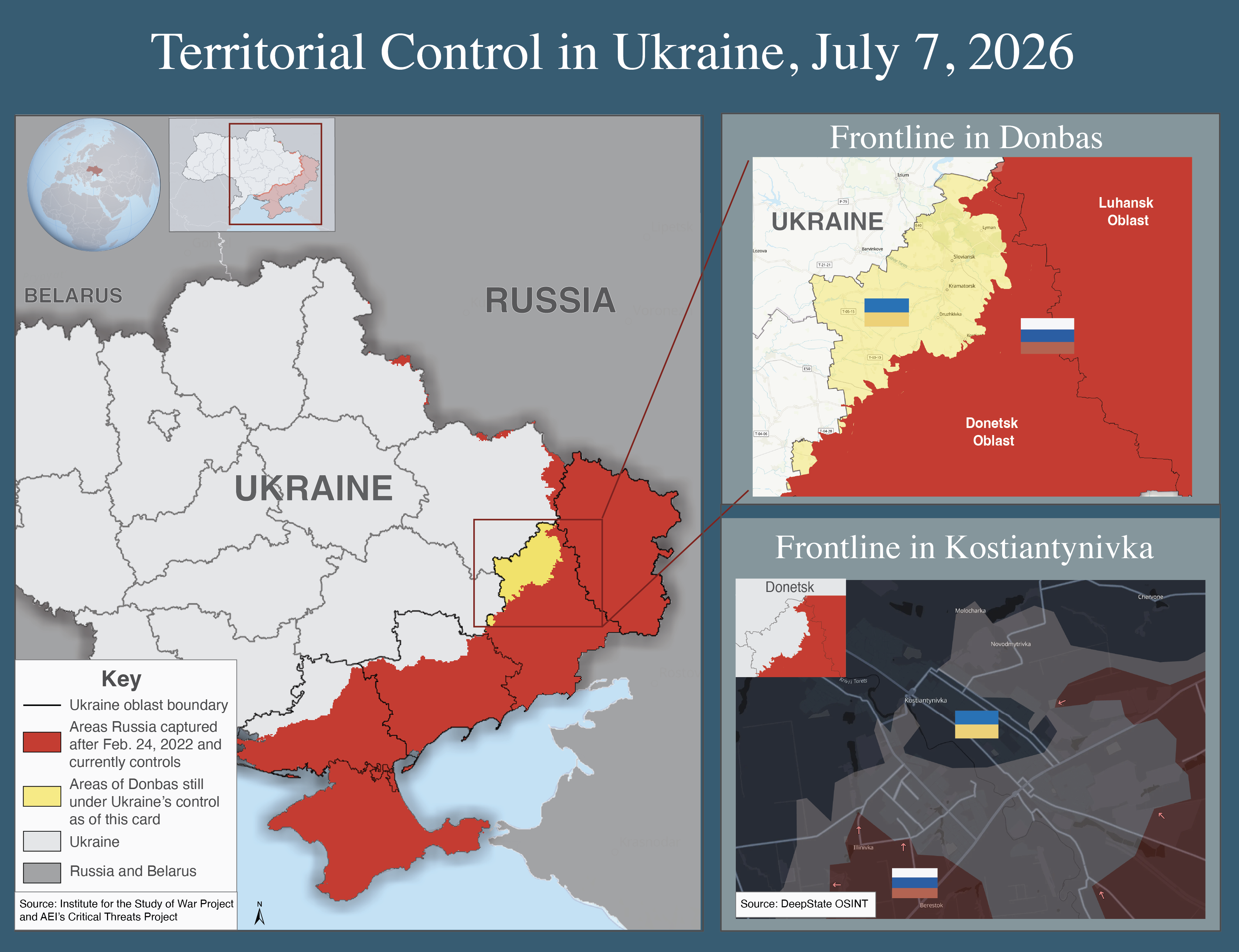
Seth G. Jones and Riley McCabe argue in a CSIS report that Russia has lost the military initiative in Ukraine as costs continue to mount. They assert that “the war in Ukraine heavily favors the defender,” that Russia’s progress has been “historically poor,” yet “despite high losses…Russia continues to fight.” On the battlefield, Jones and McCabe claim, Russia’s offensive has “largely stalled,” with average advances of “approximately 50 meters per day around Kostiantynivka, 70 meters per day around Pokrovsk and 90 meters per day around Sloviansk,” according to their July 1, 2026, report. On July 3, Russia's military told President Vladimir Putin that its forces had taken control of Kostiantynivka, according to MT. But on July 6, Volodymyr Zelenskyy denied this claim. Meanwhile, Ukrainian OSINT group DeepState showed much of Kostiantynivka in the gray zone on its map of the conflict, with Russian forces trying to execute a pincer movement to encircle the key city as of July 4, 2026.
Find past issues in the Russia-Ukraine War Report Card archive.
July 7, 2026 update: Based on data from Ukraine’s DeepState OSINT group, the past four weeks (June 9–July 7, 2026) saw Russian forces make a net gain of 31 square miles of Ukrainian territory (slightly larger than the size of Manhattan Island).1 In comparison, during the previous four-week period (May 12–June 9, 2026), Russia lost a net of 1 square mile, according to DeepState’s data. In contrast, ISW data indicates that in the past four weeks (June 9–July 7, 2026) Russian forces saw a net gain of 6 square miles of Ukrainian territory. Meanwhile, according to CSIS data, Ukrainian armed forces—which are running out of missiles for their U.S.-made Patriot air defense systems—intercepted only 14 of 54 ballistic missiles that Russia fired at Ukraine in June. More recently, Ukraine failed to intercept “any of the 23 Russian ballistic missiles” that hit the Kyiv area in the early hours of July 6, WSJ reported.
Territorial Control (DS and ISW figures as of July 7, 2026)2
 Read more