
Russia in Review, July 2–10, 2026
5 Things to Know
- Russian forces made a net gain of 31 square miles of Ukrainian territory (slightly larger than the size of Manhattan Island) in the past four weeks (June 9–July 7), according to the latest issue of RM’s Russia-Ukraine War Report Card (based on data from Ukraine’s DeepState OSINT group). In comparison, during the previous four-week period (May 12–June 9, 2026), Russia lost a net of 1 square mile, according to DeepState’s data. In contrast, ISW data indicates that in the past four weeks (June 9–July 7, 2026), Russian forces saw a net gain of 6 square miles of Ukrainian territory, according to the July 8, 2026, issue of the war card.
- Volodymyr Zelenskyy told FT the war’s decisive phase has shifted to “the sky.” But Ukraine’s greatest vulnerability is a critical shortage of antiballistic air defenses, especially Patriot interceptors capable of intercepting ballistic missiles. In a July 6 Russian strike involving 29 ballistic missiles and hundreds of drones, Ukraine failed to shoot down a single ballistic missile, according to FT. While Ukraine has intercepted about 90% of Russian long-range drones and 80% of 722 cruise missiles fired in 2026—70% of 522 ballistic missiles have gotten through, according to WSJ. Ukraine’s Patriot/PAC3 stocks are so low since the beginning of the Iran war, that launchers “sometimes sit half empty,” according to NYT. It is well understood that Ukraine effectively lacks a robust ballistic missile-defense shield, but hopes for large numbers of Patriot PAC3 interceptors are fanciful since the U.S. is currently manufacturing roughly 620 PAC3s per year, and several higher priority claimants—starting with U.S. forces in the Middle East and Indo-Pacific—are already in the queue before any substantial number will reach Kyiv. While announcements at the NATO summit about the U.S. giving Ukraine a license provided a bright shinny object to distract from the brute facts, in the real world, it will take years before Ukraine produces the first Patriot. There’s also the IRIS-T system, which Germany makes. It has some capability to shoot down ballistic missiles, but it is inferior to the Patriot’s. Some 20 units of IRIS-T have been delivered to Ukraine so far, according to a June 2026 report by Reuters.*
- WSJ’s Gerard Baker writes that senior European military and intelligence officials increasingly fear Vladimir Putin may test NATO with limited “probe” operations rather than a full-scale invasion along NATO’s eastern border—seizing small Baltic islands, staging an “assistance” incursion to protect Russian speakers in Estonia or similar moves that Moscow could frame as retaliation or humanitarian intervention. Any such step would force NATO to decide whether to respond with force; if the U.S. hesitated and the alliance failed to act, Baker argues, it would fatally undermine Article 5 and effectively destroy NATO’s credibility. Baker’s argument that Vladimir Putin could seek to exploit a perceived window of Western vulnerability in Europe deserves serious consideration. The most plausible scenarios are not a large-scale invasion, but a limited provocation against a vulnerable NATO member. Baker warns that Russia could seize Baltic islands or stage an intervention purportedly to protect Russian-speaking minorities in Estonia. His warning closely resembles long-discussed concerns about Russian exploitation of ethnic minority issues in the Baltic states. Russia has no widely recognized competing sovereignty claims over NATO-held islands, making such an operation more likely a fait accompli rather than the assertion of an existing legal dispute.
- Threats to Starlink: Leaked Chinese and Russian military documents depict Starlink as a frontline threat and primary target, not just a commercial satellite network, Sinocism reports, citing a joint investigation by The Insider, Der Spiegel and Le Monde. At a secret 2023 China–Russia military-technical forum in Guangzhou, senior engineers from the state-owned China Aerospace Science and Technology Corporation outlined an “antiStarlink alliance” built around a three-stage escalation ladder: jamming Starlink signals, hacking the network and ultimately physically destroying satellites in orbit, according to the July 9, 2026, Sinocism report.
- Czech President Petr Pavel warned Ukraine has roughly two months to make decisive progress toward ending the war before Russia’s Sept. 20 parliamentary elections. Afterward, he believes Putin may launch a highly unpopular general mobilization, according to RBC.ua. Pavel urged Ukraine’s allies to exert pressure on Russia to secure peace talks in the coming weeks. "Russia currently faces many internal problems and challenges. The Russian public is increasingly opposed to the war. It will be difficult for Putin to maintain calm at home," the Czech president claimed. While Pavel pointed to Russia’s problems in his comments, the comments can also be interpreted as a warning that it is Ukraine that may be running out of time when it comes to holding peace talks.
I. U.S. and Russian priorities for the bilateral agenda
Nuclear security and safety:
- No significant developments.
North Korea’s nuclear and missile programs:
- No significant developments.
Iran and its nuclear program:
- Russia’s state nuclear corporation Rosatom has begun sending staff back to Iran’s Bushehr nuclear power plant, with the first six employees returning, CEO Alexei Likhachev told Russia’s RIA news agency. Rosatom, which is building two new units at Bushehr, had earlier evacuated hundreds of workers after the United States and Israel launched a war against Iran on Feb. 28. (Times of Israel, 07.10.26)
Humanitarian impact of the Ukraine conflict:
Thursday, July 2, 2026
- On July 2, The New York Times reported that Russia’s four‑year war has sharply worsened conditions for pregnant women in Ukraine, driving up maternal mortality by over one‑third since 2023 and increasing premature births and miscarriages. With more than 80 maternity and neonatal facilities damaged or destroyed, many deliveries now occur in basements or shelters under bombardment, amid blackouts, displacement, frontline service and chronic stress — yet many women still choose to have children as an act of defiance and hope. (New York Times, 07.02.26)
Tuesday, July 7, 2026
- A BBC investigation summarized by Meduza has identified three alleged prison staffers involved in torture at secret detention sites in occupied Ukraine—Yuriy Temerbek (ex‑Novoazovsk traffic police), Ruslan Yeremichev (“Yermak”), and Andriy Spivak (from Omsk’s prison service)—all now living openly in Russia. Journalists mapped 93 illegal detention locations in occupied Ukrainian territory and another 102 in Russia; Ukrainian prosecutors say about 2,000 people have passed through such prisons since the full‑scale invasion began. (Meduza, 07.07.26)
Wednesday, July 8, 2026
- Axios reports the U.S.–Iran ceasefire over the Strait of Hormuz is effectively “over” after new exchanges of fire, and the White House is preparing for a campaign that could last from days to weeks depending on Tehran’s actions. Washington has launched fresh strikes, including inside Iran near the strait, after renewed attacks on shipping and U.S. bases; officials say the goal is to “slap them back hard” to keep the energy chokepoint open while still leaving room for a possible new deal. (Axios, 07.09.26)
Friday, July 10, 2026
- Ukrainian project “Schemes” and OCCRP identified the prison doctor “Konoval,” accused by about 50 former Ukrainian inmates of humiliating abuse at Russia’s Penal Colony No. 7 in Pakino, as 48‑year‑old Vyacheslav Cherdantsev. Witnesses say he forced prisoners to strip, simulate sex acts, made sexual comments, threatened rape and denied treatment, triggering a scabies outbreak. Roughly 30 ex‑prisoners said photos “look like” him; about 10 more recognized him definitively. Cherdantsev, a former Kyrgyz prison doctor, did not respond. (Meduza, 07.10.26)
For military strikes on civilian targets see the next section.
Military and security aspects of the Ukraine conflict and their impacts:
- A Novaya Gazeta Europe investigation says that after Chechen Rosgvardia columns came under fire near Hostomel in late February 2022, Ramzan Kadyrov “panicked” and ordered all Chechen units withdrawn from the Kyiv axis back to Chechnya, directly countermanding Moscow. According to a senior source in his entourage, when Rosgvardia chief Viktor Zolotov phoned and threatened to charge commanders with desertion unless they turned toward Mariupol and sent SOBR “Akhmat” as well, Kadyrov exploded and said Chechens “take orders not from Zolotov or Shoigu, but from Kadyrov,” adding that “Zolotov and Shoigu can go to hell.” (Novaya Gazeta Europe via Meduza, 07.06.26)
- Based on data from Ukraine’s DeepState OSINT group, the past four weeks (June 9–July 7, 2026) saw Russian forces make a net gain of 31 square miles of Ukrainian territory (slightly larger than the size of Manhattan Island). In comparison, during the previous four-week period (May 12–June 9, 2026), Russia lost a net of 1 square mile, according to DeepState’s data. In contrast, ISW data indicates that in the past four weeks (June 9–July 7, 2026) Russian forces saw a net gain of 6 square miles of Ukrainian territory, according to the July 8, 2026, issue of RM’s war card. (RM, 07.09.26)
Thursday, July 2, 2026
- On July 2, Ukraine’s DeepState OSINT group reported in its interactive map that the Ukrainian Armed Forces pushed back the Russian forces in Plavni. (RM,07.10.26)
Friday, July 3, 2026
- On July 3, Ukraine’s DeepState OSINT group reported in its interactive map that the Russian armed forces has advanced near Kryva Luka. (RM, 07.10.26)
- On July 3, Russian President Vladimir Putin made a rare frontline visit two days after a Russian strike on Kyiv killed at least 30 people and wounded about 100, vowing to expand a “security zone” into Ukraine’s Kharkiv and Sumy regions in response to further Ukrainian attacks on Russian infrastructure and reiterating his goal of seizing all of Donetsk and Luhansk, where Ukraine still holds a fortified area roughly the size of Delaware. He claimed Russian forces had “liberated” the key eastern town of Kostyantynivka and completed the conquest of Luhansk, while Kyiv dismissed this as “just another Russian lie,” and Ukrainian long‑range strikes continued to hit targets around St. Petersburg and deep inside Russia, including oil terminals and the Kronstadt naval base, worsening nationwide fuel shortages as Zelenskyy urged greater Western pressure ahead of the NATO summit in Ankara. (New York Times, 07.03–04.26; RFE/RL, 07.04.26)
- On July 4, The Moscow Times/AFP reported that Ukrainian President Volodymyr Zelenskyy and Ukraine’s General Staff flatly denied Russian claims to have captured the key eastern city of Kostyantynivka, calling them “just another Russian lie.” Kyiv says its forces are still defending the town and its approaches, while analysts warn that if Russia eventually secures it, the city could become a springboard for deeper advances along Ukraine’s “fortress belt” in Donetsk. (Moscow Times/AFP, 07.04.26)
- ISW says Putin vastly overstated Russian gains at a July 3 commanders’ meeting, claiming 133 settlements and over 3,000 km² seized since Jan. 1, 2026, including 29 settlements and 636 km² in June. By ISW’s mapped evidence, Russian forces have actually taken or infiltrated only 64 settlements and about 621.7 km² in all of 2026, and just 20 settlements totaling 30.42 km² in June—implying roughly 1,298 Russian casualties per km² gained that month and, at that rate, over 6.5 million casualties to capture the remaining 5,065 km² of Donetsk oblast. Russian briefers also told Putin their troops were 8–10 km from Slovyansk and Sumy and 9 km from Zaporizhzhia, but geolocated data shows lines still 13–25 km away, while only 100–250 Russian soldiers were inside Kostyantynivka in mid‑June despite Moscow’s claim of full control. (ISW, 07.04.26)
- With small pockets of Russian troops reported in the city's western, southern, and eastern districts, Kostyantynivka is in danger of falling entirely sometime before summer's end, according to some analysts, open-source intelligence experts, and Ukrainian and Western observers. (RFE/RL, 07.04.26)
- On July 3, Kremlin‑installed officials in occupied Tokmak, Zaporizhzhia region, said a Ukrainian drone strike on a crowded open‑air market killed at least five people and wounded 18, calling it a “deliberate” attack on civilians and opening a terrorism investigation; Kyiv did not immediately comment. The same day in Russia’s Kursk region, a remotely detonated mine exploded under a car carrying Rylsk district officials in the town center, injuring district head Vladimir Kovalchuk, utilities chief Sergey Besedin and two other staff. Separately, Ukrainian missiles struck Russia’s Belgorod city and district, killing one woman in a car and heavily damaging power infrastructure, with fires at substations leaving several municipalities without electricity and water. (The Moscow Times/AFP, 07.03.26; Meduza, 07.03.26; Meduza, 07.03.26)
- Ukrainian drone and missile strikes have knocked out roughly 25–33% of Russia’s refining capacity—about 2.2 million barrels per day by one expert’s estimate—triggering gasoline shortages in all but two Russian regions and occupied Crimea by early July 2026. Lines have stretched up to 18 hours in Irkutsk; at least a third of gas stations in Krasnodar are shut. Prices rose about 1.6% nationwide in the last week of June, with some independent stations in Grozny charging up to 100 rubles ($1.30) per liter. (New York Times, 07.03.26)
Saturday, July 4, 2026
- On July 4, Ukraine’s DeepState OSINT group reported in its interactive map that the Russian armed forces has advanced in Rodynske. (RM, 07.10.26)
- On July 4, RFE/RL reported that a night‑long Russian guided‑bomb attack on the northeastern city of Sumy killed at least four civilians, including a child, and injured 27, just two days after a massive strike on Kyiv that left around 30 dead and nearly 100 wounded. (RFE/RL, 07.04.26)
- Overnight July 3–4, Ukraine launched one of its largest long‑range drone raids yet on Russia’s northwest, striking oil and port infrastructure in and around St. Petersburg. St. Petersburg governor Alexander Beglov called it a “large‑scale” attack and confirmed the city’s oil terminal was hit, while Leningrad region governor Alexander Drozdenko said drones also struck the Baltic port of Vysotsk and claimed 72 drones were shot down over the region; Russia’s Defense Ministry reported 389 drones intercepted nationwide. (Bloomberg, 07.04.26; RFE/RL, 07.04.26; The Moscow Times/AFP, 07.04.26)
- Ukraine’s June campaign against Crimea targeted at least 31 Russian air-defense systems and radars in a single month, including what Kyiv claims was the $100 million Neva‑B radar, which can track targets up to roughly 370 miles away. (New York Times, 07.04.26)
Sunday, July 5, 2026
- Ukraine has refused to halt the shelling of the town of Kostiantynivka in the east of the country to allow Russia to hand over the bodies of fallen Ukrainian soldiers, the Russian Defense Ministry said on Sunday. (MT/AFP, 07.05.26)
- On July 5, RBC-Ukraine highlighted a rare admission from Kremlin spokesman Dmitry Peskov, who said Russia’s campaign against Ukraine is now a “real war,” not merely the originally branded “special military operation,” blaming Western involvement for the escalation. Peskov also described Ukraine’s long‑range strikes on Russian territory as “terrorist” in nature. The statement is one of the first times a senior Kremlin official has publicly called the conflict a war, underscoring how Western support for Kyiv and Ukraine’s deep‑strike capabilities have forced Moscow to adjust its own narrative. (RBC.ua, 07.05.26)
- The Washington Post reports one person killed and two injured in a Ukrainian strike on northern Crimea. FT data show Ukraine has hit Russian refineries at least 194 times since January 2026—an 11‑fold increase on early 2025—with a record 16 successful refinery strikes in May, driving Russia into its worst fuel crisis in decades. Bloomberg adds that Ukraine claims to have hit 16 power substations and a Crimean airfield in 48 hours, while Russia’s Defense Ministry says it intercepted 282 drones, nine guided bombs and one Neptune MD missile overnight and a total of 63,933 Ukrainian drones in the first half of 2026, with monthly claimed shoot‑downs surging from under 6,000 in January–February to 14,195 in May and 17,832 in June. (Washington Post, 07.05.26; Financial Times, 07.05.26; Bloomberg, 07.05.26)
- Since January 2026, Ukrainian forces have hit Russian refineries at least 194 times, an 11‑fold increase on the same period in 2025, with a record 16 successful refinery strikes in May alone. More than half of Russia’s regions have now imposed strict limits on fuel sales, and Moscow’s own lone refinery was struck several times in June, contributing to petrol shortages even in the capital. (Financial Times, 07.05.26)
- Russia’s own long‑range campaign has intensified: Ukrainian government data cited in the article show combined Russian missile and drone launches on Ukraine have exceeded 5,000 per month since February 2026. In one major attack on July 2, Russian forces launched 74 missiles and nearly 500 drones at Kyiv alone, killing 31 people, injuring more than 90, and leaving 10 still unaccounted for as of late July 5 while rescuers searched three strike sites. (Financial Times, 07.05.26)
Monday, July 6, 2026
- On July 6, Ukraine’s DeepState OSINT group reported in its interactive map that the Russian armed forces has advanced near Pazeno. (RM, 07.10.26)
- According to The New York Times, Ukrainian forces in Kostiantynivka repelled 11 separate Russian assaults on July 3 and estimate “more than 100” – possibly around 250 – Russian soldiers have infiltrated the city, controlling scattered buildings but not whole neighborhoods. In nearby Sumy, six Russian guided bombs hit on July 3, killing four civilians, including a 5‑year‑old girl and her mother. A southern Ukrainian farmer reports his fields, 30 miles from Russian positions in Kherson region, came under 29 drone attacks during last autumn’s sowing season and now face up to 100 Russian drones per day, making harvest “impossible.” (New York Times, 07.06.26)
- Zelenskyy told the Financial Times the war’s decisive phase has shifted to “the sky,” but Ukraine’s greatest vulnerability is a critical shortage of anti‑ballistic air defenses, especially Patriot interceptors. In a July 6 Russian strike involving 29 ballistic missiles and hundreds of drones, Ukraine failed to shoot down a single ballistic missile, despite having U.S.-made Patriot and French SAMP/T systems, because PAC‑3 rounds arrive in such tiny, last‑minute batches that stocks are nearly empty. He said Russia now fires roughly twice as many missiles as Ukraine receives via the PURL scheme and other channels, and that “there will never be enough Patriots for everyone.” Zelenskyy has pressed Trump and NATO leaders for more systems and missiles plus licensed production in Europe and Ukraine, arguing that without a robust anti‑ballistic shield—even as Ukraine excels with drones and sea denial—the “battle in the sky” that will decide the war could still be lost. (Financial Times, 07.06.26) It is well understood that Ukraine effectively lacks a robust ballistic missile‑defense shield, and that hopes for large numbers of Patriot PAC‑3 interceptors are constrained by hard production and allocation limits. The U.S. currently manufactures roughly 620 PAC‑3s per year, and several higher‑priority claimants—starting with U.S. forces in the Middle East and Indo‑Pacific—are already in the queue before any substantial quantity could realistically reach Kyiv. There’s also the IRIS-T system, which Germany makes. It has some capability to shoot down ballistic missiles, but it is inferior to the Patriot’s. Some 20 units of IRIS-T have been delivered to Ukraine so far, according to a June 2026 report by Reuters.
- The New York Times says Ukraine has squeezed more efficiency from its Patriot batteries by firing single interceptors per target, switching to manual mode, and using guns or interceptor drones against cheap UAVs, but shortages still leave cities exposed. In one recent attack Russia launched 68 missiles and 351 drones; Ukraine intercepted most cruise missiles but none of 23 ballistic missiles, and in another Kyiv strike it downed only 4 of 24 ballistic missiles. So far in 2026 Russia has fired 521 ballistic missiles at Ukraine—more than twice the same period in 2025—while Ukraine has shot down 164 (~31%), and Patriot/PAC‑3 stocks are so tight after the Iran war that launchers “sometimes sit half empty,” with only the U.S., Germany and Japan currently licensed to produce Patriots, driving Kyiv’s push for a U.S. production license (New York Times, 07.06.26).
- FT commentator Gideon Rachman writes that Russia is paying an enormous human price for minimal gains. Western officials now estimate Russian forces are losing around 35,000 soldiers killed or wounded every month on the Ukrainian front, a rate they believe already exceeds Russia’s ability to replenish its units. (Financial Times, 07.06.26) For RM’s chronology of estimates of casualties on both sides, please see RM’s latest war card.
- WSJ’s Gerard Baker says senior European military and intelligence officials increasingly fear Putin may test NATO with limited “probe” operations rather than a full‑scale invasion—seizing small Baltic islands, staging an “assistance” incursion to protect Russian speakers in Estonia, or similar moves that Moscow could frame as retaliation or humanitarian intervention. Any such step would force NATO to decide whether to respond with force; if the U.S. hesitated and the alliance failed to act, Baker argues, it would fatally undermine Article 5 and effectively destroy NATO’s credibility. (Wall Street Journal, 07.06.26)
- The Wall Street Journal, drawing on Ukrainian and independent data, says Ukraine has intercepted about 90% of Russian long‑range drones and 80% of 722 cruise missiles fired in 2026—but around 70% of 522 ballistic missiles have gotten through. In the July 6 attack on Kyiv, all 23 ballistic missiles hit, contributing to at least 12 dead and nearly 50 wounded, just four days after a July 2 strike that killed 31 and injured 100+. Lockheed delivered roughly 620 PAC‑3 interceptors in 2025 and aims for 2,000 annually only by 2030, while RTX is raising PAC‑2 output from 240 to 420 a year by 2027. (Wall Street Journal, 07.06.26)
- Ukraine didn’t shoot down any of the 23 Iskander-M ballistic missiles or the six high-speed Zircon and Oniks missiles launched by Russia, according to a Ukrainian Air Force tally published on Telegram. It had more success with slower-flying cruise missiles. (Bloomberg, 07.06.26)
- Russia’s Defense Ministry said air defenses shot down 519 Ukrainian drones overnight on July 6 across more than 20 Russian regions, occupied Crimea and the Sea of Azov, without stating the total launched. Meduza reports drones struck the large Yaroslavnefteorgsintez refinery in Yaroslavl and damaged infrastructure near the Luga range and the ports of Ust‑Luga and Vysotsk in Leningrad region. In Crimea, an energy‑infrastructure hit cut power to Sevastopol and then to the entire peninsula, forcing transport shutdowns and emergency repairs. (Meduza, 07.06.26)
- Ukraine’s K 2 brigade launched about 800 mid-range fixed wing drones in May, scoring roughly 650 confirmed hits — an 81% success rate — against Russian logistics up to 100 km behind the front using Starlink guided UAVs to close a 25–200 km “gap” between frontline drones and long range missiles. K 2 focuses on highways linking Mariupol, Berdyansk, Melitopol and Crimea, and Ukrainian intelligence says parts of this land corridor are now too dangerous, significantly slowing fuel, ammunition and troop movements. At the same time, iStories reports OSINT evidence that Ukrainian drones for the first time struck Russia’s largest refinery, Gazprom Neft’s Omsk plant 2,500 km from the border, reportedly hitting the 8.4 million ton per year ELOU AVT 11 primary unit and forcing temporary air traffic restrictions. (Washington Post, 07.06.26; iStories, 07.06.26)
- Ukraine certified its Flamingo cruise missile in only five weeks, versus the much longer timelines typical in EU states; Germany’s Diehl Defense is now looking to manufacture Flamingos domestically, signaling a potential shift toward cheaper, rapidly fielded systems. (Financial Times, 07.06.26)
Tuesday, July 7, 2026
- On July 7, Ukraine’s DeepState OSINT group reported in its interactive map that the Russian armed forces advanced near Predtechyne. (RM, 07.10.26)
- An Economist tracking project estimated on July 7 that Russia currently controls about 20.0% of Ukraine’s territory: 7.2% was under Moscow’s control before the full‑scale invasion, and a further 12.7% has been seized since February 24, 2022. Over the past 30 days, Ukraine has made modest gains of roughly 16 square kilometers. (The Economist, 07.07.26)
- Kyiv says its drones hit three Russian refineries, including Gazprom Neft’s giant Omsk plant ~2,500 km from the border, with a primary processing unit of 8.4 million tons/year reportedly damaged; Omsk is the last of Russia’s 11 largest gasoline producers to be struck. Bloomberg notes refinery outages are deepening a nationwide gasoline shortage. Overnight attacks meanwhile knocked out power across all of annexed Crimea. In response, Russia launched a major July 5–6 strike using 68 missiles (including 23 ballistic and six super/hypersonic) and 351 drones; Ukraine’s Air Force says 37 missiles and 326 drones were downed, but none of the ballistic or hypersonic missiles. Days later, Moscow mayor Sergei Sobyanin said over 430 Ukrainian drones targeted the capital region overnight, with 36–43 shot down on approach, while the Defense Ministry claimed 452 drones intercepted across Russia and Crimea. (Bloomberg, 07.06.26; The Moscow Times/AFP, 07.06–07.26; iStories, 07.07.26; Meduza, 07.07.26; RFE/RL, 07.07.26)
- Ukraine’s Unmanned Systems Forces say drones struck eight Russian‑flagged “shadow fleet” tankers in the Sea of Azov in the early hours of July 7, plus a dry‑cargo vessel and a ferry, causing “serious damage.” ISW reports that between July 1–7 Ukrainian forces hit eight named shadow‑fleet tankers (Venera‑3, Sanar‑1, Sanar‑17, Klimena, Teti, Alexei Savrasov, Ivan Cheremisinov, Penelopa), one cargo ship, one gasoline ferry to Crimea, and 44 electrical facilities across occupied Crimea and southern Ukraine; occupation authorities say 18 Crimean districts, all of occupied Kherson and parts of occupied Zaporizhzhia have suffered partial or total power outages after June–July strikes on air defenses, oil terminals, power plants, bridges and highways. (Meduza, 07.07.26; ISW, 07.07.26)
- Ukraine’s ability to shoot down Russian ballistic missiles has deteriorated in recent large-scale attacks, a sign that Kyiv is lacking U.S.-made Patriot interceptors to defend against strikes. Ukraine failed to intercept any of the 23 Iskander-M ballistic missiles or the six high-speed Zircon and Oniks missiles launched by Russia in an overnight strike from Sunday to July 6, according to a Ukrainian Air Force tally published on Telegram. It had previously intercepted roughly one-third of the ballistic missiles fired in Russia’s large-scale air assaults, and sometimes even more. (Bloomberg, 07.07.26)
Wednesday, July 8, 2026
- On July 8, Ukraine’s DeepState OSINT group reported in its interactive map that the Russian armed forces advanced near Kostiantynivka and Zatyshok. (RM, 07.10.26)
- As of July 9, 2026, DeepState’s map showed Ukrainian forces retaining control of a pocket in this key town.
- An Istories analysis says neither Russia nor Ukraine fully controls Kostiantynivka: Russian troops have infiltrated much of the ruined city and cut key roads, but Ukrainian units still hold positions in the center and south. Similar “gray zone” fighting is underway around Lyman and along the Siverskyi Donets and canal, while near Kupiansk Russia is slowly trying to eliminate Ukraine’s bridgehead east of the Oskil. (Istories/Meduza, 07.08.26)
- Ukrainian General Staff reported Ukrainian strikes on the TAIF‑NK refinery in Russia’s Nizhnekamsk, Tatarstan (capacity >8m tons/year), the Saratov refinery (7m tons/year), and the Borisoglebsk airfield in Voronezh (housing Su 34, Su 35S and Su 30M aircraft),; Ukrainian services also say they hit the Cherkasy LVDS pumping station in Bashkortostan, a key Transneft Ural node moving 2m tons of light products annually, while Gazprom reported a drone hit on the Krasnodarskaya compressor station feeding the Blue Stream gas pipeline to Turkey. (ISW, 07.08.26)
- Ukrainian Defense Minister Mykhailo Fedorov said Kyiv completed a second phase of “Operation Auchan” in June 2026, using new munitions to hit 231 Russian artillery targets and completely destroy 171. (ISW, 07.08.26)
- Ukraine says it hit two Russian oil refineries and several tankers off the country’s coast, the latest in a wave of attacks against key energy infrastructure. Kyiv’s forces struck Rosneft PJSC’s refinery in Saratov, and the TAIF-NK oil-processing facility in Russia’s Tatarstan region, Ukraine’s General Staff said in a Telegram statement. Six so-called shadow-fleet tankers, including five in the Azov Sea and one in the Black Sea, were also attacked, it said. Earlier on July 8, Robert Brovdi, Ukraine’s commander of unmanned forces, said Ukrainian forces hit a total of nine Russian tankers in the Azov Sea. Bloomberg could not independently verify the number. (Bloomberg, 07.08.26)
- Ukraine has intensified its Azov Sea campaign, claiming 21 Russian vessels hit in 72 hours: 19 shadow‑fleet tankers, one cargo ship and a ferry near Kerch. FT says eight small fuel tankers to Crimea were struck on July 7 after two larger shadow‑fleet ships were hit July 6, the “highest number of merchant vessels targeted within 48 hours” since the invasion. (Financial Times, 07.08.26)
- Ukraine’s top commander Oleksandr Syrskyi says Ukrainian forces are inflicting “consistently high” losses on Russian troops, degrading logistics and striking fuel‑energy infrastructure, but warns a “qualitative turning point” is still distant: Russia is expanding troop numbers, ramping weapons output and preparing to lengthen a >1,250 km front. (RBC.ua, 07.08.26)
- Ukrainian drones continued nationwide campaign against Russian energy infrastructure and logistics, with Gazprom confirming a strike on the Krasnodarskaya compressor station feeding the Blue Stream gas pipeline to Turkey and saying repairs are underway while flows continue. Reuters sources cited by iStories report Russia’s largest Omsk refinery has halted operations after damage to CDU‑10 (about 38% of capacity, 24,500 tons/day) and network issues idling CDU‑11 (another 37%), forcing Omsk NPP to stop selling gasoline and diesel on the St. Petersburg exchange and local Topline stations to halt sales to private motorists — meaning all 11 of Russia’s biggest gasoline producers have now been hit. In Tatarstan, OSINT and iStories point to fires at Sibur’s Nizhnekamskneftekhim and the 8‑million‑ton‑per‑year TAIF‑NK refinery, already linked to Tatneft fuel rationing “in all regions.” Additional drone‑related fires were recorded at the Borisoglebsk air base in Voronezh and near Bashneft’s Ufa refinery, while The Moscow Times/AFP say Zelenskyy confirmed overnight strikes on oil depots in Stavropol and Tver, a pumping station in Bashkortostan and a marine terminal in Rostov region, where two oil tankers in the Sea of Azov were damaged, one still burning as of early morning. (Meduza, 07.08.26; iStories, 07.08.26; MT/AFP, 07.09.26)
- In the early hours of July 8, Russia hit Kyiv with five ballistic missiles, killing one woman and injuring at least two people as fires burned an office building, warehouses and a garage cooperative in Sviatoshynskyi and Desnianskyi districts, days after a July 6 ballistic strike killed 19 in the capital and prompted a citywide day of mourning on July 7. Later that night, Russian drones and missiles killed four people nationwide — two in Kyiv and two in Kharkiv — as Moscow launched 169 long‑range drones and seven missiles (five ballistic); Ukraine says it downed or jammed 139 drones and that two anti‑radiation missiles failed, but all five ballistic missiles and 20 drones still hit 15 locations, highlighting acute Patriot shortages even as Zelenskyy, standing beside Trump in Turkey, confirmed Ukrainian drone strikes on refineries in Saratov and Tatarstan and called air defense “the priority” for new U.S. and NATO aid. (Meduza, 07.08.26; Istories, 07.08.26; Washington Post, 07.08.26)
- Russian journalist Dmitry Kolezev published an anonymous interview with what he said was a serving Russian general who says the war in Ukraine is in “stagnation” and that taking all of Donbas would require replenishing losses by 55,000–60,000 men every month—resources the state does not have. He claims the General Staff deliberately overstates successes to Putin “about twofold” and that air defense has been gutted by incompetence, with systems like Pantsir on Moscow rooftops used mainly for show. The general dismisses nuclear use or attacks on NATO as unrealistic “fantasy,” but sees new mass mobilization as likely and argues only negotiations “on any reasonable terms” can avert disaster. Without talks in the next 6–12 months, he warns, Russia faces demographic collapse, militarization, regional separatism and, ultimately, “the collapse of the state as such.” (Kolezev Telegram, 08.07.26)
Thursday, July 9, 2026
- On July 9, Ukraine’s DeepState OSINT group reported in its interactive map that the Russian armed forces has advanced near Bochkove. (RM, 07.10.26)
- Czech President Petr Pavel warned Ukraine has roughly two months to make decisive progress toward ending the war before Russia’s September 20 parliamentary elections; afterward, he believes Putin may launch a highly unpopular general mobilization. Pavel urged Western allies to intensify pressure on Moscow now to force serious peace talks while the Kremlin is constrained by domestic politics and growing public war‑weariness, saying the “window of opportunity” will quickly narrow once the Russian vote is over. (RBC.ua, 07.09.26)
- Ukrainian drones hit more Russian fuel infrastructure, including oil depots in Tver and Stavropol and two tankers in the Sea of Azov/Taganrog Bay, in what Zelenskyy calls a “long‑range sanctions” campaign to bring the “feeling of war” back to Russia; Moscow says 73 drones were downed while it launched 94 strike drones and two ballistic missiles of its own, with 19 drones and both missiles striking 13 Ukrainian sites. Regional officials reported a storage tank burning at the Tverskaya Neftebaza depot (part of Surgutneftegas’s 52‑station network), evacuations after fires reached fuel tanks in Vyazniki, Stavropol Krai, and two more tankers damaged off Rostov, while the Wall Street Journal says Ukraine’s latest FP‑1 drone strike reached Russia’s largest refinery in Omsk, nearly 1,500 miles from Ukrainian‑held territory, helping cut gasoline output in European Russia by “at least one quarter” and forcing Moscow to import gasoline for the first time in decades. (Washington Post/AP, 07.09.26; Meduza, 07.09.26; Wall Street Journal, 07.09.26)
- Economists cited by WSJ estimate Ukraine’s deep‑strike campaign has already knocked out 20–40% of Russian refining capacity, triggered long lines and rationing nationwide, and forced Russia to begin importing gasoline “from far away” because nearby Europe is closed off by sanctions. With Russia’s economy calibrated to cheap fuel, they warn subsidies to keep farmers, airlines and other sectors afloat could run to “several billion dollars a month,” further widening the budget deficit unless the war ends. (Wall Street Journal, 07.09.26)
- Ukraine currently launches “several hundred” medium‑ and long‑range drones daily, while in just 96 hours its forces hit 35 Russian fuel tankers and support vessels in the Azov and Black seas, and dozens of small tankers trying to supply fuel‑starved Crimea. (Wall Street Journal, 07.09.26)
- Ukraine currently intercepts drones and cruise missiles effectively but has failed to down any ballistic missiles in Russia’s recent July 1–2 and July 5–6 salvos, while Ukrainian intelligence says Russia can now produce 60–65 Iskander ballistic missiles per month, giving Moscow a window to intensify strikes before Ukrainian‑built Patriots come online. (ISW, 07.08.26)
- “We’ve reached a turning point,” Serhii, a 46-year-old Ukrainian army officer told FP’s Christian Caryl during his visit to Sloviansk in late June. The Ukrainians, he said, are striking devastating blows against Russia’s energy infrastructure, vital logistics, and the factories that produce critical components for its high-tech weaponry. He particularly applauded Kyiv’s campaign to sever the supply lines that provide Russian forces in occupied Crimea with ammunition, fuel, and food. So how long will it take to cut off the peninsula entirely? “I think we can do it by the end of the summer,” he answered. (Foreign Policy, 07.09.26) Contrast this estimate with RM’s assessment based on Ukraine’s DeepState OSINT group’s July 7, 2026 data. The latter indicates that in the past four weeks (June 9–July 7, 2026) saw Russian forces make a net gain of 31 square miles of Ukrainian territory (slightly larger than the size of Manhattan Island). In comparison, during the previous four-week period (May 12–June 9, 2026), Russia lost a net of 1 square mile, according to DeepState’s data.
- Russia’s FSB claims it foiled “unprecedented” Ukrainian‑planned terrorist attacks on defense sites and personnel, including an alleged plot to assassinate a senior Defense Ministry officer in Moscow. A 25‑year‑old Russian woman is accused of being recruited online by a Ukrainian intelligence officer who feigned a romantic relationship, had her rent an apartment, film the officer’s home and prepare supplies for an incoming hitman. She faces terrorism‑preparation and possible treason charges. (Meduza, 07.09.26)
Friday, July 10, 2026
- On July 10, Ukraine’s DeepState OSINT group reported in its interactive map that the Russian armed forces have advanced near Minkivka and near Bochkovoyi. (RM, 07.10.26)
- An oil refinery in the southern Krasnodar region caught fire after a Ukrainian drone attack early July 10, while authorities in the city of Taganrog evacuated some residents from their homes following a separate strike on a seaport. Officials in Krasnodar said the Ilsky Oil Refinery caught fire after drone debris fell onto it. They said debris also fell on at least one home and a commercial site. The Ilsky Oil Refinery, with a production capacity of around 138,000 barrels per day, has been attacked several times before. (MT/AFP, 07.10.26)
- A joint BBC–Mediazona project has documented more than 3,500 foreign fighters killed on Russia’s side in Ukraine. That includes 2,304 North Koreans identified from a new Pyongyang memorial, plus 1,285 others from over 40 countries—CIS states like Uzbekistan and Tajikistan, African nations, and countries such as Cuba, Nepal, India, Sri Lanka and Yemen. In total, their named list of Russian‑side dead now stands at 233,033 servicemen. NATO estimates about 24,000 foreign mercenaries from 44 states currently fight for Russia. (Meduza, 07.10.26)
- Commander‑in‑chief Oleksandr Syrskyi says Russia’s 2026 “large‑scale offensive” failed to achieve any of its stated goals despite “almost double” superiority in manpower and equipment. He notes Russia’s active offensive axes have been cut from 13 to 6–7, its advance rate has more than halved, and average monthly Russian casualties are about 32,000 killed and wounded. Ukraine’s Deep Strike assets hit 697 targets in Russia causing at least $6.1bn in damage, while Middle Strike operations hit 7,028 targets; artillery executed over 456,000 fire missions. (RBC.ua, 07.10.26)
- The Kremlin said July 10 that Ukraine’s continued drone and missile attacks inside Russia justify widening a so-called “buffer zone” in eastern Ukraine rather than pursuing peace through diplomatic negotiations. “The more Kyiv tries to escalate, the more we’re going to keep expanding this broader security zone, this buffer zone,” Kremlin spokesman Dmitry Peskov told reporters during a daily briefing. (MT/AFP, 07.10.26)
- Russian strikes with Shahed/Geran-type long-range attack drones hit a gas distribution station in the Ukrainian city of Kryvyi Rih on July 10. A significant fire broke out at the facility. (Status-6 X account, 07.10.26)
- Kremlin spokesman Peskov said he has asked the White House if it would be able to pressure Ukraine to stop the strikes on Russian infrastructure objects. Peskov added that the "Kyiv regime is currently completely unwilling to engage in a peace process." (Status-6 X account, 07.10.26)
Military aid to Ukraine:
Thursday, July 2, 2026
- In comments published July 2, 2026, Zelenskyy, speaking amid rubble in Kyiv after a massive Russian strike, said Ukraine has fully paid allies (including Norway) for some 200 air‑defense missiles but “not a single one” has arrived, accusing partners of dangerous delays. He warned that applause for Ukrainian successes in Crimea is “not enough,” stressed Ukraine is “fighting alone” on the battlefield, pressed for F‑16 progress, and vowed continued strikes inside Russia until a “just peace” is reached. (Meduza, 07.02.26)
Friday, July 3, 2026
- On July 3, 2026, Bloomberg quoted Polish Prime Minister Donald Tusk saying Poland should be “cautious” about pledging further financial aid to Ukraine at the upcoming NATO summit in Ankara, arguing that Warsaw already bears the main burden of defending the EU’s eastern border and deserves special treatment. He insisted Poland will still support Ukraine against Russia but linked funding debates to ongoing tensions over World War II–era history, while hinting at tentative progress in bilateral dialogue. (Bloomberg, 07.03.26)
Monday, July 6, 2026
- Finnish president Alexander Stubb told the FT that NATO leaders now broadly back Ukraine’s intensified long‑range drone and missile strikes inside Russia, arguing they’ve put Kyiv in its “best” military, political and financial position since 2022. (Financial Times, 07.06.26)
- Zelenskyy says Ukraine’s ballistic-missile defenses are critically short of Patriot interceptors and is pressing the Trump administration and NATO to act at the July 7–8 Ankara summit. In parallel, Ukraine’s deep‑strike campaign has hit Russian energy infrastructure “at an unprecedented rate,” including fresh damage on July 6 to facilities near the major oil‑export ports of Ust‑Luga and Vysotsk in Leningrad region. (Financial Times, 07.06.26)
Tuesday, July 7, 2026
- Finnish President Alexander Stubb called on his fellow NATO leaders to work on providing Ukraine with the means of defending itself against waves of missile strikes by Russia. Zelenskyy “needs more air defense, he needs more Patriots, because we’re seeing over 100 civilian buildings being hit just the other night with civilians dying,” Stubb said. “This is something that we Europeans and Americans need to work on.” NATO Secretary General Mark Rutte on July 6 cautioned that allies don’t have an endless supply of missile interceptors, hours after Ukraine implored the military alliance to send more to repel Russia’s deadly air strikes. (Bloomberg, 07.07.26)
Wednesday, July 8, 2026
- A NATO summit declaration in Ankara commits allies to about €70 billion in military equipment, assistance and training for Ukraine in 2026, with a pledge to sustain at least that level in 2027 as part of a broader €140 billion multi‑year package that combines an existing €60 billion EU facility with roughly €80 billion in new national pledges; the document also brands Russia a “long‑term threat” to Euro‑Atlantic security. ISW notes that fresh national commitments include a C$925 million (≈$653 million) Canadian package (C$475m for ammunition, C$400m for 35 armored vehicles, C$50m for tech and engineering), €268 million from Norway toward Patriot missiles via the PURL scheme plus additional PURL funds from Spain, and new drone‑production agreements Ukraine signed with Estonia, the Netherlands and Denmark for joint manufacturing in Ukraine and Europe. (Meduza, 07.08.26; ISW, 07.08.26)
- At the NATO summit in Ankara, U.S. President Donald Trump held his warmest meeting yet with Zelenskyy, giving his strongest public backing of Ukraine’s strategy by endorsing long‑range strikes “deep inside Russian territory” as “an escalation that could help lead to an end” of the war and signaling he will grant Kyiv a license to manufacture U.S. Patriot missile interceptors. Trump praised Ukraine’s “bravery,” said the U.S. will “give them the right to make Patriot and show them how to do it,” and even said he would consider visiting Kyiv if peace talks advance, though he acknowledged he has not yet consulted Lockheed Martin or RTX and that U.S. interceptor stocks are too low to meet Ukraine’s urgent near‑term needs. Zelenskyy, who said he approaches meetings with Trump in a “combat mood,” called rapid Patriot resupply “the most important” topic and said prior summit talks had already yielded “productive” defense commitments, while experts quoted by The Guardian note Patriot missiles cost about $3 million each, U.S. output is only ~50 per month, and any Ukrainian production line would take months to build and likely be targeted by Russia. (Wall Street Journal, 07.08.26; The Guardian, 07.08.26; RBC.ua, 07.08.26; RBC.ua, 07.08.26; Meduza, 07.08.26; RBC.ua, 07.08.26; Wall Street Journal, 07.08.26)
- Ukraine’s Foreign Minister Andrii Sybiha said Ukraine is already negotiating licenses with multiple international partners to produce Patriot-class antiballistic systems, calling licensed local manufacture one of the most effective ways to rapidly expand Ukraine’s missile-defense capacity. (RBC.ua, 07.08.26)
- Ukrainian air force officials say stocks of Patriot, NASAMS and IRIS‑T interceptors in some units are nearly exhausted, and front‑line states sharing borders with Russia—such as Germany—are reluctant to give up their own limited antiballistic reserves despite strong political support for Ukraine. (RBC.ua, 07.08.26)
- The U.K.’s new Defense Investment Plan allocates £298 billion (~$400 billion) over four years, including £63 billion for the nuclear arsenal, £5 billion for autonomous systems, £2.5 billion for cyber/electronic warfare and £790 million for homeland air defenses. Ukraine is referenced more than 30 times in the 81‑page document, which cites lessons from the war—mass, cheap, precise systems and drone warfare—as drivers for programs like Project NYX (£220 million for Apache‑loyal wingman drones) and a shift toward lower‑cost cruise missiles. (Axios, 07.08.26)
- RBC-Ukraine reports Norway will spend 3 billion kroner (about €268 million) to strengthen Ukraine’s air defense, including buying Patriot missiles under the PURL program with Denmark, Germany and Canada. Because some deliveries will be slow, Oslo plans to purchase missiles from states with existing stocks for faster transfer to Kyiv. (RBC.ua, 07.08.26)
Thursday, July 9, 2026
- Analysts say Trump’s pledge to license Ukrainian production of Patriot interceptors is symbolically major but won’t solve the 2026 missile shortfall. A PAC‑3 MSE already takes about 24 months to build in the U.S. and its solid‑fuel motor ~30 months; Ukrainian MP Yehor Chernev estimates even a pilot assembly line using imported kits would need 18–24 months, with highly sensitive components like active radar seekers likely still produced only in the U.S. A New York Times analysis notes Germany’s 2022 Patriot license has yet to yield a single missile and Japan needed about three years from its 2005 license to first PAC‑3 tests and now produces only ~30 a year, meaning Ukraine will be “starting from scratch” with a 20‑plus‑supplier chain under active bombardment and that any plant would be a prime Russian target—more a long‑term industrial hedge than an immediate fix for Ukraine’s air‑defense gap. (Washington Post/AP, 07.10.26, New York Times, 07.09.26)
- Ukrainians greeted Trump’s Patriot‑licensing pledge in Ankara with cautious relief, the New York Times reports: Patriots are Ukraine’s only reliable defense against Russian ballistic missiles, but setting up licensed production could take months or years and depends on complex supply chains. The report notes Ukraine has endured 521 ballistic‑missile launches in 2026 with only 164 intercepted so far, and quotes Kyiv residents who say “words are not actions,” urging a steady near‑term flow of U.S.‑made interceptors even as they welcome the long‑term prospect of producing Patriots domestically “like we are producing drones.” (New York Times, 07.09.26)
- Zelenskyy claimed Ukraine will receive a package of U.S.-supplied Patriot Advanced Capability‑3 (PAC‑3) interceptor missiles in the coming days, following talks with President Donald Trump at the NATO summit in Ankara. He said Kyiv and Washington also agreed to test maritime and aerial drones ahead of a possible “Drone Deal,” and reached a political agreement to license Patriot production in Ukraine. Zelenskyy called this a “window of opportunity” as Russia loses battlefield advantage. (Anadolu Agency, 07.09.26)
- A new SW Research poll for Onet finds 44.8% of Poles now believe their country’s military aid to Ukraine has been “too large,” while 38.2% judge it “adequate” and only 6.8% say it is “too little”; 10.2% are unsure. The findings underscore growing war‑weariness and cost sensitivity in a front‑line NATO state that has been one of Kyiv’s staunchest backers. (Ukrainska Pravda, 07.09.26)
Punitive measures related to Russia’s war against Ukraine and their impact globally:
Saturday, July 4, 2026
- An RFE/RL investigation published July 4, 2026, details how Russia’s Avtotor plant in Kaliningrad is assembling unlicensed “bootleg” BMW SUVs from leftover pre‑2022 kits and gray‑market parts after the German automaker exited Russia. Branded online as 2025 models but using older designs and decoupled software, the vehicles pose quality and safety risks yet remain popular among wealthy Russians seeking cheaper alternatives to sanctioned imports. (RFE/RL, 07.04.26)
Tuesday, July 7, 2026
- Slovakia’s visa centers in Russia will stop accepting Schengen visa applications from Russian nationals for two months, in July and August, except for sports-related cases; national visas for study, family reunification and specialized work will continue. Spain’s processing times for Schengen visas have stretched to up to 45 days (from 3–4 weeks), while Italy’s now exceed 60 days. (Meduza, 07.07.26)
Wednesday, July 8, 2026
- The Wall Street Journal reports a bipartisan group of U.S. lawmakers is pressing Treasury Secretary Scott Bessent at the NATO summit to back a long‑stalled Graham–Blumenthal bill enabling secondary sanctions and tariffs on countries buying Russian oil, gas or uranium. The White House has slowed the bill over concerns it would constrain Trump’s flexibility in Ukraine peace talks; lawmakers say only “painful” economic pressure will bring Moscow to serious negotiations. (Wall Street Journal, 07.08.26)
- The Kremlin on July 8 welcomed the International Olympic Committee’s decision to provisionally lift its ban on the Russian Olympic Committee, but said that the full return of Russian athletes to international competition will require further work. (MT/AFP, 07.08.26)
July 9, 2026
- Danish broadcaster DR and satellite imagery tracked Putin‑linked superyacht Graceful (renamed Kosatka) and the warship Voyevoda to Russia’s northern port of Severomorsk near Murmansk by July 5, after they passed off Denmark and along Norway’s coast under misleading AIS data claiming Istanbul as a destination. Experts believe the 82‑meter, $100–120 million yacht was moved north to shield it from Ukrainian drones, though repairs are also possible. (Meduza, 07.09.26)
Friday, July 10, 2026
- U.S. Sens. Richard Blumenthal (D‑Conn.), Lindsey Graham (R‑S.C.), Jeanne Shaheen (D‑N.H.), and Roger Wicker (R‑Miss.) said they had reached agreement with President Donald Trump’s administration to advance updated Russia sanctions legislation. The bipartisan bill would target countries and entities that continue doing business with Moscow, especially buyers of Russian oil and natural gas, in order to raise the cost of sustaining Russia’s war in Ukraine as the Kremlin resists peace talks. The White House has not yet commented. (Reuters, 07.10.26)
For sanctions on the energy sector, please see section “Energy exports from CIS” below.
Ukraine-related negotiations:
Thursday, July 2, 2026
- A senior U.S. official said Steve Witkoff and Jared Kushner are “prepared to travel to Russia and Ukraine if there was something new to discuss, but that they would not travel ‘for a photo op’.” (New York Times, 07.02.26.)
Sunday, July 5, 2026
- Kremlin aide Yuri Ushakov said Putin’s July 4 call with Trump lasted about 1 hour 25 minutes — their fourth this year — and was “business‑like and quite constructive,” focused largely on Ukraine ahead of the NATO summit in Ankara. According to Ushakov, Trump “offered to help” find a solution to the war, reaffirmed his “readiness to work towards a rapid end to the fighting,” and said envoys Steve Witkoff and Jared Kushner are prepared to visit Moscow, while Putin restated that any political‑diplomatic settlement must reflect Russia’s “fundamental” demands, including full control of the Donbas, and claimed Russian forces are “confidently advancing” and had taken Kostyantynivka — a claim Kyiv denies. Zelenskyy, who held a separate call with Trump that he described as “very good,” said there is a “real prospect” of ending the war and that U.S. resolve will be crucial as they continue talks in person at the Ankara summit. (MT/AFP, 07.05.26; Moscow Times/Reuters, 07.05.26; Kremlin, 07.04.26; Washington Post/AP, 07.05.26)
Monday, July 6, 2026
- Trump told supporters he is “surging” Russia‑Ukraine peace talks, claiming he “ended eight wars” and calling this conflict “going to be an easier one” because he knows both Putin and Zelenskyy. “He wants to end it, and Ukraine wants to end it, and we’re in talks,” Trump said. (Eric Daugherty, 07.06.26) Also see the section on Military Aid to Ukraine.
Tuesday, July 7, 2026
- Two-thirds of respondents (67%) of a Levada poll conducted in June support the actions of Russia’s armed forces in Ukraine (35% “definitely,” 32% “rather”), down 7 percentage points from May. Opposition has risen to 24% (11% “definitely,” 13% “rather”), up 8 points. At the same time, support for peace talks has grown again: 64% now say Russia should move toward negotiations, up 4 points in a month, while 29% think military action should continue. (Levada Center, 07.07.26)
Wednesday, July 8, 2026
- Trump told Zelenskyy at the NATO summit he would speak with Putin later the same day, saying he thinks Putin’s conditions for ending the war are “changing” and “probably getting a little bit better” for Ukraine. He even asked if Zelenskyy would go to Moscow to negotiate; Zelenskyy quipped it would be “difficult” because “there are a lot of Ukrainian drones there.” AlsoTrump likened the Russia‑Ukraine war to “two children fighting” in a park, adding that “sometimes you have to let them fight” but predicting a peace deal “will get done.” (Financial Times, 07.08.26; Financial Times, 07.08.26)
- Kremlin spokesman Dmitry Peskov said Donald Trump never called Vladimir Putin after promising to do so following his July 8 meeting with Volodymyr Zelenskyy at the NATO summit in Ankara, noting only that Putin is “always happy to talk.” At that meeting Trump pledged to license Ukrainian production of Patriot missiles and openly backed long‑range Ukrainian strikes into Russia, which Kyiv called “one of the best” U.S.–Ukraine meetings yet. (Meduza, 07.09.26)
Thursday, July 9, 2026
- The Financial Times says Trump’s Ankara performance mixed familiar NATO-bashing with a striking pro‑Ukraine pivot that reassured jittery allies. After threatening to pull all U.S. troops from Europe and railing about Iran, he sat beside Zelenskyy and announced Washington would license Ukraine to manufacture Patriot interceptors, calling it “pretty cool.” Diplomats told the FT Trump “likes winners,” and has been briefed that Ukraine now has the initiative with long‑range drones, making Putin “in trouble.” They hope the move signals a sustained shift toward stronger U.S. military backing and added pressure on Moscow. (Financial Times, 07.08.26)
- Reuters reports that, despite Trump’s claim a peace deal is “closer than people realize,” Putin is more likely to escalate the war in the coming months. Three Kremlin‑linked sources say he has “dug in his heels,” and that recent Ukrainian drone strikes on Russian refineries and ports—triggering severe fuel shortages—have hardened his resolve. One, who meets Putin regularly, cites a “high probability” of escalation as Putin seeks a “victory” by seizing all of Donbas and possibly creating a broader “security zone” along Ukraine’s border, while Russian strategists openly discuss striking Ukrainian industry and even NATO facilities. Putin, the source who meets him regularly said, considers winning control of the region a matter of principle, saying the Russian president “needs some kind of victory.” (Reuters, 07.09.26)
Great Power rivalry/new Cold War/NATO-Russia relations:
Thursday, July 2, 2026
- The Economist says U.S. troop levels in Europe have fallen from about 100,000 at the height of the post‑2022 build‑up to roughly 80,000, and a U.S. tank brigade has left Poland and Lithuania, undermining NATO’s new “Force Model.” Under “NATO 3.0,” America expects Europeans to lead on conventional defense while Washington provides the nuclear umbrella, yet a German think tank finds Europe still “strategically dependent” on the U.S. across the whole operational chain. With integration, not raw mass, at risk, analysts warn any future fight would resemble Ukraine’s attritional war more than a U.S.‑style high‑tech campaign. (The Economist, 07.02.26)
- U.S. Defense Secretary Pete Hegseth planned but then scrapped an announcement of further U.S. troop cuts in Europe, beyond canceling a nine‑month armored brigade rotation to Poland and withdrawing an infantry brigade from Romania. The administration is instead launching a force‑posture review that could last up to six months. Congress has moved to bar cuts below 76,000 U.S. troops in Europe without certification from top commanders, amid fears that reduced U.S. presence will embolden Russia and weaken NATO as the Ankara summit approaches. (Wall Street Journal, 07.02.26)
Friday, July 3, 2026
- A New York Times piece on July 3, 2026, cites an International Institute for Strategic Studies report documenting 144 suspicious drone incidents over a dozen European countries between August 2024 and February 2026, many near ports, air bases and a French nuclear carrier. Analysts assess it is “highly likely” these are part of a coordinated Russian campaign using “Russian‑linked vessels” in the North and Baltic seas. Legal and safety constraints often prevent NATO states from shooting drones down in peacetime, leaving allies exposed even as the EU’s proposed “drone wall” along the eastern flank remains largely unrealized. (New York Times, 07.03.26)
Sunday, July 5, 2026
- The Wall Street Journal reports that NATO’s non‑U.S. members boosted defense spending by 20% in 2025 to $574 billion, with Germany up 24% to $114 billion and aiming for about $180 billion by 2029—roughly triple 2024 levels. Around $300 billion in weapons orders have gone to U.S. firms. NATO officials warn industrial capacity is “reaching the absorption‑capacity level,” as the price of a standard 155mm shell has more than quadrupled since Russia’s 2022 invasion, prompting calls for consolidation of Europe’s fragmented defense industry and faster expansion of production. (Wall Street Journal, 07.05.26)
Monday, July 6, 2026
- Existing NATO defense plans assumed the U.S. would provide nearly 40% of allied war‑fighting capacity; that figure is now expected to fall as Washington cancels deployments, scales back assigned forces, and conducts a six‑month review of its European posture. (Financial Times, 07.06.26)
- NATO’s new analysis center in Bydgoszcz, Poland, is running dedicated projects on Russian glide bombs and other low‑cost munitions, reflecting alliance concern that cheap systems—rather than high‑end platforms alone—will heavily shape future European warfighting requirements. (Financial Times, 07.06.26)
- NATO Secretary General Mark Rutte cautioned that allies don’t have an endless supply of missile interceptors, hours after Ukraine implored the military alliance to send more to repel Russia’s deadly air strikes. “There is a limit to the amount of interceptors that are in NATO territory,” Rutte said, speaking a day before NATO leaders gather in Ankara, Turkey’s capital, for their annual summit. He stressed, however, that the alliance is “working from every angle” to produce more of the Ukraine-requested air defense systems. (Bloomberg, 07.06.26)
- On the eve of the NATO summit in Ankara, the alliance’s Secretary-General Mark Rutte said European members and Canada are on track to bring their defense spending into line with that of the United States, which has long criticized Europe's lack of military spending and perceived "free riding." (RFE/RL, 07.06.26)
Tuesday, July 7, 2026
- Trump is pressing allies to accelerate toward spending 5% of GDP on defense, far above NATO’s older 2% benchmark. European leaders point to what NATO chief Mark Rutte brands the “Trump Trillion”: two years of ~20% annual increases in non‑U.S. allied defense outlays and roughly $1 trillion in additional commitments, but Trump has dismissed this, saying “we don’t need their money.” (Axios, 07.07.26)
- The Kremlin said on July 7 that it would closely monitor the outcome of this week's NATO summit in Turkey, adding that a series of "confrontational" statements about Russia had preceded the event. (MT/AFP, 07.07.26)
- Axios reports the Pentagon has already cut U.S. Army brigade combat teams in Europe from four to three, canceling a planned deployment of about 4,000 troops to Poland. Washington has also reduced jets, tankers and warships earmarked for NATO crises, while Defense Secretary Pete Hegseth has ordered a six‑month review of U.S. force posture in Europe that could trigger further “adjustments,” according to U.S. officials. (Axios, 07.07.26)
- Sweden’s Prime Minister Ulf Kristersson brushed off any suggestion Russia might be planning a conventional attack on a NATO country. “Russia is very well aware of that attacking a NATO country would be an extremely bad idea,” Kristersson said in an interview with Bloomberg Television at a summit of the defense alliance’s leaders in Ankara, Turkey, on July 7. Asked about concern voiced by some European leaders that there could be a direct confrontation between Europe and Russia, Kristersson rejected the notion. (Bloomberg, 07.07.26)
- Serbian police arrested two suspected Russian agents at the Serbia–Hungary border in early June and found an explosive device in their luggage; German media report they were allegedly preparing a sabotage attack on a defense‑industry facility in Bavaria linked to support for Ukraine. A 2025 report by Germany’s domestic intelligence service cited by Bild concludes the country is “regularly targeted” by Russian hybrid operations. (Meduza, 07.07.26)
Wednesday, July 8, 2026
- NATO’s Ankara summit communiqué reaffirms an “ironclad commitment” to Article 5, labels Russia a “long‑term threat” to Euro‑Atlantic security, and notes that European allies plus Canada boosted defense investment by $138 billion in 2025 alone. Leaders also pledged €70 billion in military aid, training and equipment for Ukraine over the next two years, with a commitment to provide “at least a similar level” again in 2027—about €140 billion in total—by folding roughly €60 billion from the EU’s existing support facility into about €80 billion in new national pledges, stressing that European allies and Canada already fund the bulk of Ukraine’s security assistance. (Financial Times, 07.08.26; Meduza, 07.08.26) See comparison of NATO’s 2025 and 2026 summit declarations at the bottom.
- NATO members pledged €70 billion ($80 billion) in military aid to Ukraine for 2026 and “at least the equivalent levels” in 2027, ensuring continued support as Russia’s war shows few signs of abating. The military alliance made the commitment in a statement adopted at a summit in Ankara, where leaders from NATO’s 32 countries gathered. While the money doesn’t include any new contributions — it represents NATO’s previous €40 billion annual pledge plus €30 billion each year from a European Union loan — the reference is a change from last year’s summit, when leaders didn’t mention financial help for Ukraine. (Bloomberg, 07.08.26)
- Zelenskyy told the FT he will argue at NATO that Ukraine is now a “strategic asset,” not a liability: a “million-strong army,” advanced drone tech and a large defense industry that can rapidly adapt are, he says, among the alliance’s most capable deterrents against Russia. Ukrainian and allied intelligence assessments he cited warn Putin could attempt an incursion into a NATO state as early as 2027. (Financial Times, 07.08.26)
- Italy’s defense minister Guido Crosetto accused Russia of waging a “daily hybrid conflict” after Rome prosecutors arrested a 59‑year‑old former intelligence officer on charges of selling classified information from six sources (including four military officers in sensitive posts) to a Russian “diplomat” believed to be an intelligence agent. Authorities say they documented multiple conversations about information requirements and fees; Crosetto called the case “just the tip of a gigantic iceberg.” (Financial Times, 07.08.26)
Thursday, July 9, 2026
- Germany has agreed with the United States to buy long‑range Tomahawk cruise missiles and become the first foreign customer for the U.S. Typhon ground‑launched missile battery, closing a key gap with Russia even as Europe develops its own systems. Numbers and delivery timelines remain unclear. A July 7 letter of intent, signed by both defense ministers, commits Washington to approve German purchases of Tomahawk missiles and launchers in August. (Bloomberg, 07.09.26)
- U.S. State Department spokesperson Ian Bateson told RBC-Ukraine that NATO’s Ankara summit did not directly advance Ukraine’s formal membership bid; the issue “was not raised” as such. However, he said much of the agenda focused on Ukraine’s experience, especially drones, new battlefield tactics, armored warfare and defense production. Bateson highlighted Trump’s meeting with Zelenskyy—calling it a “turning point” after earlier Oval Office tensions—and stressed Washington wants a NATO oriented toward today’s war in Europe, not decades‑old models. (RBC.ua, 07.09.26)
- A Polish court in Sosnowiec sentenced Russian citizen Igor R. to seven years in prison for spying for the FSB and sending a parcel bomb, and his wife Irina R. to three years for aiding espionage, according to Ukrainska Pravda. Prosecutors say Igor R. gathered data in 2022–23 on Russian opposition figures in Poland and their helpers, then passed encrypted files to his wife to deliver to FSB handlers in Russia; he also allegedly helped ship nitroglycerin-based explosive devices via a courier firm. (Ukrainska Pravda, 07.09.26)
China-Russia: Allied or aligned?
- Leaked Chinese and Russian military documents depict Starlink as a frontline threat and primary target, not just a commercial satellite network, Sinocism reports, citing a joint investigation by The Insider, Der Spiegel, and Le Monde. At a secret 2023 China–Russia military‑technical forum in Guangzhou, senior engineers from the state-owned China Aerospace Science and Technology Corporation outlined an “anti‑Starlink alliance” built around a three‑stage escalation ladder: jamming Starlink signals, hacking the network, and ultimately physically destroying satellites in orbit, according to the July 9, 2026 Sinocism reports, citing the joint investigation by The Insider, Der Spiegel, and Le Monde. (The Insider, Der Spiegel, Le Monde, Sinocism, July 2026)
- On July 5, 2026, China’s Defense Ministry announced “Joint Sea 2026,” a naval exercise with Russia in waters and airspace near Qingdao later this month, to be followed by a joint maritime patrol in the Pacific. Beijing described the drills as part of an annual cooperation plan aimed at addressing “security challenges” and maintaining “regional peace and stability,” but provided no details on dates, ship numbers or aircraft involved. (Bloomberg, 07.05.26)
Missile defense:
- No significant developments.
Nuclear arms:
- China has again told Russia not to even consider using a nuclear weapon against Ukraine, according to President Volodymyr Zelenskyy. Russian nuclear saber rattling has accelerated in 2026, with officials and major Russian outlets making the case for tactical nukes more forcefully and unambiguously than any time since Vladimir Putin ordered the 2022 full-scale invasion of Ukraine. In response, China, a vital enabler of Moscow’s assault, has told Russia it must avoid any atomic attacks, Zelenskyy said — reiterating Beijing’s long-stated opposition to nuclear strikes. Zelenskyy framed Beijing’s stance as a significant constraint on Putin’s nuclear options. Zelenskyy added that he also discussed the topic with U.S. President Donald Trump, but he would prefer to keep the contents of that conversation private. (Bloomberg, 07.10.26, Politico, 07.10.26)
- Deputy head of Russia’s National Guard’s branch in the Russian-occupied parts of the Donetsk region, Alexander Khodakovsky, publicly argued that using tactical nuclear weapons in Ukraine makes neither military nor moral sense. Striking “dispersed” front‑line enemy troops would cause only “limited” damage while inevitably hitting Russia’s own soldiers; hitting “decision‑making centers” would mean killing civilians “on a genocidal scale.” If Russians are now so “saturated with hatred” that they are numb to such consequences, he wrote, “then it’s time to take a new look at ourselves.” (@ejdailyru, 08.07.26)
- On nuclear risks, Putin’s long-time confidant Nikolai Patrushev warns that some European states, especially in the Baltics, are provoking disaster. He says that when he watches Baltic leaders, he has the impression of “Baltic mice tugging at the whiskers of a cat with nuclear claws,” and calls such talk about attacking Kaliningrad the rhetoric of “pathologically abnormal people,” reflecting his view that escalation could have catastrophic consequences for Europe. (RG.ru, 06.15.26)
- Levada Center poll conducted June 23–30, 2026 finds most Russians opposed to using nuclear weapons in the war against Ukraine. Sixty percent say nuclear use “cannot be justified” (40% “definitely cannot,” 20% “rather cannot”), while 29% believe it “can be justified” (10% “definitely,” 19% “rather”). Support for nuclear use peaked at 39% in November 2024, then fell sharply; it has inched up slightly compared with last year. (Levada Center, 07.07.26)
Counterterrorism:
- No significant developments.
Conflict in Syria:
- Kommersant reports that Syrian investigators are examining whether the July 7 Damascus blasts during Emmanuel Macron’s visit were financed by ex‑regime figures around Bashar al‑Assad who took refuge in Russia, notably cousin and former tycoon Rami Makhlouf. The attacks, which killed one person near the presidential guest route, are thought linked to a July 2 bombing at a café by the Palace of Justice that killed 10, mainly lawyers. Syria’s interior minister says at least 30 suspects, including former Assad officials, have been detained; Damascus may ask Moscow to tighten restrictions on exiled Assad loyalists’ political activity. (Kommersant, 07.10.26)
Cyber security/AI:
- Another New York Times investigation finds state media and covert operations from China, Russia and Iran have mentioned data centers roughly 700 times between January and June 2026, seeking to exploit U.S. public unease about AI and electricity‑hungry server farms. Alethea analysts say the aim is to turn AI data centers into a “domestic fracture point,” as polls show 71% of Americans oppose having one built nearby. OpenAI recently exposed Chinese-linked actors using ChatGPT to generate anti‑data‑center propaganda, though these efforts drew “little to no authentic engagement.” (New York Times, 07.10.26)
Energy exports from CIS:
Saturday, July 4, 2026
- The Financial Times reported on July 4, 2026, that Russia’s “shadow fleet” of sanctioned oil tankers is increasingly avoiding the English Channel after French, British and Swedish forces intercepted 13 vessels this year, some now sailing unflagged after Cameroon ejected 39 ships from its registry. Tankers from Primorsk and off Portugal are rerouting via the North Atlantic or even around the Cape of Good Hope, adding days and fuel costs, as more European states move to empower their navies to stop suspect ships sailing without clear nationality. (Financial Times, 07.04.26)
Monday, July 6, 2026
- Russia’s flagship Urals crude has fallen to about $41.66 a barrel at western ports in early July, less than half its April peak during Middle East–driven market turmoil, according to Argus data used by Russia’s Finance Ministry to set taxes. The slide tightens already strained Kremlin finances after earlier windfalls when the Hormuz shutdown boosted prices and U.S. sanctions waivers lifted demand for Russian barrels. (Bloomberg, 07.06.26)
Tuesday, July 7, 2026
- The Financial Times estimates Greek shipping companies have earned at least $3.8 billion transporting Russian oil since mid‑2023, based on freight rates for 389 million barrels; another 153 million barrels carried by Greeks weren’t priced in the calculation. Dynacom Tankers alone made about $915 million, while Olympic Shipping (Onassis Group) earned at least $404 million, and Stealth Maritime and Polembros each cleared over $200 million. In May 2026, Greek firms still carried nearly 15% of Russian crude exports under the G7 price‑cap regime. (Financial Times, 07.07.26)
- Tumbling oil prices and a buildup of unsold barrels are squeezing the Kremlin even as Ukrainian attacks push Russian crude exports to post‑invasion highs. Four‑week average seaborne shipments hit 4.22 million barrels a day to July 5, the most since before 2022. Ukraine has intensified drone and missile strikes on Russian refineries, repeatedly hitting Lukoil’s Norsi plant, the 440,000‑barrel‑a‑day Omsk refinery, and facilities at Yaroslavl and Ust‑Luga. (Bloomberg, 07.07.26)
Wednesday, July 8, 2026
- Deputy Prime Minister of Russia Alexander Novak announced Russia is banning diesel exports from July 8 and will begin importing fuel to stabilize domestic supplies amid public concern and long lines at gas stations. The move comes after months of Ukrainian drone and missile strikes that have hit every major Russian refinery, contributing to a spreading fuel shortage and forcing the Kremlin to reverse earlier assurances that a ban was “unlikely.” (Meduza, 07.08.26)
Thursday, July 9, 2026
- The Financial Times estimates Ukraine’s drone strikes on Russian refineries have knocked out roughly 20–40% of refining capacity, cutting June throughput to about 4.1 million barrels/day—28% below the five‑year average and 35% below nominal capacity. The resulting fuel crisis directly affects some 50 million Russians (35% of the population), with multi‑day queues, rationing in nearly all regions, and Cossacks deployed to keep order at gas stations, even as Moscow bans diesel exports and rushes to import fuel from Belarus. (Financial Times, 07.09.26)
- Diesel futures in New York jumped 11% and European gasoil 13% after Moscow imposed a short‑term ban on diesel exports until July 31, following Ukrainian long‑range drone strikes that have halved Russia’s seaborne diesel exports to about 428,000 barrels/day in June and triggered long lines at gas stations across the country. (Wall Street Journal, 07.09.26)
- Ukraine said it hit 12 more tankers in southern Russia as Kyiv expands the scope of attacks that are deepening a nationwide gasoline shortage. The overnight strikes in the Sea of Azov targeted vessels used to supply fuel to the Russian army, as well as to skirt sanctions on transporting the country’s crude and petroleum products, Ukraine’s General Staff said in a Telegram statement. A tugboat and a dry cargo ship were also hit, according to the statement. Bloomberg couldn’t independently verify the number of hit vessels. (Bloomberg, 07.09.26)
Friday, July 10, 2026
- Reuters reports that after sustained Ukrainian drone strikes, Russia’s gasoline output has dropped to the equivalent of only about 65% of seasonal average domestic demand, based on industry sources and the agency’s own calculations. Multiple large refineries have been forced to halt operations for repairs, prompting Moscow to ban fuel exports and ramp up imports in an effort to stabilize supplies and ease shortages at filling stations. Officials acknowledge the shortfall is a serious concern, though they say production may partially recover later in July as damaged units are brought back online. (Reuters, 07.10.26)
- The Financial Times reports a looming global diesel crunch as Russia, the world’s second‑largest diesel exporter, halts exports just as the Iran war disrupts flows through the Strait of Hormuz. European diesel’s premium to crude has surged to about $60.70 per barrel, leaving diesel effectively near $135 even with crude around $70. Storage was already low; analysts warn “the rest of the world doesn’t produce enough diesel” to cover the loss, with potential knock‑on effects for farmers, industry and inflation. (Financial Times, 07.10.26)
- Deputy Prime Minister Alexander Novak publicly acknowledged that Russia faces “problems and a shortage” of fuel, blaming Ukrainian drone strikes that have forced refineries offline for repairs. All 10 of Russia’s largest refineries by capacity, including Omsk and Perm far from the front, have been hit. On July 8 Putin approved an export ban on diesel through July 31, on top of existing bans on gasoline and jet fuel, to ease long lines and erratic station closures. (Meduza, 07.10.26)
- No Kazakhstan’s Interior Ministry has deployed 59 police checkpoints near road border crossings to stop fuel smuggling, inspecting vehicles for illegal auxiliary tanks. Since January, police have recorded 255 such cases, 195 involving foreign drivers, who were fined and had extra tanks removed. Authorities say they intercepted 61 smuggling attempts in just two days. The crackdown follows Russia’s fuel crisis, which has driven “fuel tourism” from border regions into Kazakhstan for cheaper, available gasoline. (Meduza, 07.10.26)
Climate change:
- No significant developments.
U.S.-Russian economic ties:
- No significant developments.
U.S.-Russian relations in general:
Friday, July 3, 2026
- A new 11th-grade history textbook edition uploaded on Russia’s “My School” platform recasts the war narrative, crediting Donald Trump’s administration with a “positive role” in Ukraine peace talks and adding a reference to the 2025 Anchorage summit, while softening earlier anti-U.S. language and updating sections on Syria, domestic “SVO heroes,” and recent attacks like Crocus City Hall. (Meduza, 07.03.26)
Saturday, July 4, 2026
- On July 4, 2026, Russian Foreign Minister Sergey Lavrov issued a statement marking the 250th anniversary of U.S. independence, framing it against what he called the decline of Western “global hegemony” and the rise of a “more just and balanced multipolar” order. He highlighted past Russo‑American cooperation—from support for U.S. independence and the Civil War to the WWII alliance—and said Russia remains committed to the U.N. Charter. Lavrov expressed confidence that, through “equal” and “non‑interfering” dialogue, Moscow and Washington can jointly address global challenges, and he wished the American people peace and prosperity. (MID.ru, 07.04.26)
II. Russia’s domestic policies
Domestic politics, economy and energy:
Thursday, July 2, 2026
- On July 2, 2026, Communist lawmaker Nina Ostanina accused Russia’s government of hiding the full extent of the fuel crisis, claiming nearly a third of refineries are offline and warning that shortages before harvest season could threaten bread supplies and influence September Duma elections. Her criticism directly undercut Deputy Prime Minister Alexander Novak’s assertion that only “certain gas stations” face problems, as regions impose rationing after sustained Ukrainian strikes on refineries. (Meduza, 07.02.26)
Friday, July 3, 2026
- The Insider, citing UBS’s 2026 Global Wealth Report, says Russia now has the world’s second‑highest wealth inequality (Gini 0.82), just behind the UAE and ahead of South Africa and Brazil (0.81). Russia counts about 447,000 dollar millionaires (up 5.2% in 2025) and 122 dollar billionaires, ranking fifth globally. Average real wealth per adult has risen 37% since 2020, compared with a 55% increase in South Korea and declines of 14–23% in several major European economies. (The Insider, 07.03.26)
- On July 3, 2026, Meduza reported that Moscow prosecutors requested a four‑year suspended sentence for Artyom Vakhlyayev, sales head at major publisher Eksmo, accusing him of involvement in an “extremist organization” for selling LGBT‑themed books after Russia outlawed the “international LGBT movement.” He pled guilty, testified against colleagues and managers, and is part of the broader “book publishers’ case” that has already produced suspended sentences and detentions of publishing executives. (Meduza, 07.03.26)
- New polling published July 3, 2026 by state‑run VTsIOM shows Vladimir Putin’s job‑approval rating falling from 70.4% to 66.9% in a week—his sharpest drop since the 2022 invasion—amid mounting fuel shortages and economic strain. Disapproval rose to 21.3%, and a separate Levada Center survey found approval down to 74% in June, figures analysts say are notable in a climate where many Russians fear criticizing the authorities. (Moscow Times/AFP, 07.03.26)
Tuesday, July 7, 2026
- Belgorod’s acting governor Alexander Shuvaev, appointed in May 2026 at age 45, said in an interview that residents’ top wish is “for the special military operation to end,” echoing nationwide sentiment: Yandex recorded more than 137,000 searches for “when will the SVO end” in the week of June 22–28, the highest level since the invasion began, with nearly 13% of June’s queries coming from Moscow and St. Petersburg. (Meduza, 07.06.26)
- The Moscow Exchange Index fell 2.45% on July 6 to 2,187.83 points, its lowest level since February 27, 2023 (below 2,200 for the first time in over three years). Major losers included VTB (–10.5%), Inter RAO (–9.9%) and Transneft preferred shares (–8.4%); analysts note that exporters—over 50% of the index—are being hit by cheaper oil and a stronger ruble. (Meduza, 07.07.26)
Wednesday, July 8, 2026
- Russia's 450 lower-house lawmakers will receive early bonuses averaging about 4.5 million rubles ($59,000) each ahead of September's parliamentary elections, with State Duma Speaker Vyacheslav Volodin reportedly saying the payments were intended to narrow a pay gap with government ministers. (MT/AFP, 07.08.26)
- Rosstat data show Russia’s fuel crisis worsening: in the week June 30–July 6, gasoline prices rose 2.1% and diesel 3.4%—diesel’s sharpest weekly jump since 2022—bringing average prices to 74.01 rubles/liter for gasoline and 87.76 for diesel. Pump prices had already climbed 1.6% (gasoline) and 2.2% (diesel) the previous week, while some regions such as Sevastopol have recently seen spikes of around 30%. (Meduza, 07.08.26)
- An analysis in The Economist says the war is now “everyone’s problem” inside Russia: a July FOM poll finds 55% of respondents say their relatives and colleagues feel anxious (up from 40% last year), as petrol rationing leaves drivers waiting 2–3 hours for 20–30 liters, some stations run dry, and Crimea and Novorossiysk ban retail fuel sales. Focus groups in Moscow report a shift from frustration to “seething hatred” of authorities, mobilization fears are rising after reported grab‑raids in Penza, and even loyalists openly question “what all this is for” beyond Putin’s ego. (The Economist, 07.08.26)
- Russia's 450 lower-house lawmakers will receive early bonuses averaging about 4.5 million rubles ($59,000) each ahead of September's parliamentary elections, with State Duma Speaker Vyacheslav Volodin reportedly saying the payments were intended to narrow a pay gap with government ministers. (MT/AFP, 07.08.26)
Thursday, July 9, 2026
- Russia posted its first monthly budget surplus of the year in June as revenue jumped, buoyed in part by a surge in oil and gas receipts that’s likely to prove short-lived. The surplus amounted to 279 billion rubles ($3.7 billion), according to Bloomberg calculations based on Finance Ministry data published July 9. Oil and gas revenue jumped 38% from a year earlier, while non-oil revenue rose by about a third, the calculations showed. However, higher commodities prices triggered by the war in the Middle East appear set to provide only temporary relief to Moscow’s war-strained finances. (Bloomberg, 07.09.26)
- Russia’s short-lived oil windfall from the Iran war hasn’t fixed its widening fiscal hole. In the first half of 2026, Moscow spent about $320 billion—55% of the full-year budget—running a deficit of roughly $75 billion, over $30 billion more than in H1 2025. Overall oil and gas revenues for January–June were down more than 22% year-on-year, despite a Q2 price spike, while Ukrainian refinery strikes have forced costly transfers to domestic refiners amid Russia’s worst fuel shortage in decades. (New York Times, 07.09.26)
- A leader and extended interview in The Economist say oligarch Andrey Melnichenko’s unusually blunt public warnings reflect deepening Russian war fatigue and elite anxiety. The “fertilizer king” and long‑time Putin insider argues Russia now faces a dead end of four bleak paths: escalation up to possible tactical nuclear use to “break the deadlock,” collapse into warlord anarchy, subordination to China as a client state, or a North Korea–style militarized fortress — none of which, he says, offers lasting peace. Citing Ukraine’s drone and refinery strikes, fuel shortages and the war’s duration, he declares the old globalized order for Russia is over and calls, implicitly, for ending one‑man rule and devolving power toward a “sovereign” Russia where elites and citizens gain real agency, property rights are secure and the state is predictable if not liberal, warning that security‑service hardliners will resist but arguing that a serious elite debate over Russia’s post‑war future is now “unavoidable.” (The Economist, 07.09.26)
- The Economist reports billionaire Andrey Melnichenko donated 32 billion rubles in 2023 to Putin’s favored Sirius educational center just as prosecutors moved to confiscate his power company Sibeko. Two months after the payment—roughly equal to what he originally paid for Sibeko—prosecutors dropped their claim. Earlier, BBC Russia traced a 32‑billion‑ruble “charity” payment by his firm Kuzbassenergo to an unnamed recipient; Sirius is now revealed as the beneficiary. Melnichenko is worth an estimated $20.4 billion. (Meduza, 07.10.26)
- At a government meeting, Putin blamed Ukraine for trying to “disrupt the vacation season” and create “nervousness” by striking refineries, but insisted the fuel shortages are “temporary” and that Russia’s power system has one of the world’s “highest” safety margins. He urged vertically integrated oil companies not to “squeeze” product into their own networks and to supply independents, and lightly rebuked Deputy PM Novak to move faster on securing fuel for Crimea. (Istories, 07.09.26)
- A June 23–30 Levada Center poll finds Russian media consumption stable but steadily shifting online: TV remains the main news source for 56% of respondents, yet the combined audience of internet news (websites, social networks, Telegram/МАХ, etc.) has risen to 65%. Social networks are used by 38%, news sites by 25%, Telegram channels by 18–19% after the spring block, while YouTube news is cited by just 6%. (Levada Center, 07.09.26)
- Russian contract soldier Alexander Lunin, whose June 25 video appeal threatening a mutiny if Putin ignored frontline abuses went viral, has deleted that clip and 17 related Telegram posts after serving 11 days of administrative arrest for alleged extremist symbols. Lunin reappeared on July 9 saying he is “alive and well” but has not explained the deletions, which followed a home search and intense official scrutiny. (Meduza, 07.09.26)
- A Moscow judge on July 9 sentenced exiled human rights veteran Lev Ponomaryov to five and a half years in prison in absentia after finding him guilty of violating Russia’s laws on “foreign agents” and “undesirable” organizations. (MT/AFP, 07.09.26)
Friday, July 10, 2026
- A BOFIT analysis says Russia’s war‑driven spending is widening the federal deficit and complicating macro‑policy. Federal outlays jumped 17% year‑on‑year in January–May, with government procurement up 50%; the deficit reached 6 trillion rubles (2.6% of GDP), already double the full‑year plan. The central bank’s key rate is still 14.25% amid 5% annual inflation and gasoline prices up 20% year‑on‑year by late June, partly due to Ukrainian strikes on refineries. High rates and tax hikes are squeezing SMEs, while about 11.6% of corporate loans are now classified as “problematic.” (BOFIT/IntelliNews, 07.10.26)
- New VTsIOM data show Putin’s approval slipping for a second week, from 66.9% to 66.0%, while his “trust” rating fell from 76.7% two weeks ago to 72.3%. The state pollster recently added door‑to‑door sampling to its phone surveys. Independent outlet Agentstvo notes that a parallel FOM poll found the main event most Russians cited that week was the fuel shortage and rising gasoline prices, suggesting the crisis is beginning to dent perceptions of the president. (Meduza, 07.10.26)
Defense and aerospace:
Friday, July 3, 2026
- Russia’s 2026 grain and legume harvest is running one to two weeks behind last year, with only about 1.3–1.5 million hectares threshed by July 1—roughly a third of the 2025 pace—due to cold, heavy rains and now widening fuel shortages that are delaying diesel deliveries to farmers following Ukrainian strikes on refineries. (Meduza, 07.03.26)
Monday, July 6, 2026
- Russian Urals crude averaged $41.66 per barrel at western ports in the first three days of July, back below the $59 budget benchmark and far off its April wartime peak of $116.05 at Primorsk and May levels of $85–86. In June, after the U.S.–Iran deal on Hormuz, Urals averaged $60.92, briefly allowing Moscow to replenish reserves before this latest slide. (iStories/Meduza, 07.06.26)
- Internal documents show Gazprom’s new contract with Russia’s Defense Ministry will create three‑year “mobile fire group” reservist units to protect gas infrastructure, offering recruits their average civilian salary plus Defense Ministry pay and a 200,000‑ruble monthly bonus during two months of training. Participants must pass medical and selection checks, train for two months, serve only within their region, and can re‑sign for up to five more years; a 2025 law already allows reservists to be called up for special exercises by presidential order. (iStories/Meduza, 07.06.26)
- See section Military aspects of the Ukraine conflict and their impacts above.
Security, law-enforcement, justice and emergencies:
Thursday, July 2, 2026
- On July 2, 2026, a Moscow court sentenced former Rusnano senior manager Irina Rapoport in absentia to 15 years in prison, plus a 300‑million‑ruble fine and asset confiscations, over alleged embezzlement and commercial bribery tied to schemes routing more than 1.6 billion rubles out of the state nanotechnology corporation through bank Peresvet. Her defense says the case relies on a cooperating co‑defendant’s testimony; ex‑Rusnano chief Anatoly Chubais has condemned the broader prosecutions as “repression.” (Meduza, 07.02.26)
Friday, July 3, 2026
- On July 3, 2026, a Moscow military court sentenced 12 members of the far-right “National Socialism/White Power” group to between six and 20 years in prison, including Mikhail Balashov and Yegor Savelyev, accused of plotting to assassinate RT editor-in-chief Margarita Simonyan; rights monitors say the two confessed under severe beatings and electric torture. (Meduza, 07.03.26)
- The Moscow Times/AFP reported July 3, 2026 that Major General Alexander Dembitsky, former commander of an army corps in the Leningrad Military District, has been arrested on fraud charges linked to the Yastreb private mercenary group. Investigators allege Yastreb leaders, including its founder, extorted more than 8.8 million rubles from at least 89 recruits and even kidnapped a war correspondent; Dembitsky, now held in Lefortovo, denies the accusations. (Moscow Times/AFP, 07.03.26)
- Former Federal Air Transport Agency (Rosaviatsiya) chief Alexander Neradko, who led the regulator from 2009 until his dismissal in 2023, was detained in Moscow and charged with large-scale fraud, capping years of corruption probes into the agency that had already seen multiple subordinates arrested and Neradko formally reprimanded in 2022. (Meduza, 07.03.26)
Tuesday, July 7, 2026
- FSB arrested Major General Yuri Zazykin, commander of the 114th Motorized Rifle Brigade (ex‑1st DNR Army Corps), on July 4 in the Ukrainian theater and is holding him in occupied Donetsk on corruption charges. Zazykin, who led assaults at Avdiivka, had been awarded Hero of Russia in February 2025 and was reportedly about to be promoted to deputy commander of the 14th Army Corps before his arrest—part of a pattern where the Kremlin uses corruption cases to sideline commanders who have fallen out of favor. (ISW, 07.07.26)
Thursday, July 9, 2026
- A Russian court approved state nanotech firm Rosnano’s 11.9‑billion‑ruble civil claim against former executives including ex‑CEO Anatoly Chubais over losses from the Crocus MRAM‑chip project. Rosnano and partners invested about $55 million in charter capital and more than €200 million total, including €100 million from Rosnano, on terms the company now calls “unfavorable” and contrary to its mandate. Chubais, who left Russia in 2022, says prosecutions are “repression” and a “mockery of the law.” (Meduza, 07.09.26)
III. Russia’s relations with other countries
Russia’s external policies, including relations with “far abroad” countries:
Monday, July 6, 2026
- Tuareg rebels in Mali shot down a helicopter operated by Russia’s “Africa Corps”; OSINT analysts verified the shoot‑down video, and local reporting says everyone on board was killed. It is at least the second confirmed loss of a Russian military helicopter to rebels this year; another was downed in April, also killing the entire crew. (iStories/Meduza, 07.06.26)
- Russia’s Foreign Ministry said July 6 it will summon Sweden’s ambassador in Moscow to protest the latest incident involving unidentified drones crashing on the grounds of Russia’s Embassy in Stockholm. (MT/AFP, 07.06.26)
- Cyprus has resumed visa processing at its third-party centers across Russia, nearly a month after a contract lapse forced the country’s consulates to temporarily take over operations. Visa processing through private operator BLS International resumed July 6. (MT/AFP, 07.06.26)
Tuesday, July 7, 2026
- Heidelberg Materials AG, one of the world’s biggest cement producers, plans to expand in Russia after previously saying it halted new investments because of the war on Ukraine, according to people familiar with the matter. The German company plans a roughly $200 million expansion of its facility outside St. Petersburg, one of the people said. They asked not to be named because the information is private. Many Western companies either left Russia or stopped new business initiatives after Moscow’s full-scale invasion of Ukraine in February 2022. Heidelberg’s project therefore stands out, though there’s no evidence the company broke any laws or sanctions. (Bloomberg, 07.07.26)
Thursday, July 9, 2026
- Italy expelled two Russian military attachés in Rome—Ivan Petrovich Gorbachev and Mikhail Vasilyevich Astakhov—over alleged involvement in a spy ring, giving them three days to leave. The move follows the July 7 arrest of two former Italian intelligence officers accused of passing classified material to a Russian diplomat. Foreign Minister Antonio Tajani called it part of Moscow’s “hybrid tactics” and a “serious and unacceptable” interference; Russia promised a reciprocal response. (Meduza, 07.09.26)
- Russia and the West African countries making up the Alliance of Sahel States (AES) have pledged to strengthen military cooperation as jihadist insurgents gain ground in the region, according to a joint statement issued on July 8 night after talks in Niger's capital. Russian Foreign Minister Sergei Lavrov met his counterparts from Mali, Niger and Burkina Faso, all of which have turned to Moscow for support after breaking with France and other Western allies. (MT/AFP, 07.09.26)
Friday, July 10, 2026
- Turkey is seeking Russia’s consent to transfer air defense systems it bought from Moscow to a third country, an effort aimed at clearing the way for the purchase of U.S.-made F-35 fighter jets. Ankara made the approach in recent weeks, just months after President Recep Tayyip Erdogan proposed returning the S-400 missile systems to Russia — an idea that gained little traction, said Turkish officials, who asked not to be identified because the discussions are private. Giving the S-400 to a third country might not resolve the issue either, as U.S. senators told reporters this week that the transfer would not address security concerns. (Bloomberg, 07.10.26)
Ukraine:
Tuesday, July 7, 2026
- Ukrainian authorities found the buried body of 39‑year‑old Anastasia Berezovska near Kyiv; she was wanted by Interpol over the June 29 bombing in Monaco that critically injured businessman Vadym Yermolaev and his wife and lightly injured their 13‑year‑old son. Two suspects—a serving HUR officer and a former law‑enforcement officer—have been detained. Separately, Estonia says a fraud network led by Yermolaev’s elder son stole about €100 million (including €5 million from Estonians); he later paid Tallinn €8.5 million and received a suspended sentence and entry ban. (iStories, 07.07.26)
Friday, July 10, 2026
- EU ambassadors (COREPER) have agreed to open the sixth negotiation cluster, “External Relations,” in Ukraine’s EU accession talks, covering common security and defense policy, trade, humanitarian aid and development co‑operation. Deputy PM Taras Kachka said the formal decision is expected at the Intergovernmental Conference on July 14. The EU officially opened the first “Fundamentals” cluster with Ukraine on June 15, marking gradual but continued progress toward membership. (RBC.ua, 07.10.26)
- IntelliNews reports war fatigue is boiling over in Ukraine after an anti‑conscription protest in Lviv on July 9 turned into a riot, with a crowd attacking recruitment officers and overturning their car after a “press‑gang” member allegedly hit a man in the street. Social media is saturated with videos of Territorial Recruitment Center staff violently grabbing men—dubbed “busification”—amid acute manpower shortages. While Russia reportedly loses over 1,000 men a day, Ukraine is estimated to be losing roughly 125–330 soldiers daily, based on varying casualty‑ratio estimates. (IntelliNews, 07.10.26)
- In Kyiv, HUR officer Vladyslav Reut, charged with the premeditated murder of Monaco bombing suspect Anastasia Berezovska, has retracted his initial confession, now claiming former SBU officer Vitaliy Zhykovych pulled the trigger. Prosecutors allege the pair hired Berezovska for the June 29 Monaco car‑bomb attempt on tycoon Vadym Iermolaiev, then killed her on July 3, burying her in a forest. Reut told the court he killed people only “during a war” and says he confessed under duress, offering to take a polygraph. (Financial Times, 07.10.26)
- NABU and the Specialised Anti‑Corruption Prosecutor’s Office have notified a senior State Border Guard Service officer—identified by Ukrainska Pravda’s source as Colonel Artem Tkachенко—of suspicion of illicit enrichment under Article 368‑5. Investigators say that in 2023–24 he acquired assets worth over 11 million hryvnias (~$270,000) with no lawful income to justify them, including a Toyota RAV4 and large amounts of cash seized during a home search. The Border Guard Service says it will fully cooperate with the investigation. (Ukrainska Pravda, 07.10.26)
- A former official at Ukraine's state nuclear company Energoatom was formally named a suspect on Friday as Kyiv's National Anti-Corruption Bureau (NABU) presses ahead with the biggest wartime corruption case in the energy sector. The agency did not name the official. (Global Baking and Finance Review/Reuters, 07.10.26)
Russia's other post-Soviet neighbors:
Thursday, July 2, 2026
- On July 2, 2026, Belarus Security Council secretary Alexander Volfovich urged Belarusians to avoid traveling to Russia—especially border regions—after Moscow blamed Ukraine for a second drone attack on a Belarusian tourist bus in Russia’s Bryansk region. Minsk’s messaging has wavered between calling the latest blast an accident and echoing Russian claims, while Belarusian opposition figures and Ukrainian officials describe the incidents as Russian “provocations.” (Meduza, 07.02.26)
Tuesday, July 7, 2026
- Kazakhstan’s Constitutional Court ruled that President Kassym‑Jomart Tokayev may run again under the new constitution adopted in March 2026 and in force since July 1, which sets a single seven‑year presidential term and bans more than one election per person. The court clarified that all terms and appointments under the 1995 constitution “do not count” toward this limit, so any election after July 1, 2026, will be treated as a first term. Tokayev has been president since March 2019. (Meduza, 07.07.26)
- The Washington Post notes that Belarus switched off four Russian drone relay stations in Brest and Gomel regions by June 22, after a one‑week ultimatum from Zelenskyy, who threatened strikes if they stayed online. As part of a U.S.‑brokered deal in March, Lukashenko released about 250 political prisoners in exchange for Washington lifting sanctions on two state banks, the Finance Ministry and top potash producers. China, whose overland trade sends an estimated 3–5% of its Europe‑bound goods via Belarus, has signaled support for Minsk’s “sovereignty and territorial integrity,” adding another constraint on deeper Belarusian entry into the war. (Washington Post, 07.07.26)
- A New York Times investigation notes Estonia cut fentanyl overdose deaths by more than 70% by 2018, then saw mortality more than double again by 2022 as nitazenes spread. Globally, over 1,460 new psychoactive substances have been reported in more than 150 countries and territories, mostly in the last decade. Some new analogues are estimated to be 40+ times stronger than fentanyl, and in Estonia cychlorphine‑linked opioids went from zero lab detections in 2024 to killing more people in 2025 than nitazenes—and by April 2026 had already exceeded their 2025 total. (New York Times, 07.07.26)
Thursday, July 9, 2026
- A special court in Kazakhstan has overturned its earlier ruling allowing Ukraine’s state oil and gas company Naftogaz to collect a $1.4 billion international arbitration award from Russia’s Gazprom. (MT/AFP, 07.09.26)
IV. Quotable and notable
- Former Ukrainian armed forces commander-in-chief Valerii Zaluzhnyi argues that talk of Russia’s “defeat” is dangerously premature and fueled by “fantasies before disaster.” In a long essay, he warns that neither side can achieve outright military victory: Russia cannot conquer all of Ukraine, but Ukraine currently cannot liberate occupied territories. He calls the conflict a true war of attrition that will produce “no winners, only losers,” starting with Russia and Ukraine and potentially extending across Europe. Tactical successes, including deep strikes on Russian logistics and infrastructure, are temporary and cannot by themselves deliver a political victory, he writes, stressing the need to stabilize the front line and preserve Ukraine’s tolerance for mounting costs. Zaluzhnyi also criticizes NATO as an alliance of the “old world” built to avoid conflict rather than confront Russia directly, saying Europe remains Ukraine’s only hope but must rethink its security architecture. (Interfax-Ukraine, 08.07.26)
- Russian billionaire Andrei Melnichenko argues that Russia faces four grim paths—reintegration as a humiliated “vassal” of the West, becoming “a buffer zone and supplier of natural resources” to China, descent into “civil conflict with different warlords,” or a “North Korea‑style lockdown sustained by militarism, repression, isolation, rationing and the export of instability”—and that the “only alternative” is a “sovereign” Russia that “places the comfort of its people first,” where elites and citizens have real “agency” and the state protects “freedom and property ‘not as an act of good will but as an obligation’.”(The Economist, 07.09.26.)
V. Useful data
The treatment of Russia changes little between NATO’s 2025 Hague and 2026 Ankara Summit Declarations, underscoring continuity in NATO's strategic assessment. Both identify Russia as a long-term threat to the alliance. The language on Ukraine and its contribution to transatlantic security, however, becomes more robust in the 2026 declaration, with Ukraine mentioned six times in the 2026 document compared to twice in the 2025 document. In addition, while the 2025 declaration had general commitments to Ukraine, the 2026 declaration contains concrete pledges, including €70 billion ($80 billion) in military assistance for 2026, sustained support in 2027, recognition of European Allies and Canada as the principal providers of assistance and endorsement of the European Union's multi-year Ukraine Support Loan.
NATO’s Hague Summit Declaration of 06.25.25:
| NATO’s Ankara Summit Declaration of 07.08.26: |
References to Russia: 1 “United in the face of profound security threats and challenges, in particular the long- term threat posed by Russia to Euro-Atlantic security and the persistent threat of terrorism, Allies commit to invest 5% of GDP annually on core defense requirements as well as defense-and security-related spending by 2035 to ensure our individual and collective obligations, in accordance with Article 3 of the Washington Treaty.” | References to Russia: 1 “To counter the long-term threat Russia poses to Euro-Atlantic security and stability, and the persistent threat of terrorism, Allies are delivering on The Hague defense commitment.” |
References to Ukraine: 2 “Allies reaffirm their enduring sovereign commitments to provide support to Ukraine, whose security contributes to ours, and, to this end, will include direct contributions towards Ukraine’s defense and its defense industry when calculating Allies’ defense spending.” | References to Ukraine: 6 “Ukraine contributes to transatlantic security, and Allies stand united in our unwavering support for Ukraine in defending its freedom, sovereignty, and territorial integrity. European Allies and Canada now finance the vast majority of security assistance to Ukraine through bilateral and multilateral means. Allies underscore that this support must be equitable, predictable, and sustainable in the long-term. For 2026, Allies pledge €70 billion in military equipment, assistance and training for Ukraine and affirm their sovereign commitments to sustaining at least equivalent levels in 2027. To this end, we welcome the European Union’s decision to provide multi-year funding to Ukraine through the Ukraine Support Loan.” |
New polling by the Levada Center indicates that a clear majority of Russians continue to oppose the use of nuclear weapons in the war against Ukraine, although public opinion has fluctuated over the course of the conflict. According to a nationwide survey conducted on June 23–30, 2026, 60% of respondents believe that Russia's use of nuclear weapons cannot be justified, while 29% consider it justified. Support for nuclear use reached its highest level in November 2024, when 39% viewed it as justified, before falling sharply to 24% in June 2025 and recovering modestly in 2026 to 29%.
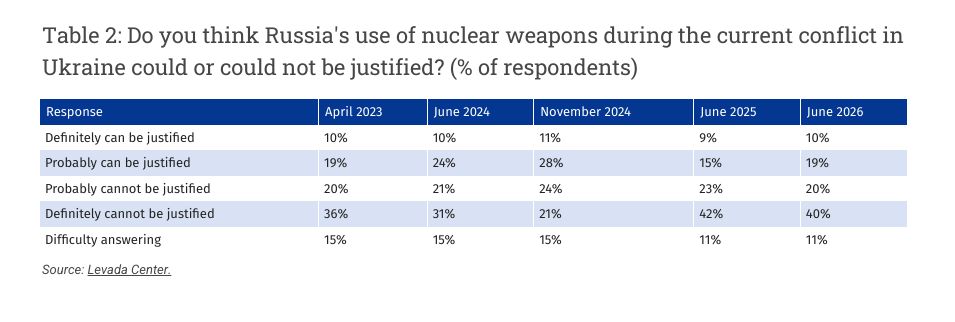
(source: Levada Center’s poll of Russians conducted June 23–30, 2026 and published on July 7, 2026)
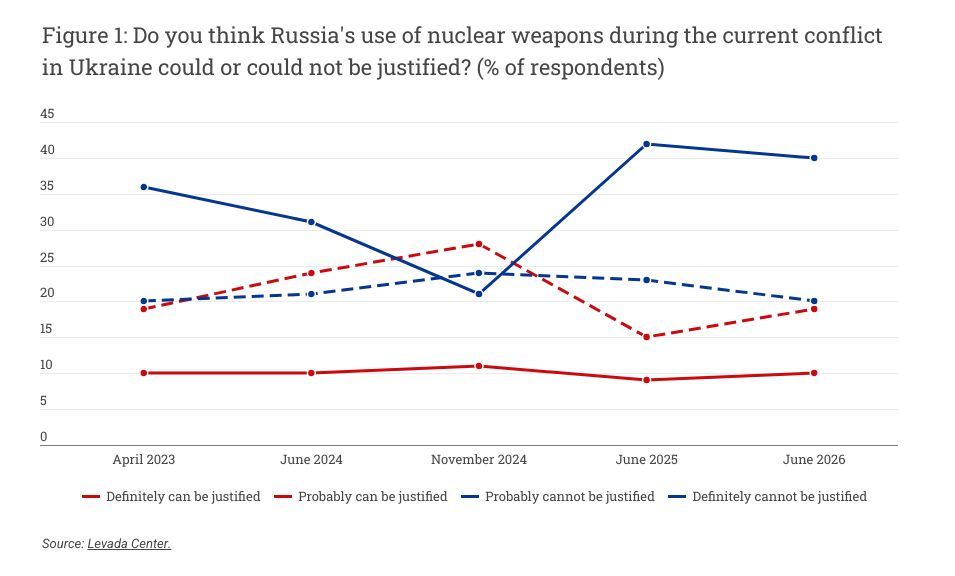
Endnotes
- Here is a more detailed description of Russian attacks that day: Russia’s July 5–6 barrage on Kyiv and other cities underscored Ukraine’s growing vulnerability to ballistic missiles despite high interception rates against drones and cruise missiles. Ukraine’s Air Force (via RBC Ukraine) said the strike used 419 aerial weapons: 68 missiles (six Zircon/Oniks, 23 Iskander‑M/S‑400 ballistic, 33 Kh‑101 and six Kalibr) and 351 Shahed/Geran/Italmas drones and Parodiya decoys. Air defenses destroyed or suppressed 363 targets — 37 missiles and 326 drones — but all 29 ballistic/anti‑ship missiles and 18 drones still hit, killing at least 12–27 people and injuring nearly 100, with 15+ residential buildings damaged or destroyed. ISW notes Russia has fired 41 ballistic missiles in its June 1–2 strike, 40 on June 14–15, 28 on July 1–2 and 29 on July 5–6, while a New York Times tally puts 2026 ballistic launches at 521 with only 164 intercepted; Ukrainian officials say they now stop almost all cruise missiles but essentially none of the ballistic ones, and Patriot deliveries will not begin until 2027. ISW assesses Moscow is deliberately lowering ballistic counts per salvo after depleting Ukraine’s Patriot stocks and is timing major strikes before events such as the July 7–8 NATO summit, even as Ukrainian drones hit Russia’s largest Omsk refinery ~2,500 km from the border, prompting first‑ever drone alerts in Novosibirsk. (ISW, 07.06.26; Financial Times, 07.06.26; RBC.ua, 07.06.26; RFE/RL, 07.06.26; Meduza, 07.06.26; New York Times, 07.06.26; iStories/Meduza, 07.06.26; The Moscow Times/AFP, 07.06.26)
The cutoff for reports summarized in this product was 10:00 am East Coast time on the day it was distributed.
AI was used in production of this digest.
*Here and elsewhere, the italicized text indicates comments by RM staff and associates. These comments do not constitute an RM editorial policy.
Slider photo: Rescuers clear the rubble after Russian missiles hit residential buildings during a massive air attack in Kyiv, Ukraine, Thursday, July 2, 2026. (AP Photo/Danylo Antoniuk)