
Russia in Review, June 5–12, 2026
3 Things to Know
- Data from Ukraine’s DeepState OSINT group indicates that in the past four weeks (May 12–June 9, 2026), Russian forces endured a net loss of 1 square mile. In comparison, the previous four-week period (April 14–May 12, 2026) saw Russia make a net gain of 41 square miles, according to the June 10 issue of RM’s Russia-Ukraine War Report Card. In the past week (June 2–9), Russian armed forces made a net gain of 6 square miles of Ukraine’s territory, according to DeepState, an increase over the reported loss of 10 square miles the previous week (May 26–June 2, 2026). In contrast, RM’s analysis of ISW’s data for the past four weeks (May 12–June 9, 2026) assesses that Russia lost a net of 91 square miles of Ukraine’s territory, and during the past week (June 2–9, 2026), lost 10 square miles of Ukrainian territory. Speaking in the Kremlin before Russian participants in the Russian-Ukrainian war on June 12, Vladimir Putin said: “We are making progress; perhaps not as quickly as we would like, but we are moving forward every day.”
- Russia’s full-scale invasion of Ukraine has now lasted more than 1,568 days, longer than WWI, according to reports by NYT and Meduza, which underscore that the conflict has become a grinding industrial war of attrition rather than a short, maneuver-centric campaign. “This is World War I, but with drones,” Yaroslav Hrytsak, a Ukrainian historian who has recently explored similarities and differences between the two wars, told NYT.
- NATO’s top U.S. commander, Gen. Alexus Grynkewich, said intelligence shows that Russia is not looking for a conflict with the alliance. “I’ve watched the intelligence very closely,” the Supreme Allied Commander Europe said at an event in Berlin this week, according to FT. “Russia is not looking for a conflict… They do understand the term ‘defensive alliance,’ and they do understand that we have a number of asymmetric advantages.” The United States plans to reduce the number of its F‑16/F‑15E fighters in Europe from about 150 to 100 and maritime patrol aircraft from 26 to 15, also removing all 8 aerial refueling tankers. Washington will also withdraw one aircraft carrier strike group carrier, according to NYT, FT and WP.
NB: Next week’s Russia in Review will appear on Thursday, June 18, instead of Friday, June 19, because of the U.S. Juneteenth holiday.
I. U.S. and Russian priorities for the bilateral agenda
Nuclear security and safety:
- Russia’s drone strike on nuclear‑related infrastructure hit the Centralized Storage Facility for Spent Nuclear Fuel in the Chernobyl exclusion zone occurred at about 02:10 on June 7, when a Geran‑2 (Shahed‑type) drone struck the reception building for fuel containers, destroying part of the structure and causing a roughly 40 m² fire that was extinguished without casualties. Energoatom and the IAEA reported no spent fuel in the building and said radiation levels remain normal, but Director General Rafael Grossi called the incident “deeply concerning,” noting “a large amount of nuclear material” is stored just meters away and recalling a February 2025 drone strike that breached Chernobyl’s New Safe Confinement and repeated wartime losses of off‑site power at the occupied Zaporizhzhia plant, which has now endured 18 such events. (Meduza, 06.07.26; Financial Times, 06.07.26; Financial Times, 06.07.26; Financial Times, 06.07.26; Rosatom, 06.05.26; ISW, 06.08.26)
- A new IPFM/SIPRI update estimates that as of early 2025 the world had about 1,240 metric tons (MT) of unirradiated HEU and 570 MT of separated plutonium; for Russia, roughly 116.1 MT of its separated plutonium is formally off-limits for weapons use (66.1 MT civilian, 25 MT pledged under the 2010 PMDA, and 15 MT weapon‑grade covered by a 1997 accord with the U.S.), while the United States has 49.4 MT of plutonium not directly available for weapons (mostly declared excess in warhead components) plus HEU in a downblending queue, with at least 3 MT of U.S. plutonium and 15 MT of Russian weapon‑grade plutonium under some form of bilateral or international monitoring. (IPFM, 06.12.26)
North Korea’s nuclear and missile programs:
- The Wall Street Journal reports North Korea’s GDP grew 3.7% in 2024—its fastest in eight years—helped by an estimated $10 billion in arms sales to Russia from mid‑2023 to end‑2024 and more than $500 million from deploying over 15,000 troops to Ukraine’s front lines (about one‑third killed or injured), according to Seoul’s INSS think tank. Trade with China has hit an eight‑year high, satellite data show oil‑storage activity and night‑time brightness roughly tripling in five years, and Pyongyang built 10,000 new homes last year—more than Los Angeles or Chicago—while luxury goods, EVs and app‑based taxi services proliferate in the capital, even as nearly half the 26‑million population remains malnourished and sanctions remain formally in place. (Wall Street Journal, 06.09.26)
- Kim Jong Un feted Chinese President Xi Jinping with two days of lavish celebrations in Pyongyang, calling ties with China a “top priority” in a clear message that Beijing, not Moscow, remains North Korea’s most important partner. (Bloomberg, 06.09.26)
Iran and its nuclear program:
- Mediators say U.S. President Donald Trump’s preliminary memorandum of understanding to end the three‑and‑a‑half‑month U.S.–Iran war and reopen the Strait of Hormuz still lacks sign‑off from Iran’s hard‑line security establishment centered on the Revolutionary Guard. The draft envisions an initial 30‑day halt to combat in and around the strait, full restoration of prewar shipping volumes with no new fees, and a U.S. lift of its port blockade, followed by a renewable 60‑day phase on Iran’s nuclear program and sanctions relief; talks are stuck over access to billions in frozen assets and the sequencing of de‑blockade versus reopening, with Supreme Leader Mojtaba Khamenei and senior IRGC generals still reviewing the text. Iranian state agency IRNA reports Tehran would assume no new nuclear obligations under the memorandum and that its “peaceful” nuclear program would remain unchanged, with any subsequent talks focused on Iran’s right to enrich uranium and retain enriched material as part of a final deal. (Wall Street Journal, 06.12.26, Anadolu Agency, 06.12.26)
- Russia’s Embassy in Tel-Aviv has warned its citizens against traveling to Israel after the country traded fire with Iran earlier on June 8 in their first attacks since the United States and Tehran struck a ceasefire deal two months ago. In a notice issued on June 8, the embassy said Russians currently in Israel should exercise caution and follow instructions from local authorities. (MT/AFP, 06.08.26)
- The U.S. House of Representatives overwhelmingly approved legislation aimed at preventing American and allied technology from ending up in Iranian-made drones used in conflicts from Ukraine to the Middle East. (RFE/RL, 06.10.26)
Humanitarian impact of the Ukraine conflict:
- Acting Belgorod Gov. Alexander Shuvaev said Ukrainian strikes have killed 541 people and wounded 3,928 in Russia’s Belgorod region since February 2022, with the border area having come under more than 55,000 attacks; the last full tally in May 2025 reported 320 dead and 2,500 wounded, highlighting the sharp escalation in cross‑border fire over the past year. (Meduza, 06.12.26)
- Ukraine’s population on government‑controlled territory is now roughly 22–25 million versus about 48 million in 1991, due to decades of low birth rates, emigration and war; experts warn that without a census and a real demographic strategy, shrinking labor supply and rapid aging will severely constrain postwar recovery. (Ukrainska Pravda, 06.11.26)
- Ukraine’s agricultural sector suffered direct losses of more than $11 billion as Russian drone strikes intensified sharply at the end of last year, according to Deputy Economy Minister Taras Vysotskyi. (Bloomberg, 06.09.26)
- Crimean residents are reporting broader shortages of basic goods such as buckwheat, sugar, rice and flour as deliveries to shops are disrupted, with independent outlet Agenstvo and Astra saying occupation authorities are blaming “natural” harvest lulls to mask the impact of Ukrainian attacks on supply routes. Gasoline shortages in occupied Crimea are also worsening as Ukrainian strikes hit both Russian refineries and bridges into the peninsula: Sevastopol’s occupation governor Mikhail Razvozhaev said major chain TES now sells fuel only via pre‑purchased QR codes, rationing has tightened from 20 liters per car per day to 20 liters per week, and a Ukrainian drone strike damaged the Chonhar bridge near the Dzhankoi checkpoint, forcing traffic closures and further constraining fuel flows. ISW assesses that continued Ukrainian strikes on rail, road and maritime links into occupied territories will increasingly degrade Russia’s ability to provision Crimea and other occupied areas with everyday necessities. (ISW, 06.08.26)
- For military strikes on civilian targets see the next section.
Military and security aspects of the Ukraine conflict and their impacts:
- Data from Ukraine’s DeepState OSINT group indicates that in the past four weeks (May 12–June 9, 2026) Russian forces endured a net loss of 1 square mile. In comparison, the previous four-week period (April 14–May 12, 2026) saw Russia make a net gain of 41 square miles. In the past week (June 2–9), Russian armed forces made a net gain of 6 square miles of Ukraine’s territory, according to DeepState, an increase over the reported loss of 10 square miles the previous week (May 26–June 2, 2026). In addition, DeepState reported in its daily map updates that Russian armed forces advanced near or in eight settlements during the June 2–9, 2026, period, while Ukrainian forces were not reported by DS to have made advances in that time. In contrast, RM’s analysis of ISW’s data for the past four weeks (May 12–June 9, 2026) indicates that Russia lost a net of 91 square miles of Ukraine’s territory, and during the past week (June 2–9, 2026), lost 10 square miles of Ukrainian territory. (RM’s Russia-Ukraine War Report Card, 06.10.26)
- Ukraine assesses it has recaptured more than 480 square kilometers (about 185 square miles) of territory since the end of January 2026. (Foreign Policy, 06.05.26)
- Russia’s new Unmanned Systems Forces branch, created in late 2025, already has some 120,000 personnel and could reach 160,000 by year‑end and 230,000 by 2030, even as Russia suffers roughly 500,000 killed since 2022 and around 30,000 dead a month at the front, according to Western intelligence. (The Spectator, 06.04.26)
- Ukraine’s long-range campaign has hit Russian oil infrastructure 68 times in the first five months of 2026, including 55 successful strikes in the last three months, plus 18 strikes on other industrial facilities. (Re:Russia, 06.02.26)
- Reuters estimates that about 700,000 barrels per day of refining capacity at 16 Russian refineries has been taken offline since the start of 2026—roughly double the disrupted capacity in the same period of 2025—after 35 primary distillation units (2.85 mbpd) were shut, compared with 12 units (1.37 mbpd) last year. OilX data cited in the analysis put May 2026 throughput at 4.58 million b/d, 13% below May 2025 and the lowest since 2009. (Re:Russia, 06.02.26)
- The range and depth of Ukrainian strikes have expanded sharply: in early 2025 only 2 of 32 recorded successful deep strikes (6%) hit targets more than 900 km inside Russia, rising to 25% in the second half of 2025 and 45% in the first half of 2026. New Ukrainian drones are now flying more than 1,500 km, and Zelenskyy says future variants may reach about 3,000 km, turning much of Russia’s interior into a viable target set. (Re:Russia, 06.02.26)
Friday, June 5, 2026
- On June 5, Ukraine’s DeepState OSINT group reported in its interactive map that the Russian armed forces advanced near Markove. (RM,06.05.26)
- ISW estimates Russian forces now control about 99.77% of Luhansk, 79.93% of Donetsk and 74.99% of Zaporizhzhia oblasts (80.82% and 75.7% respectively if infiltrated areas are included) — below Putin’s SPIEF claim of 100% Luhansk, 85% Donetsk, and 80% Zaporizhzhia. From December 2025–May 2026 Russia advanced into only 40.64 km² while losing 281.1 km²; Ukrainian forces have liberated more territory than Russia has seized in April–May, and ISW judges Russia’s Spring–Summer 2026 offensive largely stalled. (ISW, 06.05.26)
- Since February 2022, Russia has lost an estimated $500 billion in military equipment, including more than 10,000 tanks, 25,000 armored vehicles, and 30,000 artillery systems, much of it destroyed by Ukrainian first-person‑view (FPV) drones operating across a kill zone that now stretches roughly 10 miles or more on either side of the front. (Foreign Policy, 06.05.26)
- Ukrainian officials estimate they killed or seriously wounded more than 35,000 Russian troops in April 2026, with losses continuing at a similar pace in May and total Russian casualties since the invasion exceeding 1.3 million killed or wounded, while Russia’s spring offensive in Donetsk has “gone nowhere.” (Foreign Policy, 06.05.26)
- Ukraine’s Unmanned Systems Forces say they struck at least five Russian and Russian‑linked cargo ships and merchant vessels supporting logistics in and around the occupied ports of Berdyansk (~102 km from the front), Mariupol (~115 km), Yalta (~259 km) and in the Sea of Azov, including the dry cargo ships Natra and Zirkon in Taganrog Bay, where Azerbaijan reported five citizens killed and three wounded among 25 crew. Ukraine also likely hit a Svetlyak‑class patrol boat near Yurkyne (~250 km from the front) on the Kerch Peninsula and used drones to damage two locomotives near Rozdolne and Vladyslavivka (~194 and 185 km from the front) on the Dzhankoi–Kerch rail line, expanding its interdiction of Russian naval and rail logistics; Russia’s Defense Ministry claimed 123 Ukrainian drones were destroyed overnight, including over the Sea of Azov. (ISW, 06.05.26; Meduza, 06.05.26)
- FP estimates that Ukraine’s air defenses now regularly intercept 80–90% of incoming Russian drones and missiles, even during large-scale barrages, helping limit civilian casualties that still reached at least 238 killed and 1,404 injured in April 2026 alone—the highest monthly toll since July 2025. (Foreign Policy, 06.05.26)
- Ukraine’s annual drone production has surged from about 2,000 units before the full‑scale invasion to more than 4 million in 2025, from hundreds of new domestic manufacturers, with a target of 7 million drones in 2026 for both front‑line use and export. (Foreign Policy, 06.05.26)
Saturday, June 6, 2026
- On June 6, Ukraine’s DeepState OSINT group reported in its interactive map that the Russian armed forces advanced near Predtechyne. (RM,06.12.26)
- Ukrainian outlet Militarnyi, citing military sources, says Ukrainian forces “restored control” over about 250 km² in May 2026 while Russian forces seized only 130 km²; in April, Ukraine liberated 80 km² versus 150–160 km² gained by Russia. ISW’s own mapping finds an even sharper imbalance: in May, Russia seized or infiltrated only 40 km² but lost control of 280 km²; in April it gained 28 km² while losing116 km². Different methods, ISW notes, still converge on the same conclusion: Russia’s rate of advance is declining while Ukrainian recaptures are increasing. (ISW, 06.06.26)
- Residents of St. Petersburg were told to stay indoors on June 6 after what Leningrad region governor Alexander Drozdenko called an “unprecedented attack,” as Ukrainian forces conducted a second large drone strike series against the city, hitting the Kronstadt Naval Base, the Navy’s 15th Arsenal and naval yard, and the Petergofskaya and Neste oil terminals near Lomonosov, with officials acknowledging fires and three people lightly injured. Russia’s Defense Ministry claimed air defenses destroyed 376 Ukrainian drones overnight nationwide, while Zelenskyy said UAVs flew about 1,000 km to hit navy arsenals and an oil depot in Krasnodar, in a strike that underscored growing strain on Russian air defenses even during the SPIEF forum. (Washington Post, 06.06.26; Wall Street Journal, 06.06.26; iStories, 06.06.26; ISW, 06.06.26)
- A Ukrainian maritime drone, reportedly jammed by Russian electronic warfare, exploded in Romania’s Black Sea port of Constanța after Kyiv said it had “lost control” of it and warned the Romanian navy to prevent casualties. (Financial Times, 06.06.26)
- Ukrainian intelligence told the FT that 21% of people arrested for collaborating with Russia in 2025 were teenagers, and says Moscow has recruited children as young as 11 for arson and sabotage under the guise of “quest” games. (Financial Times, 06.06.26)
Sunday, June 7, 2026
- On June 7, Ukraine’s DeepState OSINT group reported in its interactive map that the Russian armed forces advanced near Kryva Luka. (RM,06.12.26)
- Russian drone strikes killed five people in Ukraine on June 7. (MT/AFP, 06.07.26)
Monday, June 8, 2026
- On June 8, Ukraine’s DeepState OSINT group reported in its interactive map that the Russian armed forces advanced near Zelene and Gulyaypole. (RM,06.12.26)
- Ukraine’s intermediate range drone campaign is increasingly disrupting some of Russia’s ground lines of communication to Crimea, with ISW noting Ukrainian forces now have drone‑enabled fire control over key hubs along the M‑04 Izvaryne–Donetsk–Dnipro highway (Luhansk City, Starobilsk, Alchevsk, Bryanka, Kadiivka), a route a Ukrainian operator calls more critical than the M‑14 to Crimea. Kyiv says its forces hit Russia’s Grushovaya oil transshipment hub near Novorossiysk and the Krasny Yar station in Volgograd region, plus oil depots at Semykolodezkaya and near Feodosia in occupied Crimea. what Ukraine’s defense minister calls a “logistics lockdown” for Russian forces. (ISW, 06.08.26; Washington Post / AP, 06.08.26; RFE/RL, 06.08.26)
- Over the last few months an increasing number of reports have emerged from the Russia-Ukraine conflict highlighting the use of uncrewed systems in medical-specific contexts. Such reports have included an aerial drone delivering blood supplies for a critically injured patient, identifying casualties requiring medical support from a distance, and delivering an evacuation option (e-bike) from the air. Remotely piloted uncrewed ground systems have also been proven in Ukraine for casualty evacuation in certain scenarios… Ultimately, such technologies are almost certainly helping to provide enhanced combat casualty care to the Armed Forces of Ukraine. (U.K. MOD X Account, 06.08.26)
Tuesday, June 9, 2026
- On June 9, Ukraine’s DeepState OSINT group reported in its interactive map that the Russian armed forces advanced in Rodynske. (RM,06.12.26)
- Ukrainian drones have again hit the Chonhar bridge on the Dzhankoi road crossing between occupied Kherson region and Crimea, forcing Russian occupation authorities to close traffic and divert vehicles to the longer Armjansk and Perekop routes, in at least the second strike on Chonhar in three days after a June 7 attack damaged the roadway. Ukraine’s intermediate range strikes have reportedly forced Russia’s Eastern Grouping of Forces to ban military cargo traffic from June 7 along the M‑14 Rostov–Crimea (R‑280) highway and the A‑291 Tavrida route from Kerch to Sevastopol, following earlier restrictions on civilian traffic as Ukrainian drones and missiles achieve fire control over key highways and rail lines. Separately, a Ukrainian drone strike earlier this week killed a woman in Russia’s southwestern Belgorod region, local authorities confirmed June 9, reversing initial reports that the attack had caused no deaths. (iStories, 06.09.26; ISW, 06.09.26; The Moscow Times / AFP, 06.09.26)
Wednesday, June 10, 2026
- Russian forces achieved new tactical gains in the Donetsk oblast’s key city of Kostyantynivka, with their two tactical groupings (“Bakhmut” and “Dzerzhinsk”) advancing into northeastern and western sectors of this city to come roughly two kilometers apart, ISW reported on June 10. On June 12, Ukrainian commanders said that more than 100, and possibly up to 250, Russian soldiers have infiltrated this eastern Ukrainian city which, alongside Druzhkivka, Kramatorsk, and Slovyansk, form a crucial defensive barrier in the Ukraine-controlled parts of the Donbas region, which is formed by the Donetsk and Luhansk oblasts. (ISW, 06.10.26; RM, 06.11.26)
- Ukrainian officers told Hromadske that more than 100, and possibly up to 250, Russian soldiers have infiltrated Kostyantynivka, Donetsk region, with enemy units now holding positions in the city center and trying to slice it into isolated sectors, echoing the Pokrovsk scenario; commanders warn Ukrainian forces are currently eliminating fewer Russians than are entering and say losing the city by late summer is a “real” risk. (Ukrainska Pravda, 06.12.26)
- Ukraine intensified its long-range “logistics lockdown” on June 10, launching a large wave of drones and FP‑5 Flamingo cruise missiles that Moscow says included 326 UAVs, while Russia fired 207 drones back at Ukraine. Zelenskyy said Flamingo missiles hit the VNIIR Progress military plant in Cheboksary, over 900 km from the front, and other strikes reportedly set ablaze Rosneft’s Kuibyshev refinery in Samara and oil facilities in Vladimir region, forcing Kuibyshev to halt crude processing and shutting two primary units of about 73,000 barrels/day each. Ukrainian officials say the campaign is now generating more than 5,000 mid‑ and long‑range drone strikes a month and has helped push Russia into a net territorial loss for May, with Ukraine claiming it retook nearly 40 square miles. A broader analysis finds Ukraine mounted 658 deep strikes (≥100 km) in 2025 and is on pace for more than 800 in 2026, contributing to an estimated 34% shortfall versus expected Russian fossil‑fuel export revenues in early 2026. (Meduza, 06.10–11.26; Washington Post / AP, 06.10.26; ISW, 06.10.26; New York Times, 06.10.26; The Economist, 06.10.26)
- Ukrainian defense firm Fire Point has conducted first tests of its FP 7.x air-defense interceptor, designed as a lower-cost alternative to the U.S. Patriot PAC 3 missile. Co founder Denis Shtilerman told the FT a single FP 7.x will cost about $700,000, versus $3.8 million for a PAC 3 — roughly 5.5 times cheaper — with serial production planned from August at up to three missiles per day and first batteries expected in 2027. FP 7.x will arm a new Freyja air-defense system being developed with European partners such as Hensoldt, Thales, Leonardo and Kongsberg. (Istories, 06.10.26)
- Russia’s full-scale invasion of Ukraine has now lasted 1,568 days — as long as World War I — underscoring that the conflict has become a grinding industrial war of attrition rather than a short, maneuver-centric campaign. The Meduza analysis stresses how, as in 1914–1918, the decisive factors are now defense production, logistics, societal resilience, and the ability of states to finance and justify a long war, rather than any expectation of quick, decisive breakthroughs on the front. (Meduza, 06.10.26)
Thursday, June 11, 2026
- On June 11, Ukraine’s DeepState OSINT group reported in its interactive map that the Russian armed forces advanced near Kostiantynivka and Illinivka. (RM, 06.12.26)
- Ukraine has carried on with its new “logistics lockdown” phase in its drone war, using upgraded, AI‑enabled midrange drones to launch over 5,000 mid‑ and deep‑range strikes a month and, in May alone, roughly twice as many attacks more than 30 miles from the front as in April, a campaign Kyiv says has helped cause fuel shortages, disrupt troop rotations and contributed to a net gain of about 40 square miles of territory. Overnight June 11, Ukrainian drones struck multiple bridges linking occupied Kherson region and Crimea—two over the North Crimean Canal near Preobrazhenka and Myrne, the road bridge between Perekop and Armiansk, and a bridge near Stavky—forcing traffic closures and further squeezing fuel flows to the peninsula already hit by repeated attacks on the R‑280 “Novorossiya” highway, which Ukrainian drones have turned into a “highway of death.” (The Moscow Times / AFP, 06.11.26; New York Times, 06.11.26; The Guardian, 06.11.26; iStories, 06.11.26; RBC.ua, 06.11.26; Meduza, 06.11.26)
- At a joint press conference with Nordic and Baltic leaders, Volodymyr Zelenskyy said Ukraine aims to reach the capacity to launch up to 600 drones and missiles a day against Russia, arguing that only then will Russians “feel this war as we do,” and tying the pledge to Kyiv’s rapid expansion of domestic strike-drone and missile production. (RBC.ua, 06.11.26)
- Russia launched a massive overnight air attack on June 10–11, firing two Iskander‑M ballistic missiles from Belgorod region and 221 Shahed, Geran, Italmas and decoy drones from multiple directions; Ukrainian air defenses shot down or suppressed 195 drones, but missiles and 21 UAVs hit nine locations, with debris falling in eight more. (RBC.ua, 06.11.26)
- Ukrainian Gen. Oleksandr Syrskyi assesses that Ukrainian FPV drones now outnumber Russian FPVs by roughly 1.5:1, helping Kyiv’s Unmanned Systems Forces hit nearly 180,000 verified targets in May (up 27% from April), including about 2,000 mid‑range strikes and 414 command posts. (ISW, 06.11.26)
Friday, June 12, 2026
- On June 12, Ukraine’s DeepState OSINT group reported in its interactive map that the Russian armed forces advanced near Zakitne. (RM,06.12.26)
- Waves of AI-guided drones are hammering Russian supply lines in occupied Ukraine as Kyiv seeks to capitalize on its latest advances in technology and tactics. Ukrainian commanders have been focusing on upgrading the medium-range strike drones, according to Ukrainian officials and a Russian involved with the industry. The latest models are more resistant to electronic jamming and have autonomous targeting capabilities that allow them to hit fuel depots, ammunition dumps and command posts up to 150 kilometers (93 miles) beyond the front lines. As a consequence, strikes on Russian tanker trucks jumped by 40% in May compared with the previous month. (Bloomberg, 06.12.26)
- ISW reports Ukrainian forces have heavily damaged or disabled multiple bridges linking occupied Kherson region to Crimea — including crossings at Armyansk, Preobrazhenka–Myrne, and near Stavky — and recently struck a large Russian convoy near Armyansk, destroying or damaging about 50 fuel and ammo trucks, temporarily cutting all land GLOCs from Kherson to Crimea and complicating Russian logistics for southern operations. (ISW, 06.12.26)
- Ukrainian drones struck two oil refineries in Nizhnekamsk (TANEKO and TAIF‑NK) and the Tolyattikauchuk petrochemical plant in Samara region on Russia Day, also hitting a 12‑story apartment building in Nizhnekamsk and injuring four people; Russia’s Defense Ministry claimed 231 drones were shot down across 15 regions, occupied Crimea and the Sea of Azov as Kyiv’s campaign against Russian energy infrastructure widens. (Meduza, 06.12.26)
- An explosion at northwestern Russia’s port of Ust-Luga has killed three citizens of Serbia and Uzbekistan, local media reported June 12, adding that five more people were injured. Unidentified authorities told state news agencies the three deaths and five injuries occurred as a result of an accident during equipment testing at a gas complex in the Leningrad region’s Kingiseppsky District. (MT/AFP, 06.12.26)
- Russian President Vladimir Putin said in a speech before Russian participants in the Ukrainian war on June 12: “We are making progress; perhaps not as quickly as we would like, but we are moving forward every day and gradually bringing our territories under control. That is how it will be—we will achieve this; no one should have any doubt about that.” (Nezavisimaya Gazeta, 06.12.26)
- Putin also vowed to intensify Russian strikes on Ukraine in response to Ukrainian drone attacks on targets across Russian territory. Putin said Russia must “respond to them [the Ukrainian Armed Forces] as they deserve.” And we are doing that. And we will intensify our strikes on the enemy’s infrastructure so as to take away its desire to attack our civilian targets. (Meduza, 06.12.26)
- Putin also said: “We will increase our strikes on the enemy's infrastructure in order to repel their desire to attack our civilian facilities. And they will not be able to solve either the task of disengaging society, nor the task of harming us in the field of the economy. In any case, this is what they are striving for.” (Status-6 X Account, 06.12.26)
- Putin also said that Russia’s force grouping in the “special military operation” zone now exceeds 700,000 personnel. (Kommersant, 06.12.26)
- A joint BBC News Russian, Mediazona, and volunteer investigation has confirmed the deaths of at least 200 Russian servicemembers aged 18 or younger since the full‑scale invasion began, including the first documented casualty born in 2008, machine gunner Alisher Svirin; in total, researchers have identified 226,055 Russian soldiers killed using open-source data as of June 12. (Meduza, 06.12.26)
- Ukraine’s Defense Ministry unveiled a new contract system that would make infantry some of the highest-paid combat troops in the world, with average monthly front-line pay of 300,000 hryvnias (about $6,700) and a maximum of 460,000, three types of fixed-term contracts (10–14 and 24 months), and post-service deferments from remobilization tied to length and intensity of combat duty. (RBC.ua, 06.12.26)
- A parcel delivered by courier exploded at the New Moscow home of Andrey Pinchuk — ex–“minister of state security” of the self-proclaimed DNR and a retired FSB colonel in the Moscow area— Russian outlets report; Pinchuk says he suffered a mild concussion but survived by sheltering behind an armored door, while his family was away. (Meduza, 06.12.26)
Military aid to Ukraine:
Sunday, June 7, 2026
- Constant Méheut reports that Ukrainian President Volodymyr Zelenskyy met U.K., German and French leaders in London as Europe weighs a bigger role in peace talks after more than a year of stalled U.S. mediation, with Washington distracted by the Iran war. Zelenskyy’s message to Putin was that talks should resume and “Europe should be part of this process”; EU support remains robust, with a $106 billion loan approved and plans to expand European air‑defense and deep‑strike production. (New York Times, 06.07.26)
Monday, June 8, 2026
- Zelenskyy met Macron, Merz and U.K. PM Starmer in London to discuss military aid.(Financial Times, Europe Express, 06.08.26)
Tuesday, June 9, 2026
- At a summit in Tallinn with Nordic and Baltic leaders, Zelenskyy said Ukraine is ready to share low‑cost interceptor drones and expertise to help regional partners defend against UAVs, noting Ukrainian teams already helped Middle Eastern states shoot down Iranian Shaheds. Estonian President Alar Karis said using NATO fighters to kill stray drones is “expensive” and wants cheaper Ukrainian tech; Zelenskyy also pushed for EU accession talks, with Ursula von der Leyen saying Ukraine is making “extraordinary progress,” and pressed for tougher sanctions on Russia’s shadow fleet. Overnight, Russia launched 166 strike drones and two guided missiles at Ukraine; Kyiv says 146 drones were downed, while one Russian woman was reportedly killed by a Ukrainian drone in Belgorod. (Washington Post, 06.09.26)
- Zelenskyy told a joint press conference with Estonian President Alar Karis that June–July EU, G7 and NATO decisions could “determine very much” in the war, stressing that Russia is losing over 30,000 soldiers a month killed or severely wounded and already faces fuel shortages and patchy communications in Crimea and parts of Russia. He called a complete, unconditional ceasefire the “ideal first step” but warned that 20–40 km “kill zones” created by drones mean a ceasefire without international monitoring missions would let Russia creep forward, so Kyiv wants guarantor‑led monitoring and a leaders’ summit with Russia, Europe and ideally the U.S. to lock in any truce. (RBC.ua, 06.09.26)
- Bulgaria’s new government plans to stop arms deliveries to Ukraine and instead push for talks, with Defense Minister Dimitar Stoyanov saying “Ukraine needs more people, not more weapons” and calling for a “just peace” shaped by both sides. Prime Minister Rumen Radev, who has long opposed military aid and wants EU sanctions on Russia lifted due to their economic cost, now leads a country that has nonetheless supplied 13 covert defense‑aid packages since 2022 and is one of the EU’s largest producers of Soviet‑caliber ammunition. (RBC.ua, 06.09.26)
Thursday, June 11, 2026
- A senior Ukrainian defense official told Politico that Kyiv will ask allies at the June 18 Ramstein meeting for an extra $20 billion in emergency defense funding — on top of a 4.4 trillion-hryvnia defense budget and $38 billion already pledged — to buy air defenses, drones, ammo, and EW gear and sustain Ukraine’s multi-layered drone and missile campaign making “Russia burn.” (Politico, 06.11.26)
- Latvia has become the sixth country to join Ukraine’s Drone Deal initiative, signing an agreement with Kyiv’s new prime minister to deepen cooperation on defense technologies, drone development and joint production, including tech transfer and training; the deal also envisions closer air‑defense coordination and stronger sanctions enforcement against Russia’s “shadow fleet.” (RBC.ua, 06.11.26)
- German arms maker Diehl Defence is in talks with Ukraine’s Fire Point to co‑produce FP‑5 Flamingo cruise missiles in Germany, potentially giving Europe an indigenous long‑range strike option with a claimed range above 3,000 km, just as the U.S. cancels Tomahawk deployments to Germany and Europe rushes to match Russia’s ground‑launched missile capabilities. (Financial Times, 06.11.26)
Friday, June 12, 2026
- A U.S. Senate Armed Services Committee version of the defense budget (NDAA) extends the Ukraine Security Assistance Initiative to 2029 and raises its annual funding cap to $750 million, money that will flow to U.S. firms producing arms for Kyiv; the $1.15 trillion overall bill also bars any use of funds to recognize Russian sovereignty over Ukrainian territory and mandates intel support for Ukraine’s liberation efforts. (Ukrainska Pravda, 06.12.26)
- An informed source told RBC-Ukraine that the U.S. has passed on warning data about a potential Russian strike with the “Oreshnik” medium‑range ballistic missile, which Ukraine cannot track independently; Kyiv’s Air Force has already cautioned that Russia could use Oreshnik within 24 hours and urged civilians not to ignore air‑raid alerts, noting three prior Oreshnik attacks on Dnipro, Lviv region, and Bila Tserkva. (RBC.ua, 06.12.26)
Punitive measures related to Russia’s war against Ukraine and their impact globally:
Saturday, June 6, 2026
- Irish lawmakers are pressing Dublin and Brussels over alumina exports from the Rusal‑owned Aughinish Alumina plant, after Russian customs data showed most 2025 output went to Rusal’s Krasnoyarsk smelter in Siberia, a “critical military‑industrial hub.” Ukraine’s embassy notes Russian‑bound alumina from Ireland rose from €196mn in 2021 to €315mn in 2025. Ireland’s stats office initially said 83% of Q1 2026 Aughinish exports went to Russia; the company later called that a “clerical error,” putting the share at 51% (vs 45% in 2025). (Financial Times, 06.06.26)
- Apple said it removed the Russian messenger app “Max” from the App Store due to sanctions‑compliance rules, after the app had reached 9th place among the most‑downloaded apps in the Russian store. The next day, Max stopped sending push notifications to Apple devices; Cloudflare has labeled the app “spyware,” the same designation earlier applied to the unofficial Telegram client Telega, which was then removed from app stores. (Istories, 06.06.26)
Monday, June 8, 2026
- The European Commission will propose new, more restrictive Schengen visa rules for Russian citizens in 2027 after a formal request from 11 Schengen states, which complain that uneven practices let Russians obtain visas in lenient countries and then move freely across the bloc. EU states issued about 620,000 Schengen visas to Russians in 2025, up 10.2% year-on-year, with roughly three‑quarters issued by consulates in France, Spain, and Italy. (Meduza, 06.08.26)
- Russia’s Digital Development Ministry has begun talks with Apple to restore the state‑backed Max messenger to the App Store after it was removed on June 3. Apple says it delisted Max “in accordance with sanctions compliance rules” but has not specified which sanctions were at issue; the app had been among the top 10 most downloaded in Russia’s store before its removal. (Meduza, 06.08.26)
Tuesday, June 9, 2026
- The U.S. House has passed H.R. 7668, the Countering China’s Control of the Caucasus Act, requiring detailed reporting on Russian and Chinese intelligence activities and influence networks in Georgia, amid concerns over democratic backsliding under the Georgian Dream government. The bill, approved under suspension of the rules with bipartisan support, mandates assessments of Moscow–Beijing cooperation, and could shape future U.S. aid and strategy toward Tbilisi; sponsors say it targets “malign influence” and supports pro‑EU Georgians, while Georgian PM Irakli Kobakhidze dismissed chief backer Rep. Joe Wilson as “absolutely frivolous.” The measure now goes to the Senate. (RFE/RL, 06.09.26)
- The European Commission’s 21st Russia sanctions package would keep the oil price cap at $44.1 per barrel until January 2027, introduce the first EU‑wide entry ban on anyone who has served in Russia’s armed forces since February 2022, and designate 30 additional tankers from Russia’s “shadow fleet,” including bunker and support vessels, on top of 632 already listed. The package targets two Russian ports and four airports handling oil flows, tightens export controls on LNG carriers, metals, alloys and drone‑related equipment, and freezes or restricts transactions at roughly 120 Russian banks plus about 20 foreign banks, crypto firms and oil traders, while also for the first time curbing Russian fish exports, including a full ban on cod. (iStories, 06.09.26 / Korrespondent, 06.09.26)
- Russia’s State Duma has passed amendments tightening control over people and organizations labeled “foreign agents.” Banks must now hand over their transaction and account data to the Justice Ministry within three days of a request; “foreign agents” are banned from hosting or commissioning social advertising; removal from the registry can only be re‑requested a year after refusal; all reporting must be electronic; and they lose protections against surprise inspections under the law on mandatory requirements. Deputy Justice Minister Oleg Sviridenko admits only 4% of those designated in 2025 received foreign funding, as since 2022 the label can be applied for vague “foreign influence.” (Meduza, 06.09.26)
Wednesday, June 10, 2026
- Putin has signed a law allowing the state to administratively prosecute Russians living abroad for a broad range of speech “offenses against the interests” of the state, including insulting officials, “discrediting” the army, calling for sanctions, or publicly equating the USSR with Nazi Germany. From Sept. 1, 2026, authorities will be able to freeze emigrants’ property and bank accounts in Russia as a “precautionary measure” until fines are paid, even if the value of seized assets far exceeds the fine. (Meduza, 06.10.26)
- Russia’s State Duma has sharply raised migration-related fees, including increasing the fee for renouncing Russian citizenship 12‑fold from 4,200 to 50,000 rubles, the temporary residence permit fee from 1,900 to 15,000 rubles (8x), and the residence permit fee from 6,000 to 30,000 rubles (5x). Employers must now pay 15,000 rubles per foreign worker they recruit, but foreigners who sign Defense Ministry contracts to fight in Ukraine are exempt and will be shielded from deportation, with the law applied retroactively to reinstate previously expelled combatants. (Istories, 06.10.26)
- Cyprus will suspend visa processing at its third-party centers across Russia and temporarily route all applications directly through its consulates, the country’s embassy in Moscow announced June 11. (MT/AFP, 06.11.26)
Thursday, June 11, 2026
- Russia restored access to Roblox Corp.’s gaming platform after concluding the company had complied with local legal requirements, according to Interfax. Roblox fully complied with Russian laws regarding user safety and the online gaming service is once again available throughout the country, the news service reported June 10, citing the Digital Ministry. Russia banned Roblox in December for inappropriate content that communications watchdog Roskomnadzor said could “negatively impact the spiritual and moral development of children.” (Bloomberg, 06.10.26)
- The International Chess Federation (FIDE) announced June 10 that it has suspended Russia after the world sports court ruled that it had violated Ukraine’s sovereignty by organizing events in annexed Crimea and occupied Ukrainian territories. (MT/AFP, 06.11.26)
Friday, June 12, 2026
- Russia’s Foreign Ministry urged citizens to avoid traveling to Thailand or even transiting its airports, claiming the U.S. has launched “a real hunt for Russians” there by using an extradition treaty and alleged “special operations to catch” Russian nationals for sanctions and criminal cases, and warning that many risk detention “without even realizing it.” (Meduza, 06.12.26)
- A new EU migration and asylum pact that took effect June 12 introduces “accelerated procedures” for applicants from countries with under a 20 percent grant rate, meaning most Russian asylum requests — only 18.1 percent were approved in 2025 — can now be handled in up to 12 weeks in border centers, prompting rights groups to warn of rushed decisions and easier deportations to “safe third countries.” (Meduza, 06.12.26)
For sanctions on the energy sector, please see section “Energy exports from CIS” below.
Ukraine-related negotiations:
Friday, June 5, 2026
- Putin told the St. Petersburg International Economic Forum that a “business contact” met Zelenskyy in Kyiv and verbally relayed a request for a one‑on‑one meeting on May 21, just weeks before Zelenskyy’s June 4 open letter proposing direct talks. Putin linked the request to a May 22 Ukrainian strike on a dormitory in occupied Starobilsk, calling it a “terrible terrorist” attack that killed children, and said he has not spoken to the intermediary since. (Meduza, 06.05.26)
- Zelenskyy said Russia “once again chooses war” after Putin publicly dismissed his June 4 open letter proposing a face‑to‑face meeting to end the conflict. Speaking at SPIEF on June 5, Putin said he saw no point in meeting now and accused Kyiv of trying to use talks to halt Russia’s advance, again tying any meeting offer to the Starobilsk dormitory strike. (Meduza, 06.06.26)
Sunday, June 7, 2026
- European leaders called on Putin to agree to an immediate and complete ceasefire that allows talks to begin on a lasting peace deal. Britain, Germany and France made the intervention after a meeting with Zelenskyy at 10 Downing Street in London hosted by U.K. Prime Minister Keir Starmer, where they discussed the conditions to end the war. The joint statement came after Putin rejected a ceasefire proposal by Ukraine last week and an escalation in military action over the weekend. Ukraine accused Moscow’s forces of striking a spent nuclear fuel storage facility near Chernobyl, while Russia said a bridge that allows access to the Crimean peninsula was damaged. (Bloomberg, 06.07.26)
Monday, June 8, 2026
- British Prime Minister Keir Starmer hosted Zelenskyy, Macron and Merz in London, where the four leaders agreed on the “urgent need” to ramp up production of interceptors and co‑develop anti‑ballistic and deep‑strike capabilities against Russia’s hypersonic Oreshnik missiles. They condemned repeated large‑scale missile and drone attacks on Ukrainian cities and Russian drone incursions into NATO territory, including last month’s strike in Romania, and called on Putin to accept an “immediate and complete ceasefire” based on the current line of contact. (Washington Post, 06.08.26)
- Zelenskyy described his 8 June call with U.S. President Trump’s envoys Steve Witkoff and Jared Kushner as “very positive,” saying they discussed ways to “give a push to diplomacy” in the coming weeks despite Washington’s focus on Iran. He said they looked ahead to the G7 summit and June events, and that he briefed them on “what we know about Moscow’s intentions,” thanking them for respect toward Ukrainians and a positive assessment of Kyiv’s positions. (RBC.ua, 06.09.26)
- Zelenskyy confirmed to Sky News that the Russian “businessman” who visited Kyiv in May with a message from Putin was Roman Abramovich. He said Abramovich “came to Kyiv” offering to shuttle messages and sounded out what Kyiv might accept in a peace deal; Zelenskyy replied that Ukraine would not hand over Donbas and that any compromises were only possible after a ceasefire. Putin had earlier claimed the intermediary’s trip showed Kyiv was not serious about peace after a Ukrainian strike on Starobilsk, while the Financial Times identified the visitor as Abramovich. (Meduza, 06.08.26)
Tuesday, June 9, 2026
- A long investigation by Istories details Roman Abramovich’s role as Putin’s go‑between since 2022: he helped broker early Istanbul talks, the Black Sea grain deal, and the 2022 “Azov” prisoner exchange (205 Ukrainians and 10 foreigners traded for 55 Russians and Viktor Medvedchuk), and has shuttled proposals between Zelenskyy and Putin — including the recent May 2026 message in which Zelenskyy insisted Ukraine would not cede Donbas and saw a ceasefire as the key concession. The piece also recounts a suspected 2022 poisoning after a negotiating round, thought by Bellingcat to be a low‑dose chemical attack meant to intimidate rather than kill. (Istories, 06.09.26)
Wednesday, June 10, 2026
- A late‑May 2026 Levada Center survey finds 74% of Russians now say they support the actions of their armed forces in Ukraine (42% “definitely,” 32% “rather” support), up 6 points from April after months of softening, while 17% do not support the war. At the same time, 60% say Russia should move toward peace talks (down from 62% in April), and 30% now favor continuing military action, up 6 points since March — the first sustained decline in support for negotiations since late 2023. About 54% believe the conflict could escalate into a war between Russia and NATO, versus 31% who do not. (Levada Center, 06.09.26)
Thursday, June 11, 2026
- The ambassadors of Britain, France and Germany met with senior officials at Russia’s Foreign Ministry on June 11, several days after the three countries held a summit in London to discuss ending the war in Ukraine. The three ambassadors reportedly met with Russian Deputy Foreign Minister Mikhail Galuzin. Earlier in the week, Russian Foreign Minister Sergei Lavrov hinted at the upcoming talks while claiming the ambassadors were “begging” to meet with his deputies. (MT/AFP, 06.11.26)
- European leaders aim to use meetings with U.S. President Donald Trump at a Group of Seven summit in France next week to get the U.S. president on board with plans to push for new peace talks between Russia and Ukraine, according to people familiar with the matter. The U.K., France and Germany believe momentum in the war has shifted toward Ukraine, creating an opening for negotiations that would move beyond terms that emerged after Trump’s summit with Putin in Alaska last year, the people said, speaking on condition of anonymity to discuss private deliberations. (Bloomberg, 06.11.26)
- Italian Premier Giorgia Meloni called on the European Union to appoint a representative to negotiate peace with Russia, inserting her voice into the debate over about how to engage with Putin. “Our firmness with regards to Russia shouldn’t become diplomatic blindness or self-exclusion,” she told lawmakers in Rome June 11. “Europe must consider jointly and pragmatically how it interacts with Moscow.” Meloni, in planned remarks ahead of next week’s G7 and European leader summits, reiterated Italy’s support for Ukraine and said it was “key to find someone who can represent European interests at the negotiating table.” (Bloomberg, 06.11.26)
Friday, June 12, 2026
- Former U.S. envoy Keith Kellogg said talks involving Ukraine, the U.S., and Russia are effectively paused, calling the break “actually good” as Washington focuses on Iran; he argued sanctions pressure on Moscow continues, insisted the Baltics and Eastern Europe remain safe because Russia lacks resources to widen the war, and confirmed Trump still plans to visit Ukraine in late summer 2026. (RBC.ua, 06.12.26)
Great Power rivalry/new Cold War/NATO-Russia relations:
Saturday, June 6, 2026
- Italy’s defense minister Guido Crosetto has proposed a new “continental” European defense alliance comprising all 27 EU states plus 13 non‑EU countries such as the UK, Norway, Turkey, and Ukraine, arguing that a credible European defense can “no longer be confined only” to EU members. In an April letter to counterparts, he framed the project as a voluntary, European‑led structure to bolster—not replace—NATO, while also urging NATO itself to consider expanding beyond Europe and North America to partners like Australia, Japan, India, Brazil, and South Korea. (New York Times, 06.06.26)
- Scientists from the University of Texas and Spanish firm GMV have identified at least 75 short GPS interference incidents over Europe since 2019, and traced at least three directly to Russia’s EKS early‑warning satellites; a U.S. Air Force briefing likewise attributed the jamming to this Russian constellation. The outages, typically lasting under 10 seconds, have affected GPS services from Iceland to Italy on U.S., EU, and Chinese systems—but not Russia’s—by powerful adjacent‑frequency signals bleeding into a core GPS band. (New York Times, 06.06.26)
Monday, June 8, 2026
- NATO downed a drone over Latvia for the first time on June 8, after French jets on Baltic Air Policing duty intercepted a “foreign drone”—likely Ukrainian—that had strayed into Latvian airspace due to Russian electronic jamming, according to Latvia’s armed forces. ISW notes this follows a June 5 incident in which Russian EW pushed a Ukrainian sea drone into Romania’s Port of Constanța; Moscow has used such episodes to push narratives that Ukraine is the aggressor, and ISW warns the Kremlin may be setting informational conditions to deflect blame for any future accidental or false‑flag strikes on NATO territory. (ISW, 06.08.26)
Tuesday, June 9, 2026
- Lithuania, Latvia, Estonia, Finland and Romania have all recently seen stray drones originating from Ukraine or Russia enter their airspace or waters, triggering air‑raid alerts and temporary evacuations. In Vilnius, Lithuania issued its first capital‑wide mobile alert since 2022 over a fast‑approaching drone; NATO jets have shot down at least one Ukrainian drone over Estonia and another over Latvia, while four Ukrainian sea drones recently self‑detonated near Romania’s Constanța and a Russian Geran‑2 drone hit an apartment block in Galați, injuring two. Officials blame Russian jamming and stress support for Kyiv while urging Ukraine to “be more careful.” (New York Times, 06.09.26)
Wednesday, June 10, 2026
- A joint Nordic–Baltic media investigation using Planet Labs satellite imagery finds Russia systematically expanding military infrastructure along its entire western flank, from the Arctic to Kaliningrad, with new barracks and depots near Finland and Norway. Analysts estimate Russia could already field around 80,000 troops along the Finnish border, up from roughly 20,000, and that new or enlarged bases at least 19 locations—including Pechenga, Kandalaksha, Novaya Vilga, Luga and Baltiysk—could ultimately host up to 115,000 troops near Norway, Finland and the Baltic states, preparations Swedish intelligence says are clearly aimed at a potential large-scale conflict with NATO. (Meduza, 06.10.26; iStories, 06.11.26)
Thursday, June 11, 2026
- NATO’s top U.S. commander, General Alexus G. Grynkewich, said intelligence shows Russia is “not looking for a conflict” with the alliance, even as Washington prepares to withdraw key air and naval assets from Europe to focus on the Pacific; he insisted deterrence remains credible and that any Russian move on the Baltics would fail. (Financial Times, 06.11.26)
- The United States plans major cuts to the forces it earmarks for NATO in Europe, reducing F‑16/F‑15E fighters from about 150 to 100 and maritime patrol aircraft from 26 to 15, and removing all 8 aerial refueling tankers. Washington will also withdraw one aircraft carrier strike group (carrier, air wing and escorts), all cruise‑missile‑armed submarines assigned to the NATO “Force Model,” and one of two bomber groups over the first six months of any conflict. European officials warn this will significantly weaken NATO’s long‑range strike and surveillance capacity and force European allies and Canada to backfill the gaps. (New York Times, 06.12.26; Financial Times, 06.11.26; Washington Post, 06.12.26)
- Sweden sees a possibility that Russia may seek to test NATO’s cohesion and its commitment to mutual defense through some kind of military attack in the “relatively near term.” A report published Friday by the parliamentary defense commission stated that such military actions could occur if the Kremlin assesses that “political conditions are favorable,” even if the military balance of forces does not meet the traditional requirements for an attack. The comments underscore a recent reassessment of how quickly Moscow might open a second front in addition to attacking Ukraine. (Bloomberg, 06.12.26)
- France, Germany and other EU states are debating a radical overhaul of the European External Action Service, including stripping some powers from chief diplomat Kaja Kallas and shifting sanctions, missions and day‑to‑day diplomacy back to the Commission and member states, amid complaints that the €1bn-a-year service is “dysfunctional” in handling today’s geopolitical crises. (Financial Times, 06.11.26)
China-Russia: Allied or aligned?
- Russia and China held another round of consultations on international legal issues in Beijing on June 4–5, led by the legal directors of both foreign ministries. The sides discussed coordination in the UN, BRICS and SCO, the functioning of international judicial bodies (including criminal courts), and issues of maritime law, navigation, and governance of the Arctic and Antarctic, agreeing on “practical mechanisms” to advance shared interests. (Russian Foreign Ministry, 06.05.26)
- At a SPIEF‑side meeting with Chinese Vice President Han Zheng, Putin highlighted that Russia‑China trade is growing at about 10% and hailed a “unprecedentedly high level” of relations as the countries mark 25 years since their 1996 Treaty of Friendship and 30 years of “strategic partnership.” He listed joint projects spanning energy, industry, agriculture, transport, logistics, nuclear power, space and AI, and said upcoming 2026–27 “years of cooperation in education” should deepen people‑to‑people ties. (Kremlin, 06.05.26)
- When Xi Jinping was appointed general-secretary of the Chinese Communist Party in late 2012 and later as president in 2013, China was emerging as an important trade partner for Central Asia with unclear ambitions toward a region traditionally under the influence of Russia. But data compiled by RFE/RL shows how Xi's tenure as China's leader has led to a wave of wide-ranging diplomatic engagement that has helped transform Beijing's role from influential neighbor into Central Asia's most consequential economic partner -- a relationship that could reshape the future of the region. RFE/RL's findings show that Xi has made 15 visits to Central Asia since 2013, the most by any Chinese leader. (RFE/RL, 06.12.26)
Missile defense:
- No significant developments.
Nuclear arms:
- Putin said Russia’s new Oreshnik ballistic missile has not yet been used in “combat” but only in test conditions “where it was convenient to observe the result,” including striking “a barn” to study submunition dispersal with drone surveillance, and acknowledged launches against targets in Kyiv, Donetsk, Dnipro (Nov 2024), Lviv region (Jan 2026), and Bila Tserkva (May 24, 2026). He openly suggested that future Oreshnik strikes could be directed at densely populated urban areas. (Meduza, 06.04.26)
Counterterrorism:
- No significant developments.
Conflict in Syria:
- Russia’s Foreign Ministry said Wednesday that it is in talks with the Syrian government regarding the “possible reformatting” of its military bases in the country. Questions over the future of Moscow’s control of the Tartus naval base and the Hmeimim airbase have mounted since the December 2024 ouster of Russian ally Bashar al-Assad. (MT/AFP, 06.10.26)
Cyber security/AI:
- Russia’s FSB has effectively gained control over the country’s internet “main switch,” triggering intermittent but sweeping mobile and data blackouts and crippling apps such as Telegram and digital payments; officials justify the move as protection against Ukrainian drones and foreign sabotage, while tech firms warn of economic damage and an exodus of IT talent. (Financial Times, 06.11.26)
Energy exports from CIS:
Sunday, June 7, 2026
- OPEC+ agreed to raise output by 188,000 barrels per day in July—the third small boost after earlier hikes of 206,000 b/d and 188,000 b/d—but the IEA says overall OPEC production is now at its lowest in more than 35 years because the effective closure of the Strait of Hormuz has stranded roughly one‑fifth of global oil supply. With the UAE quitting OPEC and Gulf producers slashing exports, analysts say the incremental increase is largely symbolic until the strait reopens and warn the prolonged disruption will keep inventories tight and prices elevated. (New York Times, 06.07.26)
Monday, June 8, 2026
- Russia’s flagship oil has begun trading in India at a discount to international prices again for the first time in more than two months as a boost from the war in Iran starts to fizzle out. The country’s Urals crude, shipped by tanker from western ports to the coast of India, traded at a discount of $3.90 a barrel to the Brent Dated benchmark on Friday, according to data from Argus Media. It flipped to a discount on May 29 for the first time since mid March. The shift happened as Brent stays stuck below $100 a barrel and key inter-month price spreads weaken, pointing to less-stressed physical markets. (Bloomberg, 06.08.26)
Tuesday, June 9, 2026
- Russia’s Energy Ministry has for the first time openly linked gasoline shortages in occupied Crimea and parts of southern Russia to a “uptick in enemy aerial attacks” on refineries and energy infrastructure, saying strikes have caused “temporary difficulties with fuel supplies” and creating an industry task force in response. At least 15 Russian regions and Crimea have imposed some form of rationing; average gasoline prices are up 4.8% since January to 67.83 rubles per liter as of June 1, with fuel costs rising in 73 regions and diesel at 79.46 rubles per liter. A nationwide gasoline export ban runs through July 31, and Reuters reports Russia has cut June crude exports to feed domestic refineries. (The Moscow Times, 06.09.26)
Wednesday, June 10, 2026
- The EU is proposing to freeze its dynamic price cap on Russian seaborne crude at $44.10 per barrel until January 2027, instead of letting it rise automatically—potentially to about $70—on July 15 based on recent market prices inflated by the Iran war and Hormuz disruption. The measure, part of the 21st sanctions package, needs unanimous approval from EU states and coordination with G7 partners; Brussels also plans to blacklist 31 Russian banks, 20 third‑country oil traders and several crypto platforms, ban entry to anyone who has served in Russia’s armed forces since 2022, tighten controls on drone‑related exports, and restrict imports of cod, other fishery products, metals and car parts. (Financial Times, 06.10.26)
Thursday, June 11, 2026
- Russia’s crude output declined to the lowest in a year in May as Ukraine launched an unprecedented string of attacks on the nation’s oil infrastructure. Russian producers pumped an average of 9.009 million barrels a day of crude in May, according to a monthly report published by the Organization of the Petroleum Exporting Countries Thursday. That’s below April’s level, which was revised slightly lower, OPEC data based on secondary sources showed. The May figure is 690,000 barrels a day below Russia’s required level for the month under an agreement with OPEC and its allies. The data doesn’t include output of condensate. (Bloomberg, 06.11.26)
Friday, June 12, 2026
- Nine out of more than 100 gas stations belonging to a single major retailer have resumed sales in annexed Crimea’s biggest city of Sevastopol as restrictions remained across other networks, authorities said Friday. Mikhail Razvozhayev, the Kremlin-installed governor of Sevastopol, announced that nine ATAN stations in and around the southern port city would begin “unrestricted” sales of AI-92, AI-95, A-100 and Diesel Ultra fuel grades starting 10 a.m. local time. (MT/AFP, 06.12.26)
Climate change:
- No significant developments.
U.S.-Russian economic ties:
- No significant developments.
U.S.-Russian relations in general:
Saturday, June 6, 2026
- Russian Post has resumed accepting packages from the United States for the first time since postal links were largely cut in 2022, with inbound parcels now arriving via transit through third countries and reaching Russian sorting centers from late May. Since November 2025 Russia has been able to send some categories of mail (gifts, documents) to the U.S., but full incoming parcel service had remained suspended due to the lack of direct air links. (Meduza, 06.06.26)
Wednesday, June 10, 2026
- Zelenskyy said his June 4 open letter to Putin, offering direct talks and a ceasefire, achieved its main aim: showing Ukraine’s partners “who is ready for peace and who is not” after Putin publicly dismissed the proposal as “rude” and unnecessary. Zelenskyy added that his separate letter to Donald Trump was meant to shift some U.S. attention back from the Middle East to Ukraine and underline Kyiv’s need for “serious missile defense capabilities.” (Meduza, 06.10.26)
Thursday, June 11, 2026
- A Russian woman who pleaded guilty to lying about her contacts with Russia's main intelligence agency -- and was later accused of sending drunken harassing messages to the FBI -- was set to be sentenced in a Manhattan federal court. U.S. prosecutors have asked that Nomma Zarubina be sentenced to at least 18 months in prison when U.S. Judge Laura Swain issues her final decision on June 11. (RFE/RL, 06.11.26)
Friday, June 12, 2026
- Outgoing U.S. Director of National Intelligence Tulsi Gabbard formally rescinded two Biden‑era assessments on Havana Syndrome that had downplayed foreign involvement, saying they selectively ignored contrary intelligence and relied on an “ethically flawed” medical study; future reviews will restart with all-source analysis, reopening the possibility that an adversary’s directed-energy weapon is responsible. (Wall Street Journal, 06.12.26)
II. Russia’s domestic policies
Domestic politics, economy and energy:
Friday, June 5, 2026
- A May 2026 Levada Center poll finds 55% of Russians name rising prices as the country’s most acute problem, continuing a 20‑year trend. Other top concerns: the “special military operation” and related issues (35%), threat of explosions or terrorist attacks (27%), corruption (26%), pension‑age increases and housing problems (24% each), an “influx” of migrants (23%), internet restrictions and blocked social networks (22%), mass impoverishment (19%) and lack of access to medical care (19%). (Levada Center, 06.05.26)
Saturday, June 6, 2026
- Russia’s economy slid into 0.2% contraction in Q1 and an $80 billion deficit in the first four months of 2026, with growth forecast at just 0.5% for the year. (Wall Street Journal, 06.06.26)
- At the St. Petersburg International Economic Forum, Vladimir Putin touted Russia’s “restrained” growth, citing 1.3% GDP growth in April 2026, official unemployment of 2.2%, forecast inflation of about 5.2% this year, and a claim that real wages have risen “over 30%” in five years, while insisting any rise in the 1.6%‑of‑GDP budget deficit would remain below that of “other industrialized countries.” ISW argues these figures mask mounting structural problems, saying ultra‑low unemployment reflects acute labor shortages that fuel wage and price inflation, while Russia also faces liquidity strains, rising external debt, a shrinking sovereign wealth fund, VAT hikes and worsening gasoline shortages after Ukrainian strikes on refineries and logistics forced regional fuel restrictions. (ISW, 06.05.26; iStories, 06.05.26)
- Putin has asked the government and Duma to freeze further planned cuts to Russia’s simplified‑regime VAT threshold for small businesses at the new 20 million‑ruble annual revenue level introduced in 2026, instead of dropping it to 15 million in 2027 and 10 million in 2028 as mandated by a 2025 law (down from a pre‑reform 60 million). He told SPIEF delegates “the further out, probably, the better,” signaling a partial rollback of the tightening tax reform. (Meduza, 06.06.26)
- State Duma budget and tax committee chair Andrei Makarov, speaking at a SPIEF business breakfast, criticized “arbitrary” behavior by Russia’s security services “during the war” and noted Russia ranks 131st globally for institutional quality in the UN innovation index, only just surpassing Venezuela and still behind Lesotho. He warned that 1990s voucher privatizations “destroyed respect for private property” and said today’s descending‑price nationalization auctions are unlikely to restore trust. (Meduza, 06.06.26)
- Russia’s central bank has changed how it sets the official euro–ruble rate, now deriving it mechanically from the dollar–ruble rate and the ECB’s euro–dollar rate at 3:30 p.m. Moscow time, after “low trading volumes” in the ruble/euro pair led to swings of ±3 rubles on single small interbank trades. The move builds on a June 2024 shift to OTC data after U.S. sanctions on the Moscow Exchange and clearing infrastructure. (Meduza, 06.06.26)
Monday, June 8, 2026
- A new report by rights group First Department and Parubets Analytics finds Russia convicted at least 478 people in 2025 on “state treason,” “espionage,” and related charges (Articles 275–276.1), up 24% from 385 in 2024, with a median “treason” sentence of 15 years—comparable to Stalin‑era Article 58 (excluding executions). About 79% of cases (376 people) were for “treason,” at least four received life sentences, and Ukrainians account for at least 166 convictions; 18 convicts were under 20 (the youngest 18‑year‑old from Kherson, arrested at 17), over 20 were older than 60, and women now make up 17.8% of defendants—more than double the 2024 share. Military and occupation courts issued roughly 40% of all verdicts. (Istories, 06.08.26)
- A Moscow court has sentenced exiled opposition figure Mikhail Khodorkovsky in absentia to 10 years in a penal colony for allegedly spreading “fakes” about the Russian army, and banned him for five years from administering websites; prosecutors had requested 14 years. The case stems from a 2022 post citing a leaked Finance Ministry letter alleging 48,000 Russian soldiers killed by mid‑August 2022 and a 2024 YouTube video about a Russian strike on Kyiv’s Okhmatdyt hospital; Khodorkovsky also faces a separate “violent seizure of power” and “terrorist organization” case tied to the Anti‑War Committee, now labeled a “terrorist organization” by Russia’s Supreme Court. (Meduza, 06.08.26)
Tuesday, June 9, 2026
- Faridaily’s analysis of Kremlin press releases shows Putin took part in 60 public events in April–May versus 55 in January–March, and made rare foreign trips to China and Kazakhstan, as the Kremlin tries to bolster his image amid falling approval ratings recorded by both VTsIOM and FOM. From January through May he officially left Moscow only twice (both times to St. Petersburg), compared with eight regional trips in the same period last year and 14 in 2024; sources say travel has been cut back for security reasons as the FSO tightens protection against possible assassination attempts. (Meduza, 06.09.26)
Wednesday, June 10, 2026
- In an interview with Vedomosti, Central Bank deputy governor Alexei Zabotkin contradicted Putin’s suggestion that key interest rates could soon be cut, arguing that the regulator cannot ease policy in the near future. He said one month of slower inflation is not a trend, warned that higher global oil prices from the Iran war will soon feed into domestic costs, and stressed that massive wartime government spending forces the Central Bank to keep rates high to contain inflation expectations. (Istories, 06.11.26)
- Russian Central Bank Governor Elvira Nabiullina has not appeared in public for about a week and unexpectedly missed Vladimir Putin’s June 10 meeting on inflation and interest rates, after having attended all similar sessions in the past. Her name was quietly removed from the St. Petersburg Economic Forum agenda and she skipped a major securities market conference, with the Central Bank citing sick leave. Independent outlet Agentstvo notes that her term runs until June 2027 amid speculation about potential successors. (Meduza, 06.10.26)
- The Russian government has for a third time failed to sell one of the country’s largest gold producers at auction after the sole potential buyer was disqualified from the bidding process. Since May, authorities have been trying to sell a 67.2% stake in the Yuzhuralzoloto Group of Companies (YUGK), which was originally valued at 162 billion rubles ($2.25 billion). The first auction on May 18 failed to attract any bidders. (MT/AFP, 06.10.26)
Friday, June 12, 2026
- Communist Party Duma deputy Vyacheslav Markhayev warned that Russia is “on the brink of a social explosion,” accusing leaders of siphoning money to “yachts and palaces” while tariffs rise and Soviet-era utilities crumble, and saying corruption and heavy losses among young men in the fifth year of the war demand a halt to rate hikes, real accountability, and a clear public plan to end the “special military operation.” (Meduza, 06.12.26)
- Russian authorities have confiscated assets worth 550 billion rubles ($7.59 billion) linked to jailed billionaire Vadim Moshkovich and transferred them to state ownership, the Interior Ministry said Thursday, in what appears to be the largest asset seizure of Russia's recent wave of nationalizations. Moshkovich, 58, founder of major agricultural producer Rusagro and ranked 51st on Forbes Russia's list of the country's wealthiest businessmen, has been held in pre-trial detention since March last year. (MT/AFP, 06.12.26)
Defense and aerospace:
Tuesday, June 9, 2026
- Meduza reports that four recently launched Russian military satellites (Kosmos‑2610 to ‑2613) have maneuvered into nearly the same 550 km, ~98°-inclination orbit as Finnish SAR satellite ICEYE‑X36, repeatedly passing within 13–18 km of it in late May, according to Integrity ISR and public tracking data. Some analysts see the behavior as consistent with “inspector” or hunter‑killer satellites; others argue it may be coincidence given the popularity of this orbital band, noting conclusive intent would require more passes near multiple ICEYE craft. (Meduza, 06.09.26)
- Russian startup Bureau 1440 has lost one of the 16 production satellites it put into orbit in March as part of its Rassvet low‑Earth‑orbit broadband constellation, leaving six experimental craft and 15 production satellites still operating, according to Kommersant and the company. Rassvet, marketed as a Russian analogue to Starlink, is slated to reach 292 satellites by 2030 and 383 overall, backed by 102 billion rubles in federal funding plus 329 billion rubles from the company under the “Data Economy” program. (Meduza, 06.09.26)
Wednesday, June 10, 2026
- Budget data analyzed by Istories show 71,200 people received enlistment bonuses for signing contracts with Russia’s Defense Ministry in Q1 2026—about 790 per day and 20% fewer than the 89,600 in Q1 2025, and below the 73,300 in Q1 2024. Researcher Janis Kluge estimates recruitment may have stabilized around 1,000 contract soldiers per day by late spring, while bonus data for families of the fallen suggest roughly 9,000 Russian troops are being killed each month in 2026—about one‑third of the inflow, though underreporting and missing bodies make casualty figures less precise than recruitment numbers. (Istories, 06.10.26)
Thursday, June 11, 2026
- Russia’s Defense Ministry has confirmed that Colonel General Alexander Chaiko has been appointed commander-in-chief of the Aerospace Forces (VKS), replacing Viktor Afzalov, who had held the post since October 2023. The decree, signed by Vladimir Putin in May, elevates an officer already notorious for his role as Eastern Military District commander during the invasion of Ukraine: investigative reporting has linked units under Chaiko’s command to the Bucha massacre and documented his presence in the occupied Kyiv region, where he allegedly approved orders to kill civilians. (Istories, 06.11.26)
Friday, June 12, 2026
- The Russian government has officially canceled the 2026 edition of MAKS, the country’s flagship International Aviation and Space Salon near Moscow, marking the fourth postponement or scrapping of the air show since 2021; no reason was given, though state conglomerate Rostec previously hinted security concerns tied to the war were behind earlier delays, with the next event now planned for 2027. (Meduza, 06.12.26)
- See section Military aspects of the Ukraine conflict and their impacts above.
Security, law-enforcement, justice and emergencies:
Monday, June 8, 2026
- Russia’s security services temporarily shut down parts of a special CCTV network used to protect Vladimir Putin after Israel used AI to mine “millions of hours” of video from thousands of Iranian traffic cameras to locate Ayatollah Khamenei and his aides before the February 28 strike. FSB chief Alexander Bortnikov warned that software “backdoors” in Tehran’s surveillance helped identify targets, and that Russia’s own vast camera systems—separate from Moscow’s ~300,000 public cameras—have become a major vulnerability as modern AI now lets analysts text‑search video for complex behaviors rather than simple faces or plates. (Financial Times, 06.07.26)
- Fire broke out at one of the processing units of the Antipinsky oil refinery in Tyumen, western Siberia, the local government said in post on Telegram. The fire occurred in a purification-system facility following a disruption in the technological process, according to a statement that didn’t provide other details. Emergency crews remain on site and are warbattling the blaze. Authorities denied reports that the fire at the facility, about 1,700 kilometers (1,050 miles) east of Moscow, was caused by a drone attack. Ukrainian UAVs were reportedly downed in the Tyumen area in October, in one of Kyiv’s furthest incursions inside Russian territory. (Bloomberg, 06.06.26)
Tuesday, June 9, 2026
- Anti-drone nets have been installed over truck parking areas on a highway about 9 km (5.6 miles) from Putin’s Valdai residence in Novgorod region, photos analyzed by the outlet Agentstvo show. Military analysts told the site such nets are normally used at the front to stop small UAVs or munitions dropped from drones; CIT’s Ruslan Leviev suggested in this case they are meant to prevent trucks from secretly launching drones, as in Ukraine’s “Spider Web” operations. (Meduza, 06.09.26)
Wednesday, June 10, 2026
- A car bomb early on June 9 in Balashikha’s Aviatorov neighborhood near Moscow killed the reported head of Russia’s Main Missile and Artillery Directorate (GRAU), Damir Davydov, when his BMW X3 exploded as he pulled out of a parking space. Russian investigators opened a criminal case but did not name the victim; multiple Russian and Ukrainian outlets, citing sources, identified Davydov and said an IED equivalent to up to 500 g of TNT had been planted under the car. The same district saw a 2025 car‑bomb killing of Lt. Gen. Yaroslav Moskalik, for which Russia blamed Ukraine’s SBU. (Meduza, 06.10.26)
- A car bomb that exploded on June 9 in Moscow’s Konkovo district targeted an employee of the Polyus Research Institute technopark, a Rostec subsidiary, Russia’s Investigative Committee said; two teenagers have been arrested, accused of retrieving an explosive from a cache, attaching it and a GPS tracker to the vehicle, and are charged with attempted murder and illegal manufacture/storage of explosives. No one was injured because the device was “neutralized by detonation” after being spotted. The blast came a day before a separate car explosion in Balashikha killed a senior defense official. (Meduza, 06.10.26)
Thursday, June 11, 2026
- Russia’s FSB says it has detained a foreign national in Moscow region allegedly recruited by Ukraine’s SBU to assassinate a Defense Ministry serviceman. The suspect, born in 1990, told interrogators he’d been living illegally in Spain for three years, contacted the SBU via Telegram, was flown to Russia, and retrieved a pistol from a cache 150 km from Moscow along with a photo and address of his target. After failing to locate the man, he says handlers told him to hide the weapon and go to Moldova for bomb‑making training before he was arrested. (Meduza, 06.11.26)
Yuri Petukhov, first deputy governor of Russia’s Novosibirsk region and the official in charge of domestic politics and election campaigns, has been arrested in Moscow on drug charges, Kommersant reports. FSB officers allegedly found a “small quantity” of narcotics on him and more packets in his hotel room; Petukhov reportedly pleaded guilty. He was ordered held in pretrial detention at Moscow’s Kapotnya facility, and Novosibirsk’s governor announced his dismissal on June 8. (Meduza, 06.11.26)
III. Russia’s relations with other countries
Russia’s external policies, including relations with “far abroad” countries:
Tuesday, June 9, 2026
- Saudi Arabia and Russia signed 13 agreements worth SAR 4.8bn ($1.28bn) in food security and agriculture on the sidelines of SPIEF, covering localization of veterinary vaccines and broiler breeding, securing feed supply chains, and new export channels for Saudi seafood, camel-milk products, coffee and soft drinks via Russian partners. Bilateral trade, Russian officials say, grew more than 62% in 2024 and accelerated further in 2025, although sanctions‑related payment frictions still constrain growth. (bne IntelliNews, 06.09.26)
Wednesday, June 10, 2026
- Russia sent an additional consignment of military equipment to Madagascar to help re-equip the island nation’s Military Engineering Corps. The shipment, which included mobile power plants and vehicles, adds to earlier gifts of armored cars, arms and ammunition. Russia has moved swiftly to challenge France, Madagascar’s former colonial power, as a major foreign partner for the African nation since Michael Randrianirina led a coup in October and became president after protests over water and power outages. (Bloomberg, 06.10.26)
Thursday, June 11, 2026
- Levada’s May 2026 polling on foreign attitudes finds overwhelmingly positive Russian views of Belarus (91% “good”), China (85%) and India (74%), while negative opinions dominate toward the U.S. (56% “bad”), the UN (60%), the EU (64%) and especially NATO (73%), reflecting a hardened anti‑Western mood amid the protracted war. (Levada Center, 06.11.26)
- Despite warnings from the EU, Serbia’s government has granted citizenship to four times as many Russian nationals as to all other foreign citizens combined this year -- including individuals under international sanctions, an RFE/RL investigation has found. Serbia grants citizenship through an expedited “national interest” procedure -- a practice that could threaten the country’s visa-free access to the Schengen Area and Belgrade's EU accession prospects.. (RFE/RL, 06.11.26)
- A court in Rostov-on-Don has fined a 19-year-old man 10,000 rubles for a VKontakte comment insulting the Taliban, in what appears to be Russia’s first penalty for “inciting hatred” over criticism of the group. The judge ruled his remark—calling Afghans “cave” people and saying they had “nothing to do in Russia”—inflamed hatred between the “people of the Russian Federation and Afghanistan.” Russia removed the Taliban from its terrorist list in April 2025. (Meduza, 06.11.26)
Ukraine:
Friday, June 5, 2026
- Hungary has dropped its veto on opening EU accession talks with Ukraine after a new government under Prime Minister Péter Magyar reached a “comprehensive agreement” with Kyiv to expand language, education, cultural and political rights for Ukraine’s ~100,000‑strong Hungarian minority in Transcarpathia. Magyar says Budapest will only back Ukraine’s membership after it closes all 33 accession chapters—potentially in 10–15 years—and then only if a legally binding referendum approves it, meaning no fast‑track despite EU plans to start formal talks soon. (Washington Post, 06.05.26)
Monday, June 8, 2026
- Ukraine’s former Supreme Court chief, Vselovod Kniaziev, has been jailed over a major bribery case after agreeing to a plea deal that imprisons him for five years, while stripping him of key assets and turning him into a central witness against accomplices. The High Anti-Corruption Court approved a plea agreement between a prosecutor of the Specialized Anti-Corruption Prosecutors Office (SAPO) and Kniaziev on Monday, after the defendant’s initial exposure in May 2023. The sentence combines prison time with sweeping financial penalties. (Kyiv Post, 06.08.26; New Voice of Ukraine, 06.08.26)
Tuesday, June 9, 2026
- Ukrainian crypto billionaire Volodymyr Nosov, founder of exchange WhiteBit, has taken a “significant” stake in Dutch supercar maker Spyker, reportedly worth several hundred million euros, in a bid to revive the 146‑year‑old brand after multiple insolvencies. Spyker plans to launch its new C8 Preliator, a twin‑turbo V8 supercar with a claimed top speed above 350 km/h, at The Quail in August, with Nosov saying the goal is to preserve the marque’s heritage while driving “a new era of growth, innovation, and global relevance.” (Financial Times, 06.09.26)
Thursday, June 11, 2026
- Ukrainian law enforcement searched the home of businessman Vasyl Veselyi on June 11 as part of the “Midas” corruption case involving Energoatom and alleged kickbacks, with media reporting he appears on leaked “Mindich tapes” linked to oligarch Tymur Mindich and senior officials; Veselyi has not been detained and has not been formally charged so far. (RBC.ua, 06.11.26)
Friday, June 12, 2026
- Two key suspects in an energy-sector corruption scandal that has shaken wartime Ukraine and cut close to President Volodymyr Zelenskyy spoke of a prominent lawmaker as someone who could advance their interests and protect cash flows, audiotape transcripts obtained by Schemes, the investigative unit of RFE/RL’s Ukrainian Service, reveal. In the audiotape transcript excerpts that Schemes obtained and verified with two independent sources, [Ihor] Myronyuk and another suspect—Dmytro Basov, a former acting security director at Energoatom—spoke of lawmaker Oleksiy Kucherenko as someone who could protect and advance their interests by influencing legislative initiatives. (RFE/RL, 06.12.26)
- Lviv entrepreneurs Roman and Ihor Hrynkevych and a former Ministry of Defense official are suspected of involvement in a corruption scheme with defense contracts worth UAH 1.84 billion. The investigation established that the businessmen, who owned several supplier companies for the Armed Forces of Ukraine, regularly transferred undue benefits to the former Ministry of Defense official for facilitating the conclusion and execution of contracts with their controlled firms. These agreements were supposed to supply body armor, helmets, winter uniforms, and equipment. The companies have already received over UAH 1 billion in advances and payments. (Antikor, 06.12.26)
Russia's other post-Soviet neighbors:
Saturday, June 6, 2026
- Armenian Prime Minister Nikol Pashinyan said Armenia has already frozen its participation and dues in the CSTO and will leave the Russian‑led bloc outright “if we decide to,” insisting “we’ll decide and we’ll leave” and rejecting outside pressure from Moscow or Minsk. He spoke after years of tension: Armenia effectively declared itself outside CSTO in December 2024, and in April 2026 the speaker of parliament warned Yerevan could also exit both CSTO and the Eurasian Economic Union if Russia raised gas prices. (Meduza, 06.05.26)
- Georgian authorities have detained Russian national Tatyana Kurashkevich at Tbilisi airport on a U.S. extradition request tied to sanctions‑evasion and aviation‑spare‑parts smuggling charges that could carry up to 70 years in prison (three counts at 20 years each and one at 10). A Tbilisi court has remanded her in custody while extradition proceedings to the U.S. move forward. (Meduza, 06.06.26)
Sunday, June 7, 2026
- Armenian Prime Minister Nikol Pashinyan said Ursula von der Leyen has promised that Armenian agricultural products will be able to enter the EU market without customs duties under a “free customs regime,” alongside over €50 million in emergency EU support to offset Russian import bans on Armenian flowers, mineral water, fruit, vegetables, herbs, and fish imposed in response to Yerevan’s pro‑EU turn. (Meduza, 06.07.26)
Monday, June 8, 2026
- Armenian Prime Minister Nikol Pashinyan secured a new mandate as voters backed his pro‑Western course in parliamentary elections, with his Civil Contract party winning about 49.8–49.9% of the vote and a projected 61 of 105 seats, down from 71 but still a clear majority. Pro‑Russian forces will form a sizeable opposition: Samvel Karapetyan’s Strong Armenia bloc took roughly 23.3–23.4% (about 28 seats), the Armenia Alliance of ex‑President Robert Kocharyan 9.94% (11 seats), and Gagik Tsarukyan’s Prosperous Armenia 4% (five seats). The result is widely seen as public backing for Pashinyan’s tilt toward the EU and a peace deal with Azerbaijan despite Russian pressure. (Bloomberg, 06.08.26; Financial Times, 06.08.26Top of Form)Bottom of Form
- The prime minister of the Georgian breakaway region of South Ossetia stepped down on Monday, paving the way for a Russian technocrat to take up the post following the recent ratification of a major integration agreement with Moscow. South Ossetia’s Moscow-backed president, Alan Gagloyev, accepted the resignation of Prime Minister Dzambolat Tadtoyev during a cabinet meeting. While Gagloyev temporarily appointed one of Tadtoyev’s deputies as interim prime minister, he announced plans to submit the candidacy of Marat Kambolov to local lawmakers for a confirmation vote. (MT/AFP, 06.08.26)
Tuesday, June 9, 2026
- China has surpassed Russia as the biggest direct foreign investor in Central Asia, a resource-rich region that has long been in Moscow’s sphere of influence but is being increasingly courted by Beijing, according to data from the Eurasian Development Bank (EDB). China’s cumulative direct investment in Central Asia over the past decade exceeded $35 billion in 2025, the EDB said in a report published in December. (RFE/RL, 06.09.26)
- ISW notes the Kremlin is trying to delegitimize Armenia’s June 7 vote, in which Pashinyan’s Civil Contract won 49.82% and a clear parliamentary majority, by pushing false claims of fraud, Western pressure and “illegitimacy” because the party fell just short of 50%. Moscow has also threatened new fish‑import curbs, echoing earlier information campaigns against Moldova’s Maia Sandu. (ISW, 06.09.26)
Wednesday, June 10, 2026
- Russian Foreign Minister Sergei Lavrov warned that Armenia may have to forfeit membership rights in the Collective Security Treaty Organization, an alliance of six former Soviet states, as tensions between Moscow and Yerevan continue to rise. (Bloomberg, 06.10.26)
- The supreme courts of Russia and Belarus have signed a memorandum of understanding that judicial officials said would help “harmonize” the court systems of both countries as part of broader reforms under their Union State agreement, state media reported Wednesday.. (MT/AFP, 06.10.26)
Thursday, June 11, 2026
- Russia’s agricultural watchdog Rosselkhoznadzor has banned all “quarantine” (high‑phytosanitary‑risk) imports and transit from Armenia as of June 12, citing repeated detections of pests, including three recent cases of khapra beetle in nuts, dried peaches and tomatoes. The move halts shipments of a wide range of Armenian exports—flowers, fruit, vegetables, berries, nuts, coffee, grains, timber and more—and follows earlier partial bans on flowers, Jermuk mineral water, vegetables and dried fruit imposed in May amid worsening political ties with Yerevan. (Meduza, 06.11.26)
- A Paris court is trying six Georgian defendants accused of leading “Operation Pushkin,” a two‑year rare‑book heist in which a network allegedly used fake identities and library cards to steal and swap with forgeries more than 170 Russian literary works—mainly valuable Pushkin editions worth nearly $3 million—from major libraries in at least 10 European countries, including France, Germany, Finland and Estonia. (New York Times, 06.12.26)
IV. Quotable and notable
- U.S. President Donald Trump remains serious about acquiring Greenland and could even use military power to achieve that goal, warns Fiona Hill, [member of the Harvard Board of Overseers.] “Trump wants to own things. [Greenland] is about him personally… I see the United States acting much more like Russia, the White House resembling the Kremlin more closely, and Trump behaving more like Putin,” Hill said." (Helsingin Sanomat, 06.11.26)
V. Useful data visualization
Figure 1. Ukrainian strikes against oil infrastructure and other industrial facilities, 2025–20261
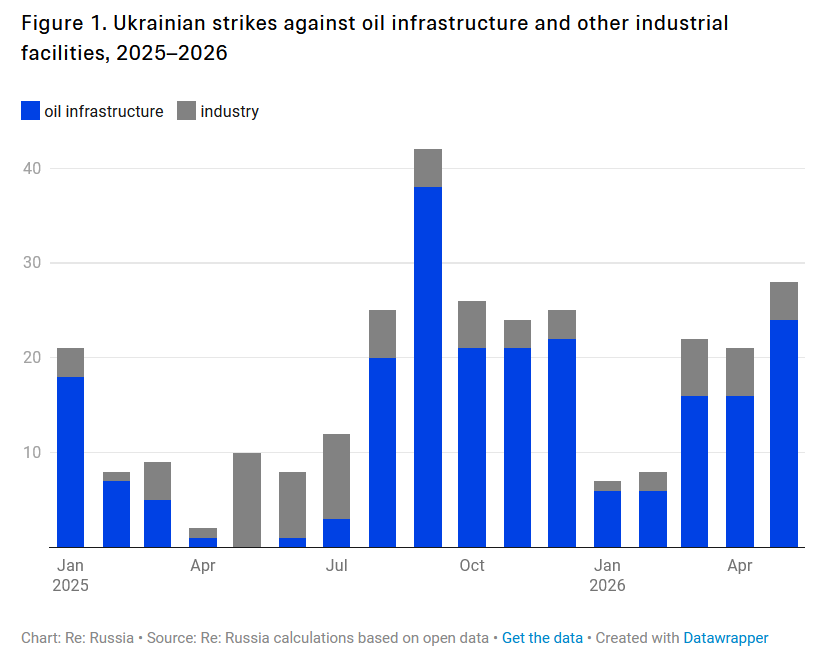
Levada Center’s May 2026 poll of Russians (percent):
| Attitude toward | Good | Bad |
| Belarus | 91 | 2 |
| China | 85 | 6 |
| India | 74 | 9 |
| Japan | 39 | 40 |
| United States | 26 | 56 |
| European Union | 18 | 64 |
| United Nations | 16 | 60 |
| NATO | 9 | 74 |
Endnotes
- Figure 1 is from Re:Russia artlce, entitled "The Second Theatre Of War: How and Why The Spring Campaign Against Russian Infrastructure is Shifting The Balance of Power in The Russia-Ukraine Conflict," (Re:Russia, 06.02.26). Reproduced here with permission of Re:Russia’s staff.
The cutoff for reports summarized in this product was 10:00 am East Coast time on the day it was distributed.
AI was used in production of this digest.
*Here and elsewhere, the italicized text indicates comments by RM staff and associates. These comments do not constitute an RM editorial policy.
Slider photo: Russian trenches in the forests of Sarikamish during WWI (public domain).