
Russia Analytical Report, Feb. 2–9, 2026
3 Ideas to Explore
- Volodymyr Zelenskyy said U.S. officials are pushing for a Russia‑Ukraine peace deal by June, before Donald Trump shifts focus to the U.S. midterm elections, according to Axios. “The [midterm] elections are, for them, definitely more important. Let's not be naïve," Zelenskyy said. "They say they want to achieve everything by June, and they will do everything possible to ensure the war ends that way,” the Ukrainian leader said. Zelenskyy also claimed that Russia still demands a Ukrainian withdrawal from the parts of Donbas that Kyiv still holds, but for the first time, Moscow has agreed to discuss the U.S. proposal to establish an economic zone in Donbas to try to bridge the gaps between the parties, according to Axios’ Barak Ravid. “The territorial issue is the key one that still needs to be resolved,” Zelenskyy has said. Inside Ukraine, a poll held by the Kyiv International Institute of Sociology indicates that a substantial minority (39%) is willing to cede the remaining Kyiv‑held areas of Donbas, which would remove the main stumbling block in the Russian-Ukrainian negotiations, in exchange for “substantial security guarantees.” However, a majority (54%) of the January 2026 poll still rejects territorial concessions, according to the recent poll and the New York Times.
- With New START gone and China’s buildup underway, the post–Cold War nuclear order is collapsing, transforming a “two scorpions in a bottle” U.S.–Russia balance into a fragile three-way contest drifting toward competitive rearmament, according to Fareed Zakaria. Lawrence Korb and Stephen Cimbala call the treaty’s expiration “perilous,” and insist arms control remains essential to manage a “two peer” challenge from Russia and China and to reduce risks rooted in command‑and‑control and human fallibility. Commenting as New START neared expiration last week, Graham Allison of Harvard University told NYT that “if you told anyone in 1945 that we’re going to see 80 years without another use of nuclear weapons in war, people would have said you’re out of your mind.” In a Harvard survey, John Holdren, Matthew Bunn and colleagues warn that New START’s end could trigger unbridled, multipolar arms racing. Finally, Richard Haass contends that New START’s lapse is “not the end of the world” but says horizontal proliferation may be even more likely. “The future of arms control is certainly not dead, but it is likely entering a new era,” Matt Korda and his FAS colleagues write regarding the demise of New START.1
- Eric Rosenbach, Carlo Giannone, Slavina Ancheva, Luc Hillion, Ethan Lee and Lukasz Kolodziej warn in a new Belfer Center report that Europe faces “its most dangerous security environment in decades,” as Russia mixes gray‑zone tactics with open military threats to weaken NATO and claim a de facto veto over neighbors’ alignments. The authors are concerned that within three years, Moscow may escalate gray‑zone pressure into a limited incursion near Estonia’s Narva, and less likely but graver, a large offensive to seize the Suwałki Gap. In contrast, the Munich Security Conference-2026 report estimates that Russia could reconstitute its forces for a “regional war” in the Baltic Sea area within two years of a potential ceasefire in Ukraine. The Belfer Center report urges Europeans to plan for Baltic contingencies under “reduced, delayed or inconsistent U.S. support,” stressing that Russia could achieve a fait accompli before NATO reaches consensus on Article 5. Deterrence, the authors conclude, will hinge on European indigenous capabilities, streamlined decision‑making and public resilience.
NB: The next Russia Analytical Report will appear on Tuesday, Feb. 17, instead of Monday, Feb. 16, because of the U.S. Presidents' Day holiday.
I. U.S. and Russian priorities for the bilateral agenda
Nuclear security and safety:
- No significant developments.
North Korea’s nuclear and missile programs:
- No significant developments.
Iran and its nuclear program:
“Military Operation Against Iran: A Realistic Scenario?,” Ivan Timofeev, Valdai Club, 02.05.26. Clues from Russian Views. Machine-translated. (This organization is affiliated with the Russian authorities.)
- Timofeev argues that a U.S. strike on Iran is increasingly thinkable largely because of the nuclear issue. Iran is “one of the key and consistent opponents of Washington” and has made “impressive progress” in its missile program; he notes that North Korea’s success as a de facto nuclear state is an “important example” for Tehran, while the fate of non‑nuclear states such as Iraq and Libya shows that regimes without nuclear weapons can be attacked and overthrown. This combination, he suggests, gives Washington a strong incentive to act before Iran crosses the nuclear threshold.
- He is skeptical that sanctions alone will stop Iran’s nuclear and missile advances. The alternative scenario of continuing “economic blockade” to erode legitimacy and generate protests may not work, he writes, because “the probability that the Iranian political system will manage to adapt to protests and ‘accommodate’ them is far from zero, as is the probability that it will advance in its missile‑nuclear program.” While the United States and Israel have “nuclear deterrence capabilities against Iran,” he stresses that Iran’s becoming a nuclear power would “fundamentally change the level of threat,” not least because any future revolutionary upheaval in a nuclear‑armed Iran would raise the question “into whose hands the nuclear weapons will fall.”
- Timofeev concludes that the most “rational” U.S. option may be a limited “hit and see” air campaign: “a strike against Iran is carried out that tests the real capabilities of its political system, the potential for protest development under U.S. military operations, and the resilience of the armed forces.” If Iran weathers the attack, Washington can fall back on sanctions, but in any case the operation would likely “undermine Iran’s military potential and its military‑industrial complex,” after which the United States could “wait for a new convenient opportunity for the next operation.” In his view, a new U.S. air operation against Iran is therefore “highly realistic,” precisely because Iran’s nuclear trajectory raises the stakes for both inaction and negotiation.
- See these links for more commentary/analysis on this subject:
- “Former National Security adviser on the nuclear talks between the US and Iran” Steve Inskeep interviews Jake Sullivan, Morning Edition, NPR, 02.06.26.
- "Trump’s Iran Gamble," Ian Bremmer, Project Syndicate, 02.05.26.
- "It Will Take More Than Bombs and Missiles to Fix Iran," Editorial Board, Bloomberg, 02.05.26.
- "Significant achievements — Yet Iran’s nuclear challenge remains unresolved," Danny Citrinowicz, European Leadership Network (ELN), 02.04.26.
Humanitarian impact of the Ukraine conflict:
“The Assault on Ukraine’s Power Grid,” Michael Holtz, The New Yorker, 02.05.26
- Holtz reports that from early October through mid‑January Ukraine’s intelligence service logged 256 drone and missile strikes on energy facilities: 11 on hydroelectric plants, 94 on thermal plants, and 151 on substations. Ukraine’s energy minister Denys Shmyhal told parliament on January 16 that “there is not a single power plant in Ukraine that the enemy has not attacked” and that “thousands of megawatts of generation have been knocked out,” forcing appeals for businesses to shut off non‑essential loads like outdoor advertising.
- The human impact is starkly quantified. DTEK, the country’s largest private energy company, has “lost more than two‑thirds of its generation capacity,” and some Kyiv districts have endured weeks‑long outages, with one January 24 strike cutting heating to “nearly half of the city’s 12,000 apartment buildings.” In Troieshchyna alone, about 600 apartment blocks lost electricity and water. Since the full‑scale invasion began, at least 160 energy workers have been killed and more than 300 wounded on the job; recent incidents include a Ukrenergo executive electrocuted during substation repairs and 12 miners killed, 16 injured when Russian drones exploded near their bus.
- Nuclear power is carrying most of the remaining load, but with its own vulnerabilities. Of Ukraine’s four nuclear plants, three remain in Ukrainian hands and active; Holtz cites energy expert Oleksandr Kharchenko’s estimate that they now produce “more than 60 percent” of the country’s electricity. Although Russia has not struck the reactors directly, its attacks have damaged substations that distribute their output and “more worryingly” those that power reactor cooling systems. International Atomic Energy Agency director Rafael Grossi calls nuclear generation “the lifeline of the country at the moment” and warns that without it Ukraine would be in an “extremely difficult position, if not completely untenable,” underscoring how Russia’s grid assault intersects with nuclear‑safety risk and national survival.
"Kyiv’s great freeze," Christopher Miller and Fabrice Deprez, Financial Times, 02.05.26
- Russian strategy: Moscow is waging a systematic campaign against Ukraine’s energy system—217 attacks on the sector since January, according to Prime Minister Yulia Svyrydenko—aimed at “freezing Ukraine into surrender,” with repeated missile and drone strikes on power plants and key nodes (such as the Darnytska thermal power plant) designed to impose prolonged blackouts and heating cuts in major cities like Kyiv.
- Strategic limits: Despite severe local hardship—tens of thousands periodically without heat, emergency tents and field kitchens in districts such as Troieshchyna, and visible psychological strain—the bombardment has not shifted public opinion toward capitulation; polling by the Kyiv International Institute of Sociology shows roughly 65 percent of Ukrainians remain ready to endure the war “as long as necessary,” and support for “peace on any terms” has not increased, undercutting Russia’s coercive leverage.
- Russian risk calculus: The article underscores that while Russia can degrade infrastructure faster than Ukraine (and the West) can repair and adapt—exploiting Kyiv’s shortages of key air-defense interceptors like Patriot PAC‑3—it has so far failed to produce strategic collapse; Ukrainians are decentralizing power generation, hardening the grid, and normalizing life around blackout schedules, suggesting that continued strikes may yield diminishing political returns for Moscow even as they consume expensive missile stocks and deepen Russia’s image as a state practicing energy terror.
“At the last open crossing, Ukrainians flee Russia’s annexation,” The Economist, 02.08.26
- The Economist reports from the Mokrany–Domanove crossing on the Belarus–Ukraine border, a de facto humanitarian corridor used by around 30–40 people a day fleeing Russian‑occupied territories. Reaching it means days of travel through Russia and Belarus, temporary papers from Ukraine’s consulate in Minsk (because Ukrainian IDs are dangerous to carry under occupation), and surviving FSB “filtration points” or intimidating border interviews. Most who arrive are women, children, and the elderly—some terminally ill, some bringing animals they refuse to abandon—but draft‑age men also cross, knowing they will be handed straight to Ukrainian officers for possible mobilization.
- Their stories show how occupation has hardened into annexation. After a three‑year “transition period,” courts, pensions, tax and property registers, and policing have been folded into Russia’s digital bureaucracy, and a new decree orders Ukrainian property owners to register by July 1st or lose their homes, with “unoccupied” properties to be seized regardless. Propaganda banners proclaim “one nation,” FSB surveillance is “omnipresent,” and residents are warned “you must never speak well of Ukraine” or risk being “taken away or locked in your own basement.” Ukrainian intelligence tells the magazine that “no one has mastered the art of occupation like the Kremlin,” noting that early pro‑Kyiv underground networks have been “filtered and frightened,” even as American‑led peace talks push Kyiv to accept the de facto loss of millions of citizens’ homes.
Military and security aspects of the Ukraine conflict and their impacts:2
- Malenko and Walker report that Russia’s “increasingly effective use of drones” at 12–50 mile range is focused on “hunting for Ukrainian drone teams” and smashing logistics, allowing a grinding advance that “is weakening Ukraine’s hand at the negotiating table.” Ukraine’s current concept is still largely to inflict maximum casualties in a “kill zone beginning about 12 miles from the front line”; new defense minister Mykhailo Fedorov has even set a goal of killing 50,000 Russian soldiers a month, up from 35,000 in December. But, as Vienna‑based analyst Franz‑Stefan Gady warns, Russia has adopted “a much more systematic approach,” while “Ukraine has better individual drone pilots” whose rear‑area strikes are “more piecemeal.”
- Front‑line officers argue Ukraine must pivot to Russia’s style of depth warfare. Maj. Oleh Shyriayev, commanding the 225th Assault Regiment in Zaporizhzhia, says Ukraine should focus more on “Russian drone operators and company and battalion command posts many miles behind the line of contact,” because “everything rests on their shoulders at the tactical level.” A deputy brigade commander describes mid‑range Russian drones that make every rotation “terrifying,” with “a lot of losses, the most losses” occurring while moving to and from the line. With casualties already estimated by CSIS at 1.2 million Russian and 500,000–600,000 Ukrainian, he and others say building Ukraine’s own 20–120‑mile strike capability—requiring more Western drones and munitions—is essential if Kyiv is to resist both battlefield pressure and demands at the peace table to surrender “strategically vital territory.”
- Malik and Vacroux write that Western estimates put Russian losses at “around 1.2 million” since February 2022, and argue that Russian budget data show “at least 1.7 million people have passed through the Russian military system” in that time. Yet, as they note, “Putin stated in December 2025 that around 700,000 Russian soldiers were deployed in Ukraine,” leading them to conclude that “even by official Russian accounts, the Russian Federation has absorbed more than 1 million casualties since invading Ukraine.”
- They stress that Moscow has repeatedly had to refill its ranks: “On Sept. 21, 2022, Russian leadership announced plans for a ‘partial mobilization’ of 300,000 military reservists,” and in 2023 and 2024 “Russian authorities signed up 345,000 contract soldiers” and then “another 410,000.”
- Comparing cost to gain, the authors note that “since Feb. 24, 2022, the Russian army has apparently suffered more than 1 million casualties to capture 29,000 square miles of Ukraine,” and remark that “Soviet ruler Josef Stalin would have purged Putin for this kind of performance.”
"Vladimir Putin Isn’t Winning in Ukraine," Editorial Board, Wall Street Journal, 02.03.26.
- Citing a new CSIS study, the board writes that Russian forces have suffered “an astonishing 1.2 million casualties in Ukraine since 2022” and that “the Russian death toll may be as high as 325,000—more than five times than in all Soviet and Russian conflicts combined since World War II.”
- Despite this, Russian gains are minimal: in the Pokrovsk sector, they note, forces advanced “on average 70 meters a day… slower than the most brutal offensive campaigns over the last century, including the notoriously bloody Battle of the Somme.”
- With “half of Moscow’s budget… flowing to the armed forces, the military-industrial complex, domestic security and debt service” and “a grand total of zero companies in the top 100” tech firms, they argue Putin “shouldn’t be able to wield a whip hand at the negotiating table,” urging Trump to exploit this “strategic opening” with tougher sanctions and more arms to force meaningful concessions.
- Pomerantsev claims that Russia’s battlefield narrative of success is contradicted by facts on the ground. When Putin “grandly announced that Russia had seized the city of Kupiansk,” Zelensky “filmed himself in the city,” and Russian TV then aired clips of troops “entering Kupiansk — only for it to be revealed that these troops were retreating.” Likewise, the winter energy offensive has not produced political collapse, he writes.
- Pomerantsev Ukrainian analyst Liubov Tsybulska that Russian “soldiers complain that about 50–70 per cent of their income goes on paying off the commander to avoid going to the front lines; buying equipment including drones and uniforms,” while recruitment is increasingly coercive, with “people with minor debts … receiving ‘offers’ to sign up and have them erased,” and prisoner‑service offers now “being made in court.”
- Pomerantsev claims that Putin’s push to “take the rest of the Donbas” risks triggering the very instability he fears.
- Economically, the author quotes Alexander Kolyandr that “the biggest challenge Putin faces this year will be budgetary,” with a 2025 deficit of 2.6 percent of GDP, “five times wider than initially planned,” and domestic borrowing that is “piling up debt and fueling inflation”—all signs, in Pomerantsev’s view, that Putin’s claim of inexorable victory conceals a system under mounting pressure.
See this link for more commentary/analysis on this subject:
Military aid to Ukraine:
- No significant developments.
Punitive measures related to Russia’s war against Ukraine and their impact globally:
- “Western sanctions have strained but not broken Russia’s defense industry: instead of collapse, the most likely trajectory is slow degradation.”
- “The Russian defense industry remains heavily dependent on foreign components and advanced machinery, exposing the limits of Russia’s technological “sovereignty” and of import‑substitution policies.”
- “Production growth rests largely on Soviet‑era mobilization capacities and refurbishing old equipment, whose stocks are now dwindling.”
- “Rising costs, lower‑quality inputs, and disrupted planning will gradually reduce reliability and increase dependence on non‑Western suppliers.”
- “Because the Russian system prioritizes survival and quantity over innovation and quality, poorly targeted, partial sanctions risk becoming ‘adaptation fuel;’ more strategically precise sanctions are needed.”
- Ivanova reports that A7, a Kremlin-linked company launched in late 2024 by state-owned Promsvyazbank and sanctioned Moldovan oligarch Ilan Șor, has rapidly become “a leading player in Moscow’s efforts to keep money flowing across its borders” since major Russian banks were cut off from SWIFT, claiming it handled ₽7.5 trillion (about $98 billion) in its first six months and nearly a fifth of Russia’s foreign trade volume by December.
- According to the author, A7 issues “imitation Russian banknotes” and linked digital instruments (including the ruble‑pegged stablecoin A7A5 and various promissory notes) that allow Russian companies and individuals to move funds via cash, crypto, and IOU‑style paper “outside the banking system” and “without using the Swift system,” with leaked documents—analyzed by Elliptic and TRM Labs—suggesting complex flows through shell firms and intermediaries in places such as Kyrgyzstan, China, Southeast Asia, and South Africa.
- Ivanova writes that, despite U.S. and U.K. sanctions, A7 is expanding offices in Russia and abroad, partnering directly with Russia’s finance ministry in a new promissory‑note vehicle (Rosveksel), and benefiting from a gradual shift in Moscow toward legitimizing crypto for foreign trade—underscored by the central bank’s recognition of A7A5 as a “digital financial asset” and A7’s stated plans to enter Latin America and operate in 20 countries within two years.
“Russia on the EU’s Blacklist: Who Will Be Hit by the New Financial Restrictions,” Alexandra Prokopenko, Carnegie Politika, 12.08.25. Clues from Russian Views. Machine-translated.
- Prokopenko explains that the European Commission has put Russia on its list of “high‑risk third countries” for money laundering and terrorism finance—the EU’s functional equivalent of a FATF blacklist alongside Iran, Myanmar, and North Korea. This does not ban transactions, but triggers mandatory “enhanced due diligence” (EDD): exhaustive background checks, manual approval of each payment, continuous re‑verification, and adverse‑media screening, turning every cross‑border transfer into “a multi‑level quest.”
- In practice, she argues, “the main victims will not be those at whom it is formally directed.” Large, Kremlin‑linked businesses have long adapted via third countries, offshores, and opaque structures. The real losers are: (1) ordinary Russian passport‑holders in Europe, who already see bank accounts, mortgages, and brokerage access cut off; (2) small and mid‑sized firms in Russia and the EU engaged in legal, non‑sanctioned trade; and (3) European tech start‑ups with Russian founders, now buried under exponentially more compliance paperwork.
- Because many banks and jurisdictions copy EU standards, the effect radiates outward: Western Balkans and Eastern Partnership countries will inherit the blacklist; international banks will apply EU‑level scrutiny globally; and hubs like Kazakhstan, Armenia, and Uzbekistan will tighten or even sever ties with Russian clients. Combined with the 19th EU sanctions package—which effectively bars EU‑based crypto platforms from servicing Russians—this may push more flows into “grey” channels (informal exchangers, shadow banking, lightly regulated crypto), paradoxically undermining financial transparency while serving mainly symbolic and political aims.
- See this link for more commentary/analysis on this subject:
Ukraine-related negotiations:
- “The U.S. wants Russia and Ukraine to sign a peace deal that ends the war by June, before President Trump pivots to focusing his energy on the midterm elections, Ukrainian President Volodymyr Zelensky told reporters.”
- "The Americans are proposing that the war be brought to an end by the beginning of this summer, and they will probably pressure the parties according to this timeline," Zelensky said. He explained that his understanding was that around June, the U.S. attention will shift to the congressional elections. "The elections are, for them, definitely more important. Let's not be naïve," he said. "They say they want to achieve everything by June, and they will do everything possible to ensure the war ends that way."
- “Zelensky said Friday the Russian delegation in Abu Dhabi has changed its rhetoric and instead of getting into "historical arguments" conducted a "concrete" discussion on what it is ready to do and what it isn't ready to do.”
- “Zelensky said that during the talks, the U.S. side confirmed it is going to be actively involved in monitoring a potential future ceasefire.”
- “Zelensky said Russia still demands a Ukrainian withdrawal from the parts of Donbas it still holds, but for the first time agreed to discuss the U.S. proposal to establish an economic zone in Donbas to try and bridge the gaps between the parties. ...Nevertheless, he stressed that Ukraine's position is still that the territorial issue will be resolved according to the current lines. “
- "We had very good talks today having to do with Russia-Ukraine. Something could be happening," Trump told reporters on Air Force One on Friday night.”
- “Why it matters: The U.S. timeline Zelensky laid out is pretty ambitious, both because there are still significant gaps between Russia and Ukraine and because Ukraine will have to hold a referendum on the peace deal before it is signed — a process that can take several months.”
- “Negotiations were also held in a political working group that discussed the main sticking point — Russia's demand that Ukraine withdraws its forces from parts of Donbas it still controls.”
- “Khrystyna Yurchenko worked hard to build a life in the eastern Ukrainian region known as the Donbas, where she poured her energy into the popular dance studio she owns. But she would give it all up, she said, for lasting peace. Ms. Yurchenko is among a growing number of Ukrainians who say they would hand over the part of the Donbas still controlled by Ukraine to Russia if that would end the war.”
- “This represents a notable shift for a war-weary Ukrainian population. Giving up territory that Russia has been unable to capture has long been considered a red line. But what once seemed impossible now appears less so, as the Kremlin insists that U.S.-backed peace negotiations will advance only if Ukraine agrees to walk away from the Donbas.”
- “In May 2022, two months after Ukrainian forces repelled the Russian Army around the capital, Kyiv, a poll by the Kyiv International Institute of Sociology found that 82 percent of Ukrainians believed that the country should not surrender territory under any circumstances. In the institute’s most recent survey, published on Monday, 40 percent of respondents said they would support giving up the Donbas in exchange for security guarantees. The two figures are not directly comparable, because earlier polls did not attach security guarantees to the question about ceding territory. But the finding tracked with other survey data showing a rising acceptance of territorial concessions. Still, a majority of Ukrainians remain opposed.”
- “Relinquishing the Donbas could fracture Ukrainian society, analysts said... For those who say they are willing to give up the Donbas, security guarantees are crucial, analysts said. Many people fear that if Ukraine were to withdraw troops without such guarantees, there would be little to stop Russia from regrouping and using the region to launch new attacks into the open lowlands beyond the fortified Donbas cities.”
“Three Takeaways From the Ukraine Peace Talks,” Anastasiia Malenko, Wall Street Journal, 02.05.26
- On the ground, prisoner exchanges remain one of the few functioning channels between Moscow and Kyiv. After this round, each side received 157 people; Ukraine’s returnees included “150 members of the military and seven civilians—most detained since 2022, including the defenders of Russian-occupied Mariupol.” For Russia, maintaining these swaps allows it to project a veneer of pragmatism even as it pursues maximalist goals elsewhere, and to repatriate its own captured soldiers without conceding anything on war aims.
- A second focus in Abu Dhabi was technical: how a cease‑fire, if agreed, could be monitored and enforced. Ukrainian negotiator Rustem Umerov called the talks “constructive” and said they focused on “how to create the conditions for a durable peace.” Yet Malenko notes that an earlier, informal U.S. proposal that both sides stop striking each other’s energy infrastructure “was short‑lived,” collapsing when Russia launched “hundreds of drones and dozens of missiles” in its biggest power‑grid attack of the year—while President Trump publicly maintained that Russia had honored the agreement, which he said “expired on Sunday.”
- The territorial question remains the fundamental Russian–Ukrainian impasse. Zelensky said “the territorial issue is the key one that still needs to be resolved,” with Kyiv insisting the “least problematic solution” is to freeze along the current contact line to avoid legitimizing conquest. By contrast, Russian Foreign Minister Sergei Lavrov reiterated that Moscow “insists on Ukraine’s military withdrawal from the Donetsk region,” signaling that the Kremlin still expects additional Ukrainian land concessions as the price of any deal.
- Finley and Toropin report that Trump has brought senior U.S. commanders directly into negotiations, including Army Secretary Dan Driscoll—“a former Army officer” and Iraq veteran—as a key player in talks to end Russia’s war on Ukraine. Driscoll’s role has “coalesced around acting as a kind of liaison between the Ukrainians and Trump officials like Witkoff and Kushner,” using his credibility with Kyiv and his “military perspective as a leader and former Army officer” to keep dialogue going between formal sessions.
- In the latest Abu Dhabi round, Driscoll was joined by Gen. Alexus Grynkewich, “commander in Europe of both U.S. and NATO forces,” who “helped negotiate the reestablishment of high-level military-to-military dialogue between the United States and Russia for the first time in four years.” A U.S. military statement said this revived channel “will provide a consistent military-to-military contact as the parties continue to work towards a lasting peace,” signaling Washington’s belief that direct uniformed contacts with Moscow are essential to managing escalation and implementing any future cease-fire.
- The article highlights the broader shift away from traditional State Department–led diplomacy. Former Bush and Obama official Elisa Ewers criticizes the overreliance on the military, saying it reflects an administration that has “devalued skilled diplomats and the tools of diplomacy,” while former State Department counselor Eliot Cohen notes there is precedent—Cold War arms‑control talks involved generals—but calls the choice of an Army secretary as front‑line negotiator “more unusual.” In practice, the Ukraine track now sees Russian counterparts facing a U.S. team where military leaders are central, not just in the background.
“Remarks and answers to media questions by Foreign Minister Sergey Lavrov following talks with the OSCE Chair-in-Office and OSCE Secretary-General,” Russian Foreign Ministry, 02.06.26. Clues from Russian Views. Machine-translated.
- On Ukraine negotiations, Lavrov insists Russia has repeatedly been ready for a political settlement and blames the West and Kyiv for torpedoing past deals. He recalls that in Istanbul in spring 2022 Russia and Ukraine “paraphed” principles of a settlement that Ukraine itself proposed, including collective security guarantees for the whole region by the five UN Security Council permanent members plus Germany and Turkey, and a ban on foreign bases and military exercises in Ukraine without the consent of all guarantors “including Russia and China.” He claims the West then forbade Kyiv to sign this agreement, and that this history is now “conveniently” ignored in Western narratives about Russia rejecting peace.
- Responding to accusations that Russia is not serious about negotiations because it continues to strike Ukraine, Lavrov cites a March 2025 “energy truce” he says was proposed by President Trump: both sides were to halt attacks on each other’s energy infrastructure for a month. According to Lavrov, Putin immediately agreed and Russia refrained from hitting Ukrainian energy facilities for that period, while Ukraine stayed silent and “more than 130” attacks were registered against Russian energy targets, including purely civilian objects. He argues that Russia still limits itself to targets with “dual use or purely military significance,” and presents this episode as proof that “the Zelensky regime” is intent on provocations and on derailing the talks.
- On nuclear weapons and strategic stability, Lavrov portrays the Ukraine conflict as part of a wider breakdown of the post–Cold War order. He accuses NATO of trying to dominate “the entire Eurasian continent,” including by expanding activities into East and Southeast Asia and introducing “nuclear components” into exercises there, and says Russia, together with China and partners in the SCO and BRICS, is defending the principle of “indivisible security.” Noting that “yesterday the strategic offensive arms treaty expired” and that a “vacuum” has arisen, he says Russia is “ready for any development of events” but “prefers dialogue” and will wait to see “to what extent the United States will be ready for the same” once Washington clarifies its overall approach to “what is called strategic stability.”
“Lavrov, Dmitriev and ‘Two Russias’: On Putin’s Attempts to Decide Ukraine’s Fate With Trump, Bypassing Europeans,” Aleksand Astrov interviewed by Mikhail Morekhdozev, Republic, 02.07.26. Clues from Russian Views. Machine-translated.
- Astrov argues that Putin’s war has backfired: it was launched to force a new world order, but “the world order started to change” not because of Putin, “but because of Trump and the United States,” leaving Russia “largely excluded” while Europe, Canada, India, and China cut new deals. He notes that the new U.S. National Defense Strategy openly calls Russia a “persistent but manageable threat” focused on Eastern Europe, and says the basic question now being put to Moscow is “who are you, really, to claim to be a global superpower?”
- In response, Astrov says, the Kremlin is trying to operate as “two Russias.” One Russia, represented by special envoy Kirill Dmitriev, “talks about a normal world in which the war in Ukraine as if already doesn’t exist” and tries to sit at the “big table” with Trump and Xi. The other Russia continues fighting in Ukraine “in order to finish it and then once again become a single, united Russia.” Lavrov, who has “melted into the official hymn,” plays the hardline, anti‑Western figure; Dmitriev is the fixer.
- Astrov warns that for Kyiv this is dangerous: “for the first time in the whole war, Kyiv has found itself face to face with Russia and the U.S. without the direct participation of Europeans.” The key issue—“security guarantees in exchange for territory”—“cannot be put back in the box,” he says; it will have to be resolved. Personally, he argues, “security guarantees are more important than territory,” likening Ukraine’s dilemma to Finland and Estonia trading disputed lands for NATO/EU security, but he stresses that telling an army that “fought for four years for this land” simply to leave it will be politically extremely difficult.
- Gorin argues that while public attention is fixed on the territorial dispute around Sloviansk and Kramatorsk, Putin’s main, unspoken condition for ending the war is “nothing short of regime change in Kyiv.” In the Abu Dhabi talks, Moscow is still demanding that Ukraine withdraw “without any further fighting” from the remaining Ukrainian‑held parts of Donbas, while hinting it will “in any case take all of Donbas by force” if Kyiv refuses, and Washington appears to have accepted the logic of linking security guarantees to territorial concessions. Yet Gorin notes both sides are exhausted, trench lines have barely moved in a year, and neither has realistic prospects of radically improving its position by fighting on, which makes a compromise cease‑fire rational for both.
- He stresses that for Putin, territory is not the only—or even primary—issue. Since 2022, the Kremlin has repeatedly described Ukraine’s leadership as a “criminal gang” and “neo‑Nazi regime,” and, more concretely, has labeled Zelensky “illegitimate,” implying he “does not have the authority to sign any international agreements.” Russian negotiators even managed to plant this notion in Trump’s mind: the U.S. president publicly called Zelensky a “Dictator without Elections,” and Steve Witkoff’s draft peace plan included a clause giving Ukraine 100 days to hold elections. More recently, when Kyiv proposed a presidential‑level summit, Moscow responded with a deliberately humiliating counteroffer that Zelensky should come to Moscow “if he is truly ready to meet.”
- In Gorin’s reading, insisting on Zelensky’s removal is “not just a personal vendetta” but a signal to all neighboring leaders that “even if you manage to put up some resistance, you will ultimately pay the price (including on a personal level).” Demanding a change in Kyiv’s leadership is therefore “a question of Putin’s external and internal political prestige” and a way to reassert control over Ukrainian sovereignty—the original goal of the war. He concludes that “the removal of Zelensky and his people from power is a non‑negotiable condition for the Kremlin, even if it gets Sloviansk and Kramatorsk,” because in Putin’s mind Ukraine and the entire post‑Soviet space remain Russia’s sphere of influence and the war was fundamentally about enforcing that claim.
“Interview of Russian Foreign Minister Sergey Lavrov for TV BRICS,” Russian Foreign Ministry, 02.09.26. Clues from Russian Views. Partially machine-translated.
- On Ukraine, Lavrov portrays the war as a defensive struggle for Russia’s basic survival. He says that the core task—“so that our country may live”—now includes “reliable security,” which in his words means “not allowing the preservation on our borders of a Nazi state that the West has created out of Ukraine and with whose help it has once again unleashed a war against us.” He repeats Moscow’s minimum conditions: “Nazi foundations must be eliminated”; Ukraine must not host “any kinds of weapons that threaten us”; and Russia must “guarantee reliable and full protection of the rights of Russians and Russian‑speaking people” in Crimea, Donbas, and “Novorossiya,” whom he claims the post‑Maidan Kyiv regime branded “creatures” and “terrorists” and attacked in a “civil war.”
- Lavrov presents the conflict as part of a broader “global war” the West is waging against Russia, using sanctions, efforts to block Russian oil and gas exports, and pressure on partners such as India to “punish” Moscow and maintain U.S. economic dominance. He says the main task of Russian diplomacy is to “create maximally favorable external conditions for the internal development of the country,” but acknowledges this is “much more difficult” today given what he calls frantic Western attempts to stop other states from trading with or arming Russia.
- When discussing US sanctions against Russia, Lavrov said: “This is all pure ‘Bidenism,’ which President Trump and his team reject. Nevertheless, they have easily pushed through the law and sanctions against Russia, which continue to be in effect. They have imposed sanctions against Lukoil and Rosneft. And they did it in the autumn, a couple of weeks after a good meeting between President Putin and President Trump in Anchorage.”
- See this link for more commentary/analysis on this subject:
Great Power rivalry/new Cold War/NATO-Russia relations:
- This Belfer Center report examines "Russian Threats to NATO's Eastern Flank" through scenario-based analysis. The authors argue that "Europe is facing its most dangerous security environment in decades. Russia has been utilizing a mix of gray zone tactics and open threats of military action to weaken NATO and assert a practical veto over its neighbors' geopolitical alignments."
- The report presents two scenarios. First, "within the next three years, Russia will likely escalate its ongoing gray zone campaign against NATO member states, culminating in a limited military incursion into NATO's northeastern flank." Russia could attempt "to seize a small but symbolically significant area, such as regions in or around the Estonian border city of Narva, using unmarked forces and unmanned systems to obscure attribution and complicate NATO's response."
- Second, though "less likely," the report examines "a large-scale Russian offensive to isolate the Baltic states by seizing the Suwałki Gap." In this scenario, "Russia could launch a large conventional assault to seize the Alliance's only overland corridor into the Baltics, triggering a fast-moving, high-intensity conflict against the Alliance."
- The report emphasizes that "European governments should plan and build forces for Baltic contingencies under conditions of reduced, delayed, or inconsistent U.S. support. Shifts in U.S. priorities and alliance politics...amplify doubts about the scale, speed, and reliability of U.S. intervention in a Baltic contingency."
- The authors identify critical vulnerabilities: "A fast-moving Russian operation to seize a symbolically significant border area could result in a fait accompli before NATO can reach political consensus." Moscow could "exploit the time required for NATO members to reach consensus on whether to invoke and operationalize an Article 5 response to consolidate control and fortify its positions."
- The report concludes that "Europe's collective ability to deter or defeat aggression on NATO's eastern flank will hinge on fielding critical indigenous capabilities and streamlining the political decision-making and policy processes necessary to employ them effectively...European security will hinge, in large part, on public resilience and underlying levels of political resolve."
“Intelligence, Service and a Changing World,” featuring Richard Moore and moderated by Graham Allison, Institute of Politics, Harvard Kennedy School, 02.02.26. Attended, transcribed and summarized by RM student associate Jack Lennon.
- On Feb. 2, 2026, Chair of the United Kingdom’s Kennedy Memorial Trust and former Chief of MI6 Sir Richard Moore joined Harvard Professor and former Director of the Belfer Center for Science and International Affairs Graham Allison at the Institute of Politics’ JFK Jr. Forum. The two discussed intelligence and public service in the turbulent 2020s. Moore’s tenure at the head of the British secret service spanned the U.S. withdrawal from Afghanistan, collapse of the Ghani government, the full-scale Russian invasion of Ukraine, Israel-Hamas war and Iran-Israel conflict.
- Allison noted how Moore and former CIA director William Burns were “very active” in having their agencies recruit assets in Russia after the invasion of Ukraine, because “quite a lot of Russians” thought the invasion “was a dumb decision” and became “disaffected with the regime.” This included people “in very influential positions.” Moore confirmed that “many Russians …including many Russians working for the regime… were utterly dismayed by what Putin did in February 2022.” He likened the full-scale invasion to the crushing of the Prague Spring in 1968, describing it as a time when “many Russians despaired of what was being done in their name… and came and worked for Western services.” Moore emphasized, “those times become a productive time” for Western intelligence agencies. Those who work with MI6 often do so because they are “very deeply disaffected with the regime that they represent” and sharing secrets is “their way of doing something about it.” He emphasized that he has invited “disaffected Russians to be in contact” through a dark web portal developed my MI6. He noted the CIA has a similar portal.
- Moore used the war in Ukraine to illustrate the role that intelligence agencies play in providing policymakers with “decision advantage.” Moore noted, “If you want to understand what a dictator’s strategic intent is, read what they say … Xi Jinping and Vladimir Putin have set down in some detail their view of where they’d like to go strategically.” Putin has told the West “everything we need to know about why he’s interested in dominating Ukraine.” Moore commented that intelligence agencies look to answer what Putin is “thinking about for the next stage, what he is thinking about negotiations, what is he thinking about the battlefield situation, what are the generals telling him, and how accurate is that?”
- On Iran and nuclear security, Allison noted that the “Armada is approaching” and that “some choices” are likely going to be made in the coming days. He asked Moore for his projection of what would happen and its consequences. Moore says it is difficult to project what will happen “because you have in Iran a regime which has lost all legitimacy.” It’s “hard to overstate just how lacking” the revolutionary regime is in support. He assesses that the regime has only a “payroll vote” and is “hanging on” because it is willing to use violence against its own people to stay in power. Moore believes that the regime will “eventually…fall, because it has nothing to offer its own people.”
- Moore argued that the “the [Iranian] regime has an obvious opportunity to pivot to diplomacy,” if they would be “very clear” about their willingness never to go for a nuclear weapon, and do what is required in a negotiation around enrichment levels and their missile program. However, Moore does not “see any sign of them seriously engaging in that.”
- Contrasting the collapse of the Ghani government in Afghanistan with Ukraine and Zelenskyy, Moore noted that in Zelenskyy you had someone who “was a different kind of leader” than Ashrafi Ghani. Western intelligence agencies “recognized that the Taliban were likely to take over if Western forces were withdrawn,” but “all underestimated how quickly that would happen.” Western services thought that the Ukrainians “would struggle” to hold back the Russians, but “underestimated just how bad the Russian army would prove to be in the battlefield” and Zelenskyy’s bravery in staying and leading his people to “resist the Russian invaders.”
- Allison recalled how Gorbachev was asked during his 2007 visit to Harvard why the CIA did not predict his overthrow, to which he responded, “I didn’t anticipate it either.”
"Europe’s Next Hegemon: The Perils of German Power," Liana Fix, Foreign Affairs, 02.05.26
- Fix argues that Germany’s rapid rearmament is being driven above all by the Russian threat: Berlin’s Zeitenwende and its path to becoming Europe’s largest military spender are responses to Moscow’s war on Ukraine and the prospect of reduced U.S. engagement, but this buildup could inadvertently fracture Europe’s Russia policy if it triggers intra‑European rivalry instead of collective deterrence.
- The article warns that an AfD‑led Germany would fundamentally alter the balance vis‑à‑vis Russia: the party is “Russia‑friendly, opposed to supporting Ukraine,” and skeptical of NATO and the EU, so a heavily armed Germany under AfD control could weaken sanctions and military support to Kyiv, seek accommodation with Moscow, and pull German forces (e.g., in Lithuania) out of front‑line deterrence, inviting Russian opportunism.
- Fix contends that to keep Germany’s growing power from destabilizing the Russia–Europe security order, Berlin must lock itself into “golden handcuffs”: large‑scale joint EU defense borrowing, deeper integration of its defense industry with European partners, and tighter multinational command structures that make German capabilities part of a collective shield against Russia, rather than a free‑floating national instrument that others feel compelled to counterbalance.
"Europe Is Getting Ready to Pivot to Putin," Anchal Vohra, Foreign Policy, 02.06.26
- Vohra argues that Trump’s unilateral, transactional approach to Ukraine peace talks—his 28‑point plan promising to reintegrate Russia into the global economy, restore Russian energy flows to Europe, and even tap frozen Russian assets for U.S.–Russian projects—has pushed European leaders to contemplate their own direct accommodation with Moscow, both to protect their interests and to avoid being sidelined in the redesign of the Russia–Europe security and economic order.
- The piece highlights how deeply Europe remains economically intertwined with Russia despite four years of war: thousands of EU firms still operate in Russia; key sectors such as LNG, fertilizer, and steel continue to rely on Russian supply; and major entities like Lukoil and NLMK remain unsanctioned at the EU level, meaning that any eventual Russia–Europe détente will likely center on calibrated sanctions relief and trade normalization rather than a clean break—giving the Kremlin leverage even as it remains a “regional bully.”
- Vohra’s analysis implies that Europe’s Russia strategy has always been more about managed interdependence than full isolation: sanctions were designed as a “pause” rather than an exit, leaving Brussels with both leverage (frozen assets, financial restrictions) and vulnerabilities (energy and industrial dependence). As U.S.–European rifts deepen, she suggests, the logic of this partial decoupling may lead the EU toward a phased economic and diplomatic re‑engagement with Moscow on its own terms, even while Russia retains significant coercive tools against Ukraine and NATO.
- “The grand strategy of his second presidential term is perhaps best described as ‘predatory hegemony,’” Stephen M. Walt writes, defining it as an approach whose “central aim is to use Washington’s privileged position to extract concessions, tribute, and displays of deference from both allies and adversaries, pursuing short-term gains in what it sees as a purely zero-sum world.”
- A predatory hegemon, Walt argues, is “as likely to exploit its partners as it is to take advantage of a rival,” seeking “the lion’s share” in every interaction and viewing existing rules and institutions as having “no intrinsic value or legitimacy” if they do not yield asymmetric benefits. He contends that Trump’s tariffs, linkage of military protection to economic demands, and insistence on public displays of fealty from allies exemplify this strategy.
- Walt warns that “predatory hegemony contains the seeds of its own destruction,” noting that in a multipolar world with a rising China, other states have options and are already working to reduce dependence on the United States. By bullying allies, undermining institutions, and monetizing U.S. power for personal gain, he concludes, Trump is squandering the networks of trust and cooperation that long underpinned U.S. influence and is pursuing “a losing strategy” that will leave America “poorer, less secure, and less influential.”
- The author argues there is currently only one real sphere of influence in the world: the American-led Western Hemisphere, where the United States enjoys unmatched military, economic, and political dominance; by contrast, China and Russia lack the power and consent of neighbors needed to build comparable spheres.
- This creates a dangerous asymmetry: the United States is so secure at home that it risks complacency about threats in Eurasia, while Russia and China feel too aggrieved and constrained by the U.S.-led order to accept the status quo, pushing them toward disruptive or revisionist behavior.
- Despite ambitions for large spheres, Russia’s military and economic weakness and China’s competitive, well-armed neighborhood prevent them from consolidating regional empires; they can cause damage and coercion but cannot reliably dominate or integrate neighbors the way the United States can in its hemisphere.
- A “one-sphere world” both tempts and pressures Washington: it could misuse its dominance, turn alliances into protection rackets, and let the liberal order decay—or it can leverage its secure base and growing rearmament among frontline allies to rebuild a tougher, more resilient democratic coalition that constrains Beijing and Moscow.
- The author concludes that the Western Hemisphere should serve as the foundation of a renewed international order, not an imperial playground.
“Under Destruction – Munich Security Report 2026,” Munich Security Conference, February 2026. Selected assessments with a focus on Russia/post-Soviet Eurasia.
- “Rather than being treated primarily as a question of sovereignty and international law, the [Russian-Ukrainian] war is at growing risk of being reframed as a negotiable dispute between powerful leaders.”
- At a time when Russia is seemingly regaining tactical initiative along parts of the front with Ukraine and is intensifying its hybrid warfare campaign across Europe, Washington’s gradual retreat, wavering support for Ukraine… are heightening Europe’s sense of insecurity.” “The war is at growing risk of being reframed as a negotiable dispute between powerful leaders, in which territory, security guarantees, and even natural resources become bargaining chips.”
- “Peace is no longer primarily conceived as a rights-based settlement anchored in law and institutions but as the coercive management of conflict through ‘top-down deals’ between powerful actors.”
- “There is thus a risk that the outcome will be a ‘victor’s peace,’ brokered with ‘tools reactivated from the dustbin of history’ and ‘reminiscent of earlier eras before the post-1945 universalism.’”
- “Russia has brought war back to Europe.”
- “Indeed, some intelligence agencies estimate that Russia could reconstitute its forces for a ‘regional war’ in the Baltic Sea area within two years of a potential ceasefire in Ukraine.”
- “Russia is increasingly blending cyber and kinetic tactics in its suspected surveillance, sabotage operations, and attacks on energy grids, blurring the boundaries between war and peace.”
- “Many of these incidents are designed to remain deniable or ambiguous, enabling Russia to evade direct attribution while exerting psychological pressure and inducing political paralysis.”
- “Its [Russia’s] persistent nuclear saber-rattling is only the most brazen reminder that the military threat extends well beyond Ukraine.”
- “Debates about nuclear proliferation and strategic autonomy are regaining momentum.”
- Kimmage and Notte write that on the eve of the 2022 invasion “Russia enjoyed a decent global position,” with “a strong partnership with China; extensive economic ties with Europe; a working relationship, however fraught, with the United States,” but that after the invasion “Europe and the United States immediately became Moscow’s adversaries,” the war “absorbed Russia’s attention and virtually all of its military capacity,” and “after four years of fighting, Ukraine remains in control of roughly 80% of its territory.”
- According to the authors, “these shifts masked a more negative and enduring reality for the Kremlin”: Russia has “lost much of its capacity to protect its partners and its interests beyond Ukraine,” so that in cases from Nagorno‑Karabakh to Lebanon and Yemen and finally Syria.”
- Kimmage and Notte argue that Moscow’s global position is ebbing because of Trump,” contending that “now that the United States has embraced revisionism, Russia’s inability to project power beyond Ukraine has become more obvious.
"NATO’s Leader Is Totally Lost," Stephen M. Walt, Foreign Policy, 02.04.26.
- Walt writes that NATO Secretary‑General Mark Rutte’s central aim “has been to keep the United States fully committed to NATO and European security more broadly,” even if that means “shamelessly flattering U.S. President Donald Trump and pouring cold water on European efforts to achieve greater strategic autonomy,” and he criticizes Rutte’s recent claim to the European Parliament that Europe simply cannot defend itself without U.S. help, telling those who disagree to “keep on dreaming.”
- According to Walt, Rutte is wrong both strategically and politically: NATO’s European members enjoy “more than a 3‑to‑1 edge in population, a nearly 10‑to‑1 edge in GDP,” and “spend more on defense each year than Russia does,” so “the claim that Europe lacks the basic wherewithal to mount an effective defense is false,” while constantly emphasizing European weakness and dependence “just reinforces the MAGA‑world’s contempt for the United States’ democratic allies” and plays into Trump’s pattern of exploiting weakness and respecting strength.
- The author argues that Rutte has “chosen to appease Trump and dismiss European autonomy” in order to “preserve the status quo,” but in an era where “the Trump regime has precisely zero commitment to so‑called liberal values” and U.S. attention is shifting toward China, NATO’s job is to prepare for “a world where the United States is either not as central to the alliance or possibly absent entirely,” which is why Walt concludes that “the safest course would be a new division of labor within NATO,” with Europe rapidly building up its own capabilities and the United States becoming “their ally of last resort but not Europe’s ‘first responder.’”
- Natalizia and Mazziotti di Celso argue that NATO’s GDP‑based targets are politically convenient but substantively flawed, warning that “pressuring governments to spend more does not, by itself, produce stronger militaries—and in some cases, it can actively undermine military effectiveness,” especially in countries where the military plays a “marginal role in domestic politics and public debate.”
- According to the authors, Italy exemplifies this problem: Rome has “prioritized formal compliance with NATO—and especially U.S.—spending benchmarks over a substantive increase in defense resources,” reporting a roughly €45 billion defense budget to NATO for 2025 when “actual defense spending was closer to 31 billion euros,” achieved by reclassifying expenditures from other ministries rather than truly boosting combat capability.
- The authors write that Italy’s recent increases have gone mainly into politically attractive programs—“large‑scale investment programs, most notably in armored land forces,” and domestic policing missions—while “spending on operations, maintenance, or training … has remained flat or is even projected to decline,” meaning “a defense buildup that satisfies political and industrial priorities while leaving Italy’s core military effectiveness largely unchanged.”
- Natalizia and Mazziotti di Celso contend that if NATO wants “real capability,” it must pair budget pressure with efforts to close the civil‑military gap, urging an “honest and nonideological” public debate about the fact that “the true purpose of the armed forces” is “to fight,” and calling for investments in university and think‑tank work, public outreach, and regionally based reserve forces so that higher spending can actually translate into combat readiness.
- See these links for more commentary/analysis on this subject:
- “Europe Needs an Army: Only Collective Defense Can Protect the Continent,” Max Bergmann, Foreign Affairs, 02.09.26
- "What the European Union Must Do to Confront Global Bullies," Linn Selle, German Council on Foreign Relations (DGAP), 02.09.26.
- “America Reclaims Its Dominance in Space,” Arthur Herman, Wall Street Journal, 02.08.26.
China-Russia: Allied or aligned?
"The Chinese Yoke: Russia’s Return to Vassalship," Matthew Zalewski, War on the Rocks, 02.04.26.
- “A… dynamic is taking shape as Russian President Vladimir Putin’s regime becomes structurally dependent on China—not only to sustain its war in Ukraine, but also to maintain basic stability,” Matthew Zalewski writes, likening Russia’s position to Muscovy under the Mongol yoke.
- By 2024, Zalewski notes, “Russia imported 60% of new passenger cars and 65% of trucks from China,” while Chinese “teapot” refineries, pipelines, shadow fleets and yuan‑based deals allow Beijing to buy Russian hydrocarbons “well below market price,” making China “the economic lifeline for Russia.”
- After the war, “the priority… will be maintaining the ruling regime even at the cost of further subordination to China,” he argues, warning that a looming succession crisis in a system of “deliberately weak institutions” will give Beijing leverage as a potential kingmaker, much as the Khans once decided who ruled Muscovy.
- The author dismisses a “reverse Nixon” strategy as dangerous: “To support the Putin regime’s survival or a like-minded successor is to support renewed hybrid warfare in the United States and Europe,” he writes, urging NATO instead to “maintain Russia’s isolation” even if it drives Moscow deeper into Beijing’s orbit, because “the current regime in Russia will respect strength and political unity over any agreements on paper.”
“Video conference [between Vladimir Putin] and President of the PRC Xi Jinping,” Kremlin.ru, 02.04.26. Clues from Russian Views. Machine translated from Russian.
Vladimir Putin:
- “Honorable Mr. President, dear friend! I am glad that we are continuing the good tradition of our personal meetings at the start of a new year, when we sum up the results of the past period and outline plans for the future. All the more so on such a symbolic day: according to the traditional Chinese calendar, today is Lichun—the “Beginning of Spring,” after which the frosts recede, renewal begins, and nature enters a new cycle. And for Russian-Chinese relations, I can say with confidence that every season of the year is like spring.”
- “I would like to personally congratulate you, and through you the entire friendly Chinese people, on the New Year 2026 and the upcoming Spring Festival, which, as we understand, will usher in the Year of the Red Fire Horse. The Fire Horse is associated with strength, energy, and the drive to move forward—just what characterizes the ties between our countries. Regardless of the international situation, I am confident in the strength of our relations and in their steady development in all areas. ”
- “The comprehensive Russian-Chinese partnership and strategic cooperation is exemplary in character. This year we mark the 25th anniversary of the Treaty of Good-Neighborliness and Friendly Cooperation, which is fundamental for our relations. Its continued implementation undoubtedly serves the core interests of the peoples of our two countries, strengthens the comprehensive and truly all-encompassing interaction between Russia and China, and most importantly, improves the well-being of our citizens. ”
- “Taking this opportunity, I would like once again to firmly confirm our support for all our joint efforts to ensure the sovereignty and security of our two countries, their socio-economic prosperity, and their right to choose their own path of development. ”
- “Economic cooperation in 2025 continued to develop steadily. Despite a small decline—I would even say a correction in the figures—our trade turnover, for the third year in a row, has comfortably exceeded the landmark level of $200 billion.”
- “The introduction of a visa-free regime is undoubtedly helping the growth of business and humanitarian contacts. I am grateful to you for this initiative, which we readily supported. As far as I know, since it took effect, the relevant agencies have not encountered any significant problems.”
- “As for the international situation, in conditions of growing turbulence in the world, the foreign policy coordination between Moscow and Beijing remains an important stabilizing factor. We are ready to continue the closest coordination on global and regional issues, both in the bilateral format and on all multilateral platforms: in the UN, BRICS, the Shanghai Cooperation Organization, and others, where the Russian-Chinese tandem plays, in many respects, a key role. We wish success to China’s chairmanship and will certainly provide every necessary support to our Chinese friends in the Asia-Pacific Economic Cooperation forum.”
Xi Jinping (spoke in Chinese):
- “Honorable President Putin, my old and dear friend! I am very glad to meet with you in the format of a video conference at the beginning of the new year. Today, according to the lunar calendar, we celebrate Lichun, the beginning of spring. You have just mentioned this. Lichun opens the cycle of the 24 solar terms and marks the return of spring to the earth, symbolizing a new beginning and hope. On such a pleasant and highly symbolic day, I am pleased to have an in-depth conversation with you, so that together we can develop a new grand plan for the development of our bilateral relations.”
- ”The other day, you specially sent Comrade Shoigu to China so that he could “synchronize watches” with Comrade Wang Yi on international and regional “hot spots” in preparation for our meeting. Comrade Wang Yi has reported to me. Today I am ready to exchange views with you on major strategic issues.”
- “Over the past year, we have met twice. China–Russia relations are entering a new stage of development. We solemnly celebrated the 80th anniversary of the victory of the global anti-fascist coalition, which demonstrates the determination of our countries to defend the outcomes of the Second World War and international justice. Bilateral trade cooperation is developing dynamically and steadily, and cooperation in new areas is advancing at an accelerated pace.”
- “China is ready to further expand its high-level opening to the outside world and is ready to share new development opportunities with countries around the world, including Russia. This year also marks the 30th anniversary of the establishment of the China–Russia partnership of strategic interaction, the 25th anniversary of the signing of the China–Russia Treaty of Good-Neighborliness, Friendship and Cooperation, and the launch of the China–Russia Years of Education. It is important to seize this historic opportunity, to constantly deepen strategic interaction, and jointly to shoulder the responsibilities of great powers, so that China–Russia relations can continue to develop along the right trajectory.”
- "Vladimir Putin and Xi Jinping agreed that there is a clear need for standing mechanisms of bilateral consultations along all channels—security councils, foreign ministries, defense agencies—which would underpin their personal communications."
- "Vladimir Putin and Xi Jinping once again stated that the comprehensive partnership and strategic cooperation between the two countries is at an unprecedented level, is equal and mutually beneficial in nature, is not directed against anyone, and is not subject to any situational fluctuations."
- "We provide each other with support on key issues affecting national interests. Faced with external challenges, our countries act, as our Chinese friends say, ‘back to back’ and can rely on one another."
- "During the conversation, President Xi Jinping invited Vladimir Putin to pay an official visit to China in the first half of the year. The invitation was gratefully accepted; the dates and details will be agreed separately." "The leader of the PRC also invited the President of Russia to take part in the summit of the Asia-Pacific Economic Cooperation (APEC) forum in the southern Chinese city of Shenzhen in November. Russia supports the work of China’s APEC chairmanship, and, of course, our President will be ready to participate in the meeting in Shenzhen." "Incidentally, bilateral meetings between the leaders are also planned in connection with other international events, particularly those held under the auspices of the SCO and BRICS."
- "The leaders paid considerable attention during the conversation to issues of trade and economic cooperation. It was noted that, despite a slight decrease due to a number of objective and subjective factors, mutual trade turnover has, for three years in a row, exceeded the 200-billion-dollar mark by a significant margin. China still ranks first among our foreign trade partners.
- "Notably, the leaders stressed the importance of developing innovative areas of work, including in the field of artificial intelligence. They supported the Chinese initiative to establish a World Organization for Cooperation in the Field of Artificial Intelligence."
- "Both sides gave high marks to the Chinese initiative, supported by us, to introduce a visa-free regime."
- "Russia and China advocate equal, mutually beneficial cooperation based on the principles of international law and the UN Charter."
- "The President drew attention to the fact that tomorrow, Feb. 5, the term of the Treaty on the Limitation of Strategic Offensive Arms expires. As you know, on September 22, 2025, we proposed to the Americans that the central numerical limits be extended for one year as voluntary self-restraints, but an official response from the Americans has still not been received. Vladimir Putin stressed that in this situation we will act in a balanced and responsible manner, on the basis of a thorough analysis of the overall security situation. We remain open to exploring negotiating avenues for ensuring strategic stability."
- "The leaders are aware of the ongoing contacts between our countries and the administration of Donald Trump, and they see opportunities emerging in this. The President of the PRC, in particular, supports the trilateral working group negotiations on security issues currently under way in Abu Dhabi. Our President shared his latest assessments of efforts to achieve a peaceful settlement of the Ukrainian conflict."
- " Special attention was given to the tense situation surrounding Iran."
- "The leaders compared approaches regarding the situation around Venezuela and Cuba, and spoke in favor of preserving the level of cooperation that our countries have built up with Caracas and Havana."
- "Among the regional topics, the leaders exchanged views on the situation in the Asia-Pacific region, and the President of the PRC spoke about relations between Beijing and Tokyo. The Russian side once again expressed support for China’s principled line on Taiwan, that is, our support for the One China principle."
"RIC in 2026: What It Can and What It Cannot Do,” Hun Nun, Valdai Club, 02.04.26. Clues from Russian Views. Machine translated. (This organization is affiliated with the Russian authorities.)
- Hun Nun writes that “the RIC format can be described as neither an ineffective nor a super‑effective instrument. Its value is limited but real: it keeps channels open and simplifies selective coordination among the three Eurasian powers in a fragmented world order.”
- According to the author, “from the standpoint of global governance, the Russia–India–China (RIC) format is less a basis for an alliance than a means of maintaining channels of communication, as multilateral institutions are becoming increasingly difficult to use for fully solving problems,” and “RIC is neither an alliance nor a treaty body—it is a deliberately simplified platform that helps three major powers exchange views when broader forums become too polarized and formalized.”
- Nun argues that “this simplicity explains the format’s resilience amid geopolitical shocks, but it also defines its ceiling: RIC can facilitate dialogue and selective coordination, but it cannot overcome structural divergences—the strategic rivalry between China and India and the asymmetric pressure Russia faces from the West.”
- The author writes that “under such conditions, RIC’s role appears modest but useful: it is a consultative venue for comparing the effectiveness of approaches, identifying regulatory problems at an early stage, and discussing basic risk‑control measures for cross‑border transactions amid growing sanctions risks,” rather than a mechanism for “cartel‑like coordination” or deep integration.
- Hun Nun believes that “for RIC to remain useful, it must adhere to minilateralism without bloc logic—to be a small‑format mechanism for cooperation on specific issues rather than a coalition platform,” and concludes that “with realistic expectations, RIC can function as a stabilizer, but excessive hopes it will probably not fulfill—it will merely reveal fractures it is incapable of fixing.”
Missile defense:
“Why Missile Defense Now Raises the Risk of War,” Azriel Bermant, Foreign Policy, 02.09.26
- Bermant writes that the traditional case for missile defense in places like Israel and Ukraine is that it is “purely defensive” and can “make war less likely” by “devaluing” an adversary’s missile threat and “strengthening public morale.” But he argues that this logic has “been turned on its head,” warning that “a reliable anti-missile shield could just as well create an incentive for escalation,” because if leaders “believe that their state is secure behind the shield, they may calculate that their own offensive military actions carry significantly lower risk.” Israel’s 2025 experience—when defenses intercepted only 86% of Iranian missiles and “at least 33 Israelis were killed and more than 3,500 were wounded”—shows, he says, “the increased vulnerability caused by overreliance on missile shields.”
- Turning to Trump’s homeland “Golden Dome,” Bermant calls it “a classic security dilemma,” noting that by openly planning “a universal defense against all threats,” Washington convinces Russia and China that the shield is “a potential prelude to a first strike.” He recalls that earlier U.S. missile‑defense pushes led to the 1972 ABM Treaty precisely because both sides saw that such systems could “damage strategic stability and spark a costly new arms race,” and warns that today “the quest for total invulnerability is not making the world safer.” Instead, he concludes, the Trump administration’s “reckless approach—combining the push for missile defense with its willingness to aggressively intervene abroad—raises the risks of fatal miscalculations” and “is laying the foundations for volatile and unpredictable global conflict.”
Nuclear arms:
“The post-Cold War nuclear era might have just ended,” Fareed Zakaria, Washington Post, 02.06.26
- Zakaria argues the old nuclear order is collapsing, starting with the end of U.S.–Russian arms control: “There are now no legally binding limits on the world’s two largest nuclear arsenals for the first time in more than 50 years,” and what once was “not a safe world—but … a stable one” has given way to a context in which “that era might be at an end.” He notes that when New START was signed, China’s arsenal was small and Russia’s forces aging, but “that world ‘no longer exists.’”
- He stresses that both Russia and China are transforming the strategic landscape in destabilizing ways. Russia has “modernized roughly 95% of its strategic nuclear forces” and built “a vast regional nuclear arsenal” of an estimated 1,500 tactical warheads, while during the Ukraine war Putin has “repeatedly invoked nuclear threats, engaging in a scary game of blackmail.” China, meanwhile, has jumped from “roughly 240 nuclear warheads” in 2012 to “more than 600” today and “is on track to reach 1,000 by 2030,” moving toward a full triad and “launch on warning.” Beijing has “bluntly” rejected arms‑control talks, treating transparency and verification as “vulnerabilities” and “a constraint to be avoided.”
- Zakaria warns this has turned the old “two scorpions in a bottle” balance into a three‑way contest in which “deterrence grows more fragile as the system grows more complex.” With Russia and China “cooperating more closely” and a U.S. posture built for “a largely bilateral rivalry,” he sees the world “drifting from managed deterrence toward competitive rearmament, from limits toward accumulation, from predictability toward improvisation.” The nonproliferation bargain is also fraying: as confidence in U.S. guarantees erodes, “some are quietly reassessing their options,” with debate on independent nuclear forces moving “from the margins toward the mainstream” in countries such as South Korea and even Japan.
- Korb and Cimbala call New START’s expiration “a critical and perilous milestone,” but argue it should not mean abandoning arms control. They note that critics, citing Russia’s “obstinacy in resisting a peace agreement with Ukraine” and its intensified winter bombardment of Ukrainian power grids, see Moscow as fundamentally untrustworthy and urge the United States to “accelerate the modernization of its strategic nuclear forces” and pursue Trump’s Golden Dome missile shield, bypassing further negotiations.
- The authors acknowledge Russia’s aggressive behavior—Putin “has conceded nothing” on Ukraine, continues to tout new strategic systems “that can bypass conceivable antimissile defenses,” and is modernizing a “singular inventory” of non‑strategic nuclear weapons—while also warning that China’s rapid buildup and “closer military alliance” with Moscow, including exercises that appear to simulate nuclear first use, create a “two‑peer” nuclear challenge for Washington. Yet they insist this environment “does not necessarily take the case for arms control off the table”; an “open‑ended arms race” would worsen mistrust and crisis‑management risks.
- They argue that deterrence stability rests as much on command‑and‑control “software” and human decision‑making as on numbers. Drawing lessons from the Cuban Missile Crisis, they stress that even overwhelming U.S. superiority did not eliminate the danger of miscalculation, and that modern systems—entangled with cyber networks and compressed timelines—do not remove the need for negotiated limits and mutual understanding. Arms control, in their view, not only caps forces but reinforces leaders’ appreciation that in any nuclear war “their own personal survival will be at risk,” underscoring the priority of preventing nuclear use rather than seeking advantage in a post–New START arms race.
- John P. Holdren: "A common-property resource is one from which all can benefit as long as all cooperate in its sensible management… The ocean, the atmosphere, and peaceful international relations are all global common-property resources… The collapse of any of them could end civilization as we know it, but the one that could destroy all that we value most suddenly is use of nuclear weapons in conflict… an important bastion against the danger of nuclear war has been the mutual restraint embodied in international agreements on nuclear arms control and nonproliferation… New START's imminent expiration, which would quite likely be followed before long by the collapse of the Non-Proliferation Treaty of 1968, could well launch an era of unbridled, multipolar, nuclear-arms racing that ends in total disaster."
- Matthew Bunn: "As New START expires, for the first time in half a century, we will be living in a world with no agreed limits on the United States and Russia building up their nuclear forces… nuclear arms control has improved U.S., Russian, and global security and reduced the risk of nuclear war by reducing tensions, increasing predictability and transparency, and limiting nuclear forces of particular concern."
- Mariana Budjeryn: "The expiration of the New START treaty ushers in a world bereft of any formal, mutually agreed restraints on strategic nuclear arsenals of the two nuclear superpowers… the demise of arms control will put even greater pressure on the already stressed nonproliferation regime… The old global nuclear order is rapidly crumbling, but the new one is yet to emerge. Dangerous times."
- Gary Samore: "The expiration of New START will free the U.S. to exceed the treaty limits of 1,550 deployed strategic nuclear warheads and 700 deployed launchers… prospects are not good for additional arms control agreements to constrain nuclear expansion by the U.S., Russia and China… China, however, rejects any treaty that would not give it nuclear equivalence with the U.S. and Russia, which the U.S. (and probably Russia) are not prepared to accept. So, for the time being, nuclear buildup seems like the most likely path."
- Ulrich Kühn: "Once New START is gone, both sides will soon feel pressures to increase the number of their warheads… This logic, which denounces diplomacy at the expense of unilateral militarism, will become the main driver behind the arms race of the 21st century… The ones to suffer from this policy will be the American people. They will have to foot the massive bills that will come with arms racing…"
- Stephen Herzog: "On Feb. 6, 2026, New START will expire… The consequences will reverberate far beyond Washington and Moscow… Many non-nuclear-weapon states––particularly across the Global South––will also see this as a confirmation that the United States and Russia have abandoned their Article VI disarmament commitments in the Nuclear Non-Proliferation Treaty."
- Nicole Grajewski: "With the expiration of New START, Russia regains formal freedom to expand its strategic nuclear forces beyond treaty limits… In the near term, Russia is likely to keep its deployed strategic forces close to former New START ceilings… The most likely outcome after New START is not a dramatic arms race but a steady pattern of selective adaptation. Russia will hedge, probe, and shift competition into less transparent domains, increasing ambiguity and complicating escalation control even in the absence of large numerical change."
- Jonathan Hunt: "If the expiration of New START heralds of new arms race, it won't be with Russia… the driving force behind vast reductions in nuclear arms between 1991 and 2011 was not diplomacy but rather geopolitics… The decline of arms control is instead bound up in the rise of a new great-power competitor—the People's Republic of China and its expanding People's Liberation Army Rocket Forces."
"The New Nuclear Challenge," Richard Haass, Project Syndicate, 02.09.26.
- “[T]he non-extension of New START, however unfortunate, is not the end of the world. Neither the U.S. nor Russia wants a new, costly and dangerous arms race. Yes, there will be some modernization and expansion of arsenals, but it is quite possible a degree of transparency, signaling, and even stability will remain in place—and that a new, formal pact will ultimately be negotiated,” the author argues.
- “Interestingly, limiting the so-called vertical proliferation of existing nuclear-weapons countries—the expansion of existing arsenals—might not be the biggest challenge we face in the nuclear realm… [A]rguably more troubling is horizontal proliferation: additional countries seeking to join the nine countries that currently comprise the nuclear club,” according to the author.
- “It is essential that Iran’s ambitions continue to be frustrated, as a nuclear-armed Iran might be more aggressive in its use of proxy forces throughout the region. And it would almost certainly prompt several countries in the region, including Turkey, Saudi Arabia, and Egypt, to develop or acquire nuclear weapons of their own. The prospect of the world’s least stable region bristling with nuclear weapons is chilling,” the author writes.
- “For countries in Europe and Asia, two other factors are increasing their interest in nuclear weapons. One is concern about the threats posed by Russia, China, and North Korea. … Growing concern about the ambitions, intentions, and capabilities of countries that seek fundamental changes to existing geopolitical arrangements dovetails with increasing doubts about whether the U.S. will continue to provide deterrence against such threats,” according to the author.
- “We need to alter our thinking about nuclear weapons. We have grown too comfortable with them. The time to become uncomfortable has arrived,” the author concludes.
“The end of nuclear arms control,” Editorial Board, Financial Times, 02.06.26.
- The FT editors note that for the first time in 50+ years there is no treaty capping U.S. and Russian strategic arsenals: New START’s limit of 1,550 deployed warheads per side has lapsed, despite Putin offering Trump a one‑year extension. Its verification regime—inspections, data exchanges, movement notifications—has vanished with it.
- Without legal limits or inspections, both sides can rapidly upload warheads from stockpiles onto existing multi‑warhead missiles and bombers; there is now “no legal or diplomatic redress” if one suspects the other of doing so, only counter‑deployment, reviving the classic arms‑race dynamic and heightening the risk of miscalculation, according to FT.
- A U.S.–Russian build‑up would ripple outward. China, at roughly 600 warheads and “on course for 1,000 by 2030,” might accelerate, while states such as Turkey and Saudi Arabia could seek nuclear status as Trump casts doubt on the U.S. “umbrella.” With Washington and Moscow still holding nearly 90% of global warheads, the editorial calls letting New START die a major step in the wrong direction, FT editors argue.
“Trump’s Indecent Nuclear Proposal,” W.J. Hennigan, The New York Times, 02.06.26
- Hennigan notes that New START, which capped each side at 1,550 deployed strategic warheads and helped cut global arsenals from “roughly 70,400 in 1986 to 12,500 today,” has been allowed to expire, and that Trump responded by calling for a “new, improved and modernized Treaty.” The administration’s plan is to seek a broad multilateral deal, but Hennigan calls it “aspirational at best and, at worst, disingenuous.”
- The article stresses the numerical imbalance Trump wants to pull China into: the United States has “some 3,700 estimated weapons and Russia 4,300, compared with China’s estimated 600.” The Pentagon believes Beijing is “on track to almost double” its arsenal “to more than 1,000 by the decade’s end,” and China has flatly said it “will not participate in nuclear disarmament negotiations at this stage.”
Former U.S. officials quoted by Hennigan warn that scrapping bilateral limits for a vague trilateral goal is reckless. Alexandra Bell calls it “foolish bordering on reckless” to “forsake a half-century worth of effort” for a “nebulous attempt” at a three‑way deal, while Thomas Countryman asks whether Washington will make “concrete proposals” or “go directly to uploading warheads” as some around Trump urge.
- “If this is a nuclear arms race, the United States is losing; and if it is not yet an arms race but turns into one, the United States is starting from behind.” Russia and especially China have significantly expanded their arsenals while the U.S. has remained capped at New START’s 1,550‑warhead / 700‑launcher limits, even as Moscow has violated or suspended multiple agreements and built up unconstrained nonstrategic forces.
- “The United States does not need to massively build up—it needs to diversify and expand.” Williams argues that Washington requires a more flexible, regionally relevant posture—uploading some warheads on existing ICBMs/SLBMs (Kingston Reif says this could “roughly double” deployed numbers), adding “resilient, survivable, and forward‑deployed” nuclear systems, and possibly enlarging B‑21 and Columbia buys, rather than a brute-force numerical race.
- “This is not the end of arms control.” She contends the post‑New START era is a chance to reshape arms control, with Trump personally leading high‑level initiatives—potentially a trilateral summit with Putin and Xi on risk‑reduction (hotlines, “keeping a human in the loop,” renewed NPT commitments)—while the U.S. also “works with the international community to hold Russia and China accountable” and invests in new verification concepts and a new generation of arms‑control experts.
- The last remaining agreement limiting U.S. and Russian nuclear weapons has now expired. For the first time since 1972, there is no treaty-bound cap on strategic nuclear weapons,” the authors write.
- “In the absence of an official agreement following New START’s expiration, however, both countries will likely default to mutual distrust and worst-case thinking about how their arsenals will grow in the future,” according to the authors.
- “Ultimately, if both countries chose to upload their delivery systems to accommodate the maximum number of possible warheads, both sets of arsenals could nearly double in size.,” the authors write.
- “The future of arms control is certainly not dead, but it is likely entering a new era.” The authors argue.
- “It is also imperative that the United States and Russia commit to engaging in arms control as a means of reducing the risk of nuclear use, whether intentional or by accident or misinterpretation,” according to the authors.
“Trump’s New Start on Nuclear Weapons,” The Editorial Board, Wall Street Journal, 02.06.26
- The editorial defends letting New START expire, arguing that it was “an old framework that constrained only the free world.”
- The piece warns that extending New START now—especially as a sweetener in Ukraine peace talks—would give Russia and China time to race ahead while Washington remains bound.
- Finally, the editorial emphasizes missile defense as central to deterrence in a world of Russian and Chinese “nuclear blackmail.” Trump’s proposed “Golden Dome” is dismissed by some as a boondoggle, but the board argues that those “fretting about nuclear escalation should welcome a defensive shield that reduces the odds of a successful attack and buys the U.S. better options than massive retaliation.”
- The collapse of Russian nuclear pacts “show again the limits of arms control,” it concludes, asserting that “Mr. Putin … resumed the Soviet practice of cheating while the U.S. followed the rules,” and that the safest path is “a credible deterrent force with capable missile defenses,” not treaties adversaries have no intention of honoring, according to the editorial.
- Bollfrass argues that even though New START has expired and “the bilateral strategic nuclear balance is now unregulated for the first time since 1972,” a rapid Russian warhead build‑up is unlikely in the near term because of “numerical parity” with the U.S. and Moscow’s fiscal constraints. Russia ended 2025 with “a budget deficit of 2.6% of GDP and sharply reduced oil and gas revenues,” and its economy will “still face serious challenges” even if the war, sanctions, and associated expenditures end.
- He notes that Russia’s nuclear‑modernization program has already been slowed by cost and technical problems: the Barguzin rail‑mobile ICBM was reportedly dropped from the 2018–27 armament plan “due to financing constraints,” development of the Sarmat heavy ICBM “has been plagued by difficulties and delays,” and even “exotic” systems such as the Burevestnik nuclear‑powered cruise missile “have experienced setbacks in development.” Although Russia can “increase the number of warheads on its deployed ICBM and submarine-launched ballistic-missile forces,” fundamentally changing the strategic balance would require substantial new funding.
- At the same time, Bollfrass warns that Trump’s focus on the “Golden Dome” missile‑defense project risks destabilizing Russia’s deterrence calculus more than raw warhead numbers. Moscow has “consistently opposed U.S. missile‑defense initiatives, arguing that they undermine Russia’s deterrent capabilities and disrupt the strategic balance,” and has pursued platforms like the Poseidon nuclear undersea vehicle and the Kinzhal air‑launched ballistic missile “explicitly designed to defeat U.S. missile-defense efforts.” With New START gone and missile defense elevated as a signature U.S. policy, he concludes, the U.S.–Russia deterrence relationship becomes more complex, adversaries are prompted to diversify strategic technologies, and—without treaty mechanisms—both sides lose a “crucial channel” for managing this evolving nuclear competition.
"Can Europe do nuclear deterrence without America?," The Economist, 02.02.26.
- “In Germany there was a genuine nuclear taboo until last year,” Alexander Bollfrass of the International Institute for Strategic Studies said, but politicians are now “quietly discussing hedging against the withdrawal of America’s nuclear umbrella,” as Trump’s pursuit of Greenland and doubts over U.S. guarantees intensify fears of Russia.
- The article notes that Britain and France have moved closest to offering a European alternative. In the 2025 Northwood declaration they agreed to “co-ordinate” use of their nuclear weapons and stated that “there is no extreme threat to Europe that would not prompt a response by our two nations,” a step a French defense official called a sign of “strong bilateral trust.”
- French thinkers, invoking Paris’s doctrine of “strict sufficiency,” argue that U.S. claims only its massive arsenal can credibly deter Russia are “cold-war dogma.” Many in Germany “buy the French argument…that the French offer is heavier on credibility… even if it’s lower on capability,” Bollfrass suggested, while warning that a future French president from the populist right “might have a very different view of French national interests.”
- Starchak notes that 2025 was “a contradiction”: the Defense Ministry reported new Yars ICBMs, the Knyaz Pozharsky submarine, and Tu‑160M bombers entering service, yet “the proportion of modern weapons… in the nuclear triad fell from 95% to 92%.” In the Strategic Rocket Forces, the share of “latest weapons” rose only from 88% to 90%, meaning “the 2024 deadline set for completing the modernization… has been missed by a considerable margin.” He argues that the recent drop is largely in aviation: after Ukraine’s Operation Spiderweb drone attacks on June 1, 2025, the air‑leg went from being “approximately 97% up to date” to “86%,” as destroyed Tu‑95MS were replaced by older airframes dragged back into service.
- On Sarmat, Starchak writes that “Russia has not had a technically ready heavy intercontinental missile for over seven years now,” and that “to date, there has been only one confirmed successful Sarmat launch.” Several attempts “have failed,” including a test that “destroyed” a silo at Plesetsk, and another “unsuccessful launch” in November 2025 at Yasny. Production is snarled: the Krasmash plant received 18 billion rubles in 2015 but “modernized its production facilities” only partially; it and other firms face “financial and manufacturing problems,” a shortage of Russian components, and “major losses in terms of technology and personnel” after the break with Ukrainian designers. Even if Putin announces deployment in 2026, Starchak estimates that “even deploying thirty launchers could take about ten years,” and that Sarmat will have “fewer launchers than the Voyevoda currently has.”
- Starchak’s core claim is that, for Putin, “modernizing the country’s nuclear forces turns out to have been a secondary goal”: the primary objective is “to increase its weapons stockpiles to make the threat to the West appear more convincing.” He writes that, in the Kremlin’s view, “Russia’s nuclear forces are already the most modern and high‑tech in the world,” and that the next phase is to give the Strategic Rocket Forces “the Oreshnik and likely other missiles with similar ranges,” while at some point “the nuclear‑powered weapons—the Burevestnik and Poseidon—will start to be rolled out.” Putin, Starchak concludes, is “confident that the global strategic balance is shifting in Russia’s favor,” and that this drive to “strengthen the nuclear threat on all fronts… made growth in missile arsenals and an arms race inevitable.”
- “[When asked: ‘Has Russia ever discussed the possible use of nuclear weapons on the territory of Ukraine?’] Russia acts strictly in accordance with its nuclear doctrine, and the head of our state has spoken about this repeatedly. At present this doctrine is operating in the 2024 version. In this nuclear doctrine, or the Foundations of Nuclear Deterrence, there is Article 19, which directly lists all the circumstances under which nuclear weapons may be used to neutralize more dangerous threats. Given that Russia has not used nuclear weapons, it means that such threats to our country did not exist. That is the first point.
And the second point: the current version of the Foundations of Nuclear Deterrence takes into account to a greater extent the consequences of the ongoing conflict and the emergence of new types of weapons. It now envisages the use of nuclear weapons not only in response to a nuclear strike, but also in response to the massive use of drones, missiles, and other means of weapons delivery. That is, the criteria for their use have become broader. But this does not mean that in every such case Russia—or the Supreme Commander-in-Chief—will decide to use them or not. It is obvious that nuclear weapons are nuclear weapons. They are an extraordinary weapon and extremely dangerous for all humanity. But at the same time, as has also been said repeatedly, if it comes to the fate of the country, there should be no doubts for anyone.” - “[When asked: ‘How dangerous is the situation, in your view, and will there be a global world war?’] I don’t want to dramatize things, but the situation is very dangerous. Yes, recently we have resumed contacts with the United States, which is welcome, because contact is always better than no contact at all. We are consulting on a whole range of issues, including matters related to settling the Ukrainian conflict. But overall the situation is very dangerous, because, as you probably follow, the hands of the clock on that well-known dial are moving. They have not moved backward; over all this time they have only been moving forward and forward… You understand, as it were, the pain threshold is being lowered… a global conflict, unfortunately, cannot be ruled out. I believe the danger is very great, and it is not decreasing.”
- “[Trump] wanted to send a couple of boats [atomic submarines] somewhere; we never did find them.”
- “For almost 60 years we have not had a situation in which strategic nuclear arsenals were not constrained by something. And now such a situation is possible. I do not want to say that this immediately means catastrophe and that a nuclear war will begin, but it should nevertheless alarm everyone.”
- “People often say that 95% or 90% [in the draft Russia–Ukraine peace deal] has been agreed. There can be no arithmetic calculation here. If we talk about the territorial issue, it does indeed exist, and it is indeed of the most complex nature.”
- “It has also been voiced in the U.S. Senate that some kind of European contingent should be deployed [in Ukraine] in the future. We have said repeatedly—our head of state, the foreign minister, and I have said it in several places—that we do not accept such ways of enforcing guarantees.”
- “It is necessary that no threat ever again emanate from there [from Ukraine]. A threat of revanche. Especially if that threat is encouraged by certain European or other countries, primarily Western ones. Therefore, dismantling such a political regime is, in my view, an exceptionally important task. Everything else will be shown by the future.”
- “China is our strategic partner. We proceed from the principle of China’s unity, including Taiwan. For us, this is a single China—the People’s Republic of China. As for any hypothetical scenarios, I will, of course, not comment on them.”
"The Doomsday Clock Is a Crock," Jack Butler, Wall Street Journal, 02.05.26.
- Butler argues that “the ‘Doomsday Clock’ is broken. If it ever worked,” noting that the Bulletin of the Atomic Scientists now has it at “85 seconds to midnight, ‘the closest it has ever been to catastrophe,’” even though during the Cuban missile crisis—when “the U.S. and the U.S.S.R. nearly went to war”—the clock “remained at seven minutes to midnight.”
- According to Butler, the Bulletin’s judgments have long been politicized, from its 1984 warning that “the blunt simplicities of force threaten to displace any other form of discourse between the superpowers” to its 2007 move to declare climate change “nearly as dire” a threat as nuclear weapons and later to treat both as “equivalent,” a shift he says “made it easier to creep the clock closer to midnight, garnering more attention.”
- Butler contends that recent statements about “hard‑won global understandings” collapsing and a worldwide “failure of leadership” reflect a “technocratic presumption to lead,” arguing that “their attempted negation of politics amounts to a form of politics itself,” and concludes that while existential risks are real, “if you really want to know what time it is, get a watch.”
- Sanger and Broad argue that the expiration of New START marks more than a technical deadline: “for the first time since 1972” the United States and Russia are left “with no limits on the size or structure of their arsenals,” just as both are planning new generations of weapons and “newly evasive means of delivering the deadly warheads,” signaling that “the end to an era of arms control” has arrived.
- The authors stress that what once underpinned the nuclear order—the U.S. “nuclear umbrella” and a dense web of treaties—has been badly shaken: Trump has “presided over the disassembly of some of the main nuclear restraints,” repeatedly cast doubt on using U.S. weapons to protect allies, and issued a National Security Strategy declaring that “the days of the United States propping up the entire world order like Atlas are over,” prompting allies from France and Germany to Poland, Japan, and Sweden to openly debate independent or shared nuclear options.
- Sanger and Broad describe a three‑cornered arms competition in which Russia is fielding “superweapons” such as the Poseidon undersea drone and preparing a nuclear anti‑satellite capability, China is abandoning “minimum deterrence” and racing toward “more than 1,000” warheads with both strategic and “highly precise theater weapons,” and Washington is set to “break out of the numeric limits of the New START treaty” by reactivating submarine launch tubes and deploying “hundreds more warheads,” moves that could trigger “spirals of moves and countermoves” and erode already‑weak norms against nuclear use.
- The piece notes that many arms‑control veterans accept that “you wouldn’t negotiate the same treaty again” and that any future regime must grapple with hypersonics, undersea and space‑based systems, and new nuclear actors, but it concludes that there is “little interest” in Washington in negotiating “something as big as a follow‑on to New START;” instead, absent a “strategic pause,” the world is drifting toward a looser, more multipolar nuclear order defined less by formal limits and more by ad hoc deterrence, shifting alliances, and growing proliferation pressures.
- “After the Soviet Union broke up, more than a dozen Central and Eastern European states joined the NATO alliance, and thus gained the protection of the American nuclear umbrella. All told, on and off, it covered nearly 40 nations. To the surprise of doom-mongers, the policy helped keep the peace. Graham Allison, a Harvard political scientist who wrote the first major book about the Cuban missile crisis, the closest the Soviet Union and the United States came to a nuclear exchange, noted that “if you told anyone in 1945 that we’re going to see 80 years without another use of nuclear weapons in war, people would have said you’re out of your mind.”
“Strategic Puzzle,” Dmitri Trenin, Kommersant, 02.04.26. Clues from Russian Views. Machine-translated. (This individual is associated with the Russian authorities.)
- Trenin writes that the Feb. 5, 2026 expiry of New START is only the “symbolic end of a 50‑year era” of U.S.–Soviet/Russian strategic arms control that in fact had already died. The main causes are “obvious and objective”: “tectonic shifts in world geopolitics; nuclear multipolarity has become a fact; modern technologies have turned a whole range of non‑nuclear weapons into strategic ones; new spheres of struggle have appeared—cyberspace, outer space and biotechnology; quantitative parameters of limits have become insufficient, and so on.” A crucial subjective factor, he adds, is “the unwillingness of American leadership to bind itself by obligations given in the period of confrontation with the USSR.” Arms control has often been conflated with strategic stability, but, he argues, “this is not quite correct”: it “contributed to predictability” but “did not guarantee peace.” He notes that New START limited only two powers; “the nuclear arsenals of other ‘official’ nuclear powers—Britain, France and China—have never been limited by anyone,” nor have those of “unofficial” nuclear states such as Israel, India, Pakistan, and North Korea.
- He warns that in today’s world “strategic stability… is not an approximate strategic parity and the presence of arms‑control treaties, but the absence of incentives for military conflicts between major powers, above all nuclear ones.” Trying to “scale up” the U.S.–Russia model in a world of nine nuclear states won’t work: Americans struggle with the “problem of three bodies”—linking U.S., Russian, and Chinese limits—but “the big ‘nuclear triangle’ is not the only one: there is also China–India–Pakistan in Asia and Russia–Britain–France in Europe. This strategic puzzle, it seems, has no solution.” Stability, he concludes, still rests “primarily on the reliability of nuclear deterrence—intimidation, that is, on the presence of a sufficient arsenal of means and the readiness to use it.”
“The U.S. Enters a Race of Arguments,” Elena Chernenko, Kommersant, 02.08.26. Clues from Russian Views. Machine-translated.
- Chernenko says U.S. officials have now given three main reasons why Trump did not accept Putin’s proposal to keep New START’s limits voluntarily after its Feb. 5 expiry:
- New START is not beneficial for the U.S. because it ignores Russian tactical nukes. Rubio and DiNanno argue the treaty capped only strategic weapons while leaving untouched Russia’s estimated ~1,800 tactical warheads versus roughly ~200 for the U.S., making a purely strategic deal unfair.
- Russia “suspended” and allegedly violated the treaty. Washington points to Moscow’s 2023 suspension of New START and claims of non‑compliance (mainly around inspections and data exchanges), while Russia counters that U.S. talk of a “strategic defeat” for Russia and support for Ukrainian strikes on bases covered by the treaty forced its hand and that both sides still pledged to observe the numerical limits.
- Any future deal must include China. Rubio calls China’s “rapid and opaque” buildup—from about 200 warheads in 2020 to “more than 600” today and a projected 1,000+ by 2030—proof that “old” bilateral models are obsolete, saying an agreement “that does not take into account China’s buildup… will undoubtedly make the United States and our allies less secure” and insisting “we need not the old good New START, but something new.” Russia, by contrast, proposed only a temporary extension of New START‑level ceilings while negotiating a successor.
- See these links for more commentary/analysis on this subject:
- Video: “Fareed Zakaria Warns Of New Nuclear Arms Race | IS Russia, China & U.S. Entering A Standoff?” Fareed Zakaria, The Global Public Square, CNN, 02.09.26.
- “European perspectives on the Non-Proliferation Treaty: Italy,” Federica Dall’Arche, ELN, 02.05.26.
“Europe Faces Uncertainty as New START Ends,” Gabriela Reitz and Benjamin Harris, CFR, 02.06.26.
- "Death of New START heralds 'a world with more nuclear risk'," Colin Demarest, Axios, 02.04.26.
- A new nuclear arms race beckons," The Economist, 02.03.26.
- "Three questions for the world after the New START Treaty," Alexander Ermakov, Russian International Affairs Council, 02.03.26.
- "Nuclear deterrence treaties are gone. Will there be a nuclear war?" Boris Bondarev, The Moscow Times, 02.05.26.
Counterterrorism:
- No significant developments.
Conflict in Syria:
- Matveeva writes that Assad’s downfall “was a blow for the Kremlin, but it did take it on the chin,” and argues that the relationship now must be rebuilt “on a new basis—not between patron and client, but on an equal footing,” with Russia folded into “the new Syrian government’s diversification agenda” so that Syria can gain partners “without becoming a pawn in somebody else’s geopolitical game.”
- According to the author, Moscow’s leverage rests on concrete assets: “Moscow is a long‑term military partner. Most of its weapons come from Russia, and Syrian personnel are trained to use them,” while Russian Military Police “man eight observation points between Quneitra and the Golan Heights,” and Russia “holds around U.S.$ 20 billion in investments across productive sectors in Syria, encompassing energy, infrastructure and industrial facilities, which serve the country’s long‑term needs.”
- Matveeva believes that deep personal ties and convergent interests make the new arrangement durable, noting that President Ahmad al‑Sharaa’s brother Maher, a former doctor in Russia, “was put in charge of building relations with Moscow,” and that al‑Sharaa “knows that Moscow is not going to lecture him on democratic deficit and human rights,” since for Putin “what matters most is that Syria has a stable government that controls the country and fights the Islamic State (IS),” allowing Russia to build a policy “more enduring and mutually beneficial than the old Assad arrangements of the past.”
“Speech by Russian Foreign Minister Sergey Lavrov at the 15th Valdai Middle East Conference,” Russian Foreign Ministry, 02.09.26. Clues from Russian Views. Machine-translated.
- In this Valdai speech, Lavrov is focused on the Middle East: he denounces Western interventions in Libya, Syria and Iraq; criticizes the Trump-era Abraham Accords and current U.S. peace plan as attempts to “drive the Palestinian problem into a dead-end;” and insists that the “key problem” remains the creation of a viable Palestinian state, warning that “temporary” relocation for Palestinians tends to become permanent.
- On Iran, he says Moscow “welcomes the mediation efforts of the Sultanate of Oman” and stresses “there must be a peaceful settlement,” warning that some actors are tempted to “use force and ‘finish off’ opponents,” which he calls “the wrong impulse” that will “only accumulate problems” and “in no way ensure security for any state.” He also calls for full normalization between Iran and the Gulf states and briefly surveys other regional flashpoints (Yemen, Sudan, Somalia/Somaliland, Syria, Iraq, the Kurdish question).
Cyber security/AI:
- No significant developments.
Energy exports from CIS:
- Belton reports that Russian oil revenues fell 50% in January year‑on‑year after U.S. Treasury sanctions on Rosneft and Lukoil forced discounts of “more than $20 per barrel,” and that up to 80% of Russia’s output is now under U.S. sanctions. With the EU considering a full maritime services ban (insurance, shipping) and 14 European states warning they could intercept Russia’s “shadow fleet,” roughly 3.5 million barrels/day of exports via the Baltic and Black seas are at risk. Economist Janis Kluge calls shipping Moscow’s “Achilles’ heel,” warning that if lanes close “it will really run into big trouble.”
- Inside Russia, officials and executives are warning Putin of a potential crisis “in three or four months” as the budget deficit widens, real inflation far exceeds the official 6%, interest rates sit at 16%, restaurants close at record levels, and layoffs mount. A Russian academic close to diplomats calls an EU services ban and tanker seizures a “serious threat” not only economically but politically, while former banker Craig Kennedy says “oil revenue are sliding, credit is overextended. And Moscow knows things are only likely to get worse in 2026,” increasing pressure on the Kremlin even as it tries to keep Trump onside in Ukraine negotiations.
- Vakulenko, a former head of strategy at Gazprom Neft and now a senior fellow at the Carnegie Russia Eurasia Center, argues that Russia’s oil windfall is overwhelmingly a Putin‑era phenomenon. He notes that from 1965–82 the USSR earned “about $1.2 trillion in 2022 dollars” from oil exports, roughly $65 billion a year, whereas “in the prewar Putin years 2000–2021” Russia earned “$4.9 trillion, or on average $222 billion a year,” despite having half the Soviet population. The popular idea that “we owe both Soviet prosperity and the collapse of the USSR to oil prices,” he says, “is more of a myth.”
- On sanctions and the war, Vakulenko insists that the West cannot simply cut Russia off: “First, you cannot completely stop buying oil from Russia. There is no spare oil in the world to replace the seven million barrels a day that Russia supplies.” A sharp boycott would mean a “huge deficit” and prices of “$200–250 per barrel,” triggering a global crisis and, paradoxically, allowing Russia to sell less volume but “much more expensively.”
- He stresses that even under maximal U.S.–EU pressure, Moscow will still sell “at least a million barrels a day by pipeline to China… always,” and doubts this would make Russia “physically unable to finance military operations,” though higher costs, shrinking investment, and repeated Ukrainian drone strikes on refineries are setting up a slow, structural decline in Russian output of “2–3% a year” as old fields are drained and new ones aren’t developed.
The authors write that “tipping the balance requires heightened pressure on the Russian economy and its sources of tax revenues,” arguing that “carefully coordinated, specifically targeted, and legally unassailable sanctions from the United Kingdom and Europe would give Ukraine greater leverage at the negotiating table, increasing the chances of a just and lasting peace.”
According to the authors, Russia’s fossil fuel exports remain central to its war effort: “In the decade before the invasion of Ukraine, taxation of the oil and gas sector made up 44% of federal budget revenues,” and although the economy has shifted somewhat, “fossil fuel taxes still accounted for around 24.5% of budget revenues over the first three quarters of 2025.”
Brooks, Davidson, Harris, Koh, and Marshall stress that the “shadow fleet” has eroded the impact of earlier sanctions, noting that “beginning at only around 100 ships in March 2022 … the shadow fleet has since expanded by approximately seven ships per month to nearly 350 ships by March 2025,” and warning that these “much older” and poorly regulated tankers mean that “as things stand, a serious disaster is a matter of when, not if.”
The authors argue that “a better European sanctions option is needed,” and they endorse the Kyiv School of Economics’ approach, under which “a coalition of coastal states in the Baltic, North, and Mediterranean Seas assert ‘jurisdictional authority’ to protect their coastlines from potential oil spills by demanding adequate insurance.”
The authors believe that such changes “could shift Russia’s oil trade away from noncompliant tankers towards compliant tankers that adhere to European law and regulations,” estimating under strong enforcement that “the share of noncompliant exports approaches zero (2.0%) … and these reforms would reduce Russian tax revenue from the Baltic oil trade by between 5.6% and 14.0%,” thereby offering “a realistic option for Europe to stiffen pressure on Russia to withdraw from Ukraine and reach a peaceful resolution to the illegal war.”
“Unpacking Trump's claim on India halting Russian oil imports,” Ben Geman, Axios, 02.09.26.
- Trump’s new tariff‑lowering executive order claims India has “committed” to stop importing Russian oil, a move that would be “big, if it’s true,” given India became a major buyer of discounted Russian crude after Europe’s embargo and those revenues help “keep the grinding campaign going” in Ukraine.
- Geman notes that Russian exports to India are dropping but far from zero: flows were down 29% month‑on‑month in December, and slipped again to about 1.2 million barrels/day in January, well below the roughly 2 million b/d seen in mid‑2025. Analysts are skeptical of a full phase‑out: Tatiana Mitrova calls it “tactical adjustment,” with “volumes reduced at the margin, discounts increased, and refiners diversify some purchases,” letting India “signal responsiveness to U.S. pressure without abandoning cost‑competitive supply.”
- The joint U.S.–India statement on an interim trade “framework” doesn’t mention Russian oil, and Atlantic Council fellow Michael Kugelman writes that “for economic, diplomatic, and strategic reasons, India is highly unlikely to stop buying cheap oil from Russia.” German links this to broader pressure on Moscow’s war‑financing: Trump is also threatening new tariffs on countries trading with Iran, Washington just sanctioned 14 more Iranian “shadow fleet” tankers, and EU leaders are proposing a “full maritime services ban for Russian crude oil” that could further complicate Russia’s ability to sell oil and influence Ukraine settlement talks.
"The Impact of U.S. and EU Restrictive Measures on the Russian LNG Sector," Ksenia Komkova and Evgeny Tipailov, Russian International Affairs Council, 02.06.26. Clues from Russian Views. Machine-translated. (This organization is affiliated with the Russian authorities.)
- “Over the past 10 years, restrictive measures (sanctions) imposed by foreign states and their associations (primarily the U.S. and the EU) have significantly expanded, affecting both the Russian economy as a whole and the LNG sector in particular,” according to the authors.
- “The imposition of U.S. blocking sanctions on entities associated with Russian LNG projects has resulted in both the impossibility of U.S. entities interacting with them and the reluctance of non-U.S. entities to interact with them due to the risk of the U.S. imposing secondary sanctions or imposing penalties for circumventing sanctions prohibitions. This has led to difficulties in supplying equipment and technology for Russian LNG projects and finding buyers for the LNG produced there,” the authors write.
- “The current EU sanctions regime includes various prohibitions … which could lead to complications in the implementation of Russian LNG projects, for example, if European technological solutions are used,” the authors note.
- “[S]anctions and certain other prohibitions and restrictions imposed by the EU have both an indirect impact on Russian LNG projects and lead to difficulties in their implementation at various stages—from the use of European technologies to the transportation of produced LNG—and directly affect the possibility of acquiring and importing Russian-origin products into the EU,” the authors argue.
- “Overall, although the U.S. and EU regimes provide for some exceptions to the restrictive measures described above, these exceptions are, however, targeted and the practical application of them is extremely limited. A further, consistent tightening of anti-Russian sanctions against the Russian LNG sector is expected,” the authors conclude.
- See this link for more commentary/analysis on this subject:
Climate change:
U.S.-Russian economic ties:4
"Why Trade Deals With Russia Won’t Bring Peace," Sam Skove, Foreign Policy, 02.02.26.
- Trump envoy Steve Witkoff has argued that post‑war business will lock in peace: “If ‘everybody’s prospering and they’re all a part of it, and there’s upside for everybody, that’s going to naturally be a bulwark against future conflicts there,’” he told the Wall Street Journal, while praising Russia’s “vast resources, vast expanses of land,” Skove reports.
- Experts are skeptical. “Investing in Russia ‘will be a very, very difficult environment for a very long time,’” said Chris Weafer of Macro‑Advisory. Tatiana Stanovaya argued that “money doesn’t trump what the Kremlin sees as its core security interests,” and Charles Hecker warned: “Here we are once again, thinking that business can transform political relationships… actually, no, it can’t.”
U.S.-Russian relations in general:
“Overview of Key Trends,” in R.Politik's Bulletin No. 3 (177) / 2026, Tatiana Stanovaya, 02.09.26.
- “Russian–American relations have entered a relatively new phase, in which, on the surface, Moscow appears to have gained what it has long aspired for: an accelerated peace process concerning Ukraine, the restoration of military-to-military contacts, and the potential launch of a strategic dialogue. However, events are not unfolding as the Kremlin anticipated. The trilateral talks in Abu Dhabi have yielded little progress (no signs of any Ukrainian concessions). The American delegation has chosen to leave the Russians and Ukrainians to deal with their irreconcilable positions independently, while simultaneously exerting pressure to reach an agreement that can be framed as the end of the war by the summer.”
- “Strategic discussions on the expired START Treaty, proposed by the US, are viewed by Moscow as doomed and unrealistic. China is refusing to participate, while Moscow insists on including France and the UK. Meanwhile, criticism of the Trump administration’s openly unfriendly conduct towards Russia has become increasingly vocal.”
- Newly released Justice Department documents show Jeffrey Epstein repeatedly tried in the 2010s to arrange a meeting with Vladimir Putin—often via former Norwegian prime minister Thorbjørn Jagland—writing that “he is desperate to engage western investment in his country… I have his solution,” and telling Ehud Barak he’d been invited to the St. Petersburg International Economic Forum but declined, adding of Putin, “If he wants to meet he will need to set aside real time and privacy.” The files contain no evidence the meeting ever happened.
- The trove details extensive contacts with senior Russians. Sergey Belyakov, a graduate of the FSB Academy and then deputy economic development minister, cultivated a “close relationship” from 2014 on, inviting Epstein to SPIEF and later telling him from his new role at the Russian Direct Investment Fund that he was “looking for opportunities to attract money to Russia.” Epstein leaned on Belyakov for help with a “Russian girl from Moscow” he said was trying to blackmail “a group of powerful businessmen,” and appears to have had dealings with UN envoy Vitaly Churkin (helping his son find U.S. work) and oligarch Oleg Deripaska via Peter Mandelson’s circle. He also hired former Nashi activist Maria Drokova (now Maria Bucher), once awarded a medal by Putin, to assist with public relations.
II. Russia’s domestic policies
Domestic politics, economy and energy:
- Inozemtsev describes “deathonomics” as a new Russian model in which the state “purchases the lives of Russians who possessed virtually no economic value” by turning military service into one of the country’s highest‑paid occupations. He estimates that by the end of 2023 combat pay and death gratuities reached 3–4 trillion rubles a year—“close to 2% of Russia’s GDP.” In many regions, he writes, a man who fights for a year and is killed “earns for his family members money he could not have earned over fifteen or twenty years, and in some cases even twenty‑five years” in civilian work, making death “the most economically effective way to live one’s life in Putin’s Reich.”
- These incentives, he argues, draw in “residents of underdeveloped regions,” the under‑ and unemployed, “indebted people,” and “criminal and pauperized elements,” turning “economically useless lives into a tangible financial asset.” Because the war relies on “volunteers” from marginal groups rather than a mass draft, “the enormous number of deaths… failed to provoke a public outcry,” and readiness to die “at the call of the state” is recast as a core Russian virtue. Inozemtsev concludes that deathonomics both props up consumer demand and “creates a solid economic foundation” for Putin’s regime, while pushing the real costs—demographic decline and technological backwardness—into the future.
"How to Think About Russia’s Future," S. Frederick Starr, The National Interest, 02.03.26.
- Starr writes that Russia “has sacrificed over a million men, killed and incapacitated, in order to gain a fragile hold on only a fifth of Ukraine’s territory,” and in the process “has crippled Russia’s flagship energy industry, depleted the National Wealth Fund, and impoverished the Russian countryside,” while at the same time crystallizing Ukraine’s national identity and helping transform it “into a major producer of advanced military hardware.”
- According to the author, postwar Russia faces “three intractable crises”: it “has no money to maintain 2.4 million men in the military, yet to demobilize them would pose enormous social risks,” it confronts an “insatiable” demand for capital after the war “swallowed most of the funds needed to maintain basic infrastructures and services across the land,” and it is “desperately short of the skilled and unskilled labor needed to restore the national economy,” with the demographic collapse so severe that “Russia’s population shrinks by one person every 30 seconds.”
- Starr argues that Russia’s previous military defeats show how failure can trigger internal change, noting that “defeat in the first Crimean War led to what Russians still call their ‘Era of Great Reforms,’” that after the Russo‑Japanese War Nicholas II “grudgingly established Russia’s first elected national representative assembly, the Duma,” and that World War I “led to the abdication of Nicholas II and the 1917 February Revolution,” all illustrating that “regime failures can lead to change and reform with or without a change of the top leader.”
- The author believes that the key to Russia’s longer‑term future is generational turnover: “we shall see the emergence of an emphatically post‑Soviet generation of Russian men and women in leadership roles,” drawn from three groups—“upwardly mobile professional men and women” in the big cities, embittered youth from smaller towns who “came to despise the war and everything related to it,” and “the estimated 900,000 young men and women who fled Russia after 2022”—who “will emerge onto the national stage together, with an impact that is as yet unknown but will inevitably be consequential.”
- As Starr concludes, “whatever the longer‑term prospects for democratization, Russia’s disastrous war on Ukraine has created the potential for a period of reform and renewal in Russia,” and the United States and Europe should therefore maintain “a resolute and unhurried negotiating posture, combined with quiet outreach to the rising generation of Russians,” since “only this promises the kind of long‑term settlement and peace that Ukraine, Europe, and America all seek,” while engaging younger Russians “as colleagues, potential competitors, and friends.”
- The authors note that “despite continued growth in wages and incomes, Russians have not become significantly wealthier,” pointing out that “on the eve of the war, the price of a new car equaled 35 average monthly salaries; by 2024, it had risen to 38,” so that “for the average Russian earner, car affordability has declined, especially for new vehicles,” and the rate of motorization “remains relatively low, averaging +2% per year.”
- According to the analysis, the 2025 demand collapse was driven by “the high key interest rate, which led to a sharp contraction in auto lending,” with car‑loan rates peaking at “27.3% per annum,” but a deeper constraint is fiscal: “the share of various taxes and fees in the price of a car has risen from 28% in 2012 to 40% in 2025,” and after indexation of the scrappage fee it is “expected to reach 44%,” meaning “the government’s fiscal appetite imposes an additional hidden tax on middle class consumption, restraining the growth of the car market.”
- The authors argue that “the Russian car market remains small and continues to shrink” and that the auto industry, which “collapsed in 2022 following the start of the war,” is “unlikely to recover even with the support of Chinese brands and manufacturers,” because the market is “toxic due to sanctions and unpromising in terms of declining Russian export revenues, as well as political and fiscal instability,” so that “a small and toxic market does not appear attractive or stable,” and “a possible easing of sanctions is unlikely to change the situation fundamentally.”
“Russia returns to Europe—through its opposition,” Vladimir Kara-Murza, Washington Post, 02.09.26
- Kara-Murza writes that, nearly four years after expelling Russia over the invasion of Ukraine, the Council of Europe’s Parliamentary Assembly has created a Platform for Dialogue and seated 15 representatives of Russia’s anti‑war, pro‑democracy opposition (including himself). Opening the first meeting, Assembly president Petra Bayr declared: “Russia is not only a regime. There are people inside and outside the country who reject the war… Europe has not forgotten you,” signaling that Strasbourg is now treating Russian society—rather than the Kremlin—as its interlocutor.
- He argues the platform’s mission is both immediate and long‑term: “advocating for Russian political prisoners,” “strengthening sanctions on Putin’s war machine,” and, crucially, “devising a road map for the post‑Putin transition.” Noting that regime change in Russia has often come suddenly—“the swift collapse of the Czarist empire in 1917 and the Soviet regime in 1991 are cases in point”—he insists that “next time, we have no right to fail,” echoing German Justice Minister Stefanie Hubig’s hope that one day “Russia too will return to the Council of Europe as a democratic country, just as Germany was allowed to return after the self‑inflicted catastrophe of the 20th century.”
- See these links for more commentary/analysis on this subject:
- Podcast: “A Million Casualties and Counting: How Russia Contains Dissent,” Andrew C. Kuchins, and Chris Monday, National Interest, 02.05.26.
- "To cut or not? Central bank faces tough choice," Alexander Kolyandr and Alexandra Prokopenko, The Bell, 02.06.26.
- "All eyes on inflation again," Alexandra Prokopenko and Alexander Kolyandr, The Bell, 02.04.26.
- "Four Years of Fighting Inflation: The Main Secret of Putin's Rear," Sergey Shelin, The Moscow Times, 02.08.26.
- "The Myth of Three and a Half Percent, or Why a Coup D'etat in Russia Is Impossible," Sergey Konyashin, The Moscow Times, 02.05.26.
- “The Putin regime faces mounting pressure but is still far from collapse,” Will Dixon and Maksym Beznosiuk, Atlantic Council, 02.09.26.
- “Putin’s war economy is on the verge of implosion,” Samuel Ramani, The Telegraph, 02.09.26.
Defense and aerospace:
- See section Military aspects of the Ukraine conflict and their impacts above.
Security, law-enforcement, justice and emergencies:
See this link for more commentary/analysis on this subject:
III. Russia’s relations with other countries
Russia’s external policies, including relations with “far abroad” countries:
"Interview with Vladimir V. Maslennikov, Director of the Department of European Problems of the Russian Foreign Ministry, on the Arctic and Greenland," Russian Foreign Ministry, 02.04.26. Clues from Russian Views. Machine translated.
- “In the Arctic, one clearly feels not only global warming, but also political cooling,” Vladimir Maslennikov said, arguing that NATO states are abandoning the old principle of “high latitudes—low tension” and that Western military activity is “increasing in intensity and scale,” taking on an “ever more offensive and aggressive character.”
- Maslennikov complained that “illegitimate sanctions measures aimed at hindering the development of the Russian Arctic” were being used and that this “naturally leads to the overall destabilization of the situation in the Arctic, turning it into an arena of geopolitical struggle,” while tensions are growing “not only between the West and Russia, but also within the Western ‘coalition’,” as shown by the crisis over Greenland.
- On the Arctic Council, he said it remains “essentially the only surviving multilateral structure in the North,” but is functioning “at low speed” after four years of “freezing” full‑format activity. “Whether the Council will be able to overcome the current period of stagnation depends entirely on our Western neighbors in the region,” he stressed.
- Addressing accusations that Russia and China seek to “seize” Greenland, Maslennikov cited recent statements from Moscow: “President Vladimir Putin said that ‘this does not concern us at all—whatever is happening with Greenland,’” and Foreign Minister Sergei Lavrov said Russia has “no relation” to any such plans. “There were no such plans and there are none, neither for us nor for our Chinese colleagues,” he insisted.
- On the Northern Sea Route, Maslennikov noted that its boundaries “pass quite far from Greenland” and that “it is not appropriate at this stage to speak of any direct impact” of the Greenland situation on Russia’s Arctic logistics. Russia, he said, will “firmly defend its positions in the region,” warning that “any attempts to ignore Russia’s national interests in the Arctic, especially in the sphere of security, will not remain unanswered.”
- See these links for more commentary/analysis on this subject
Ukraine:
- Snider writes that “the biggest progress in the talks between Russia and Ukraine is that, for the first time since the opening weeks of the war, Russia and Ukraine are talking,” and recalls that “the first time they held direct talks, they were on their way to ending the war—at least before Ukraine’s friends in the United States, the UK, and Poland encouraged an end to diplomacy and a full commitment to war.”
- According to the author, while negotiations grind on, “what Ukraine is refusing to yield at the negotiating table, they are yielding on the battlefield,” as “the media long talked about the 20% of the eastern Donbas region that Ukraine still controls,” but that figure has steadily shrunk until “last week it was 12%, and now some reports are citing 10%,” so that “while Zelenskyy talks and refuses to surrender territory, the territory is being surrendered.”
- Snider contends that “Ukraine is losing the land in the war that they refuse to lose in the peace,” and argues that “for Zelenskyy, losing the war may be preferable to losing the peace,” because “if Ukraine loses the peace, Ukrainians will blame Zelenskyy,” whereas “if Ukraine loses the war, Zelenskyy can blame the U.S. and Europe.”
- The author notes that Zelenskyy “nourished the people of Ukraine during the war with promises of maximalist achievements: of reconquering all lost territory, including Donbas and the Crimean peninsula, and of gaining membership in NATO,” and highlights the warning from the acting commander of the Azov Brigade that there would be no “peace without victory,” telling Zelenskyy, “There is only one victory—not a single Russian soldier on Ukrainian territory. We will not leave this war to our descendants, and you will not leave it either, because if you try, it will be bad. Both for you and for them.”
- Snider argues that Zelenskyy has already started shifting blame onto Europe, pointing to his Davos speech where he “pounded Europe for its weakness,” saying that “a year has passed—and nothing has changed,” accusing Europeans of loving “to discuss the future but avoid taking action today,” and most sharply declaring that “Europe relies only on the belief that if danger comes, NATO will act,” that it is “a geography” but “not a great power,” and, in what Snider calls a final insult, describing Europe as “just a ‘salad’ of small and middle powers.”
Russia's other post-Soviet neighbors:
- Zolyan argues that from Moscow’s perspective Armenia has shifted from “guaranteed ally” to another “hybrid battlefield where it is fighting the West.” Russia’s failure to intervene during the 2020 war and the 2023 exodus from Nagorno‑Karabakh shattered the older “big brother” image; Armenia has since moved toward the United States and the EU, culminating in the Trump Route for International Peace and Prosperity (TRIPP), a U.S.–Armenian‑run corridor in the Syunik region that preserves Armenian sovereignty while giving Azerbaijan access to Nakhchivan. For the Kremlin, the fact that Washington now controls the preferred alternative to the Russian‑backed Zangezur corridor is a clear loss of leverage.
- In response, Moscow is unlikely to accept this erosion of influence quietly and will seek to shape Armenia’s internal politics around the peace process with Azerbaijan. Zolyan notes that Russian state corporations (Gazprom, Russian Railways) still operate freely and that Armenia hasn’t left the CSTO or shut Russian bases, but he expects the Kremlin to lean heavily on “soft power” in upcoming parliamentary elections—backing pro‑Russian forces tied to former presidents Robert Kocharyan and Serzh Sargsyan and to the “Our Way” movement—while also exploiting any renewed conflict with Baku and Ankara to push Yerevan “back into Moscow’s embrace.” If the Armenia‑Azerbaijan peace track and TRIPP implementation proceed, however, he concludes that Russia’s ability to coerce Yerevan will diminish and relations will shift to a more limited, pragmatic footing.
- See these links for more commentary/analysis on this subject:
- "The South Caucasus is at a turning point between sovereignty, economic constraints, and geopolitical challenges," Anton Chablin, Russian International Affairs Council (RIAC), 02.05.26. Clues from Russian Views. In Russian. (This organization is affiliated with the Russian authorities.)
- "Combating Hybrid Threats: How Moldova Protected its Democracy," Anastasia Pociumban, German Council on Foreign Relations, 02.03.26.
IV. Useful data:
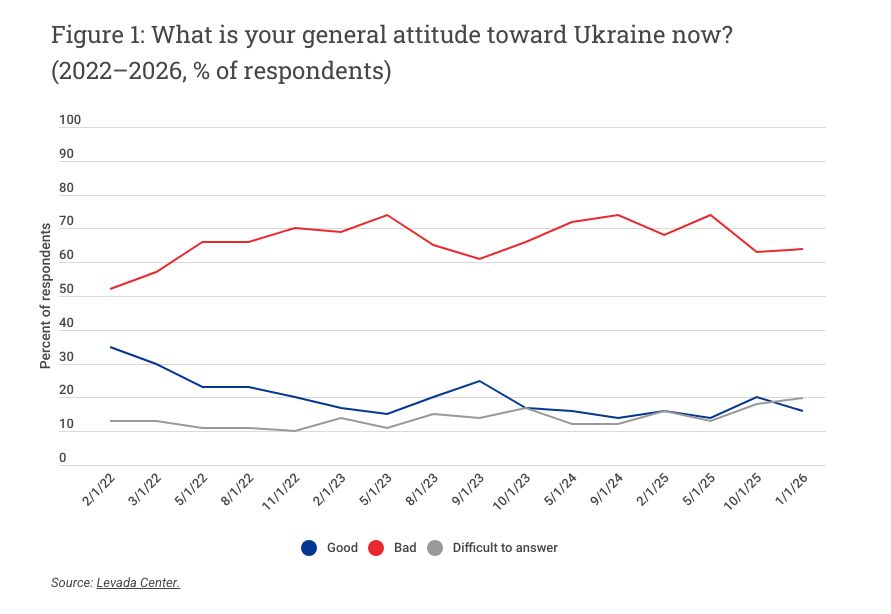
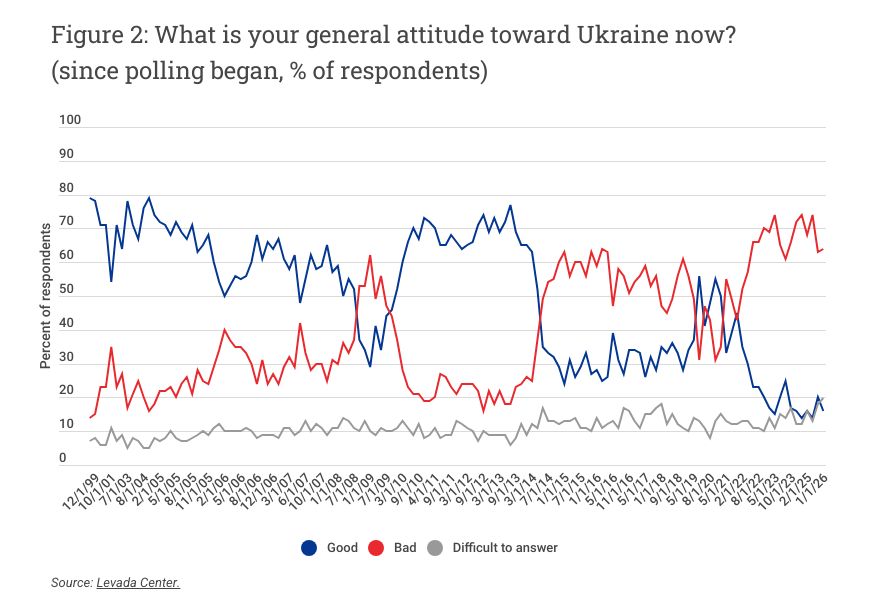
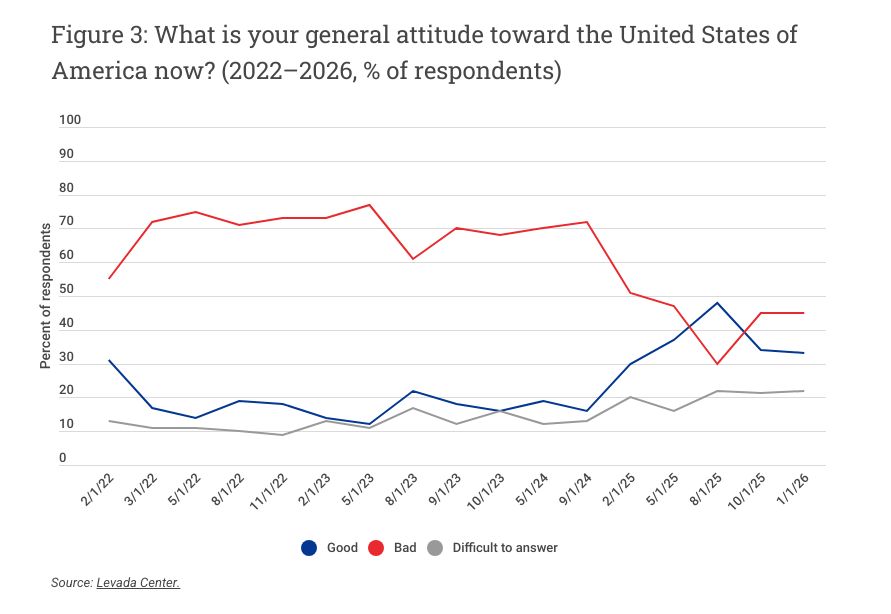
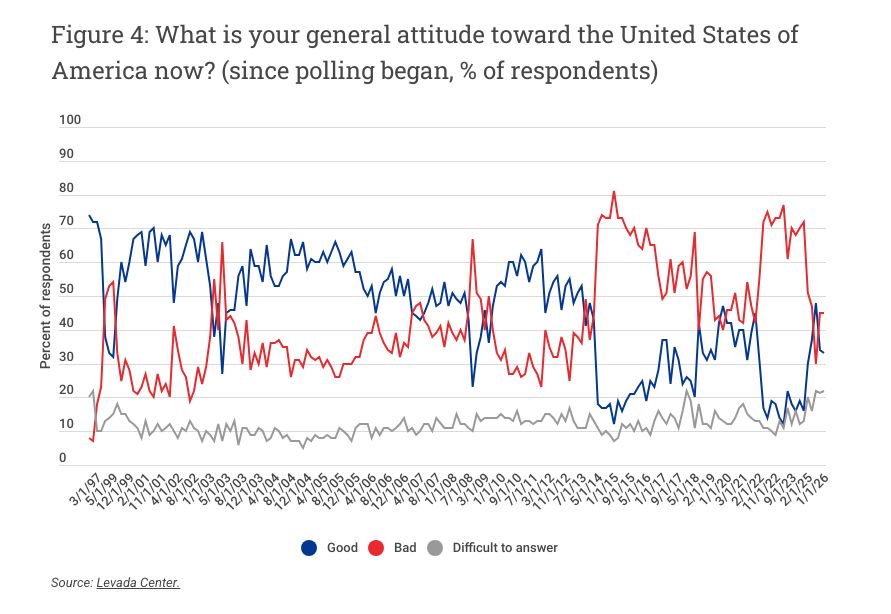
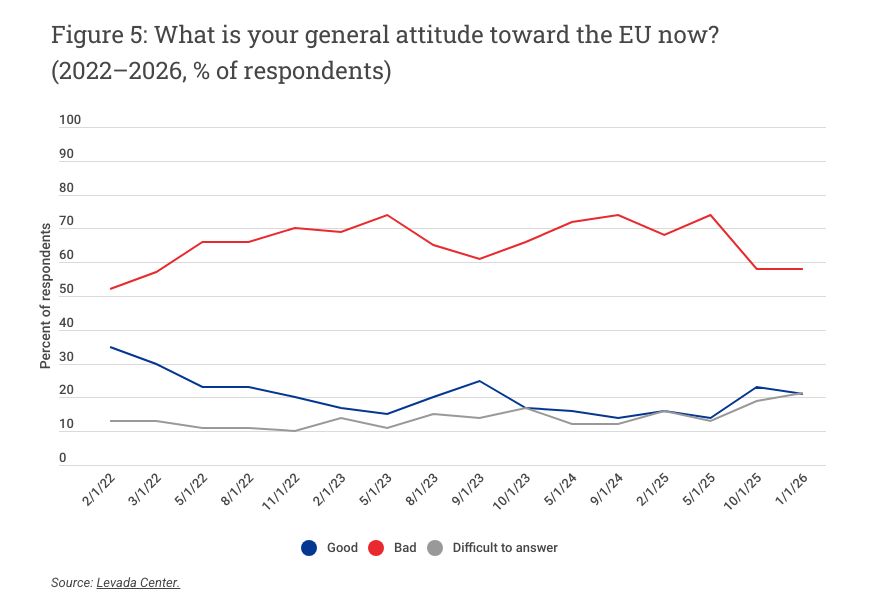
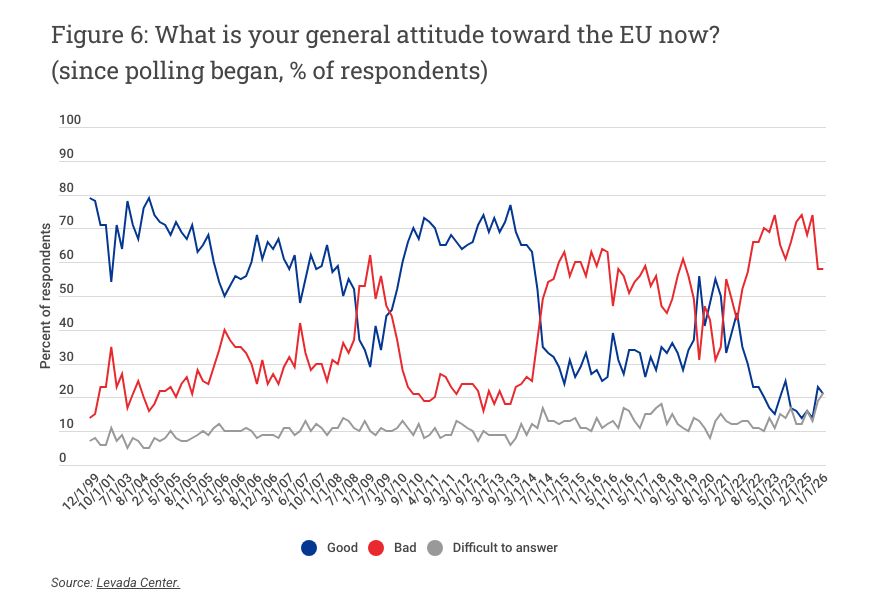
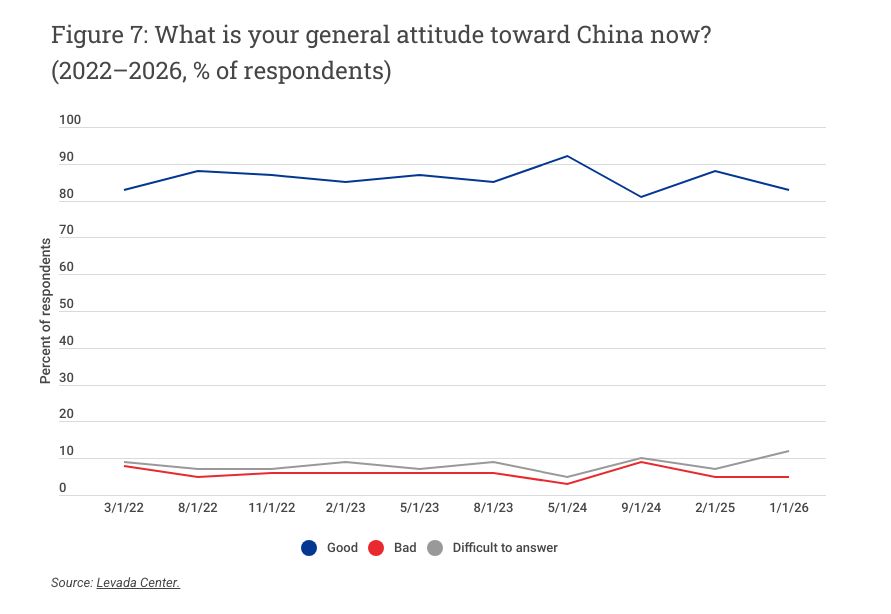
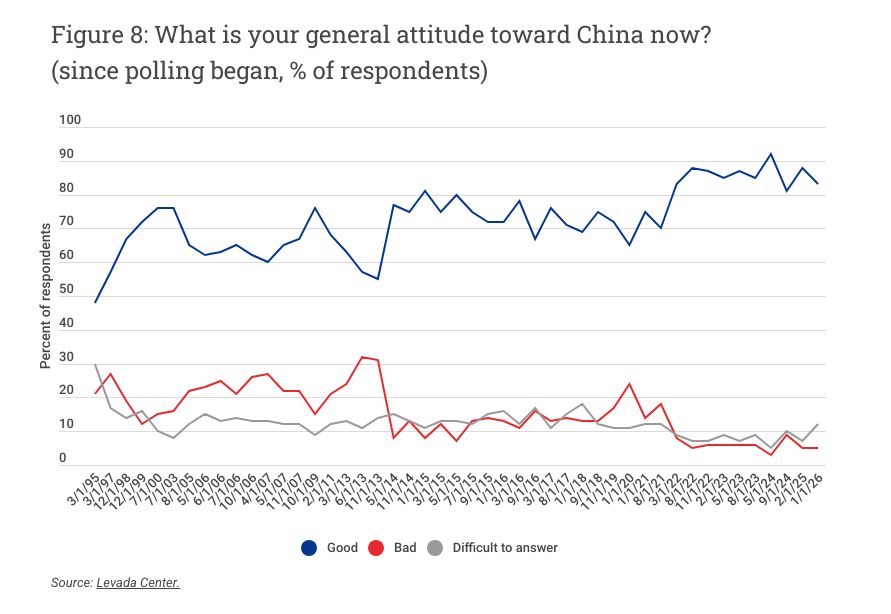
Endnotes
- Russian and U.S. negotiators discussed the expiration of the New START Treaty and agreed on the need to quickly launch new arms control talks, the Kremlin said on Feb. 6, 2026. “There is an understanding, and they talked about it in Abu Dhabi, that both parties will take responsible positions and both parties realize the need to start talks on the issue as soon as possible,” Kremlin spokesman Dmitry Peskov said, according to AP. According to a Feb. 5, 2026, post on X by Barak Ravid of Axios, “A source with knowledge said the practical implications were that both U.S. and Russia would agree to observe the [New START] deal's terms for at least six months, during which time negotiations on a potential new deal would take place.”
- Russian authorities say they have arrested two Russian citizens, 65‑year‑old Lyubomir Korba (detained in Dubai and handed over to Russia) and 66‑year‑old Viktor Vasin, over the shooting of GRU first deputy chief Vladimir Alexeyev in a Moscow apartment building, and named a third suspect, 54‑year‑old neighbor Zinaida Serebritskaya, who allegedly fled to Ukraine. (Meduza, 02.09.26) Ukrainian authorities denied involvement.
- For European, Ukrainian, Chinese and Indian experts’ views on demise of New START follow this link to a RM publication.
- Volodymyr Zelenskyy said U.S. and Russian officials are discussing a “Dmitriev package” of bilateral economic agreements worth about $12 trillion that may include provisions affecting Ukraine, while Washington is pushing to end the war by June as Russia intensifies pressure with mass strikes—29 missiles and 408 attack drones hitting energy facilities in eight regions and causing nationwide power outages. (Washington Post, 02.09.26)
The cutoff for reports summarized in this product was 10:00 am Eastern time on the day this digest was distributed. Unless otherwise indicated, all summaries above are direct quotations.
AI was used in production of this digest.
*Here and elsewhere, the italicized text indicates comments by RM staff and associates. These comments do not constitute a RM editorial policy.
Slider photo: In this photo provided by Ukraine's 65th Mechanized Brigade press service, a soldier smokes a cigarette at his position on the frontline in the Zaporizhzhia region, Ukraine, Saturday, Feb. 7, 2026. (Andriy Andriyenko/Ukraine's 65th Mechanized Brigade via AP)