
Russia Analytical Report, March 3-10, 2025
4 Ideas to Explore
- Joe Biden’s policy vis-à-vis the Russian-Ukrainian war “had dead-ended long before Biden left office,” Stephen Kotkin argued in an interview with The New Yorker. In Kotkin’s view, the U.S. has “done a lot” to prop up Ukraine on the battlefield during Biden’s presidency. “It’s in the political sphere that we’ve failed to apply significant pressure,” Kotkin said, reproaching U.S. authorities for dragging their feet on creating “viable political alternatives” to Vladimir Putin’s rule. “The regimes can get destabilized, because a lot of people would like to see a different future for Russia,” Kotkin argued. Meanwhile the Russian-Ukrainian war has taken such a turn that a Ukraine divided like Korea has become a potentially “good outcome” for Kyiv, according to Kotkin. “The bad outcome is Ukraine loses its sovereignty,” he said. Zooming out for a historical look, Kotkin also observed in the interview that “Russian grand strategy for … three centuries has been the following: West decline! Have the West implode and collapse, and then we’ll survive.” “It’s not American power that’s declining,” he argued.1
- The Russian-Ukrainian conflict has become a war of attrition, which Russia has historically tended to prevail in, and isolating Russia over that conflict is no longer a sustainable strategy for the U.S., Donald Trump’s Ukraine war envoy Keith Kellogg told a CFR event March 6. “The one thing you never want to do with the Russians is get into an attrition war,” he said, estimating that casualties on both sides of the war average 600 daily deaths, with Ukrainian military fatalities already surpassing those the U.S. suffered in the Vietnam and Korean Wars combined. Meanwhile, Russia has over 490,000 soldiers deployed to Ukraine, “a force that is larger than today’s active United States Army,” Kellogg warned. Trump’s envoy also criticized the Biden administration’s non-engagement of Russia during the war. “The continued isolation and lack of engagement with the Russians as the war in Ukraine continued is no longer a viable or a sustainable strategy and is certainly not a responsible approach diplomatically for the United States to continue,” he said. Kellogg also criticized the Biden administration’s approach for funding aid to Ukraine. “America has funded this war with over $170 billion. This year alone, with the most recent tranche of over $60 billion, is an amount larger than we funded the United States Marine Corps this year … When a nation is [more] concerned about filling somebody else’s potholes than their own potholes, they fail,” he said. Kellogg then made it clear that the U.S.-Ukrainian deal on Ukraine’s mineral resources is meant to be a financial recuperation strategy for the U.S. taxpayer.
- There is at least a “temporal correlation” between the purported suspension2 of U.S. intelligence sharing with Ukraine and the start of the collapse of the Ukrainian-held salient in Russia’s Kursk region, according to ISW’s March 9 “Russian Offensive Campaign Assessment” regarding Ukrainian-held territory in Russia. That same day Donald Trump announced that the United States had “just about” ended its suspension of intelligence sharing with Ukraine, which the Economist has described as “most vital.” In his March 9 comments, Trump did not touch upon the suspension of the supplies of military equipment to Ukraine. Unless those are resumed, Ukraine will probably run out of its last American military supplies in “two or three months,” a senior Ukrainian intelligence official warned in an interview in FT.
- Which country will go nuclear next? Gideon Rose poses this question in his latest article for FA, while pondering consequences of U.S. becoming an “an unreliable ally.” “The most obvious candidates would be Ukraine and Taiwan, nations clearly threatened by powerful nuclear-armed neighbors,” he writes.
I. U.S. and Russian priorities for the bilateral agenda
Nuclear security and safety:
- No significant commentary or analysis in monitored publications.
North Korea’s nuclear and missile programs:
- No significant commentary or analysis in monitored publications.
Iran and its nuclear program:
- No significant commentary or analysis in monitored publications.
Humanitarian impact of the Ukraine conflict:
- No significant commentary or analysis in monitored publications.
Military and security aspects of the Ukraine conflict and their impacts:
- “Russian forces are collapsing the northern part of the Ukrainian salient in Kursk Oblast following several days of intensified Russian activity in the area. Geolocated footage published on March 8 indicates that Russian forces seized Novaya Sorochina (northwest of Sudzha), Malaya Loknya (just south of Novaya Sorochina), and Lebedevka (south of Malaya Loknya), and the fields between the settlements.”
- “Russian forces reportedly advanced in Sudzha itself with support from North Korean forces. Russian milbloggers claimed that Russian forces advanced into the industrial area in northeastern Sudzha and that Russian forces maintain positions in the town along the east bank of the Sudzha River.”
- “Russian forces recently advanced just across the international border of the Kursk Oblast salient into Sumy Oblast and reportedly advanced south of Sudzha City. Geolocated footage published on March 8 indicates that Russian forces recently seized Novenke (northeast of Sumy City and just across the international border in Sumy Oblast).”
- “The temporal correlation between the suspension of US intelligence sharing with Ukraine and the start of Russia's collapse of the Ukrainian Kursk salient is noteworthy.”
- “Reports about the extent of the suspension of US military aid to Ukraine continue to indicate that the suspension will likely affect Ukraine's ability to defend itself against Russia.”
- “Ukraine's European partners may be able to independently supply commercially available satellite imagery to Ukraine amid the suspension of Ukraine's access to US portals with such imagery.”
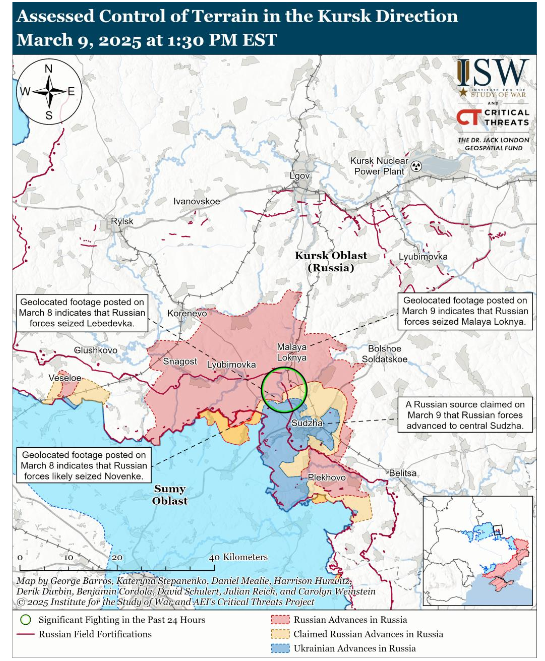 3
3
"Russian Forces Depleted and Stalling on Eastern Front, Ukraine Says," Marc Santora, NYT, 03.10.25
- “Ukrainian forces have stalled the Russian offensive in the eastern Donetsk region in recent months and have started to win back small patches of land, according to Ukrainian soldiers and military analysts. Russia still holds the initiative, and conducts dozens of assaults across the eastern front every day, the soldiers and analysts say. But after more than 15 months on the offensive, Russian brigades have been depleted and Moscow is struggling to replace destroyed equipment, offering limited opportunities that Ukrainian forces are trying to exploit.”
- “The Russian offensive effort in Donetsk has stalled in recent months due to poor weather, exhaustion among Russian forces, and effective Ukrainian adaptation to the way Russian troops have been fighting,” said Michael Kofman, a senior fellow at the Carnegie Endowment for International Peace in Washington.”
- “Western military analysts and U.S. officials believe that the order to hold back equipment is likely to take several months to have a significant impact on the front. But the loss of intelligence is already hurting Ukraine’s ability to strike Russian command centers, logistics hubs and concentrations of troops behind the front lines. Ukrainian soldiers said the lack of intelligence was especially problematic in the Kursk region of Russia, where Russian and North Korean soldiers are on the offensive and have rapidly advanced.”
“How do Ukrainian soldier fatalities compare with Russia’s?” The Economist, 03.06.25.
- “This is a bloody war, but Russia is bleeding more than Ukraine. And it is taking almost no territory.”
- “In September 2024 a leaked report from a Ukrainian intelligence agency suggested that at least 70,000-80,000 soldiers had died. These numbers do not include civilian deaths, on which there is strikingly little data. Many tens of thousands of civilians are believed to have been killed.”
- “Russian deaths, however, are even higher. BBC Russia estimates that between 150,000 and 210,000 soldiers had been killed as of February.”
- “[Russia’s] higher death toll in 2024 comes with strikingly little change in territory. By our calculations Russia captured only 0.57% of Ukrainian territory in 2024. At that rate it would take another 141 years for its soldiers to conquer the whole country.”
“Ukraine is not obviously losing this war. No matter how much pressure Mr. Trump puts on Mr. Zelensky, he will not be inclined to accept a Carthaginian peace that dooms his country to a chaotic and miserable future—or which leaves the door open to another invasion.”
For more commentary/analysis on this subject, see:
Military aid to Ukraine:
- “The long unthinkable prospect of Ukraine fighting without US weapons, equipment or intelligence looks set to become a reality after the White House on Monday announced it would cut military aid to Kyiv. A senior Ukrainian intelligence official said that Ukraine would probably run out of the last American military supplies in “two or three months”. “After that, it will be very difficult for us,” the official told the Financial Times. “It will not be a total collapse, but we will be forced to withdraw from areas more quickly.”
- “Over the past three years, US military support totaled $65.9bn, according to the state department. While Congress appropriated close to $175bn, only part of that went directly to Ukraine.”
- “The support has been extensive — from deliveries of artillery shells and armored vehicles to the provision of sophisticated air defense systems, vehicle-launched mobile bridges, anti-tank mines and long-range missiles. Crucially for Ukraine, that support includes intelligence-sharing, which has reportedly not so far been suspended.”
- “A shortage of interceptor missiles for the five US-made Patriot systems in use by Ukraine would represent a major blow to the country’s defensive capabilities, just as Russia has been expanding its drone and missile strike campaign deep within Ukraine. Ukraine’s Prime Minister Denys Shmyhal said on Tuesday that “the Patriot is currently the only system able to shoot down Russian ballistic missiles”.”
- “A shortage of artillery shells could be partially offset by European efforts, with the EU planning to produce up to 2mn artillery shells in 2025.”
- “US-provided HIMARS multiple rocket launchers have enabled Ukraine to destroy high-value targets such as command posts and logistical centers on Russian-held territory. ... “We have no real substitute for the HIMARS,” said Pavlo Narozhny, a Ukrainian military analyst and co-founder of Reactive Post, an organization supporting Ukrainian artillery units. The HIMARS launchers have also enabled Ukraine to use long-range ATACAMS missiles to hit targets in Russia, as far as 300km away.”
- “If Starlink is shut down, problems will start immediately,” Yehor Firsov, a former Ukrainian MP now serving in the military, wrote in late February. “Infantry in defensive dugouts, intelligence, drone and artillery crews, brigade and battalion headquarters . . . everyone uses Starlink.”
"As Trump Suspends Military Aid, What Are the Chokeholds on Ukraine?" The Economist, 03.03.25.
- “The critical elements of American support are weapons; the ability to maintain and repair them; the air-defense missiles that keep cities functioning; the Starlink system that is the backbone of military communications; and, perhaps most critically, intelligence sharing. Ukrainian soldiers know what follows when the flow of American weapons dries up.”
- “Ukraine can substitute a lot of artillery firepower with its own drone systems. In this respect, it is simply a matter of finding the money: the local defense industries are running below full capacity.”
- “Ammunition flows are less important than other components of American assistance. Only America is able to produce high-end weapons like the Patriot missiles that can intercept the Russian hypersonic and ballistic missiles raining down on cities. On paper, the French/Italian SAMP/T system could be a substitute, if it could be produced at scale. In practice, the system is unable to neutralize the fastest missiles, though a more advanced version is expected next year.”
- “The Starlink satellite network is paid for by Poland, but controlled by the Americans. The Ukrainians have produced workarounds before—not least during operations in Russia’s Kursk region, where Starlink systems are mostly disabled. Here, engineers used mobile technologies and drone relays to provide soldiers with communications. A Ukrainian official says a back-up using similar technologies is in the works.”
- “Most vital of all is American intelligence, which is provided via NATO arrangements. This is what allows the country’s armed forces to see all manner of threats: Russian planes when they are about to strike; Russian forces as they prepare to launch new invasions; the flow of Russian, Iranian and North Korean weapons; the stores, logistics and operational hubs of the Russian war machine. It allows Ukraine to guide, in real time, rockets and drones to targets inside Russia. Ukrainian drones can see in the short distance behind the current front lines. But American eyes let them see deep. American officials in Europe Command (EUCOM), which oversees all American forces on the continent, use artificial intelligence to fuse data from satellite images, electronic intelligence and other sources to identify high-value targets. A Western military official says Europe might be able to provide some of the capability—Britain, for example, routinely flies Rivet Joint surveillance aircraft over the Black Sea—but not quite as quickly.”
- “For those involved in Ukraine’s defense industries, the psychological blow might be as damaging as the material one. It would feel like a betrayal, they say—especially for those accustomed to the seamless technological collaboration seen in projects like the Batyar drone.”
"What US Military Aid Suspension Means for Ukraine’s Soldiers," Jack Watling, FT, 03.10.25.
- “The Trump administration’s decision to halt US military-technical assistance and the uncertainty around continued intelligence sharing with Kyiv ... will not cause a rapid deterioration of Ukraine’s ability to resist, but will incur a cost in the lives of Ukrainian soldiers and civilians. They also do nothing to shift the strategic calculus for Kyiv, whose reluctance to accept an American deal on any terms reflects the existential stakes for which President Volodymyr Zelenskyy is negotiating.”
- “Given that Ukraine will keep fighting — potentially in defiance of the US — the risk is that the Trump administration continues to apply leverage. They could next shut down Elon Musk’s satellite-powered internet provider Starlink, seriously disrupting Ukrainian command and control.”
- “The challenge for both Ukraine and its European allies is that it is not clear whether the US president cares about the collapse of the Ukrainian frontline. The Trump administration has made it clear that it wants Europe to manage European security — if the fall of Ukraine brings about this shift, then the US may well see it as a strategic success. The White House may prefer to win plaudits for achieving a peace — albeit on unnecessarily unfavorable terms to Kyiv — but it is equally possible that the US will settle for a Ukrainian defeat, which it will squarely blame on Zelenskyy.”
“This is Europe’s War Now,” Dmytro Kuleba, NYT, 03.03.25. Clues from Ukrainian Views.
- “On Friday, after a grim-faced Volodymyr Zelensky departed the White House, President Trump wrote on social media that the Ukrainian leader could “come back when he is ready for Peace.” Peace is a powerful word, but to grasp its true meaning one has to look at the context in which it is uttered. On the same day that Mr. Trump spoke of the importance of peace and sent Mr. Zelensky home to think about it, Russia launched more than 150 attack drones on Ukrainian cities. While Mr. Trump emphasizes that he is making great progress with President Vladimir Putin of Russia toward peace, the latter has only increased his strikes since the inauguration.”
- “Europeans understand, as the Trump administration appears not to, that Ukraine wants a peace deal — it just doesn’t want to end up destroyed by the peace terms. The obsession of Mr. Putin is all of Ukraine, nothing less. It is neither NATO nor a strip of Ukrainian land. If Ukraine is still independent and armed by the end of negotiations, Mr. Putin will not see that as the end. He will settle for a piece of Ukraine today only to come for the whole tomorrow.”
- “If it were about NATO, then Mr. Putin would not have so meekly accepted Sweden and Finland’s accession in 2023. Today, NATO’s frontier is closer to St. Petersburg than Ukraine’s border is to Moscow. Nor is the point to retain the roughly 20% of territory that Russia has managed to wrest from Ukraine so far in this war. Mr. Putin cannot tolerate an independent Ukraine because for the last 300 years almost none of his predecessors could. And because if Ukraine is successful as a Western democracy, it will pose a direct threat to the Russian people’s acceptance of Mr. Putin’s autocratic model.”
- “Mr. Trump has made a cease-fire in Ukraine too central to his foreign policy to not succeed. He cannot fail to make a deal and he certainly cannot allow Ukraine to become what Afghanistan was to President Joe Biden, a foreign policy disaster that defined the rest of his presidency. Trapped by his own ambition, Mr. Trump craves fast success—hence last week’s attack on Mr. Zelensky, whose insistence on terms Ukraine can live with seems to stand in the way of it. Mr. Putin understands this. He therefore may concede to a cease-fire to take the maximum benefits offered by Mr. Trump, but he will not abandon his strategic goal of destroying Ukraine. Without security guarantees the war will, at some point, start again.”
- “Friday’s events were the formalization of a new reality that has been becoming apparent for several weeks: America may still seek to lead the world, but it’s a different world. And if there was any silver lining to the scene of Mr. Trump and Vice President JD Vance berating Mr. Zelensky in the Oval Office, it was the shock waves it sent across Europe. European leaders who had heard Mr. Vance’s words of admonishment at Munich in February already grasped that they could not simply wait out Mr. Trump as they did during his first term. Any who still doubted that were surely convinced by Friday’s performance.”
- “Europe has already taken important steps and it’s promising to do more … Europe could wrest the cards from [President Trump’s] hands in two moves: offer an alternative agreement on Ukraine’s minerals and confiscate Russian frozen assets to use them to finance the production and purchase of arms—including from the United States, if they wish. The European Union, Britain and Norway could not entirely replace the United States as Ukraine’s supporters, but these pragmatic steps would instantly elevate Europe’s role and give Ukraine the breathing room it needs.”
- “Europe finally has a plan for to end the war in Ukraine and provide for European security. German chancellor-in-waiting Friedrich Merz has found a way to eliminate the German debt brake and unleash hundreds of billions of euros in German money. European leaders have agreed to a €800bn “ReArm Europe” defense fund to increase military spending and jumpstart the defense industry. And British prime minister Keir Starmer and French president Emmanuel Macron have proposed a European force of some 30,000 soldiers to deploy to Ukraine after a ceasefire.”
- “By European policymaking standards, this amounts to a revolution. Even by the tougher standard of Europe’s geopolitical needs, it is a good start. U.S. president Donald Trump’s effective abandonment of Ukraine and European security seems to have finally focused European minds. For the United States under Trump, Europe’s latest actions point in the right direction, but they miss the bottom line. The US will no longer to take responsibility for European security in any way—morally, fiscally or militarily. Europeans can’t just do more; they need to do it all.”
- “The problem is that most of Europe’s efforts still seem intended to address the old burden-sharing debate. They offer increased European contributions in exchange for continued American commitment to European security.”
- “Take the UK-French proposal to put some 30,000 European troops into Ukraine as some sort of peacekeeping or tripwire force. In essence, this UK-French plan amounts to a US security guarantee once removed: European forces guarantee Ukrainian security, but the US military guarantees the security of the European forces. Trump… seems to intuitively understand the danger of open-ended contracts. When asked about US support for a European force, he noted, “Well, there is a backstop. First, you have European countries, because they’re right there, we’re very far away.”
- “His defense secretary Pete Hegseth was more explicit, “any security guarantee must be backed by capable European and non-European troops. If these troops are deployed as peacekeepers to Ukraine at any point, they should be deployed as part of a non-NATO mission. And they should not be covered under Article 5… To be clear, as part of any security guarantee, there will not be US troops deployed to Ukraine.”
- “Europe has come a long way in six weeks. But it has much further to go… Europeans have not adequately responded to the end of US protection. They have finally provided a robust answer to the burden-sharing question that American presidents have been asking since the Eisenhower administration. But that is no longer the question. Under Trump, the question is now how will Europeans defend Europe without America? The proposed European force in Ukraine doesn’t purport to do that and the ReArm Europe fund and the German efforts are only a start. Until Europeans answer that question does, Washington will remain unimpressed.”
For more commentary/analysis on this subject, see:
- "Potential European Mission in Ukraine: Key Military Factors," Ben Barry, IISS, 03.07.25.
- "How to Defend Ukraine’s Skies During Peace Negotiations," Benjamin Jensen, Mark Montgomery and Jose M. Macias III, CSIS, 03.07.25.
- "Disdain for Ukraine: How Europeans Can Support Zelensky Against Trump’s Cuts," Eva Sanders, ECFR, 03.05.25.
- "Asserting Agency: How Europeans Can Ensure Ukraine’s Security," Marie Dumoulin, ECFR, 03.10.25.
- "Back to the Future: Applying the Chilcot Checklist to Ukraine," Ed Arnold, RUSI, 03.10.25.
- "Aiding Ukraine Has Been a Great Investment for the US," Hal Brands, Bloomberg, 03.07.25.
Punitive measures related to Russia’s war against Ukraine and their impact globally:
"Will the Warming of Russia-U.S. Dialogue Lead to the Lifting of Sanctions?" Ivan Timofeev, RIAC, 03.07.25.^ Clues from Russian Views. (This organization is affiliated with the Russian authorities.)
- “Historical experience and the latest news give reason to assume that anti-Russian sanctions may be weakened.”
- “Firstly, easing and lifting sanctions are not equivalent to reaching political agreements or normalizing relations. Changes on the sanctions front may be significantly delayed. Cosmetic, signal easing may be followed by stagnation. Legal mechanisms that allow sanctions to be imposed have been in place for decades, even if exceptions and exemptions apply to them. They can be reinstated at any time.”
- “Secondly, sanctions are sensitive to changes in presidential administrations in the United States. Obama and Trump's policies on Iran were diametrically opposed. Congress also plays a role. It can weave a "web of laws" that limits the president's powers. In the case of anti-Russian sanctions, such a "web of laws" already exists. For example, a ban on Russian energy resources, the breakdown of normal trade relations, and the like are enshrined in law. The president cannot cancel these laws without the support of Congress.”
- “Thirdly, American sanctions are more important than those of the EU and other countries, because the US is at the center of the global financial system. Their secondary sanctions are an incentive for others to take restrictions seriously. In our case, negotiations with the US are more of a plus than a minus.”
- “Fourthly, the easing of sanctions may take a long time and be extremely uneven. In some cases, the process drags on for decades, and sometimes simply leads to nothing.”
- “If the US takes a steady course of easing [sanctions on Russia], then sooner or later the EU and other countries may follow their example. However, the complexity of the Ukrainian issue threatens to disrupt the settlement with the risk of returning sanctions in an even larger volume.”
For more commentary/analysis on this subject, see:
- "What Europe Can Do If Trump Drops Russia Sanctions," Agathe Demarais, FP, 03.04.25.
- "Rishi Sunak on Why Ukraine Should Get Russia’s Frozen Assets, Not Just the Interest on Them," The Economist, 02.28.25.
Ukraine-related negotiations:
- “We'll know more about Ukraine's situation after tomorrow's meeting in Saudi Arabia between Ukrainian and U.S. negotiating teams. My understanding from the Ukrainian side is that they are prepared to accede to President Donald Trump's demand for a share of future mineral revenues and are ready to begin negotiations without demanding Russian withdrawal from occupied territories as a precondition — but still want security guarantees provided by European nations with some U.S. backstop. That was what Trump team has been proposing in private talks since Election Day. ... So maybe that's a prelude to talks with Russia.”
- “If Trump "moves the goalposts" and insists that Ukraine accept Russian conditions as a starting point, this diplomatic effort deserves to collapse — because he's demanding a Ukrainian surrender. If Ukraine goes forward on the battlefield, it's hard to know how long they could last. But one of the big mistakes in this war has been to underestimate Ukrainian determination on the battlefield and to overestimate Russian capabilities. So maybe Ukraine could maintain the current stalemate — though at terrible cost.”
- “If Trump's team signs off on the Ukrainian position (and concessions that will offer to get U.S. support) then there is no reason the U.S. shouldn't lift or modify the intel embargo. If, on the other hand, the U.S. demands further concessions, then we will know this process has really broken down.”
- “A ceasefire in place would in many ways represent a defeat of Russian war aims. To me, this war was about whether Ukraine could become a secure, sovereign *European* country. That's still the measure of success for me.”
- “European military forces would... represent a significant "tripwire," I think.”
- “I think Europe can — and must — keep Russia from expanding any farther.”
- “One danger of Trump's accelerating move away from NATO is that European nations such as Germany now have to think about developing their own nuclear deterrent.”
- “Biden's policy was to support Ukraine without risking a direct US conflict with Russia. I thought that was the right policy, but it tied Biden's hands more than it needed to.”
- “[When asked: So, assuming the United States completely stops all aid to Ukraine, including intelligence sharing, how long can Ukraine hold on with only just Europe's help?] Months; maybe many months.”
- “Here's my biggest worry: Air defense. .... without U.S. Patriots and interceptors to stop Russian missiles — and the intel that helps Ukraine anticipate incoming attacks — Ukraine will be open to Russian air attack, with potentially devastating consequences.”
- “Ukraine is getting good intel from Britain, especially, but there are some assets that are unique to the U.S.”
- “Starlink is the backbone of Ukraine's forward command and control. Loss would be very damaging.”
- “Zelensky's biggest rival is Gen. Valery Zaluzhny, and he is if anything more hawkish than Zelensky.”
"How To End The Russia-Ukraine War," Lawrence J. Korb and Stephen Cimbala, NI, 03.07.25.
- “Although the case for a peace agreement in Ukraine is compelling from a humanitarian standpoint, and even if Ukraine and our European allies become part of the negotiations finding the correct protocols to accomplish this mission in a way that satisfies all parties, particularly the Russians, poses major obstacles for participants in negotiations and their various supporters and interlocutors. The objectives and structure for such negotiations must include:”
- “Arranging a cease-fire in place at a time agreed upon by Ukraine and Russia;”
- “Stipulating which forces on each side can remain stationed on Ukrainian territory after the ceasefire and during follow-on negotiations.”
- “During the negotiations, neither side should be permitted to engage in short or long range attacks by ground, maritime or air forces against the forces of the other side, nor against populations located within their respective spheres of influence; this restriction includes clandestine operations making use of proxies or other unconventional warfare or covert action.”
- “States or groups of states represented at the talks should include, in addition to Ukraine and Russia: the United States; the European Union; the UN Security Council; and the Organization for Security and Cooperation in Europe (OSCE). Observers representing other interested states and organizations can be invited, including from NATO and the European Union.”
- “The long-range objectives for negotiators will have to include the establishment of a timetable for the withdrawal of all foreign combatant forces from Ukraine, with the exception of Russian forces located on former parts of Ukraine claimed by Russia, and subsequently accepted as Russian by Ukraine and its supporters in the United States and NATO.”
- “In addition, a monitoring and verification system will have to be established.”
- “The endgame of negotiations should be to move from the temporary and expedient line of control and demilitarized zone immediately following an armistice to a more permanent and durable demarcation of what is Russian and what is Ukrainian. This will have to be spelled out in detail and agreed by all participants before further steps are taken, including the removal of Ukrainian and Russian military forces to their respective post-agreement zones.”
- “The larger challenge will be to ensure that Russia does not renege and renew its appetite for swallowing the remainder of Ukraine at the first opportunity. This objective requires that the United States, the European Union, and NATO’s support of free Ukraine with military assistance for the sake of deterrence, economic aid for the rebuilding of its devastated economy, and above all, security guarantees against a Russian repeat of 2022.”
- “The military options should be developed during post-peace agreement training of NATO European and U.S. military forces in scenarios ranging from limited war to full engagement between NATO and Russia.
- “Russia needs to rethink its diplomatic-strategic behavior. One outcome of Russia’s war against Ukraine was to enlarge NATO to a membership of thirty-two countries, including previously neutral Sweden and Finland. And, although Putin and Chinese leader Xi Jinping have entered into an alliance of sorts on some issues of military preparedness and foreign policy, China’s support for Russian aggression in Europe is conditional with respect to how extensive and how dangerous Russian ambitions prove to be.”
Remarks by Keith Kellogg at CFR’s “Securing Ukraine's Future” event, 03.06.25.
- “Just on the Ukrainian side alone, more soldiers have been killed, the Ukrainians, than the United States lost in the Vietnam War and the Korean War combined. Russia has over 490,000 soldiers deployed to Ukraine, a force that is larger than today’s active United States Army. The casualties of this war have surpassed one million. And on an average, this war is costing an average of 600 soldiers killed in action per day.”
- “[“That’s a pretty major concession to Russia, to constrain Ukraine’s ability to target and hit Russian forces,” CBS’ Margaret Brennan, who was moderating the conversation with Keith Kellogg at CFR, said of the cutoff on intelligence sharing.] “This pressure really seems to be directly impacting potentially what they can do on the battlefield.” “Very candidly, they brought it on themselves, the Ukrainians,” Kellogg said. Asked what Ukraine will have to do to turn intelligence sharing and flow of military aid back on, Kellogg pointed to the proposed minerals deal between the U.S. and Ukraine. Asked what the impact of turning off intelligence sharing and military aid will have, Kellogg said, “I think in—the best way I can describe it is sort of like hitting a mule with a two by four across the nose. You got their attention. And it’s very—it is significant, obviously, because of the support that we give, OK, but it’s one way of sort of get your attention to do it. But it’s a pause. It’s not an end.”
- “America has funded this war with over $170 billion. This year alone, with the most recent tranche of over $60 billion, is an amount larger than we funded the United States Marine Corps this year ... When a nation is concerned about filling somebody else’s potholes than their own potholes, they fail.”
- “The seizing of frozen Russian sovereign assets to rebuild and rearm Ukraine, maximum pressure sanctions on Russian energy are a few of the tools the president is leveraging to get Russia to a peace deal.”
- “For the president of the United States to not engage with the leader at war has had immense ramifications for our national security. The continued isolation and lack of engagement with the Russians as the war in Ukraine continued is no longer a viable or a sustainable strategy and is certainly not a responsible approach diplomatically for the United States to continue.”
- “While the kinetic action and direct military engagement of this war is bound to Russian and Ukrainian territory, this war is ultimately being waged by a competing alliance structure who are all proxies to this war. Russia’s war effort has led to a deepening of alliances with the Chinese, the Iranians, and North Koreans, where the Europeans are supporting Ukraine by proxy, in a simple fear that if Russia is not stopped in Ukraine the war will spill over to the rest of Europe.”
- “My experience in the reading of history, in studying the Russian at war—in fact, there’s a great book by—Russia at War, by a guy named Alexander Werth, that—when it comes right down to it, the one thing you never want to do with the Russians is get into an attrition war. I mean, this is the same nation that in World War II lost 70,000 troops dead in Stalingrad in six months and continued to fight.”
"Ukraine Holds a Weak Hand," Walter Russell Mead, WSJ, 03.04.25.
- “Ukraine's concerns are well founded, but with Mr. Trump in the Oval Office, most of Kyiv's goals are unobtainable. Mr. Zelensky knows he must choose whether to work within the framework the Americans have offered him or to fight on with diminished and perhaps vanishing American assistance, relying on European economic and military aid together with the fighting spirit of the Ukrainian people to force Russia to agree to better terms. With European leaders urging him to consider a one-month cease-fire, the prospects for meaningful as opposed to theatrical European support seem slim.”
- “After the Oval Office meltdown, the question for Mr. Zelensky is simple: Is Ukraine better off accepting the Trump framework and trying to push for more favorable terms inside the process, or is it better off rejecting the framework up front in hopes of forcing Mr. Trump to offer something more appealing?”
- “Like many Americans, your Global View columnist regrets the failure of successive U.S. presidents to offer more support for Ukraine over the years. But given Mr. Trump's oft-repeated views, Mr. Zelensky would be wise to accept the minerals agreement and to let negotiations proceed. Sadly, no better offers are coming his way.”
"Who Holds the Trump Cards in Ukraine?" Michael Froman, CFR, 03.07.25.
- “Ukraine has the weakest hand at the table. As Trump and his emissaries have made clear, Washington is not inclined to indefinitely support Kyiv. Trump’s main objectives are to get a return on the investment the United States has made in supporting Ukraine and to secure a swift end to the war that does not entail further U.S. involvement. This leaves Ukraine with only a few cards to play, including signing a critical minerals deal (billed by U.S. Treasury Secretary Scott Bessent as an “economic partnership”) and publicly praising Trump. Ukraine may also seek to gain more leverage by getting more European support, but the Europeans can only do so much, at least in the near term.”
- “It’s true that Russian progress on the battlefield has been slow and costly despite the assistance of North Korean troops on the ground. But just today, Russia carried out an intense assault to retake territory in its Kursk province, an attack that appears to have broken through Ukrainian lines and could spell the end of Zelenskyy’s gambit to maintain a Ukrainian beachhead on Russian soil. The Russian economy is struggling, but by no means on the brink of collapse. And in recent weeks, Putin was dealt a powerful new card: the Trump administration has begun to openly tease the possibility of a great reset in U.S.-Russian relations to strike a quick deal and perhaps pry Putin away from his “best friend,” Chinese President Xi Jinping. To this end, the Trump administration voted alongside Russia and North Korea at the UN to stymie an effort to explicitly condemn Putin’s regime for the 2022 invasion.”
- “Putin can only press his advantage so far, however. After a devastating barrage of Russian cruise and ballistic missiles hit Ukrainian energy infrastructure last night, Trump issued a rare public threat against Russia on Truth Social, saying he was “strongly considering” sanctions and tariffs on Russia to force it to the negotiating table.”
- “Then there are the Europeans. With the United States pulling back from its longtime commitments, Europe is trying to fill the void, not only in Ukraine but also in the continent at large. ...To bolster a future cease-fire agreement, European leaders are finally starting to seriously discuss seizing more than €200 billion of frozen Russian central bank assets as a response to potential Russian violations. They have declined to take this step so far, citing legal and economic concerns. But as British Foreign Minister David Lammy has put it, it may be time to move from “freezing the assets to seizing the assets.”
- “Now comes time for a new round of betting. What is Ukraine’s bottom line, both with the United States and with Russia? What American chips is Trump willing to wager to strike not just any deal, but a deal that creates a just and durable peace? What is Europe’s real appetite for reform, rearmament, and the deployment of boots on the ground and planes in the air over Ukraine? And what, if any, ground is Putin willing to give? Now is not the time to bluff.”
- “Conclusion of a ceasefire agreement between Ukraine and Russia, if necessary with the involvement of a mediator(s).”
- “Agree on a ceasefire line and codify it since it will be the basis from which the parties must withdraw.”
- “Create a Joint Military Coordination Commission (JMCC) to enable mil to mil contacts and coordination through which the parties can exchange information and hold each other accountable. Bilateral cooperation could be augmented by a third-party Multilateral Liaison Team.”
- “Agree on a buffer zone and limitation zones for heavy weapons.”
- “Deploy an international monitoring and verification mission to monitor the ceasefire and verify the withdrawal of heavy weapons.”
- “Engage countries, particularly from Europe, to provide troops and leadership to the international monitoring mission and to liaise with Ukraine and Russia through the JMCC to end the violence and reduce the risk of its recurrence.”
- “Carry out humanitarian demining, particularly in the buffer zone, to clear an area where international monitors can operate, and people displaced by the violence can return.”
- “With the consent of the parties, open humanitarian corridors across the ceasefire line to enable freedom of movement and access for recovery and reconstruction.”
- “Engage with civil society to address the needs of the affected populations and create opportunities for affected communities themselves to be agents of change.”
- “Agree on security guarantees to reduce the likelihood of a resumption of hostilities.”
- “Use the ceasefire as a first step towards a broader package of agreements including a political settlement as well as arms control agreements and confidence- and security-building measures between NATO and Russia and strategic stability between the United States and Russia as well as discussions on the future of European security.”
“‘The Era of Peace Is Gone’: Dmytro Kuleba Delivers 2025 Lamont Lecture,” Chris Conway, RM, 03.10.25. Clues from Ukrainian Views.
- “On the third anniversary of Russia’s invasion of Ukraine, former Ukrainian foreign minister and senior fellow at the Belfer Center for Science and International Affairs Dmytro Kuleba delivered the Center’s 2025 Lamont Lecture, “A View from Ukraine.” In conversation with Belfer Center director Meghan O’Sullivan, Kuleba outlined his views on Ukraine’s ongoing talks with the Trump administration, the potential for a ceasefire and the future of Ukraine itself.”
- “Arguing that the Trump administration’s aim for a ceasefire was inherently misguided, Kuleba criticized what he saw as the West’s continuous misreading of Russia’s intentions and the lack of a coherent strategy to deal with Russia’s expansionist tendencies. Kuleba called on European countries to unite behind support for Ukraine and touched on his country’s dogged resilience throughout its conflict with Russia.”
- “Kuleba criticized the history of “resets” between Russia and the U.S., the results of the latter’s repeated failure to gauge Russia’s true intentions. … Kuleba believes U.S. President Donald Trump’s current reconciliatory approach echoes Barack Obama’s attempted “reset” in 2009 and is equally doomed to failure.”
- “Belfer’s Meghan O’Sullivan asked Kuleba about the prospects for a ceasefire in Ukraine. Despite the Trump team’s desire for a ceasefire, Kuleba responded, whatever they achieve will not be sustainable. … Kuleba noted that neither Europeans nor Americans had yet internalized that “the second goal of Putin after Ukraine is to expose the weakness of the West to the whole world.”
- “Regarding security guarantees, Kuleba argued that only NATO membership would be sufficient to deter further Russian aggression. All “assurances” provided to date had failed. Kuleba acknowledged that what would deter Putin remained an “open question,” especially considering NATO’s uncertain future as Trump’s second presidency continues.”
- “Kuleba remained optimistic in his predictions for the future. Expressing hope for eventual reconciliation between Russians and Ukrainians, he drew comparisons with Franco-German rapprochement following the two world wars. To make that happen, he declared, the future president of Russia would have to come to Ukraine, kneel before the monument to the victims of Russian aggression and apologize on behalf of the Russian people. But before that, “Russia has to change.”
"Russians Believe Their Leaders Should Negotiate from a Position of Strength," Denis Volkov, Russia.Post/Forbes Russia, 03.07.25. Clues from Russian Views.
- “Overall, ending the Russia-Ukraine conflict and starting peace negotiations is currently supported by about 60% of Russians. We saw these numbers in surveys starting in summer 2024, but the Ukrainian army’s incursion into Kursk Region had the effect of decreasing support for peace negotiations for a time. Indeed, since February 2022, the proportion of those in favor of a peaceful resolution of the conflict almost never fell below half the population.”
- “Still, this should be understood as the most general desire to end the conflict and stop the bloodshed. The most frequently heard argument in favor of this – in focus groups and in responses to open questions – is that too many have already died on both sides.”
- “The growth in support for peace negotiations is driven also by a shift in rhetoric by the Kremlin, which has been signaling Russia’s readiness for talks for the past few months.”
- “In the last couple of months, less than a third of Russians have been against peace negotiations and for fighting on, whereas throughout the conflict the average was about 40%. Their main argument is that “we should not stop halfway” and “we need to finish what we started” given that “so much has already been sacrificed.”
- “Let us return to the desire for peace negotiations prevailing in Russian society. The majority of Russians (70%) believe they should be conducted first and foremost with the US.”
- “Though Ukraine is seen as being controlled by the West, there is an understanding that signing a peace agreement cannot be done without its participation.”
- “Though support for a peaceful settlement prevails in Russia society, the majority are not in favor of peace at any price... This is likely attributable to the belief, voiced by three quarters of respondents, that Russia is winning on the battlefield today. About the same number – 72% – say that the conflict is going well for Russia. People reason that with Russia gradually gaining the upper hand on the ground, Russian leaders can and should negotiate from a position of strength.”
"Interview of Russian Foreign Minister Sergei Lavrov with ‘New Regions of Russia,’" Russian Foreign Ministry, 03.10.25.^ Clues from Russian Views.
“[When asked: Do you support the opinion that U.S. President D. Trump can take an active part in the negotiation process between Russia and Ukraine and become a kind of "peacemaker"?]”
- “I would not like to get too far ahead of myself. As Russian President V. V. Putin has repeatedly said, we are always ready for negotiations. But at the same time, our national interests must be guaranteed. The root causes of the conflict in Ukraine must be eradicated - the head of state especially emphasized this most important point in his telephone conversation on February 12 with US President D. Trump. Let me remind you: we are talking, first of all, about the need to eliminate threats to Russia's security from the Ukrainian and Western directions in general, which have arisen as a result of NATO expansion to the east, as well as the need to stop the practice adopted by the Kyiv regime of exterminating everything that is in one way or another connected with Russia and the Russian world - the Russian language, culture, canonical Orthodoxy, Russian-language media.”
- “It is too early to draw far-reaching conclusions, but what we have heard so far from representatives of the Trump administration is generally encouraging. The owner of the White House himself admitted that one of the root causes of the conflict was NATO expansion and attempts to draw Ukraine into it. US Secretary of State M. Rubio talks about the multipolarity of the modern world and the need to respect the interests of all states - large and small. At the UN, American diplomats, for the first time in three years, voted together with Russia and our like-minded people against the odious General Assembly resolution promoted by Kiev and its patrons from the European Union. All of these are steps in the right direction. We appreciate them, but I repeat: it is premature to draw any profound conclusions on this basis. We have not even begun to work on overcoming the accumulated problems and contradictions in our relations with the Americans.”
For more commentary/analysis on this subject, see:
- "A Path to Peace in Ukraine, Minus the Betrayal," David French, NYT, 03.06.25.
- "Why Volodymyr Zelenskyy Refuses Donald Trump’s Ceasefire ‘Trap,’" Ben Hall, FT, 03.04.25.
- "Trump’s Oval Office Tantrum Won’t End Ukraine War," Editorial Board, The Boston Globe, 03.04.25.
- "Real Ukraine Peace Talks Require a Real US Security Guarantee," Andreas Kluth, Bloomberg, 03.06.25.
- "Kyiv and Moscow Are Divided by a Valley of Lies," Marc Champion, Bloomberg, 03.05.25.
- "Why a Ceasefire Holds Little Appeal for Zelenskyy," Steven Pifer, Brookings, 03.04.25.
Great Power rivalry/new Cold War/NATO-Russia relations:
- “Presidents rarely turn a ship as big as the United States during a four-year term.”
- “I’m not validating anything here, but Trump has revealed some truths about American power and America’s place in the world, and the European place in the world here, that are valuable truths.... the truths are as follows: Zelensky is looking for security guarantees, which means that not just Ukrainians will die—that people from other countries, European countries especially, will die. .... Trump has ...shown that it’s put up or shut up on the European side. And even though Putin couldn’t get the Europeans to get their act together, maybe Trump will ... nobody would send troops. I mean, what is this charade that we’re talking about? Trump exposed this. Now what are we going to do about it—first and foremost, as Europeans? ... The Biden policy had dead-ended long before Biden left office. Something needed to be done. The trajectory we were on was failing. And let’s get on a trajectory that’s succeeding.”
- “Everybody wants more and more American power, but American power can’t fulfill all its current commitments, let alone make new ones. ... You can’t say that American power is sufficient to meet its current commitments on the trajectory that we’re on.”
- “Russian grand strategy for, I don’t know, three centuries has been the following: West decline! Have the West implode and collapse, and then we’ll survive. That’s Russian grand strategy. Things are bad in Russia. They’re horrible in Russia, but, hey, if the West implodes—if the West defeats itself, if the West is undermining its own policies and strengths—then Russia will be O.K. This is your fear. This is what you’re talking about: that Trump is doing Putin’s work for him. My argument is that that might be true, but I wouldn’t trade U.S. power for Russian power in any dimension. ... Trump is playing with fire here.”
- “It’s not American power that’s declining.”4
- “[The Russian population is] hoping that this abominable war ends.”
- “Russia has controlled nineteen per cent, roughly, of Ukrainian territory, more or less. That’s more than two years. They’ve lost seven hundred thousand people [dead and wounded], gaining nothing in those two-plus years.”
- “Now, you ask yourself: How sustainable is that over the really long term? And the answer is, Putin keeps throwing lives into the meat grinder—now it’s North Korean lives—because the Ukrainians have fewer lives to throw up against him. Ukraine doesn’t need Abrams tanks. They got them and they didn’t help. It doesn’t need F-16 planes because they can’t fight in the battlefield against Russian anti-aircraft. Ukraine needs five hundred thousand eighteen-to-twenty-four-year-olds, and nobody’s sending them. But again, Russia needs the same thing. They need either to get Ukraine to capitulate, which it’s refused to do, remarkably, or they need to get others to force Ukraine to capitulate, which I don’t think anybody can do. So Russia’s in this holding action. Putin is willing to go as long as it takes, but Russian society—maybe not.”
- “The primary problem of this from the beginning has been the idea that Ukraine was going to win this on the battlefield, rather than somehow apply the kind of political pressure to force an armistice that was favorable to Ukraine, meaning they could retain the sovereignty that they defended when they defended their capital, Kyiv, and they could invest in reconstruction and attempt the kind of South Korean trajectory from the armistice in the Korean War. That’s been the play from the beginning. It’s still the play now. You and I have been talking about this for three years now.”
- “[When asked: In other words, the outcome that’s possible, and that ends the meat grinder, is like a divided Korea: a divided Ukraine.] That’s the good outcome. The bad outcome is Ukraine loses its sovereignty; it recognizes Russian annexations of the territory that Russia controls and even beyond the territory Russia currently controls; it’s forced to put limits on the size of its military so it’s defenseless; it cannot join an international security alliance or form any security alliance whatsoever. Those limits on Ukrainian sovereignty amount to capitulation. That’s not peace; that’s peace-on-the-knees, right? That’s what Putin is now “willing to negotiate.” He was not willing to negotiate a peace in which Russia kept control over Ukrainian territories but nobody recognized them as Russian. Ukraine put no limits on its military so it could defend itself if fighting resumed, and Ukraine could join any organization that was willing to take them and that they were qualified for, whether currently existing or future existing. That’s the favorable armistice that we’ve been hoping enough political pressure on Putin would deliver. We are nowhere near that right now. We should have been working toward that for years now, and we haven’t been.”
- “We put very significant pressure on the battlefield, including allowing long-range strikes onto Russian territory, not just defense of Russian-occupied Ukrainian territory. ... [W]e’ve done a lot there. It’s in the political sphere that we’ve failed to apply significant pressure. Putin suffered a debacle in Syria. Who did that? The Israelis and the Turks did. So that was available the whole time, the debacle in Syria. There are many other vulnerabilities, including in Africa, where Russian interests could have been rolled back, with a little of this and a little of that.”
- “More importantly, the story is always this: authoritarian regimes can fail at everything, and they often do, but they survive as long as they succeed at one thing: the suppression of political alternatives. If political alternatives—viable political alternatives—appear, either on the domestic scene, in the media space that’s infiltrated, or in exile, the regimes can get destabilized, because a lot of people would like to see a different future for Russia. But they don’t have that on the horizon, and it’s too risky to step out for nothing. ... There’s no exile—a protected exile, government in exile—offered to them. Nothing’s on offer to them except support for Putin or a bullet in the neck.”
- “China has taken whatever market share in the Russian domestic market it’s wanted. And so Russia is on a failed trajectory for Russia’s own nationalist interests.”
- “Trump plays good cop with all your strongmen and faux strongmen, and he then has his staff play bad cop with them; and he plays bad cop with all of our allies, our treaty allies, and he has his staff play good cop with them.”
- “There’s a lot in American history that is not necessarily optimistic for the future, and yet we made it through to the other side, and it’s quite possible we’ll make it through the current epoch that we’re in. And certainly I wouldn’t bet on the authoritarians in the long run, even if the short run can be very messy and maybe worse than messy.”
"Putin Played a Long Game. It's Starting to Pay Off," Matthew Luxmoore, WSJ, 03.04.25.
- “Even Putin's most hawkish advisers have been surprised by the speed with which the tone coming from the White House has changed in recent weeks, according to people who travel to Moscow and speak with Russian officials. "The new administration is rapidly changing all foreign policy configurations," Putin spokesman Dmitry Peskov said last week of President Trump's team.”
- “For Putin, the current moment is a vindication of the patient strategy he has honed during a quarter-century in power.”
- “With Trump bringing Moscow in from the cold and suspending crucial military assistance to Kyiv, Putin sees an opportunity to fundamentally change Russia's position in the world, analysts say. What he wants is far more than a simple settlement to end the fighting. Putin's goal is to turn Ukraine into a neutered state permanently vulnerable to Russian military aggression, and bar it from rearming with Western support. His ambition is to force NATO entirely out of Eastern Europe.”
- “Putin won't be rushed into the kind of deal Trump might advocate because he has spent decades calling for the kind of global reorganization that he thinks might now be finally emerging. "His initial idea in Ukraine, that he must do what he wants to do and the West will have no other way but to back down, was the right idea," said Boris Bondarev, a former Russian diplomat who resigned over the war and now lives in Europe. "He is now saying: Make us an offer we can't refuse. We'll wait."
"The Transcript of President Trump’s Speech to Congress," NYT, 03.04.25.
- “When Putin saw what happened [with U.S. withdrawal from Afghanistan], I guess he said, “Wow, maybe this is my chance.” That’s how bad it was. Should have never happened. Grossly incompetent people.”
- “People have been talking about that so much lately with everything going on, with Ukraine and Russia. A lot of things are happening in the Middle East. It’s a rough neighborhood, actually.”
- “I’m also working tirelessly to end the savage conflict in Ukraine. Millions of Ukrainians and Russians have been needlessly killed or wounded in this horrific and brutal conflict with no end in sight. The United States has sent hundreds of billions of dollars to support Ukraine’s defense with no security, with no anything.”
- “Do you want to keep it going for another five years? Yeah? You would say. Pocahontas says yes. 2,000 people are being killed every single week — more than that. They are Russian young people, they’re Ukrainian young people. They’re not Americans, but I want it to stop. Meanwhile, Europe has sadly spent more money buying Russian oil and gas than they’ve spent on defending Ukraine, by far.”
- “Think of that. They’ve spent more buying Russian oil and gas than they have defending. We’ve spent perhaps $350 billion, like taking candy from a baby. That’s what happened. And they’ve spent $100 billion. What a difference that is. And we have an ocean separating us, and they don’t. But we’re getting along very well with them and lots of good things are happening. Biden has authorized more money in this fight than Europe has spent by billions and billions of dollars. It’s hard to believe that they wouldn’t have stopped it at some point. Come on, let’s equalize. You’ve got to be equal to us. That didn’t happen. Earlier today I received an important letter from President Zelensky of Ukraine. The letter reads: “Ukraine is ready to come to the negotiating table as soon as possible to bring lasting peace closer.” “Nobody wants peace more than the Ukrainians,” he said. “My team and I stand ready to work under President Trump strong leadership to get a peace that lasts. … We do really value how much America has done to help Ukraine, maintain its sovereignty and independence. … Regarding the agreement on minerals and security, Ukraine is ready to sign it at any time.” That is convenient for you. I appreciate that he sent this letter. I just got it a little while ago. Simultaneously we’ve had serious discussions with Russia. Then I’ve received strong signals that they are ready for peace. Wouldn’t that be beautiful? Wouldn’t that be beautiful?”
- “It’s time to stop this madness. It’s time to halt the killing. It’s time to end the senseless war. If you want to end wars, you have to talk to both sides. Nearly four years ago, amid rising tensions, a history teacher named Marc Fogel was detained in Russia and sentenced to 14 years in a penal colony. Tough stuff. The previous administration barely lifted a finger to help him. They knew he was innocent but they had no idea where to begin. But last summer, I promised his 95-year-old mother, Malphine, that we would bring her boy safely back home. After 22 days in office, I did just that, and they are here tonight.”
“Transcript: Fiona Hill on ‘Face the Nation’ with Margaret Brennan,” CBS News, 03.09.25.
- “[On suspension of U.S. military aid] I think we can see the impact. It's certainly, on the one hand, emboldened Russia to really step up the attacks. And it's also not just blindsided, but also partially blinded Ukraine... I mean, this is really unprecedented in terms of the actions of the United States in this regard, because it's not just affecting Ukraine.”
- “Like the rest of our allies, he [Zelensky] actually thinks that commitments made by the United States are supposed to hold over successive administrations.”
- “[When asked: Europe seems to be taking these threats seriously and looking at an alternative to the American nuclear deterrent and umbrella. That's- does that mean the Transatlantic Alliance is gone?] I was also at the Munich Security Conference. I heard Vice President Vance's speech. I was standing next to a couple of very prominent Europeans who were completely in shock. And immediately after that, as you well know, there were many statements coming out of Germany, as well as countries like Sweden, basically asking whether the United States could be trusted on nuclear weapons. And we have to remember that Ukraine had nuclear weapons that it gave up.”
"Trump and the End of American Soft Power," Joseph S. Nye, FT, 03.08.25.
- “Liberal values and institutions mean little to Trump, and he has weakened or withdrawn from several. One of the most important norms of the UN system is that states are not supposed to take their neighbors’ territory by force. It is a norm that Russia blatantly violated with its full-scale invasion of Ukraine in February 2022. Yet on the third anniversary of the war, Trump refused to condemn Russia’s violation and the US instead voted with Russia in the UN.”
- “The rise of human rights law after the second world war, including the 1948 Universal Declaration of Human Rights, was a reaction to the horror of genocide. While many nations have signed up to these conventions, they often fail to adhere to them, or they interpret them in different ways. The world is far from a consensus on liberal values — and even within democracies, the rise of populist nationalism shows deep differences. Nonetheless, universal values affect politics and power. Trump’s myopic transactionalism misses this “truth social”.
- “Values affect a nation’s attractiveness or soft power, and surveys show that the most admired countries have tended to be liberal democracies. The US has generally ranked near the top. Autocracies such as Russia or China tend to rank lower. On the other hand, attractiveness depends on the perceptions of the beholder and can vary from country to country and group to group within countries. Autocracies sometimes find other autocracies attractive. It is interesting that in the great power competition between the US and China, recent Pew polls find China lagging behind the US on most continents, but the two countries are roughly tied in Africa.”
- “As Trump, with the help of billionaire Elon Musk, weakens democratic norms, destroys institutions and asserts the power of what his supporters call the “unitary executive” presidency, some critics fear that January 2021 was a harbinger of democratic decline. Trump’s blanket pardon of violent protesters has reinforced these fears. If these trends continue, they will weaken American soft power.”
For more commentary/analysis on this subject, see:
- "It’s Time for a New Trans-Atlantic Bargain," Ivo H. Daalder, FP, 03.07.25.
- "Europe Is Getting Ready for the End of NATO," James Stavridis, Bloomberg, 03.05.25.
- “Trump is making Europe great again,” Gideon Rachman, FT, 03.10.25.
- “The lesson from Trump’s Ukrainian weapons freeze. And the grim choice facing Volodymyr Zelensky,” The Economist, 03.04.25.
- "What Key Defence Capabilities Should Europe Prioritise to Strengthen Its Security Architecture?" Robert Ondrejcsák, Nathalie Tocci, Ziya Meral, and Catherine Ashton, ELN, 03.07.25.
- "Creating a European Army Is No Longer Optional," Max Boot, WP, 03.05.25.
- "The Dangerous Tension in Europe’s Response to Trump," The Economist, 03.05.25.
- "Europe still has 'cards.' Play them all," Lee Hockstader, WP, 03.07.25.
- "Trump Wants Europe to Defend Itself. In Practice, That Won't Be Easy,” Steven Erlanger, NYT, 03.07.25.
- "The Case Against European Rearmament," Yanis Varoufakis, Project Syndicate, 03.06.25.
- "The Most Startling U-Turn in the History of U.S. Foreign Policy," Max Boot, WP, 03.10.25.
- “Why Are We Surprised by the Trump-Putin Alliance?,” Maciej Kisilowski, and Anna Wojciuk, FP, 03.06.25.
- "The Coming Age of Territorial Expansion," Michael Albertus, FA, 03.04.25.
- "Trump's Unused Trump Card," Holman W. Jenkins Jr., WSJ, 03.05.25.
- "On Ukraine, Split the Difference Between Trump and Biden," Michael Hirsh, FP, 03.08.25.
- “The Big Read. The Wirecard fugitive, Russian intelligence and a Bulgarian spy ring,” Helen Warrell, Martha Muir and Daria Mosolova, FT, 03.07.25.
China-Russia: Allied or aligned?
- “Angela Stent: I would say that a [US-RF] reset is possible because the U.S. has changed the rules of the game and we see a U.S. very willing to engage with Russia... it is highly unlikely that Russia has any desire to separate itself from China. Of course, it likes to have options. If it had a successful reset with the United States, that would probably give it somewhat more leverage in dealing with China. At the moment, it’s highly dependent on China to continue this war. But I think what Russia would do would be to say, fine, we’re going to continue this close relationship with China, with North Korea, Iran, et cetera. But now we have a good relationship with the United States. This just raises our standing in the world.”
- “Ali Wyne: My sense is that Chinese officials are, I think, quite surprised, by the speed of developments and the extent to which the Trump administration wants to, it seems, normalize relations between Washington and Moscow. On balance, I don’t think that China is particularly concerned about the possibility of a real rapprochement.”
- “Nara Varma: What we’re seeing is a number of European leaders who are saying that they’ve turned their backs on Russia and on Russian gas and that they can’t really afford to turn away from all of their major partners, so that in the event of the U.S. formally withdrawing from European security, they might want to turn to Beijing.”
For more commentary/analysis on this subject, see:
- "Should China Have a Role in Ending the War in Ukraine?" Pavel K. Baev, Robin Brooks, Jonathan A. Czin, Patricia M. Kim, Michael E. O’Hanlon, and Constanze Stelzenmüller; Conveners: Ryan Hass, Patricia M. Kim and Emilie Kimball, Brookings, 03.06.25.
- "Europe Must Take the Gamble and Engage With China on Ukraine," William Matthews, Chatham House, 03.06.25.
- "Russia and China in the Indo-Pacific: China's Use of the Instruments of Power," Robert E. Hamilton and Christopher Primiano, FPRI, 03.06.25.
Missile defense:
- No significant commentary or analysis in monitored publications.
Nuclear arms:
Speech by French President Emmanuel Macron, 03.05.25.
- “It is with clarity that I can say that we are moving into a new era. The war in Ukraine has been ongoing for some three years now. We took decisions to sanction Russia and we were right in doing so, because it’s not just the Ukrainian people who are fighting bravely for their safety, but it is our very security that is under threat.”
- “The Russian threat is ever present and is on European borders. It is affecting all of us. Russia has already turned the war in Ukraine into a global conflict. … By now, in 2030, Russia is going to increase the scope of its army with 1.5 million additional soldiers, 7,000 tanks and 1,500 fighter jets. So given that observation, who is going to say that Russia is going to stop at Ukraine?”
- “All peace initiatives are heading in the right direction and we welcome progress being made. We need to continue enabling Ukrainians to resist so that they can end up in a stable situation for themselves and stability for us as well. And that is why peace cannot be achieved by abandoning Ukraine.”
- “Peace cannot come at any price. And it cannot come from Russia dictating the terms. Peace for Ukraine cannot come with the collapse of Ukraine. … For us to sign a peace agreement where Ukraine will no longer be invaded by Russia, we have to do so by supporting the Ukrainian troops in the mid-term. It may require further European forces to be deployed.”
- “We need to reinforce our own defense and security capabilities. The future of Europe is not going to be decided by Russia or by Washington. … We need to ensure that Europeans are ready to defend ourselves. We need to ensure that our European nations can properly defend and cooperate. … So with now action being taken, France has a unique role to play.”
- “Our nuclear deterrence protects us. It is French from A to Z. It has been in place ever since 1964 and it has always played an essential role in ensuring peace and security in Europe. But when we want to reach out to our German Chancellor, a new German Chancellor, we want to ensure that that deterrence applies to all European allies.”
"Get Ready for the Next Nuclear Age," Gideon Rose, FA, 03.08.25.
For more commentary/analysis on this subject, see:
- "When Nuclear Weapons Fail to Deter," Paul Avey, FA, 03.06.25.
- "Can France and the United Kingdom Replace the U.S. Nuclear Umbrella?" Astrid Chevreuil and Doreen Horschig, CSIS, 03.04.25.
- "Nuclear Proliferation Will Haunt ‘America First,’" Ankit Panda, Vipin Narang and Pranay Vaddi, WotR, 03.10.25.
Counterterrorism:
- No significant commentary or analysis in monitored publications.
Conflict in Syria:
- No significant commentary or analysis in monitored publications.
Cyber security/AI:
- “Modern unmanned systems in Ukraine are not yet fully autonomous. While AI substantially enhances certain functions—from ISR to ATR and navigation—these enhancements are still partial in scope. The need to remove humans from direct combat remains a driving vision, but the limited scale of true autonomy reveals the extent of current technological limitations. Rather than rely on comprehensive end-to-end solutions, Ukraine has adopted a step-by-step approach, incrementally introducing AI-driven capabilities to address specific operational challenges. This approach not only reflects the realities of ongoing warfare but also demonstrates the practical ways that military concepts, such as target selection and last-mile navigation, are being converted into battlefield-ready functionalities.”
- “Overall, AI has made a substantial difference in streamlining data analysis, reducing human error, and coping with EW, but it still requires human oversight—particularly for engagement decisions. Although these discrete functions bring Ukrainian unmanned systems closer to a vision of full autonomy, they have not converged into a seamlessly integrated autonomous process.”
- “Key trends in Ukraine point toward a future in which reliable full autonomy might become a reality.”
- “First, the adoption of modular architectures for both hardware and software demonstrates a flexible approach that reduces development costs and streamlines upgrades. By separating AI software from the physical platforms, Ukrainian defense companies can more quickly update or replace specific functions, such as target recognition, without redesigning entire systems.”
- “Second, a strong emphasis on open-source technologies and separate software sales demonstrates the benefits of leveraging existing innovations rather than reinventing each component from scratch. This helps maintain a rapid research and development cycle while keeping hardware affordable.”
- “Third, the growing miniaturization of AI models, trained on smaller, carefully curated datasets, makes onboard real-time processing increasingly feasible. The resulting ability to execute advanced tasks, such as last-mile autonomous navigation, without depending on stable communications or satellite guidance reduces susceptibility to EW and expands operational reach.”
- “Fourth, broader integration of unmanned systems into military strategy and operations, from common operating pictures to doctrinal reforms, signals that Ukrainian forces are serious about scaling AI beyond the experimental stage.”
- “Although these measures do not yet combine into an entirely autonomous battlefield, they form the essential foundations of a technology road map that one day might yield fully autonomous warfare—but with continued human involvement where critical ethical and strategic judgments are required.”
- “One of the most pressing challenges facing Europe remains that its governments are under near-constant digital attack. In the past few weeks, the Trump administration has intensified this issue by signaling that Europe will need to reduce its reliance on the US, suspending military aid to Ukraine and cutting off intelligence-sharing with Kyiv – thereby emboldening Russia to step up its efforts. It is not yet clear whether US technology companies, which have provided support to Ukraine, will fall in line with Trump’s negotiation strategy. What is certain, however, is that without the US security umbrella, a European digital shield is more necessary than ever.”
Energy exports from CIS:
- No significant commentary or analysis in monitored publications.
Climate change:
- No significant commentary or analysis in monitored publications.
U.S.-Russian economic ties:
- “The feeling of optimism is now stronger than three months ago. That’s for sure.”
- “Despite the ongoing events, none of our committees at AmCham Russia stopped working. Last year alone, we held more than 200 meetings with companies; we discussed their problems and organized meetings with Russian government bodies to resolve them. I want to say that for the last three years, we have maintained good relations with Russian ministries and agencies. They have received us politely, communicated with us; we have resolved many issues together; everything has been very professional. We say: “the chamber is a ‘friendly’ organization from an ‘unfriendly’ country.”
- “I have not seen the details of what is included [in K. Dmitriev’s estimate that US business have lost $300 billion from exiting Russia]. I think when you combine direct losses and lost profit, losses of market share, fire sales of businesses, and increased costs of doing business (logistics, payments, changes in supply chains), the numbers match.”
- “Based on what we have heard in public sources, the amount of frozen money is approximately the same as that in US and European accounts – about $300 billion. But this is only speculation; no one has provided exact data.”
- “Last year, we managed to lobby the US government to cancel permits for the supply of medical equipment to Russia.”
- “[When asked: What sanctions, in your view, should be lifted first?]
Currently, we are preparing a white paper for the US government, which I hope to present in the US. It is an analysis that has been carried out for many months on what problems US companies have faced in the last three years and which sanctions have caused the most harm.”- “On “aviation safety” we have teamed up with the Franco-Russian Chamber of Commerce and Industry, which also considers it important (as everyone probably does). Together, we have launched the Two Continents Initiative, and we are working on a joint position on this issue.”
- “The second piece of the proposals is lifting the investment ban for US companies. Many firms are ready to expand, to invest in the expansion of production in Russia, but this ban limits them very much.”
- “The third piece concerns removing sanctions on Russian banks to enable cross-border payments, without which we all suffer. This will immediately reduce the cost of doing business for both US and Russian companies and others. Due to the current restrictions, the cost of doing business has gone up several fold.”
- “The fourth is removing restrictions on luxury items, including cosmetics. This is a strange measure, which banned imports of US cosmetics to Russia and led to the loss of market share in this segment for many companies.”
- “There are several categories of companies and scenarios for them coming back.”
- “The first category is fast-moving consumer goods (FMCG) firms that have an option to buy back their businesses. They can come and start operations immediately. They represent 10-20% of the total number of companies that exited. It is mainly companies that halted operations in the first year [of the war] and took options on their businesses in Russia for up to five years.”
- “The second category is companies that “left but did not leave.” They retained offices here – you can see them in many business centers. There may be only five people, but they have an office, a license – everything is there. This category includes firms that retained production sites here and continue to pay salaries to the workers at these plants. It is much easier for them to come back and start working than for companies that totally exited.”
- “But for companies that sold off all their assets, [where] there were emotions, returning will be hard.”
- “My forecast is that this year, maybe only a few companies will restart operations.”
- “[When asked: In what areas has Russian business been unable to replace US imports?] We have not seen a “Russian Boeing” yet. I understand there is Sukhoi and that it is trying to fill the gap, but Boeing is Boeing. Who knows how much time and effort will be needed to replace [Boeing]. Or another example: Cisco Systems.”
- “[When asked Do you think US companies made a mistake by pulling out of the Russian market abruptly?] I always tried to persuade companies not to do this. It would have been better to keep a small office, keep some people. ... You will lose the market. The market will not die because you exit. It means someone will take your place.”
- “While the Kremlin is delighted with U.S. President Donald Trump halting military aid to Ukraine and publicly humiliating his Ukrainian counterpart, Volodymyr Zelensky, this seems unlikely.”
- “For big Western companies, Russia remains a high risk investment.”
- “First, nobody knows what will happen to Russia’s reserves, which were frozen at the start of the full-scale invasion (the majority, about $210 billion, is held in Europe).”
- “Second, in recent years Russia has made it much harder for foreign companies to operate.”
- “The exodus of Western countries from Russia in spring 2022 following the full-scale invasion was a shock for Russian officials. “It still seemed that business was business, and politics was politics,” an official admitted to The Bell back then. But the exodus was huge. In the first two years of the war alone, Reuters calculated that companies leaving Russia lost over $107 billion. Moreover, the process is ongoing – Western companies are still leaving.”
- “The war in Ukraine has changed Russian business beyond recognition, with foreigners selling their assets (regardless of years of work in the country); being prevented from accessing dividends and removing property; losing copyright over their brands; and seeing their Russian managers jailed.”
- “As relations between Washington and Moscow appear to thaw, Russian officials are obsessed with the idea that U.S. companies will soon be back. ... Apparently, the Economic Development Ministry is already working on the conditions for returning companies.”
- “It’s possible that some Western companies are considering re-entering the Russian market. “If this is an American brand that could easily return to the consumer sector, why not?” said the GR director of a leading retail chain. But, for the most part, businesses that left after the war are in no hurry to return. “I can’t say that there’s already a huge line of people wanting to return. A few companies are interested, are getting involved, phoning their lawyers and keeping their finger on the pulse,” the head of the American Chamber of Commerce in Russia, Robert Agee, said in an interview published Friday. He added that some companies involved in fast-moving consumer goods might go back – but not much more than that.”
- “The Bell sent questions about their plans in Russia to more than 60 foreign companies which, according to the Kyiv School of Economics, were market leaders (in terms of revenue) among those firms that left Russia after the invasion of Ukraine in 2022. We received 16 responses – and not one of them was positive.”
- “Several companies responded with a blunt “no” when asked about returning to Russia. These included Nissan (Japan), Nokian Tyres (Finland), ELKO Group (Latvia, electronics), telecoms holding VEON (UAE), Ingka, the Dutch holding that owns IKEA, as well as Henkel and U.S. elevator manufacturer Otis.”
- “American oilfield services company Baker Hughes told The Bell that: “if and when sanctions on Russia are lifted” it would “evaluate the commercial environment for a return.” Bosch said that it is in discussions with the Gazprom Household Systems holding, which, in May last year, became the administrator of two factories that once belonged to the German company.”
- “Swedish Tetra Pak, Polish restaurant holding AmRest, Italian oil company Enel, German IT provider SAP, Danish brewer Carlsberg, Australian packaging manufacturer Amcor, Swedish truck manufacturer Scania and German DIY chain OBI all declined to comment.”
- “State-owned Russia media might give the impression that there is a line of foreign companies impatiently waiting at the Russian border for the chance to return. But this is misleading. A warm relationship between Putin and Trump does not mean changes to Russia’s business climate. And foreign investors in Russia are welcome only in theory – not practice. Any deals that do come to fruition are likely to just be one-offs.”
For more commentary/analysis on this subject, see:
U.S.-Russian relations in general:
"Russia’s Peace Demands on Ukraine Have Not Budged," Thomas Graham, CFR, 03.07.25.
- “Trump in his address to Congress this week said Russia has sent “strong signals that they are ready for peace.” Is that true? Not really. The Kremlin has not budged from its maximal demands for ending the conflict, which Russian President Vladimir Putin laid out last June and include:”
- “No NATO membership for Ukraine;”
- “Ukraine’s recognition of Russia’s annexation of four Ukrainian provinces (even though Russia does not physically control all the territory of three of them);”
- “Ukraine’s demilitarization and denazification (code for the installation of a pro-Russia puppet in Kyiv); and”
- “The lifting of anti-Russia sanctions.”
- “Putin doubled down on that position just this week, saying during a March 6 visit to the Defenders of the Fatherland Foundation that Russia does not intend to make any compromises in peace negotiations.”
- “Putin has no pressing need to pursue negotiations or ratchet down the fighting. But to placate Trump, he continues to declare his readiness to talk.”
- “Trump has described a deal on Ukrainian minerals as tantamount to a security guarantee because Russia would not be likely to threaten U.S. business interests. Is that valid? There are at least two problems with this idea.”
- “First, how much private business interest would there be in Ukraine?”
- “Second, Ukraine occupies a special place in the Russian political imagination. Kievan Rus is the source of modern Russian statehood. Ukrainian territory has served as a critical buffer zone against foreign enemies for centuries, as well as a source of Russian power in the past 150 years. Russians consider their preeminence in Ukraine as essential to their security and prosperity.”
- “Are we seeing a genuine opening of ties between Moscow and Washington? ... Despite recent developments, it is premature to conclude that a genuine opening of ties is in the offing.”
- “U.S.-Russia policy is always more effective when it combines deterrence with diplomacy. The Trump administration is right to take steps to restore more normal diplomatic relations with Russia. But it also needs to demonstrate clearly to the Kremlin that it is prepared to vigorously defend U.S. interests. With regard to the Russia-Ukraine war, that entails taking steps to preserve a genuinely independent and sovereign Ukraine and thus prevent Russia from achieving its maximal goals. These steps should include”
- “developing a common vision with European allies and Ukrainian partners on Ukraine’s future;”
- “continuing to provide military, financial, and humanitarian support to Ukraine;”
- “closely cooperating in building up Europe’s defense and security capabilities; and”
- “implementing targeted sanctions against Russia that erode its ability to prosecute the war.”
“Why Washington’s Stance Will Pave the Way for Russian Expansionism,” Natia Seskuria, FP, 03.06.25.
- “It took the Trump administration just four weeks to break Moscow’s international isolation and bring Russian officials to Riyadh for negotiations on Ukraine’s future—without the involvement of the Ukrainian government or European allies. Prior to that, U.S. Secretary of Defense Pete Hegseth dismissed the possibility of Ukraine joining NATO or receiving U.S. security guarantees—effectively shifting the responsibility for Ukraine’s defense onto Europe. By offering the most important concessions up front, Hegseth gave up valuable U.S. leverage before negotiations even started.”
- “Despite concerning signals from the Trump administration, Ukrainian President Volodymyr Zelensky went to Washington with hopes of securing support from President Donald Trump and potentially finalizing a minerals deal. However, the meeting took an unexpected turn when Trump and Vance accused Zelensky of “gambling with World War III” and showing ingratitude for U.S. assistance. As a follow up step, Trump froze military aid as well as intelligence sharing to Ukraine.”
- “Unsurprisingly, since the Trump administration started to put pressure on Ukraine, the Kremlin’s stance has only hardened, with Moscow now calling for the cancellation of the 2008 Bucharest summit promise that Ukraine and Georgia would eventually join NATO. In addition to these demands, Russia opposes the deployment of NATO peacekeeping forces to enforce any future cease-fire. This reveals the Kremlin’s true intentions: After years of economic and political isolation, Moscow sees a rare opportunity to negotiate a favorable deal.”
- “More worryingly, Putin’s appetite will not shrink by signing a peace deal. A cease-fire would provide Russia with a much-needed pause and space to rebuild its military and resources, setting the stage for a renewed offensive when the conditions are right. This is why Russia adamantly rejects any Western presence on Ukrainian soil, fearing that such a presence could hinder its long-term objectives.”
- “Trump’s rush to sign a peace deal through placing Ukraine under pressure indicates that he is not interested in sustainable peace; rather, he is driven by a desire to be remembered as a peacemaker president who resolved some of the world’s most complex conflicts.”
- “In fact, while Trump criticizes his predecessors for mishandling Russia, he risks overlooking the lessons of previous U.S. administrations. Those who believed that normalizing relations and engaging constructively with Moscow would lead to peace were proven wrong. From George W. Bush to Barack Obama, each administration tried to reset relations with Russia, only to see the Kremlin escalate—first by invading Georgia in 2008 and then annexing Crimea in 2014. By repeating this mistake, the U.S. may inadvertently enable Russia to achieve its strategic goals, undermining the security of Europe and the broader international order.”
For more commentary/analysis on this subject, see:
- "Trump’s Affinity for Putin Grows More Consequential Than Ever," Mark Mazzetti, NYT, 03.08.25.
- "Please Don’t Quote Me: NYT White House Correspondent Peter Baker on How Trump’s Attacks on the Media Echo the Early Putin Years," Meduza, 03.04.25.
- "Normalization May Happen Quite Quickly," Ivan Timofeev, Der Freitag/Russian International Affairs Council (RIAC), 03.07.25. In Russian. (RIAC is affiliated with the Russian authorities.)
II. Russia’s domestic policies
Domestic politics, economy and energy:
No significant analysis, but the following item is worth skimming:
- "The Imperialist Philosopher Who Demanded the Ukraine War," James Verini, The New Yorker, 03.01.25. (Profile of Alexander Dugin)
Defense and aerospace:
- See section Military aspects of the Ukraine conflict and their impacts above.
Security, law-enforcement and justice:
"Expanded Meeting of the Interior Ministry Board," Vladimir Putin, Kremlin.ru, 03.05.25.
- “You also have within your purview important matters dealing with protecting social and transport infrastructure, as well as public spaces, from terrorist threats. I would like to ask you to pay special attention to this area, in particular during the upcoming celebrations marking the 80th anniversary of the Great Victory.”
- “I request that additional attention be paid to the solve rate for cybercrimes. Particularly since last year, unfortunately, their number, as you are aware, increased, with damages exceeding 200 billion rubles. Moreover, nearly a quarter of the victims and affected individuals were retirees. I note with regret that the solve rate for such crimes has also declined, standing at approximately 23 percent.”
- “Our efforts to crack down on drug trafficking must be just as proactive and consistent.”
- “The Interior Ministry is faced with serious tasks in the sphere of migration. Our priority here is to ensure the security of our society and people, as well as to preserve our cultural identity.”
- “Combatting extremism remains a priority for the Interior Ministry. Ethnic and religious intolerance, as well as aggressive, militant radicalism are threatening the unity and cohesion of the multi-ethnic people of Russia, as we are well aware.”
III. Russia’s relations with other countries
Russia’s external policies, including relations with “far abroad” countries:
No significant analysis, but the following item is worth skimming:
Ukraine:
- “A new Economist-YouGov poll shows Americans disapprove of Trump's handling of the war 45 percent to 40 percent. That's not a huge gap. But it's worse than his overall approval rating, and it's tied for his worst issue in what was otherwise a pretty decent poll for Trump.”
- “In addition, just 21 percent strongly approve of his handling of the war, compared with 36 percent who strongly disapprove. Just 43 percent of Republicans strongly approve.”
- “The story is similar in a Reuters-Ipsos poll. It shows Trump's approval on the broader issue of foreign policy continuing to deteriorate. While Americans approved of Trump's foreign policy by two points in January (39 percent to 37 percent), they now disapprove by 13 points (50 percent to 37 percent).”
- “A key reason appears to be how Trump has talked about the war, an approach that Americans clearly disagree with.”
- “The Economist poll shows four times as many Americans saying Trump sympathizes more with Russia (43 percent) than say he sympathizes more with Ukraine (10 percent). That gap has been steadily widening.”
- “In contrast to Trump, Americans say they personally sympathize more with Ukraine than Russia by a 56 to 3 margin. It's basically the complete reverse, and it suggests Americans decidedly don't see Trump as being on the same page with them.”
- “The Reuters poll also finds that: Americans dislike Trump's proposal to condition U.S. military aid on getting a share of Ukraine's mineral wealth, 50 percent to 46 percent. While in January 48 percent of Americans agreed that the "problems of Ukraine are none of our business, and we should not interfere," that number has since dropped to 37 percent. The percentage of Americans who support Ukraine using U.S. weapons to strike inside Russia has increased from 52 percent in January to 57 percent today. Other polling has shown that Americans are increasingly willing to support a negotiated settlement that ends the war with some territorial concessions to Russia. It's early in Trump's gambit, but they don't necessarily like the way he has gone about trying to secure that.”
"The Lesson from Trump’s Ukrainian Weapons Freeze," The Economist, 03.04.25.
- “Donald Trump’s foreign policy works on a simple formula: the more you depend on America the worse he can treat you. That is the lesson the world should take from a devastating week, which culminated in an announcement on March 3rd that America is pausing all military aid to Ukraine until it accepts Mr. Trump’s terms for peace with Russia.”
- “Bitter as it will be, Volodymyr Zelensky, Ukraine’s president should now swallow his pride and do what he must to salvage as much American help as Mr. Trump is willing to give. Do not imagine that the outcome will be good for Ukraine, Europe or even America. It will just be less awful than what would follow from Mr. Zelensky’s continued defiance of a president who so catastrophically miscalculates his country’s interests.”
- “The choice for Mr. Zelensky is therefore a bad minerals deal without security guarantees, but with the possibility of at least some American support and with a European military presence; or no deal and no American support. He should take the deal, because it raises the chances that he will continue to receive American communications, intelligence and even some weapons. Mr. Trump is also more likely to agree to European countries buying American weapons to equip the Ukrainian army in case Mr. Putin breaks a ceasefire. The deal also gives Ukraine a little bit of leverage over Mr. Trump, because it can threaten to walk away from it and embarrass him if he tries to impose an unacceptable peace. This is a grim outcome.”
- “[A]midst the sound and fury surrounding Ukraine over the last month, one constant remains. Ukraine needs to continue its journey to secure the integrity of its financial system to combat corruption, confiscate the proceeds of crime and ensure every cent invested in Ukraine’s future is put to work.”
- “The main judges of this progress are the European Commission and the Financial Action Task Force (FATF) via its regional body at the Council of Europe, MONEYVAL … Progress matters as they are some of the very few independent and internationally recognized assessors of Ukraine at a time when independent analysis is in short supply.”
- “The efforts made by Ukraine in its EU accession evaluation highlight Ukraine's commitment to meeting EU standards, but challenges remain. The EU has laid out further expectations in its Ukraine Plan that need to be met, including more robust oversight of high-risk sectors, stricter controls on virtual assets, and stronger anti-money laundering (AML) enforcement to fully align with EU standards.”
- “Ukraine’s financial crime architecture is strong. Since the 2017 Mutual Evaluation Report, Ukraine has made notable progress in strengthening its fight against financial crime. … But those scrutinizing Ukraine’s response to financial crime are not merely looking for institutions, laws and an active civil society. They are looking for the effective use and implementation of Ukraine’s architecture – this is where Ukraine must demonstrate clear progress. Asset confiscation and criminal prosecutions are key measures by which the FATF will make its judgements.”
- “A resilient financial system is not just about compliance for Ukraine – it is a strategic necessity, especially in wartime. With billions in international aid flowing in, and financial crime risks heightened, ensuring transparency is critical.”
- “Assessing Ukraine’s progress on anti-money laundering should focus on evidence-based evaluations from international watchdogs, not political soundbites shaped by disinformation. Hostile actors have long sought to exploit perceptions of corruption in Ukraine to weaken international support … For Ukraine, a well-regulated financial system is not just about EU integration or technical compliance - it is a matter of national security and international trust.”
For more commentary/analysis on this subject, see:
- "Trump’s Attacks Give Zelensky a Bit of a Reprieve at Home," Kim Barker, NYT, 03.10.25.
- "Amid U.S. Pressure, Ukrainian Elites and Society Rally Around Zelensky," Konstantin Skorkin, CEIP, 03.05.25.
- "How Trump Can Turn the Ukraine Mineral Deal Into Real Security," Gracelin Baskaran, NYT, 03.06.25.
- "Ukraine Minerals Deal Is Mostly Hyperbole," Joshua Busby, Emily J. Holland and Morgan D. Bazilian, FP, 03.03.25.
- "Ukraine Without America," Andriy Zagorodnyuk, FA, 03.04.25.
- "The (Fatuous) Case for Betraying Ukraine," Bret Stephens, NYT, 03.04.25.
- "Watching Trump From Ukraine," Bernard-Henri Levy, WSJ, 03.08.25.
- “Can the U.S.-Ukrainian Rift be Healed?” Constanze Stelzenmüller, Melinda Haring, Justin Logan, Michael Kofman and Ryan Evans, WotR, 03.06.25. Podcast.
Russia's other post-Soviet neighbors:
"Current Geopolitical Situation in the South Caucasus," Sergey Markedonov, Valdai Club, 03.07.25.^ Clues from Russian Views. (This organization is affiliated with the Russian authorities.)
- “The Caucasus is changing dramatically before our eyes. Just five years ago, it could be called a sphere not only of special interests, but also of priority influence of Russia. This position was not shaken by either the “five-day war” in South Ossetia and Abkhazia in August 2008, despite the unprecedented support of Georgia from the US, EU and NATO, or the “four-day war” in April 2016 in Karabakh, after which exclusive Russian moderation was recognized by both the West and Turkey with Iran. And even the events of 2020, as a result of which a peacekeeping contingent from Russia was deployed on Karabakh soil, were perceived by many in both the US and Europe as strengthening Moscow's position. The logic was as follows: until November 2020, there was no military presence of the Russian Federation in Karabakh, after which it appeared.”
- “Today, this exclusive influence is questioned by both external players and the countries of the region themselves. This does not mean that Russia is leaving the South Caucasus. But the room for maneuver has narrowed significantly. Nevertheless, the changing regional geopolitical design, along with new risks, also creates new opportunities for Russia.”
- “This is facilitated, firstly, by the deficit of regional integration, the activation of external players in the absence of unity in approaches to “how we should organize” the Caucasus. Secondly, Russia’s economic presence in the countries of the South Caucasus remains significant, despite the emerging crises in relations with Armenia, Azerbaijan and the absence of diplomatic relations with Georgia. Everywhere, the Russian Federation is among the top three partners of the Caucasian states. Thirdly, security and sovereignty considerations. The main thing is to manage the situation wisely, abandoning inertial scenarios (the “they won’t go anywhere” scheme no longer works) and, on the contrary, promoting its own version of a peaceful and stable neighborhood based on pragmatism, and not on geopolitical chimeras.”
For more commentary/analysis on this subject, see:
Footnotes
- If one were to measure America’s relative power (e.g. power relative to the world as a whole), one would find the U.S. declining in vital dimensions of national power such as its shares in world GDP (PPP) and population.
- According to FT’s 03.04.25 article, intelligence-sharing was not suspended at the time. According to CNN’s 03.07.25 report, the Trump administration ordered a partial rather than full halt to the intelligence the U.S. shares with Ukraine to help the country fight Russia.
- https://www.understandingwar.org/backgrounder/russian-offensive-campaign-assessment-march-9-2025
- IMF and Worldometer data shows U.S. shares in world’s GDP and in world’s population have been declining for decades.
The cutoff for reports summarized in this product was 10:00 am Eastern time on the day this digest was distributed. Unless otherwise indicated, all summaries above are direct quotations.
*Here and elsewhere, the italicized text indicates comments by RM staff and associates. These comments do not constitute a RM editorial policy.
^Machine-translated.
Slider photo by AP Photo/Jose Luis Magana.
 Russia Analytical Report