Russia in Review, March 11-18, 2022
This Week’s Highlights
- About 12 million people have been affected by the war in Ukraine, Bloomberg cites the EU’s home affairs commissioner as saying, while the U.N. estimated that almost 1.4 million children have fled the country since Russia’s invasion—nearly one child per second, AFP reports. The U.N.’s world food program, meanwhile, warned, per Reuters, that Ukraine's "food supply chain is falling apart,” with infrastructure damaged and security concerns scaring off workers. Russian forces continued to shell encircled cities this week, while Ukrainian forces launched a “counteroffensive,” the Financial Times cited a Ukrainian official as saying.
- Russian President Vladimir Putin gave at least two emotional speeches this week, as senior officials loyal to his cause railed against alleged Russophobia in the West, hinting at a sense of existential conflict. First, Putin seethed against pro-Western Russians on March 16, the New York Times and Reuters report, calling them “scum and traitors” who needed to be removed from society as “slave-like” stooges whom the West wanted to use as a "fifth column" to destroy Russia. Two days later, he addressed a large rally in Moscow—padded with public-sector workers pressured into attending by their employers, according to the BBC—commemorating Russia’s “reunification” with Crimea. Speaking at a soccer stadium from a stage decked out with slogans such as "For a world without Nazism," Putin said that the goal of the “special military operation” in Ukraine is to “rid people of genocide” and quoted the Gospel of John: “There is no greater love than to lay down one’s life for one’s friends,” Reuters and Meduza report.
- According to conservative U.S. intelligence estimates, more than 7,000 Russian troops have died in Ukraine in the 20 days since President Vladimir Putin invaded the country—greater than the number of American troops killed over 20 years in Iraq and Afghanistan combined, the New York Times reports. Hence, “Russia is increasingly seeking to generate additional troops to bolster and replace its personnel losses in Ukraine,” Britain’s Defense Ministry said this week, according to the Financial Times—redeploying forces from the Far East and Armenia and increasingly seeking to exploit irregular sources such as private military companies, Syrian and other mercenaries. Western intelligence officials likewise told the FT that Chechen hit squads were key to the failed plan to assassinate Ukraine’s political leadership in the first 48 hours of the invasion.
- Despite cautious optimism about progress toward a peace deal mid-week, Ukrainian and Russian negotiators ultimately stressed that the talks were difficult, with differences remaining over what neutrality or security guarantees for Ukraine would look like, Reuters and The Washington Post report. Russia’s president showed no sign of compromise, vowing Moscow would achieve all of its war aims and would “never allow Ukraine to become a stronghold of aggressive actions against our country,” according to the Financial Times. In a March 17 phone call with his Turkish counterpart, Putin laid out his demands, including some about the status of Donbass and Crimea that would require face-to-face negotiations between him and Ukrainian President Volodymyr Zelensky, the BBC reports. Western officials, meanwhile, have been blindsided by reports of Ukrainian negotiators’ proposal for security guarantees from foreign countries, including Turkey and major nuclear powers, the FT writes.
- President Joe Biden on March 15 signed a spending bill including $13.6 billion for assistance to Ukraine as the country fights off the Russian invasion, CNBC and other outlets report. This sum includes $3.5 billion to provide weapons to the country and to replenish U.S. stocks of military equipment already sent, according to a Defense Department spokesman cited by Bloomberg. The following day the administration said the Pentagon would, for the first time, send Ukraine armed drones capable of inflicting significant damage to Russian ground units, The Washington Post writes. Moscow reacted angrily, with senior diplomats calling the aid “a destabilizing factor” and warning that “pumping weapons” into Ukraine “makes those convoys legitimate targets,” Reuters and AP report.
- Some of the announcements about additional U.S. military aid to Ukraine came after President Volodymyr Zelensky’s stirring March 16 speech to Congress, when he pleaded for air support to protect the skies over Ukraine and defend against Russia’s attacks, reports The Washington Post. Zelensky, an actor and TV producer before he became president in 2019, has demonstrated great skill in tugging on each nation's distinct historical heartstrings—invoking 9/11 in addressing U.S. lawmakers, the Holocaust and the Berlin Wall in his speech to the German Bundestag and, as the Post writes, echoing a refrain from an oration delivered by Winston Churchill during World War II when addressing the British Parliament.
- The U.S. military aid was also announced the same week that the White House warned that Beijing would face severe “consequences” if it helps Moscow evade sanctions. Hours after the warnings, U.S. media reported that Russia has asked China for military and economic aid for its war in Ukraine, the AFP reports. The Kremlin denied the reports, but a Chinese foreign ministry official met the Russian ambassador to the country on March 17 and discussed security cooperation, per the FT, and the U.S. has told allies that China signaled its willingness to provide military assistance to Russia, including surface-to-air missiles, drones, intelligence-related equipment, armored vehicles and vehicles used for logistics and support, the paper reports. A two-hour conversation March 18 between President Joe Biden and Chinese leader Xi Jinping did not seem to bring the sides’ positions closer.
I. Special Section: Ukraine Conflict
Military action/impacts:
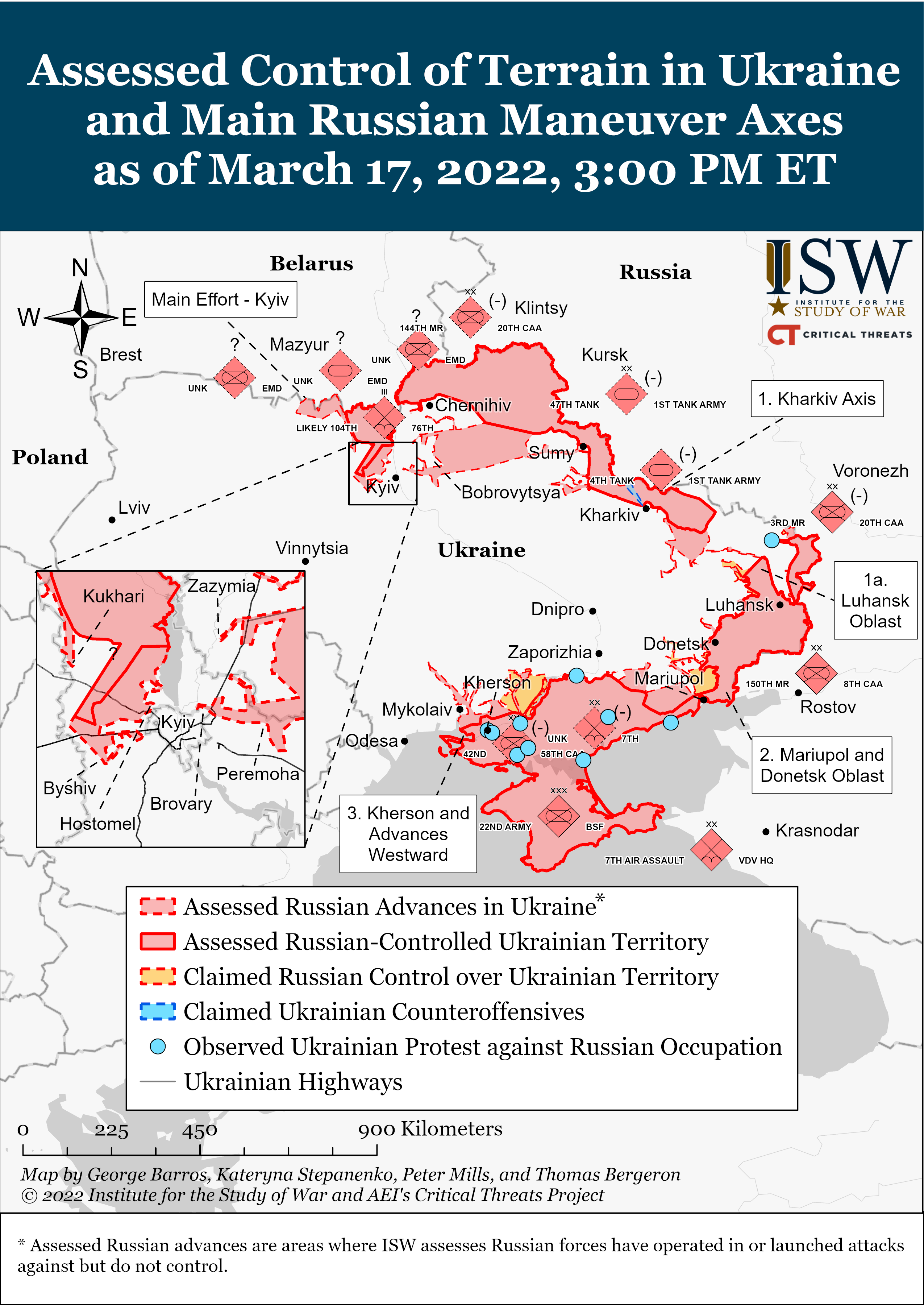
- Maps of main Russian movements: New York Times and the Institute for the Study of War
- Largely bogged down outside major cities in Ukraine, Russian forces have turned to shelling them from a distance, including dozens of confirmed attacks on health facilities, as the war entered its fourth week on March 17. "Russian forces have made minimal progress this week," Britain's defense ministry said in a daily military intelligence update. "Ukrainian forces around Kyiv and Mykolaiv continue to frustrate Russian attempts to encircle the cities." (AP, 03.16.22, Reuters, 03.18.22)
- Ukraine has launched a “counteroffensive” against the Russian army to try to “radically change the parties’ dispositions,” according to an adviser to Ukrainian President Volodymyr Zelensky. Mykhailo Podolyak was speaking hours after Ukraine’s emergency situations ministry reported that Russia had launched missile and artillery strikes in Kyiv for the third consecutive evening, hitting residential buildings. (Financial Times, 03.16.22)
- Kyiv’s northern suburbs have suffered heavy damage, but the capital itself has held firm, under a curfew and subjected to deadly nightly rocket attacks. Residents huddled in homes and shelters as Russia shelled areas in and around the city, including a residential neighborhood 1.5 miles from the presidential palace. Kyiv city authorities on March 18 said 222 people had been killed in the capital since Russia's invasion of Ukraine began, including 60 civilians and four children. A further 889 people have been wounded, including 241 civilians, the city administration said in a statement. In addition, 889 people have been injured, including 241 civilians—18 of them children. Fifty-five buildings have been damaged, including 36 residential buildings, six schools and four kindergartens. (Reuters, 03.17.22, Reuters, 03.18.22, Reuters, 03.18.22, Meduza, 03.18.22)
- While Moscow’s ground advance on the Ukrainian capital appeared largely stalled, President Vladimir Putin said the operation was unfolding “successfully, in strict accordance with pre-approved plans.” (AP, 03.16.22, The Wall Street Journal, 03.15.22, The Washington Post, 03.15.22)
- Kyiv’s mayor imposed a 36-hour curfew from late March 15, saying that the capital faced a “difficult and dangerous moment” after heavy artillery barrages shook the city and a firefight overnight lit up the horizon with tracer bullets. (The Wall Street Journal, 03.15.22)
- Near the outskirts of Kyiv, two journalists working for Fox News were killed and a third was injured when their vehicle came under fire near Russian positions. (The Wall Street Journal, 03.15.22)
- Around half of Kyiv’s 3.4 million residents have fled and some spend nights sheltering in metro stations. (Reuters, 03.15.22)
- In Mariupol, Ukraine said it had so far rescued 130 people from the basement of a theater being used as a bomb shelter when it was flattened by Russian strikes two days ago. Kyiv said it feared as many as 1,000 could still be trapped inside. It has given no information yet about dead or wounded. Russia denies hitting the theater. Mariupol, a southern port city, has suffered the worst humanitarian catastrophe of the war, with hundreds of thousands of civilians trapped in basements with no food, water or power as Russian forces pound it with artillery fire and air strikes. The city council has said more than 350,000 people were still sheltering in the city and 30,000 had left. Mariupol has been encircled for weeks by Russian forces. (Reuters, 03.18.22, Reuters, 03.17.22, CNN, 03.16.22)
- Some 2,000 vehicles carrying civilians managed on March 15 to leave the besieged city, which has been devastated by relentless Russian shelling, local authorities said. About 20,000 civilians have been evacuated via a humanitarian corridor to the Ukrainian-government-held city of Zaporizhzhia, according to local officials who estimated that more than 2,300 civilians have been killed in the two-week siege. The city's deputy mayor also said Russian troops are holding 400 people, including doctors and patients, "like hostages" at a local hospital. (RFE/RL, 03.15.22, Bloomberg, 03.15.22)
- A convoy with supplies for Mariupol, where residents are desperate for food and water, was stuck in nearby Berdyansk, Deputy Prime Minister Iryna Vereshchuk said March 15. Buses heading to the city to deliver humanitarian aid and offer transport for residents seeking to leave have been held up outside the city since the weekend by Russian forces. The Red Cross said desperate families were being "suffocated" as food and water ran out. (Reuters, 03.15.22, Bloomberg, 03.15.22, Reuters, 03.15.22)
- Ukraine's Foreign Ministry said on Saturday that a Mariupol mosque where 80 civilians were taking shelter has been shelled by Russian forces. The adults and children hiding there from shelling in the besieged city included citizens of Turkey, the ministry wrote on its Twitter account. It did not specify when the shelling took place. (The Moscow Times, 03.12.22)
- At the front line of the battle for southern Ukraine, Mykolaiv, a city of about 500,000 people on the Black Sea shoreline, is all that’s standing in Russia’s way of an assault on the major port city of Odessa. But despite more than a week of heavy bombardment, Ukraine’s forces there have remarkably thwarted Russian advances—a major blow to the Kremlin’s apparent plans for an attack on Odessa, an economic lifeline for Ukraine. Though Russian warships have lingered off Odessa’s coast, local officials have said the Russians are probably delaying any amphibious assault until they can get more ground support from their forces in the east. That is how Mykolaiv has become a crucial roadblock. Russian forces about 40 miles to the southeast have repeatedly shelled the city, including civilian residences, with suspected cluster munitions, but have been unable to move into Mykolaiv itself. (The Washington Post, 03.16.22)
- Ukrainian forces readied defensive positions in Odessa, digging trenches and installing Czech anti-tank hedgehogs in continued preparation for a Russian attack. Residents have been racing to fortify historic buildings and monuments, converting the beaches into sandbags that guard everything from Odessa’s town hall to its 19th-century opera and ballet theatre as well as the statue of the city’s founding governor atop its famed Potemkin Stairs. (The New York Times, 03.16.22, Globe and Mail, 03.13.22)
- A rapid Russian advance into the strategic southern town of Voznesensk, a gateway to a Ukrainian nuclear power station and pathway to attack Odessa, would have showcased the Russian military’s abilities and severed Ukraine’s key communications lines. Instead, the two-day battle for the town of 35,000 people, details of which are only now emerging, turned decisively against the Russians. Judging from the destroyed and abandoned armor, Ukrainian forces, including local volunteers, eliminated most of a Russian battalion tactical group on March 2-3. The Ukrainian defenders’ performance against a much-better-armed enemy in an overwhelmingly Russian-speaking region was successful in part because of widespread popular support for the Ukrainian cause—one reason the Russian invasion across the country has failed to achieve its principal goals so far. Ukraine on March 16 said it was launching a counteroffensive on several fronts. (The Wall Street Journal, 03.16.22)
- Often armed only with shoulder-launched, portable rocket launchers—thousands of which have been provided by Western countries since the invasion began—small groups of Ukrainian troops have used their terrain and Russia’s tactics to their advantage, and helped lead a resistance that has surprised even Kyiv’s closest backers in the West. The compact weapons used by Ukraine and the heavy artillery relied upon by Russian troops form the backbone of the contrasting tactics employed by both sides. (Financial Times, 03.16.22)
- More than a fortnight after falling under Russian occupation, the residents of Kherson are wrestling with acute shortages of medicine and holding daily protests against the Kremlin's forces. They are also worried that increased shelling on the outskirts might signal the start of a Ukrainian push to recapture their southern city, which is a key port on the Black Sea. Deputy Mayor Yuri Stelmashenko said March 15 that Kherson had less than a week's supply of food and medicine left. (BBC, 03.16.22)
- Ukrainian officials on Saturday accused Russia of planning a fake referendum on creating a pro-Moscow "people's republic" in Kherson. Russian forces seized the city, with a population of 290,000, on March 3 following a three-day siege. It was the first major city to fall following Moscow's invasion. Russia is trying to create new “pseudo-republics” in Ukraine to break the country apart, President Volodymyr Zelensky said in his nightly address to the nation Saturday. He called on Ukraine’s regions, including Kherson, not to repeat the experience of Donetsk and Luhansk, where pro-Russian separatists began fighting Ukrainian forces in 2014. Ukrainian Foreign Minister Dmytro Kuleba drew a parallel with Russia's annexation of Crimea, where it held a referendum on joining Russia after deploying troops there. (The Moscow Times/AFP, 03.12.22, AP, 03.12.22)
- The regional emergency service said March 16 that at least 500 residents of the city of Kharkiv have been killed since Russia invaded on Feb. 24. Reuters was unable immediately to verify the information. Russia denies targeting civilians. On March 15, Mayor Ihor Terekhov said in a televised interview that more than 600 buildings have been destroyed in the city, Ukraine's second biggest, since the start of the invasion. A Russian airstrike before dawn March 17 killed 21 people and destroyed a school and community center in Merefa, near Kharkiv, officials said. (Reuters, 03.16.22, Reuters, 03.15.22, AP, 03.17.22)
- With Moscow trying to regain the initiative in a stalled campaign, Russia fired missiles at an airport near Lviv, a city where hundreds of thousands found refuge far from Ukraine's battlefields. At least three blasts were heard near Lviv's airport early March 18. The mayor, Andriy Sadovy, said several missiles had struck an aircraft maintenance facility, destroying buildings but causing no casualties. (Reuters, 03.18.22)
- Ukraine handed over nine captured Russian soldiers to secure the freedom of the mayor of the city of Melitopol, who was detained last week, the Interfax Ukraine news agency quoted a senior official as saying on March 16. The office of Zelensky earlier said mayor Ivan Fedorov had been released but gave no details. A second Ukrainian mayor was reportedly abducted by invading Russian forces on March 13. Several officials, including Ukraine’s foreign minister, accused Russian forces of abducting Yevhen Matveyev, the mayor of Dniprorudne, a city of about 18,000 people in southeast Ukraine. The reports could not immediately be independently verified by The Washington Post. (Reuters, 03.16.22, The Moscow Times/AFP, 03.13.22, The Washington Post, 03.13.22)
- Other reports of violence this week included:
- In Rivne in western Ukraine, officials said 19 people had been killed in a Russian air strike on a TV tower. If confirmed it would be the worst attack on a civilian target so far in the northwest where Russian ground troops have yet to tread. Russia denies targeting civilians. (Reuters, 03.15.22)
- The World Health Organization has verified 43 attacks on hospitals and health facilities, with 12 people killed and 34 injured. (AP, 03.16.22)
- Russian shelling on March 16 in the northern city of Chernihiv killed at least 10 people as they waited in line for bread. One of those killed was an American citizen, 67-year-old James Whitney Hill, who had traveled to the city with his Ukrainian partner months ago for her to receive medical treatment and later became trapped there. The governor of the surrounding region said March 17 that 53 civilians had been killed in the preceding 24 hours. (The New York Times, 03.16.22, Axios, 03.17.22, Reuters, 03.17.22)
- Overnight on March 14-15 Russian forces fired two missiles at the airport in Dnipro, in central-eastern Ukraine, destroying the runway and damaging the terminal, said the regional governor, Valentyn Reznichenko. (The Wall Street Journal, 03.15.22)
- A U.S. journalist was shot dead and another wounded on Sunday in Irpin, a frontline suburb of Kyiv that has witnessed some of the fiercest fighting since Russia invaded Ukraine. Papers found on the American reporter's body identified him as 50-year-old video documentary shooter Brent Renaud, of New York. (The Moscow Times/AFP, 03.13.22)
- A wounded pregnant woman taken on a stretcher from a Ukrainian maternity hospital that was bombed by Russia last week has died, along with her baby, The Associated Press has learned. Images of the woman, whom the AP has not been able to identify, were seen around the world, personifying the horror of an attack on civilians. (AP, 03.15.22)
- Ukrainian officials accused Russia over the weekend of using phosphorus chemical bombs in the eastern Donbas region; the allegations have not yet been independently verified. International law prohibits the use of white phosphorus shells in heavily populated civilian areas but allows them in open spaces to be used as cover for troops. (The Moscow Times/AFP, 03.13.22)
- Russia said March 14 that an attack by Kyiv's forces on the separatist stronghold of Donetsk in eastern Ukraine had left 23 people dead, with the military accusing Kyiv of committing a "war crime." Moscow accused Ukraine's army of firing a Tochka-U missile at a residential area in Donetsk, in one of the most serious attacks on the city since Russia sent troops into Ukraine over two weeks ago. (The Moscow Times/AFP, 03.15.22)
- "Around 1,300" Ukrainian troops have been killed since Russia invaded, Zelensky said on Saturday as Moscow's forces closed in on the capital Kyiv. This was the first time Kyiv had given such a toll since the beginning of fighting. On March 2 Russia said it had lost nearly 500 soldiers but has not updated the figure since. (AFP/The Moscow Times, 03.12.22)
- According to conservative U.S. intelligence estimates, more than 7,000 Russian troops have died in Ukraine in the 20 days since President Vladimir Putin invaded the country—greater than the number of American troops killed over 20 years in Iraq and Afghanistan combined. It is a staggering number, American officials say, with implications for the combat effectiveness of Russian units, including soldiers in tank formations. Pentagon officials say a 10% casualty rate, including dead and wounded, for a single unit renders it unable to carry out combat-related tasks. (The New York Times, 03.16.22)
- Russian state TV confirmed on March 18 that one of its top commanders died in Ukraine, CNN reported, confirming a claim by Ukraine’s Ministry of Defense that its soldiers had “eliminated” Col. Sergei Sukharev, commander of the elite 331st Guards Airborne Regiment. (The Hill, 03.18.22)
- The U.N. human rights office in Geneva said it had recorded 2,032 civilian casualties so far—780 killed and 1,252 injured. Some 3.2 million civilians, mostly women and children, have now fled Ukraine to neighboring countries, the U.N. said. The death toll remains unknown, though Ukraine has said thousands of civilians have died. (Reuters, 03.17.22, AP, 03.17.22)
- About 12 million people have been affected by the war in Ukraine, including 2 million internally displaced people and 2.8 million who have fled to the European Union, EU home affairs commissioner Ylva Johansson said March 15. The U.N. said that nearly 1.4 million children have fled Ukraine since the conflict began on Feb. 24—nearly one child per second. (Bloomberg, 03.15.22, AFP/The Moscow Times, 03.15.22)
- The U.N. offered a dire portrait of widespread human suffering in Ukraine during an emergency session of the Security Council on March 17, estimating the number of civilian casualties to be 1,900, with 726 people killed—52 of them children—since the invasion began. The actual numbers are likely to be much higher. (The New York Times, 03.17.22)
- As Ukraine mourns its dead, Lviv’s local government lined up 109 empty strollers in the city’s cobbled central square on March 18 to commemorate the children killed in the country since Russia's invasion—one for each child killed since the start of the war, according to Ukrainian authorities. Zelensky had said March 15 that 97 children had died so far in the invasion. (Reuters, 03.18.22, Reuters, 03.15.22)
- Ukraine's "food supply chain is falling apart” under Russia's invasion, with infrastructure destroyed and shops and warehouses growing empty, the United Nations said on March 18. WFP, which feeds people in global crisis zones, also buys nearly half of its wheat from Ukraine. Kern said the war has already driven global food prices to all-time highs, and could cause "collateral hunger" in poor countries worldwide. (Reuters, 03.18.22)
- The U.N. Food and Agriculture Organization has warned that up to 30% of crop areas in Ukraine will either not be planted or be unharvested this year because of the conflict. (Financial Times, 03.13.22)
- Ukraine was able to evacuate more than 4,000 people from front-line cities on March 14 via seven humanitarian corridors, deputy prime minister Iryna Vereshchuk said in a video statement. She said three other humanitarian corridors did not operate successfully and she accused Russian forces of firing on civilians who were evacuating in the Kyiv region. Russia has repeatedly denied firing on civilians. (Reuters, 03.14.22)
- More than 100 buses carrying a few thousand civilians left the besieged northeastern city of Sumy in a "safe passage" operation, the International Committee of the Red Cross said on March 15. They were heading towards Lubny in central Ukraine after Russians gave a green light for the evacuation. (Reuters, 03.15.22)
- The Kremlin said March 14 it may still opt to take control of large cities in Ukraine, as Moscow's military advanced steadily toward several major urban hubs. "Putin gave orders to hold back on any immediate assault on large cities because the civilian losses would be large," Kremlin spokesman Dmitry Peskov told reporters. He added however that the Defense Ministry "does not rule out the possibility of putting large cities, which are already almost fully encircled, under its full control." (The Moscow Times/AFP, 03.15.22)
- Russia’s losses in materiel are significant. The Oryx blog has recorded 1,034 Russian vehicles, artillery pieces and aircraft destroyed, damaged, abandoned or captured. These include 173 tanks, 261 armored and infantry fighting vehicles and 28 surface-to-air missile systems. (Financial Times, 03.12.22)
- The U.S. estimates that 100 of Russia’s roughly 170 battalion tactical groups (BTGs)—designed to be both quickly adaptable and possess high levels of firepower—have been deployed in Ukraine. Their heavy reliance on vehicles—roughly 75 in each—and relatively low numbers of just 200 infantry troops makes them particularly vulnerable to attacks on their flanks or rear. (Financial Times, 03.16.22)
- American intelligence officials have discovered that the barrage of ballistic missiles Russia has fired into Ukraine contain a surprise: decoys that trick air-defense radars and fool heat-seeking missiles. The use of the decoys may help explain why Ukrainian air-defense weapons have had difficulty intercepting Russia’s Iskander missiles. (The New York Times, 03.14.22)
- “Russia is increasingly seeking to generate additional troops to bolster and replace its personnel losses in Ukraine,” Britain’s Defense Ministry said this week. To do that, Moscow is redeploying forces from as far away as Russia’s “eastern military district, Pacific Fleet and Armenia. It is also increasingly seeking to exploit irregular sources such as private military companies, Syrian and other mercenaries,” it said. (Financial Times, 03.17.22)
- Putin is now importing foreign fighters to join its military operation in Ukraine and last week approved 16,000 soldiers to come from Syria to help Russian forces. Soldiers from the Central African Republic have also joined to fight alongside Moscow. (Financial Times, 03.16.22)
- Western intelligence officials told the Financial Times that Chechen hit squads were key to the failed plan to assassinate Ukraine’s political leadership in the first 48 hours of the invasion. For the past three weeks, at least three Chechen tactical formations have been fighting in the country. (Financial Times, 03.15.22)
- Ramzan Kadyrov, the strongman leader of Chechnya, said March 14 that he was in Ukraine alongside Russian forces. Kadyrov, who is accused by international NGOs of serious human rights violations in the tightly controlled Caucasus republic, posted a video on Telegram of himself in military uniform studying plans around a table with soldiers in a room. (The Moscow Times/AFP, 03.14.22)
- Thousands of Belarusians are estimated to live in Ukraine. Many fled their homes after Belarus’s anti-government demonstrations in 2020 and 2021. And hundreds are believed to have joined the Ukrainian defense forces so far. The majority of the volunteers work alongside the freshly created territorial defense units or offer auxiliary services. (FP, 03.14.22)
- Three Panamanian-flagged ships have been hit by Russian missiles in the Black Sea since Russia's invasion of Ukraine last month, Panama's Maritime Authority said on March 16. One ship sank, the maritime authority said in a statement, but there were no casualties reported. The two others remain afloat with damages. The administrator of the Panama Maritime Authority announced that all crew members are safe. (Reuters, 03.16.22)
Negotiations:
- President Vladimir Putin in a March 17 phone call told his Turkish counterpart, Recep Tayyip Erdogan, what Russia's demands were for a peace deal with Ukraine. These fell into two categories, according to Erdogan’s spokesman Ibrahim Kalin, who had listened in on the call. The first includes Ukrainian neutrality (no applying to NATO), disarmament to ensure it wasn't a threat to Russia, protection for the Russian language in Ukraine and “de-Nazification.” The second category, Putin said, would need face-to-face negotiations between him and President Volodymyr Zelensky. But Kalin was much less specific about these issues, saying simply that they involved the status of Donbas and Crimea. (BBC, 03.17.22)
- Officials from Russia and Ukraine met again for peace talks March 17 but said their positions remained far apart. A day earlier both sides had expressed cautious optimism that peace talks were making progress toward ending the fighting. Ukraine's President Volodymyr Zelensky said negotiations were becoming "more realistic,” while Russian Foreign Minister Sergei Lavrov said there was "some hope for compromise.” But both sides also stressed that the talks were difficult, with differences remaining over what neutrality, or security guarantees, for Ukraine would look like. (Reuters, 03.17.22, The Washington Post, 03.16.22, Reuters, 03.16.22)
- Russia’s President Vladimir Putin showed no sign of compromise, vowing Moscow would achieve all of its war aims in Ukraine. “We will never allow Ukraine to become a stronghold of aggressive actions against our country,” he said March 16. A day earlier he had told European Council President Charles Michel that Ukraine “is not showing a serious attitude toward finding mutually acceptable solutions.” (Financial Times, 03.16.22, Bloomberg, 03.15.22, Reuters, 03.15.22)
- Mid-week, five people briefed on the bilateral talks said Ukraine and Russia had made significant progress on a tentative peace plan including a ceasefire and Russian withdrawal if Kyiv declares neutrality and accepts limits on its armed forces. The proposed deal was discussed in full for the first time March 14, said two of the people. A 15-point draft considered that day would involve Kyiv renouncing its ambitions to join NATO and promising not to host foreign military bases or weaponry in exchange for protection from allies such as the U.S., U.K. and Turkey. However, the nature of Western guarantees for Ukrainian security could prove to be a big obstacle to any deal, as could the status of the eastern territories seized by Russia and its proxies in 2014. Although Moscow and Kyiv both said they had made progress on the terms of a deal, Ukrainian officials are skeptical Putin is fully committed to peace and worry that Moscow could be buying time to regroup its forces and resume its offensive. (Financial Times, 03.16.22)
- A Russian source briefed on the talks said the proposed settlement, if agreed, could give both sides a credible way to declare victory in the war. “Every side needs a win,” the person said. “[Putin] needs to be able to sell it to the people. Putin can say that we wanted to stop Ukraine joining NATO and putting foreign bases and missiles in its territory. If they do that, he can say, ‘I got it.’” (Financial Times, 03.16.22)
- The White House was skeptical, saying March 16 that the Biden administration is not seeing Russia take any actions to de-escalate its invasion of Ukraine that would suggest progress in the negotiations. (Reuters, 03.16.22)
- After bilateral talks via video link on March 15, Ukrainian officials played up hopes the war could end sooner than expected, saying Moscow may be coming to terms with its failure to impose a new government by force. Zelensky said Ukraine was prepared to accept security guarantees from the West that stop short of its long-term objective of joining NATO: "If we cannot enter through open doors, then we must cooperate with the associations with which we can, which will help us, protect us ... and have separate guarantees." Mykhailo Podolyak, an adviser to Zelensky’s chief of staff and member of the Ukrainian delegation, said in a March 15 tweet that there are “fundamental contradictions” in the talks, “but there is certainly room for compromise.” (Reuters, 03.15.22, Bloomberg, 03.15.22)
- Ukrainian negotiators’ proposal for security guarantees from foreign countries, including Turkey and major nuclear powers, has blindsided Western officials, who question how it would work and whether it can be agreed between Moscow and Kyiv without commitments from the guarantors first. A senior U.S. defense official said the U.S. was not involved in the negotiations. (Financial Times, 03.17.22)
- The Kremlin said March 16 that the sides were discussing a status for Ukraine similar to that of Austria or Sweden, both EU members that are outside the NATO military alliance. However, Ukraine later rejected such neutrality proposals, saying talks with Moscow to end fighting should focus on “security guarantees.” (Reuters, 03.16.22, AFP, 03.16.22)
- A senior Ukrainian official said that Israeli Prime Minister Naftali Bennett told Ukrainian President Volodymyr Zelensky on March 8 that he should take Russian President Vladimir Putin’s proposal for ending the war. An official in the Israeli Prime Minster's Office denies the claim. (Axios, 03.11.22)
- See also “Ukraine” and “relations with ‘far abroad’” sections below.
Punitive measures related to Ukraine and their impact globally:
- The United States, EU and Britain announced further sanctions on March 15, while Moscow retaliated by putting President Joe Biden and other U.S. officials on a "stop list" that bars them from entering Russia. (Reuters, 03.15.22)
- The EU and U.K. agreed on separate sets of fresh sanctions and restrictions—a day after the U.S. added a roster of Russian Defense Ministry officials to its own target list—as all three seek to ratchet up pressure on Russian President Vladimir Putin. The EU sanctions went furthest among the new measures. They include a broad ban on energy-sector investment, a moratorium on luxury exports into Russia and new targeted sanctions against Russian business executives and oligarchs, including Roman Abramovich, the billionaire owner of Britain’s Chelsea FC soccer team, diplomats said. (The Wall Street Journal, 03.15.22)
- With its new package, the EU plans to ban the import of finished steel from Russia, which the bloc says is worth around $3.6 billion in lost export revenue for Russia. The EU also intends to restrict the Russia-related work of EU credit-ratings firms. (The Wall Street Journal, 03.15.22)
- The U.K. announced 370 more sanctions targets, including Russia's former president Dmitry Medvedev, current Prime Minister Mikhail Mishustin and Defense Minister Sergei Shoigu, who are to be hit with asset freezes and travel bans. Others include Putin's spokesman Dmitry Peskov and Russian Foreign Ministry spokeswoman Maria Zakharova, whom the U.K. called "Russian propagandists.” Earlier, the U.K. hit Russia with trade restrictions, including an additional 35% tariff on vodka. The move comes after the government fast-tracked new legislation to speed up and harden U.K. sanctions called the Economic Crime Act. (BBC, 03.15.22)
- The U.S. secretary of state, Antony Blinken, said that the West’s coordinated actions since the invasion began were aimed at crippling Moscow’s technological abilities. “One of the things we’re doing is denying Russia the technology it needs to modernize its country, to modernize key industries: defense and aerospace, its high-tech sector, energy exploration,” he said in an NPR interview. (The New York Times, 03.16.22)
- The U.S. House of Representatives voted overwhelmingly on March 17 to strip Russia of its preferential trade status with the United States, moving to further penalize the country’s economy in response to the invasion of Ukraine. (The New York Times, 03.17.22)
- G7 nations have moved to strip Russia of its World Trade Organization (WTO) membership privileges. The Group of Seven, comprising the world’s seven wealthiest liberal democracies, will no longer treat Russia as a “most favored nation.” (bne IntelliNews, 03.17.22)
- President Vladimir Putin decried Western sanctions against Moscow on March 16. He accused the West of trying to “squeeze us, to put pressure on us, to turn us into a weak, dependent country.” The following day, Russia warned the United States that Moscow had the might to put the world's pre-eminent superpower in its place and accused the West of stoking a wild Russophobic plot to tear Russia apart. Dmitry Medvedev, who served as president from 2008 to 2012 and is now deputy secretary of Russia's Security Council, said the U.S. had stoked "disgusting" Russophobia in an attempt to force Russia to its knees. "It will not work—Russia has the might to put all of our brash enemies in their place," Medvedev said. (AP, 03.16.22, Reuters, 03.17.22)
- The head of Gazprom on March 17 called on the gas giant's 500,000 employees to rally around Putin to preserve Russia as a great power in the face of foreign attempts to break it. (Reuters, 03.17.22)
- The U.S. Department of Justice said banks, cryptocurrency exchanges and other financial institutions that serve Russian oligarchs under American sanctions will be in its “crosshairs,” detailing the agenda of a special task force set up to enforce sanctions in response to Moscow’s invasion of Ukraine. (Financial Times, 03.12.22)
- The Treasury Department re-designated Belarus President Alexander Lukashenko as a corrupt government official subject to sanctions, a move the U.S. previously took in 2006, and newly designated his wife, Halina Lukashenka. (Bloomberg, 03.15.22)
- Japan will freeze assets of 17 Russian individuals, including family members of a close ally of Putin, as the country imposes additional economic sanctions against Russia following its invasion of Ukraine. (Financial Times, 03.15.22)
- Mikhail Fridman—one of Russia’s original oligarchs—argues that punishing billionaires like him shows a troubling misunderstanding of power in Russia. If the point of sanctions is to motivate people like him to apply pressure on Putin, he says, that’s worse than unrealistic. It means that “those who are making this decision understand nothing about how Russia works. And that’s dangerous for the future.” (Bloomberg, 03.17.22)
- Russia has set out strict rules for foreigners seeking permits to buy and sell Russian securities and real estate, a client memo by Citigroup showed, as details emerge of new state controls on investment in response to Western sanctions. Russia temporarily stopped foreigners dumping Russian assets this month, saying it wanted to ensure decisions were considered and not driven by political pressure, as sanctions have intensified after Moscow's invasion of Ukraine. (Reuters, 03.17.22)
- Russian prosecutors have issued warnings to Western companies in Russia, threatening to arrest corporate leaders there who criticize the government or to seize assets of companies that withdraw from the country, according to people familiar with the matter. Prosecutors delivered the warnings in the past week to companies including Coca-Cola, McDonald’s, Procter & Gamble, IBM and KFC owner Yum Brands, the people said. The calls, letters and visits included threats to sue the companies and seize assets including trademarks. (The Wall Street Journal, 03.14.22)
- Some creditors have received payment, in dollars, of Russian bond coupons that fell due this week, two market sources said on March 17, meaning that Russia may for now have averted what would have been its first sovereign bond default in a century. Russia said earlier it had sent funds to cover $117 million in coupon payments on two dollar-denominated sovereign bonds. The payments were seen as the first test of whether Moscow will meet its debt obligations after Western sanctions hobbled its financial dealings. Earlier this week Russia’s Finance Minister Anton Siluanov said that payment would be made in rubles if the transfer was unsuccessful due to the West’s unprecedented financial sanctions in response to the Kremlin’s invasion of Ukraine. But a “forced redenomination” of payments into rubles would indicate “that a default or a default-like process has begun,” Fitch Ratings said. Siluanov had said that Western sanctions freezing some of the Russian central bank’s assets were an attempt to force the country in to an “artificial default” on its $38.5 billion of foreign currency bonds. (Reuters, 03.17.22, Financial Times, 03.16.22)
- Almost two years of chip shortages have had an unexpected upside for the semiconductor industry: It is better prepared to manage the turmoil caused by Russia’s invasion of Ukraine. Production of vital raw materials for chip making is concentrated in Russia and Ukraine. The countries are a major source of both neon gas, needed to feed lasers that print minute circuitry onto silicon, and the metal palladium used in later manufacturing stages. But worries about a potential shortage of those materials may not be realized, in part because the industry has reset how it operates after being whipsawed by pandemic-era demand and repeated shocks, including a factory fire, extreme climate events and supply-chain disruptions. Companies have stocked up on neon and other important chip-making materials, and now typically have a six-week to three-month reserve, an electronic materials consultant has said. (The Wall Street Journal, 03.13.22)
- Koch Industries, the American manufacturing giant that employs 122,000 people across the world, said March 16 it would not exit its operations in Russia because doing so would put its “employees there at greater risk and do more harm than good.” (The Washington Post, 03.17.22)
- Europe’s biggest paint maker Akzo Nobel expects its Russian operations to collapse within weeks, making it one of the first multinationals to reveal how the country’s economy is buckling under sanctions. (Financial Times. 03.14.22)
- BNY Mellon, a New York bank that tracks and holds assets for many big institutions, may lose as much as $200 million in revenue this year as it stops new business in Russia and complies with a raft of sanctions imposed by Western nations aimed at crippling the nation’s economy. (The New York Times, 03.18.22)
- Bermuda says it is suspending certification of Russian planes licensed in the British overseas territory due to sanctions on Moscow, likely impacting hundreds of Russian commercial aircraft around the world. The move could have critical effects including the grounding of a significant portion of the Russian fleet, more than 700 of which are believed to be licensed in Bermuda. (The Moscow Times/AFP, 03.13.22)
- A Russian vessel carrying 8,000 tons of a petroleum-derived product was denied a request to dock at the easternmost tip of the U.S. The ship’s operator asked on March 3 to dock in Eastport, Maine, after being turned away from a port on the St. Lawrence Seaway by the Canadian government following the Russian invasion of Ukraine. “For a myriad of reasons, it was not in our best interest to entertain the vessel,” Chris Gardner, executive director of the Eastport Port Authority, said March 15. The ship was carrying a petroleum product called solid pitch, which is used in manufacturing. (AP, 03.16.22)
- To tighten the economic pressure on Russia, Sen. Elizabeth Warren plans to introduce legislation March 17 to crack down on the use of bitcoin and other cryptocurrencies to evade tough sanctions for the invasion of Ukraine. (The Boston Globe, 03.17.22)
II. U.S. and Russian priorities for the bilateral agenda
Nuclear security:
- Electricity supply has been restored at Ukraine's retired Chernobyl nuclear power plant, seized by Russian forces in the first days of the invasion, energy officials in Kyiv said Sunday. (The Moscow Times/AFP, 03.13.22)
North Korea’s nuclear and missile programs:
- No significant developments.
Iran and its nuclear program:
- Russia walked back recently made demands on Washington related to the Iran nuclear deal, clearing the way for Tehran and Washington to revive the 2015 agreement, senior Western diplomats said. On March 15, after Russia’s Foreign Minister Sergei Lavrov met in Moscow with his Iranian counterpart, both Lavrov and Hossein Amir-Abdollahian said Russia wasn’t standing in the way of the accord. Russia earlier this month had demanded guarantees from Washington that its economic ties with Iran wouldn’t be affected by the Western sanctions imposed on Moscow over Ukraine. The last-minute move was the driving factor that prevented a deal to revive the 2015 nuclear agreement over the past 10 days, Western diplomats have said. (The Wall Street Journal, 03.15.22)
- Oil prices declined on expectations that attempts to revive Iran’s nuclear deal won’t be derailed by the Ukraine war. (Bloomberg, 03.15.22)
Other great power rivalry/new Cold War/NATO-Russia relations:
- President Joe Biden’s national security adviser, Jake Sullivan, warned his Russian counterpart on March 16 against “any possible Russian decision to use chemical or biological weapons in Ukraine,” the White House said. The explicit warning to Nikolai Patrushev reflected escalating concerns in Washington that the Kremlin, stymied in its hopes of a quick takeover of Ukraine, could resort to weapons of mass destruction. Officials said there was no direct mention of the use of battlefield nuclear weapons, although two officials said the administration had sent a separate warning on that issue through other channels in the opening days of the war, when Putin announced he was placing Russian nuclear forces on alert. Secretary of State Antony Blinken reiterated the concerns the following day, saying President Vladimir Putin “may be growing more desperate” and might be preparing to use chemical weapons in the war. (The New York Times, 03.16.22, The New York Times, 03.17.22)
- Russian President Vladimir Putin on March 16 referred to pro-Western Russians as “scum and traitors” who needed to be removed from society, describing the war in Ukraine as part of an existential clash with the United States and setting the stage for an ever fiercer crackdown at home and even more aggression abroad. Comparing the West to Nazi Germany, the Russian leader laced his speech with derision for the “political beau monde” in Europe and the United States, and for the “slave-like” Russians who supported it. He added the West wanted to use the “traitors” as a "fifth column" to destroy Russia. It was a far more hardline message than one delivered earlier in the day by Foreign Minister Sergei Lavrov, who said that Russia saw “a certain hope that a compromise can be reached” with Ukraine to end the war. (The New York Times, 03.16.22, Reuters, 03.17.22)
- In talks at NATO’s Brussels headquarters on March 16, U.S. Defense Secretary Lloyd Austin and his counterparts weighed what defenses to set up on the organization’s eastern flank, from Estonia in the north through Latvia, Lithuania and Poland down to Bulgaria and Romania on the Black Sea. The aim is to deter President Vladimir Putin from ordering an invasion of any of the 30 allies—not just for the duration of his war in Ukraine but for the next 5-10 years. Before launching it, Putin had demanded that NATO stop expanding and withdraw its forces from the east. The opposite is happening. “Today, we have tasked our military commanders to develop options across all domains. Land, air, sea, cyber and space,” NATO Secretary-General Jens Stoltenberg said. He expects to hear about those options within weeks. (AP, 03.16.22)
- A day earlier Stoltenberg said that reinforcing the alliance’s eastern members could include basing “substantially more forces” in those countries at a higher readiness level and more prepositioned equipment. He also warned Russia that using chemical weapons would be “unacceptable” and reiterated earlier Western claims that Russia may try to stage a “false-flag operation” involving such weapons after Moscow made “absurd claims” about bioweapons labs in Ukraine. (Bloomberg, 03.15.22)
- Slovakia’s parliament has approved the presence of 2,100 NATO troops in the country. The nation bordering Ukraine will host U.S., German, Czech, Dutch, Polish and Slovenian troops, as well as a Patriot missile-defense system, Defense Minister Jaroslav Nad said. Ukraine’s Uzhhorod airfield, located just 0.6 miles from the border, may be the target of a Russian attack, he said. (Bloomberg, 03.15.22)
- Ukrainian President Volodymyr Zelensky renewed his plea for air support to protect the skies over Ukraine and defend against Russia’s attacks during a virtual speech to U.S. lawmakers March 16, as suspected Russian munitions struck another apartment building in Kyiv in an attack that has become part of a daily pattern. “Ukraine is grateful to the United States for its overwhelming support,” Zelensky said. “I call on you to do more.” In closing remarks appealing directly to President Joe Biden, he called on him to “be the leader of the world,” which “means to be the leader of peace.” (The Washington Post, 03.16.22)
- Ukraine's Zelenskiy addressed the German Bundestag by video link, pulling no punches in a speech that invoked the Holocaust and the Berlin Wall, and seemed intended to shame pro-Russian politicians in Germany, Moscow's main energy buyer. (Reuters, 03.17.22)
- In an emotional televised speech on March 15, Zelensky implored Canadian politicians to increase military support and help implement a no-fly zone over his country to stop Russian bombardments. (The Wall Street Journal, 03.15.22)
- In a series of hopscotching video addresses to Western allies earlier this month, Zelensky offered a stream of what White House press secretary Jen Psaki described March 15 as “very powerful” remarks. Zelensky’s appeal to European leaders in early March was so emotional that his English-language interpreter briefly choked up. A week later, when he addressed the British Parliament, Zelensky made a similarly moving pitch, echoing a refrain from an oration delivered by Winston Churchill during World War II. (The Washington Post, 03.16.22)
- Zelensky will virtually address members of Israel’s parliament, the Knesset, on March 20, according to the Ukrainian ambassador in Israel. (The New York Times, 03.16.22)
- President Joe Biden on March 15 signed a $1.5 trillion bill that funds federal operations through September and includes $13.6 billion for assistance to Ukraine as the country fights off a Russian invasion. The money will fund defensive military equipment and training, along with aid for Ukrainian refugees both within the country and in neighboring nations. (CNBC, 03.15.22)
- The Ukraine aid in the spending bill includes $3.5 billion to provide weapons to the country and to replenish U.S. stocks of military equipment already sent, according to Defense Department spokesman Chris Sherwood. The Pentagon is likely to send Ukraine anti-air and anti-armor weapons, small arms and ammunition, tactical gear, meals and medical kits, Sherwood said in an email. Other funds would go toward the deployment of U.S. troops and intelligence support for the U.S. European Command. (Bloomberg, 03.15.22)
- The Biden administration said March 16 that the Pentagon will expand the size and scope of weaponry being rushed to Ukraine, including for the first time armed drones capable of inflicting significant damage to Russian ground units, while U.S. officials continue to search for sophisticated antiaircraft systems owned by European allies. The disclosure coincided with Biden’s pledge of an additional $800 million in security assistance for Ukraine after Zelensky’s emotional appeal for the U.S. either to establish a no-fly zone over Ukraine or to provide fighter jets and powerful surface-to-air weapons. Some of the high-tech defensive weapons to be provided are not only easily portable but require little training to use against Russian tanks, armored vehicles and aircraft, according to U.S. and European officials. (The Washington Post, 03.16.22, The New York Times, 03.16.22)
- Republican lawmakers urged the Biden administration to speed up and broaden the delivery of arms and equipment to Ukraine, in a letter to the president on March 15. The six lawmakers—members of defense, intelligence and foreign affairs committees—proposed a list of additional items that could be sent, ranging from grenade launchers and small drones to first-aid kits and gas masks. (Bloomberg, 03.15.22)
- On Saturday Biden had authorized $200 million in military equipment for Ukraine, on top of the $350 million in military equipment Washington had already authorized on Feb. 26—the largest such package in U.S. history. (AFP/The Moscow Times, 03.13.22)
- The U.S. is providing an additional $186 million in aid to help refugees and internally displaced people, Secretary of State Antony Blinken said in a statement. He called on Russia to ensure safe passage for humanitarian workers, as well as for people seeking to leave cities where they are trapped. (Bloomberg, 03.15.22)
- Russia's Foreign Ministry said March 17 that giving Ukraine air defense systems, as requested by Ukraine's president a day earlier, would be “a destabilizing factor” that would “not bring peace to Ukraine,” adding that, "in the long term, they could have much more dangerous consequences." On March 12 Russian Deputy Foreign Minister Sergei Ryabkov warned that Moscow could target Western shipments of military equipment to Ukraine. Moscow, he said, has “warned the U.S. that pumping weapons from a number of countries it orchestrates isn’t just a dangerous move, it’s an action that makes those convoys legitimate targets.” (Reuters, 03.17.22, AP, 03.12.22)
- In a dramatic show of support, a delegation of European leaders traveled to Kyiv on March 15 to meet with Ukraine’s President Volodymyr Zelensky as Russian attacks raged across the country and targeted the besieged capital. The prime ministers of Poland, Czech Republic and Slovenia—all NATO states—planned to offer a broad package of support for Ukraine, the Polish government said. “Europe must guarantee Ukraine’s independence and ensure that it is ready to help in Ukraine’s reconstruction,” Poland’s Prime Minister Mateusz Morawiecki said ahead of the meeting. Afterward, Zelensky said the talks had focused on security guarantees for Ukraine, strengthening sanctions against Russia and the prospects of Ukraine’s membership in the EU, according to Zelensky’s official website. (The Wall Street Journal, 03.15.22, The Washington Post, 03.15.22)
- Poland sees the need for a NATO peacekeeping mission in Ukraine, Deputy Premier Jaroslaw Kaczynski said late March 15 in Kyiv. “This mission cannot be a defenseless one,” he said. “It must strive for humanitarian and peace aid in Ukraine.” (Bloomberg, 03.15.22)
- U.S. President Joe Biden will make his first visit to Europe since the invasion of Ukraine to discuss the crisis with NATO allies next week, the White House said March 15. NATO leaders will meet at the military alliance's headquarters in Brussels on March 24 to discuss the crisis that has prompted fears of wider conflict in the West unthought-of for decades. There, Biden will "reaffirm our iron-clad commitment to our NATO allies," the White House said. He will also attend an EU summit in Brussels to discuss Russia's invasion of Ukraine and Western efforts to impose "economic costs on Russia (and) provide humanitarian support to those affected by the violence." (Reuters, 03.15.22, AFP, 03.15.22)
- European governments have approached the U.S. government and defense contractors with a shopping list of arms including drones, missiles and missile defenses as the Russian invasion of Ukraine drives renewed demand for U.S. weaponry. (Reuters, 03.17.22)
- Moscow's claims that there are bioweapons labs in Ukraine under Pentagon control are an "embarrassment to Russia," according to a scientist who was among a group of experts who have debunked the conspiracy theory. Olga Pettersson, an expert in genome sequencing based in Sweden, told Newsweek that she was stunned at what the Russian foreign ministry had presented as evidence that Ukraine was developing a biological weapons program in cahoots with the U.S. She was among a group of 10 scientists that has publicly accused the Russian government of lying. Some members of the group are in Russia and have risked their safety to tell the truth. (Newsweek, 03.18.22)
- As scrutiny of Russia’s increasing reliance on mercenaries in Ukraine mounts, the Kremlin is trying to deflect it back onto U.S. veterans who have volunteered to defend Ukraine. (Foreign Policy, 03.15.22)
- The U.N.’s highest court on March 16 ordered Russia to “immediately suspend” military actions in Ukraine, a largely symbolic ruling that was nevertheless welcomed by the Ukrainian government. The International Court of Justice voted 13-2 for the injunction, with the two opposing votes cast by judges from Russia and China. (The New York Times, 03.16.22)
- The U.N. Security Council did not proceed with a planned March 18 vote on a Russian-drafted call for aid access and civilian protection in Ukraine, as Russia's U.N. envoy accused Western countries of a campaign of "unprecedented pressure" against the measure. Diplomats said earlier the measure was set to fail because it did not push for an end to fighting or withdrawal of Russian troops and did not address accountability or acknowledge Russia's invasion of its neighbor. (Reuters, 03.17.22, Reuters, 03.16.22)
China-Russia: Allied or aligned?
- President Biden and China’s Xi Jinping spoke for nearly two hours March 18, exchanging views on a video call that came as their countries navigated thorny political and economic differences over Russia’s invasion of Ukraine. Washington has piled pressure on Beijing to not support the invasion, especially by providing Russia with military assistance. China released a statement after the call that did not appear to signal a shift in stance. Though it called on the U.S. and NATO to dialogue with Russia to “solve the crux of the Ukraine crisis,” it made no mention of what efforts Beijing might take to achieve peace in Ukraine. It decried “the Ukraine crisis,” but avoided the words “war” or “invasion.” It said China is willing to provide further humanitarian assistance to Ukraine. (The Washington Post, 03.18.22, Reuters, 03.17.22, CNN, 03.18.22)
- Secretary of State Antony Blinken said March 17 that the United States would punish China if President Xi Jinping chose to give military aid to Russia for the war in Ukraine, where Russian forces have killed thousands of civilians. “China will bear responsibility for any actions it takes to support Russia’s aggression, and we will not hesitate to impose costs.” (The New York Times, 03.17.22)
- The United States expressed concern March 14 about "alignment" between Russia and China, after high-ranking U.S. and Chinese officials met for seven hours on the Ukraine war and other security issues. "We do have deep concerns about China's alignment with Russia," a senior U.S. official told reporters, speaking on condition of anonymity, adding: "It was a very candid conversation." U.S. National Security Advisor Jake Sullivan and Yang Jiechi, the Chinese Communist Party's chief diplomat, met in a Rome hotel for what a White House readout described as a "substantial" session. (AFP/The Moscow Times, 03.15.22)
- China’s ambassador in Washington pushed back against accusations about Beijing’s role in the lead-up to the war in Ukraine. “Assertions that China knew about, acquiesced to or tacitly supported this war are purely disinformation,” Ambassador Qin Gang wrote in The Washington Post. Qin said China has made “huge efforts” to push for peace talks. He described threats from U.S. officials that China would suffer consequences if it attempts to help Russia evade sanctions as “unacceptable.” (Bloomberg, 03.15.22)
- Hours after the White House warned that Beijing would face severe “consequences” if it helps Moscow evade sanctions, U.S. media reported that Russia has asked China for military and economic aid for its war in Ukraine. Beijing refused to directly address the reports. Moscow also asked Beijing for economic assistance against the crippling sanctions imposed against it by most of the Western world, the New York Times said, again citing anonymous officials. (The Moscow Times/AFP, 03.15.22)
- Kremlin spokesman Dmitry Peskov denied reports Russia has asked China for military aid. "Russia has its own potential to continue the operation," Peskov told reporters. (The Moscow Times/AFP, 03.15.22)
- A Chinese foreign ministry official met the Russian ambassador to the country on March 17 and discussed security cooperation. (Financial Times, 03.18.22)
- The U.S. has told allies that China signaled its willingness to provide military assistance after Russia requested equipment including surface-to-air missiles to support its invasion of Ukraine, according to officials familiar with American diplomatic cables on the exchange. Two officials said Washington had told allies that Russia had asked China for five types of equipment. Other than surface-to-air missiles, they were drones, intelligence-related equipment, armored vehicles and vehicles used for logistics and support. (Financial Times, 03.14.22)
- About 80% of China's total arms imports in 2017-2021 were from Russia, according to the Stockholm International Peace Research Institute (SIPRI). These purchases make up 21% of Russia's total arms exports, making China its second largest customer. But China has been gradually expanding its own military production capabilities and is now the world's fourth largest arms exporter. "China's weapons are getting more advanced now. Its drones, for example, are one area that Russia would be very interested in," says Siemon Wezeman at SIPRI. But, he says, "so far we haven't seen any evidence" that Russia has bought Chinese drones. (BBC, 03.15.22)
- German Economy Minister Robert Habeck warned China against undermining Western sanctions against Russia. If Beijing should abandon its “ambivalent status” and move to invest in Russia, “then this would also have consequences for our relations with China,” Habeck said March 15 at an auto industry event in Berlin. (Bloomberg, 03.15.22)
- As Western sanctions on Moscow mount following its invasion of Ukraine, Chinese media tell a story to domestic audiences that avoids blaming Russia and portrays sympathy for President Vladimir Putin's perspective. Beijing has refused to support or condemn its close ally Moscow, while blaming the United States and NATO's "eastward expansion" for worsening tensions. It is a view that reverberates across state newspapers and television—as well as social media—in China's tightly controlled news environment. (The Moscow Times/AFP, 03.14.22)
- Chinese diplomats and prominent state media are parroting Russian disinformation reports about U.S.-run biological laboratories in Ukraine, deepening tensions between Washington and Beijing. (Financial Times, 03.14.22)
- See also “Other great power rivalry/new Cold War/NATO-Russia relations” section above.
Missile defense:
- See Slovakia entry in “Other great power rivalry/new Cold War/NATO-Russia relations” section above.
Nuclear arms control:
- No significant developments.
Counterterrorism:
- No significant developments.
Conflict in Syria:
- Military coordination between Israel and Russia in Syria hasn't been interrupted since Israel condemned Russia's invasion of Ukraine, three Israeli officials told Axios. Russia holds enormous influence in Syria but allows Israel to operate freely against Iranian activity there. Israeli officials have told the U.S. and other allies that they need to take a careful approach to the Ukraine crisis to ensure that continues. (Axios, 03.09.22)
Cyber security:
- Russian government websites are facing unprecedented cyberattacks and technical efforts are being made to filter foreign web traffic, the TASS news agency cited the digital ministry as saying March 17. Russian government entities and state-owned companies have been targeted over events in Ukraine, with the websites of the Kremlin, flagship carrier Aeroflot and major lender Sberbank among those to have seen outages or temporary access issues in recent weeks. (Reuters, 03.17.22)
Energy exports from CIS:
- The International Energy Agency has just unveiled ideas for quickly cutting oil demand at a time when Vladimir Putin's war on Ukraine could bring substantial loss of Russian barrels from global markets. The 10-point plan comes amid IEA warnings that the war could become the biggest supply crisis in decades as countries look to isolate Russia. (Axios, 03.18.22)
- Germany, Italy and others have worked to make sure the EU can continue to import Russian oil and natural gas and have created carve-outs in energy and banking sanctions to enable that. During discussions on March 15, German officials, with the backing of Hungary, Italy and others urged a focus on implementing already agreed sanctions, according to diplomats. Meanwhile, France unveiled a plan to end Russian oil and gas imports by 2027. (The Wall Street Journal, 03.15.22, Financial Times, 03.17.22)
- An immediate EU-wide embargo on Russian oil and gas imports would send economic shockwaves throughout Europe and cause at least £70 billion of damage to the British economy, chancellor Rishi Sunak has told colleagues. (Financial Times, 03.18.22)
- The United States and Britain are ramping up pressure on Saudi Arabia to pump more oil and join efforts to isolate Russia, while Riyadh has shown little readiness to respond and has revived a threat to ditch dollars in its oil sales to China. British Prime Minister Boris Johnson flew into the world's biggest crude oil exporter on March 16, a day after U.S. security advisor Brett McGurk arrived with a U.S. delegation. (Reuters, 03.16.22)
- The United Arab Emirates is keen to cooperate with Russia on improving global energy security, UAE Foreign Minister Sheikh Abdullah bin Zayed Al Nahyan said in Moscow on March 17. Russia's invasion of Ukraine and the resulting sanctions have put a spotlight on Gulf energy exporters as consumers look for supplies to replace Russian oil. Like Saudi Arabia, the UAE has so far resisted U.S. pleas to use its spare production capacity to help contain oil prices, with both countries saying they are committed to an output pact under the OPEC+ alliance, which includes Russia. (Reuters, 03.17.22)
- As energy supermajors such as BP and ExxonMobil pledge to exit Russia because of its war in Ukraine, a lower profile group of companies that serve the country’s oil industry have not followed. Schlumberger, Baker Hughes and Halliburton are the three biggest Western oilfield services companies, hired to do the frontline work at oilfields such as drilling wells and producing oil and gas. The U.S.-listed companies conduct billions of dollars of business in Russia and are partners of state-backed producers Rosneft and Gazprom. While the sanctions stop oilfield services companies from pumping new money into Russia, they stop short of preventing them from continuing their current operations. (Financial Times, 03.18.22)
Climate change:
- Making significant, near-term cuts to methane emissions in tandem with slashing carbon emissions would dramatically improve the odds that Arctic sea ice could survive during the summertime through 2100, a new study finds. In addition to effects on weather, indigenous populations and iconic species, a seasonally ice-free Arctic—which at present emissions rates is expected to emerge as soon as the 2030s—would present geopolitical risks as a contested region between the U.S. and Russia, among other countries. (Axios, 03.16.22)
U.S.-Russian economic ties:
- See section on “Punitive measures related to Ukraine and their impact globally” above.
U.S.-Russian relations in general:
- U.S. President Joe Biden labelled Russian President Vladimir Putin a “war criminal” for the first time on March 16, after Russian forces sharply ratcheted up their attacks on civilian populations in their war against Ukraine. Jen Psaki, the White House press secretary, later said Biden “was speaking from his heart and speaking from what he [has] seen on television.” The following day, Biden described the Russian president as a “murderous dictator, a pure thug who is waging an immoral war against the people of Ukraine.” The International Criminal Court, based in The Hague, has opened a probe into allegations of war crimes committed by “any party” in Ukraine. (Financial Times, 03.16.22, New York Times, 03.17.22)
- The practical obstacles to punishing Putin are huge, experts said, though his battlefield commanders in Ukraine could be more vulnerable. Complicating matters is the fact that the United States does not officially recognize the ICC, which is the main forum for prosecuting war crimes. (The New York Times, 03.17.22)
- Kremlin spokesman Dmitry Peskov said Biden's claim that Putin was a "war criminal" was an unforgivable remark by the leader of a country that had killed civilians in conflicts across the world. (Reuters, 3.17.22)
- The U.S. Senate passed a resolution by unanimous consent on March 15 that condemned Russian President Vladimir Putin for the invasion of Ukraine and expressed support for Ukraine. Senators from both parties who had returned from a trip to Poland and the Ukraine border called on the Biden administration to do more to arm Ukraine and sanction Russia. (Bloomberg, 03.15.22)
- A Russian court extended the detention of the WNBA star Brittney Griner by two months on March 17, and denied an appeal from her legal team, who had hoped to have her transferred to house arrest. Griner, 31, has been held in Russia since mid-February on drug charges that could carry a sentence of up to 10 years if she is convicted. The W.N.B.A. season begins May 6. Griner, a two-time Olympic gold medalist and a seven-time All Star for the Phoenix Mercury, is one of the game’s most prominent stars. (The New York Times, 03.17.22)
- The Justice Department unsealed an indictment March 14 charging that Russian oligarch Andrey Muraviev schemed to make illegal campaign contributions to boost a planned marijuana business—a strange saga that previously led to a federal investigation of former New York mayor Rudolph Giuliani. (The Washington Post, 03.14.22)
III. Russia’s domestic policies
Domestic politics, economy and energy:
- President Vladimir Putin quoted from the Bible in a March 18 speech to help justify the war in Ukraine, as rallies and other events were held throughout Russia to celebrate the anniversary of the “reunification” of Crimea. Speaking at a soccer stadium with room for 80,000 viewers, from a stage decked out with slogans such as "For a world without Nazism," Putin said Russia had “done quite a lot to improve Crimea and Sevastopol” and had to pull them out of the sorry state Ukraine had left them in. Putin also said that the goal of the “special military operation” in Ukraine is to “rid people of genocide,” quoting the Gospel of John: “There is no greater love than to lay down one’s life for one’s friends.” A BBC reporter spoke to dozens of people queueing to enter the venue and many told him they worked in the public sector, and that they had been pressured into attending by their employers. Coverage of his speech on state television was unexpectedly interrupted by what the Kremlin said was a technical problem with a server. In the Crimean city of Sevastopol, the day began with a ride by the Night Wolves, a motorcycle gang that has actively supported Putin and participated in his events for years. (Russia Matters, 03.18.22, Meduza, 03.18.22, Reuters, 03.18.22, BBC, 03.18.22)
- Russian state prosecutors requested a judge sentence Kremlin critic Alexei Navalny to an additional 13 years in prison on charges of fraud and contempt of court, the independent Novaya Gazeta newspaper reported March 15. Navalny is currently on trial from prison, where he is serving a two-and-a-half year sentence. Russia’s most high-profile opposition figure, Navalny was poisoned in 2020 with a nerve agent while campaigning in Siberia. (The Moscow Times, 03.15.22)
- Russian police detained more than 800 people for protesting Moscow's "military operation" in Ukraine on Sunday. OVD-Info, which monitors arrests during protests, said police had detained 817 people during demonstrations in 37 cities in Russia. Last weekend, police arrested more than 5,000 protesters across Russia. OVD-Info said at the time that 14,804 people had been detained across the country at protests against the Russian military incursion in Ukraine, which began Feb. 24. (The Moscow Times/AFP, 03.13.22)
- The Institute of International Finance now expects the Russian economy to contract by 15% (versus 3% previously), according to a BBC report. (bneIntellinews, 03.10.22)
- The Kremlin has told Russians not to panic buy staple goods such as sugar and buckwheat as prices rise at record rates and shortages have been reported across the country. “Russians have absolutely no need to run to the shops and buy up buckwheat, sugar and toilet paper,” Kremlin spokesman Dmitry Peskov told reporters March 18. “The fuss around supplies in food stores is extremely emotional.” (The Moscow Times, 03.18.22)
- A decade-long Kremlin-backed strategy aimed at weaning Russia off a reliance on imported medicines has had limited impact. About 70% of commercial medicines are imported, compared with 76% in 2012, according to a report by Gowling WLG, a law firm. (Financial Times, 03.18.22)
- State Duma deputies from Russia’s ruling party, United Russia, have drafted amendments to the Russian Criminal Code and Code of Administrative Offenses that would further limit what information can be spread about Russia’s activities abroad. “We’re proposing criminal charges for the spread of fake news (public dissemination of information known to be false) not only about the army, but also about any other state agencies working abroad,” said lawmaker Alexander Khinshtein, a former journalist. The amendment may be considered by the State Duma’s information policy committee as early as next week. (Meduza, 03.18.22)
- A Russian TV producer who protested Russia's invasion of Ukraine by bursting onto a live news broadcast on Russian state television with a sign denouncing the war has been fined 30,000 rubles (about $280), although it is not clear whether further charges will be pursued against her. The fine, ordered on March 15 by a Moscow court, was for calling for unsanctioned protests—a charge related to her pre-recorded video address prompting others to protest as well, not for interrupting the TV broadcast. After the judge pronounced the ruling, the producer, Marina Ovsyannikova, told reporters that she had been questioned for 14 hours without lawyers. (The Washington Post, 03.15.22, RFE/RL, 03.15.22)
- The letter Z first appeared painted on the sides of Russian tanks and military vehicles near Ukraine ahead of Moscow’s Feb. 24 invasion and is believed to help troops identify different force contingents. It has since become a symbol of support for Russia's armed forces, with Russian lawmakers and state television heavily promoting it. But what started as calls for employees of state-run organizations to wear the symbol has quickly spread to target students, including schoolchildren, who often have little or no choice in the matter. (The Moscow Times, 03.17.22, The Barents Observer, 03.16.22)
- Former Russian Deputy Prime Minister Arkady Dvorkovich, who is now president of the International Chess Federation (FIDE), has voiced his opposition to the war, becoming one of very few former senior Russian officials to openly criticize it. “Wars are the worst things one might face in life … including this war,” Dvorkovich told Mother Jones from Russia, where he says he is “safe with my family and friends. … My thoughts are with Ukrainian civilians.” Two weeks ago FIDE voted unanimously to ban Russians from competing under their own flag, and strip the country of the Chess Olympiad slated for Moscow this summer. (Mother Jones, 03.14.22)
- A Russian star ballerina who has been vocal in her opposition to the Kremlin’s war in Ukraine has left the Bolshoi, the Russian company whose name is synonymous with ballet. Olga Smirnova, 30, on March 16 announced that she had joined the Dutch National Ballet in Amsterdam, becoming one of the most significant Russian cultural figures to leave the country because of its invasion of Ukraine. (The New York Times, 03.16.22)
- Instagram was inaccessible in Russia on March 14 after Russia announced it would cut off access to the app and launch a criminal investigation into its parent company Meta, adding to the country’s growing isolation since the start of its war on Ukraine. Russia’s media watchdog, Roskomnadzor, on March 11 said it planned to restrict access to Instagram within 48 hours, after Meta changed its moderation policies to allow for certain violent speech, such as “death to the Russian invaders,” by Ukrainian users. (The Moscow Times/AFP, 03.14.22, Financial Times, 03.12.22)
- Russia’s Sputnik V vaccine against the coronavirus will have to wait longer for a decision on emergency use authorization by the World Health Organization. A W.H.O. official said on March 16 that the organization was forced to delay the assessment process for the vaccine because of difficulties with travel created by Russia’s invasion of Ukraine. (The New York Times, 03.16.22)
Defense and aerospace:
- Russia said on March 16 it would accelerate the development of its domestic civilian aerospace sector by focusing on flagship airliner projects such as the Irkut MS-21, also known as the MC-21, and the Sukhoi Superjet. (Reuters, 03.16.22)
Security, law-enforcement and justice:
- Russian regulators on March 18 accused U.S. tech giant Google and its video subsidiary YouTube of "terrorist" activities, the first step towards a possible access ban. Russia has already blocked access to other global tech giants including Facebook, Twitter and Instagram as well as several independent media. (AFP/The Moscow Times, 03.18.22)
- The stuttering progress of Russia's invasion of Ukraine has thrown an unwanted spotlight on the Russian intelligence services, who observers say failed to prepare the Kremlin for the realities of the assault. Several reports have suggested that one department of Russia's powerful Federal Security Service (FSB) has come under particular scrutiny with its leader interrogated and reportedly even under house arrest. This has led several commentators to question if all is well at the ominous headquarters of the FSB on Lubyanka Square in Moscow, once the home of the KGB in the U.S.S.R. (The Moscow Times/AFP, 03.15.22)
- Russia has formally notified the Council of Europe that it is pulling out of the human-rights organization, just hours before the body was to vote to expel Moscow in the wake of its invasion of Ukraine. (Bloomberg, 03.15.22)
IV. Russia’s relations with other countries
Russia’s general foreign policy and relations with “far abroad” countries:
- In a conversation with German Chancellor Olaf Scholz on March 18, Vladimir Putin complained that Ukrainian representatives have been making “unrealistic proposals” and trying to “draw out the negotiation process,” while Russia is “ready to work faster” to come to an agreement. Scholz told Putin a ceasefire is necessary and that the humanitarian situation needs to be improved. (Meduza, 03.18.22)
- Foreign ministers of the Group of Seven leading economies said in a joint statement that Putin is conducting an “unprovoked and shameful war.” (AP, 03.17.22)
- Police in Slovakia, a NATO and EU member bordering Ukraine, on March 15 detained four people suspected of spying for Moscow and expelled three Russian diplomats. Russia said the expulsions wouldn’t go unanswered. (Bloomberg, 03.15.22)
- Australia and the Netherlands launched fresh legal proceedings against Russia on March 14 over the 2014 downing of Malaysia Airlines flight MH17, saying Moscow's invasion of Ukraine called for urgent accountability. The joint action was filed with the U.N.'s civil aviation body, the International Civil Aviation Organization. (The Moscow Times/AFP, 03.15.22)
- The Swiss Bankers Association (SBA) estimated that the country’s banks hold between 150 billion and 200 billion Swiss francs ($213 billion) of Russian client money in offshore accounts. This indicates that the extent of wealthy Russians' business with banks in Switzerland, the world's biggest center for offshore wealth, is far more extensive than the on-balance sheet exposures several of its financial firms have begun to detail. (Reuters, 03.17.22)
- India’s central bank is in initial consultations on a rupee-ruble trade arrangement with Moscow that would enable exports to Russia to continue after Western sanctions restricted international payment mechanisms. The talks, which would allow India to continue to buy Russian energy exports and other goods, risks angering Washington and its allies as they seek to punish Moscow for its war on Ukraine. (Financial Times, 03.16.22)
- South African President Cyril Ramaphosa on March 17 blamed NATO for the war in Ukraine and said he would resist calls to condemn Russia, in comments that cast doubt over whether he would be accepted by Ukraine or the West as a mediator. "The war could have been avoided if NATO had heeded the warnings from amongst its own leaders and officials over the years that its eastward expansion would lead to greater, not less, instability in the region," Ramaphosa said in response to questions in parliament. But he added that South Africa "cannot condone the use of force and violation of international law"—an apparent reference to Russia's invasion of Ukraine. (Reuters, 03.17.22)
- The IMF board suspended the ceremonial role of “dean,” which was held by a Russian representative. (Financial Times, 03.17.22)
Ukraine:
- President Vladimir Putin renewed his efforts to justify Russia's invasion of Ukraine in a televised videoconference with top officials. He claimed, falsely, that “the pro-Nazi regime in Kyiv” was on its way to obtaining weapons of mass destruction, “and their aim, of course, would have been Russia.” (The New York Times, 03.16.22)
- At the United Nations, Russian envoy Vassily Nebenzia said Moscow would end what it calls its "special military operation" when its goals were achieved, including demilitarization. (Reuters, 03.15.22)
- In a recent edition of state TV's flagship weekly news show, the anchor claimed that if Russia "hadn't intervened now, in three years' time Ukraine would have been in NATO … with a nuclear bomb. [Ukraine] would definitely advance on Crimea, then on southern Russia." An alternative reality, in which Ukraine is the aggressor. (BBC, 03.16.22)
- One of Zelensky's top aides predicted the war would be over by May or even within weeks as Russia had run out of fresh troops. "We are at a fork in the road now," Oleksiy Arestovich said in a video. He said he expected either a peace deal within one or two weeks or another Russian attempt with new reinforcements, which could prolong the conflict for another month. (Reuters, 03.15.22)
- Ukraine raised 5.4 billion hryvnia ($185 million) from an auction of dollar and hryvnia domestic bonds, as it continues to finance its budget and military expenditures after Russia’s invasion. Last week, the government received $1.4 billion in emergency financing support from the IMF, while the EU provided the first part of an assistance package. (Bloomberg, 03.15.22)
- Ukraine accounts for about a fifth of Europe’s supply of harnesses for car wiring. Both BMW and Volkswagen have had to idle plants across Europe after Russia’s invasion forced Ukrainian wiring plants to shut. Now the country’s fledgling auto industry, which boasts close to 40 parts factories, is at risk, as carmakers race to relocate or duplicate the bespoke equipment needed to make harnesses. (Financial Times, 03.16.22)
- See most Ukraine-related news above.
Russia's other post-Soviet neighbors:
- Uzbekistan, a Central Asian republic with close ties to Russia, called on March 17 for a diplomatic resolution of the conflict in Ukraine and said it would not recognize Moscow-backed separatist statelets there. In the strongest anti-war statement to come from Russia's former Soviet allies so far, Uzbek Foreign Minister Abdulaziz Kamilov told parliament that, while Tashkent wanted to maintain good relations with both Moscow and Kyiv, it opposed the war. (Reuters, 03.17.22)
- Dire economic pain has been radiating from Russia to Central Asia and could be more destabilizing than anything the region has seen since the fall of the Soviet Union:
- As Central Asia begins to the feel the effect of Western sanctions against Russia, the World Bank has released some dismal forecasts. Migrant remittances, upon which many families in the region depend, are about to plunge. Kyrgyzstan and Tajikistan, two of the most migrant-dependent countries in the world, will be most severely affected by the expected fall in remittances sent from Russia, the data suggest. (Eurasianet.org, 03.11.22)
- Kazakhstan has banned the export of hard currency in amounts worth more than $10,000, as well as gold and silver bullion, as it attempts to stabilize a national currency battered by the knock-on effect of international sanctions against its main trading partner, Russia. (Eurasianet.org, 03.15.22)
- The Russian government has announced that it intends to extend its ban on the export of grain and sugar to fellow members of the Eurasian Economic Union trading bloc until the end of August in a move that has sparked fear of food shortages around the region. (bne IntelliNews, 03.14.22)
- Belarus’ Prime Minister Roman Golovchenko has asked for increased economic support from Russia amid the strong sanctions pressures. Belarus’ economy has taken heavy hits from the Western sanctions. (bne IntelliNews, 03.15.22)
- The Lithuanian Orthodox Church is determined to seek more independence from Moscow as it condemns Russia’s invasion of Ukraine, Archbishop Innokentiy of Vilnius and Lithuania has said. “The position of the Orthodox Church in Lithuania remains unchanged: We strongly condemn Russia’s war against Ukraine and pray to the Lord to bring it to an end as soon as possible,” the head of the Church said March 17. (LRT, 03.18.22)
 News Archive