
Russia in Review, Sept. 5-12, 2025
3 Things to Know
- NATO fighter jets have shot down Russian drones over Polish airspace for the first time, after what Warsaw described as an “unprecedented violation” of its territory, which prompted the alliance to hold emergency consultations per the NATO treaty’s Article 4. The intrusion exposed what some Western officials and analysts described as serious gaps in NATO’s eastern air defenses, with alliance jets downing only four of the estimated 19–23 drones.1 Western analysts, such as former SACEUR Ben Hodges, believe the attack was a deliberate rehearsal to test NATO’s systems.2 If Vladimir Putin’s intention was, indeed, to test NATO’s air defenses, the Russian president “would be most pleased with the result,” according to Financial Times. Test or not, the incident brought Europe “the closest we have been to open conflict since World War II,” according to Polish Prime Minister Donald Tusk. Donald Trump suggested the incursion “could have been a mistake,” but Tusk dismissed this3 while Polish President Karol Nawrocki called the incident “an unprecedented moment in the history of NATO and Poland.”4 While Russian warplanes have long tested NATO’s responses by flying near or even into the airspace of alliance members, forcing them to scramble jets, the Sept. 10 incident was the first time the U.S.-led bloc has engaged directly with the Russian armed forces since their full-scale invasion of Ukraine, according to WSJ. By contrast, Russia’s Defense Ministry played down the incident, insisting its drones did not intentionally cross into Poland and claiming that electronic jamming caused the breach. If Belarus’s Defense Ministry is truthful in its claim that it “warned" Poland about “unknown aerial vehicles” approaching their borders, then it raises questions about the ability of the leader of NATO’s eastern flank,5 which Poland is, to cope with a hypothetical air war with Russia on its own.6
- On Sept. 6–7, 2025, Russia launched its largest aerial assault of the war against Ukraine, firing between 805 and 823 projectiles—including over 800 Shahed drones and up to 13 missiles—across the country. Ukrainian air defenses intercepted at least 747 drones and several cruise missiles, marking their highest recorded single-night shootdown. Despite the significant interception rate, strikes caused up to five deaths, destroying residential buildings and, for the first time, damaged Kyiv’s Cabinet of Ministers. A Russian Iskander ballistic missile was confirmed in the Kyiv attack. Russia’s Defense Ministry denied striking civilian targets, despite mounting evidence.
- In the period of Aug. 12–Sept. 9, Russian forces gained 160 square miles of Ukrainian territory, which marks a 34% decrease from the 241 square miles these forces gained in the period of July 15–Aug. 12, 2025, according to the Sept. 10, 2025, issue of the Russia-Ukraine War Report Card. As of Sept. 9, 2025, Russian forces occupied 44,943 square miles of Ukrainian territory, which constitutes 19% of Ukraine’s territory (an area roughly equivalent to the U.S. state of Ohio), according to the card. Russian forces have also reduced the rate of casualties they suffer while advancing by 31%, according to ISW’s analysis of the Ukrainian General Staff’s estimates. The rate went from 99 casualties per square kilometer gained from January through April 2025 to 68 casualties per kilometer gained from May through August 2025. Russia has also seen its losses of tanks decline recently. Oryx estimates that the past summer saw Russia lose 83 tanks in Ukraine, down from 252–274 tanks in the same periods of 2022–2024.
I. U.S. and Russian priorities for the bilateral agenda
Nuclear security and safety:
- Six out of seven nuclear safety criteria at the Zaporizhzhia Nuclear Power Plant (ZNPP) have now been violated, IAEA Director General Rafael Grossi warned. Grossi said the safety situation remains “precarious,” highlighting ongoing military activity and attacks “very close to the ZNPP site.” The compromised criteria include plant integrity, equipment, external power, personnel conditions, monitoring and communication—all but one of Grossi’s outlined safety pillars. (TASS, 09.10.25)
- Ukrainian nuclear sites—including research reactors and storage facilities—face growing risk of a radiation disaster as Russia’s war drags on. At the Kharkiv Institute of Physics and Technology, a facility housing highly enriched uranium, Ukrainian authorities say Russian munitions have struck the building 74 times. Other sites—such as Chernobyl and the Russian-occupied Zaporizhzhia nuclear plant—have narrowly avoided catastrophe from bombs and power failures. (New York Times, 09.09.25)
North Korea’s nuclear and missile programs:
- No significant developments.
Iran and its nuclear program:
- No significant developments.
Humanitarian impact of the Ukraine conflict:
- Prince Harry visited Ukraine on Sept. 12, arriving by overnight train in a surprise visit to Kyiv less than a week after the city was hit by a barrage of Russian drones that struck a government building and killed at least five people. This is the prince’s second visit to Ukraine this year. In April, he traveled to the western city of Lviv, where he toured a rehabilitation facility. (New York Times, 09.12.25)
- For military strikes on civilian targets see the next section.
Military and security aspects of the Ukraine conflict and their impacts:
- In the period of Aug. 12–Sept. 9, Russian forces gained 160 square miles of Ukrainian territory, which marks a 34% decrease from the 241 square miles these forces gained in the period of July 15–Aug. 12, 2025, according to the Sept. 10, 2025, issue of the Russia-Ukraine War Report Card. As of Sept. 9, 2025, Russian forces occupied 44,943 square miles of Ukrainian territory, which constitutes 19% of Ukraine’s territory (an area roughly equivalent to the U.S. state of Ohio), according to the card. (RM, 09.10.25)
- Russian forces have reduced their casualty rates per square kilometer of territorial gain in Ukraine over the past four months, according to ISW analysis of Ukrainian General Staff data. From May through August 2025, Russia gained 1,910 square kilometers while suffering 130,160 casualties—averaging 68 casualties per square kilometer gained, down from 99 in the first four months of 2025. During this period, Russia gained between 445 and 499 square kilometers each month, with casualties per month falling from 35,370 in May to 28,880 in August. (ISW, 09.09.25)
- Ukraine loses an average of 18 soldiers killed, 243 wounded and 79 missing per day, Ukrainian volunteer Taras Chmut reportedly estimated in an interview on YouTube, Stranaua media outlet claimed on Sept. 2. (Stranaua’s Telegram channel, 09.02.25) If the estimate is correct and daily trends persist, this would amount to 340 total losses, including KIAs, wounded and MIAs, per day and 10,200 losses per month.
- Russian drone attacks on Ukraine have sharply increased, averaging over 5,200 launches each month this summer—a trend expected to continue. Missile strikes, while slightly down, remain in the hundreds per month. (Financial Times, 09.09.25)
- Russia’s massive missile and drone barrages on Ukraine are often closely timed with key diplomatic events, analysts say. (New York Times, 09.09.25)
- Ukrainian intelligence estimates Russia can now produce around 2,700 Shahed-type drones monthly, with a goal to reach 5,700 per month by year-end. Officials warn Russia could escalate attacks to over 1,000 drones per day this fall if production trends continue. (ISW, 09.08.25)7 Contrast this with CSIS’ estimate as reported in the Sept. 10, 2025, issue of the Russia-Ukraine War Report Card and displayed in the table below.
| Russian launches at Ukraine | July 2025 | August 2025 | Difference in absolute numbers | % Change |
| Cruise missiles | 103 | 62 | -41 | -40% |
| Ballistic missiles | 54 | 55 | +1 | 2% |
| Drones | 6,472 | 4,212 | -2260 | -35% |
- Russia is boosting its defense industrial base far from Ukraine’s reach, planning to produce 2,500 high-precision missiles and over 50,000 fiber optic drones monthly in 2025, according to Ukrainian and Russian officials. (ISW, 09.08.25)
- Russia’s ability to sustain and expand Shahed-type drone attacks relies heavily on Chinese components. A recent investigation by the Ukraine-based, open-source intelligence organization Frontelligence Insight found that the at the drone maker in Russia’s Alabuga Special Economic Zone (ASEZ) alone depends on China for at least 41 components. (ISW, 09.08.25) Russia is not alone in importing drone parts for combat use from China, according to Belfer Center researcher Quinn Urich in this RM post. “With only 5% of Ukrainian defense firms reporting they do not use Chinese components in their systems, the vast majority of drones that fill the sky are likely either made in China or contain a number of key components made in China,” Quinn estimates in his post.
- Ukraine has emerged as a global hub for advanced, battle-tested drones, but exports remain highly restricted as the country prioritizes its own defense needs. Ukrainian drone producers warn that without export revenue, domestic innovation—and the country's ability to outpace Russia’s drone arsenal—is at risk. (Washington Post, 09.07.25)
- In summer 2025, Russian equipment losses on the battlefield dropped significantly, with 83 tanks and 189 armored vehicles lost between June and August—down from 252–274 tanks and 411–619 vehicles in the same summer months of 2022–2024, according to Oryx data analyzed by iStories. The report attributes this decline partly to much less active use: Ukrainian sources describe sectors where Russians fought without any equipment support. OSINT analysts estimate just 46% of Russia’s prewar tanks, 42% IFVs and 49% APCs remain, as drones now account for 75% of strikes on Russian equipment. Analysts say Russia may be conserving armor for a massed autumn offensive, hoping to overwhelm Ukrainian drone defenses. (iStories, 09.09.25)
Friday, Sept. 5, 2025
- On Sept. 5, Ukraine’s DeepState OSINT group reported in its interactive map that the Russian armed forces advanced in Yunakivka, Serebryanske forestry and near Sichneve. (RM, 09.12.25)
Saturday, Sept. 6, 2025
- On Sept. 6, Ukraine’s DeepState OSINT group reported in its interactive map that the Russian armed forces advanced near Ternove, Sichneve, Sosnivka, Zvirove and Voronne. (RM, 09.12.25)
Sunday, Sept. 7, 2025
- On the night of Sept. 6–7, Russia carried out its largest aerial assault of the war, launching between 805 and 823 projectiles—including over 800 Shahed attack and decoy drones and up to 13 missiles—at targets across Ukraine Ukrainian air defenses intercepted at least 747 drones and several cruise missiles, but strikes killed between two and five people, destroyed residential buildings, and, for the first time, hit Kyiv’s Cabinet of Ministers. (New York Times, 09.07.25, Financial Times, 09.07.25, ISW, 09.08.25, ISW, 09.08.25)
- Russia used an Iskander ballistic missile in the attack that damaged a Ukrainian government building in Kyiv over the weekend, an official said Sept. 8. (MT/AFP, 09.09.25)
- Senior Ukrainian officials led 60 foreign diplomats through government offices in central Kyiv on Sept. 8, showing extensive destruction from Russia’s largest air assault since its all-out invasion. (Washington Post, 09.08.25)
- The Russian Ministry of Defense denied that Russian forces hit civilian infrastructure, including Kyiv’s Cabinet of Ministers building. (ISW, 09.08.25)
- On Sept. 7, Ukraine’s Unmanned Systems Forces struck and severely damaged Transneft’s Vtorovo oil pumping station in Vladimir Oblast. Additional explosions disabled major pipelines in Penza and Saratov Oblasts, including the Kuibyshev-Lysychansk line, which supports the Russian military. Ukrainian forces also launched missile and drone strikes on three command posts near occupied Donetsk City. (ISW, 09.09.25)
- On Sept. 7, Ukraine’s DeepState OSINT group reported in its interactive map that the Ukrainian Defense Forces cleared Volodymyrivka and pushed back Russian forces near Razine, Zolotyi Kolodyazh and Novotoretske, while the Russian forces advanced in Serebryanske forestry. (RM, 09.12.25)
Monday, Sept. 8, 2025
- Russian President Vladimir Putin was likely in Sochi when the city came under attack by Ukrainian drones on Sept. 8 night, the independent outlet Agentstvo reports. (Meduza, 09.09.25)
- Ukraine’s Unmanned Systems Forces struck an oil pumping station near Naitopovichi, Bryansk Oblast, used for petroleum transport to Russia from Belarus. Ukraine also hit the Ilsky Oil Refinery in Krasnodar Krai, reportedly destroying its main oil refining complex. Ukrainian forces conducted attacks against Russian military warehouses in Kursk Oblast. (ISW, 09.08.25)
- Russian drones attacked a thermal power plant in Ukraine’s Kyiv region overnight. (Meduza, 09.08.25)
- The Ukraine war’s relentless drone barrages have forced Russian and Ukrainian tanks to be outfitted with anti-drone cages, nets and spikes, marking a tactical revolution. First-person-view (FPV) drones, used as guided missiles, now threaten even U.S.-made Abrams tanks, pushing both sides to improvise rapidly and placing tanks at greater risk than at any time since their widespread introduction. (New York Times, 09.08.25)
Tuesday, Sept. 9, 2025
- A Russian air strike on the village of Yarova in Ukraine’s Donetsk region on Sept. 9 killed at least 23–24 people and injured 18–19 more, according to Ukrainian officials. Most victims were elderly civilians waiting to collect pension payments near a postal van. Ukrainian President Volodymyr Zelenskyy condemned the attack as “brutally savage,” urging a forceful international response as civilian casualties mount. Russian forces also carried out drone and cruise missile strikes across other parts of Ukraine. In the Zhytomyr region, several civilian businesses and private homes were damaged. The attack killed one person and injured another. In the Khmelnytskyi region, three people were injured. (Meduza, 09.10.25, RFE/RL, 09.09.25, Financial Times, 09.09.25, Washington Post, 09.09.25, Wall Street Journal, 09.09.25, Bloomberg, 09.09.25, New York Times, 09.09.25, Meduza, 09.09.25)
- South Africa said it was “deeply concerned” by a Russian attack that killed Ukrainian pensioners, striking a more critical tone of Moscow than usual as it repeated its desire to help find peace. (Bloomberg, 09.10.25)
Wednesday, Sept. 10, 2025
- On Sept. 10, Ukraine’s DeepState OSINT group reported in its interactive map that the Ukrainian Defense Forces pushed back the enemy near Volodymyrivka and Shakhove while Russian forces advanced in Serebryanske forestry, near Poltavka and Pankivka. (RM, 09.12.25)
Thursday, Sept. 11, 2025
- On Sept. 11, Ukraine’s DeepState OSINT group reported in its interactive map that the Russian armed forces advanced near Novoselivka, Maliivka, Ternove and Berezove. (RM, 09.12.25)
- Ukrainian Su-27 pilot Maj. Oleksandr Borovyk was killed on Sept. 11 while carrying out a combat mission in the Zaporizhzhia region, according to the 39th Tactical Aviation Brigade. (Korrespondent.net, 09.11.25)
- Ukrainian Commander-in-Chief Oleksandr Syrskyi reports that Russia is rapidly copying Ukraine’s drone interceptor technology and increasing the strike range of its UAVs, fueling a direct tech “arms race” in the drone sphere. He noted Ukraine’s electronic warfare units suppressed more enemy drones in August, and Ukrainian drones hit over 60,000 Russian targets last month—most destroyed by kamikaze and strike drones. (Ukrainska Pravda, 09.11.25)
Friday, Sept. 12, 2025
- A woman was killed in a Ukrainian drone strike in the southwestern city of Belgorod, regional officials said on Sept. 12, after the Russian Defense Ministry reported downing hundreds of drones across the country overnight. (MT/AFP, 09.12.25)
- Ukraine’s military has denied Russian claims of capturing the villages of Aleksandrograd, Ivanivka, and Zelenyi Hai in the Novopavlivka sector. (Korrespondent.net, 09.12.25)
Military aid to Ukraine:
Monday, Sept. 8, 2025
- Ukraine is facing a critical shortage of air defense weapons as the Pentagon slows shipments following a U.S. defense review. Western and Ukrainian officials warn that continued or increased Russian strikes could quickly deplete Kyiv’s interceptor stocks. The U.S. has paused or slowed delivery of Patriot, Stinger, and other key munitions, while European allies have begun buying and delivering some systems to help fill the gap. Kyiv’s officials emphasize the urgent need for more anti-drone and missile defenses. (Financial Times, 09.08.25)
Tuesday, Sept. 9, 2025
- After a breakthrough White House summit in August, European partners bought $2 billion worth of American military equipment—including air defenses—to supply Ukraine, with Kyiv aiming for at least $1 billion in monthly purchases. (Financial Times, 09.09.25)
Thursday, Sept. 11, 2025
- Ukraine’s chief weapons procurement official said the military was “very much concerned” about the U.S.’s changing stance on supplying aid, noting that the country needed some systems only the U.S. can provide. Defending Ukraine against air attacks requires a huge number of defensive systems, including protection against drones, electronic warfare gear and high-end air defense capabilities such as the U.S.-made Patriot, said Arsen Zhumadilov, director of the country’s Defense Procurement Agency. (Bloomberg, 09.11.25)
- Sweden pledged additional military and financial assistance to Ukraine. The Swedish Ministry of Defense reported on Sept. 11 that Sweden announced its twentieth military aid package to Ukraine, which allocates roughly 9.2 billion Krona (SEK) ($987 million) for battlefield needs. (ISW, 09.11.25)
Friday, Sept. 12, 2025
- Germany’s federal government has allocated €9 billion annually in military aid for Ukraine for both 2026 and 2027—€10.6 billion less than requested by the Defense Ministry, according to an internal document obtained by Bild. (Ukrainska Pravda, 09.12.25)
- Zelenskyy met with U.S. special envoy Keith Kellogg in Kyiv to discuss air defense cooperation, including funding and procurement of additional Patriot systems through European-backed initiatives. The talks also covered bilateral agreements on joint drone and weapons production, as well as increasing tariff and sanctions pressure on Russia. (RBC.ua, 09.12.25)
- Italian Deputy Prime Minister Matteo Salvini’s League party, polling at 9%, has ramped up pro-Russian rhetoric, opposing EU troop deployments and arguing Ukraine “cannot win.” While PM Giorgia Meloni’s Brothers of Italy remains pro-Ukraine, a recent survey found 60% of League supporters oppose security guarantees for Kyiv, compared with one-third of Meloni’s. (The Economist, 09.12.25)
Punitive measures related to Russia’s war against Ukraine and their impact globally:
Saturday, Sept. 6, 2025
- Belgian Foreign Minister Maxime Prévot reiterated that the outright confiscation of over €190bn in Russian central bank assets frozen by the EU to aid Ukraine is “not an option” for Belgium, warning that such a move risks major damage to Europe’s economy and financial markets, as well as global confidence in the euro. While Belgium is open to bolder strategies to maximize profits from the assets—provided the legal risks are shared across the EU—Prévot emphasized the need for caution to avoid “killing the hen laying golden eggs.” Current profits from the frozen funds are being used to repay G7 loans for Ukraine. (MT/AFP, 09.06.25, Financial Times, 09.09.25)
Monday, Sept. 8, 2025
- EU officials have begun discussing potential sanctions on China and other third countries for buying Russian oil and gas, following U.S. calls to intensify pressure on Moscow. The proposals for secondary sanctions are at a very early stage and would require unanimous EU approval. (Financial Times, 09.08.25)
Wednesday, Sept. 10, 2025
- U.S. President Donald Trump has urged the European Union to impose tariffs as high as 100% on imports from China and India, as part of a coordinated plan to increase pressure on Moscow by targeting buyers of Russian oil. Trump has indicated that the U.S. is “ready to go” with parallel tariffs if Europe acts first, seeking to deter India’s ongoing purchases of Russian oil and China’s support for the Russian economy. The EU is currently preparing its 19th sanctions package against Russia, but consensus on broad new measures remains challenging due to internal opposition from member states. (Financial Times, 09.09.25, Wall Street Journal, 09.10.25, Bloomberg, 09.10.25)
- In a recent interview, Vice President JD Vance said Trump “hasn’t seen any reason” to keep Russia economically isolated aside from the ongoing Ukraine war. Vance indicated that if the conflict ends, Trump would be open to “a whole host of economic arrangements” with Russia, noting its vast oil, gas and mineral wealth. Vance added that Trump’s priority is to “stop the killing” in Ukraine and consider U.S. benefits from renewed trade. (Washington Post, 09.10.25)
- Russia’s Transportation Ministry and S7 Airlines declined offers from Egypt and the Philippines to operate Airbus passenger planes that were grounded due to Western sanctions, the business newspaper Kommersant reported on Sept. 10. (MT/AFP, 09.10.25)
- The European Union’s General Court on Sept. 10 annulled sanctions against Russian billionaire and former steel pipe magnate Dmitry Pumpyansky. Pumpyansky, whose fortune is estimated at $2.9 billion, was first sanctioned in March 2022. (MT/AFP, 09.10.25)
Thursday, Sept. 11, 2025
- A bipartisan group of U.S. senators introduced a new bill to label Russia and Belarus as state sponsors of terrorism if they do not return more than 19,000 Ukrainian children reportedly kidnapped during the war. The initiative, led by Sens. Lindsey Graham, Richard Blumenthal, Amy Klobuchar and Katie Britt, comes amid renewed momentum in Congress for a sweeping Russia sanctions package following Russia’s violation of Polish airspace and growing demands for a strong U.S. response to Moscow’s aggression. (Axios, 09.11.25)
- Yulia Navalnaya urged the European Union on Sept. 10 not to impose restrictions on tourist visas for Russian citizens, arguing that such a move would harm ordinary people and feed into Kremlin propaganda. (MT/AFP, 09.11.25)
Friday, Sept. 12, 2025
- The United States joined Western allies in a joint statement Sept. 12 to express concern about Russia's drone incursion into Poland and accuse Moscow of violating international law and the founding U.N. Charter. (Reuters, 09.12.25)
- Trump said his patience with Putin is “sort of running out and running out fast,” but stopped short of threatening new Ukraine-related sanctions. In an interview with Fox News, Trump said, “We’re going to have to come down very, very strong,” mentioning sanctions on banks and oil, along with tariffs, while urging European participation. “But I’ve already done it. I’ve done a lot,” Trump said, highlighting the 50% tariff on Indian exports to the U.S. for Russian oil purchases. “That’s not an easy thing to do... this is a Europe problem, much more than our problem.” (Reuters, 09.12.25)
- Asked by Fox News what “clamping down on Putin” would entail, Trump replied, “It will be hitting hard with sanctions to banks and having to do with oil and tariffs also.” The remarks highlight Trump’s emphasis on targeting Russian financial and energy sectors as core elements of his strategy to pressure Moscow. (Fox News via X, 09.12.25)
- The EU has agreed to extend existing sanctions targeting more than 2,500 Russian politicians, oligarchs and military commanders—including Putin and Foreign Minister Sergei Lavrov—for another six months. The sanctions were due to expire on Sept. 15. (The Guardian, 09.12.25)
- Britain, Japan and New Zealand announced fresh sanctions on Russia, tightening curbs on oil revenues and supply chains. Britain sanctioned 70 vessels in Russia’s “shadow fleet” of oil tankers and 30 companies and individuals involved in military supply. New Zealand and Japan lowered their Russian crude oil price cap to $47.60, and Japan imposed new asset freezes and export bans. The new measures coincide with similar EU sanctions, aiming to restrict Moscow’s war financing and crack down on sanctions evasion across multiple jurisdictions. (The Moscow Times, 09.12.25)
- NATO has launched the "Eastern Sentry" operation to bolster the defense of Europe's eastern flank following Russia's drone breach of Poland's airspace earlier this week, Secretary-General Mark Rutte announced Friday. speaking at a joint press conference with Supreme Allied Commander Europe (SACEUR) Gen. Alexus G. Grynkewich, Rutte said that the Eastern Sentry would add "flexibility and strength" to NATO's posture It includes a range of military assets, including fighter jets, naval units, and air and ground‐based systems. “The key to this is an entirely new defense design,” the general said. (Newsweek, 09.12.25, Washington Post, 09.12.25)
For sanctions on the energy sector, please see section “Energy exports from CIS” below.
Ukraine-related negotiations:
Monday, Sept. 8, 2025
- Trump gave Putin "what he wanted" with last month's summit in Alaska, said Zelenskyy, who was not represented at the talks, in a recent interview. Zelenskyy has stressed that there must be more pressure on Putin, who continues to bombard war-torn Ukraine. "He wanted very much to meet with President Trump, with the President of the United States," he said. "And I think that ... Putin got it. And, it's a pity." (Axios, 09.08.25)
Wednesday, Sept. 10, 2025
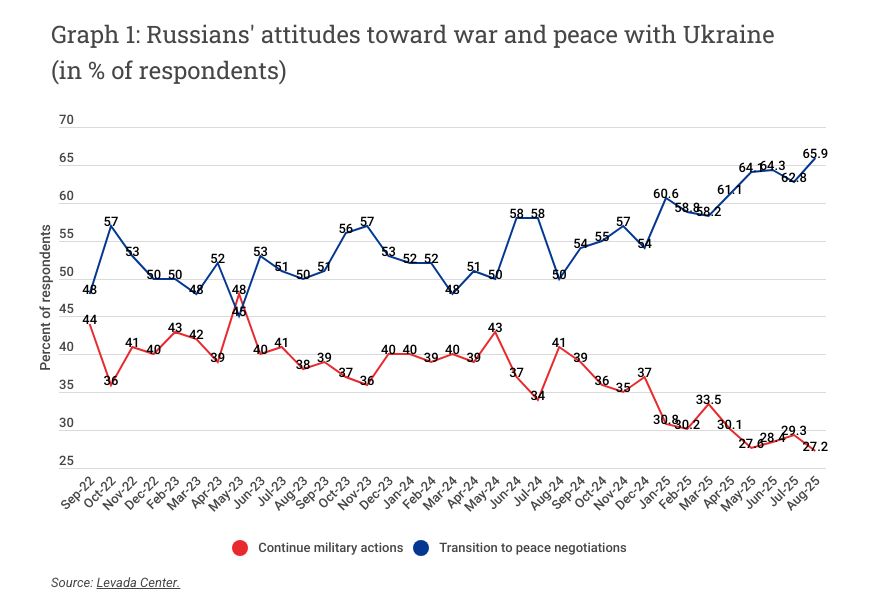
- The share of Russians who favor peace talks on resolving the Russian-Ukrainian war over continuing the hostilities has crept up to a record level: 65.9%, according to the Levada Center’s August poll. But while many of the August poll’s respondents favor peace talks over war, 78% of them also support the actions of the Russian army in Ukraine. In addition, more Russians (39%) believe the war will continue for over a year than believe it will end in half a year or less (36%). (RM, 09.10.25)
Friday, Sept. 12, 2025
- Formal talks between Russia and Ukraine are now on hold, with the Kremlin pausing active diplomatic engagement, Kremlin spokesperson Dmitry Peskov confirmed on Sept. 12. Technical communication remains open, but substantive progress is seen as unlikely. President Putin has expressed skepticism about restarting talks and dismissed Kyiv’s suggested locations for a meeting, instead offering Moscow as a venue—a proposal swiftly rejected by Zelenskyy. The diplomatic impasse follows months of failed efforts, including Trump’s shifting positions on ceasefire and peace talks, and continuing mutual accusations over each side’s “political will” for meaningful negotiations. Peskov claimed that communication channels remain open but no progress is expected for now, blaming European countries for hindering a peaceful settlement. (BNE IntelliNews, 09.12.25, Korrespondent.net, 09.12.25)
Great Power rivalry/new Cold War/NATO-Russia relations:
Monday, Sept. 8, 2025
- EU Council President António Costa said the bloc and U.S. President Donald Trump have “turned the page” after months of turbulence, following new agreements on defense, trade, and support for Ukraine’s security. (Financial Times, 09.08.25)
- Estonia's Foreign Ministry on Monday said it had summoned the Russian Embassy's charge d'affaires to lodge a protest after a Russian helicopter violated its airspace. The Russian MI-8 aircraft entered the Baltic country's airspace on Sunday near the island of Vaindloo, in the Gulf of Finland. (MT/AFP, 09.08.25)
- Russian Security Council Chair Dmitry Medvedev threatened Finland in a TASS op-ed, warning that confrontation could mean “collapse of Finnish statehood forever.” Medvedev invoked claims of Finnish Nazi ties, persecution of Russians, and alleged NATO aggression—directly mirroring narratives the Kremlin used to justify its invasions of Ukraine. ISW assesses this as part of ongoing Russian threats and justification efforts toward NATO states. (ISW, 09.08.25)
Wednesday, Sept. 10, 2025
- NATO fighter jets have shot down Russian drones over Polish airspace for the first time, after what Warsaw described as an “unprecedented violation” of its territory that prompted the alliance to hold emergency consultations. This was the first time the U.S.-led military alliance has engaged directly with the Russian armed forces since Putin launched his full-scale invasion of Ukraine The operation in the early hours of Wednesday, during a massive Russian attack on Ukraine, involved Dutch and Polish fighter jets, while German Patriot missiles were put on alert and an Italian early warning aircraft provided support.8 Poland’s Prime Minister Donald Tusk said that of an estimated 19 drones that entered Polish airspace, only about four “that presented a direct threat” were shot down. Poland activated Article 4 of the NATO Treaty, which allows a member of the bloc to request a consultation with allies when it believes its security or territorial integrity has been threatened. (Financial Times, 09.09.25 - 09.10.25, Meduza, 09.10.25, Financial Times, 09.10.25)9
- Russian warplanes have long tested NATO’s responses by flying near or even into the airspace of alliance members. NATO countries rotate air-policing duties along alliance borders. Those cat-and-mouse encounters, involving traditional crewed aircraft, have become more brazen since Russia’s large-scale invasion of Ukraine in 2022, but remain on the alliance’s periphery. Tuesday night’s drone incursions reached farther west over Poland than at any time previously reported during the war. (Wall Street Journal, 06.10.25)
- A Polish arms industry official told the Financial Times that most of the identified drones were “Gerbera” drones—Iranian-designed Shahed drones that are not fitted with a warhead and are used as decoys ahead of missile attacks on Ukraine. (Financial Times, 09.10.25)
- Polish officials suspect that a subsequent wave of armed Shaheds was headed to Ukraine’s western city of Lviv, and that the Gerbera decoys were deliberately flown into Poland to skirt Ukrainian air defenses around Lviv. “One drone, what we have seen so far, may be a mistake,” the arms industry official said. But “19 drones is not a mistake.” (Financial Times, 09.10.25)
- Nato has acknowledged that its eastern air defenses are one of its weak spots and in urgent need of investment. (Financial Times, 09.10.25)
- The drone incursion into Poland exposed serious gaps in NATO’s eastern air defenses, as alliance jets shot down only four of an estimated 19 drones—Analysts warn Europe’s air defense remains ill-prepared for the mass assaults Russia regularly unleashes on Ukraine, and stress NATO needs multi-layered, integrated defenses. Officials believe the attack aimed to test NATO, sow division, and maintain anxiety on Russia’s border. (Financial Times, 09.09.25)
- Officials, defense experts and analysts say, the attack will have shown just how unprepared Europe is for the type of mass air assault that Russia inflicts on Ukraine almost every night. “[Moscow] will have taken note that we have still not learned from what Ukraine has been dealing with for years,” said Ben Hodges, former commanding general of the U.S. Army in Europe. “We are absolutely not prepared for that… and now they are at our door.” “This was not an accident, obviously, given the number of drones,” said Hodges. “This was a rehearsal. To probe, and find out how good are our early warning systems, what are our reaction times.” (Financial Times, 09.10.25)
- If Vladimir Putin’s intention was to use an early-morning drone foray into Poland to test NATO’s air defenses, the Russian president would be most pleased with the result. And, experts warn, he will probably be encouraged to go further next time. (Financial Times, 09.10.25)
- Poland’s Prime Minister Donald Tusk said the incident brought Europe "the closest we have been to open conflict since World War Two." (Financial Times, 09.11.25)
- Nato secretary-general Mark Rutte commended “a very successful reaction by Nato” and vowed to defend “every inch of allied territory… We need to invest more… so we have what we need to deter and defend,” Rutte added. Rutte said that allies had “expressed solidarity with Poland and denounced Russia’s reckless behavior.” Rutte said a full assessment is ongoing but “the violation last night is not an isolated incident.” He added, “Last night showed we are able to defend every inch of NATO territory including, of course, its airspace.” (Financial Times, 09.10.25, Axios, 09.10.25, Financial Times, 09.11.25. Bloomberg, 09.10.25
- “Increasing evidence indicates that this movement, this direction of strike, was no accident,” Ukrainian President Volodymyr Zelenskyy said on X, adding that the use of “combat aircraft from several European countries simultaneously to shoot down Russian weapons and protect human lives is highly significant.” (Wall Street Journal, 06.10.25)
- Matthew Whitaker, U.S. ambassador to NATO, wrote, “We stand by our NATO Allies in the face of these airspace violations and will defend every inch of NATO territory,” after overnight Russian drone incursions into Poland. (Axios, 09.10.25)
- Rep. Joe Wilson (R–S.C.) called the air incursion an “act of war” on X, urging President Trump to impose “mandatory sanctions that will bankrupt the Russian war machine and arm Ukraine with weapons capable of striking Russia.” (Axios, 09.10.25)
- Ursula von der Leyen, European Commission president, said that Iranian-designed Shahed drones were involved in the “reckless and unprecedented violation of Poland’s and Europe’s airspace.” (Financial Times, 09.11.25)
- “Once again Russia tests frontier states, EU & Nato,” the EU’s defense commissioner Andrius Kubilius said, calling for the construction of a “drone wall” along Europe’s eastern flank. (Financial Times, 09.11.25)
- Poland has asked allies for additional air defense systems and counter-drone technology to better protect its land from Russian incursions, according to people familiar with the matter. (Bloomberg, 09.10.25)
- Russia’s Ministry of Defense said its drones did not intentionally cross into Poland and offered to consult with Warsaw about the incident. While Moscow claims electronic jamming caused the breach, Western experts suspect deliberate probing of NATO’s defenses. (The Economist, 09.10.25, Axios, 09.10.25)
- Belarus’s Ministry of Defense stated it had "warned" Poland and Lithuania about “unknown aerial vehicles” approaching their borders after around ten Russian drones entered Polish airspace. "This helped the Polish side react quickly to the drone activity," said Pavel Muraveiko, the head of Belarus's armed forces. He added that Belarus had also shot down drones that entered its airspace as a result of jamming. (Wall Street Journal, 09.11.25, Istories.media, 09.10.25)
Thursday, Sept. 11, 2025
- Drone parts were found in the villages of Mniszkow, central Poland, and Czesniki in the country's southeast, among other places, local mayors said. (Wall Street Journal, 09.11.25)
- Polish officials provided additional clarification on the impacts of the Sept. 9–10 Russian drone incursion into Polish airspace. Poland’s Ministry of Internal Affairs reported that as of 1900 local time on Sept. 11, Polish law enforcement agencies found 17 total drones throughout eastern and northern Poland. Polish media reported that at least one drone crashed near a Polish Territorial Defense Force unit in Nowe Miasto nad Pilicą (southwest of Warsaw). A Polish defense analyst stated that at least 15 of the recovered drones were Gerbera decoy drones, many of which were equipped with fuel tanks that doubled their range to as far as 900 kilometers. (ISW, 09.11.25)
- Experts said images posted on Polish state media of the small aircraft suggest they were Russian reconnaissance drones or decoys, most likely the Gerbera model. Serhiy Beskrestnov, a Ukrainian expert on electronic warfare, said the use of Gerbera drones -- which can serve a reconnaissance purpose when outfitted with a camera -- suggests Russia was testing NATO's resolve by forcing Poland and its allies to scramble air defenses, allowing Moscow to assess the speed and efficiency of the response. Gerbera drones are more vulnerable to spoofing than the explosive Shahed drones (Wall Street Journal, 09.11.25)
- Reports suggest Russia may be using modified drones with extended range and Polish or Lithuanian SIM cards, further casting doubt on Russia’s denials. (ISW, 09.11.25) (ISW, 09.11.25)
- Tuesday night's drone incursions reached further west over Poland than at any time previously reported during the war. (Wall Street Journal, 09.11.25)
- "We are dealing likely with a provocation on a large scale," said Prime Minister Donald Tusk of Poland, a North Atlantic Treaty Organization member, following an emergency meeting of ministers on Wednesday. (Wall Street Journal, 09.11.25)
- Asked whether NATO regarded the incident as a deliberate attack or a mistake, NATO Secretary-General Mark Rutte said that a full assessment was continuing. "Whether it was intentionally or not, it is absolutely reckless. It is absolutely dangerous," Rutte said. "I think last night showed that we are able to defend every inch of NATO territory, including, of course, its airspace." (Wall Street Journal, 09.11.25)
- NATO is preparing a defensive military measures in response to the drone incursion in Poland to strengthen deterrence across the alliance’s eastern flank, according to a person familiar with the matter. There will also be a political response, according to the person, who requested anonymity to discuss private matters. An initial one was delivered on Wednesday, with Secretary General Mark Rutte and other allied leaders condemning Russia’s “reckless behavior.” The military response will be coordinated by Supreme Allied Commander Europe Alexus Grynkewich, who is responsible for planning and executing all the alliance’s military operations, according to the person. (Bloomberg, 09.11.25)
- Poland’s allies reiterated their support for Poland following the drone incursion, condemning Russia for purposefully conducting the incursion to test NATO readiness. Polish Deputy Defense Minister Władysław Kosiniak-Kamysz reported on Sept. 10 that Sweden has provided an emergency package of air defense assets and aircraft to Poland; that the Netherlands is providing Poland with systems such as Patriots, National Advanced Surface-to-Air Missile Systems (NASAMS), and anti-drone systems; and that other allies are also providing Poland with concrete declarations of support. (ISW, 09.11.25)
- Dutch Foreign Minister David van Weel summoned Russian ambassador Vladimir Tarabrin over the drones that flew over Poland on Wednesday, his spokesperson said. (Bloomberg, 09.11.25)
- Russia's Defense Ministry said it had no plans to strike any targets in Poland and was ready to carry out consultations with the Polish military on the incident. It also said the drones that crossed the border have a flight limit of around 400 miles, a distance that could make launching them from Russia difficult. Kremlin spokesman Dmitry Peskov declined to comment specifically on the incident, but said the leadership of the European Union and NATO "nearly daily accuse Russia of provocations, most often without even trying to present their line of reason." The Russian foreign ministry accused Poland of spreading “myths” to escalate the war, while Polish authorities summoned Russia’s chargé d’affaires over the airspace violation. (Wall Street Journal, 09.11.25, ISW, 09.11.25)
- NATO’s Baltic members sent a joint letter to the U.S. Congress, asking for a key military financing initiative to be preserved after the Pentagon said it planned to cut funding for European nations bordering Russia. (Bloomberg, 09.11.25)
Friday, Sept. 12, 202
- “What’s with Russia violating Poland’s airspace with drones?” Donald Trump posted on Truth Social. “Here we go!” But no further statement followed, let alone any action. A failure by NATO to react to an unprecedented violation of a member’s airspace will bring Mr. Putin a step closer towards his goal of dividing the Atlantic alliance. “It could have been a mistake, but regardless, I’m not happy about anything having to do with that whole situation,” Trump told reporters Thursday at the White House as he left for a trip to New York. “But hopefully it’s going to come to an end.” Trump subsequently added that he would condemn Russia “even for being near that line.” “They were actually knocked down... but he shouldn't be close to Poland anyway.” (The Economist, 09.12.25, Bloomberg, 09.11.25) (Washington Post, 09.12.25, Fox News, 09.12.25)
- Poland’s Prime Minister Donald Tusk dismissed President Trump’s suggestion that Russian drones entering Polish airspace “could have been a mistake,” insisting “we know it wasn’t.” The incident marked the first direct NATO engagement with Russian assets since 2022 and prompted emergency UN Security Council talks. In response, Poland closed its border with Belarus, while France and other NATO states pledged fighter jets, helicopters, and missile systems to bolster Poland’s defenses. Trump, meanwhile, called for stronger action against Putin but also blamed Ukraine’s president for failed peace talks. Tusk dismissed as “manipulation and disinformation” any claims that Ukraine was behind the recent incursion of Russian drones into Polish airspace. (Ukrainska Pravda/Eurointegration, 09.12.25) (Financial Times, 09.12.25)
- Karol Nawrocki, the president of Poland, called the drone incident “an unprecedented moment in the history of NATO and Poland.” In a speech to parliament, Mr. Tusk called for the “full mobilization” of NATO members, and reprimanded those prone to criticize European countries rather than Russia over the war in Ukraine. (The Economist, 09.12.25)
- “Russia deliberately attacked Poland—we have facts and evidence for that. It was a planned provocation, coordinated with a disinformation campaign. Softening this truth strengthens the Russian narrative. Every word questioning the fact that we were dealing with a deliberate action supports Russian disinformation. Disinformation is also an element of war,” said Polish Deputy Prime Minister and Minister of Digital Affairs Krzysztof Gawkowski in an interview with @wroblewski_m. (X, 09.12.25)
- Germany’s defense ministry says expanded German air policing in Polish airspace is now fully operational in response to Russian drone incursions. Two alarm rotas are on 24/7 alert, ready for immediate action alongside NATO allies to help secure Polish skies. (The Guardian, 09.12.25)
- Germany and France summoned their Russian ambassadors this week to protest the incursion of Russian drones into Polish airspace, following similar actions from countries including the Netherlands and Spain. The move expresses strong dismay over what is viewed as a deliberate Russian provocation. (The Guardian, 09.12.25)
- The UN Security Council is to hold an emergency session on Friday at Poland’s request, following Wednesday’s incursion by Russian drones into Polish airspace. The move comes as Warsaw seeks international support for what it decried as a major violation of its border and NATO airspace. (The Guardian, 09.12.25)
- After Russian drones breached Polish airspace, Ukrainians fear European countries may withhold desperately needed air defense systems to protect their own skies. Ukraine urgently calls for more NATO support, warning that Russia’s escalating drone and missile attacks—including a single night with over 800 drones—are overwhelming its defenses. President Zelenskyy appealed for a “joint air defense system” over Europe, but some officials worry Europe’s response will be to further prioritize its own security. Ukraine’s dwindling supply of interceptors and limitations on using advanced NATO systems leave cities increasingly vulnerable. (Washington Post, 09.12.25)
- Russia's drone incursion into Polish territory on Sept. 10 failed to result in much physical damage on the ground, but it did uncover a major hole in Europe's defense forces: The allies don't have cost-effective counter-measures to deal with low-cost Russian attacks. As many as 19 drones flew into Polish—and thus NATO—airspace. Four appeared to have been shot down. An explanation from some European officials, who spoke to RFE/RL on background, is that priority was given to those drones that seemed to be headed toward critical infrastructure. (RFE/RL, 09.12.25)
- France and Germany said they were helping to strengthen NATO ally Poland's air defense after at least 19 Russian drones entered Polish airspace on Sept. 10, severely raising tensions between the Western military alliance and Moscow. German government spokesman Stefan Kornelius on Sept. 11 said Berlin's military would "extend and expand" air policing over Poland to provide additional cover for the country's airspace. French President Emmanuel Macron said his country would "deploy three Rafale fighter jets to contribute to the protection of Polish airspace and of NATO's Eastern Flank together with our Allies." (RFE/RL, 09.12.25)
China-Russia: Allied or aligned?
- China’s exports to Russia fell 16.4% in August from a year earlier, the steepest decline since February. Exports totaled $8.55 billion in August, down 5.8% from July. Russian shipments to China also fell sharply, declining 17.8% year-on-year to $9.35 billion, a 6.9% decrease from July, according to the Russian state news agency TASS. Overall bilateral trade for the month fell to $17.9 billion. (MT/AFP, 09.08.25)
- China and Russia signed over 20 new cooperation deals last week, expanding energy, defense, and visa ties, with Russia pushing for new fundraising channels amid Western sanctions. However, Beijing kept the upper hand, declining to finalize key financial arrangements—including panda bond sales and UnionPay access—while still boosting trade and joint military exercises. Chinese-Russian trade flows have dipped by nearly 17% year-on-year, underscoring Moscow’s growing economic reliance. Analysts say that while China is Russia’s critical economic lifeline during the Ukraine war, the partnership remains closely dictated by Beijing’s interests and conditions. (Washington Post, 09.11.25)
- China is set to allow major Russian energy companies to raise funds by issuing renminbi “panda bonds” in its domestic market for the first time since 2017. Chinese rating agencies have recently upgraded several Russian energy firms, though concerns over potential secondary sanctions from the U.S. remain. (Financial Times, 09.08.25)
- Russia’s state nuclear monopoly Rosatom is preparing to issue renminbi “panda bonds” in China’s domestic bond market. (Financial Times, 09.08.25)
- Russian state corporation Rosatom and China National Nuclear Corporation (CNNC) signed a memorandum of understanding on Sept. 10 to deepen cooperation on human resources and workforce development. The agreement, signed in Moscow by Rosatom HR Deputy Director Tatiana Terentyeva and acting head of CNNC’s HR department Li Changyu, envisages joint projects, coordination on talent training, and collaboration between youth and women’s industry groups. Both sides emphasized the pact will clarify objectives and responsibilities, strengthening their partnership in developing a high-tech nuclear workforce, including within broader BRICS cooperation frameworks. (Rosatom, 09.10.25)
Missile defense:
- Zelenskyy proposed integrating Ukraine into Europe’s “eastern air shield,” emphasizing that Ukraine’s air defense experience and resources should be central to a coordinated, multi-layered regional system to protect borders against Russia and Belarus. Zelenskyy said the recent Russian drone incursion into Poland showed the urgent need for a joint system—including drones, aviation, and mobile groups—coordinated by Ukraine alongside partners like Poland. He also invited EU allies to co-finance and co-produce interceptor drones with Ukraine. (Ukrainska Pravda, 09.11.25)
Nuclear arms:
- Russia and Belarus launched Zapad-2025 joint military exercises on Sept. 12, with simulated nuclear strike planning alongside conventional drills. Lithuanian intelligence estimates about 30,000 troops will participate—significantly fewer than in 2021, as most Russian combat units remain in Ukraine. Exercises will focus mainly in Belarus’s Minsk region, but some drills are near NATO borders, intensifying security concerns. As part of the maneuvers, troops will rehearse non-live-fire scenarios involving tactical nuclear weapons, while NATO and regional states conduct parallel military drills, fortifying strategic points like the Suwałki Gap. (Meduza, 09.12.25)
- Analysts say this year’s Zapad will seek to achieve three things: test Nato’s responses to provocations such as the drone incursions, demonstrate that despite its military failures in Ukraine it is still a formidable fighting force, and maintain a state of anxiety in Nato states bordering Russia and Belarus. (Financial Times, 09.10.25)
- Poland is deploying about 40,000 troops to its borders with Belarus and Russia ahead of the large-scale Russian-Belarusian military exercise "Zapad-2025. (RBC.ua, 09.11.25)
- Poland closed all border crossings with Belarus on Sept. 11, rolling out barbed wire and barriers ahead of the Russian-Belarusian Zapad-2025 military exercises scheduled for Sept. 12–16. (Meduza, 09.12.25)
- Russia on Thursday urged Poland to reopen its border with Belarus, Moscow's close ally, calling the closure "destructive" and warning of consequences. Polish Prime Minister Donald Tusk announced Tuesday the closure of the border with Belarus from 12:00 a.m. on Sept. 12 (10 p.m. GMT on Sept. 11), in response to the upcoming joint Russian-Belarusian war games. "We urge Warsaw to consider the consequences of such destructive steps and to review its decision as soon as possible," Foreign Ministry spokeswoman Maria Zakharova said in a statement. (MT/AFP, 09.11.25)
- Latvia will close the airspace over its eastern border for at least one week, Minister of Defense Andris Spruds said. The decision comes a day after Poland shot down drones that crossed into its territory. (Bloomberg, 09.11.25)
- Construction is under way on a site in Belarus experts say looks like a military facility that could potentially house Russian strategic missiles, according to satellite images examined by RFE/RL and its partners in an investigative project. Images from Planet Labs of the sprawling site in the Slutsk district, 60 kilometers south of Minsk, show substantial construction on what TV footage from May 2024 indicates was in part an empty field at the time. (RFE/RL, 09.10.25)
Counterterrorism:
- No significant developments.
Conflict in Syria:
- Syrian leader Ahmed al-Sharaa is to visit Moscow next month, Russia's Deputy Prime Minister Alexander Novak announced in Damascus on Tuesday, hailing a new page in ties after the overthrow of longtime ally Bashar al-Assad." (MT/AFP, 09.09.25)
Cyber security/AI:
- A surge in Ukrainian drone strikes deep inside Russia has prompted the Kremlin to impose internet blackouts around military and industrial facilities, disrupting daily life and commerce for millions of Russians. Nationwide, temporary outages exceeded 2,000 in July and August—triple June’s figure—crippling cash registers, GPS navigation, and public transport. Each hour of blackout costs an estimated 46.4 billion rubles ($557 million). High-security regions have faced weeks-long mobile internet cuts, and cash in circulation rose by $2.2 billion in July as Russians adapted to digital instability. (Financial Times, 09.12.25)
- Russia operates over 1.3 million mobile base stations and previously imported 50,000 units each year to maintain network quality, but Western sanctions and vendor exits have made replacements difficult. (Financial Times, 09.12.25)
Energy exports from CIS:
- Russian exports of petroleum products have shrunk in early Sept., led by steep declines in diesel and naphtha shipments, as drone attacks curb refining output. Total refined-product exports dropped to 1.96 million barrels a day in the first seven days of September, according to data compiled by Bloomberg from analytics firm Vortexa Ltd. (Bloomberg, 09.11.25)
- U.S. energy secretary Chris Wright demanded that European countries stop buying Russian oil and gas if they want Washington to tighten sanctions on Moscow. Wright urged the EU to buy more U.S. LNG to meet trade deal requirements, as Russian fossil fuels still accounted for 14% of EU gas imports in 2024. He also warned that EU climate rules threaten the EU-U.S. trade deal’s future. (Financial Times, 09.08.25)
- The European Union is considering backtracking on a proposed ban on providing terminal services to Russian liquefied natural gas suppliers, potentially weakening a plan to phase out the gas purchases helping to fund Vladimir Putin’s war machine. (Bloomberg, 09.08.25)
- France and Germany are urging the European Union to target major Russian oil companies as part of the bloc’s next package of sanctions, according to proposals seen by Bloomberg. (Bloomberg, 09.09.25)
- Three and a half years into the invasion of Ukraine, Western efforts to cut off Russia’s energy profits have largely failed, with Moscow earning about $600 million daily from exports. (Foreign Policy, 09.09.25)
- Russia’s August crude output was below its OPEC+ target, following recent adjustments to the group’s compensation plans. The nation pumped 9.175 million barrels a day last month, according to people who saw the data and asked for anonymity as the information isn’t public. That’s an increase from July, but about 84,000 barrels a day below the country’s quota for August including compensation cuts. (Bloomberg, 09.10.25)
- Hungary clinched a 10-year gas supply agreement with Shell Plc, marking one of its first steps to diversify away from Russian flows as a European Union deadline to phase out those imports nears. (Bloomberg, 09.09.25)
- Russia and China appear to be moving forward with a major natural gas pipeline between their countries after years of stalled negotiations. Russian energy giant Gazprom PJSC said it has signed a legally binding memorandum with China National Petroleum Corp. to build the Power of Siberia 2 pipeline. China has yet to confirm the agreement was struck and key issues such as financing, pricing and the volume of gas that will be sold remain unresolved. (Bloomberg, 09.09.25)
- Exxon Mobil Corp. and Chevron Corp. are bullish on China’s future appetite for liquefied natural gas even if Russia succeeds in adding another pipeline to the Asian nation. (Bloomberg, 09.09.25)
- The International Energy Agency (IEA) warns that a growing oil supply surplus could soon pressure Russian producers, as global output is projected to rise by 2.7 million barrels a day in 2025. While OPEC+ has agreed to lift production, the IEA notes tighter Western sanctions on Russian energy may curb Russian output. Yet, previous Iran and Russia sanctions have had little effect on global flows. A new EU ban on refined fuels from Russian crude is set to take effect next year, potentially disrupting Russian energy exports further. (Wall Street Journal, 09.11.25)
Climate change:
- No significant developments.
U.S.-Russian economic ties:
- No significant developments.
U.S.-Russian relations in general:
- U.S. President Donald Trump has signed an executive order that could designate countries that have wrongfully detained U.S. citizens as state sponsors of terrorism, including Iran, Afghanistan, Russia, and China. (RFE/RL, 09.07.25)
- The U.S. State Department has notified European countries that it’s terminating memorandums of understanding to cooperate on detecting and exposing disinformation spread by countries including Russia, China, and Iran. (Meduza, 09.09.25)
- Russian citizens seeking U.S. visas for tourism, study or temporary work must now travel to Poland or Kazakhstan for their required interviews, the State Department said in an update released Saturday. (MT/AFP, 09.08.25)
- The father of Russian Vadim Kruglov who was found dead at the Burning Man festival last month has asked U.S. President Donald Trump to order an FBI investigation into his son’s apparent murder, Russian media reported Thursday. (MT/AFP, 09.11.25)
- Russian authorities have renamed a school in the occupied part of Ukraine’s Donetsk region in honor of Michael Gloss, the son of a CIA deputy director who joined the Russian military and died while fighting in Ukraine last year (Meduza, 09.10.25)
- Former Russian President Dmitry Medvedev claimed Thursday that Western support for Ukraine is linked to growing political violence in the United States after conservative activist Charlie Kirk was shot dead while speaking at a university campus in Utah. (MT/AFP, 09.11.25)
II. Russia’s domestic policies
Domestic politics, economy and energy:
- Russia’s Central Bank lowered its key interest rate by 100 basis points to 17% on Friday, marking the third consecutive cut this year. Rates dropped from 21% in June to 20%, then to 18% in July. Despite the easing, the bank cited high inflation expectations, though lending activity has increased and the economy is “returning to a path of balanced growth.” Analysts at Russian banks had expected a larger rate cut to 16%. (Meduza, 09.12.25)
- Russia faces growing concerns about the eventual return of its enormous army, including tens of thousands of pardoned convicts, as the Ukraine war continues. Nearly 1.5 million Russians have served, with returning veterans already linked to hundreds of civilian murders and violent crimes. The Kremlin is working to prevent social destabilization—with programs for job placement and high-level appointments for veterans—but authorities and analysts worry the scale of trauma and criminality could eclipse problems seen after the Soviet war in Afghanistan. (Reuters, 09.09.25)
- As many as 30% of respondents of a Levada poll in August reported that their relatives, friends, or acquaintances have been killed in the Russian-Ukrainian war. In addition, for 28% of respondents, the war has had a direct impact: either the respondents themselves, or their relatives, friends, and acquaintances are fighting in the war. (RM, 09.10.25) These significant percentages signal how wide and tangible the impact of the conflict on the Russian public has become, in spite of the Kremlin’s effort to limit the impact of what its propagandists at least initially insisted was not a war, but a “special operation,” threatening those who called a spade a spade with prosecution.
- Between January and August, Russia’s energy earnings dropped 20% year-on-year and the budget deficit hit 2.2% of GDP, far exceeding Kremlin targets. Analysts forecast Russian GDP growth to slow to 1.4% this year, with wartime spending doubling in nominal terms since 2022 and reserves depleted to sustain the war effort. (Financial Times, 09.07.25)
- The Russian government is weighing an increase in the value-added tax (VAT) as war spending deepens the country’s budget deficit, The Bell reported, citing people familiar with the discussions. (Meduza, 09.11.25)
- President Putin submitted a bill to the State Duma on Sept. 8 to withdraw Russia from the European Convention for the Prevention of Torture. (ISW, 09.08.25)
- President Vladimir Putin does not take vacations and sleeps only “a few hours a day,” Kremlin spokesman Dmitry Peskov said Monday. (MT/AFP, 09.09.25)
- Russian opposition figure Ilya Yashin said Monday that authorities had stripped him of his citizenship, citing court documents from his lawyer. (MT/AFP, 09.08.25)
- Russian pop icon Alla Pugacheva, in her first interview since going into exile, condemned Russia’s invasion of Ukraine and described patriotism as telling one’s homeland when it is wrong. (Washington Post, 09.11.25)
- Television remains the main source of news for Russians, with 60% of respondents using it, though this share has fallen by 10 percentage points since March 2022, according to the Levada Center’s latest poll of Russians. Social networks are now used by 36% of respondents, internet news sites by 29%, and Telegram channels by 26%. Radio (9%), YouTube channels (8%), and print media (6%) are less common sources. (Levada, 09.12.25)
- Russia’s financial watchdog Rosfinmonitoring on Thursday added exiled author and anti-war intellectual Dmitry Bykov to its list of “terrorists and extremists. (MT/AFP, 09.11.25)
Defense and aerospace:
- President Vladimir Putin chaired a meeting on the development of engine manufacturing at UEC-Kuznetsov in Samara on Sept. 5, bringing together top Russian officials and industry leaders. Putin highlighted that Russia remains among the top five nations in aircraft and rocket engine production, with deliveries rising over 50% in four years—from 791 to 1,227 units. He noted full import substitution for engines in Ansat helicopters and Sukhoi Superjet aircraft, and stressed the strategic importance of developing and serially producing the new PD-26 turbofan engine for both military and next-generation civil aviation. (Kremlin.ru, 09.05.25)
- President Vladimir Putin likely extended the military service of General Valery Gerasimov, chief of the General Staff of Russia’s armed forces, after he turned 70, the Vedomosti business newspaper reported Monday. (MT/AFP, 09.09.25)
- Russia’s National Guard (Rosgvardia) has reintroduced tank units as part of a wider expansion of its heavy weaponry, the force’s chief Viktor Zolotov said Thursday. (MT/AFP, 09.11.25)
- See section Military aspects of the Ukraine conflict and their impacts above.
Security, law-enforcement, justice and emergencies:
- Former Kursk region Governor Alexei Smirnov has admitted to taking bribes in connection with construction projects for border defenses, Russian state media reported on Thursday, citing law enforcement sources. Smirnov, who governed Kursk until December 2024, gave the confession as part of a plea deal with investigators. (MT/AFP, 09.11.25)
Russian police are reviewing allegations against Roman Alekhin, a pro-war blogger and ex-adviser to Kursk’s former governor, for the suspected embezzlement of aid intended for soldiers in Ukraine. (Meduza, 09.09.25)
III. Russia’s relations with other countries
Russia’s external policies, including relations with “far abroad” countries:
- Russia’s Foreign Ministry on Wednesday condemned Israel’s deadly airstrikes against members of the Hamas militant group in Qatar’s capital city the day before, calling it a “gross violation” of international law that undermines efforts to end the war in Gaza. (MT/AFP, 09.10.25)
- Japan announced Wednesday that it would close all six of its business education centers in Russia amid worsening bilateral relations. (MT/AFP, 09.10.25)
- Iraqi Prime Minister Mohammed Shia al-Sudani and U.S. President Donald Trump announced Tuesday the release of Israeli-Russian academic Elizabeth Tsurkov, who was kidnapped in Baghdad in March 2023. (MT/AFP, 09.10.25)
- A French national was arrested in Russia’s Far East and placed in pre-trial detention, French diplomatic sources told AFP on Monday. The sources did not specify the date or circumstances of the arrest, but said the French Consulate in Moscow had requested consular access. French media identified the man as Sofiane Sehili, 44, an ultra-endurance cyclist who had sought to set a record crossing Europe. (MT/AFP, 09.08.25)
- A Swiss court has ruled to grant the Island of Jersey access to banking records as part of a money laundering and sanctions investigation into Russian billionaire Roman Abramovich. Jersey, a British Crown dependency, filed its request for criminal assistance with Switzerland in June 2022, according to the compliance services firm Comsure. (MT/AFP, 09.08.25)
Ukraine:
- The long-running historical dispute between Ukraine and Poland over World War II–era massacres was eased Saturday with the reburial of 42 people killed in 1945 and left in a mass grave near the abandoned Polish village of Puzhnyky, Ukraine. The ceremony, attended by Polish and Ukrainian officials, marks a new policy allowing exhumation and dignified reburial of ethnic Polish victims in Ukraine. Both countries hope the move will strengthen crucial bilateral ties as they confront Russia. (New York Times, 09.08.25)
- The International Monetary Fund estimates Ukraine’s external funding needs could be $10–20 billion higher than Kyiv’s official projection of $37.5 billion for 2026–27, creating a potential gap of up to $20 billion. The discrepancy emerged during recent IMF discussions in Kyiv, and a final figure must be agreed before IMF board approval of the next loan package. With most of its current $15.5 billion IMF program already spent and U.S. aid waning, Ukraine faces mounting concerns about covering rising wartime expenditures. (Bloomberg, 09.11.25)
- The National Bank of Ukraine kept the key rate at 15.5%, it said in a statement Thursday. (Bloomberg, 09.11.25)
- Ukrainian anti-corruption investigator Ruslan Magamedrasulov has been jailed pending trial after being accused of selling industrial hemp to Russia—charges supporters call “absurd” and politically motivated. Magamedrasulov was known for investigating close associates of President Zelenskyy; his arrest in July by Ukraine’s security service follows this summer’s crackdown on anti-corruption agencies. Activists and opposition lawmakers view his prosecution as a warning to steer clear of high-level corruption probes. The case is seen as a key test for Ukraine’s commitment to anti-corruption reforms during wartime (New York Times, 09.12.25)
- A Ukrainian Defense Ministry official was arrested in Kyiv for allegedly accepting a $10,000 bribe in exchange for promising to secure job placements at a critical enterprise, enabling military-age men to receive mobilization exemptions. Authorities say the official offered to fictitiously register men through the “Reserv+” system, granting deferred conscription as essential employees. The suspect was caught after receiving payment and has been jailed pending bail; investigations continue to identify accomplices. (Ukrainska Pravda, 09.11.25)
- The Kyiv’s Pechersk court kept NABU detective Magamedrasulov in custody, whom the SBU accuses of doing business in Russia. His lawyers asked to release him at least under house arrest, as he suffered a stroke in 2014, and in March and May of this year, he underwent complex brain surgery. (Antikor, 09.12.25) Machine translated.
- One in three Ukrainians has personally encountered bribe demands. Despite the high level of perceptions of corruption as a problem among Ukrainians, only 30% of citizens reported that they or members of their families personally encountered corrupt practices over the past year. Of these, only 23% agreed to engage in the proposed corrupt exchange, while 68% refused. The survey underscored the relevance of the corruption issue, as the vast majority of Ukrainians perceive corruption as a widespread phenomenon—87% of respondents. Although this perception is shared across all age cohorts, older individuals (65+) expressed the most critical assessments, with 90% identifying corruption as widespread. By contrast, among youth under 24, the share was somewhat lower—81%. (Transparency International-Ukraine, 09.09.25)
Russia's other post-Soviet neighbors:
- Belarus released 52 political prisoners, including 14 foreign nationals, in a U.S.-brokered deal that saw the Trump administration lift sanctions on the state airline Belavia. The move is part of President Alexander Lukashenko’s attempts to normalize ties with Washington, which also hopes to reopen its embassy in Minsk. U.S. envoy John Coale delivered a personal letter and cufflinks from Trump to Lukashenko. The release comes as Belarus prepares for joint military drills with Russia and follows recent gestures, including the release of more than 300 prisoners since July 2024. (New York Times, 09.11.25)
- The United States has lifted sanctions on Belarus’s state airline Belavia, announced by U.S. envoy John Cole during a meeting with Alexander Lukashenko in Minsk. The move—ordered “immediately” by President Trump—aims to normalize U.S.-Belarus relations after Belavia was sanctioned in 2022 for supporting Russia’s war in Ukraine. (Korrespondent.net, 09.11.25, Ukrainska Pravda, 09.11.25, Eurointegration, 09.11.25)
- In the first half of 2025, Belarus’s GDP growth slowed to 2.1%, but remains well above prewar levels. Analysts note that while the economy rebounded after a severe 2022 contraction, factors like population loss, labor shortages, and persistent inflation remain challenges for Minsk’s post-sanctions recovery. (Financial Times, 09.05.25)
- Moldovan President Maia Sandu warned European lawmakers on Tuesday that Russia is waging an “unlimited” interference campaign to try to pull her country into its orbit ahead of parliamentary elections this month. “On Sept. 28, Moldova will hold the most consequential election in its history,” Sandu said. (MT/AFP, 09.09.25)
- . Polish authorities on Monday released Pussy Riot member Aysoltan Niyazova from custody after detaining her over the weekend at the request of Turkmenistan. Her release was confirmed by fellow Pussy Riot member Lucy Shtein in comments to the exiled news website Novaya Gazeta Europe. (MT/AFP, 09.08.25)
- Armenia and Turkey have resumed direct talks on normalizing relations after more than 30 years without diplomatic ties and a closed land border. Turkish special envoy Serdar Kılıç met Armenian counterpart Ruben Rubinyan at the Margara crossing for negotiations focused on opening the border, restoring diplomatic relations, and allowing third-country travel. (Korrespondent.net, 09.12.25)
- Russia’s Federal Security Service (FSB) said Monday that it arrested a citizen of Azerbaijan accused of plotting attacks on law enforcement buildings in the southern Stavropol region on behalf of Ukraine. (MT/AFP, 09.08.25)
IV. Quotable and notable
- “[Moscow] will have taken note that we have still not learned from what Ukraine has been dealing with for years,” Ben Hodges, former commanding general of the U.S. Army in Europe, said over the drone incidents over Poland. “We are absolutely not prepared for that… and now they are at our door.” “This was not an accident, obviously, given the number of drones,” said Hodges. “This was a rehearsal. To probe, and find out how good are our early warning systems, what are our reaction times.” (Financial Times, 09.10.25)
- “The message from [Russia’s drone incursion into Poland] is that [NATO] needs to create an integrated air and ballistic missile defense system—and that Europeans are going to have to realize they will have to do this themselves,” said Fiona Hill, a member of Harvard’s Board of Overseers. (The Guardian, 09.11.25)
V. Useful data
Footnotes
- Polish officials suspect that a subsequent wave of armed Shaheds was headed to Ukraine’s western city of Lviv, and that the Gerbera decoys were deliberately flown into Poland to skirt Ukrainian air defenses around Lviv. Many of the drones that crossed into Poland were reported to have been Geran drones, which are typically not fitted with a warhead and are used as decoys ahead of missile attacks on Ukraine. A Polish defense analyst noted that many of the drones were Gerbera decoys with extended ranges, likely intended to bypass Ukrainian defenses around Lviv. If this assessment is accurate, then reluctance to expend costly interceptors on cheap decoys, rather than poor performance, could partially explain why only four were shot down.
- “We are absolutely not prepared for that… This was a rehearsal. To probe, and find out how good are our early warning systems, what are our reaction times,” ex-SACEUR Hodges admitted in an interview with Financial Times.
- “One drone, what we have seen so far, may be a mistake,” a Polish arms industry official said. But “19 drones is not a mistake.” Many of the drones were equipped with fuel tanks that doubled their range to as far as 900 kilometers.
- Asked whether NATO regarded the incident as a deliberate attack or a mistake, NATO Secretary-General Mark Rutte said that a full assessment was continuing.
- NATO has earlier acknowledged that its eastern air defenses are one of its weak spots and in urgent need of investment.
- Sources used: Financial Times, 09.09.25, 09.10.25; Meduza, 09.10.25; Financial Times, 09.10.25; Wall Street Journal, 06.10.25; Financial Times, 09.10.25; Financial Times, 09.10.25; Financial Times, 09.10.25; Financial Times, 09.11.25; Financial Times, 09.10.25; The Economist, 09.10.25; Axios, 09.10.25; Wall Street Journal, 09.11.25; istories.media, 09.10.25; ISW, 09.11.25; Bloomberg, 09.11.25;The Economist, 09.12.25; Bloomberg. 09.11.25; Washington Post, 09.12.25; Fox News, 09.12.25; Ukrainska Pravda/Eurointegration, 09.12.25; Financial Times, 09.12.25; RFE/RL, 09.12.25; ISW, 09.11.25.
- Rheinmetall CEO Armin Papperger said the military drone market “could be a big bubble,” noting that short-range UAV prices have dropped to around €1,000 and long-range to €2,500 each. Despite drones’ rising battlefield use since Russia’s invasion of Ukraine, Papperger doubts that government contracts will scale fast enough to meet market hype—forecasting up to €140 million in drone sales this year versus ambitions of €1 billion by 2030. Rheinmetall now targets €40–€50 billion in group sales by 2030, with orders potentially reaching €120 billion next year. (Wall Street Journal, 09.12.25)
- Poland’s military said that Dutch F-35 jets were involved in the operation while Italy confirmed that its radar surveillance planes had been “involved in the defense of Polish skies.” (Financial Times, 09.11.25)
- Russian drones and missiles have frequently breached NATO airspace in the past. Indeed, Ukrainian officials have complained that their allies have chosen to turn a blind eye to previous incursions. In late August a Shahed drone crashed in a cornfield in eastern Poland, some 120km from Warsaw. A Russian Kh-101 missile briefly appeared over Poland in early 2024. Russian drones apparently aimed for Ukrainian ports on the Dniester river have, Ukrainians insist, been intercepted and even landed across the river in Romania. Finland recently accused Russia of violating its airspace with military aircraft twice, in May and June, with Estonia making a similar accusation earlier this month. But the scale of the latest incursion far surpasses Russia’s previous violations. (The Economist, 09.12.25)
The cutoff for reports summarized in this product was 10:00 am East Coast time on the day it was distributed.
*Here and elsewhere, the italicized text indicates comments by RM staff and associates. These comments do not constitute an RM editorial policy.
Slider photo by AP Photo/Czarek Sokolowski.
 Russia in Review