
Russia in Review, March 13–20, 2026
4 Things to Know
- The U.S. intelligence community’s 2026 Annual Threat Assessment marks a shift in how it approaches analyzing Russia. Whereas the 2025 report devoted a separate detailed country chapter to Russia (as well as to China, Iran and North Korea), the 2026 version is organized by region, dispersing analysis of states across thematic and geographic sections.1 Importantly the 2026 assessment sharpens America’s escalation concerns vis-à-vis Russia, shifting from concerns about “unintended escalation” in 2025 to explicit warnings about both inadvertent and deliberate escalation, including possible direct conflict with NATO and even potential nuclear exchanges in the 2026 edition. "The most dangerous threat posed by Russia to the U.S. is an escalatory spiral in an ongoing conflict such as Ukraine or a new conflict that led to direct hostilities, including nuclear exchanges,” according to ATA-2026. However, neither ATA-2026 nor its predecessor forecast when these hostilities might occur.2 Several other core judgments remain stable from 2025 to 2026: Both assessments see Russia gaining the upper hand in Ukraine and conclude that losses have not critically degraded Russia’s battlefield capacity. In addition, the U.S. intelligence community’s 2026 view describes Moscow as being confident that it can impose a settlement favorable to the Kremlin on Kyiv. For a more detailed comparison of Russia-related aspects of the ATA-2025 and ATA-2026, see this RM blog post.*
- The past week saw Russia reportedly seeking a greater role in various dimensions of the Iran conflict without direct involvement in hostilities in hopes of saving the regime, which is its closest partner in the Middle East. While reportedly expanding intelligence-sharing and military cooperation with Iran (which is something Russia denies publicly, but privately offers to discontinue in exchange for the U.S. ending its intelligence-sharing with Ukraine), the Russian leadership has also unsuccessfully proposed to the Trump administration to take custody of Iran’s 450 kilograms of 60%-enriched uranium as part of a deal to end the war. Also, this week saw Russia’s Rosatom condemn what it and the IAEA described as an incident in which a projectile struck Iran’s Bushehr Nuclear Power Plant.
- RM’s analysis of ISW data for the past four weeks (Feb. 17–March 17, 2026) indicates that Russian forces lost 33 square miles of Ukraine’s territory (area roughly equivalent to one and a half Manhattan Islands) during that period, according to the latest issue of the Russia-Ukraine War Report Card. That’s in contrast to the estimated 127 square miles the Russian forces gained during the previous four-week period (Jan. 20–Feb. 17, 2026). According to ISW data, during the week of March 10–17, 2026, Russia notched a positive gain of 5 square miles, returning to the total estimated control of 45,783 square miles of Ukrainian territory it last achieved on Feb. 24, 2026, according to the March 18 issue of the RM war report card.3
- The largest redistribution of property in Russia since the 1990s has already affected dozens of Forbes-listed billionaires and nearly 20 of the country’s biggest companies by revenue, according to the Cedar analytical center cited by The Moscow Times. Analysts estimate that from 2022 to 2024, the value of seized assets reached about 5 trillion rubles (50 billion USD). Russia has transferred more than 800 companies into state ownership via court decisions, the head of the Federal Agency for State Property Management, Vadim Yakovenko, said at a ministry meeting this week. Around 805 firms have been taken over, with more added “every day.”
I. U.S. and Russian priorities for the bilateral agenda
Nuclear security and safety:
- Ukraine’s energy system is being reinforced with new equipment from the International Atomic Energy Agency for Mykolaivoblenergo, Foreign Minister Andriy Sybiha said. The systems will improve reliability by detecting grid overloads more quickly, locating damage faster, and better isolating accidents, helping restore infrastructure after Russian attacks. Sybiha thanked the IAEA and the donor state, stressing such practical support is vital to strengthen resilience under constant strikes. (RBC-Ukraine, 03.20.26)
- Russia’s state nuclear corporation Rosatom and the U.N. nuclear watchdog said March 18 that a projectile struck the Bushehr Nuclear Power Plant in Iran, marking the first such incident since the start of U.S.-Israeli attacks. “We categorically condemn what has occurred and call on all parties to exert every possible effort to de-escalate the situation in the vicinity of the Bushehr NPP,” Rosatom CEO Alexei Likhachyov said. (MT/AFP, 03.18.26)
- Russia’s state nuclear corporation Rosatom saw its foreign revenues fall to $16.5 billion in 2025 from more than $18 billion in 2024, its first export decline in years, even as total open revenue topped 3 trillion rubles, Bellona reports. Rosatom still controls about 40% of global uranium enrichment services and holds a $200 billion portfolio of foreign orders. China sharply expanded purchases of Russian enriched uranium in 2025, adding “hundreds of tons” — nearly equivalent to the annual fuel needs of France’s reactor fleet. (Bellona, 03.2026)
- Russia’s Deputy Foreign Minister Sergey Ryabkov met Pugwash Conferences on Science and World Affairs Secretary-General Kristoffer Hallberg on March 13 on the sidelines of the Moscow nonproliferation conference, the Foreign Ministry said. The two held what Moscow called a “substantive exchange” on international security and strategic stability, emphasizing the role of non-governmental organizations in preventing an arms race and further escalation of regional conflicts. (Russian Foreign Ministry, 03.14.26)
North Korea’s nuclear and missile programs:
- North Korea may have supplied weapons and troops worth as much as $14 billion to support Russia’s war in Ukraine, though only a portion of that appears to have been paid back to the reclusive regime, a study said. Troop deployments and military exports between August 2023 and December 2025 are estimated to have totaled between $7.67 billion and $14.4 billion, a recent report by South Korea’s state-funded Institute for National Security Strategy said. Most of the compensation — about 80% to 96% — has likely been, or will be, paid in sensitive military technology and precision components that are difficult to detect via satellite. (Bloomberg, 03.18.26)
- North Korea’s foreign currency earnings have reached their highest levels since before sweeping sanctions were imposed in 2018 over its banned weapons programs, driven by cyber-heists and arms sales to Russia, U.S. intelligence authorities said. North Korea earns at least $1 billion annually from its illicit cyber operations, which help fund its military and leader Kim Jong Un’s push for ever more advanced missiles and nuclear capabilities, according to the Office of the Director of National Intelligence. (Bloomberg, 03.19.26)
Iran and its nuclear program:
Friday, March 13, 2026
- U.S. President Donald Trump rejected a proposal from Russian President Vladimir Putin to transfer Iran’s stockpile of 450 kilograms of 60%-enriched uranium to Russia as part of a deal to end the war, U.S. officials told Axios. The material, enough for more than 10 nuclear bombs and convertible to weapons-grade within weeks, is a key U.S.-Israeli target. Moscow, which previously stored Iranian low-enriched uranium under the 2015 nuclear deal, has floated similar ideas before; Washington insists only that the uranium be “secured,” while also weighing special forces options. (Axios, 03.13.26)
- The United States is rushing thousands of Ukrainian-designed Merops interceptor drones to the Middle East after Iran’s Shahed-style attack drones exposed the limits and cost of American air defenses. Each Merops round costs under $20,000, compared with about $3 million for a Patriot interceptor, and Ukrainian and U.S. officials say Merops accounted for roughly 90% of Shaheds shot down in Ukraine before similar systems appeared. U.S. forces have already fired some 800 Patriot missiles in two weeks of war with Iran—more than Ukraine has used in four years. (New York Times, 03.13.26)
- Gulf states have likely fired between 1,900 and nearly 3,000 Patriot interceptors in the first days of the war with Iran, far outpacing Ukraine’s roughly 600 Patriot launches over four years, The Economist estimates. Based on reported shootdowns of at least 887 Iranian missiles and 2,581 drones, and typical doctrine of two or more interceptors per ballistic missile, interceptor spending already exceeds $5.1 billion, with Patriots costing $3–6 million each. Saudi Arabia may have bought 1,800 Patriots, Qatar 1,000 and the UAE 900, leaving regional stocks under severe pressure. (The Economist, 03.13.26)
- Analysis of the wars in Ukraine and Iran shows how “precise mass” drone warfare is reshaping combat economics. Iran’s Shahed‑136 one‑way attack drones cost $20,000–$50,000 each, have ranges up to 2,000 km, and are fired in the thousands, while defenders may intercept about 80% of barrages. But interceptors are far pricier: a Patriot missile costs about $4 million versus a $35,000 drone, and even Coyotes cost $125,000. The UAE alone reports 174 Iranian ballistic missiles, 8 cruise missiles, and 689 drones fired at it, as Russia targets production of up to 1,000 Geran‑2 drones per day. (CFR, 03.13.26)
- Ukraine, long a recipient of Western security aid, is now offering “a pivotal technology to intercept the exploding drones menacing the region’s oil facilities and shipping,” having sent interceptor drones and teams to Saudi Arabia, Qatar, and the UAE. Ukrainian President Volodymyr Zelenskyy says “eleven countries in all” have requested Ukrainian assistance against Shaheds ( New York Times, 03.13.26.)
Saturday, March 14, 2026
- Trump conceded that Putin was helping Iran. “I think he might be helping them a little bit, yeah, I guess, and he probably thinks we are helping Ukraine, right?” the U.S. president told Fox News Radio in an interview that aired on March 13. “He says that and China would say the same thing. It’s like, hey, they do it and we do it in all fairness. They do it and we do it,” Trump added. (Financial Times,03.14.26)
Monday, March 16, 2026
Russia’s consulate in central Iran said March 15 that it would temporarily suspend operations due to ongoing U.S.-Israeli attacks. (MT/AFP, 03.16.26)
Tuesday, March 17, 2026
- U.S. intelligence assesses that Iran’s regime is likely to survive the current U.S.-Israeli air campaign, emerging weaker but more hard-line, with the Islamic Revolutionary Guard Corps further consolidating power. Despite the killing of Supreme Leader Ali Khamenei and senior commanders, and billions in U.S. costs plus 13 American troops killed, analysts see little short‑term prospect of regime change. Tehran’s control of the Strait of Hormuz and continued missile and drone barrages have angered Gulf allies and are central to Iran’s strategy of forcing U.S. de‑escalation. (Washington Post, 03.17.26)
- Joe Kent, director of the National Counterterrorism Center, resigned in protest over the U.S.-Israeli war in Iran, becoming the highest-ranking Trump administration official to quit over the conflict. In a public letter, he argued Iran posed no imminent threat and said the war was driven by Israeli pressure, drawing sharp criticism from Trump and bipartisan accusations of antisemitism, even as some lawmakers echoed his doubts about the war’s justification. (New York Times, 03.17.26)
- Iran’s new Supreme Leader Ayatollah Mojtaba Khamenei has rejected ceasefire or de-escalation proposals conveyed by two intermediary countries, a senior Iranian official said. In his first foreign policy session, Khamenei reportedly insisted it is “not the right time for peace” until the United States and Israel are “brought to their knees, accept defeat, and pay compensation,” signaling a hard line as regional states seek to end the Iran war. (Times of Israel, 03.17.26)
- EU foreign policy chief Kaja Kallas said Brussels and the U.N. are exploring whether a plan to reopen the Strait of Hormuz could mirror the Black Sea grain initiative that allowed Ukrainian food exports during the war with Russia. She added that EU foreign ministers will discuss expanding the Aspides naval protection mission in the Gulf to cover Hormuz shipping, arguing it would be “easiest” to adapt the existing operation for regional security needs. (Financial Times, 03.17.26)
- According to several energy experts, if the strait remains closed for even a month—if the U.S. and Israel don’t swiftly defeat Iran’s navy and neutralize its sabotage ability—that [$200 a barrel oil price] might not be hyperbole. In that scenario, sustained higher oil prices could plunge the world into a recession, raise borrowing costs, alter the outcome of ongoing wars, and shift the balance of global-power competition in favor of Russia and China. “We would be entering a completely different world,” Meghan O’Sullivan, the director of the Geopolitics of Energy Project at Harvard Kennedy School, told the Atlantic. (The Atlantic, 03.13.26)
Wednesday, March 18, 2026
- "Selective cooperation among China, Russia, Iran, and North Korea... is bolstering the threat that each of them poses to the U.S.,” according to the Annual Threat Assessment of the U.S. Intelligence Community in 2026. (RM, 03.18.26)
- "China’s economic support for Russia and Iran and their increasing trade has helped Moscow and Tehran to each withstand U.S.-led international sanctions,” according to the Annual Threat Assessment of the U.S. Intelligence Community in 2026. (RM, 03.18.26)
- Gulf states and the U.S. have been firing multimillion‑dollar Patriot and air‑to‑air missiles at Iranian Shahed drones costing tens of thousands, while Ukraine promotes cheaper layered defenses using truck‑mounted guns, interceptor drones and jamming. The UAE says it has intercepted nearly all incoming ballistic missiles and 94% of drones; Qatar stopped 97% of missiles and 72% of drones. Kyiv has sent expert teams and is negotiating sales of jammers and interceptor systems. (WSJ, 03.18.26)
- Gulf monarchies battered by more than 2,000 Iranian missiles and drones since Feb. 28 now want Tehran’s regime crippled before accepting any end to the war, senior officials told the Wall Street Journal. Over 80% of strikes on the UAE have hit civilian infrastructure, and closure of the Strait of Hormuz—once carrying 35% of global crude and 20% of LNG—has reinforced calls for Iran to be “defanged” so it cannot repeat such attacks. (WSJ, 03.18.26)
- Russia is expanding intelligence-sharing and military cooperation with Iran, providing satellite imagery and upgraded Shahed‑drone technology to help Tehran target U.S. and Israeli forces, people familiar with the matter told the Wall Street Journal. Moscow sees prolonging the Iran war as militarily and economically advantageous and is supplying advice on drone tactics as well as imagery from Russian military satellites. (Wall Street Journal, 03.18.26)
- Zelenskyy said more than 200 Ukrainian military experts are now in the Middle East helping defend against Iranian Shahed drones, with teams already deployed in the UAE, Qatar and Saudi Arabia and en route to Kuwait. He said 11 countries, including the United States, have requested Kyiv’s assistance and that 34 additional specialists are ready to deploy, touting Ukraine’s cheaper, “war‑proven” interceptor systems as a basis for new security partnerships. (New York Times, 03.18.26)
- The Kremlin on March 18 condemned the killing of Iranian security chief Ali Larijani after authorities in Tehran vowed retaliation for his death in an Israeli airstrike. (MT/AFP, 03.18.26)
- Kremlin aide Nikolai Patrushev said the U.S.-Israeli “Operation Epic Fury” against Iran has destroyed the existing system of global trade and energy flows, turning the Strait of Hormuz from a logistics hub into a war zone and causing “colossal” ecological damage in the Gulf. He warned that disrupted oil and gas exports, soaring freight and insurance costs, and shrinking fertilizer shipments threaten industry and agriculture in Asia, Africa and Europe. Patrushev called the war unjustified, argued it undermines U.S. credibility as a security guarantor, and predicted long delays before damaged Gulf energy infrastructure can be restored. (Kommersant, 03.18.26)
Friday, March 20, 2026
- The Iran war poses “the greatest global energy security threat in history,” IEA chief Fatih Birol told the Financial Times, warning it could take six months or longer to fully restore Gulf oil and gas flows even after any ceasefire. He said more oil has been knocked offline than in the 1970s shocks and twice as much gas as Europe lost from Russia in 2022, as Iran’s effective blockade of the Strait of Hormuz traps about one‑fifth of global oil and LNG exports. (Financial Times, 03.20.26)
- Russia proposed to curb its military support for Iran in exchange for the U.S. ending its intelligence partnership with Ukraine, an offer Washington rejected, the Financial Times reports. Kremlin envoy Kirill Dmitriev conveyed the idea to U.S. negotiators Steve Witkoff and Jared Kushner in Miami, suggesting Moscow would stop sharing targeting data with Tehran if U.S. intel to Kyiv ceased. The proposal followed Putin’s earlier pitch to take Iran’s enriched uranium to Russia, also rebuffed. Analysts say the offer looked more like signaling than a serious bargain and would have been a poor trade for Washington. (Financial Times, 03.20.26)
- The Trump administration is making detailed preparations for a possible deployment of U.S. ground forces into Iran, CBS News reports, citing multiple briefed sources. Senior commanders have submitted specific requests and contingency plans, including how to detain and process captured Iranian soldiers and paramilitaries. Elements of the 82nd Airborne Division and at least two Marine Expeditionary Units, totaling several thousand Marines and multiple warships, are being moved toward the region as part of the Army’s Global Response Force. The White House says this planning does not mean a decision has been made on ground troops. (CBS News, 03.20.26)
- The Trump administration is weighing plans to seize or blockade Iran’s Kharg Island, which handles about 90% of Tehran’s oil exports, to force reopening of the Strait of Hormuz, four sources told Axios. Any operation would follow weeks of additional strikes to degrade Iranian defenses and require more U.S. Marines, even as some former Pentagon officials warn the mission could expose troops to major risk without guaranteeing Iranian concessions. Alternatives include a naval escort operation for tankers through the strait. (Axios, 03.20.26)
- Zelenskyy said the United States has requested Ukrainian “expert support” for its forces on two unspecified fronts in the Middle East. He noted that Ukrainian teams are already working with five states on countering Iranian Shahed drones by providing assessments and helping design air-defense systems, and that Kyiv is also processing additional requests from other regional and European partners with troops in the area. (Ukrainska Pravda, 03.20.26)
- Ukrainian specialists are helping five Middle Eastern and Gulf states defend against Iranian Shahed drone attacks, with interceptor units already operating in the UAE, Saudi Arabia, Qatar, Kuwait and Jordan, Zelenskyy and security chief Rustem Umerov said. Zelenskyy added that the U.S. has requested expert support for two areas in the region, and that Kyiv is exploring a role in restoring security in the Strait of Hormuz while also seeking to resume U.S.-brokered peace talks with Russia. (Washington Post, 03.20.26)
- Ukrainian air-defense instructors sent to the Middle East were “shocked” that the U.S. and Gulf states were using extremely costly interceptors like Patriot and SM‑6 missiles—costing $3–6 million apiece—against $70,000 Shahed drones, and often firing as many as eight Patriots at a single target, The Times reported. They also criticized poor radar camouflage that allowed Shaheds to destroy billion‑dollar U.S. early‑warning and THAAD radars visible on open satellite imagery. (Korrespondent.net, 03.20.26)
Humanitarian impact of the Ukraine conflict:
Thursday, March 19, 2026
- The Red Cross said March 19 that it is facilitating the exchange of around 1,000 bodies each month between Russia and Ukraine, while "thousands and thousands" of dead remain unidentified. (MT/AFP, 03.19.26)
Friday, March 20, 2026
- Hungarian Prime Minister Viktor Orbán threatened further steps against Ukraine beyond vetoing a €90 billion EU loan, saying Budapest has “a lot of cards” including its control over 40% of Ukraine’s electricity transit and its veto over future Russia sanctions. He insists oil flows via the damaged Druzhba pipeline must resume before he lifts his block, escalating a feud as he campaigns on an anti‑Ukraine platform ahead of April 12 elections. (Washington Post, 03.20.26)
- As the U.S. Congress begins shaping its Fiscal Year 2027 budget, a small but symbolically powerful provision has emerged from both chambers: $15 million dedicated to tracking Ukrainian children abducted by Russia -- a program whose funding was cut by President Donald Trump's administration last year but that advocates say is essential for future war crimes prosecutions and, ultimately, bringing those children home. (RFE/RL, 03.20.26
- For military strikes on civilian targets see the next section.
Military and security aspects of the Ukraine conflict and their impacts:
- RM’s analysis of ISW data for the past four weeks (Feb. 17–March 17, 2026) indicates that Russian forces lost 33 square miles of Ukraine’s territory (area roughly equivalent to one and a half Manhattan Islands) during that period, according to the latest issue of the Russia-Ukraine War Report Card. (RM, 03.19.26)
Friday, March 13, 2026
- On March 13, Ukraine’s DeepState OSINT group reported in its interactive map that the Russian armed forces advanced near Horikhove. (RM, 03.20.26)
Saturday, March 14, 2026
- On March 14, Ukraine’s DeepState OSINT group reported in its interactive map that the Russian armed forces advanced near Pishchane, Makiivka and Zahirne. (RM, 03.20.26)
- Russian forces carried out one of their largest mixed missile‑and‑drone barrages of the war overnight March 13–14, launching about 430 strike drones and 72 missiles at Ukraine, primarily targeting energy and civilian infrastructure, according to Ukraine’s Air Force and local officials. Ukrainian defenses reported downing 402 drones, one Zirkon hypersonic missile, seven Iskander‑M/S‑400 ballistic missiles, and all 25 Kalibr and 24 Kh‑101 cruise missiles, yet six missiles and 28 drones still struck 11 sites, killing at least five and injuring 22 in Kyiv region and damaging energy facilities nationwide. Regional chief Mykola Kalashnyk said four–five people were killed and around 15 wounded in Kyiv region alone, including several in critical condition, with “about 30 damaged sites” ranging from homes and schools to businesses and critical infrastructure. The strike coincided with the U.S. decision to postpone planned Russia–Ukraine talks because of the Iran war, and Zelenskyy used the attacks to renew calls for Europe to rapidly expand production of air‑defense missiles, especially against ballistic threat. (ISW, 03.14.26, Washington Post, 03.14.26, RFE/RL, 03.14.26, MT/AFP, 03.14.26)
- Ukrainian drone attacks in Russia’s southern Krasnodar region sparked a fire at the Afipsky oil refinery and damaged a “technical vessel” and pier facilities at Port Kavkaz near the Kerch Strait, hospitalizing three people before fires were brought under control ISW says Ukrainian forces claimed strikes not only on Afipsky and Kavkaz but also on the Khanskaya airfield, Iskander missile launchers, a Nebo‑U radar, air‑defense systems, depots, and rail logistics hubs in Crimea, Belgorod, Donetsk and Zaporizhzhia, describing the campaign as aimed at disrupting Russian missile salvos and preparations for a spring–summer offensive. (Bloomberg, 03.14.26, ISW, 03.14.26)
- A Greek oil tanker was damaged by a projectile or drone in the Black Sea as it sailed toward Russia, Greece’s shipping ministry said. The vessel was hit Saturday some 14 nautical miles (26 km) off Russia’s Black Sea port of Novorossiysk, the ministry said in a statement. (Bloomberg, 03.14.26)
Sunday, March 15, 2026
- On March 15, Ukraine’s DeepState OSINT group reported in its interactive map that the Russian armed forces advanced near Myrne. (RM, 03.20.26)
Ukraine this weekend launched one of its largest waves of drone attacks on Moscow since the start of the war, with city authorities saying that air defense systems destroyed at least 250 drones bound for the capital. The attacks, which began on Saturday afternoon, have continued into March 16, Moscow Mayor Sergei Sobyanin said in a message posted on Telegram. Russia’s Defense Ministry said that an additional 53 Ukrainian drones on their way toward Moscow were downed between Sunday night and March 16 morning. (MT/AFP, 03.16.26)
Monday, March 16, 2026
- On March 16, Ukraine’s DeepState OSINT group reported in its interactive map that the Russian armed forces advanced near Orikhovo-Vasylivka, Minkivka and in Vasyukivka. (RM, 03.20.26)
- Ukrainian units have entered Sichneve, Vorone, Rybne and parts of Novomykolaivka, advanced toward Novoivanivka, and reached the outskirts of Hirke, Staroukrainka and Svyatopetrivka. These gains have forced Russian troops around Oleksandrivka onto an “active defense,” slowed their advances west of Hulyaipole to roughly 1.2–1.5 km per week, and are beginning to threaten key roads such as the Hulyaipole–Velyka Novosilka route. (ISW, 03.16.26)
- Chief of Russian General Staff Valery Gerasimov has claimed this week that Russian forces have taken control of 12 settlements in Ukraine in the first two weeks of March as part of advances along the front line in eastern and southern Ukraine, according to a Reuters report on March 16. In contrast, Zelenskyy and commander-in-chief of Ukrainian armed forces Oleksandr Syrskyi claimed Ukrainian forces have recaptured 400 square kilometers (154 square miles) in the southern Zaporizhzhia Oblast in recent weeks, Reuters reported March 16. (RM, 03.16.26)
- Ukraine has publicized a rare advance in the “kill zone” of the southeastern Zaporizhzhia and Dnipropetrovsk regions with Finnish monitor Black Bird estimating Russian forces were pushed out of 213 sq km along the southern front. (Financial Times, 03.17.26)
Tuesday, March 17, 2026
- On March 17, Ukraine’s DeepState OSINT group reported in its interactive map that the Russian armed forces advanced near Fedorivka Druha and Kleban-Byk while Ukrainian Defense Forces pushed back the enemy near Berezove. (RM, 03.20.26)
- Russian Security Council Secretary Sergei Shoigu admitted that Ukraine’s long-range strike campaign against Russian infrastructure has intensified sharply, saying airstrikes across all Russian regions rose nearly fourfold in 2025 to 23,000 from 6,200 in 2024. He warned that Ukraine can now hit targets in the Urals, placing the region in an “immediate threat zone,” and claimed no part of Russia is fully safe, hinting the Middle East war also heightens terrorism risks. ISW says Moscow may be preparing the public for further mobilization and nationwide internet controls. (ISW, 03.17.26)
- Ukrainian drone strikes killed a man and injured several others in the southwestern Belgorod region, local authorities said March 17. MT/AFP, 03.17.26)
Wednesday, March 18, 2026
- On March 18, Ukraine’s DeepState OSINT group reported in its interactive map that the Russian armed forces advanced near Oleksandohrad and Huliaypole. (RM, 03.20.26)
- "During the past year, Russia has maintained the upper hand in its war against Ukraine and sees little reason to stop fighting so long as its forces continue to gain ground,” according to the Annual Threat Assessment of the U.S. Intelligence Community in 2026. (RM, 03.18.26)
- An overnight Ukrainian drone attack in the southern Krasnodar region killed one person, local authorities said on March 18. (MT/AFP, 03.18.26)
- Russian forces are intensifying a battlefield air-interdiction campaign with Molniya “mothership” drones launching FPV attack drones 40–50 km behind the front to hit Ukrainian logistics and civilian vehicles, a Ukrainian officer in the Kupyansk sector said. Another Ukrainian servicemember near Pokrovsk reported destroying over 100 Molniya drones in three days and said their effectiveness has dropped without Starlink. Russia is experimenting with slower alternatives—radio relays, fiber links and Kometa satellites—to restore drone C2 after the February 1 Starlink block. (ISW, 03.18.26)
Thursday, March 19, 2026
- On March 19, Ukraine’s DeepState OSINT group reported in its interactive map that the Russian armed forces advanced in Riznykivka, near Pokrovsk and Novomarkove. (RM, 03.20.26)
- Ukrainian forces have achieved a significant counteroffensive near Hulyaipole on the Dnipropetrovsk–Zaporizhzhia border, pushing 10–15 km into Russian lines, reaching villages such as Novohryhorivka and the outskirts of Novoivanivka, and threatening supply routes for Russia’s 5th and 36th armies. Moscow has rushed reserves, while continuing its push on Orikhiv. Meduza warns that to enable these gains, Kyiv has thinned defenses near Pokrovsk, allowing new Russian advances toward Dobropillia and toward Sloviansk and Kramatorsk. (Meduza, 03.19.26)
- Russian drones struck border communities in Ukraine’s Sumy region on March 19, killing three civilians and wounding three more, regional governor Oleh Hryhorov and prosecutors said. A 62‑year‑old man died after a hit on the Velykopysarivska community, while a drone strike on a car in the Vorozhbianska community injured two men aged 64 and 65. A later attack on Khutor-Mykhailivska community killed two brothers, 33 and 37, and injured a 54‑year‑old man. (Korrespondent.net, 03.19.26)
- Russia’s state gas giant Gazprom said Ukrainian drones targeted 26 times its compressor stations that support gas exports via the TurkStream and Blue Stream pipelines between March 17 and 19. The company reported 22 attempted strikes on the Russkaya station, three on Kazachya and one on Beregovaya, claiming all were repelled without damage. Kremlin spokesman Dmitry Peskov warned such attacks on export infrastructure could “further destabilize” the global situation. (Ukrainska Pravda, 03.19.26)
- Russia’s Defense Ministry appears to be formalizing parts of its Combat Army Reserve (BARS), ISW reports. The ministry said on March 18 that the BARS‑22 detachment is now subordinated to the new 55th Naval Infantry Division (formed from the 155th Brigade) and is fighting in the Dobropillia area. The 55th Division has elements split between Dobropillia and Hulyaipole, and bringing BARS units under divisional command fits Moscow’s wider reform drive to expand regular maneuver divisions and tighten control over previously semi‑informal reservist formations. (ISW, 03.19.26)
Friday, March 20, 2026
- Ukraine’s OSINT project DeepState reported Russian troops gained about 1.6 square kilometers near Pokrovsk, Riznykivka and Novomarkove in Donetsk region over the past day. (Korrespondent.net / DeepState, 03.20.26)
- Ukraine’s General Staff said its forces damaged a Russian A‑50 early warning aircraft at the 123rd aircraft repair plant in Staraya Russa, Novgorod region, during a March 17 strike, and hit the Alchevsk metallurgical plant in occupied Luhansk, which it says produces shell casings and armor steel. Ukrainian forces also struck infrastructure at the Vostochny training range in occupied Zaporizhzhia. (Korrespondent.net / DeepState, 03.20.26)
- On March 20, Ukrainian forces managed to shoot down a Russian Kamov Ka-52 attack helicopter with an FPV drone in the area of Nadiivka in Ukraine's Donetsk Oblast. Following the helicopter's interception, the Ukrainians also hunted down and struck two Ka-52's crew members who were taking cover in a ditch. (Status-6 X Account, 03.20.26)
- A Ukrainian drone attack has killed a person in the southwestern Belgorod region, Governor Vyacheslav Gladkov said March 20. The man died in the village of Murom across the border from eastern Ukraine’s Kharkiv region, Gladkov wrote. (MT/AFP, 03.20.26)
- With U.S.-brokered peace talks stalled by the Iran war, Russia is expected to launch new offensives in eastern Ukraine as windfall oil revenues and diverted Western air-defense resources bolster Moscow’s position. Analysts say Russian forces are preparing pushes in Donetsk and other sectors while Ukraine’s manpower and missile stocks are strained, EU aid is held up by political rifts, and Trump publicly pressures Zelenskyy to “get a deal done” even as Kyiv fears Patriot shortages and growing Russian gains. (Washington Post, 03.20.26)
Military aid to Ukraine:
Tuesday, March 17, 2026
- In the last month alone, the U.K. has delivered to Ukraine: 3,500 drones, 18,000 artillery rounds, 3 million rounds of small ammunition. With conflicts on two continents, the U.K.'s commitment to Ukraine remains steadfast. (U.K. MOD X Account, 03.17.26)
Wednesday, March 18, 2026
- Spain will provide Ukraine a new military aid package including joint production of defense equipment worth €1 billion (about $1.4 billion), Prime Minister Pedro Sánchez announced. Kyiv and Madrid signed an agreement on assistance covering technology and equipment transfers, plus a defense-industrial memorandum on joint production. Ukraine’s state railway Ukrzaliznytsia also signed deals with Spanish firm Tria Ingeniería and state bank ICO on rail reconstruction and modernization, and both countries agreed to jointly develop complex defense systems. (ISW, 03.18.26)
Thursday, March 19, 2026
- Ukraine is rapidly developing its own long‑range missiles to offset Western shortfalls, with private firm Fire Point now fielding Flamingo cruise missiles reportedly able to hit targets up to 3,000 kilometers away with 1,150‑kg warheads and jamming‑resistant guidance. Kyiv has already used a Flamingo to strike Russia’s Votkinsk missile plant over 1,000 km beyond Moscow and is moving to serial production, aiming by late 2026 to produce several such missiles daily alongside new FP‑7/FP‑9 ballistic systems. (Foreign Policy, 03.19.26)
Friday, March 20, 2026
- Ukraine has asked Qatar to provide Mirage fighter jets in exchange for Ukrainian assistance defending the Gulf state against Iranian drones, Ukrainian and Qatari media reported. Kyiv hopes to receive “technology and financing” in return for its expertise and interceptor systems, Zelenskyy has previously said, as Ukraine seeks to turn its wartime air‑defense experience into broader security partnerships. (Korrespondent.net, 03.20.26)
Punitive measures related to Russia’s war against Ukraine and their impact globally:
Tuesday, March 17, 2026
- German Foreign Minister Johann Wadephul said Ukraine must remain Europe’s “priority number one” and urged continued, even tighter, sanctions on Russia despite Washington’s recent easing of some oil curbs. Speaking in Brussels ahead of an EU foreign ministers’ meeting, he criticized—without naming it—Hungary’s blockage of a planned €90bn EU loan for Kyiv, warning that “anyone who blocks this agreement is playing into Russia’s hands” and insisting that sanction relief now is “definitely the wrong way to go.” (Financial Times, 03.17.26)
- Chelsea Football Club has been fined a record £10 million and handed a suspended one‑year transfer ban for its men’s team after the Premier League found more than £47.5 million in secret payments made via entities linked to former owner Roman Abramovich between 2011 and 2018. Undisclosed sums went to players, unregistered agents and third parties in connection with major signings including Eden Hazard, Samuel Eto’o, Nemanja Matić and David Luiz. (Financial Times, 03.17.26)
Wednesday, March 18, 2026
- The British government says it will take “further steps” against Roman Abramovich after he missed a March 17 deadline to transfer £2.5 billion from the 2022 sale of Chelsea FC, which he pledged to donate to victims of Russia’s war in Ukraine. The funds remain frozen amid a dispute over whether they should be spent exclusively in Ukraine, and officials are preparing possible legal action to enforce the commitment. (Washington Post, 03.18.26)
For sanctions on the energy sector, please see section “Energy exports from CIS” below.
Ukraine-related negotiations:
Saturday, March 14, 2026
- Trump said he is “surprised” Zelenskyy “doesn’t want to make a deal” and called him “far more difficult to make a deal with” than Putin, urging Kyiv to accept a settlement over Russia’s invasion. Defending his decision to temporarily ease sanctions on Russian oil, Trump said they would “go back as soon as the crisis is over,” and dismissed Ukraine’s offer to help intercept Iranian drones, saying “we don’t need help” and that “the last person we need help from is Zelenskyy.” (NBC News, 03.14.26)
Sunday, March 15, 2026
- The U.S.-led Ukraine peace process is stalling as Trump’s focus shifts to the war with Iran, EU diplomats say, with a planned March 5 round of three-way talks in Abu Dhabi postponed and no new date set. Europeans warn that surging oil prices, a 30‑day U.S. waiver on Russian oil sanctions, and diversion of air-defense supplies to the Middle East are easing pressure on Moscow. Kyiv and EU officials say Russia shows no willingness to compromise, while Washington avoids tougher sanctions. (Financial Times, 03.14.26)
- Zelenskyy said Kyiv is ready for the next round of U.S.-Russia-Ukraine peace talks but is waiting on Washington and Moscow to agree on venue, after Russia refused a U.S.-hosted meeting. He warned the Iran war poses a “very high” risk of draining air-defense stockpiles Ukraine needs against Russian strikes, and said Washington has “several times” requested Ukrainian drone-defense assistance despite Trump’s public denial. Zelenskyy also condemned EU pressure to restart Druzhba pipeline oil transit as “blackmail.” (Washington Post, 03.15.26)
Monday, March 16, 2026
- At a press conference with Kenya’s foreign minister, Russian Foreign Minister Sergei Lavrov called Ukraine’s elected government a “root cause” of the conflict and labeled any potential European peacekeeping presence on Ukrainian-held territory “occupying forces.” ISW notes this fits the Kremlin’s narrative of “root causes” used to insist on NATO rollback, Ukrainian “neutrality,” “demilitarization” and “denazification” — effectively regime change in Kyiv. (ISW, 03.16.26)
- Russia agreed to stop enlisting Kenyans to fight in the Kremlin’s war on Ukraine amid mounting concern among a number of African countries about their citizens being recruited to the conflict. (Bloomberg, 03.16.26)
- European officials slammed a call by Belgian Prime Minister Bart de Wever to cut a deal with Putin to end the war in Ukraine and resume the flow of cheap Russian energy to Europe. De Wever told Belgian newspaper l’Echo in an interview published Saturday that Europe “must normalize relations with Russia and regain access to cheap energy. It’s common sense,” adding that “behind closed doors” European leaders tell him he is right. His comments were criticized by EU ministers meeting in Brussels on March 16. (Bloomberg, 03.16.26)
Tuesday, March 17, 2026
- The Trump administration’s persistent push for a Ukraine peace deal with Putin is driven partly by a long-term bid to counter China, officials told Politico. The strategy envisions incentivizing Russia to end the war, reintegrating it economically and attracting U.S. investment to pull Moscow away from Beijing, which the White House sees as the main strategic threat. Critics in Kyiv and among analysts say the Russia‑China partnership is “iron‑clad” and warn that offering economic rewards to Moscow risks repeating failed engagement policies. (Politico, 03.17.26)
Wednesday, March 18, 2026
- Zelenskyy said the war in Iran gives him “very bad feelings” about its impact on Ukraine, warning U.S. attention is now focused “more on the Middle East than on Ukraine” and that trilateral peace meetings with Washington and Moscow are repeatedly postponed as a result. He said Ukrainian, U.S. and Russian negotiators still talk daily, but the next in‑person round is stalled because Russia opposes holding it in the United States; Kyiv will accept any venue “except Russia.” (Meduza, 03.18.26)
- "Moscow almost certainly remains confident that it will prevail on the battlefield in Ukraine and force a settlement on its terms,” according to the Annual Threat Assessment of the U.S. Intelligence Community in 2026. (RM, 03.18.26)
Thursday, March 19, 2026
- Kremlin spokesman Dmitry Peskov said trilateral peace talks between Russia, Ukraine and the United States are “on pause,” with no date or venue set for the next round after February’s meeting in Geneva. Deputy Foreign Minister Mikhail Galuzin likewise told Izvestia there is no agreement on a new session, though Moscow’s special envoy continues contacts with the U.S., and Russia and Ukraine are still coordinating prisoner and body exchanges. (Meduza, 03.19.26)
- Ukrainian Foreign Ministry spokesman Heorhii Tykhyi confirmed that U.S.–Russia–Ukraine peace talks are postponed but not canceled, saying the Iran war has repeatedly forced delays and that Washington’s attention is now focused on the Middle East. He stressed negotiators from all three sides remain in daily contact, but that progress requires in‑person meetings and ideally a leaders’ summit, something Kyiv favors but sees no willingness for from Moscow. The Kremlin has likewise described the trilateral format as “on pause.” (RBC-Ukraine, 03.19.26)
Friday, March 20, 2026
- Zelenskyy said Ukraine and the United States will hold a new round of talks on ending Russia’s war on March 21 in the U.S., without Russian participation. He called it “time to end the negotiating pause” and said Kyiv will push for firm dates to resume trilateral talks with Moscow, while also raising concerns about the risks created by Washington’s recent easing of sanctions on Russian energy. The Ukrainian delegation will include NSDC secretary Rustem Umerov, military intelligence chief Kyrylo Budanov, ruling‑party leader Davyd Arakhamia, and First Deputy Foreign Minister Serhiy Kyslytsia, and will work on bilateral documents on war termination, long‑term security guarantees, and postwar reconstruction, with what Zelenskyy described as a focus on achieving a “dignified peace.” (RBC-Ukraine, 03.20.26, Meduza, 03.20.26)
- Russia will not join the March 21 talks in the United States, which will instead be a bilateral U.S.–Ukraine meeting, Kremlin spokesman Dmitry Peskov said, calling the suspension of trilateral talks “temporary” and expressing hope for a future resumption once a venue is agreed. (Korrespondent.net / RBC-Ukraine, 03.20.26)
- The share of Ukrainians willing to “endure the war as long as necessary” has fallen from 65% in late January to 54% in early March, according to a Kyiv International Institute of Sociology poll. Another 28% now favor a shorter timeframe (a few months to half a year). Sociologists link the drop to stalled peace talks, winter energy hardships, and broader geopolitical uncertainty. (Ukrainska Pravda, 03.20.26)
Great Power rivalry/new Cold War/NATO-Russia relations:
Wednesday, March 18, 2026
- "The continuation of the [Russia-Ukraine] war increases the risk of both inadvertent and deliberate escalation to direct conflict between Russia and NATO forces,” according to the Annual Threat Assessment of the U.S. Intelligence Community in 2026. (RM, 03.18.26)
Thursday, March 19, 2026
- Estonia says a Russian Su‑30 fighter briefly violated its airspace over the Gulf of Finland near Vaindloo Island on March 18, remaining inside for about one minute. The Estonian Defense Forces reported the jet had no filed flight plan and failed to establish two‑way radio contact with Estonian air traffic control. Tallinn has repeatedly condemned similar incursions as provocative amid heightened regional tensions over Russia’s war on Ukraine. (ISW, 03.19.26)
China-Russia: Allied or aligned?
- "Russia is likely to remain resilient against Western sanctions and export controls, although at the cost of expanding budget deficits and underinvestment in the civilian economy that increase the risk of long-term economic stagnation and deepening dependence on China,” according to the Annual Threat Assessment of the U.S. Intelligence Community in 2026. (RM, 03.18.26)
- "China’s engagement with Russia substantially strengthens Moscow’s ability to sustain the war in Ukraine and resist external pressure,” according to the Annual Threat Assessment of the U.S. Intelligence Community in 2026. (RM, 03.18.26)
- China’s top political adviser Wang Huning met Harvard professor Graham Allison in Beijing on Friday, saying that positive interactions between Xi Jinping and U.S. President Donald Trump are providing “important strategic guidance” for improving bilateral ties. Wang called Taiwan “at the very core of China’s core interests” and urged strengthened dialogue, better management of differences, and expanded pragmatic cooperation. For his part, Allison said when international peace and order are gravely eroding, finding the right way for the two major countries to get along with each other is crucial for the world. (Bastille Post, 03.20.26)
Missile defense:
- "In spite of the growing proliferation of one-way attack UAVs that perform missile-like functions… Russia will continue to prioritize advanced missiles that can threaten the U.S,” according to the Annual Threat Assessment of the U.S. Intelligence Community in 2026. (RM, 03.18.26)
Nuclear arms:
- "The most dangerous threat posed by Russia to the U.S. is an escalatory spiral in an ongoing conflict such as Ukraine or a new conflict that led to direct hostilities, including nuclear exchanges,” according to the Annual Threat Assessment of the U.S. Intelligence Community in 2026. (RM, 03.18.26)
- "Russia’s use of nuclear threats and combat use of dual-capable intermediate range ballistic missile systems in Ukraine raises the specter of a regional conflict expanding to an existential threat to the Homeland,” according to the Annual Threat Assessment of the U.S. Intelligence Community in 2026. (RM, 03.18.26)
- "Russia has the largest and most diverse nuclear weapons stockpile and is modernizing its nuclear weapons capabilities in the face of multiple failed tests of new systems,” according to the Annual Threat Assessment of the U.S. Intelligence Community in 2026. (RM, 03.18.26)
- "Since the start of its war in Ukraine, Russia has levied nuclear threats against the U.S. and NATO, declared that it deployed nuclear weapons in Belarus, and unilaterally suspended its data exchanges required by the New START Treaty,” according to the Annual Threat Assessment of the U.S. Intelligence Community in 2026. (RM, 03.18.26)
Counterterrorism:
- No significant developments.
Conflict in Syria:
- No significant developments.
Cyber security/AI:
- "Cyber actors from China, Russia, Iran, North Korea, and ransomware groups will continue to pose critical threats to U.S. networks and critical infrastructure,” according to the Annual Threat Assessment of the U.S. Intelligence Community in 2026. (RM, 03.18.26)
- "Russia poses a persistent, advanced cyber attack and foreign intelligence threat,” according to the Annual Threat Assessment of the U.S. Intelligence Community in 2026. (RM, 03.18.26)
- Ukraine is stepping up artificial intelligence integration and defense-industrial cooperation with the UK to boost battlefield performance and long-term capabilities. Defense Minister Mykhailo Fedorov announced a new A1 Defense AI Center, supported by London, to turn battlefield data into autonomous systems spanning drones, mid‑range and deep strikes, and artillery. A joint Zelenskyy–Starmer statement said Kyiv and London will expand joint drone production. Fedorov added that Ukraine is for the first time sharing combat data with allies to train AI models and feeding it into the Delta C2 system to automatically identify air and ground targets. (ISW, 03.17.26)
- Mobile internet outages across Russia are leading to needless deaths from Ukrainian attacks since Russians are sometimes unable to receive air raid alerts on their phones, the governor of the southwestern Belgorod region said Thursday. (MT/AFP, 03.19.26)
- Russia’s Defense Ministry has reportedly ordered troops to stop using Telegram, threatening to reassign violators to assault units, even as the Kremlin moves to throttle the app nationwide. Russian milbloggers warn the ban will hurt operations because frontline communications and coordination are heavily “tied to Telegram,” and complain about being pushed onto the state-controlled Max messenger, which many units find unusable. ISW cites data showing 6,000–12,000 outage complaints on March 14–15 and notes blocks are especially visible in Moscow and St. Petersburg, marking a sharp escalation in Russia’s broader internet-censorship campaign. (ISW, 03.16.26)
Energy exports from CIS:
Friday, March 13, 2026
- Around 124 million barrels of Russian oil are currently at sea worldwide, equivalent to roughly five to six days of the supplies that would normally transit the Strait of Hormuz, industry executives told The Wall Street Journal. The figure underscores the scale of seaborne Russian crude now covered by a new U.S. Treasury waiver, which allows countries to purchase sanctioned Russian oil already in transit through April 11 in an effort to ease supply constraints and contain price pressures on benchmarks such as Brent. (Wall Street Journal, 03.13.26)
- The volume of Russian crude held on tankers has fallen sharply as Asian buyers rush to secure discounted supplies amid the Iran-related oil shock. Analysts at ship‑tracking firm Kpler estimate that stocks at sea dropped from about 135 million barrels before Operation Epic Fury to 121 million barrels as of Friday, with more than 4 million barrels a day discharged at ports this month. The U.S. has temporarily allowed purchases of Russian oil already at sea and granted India a specific waiver. (Wall Street Journal, 03.13.26Top of Form
- The Iran war and closure of the Strait of Hormuz have pushed Brent from about $59 a barrel in December to around $100, trapping roughly 15% of global oil supply in the Gulf and turning Russian crude into a sought‑after substitute. Russia’s export volumes had fallen by a fifth and oil‑and‑gas revenues by 44% year-on-year, driving a 3.4 trillion‑ruble deficit in two months, but inventories at sea have now dropped over 10% to 122 million barrels. Each $10 rise in Brent adds an estimated $2.8 billion to Russia’s exports and $1.6 billion to the budget. (The Economist, 03.13.26)
- The U.S. decision to suspend some sanctions on Russian oil already loaded onto tankers until April 11 covers roughly 137 million barrels, giving Moscow both economic relief and a political boost as prices soar due to the war in Iran. Russia earns more than $1.6 billion a month for each $10 increase in its crude price; with Urals up about $30 per barrel, that means over $150 million in extra revenue per day. Analysts doubt the waiver will significantly ease the global supply shock, while the EU and Ukraine condemn it as a strategic error. (New York Times, 03.13.26)
Saturday, March 14, 2026
- Russia is hailing the Trump administration’s 30-day waiver allowing the purchase of some 128 million barrels of Russian oil already at sea, a step meant to tame prices after the U.S.-Israeli war on Iran but which analysts say could hand Moscow up to $150 million in extra revenue per day as Urals prices double to above $80. Sanctions on Rosneft and Lukoil had previously slashed oil-and-gas revenues by over 40% year-on-year, but higher prices and reduced discounts now ease that squeeze. (Washington Post, 03.14.26)
- European leaders are openly clashing with Washington over Russia policy as the Middle East war unfolds, with allies warning that U.S. moves risk strengthening Moscow. German Chancellor Friedrich Merz on Friday joined other European officials in criticizing the Trump administration’s decision to temporarily ease sanctions on Russian oil to curb price spikes, arguing Russia poses a bigger long-term threat to Europe than Iran. The dispute highlights a growing rift inside the trans-Atlantic alliance over how to balance Iran and Russia priorities. (Wall Street Journal, 03.14.26)
- Italy’s deputy prime minister has urged Brussels to follow Donald Trump’s decision to reduce pressure on energy prices by easing oil sanctions on Russia. The U.S. has “made a pragmatic choice and I believe Italy and Europe should make the same pragmatic choice”, Matteo Salvini said. “It’s not about being pro-Putin [or] anti-Putin. In my opinion Trump did the right thing.” However Antonio Tajani, Italy’s foreign minister, echoed other EU leaders’ concerns that economic sanctions on Russia should be maintained until Moscow agreed to a ceasefire in Ukraine. (Financial Times,03.14.26)
Sunday, March 15, 2026
- Ukrainian President Volodymyr Zelenskyy challenged European governments over Russian oil imports, asking whether they had “collectively decided” to restore Russian exports as Kyiv faces pressure to repair the Druzhba pipeline, damaged by Russian strikes in January. Hungary and Slovakia are blocking a €90bn EU loan to Ukraine and the latest EU Russia sanctions package unless Druzhba is restarted, despite Kyiv presenting evidence of the damage. Zelenskyy said he could relent if the EU insisted, warning he cannot “leave the army without weapons.” (Financial Times, 03.15.26)
Monday, March 16, 2026
- Prices for Russia’s key export blend delivered to India hit a record high after the U.S. widened its permit allowing countries to buy the nation’s crude. Urals crude on India’s west coast reached $98.93 a barrel on Friday, according to data from Argus Media The discount on Russia’s crude shipped to Indian ports narrowed to $4.80 a barrel versus the global benchmark Dated Brent on Friday, the lowest in more than four months, the data showed. (Bloomberg, 03.16.26)
Tuesday, March 17, 2026
- The Iran war’s closure of the Strait of Hormuz—normally carrying about 20% of global oil and petroleum products, over 80% of it to Asia—is triggering an economic shock far beyond higher U.S. gasoline prices. JPMorgan estimates crude supply cuts could reach 12 million barrels per day, forcing a comparable drop in consumption. Governments from Bangladesh to Pakistan and the Philippines are closing universities, shortening workweeks and rationing fuel, while India faces LPG hoarding and cremation disruptions as shortages and price spikes deepen. (Axios, 03.17.26)
- Ukraine agreed to let EU-funded repair work begin on the Druzhba pipeline, which carries Russian oil to Hungary and Slovakia, after weeks of pressure from Brussels and veto threats from Budapest and Bratislava over a €90bn EU loan to Kyiv. President Volodymyr Zelenskyy said fixing a pumping station in Lviv region could restore flows within about six weeks, while urging the EU to fully phase out Russian oil by end-2027. EU leaders hope the compromise will unblock the loan and a new Russia sanctions package. (Financial Times, 03.17.26)
- Italy, France and seven other European Union countries have warned the European Commission that a damaged Russian liquefied natural gas (LNG) carrier adrift in the Mediterranean poses a serious environmental threat, Reuters reported Monday. (MT/AFP, 03.17.26)
- A tanker carrying Russian crude appears headed to Cuba as the fuel-starved Caribbean island seeks a reprieve three months after the Trump administration effectively shut off the flow of oil to the country. Data from maritime intelligence firm Kpler Ltd. shows a tanker carrying more than 700,000 barrels of Russian crude is expected to arrive in Cuba by the end of the month. (Bloomberg, 03.17.26)
Wednesday, March 18, 2026
- Italy, France and other EU members have warned that a Russian liquefied natural gas tanker that was set ablaze in the Mediterranean earlier this month poses “an imminent and serious risk of major ecological disaster.” The Russian-flagged Arctic Metagaz, which is suspected of having been targeted by a Ukrainian attack involving unmanned sea drones, is in a “precarious condition” in “the heart of the union’s maritime space,” a letter from nine EU members said. (Financial Times, 03.18.26)
- Carrying at least 700 tons of fuel plus some LNG and linked to Russia’s sanctions‑evading “shadow fleet,” the ship has floated from waters near Malta toward Libya as Italy, Malta, Libya and the EU trade alerts but none takes responsibility for securing or salvaging it. (New York Times, 03.19.26)
- Asian refiners are moving unusually early to secure Russian crude from the Far East as Middle East supply disruptions persist and a U.S. waiver on Russian oil (through April 11) nears expiry. Kpler estimates Russia’s March exports at about 3.9 million barrels a day, up from 3.2 million in February, with Indian and Chinese buyers quickly locking in Urals and ESPO cargoes; May ESPO shipments are trading around $10 a barrel above Brent. (Wall Street Journal, 03.18.26)
- Russia has dispatched two tankers carrying oil and gas to Cuba as the island grapples with a deepening energy crisis exacerbated by a U.S. oil blockade The Hong Kong-flagged tanker Sea Horse, which is believed to be loaded with around 27,000 tons of gas, is expected to arrive in Cuba in the coming days after diverting its course last month, Samir Madani, co-founder of maritime intelligence company TankerTrackers, told the FT. A second vessel, the Russian tanker Anatoly Kolodkin, is carrying between 725,000 and 728,000 barrels of oil and is due to reach Cuba in early April, he said. U.S. President Donald Trump on Monday said he believes he would have the “honor of taking Cuba.” Experts say the cargoes would provide only weeks of relief. (Washington Post, 03.20.26, MT/AFP, 03.18.26, New York Times, 03.20.26)
- The U.S. Treasury explicitly barred Cuba from receiving Russian crude under its temporary sanctions waiver for Russian oil at sea, closing a potential lifeline as two tankers head toward the island, CNBC reports. An updated general license from OFAC adds Cuba to the list of countries prohibited from transactions involving Russian-origin crude or products, even as maritime trackers follow the Hong Kong‑flagged Sea Horse (about 190,000 barrels of gasoil) and the Russian‑flagged Anatoly Kolodkin (around 730,000 barrels of crude) toward Cuban waters amid a deepening U.S. oil blockade. (CNBC, 03.20.26)
- Major Chinese oil companies Sinopec and PetroChina are exploring purchases of Russian-origin crude after the U.S. temporarily lifted sanctions on Russian oil already at sea, ISW reported, citing Reuters. These would be their first Russian buys since November 2025 and come as Brent trades near $110 a barrel and Middle East supplies are disrupted. Such deals, likely via intermediaries holding Russian cargoes in storage, could restore declining Russian oil revenues and give China discounted imports. (ISW, 03.18.26)
Thursday, March 19, 2026
- Escalating attacks on Persian Gulf energy infrastructure threaten to sharply tighten global oil and gas supply, with benchmark oil briefly jumping above $118 a barrel and European LNG prices up about 20%, the New York Times reports. Recent strikes hit Iran’s South Pars gas field and Qatar’s Ras Laffan complex, as well as refineries and gas facilities in Kuwait, Qatar and Saudi Arabia, compounding the effective closure of the Strait of Hormuz. Experts warn that damage-driven outages could take months to repair, pushing prices even higher. (New York Times, 03.19.26)
- Russia is considering deploying armed naval patrols and placing “special means of defense” on board its oil tankers to protect its sanctions‑evading “shadow fleet” after a series of suspected Ukrainian drone attacks, including the Arctic Metagaz LNG tanker in the Mediterranean, Nikolai Patrushev told Kommersant. He suggested more ships are reflagging to Russia and hinted at tighter state control over shipping, while condemning the U.S.‑Israeli war in Iran for “carving up” global energy markets. Kremlin officials are weighing military escorts and on‑board defenses for Russian merchant shipping, including the sanctions‑evading “shadow fleet,” presidential aide Nikolai Patrushev told Kommersant. (Financial Times, 03.19.26, ISW, 03.19.26)
- Russia’s top shadow‑fleet trader Etibar Eyyub has seen business surge after the Iran war and a U.S. waiver on Russian oil already at sea, the Wall Street Journal reports. Eyyub, a 47‑year‑old Azeri who handles more than $50 billion of Russian crude and fuel annually and controls up to a third of roughly 600 Russian oil tankers, is now moving over 30 million barrels recently bought by Indian refiners, with Chinese demand also rebounding. Urals crude, which traded at a steep discount before the war, is now near parity with global benchmarks. (Wall Street Journal, 03.19.26)
- India is exploring additional ways for Russia to utilize its accumulated rupee reserves, a senior central bank official said. The central bank is assessing whether Russian entities can put their rupee funds to productive use in the Indian economy, said N. Senthil Kumar, chief general manager in the Reserve Bank of India’s foreign exchange department, at a business event on India and Russia in Mumbai. He did not elaborate on the measures or the amount of rupees accumulated by Russia. India emerged as a major buyer of Russian oil following the invasion of Ukraine in early 2022, snapping up heavily discounted barrels as other importers shunned Moscow’s energy. As a result, Russia has accumulated large rupee holdings from crude sales to India, with part of the trade settled in the local currency. However, it has struggled to deploy these funds effectively within the South Asian economy. (Bloomberg, 03.19.26)
- South Korea is considering buying Russian oil for the first time in more than three years as Asian refiners scramble to secure alternative crude shipments following the effective closure of the Strait of Hormuz due to the Middle East war. (MT/AFP, 03.19.26)
Friday, March 20, 2026
- French naval forces have detained the tanker Deyna in the Mediterranean, a vessel President Emmanuel Macron described as part of Russia’s sanctions‑evading “shadow fleet.” Sailing from Murmansk under the Mozambican flag, the ship is accused of skirting international sanctions and maritime law to profit from the war and help finance Russia’s military effort. Macron said the Iran conflict “will not distract” France from supporting Ukraine and cracking down on such tankers. (Meduza, 03.20.26)
- Russian energy giant Lukoil PJSC completely wrote off its investments in foreign assets after the U.S. blacklisted the company. Russia’s No. 2 oil producer recognized 1.67 trillion rubles ($19.8 billion) in impairments for last year after losing control of its international businesses, it said in a financial report Friday. That led to a net loss of 1.06 trillion rubles, compared with a profit a year earlier. The U.S. slapped sanctions on Lukoil and peer Rosneft PJSC in a bid to pressure the Kremlin to end its war in Ukraine. The move sent shockwaves across countries where Lukoil operates and forced the producer—the most internationally diverse of Russia’s large oil companies—to offer its overseas businesses for sale. (Bloomberg, 03.20.26)
Climate change:
- No significant developments.
U.S.-Russian economic ties:
- "A durable settlement to the war in Ukraine could open the door for a thaw in U.S.-Russia relations and an improved bilateral geostrategic and commercial relationship,” according to the Annual Threat Assessment of the U.S. Intelligence Community in 2026. (RM, 03.18.26)
- Russia’s holdings of U.S. government securities remained at just $29 million in January 2026, unchanged from December, according to U.S. Treasury data. Of that total, $22 million was in long‑term Treasuries and $7 million in short‑term bills. Russia has slashed its exposure from about $96 billion in early 2018, and the Bank of Russia says it no longer holds or buys U.S. Treasuries, leaving any remaining positions to private and corporate investors. (TASS, 03.19.26)
U.S.-Russian relations in general:
Saturday, March 14, 2026
- Svetlana Pozhidaeva, a former Russian model who worked as one of Jeffrey Epstein’s “assistants” has publicly told her story after U.S. Justice Department redaction errors in recently released Epstein files exposed her name. Now in her 30s and living under a new identity, she says she spent years trapped by Epstein between 2008 and 2019 through control of her immigration status, finances and housing. Pozhidaeva decided to speak on the record after online harassment and threats to reveal her new name. (Wall Street Journal, 03.14.26)
Monday, March 16, 2026
- Mr. Nobody Against Putin, a documentary about wartime propaganda in a Russian provincial school, won the Academy Award for best documentary (feature), drawing international attention to the role of state messaging in Russia's education system since the start of the war in Ukraine. (RFE/RL, 03.16.26)
Wednesday, March 18, 2026
- A federal judge ordered Voice of America to fully restart its news operations, nullifying most Trump administration moves to shutter the U.S.-funded broadcaster. Judge Royce Lamberth ruled the administration had “flagrantly” violated laws requiring robust global news services, and directed more than 1,000 full-time journalists and staff to return by March 23, restoring broadcasts in 49 languages to pre-2025 levels. (New York Times, 03.17.26)
- "Russia views itself as a key geostrategic competitor of the U.S. and seeks a multipolar world order in which Russia reaches and maintains a privileged position, equal to that of the U.S. and other great powers, including China,” according to the Annual Threat Assessment of the U.S. Intelligence Community in 2026. (RM, 03.18.26)
II. Russia’s domestic policies
Domestic politics, economy and energy:
Saturday, March 14, 2026
- Moscow is experiencing mass mobile internet blackouts as authorities step up their campaign to control the internet, causing businesses multibillion-ruble losses and disrupting public services. Central Moscow has been suffering outages since March 5, with average daily mobile internet traffic dropping about 20% compared to the previous month, follows from data from a monitoring center of Russian internet watchdog Roskomnadzor. Sales of walkie-talkies, pagers and landline phones have surged, according to local media. (FT, 03.14.26)
Monday, March 16, 2026
- Russians’ psychological well-being has worsened as financial anxiety grows and hopes for a quick end to the war in Ukraine fade, according to a February survey by the Russian Academy of Sciences’ (RAS) Institute of Psychology. The monitoring study found rising levels of psychological distress across all socio-economic groups. Symptoms associated with depression were reported by 42% of respondents, while 27% said they experienced difficult-to-control anxiety. Overall, 31% of Russians display pronounced anxiety and depressive symptoms, the institute said. (MT/AFP, 03.16.26)
People across Russia began reporting problems accessing Telegram over the weekend, raising speculation among tech industry experts that the government may have already moved to block the messaging app ahead of an anticipated crackdown next month. (MT/AFP, 03.16.26)
Tuesday, March 17, 2026
- Widespread mobile Internet outages have been hitting Moscow for over a week, causing significant disruptions to daily life and raising fears about how far President Vladimir Putin's government will go to tighten its control over online activity. (RFE/RL, 03.17.26)
- Authorities in St. Petersburg warned on Tuesday that mobile internet in the city of 5.6 million could be shut off for “security reasons” as some residents reported outages earlier in the day. (MT/AFP, 03.17.26)
Wednesday, March 18, 2026
- Russians now say they need about 80,000 rubles [953 USD] per person per month to “live normally,” a figure that jumped 21% in a year—the fastest increase since 2001, according to a February nationwide survey by the Levada Center. Respondents put the “subsistence minimum” at roughly 43,800 rubles, more than double the official threshold, and consider a family poor at about 24,000 rubles per person and rich at around 357,000. Only four in ten rate their own income above this subjective minimum, down from last year. (Levada Center, 03.18.26)
- Vodka has become Russia’s fastest-rising alcoholic drink in price, with the average retail cost reaching 948.48 rubles per liter in February 2026, up 2.4% month-on-month and 16.08% year-on-year, Kommersant reports citing Rosstat. Beer rose 14.96% over the year to 208.29 rubles per liter, fortified wine 12.6% to 963.48 rubles, and cognac 10.09% to 1,700 rubles. Market participants blame higher excise taxes on spirits, a raised minimum retail price and rising production costs, hitting the budget segment hardest. (Meduza, 03.18.26)
Thursday, March 19, 2026
- Russian privatization chief Vadim Yakovenko said more than 800 companies have been transferred into state ownership via courts, with about 805 firms “going into state revenue” and more added daily. The government aims to sell 90% of these nationalized assets within a year, targeting about 100 billion rubles, including major deals involving Makfa, Kuban-Vino and Bashkir Soda. Analysts estimate 2022–2024 seizures totaled roughly 5 trillion rubles, largely benefiting big state corporations and Kremlin-linked business groups. (The Moscow Times, 03.19.26)
- Kamchatka Governor Vladimir Solodov has designated the village of Sedanka Russia’s first “village of military valor” for its role in the war against Ukraine. A regional law allows the title where at least 15% of men aged 18–65 have served in the invasion; authorities say about one in three working‑age men from Sedanka went to the front—42 people out of a population of 457 recorded in 2025. (Meduza, 03.19.26)
- Russian President Vladimir Putin is getting harder to find. In November, Systema, RFE/RL's Russian investigative unit, revealed that the Kremlin was obscuring Putin's location and keeping much of his travel under wraps by using three nearly identical offices in different parts of Russia for meetings. Since then, and for more than 160 days stretching back to October, the Kremlin posted no footage or photos from any of those three offices: one just outside Moscow, one in Sochi on the Black Sea, and one in a wooded compound at Valdai, northwest of the capital. (RFE/RL, 03.19.26)
- A longtime pro-Kremlin activist known for attacks on Russian opposition leader Alexey Navalny lashed out at Vladimir Putin, the latest sign of fatigue with the war on Ukraine. In a series of posts on Telegram, Ilya Remeslo called Putin an illegitimate president and urged him to step down. He alleged the war was “destroying the country” and risked a repeat of the 1917 chaos in Russia. He previously made a name for himself filing complaints against Navalny, Russia’s most prominent opposition leader, who died in a Russian prison in 2024. He accused Navalny and his organizations of legal violations and sought to have their activities restricted in Russia. (Bloomberg, 03.19.26)
Friday, March 20, 2026
- Russia’s central bank cut its key interest rate for a seventh straight meeting, to 15% from 15.5%, even as soaring oil and gas prices from the Iran war promise a windfall for the sanctions‑hit economy. The Bank of Russia said inflation has cooled since January’s tax hike and signaled further cuts are possible as growth approaches a “balanced path,” though it warned geopolitical tensions could still push inflation above forecasts. (Wall Street Journal, 03.20.26)
Defense and aerospace:
- "Even with wartime attrition, Russia’s ground forces have grown, and its air and naval forces are intact and arguably more capable than before the full-scale invasion,” according to the Annual Threat Assessment of the U.S. Intelligence Community in 2026. (RM, 03.18.26)
- "Despite recruitment challenges, Russia has regularly generated sufficient personnel to replenish losses and create new units to sustain attacks on multiple frontline axes,” according to the Annual Threat Assessment of the U.S. Intelligence Community in 2026. (RM, 03.18.26)
- "China has eclipsed Russia as the key U.S. competitor in space,” according to the Annual Threat Assessment of the U.S. Intelligence Community in 2026. "Russia remains a capable space power, even while its space industry suffers from systemic underfunding, quality control issues, international sanctions, and export controls,” according to the Annual Threat Assessment of the U.S. Intelligence Community in 2026. (RM, 03.18.26)
- Ukraine’s commander-in-chief Oleksandr Syrskyi said Russia plans to recruit another 409,000 troops in 2026, underscoring that Moscow “does not abandon its intentions” and is preparing for continued aggression. He noted enemy activity on the front is increasing with better weather and said he held an operational meeting on fortifications, anti‑drone defenses and preparing settlements for defense, warning that the quality and speed of this work will determine both the resilience of Ukraine’s lines and soldiers’ lives. (RBC-Ukraine, 03.19.26)
- Ukrainian Commander-in-Chief Oleksandr Syrskyi said Russia plans to expand its new Unmanned Systems Forces to 101,000 personnel by April 1 and can now produce more than 19,000 first-person-view attack drones per day, prompting accelerated formation of drone units, especially in southern Ukraine. ISW notes this shift as Ukrainian counterattacks gain ground. Separately, Vladimir Putin replaced long‑serving Interior Ministry first deputy Alexander Gorovoy with Andrei Kurnosenko, seen as linked to Security Council member Alexei Dyumin, in what insiders describe as a broader reshuffle. (ISW, 03.13.26)
- "Russia has advanced systems, including counterspace weapons, hypersonic missiles, and undersea capabilities designed to negate U.S. military advantages,” according to the Annual Threat Assessment of the U.S. Intelligence Community in 2026. (RM, 03.18.26)
- "Moscow’s rising defense spending and investments in defense-industrial capacity will continue to enable a high level of production of critical capabilities - such as artillery, long-range missiles, one-way attack UAVs, and glide bombs—and ensure Russia retains a firepower advantage over Ukraine,” according to the Annual Threat Assessment of the U.S. Intelligence Community in 2026. (RM, 03.18.26)
- See section Military aspects of the Ukraine conflict and their impacts above.
Security, law-enforcement, justice and emergencies:
Russia’s FSB security service has arrested the health minister of the southern Krasnodar region on suspicion of fraud, the state-run news agency TASS reported Tuesday. Yevgeny Filippov, who has served as Krasnodar’s health minister since 2013, is allegedly accused of using his post to illegally enrich himself and his family. The charges he is said to face carry a maximum sentence of 10 years in prison. Law enforcement authorities have not publicly commented on the reports. (MT/AFP, 03.17.26)
III. Russia’s relations with other countries
Russia’s external policies, including relations with “far abroad” countries:
- "Most European countries regard Russia as their greatest and most enduring adversary,” according to the Annual Threat Assessment of the U.S. Intelligence Community in 2026. (RM, 03.18.26)
- "Moscow is seeking to expand and deepen its presence in the Arctic through increased maritime trade, natural resource extraction, and military activity,” according to the Annual Threat Assessment of the U.S. Intelligence Community in 2026. "The Russian Arctic Fleet has 42 icebreakers, including eight nuclear and 34 diesel-electric. Russia is building what could become the most powerful nuclear icebreaker in the world, which is reported to be operational by 2030,” according to the Annual Threat Assessment of the U.S. Intelligence Community in 2026. (RM, 03.18.26)
- A district court in Warsaw has approved a Ukrainian request to extradite Russian archaeologist Aleksandr Butyagin, a prominent scholar accused by Kyiv of illegally conducting excavations in annexed Crimea and damaging cultural heritage sites. The court recognized "the full admissibility" of Ukraine's request, which followed Butyagin’s arrest in December 2025. Butyagin's lawyer said he would appeal the decision, which Russia's Foreign Ministry called “political.” (RFE/RL, 03.18.26)
- Russia is moving to allow the use of its armed forces to protect citizens facing arrest or prosecution overseas, underscoring Moscow’s hostility toward foreign courts pursuing cases against Russians. Under the measure, military force could be deployed to protect Russians whose cases are in foreign courts or international tribunals whose authority Moscow doesn’t recognize, according to draft legislation published on the parliament’s website Thursday. Any decision to use the armed forces would rest with the president. The speaker of the lower house of parliament, Vyacheslav Volodin, said on Friday that lawmakers would prioritize the bill, according to the Interfax news service. “The Western justice system has completely discredited itself,” he said. (Bloomberg, 03.20.26)
- A correspondent and cameraman of the Kremlin-funded news network RT were injured in a missile strike while reporting in southern Lebanon on Thursday. RT cameraman Ali Rida captured the moment correspondent Steve Sweeney ducked for cover as a loud explosion ripped behind him. (MT/AFP, 03.19.26)
Ukraine:
Tuesday, March 17, 2026
- Western officials say Russia has turned its extensive diplomatic compounds in Vienna into one of its largest covert signals‑intelligence hubs in the West, using clusters of rooftop satellite dishes to intercept communications across Europe, the Middle East and Africa. Open‑source analysts have tracked frequent dish reorientation and identified targeting of key commercial satellites, while Austria’s own intelligence service warns the Russian SIGINT stations pose a “significant security risk” but faces legal and political limits on curbing them. (Financial Times, 03.17.26)
- The Kremlin said Tuesday that Moscow remains committed to helping authorities in Havana after U.S. President Donald Trump claimed he could do “anything I want” with Cuba after a U.S.-imposed oil blockade plunged the island nation into darkness. (MT/AFP, 03.17.26)
- The deputy heads of Ukraine's SBU Security Service in the Kyiv and Rivne oblasts, and a civilian intermediary, have been charged with extorting more than $322,000 from amber business owners to close criminal cases and ensure unhindered operations, Ukraine’s Prosecutor General Ruslan Kravchenko reported on March 17. (New Voice of Ukraine, 03.17.26)
Thursday, March 19, 2026
- Ukraine’s central bank kept its key policy rate at 15% instead of cutting further, citing rising inflation risks from higher energy prices amid the war in Iran. The NBU warned inflation could exceed its forecast trajectory and said it is ready to raise rates if price pressures intensify or external financing falters, noting worsened household expectations due to energy disruptions and higher fuel and food prices, and warning that a prolonged Middle East conflict could both spur inflation and boost Russia’s war finances. (Korrespondent.net, 03.19.26)
- Hungarian Prime Minister Viktor Orbán is turning his veto of a €90 billion EU loan to Ukraine into a centerpiece of his tight April 12 election campaign, explicitly tying it to a dispute over repairing the Druzhba oil pipeline damaged by a Russian drone strike in January. He accuses Kyiv of imposing an “oil blockade,” vows that “Hungary won’t pay,” and demands the restoration of Russian oil flows as the price for lifting his veto, even as EU leaders insist Budapest must honor December’s unanimous agreement and have pushed Volodymyr Zelenskyy to accept EU-financed repairs that Kyiv characterizes as “blackmail” linked to threats of losing weapons and funds. EU leaders have sharply criticized Orbán for using vital Ukraine aid as an election ploy and for framing the issue as “existential” for Hungarian energy security. Backed by Slovakia, Orbán has warned that “we’re waiting for the oil, the rest is just fairy tales,” signaling little chance that this week’s Brussels summit will break the stalemate over the €90 billion package, which Ukraine says it needs to stay afloat over the coming months. (New York Times, 03.19.26; Washington Post, 03.19.26; Bloomberg, 03.19.26)
- The High Anti-Corruption Court on March 19 sentenced Lyudmila Marchenko, a lawmaker who previously represented President Volodymyr Zelenskyy's party, to two years in prison in a bribery case. (Kyiv Independent, 03.19.26)
Friday, March 20, 2026
- Hungarian counterterror police allegedly administered a “forced injection” to one of seven Ukrainian Oschadbank employees detained during a 5 March raid on armoured cash‑in‑transit vehicles carrying gold and tens of millions in cash from Vienna to Ukraine, sources in Kyiv told the Guardian. The man, a former SBU officer with diabetes, reportedly lost consciousness and was later hospitalized; tests in Ukraine allegedly showed traces of a “truth serum”‑type drug. Their lawyer confirmed one detainee was injected against his will as Hungary pursues a money‑laundering case and withholds the seized funds. (The Guardian, 03.20.26)
- NABU detectives and SAPO prosecutors are conducting searches in courts and among employees of the Office of the Prosecutor General in the case of Yanukovych’s ex-associate Yuriy Ivanyushchenko. Investigative measures concern the ex-MP from the “Party of Regions.” (Antikor, 03.20.26)
Russia's other post-Soviet neighbors:
Tuesday, March 17, 2026
- Kazakhstan has approved a new constitution that significantly strengthens President Kassym‑Jomart Tokayev’s authority, with more than 87% voting in favor on turnout above 73%, according to preliminary results. The changes merge the two‑chamber parliament into a single body, restore the vice presidency, give Tokayev wide appointment powers, and create a presidentially appointed People’s Council able to initiate laws and referendums—steps analysts say could let him reset term limits beyond 2029. The constitution also explicitly defines marriage as between a man and a woman. (Washington Post, 03.17.26)
Wednesday, March 18, 2026
- A Russian strike on Ukraine’s Novodnistrovsk hydropower plant has polluted the Dniester River with oil, cutting water to tens of thousands in Moldova, including the city of Balti, Moldovan authorities said. President Maia Sandu blamed Russia and declared a 15‑day environmental alert as military tankers and Romanian aid deliver drinking water. Tests show improving indicators, but supplies will resume only after consecutive clean readings; prosecutors plan a criminal case. (Washington Post, 03.19.26)
- Moldova’s Foreign Ministry on Tuesday summoned Russia’s ambassador to Chisinau over the strike. (MT/AFP, 03.17.26)
Thursday, March 19, 2026
- Belarusian President Alexander Lukashenko met in Minsk with U.S. special envoy John Coale to discuss restoring full embassy operations, sanctions, economic issues and the release of political prisoners, Belarusian state media said. The talks follow recent U.S. sanctions easing and Belarus’s release of 123 detainees to Ukraine and Lithuania, plus high‑profile opposition figures earlier this year. Exiled leader Sviatlana Tsikhanouskaya welcomed efforts but urged Washington to push for systemic change and free all 1,100-plus political prisoners. (Washington Post, 03.19.26)
Friday, March 20, 2026
- The United States has lifted sanctions on three major Belarusian potash producers—Belaruskali, Belarusian Potash Company and Agrorozkvit—as well as the state investment bank, in exchange for Minsk freeing 250 political prisoners, amid surging global fertilizer prices driven by the Iran war. The companies supply up to one-fifth of world potash, giving Belarus a major economic lifeline. Envoy John Coale said the move is part of broader talks that include reopening the U.S. Embassy in Minsk and possible further prisoner releases. (New York Times, 03.20.26)
IV. Quotable and notable
- No significant developments.
V. Useful charts
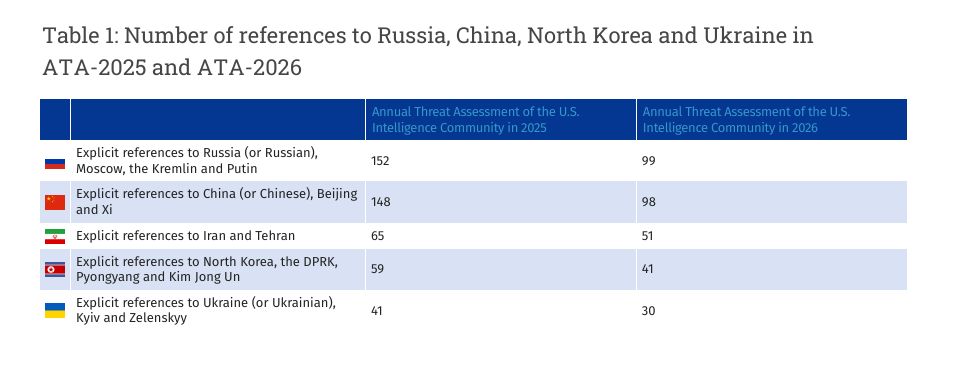
Endnotes
- It should be noted that references to all four of these countries declined notably in the 2026 document compared to its 2025 predecessor: Russia from 152 to 99 mentions, China from 148 to 98, Iran from 65 to 51, and North Korea from 59 to 41.
- In contrast, a number of earlier forecasts, which I catalogued last year, predict a conflict between Russia and NATO within a decade, with 2027–2028 the most frequently forecast years for when Russia would attack, and 2030 the most frequently forecast year for when Russia would be capable of such an attack.
- In the period of March 10–17, 2026, the Ukrainian Defense Forces pushed back the adversary near Berezove, according to DeepState, a Ukrainian OSINT group associated with the country’s MoD. The same period saw Russian forces advance near Bessalivka, Stupochky, Udachne, in Berestok, near Fedorivka Druha, Yablunivka, Horikhove, Pishchane, Makiivka, Zahirne, Myrne, near Orikhovo-Vasylivka, Minkivka, in Vasyukivka, Fedorivka Druha and Kleban-Byk, according to DeepState. In addition, according to a Reuters report on March 16, chief of Russian General Staff Valery Gerasimov has claimed this week that Russia has taken control of 12 settlements in Ukraine in the first two weeks of March as part of advances along the front line in eastern and southern Ukraine. In contrast, Ukrainian leadership has claimed Ukrainian forces have recaptured 400 square kilometers (154 square miles) in the southern Zaporizhzhia Oblast in recent weeks, Reuters reported March 16.
The cutoff for reports summarized in this product was 10:00 am East Coast time on the day it was distributed.
AI was used in production of this digest.
*Here and elsewhere, the italicized text indicates comments by RM staff and associates. These comments do not constitute an RM editorial policy.
Slider photo by Tasnim News Agency.