
Russia in Review, Feb. 27–March 6, 2026
5 Things to Know
- “Russia is one of the biggest winners in the early days of the largest U.S. military confrontation in decades, as Iranian missiles deplete stocks of Patriot interceptors that Ukraine needs for its defense,” WSJ reports. “For us, this is a matter of life,” Volodymyr Zelenskyy said of the interceptors. Meanwhile, the U.S. and at least one Gulf government are now seeking Ukrainian-made interceptor drones and Ukrainian drone-interceptor teams to help defend against Iran’s mass Shahed attacks, which cost about $20,000–$50,000 each, as stocks of expensive Patriot interceptors—at roughly $3 million apiece—run low, according to FT. Zelenskyy has responded to such inquiries by offering to send these teams and drones to Gulf states on the condition that any deal both secures additional Patriot systems and interceptors for Ukraine and does not weaken Ukraine’s own air defenses. While willing to consider assistance to Gulf states in the drone sphere, Zelenskyy openly fears that a prolonged Middle East war will force the U.S. and Europe to divert Patriot interceptor missiles away from Ukraine as Russia continues launching large numbers of cheap, Iranian-designed Shahed drones at Ukraine.
- Russia is sharing information on the location of U.S. military forces in the Middle East with Iran, according to U.S. officials, WSJ reports. The information shared includes locations of U.S. warships and aircraft, according to WSJ, although “the classified U.S. intelligence finding doesn’t show that Russia is sharing locations with Iran explicitly for targeting purposes, but that would be a reasonable conclusion for why Russia is doing it, one of the officials said,” according to WSJ. Earlier this week, it appeared that Russian leadership was continuing to sit on the fence regarding the U.S.-Israeli war against Iran, condemning the deadly strikes against Iran and calling for a diplomatic resolution of the conflict. Moscow condemned the strikes as “unprovoked aggression” and a grave breach of international law, casting itself as defender of national sovereignty and regional stability. Vladimir Putin sent condolences to President Masoud Pezeshkian over Ayatollah Ali Khamenei’s assassination, praising him as an “outstanding statesman” and pillar of the Russia–Iran partnership, while Foreign Minister Sergei Lavrov coordinated closely with Iran, China, Qatar, the UAE and others, promising to use Russia’s U.N. Security Council seat to push for a settlement and an immediate halt to hostilities, which forced Russia to halt work at the Bushehr NPP, among other costs.At the same time, Moscow is acutely aware of the conflict’s opportunities. The Kremlin sees the U.S. diversion to Iran and higher oil prices as potential, if temporary, advantages for its war in Ukraine.
- RM’s analysis of ISW data for the past four weeks (Feb. 3–March 3, 2026) indicates that Russian forces have gained 46 square miles of Ukraine’s territory (area roughly equivalent to two Manhattan Islands) during that period, nearly a third of the 123 square miles they gained over the previous four-week period (Jan. 6–Feb. 3, 2026). As for the past week of Feb. 24–March 3, 2026, according to ISW data, Russian forces gained 25 square miles. The gain in this period contrasts with the Russian forces’ loss of 33 square miles of Ukrainian territory in the preceding one-week period of Feb. 17–24, 2026, according to ISW.1
- A February 2026 Levada Center survey shows that while most Russians still back the war in Ukraine, support for peace talks has reached a record high—revealing a widening gap between the desire for “peace” and what that peace would entail. While 67% now say peace negotiations should begin, and only 24% want military action to continue—the highest and lowest readings, respectively, since Levada began asking this question in 2022—other polling underscores that many Russians favor talks only on terms Ukrainians are unlikely to accept. For instance, a February 2026 Russian Field survey finds large majorities of Russians deem it “mandatory” for any peace deal that Donbas be recognized as Russian, Ukraine forgo NATO membership and Western sanctions on Russia be lifted, while a January 2026 KIIS poll shows 57% of Ukrainians categorically reject withdrawing troops from Donbas even for Western security guarantees. A separate question in Levada’s February survey finds 57% of Russians consider strikes on Ukraine’s energy infrastructure “rather justified,” versus 20% who say they are unacceptable; opponents mostly cite civilian suffering, while supporters frame the attacks as retaliatory or necessary to weaken Ukraine’s economy and military. See graphs on the Levada poll at the end of the digest.*
- Emmanuel Macron has unveiled a new French doctrine of “forward deterrence,” under which Paris would, for the first time, temporarily deploy elements of its nuclear forces to allied European countries and involve partners more directly in French nuclear planning and exercises. Framed as compatible with NATO and U.S. extended deterrence, the doctrine reflects both Russia’s invasion of Ukraine and European doubts about Washington’s long‑term reliability. Moscow has responded sharply, with Russia’s Foreign Ministry denouncing the move as “extremely destabilizing” and portraying it as part of a broader NATO drive to expand nuclear capabilities under anti‑Russian slogans. Russian officials warn they will treat the combined nuclear forces of the U.S., U.K. and France as a single strategic whole in any future arms‑control talks.
I. U.S. and Russian priorities for the bilateral agenda
Nuclear security and safety:
- Russia’s state nuclear agency Rosatom has warned that Iran’s Russian‑built Bushehr nuclear power plant is at growing risk as nearby fighting intensifies. Rosatom chief Alexey Likhachev said explosions are audible just kilometers from the plant’s protective perimeter and that “the threat is clearly growing as the conflict escalates,” according to the Wall Street Journal. He said Rosatom plans to evacuate up to 200 employees after already pulling out about 100 non‑essential staff, leaving roughly 600–700 Russian specialists still on site. Meduza reports that Likhachev also claimed Rosatom has lost all contact with Iran’s nuclear industry leadership amid the Middle East hostilities and cannot fully assess their condition or the damage to facilities, despite IAEA imagery showing strikes on Iranian nuclear sites. Work at Bushehr has been fully halted, Likhachev said, while insisting the plant remains a priority and warning that a strike could trigger a regional catastrophe. (Meduza, 03.03.26, Wall Street Journal, 03.02.26, Wall Street Journal, 03.02.26)
- The IAEA Board of Governors adopted a resolution condemning the direct nuclear‑safety risks created by Russia’s strikes on Ukraine’s power infrastructure, but the United States voted against it, arguing the text was an “unnecessary resolution” that could harm peace efforts. Ukrainian Foreign Minister Andrii Sybiha called attacks on substations powering nuclear sites a deliberate attempt to raise the risk of a blackout and a nuclear incident, describing Russia’s actions as “nuclear terrorism.” (Korrespondent.net, 03.05.26)
- Globally, states reported about 379 tons of civilian plutonium as of Dec. 31, 2024, of which only about 146 tons are under IAEA or Euratom safeguards. Japan declared 44.4 tons of separated plutonium (8.6 tons in Japan and 35.8 tons abroad, mostly in the U.K. and France). The United States declared 49.4 tons of separated plutonium, including 4.6 tons in MOX fuel and 44.8 tons “held elsewhere,” with 5.3 tons reported as disposed as waste. Russia reported 66.1 tons of civilian separated plutonium, up from 64.9 tons in 2023. China has not submitted INFCIRC/549 civilian plutonium reports since 2016, when it declared 40.9 kg of separated plutonium. (IPFM, 03.02.26)
North Korea’s nuclear and missile programs:
- No significant developments.
Iran and its nuclear program:
Saturday, Feb. 28, 2026
- Dmitry Medvedev, Russian Security Council Deputy Chairperson, said: “The peacemaker has once again shown his true face. All the negotiations with Iran are just a cover operation. No one ever doubted that. No one really wanted to agree on anything in particular. The question is who has more patience to wait for the inglorious end of their enemy.” (Medvedev’s Telegram account, 02.28.26)
- The Russian Foreign Ministry said: “This is a deliberate, premeditated, and unprovoked act of armed aggression against a sovereign and independent U.N. member state, in direct violation of the fundamental principles and norms of international law...The aggressors’ intentions are evident and have been stated openly said: to dismantle the constitutional order and remove the leadership of a state they deem undesirable because it has refused to yield to the dictates of force and hegemonic pressure. Responsibility for the impact of this man-made crisis, including the unpredictable chain reaction and the spiral of escalating violence, rests entirely with them.... We call for an immediate return to a political and diplomatic track.” (Russian Foreign Ministry, 02.28.26)
- Sergei Lavrov, foreign minister of Russia, on Feb. 28 told his Iranian counterpart, Abbas Araghchi, that Moscow would work to help bring a swift and peaceful end to U.S. and Israeli airstrikes on Iran, the Russian Foreign Ministry said. Lavrov didn’t provide details but said Moscow could use its seat in the United Nations Security Council to “facilitate a search for a peaceful solution.” The Iranian foreign minister, who initiated the phone call, said Tehran was grateful for Moscow’s “unwavering and firm support.” (Wall Street Journal, 02.28.26)
- Lavrov told UAE Foreign Minister Abdullah bin Zayed in a Feb. 28 call that U.S.‑Israeli strikes on Iran were an “unprovoked aggression” and “unacceptable.” Both ministers called the escalation “destabilizing” and a threat to Gulf Arab security, and agreed on the “need for an immediate cessation of all hostilities” and a return to a political‑diplomatic track that takes into account the “legitimate interests of all regional states.” (Russian Foreign Ministry, 03.01.26)
- Lavrov and Qatar’s prime minister/foreign minister Mohammed Al Thani discussed the Iran crisis and “unanimously called for ceasing any hostilities” that risk destabilizing the region. They urged an urgent return to diplomacy among the U.S., Israel and Iran “on the basis of the U.N. Charter and the Nuclear Non‑Proliferation Treaty,” with full regard for Gulf Arab interests; Lavrov also reiterated Russia’s proposal for a collective security architecture in the Gulf. (Russian Foreign Ministry, 02.28.26)
- Leonid Slutsky, Russian State Duma International Affairs Committee Chairperson criticized U.S. aims in striking Iran and called for both the United Nations Security Council (UNSC) and the broader international community to intervene in situation to stop the strike. (ISW, 02.28.26)
- Alexei Chepa, International Affairs Committee First Deputy Head expressed hope that the United States will become preoccupied with the conflict in Iran and “forget” about Ukraine and assessed that the new conflict will likely delay a peace deal in Ukraine. (ISW, 02.28.26)
Sunday, March 1, 2026
- Vladimir Putin, Russian president, expressed condolences to President of the Islamic Republic of Iran Masoud Pezeshkian over the assassination of Supreme Leader of Iran Ali Khamenei and members of his family. Putin said: “Please, accept my deepest condolences on the assassination of Supreme Leader of the Islamic Republic of Iran Seyyed Ali Khamenei and members of his family, committed in cynical violation of all norms of human morality and international law. In our country, Grand Ayatollah Khamenei will be remembered as an outstanding statesman who made an enormous personal contribution to the development of friendly ties between Russia and Iran and to raising them to the level of a comprehensive strategic partnership. Please, convey my most sincere sympathy and support to the family and friends of the Supreme Leader, as well as to the leadership and to the entire people of Iran.” (Kremlin.ru, 03.01.26)
- The Russian Foreign Ministry said: “[The U.S. and Israel] cannot but recognize that they are effectively prompting countries cross the globe, and the Middle East in particular, to pursue ever more grave means of countering emerging threats by plunging the Middle East into the abyss of uncontrolled escalation,” it said. (The Moscow Times, 03.01.26)
- Russia’s Foreign Ministry said Lavrov and Chinese Foreign Minister Wang Yi held a phone call on March 1 in which both “condemned the massive military strikes by the U.S. and Israel on Iranian territory,” calling them “acts of aggression [that] grossly violate norms of international law and the fundamental principles of the U.N. Charter” and destabilize the region. They stressed the “unacceptability of a course aimed at overthrowing legally elected authorities of sovereign states,” urged an immediate halt to hostilities, and backed a “political‑diplomatic settlement” of issues over Iran, pledging to coordinate in the U.N. Security Council, IAEA, SCO, and the “Group of Friends in Defense of the U.N. Charter.” (Russian Foreign Ministry, 03.01.26)
- Fu Cong, China’s ambassador to U.N., blamed the U.S. and Israel for brazen strikes and “causing a sudden escalation of regional tensions.” He said Beijing is saddened by a large number of civilian casualties. U.N. Secretary-General António Guterres opened the meeting by saying, “We are witnessing a grave threat to international peace and security,” in what he called the world’s most volatile region. (Wall Street Journal, 03.01.26)
- Vasily Nebenzya, Russia’s Permanent Representative to the U.N., decried the strikes as a “genuine betrayal of diplomacy” and dismissed Western arguments that Iran was seeking to acquire nuclear weapons as “completely unfounded.” “Despite its willingness to engage in the diplomatic process, Tehran is once again being stabbed in the back,” Nebenzya said at an emergency U.N. Security Council session. (The Moscow Times, 03.01.26)
- ISW notes Moscow’s response to the U.S.–Israeli killing of Iran’s Supreme Leader Ali Khamenei has been limited to rhetorical support. Putin’s condolence message called the strike an “assassination” and praised Khamenei as an “outstanding statesman,” while the Foreign Ministry condemned Washington and Tel Aviv for “hunting” Iran’s leaders and warned of regional destabilization. Lavrov held calls with Gulf and Chinese counterparts, offering coordination at the U.N. and IAEA, but Russia remains constrained by its own war in Ukraine and desire for U.S. concessions. (ISW, 03.01.26)
Monday, March 2, 2026
- Putin has offered to mediate an end to the U.S.‑Israeli war against Iran in a flurry of calls with Gulf leaders. According to Kremlin readouts, Putin told Bahrain’s King Hamad bin Isa Al Khalifa that Moscow was ready to use “all possibilities at hand to actively help stabilize the situation” in the region. Saudi Crown Prince Mohammed bin Salman said Russia could play a “positive, stabilizing role” given its ties with both Tehran and Gulf capitals. Putin also told UAE ruler Mohamed bin Zayed he was prepared to convey Emirati complaints about Iranian attacks directly to Tehran. (Financial Times, 03.02.26)2
- The Kremlin said Putin held four phone calls with Gulf leaders on March 2 as he seeks to position Russia as a mediator in the U.S.‑Israeli war against Iran. According to official readouts, he spoke sequentially with UAE President Mohammed bin Zayed Al Nahyan, Qatar’s Emir Tamim bin Hamad Al Thani, Bahrain’s King Hamad bin Isa Al Khalifa, and Saudi Crown Prince and Prime Minister Mohammed bin Salman Al Saud, discussing the Iran crisis and Russia’s offer to “help stabilize the situation” through diplomacy. (Kremlin.ru, 03.02.26)
- Dmitry Peskov, Putin’s spokesman, said: “We are in constant contact with the leadership of Iran and are discussing the situation surrounding that country.” Peskov expressed “deep disappointment” that Oman-brokered negotiations with U.S. and Iranian officials over Tehran’s nuclear program once again “deteriorated to the point of outright aggression” despite reports of progress having been made between the two countries. (AFP/MT, 03.02.26)
- Dmitry Medvedev, deputy chair of Russia’s Security Council, warned that a nuclear clash between Russia and the West remains a real risk, telling state agency TASS that while a third world war has “formally” not begun, it “will undoubtedly start” if U.S. President Donald Trump continues his “insane course” of regime change and that “any event” could be the trigger. Medvedev said “the U.S. fears Russia and knows the price of a nuclear conflict,” adding that in such a war “Hiroshima and Nagasaki will look like children’s games in a sandbox.” He also predicted Iran will now “with triple energy” seek to build nuclear weapons after Khamenei’s assassination. (TASS, 03.02.26)
- Medvedev said warned that Trump has “committed a gross mistake,” saying that “by his decision he has put all Americans under potential attack,” and stressing that the late ayatollah was “the spiritual father of almost 300 million Shiites. And now he is also a martyr. Draw the rest of the conclusions yourselves. And now there is no doubt that Iran will with triple energy seek to create nuclear weapons.” (TASS, 03.02.26)
- Mikhail Ulyanov, Russia’s Governor to the IAEA Board of Governors said Russia convened the emergency IAEA Board because the “tragic events in Iran are directly related to the Agency’s mandate. Ulyanov insists that “any nuclear installations under no circumstances should become the target of strikes,” reminding members that “attacks on nuclear facilities and threats of such attacks are a violation of international law, the U.N. Charter and the Statutes of the U.N. and the IAEA,” and emphasizes that Russian personnel are still working at the Bushehr nuclear plant, demanding Washington and Tel Aviv “immediately cease military actions and return the situation to the channel of political‑diplomatic settlement” to avoid “catastrophic consequences for the entire Middle East.” (Russian MFA / IAEA Board, 02.03.26.)
Tuesday, March 3, 2026
- Moscow is alarmed by U.S.-Israeli strikes on Iran but largely powerless to help its ally, and instead sees potential advantages for its war in Ukraine. Kremlin officials expect Gulf demand for air-defense missiles to divert scarce systems such as U.S.-made Patriots away from Kyiv, while higher oil prices could ease Russia’s budget strain after months of discounted crude. At the same time, Khamenei’s killing, following Assad’s ouster and Maduro’s capture, underscores the rapid erosion of Russia’s global client network. (Bloomberg, 03.03.26)
- Iran has launched hundreds of explosive drones at Gulf Arab states, damaging U.S. bases and critical infrastructure and exposing serious gaps in regional air defenses, the Wall Street Journal reports. Analysts say Tehran is using mass swarms of Shahed‑type drones, modeled on Russia’s tactics in Ukraine, to overwhelm interception systems, hit ports, airports and oil facilities, and pressure U.S. allies while driving up global energy prices. Experts say Gulf states will need Ukraine‑style multilayered defenses and better intelligence‑sharing to cope with the threat. (Wall Street Journal, 03.01.26)
- The New York Times reports that Iran’s Shahed loitering munitions, built largely from commercial electronics and costing an estimated $20,000–$50,000 each, are forcing the United States and its allies into an unfavorable “money game.” Patriot PAC‑3 interceptors used to shoot them down cost more than $3 million apiece and are produced in limited numbers. (New York Times, 03.05.26)
- Peskov said Putin is “making every effort to bring down tensions, even a little” amid the U.S.-Israeli war against Iran and would relay Gulf leaders’ “deep concern” over Iranian attacks on their countries. He added there was “no clarity” on reported plans for new Russia-Ukraine peace talks with U.S. mediation, and said Abu Dhabi was unlikely to host them “for obvious reasons.” (Financial Times, 03.03.26)
- Ukrainian President Volodymyr Zelenskyy has offered to send Ukraine’s top drone‑interceptor teams to help Gulf states defend against Iranian Shahed attacks if their leaders persuade Putin to accept a short ceasefire in Ukraine. (The Telegraph, 03.03.26, Bloomberg, 03.02.26, MT/AFP, 03.03.26)
- Russian officials are condemning the U.S.‑Israeli operation against Iran while Zelenskyy backs it, calling the strikes on Iranian military assets “a good decision” against a regime seeking nuclear weapons. Zelenskyy reiterated that Ukraine is ready to send drone‑interceptor crews to Middle Eastern states in exchange for Patriot interceptor missiles, stressing that Patriot systems are ill‑suited to stopping mass Shahed attacks but vital for Ukraine’s defense. (ISW, 03.03.26)
Wednesday, March 4, 2026
- Spanish Prime Minister Pedro Sánchez condemned the U.S.–Israeli war in Iran as a “disaster” and a breach of international law, likening it to Russia’s invasion of Ukraine, Israel’s assault on Gaza and the 2003 Iraq war. Reaffirming Spain’s “no to war” stance, he warned that “you cannot respond to illegality with more illegality” and called for dialogue and diplomacy instead. His remarks followed Trump’s threat to “cut off” all trade with Spain after Madrid refused use of joint U.S.–Spanish bases for strikes on Iran. (Financial Times, 03.04.26)
- Russia’s Foreign Ministry estimates about 50,000 Russian tourists are stranded across the Middle East as the Iran war disrupts air travel, with popular destinations such as Dubai, Qatar and Iran affected by mass flight delays and cancellations. Officials say roughly 7,000 Russians have already been evacuated on special and charter flights, while others are urged to monitor official advisories and take precautions as the conflict and associated airspace closures continue. (bne IntelliNews, 03.04.26)
- Russian state television hosts have denounced U.S.-Israeli strikes on Moscow’s ally Iran as “war crimes,” accusing Washington of using diplomacy as cover for military action and warning that similar tactics could one day be deployed against Russia. (MT/AFP, 03.04.26)
Thursday, March 5, 2026
- Russia’s Embassy in Tehran said it has evacuated more than 100 Russian women and children from Iran amid U.S. and Israeli strikes, thanking Iranian authorities for helping them cross into Azerbaijan before a Russian Emergency Situations Ministry plane flew them home. The embassy, which earlier said 45 children were among those evacuated, did not specify how many staff remain but urged Russian citizens to avoid travel to Iran as the conflict escalates. (The Moscow Times, 03.05.26)
- U.S.–Israeli war with Iran is already reshaping the Ukraine conflict, putting U.S.‑brokered Russia‑Ukraine talks on hold and threatening Kyiv’s air‑defense supplies. President Volodymyr Zelenskyy said he fears a prolonged Middle East war will force the U.S. and Europe to divert Patriot systems and interceptor missiles away from Ukraine just as Russia continues launching large Shahed drone swarms—155 were fired overnight March 5. Kyiv is offering to send Ukrainian drone‑defense experts and interceptor drones to Gulf partners in exchange for more Patriots, insisting any assistance must not weaken Ukraine’s own defenses. (New York Times, 03.05.26)
Friday, March 6, 2026
- Russia is sharing location information on U.S. military forces in the Middle East with Iran, which Tehran could be using to guide its missile attacks in the region, according to U.S. officials. It is the strongest indication yet of cooperation between the two nations during the conflict. The classified U.S. intelligence finding doesn’t show that Russia is sharing locations with Iran explicitly for targeting purposes, but that would be a reasonable conclusion for why Russia is doing it, one of the officials said. The types of information being shared include the coordinates of U.S. military ships and aircraft, they said. (Wall Street Journal, 03.06.26)
- One person familiar with the matter said U.S. officials did not believe Russian intelligence was used by Iran in its attack on an American base in Kuwait, which killed six U.S. service members. (Financial Times, 03.06.26)
- Moscow police detained dozens of Iranian nationals who gathered in public to celebrate the killing of Iran’s supreme leader Ayatollah Ali Khamenei during a U.S.-Israeli military operation, the Ostorozhno Novosti news outlet reported March 6. The gathering took place on March 1 outside the Salaryevo metro station in southwestern Moscow. (MT/AFP, 03.06.26)
- Putin spoke by phone with Iranian President Masoud Pezeshkian, the Kremlin reports. The Russian leader expressed his condolences to Pezeshkian over the assassination of Ayatollah Ali Khamenei, his family members, and the civilian casualties, and noted that he is in constant contact with the leaders of the Arab Gulf states. (TASS via Telegram, 03.06.26)
Humanitarian impact of the Ukraine conflict:
Saturday, Feb. 28, 2026
- Western military officials believe that at least two-thirds of Ukraine’s energy production capacity has been destroyed, damaged or occupied by Russia since the autumn. (Times of London, 02.28.26)
Wednesday, March 4, 2026
- Citing U.N. data, Ukrainian Ombudsman Dmytro Lubinets said Russia executed 337 Ukrainian POWs by the end of 2025 and systematically tortured over 95 % of prisoners. (ISW, 03.04.26)
- Ukrainians received the equivalent of more than $8 billion in remittances from abroad in 2025 via official and informal channels, the National Bank reports. Domestic money transfers through payment systems totaled 1.3 trillion hryvnias (about $31.6 billion), roughly the same as in 2024, with an average transfer of 1,206 hryvnias. The largest inflows via payment systems came from the United States (22.4%), Germany (12.4%), Israel (11.1%), the U.K. (10.7%) and Italy (10.5%), led by Western Union, RIA and MoneyGram. (Korrespondent.net, 03.04.26)
- The European Union will ask international partners for additional funding for Ukraine as the war-battered nation risks running out of money in the fifth year of Russia’s full-scale invasion. EU leaders will call “for intensified outreach to third countries to help close the remaining gap of €30 billion ($34.9 billion)” when they gather for a summit meeting in Brussels later this month, according to draft conclusions seen by Bloomberg. The bloc agreed in December to provide Kyiv with €90 billion in loan assistance for this year and next, financed through joint borrowing after several member states balked at tapping frozen Russian central bank assets to underwrite the loan. (Bloomberg, 03.04.26)
Thursday, March 5, 2026
- Russia and Ukraine have conducted a major prisoner exchange, each side returning 200 captured servicemembers, Russia’s Defense Ministry said, noting the swap was mediated by the UAE and the United States. Zelenskyy confirmed the exchange and said 200 Ukrainian families had received word that their relatives were coming home. Russian negotiator Vladimir Medinsky added that, under agreements reached in Geneva, a further exchange of 500 prisoners on each side is planned for March 5–6. (Meduza, 03.05.26)
Friday, March 6, 2026
- Russia and Ukraine completed the final stage of a two-day prison exchange on March 6, with the Defense Ministry in Moscow saying the initiative was made possible with the mediation of the U.S. and UAE. The two countries released 300 POWs each after having both swapped 200 captive soldiers on March 5. (MT/AFP, 03.06.26)
- For military strikes on civilian targets see the next section.
Military and security aspects of the Ukraine conflict and their impacts:
- RM’s analysis of ISW data for the past four weeks (Feb. 3–March 3, 2026) indicates that Russian forces have gained 46 square miles of Ukraine’s territory (area roughly equivalent to two Manhattan Islands) during that period, nearly a third of the 123 square miles they gained over the previous four-week period (Jan. 6–Feb. 3, 2026). As for the past week of Feb. 24–March 3, 2026, according to ISW data, Russian forces gained 25 square miles. The gain in this period contrasts with the Russian forces’ loss of 33 square miles of Ukrainian territory in the preceding one-week period of Feb. 17–24, 2026, according to ISW. (Russia-Ukraine Report Card, 03.04.26)
Friday, Feb. 27, 2026
- On Feb. 27, Ukraine’s DeepState OSINT group reported in its interactive map that the Russian armed forces advanced near Platonivka, Novooleksandrivka, in Riznykivka and Hryshyne. (RM, 03.04.26)
Saturday, Feb. 28, 2026
- On Feb. 28, Ukraine’s DeepState OSINT group reported in its interactive map that the Russian armed forces advanced near Platonivka. (RM, 03.04.26)
Sunday, March 1, 2026
- On March 1, Ukraine’s DeepState OSINT group reported in its interactive map that the Ukranian Defense Forces drove back Russian forces near Zlahoda, Novohryhorivka, Novomykolaivka, Stepove and Ternove. (RM, 03.04.26)
- A Russian strike has killed one man and wounded four in Ukraine's Dnipropetrovsk, the eastern region's military administration head said early on March 1. (MT/AFP, 03.01.26)
- An AFP analysis cited by The Moscow Times says Russia fired 288 missiles at Ukraine in February 2026 in overnight strikes—up about 113% from 135 in January and the highest monthly total since Kyiv began publishing data in early 2023. The previous record was 270 in October 2025. Zelenskyy said that over the three winter months Russia launched “more than 14,670 guided aerial bombs, 738 missiles, and nearly 19,000 attack drones,” mostly Shaheds, as part of a sustained campaign against Ukraine’s energy grid. (The Moscow Times, 03.01.26)
Monday, March 2, 2026
- On March 2, Ukraine’s DeepState OSINT group reported in its interactive map that the Russian armed forces advanced near Markove, Rivne and Hryshyne. (RM, 03.04.26)
- Russian strikes have killed at least eight people in Ukraine including during an attack on a civilian passenger train, Ukrainian authorities said March 2. (MT/AFP, 03.02.26)
- Ukraine’s armed forces say they struck the Sheskharis oil terminal and Novorossiysk naval base in Russia’s Krasnodar region overnight on March 2, sparking a “large-scale fire” at one of Russia’s biggest Black Sea export hubs. The Krasnodar governor reported five wounded and declared a state of emergency. Sheskharis and the nearby Caspian Pipeline Consortium terminal handle a major share of Russian and Kazakh crude; Kyiv previously hit both in November, after which the U.S. reportedly warned Ukraine not to target American-linked interests at the port. (The Moscow Times, 03.02.26)
- Ukraine’s Security Service and Defense Forces say their March 2 drone strike on Russia’s Novorossiysk port critically damaged the frigate Admiral Essen, a carrier of eight Kalibr cruise missiles. A hit to the ship’s central superstructure reportedly set off decoy launchers, disabled the TK‑25 electronic-warfare suite, damaged ZR‑90 Orekh fire-control radars, and likely hit the main Fregat‑M2M search radar. A deck fire burned about 18 hours, and the frigate is now assessed unable to launch Kalibr strikes on Ukraine. (Korrespondent.net, 03.05.26)
Tuesday, March 3, 2026
- On March 3, Ukraine’s DeepState OSINT group reported in its interactive map that the Russian armed forces advanced near Dorozhnyanka. (RM, 03.04.26)
- For the first time in at least two years, Russian forces appear to have lost territory in Ukraine, according to battlefield experts and open-source researchers, as Ukrainian forces eke out small battlefield gains and push back Russian troops. The findings, reported by DeepState, an open-source group with ties to the Ukrainian military, and Black Bird Group, a Finnish research organization, do not appear to signal a wholesale turning of the tides in the Ukraine war. The recaptured land is centered on Kupyansk (Kharkiv) and rural areas in southern Dnipropetrovsk and Zaporizhzhya, especially around Hulyaypole and the Haychur River. According to Black Bird Group, Russia has now lost a total of almost 37 square kilometers since January. (RFE/RL, 03.03.26)3
- Ukrainian drone strikes killed a man in the southwestern Belgorod region, local authorities said late March 2. Belgorod region Gov. Vyacheslav Gladkov said the man died before paramedics could reach him in a village around 10 kilometers (6 miles) from the border with Ukraine. (MT/AFP, 03.03.26)
- A Kremlin insider told ISW that Russia’s presidential administration is planning the September 2026 Duma elections on the assumption the war will still be ongoing, with three scenarios all centered on continued fighting. The “most likely” case foresees current wartime dynamics persisting without “drastic changes,” reinforcing other signs that the Kremlin is hard‑wiring a protracted war into its domestic political agenda while remaining confident it could sell any eventual settlement as a victory. (ISW, 03.03.26)
- Zelenskyy said Russian plans for 2025–2027 envisage seizing the rest of Donetsk and Luhansk, advancing in Zaporizhzhia and Kherson and capturing all of Odesa region, goals ISW calls “wildly unrealistic” given Moscow’s record. The think tank notes Russia has repeatedly missed earlier deadlines to take all of Donetsk and failed in its 2022 drive on Kyiv, yet the high command continues to set overambitious objectives that cost heavy casualties without major gains. (ISW, 03.03.26)
- Russia’s Winter 2025–2026 long‑range campaign against Ukraine’s energy grid and civilians failed to break Ukrainian morale or halt industrial growth, ISW assesses. Zelenskyy said Moscow did not turn the public against the military or make Kyiv uninhabitable, while a Defense Ministry adviser reported the defense industry’s output has increased fiftyfold since 2022 to an estimated $50 billion. Russia is now shifting strikes toward water and logistics, implicitly acknowledging its winter effort fell short. (ISW, 03.03.26)
Wednesday, March 4, 2026
- On March 4, Ukraine’s DeepState OSINT group reported in its interactive map that the Russian armed forces advanced in Hryshyne and Huliaypole. (RM, 03.06.26)
- ISW’s Frederick and Kimberly Kagan argue that “Ukraine is holding its own,” noting that Russian forces now occupy 19.4% of Ukrainian territory, up only 1.5 percentage points from November 2022 after earlier Ukrainian counteroffensives cut Russia’s control from 26.8% to 17.9%. They write that Russia has needed “three and a half years to seize 9,318 square kilometers” while suffering “over 1 million casualties in total,” and say Ukraine has recorded net daily gains more often than losses over the past six months, liberating more land than Russia seized in the last two weeks of February. Russian weekly gains this year are below their highs from last year. Indeed, Ukraine liberated more land than Russian forces seized the last two weeks of February, according to the authors. (Washington Post, 03.04.26) Click on this link to access graphs that accompany this commentary.
- Russian forces attempted twice on March 3 to break through Ukraine’s state border in Kharkiv region toward the villages of Zybyno and Kruhlye, regional governor Oleh Syniehubov said. A spokesperson for the Joint Forces grouping confirmed that Russian assault groups tried to breach defensive lines on the South Slobozhanskyi axis but came under Ukrainian fire and were repelled. (Ukrainska Pravda, 03.04.26)
- A Russian-flagged LNG tanker serving the sanctioned Arctic LNG‑2 project has become the first liquefied natural gas carrier ever lost at sea after explosions and a major fire sank it off Libya, bne IntelliNews reports. Moscow claims the Arctic Metagaz was struck by Ukrainian naval drones, while Kyiv has not commented publicly. The ship was part of Russia’s “shadow fleet” used to move energy exports under Western sanctions, making the loss both a maritime first and a potential blow to Moscow’s sanctions‑busting logistics. (bne IntelliNews, 03.04.26)
- Putin accused Ukraine of carrying out a “terrorist” naval drone attack that sank the sanctioned LNG tanker Arctic Metagaz near Malta, calling it an act of “international terrorism and piracy.” Russia’s Transport Ministry said a Ukrainian drone launched from Libya struck the vessel, which was carrying LNG from Murmansk “in full compliance” with regulations; all 30 crew were rescued. Kyiv has not commented; it has previously targeted Russian oil tankers with sea drones. (The Moscow Times, 03.04.26)
- Sources in Ukraine’s Security Service say a joint SBU–Defense Forces drone attack on Russia’s Novorossiysk port overnight on March 2 hit the naval minesweeper Valentin Pikoul and heavily damaged two anti‑submarine ships, Yeysk and Kasimov. Three Russian sailors were reportedly killed and 14 wounded. The strike also damaged a 30N6E2 S‑300PMU‑2 radar, a Pantsir‑S2 air‑defense system, and six of seven oil-loading berths at the Sheskharis terminal, sparking an overnight fire at one of Russia’s key fuel hubs for forces fighting in Ukraine. (RBC.ua, 03.04.26)
- Russia launched 149 attack drones of various types from multiple directions between the evening of March 3 and the morning of March 4, including about 100 Shaheds, according to Ukraine’s Air Force. Ukrainian aviation, air-defense missile units, electronic warfare and mobile fire groups shot down or suppressed 129 drones over the north, south and east, while 19 drones hit targets at 15 locations and debris fell at one more site; the attack was still ongoing by morning. (RBC.ua, 03.04.26)
- Russian air defenses shot down a Russian Mi-8 military helicopter near the village of Dudki in Rostov region while responding to Ukrainian drones, killing all three crew members, according to the ASTRA Telegram channel and pro-war blogger Fighterbomber. The helicopter crashed onto a farmer’s barn near the Millerovo air base and caught fire; no civilians were hurt. Officials acknowledged no civilian casualties but did not publicly mention the helicopter loss. (Ukrainska Pravda, 03.04.26)
- Ukrainian Commander-in-Chief Oleksandr Syrskyi said more than 700,000 Russian troops are currently deployed against Ukraine and that Moscow aims to expand its invasion force to 800,000 despite heavy personnel and equipment losses. He told his Dutch counterpart that Ukraine has no choice but to keep fighting and destroy the enemy, stressing that the Armed Forces’ most urgent needs are air-defense systems and various types of missile weapons as Russia maintains offensive pressure. (RBC.ua, 03.04.26)
Thursday, March 5, 2026
- On March 5, Ukraine’s DeepState OSINT group reported in its interactive map that the Russian armed forces advanced near Pokrovka. (RM, 03.06.26)
Friday, March 6, 2026
- At least nine people, including three children, were wounded in annexed Crimea after a Ukrainian drone intercepted by Russian air defense systems crashed near a residential building, Kremlin-installed authorities said March 6. Russia’s Defense Ministry said its air defense systems intercepted 68 Ukrainian drones over annexed Crimea, the Black Sea and the Sea of Azov between March 5 night and March 6 morning. (MT/AFP, 03.06.26)
Military aid to Ukraine:
Sunday, March 1, 2026
- The Wall Street Journal reports that four years into the full‑scale invasion, the technology flow between Ukraine and the West has reversed said: European militaries are now buying Ukrainian-designed drones and missiles to modernize against Russia. Under Germany’s “Build With Ukraine” initiative, at least 10 joint plants are planned this year, including a new factory near Munich that will produce 10,000 Linza drones annually using Ukrainian anti‑jamming tech and AI navigation. Berlin has earmarked over €11 billion for Ukraine’s defense in 2026, including up to €2 billion in subsidies for joint production in Ukraine and Germany, as Europe scrambles to catch up in drone warfare while U.S. military aid remains largely frozen under Trump. (Wall Street Journal, 03.01.26)
Tuesday, March 3, 2026
- A protracted war in the Middle East could reduce the availability of air defenses for Ukraine, Zelenskyy said, acknowledging potential ripple effects from the U.S.-led bombing campaign in Iran. Washington has all but stopped providing military aid to Kyiv since Trump returned to the White House last year, but the U.S. continues to sell weapons financed by Ukraine’s allies, mainly from Europe. Zelenskyy said that he had discussed military assistance with German Chancellor Friedrich Merz earlier on March 2 and is set to discuss the issue with other capitals later in the day. Aid tranches from allies are proceeding as usual for now, he said. (Bloomberg, 03.02.26)
Thursday, March 5, 2026
- Russia is one of the biggest winners in the early days of the largest U.S. military confrontation in decades, as Iranian missiles deplete stocks of Patriot interceptors that Ukraine needs for its defense. Iran has fired more than 500 ballistic missiles and 2,000 drones, while Lockheed Martin produced just over 600 PAC‑3 interceptors in 2025, with Ukraine’s air force estimating it needs at least 60 per month to keep pace with Russian ballistic attacks. NATO stockpiles are so strained that Germany has managed to pledge only five missiles so far, even as Russia produces about 80 ballistic missiles monthly and continues daily Shahed drone strikes. (Wall Street Journal, 03.05.26)
- “For us, this is a matter of life,” Zelensky said of the interceptors. Zelenskyy warned that the U.S.–Israeli war with Iran is already affecting Ukraine, putting trilateral U.S.–Russia–Ukraine peace talks on hold and threatening supplies of vital air-defense systems as Patriots and interceptors are diverted to the Middle East. He said Kyiv fears a prolonged conflict could reduce missile deliveries just as Russia continues nightly Shahed attacks—launching 155 drones overnight March 5—while Ukraine offers to send drone-defense experts and interceptor drones to Gulf states in exchange for more Patriot systems. (New York Times, 03.05.26)
- The Financial Times reports that the Pentagon and at least one Gulf government are in talks to buy Ukrainian-made interceptor drones to counter Iranian Shahed attacks, as Patriot missile stocks run low. Ukrainian officials say interest in their cheap, mass‑produced interceptors—costing only a few thousand dollars apiece—is surging, and any exports would be coordinated with Kyiv to ensure they do not undermine Ukraine’s own defense. (Financial Times, 03.05.26)4
- Reuters reports that Ukraine’s F-16 fleet suffered a severe shortage of U.S.-made AIM‑9 Sidewinder missiles for more than three weeks from late November to mid‑December 2025, leaving jets with almost nothing to fire at Russian drones and missiles. Pilots resorted to daytime cannon runs and reusing dud missiles until partners rushed new stocks in December. The episode, which also curtailed NASAMS and RIM‑7 use, underscores Kyiv’s dependence on Western munitions as global demand for air defenses spikes amid the Iran war. (Reuters, 03.05.26)
Friday, March 6, 2026
- Zelenskyy is trying to leverage his nation’s war savvy to keep it on the world’s agenda as the Iran conflict increasingly absorbs the attention of Trump, putting the U.S.-brokered peace talks with Russia on indefinite hold. On March 5, he offered to share his country’s expertise in protecting against explosives-laden Iranian drones, which are swarming the defenses of the U.S. and its Middle East allies. “Our appeal is very simple: we would like to fill our deficit of Patriot missiles and supply a certain number of interceptors,” Zelenskyy told reporters in Kyiv. (Bloomberg, 03.06.26)
- Several European Union states warned at a closed-door meeting in Brussels this week that there is a shortage of interceptors across the world, according to people familiar with the matter. Some of the officials noted that interceptor missiles could become more scarce if the war in the Middle East drags on. The continent has already tapped stockpiles to support Ukraine’s fight against Russia’s aggression, the people said. (Bloomberg, 03.06.26)
Punitive measures related to Russia’s war against Ukraine and their impact globally:
Sunday, March 1, 2026
- Belgian special forces have seized a Russian “shadow fleet” oil tanker in the North Sea in a coordinated sanctions-enforcement operation, Bloomberg reports. Foreign Minister Maxime Prévot said the boarding, conducted with G7, Nordic and Baltic partners and supported by French Navy helicopters, targeted the tanker Ethera, which is being escorted to Zeebrugge for confiscation. French President Emmanuel Macron called it “a major blow” to Russia’s sanctions‑evading fleet, saying Europeans are “determined to cut off the sources of funding for Russia’s war.” Ukraine’s foreign minister urged other partners to follow suit. (Bloomberg, 03.01.26)
Monday, March 2, 2026
- The Financial Times reports the EU is poised for its first use of “secondary” sanctions under anti‑circumvention powers, proposing a ban on exports of dual‑use goods to Kyrgyzstan over alleged re‑exports to Russia’s defense sector. EU documents say Kyrgyz imports of “high‑priority” EU items have risen almost 800% since the 2022 invasion while exports to Russia are up 1,200%, posing a “particularly high risk of circumvention.” Bishkek denies systematic violations, warns country‑level sanctions would be a “severe reputational blow,” and says it is ready to challenge any EU move in court. (Financial Times, 03.02.26)
Tuesday, March 3, 2026
- The Bank of Russia is suing the European Union for putting an indefinite freeze on assets blocked over Putin’s invasion of Ukraine, arguing that it’s being deprived of legal protections in a first challenge of its kind since the war erupted. The claim filed with the EU’s General Court in Luxembourg contests the European Council’s regulation of Dec. 12, 2025, according to a Russian central bank statement published March 3. The EU regulation violates “basic and inalienable rights to access justice, inviolability of property, and the principle of sovereign immunity of States and their central banks” that are guaranteed under international law, according to the statement. (Bloomberg, 03.03.26)
- Russia’s Justice Ministry has designated UC Berkeley and the Russian-American Science Association (RASA) as “undesirable” organizations. (MT/AFP, 03.03.26)
Wednesday, March 4, 2026
- The U.K. has revoked sanctions on British accountant John Michael Ormerod, who was designated last May after he bought at least 25 second-hand tankers that later carried more than 120mn barrels of Russian oil for Lukoil. Ormerod said the measures, which froze his accounts, had a “devastating impact” and publicly urged others to avoid any actions that might support Russia’s energy sector. Officials concluded this statement met the objectives of his designation and delisted him. (Financial Times, 03.04.26)
For sanctions on the energy sector, please see section “Energy exports from CIS” below.
Ukraine-related negotiations:
- A new nationwide survey by the Kyiv International Institute of Sociology finds that 70% of Ukrainians do not believe the current negotiations will lead to lasting peace, while 25% do. Asked whether Ukraine should withdraw its troops from Donbas and accept Russian control there in exchange for U.S. and European security guarantees, 57% “categorically reject” the idea. (KIIS, 02.24.26)
- Russian public opinion is increasingly open to peace yet still backs maximalist war aims, according to new polling by independent firm Russian Field. A nationwide telephone survey of 1,600 respondents conducted Feb. 5–14, 2026 finds 53% now favor transitioning to peace negotiations, while 38% want the “special military operation” to continue (RM; Russian Field). At the same time, 52% believe the war will not end in 2026, and 57% still consider the operation successful for the Russian army, versus 32% who disagree. If Putin signed a peace agreement, 83% say they would support his decision—a record high—while 12% would not; a ceasefire without preconditions would be backed by 56% and opposed by 38%. Majorities name as “mandatory” terms for a peace deal recognition of the occupied “DNR” and “LNR” as Russian territory (75%), Ukraine’s refusal to join NATO (71%) and lifting sanctions (70%), Russian Field reports. (Russian Field, February 2026) Machine-translated.
Saturday, Feb. 28, 2026
- Bloomberg reports that Russian officials increasingly see no point in continuing U.S.-led peace talks unless Kyiv agrees to cede territory, with next week’s round described as decisive. According to people close to the Kremlin, Russia is ready to sign a draft memorandum if Ukraine withdraws from its eastern Donetsk region, to be followed by a Putin–Trump–Zelenskyy summit that would confirm the deal and trigger a mutual pullback of forces. By contrast, Zelenskyy’s chief of staff Kyrylo Budanov told Ukrainian TV that, at the last talks, the Russian side said it would accept U.S.-proposed postwar security guarantees for Ukraine, according to the Times of London and Kyiv Post. Those could include a standing Ukrainian army of about 800,000, Western weapons and training, and a U.K.‑ and France‑led peacekeeping force. The two accounts highlight a striking tension between reported Russian demands for sweeping territorial concessions and apparent openness to a heavily armed, Western‑backed Ukraine. (Bloomberg, 02.28.26, Times of London, 02.28.26, Kyiv Post, 02.28.26)
- Putin has not demonstrated a genuine desire to end the war in Ukraine, Latvia’s top diplomat said, arguing that only sustained military and economic pressure will compel Moscow to negotiate seriously. “We are not seeing that,” Foreign Minister Baiba Braze told RFE/RL in an interview when asked whether Putin was serious about peace. (RFE/RL, 02.28.26)
Monday, March 2, 2026
- Russia and Ukraine still expect planned U.S.-led peace talks to take place this week, even as Trump’s administration continues a military campaign against Iran. With airspace in the United Arab Emirates currently closed amid the risk of missile and drone attacks, the talks are unlikely to take place in Abu Dhabi, according to a person in Moscow with knowledge of the situation. Istanbul is one possible alternative venue. Zelenskyy told reporters March 2 that talks he said were planned for around March 5-6 in Abu Dhabi haven’t yet been canceled. Turkey and Switzerland could be alternative locations, he said. (Bloomberg, 03.02.26)
- Kremlin spokesman Dmitry Peskov said Moscow remains interested in Trump‑brokered talks on ending the war in Ukraine, praising U.S. mediation by Steve Witkoff and Jared Kushner and insisting “it’s in our interests to continue these negotiations.” His comments follow reports that some Kremlin officials are threatening to quit the process if Zelenskyy continues to reject ceding Donbas territory as part of a deal. (The Moscow Times, 03.02.26)
- Zelenskyy noted Western partners have not yet reduced deliveries of key air-defense missiles, such as Patriot systems, but warned volumes could fall if fighting around Iran continues. Zelenskyy said Russia’s winter campaign failed to destroy Ukraine’s power grid but is now shifting to target water and transport infrastructure. (Washington Post, 03.02.26)
Tuesday, March 3, 2026
- The latest Levada Center poll shows Russian opinion tilting toward talks while still backing the war and its methods. A record 67% now say it is necessary to move to peace negotiations—up 6 points in a month—while just 24% want to continue military action, the lowest share since the invasion began. Yet 72% still support the actions of the Russian armed forces in Ukraine (40% “definitely,” 32% “rather”), versus 17% opposed. More than half of respondents (57%) say Russian strikes on Ukraine’s energy infrastructure are “rather justified,” and only 20% call them unacceptable; justifiers most often describe them as “retaliatory” or needed to weaken Ukraine’s economy and military potential, while opponents emphasize civilian suffering and damaged hospitals, schools, and homes. At the same time, attention to the war has dropped to a post‑2022 low: only 44% follow events closely, and 21% say they do not follow them at all. (Levada, 03.03.26) See tables at the end of the digest.
Wednesday, March 4, 2026
- U.S.-brokered peace talks between Kyiv and Moscow initially planned for this week are postponed indefinitely due to the war in Iran, according to Zelenskyy. “For now, because of the situation with Iran, the necessary signals for a trilateral meeting haven’t come yet,” Zelenskyy said in his regular address to the nation late March 4. (Bloomberg, 03.05.26)
Thursday, March 5, 2026
- Trump said Zelenskyy is obstructing a peace deal with Russia and rapidly losing bargaining leverage, insisting “Zelenskyy has to get to work and make a deal” and calling it “unbelievable that he is the obstacle.” In an interview with Politico, Trump again blamed Zelenskyy for the lack of progress in U.S.‑mediated talks, saying the Ukrainian leader “is not showing enough readiness for negotiations” and now has “even fewer cards.” Trump claimed the Kremlin is ready for dialogue, while also outlining plans to shape Iran’s post‑war leadership, predicting the fall of Cuba’s communist government and attacking AI startup Anthropic over access for the Pentagon. He also criticized the previous Biden administration for supplying free ammunition to Ukraine instead of selling it to Middle Eastern states. (RBC.ua, 03.05.26, Ukrainska Pravda, 03.05.26)
- Zelenskyy noted that “necessary signals” for a trilateral meeting with U.S. mediation have not arrived, though Kyiv remains ready to resume once security and political conditions allow. As part of earlier Geneva understandings, Russia announced two prisoner swaps this week totaling 500 captives per side. (Bloomberg, 03.05.26)
- EU foreign policy chief Kaja Kallas said the bloc could be open to direct talks with Moscow on ending the war in Ukraine but only if Russia scales back its “maximalist demands.” She has circulated a paper urging caps on Russian forces to match any cap on Ukraine’s, withdrawal of Russian troops from other post‑Soviet states, and competitive elections in Russia, arguing that unrealistic Russian demands must be matched by ambitious European conditions. (RFE/RL, 03.05.26)
- Lavrov said Moscow still regards the “understandings of Anchorage” with the U.S. as the baseline for a Ukraine peace deal but warned that the “spirit of Anchorage is evaporating.” He described the Anchorage summit atmosphere as “comradely, respectful and constructive,” yet noted growing strains, even as he stressed there has been “some progress” in the trilateral talks in Abu Dhabi and Geneva and that Russia is ready to continue contacts. (Meduza, 03.05.26)
Great Power rivalry/new Cold War/NATO-Russia relations:
Thursday, March 5, 2026
- Russia will host a national pavilion at the 2026 Venice Biennale for the first time since its full-scale invasion of Ukraine, signaling Moscow’s push to shed pariah status in global culture and sport. The exhibition, “The Tree Is Rooted in the Sky,” will feature at least 38 artists and musicians; Kremlin cultural envoy Mikhail Shvydkoy called it proof Russian culture “is not isolated.” Ukrainian curators criticized the move as information warfare, even as Russian athletes and performers are slowly being readmitted to major international events. (New York Times, 03.05.26)
Friday, March 6, 2026
- As the U.S. weighs economic pressure on Moscow and Tehran, Russia is tightening military cooperation with Iran. The Financial Times and Washington Post say Russia has begun providing Iran with “pretty comprehensive” targeting intelligence on U.S. planes, warships and bases in the Middle East, marking the first direct involvement of a major U.S. adversary in Iran’s war. Moscow, which has signed a strategic partnership and a secret €500 million air‑defense deal with Tehran, is sharing satellite and battlefield data honed in Ukraine even as the Trump administration eases some sanctions so India can buy more Russian oil. (Financial Times, 03.06.26, Washington Post, 03.06.26)
- Putin is determined to keep spending on strengthening Russia’s military despite a weakening economy, according to a Lithuanian intelligence assessment. The country’s growing economic difficulties aren’t enough to force Putin to end the war in Ukraine, where he’s likely still seeking a breakthrough on the battlefield, the Lithuanian National Threat Assessment report said. This determination remains a major source of concern to its neighbors as Moscow continues to add new military units on NATO’s borders even with the ongoing hostilities in Ukraine, it said. (Bloomberg, 03.06.26)
China-Russia : Allied or aligned?
Monday, March 2, 2026
- There’s little sign Tehran can count on Beijing to bolster its defenses. Reports have swirled in recent months of Chinese air defense systems destined for Iran alongside claims China is shipping missile propellant ingredients to the Islamic Republic, although neither side has publicly commented. After Trump’s strike, China’s Foreign Ministry dismissed a separate account that Beijing was poised to arm Iran with supersonic anti-ship missiles as “not true.” So far, there isn’t any evidence from the battlefield that Chinese weapons have been deployed, a contrast with the recent Thai-Cambodia border war and India-Pakistan conflict. President Xi Jinping has limited China’s public support to condemning the U.S. for attacking Tehran, which supplies about 13% of its seaborne crude. (Bloomberg, 03.02.26)
Tuesday, March 3, 2026
- China has responded to the U.S.–Israeli campaign against Iran with sharp criticism but little concrete support, wary of jeopardizing oil supplies through the Strait of Hormuz and its larger economic ties with Gulf states. Beijing signals backing for Iran’s “sovereignty” while positioning itself as a defender of international order and preparing to work with whoever rules Tehran after the war. Analysts say the conflict exposes the limits of China’s partnerships even as it benefits from U.S. military overstretch and gains intelligence on U.S. capabilities. (Wall Street Journal, 03.03.26)
Missile defense:
- No significant developments.
Nuclear arms:
- Russia warned that the U.S.–Israeli war against Iran could spur both Tehran and Arab states to seek nuclear weapons, with Lavrov saying the conflict risks unleashing an uncontrolled proliferation race and producing the very outcome Washington says it wants to avoid. Moscow reiterated it has seen no evidence Iran was developing a bomb, and the Kremlin said Putin will try to relay Gulf leaders’ concerns to Tehran while working to ease regional tensions. (Reuters, 03.03.26)
- The Financial Times reports that French President Emmanuel Macron has unveiled a new French doctrine of “forward deterrence,” offering for the first time to temporarily deploy elements of France’s nuclear forces to allied European countries. In a speech at the Île Longue submarine base, Macron said France has held in‑depth talks with Germany, Poland, the Netherlands, Belgium, Greece, and Sweden, and that joint committees will be formed so partners can participate in French nuclear exercises and host air‑launched components of its deterrent. France’s arsenal is about 300 warheads, deployed on submarines and Rafale jets, and officials say nuclear forces consume roughly 13% of the defense budget. Paris stresses the plan is “perfectly compatible” with NATO and U.S. extended deterrence and that French decision‑making will remain fully independent, but the move is clearly shaped by Russia’s invasion of Ukraine and doubts about Washington’s long‑term role under Trump. (Financial Times, 03.02.26)
- Russia’s Foreign Ministry condemned Macron’s plan to expand France’s nuclear arsenal as “extremely destabilizing,” framing it as part of a broader NATO drive to boost nuclear forces under “anti‑Russia” slogans. The statement attacks U.K. and French moves to build an “autonomous” European deterrent alongside U.S. nuclear sharing, warns Moscow will factor NATO’s overall nuclear capability into any future arms‑control talks, and repeats unsubstantiated claims that London and Paris have considered transferring nuclear elements to Ukraine. (Russian MFA, 03.04.26)
- Finland’s plans to allow nuclear weapons on its territory would force Russia to take countermeasures, the Kremlin warned March 6, casting the proposal as a new threat on its border. Spokesman Dmitry Peskov said Helsinki’s willingness to align with French and German proposals to strengthen NATO and Europe’s nuclear deterrence “leads to an escalation of tensions on the European continent.” “By placing nuclear weapons on its territory, Finland will begin to pose a threat to us. And if Finland threatens us, we will take appropriate measures,” he added. Finnish Defense Minister Antti Hakkanen said March 5 that plans to lift restrictions prohibiting nuclear weapons on its soil would bring the new NATO member in line with the Western military alliance’s deterrence policy. (MT/AFP, 03.06.26)
- Lavrov escalated nuclear rhetoric and anti‑Western messaging by accusing Western elites of being guided by “Epstein instincts” rather than self‑preservation. Speaking on a weekly state TV program, he was asked whether leaders in France and the U.K. had “lost all instincts of self‑preservation” amid unsubstantiated SVR claims that they were covertly discussing giving Ukraine a nuclear weapon. “Their instincts are mostly Epstein‑like, as I understand it, in that society,” Lavrov said, alleging that instincts “concerning the fate of their own states and caring for their own people have clearly been degraded.” His language mirrors pro‑war Russian milbloggers who label the U.S. and Israel an “Epstein coalition” after their strikes on Iran, implying the conflict is a diversion from the Jeffrey Epstein scandal. (The Moscow Times, 03.02.26)
- Several air defense and electronic warfare installations appear to have cropped up around a site in Belarus where Russia may have deployed a nuclear-capable, hypersonic missile system called Oreshnik, recent satellite imagery indicates. An analysis of images captured by Planet Labs on Feb. 17 suggests that six positions that appear to hold equipment designed to protect facilities from aircraft, drones, and missile strikes now ring the former site of the Soviet-era Krychev-6 military airfield near the village of Krychau, close to the Russian border in eastern Belarus. (RFE/RL, 03.04.26)
Counterterrorism:
- No significant developments.
Conflict in Syria:
- No significant developments.
Cyber security/AI:
- Putin warned that it is dangerous for Russian military personnel to use Telegram, even though the messaging app has become a primary communication tool for troops on the front in Ukraine, Meduza reports. The remark underscores ongoing Russian concerns about operational security and leaks from soldiers’ phones amid the widespread battlefield use of civilian apps. (Meduza, 03.05.26)
Energy exports from CIS:
Sunday, March 1, 2026
- Key members of the OPEC+ oil cartel announced a greater-than-expected increase to production quotas on March 1 following U.S. and Israeli strikes on Iran that triggered retaliation by Tehran across the Middle East. The eight-member V8 (Voluntary Eight) group said they had agreed a “production adjustment” of 206,000 barrels per day (bpd). Before the weekend's meeting, experts had forecast a more modest increase of 137,000 barrels per day. (MT/AFP, 03.01.26)
- European states are intensifying enforcement against Russia’s oil “shadow fleet” said: Belgium’s defense minister said special forces, backed by French Navy helicopters, boarded and seized the sanctioned tanker Ethera in the North Sea under Operation Blue Intruder. Ship‑tracking data show the vessel has previously sailed under multiple flags, gone dark on AIS for months, and made at least two trips to Novorossiysk. The seizure, ISW notes, is part of a broader EU‑U.S. drive to cut Russia’s sanctions‑evading export routes. (ISW, 03.01.26)
Tuesday, March 3, 2026
- The EU is pressing Ukraine to grant access to inspect the Druzhba pipeline after Hungary and Slovakia accused Kyiv of exaggerating damage from a January Russian air strike in order to halt Russian oil flows. A senior EU diplomat called Kyiv’s refusal an “own goal,” while a Ukrainian official asked, “Why must we repair the pipeline … which gives oil from Russia to Russia’s friends?” Naftogaz chief Sergii Koretskyi said the strike ignited a tank fire “that took 10 days to extinguish” and damaged key equipment. (FT, 03.03.26)
Wednesday, March 4, 2026
- Putin said his country will consider ending most sales of natural gas to Europe in favor of more promising alternative markets. The European Union plans a gradual ban on imports of both Russian pipeline gas and liquefied natural gas by late 2027. In this light, the Russian leader said he would instruct his government to assess redirecting supplies away from the bloc so that officials could work on the issue with companies. “Other markets are opening now,” Putin said on state television on March 4. “Maybe it’s better for U.S. to end supplies to the European market right now? To go to those markets that are opening now and get a foothold there.” (Bloomberg, 03.04.26)
- China is bracing for major energy disruption as the Iran war threatens the Strait of Hormuz, through which one‑third of its oil and a quarter of its gas imports pass, and cuts off the 13% of its crude that comes from Iran, the Financial Times reports. Analysts say Beijing will lean more heavily on Russia, already its biggest supplier with 20% of imports, while considering tapping its 1.1–1.4bn‑barrel oil reserves and accelerating projects like the Power of Siberia 2 gas pipeline. (Financial Times, 03.04.26)
- The U.S. will exempt the German unit of Rosneft PJSC from sanctions against the Russian oil major indefinitely, according to a person familiar with the matter, marking a win for Berlin after intense diplomatic negotiations. (Bloomberg, 03.04.26)
Thursday, March 5, 2026
- A surge in oil prices driven by the U.S.-Israel war on Iran won’t solve the Kremlin’s budget problem, but it could help Russia replenish rapidly depleting rainy-day reserves. The Finance Ministry plans to lower the level that governs when energy revenue is saved — and when the National Wellbeing Fund is tapped to cover shortfalls. It’s currently set at $59 a barrel but will be decreased soon despite the recent rally in oil. That would steer any additional gains from oil sales toward rebuilding reserves rather than financing spending, which remains elevated due to the full-scale invasion of Ukraine. (Bloomberg, 03.05.26)
- A Russian liquefied natural gas tanker sanctioned by the U.S. halted its journey in the Mediterranean Sea after a nearby ship was allegedly attacked by Ukrainian drone boats. Arctic Pioneer, a Russian-flagged tanker that has been used to ferry fuel from the U.S.-sanctioned Arctic LNG project, has been idling near Egypt’s Port Said since March 3, according to ship-tracking data compiled by Bloomberg. (Bloomberg, 03.05.26)
- The EU is weighing financial and technical support to help Ukraine repair the Druzhba oil facility after a January Russian strike, as Hungary and Slovakia block new sanctions on Moscow and a €90 billion EU loan package until Russian oil flows resume. Volodymyr Zelenskyy said “I wouldn’t restore it… This is Russian oil,” but acknowledged Kyiv may have to relaunch the pipeline if EU leaders cannot bypass Budapest’s veto. Repairs would take one to one-and-a-half months. (Bloomberg, 03.05.26)
- Ahead of an April Trump–Xi summit, Treasury Secretary Scott Bessent is weighing a push for China to cut discounted oil imports from Russia (and eventually Iran) and instead buy more U.S. oil and gas, the Wall Street Journal reports. The proposed trade‑off would be part of a broader package that also seeks increased Chinese purchases of U.S. soybeans and Boeing jets and looser Chinese export controls on rare earths, while Beijing is expected to press for tariff relief and eased U.S. tech export restrictions. (Wall Street Journal, 03.05.26)
Friday, March 6, 2026
- Indian refiners are moving quickly to buy Russian oil, with million of barrels floating in Asian waters offering a quick fix to a Middle East supply crunch after the U.S. relaxed restrictions on the trade. The United States on March 5 temporarily eased sanctions on Moscow to allow Russian oil currently stranded at sea to be delivered and sold to India. More than 10 million barrels of Russian crude have already been bought, according to people with direct knowledge of the deals. Russian barrels already account for tankers idling with more than 30 million barrels in the Indian Ocean. (Bloomberg, 03.06.26, MT/AFP, 03.06.26, New York Times, 03.05.26)
Climate change:
- No significant developments.
U.S.-Russian economic ties:
- No significant developments.
U.S.-Russian relations in general:
- No significant developments.
II. Russia’s domestic policies
Domestic politics, economy and energy:
Friday, Feb. 27, 2026
- A New York Times report says that since December there have been about a dozen major blackouts and central-heating cutoffs across Russia, from Murmansk to the Pacific, leaving hundreds of thousands without power and heat “for days” during an unusually brutal winter. Russia’s construction and utilities minister has admitted that 40% of utilities are in serious disrepair. Putin said Russia needs to spend 4.5 trillion rubles (~$59bn) by 2030 on upgrades—less than half the sum in a 2022 government strategy—yet the 2025 federal budget allocated only 150 billion rubles (<$2bn), of which the Audit Chamber found just one-third was actually disbursed, as war-driven military spending crowds out investment in utilities, health, and education. (New York Times, 02.27.26)
Monday, March 2, 2026
- Russia’s Supreme Court on March 2 designated the Russian Anti-War Committee as a terrorist organization, marking the latest escalation against civic groups opposed to the full-scale invasion of Ukraine. (MT/AFP, 03.02.26)
- A judge in Moscow on March 2 sentenced exiled political commentator Yekaterina Schulmann to one year in prison in absentia after finding her guilty of violating Russia’s “foreign agent” law. (MT/AFP, 03.02.26)
Tuesday, March 3, 2026
- Investigative Committee head Alexander Bastrykin proposed expanding grounds for stripping naturalized Russians of citizenship to include intentional grave and especially grave crimes, arguing that such offenders lose their political and legal connection to the state and damage trust in citizenship. He also called for full confiscation of all assets as a criminal penalty for corruption, saying only tough measures can curb officials’ greed. Bastrykin linked these initiatives to tighter migration control and cited rising crime by foreign citizens and stateless persons in 2025. (Meduza, 03.03.26)
- A St. Petersburg court has banned the LGBTQ+ rights group Coming Out as “extremist,” the first such designation against an LGBTQ+ organization since Russia’s 2023 Supreme Court ruling outlawing the so‑called “international LGBT movement.” (Washington Post, 03.03.26)
Wednesday, March 4, 2026
- Russia’s Finance Ministry said March 4 that it will halt foreign currency and gold purchases and sales in March under its “budget rule,” as it prepares to revise the oil price benchmark used to calculate excess revenue. Under the current rule, revenues earned above $59 per barrel of Urals crude are funneled into Russia’s National Wealth Fund. Shortfalls, meanwhile, are covered by the rainy-day fund. Urals averaged $54.2 in January, contributing to a budget deficit of 1.72 trillion rubles ($22 billion) that month. (MT/AFP, 03.04.26)
- Moscow Mayor Sergei Sobyanin announced a 15% reduction in executive-branch civil servants and managerial staff at some subordinate institutions, citing slower-than-expected budget revenue growth of 2% in the first two months of 2026 versus a planned 6.5%. City authorities will also cut this year’s investment program by 10%, postponing some infrastructure and cultural projects to preserve funding for support to the Defense Ministry, servicemembers and their families. (iStories, 03.04.26)
- An investigation by iStories finds that companies in banker Viktor Grigoryev’s Sphere group, which controls dozens of defense plants, paid 89‑year‑old Tamara Manturova, mother of First Deputy Prime Minister Denis Manturov, about 3.28 billion rubles in 2022–2025 as loan repayments and interest. Sphere and related structures acquired stakes and assets at multiple defense enterprises, including Moscow and regional plants, while Manturov publicly claimed to have left industrial assets when he entered government service, raising clear conflict‑of‑interest concerns. (iStories, 03.04.26)
Thursday, March 5, 2026
- An investigation by RFE/RL’s Systema unit finds recent Kremlin videos of Putin’s meetings with domestic officials were pre‑recorded, using the changing condition of potted plants in his Kremlin office to show the footage predates the claimed March 2–3 dates. The report says such recycling of old video is routine and appears aimed at projecting business‑as‑usual at home as the U.S.–Israeli war on Iran intensifies and Russia’s regional influence erodes. (RFE/RL, 03.05.26)
- Bloomberg reports that the Iran war–driven spike in oil prices is giving Russia only a brief chance to rebuild its fast-depleting National Wellbeing Fund. The Finance Ministry plans to lower the budget “cutoff” oil price from $59 a barrel so extra revenue is saved rather than spent, even as discounts on Urals crude remain steep (about $30.9 a barrel). With liquid reserves already down roughly 60% and 419 billion rubles withdrawn in the first two months of 2026, Moscow faces a choice between cutting spending, raising non‑oil taxes, or heavier borrowing. (Bloomberg, 03.05.26)
Defense and aerospace:
Tuesday, March 3, 2026
- Russia finished repairing a damaged launch pad at the Baikonur Cosmodrome, the country’s only site capable of sending crewed rockets into space. The refurbishment involved the installation of new equipment at the service cabin complex, the nation’s space corporation Roscosmos said in a statement March 3. The site is now being prepared for the March 22 launch of a Progress cargo spacecraft to the International Space Station. “We promised to complete the restoration by the end of winter and met the deadline,” Roscosmos chief Dmitry Bakanov said in the statement. (Bloomberg, 03.03.26)
Wednesday, March 4, 2026
- Documents obtained by iStories show Russia’s Defense Ministry plans to recruit about 78,800 contract soldiers into newly created unmanned systems (drone) troops by the end of 2026. The force is slated to include seven brigades, 15 regiments, 70 battalions, “Rubikon” detachments, heavy UAV companies and ground-robotics units, with 58,000 recruits drawn from students, UAV-course graduates, ex-aviation personnel and trained women. Leaked files also detail a nationwide push in universities and training centers, including occupied Ukrainian territories, to rapidly expand drone-operator training. (iStories, 03.05.26)
- See section Military aspects of the Ukraine conflict and their impacts above.
Security, law-enforcement, justice and emergencies :
- Russia’s Investigative Committee has opened a criminal case against former first deputy defense minister Ruslan Tsalikov, a longtime Sergei Shoigu ally, and placed him under arrest. He is accused of creating a criminal organization that stole budget funds between 2017 and 2024, money laundering, two counts of large-scale bribery, and 12 counts of embezzlement. Tsalikov previously served under Shoigu in the Emergencies Ministry, the Moscow region administration, and the Defense Ministry. (Meduza, 03.05.26)
- A Moscow court has rejected former deputy defense minister Timur Ivanov’s lawsuit seeking to be sent from pretrial detention to fight in Ukraine, ruling that serving at the front to “atone” is a privilege, not an automatic right. Ivanov, already sentenced to 13 years for embezzlement and money laundering and facing additional large‑scale bribery charges, had asked to sign a contract for service in the “special military operation.” The Meshchansky District Court dismissed his claim against the Defense Ministry and Moscow draft office. (Meduza, 03.05.26) Both Ivanov and Tsalikov were Shoigu’s proteges at MoD, when Shoigu was the defense minister.
- Putin has urged Russia’s Interior Ministry to recruit veterans of the country’s war in Ukraine to help address growing personnel shortages in the country’s police force. Interior Minister Vladimir Kolokoltsev said the ministry faced a shortfall of 212,000 officers in 2025. High staff turnover has exacerbated the problem, with 80,000 officers departing last year compared to 58,000 new hires. (MT/AFP, 03.04.26) Some of these veterans are former convicts, including murderers, who had been released from prison on condition that they join combat on the Russian side.
Russia’s prison population has fallen to a historic low, the newly appointed first deputy chief justice of the Supreme Court said March 4, coming after years of the Russian military’s recruitment of convicted criminals to fight in Ukraine. First Deputy Chief Justice Vladimir Davydov said 308,000 people are currently incarcerated nationwide, which would represent a roughly 70% drop from the 1.06 million inmates he said were held in Russian prisons in 2001. Davydov not address the likely significant impact of large-scale prisoner recruitment for the military since the invasion of Ukraine in 2022, when authorities stopped publishing detailed prison statistics. (MT/AFP, 03.04.26)
III. Russia’s relations with other countries
Russia’s external policies, including relations with “far abroad” countries:
Monday, March 2, 2026
- Former shareholders of the dismantled Russian oil giant Yukos won a significant legal victory on March 2 after London’s High Court ruled they may seek to enforce arbitration awards against Russian state assets in Britain, in a long-running dispute now valued at more than $65 billion including interest and penalties. (MT/AFP, 03.02.26)
Tuesday, March 3, 2026
- Putin held a phone call with Hungary’s Prime Minister Viktor Orbán on March 3 to discuss the plight of Hungarians fighting for Ukraine who were taken prisoner by Russia. (MT/AFP, 03.03.26)
Wednesday, March 4, 2026
- Russia plans to release two ethnic Hungarian prisoners of war to Budapest, giving Prime Minister Viktor Orban a helping hand in his campaign ahead of April’s elections. (Bloomberg, 03.04.26)
Friday, March 6, 2026
- A Russian judge has sentenced a Romanian man to 15 years in prison after he was found guilty of spying for Ukraine, court officials said March 5. Prosecutors in the southern Krasnodar region said the man contacted Ukrainian military intelligence in November 2024 and later used a quadcopter to gather information about the location of an air defense system in the resort city of Sochi. Romania’s Foreign Ministry confirmed that one of its citizens had been convicted in Russia. A ministry spokesman, Andrei Tarnea, said Bucharest had been monitoring the case since December 2024. (MT/AFP, 03.06.26)
Ukraine:
Tuesday, March 3, 2026
- Zelenskyy told Italy’s Corriere della Sera that Ukraine’s presidential elections would be held after the end of the war rather than during a temporary ceasefire, and said he was not sure he would run again, depending on Ukrainians’ wishes. After publication, his office clarified that this remark answered a question about his own candidacy, not a change of position on election timing, which remains constrained by martial law. (Meduza, 03.03.26)
- Ukraine’s bid to lock in a fast‑track EU accession date of 2027 as part of any peace settlement is meeting strong resistance from key European capitals, Reuters reports, with France, Germany and others wary of “reverse enlargement” that lets Kyiv join before fully meeting standards. Diplomats cite fears over corruption and public backlash, while the European Commission instead explores gradual integration and limited-benefit membership models; Kyiv’s chief negotiator insists firm timelines are vital to underpin any postwar settlement. (Reuters, 03.03.26)
Wednesday, March 4, 2026
- EU ambassadors are preparing to push back against the European Commission’s “membership-lite” proposal that would let Ukraine join the EU first and gain funding and voting rights later, tied to reform milestones. Diplomats from key capitals, including Paris and Berlin, insist “reverse accession” has “no chance of prevailing” and say the enlargement process must remain merit-based, with full membership only once all criteria are met. The Commission argues a tailored model is needed so Kyiv does not feel abandoned after any peace deal. (Financial Times, 03.04.26)
- Ukrainian investigators uncovered a scheme to steal about 500 tons of fuel worth over 21 million hryvnias that had been allocated to the Armed Forces, according to the State Bureau of Investigation. A Defense Ministry logistics official allegedly inflated fuel needs between 2022 and 2025, fabricated usage and events, and, together with an officer from the General Staff and a unit fuel chief, diverted fuel later sold in bulk in Mykolaiv region. Three suspects face charges of large-scale misappropriation of military property and document forgery, with potential sentences of up to 15 years. (Korrespondent.net, 03.04.26)
- Zelenskyy dismissed the head of Ukraine’s Security Service (SBU) in Zhytomyr region, Volodymyr Kompanichenko, following a corruption scandal over substandard aircraft shelters. Investigators allege an Air Force logistics commander conspired with Kompanichenko to bribe military counterintelligence leaders, using 13 million hryvnias to secure a favorable inspection of protective arched structures built on airfields under a 1.4‑billion‑hryvnia program. Kompanichenko had led the regional SBU since November 2022. (RBC.ua, 03.04.26)
- Former State Border Guard Service chief Serhii Deineko has been mobilized into the Defense Forces and appointed commander of the Luhansk Border Detachment, a spokesman said, adding that his prior dismissal does not bar service under mobilization. The move comes after NABU and SAPO exposed a 2023 bribery scheme in which border officials allegedly took at least 204,000 euros to facilitate cigarette smuggling to the EU using vehicles mimicking diplomatic plates; Deineko is among key suspects. (RBC.ua, 03.04.26)
- Ukrainian law enforcement detained an officer from a military unit in Sumy region on suspicion of stealing and selling weapons. Investigators say he illegally sold one assault rifle for $2,000 in October 2025 and prepared to sell another rifle along with a grenade launcher, ammunition, grenades and fuses before being arrested after receiving a further $2,000. He has been charged with unlawful acquisition, storage and sale of firearms, ammunition and explosives, which carries three to seven years in prison. (Ukrainska Pravda, 03.04.26)
Russia's other post-Soviet neighbors:
Tuesday, March 3, 2026
- Kyrgyzstan is prepared to “challenge” the EU in court if Brussels imposes country-level sanctions over alleged re-exports of dual‑use goods to Russia, first deputy cabinet chair Daniyar Amangeldiev told the FT, warning such a move would “have consequences for our image.” He insisted Bishkek is “working hard to comply” but that “rules for U.S. to follow” have not been clearly set, arguing sanctions should target specific violators, not a “relatively small economy” caught “between a rock and a hard place” over its ties with Moscow. (Financial Times, 03.03.26)
Thursday, March 5, 2026
- A Yekaterinburg court sentenced seven members of the Ural Azerbaijani diaspora to between 10 and 22 years in a strict-regime colony over a series of contract killings and attempted murders of businessmen between 2001 and 2011. Former diaspora head Shahin Shykhlinski received 22 years, while others — mostly members of the Safarov family — were convicted of murder or attempted murder tied to business turf wars and internal power struggles. The case unfolded amid recent tensions between Russia and Azerbaijan. (Meduza, 03.05.26)
IV. Quotable and notable:
- No significant developments.
V. Useful data visualization:
A February 2026 survey by the Levada Center indicates that while a large majority of Russians express support for the actions of the Russian Armed Forces in Ukraine and for its strikes on Ukraine’s energy infrastructure, support for peace negotiations has reached its highest level to date.
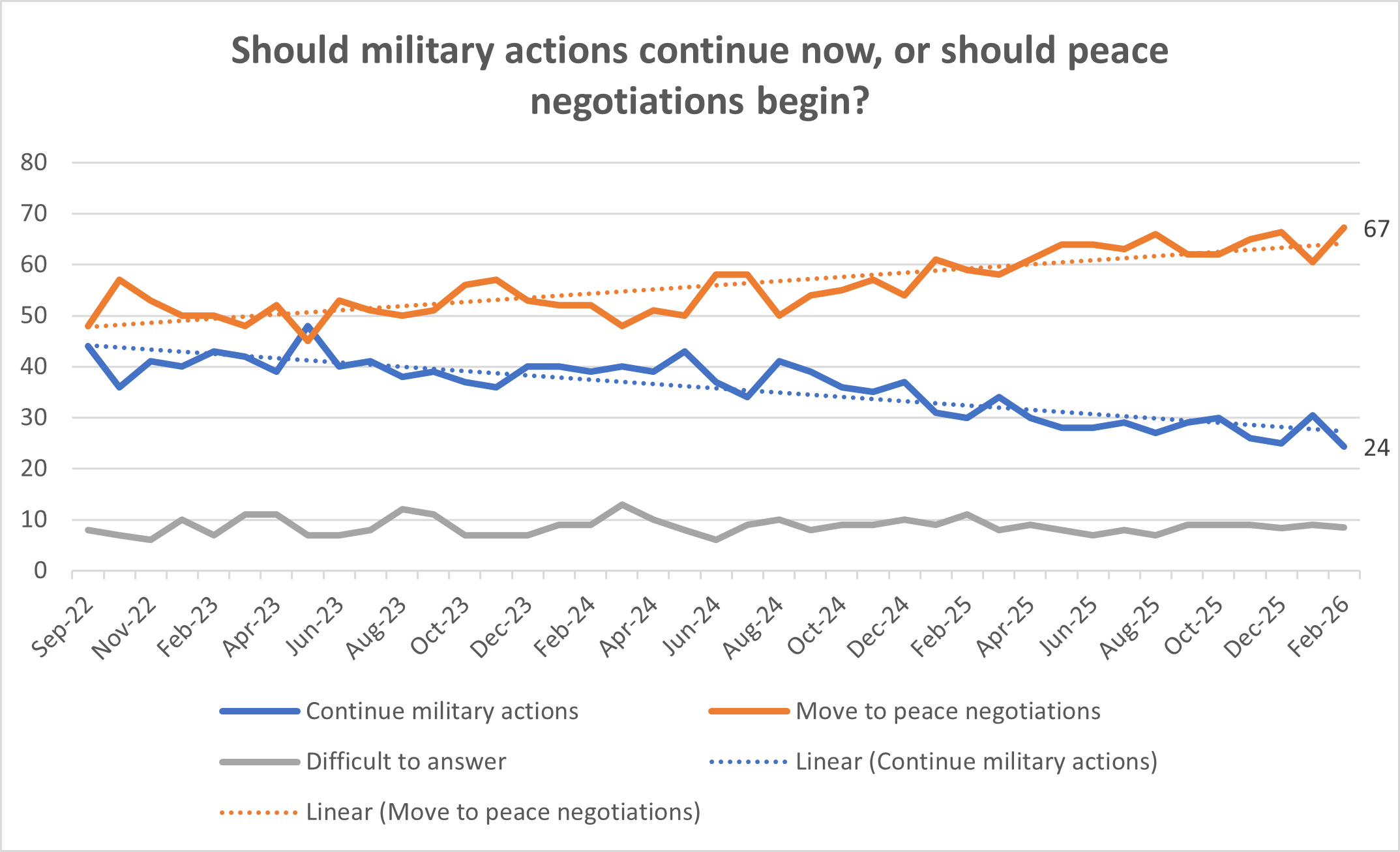
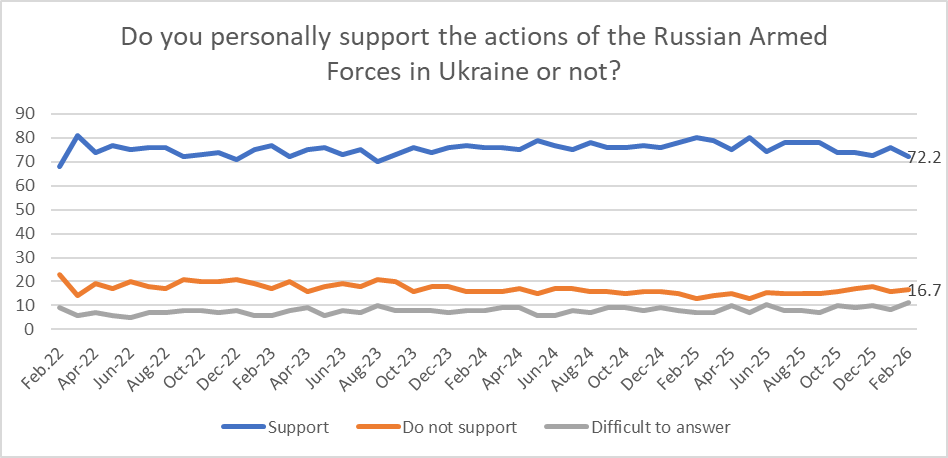
| Recently Russia has carried out strikes on Ukraine’s energy infrastructure (power plants, substations, etc.). Some consider such strikes justified, while others say such strikes are unacceptable. Which of these views do you personally tend to agree with more? | |
| Rather the first (such strikes are justified) | 57 |
| Rather the second (such strikes are unacceptable) | 20 |
| Difficult to say | 23 |
| Why do you think such strikes are unacceptable? | |
| People are killed; civilians suffer; ordinary citizens who have nothing to do with the war are affected | 52.2 |
| Opposed to military actions; no one needs war; peace is needed | 16.6 |
| Hospitals, schools, and kindergartens are left without electricity and heat; people freeze | 13.3 |
| We will have to rebuild later—why destroy? | 6.9 |
| They will lead to trouble; they strike our territory because they give a mirror response | 5.7 |
| Other | 3.2 |
| Difficult to answer | 13 |
| Why do you think such strikes are justified? | |
| They are retaliatory strikes; we did not start this | 32 |
| To damage the economy, stop military production, and weaken Ukraine’s military potential | 15 |
| To bring the conflict closer to an end so the war will finish; to force Ukraine into negotiations | 12 |
| To damage the army, win, and achieve our objectives | 9 |
| They deserve it; so they see Russia’s strength; they are enemies, fascists | 6 |
| War is war; in war all means are acceptable | 5 |
| It is necessary; the military knows better; I trust the leadership | 4 |
| It is better than striking the civilian population | 2 |
| To defend Russia so fewer of our people die | 1 |
| To provoke dissatisfaction inside the country | 1 |
| Other | 6 |
| Difficult to answer | 12 |
Endnotes
- Writing in a commentary for WP this week, ISW’s leadership estimated that “Ukraine liberated more land than Russian forces seized the last two weeks of February.” An accompanying graph in the commentary indicates that Russia lost 15 square miles in the penultimate week of February and some 31-35 square miles in the final week of February. According to Ukraine’s OSINT group DeepState, which is associated with Ukraine’s MoD, Russian forces gained 49 square miles (126 square kilometers) of Ukrainian territory in February 2026, which consisted half of what they gained in January 2026 and the smallest monthly gain since July 2024. DeepState reported that the Ukrainian armed forces drove the Russian forces back near Zlahoda, Novohryhorivka, Novomykolaivka, Stepove and Ternove on March 1. DeepState also reported that the Russian armed forces advanced near Platonivka, Novooleksandrivka, in Riznykivka and Hryshyne on Feb. 27, near Platonivka on Feb. 28, near Markove, Rivne and Hryshyne, on March 2 and near Dorozhnyanka on March 3.
- The Kremlin footage seemed calculated to suggest that while the United States and Israel were bombarding longtime Russian partner country Iran, it was business as usual for Putin. On March 2-3, Putin's administration published videos showing him meeting with officials far removed from international affairs. (RFE/RL, 03.04.26)
- For the first time since summer 2023, Ukrainian forces liberated more territory than they lost in the last two weeks of February 2026, according to ISW, which estimates net gains of about 33 square kilometers between Feb. 14–20 and 57 square kilometers between Feb. 21–27, for roughly 257 square kilometers since Jan. 1 (vs. Zelenskyy’s claim of 460). ISW cautions these localized successes are unlikely to become a large counteroffensive but have disrupted Russian preparations for a spring–summer push. (ISW, 03.03.26)
- Zelenskyy said Ukraine will send “Shahed” drone defense experts to work on the ground in Middle Eastern states facing Iranian attacks, but only in ways that do not weaken Ukraine’s own defenses. He said he has already spoken with leaders of the UAE, Qatar, Jordan and Bahrain, and tasked Foreign Minister Andrii Sybiha, intelligence chiefs and defense officials with drafting support options to help protect civilians and restore safe navigation in the region. (RBC.ua, 03.05.26, Axios, 03.05.26)
The cutoff for reports summarized in this product was 10:00 am East Coast time on the day it was distributed.
AI was used in production of this digest.
*Here and elsewhere, the italicized text indicates comments by RM staff and associates. These comments do not constitute an RM editorial policy.
Slider photo: A plume of smoke rises after a strike in Tehran, Iran, Monday, March 2, 2026. (AP Photo/Mohsen Ganji)