
Russia in Review, Feb. 13–20, 2026
5 Things to Know
- The U.S.-brokered Russia‑Ukraine talks in Geneva on Feb 17–18 produced no public breakthrough on such key issues as control of territories, though the sides did appear to make progress on how a ceasefire would be implemented. Commenting on outcomes of Day 1 of the negotiations Volodymyr Zelenskyy—who, like Vladimir Putin, has yet to negotiate personally with his counterpart—signaled conditional openness to withdraw from the Kyiv-controlled fortified part of Donbas, but only if a demilitarized zone is created and the U.S. first provides at least 20‑year security guarantees and pledges. Zelenskyy told Axios that any peace deal must be approved by referendum and that Ukrainians would “never” forgive a unilateral pullout or being asked to give up additional land. On Day 2 negotiators again explored the idea of setting up a demilitarized zone in Donbas—about 50 miles long and 40 miles wide—as a possible compromise, but no agreement was reported to have been reached. More encouragingly, the negotiating teams’ military officials were reported to have made an incremental but significant progress on how a ceasefire would work, agreeing on key terms and defining what would constitute violations. Switzerland will host this next round of talks in about 10 days, Zelenskyy said on Feb. 20.1
- Every power plant in Ukraine has been damaged by Russian attacks, forcing millions to face heating cuts in the cold, President Volodymyr Zelenskyy told the past Munich Security Conference. "But we still generate electricity," he added defiantly, according to AFP. At one point, about half of the Ukrainian capital’s 12,000 apartment buildings lost heating, according to FT. While damaging Ukraine’s energy and other infrastructure, Moscow's attacks are also inflicting a growing toll on Ukrainians themselves. In 2025, Russia killed more than 2,500 Ukrainian civilians, more than in any year since 2022 and a 20% increase from 2024, according to UN statistics cited by NYT. ''It's basically impossible to live,'' 18-year old resident of Kyiv Yuliia Baliosa told this newspaper. Daily numbers of one‑way attack drones launched by Russia at Ukraine jumped to from 142 a day in January to 190 per day in February, according to UK Defense Intelligence.
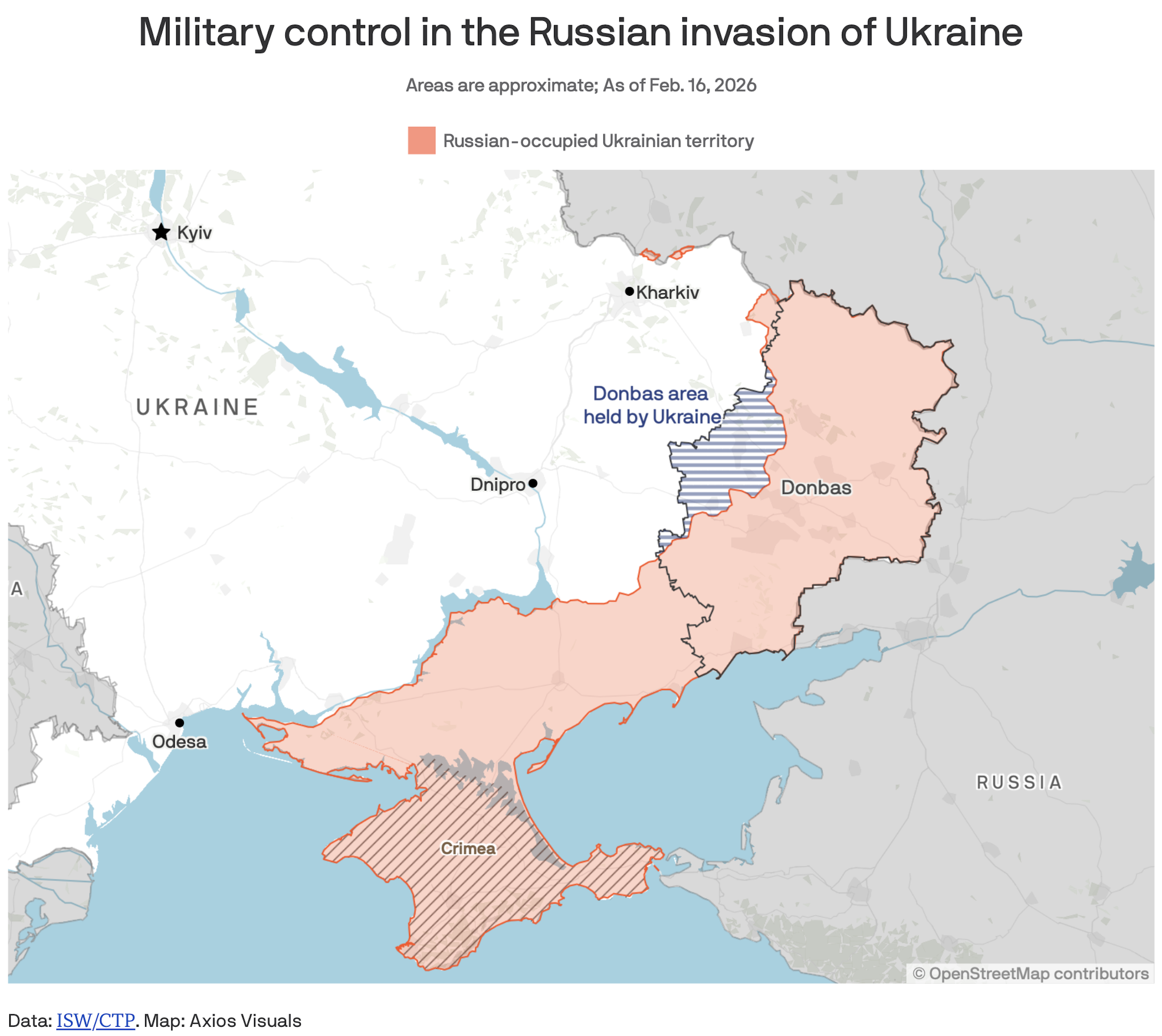
- RM’s analysis of ISW data for the past four weeks (Jan. 20–Feb. 17, 2026) indicates that Russian forces have gained 127 square miles of Ukraine’s territory (area slightly larger than Martha’s Vineyard) during that period, an increase over the 63 square miles it gained over the previous four-week period (Dec. 23, 2025–Jan. 20, 2026). More recently, Russian forces actually lost 19 square miles in the period of Feb. 10–17, 2026, according to ISW data. As this organization said on Feb. 15, “recent Ukrainian tactical counterattacks have reportedly liberated multiple small settlements along the Yanchur and Haichur rivers in the Oleksandrivka and Hulyaipole directions” in the southern oblast of Zaporizhzhia. According to a site that publishes data by Ukraine’s DeepState OSINT group, however, Russian forces actually gained 6.6 square miles in the period of Feb. 10–17, 2026. Although DeepState did say in its updates that Ukrainian forces cleared “enemy infiltration” near Bilytske, Prymorske and Lukianivske in the period of Feb. 10–17, 2026, this OSINT group also reported that Russian forces occupied Bondarne on Feb. 10 and Rivne on Feb. 15. More recently, Ukrainian president Volodymyr Zelensky said on Feb. 20 that his army liberated 300 square kilometers in the south.
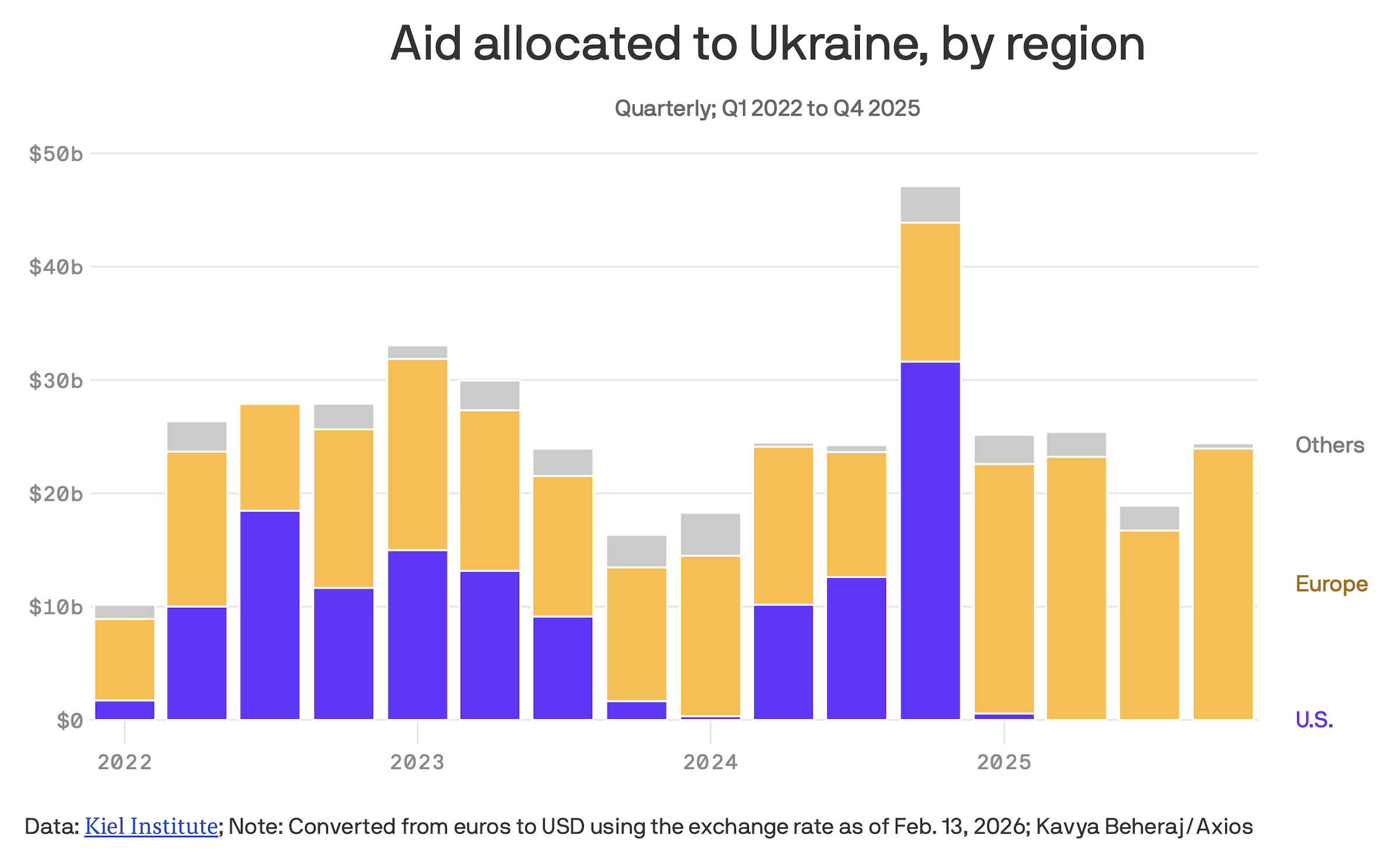
- Germany’s Kiel Institute estimates that U.S. military aid to Ukraine fell by 99% in 2025 as Europe replaced the United States as the engine of Ukraine’s survival, according to WSJ and Axios. Kiel data show that from 2022 to 2025, countries provided $10–50 billion in aid to Ukraine each quarter, with the U.S. supplying about a third of all aid before 2025 but “little to no aid” afterward, Axios reports. The WSJ says European military aid rose 67% in 2025 versus the 2022–24 average, while European financial and humanitarian support increased 59%. Non‑U.S. NATO members bought more than $4.3 billion in American weapons for Kyiv, and the EU approved a nearly $107 billion loan that Ukraine can also use for defense, the WSJ notes.
- In an article entitled “How big is the prize of reopening Russia?” The Economist reports that Kremlin envoys have dangled a fantastical “$12trn” package of deals to the Trump administration in return for sanctions relief, a figure “equivalent to six times Russia’s annual economic output” and designed to sell “the Greatest Deal.” In reality, pre‑war EU exports to Russia were just “€90 billion ($106 billion)” a year, while Russia’s entire economy is “$2.2 trillion—less than Italy’s,” and foreign firms’ total 2021 profits were only “$18 billion” on “around $300 billion” in revenues, according to the Economist. Even the “treasure trove of Arctic and northern resources” is uncertain: West Siberia may hold “12 billion barrels” of shale oil, the Arctic “nearly 50 billion exploitable barrels” if prices stay near “$100,” and Russia’s far north an estimated “29m tons of rare earths,” but projects like Rosneft’s $160 billion Vostok Oil face sanctions, legal tangles and huge infrastructure costs, according to the Economist. With 23,000 Western sanctions in place, corrupt courts, capital controls risk and the danger that a bad peace would pave the way for “the next war,” The Economist concludes the $12 trillion promise is a trap, not a windfall. There are various ways to measure GDP of countries. If measured at market exchange rates, Russia’s GDP would be, indeed, smaller than Italy’s. However, if measured in constant international dollars, PPP, Russia’s economy would be larger than Italy’s, ranking No. 5 in the world in 2024, which is the latest year WB has data for.
Table 1: GDP, constant 2015 US$, trillion (source: World Bank)
| 22.57 tn |
| 18.49 tn |
| 4.61 tn |
| 3.68 tn |
| 3.48 tn |
| 3.32 tn |
| 2.72 tn |
| 2.03 tn |
| 2.03 tn |
| 1.92 tn |
| 1.83 tn |
| 1.67 tn |
| 1.61 tn |
Table 2: GDP, PPP constant 2021 international $, trillion (source: World Bank)
| 33.60 tn |
| 25.67 tn |
| 14.25 tn |
| 6.09 tn |
| 5.72 tn |
| 5.22 tn |
| 4.17 tn |
| 4.10 tn |
| 3.76 tn |
| 3.64 tn |
| 3.14 tn |
|
|
I. U.S. and Russian priorities for the bilateral agenda
Nuclear security and safety:
- Volodymyr Zelenskyy said he instructed Ukraine’s negotiators in Geneva to raise the future of the Russian‑occupied Zaporizhzhia Nuclear Power Plant and discuss “monitoring of any ceasefire” and Moscow’s territorial demands. (Bloomberg, 02.17.26)
North Korea’s nuclear and missile programs:
- North Korea’s state media said a new Pyongyang street, Saebar (“New Star”), has been opened for families of soldiers killed in the “overseas military operation” in Russia’s Kursk region, with Kim Jong Un presiding over the ribbon‑cutting. South Korean intelligence estimates around 600 North Korean troops have been killed and about 4,100 wounded in Russia’s war on Ukraine. (Mediazona, 02.16.26)
Iran and its nuclear program:
- Russian Foreign Minister Sergei Lavrov warned that any new U.S. strike on Iran would have “serious consequences” and urged restraint to find a solution that lets Tehran pursue a “peaceful nuclear program,” in an interview with Saudi Arabia’s Al-Arabiya TV. His comments came a day after U.S. and Iranian negotiators held indirect talks in Geneva to defuse a mounting crisis. (Reuters, 02.19.26)
- The Iranian and Russian navies have been conducting joint drills in the Sea of Oman and northern Indian Ocean as Washington issues new threats against Tehran. “Iran would be very wise to make a deal,” White House Press Secretary Karoline Leavitt said after U.S.-Iran nuclear talks in Geneva ended without a breakthrough. The U.S. is sending a second aircraft carrier to the region as part of its military buildup. (RFE/RL, 02.19.26)
Humanitarian impact of the Ukraine conflict:
Saturday, Feb. 14, 2026
- Every power plant in Ukraine has been damaged by Russian attacks, forcing millions to face heating cuts in the cold, President Volodymyr Zelenskyy told the Munich Security Conference Saturday, calling Russia's Vladimir Putin a "slave to war." "There is not a single power plant left in Ukraine that has not been damaged by Russian attacks," Zelenskyy said. "Not one." "But we still generate electricity," he added defiantly, praising the thousands of workers repairing the plants. (AFP via Barron’s, 02.13.26)
Sunday, Feb. 15, 2026
- Kyiv’s 3.5 million residents are enduring their harshest winter since 2022, with temperatures plunging below –20°C as Russia repeatedly targets the city’s three main power plants and other energy sites. At one point, about half of the capital’s 12,000 apartment buildings lost heating; some 1,200 remained disconnected earlier this week. Authorities have opened around 1,500 “invincibility centers” with heat, power and Starlink access, yet Ukraine still faces a nationwide electricity deficit. Kyiv Mayor Vitali Klitschko, whom over 50% of respondents recently said they do not trust, says prosecutors have opened about 1,600 cases against him, with only two verdicts so far. (Financial Times, 02.14.26)
Tuesday, Feb. 17, 2026
- Ukrainian President Volodymyr Zelenskyy said Tuesday that 2,000 Ukrainian children had been brought back from Russia and Russian-occupied land since the start of the war, but that thousands more remained "captive." (MT/AFP, 02.17.26)
- By most measures, the war has grown worse for Ukrainians since Mr. Trump returned to the White House, not better. More civilians were killed and injured in 2025 than in the previous year. More missiles and drones are hitting city centers. Russia captured more territory in its slow-moving advances in 2025 than in any year since 2022, when it launched its full-scale invasion. Moscow has practically destroyed Ukraine’s power grid during the country’s harshest winter in more than a decade. (New York Times, 02.17.26)
- Moscow's attacks inflicted a growing toll on Ukrainians. In 2025, Russia killed more than 2,500 Ukrainian civilians, more than in any year since 2022 and a 20% increase from 2024, according to United Nations statistics. Russia sent more than 53,000 long-range drones to civilian targets in Ukraine in 2025, almost five times as many as in 2024. (New York Times, 02.17.26)
- Many businesses have struggled this winter, including a cafe that once had the name Trump Pizza Station. The owner changed the name after Mr. Trump berated Mr. Zelenskyy at the White House almost a year ago, settling on the new name Nolan. Yuliia Baliosa, 18, a bartender there, said that customers had stopped coming because they were no longer going to nearby offices or to the local university. The generator was expensive. On a recent weekday, the Nolan cafe was out of most food during lunch hours: no pizza, no burgers, nothing hot. ''It's basically impossible to live,'' Ms. Baliosa said. ''Just live, really. People have become very angry. Very.'' (New York Times, 02.17.26)
- Millions of Ukrainians are enduring one of the coldest winters in recent memory without reliable electricity and heating as waves of Russian missile and drone attacks have devastated energy infrastructure. Tens of thousands of Russians living along the country’s western edge are facing similar hardships now, as cross-border strikes damage essential utilities, forcing authorities to adopt emergency measures. Belgorod, a regional capital about 40 kilometers from Ukraine, has become the most visible illustration of the growing domestic cost of the Kremlin’s war. The city of about 322,000 people is grappling with extensive damage to its energy network following Ukrainian missile attacks, with the destruction severe enough to leave residents without hot water potentially for months. (Bloomberg, 02.17.26)
Wednesday, Feb. 18, 2026
- The FT cites UN data showing that total civilian casualties in Ukraine in 2025 reached at least 2,514 killed and 12,142 injured—a 31% increase in casualties versus 2024 and 70% higher than in 2023—as Russia intensified missile and drone attacks on energy infrastructure during the harshest winter in more than a decade. (Financial Times, 02.18.26)
Thursday, Feb. 19, 2026
- An investigation by Current Time’s “Systema” and RFE/RL’s “Schemes” found that Russian Major General Roman Demurchiev, now deputy commander of Russia’s 20th Combined Arms Army, boasted in private messages about torture, executions, and mutilation of Ukrainian prisoners of war, including cutting off ears. Reporters reviewed his 2022–2024 correspondence, authenticated by a Ukrainian military source, and matched it to battlefield events, concluding that Russian command not only knows about such abuses at the front but actively encourages them. (Current Time/RFE/RL, 02.19.26)
Friday, Feb. 20, 2026
- “Hundreds of Ukrainian women and girls have reported sexual violence by Russian troops” during nearly four years of war, with advocates saying the true number is “most likely far higher.” Some survivors say they were “forced to serve as sex slaves,” others became pregnant and now raise children who “will forever remind them of their attackers,” as many victims stay silent to avoid “stigma and painful memories,” while the Kremlin calls such reports “groundless.” (New York Times, 02.20.26)
- Russian forces control “about 20% of the country and its estimated 3 million to 5 million people,” where residents face “problems with housing, water, power, heat and health care” and “all life is leaving the occupied territories.” By spring 2025, “some 3.5 million people in the four regions had been given Russian passports” to access services, as activists describe “systemic and total control,” “filtration camps,” and detention centers where “tens of thousands of Ukrainian civilians” are held and tortured. (AP, 02.20.26)
- Ukraine secured over €600 million in commitments to repair its power system at an International Energy Agency meeting in Paris, Energy Minister Denys Shmyhal said. Partners will contribute more than €250 million to the Ukraine Energy Support Fund, $276 million via the U.S. SPARK project, and a €71 million French grant. Latvia, Austria, Finland, Croatia, France and Germany agreed to transfer equipment from at least six decommissioned TPP/CHP plants for rapid installation in Ukraine. (Korrespondent, 02.20.26)
- Hungary has “blocked an agreed €90bn EU loan for Ukraine aimed at stabilizing the war-torn country’s finances,” after its EU ambassador “raised an objection” to borrowing that “requires unanimity among the 27 EU member states.” An €8bn IMF program “could be endangered” and without the loan Ukraine “risks running into financial collapse in the second quarter.” (Financial Times, 02.20.26)
- For military strikes on civilian targets see the next section.
Military and security aspects of the Ukraine conflict and their impacts:
- A Guardian investigation based on interviews with “more than 100” insiders details how the CIA and MI6 obtained “detailed and accurate insight” into Vladimir Putin’s invasion plans. European services and Volodymyr Zelenskyy largely dismissed the U.S.-UK warnings as “scaremongering,” a case the authors call both a “spectacular intelligence success” and a failure to anticipate the war’s course. The newspaper reminds us how CIA Director William Burns had a call November 2021 with Putin to warn him against the invasion and how Burns later reported to Joe Biden that Putin would “do it.” (Guardian, 02.20.26)
- Valerii Zaluzhnyi says his original 2023 counteroffensive plan envisioned concentrating a single powerful “fist” to break through Russian lines in Zaporizhzhia and drive to the Sea of Azov, but argues the strike force was instead dispersed across a wider front, diluting its effectiveness; two unnamed Western defense officials told AP his account of the plan’s dilution matches their understanding. (AP, 02.18.26)
- UK Defense Intelligence said Russia launched “approximately 4,400” one‑way attack drones at Ukraine in January 2026, down from “approximately 5,100” in December, but daily launches jumped to “approximately 190 per day” in early February from “approximately 140 per day” in January. Since October 2025, Russia has fired “more than 20,000” drones and “more than 300” long‑range air‑launched missiles in a campaign to “systematically destroy Ukraine’s electrical grid and heat generation capacity,” also hitting water supplies. (UK MoD/Defense Intelligence, 02.19.26)
- The Russian military is estimated to be losing 25,000–35,000 personnel per month, with over 1.2 million killed and wounded since February 2022, including heavy losses among elite units and junior officers that U.S. analysts judge will have long‑term effects on combat effectiveness. Russia claims to be recruiting roughly 30,000–40,000 new troops a month and says its armed forces took on 450,000 personnel in 2024 and 417,000 in 2025, after an earlier one‑time mobilization of 300,000 reservists in September 2022 and an authorized expansion to 1.5 million active‑duty troops (CRS, 02.04.26)
- U.S. officials assess Russia has lost more than 3,000 tanks—more than its pre‑war active‑duty tank inventory—along with large numbers of armored vehicles, artillery systems, helicopters and naval vessels, forcing Moscow to prioritize refurbishing old equipment over producing new models. (CRS, 02.04.26)
- In the past month, Russian forces made a net gain of 178 square miles square miles in Ukraine (rough equivalent to 7.5 Manhattan islands) , according to the latest issue of the Russia-Ukraine War Report Card. (RM, 02.18.26)
Friday, Feb. 13, 2026
- On Friday, Feb. 13, 2026 Ukraine’s DeepState OSINT group reported in its interactive map that Ukraine’s Defense Forces drove the Russian forces back near Verbove. The Russian forces advanced in Stupochky and near Zakitne. (RM, 02.20.26)
- NATO Secretary-General Mark Rutte told The Moscow Times that Russian casualties have reached about 35,000 in December and 30,000 in January, meaning more Russian soldiers are being killed than recruited, and warned that at this rate losses will soon hit Moscow and St. Petersburg as the war “is killing Russia.” (MT/AFP, 02.15.26)
Saturday, Feb. 14, 2026
- On Saturday, Feb. 14, 2026 Ukraine’s DeepState OSINT group reported in its interactive map that the Russian armed forces advanced near Novomykolaivka. (RM, 02.20.26)
- Drone strikes killed one civilian in Odesa and another in Russia’s Bryansk region, while a Ukrainian strike on Belgorod the previous day left two dead and five wounded. Russian occupation authorities in Luhansk said Ukrainian drones struck the settlement of Tsentralny in Perevalsk district on Feb. 14, injuring at least 19 people, including a child (Washington Post/AP, 02.14.26, Mediazona, 02.14.26)
- Citing Russian assaults in Donetsk, Volodymyr Zelenskyy estimated that Russia is paying about 156 soldiers killed or badly wounded for each kilometer gained, with 35,000 casualties in December and 30,000 in January, while mobilizing roughly 40,000 men a month; Ukraine’s goal, he said, is to destroy at least 50,000 Russian troops per month. (RFE/RL, 02.14.26) According to RM’s calculations, Russia gained 303 square kilometers from Dec. 2–30, 2025, and 275 square kilometers from Dec. 30, 2025–Jan. 27, 2026. If accurate, and taking Zelenskyy’s casualty estimates at face value, that means Russia suffered 116 casualties per square kilometer in December 2025 and 109 per square kilometer in January 2026. The average across the period Zelenskyy highlights would therefore be 113 Russian casualties per square kilometer, according to RM’s calculations based on ISW data, and Zelenskyy’s casualty estimates for each respective month.
Sunday, Feb. 15, 2026
- On Sunday, Feb. 15, 2026 Ukraine’s DeepState OSINT group reported in its interactive map that the Russian armed forces occupied Rivne and advanced in Pokrovsk, Myrnohrad and Rodynske. (RM, 02.20.26)
- Ukraine launched a heavy overnight drone attack on Russia’s Krasnodar region, hitting the Taman seaport at Volna where a fuel tank, warehouses and terminals were damaged, injuring two people and requiring 126 emergency workers and 34 pieces of equipment to fight multiple fires; Sochi and Anapa’s Yurovka village also reported minor damage, while Moscow’s mayor said 18 drones heading for the capital were shot down. (Bloomberg, 02.15.26)
- Recent Ukrainian tactical counterattacks have reportedly liberated multiple small settlements along the Yanchur and Haichur rivers in the Oleksandrivka and Hulyaipole directions, according to ISW. Ukrainian analyst Kostyantyn Mashovets says recent tactical counterattacks along the Yanchur and Haichur rivers have pushed Russian forces back 9–9.5 km in some sectors near Oleksandrivka and Hulyaipole, retaking at least eight named settlements (including Vyshneve, Yehorivka, Zlahoda and Rybne) and slowing Russian advances that had been accelerating since late 2025; ISW classifies these as local counterattacks rather than a full‑scale counteroffensive. (ISW, 02.15.26, ISW, 02,15,26) According to a site that publishes data by Ukraine’s DeepState OSINT group, however, Russian forces actually gained 6.6 square miles in the period of Feb. 10–17, 2026. DeepState itself referred to no liberation of Ukrainian settlements in the updates on its site for that period. Although DeepState did say in its updates that Ukrainian forces cleared “enemy infiltration” near Bilytske, Prymorske and Lukianivske in that period, this OSINT group also reported that Russian forces occupied Bondarne on Feb. 10 and Rivne on Feb. 15.
- Ukraine has recaptured “201 square kilometers (78 square miles) from Russia between Wednesday and Sunday last week,” the fastest battlefield gain in 2.5 years, AFP said, citing ISW data. The reclaimed area is “almost equivalent to the Russian gains for the entire month of December” and the most land retaken “since a June 2023 counter-offensive.” ISW said Ukrainian counterattacks are “likely leveraging the recent block on Russian forces’ access to Starlink.” (France 24 with AFP, 02.16.26)
- General Staff Army General Valery Gerasimov continues to aggrandize Russian seizures of small villages and fields to influence ongoing negotiations and push the West and Ukraine to give in to Russian territorial demands. Gerasimov claimed on Feb. 15 that Russian forces seized 12 settlements and 200 square kilometers of Ukrainian territory in the first half of February 2026.ISW has observed evidence to assess that Russian forces seized roughly 203 square kilometers between Feb. 1 and 14. (ISW, 02.15.26)
- Western officials estimate Russia suffered roughly 415,000 casualties in 2025 (down slightly from 430,000 in 2024), bringing total losses to over 1.2 million, with monthly casualties reaching up to 35,000 in December and loss ratios on some sectors rising to as many as 25 Russian casualties for each Ukrainian. (Bloomberg, 02.16.26)
- UK Defense Secretary John Healey said Russia is increasingly relying on “thousands” of foreign fighters from countries including India, Pakistan, Nepal, Cuba, Nigeria, Senegal and about 17,000 troops from North Korea as its battlefield losses outpace recruitment. . (Bloomberg, 02.16.26)
Monday, Feb. 16, 2026
- On Monday, Feb. 16, 2026 Ukraine’s DeepState OSINT group reported in its interactive map that the Russian armed forces advanced near Platonivka and in Myrnohrad. The area of infiltration near Bilytske has been cleared. (RM, 02.20.26)
- RM’s analysis of ISW data for the past four weeks (Jan. 20–Feb. 17, 2026) indicates that Russian forces have gained 127 square miles of Ukraine’s territory (area slightly larger than Martha’s Vineyard) during that period, an increase over the 63 square miles it gained over the previous four-week period (Dec. 23, 2025–Jan. 20, 2026), according to the latest issue of the Russia-Ukraine War Report Card. (RM, 02.18.26)
- Russia’s Bryansk’s governor said Russian air defenses shot down 229 Ukrainian drones in his region alone, while Ukraine’s Air Force reported 62 long‑range Russian strike drones and six missiles launched overnight at Ukrainian targets. (Washington Post/AP, 02.16.26)
- New satellite imagery reviewed by a Ukrainian OSINT outlet shows a 6‑meter crater near a prep area fence at Russia’s Kapustin Yar test range, confirming at least one FP‑5 Flamingo cruise missile from Ukraine’s January 2025 strike reached the launch site, though it appears either to have missed key facilities or been intercepted; a Russian milblogger claims four Flamingos were launched in that salvo. (ISW, 02.16.26)
Tuesday, Feb. 17, 2026
- On Tuesday, Feb. 17, 2026 Ukraine’s DeepState OSINT group reported in its interactive map that the Ukrainian Defense Forces pushed back the enemy near Vyshneve, Verbove and Ternove. The Russian forces advanced near Berestok. (RM, 02.20.26)
- Russian forces launched a “large, combined strike package” of 425 drones and missiles against Ukrainian energy and transport infrastructure overnight on Feb. 16–17. The Ukrainian Air Force said Russia fired 396 strike drones, including roughly 250 Shaheds, plus 29 missiles, and that Ukrainian defenses downed 367 drones and 25 missiles. Four ballistic missiles and 18 drones hit 13 locations, causing blackouts for “at least 28,000 consumers in Kharkiv Oblast” and “tens of thousands” in Odesa. (ISW, 02.17.26)
- Russia’s Defense Ministry said Tuesday that its air defense systems destroyed more than 150 Ukrainian drones overnight, marking one of the largest such attacks since the start of the year. The Russian military said 79 drones were downed over the Black Sea and the Sea of Azov, with 38 others destroyed over annexed Crimea and 18 over the Krasnodar region. It was the largest wave of Ukrainian drone attacks since Jan. 1, when the Defense Ministry reported downing 168 unmanned aircraft. (MT/AFP, 02.17.26)
Wednesday, Feb. 18, 20926
- On Wednesday, Feb. 18, 2026 Ukraine’s DeepState OSINT group reported in its interactive map that the Russian armed forces advanced in Nykyforivka, near Nelipivka, Nove Shakhove and Zatyshok. (RM, 02.20.26)
Thursday, Feb. 19, 2026
- On Thursday, Feb. 19, 2026 Ukraine’s DeepState OSINT group reported in its interactive map that the Russian armed forces advanced in Riznykivka, Holubivka and near Hryshyne. (RM, 02.20.26)
- Ukrainian Defense Ministry adviser Hanna Gvozdiar said Ukraine’s defense industry has increased output “fiftyfold” since the full‑scale invasion, reaching about “$50 billion” and now providing “over 50%” of the military’s needs. She highlighted expanding joint production with European states. Sweden announced an almost “12.9 billion kronor (about $1.4 billion)” package including short‑range air defenses, ammunition, long‑range drones, and unmanned surface vehicles, to strengthen Ukraine’s DIB and joint plants in Europe. (ISW, 02.19.26)
- Kenya’s National Assembly leader Kimani Ichung’wah said “as many as 1,000 Kenyans have been recruited to fight for Russia” in Ukraine by “rogue agencies” offering up to 350,000 shillings ($2,715) a month, sign-on bonuses of 1.2 million shillings, and Russian citizenship. A watchdog estimates about 300 Africans have been killed in the war. Russia’s embassy denied illegal recruitment. (Bloomberg, 02.19.26)
- A Russian milblogger posted footage allegedly showing a Geran‑2 “mothership” drone releasing an FPV drone over Sumy Oblast, claiming Russian forces now use Gerans as “signal repeaters” so FPVs detach near targets. Another milblogger said these aerial relays are crucial after Russia “lost access to Starlink.” Ukrainian expert Serhiy “Flash” Beskrestnov earlier reported Russia using cheaper Gerbera and Molniya drones similarly, but Geran motherships can still continue to their own targets. (ISW, 02.19.26)
- In the Great Patriotic War, from June 1941 to May 1945, the Red Army advanced 1,600km from Moscow to Berlin. In this longer war, Russian forces in Donetsk, the main focus, have advanced just 60km—the distance from Washington to Baltimore. (The Economist, 02.19.26)
Friday, Feb. 20, 2026
- Ukraine’s Air Force said Russia launched one Iskander‑M ballistic missile from Rostov region and 128 attack drones overnight on Feb. 20, including about 80 Shaheds plus Gerbera, Italmas and other types. Ukrainian air defenses “shot down/suppressed” 107 drones over the north, south and east. There were impacts from the ballistic missile and 21 drones at 14 locations, and debris from downed drones fell at one additional site. (Ukrainska Pravda, 02.20.26)
- Ukrainian President Volodymyr Zelensky told AFP on Friday that his country is not losing its war against Russia,. "You can't say that we're losing the war. Honestly, we're definitely not losing it, definitely. The question is whether we will win," Zelensky told AFP journalists at the presidential palace in the Ukrainian capital. "I won't go into too many details," Zelensky said of the advances, "but today I can congratulate our army first and foremost -- all the defence forces -- because as of today, 300 (square) kilometres have been liberated" in the south(AFP, 02.20.26)
- Ukrainian National Guard commander Brig. Gen. Oleksandr Pivnenko said Ukraine, “can still fight for several years, 100%,” but insisted wars over “territories and resources” must end. He said Ukrainians are tired and want the war to stop, yet “we will not give anything away, I am sure,” framing any ceasefire as preferable to losing territory. (Korrespondent, 02.20.26)
- Ukrainian Prosecutor General Ruslan Kravchenko said a joint Ukrainian‑Moldovan team arrested 10 people in Ukraine and Moldova over an alleged Russian‑ordered plot to assassinate senior Ukrainian political figures. One intended target was named: Andriy Yusov, a senior Ukrainian military communications official. (MT/AFP, 02.20.26)
Russian Advances in Ukraine's Donbas:2

Military aid to Ukraine
Friday, Feb. 13, 2026
- President Volodymyr Zelenskyy told the Munich Security Conference that what is needed is speedier deliveries for Ukraine's Western-supplied air defense systems, saying: "Sometimes we manage to deliver new missiles for our Patriots or NASAMS." (AFP via Barron’s, 02.13.26)
- Ukraine’s Defense Minister Mykhailo Fedorov says partners have pledged $38 billion in 2026 for drones, air defense, artillery and other aid, including over $2.5 billion for Ukrainian drones, nearly $2 billion for air defense, and $500 million via the PURL scheme for U.S. weapons; Norway and France are financing French guided bombs, Sweden backs a €90 billion EU loan tied to Gripen jets and air defenses, and Germany has offered five extra PAC‑3 Patriot missiles if partners send 30 more. (ISW, 02.13.26)
Tuesday, Feb. 17, 2026
- The Kiel Institute estimates that U.S. military aid to Ukraine fell by 99% in 2025, even as Europe “quietly replaced the United States as the engine of Ukraine’s survival,” according to the Wall Street Journal and Axios. Kiel data show that from 2022–2025, countries provided $10–50 billion in aid to Ukraine each quarter, with the U.S. supplying about a third of all aid before 2025 but “little to no aid” afterward, Axios reports. The WSJ says European military aid rose 67% in 2025 versus the 2022–24 average, while European financial and humanitarian support increased 59%. Non‑U.S. NATO members bought more than $4.3 billion in American weapons for Kyiv, and the EU approved a nearly $107 billion loan that Ukraine can also use for defense, the WSJ notes. Yet total global military allocations for Ukraine in 2025 were still 4% below 2022 levels, while Russia has suffered roughly 415,000 casualties, Axios adds, citing CSIS estimates. (Axios, 02.19.26, Wall Street Journal, 02.17.26)
Aid Allocated to Ukraine:3
Friday, Feb. 20, 2026
- Norway, Britain, the Netherlands and Sweden will buy “$500 million” in U.S. weapons for Ukraine, while Latvia plans an additional “$11 million,” as House Democrats’ Ukraine-aid push is “just one Republican supporter short of success.” (Washington Post, 02.20.26)
Punitive measures related to Russia’s war against Ukraine and their impact globally:
Monday, Feb. 16, 2026
- Poland is preparing a reparations claim against Russia for Soviet‑era atrocities, after already demanding €1.3 trillion from Germany for World War II losses; Warsaw’s new “eastern report” will cover crimes such as the 1940 Katyn massacre, in which about 22,000 Polish officers and civilians were executed, and the long‑term economic and social impact of more than four decades of Soviet dominance. (Financial Times, 02.16.26)
Tuesday, Feb. 17, 2026
- The New York Times reports that Senators Richard Blumenthal and Sheldon Whitehouse visited Kyiv to push a stalled bipartisan sanctions bill that would impose penalties of up to 500% on countries buying Russian oil, gas and uranium, a measure already backed by 85 senators—enough to override a veto. Axios says they were joined by Senators Jeanne Shaheen and Chris Coons on the first congressional visit to Odesa since Russia’s full‑scale invasion, using the trip to press for tougher sanctions, including secondary tariffs on Russian oil buyers. The four were the first U.S. senators to visit Odesa since the war began According to the Washington Post, the four senators stressed the war is “not a frozen conflict,” citing continued strikes on civilian and energy infrastructure; Shaheen said “the path to lasting peace runs through sustained pressure on Vladimir Putin,” while Coons argued that only by raising costs will Moscow come to the table. (New York Times, 02.17.26, Axios, 02.20.26, Washington Post, 02.20.26, Washington Post, 02.18.26)
- Russian presidential aide and former Security Council secretary Nikolai Patrushev used sharply escalatory language to pressure the West to halt seizures of Russia’s shadow fleet oil tankers. He told state newspaper Argumenty i Fakty that Russia must deliver a “firm rebuff” to alleged British, French, and Baltic efforts to block its access to the Atlantic Basin and insisted Moscow needs a permanent naval presence in the “main maritime directions” to deter “Western pirates.”. Calling the navy the “most powerful and flexible geopolitical instrument” of Russia’s armed forces, he urged BRICS to adopt a “full-fledged strategic maritime dimension.” (ISW, 02.17.26)
Wednesday, Feb. 18, 2026
- U.S. President Donald Trump extended for another year the sanctions imposed on Russia over its invasion of Ukraine, covering measures first introduced in 2014, 2018, and 2022. The order says Russian authorities’ “actions and policies…continue to pose an unusual and extraordinary threat to the national security and foreign policy of the United States.” It was signed on Feb. 18, despite ongoing trilateral peace talks. (Meduza, 02.19.26)
- Sweden’s security service has detained a Russian citizen at the request of the United States on suspicion of violating U.S. sanctions, a spokesperson told broadcaster TV4. The Swedish Security Service (SaPo) arrested the man, whose identity has not been disclosed, in late December under an international warrant, spokesperson Jonathan Svensson told TV4. (MT/AFP, 02.18.26)
Friday, Feb. 20, 2026
- An IT blunder has revealed an apparent smuggling ring that has moved at least $90bn of Russian oil and is playing a central role in funding the Kremlin’s war in Ukraine. The Financial Times reported an apparent smuggling network that has moved over $90 billion of Russian oil, largely for Rosneft, using at least 48 ostensibly independent companies that all share a single private email server. Customs data link 442 domains to trades since sanctions on Rosneft and Lukoil in October 2025, with short‑lived UAE‑based firms such as Redwood Global Supply (now the largest exporter of Russian crude) masking origins and prices and relying on Russia’s “shadow fleet.” (Financial Times, 02.20.26)
- EU ambassadors failed to agree on the 20th sanctions package against Russia, jeopardizing plans to approve it by Feb. 23, Ukrainska Pravda reported, citing EU diplomats. The main dispute is a proposal for a full ban on maritime services for Russian oil tankers sailing along Europe’s coast, including port access, insurance, food supplies, and bunkering. Greece and Malta have led objections, while Hungary, Spain, and Italy oppose targeting foreign ports and banks aiding Russian oil exports. (Ukrainska Pravda, 02.20.26)
- Slovak Prime Minister Robert Fico said “everyone in the European Union understands that Ukraine is losing,” claiming that when Volodymyr Zelenskyy tells EU leaders “we are winning,” “we all know that you are losing!” He added that anti-Russian sanctions “have proven to be ineffective and do not affect Russia in any way,” in a video address posted on Facebook. (TASS, 02.20.26)
For sanctions on the energy sector, please see section “Energy exports from CIS” below.
Ukraine-related negotiations:
Friday, Feb. 13, 2026
- ISW says Western reporting indicates the U.S. has effectively accepted Russia’s preferred sequencing: Ukraine would first cede territory (notably remaining Ukrainian‑held parts of Donetsk) before receiving any formal U.S./EU security guarantees, even though Moscow refuses any meaningful guarantees and opposes Western troops or monitoring forces—creating a scenario where Kyiv could surrender critical ground with no credible protection from future Russian aggression. (ISW, 02.13.26)
- ISW argues Putin’s rejection of robust Western security guarantees is a bigger obstacle to peace than Ukraine’s stance on territory: Moscow still demands full withdrawal from all of Luhansk, Donetsk, Zaporizhzhia and Kherson, enforced neutrality and “demilitarization” of Ukraine, “denazification” (regime change), recognition of its annexations, and lifting of all sanctions, while Kyiv has offered conditional concessions—including on territory and wartime elections—if adequate guarantees are secured. (ISW, 02.13.26)
Saturday, Feb. 14, 2026
- President Volodymyr Zelenskyy told the Munich Security Conference that Ukraine will only hold elections two months after a ceasefire with Russia to ensure security for voters, rejecting U.S. pressure for a presidential vote by May 15 while war continues. He insisted U.S. and European security guarantees must be signed before any peace agreement and said Kyiv is “ready to speak” about a free economic zone in Donbas as part of postwar reconstruction compromises, but not to “just run away” from the 200,000 Ukrainians still there. Zelenskyy urged the West to provide “real, strong security guarantees” for Ukraine and Europe before any peace deal, calling Vladimir Putin a “slave to war” who will threaten other countries if not stopped in Ukraine. Zelenskyy said Ukraine is ready to hold elections “as quickly as possible” if there is a sustained ceasefire, calling for at least two months of ceasefire (or “many days” at minimum) plus security guarantees, and insisting any guarantees must be signed before a war‑termination agreement to avoid ceding territory without protection against renewed Russian aggression. (ISW, 02.14.26, Financial Times, 02.14.26. RFE/RL, 02.14.26)
- The New York Times reports that the Trump administration is intensifying pressure on Kyiv to accept concessions to Russia—including elections by May 15 and territorial compromises in Donbas—to end the war by early summer, a timetable Zelenskyy says is driven by U.S. midterms. Yaroslav Yurchyshyn, a member of Ukraine’s Parliament, said that the Trump administration had threatened to pull out of the negotiating process if Ukraine was not prepared to compromise, including by holding elections. Mr. Yurchyshyn said that during the peace talks in the Emirates this month, the United States called for Ukraine to hold elections by May 15. (New York Times, 02.14.26)
- Russian Duma Defense Committee deputy Alexei Zhuravlyov said Russia “will not be satisfied” with just Luhansk, Donetsk, Zaporizhzhia and Kherson, reiterating demands for regime change in Kyiv and a “friendly” pro‑Russian government, while Kremlin officials continue to reject meaningful Western security guarantees and signal readiness to keep pursuing full war aims militarily. (ISW, 02.14.26)
Sunday, Feb. 15, 2026
- U.S. Secretary of State Marco Rubio used meetings at the Munich Security Conference to reassure Volodymyr Zelenskyy that Ukraine remains the “center of gravity” in Washington’s transatlantic policy, but warned that any settlement will require “hard” concessions as Russia focuses on consolidating the roughly 20% of Donetsk it doesn’t yet control. Rubio met Zelenskyy for about 40 minutes, discussed next week’ Geneva talks, and said U.S. envoys Steve Witkoff and Jared Kushner will keep pressing for a deal. (RFE/RL, 02.15.26)
- Zelenskyy reported that he met with U.S. Secretary of State Marco Rubio and had a telephone conversation with U.S. Special Envoy to the Middle East Steve Witkoff and former Senior Advisor to the U.S. President Jared Kushner. Zelenskyy stated that the United States is proposing security guarantees for post-war Ukraine that would last 15 years but called for guarantees for at least 20 years, if not longer. (ISW, 02.15.26)
- ISW reports Russian Deputy FM Mikhail Galuzin is again calling Zelenskyy “illegitimate” and reviving Putin’s March 2025 proposal for a UN “external administration” to run Ukrainian elections, despite UN and U.S. officials already rejecting it as violating Ukraine’s constitution and sovereignty. Moscow is using this to argue it can only sign “legitimate” peace documents with a future, Russia‑approved government. (ISW, 02.15.26)
Tuesday, Feb. 17, 2026
- Day 1 of U.S.-brokered Russia‑Ukraine talks took place in Geneva on Feb. 17 as Zelenskyy signaled conditional openness to withdraw from Kyiv-controlled fortified part of Donbas, but only if a demilitarized zone is created and the U.S. first provides at least 20‑year, legally watertight security guarantees. The Day 1 talks ran over six hours with “no sign of a breakthrough,” as all three sides focused on mandates and mechanics rather than closing gaps on territory, security guarantees or ceasefire sequencing. (New York Times, 02.17.26,Washington Post, 02.17.26, Washington Post, 02.17.26, ISW, 02.16.26, Financial Times, 02.18.26)
- Washington’s team—Steve Witkoff, Jared Kushner and Army Secretary Dan Driscoll—worked under Donald Trump’s June deadline. After Day 1 talks were over Witkoff said the talks had "brought about meaningful progress" in stopping the war. (RFE/RL, 02.17.26)
- Axios reports that in a 37‑minute phone interview on Day 1 of the Geneva talks, Zelenskyy said any peace deal must be approved by referendum and that “freezing” current front lines in Donbas could be acceptable to voters, but warned Ukrainians would “never” forgive a unilateral pullout or being asked to give up additional land. Zelenskyy said only about 10% of the Donbas region remains under Ukrainian control and that the U.S. proposal would have Ukraine withdraw from that pocket and turn it into a demilitarized “free economic zone,” a plan he warned would be rejected in a nationwide referendum because it asks Ukrainians to “simply pull out of Donbas” and sacrifice sovereignty and citizenship for roughly one-tenth of the region. He said Russia has so far offered only a one‑day ceasefire to hold elections and a referendum, calling this “absurd” and proof Moscow is not serious about peace. The. (Axios, 02.17.26) RM calculates, based on ISW data, that as of 01.27.26, Ukraine controlled 10.3% of the Donbas. Given that 21 days have passed since RM’s estimate, Zelenskyy’s figure is likely accurate.
Wednesday, Feb. 18, 2026
- Day 2 of the U.S.-brokered Russia‑Ukraine talks in Geneva lasted for less than 2 hours and concluded on Feb. 18 without any public breakthroughs reported. However, the negotiators did quietly explore a demilitarized strip in eastern Donetsk—about 50 miles long and 40 miles wide—as a possible compromise between Russia’s demand that Ukraine hand over remaining territory and Kyiv’s refusal to withdraw unilaterally. Putin’s aid Yuri Ushakov has suggested Russia could accept such an area if Russian police or national guard patrol it, while Ukraine wants an international peacekeeping force and a mixed civilian administration there.[4] In addition, both sides claimed limited progress on the military track while also pondering revival of the “28‑point” plan and even a free‑trade zone; (New York Times, 02.18.26, Washington Post/AP, 02.18.26, New York Times, 02.18.26)
- Zelenskyy said “all three sides were constructive on the military track” of the Geneva talks and that the military “basically understands how to monitor a cease-fire and the end of the war, if there is political will,” adding that monitoring would “definitely involve the American side.” He noted that negotiators have “basically agreed on pretty much everything” related to ceasefire mechanisms, while the political track showed less progress and some details have not yet been reported to him in full. The Financial Times writes that Zelenskyy says the sides “almost” agreed on ceasefire monitoring, including a U.S. role using intelligence and high‑tech systems, but reports “no breakthrough” on the status of the Zaporizhzhia nuclear plant. According to the FT, Zelenskyy has also signaled conditional openness to a demilitarized zone in Donbas—where both Ukrainian and Russian troops would pull back from equal portions of territory—while stressing that any territorial compromise can come only after Ukraine secures firm, binding security guarantees from Western allies, especially the United States. (Financial Times, 02.18.26, New York Times, 02.18.26)
- CNN reported that military officials at the U.S.‑Ukraine‑Russia talks in Geneva made “incremental but significant progress” on how a ceasefire would work, including agreeing key terms and defining what would constitute violations, according to a source familiar with the talks. The military‑to‑military track, led for the U.S. by Army Secretary Dan Driscoll and Gen. Alex Grynkewich, left participants “cautiously optimistic,” though political negotiations remained “tense” and Zelenskyy said “sensitive political matters” were not yet sufficiently worked through. (CNN, 02.20.26, RFE/RL, 02.18.26, Bloomberg, 02.18.26)
- There is progress, but no details can be disclosed at this stage,” Ukraine’s National Security and Defense Council Secretary Rustem Umerov, the head of Ukraine’s delegation, told reporters in Geneva after the talks ended. The next step is to reach enough consensus to put decisions in front of the presidents, he said. (Bloomberg, 02.18.26)
- The talks were difficult and businesslike, the head of Russia’s delegation Vladimir Medinsky said on Wednesday, adding the next meeting will take place soon without specifying when. “This is complex work that requires alignment among all parties and sufficient time. (Bloomberg, 02.18.26)
- Russian officials signaled Moscow “would not be satisfied with just territorial concessions,” ISW said, citing the Russian Embassy in Belgium, which told Izvestia Russia will demand a legally binding NATO “non-expansion clause” based on its December 2021 “draft treaty.” Those prewar ultimatums sought to halt deployments to post‑1997 members and reverse NATO’s “open door” policy. ISW said the Kremlin still shows “no willingness to compromise” on its original war aims. (ISW, 02.18.26)
- After the formal end of the trilateral Geneva talks, Ukraine’s delegation held a separate meeting with Russian envoy Vladimir Medinsky without U.S. participation,. Presidential communications adviser Dmytro Lytvyn said the encounter “definitely should not be considered some separate format,” describing it as Medinsky’s request to clarify issues already discussed. He stressed it was unplanned, “nothing substantive,” and warned against portraying Medinsky as having any “special or parallel” role. (RBC‑Ukraine, 02.20.26)
Thursday, Feb. 19, 2026
- Western intelligence officials link Putin’s refusal to compromise to his belief Russia’s economy can sustain a long war. One chief said Putin “neither wants nor needs a quick peace” because the economy “is not on the verge of collapse,” though sanctions and high borrowing costs create “very high” financial risks in late 2026. ISW notes “unsustainably high” defense spending, labor shortages, and oil‑gas revenues at a “five‑year low.” (ISW, 02.19.26)
Friday, Feb. 20, 2026
- BC‑Ukraine reports that President Volodymyr Zelenskyy, briefing after the latest Geneva round, said “real opportunities to end the war with dignity remain,” arguing that sustained global pressure on Moscow can still secure a “reliable peace.” He said there has been “constructive” progress on the military track, including work on a detailed ceasefire‑monitoring document with a U.S. role, and movement on prisoner‑of‑war exchanges, but “no agreement yet on territories or Donbas,” with another trilateral round expected in about 10 days, likely again in Geneva. Zelenskyy stressed that Ukraine is “ready for real compromises, but not compromises at the price of our independence and sovereignty,” calling the talks themselves a “big compromise” given that Russia occupies “almost 20% of our territory” and Kyiv is negotiating on a “we stand where we stand” basis. He reiterated that Russia’s demand Ukraine “leave Donbas” is unacceptable and rejected Moscow’s offer to halt further advances as a form of “terrorism” and ultimatum—“‘I am ready not to kill you—give us everything.’” (RBC-Ukraine, 02.20.26, RBC-Ukraine, 02.20.26, RBC‑Ukraine, 02.20.26)
- "Both the Americans and the Russians say that if you want the war to end tomorrow, get out of Donbas," Zelensky said about the eastern region that Russia has claimed as its own. As well as demanding territorial concessions, the United States and Russia are pressuring Ukraine to hold presidential elections as part of its sweeping plan for a peace deal. Zelensky, who has said Ukraine could only hold a vote when the war is over, said Russia was only pushing for a quick vote because the Kremlin wants to remove him from power. "Let's be honest -- the Russians just want to replace me," Zelensky said. "No one wants elections during a war. Everyone is afraid of its destructive effect," he added. (AFP, 02.20.26)
- Discussing the past 2-day talks in Geneva President of Ukraine Volodymyr Zelensky told journalists on Feb. 20 that, so far, only the military subgroup of the negotiators has shown results. Inside the political subgroup, where the withdrawal of the Ukrainian Armed Forces from Donbas is being discussed, there has been no movement. “All three sides acknowledged that […] if there is an end to the war, if there is a ceasefire, then monitoring of the ceasefire will be carried out primarily by the Americans. They will preside in this area,” he said. Within ten days there is to be another meeting, probably again in Geneva (Istories, 02.20.26)
- Ukrainian Presidential communications adviser Dmytro Lytvyn denied reports that Volodymyr Zelenskyy told aides peace talks had “failed” and ordered preparations to “fight for another three years,” calling it a “stupid fake.” He said there was “no such conversation” and “no such task,” and that Ukraine expects the negotiation teams to meet again in February, “though it depends not only on Ukraine.” (Korrespondent, 02.20.26)
- U.S. President Donald Trump said the war in Ukraine has turned out “more complicated” than he expected, admitting he once thought it would be “the easiest” of America’s conflicts to end. Speaking at a Board of Peace session in Washington, he said the U.S. has “finished eight wars” and that Ukraine is the “ninth still ahead,” adding that in war “you never know what will be easy and what will not.” (RBC‑Ukraine, 02.20.26)
- Five European intelligence chiefs told Reuters that Putin “does not want to end the war in Ukraine quickly,” saying the Kremlin’s goals remain “unchanged” and include removing President Volodymyr Zelenskyy, imposing Ukrainian “neutrality,” and demanding recognition of Russia’s 2022 annexations. Ceding the rest of Donetsk “would not satisfy” him; he would “then make further demands,” including NATO “restructuring,” Ukraine’s abandonment of NATO, severe limits on its military, and a “friendly” puppet government. (ISW, 02.19.26)
Great Power rivalry/new Cold War/NATO-Russia relations:
- A 2025 NATO exercise in Estonia, Hedgehog, showed how badly alliance forces fare under Ukrainian‑style drone warfare. More than 16,000 troops from 12 NATO countries trained with Ukrainian drone teams using the Delta battlefield‑management system. In one scenario, a 10‑person Ukrainian adversary cell mock‑destroyed 17 armored vehicles and carried out 30 additional “strikes” in about half a day, while an adversary force of ~100 operators flying 30+ drones over under 4 square miles “eliminated” two NATO battalions in a day, leaving them combat‑ineffective; participants said “there was no possibility to hide.” (Wall Street Journal, 02.13.26)
Saturday, Feb. 14, 2026
- At the Munich Security Conference, U.S. Secretary of State Marco Rubio sought to reassure allies that Washington will not abandon the transatlantic alliance, calling Europe and America “one civilization” bound by “an unbreakable link,” the Financial Times reports. In a speech the New York Times says was markedly more diplomatic than JD Vance’s 2025 address and prompted a “sigh of relief” in the hall, Rubio stressed shared “Western civilization” and said the U.S. wants to “chart a path” of prosperity together, while urging higher European defense spending. At the same time, both outlets note that he echoed Trump‑era themes about “mass migration,” “civilizational erasure” and overgrown welfare states, language European officials saw as aimed largely at U.S. domestic politics. According to the FT and New York Times, European leaders welcomed the softer tone but highlighted the lack of substantive detail on Russia, Ukraine or the future of U.S. security commitments. (Financial Times, 02.14.26, New York Times, 02.14.26) Throughout the weekend, Belfer Center leadership, faculty, fellows and affiliates part of the Harvard Kennedy School community took part in a range of official panels, roundtables, task forces and collaboration with colleagues across the European and Transatlantic policy and practitioner ecosystem. (Belfer Center, February 2026)
- Ursula von der Leyen told the Munich Security Conference that the EU must “bring Europe’s mutual defense clause to life,” arguing Article 42.7’s pledge of “aid and assistance by all the means in their power” should become a real security guarantee alongside, not instead of, NATO. Citing Russia’s war and Trump’s threats, she said Europe must “change or die,” formalize new security partnerships with the UK, Norway, Iceland and Canada, and build a “European backbone” of space, intelligence and deep‑strike capabilities. (Financial Times, 02.14.26)
- The Washington Post reports that a Norwegian government scientist, long skeptical of “Havana syndrome,” secretly built a pulsed‑microwave device based on classified foreign designs and tested it on himself in 2024, experiencing neurological symptoms similar to (though not identical with) classic AHI cases. Norway informed the CIA, prompting Pentagon and White House visits, and contributing to renewed debate inside the U.S. intelligence community over whether directed‑energy weapons could explain at least some anomalous health incidents. (Washington Post, 02.14.26)
Monday, Feb. 16, 2026
- Western intelligence officials say ex‑recruiters and propagandists from Russia’s Wagner Group are now a primary conduit for GRU‑directed sabotage in Europe, hiring “disposable” agents for arson and other attacks on NATO soil. In one case, 21‑year‑old Briton Dylan Earl, recruited via Wagner‑linked encrypted social media in late 2023 and himself recruiting four more young men, burned down a London warehouse holding Ukraine aid in March 2024 and was sentenced to 23 years in prison. Officials say that over the past two years more plots have been foiled than have succeeded. (Financial Times, 02.15.26)
Thursday, Feb. 19, 2026
- Ukrainian President Volodymyr Zelenskyy said the United States is discussing “a new agreement on NATO” with Russia, without specifying details. Russian Deputy Foreign Minister Alexander Grushko insisted “there is no interaction” with NATO, saying contacts are “excluded by definition” because alliance documents now define Russia as a “direct, immediate—and now they’ve added long-term—threat.” He said that applies even to the “planning horizon after a peaceful settlement in Ukraine.” (Istories, 02.19.26)
Friday, Feb. 20, 2026
- Five “E5” nations—France, Poland, Germany, the U.K. and Italy—agreed to jointly invest in “low-cost air defense systems and autonomous drones” using Ukrainian expertise in a program called “Low-Cost Effectors and Autonomous Platforms, or LEAP.” Poland’s defense minister said they will develop “drone-based strike capabilities, low-cost joint production, and joint procurement of drone effectors…using artificial intelligence,” to match “relatively low-cost missiles, drones, and other threats” amid “more uncertain” European security. (Washington Post, 02.20.26)
- North American Aerospace Defense Command said U.S. jets “detected, tracked and intercepted” two Russian Tu‑95 bombers, two Su‑35 fighters and one A‑50 spy plane “near Alaska” on Thursday, launching “two F‑16s, two F‑35s and four KC‑135s” until the Russian aircraft left the Alaskan Air Defense Identification Zone. NORAD stressed the planes “remained in the ADIZ and did not enter Canadian or U.S. airspace” and that such activity “occurs regularly and is not seen as a threat.” (The Hill, 02.20.26)
China-Russia: Allied or aligned?
- Western officials told Bloomberg that China significantly expanded support for Russia’s war in Ukraine in 2025 and is now the key facilitator of Moscow’s campaign by supplying dual‑use components, critical minerals for drone production, and buying large volumes of Russian oil; U.S. Ambassador to NATO Matthew Whitaker said in Munich that “this war is being completely enabled by China.” Whitaker separately said China “could call Vladimir Putin and end this war tomorrow,” arguing Beijing could cut off dual‑use tech and stop buying Russian oil and gas, as tracking data show about 1.65 million barrels per day of Russian crude were offloaded at Chinese ports in January—near a post‑invasion high—while China insists such accusations are “entirely baseless” and claims a “constructive” role in seeking peace. (Bloomberg, 02.14.26)
- Bloomberg reports Thailand has become a key conduit for Chinese drones to Russia, with official data showing that in the 11 months to November 2025 Russia imported “$125 million of drones from Thailand,” or “88% of Thailand’s total UAV exports and eight times what it bought the previous year,” while China shipped “$186 million of drones” to Thailand. Skyhub Technologies alone imported “$25 million of drones in 2025,” and China Thai Corp. imported “$144 million.” (Bloomberg, 02.20.26)
- Russia–China trade dipped slightly in 2025 to $228 billion after several years of rapid growth, still above the $200 billion target and far above pre‑2022 levels, but modest compared with China’s $5 trillion total trade and its turnover with the EU and U.S. The figures underscore that Moscow is far more dependent on Beijing—mainly as a buyer of Russian oil, gas and raw materials—than vice versa. (bne IntelliNews, 02.14.26)
- China increased its support for Russia’s war in Ukraine in 2025 and is likely to deepen cooperation with Moscow further this year, Western officials said, casting doubt on efforts by European leaders to improve relations with Beijing. (Bloomberg, 02.14.26)
Missile defense:
- No significant developments.
Nuclear arms:
- A Politico/Public First poll of >2,000 voters each in the U.S., Canada, U.K., France and Germany (Feb. 6–9) finds rising expectations of World War III within five years: 46% of Americans and 43% of Britons now say a global war is “likely” or “very likely,” up from 38% and 30% in March 2025; only Germans on balance see it as unlikely. Majorities in France, Germany, the U.K. and Canada say their countries should spend more on defense, but support drops sharply when this implies cuts, higher taxes or more debt, falling to 28% in France and 24% in Germany. (Politico, 02.13.26)
Saturday, Feb. 14, 2026
- Bloomberg reports that, after a brief 2025 U.S. intel cutoff to Ukraine, European governments are for the first time since the Cold War openly debating their own nuclear deterrent. German Chancellor Friedrich Merz confirmed confidential talks with Emmanuel Macron on “European nuclear deterrence,” while experts say a full pan‑European arsenal is likely unaffordable; more realistic options include closer UK–French coordination, extending French deterrence concepts to EU partners, and investing heavily in advanced non‑nuclear strike capabilities. (Bloomberg, 02.14.26)
Sunday, Feb. 15, 2026
- Polish President Karol Nawrocki said he is a “strong supporter” of Poland joining a nuclear project and that the country “must go down this path,” arguing that as a state on the edge of the war zone it should consider strengthening its security “even relying on atomic potential,” despite unknown timing and likely Russian backlash. (Meduza, 02.15.26)
- Polish Foreign Minister Radoslaw Sikorski called Nawrocki’s suggestion that Poland should develop its own nuclear weapons “irresponsible and harmful,” saying such issues are handled under “the strictest confidentiality” and were not consulted. Nawrocki, backed by the Trump administration, argued Poland should pursue “its own nuclear potential” in light of Russia’s threat, despite being an NPT signatory. (Bloomberg, 02.20.26)
Wednesday, Feb. 18, 2026
- A senior U.S. arms-control official said seismic data from Kazakhstan showed a magnitude‑2.76 event near China’s Lop Nur site on June 22, 2020, which the State Department assesses was “not consistent” with an earthquake or mining blast and may indicate a clandestine explosive nuclear test—an allegation Beijing denies but which Trump has used to justify resuming U.S. nuclear testing as China’s arsenal, now estimated at about 600 warheads versus roughly 4,300 for Russia and 3,700 for the U.S., rapidly expands. (Washington Post, 02.18.26)
- A senior U.S. State Department official has flatly rejected suggestions that Washington and Moscow are informally continuing to observe the limits of the now-expired, nuclear-weapon-limiting New START treaty, saying there is no "gentlemen’s agreement" in place. “I know of no such agreement," Assistant Secretary of State Christopher Yeaw said on Feb. 17 at the Hudson Institute when asked whether the two sides were quietly adhering to New START's caps despite the treaty's expiration. (RFE/RL, 02.17.26)
Thursday, Feb. 19, 2026
- IAEA’s Rafael Grossi says that with New START expired “we don’t have… any other arms limitation treaty to set a maximum number of warheads,” though he does not expect “a dramatic change in nuclear arsenals in the immediate future.” What disappears is “predictability,” just as Washington wants China involved and “new technologies now—vectors and hypersonic submarine drones—would need to be included.” He warns that “more than 30 states” could “theoretically be in a capacity to move into this sphere,” and that talk in NPT-abiding countries of revisiting their stance is “a very disturbing trend,” since a world with “20 countries with weapons” would make nuclear use in regional conflicts almost inevitable and unravel the “world nuclear order as we know it.” (Foreign Policy, 02.18.26)
Friday, Feb. 20, 2026
Counterterrorism:
- Russian prosecutors asked a Moscow military court to sentence four gunmen who carried out the March 22, 2024 Crocus City Hall attack to life imprisonment and reportedly sought life terms for a total of 15 out of 19 defendants, with 19–22 years for the others, plus stripping several of Russian citizenship. The attack near Moscow killed 149 people, left one missing, and injured more than 600. (Mediazona, 02.16.26)
Conflict in Syria:
- The U.S. is withdrawing all of its roughly 1,000 troops from Syria over the next two months, officials told the Wall Street Journal, ending a decade-long deployment that fought Islamic State. The decision follows the “near-total disbandment of the Kurdish-led Syrian Democratic Forces,” with President Ahmed al-Sharaa’s army seizing most Kurdish territory and the SDF agreeing to integrate. A U.S. official said the pullout will be “conditions-based,” but analysts warn it could leave space for an ISIS resurgence. (Wall Street Journal, 02.19.26)
Cyber security/AI:
- Ukraine and SpaceX have shut down Russia’s illicit use of Starlink, blunting a new drone tactic that had turned the Pavlohrad–Pokrovsk supply road into a deadly gauntlet: smuggled Starlink terminals mounted on Molniya drones streamed targeting video and allowed long‑range, real‑time guidance, but a new whitelist that only enables Ukrainian‑registered terminals has cut Russian drone strikes by up to 15% in some sectors and partially blinded frontline command posts. (Wall Street Journal, 02.14.26)
- ISW reports that after SpaceX blocked unregistered Starlink terminals on Feb. 1, Russia’s Rubikon drone unit has stopped providing precise geolocation in its strike videos, suggesting degraded capability; a Ukrainian unmanned‑systems commander told the BBC it may take Russian forces about six months to find an effective alternative to Starlink for extending short‑ and mid‑range drone strikes into Ukraine’s rear. (ISW, 02.14.26)
- Foreign intelligence services can see Telegram correspondence sent by Moscow’s troops in Ukraine, Russia’s digital development minister claimed on Wednesday after authorities moved to curb the popular messaging app’s operations in the country. (MT/AFP, 02.18.26)
- Russia’s Federal Security Service chief Alexander Bortnikov said talks with Telegram founder Pavel Durov “led nowhere” and accused the platform of enabling “a wide range of criminal activity, including crimes against children—which we have repeatedly flagged—as well as terrorist attacks and acts of sabotage.” He said the FSB is no longer in contact with the Dubai-based entrepreneur and rejected Durov’s criticism of Russian throttling of Telegram, insisting, “No one is violating freedom of speech. We need to protect the public’s interests.” (Meduza, 02.19.26)
- Kremlin spokesman Dmitry Peskov said Thursday the Kremlin will keep its official Telegram channel even as Russia tightens restrictions, saying it also runs a channel on state-backed Max. Asked if the press service uses VPNs to manage Telegram, he replied, “Somebody somewhere does,” adding, “Many foreigners are interested in the presidential agenda, and it’s in our interests to communicate this agenda to them.” Restrictions began in 2025 and may expand further. (Meduza, 02.19.26)
- The Wall Street Journal reports that Anthropic’s AI model Claude was used via Palantir’s tools during the U.S. raid to capture former Venezuelan President Nicolás Maduro, marking the first known deployment of a frontier LLM in a classified Pentagon operation and deepening a $200 million, still‑contested DoD contract; Anthropic says all use of Claude must comply with its policies banning facilitation of violence, while U.S. defense officials have signaled they won’t “employ AI models that won’t allow you to fight wars.” (Wall Street Journal, 02.15.26)
Energy exports from CIS:
Saturday, Feb. 14, 2026
- British Defense Secretary John Healey and counterparts from the UK-led Joint Expeditionary Force discussed options to seize tankers tied to Russia’s 1,500‑strong “shadow fleet,” including joint interdiction operations, in a bid to tighten sanctions on Russian oil revenues. Baltic and Nordic ministers signaled growing willingness to act, though some allies remain cautious over escalation risks as more than 600 such vessels are already under EU/UK/U.S. sanctions. (Bloomberg, 02.14.26)
Sunday, Feb. 15, 2026
- Slovak Prime Minister Robert Fico accused Ukraine of deliberately delaying the restart of Russian oil flows via the Druzhba pipeline (suspended since January 27 after an attack) to pressure Hungary over its opposition to Ukraine’s EU membership, claiming “we have information that [the pipeline] should have been fixed” and calling the situation “political blackmail,” though he offered no evidence and said he doesn’t know who struck the infrastructure. (Reuters, 02.15.26)
Monday, Feb. 16, 2026
- Kpler’s senior crude analyst Naveen Das expects OPEC+ to resume unwinding the remaining 1.66 million barrels per day of voluntary cuts over six months after a Q1 pause, but notes some members such as Russia have limited capacity to raise output, so Brent is still forecast to average about $65 per barrel in 2026. Recent prices are around $67.7 for Brent and $62.4 for WTI, with analysts saying de‑escalation in Russia‑Ukraine talks could remove some risk premium. (Wall Street Journal, 02.16.26)
Tuesday, Feb. 17, 2026
- France will release a tanker after hitting it with a multimillion-euro fine for flouting European sanctions on Russian oil, following its seizure in the Mediterranean Sea last month. The Grinch will leave French waters after “paying several millions of euros and three weeks of costly immobilization at Fos-sur-Mer,” French Foreign Minister Jean-Noel Barrot said in a post on X Tuesday. (Bloomberg, 02.17.26)
- The European Union’s attempt to penalize foreign ports and banks that Russia uses to illicitly sell oil is running into opposition, threatening to weaken the bloc’s latest sanctions package. Several capitals are wary of proposals to hit ports in Georgia and Indonesia, according to people familiar with the matter. (Bloomberg, 02.17.26)
- A European Commission spokeswoman on Feb. 17 confirmed that Brussels was in touch with Ukraine regarding the Druzhba pipeline that has been damaged since late January, preventing Russian oil from flowing to Hungary and Slovakia. "We are in contact with Ukraine on the timeline for reparation of the Druzhba oil pipeline and how quickly this might be up and running," Anna-Kaisa Itkonen told journalists in Brussels, adding the EU executive was ready to call an emergency coordination group with relevant parties to discuss alternative routes to fuel supply. (RFE/RL, 02.17.26)
Thursday, Feb. 19, 2026
- Nordic leaders signaled skepticism about seizing Russian “shadow fleet” tankers, even as allies discuss tougher measures. Norwegian Prime Minister Jonas Gahr Store said “Norway hasn’t been talking about seizing anybody’s ships,” but is focused on “order and security and predictability in maritime transport” and will “call up and inspect if necessary.” Iceland’s Kristrun Frostadottir said seizure options “weren’t being discussed.” (Bloomberg, 02.19.26)
- Hungary and Slovakia “threatened to cut off energy supplies to Ukraine” in a dispute over the Druzhba (“Friendship”) oil pipeline, which crosses Ukrainian territory, potentially compounding a crisis that has left millions of Ukrainians without reliable power during the coldest months of the year. Hungarian Prime Minister Viktor Orban said Wednesday that his country would suspend diesel supplies to Ukraine until Kyiv restarts the pipeline. Slovak Prime Minister Robert Fico followed suit and threatened to cut off power supplies to Ukraine. His government said that the Slovnaft oil refinery would stop the export of diesel to Ukraine. The countries accounted for more than 60% of Ukraine’s electricity imports in January. Ukrainians rely on diesel to power the backup generators that keep homes and businesses running during extended power cuts caused by Russian attacks and use it as fuel for the military. (Wall Street Journal, 02.19.26)
Climate change:
- No significant developments.
U.S.-Russian economic ties:
- The New York Times reported that Texas investor Gentry Beach, a college friend of Donald Trump Jr., quietly signed an agreement last fall with Russian energy giant Novatek to develop natural gas in Alaska, testing “tremendous opportunity” deals with Russia even as the war continues. “Trump is a transactional president,” Beach said, adding that “this project is known about at the highest levels” in Moscow and Washington. (New York Times, 02.19.26)
U.S.-Russian relations in general:
Saturday, Feb. 14, 2026
- IStories reports that former Wagner-linked operatives running a Russia-based “Company” orchestrated a February 2024 pro‑Trump motorbike rally and protest outside the U.S. Embassy in Bangui, Central African Republic, with banners like “CAR for Donald Trump,” as part of a wider influence network active in more than 20 African and several Latin American states and connected to Russia’s SVR foreign intelligence service. (IStories, 02.14.26)
Sunday, Feb. 15, 2026
- U.S. Secretary of State Marco Rubio said the United States has “no reason to doubt” the findings of labs in the UK, Sweden, Germany, France and the Netherlands that Alexei Navalny was poisoned with the dart‑frog toxin epibatidine, calling the report “alarming” at a press conference in Bratislava. He noted Washington did not join the allies’ formal OPCW statement but stressed that does not mean the U.S. disagrees with their conclusions. (Mediazona, 02.15.26)
Monday, Feb. 16, 2026
- European labs in the U.K., France, Germany, Sweden and the Netherlands found the lethal dart‑frog toxin epibatidine in Alexei Navalny’s samples; the compound is 100–200 times more potent than morphine and can cause convulsions, paralysis and death by suffocation. Because dart frogs in captivity don’t produce it and it isn’t found naturally in Russia, officials say there is “no innocent explanation” for its presence, concluding poisoning was “highly likely” the cause of Navalny’s 2024 prison death. (Axios, 02.16.26)
Tuesday, Feb. 17, 2026
- Moscow’s Solntsevsky district court sentenced U.S. citizen Robert Mao, a California resident and legal gun collector, to four years in a general‑regime colony for attempting in October 2024 to take Kalashnikov and Saiga rifle parts out of Vnukovo Airport without declaring them; he later handed all accessories to a Russian military unit and admitted guilt on appeal, but the conviction was upheld. (Meduza, 02.17.26)
Thursday, Feb. 19, 2026
- President Vladimir Putin’s economic envoy Kirill Dmitriev wrote on X that “the portfolio of potential U.S.-Russia projects is over $14 trillion,” contingent on peace in Ukraine and sanctions relief, dismissing Volodymyr Zelenskyy’s $12 trillion “Dmitriev package” figure as “fake news.” Kremlin spokesman Dmitry Peskov said there are “American companies that want to return to the Russian market,” but that “meaningful cooperation” depends on a peace deal. The Economist called the $14 trillion estimate “hyperbole.” (MT/AFP, 02.19.26)
Friday, Feb. 20, 2026
- Meduza reported that newly released U.S. Justice Department files from the Jeffrey Epstein archive include an October 27, 2010 email in which Epstein asked former Microsoft chief technology officer Nathan Myhrvold, “Did you host Putin on your boat?” Myhrvold replied the same day: “His wife and daughter. Nathan.” The documents do not indicate when the visit occurred, which daughter was meant, or why Epstein was interested, but show frequent contacts between Epstein and Myhrvold around that time. (Meduza, 02.20.26)
- A Russian woman who allegedly drunk‑texted FBI agents has pleaded guilty to lying about her ties to Russia’s FSB, RFE/RL reported. Nomma Zarubina, who moved to the U.S. in 2016 and cultivated contacts in Russian émigré circles and U.S. think tanks, admitted concealing communications with two FSB officers who “guided her networking.” The Justice Department called her lies “an affront to law enforcement’s national‑security efforts.” Her bail was revoked in November 2025; sentencing is set for June. (RFE/RL, 02.20.26)
- Russian investigators have opened a treason case against Ivan Semenikhin, an officer in Russia’s Main Criminal Investigation Directorate, Russian media reported. The Lefortovo District Court jailed him in February 2025, but the exact allegations are unknown. Semenikhin had cooperated in 2020 with U.S. DHS special agent Greg Squire on a child‑abduction case; lawyer Ivan Pavlov suggested the FSB may have “retrospectively” treated such foreign contacts as espionage. (Istories, 02.20.26)
II. Russia’s domestic policies
Domestic politics, economy and energy:
Saturday, Feb. 14, 2026
- Five European countries said Alexey Navalny was killed in prison with the rare dart‑frog toxin epibatidine, accusing Russia of violating the Chemical Weapons Convention. Independent labs in the UK, Sweden, France, Germany and the Netherlands analyzed smuggled post‑mortem samples and all detected epibatidine, a powerful synthetic neurotoxin not naturally present in Russia. In a joint statement they stressed Moscow had “means, motive and opportunity” to poison him and have notified the OPCW; Yulia Navalnaya said the findings prove “Putin killed Alexey with a chemical weapon.” (Meduza, 02.14.26)
Monday, Feb. 16, 2026
- The mother of Aleksei Navalny, the Russian opposition leader who died in prison on Feb. 16, 2024, said European laboratory findings that he was killed with a toxin derived from South American poison dart frogs confirmed "what we knew from the beginning.... He was murdered." Lyudmila Navalnaya spoke at a memorial service held in honor of her son at the Borisovskoye cemetery in Moscow Dozens gathered at a Moscow cemetery to pay tribute to Navalny on the second anniversary of his death. Lyudmila Navalnaya laid flowers at his grave, joined b. y diplomats from several European countries. Police detained at least 19 people in cities across Russia as they held memorials to Navalny. (MT/AFP, 02.17.26) (RFE/RL, 02.16.26, RFE/RL, 02.16.26)
- Moscow courts on Monday sentenced exiled Russian-Georgian journalist Yekaterina Kotrikadze and Russian businessman Yevgeny Chichvarkin to several years in prison in absentia after finding them guilty of spreading “fakes” about Russia’s invasion of Ukraine. (MT/AFP, 02.16.26)
- IStories’ analysis of regional budgets finds that since the full‑scale invasion, 66 of Russia’s 85 regions (about 78%) have cut planned housing‑and‑utilities spending by at least 10% in at least one year; cuts peaked in 2024 and 2025, when 27 and 33 regions respectively reduced the housing and utilities budgets after inflation averaging 8.6% annually, implying even deeper real‑terms declines. (IStories, 02.16.26)
Tuesday, Feb. 17, 2026
- The lower-house State Duma on Tuesday passed a bill that would require internet and mobile providers to comply with orders from Russia’s FSB security service to shut down telecommunications services. (MT/AFP, 02.17.26)
Wednesday, Feb. 18, 2026
- In the Indigenous hamlet of Sedanka on Russia’s remote Kamchatka Peninsula, residents live amid “leaky roofs and odorous patches of mold” in houses without running water, while bears rummage through overflowing dumps, yet the village has sent 39 of its roughly 67 men to fight in Ukraine. (New York Times, 02.18.26)
- Russia’s Justice Ministry has designated the international successors of the Memorial human rights group as “undesirable” organizations, extending a yearslong crackdown on one of the country’s most prominent civil society networks. (MT/AFP, 02.18.26)
Thursday, Feb. 19, 2026
- President Vladimir Putin urged Russian businesses to play a “key role” in solving Russia’s demographic crisis by encouraging employees to “build bigger, multi-child families.” He said the number of workers’ children under six will count toward the new Corporate Social Capital Standard (SOKB), which will help determine state support. The SOKB’s 95 indicators include children per employee, share of multi-child families, war veterans employed, and spending on “traditional Russian spiritual, moral, cultural and historical values.” (MT/AFP, 02.19.26)
- A Levada Center poll conducted January 15–23 found 56% of Russians rate the country’s current economic situation as “average,” a view that has “dominated…since 2006.” Twenty-two percent now say it is “bad,” a share that has risen by 7 points since September 2025, while 19% call it “good,” down 9 points since May 2025. Before 2006, negative assessments had prevailed. (Levada Center, 02.19.26)
Friday, Feb. 20, 2026
- Russia’s central bank sold 300,000 ounces of gold in January, cutting bullion holdings to 74.5 million ounces, Bloomberg reported. With prices averaging about $4,700 per ounce, the sale could have raised roughly $1.4 billion if done at market rates. Despite drawing on reserves as part of “mirror operations” linked to budget financing, the value of Russia’s gold holdings still jumped 23% in January to $402.7 billion. (Bloomberg, 02.20.26)
- Since the start of the war more than 500 Russian firms had been expropriated, after prosecutors once filed “no more than one expropriation petition a year.” The prosecutor-general boasted of recovering “2.4trn rubles ‘for the benefit of the state’.” (The Economist, 02.20.26)
- A Moscow court granted the Prosecutor General’s claim to nationalize “Sirena-Travel,” operator of the Leonardo booking system that “controls 80%” of airline tickets sold in Russia, finding it was created by Duma deputy Rifat Shaykhutdinov using state aviation resources. Assets valued at “more than 35 billion rubles” and gross profit of “about 8.5 billion rubles” — including the Novotel” hotel, “Valo” chain, multiple companies, apartments and land — were seized for the state. (iStories, 02.20.26)
- Russia’s fertility rate fell to “1.3—the lowest level since 2006.” (The Economist, 02.20.26)
Defense and aerospace:
- ISW said Vladimir Putin is likely preparing “limited, rolling involuntary reserve call-ups” as Russia struggles to replace losses. The State Duma passed a bill tightening penalties for “distortion of historical truth” and “evasion of the duty to defend the Fatherland,” which one lawmaker said should make draft evasion “socially unacceptable.” ISW noted Russia’s voluntary recruitment is “slowing,” with Bloomberg reporting Russia suffered about 9,000 more casualties than replacements in January 2026. (ISW, 02.18.26)
- Russian officials say the armed forces recruited 417,000 personnel in 2025 versus a reported goal of 403,000, but the CRS notes training is often substandard and rushed—adequate for positional attritional fighting, but insufficient for complex maneuver operations or large‑scale offensives. (CRS, 02.04.26)
- Since June 2025, according to Re: Russia, a think-tank, the average sign-on bonus has increased by 0.5 million rubles, to 2.43 million rubles ($32,000). (The Economist, 02.19.26)
- Ukraine is now less dependent on American intelligence than it was, and America has reduced its financing of the war by 99%. (The Economist, 02.19.26)
- Russia spent about 7.3% of GDP on defense in 2025, including 5.1% directly on the war, and draft budgets project roughly 8% of GDP on defense and national security in 2026–27, levels some analysts doubt are sustainable given sanctions, labor shortages and stagnant innovation. (CRS, 02.04.26)
- Russia says its arms exports rebounded to over $15 billion in 2025, supplying more than 30 countries and returning close to prewar levels despite Western sanctions; Vladimir Putin claims the revenue will modernize and expand the defense-industrial base. Western analysts doubt the numbers, citing SIPRI data showing Russian major arms exports fell 47% between 2022–24 and may have dropped to about $3 billion in 2023. (bne IntelliNews, 02.14.26)
- Russia is expanding the BARS‑Sarmat Unmanned Systems Special Purpose Center into a full-spectrum drone R&D hub with specialized “Dnepr” and “Stalingrad” detachments for 30–35 km deep strikes, a “Bagration” air-defense detachment, and a new “soldier technologist” role, forming the core of six planned Unmanned Systems Forces brigades to scale battlefield‑air‑interdiction drone tactics across the army. (ISW, 02.16.26)
- An explosion at a military police headquarters in the northwestern Leningrad region killed three people and led to the partial collapse of the building, local authorities said Tuesday.. (MT/AFP, 02.17.26)
- See section Military aspects of the Ukraine conflict and their impacts above.
Security, law-enforcement, justice and emergencies:
- Russian media report that Viktor Savvinov, twice released early from prison to fight in Ukraine, has been arrested in Yakutsk on suspicion of killing a man and a woman—after previously serving time for one murder (11‑year sentence) and then receiving 20 years for two more killings before being freed again under a July 2025 military contract. Investigations have found over 1,000 people in Russia have been killed or injured by soldiers returning from the war since 2022. (MT/AFP, 02.16.26)
- A Russian military court is trying Lt. Col. Konstantin Frolov, call sign “Executioner,” whom investigators accuse of leading a scheme in the 83rd Guards Air Assault Brigade in which “more than 30 soldiers and medics used weapons to shoot themselves” to claim injury payouts, defrauding the army of 200 million rubles ($2.6 million). Frolov admits skimming money from compensation but denies organizing self‑inflicted wounds, saying, “my country…is now contradicting itself and keeping me in a cage.” (New York Times, 02.19.26)
- A Kursk court sentenced former regional development chief Vladimir Lukin to “nine years in prison” for “large-scale fraud committed by an organized group” over defense fortification contracts near the Ukrainian border, after Ukrainian forces breached lines that “reportedly cost 15 billion rubles ($195 million)” and took “nearly three years to construct.” Prosecutors say he siphoned off “152.8 million rubles ($2 million).” Three co‑defendants received seven to 8.5‑year terms. (The Moscow Times, 02.20.26)
III. Russia’s relations with other countries
Russia’s external policies, including relations with “far abroad” countries:
Tuesday, Feb. 17, 2026
- During Macron’s visit to India France and India came close to finalizing a $35 billion deal for 114 Rafale fighter jets—India’s largest‑ever defense purchase and Dassault’s biggest single export order—with a large share of production and assembly to occur in India; the Indian Air Force currently has fewer than 30 fighter squadrons versus a target of 42, and has already bought 36 Rafales in 2016 and 26 for its navy in 2024. Praveen Donthi, a senior analyst at Crisis Group, said Russia is “the cornerstone of India’s strategic autonomy,” he added. “It will be challenging for New Delhi to further reduce its reliance on Russian equipment.” (Financial Times, 02.17.26)
Wednesday, Feb. 18, 2026
- Russian President Vladimir Putin told Cuban Foreign Minister Bruno Rodriguez in the Kremlin that new U.S. restrictions on the communist-run island were “unacceptable,” saying, “You know how we feel about this. We do not accept anything like this.” He said relations were developing “on a positive track.” Sergei Lavrov separately urged Washington not to impose a full naval blockade on Cuba and called for negotiations instead. (Reuters, 02.18.26)
Thursday, Feb. 19, 2026
- Russian President Vladimir Putin gave his blessing to Madagascar’s new leader, Colonel Michael Randrianirina, in the Kremlin as Moscow seeks to expand its African footprint. Randrianirina, who arrived on a Russian-chartered plane weeks after Moscow sent military equipment, said he was counting on support during a “difficult period.” Putin called Madagascar an “important partner” and touted cooperation in “agriculture, geological exploration, energy, medicine, healthcare and education.” (MT/AFP, 02.19.26)
- Madagascar’s President Michael Randrianirina broke tradition by making Moscow—not former colonial ruler France—his first official foreign trip, meeting Vladimir Putin on Feb. 19 and declaring the island “ready for full cooperation.” Russia, which ranked just 46th among Madagascar’s trading partners in 2024, has rapidly supplied weapons, trucks and an Mi‑8 helicopter and is training Malagasy troops. A delegation also toured a Russian drone production center for possible use in surveillance and disaster management. (Bloomberg, 02.20.26)
Friday, Feb. 20, 2026
- A whistle-blower told the World Anti-Doping Agency that Veronika Loginova, director general of Russia’s antidoping agency, was “directly involved in the attempted cover-up of drug test results from the 2014 Winter Games.” WADA confirmed receiving a tip from “a known source who made a new and serious allegation,” now with its investigations unit, though “no corroborating evidence had been produced.” Loginova called the claims “fantasies” and denied any role in lab operations, as Russia seeks to “re-establish its Olympic eligibility.” (New York Times, 02.20.26)
Ukraine:
Sunday, Feb. 15, 2026
- Ukraine’s former energy and justice minister Herman Halushchenko, dismissed in November 2025 amid the “Midas” corruption probe around Energoatom and businessman Timur Mindich, was detained overnight on Feb. 15 while trying to leave the country by train, after a border alert from NABU and the Specialized Anti-Corruption Prosecutor’s Office. (Meduza, 02.15.26)
Monday, Feb. 16, 2026
- Ukraine’s National Anti-Corruption Bureau charged former energy minister German Galushchenko with money laundering and involvement in a criminal organization after pulling him off a Warsaw‑bound train at the border. NABU alleges a scheme that generated over $112 million in illicit energy‑sector income, including more than $7.4 million sent to a family‑controlled fund and an additional 1.3 million Swiss francs plus €2.4 million withdrawn in cash and delivered to relatives in Switzerland; Galushchenko faces up to 12 years in prison and asset forfeiture if convicted. (Financial Times, 02.16.26)
Wednesday, Feb. 18, 2026
- he Associated Press reports that former army chief Valerii Zaluzhnyi, now Ukraine’s ambassador to the U.K., says his tensions with President Volodymyr Zelenskyy began soon after Russia’s full‑scale invasion and peaked in mid‑September 2022, when “dozens” of SBU agents arrived to raid his Kyiv command office during a major counteroffensive. Zaluzhnyi called the move “an act of intimidation,” saying he warned presidential chief of staff Andriy Yermak he would “repel this attack, because I know how to fight,” while the SBU insists no search occurred and says the address figured in an organized‑crime probe, AP notes. He blamed the failed 2023 counteroffensive on what he describes, in comments relayed by Meduza, as Zelenskyy’s failure to provide sufficient resources, and called talk of nuclear proliferation “very disturbing.” AP adds that Zaluzhnyi says he has rebuffed political overtures, including a spring 2025 approach by former Trump campaign chair Paul Manafort, and will not discuss running for office until the war or martial law ends to avoid deepening internal divisions. (AP, 02.18.26)
- An Ipsos poll cited by AP in January 2026 put Zaluzhnyi at 23% support versus Zelenskyy at 20% in a hypothetical postwar presidential race, making the ex‑general the president’s top rival in public opinion. Analysts say many would be voting both “for Zaluzhnyi and against Zelenskyy,” blaming the incumbent for battlefield setbacks and high‑level corruption scandals that have eroded his once‑dominant popularity. (AP, 02.18.26)
Friday, Feb. 20, 2026
- Ukraine’s anti-corruption agency accused former energy minister German (Herman) Galushchenko of laundering part of a $100 million kickback scheme around state nuclear company Energoatom, detaining him as he tried to leave by train. Operation Midas, run by NABU and SAPO, is based on “15 months of wiretapping work,” “1,000 hours of audio recordings and more than 70 raids,” and targets an alleged “criminal organization” of current and former energy officials and ministers. (Independent, 02.20.26)
- Ukraine’s Security Service said the chief psychiatrist of the Armed Forces, who also heads a military psychiatric clinic, received almost $1 million in illicit income and laundered it via luxury property and cars registered to relatives. Assets include a seaside apartment in Odesa in his daughter’s name, a cottage near Kyiv for his stepson, and three BMWs (X3, X5, X7; 2022–2024 models) registered to his children. He faces up to 12 years in prison. (Korrespondent, 02.20.26)
- Ukraine is now among “30 countries with the oldest population,” with “almost 22% of Ukrainians” aged 65 or older, Social Policy Minister Denys Ulyutin said. He said the ministry is developing its flagship “Active Longevity” program to keep older people “active, healthy and integrated” and invited Japan to be a strategic partner on barrier‑free infrastructure, rehabilitation devices, and inclusive routes. Earlier data showed 249,000 deaths vs. 86,800 births in the first half of 2025. (Korrespondent, 02.20.26)
Russia's other post-Soviet neighbors:
- Axios reported that Trump’s inaugural “Board of Peace” summit included several post‑Soviet states among its more than two dozen members. The participants included representatives of Armenia, Azerbaijan, Kazakhstan, Uzbekistan, Belarus. The board, created in part to oversee a Gaza ceasefire and seen by some as a potential rival to the UN Security Council, is meant to “almost be looking over the United Nations,” Trump said. (Axios, 02.20.26)
- A court sentenced former Nagorno‑Karabakh prime minister Ruben Vardanyan to 20 years in prison on charges including financing terrorism; prosecutors had sought life imprisonment. His family says he was detained 874 days before the verdict and that no evidence was presented on any count, calling the trial a political show. “The proceedings taking place in Baku do not meet the basic standards of a fair trial and therefore cannot be regarded as a court in the true sense of the word. I regret nothing. I carried out all my actions consciously and voluntarily, fully understanding the possible consequences,” the statement by Vardanyan, published by his family in December 2025, said. (Meduza, 02.17.26)
- Azerbaijani President Ilham Aliyev told the Munich Security Conference that Russia had carried out three attacks on Azerbaijan’s embassy in Kyiv despite Baku providing exact coordinates after the first strike, calling it a “deliberate attack” on a diplomatic mission; Russia’s Foreign Ministry rejected this as “not corresponding to reality,” blaming damage on Ukrainian air defenses and insisting its forces hit only “legitimate military targets.” (Meduza, 02.15.26)
- Estonia launched tenders to build 600 underground infantry bunkers along its border with Russia, each designed to hold about 15 people and costing around €50,000 apiece so far, officials said. The project, coordinated with Latvia, is part of a wider trench and bunker system fortifying more than 1,000 kilometers of borders with Russia and Belarus. Initial use will be to store barbed wire and concrete barriers. (Bloomberg, 02.19.26)
Footnotes
- Sources used in writing this highlight: New York Times, 02.17.26,Washington Post, 02.17.26, Washington Post, 02.17.26, ISW, 02.16.26,Financial Times, 02.18.26, New York Times, 02.17.26,Washington Post, 02.17.26, Washington Post, 02.17.26, ISW, 02.16.26, Financial Times, 02.18.26, Financial Times, 02.18.26, New York Times, 02.18.26, CNN, 02.20.26, RFE/RL, 02.18.26, Bloomberg, 02.18.26.
- This map originally appeared in the 02.17.26 issue of Axios PM by Mike Allen. Axios’ Dave Lawler, who oversees all of Axios' web coverage, kindly agreed via 02.19.26 email to grant Russia Matters permission to use this map in RM’s 02.20.26 issue of its Russia in Review news digest.
- This graph originally appeared in a 02.19.26 Axios article by Zachary Basu. Axios’ Dave Lawler, who oversees all of Axios' web coverage, kindly agreed via a 02.19.26 email to grant Russia Matters permission to use this graph in RM’s 02.20.26 issue of its Russia in Review news digest.
- In negotiations over recent weeks, officials have discussed the idea of forming a demilitarized zone controlled by neither army, according to three people familiar with the talks who would only speak anonymously to discuss sensitive negotiations. This revives a proposal that was included in prior peace plans, including a 28-point plan floated by the Trump administration in November. Over the past week, President Volodymyr Zelenskyy of Ukraine has repeatedly downplayed the prospects of surrendering land for peace. “Allowing the aggressor to take something is a big mistake,” he wrote on social media on Monday. (New York Times, 02.18.26)
The cutoff for reports summarized in this product was 10.00 am East Coast time on the day it was distributed.
AI agents were used in production of this digest.
Here and elsewhere, the italicized text indicates comments by RM staff and associates. These comments do not constitute an RM editorial policy.
Slider photo: People stand in line for free hot meals that veterans of the 3rd Separate Assault Brigade of Ukraine's Armed Forces serve in residential neighborhood as repeated Russian air attacks on the country's energy sector leave people without power, heating and water in the harshest winter in decades in Kyiv, Ukraine, Sunday, Feb. 8, 2026. (AP Photo/Efrem Lukatsky).