
Russia in Review, April 17–24, 2026
7 Things to Know
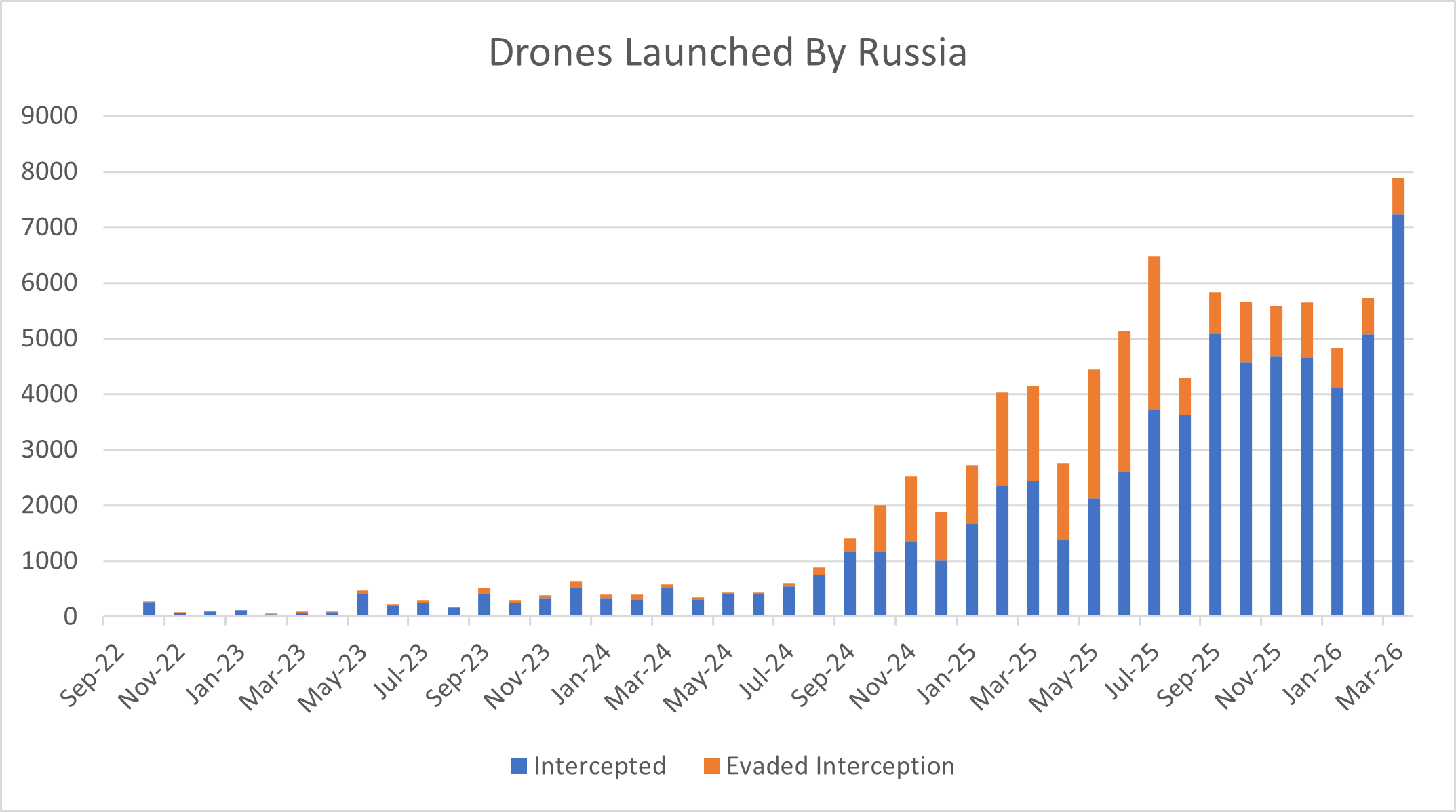
- Bottom line: 657 long-range Russian drones and 26 missiles struck their targets in Ukraine in March 2026 – in contrast to 1,712 drones and 44 missiles in March 2025. Belfer Center’s analysis of CSIS data on Russian aerial strikes shows that Russia launched more drones to attack targets in Ukraine in March 2026 than in any other month of the war since data started being collected in September 2022, yet Ukrainian forces still intercepted 92%, with only 657 of 7,889 drones reaching their targets. Ukraine’s ability to intercept drones significantly improved since March of last year, when 1,712 of the 4,154 drones launched by Russia hit their targets with Ukraine only intercepting 60%. When it comes to interceptions, it is also notable that of 12 ballistic missiles launched by Russia in March 2026, Ukraine intercepted none, according to the April 22, 2026 issue of the Russia-Ukraine War Report Card produced by Belfer Center’s Russia Matters project.
- RM’s most recent analysis of ISW data for the past four weeks (March 24–April 21, 2026) indicates that Russian forces suffered a net loss of 2 square miles of Ukraine’s territory during that period. During the prior four-week period (Feb. 24–March 24, 2026), Russia suffered a net loss of 4 square miles, according to the April 22, 2026 issue of RM’s Russia-Ukraine War Report Card. In the shorter recent period of April 17–23, Russian forces advanced in or near nine Ukrainian settlements, but captured none, according to daily updates that Ukraine’s DeepState OSINT group posts on its map.1
- A review of Iranian military journals by FT has revealed that “Tehran’s commanders have intensely studied the Ukraine war to modernize doctrine, stressing mass cheap drones, AI, cyberwarfare and flexible small-unit tactics.” Authors of articles in these cite “Ukrainian resilience and Russian shortcomings to argue for investing in swarms of low-cost UAVs, space- and laser‑based systems, and updated training,” according to FT. FT has earlier reported that Moscow has provided its ally with crucial support including satellite imagery, targeting data and intelligence support. Russia is sending upgraded drones used in the Ukraine war to Iran, according to AP. Vladimir Putin and Iranian President Masoud Pezeshkian have reportedly held three phone calls since the launch of U.S.-Israeli attacks, and Iranian Foreign Minister Abbas Araghchi will travel to Russia in the next several days, according to TASS and WSJ.
- Netherlands’ Military Intelligence and Security Service (MIVD) estimates that since the 2022 invasion, Russia has suffered about 1.2 million permanent losses, including more than 500,000 dead, while Ukraine has suffered about 500,000 permanent losses. MIVD says in its annual report: “In 2025, however, a worrying trend can be observed in which the ratio of daily fatalities is moving closer together as a result of an increasing number of Ukrainian permanent losses. This ratio is unfavorable for Ukraine, because, unlike Russia, it is barely able, if at all, to replenish the losses.”2 For RM’s catalog of the 2024-2026 estimates of Russian and Ukrainian casualties, please follow this link and scroll down to Endnote 4.
- The EU has finally approved a €90 billion ($105 billion), two‑year, interest‑free loan package for Ukrainealongside its 20th sanctions round on Russia, after Hungary and Slovakia dropped their vetoes. About €70 billion is earmarked for defense—air defenses, drones, domestic arms production and weapons purchases—while the rest will support Ukraine’s budget, energy “winterization,” critical infrastructure and social spending; repayment is due only if Russia pays war reparations. EU officials say the loan will cover roughly two‑thirds of Ukraine’s estimated €135.7 billion in external financing needs for 2026–27, with the remainder expected from the IMF and others, and a further €117 billion from the EU’s long‑term budget could keep Kyiv financed through 2029.3
- In March 2026, Russia’s monthly fossil fuel export revenues saw a 52% month-on-month increase to €713 million ($841 million) per day—the highest in two years—while volumes grew by a more modest 16%, according to the Finland-based Centre for Research on Energy and Clean Air (CREA). This increase in earnings was driven by a massive 115% month-on-month rise in seaborne crude export revenues, according to CREA and Foreign Policy. In April, however, Russia was to cut oil output by an estimated 300,000–400,000 barrels per day from first‑quarter levels—the steepest monthly fall in about six years, Reuters reported. This news agency attributed the decline to Ukrainian drone attacks on key ports and refineries and the shutdown of Druzhba pipeline flows to Hungary and Slovakia. On April 23, RBC.ua reported that Russia has resumed crude deliveries to Slovakia via the Druzhba pipeline.
- The White House confirmed it will invite Vladimir Putin to the December 14–15 G20 summit at Donald Trump’s National Doral resort in Miami, as all G20 leaders are to be asked. Trump said he “doubts” Putin will attend but argued his presence would “probably be very helpful,” MT reported. Russia has received an invitation to attend the December 2026 G20 summit in Miami “at the highest level,” Deputy Foreign Minister Alexander Panin was quoted by RBC.ru as saying.
I. U.S. and Russian priorities for the bilateral agenda
Nuclear security and safety:
- Rosatom chief Alexei Likhachev visited Turkey’s Akkuyu nuclear power plant construction site to inspect preparations for a key pre‑startup stage at the first reactor: cold and hot testing with dummy fuel assemblies. He said the project is moving toward initial launch and operation of the first of four units and confirmed talks with Turkish firms on taking equity stakes and sharing in future power generation profits, stressing the need for local partners over the plant’s potential 100‑year lifecycle. (Rosatom, 04.22.26)
North Korea’s nuclear and missile programs:
- Russian-installed Kherson leader Vladimir Saldo met North Korean Ambassador Sin Hong Chol in Moscow to discuss potential cooperation in agriculture, humanitarian aid, culture, sports and education, The Moscow Times reports. Saldo said Pyongyang’s food needs align with proposals for supplies of vegetable oil, flour and processed foods, and invited the envoy to visit occupied Kherson, underscoring deepening Moscow–Pyongyang ties that already include North Korean munitions, reported troop deployments, and tens of thousands of North Korean laborers working in Russia under conditions described by rights groups as akin to forced labor. (MT/AFP, 04.18.26)
- Russia and North Korea held a ceremony marking the joining of the first road bridge over the Tumen River, their first road link, which is set to open this summer and handle up to 300 vehicles and 2,850 people daily. Moscow calls it a “landmark” step to deepen trade and humanitarian ties as the two sanctioned states expand political, cultural, and military cooperation. (Moscow Times, 04.21.26)
Iran and its nuclear program:
Sunday, April 19, 2026
- The Financial Times, reviewing more than 300 articles in Iranian military journals, finds Tehran’s commanders have intensely studied the Ukraine war to modernize doctrine, stressing mass cheap drones, AI, cyberwarfare and flexible small-unit tactics. Authors, including senior officers, cite Ukrainian resilience and Russian shortcomings to argue for investing in swarms of low-cost UAVs, space- and laser‑based systems, and updated training; some pieces push for Russian Su‑35 fighter purchases and integrating “suicide drones” and AI targeting, revealing both internal debates and how Iran is adapting its forces for future conflicts. (Financial Times, 04.19.26)
Tuesday, April 21, 2026
- Iranian Foreign Minister Abbas Araghchi told his Russian counterpart Sergey Lavrov that the U.S. is repeatedly violating the cease-fire and carrying out “unlawful and provocative” actions against Iranian ports and vessels, citing the seizure of the ship Touska. Tehran and Moscow also discussed deepening cooperation and coordinating diplomacy to “restore regional peace and stability.” (Wall Street Journal, 04.21.26)
- Russia’s aviation regulator has lifted restrictions on using Iranian airspace and restored ticket sales for flights to the UAE, reopening key routes disrupted by the Iran war. A Russian travel industry representative said regional hubs are steadily resuming previously suspended flights and connections. (Wall Street Journal, 04.21.26)
Thursday, April 23, 2026
- Iran’s ambassador to Moscow, Kazem Jalali, said Vladimir Putin and Iranian President Masoud Pezeshkian have been in “very good contact,” holding three phone calls since the U.S.-Israeli offensive against Iran began on Feb. 28. He noted close coordination between foreign ministers Sergey Lavrov and Abbas Araghchi as well. Iran claims 3,375 of its citizens have been killed during the 40‑day conflict; Tehran has rejected Washington’s unilateral extension of a two‑week cease-fire announced April 7. (TASS, 04.23.26)
Friday, April 24, 2026
- Iranian Foreign Minister Abbas Araghchi will travel to Pakistan, Oman, and Russia starting Friday for talks on “current developments in the region” and “the war imposed by the United States and the Israeli regime against Iran,” state agency IRNA said. Earlier U.S.–Iran talks in Pakistan collapsed, after which Washington both announced a blockade on Iranian ports and extended a unilateral cease‑fire. All three countries on Araghchi’s itinerary have previously played roles mediating between Tehran and Washington. (Wall Street Journal, 04.24.26)
Humanitarian impact of the Ukraine conflict:
Saturday, April 18, 2026
- Ukraine has documented extensive Russian looting of cultural property, with the Kherson Art Museum alone losing nearly 10,000 of its 14,000 works when retreating Russian forces trucked them to occupied Crimea. Across retaken areas, over 35,000 museum items are confirmed looted and 2.1 million objects remain in occupied territories; Russia has moved to fold 77 Ukrainian museums into its national catalog, effectively claiming their collections. Prosecutors say 23 criminal cases cover 174 episodes of cultural theft or destruction, but poor documentation and removed inventory books make tracing most works extremely difficult. (Washington Post/AP, 04.18.26)
Monday, April 20, 2026
- President Volodymyr Zelenskyy criticized Kyiv and several regions as “laggards” in preparing backup power and heat for next winter, saying all cities and communities have resilience plans that must be fully implemented by Sept. 1 but that the capital still “clearly lacks understanding” of the need for sufficient reserve sources in every district. He singled out Donetsk, Chernihiv, Lviv, Poltava and Kirovohrad oblasts, plus Zaporizhzhia and Kherson, for extra scrutiny and ordered the Air Force commander and defense minister to work with frontline regions on additional interceptors and crew training to protect energy infrastructure. (RBC.ua, 04.20.26)
Wednesday, April 22, 2026
- A Europol “hackathon” involving 40 investigators from 18 countries has identified 45 additional Ukrainian children forcibly transferred or deported by Russia since 2022, mapping routes, facilitators and facilities. Europol passed the data to Kyiv. Ukraine has officially confirmed 20,570 such child transfers within occupied areas or into Russia, while Yale’s Humanitarian Research Lab is tracking around 35,000 cases, suggesting the true scale is much larger. (ISW, 04.22.26)
Thursday, April 23, 2026
- Ukrainian Presidential Office head Kyrylo Budanov said another prisoner exchange with Russia is being prepared after Kyiv received a new list of POWs Moscow wants to trade. He described remaining obstacles as “minor legal issues” on the Russian side and told reporters “don’t worry, everything will be fine.” On April 11, Ukraine and Russia swapped 182 people (175 military, 7 civilians), and officials say they are working to expand the numbers returned in future exchanges. (Ukrainska Pravda, 04.23.26)
Friday, April 24, 2026
- Russia and Ukraine have conducted a new prisoner exchange “193 for 193,” President Volodymyr Zelenskyy and Russia’s Defense Ministry confirmed. Zelenskyy said the group includes wounded POWs and those against whom Russia had opened criminal cases. The swap follows an April 11 “175‑for‑175” exchange and a larger March operation in which each side released 500 captives over two days. (Mediazona, 04.24.26)
- Ukrainian activists covered Washington’s National Mall with 20,000 teddy bears to highlight the more than 20,000 Ukrainian children confirmed as forcibly transferred or deported to Russia since 2022. The event, organized by Razom for Ukraine and the American Coalition for Ukraine, comes after U.S. lawmakers earmarked $25 million to support efforts to locate, return, and rehabilitate these children. The NGOs say the display is meant to keep international attention on what investigators describe as a systematic campaign of child abductions. (RFE/RL, 04.24.26)
- For military strikes on civilian targets see the next section.
Military and security aspects of the Ukraine conflict and their impacts:
- RM’s most recent analysis of ISW data for the past four weeks (March 24–April 21, 2026) indicates that Russian forces suffered a net loss of 2 square miles of Ukraine’s territory during that period. During the prior four-week period (Feb. 24–March 24, 2026), Russia suffered a net loss of 4 square mile, according to the April 22, 2026 issue of RM’s Russia-Ukraine War Report Card. (RM, 04.22.26)
- A total of 657 long-range Russian drones and 26 missiles struck their targets in Ukraine in March 2026 – in contrast to 1,712 drones and 44 missiles in March 2025. This follows from Belfer Center’s analysis of CSIS data on Russian aerial strikes in the Russia-Ukraine war. This analysis shows that Russia launched more drones to attack targets in Ukraine in March 2026 than in any other month of the war since data started being collected in September 2022, yet Ukrainian forces still intercepted 92%, with only 657 of 7,889 drones reaching their targets. Ukraine’s ability to intercept drones significantly improved since March of last year, when 1,712 of the 4,154 drones launched by Russia hit their targets with Ukraine only intercepting 60%. When it comes to interceptions, it is also notable that of 12 ballistic missiles launched by Russia in March 2026, Ukraine intercepted none, according to the April 22, 2026 issue of the Russia-Ukraine War Report Card produced by Belfer Center’s Russia Matters project. (RM, 04.24.26)
Friday, April 17, 2026
- On Friday, April 17, 2026 Ukraine’s DeepState OSINT group reported in its interactive map that the Russian armed forces advanced in Rodynske and Chervonyi Lyman. (RM, 04.17.26)
- Ukrainian drone maker Wild Hornets says its Sting interceptor drone was remotely piloted from abroad to a range of 2,000 km into northern Ukraine using the Hornet Vision Ctrl system, after previously intercepting two Russian Shahed drones at 500 km. The Sting—designed to hunt Shahed‑type, jet‑powered drones—flies over 340 km/h at altitudes up to 3,000 meters, illustrating how Ukraine’s industry is innovating to counter Russia’s long‑range strike fleet. (ISW, 04.17.26)
- ISW says Leningrad Oblast Governor Alexander Drozdenko has publicly called his region a “frontline oblast” after Ukrainian long‑range drone strikes on “economic and port” facilities, and announced plans to bolster air defenses and recruit reservists into mobile fire groups to guard industrial and critical sites. He also warned residents to expect mobile‑internet slowdowns, as authorities tighten censorship while trying to protect deep‑rear infrastructure. (ISW, 04.17.26)
Saturday, April 18, 2026
- On Saturday, April 18, 2026 Ukraine’s DeepState OSINT group reported in its interactive map that the Russian armed forces advanced near Prokhody and Taratutyno. (RM, 04.24.26)
- ISW reports Ukraine’s long-range drone and missile campaign continues to exploit overstretched Russian air defenses, hitting the Novokuibyshevsk and Syzran refineries in Samara, the Vysotsk Lukoil-2 oil terminal in Leningrad region, and the Tikhoretsk pumping station in Krasnodar, as well as fuel tanks and multiple Black Sea Fleet ships and radars in occupied Crimea. Russian officials acknowledged fires at Vysotsk and near Tikhoretsk, while geolocated footage showed major blazes at refineries and the Sevastopol oil depot. (ISW, 04.18.26)
- According to Ukrainian EW expert Serhiy “Flash” Beskrestnov, Russia equips each Shahed long‑range attack drone with special Tele2 (T2) SIM cards ordered from state operator Rostelecom, enabling remote control, telemetry and real‑time video via cellular data. While Ukraine has blocked T2 roaming domestically, Shaheds flying near Belarus, Poland and Romania can still connect via those countries’ networks, suggesting Moscow is exploiting roaming loopholes and Belarusian infrastructure to sustain its strike campaign. (ISW, 04.18.26)
Sunday, April 19, 2026
- On Sunday, April 19, 2026 Ukraine’s DeepState OSINT group reported in its interactive map that the Russian armed forces advanced near Riznykivka. (RM, 04.24.26)
- Russian strikes killed at least two people in Ukraine on April 19 as Moscow launched 236 drones overnight, 203 of which were shot down, while 32 hit targets in 18 locations, according to Ukraine’s Air Force. A “massive” drone attack on Chernihiv killed a 16‑year‑old boy and wounded four, and a drone strike on Kherson hit a van, killing one man and injuring another; Ukraine said it responded by hitting the Atlant Aero drone factory in Taganrog with Neptune cruise missiles, calling it an “important part of the Russian military‑industrial complex.” (Washington Post/AP, 04.19.26)
- Ukrainian drones struck Russia’s Baltic port of Vysotsk, igniting a fire that was later extinguished, after Russian air defenses shot down 27 UAVs over Leningrad region, Bloomberg reports. Vysotsk—which includes a Lukoil terminal—sits alongside key export hubs Primorsk and Ust‑Luga, through which about 40% of Russia’s seaborne crude flows; the northern attacks come as Kyiv tries to choke Kremlin oil revenues and as Russia calls up reservists into “mobile armed squads” to defend critical infrastructure from escalating drone raids. (Bloomberg, 04.19.26)
- A New York Times analysis details how cheap drones are reshaping conflicts in Ukraine and Iran, noting Iranian Shahed‑136s cost around $35,000 each, while U.S. interceptors range from roughly $65,000 for an F‑16 + APKWS combo to $4.2 million for two SM‑2s and $8 million for two Patriot PAC‑3 MSEs—often fired in pairs. The cost imbalance, plus mass swarms of low‑cost drones, is depleting U.S. munitions stockpiles and exposing a gap in American defenses designed for “fewer, faster, higher‑end” threats, spurring interest in cheaper systems like Coyote interceptors, C‑RAM guns and AI‑guided interceptor drones such as Merops. (New York Times, 04.19.26)
- Ukraine’s Unmanned Systems Forces say they have, for the first time, used an unmanned surface vessel to launch an interceptor drone that shot down a Russian Shahed, and are now forming dedicated naval drone battalions in at least two brigades. ISW notes Russian milbloggers complained that Moscow’s own USF is lagging badly in adaptation due to cronyism, as Ukrainian innovation in sea‑ and air‑launched drones increasingly shapes the war’s tactics. (ISW, 04.19.26)
Monday, April 20, 2026
- On Monday, April 20, 2026 Ukraine’s DeepState OSINT group reported in its interactive map that the Russian armed forces advanced near Riznykivka and Predtechyne. (RM, 04.24.26)
- Ukrainian drones struck Russia’s Black Sea port of Tuapse for the second time in four days overnight April 20, hitting the Rosneft‑operated refinery (capacity ~240,000 barrels per day), igniting fuel tanks and killing at least one person while injuring another, according to Krasnodar Governor Veniamin Kondratyev. He described the raid as a “massive” drone attack that also damaged transport infrastructure at the seaport; Ukraine’s drone forces chief Robert Brovdi confirmed Tuapse was deliberately targeted as part of a wider campaign to curb Moscow’s oil exports and its ability to profit from the Iran‑driven price spike. Russia’s Defense Ministry said it shot down 112 Ukrainian drones overnight, including over Krasnodar Krai. (RFE/RL, 04.20.26; Meduza, 04.20.26)
- The Financial Times says Ukrainian firms such as Tenebris and Wild Hornets have fielded internet‑guided interceptor drones that can down Russian Shaheds from hundreds of kilometers away, with some Sting and Bagnet systems flown from as far as 500–2,000 km from the target. As of March, UAVs accounted for about 70% of Russian drones shot down in Kyiv region, easing pressure on scarce Patriot missiles and allowing a small cadre of highly skilled operators to work from underground command posts while launch crews handle “boxes” of interceptors closer to the front. (Financial Times, 04.20.26)
- Ukrainian Defense Ministry adviser Serhiy Beskrestnov, a prominent blogger known as “Flash,” was wounded when a Russian Shahed drone slammed into his house, destroying it, iStories reports. Beskrestnov wrote that Russia launched four “jet‑powered Shaheds” at him and that one hit his wall, adding, “I have no home anymore,” and posting a photo from hospital; it is the first known case of Russian drones directly targeting and injuring a Ukrainian official at his residence. (iStories, 04.20.26)
Tuesday, April 21, 2026
- A Ukrainian drone strike on the Black Sea port of Tuapse killed one person and sparked major fires at Rosneft’s export terminal, the second attack on the site in less than a week. Facilities including a gas pipeline, church, and schools were damaged, and satellite imagery showed a vast smoke plume. Russia says it intercepted 112 drones overnight as Ukraine steps up strikes on energy infrastructure. (Moscow Times, 04.21.26)
- Russia’s top general Valery Gerasimov claimed Russian forces have seized 1,700 square kilometers and 80 settlements in Ukraine so far in 2026, advancing toward the Sloviansk–Kramatorsk–Kostiantynivka “fortress belt” and pushing in Sumy and Kharkiv to create a “security zone.” Ukraine reported halting multiple assaults near these areas, while pro-Ukrainian mapping projects estimate Russian gains this year at closer to 600 square kilometers. Gerasimov said Russia's Southern Grouping of forces was attacking the Donetsk fortress belt comprising the cities of Sloviansk, Kramatorsk and Kostiantynivka, and that Russian forces were about 7 to 12 km (4.3 to 7.5 miles) from Sloviansk and Kramatorsk. Gerasimov also announced that its forces had "fully completed" the occupation of Luhansk oblast. (Reuters , 04.21.26, Kyiv Post, 04.22.26)
- ISW says Russian Chief of General Staff Valery Gerasimov is vastly overstating Russia’s 2026 gains. Gerasimov claims 1,700 sq km and 80 settlements seized, including all of Luhansk, plus advances to within 7 km of Kramatorsk and 12 km of Sloviansk. ISW’s mapping shows only 381.5 sq km and 13 settlements taken this year, with Russia losing nearly 60 sq km since March 1, and no evidence of control in places Gerasimov names such as Lyman, Borova, Studenok, or Zaporozhets. (ISW, 04.21.26)
- Some pro-Russian commentators on Telegram mocked Russian Chief of General Staff Valery Gerasimov after he claimed the “Luhansk People’s Republic has been liberated” and that Russia’s offensive is advancing “in all directions,” with blogger Alex Parker and ex-separatist politician Oleg Tsarev sarcastically asking whether LNR had been “liberated for the fourth time.” (Romanov_92, apwagner, OlegTsarov, RM, 04.21.26)
- Commenting on Gerasimov’s statement Pro-war Russian blogger Voyenkor Kotyonok, predicts intense, prolonged fighting and argues there is “no point” in frontal assaults across pre-sighted, mined terrain. Instead, he describes a plan to envelop Ukrainian positions, create an outer encirclement ring, and then “methodically” force defenders out, noting Kyiv has signaled it does not intend to withdraw. (Voyenkor Kotyonok’s Telegram account, 04.21.26)
- Overnight April 20–21, SBU drones reportedly struck the Transneft‑Privolga Samara pumping station on the Druzhba pipeline, damaging five 20,000 m³ tanks, and hit an industrial facility in Saratov region, while Ukrainian forces also targeted an equipment depot and rail infrastructure near Persianovsky in Rostov (delaying 15 trains) and destroyed a weapons and equipment concentration near Klimovo in Bryansk. New imagery confirms major damage at the Syzran and Tuapse refineries, with smoke from Tuapse visible for more than 300 km. (ISW, 04.21.26)
- Ukraine’s UN envoy Andriy Melnyk said Russia would need catastrophic losses to occupy more Ukrainian territory, estimating it loses 254 soldiers per square kilometer gained. He claimed seizing all of Donetsk region would require at least 1.5 million additional Russian troops killed and fully occupying Ukraine would cost about 122 million lives and 183 years of war. Melnyk rejected any Russian ultimatums, vowing Ukraine will not cede “a single square millimeter” of its land. (RBC.ua, 04.21.26)
Wednesday, April 22, 2026
- On Wednesday, April 22, 2026 Ukraine’s DeepState OSINT group reported in its interactive map that the Russian armed forces advanced near Myrne. (RM, 04.24.26)
- A Ukrainian drone strike on the Russian city of Syzran in Samara region hit a four‑story apartment block near a frequently targeted Rosneft refinery, killing a woman and a child and injuring around 11–12 people, including at least two children, according to regional and emergency officials. Part of the building on Astrakhanskaya Street collapsed, another high‑rise caught fire, and several parked cars were damaged; the site is close to Rosneft refineries that have been repeatedly struck by Ukraine and whose operations, along with the Novokuibyshevsk refinery, have recently been disrupted by drone attacks. Russia’s Defense Ministry claimed it intercepted 155 Ukrainian drones nationwide that night. (Washington Post, 04.22.26; Meduza, 04.22.26; The Moscow Times, 04.22.26)
- Ukraine’s Commander-in-Chief Oleksandr Syrskyi visited units on the Pokrovsk axis, where he said Russian forces are applying the greatest pressure, with 688 attacks recorded there since early April. After meeting commanders and drone-force officers, he ordered additional support and emphasized the growing role of UAVs as Russia regroups and brings in reserves. (Ukrainska Pravda, 04.22.26)
- Ukraine’s air force said Russian troops launched 215 attack drones overnight on April 22, including about 140 Shaheds and other types like Geran and Italmas. Air defenses shot down or disrupted 189 UAVs over northern, southern, and eastern regions, but 24 drones hit 13 locations and debris fell in six others; the attack was still ongoing as of 8:00 a.m. (Ukrainska Pravda, 04.22.26)
- Attacks on Ukrainian draft officers have surged as war fatigue deepens and resistance to mobilization grows, Bloomberg reports. Police recorded 341 assaults on recruiters in 2025—almost triple 2024’s figure—with more than 100 incidents already this year, including knife attacks that caused serious injuries and at least one death. Authorities say about 2 million men are being sought for conscription violations, fueling anger among frontline troops over a lack of rotation. Kyiv is wary of tightening draft rules further and is exploring measures such as redeploying rear-area staff and recruiting more foreign fighters. (Bloomberg, 04.21.26)
- Netherlands’ Military Intelligence and Security Service (MIVD) estimates that since the 2022 invasion, Russia has suffered about 1.2 million permanent losses, including more than 500,000 dead, while Ukraine has suffered about 500,000 permanent losses. MIVD says in its annual report: “In 2025, however, a worrying trend can be observed in which the ratio of daily fatalities is moving closer together as a result of an increasing number of Ukrainian permanent losses. This ratio is unfavorable for Ukraine, because, unlike Russia, it is barely able, if at all, to replenish the losses.” (RM, 04.22.26)
Thursday, April 23, 2026
- On Thursday, April 23, 2026 Ukraine’s DeepState OSINT group reported in its interactive map that the Russian armed forces advanced near Hryshyne and Novooleksandrivka. (RM, 04.24.26)
- In the period of April 17–23, Russian forces advanced in or near nine Ukrainian settlements, but captured none, according to daily updates that Ukraine’s DeepState OSINT group posts on its map.4 (RM, 04.23.26)
- Volodymyr Zelenskyy said Russian claims to have captured over 700 sq km and all of Luhansk region “do not correspond to reality,” insisting that since January Ukraine has liberated more territory than it has lost. He called Ukraine’s current military position “the most stable in 10 months,” but stressed troops remain under heavy pressure and need more funding and drones. Zelenskyy also said Russian monthly losses are now a “constant” 30,000–35,000 personnel. (RBC.ua, 04.23.26)
- Russian forces hit a residential high‑rise in Dnipro overnight April 22–23, killing at least three civilians and injuring at least 10, according to Ukrainian officials and geolocated footage cited by ISW. (ISW, 04.23.26)
- At least three people were killed in overnight Ukrainian drone attacks across Russia, regional officials said. One person died in Novokuibyshevsk, Samara region, where “industrial facilities” were hit; unconfirmed reports say the already-halted Rosneft Novokuibyshevsk refinery was among the targets. Two more people were killed in separate strikes in Belgorod region. Russia’s Defense Ministry claimed to have intercepted 154 Ukrainian drones nationwide. In Ukraine’s Dnipropetrovsk region, Russian strikes killed at least two people and wounded eight. (Moscow Times, 04.23.26)
- A massive fire at Rosneft’s Tuapse refinery, hit twice by Ukrainian drones since April 16, has caused what residents describe as “toxic black rain” over the Black Sea city, coating streets, cars and animals in oily residue. Russia’s consumer watchdog Rospotrebnadzor now admits benzene, xylene and soot levels are two to three times legal limits and has urged people to stay indoors, though schools remain open. The 12‑million‑ton‑per‑year refinery has been offline since April 16 and was still burning on April 23, with a smoke plume stretching hundreds of miles, prompting critics to call it Russia’s worst war‑related environmental disaster so far. (Financial Times, 04.23.26; New York Times, 04.23.26)
- Ukrainian drone forces and the Azov National Guard’s 1st Corps say they destroyed the FSB’s Mobile Operations Directorate HQ and base in occupied Donetsk on April 22, using eight FP-2 strike drones with 60–100 kg warheads. Intelligence reports claim 12 Russian officers killed and 15 wounded. The FSB unit allegedly handled counterintelligence, sabotage operations, agent networks, and repression of “disloyal” civilians. (Korrespondent, 04.23.26)
- Ukrainian Presidential Office head Kyrylo Budanov said Ukrainian intelligence is closely monitoring Belarus and does not expect any sudden attack from its territory. Speaking at the Kyiv Security Forum, he acknowledged “signs of potential threats” but said reconnaissance agencies have already increased vigilance and see no current massing of troops or equipment near Ukraine’s border. “Nothing will happen suddenly,” he assured, echoing recent border guard reports of no major Belarusian movements toward Ukraine. (Ukrainska Pravda, 04.23.26)
- Ukraine’s military intelligence said its forces in Kharkiv region eliminated a group of Kenyan citizens fighting for Russia, identifying one as 22‑year‑old radio operator Eric Nyambura Mwangi. GUR says Mwangi and at least five other Kenyans arrived in Yaroslavl in October 2025, signed contracts, received only 1.5 weeks’ training, and were then thrown into assault units near Borova, where Mwangi was killed by Ukrainian mortar fire. Kyiv has identified 2,965 African citizens under Russian contract and confirmed at least 316 killed. (Ukrainska Pravda, 04.23.26)
- War has turbocharged Ukraine’s defense-tech sector, where some 2,300 firms rapidly develop drones and unmanned ground vehicles that now conduct over 22,000 missions per quarter and, by Kyiv’s estimate, inflict 96% of Russian casualties. Drone output has surged from 800,000 in 2023 to a planned 7 million this year, giving Ukraine about a 1.3:1 advantage in FPV drones and enabling 1,500 km strikes. But procurement bottlenecks, corruption, and Russia’s edge in missiles and glide bombs remain serious constraints. (The Economist, 04.23.26)
Friday, April 24, 2026
- Russia launched a large overnight strike on Ukraine on April 23–24, killing at least four people and injuring 19 in one of the heaviest drone attacks in weeks. Ukraine’s Air Force said Russia fired two Iskander‑M ballistic missiles and 107 strike drones (about 70 Shaheds), of which air defenses shot down or jammed 96; two missiles and 10 drones still hit nine locations, with debris falling in two more. In Odesa, two 75‑year‑old spouses were killed, three residential buildings were heavily damaged (two destroyed), and a Saint Kitts and Nevis–flagged cargo ship caught fire but its crew survived; two other civilians were killed in Kherson and Mykolaiv regions. (Meduza, 04.24.26; Ukrainska Pravda, 04.24.26)
- Authorities in Krasnodar Krai say the open blaze at Tuapse’s marine oil terminal, triggered by Ukrainian drone strikes, has been extinguished, with 276 personnel and 77 vehicles still on site for full suppression. The facility has burned twice since April 16, sending oil into the sea and Tuapse River and causing “black rain” and toxic air levels over the city. Officials report 750 meters of booms installed, but residents say barriers are “about to give way” and complain that only a handful of workers are removing oil with shovels and that local authorities are largely absent. (Meduza, 04.24.26)
- Russian officials in Tuapse have finally warned residents that air toxin levels are 2–3 times above safe limits after repeated Ukrainian drone strikes ignited the local Rosneft refinery, producing “black rain” of oily droplets. The plant has been offline since April 16 and was hit again on April 22; the fire was still burning on April 24, with a smoke plume stretching hundreds of miles. Schools and offices remain open despite reports of animals and buildings coated in oil. (New York Times, 04.24.26)
- Ukraine’s General Staff said Russian forces sharply increased ground assaults on April 24, launching 112 attacks by 16:00—almost four times the number recorded by that time the previous day. More than 40 assaults were concentrated on the Pokrovsk axis alone, in and around 15 settlements, underlining sustained pressure on Ukrainian defenses as Russia tries to exploit spring conditions and probe for weaknesses along the eastern front. (Korrespondent, 04.24.26)
Military aid to Ukraine:
Friday, April 17, 2026
- Ukraine and Germany have concluded six new defense‑industrial cooperation deals, including an agreement between Ukrainian strike‑drone and cruise‑missile producer Fire Point and German firm Diehl Defense on anti‑ballistic missile systems, and a memorandum between TAF Industries and THYRA for serial co‑production of interceptor drones in Germany. ISW says such joint projects will strengthen Ukraine’s air defenses against Russian missile and drone barrages while expanding Europe’s own defense‑industrial base. (ISW, 04.17.26)
Monday, April 20, 2026
- ISW reports incremental gains by both sides: Ukrainian forces recently advanced near Borova in Kharkiv oblast and in western Zaporizhzhia, while Russian troops made localized advances in northern Sumy oblast and around Kostyantynivka–Druzhkivka and Dobropillia in Donetsk. These shifts reflect a grinding, attritional campaign with frequent but small changes to the front line rather than large breakthroughs. (ISW, 04.20.26)
- Ukrainian drones struck the oil tank farm at Rosneft’s Tuapse refinery on April 19–20, causing major fires, as part of a wider campaign against Russian military, energy, and port infrastructure in Krasnodar Krai. Recent targets include the Sheskharis oil terminal, a Black Sea frigate near Novorossiysk, pumping stations at Krymsk and Tikhoretsk, and the ports of Tuapse and Yeysk, exposing Russia’s difficulty defending widely dispersed infrastructure. (ISW, 04.20.26)
- Ukraine continues a mid-range strike campaign against Russian military assets in Belgorod oblast aimed at disrupting logistics, as Russia launched 142 Shahed-type drones against Ukraine in a single overnight barrage. ISW notes that Russia is struggling to protect infrastructure across its vast territory even as it intensifies drone and missile attacks on Ukrainian cities and energy facilities. (ISW, 04.20.26)
Tuesday, April 21, 2026
- Germany summoned Russia’s ambassador after Moscow published a list of foreign companies allegedly aiding Ukraine’s drone production, which ex-President Dmitry Medvedev called “potential targets” for Russian strikes. Berlin condemned the move as “direct threats” aimed at weakening support for Kyiv and vowed not to be intimidated. The list, posted by Russia’s Defense Ministry, includes three German firms and warns of “unpredictable consequences” for countries supplying drones to Ukraine. (RFE/RL, 04.21.26)
Thursday, April 23, 2026
- The EU has finally approved a €90 billion ($105 billion), two‑year, interest‑free loan package for Ukrainealongside its 20th sanctions round on Russia, after Hungary and Slovakia dropped their vetoes. About €70 billion is earmarked for defense—air defenses, drones, domestic arms production and weapons purchases—while the rest will support Ukraine’s budget, energy “winterization,” critical infrastructure and social spending; repayment is due only if Russia pays war reparations. EU officials say the loan will cover roughly two‑thirds of Ukraine’s estimated €135.7 billion in external financing needs for 2026–27, with the remainder expected from the IMF and others, and a further €117 billion from the EU’s long‑term budget could keep Kyiv financed through 2029. (RBC.ua, 04.23.26; Wall Street Journal, 04.22.26; Financial Times, 04.22–23.26; New York Times, 04.22–24.26; Washington Post, 04.23.26; RFE/RL, 04.22–24.26)
- Zelenskyy said U.S. weapons deliveries under the PURL program “have not stopped” but acknowledged Ukraine still faces a serious shortage of air defense systems. Speaking to journalists, he stressed that existing U.S. and allied supplies are insufficient to cover all critical sites amid massive Russian drone and missile barrages, and he continues to press Washington and European partners for more Patriots, other long‑range SAMs, and interceptor missiles. (European Pravda, 04.23.26)
- President Volodymyr Zelenskyy detailed new security agreements under which Ukraine will help Saudi Arabia, Qatar and the UAE defend against Iranian drones and missiles. Kyiv will provide interceptor drone tech, software, training and systems-integration support, and open joint production lines, in exchange for diplomatic backing, energy deals and advanced air-defense systems. Ukrainian Shahed‑interceptor drones cost about $10,000 each, far cheaper than U.S. missiles Gulf states have been firing at Iranian-designed drones. (New York Times, 04.23.26)
- Zelenskyy told CNN that only foreign troops physically deployed along Ukraine’s front line—not diplomatic “words”—can reliably deter Vladimir Putin from launching new wars. He argued that an international military presence would make renewed aggression “very dangerous” for Russia, and urged powerful leaders such as U.S. President Trump, China’s Xi Jinping and India’s Narendra Modi to tell Putin he is wrong, saying compromise-based mediation won’t work if he feels no guilt. (Ukrainska Pravda, 04.23.26)
Friday, April 24, 2026
- France is reportedly preparing to propose that Greece transfer 43 Mirage 2000 fighter jets—24 Mirage 2000‑5s and 19 older Mirage 2000 EGM/BGM—to Ukraine in exchange for discounted Rafale jets. According to Le Figaro and Greek outlet Estia, Emmanuel Macron is expected to table the offer during his April 24–25 visit to Athens. Not all 43 Mirages are believed combat‑ready, but Paris would supply a “similar number” of Rafales at reduced prices, allowing Greece’s 114th Wing to field two full Rafale squadrons (36 aircraft). (European Pravda, 04.24.26)
Punitive measures related to Russia’s war against Ukraine and their impact globally:
Wednesday, April 22, 2026
- The EU’s 20th sanctions package on Russia does not include a full ban on maritime services for Russian tankers carrying crude and oil products, as originally planned, EU diplomats told European Pravda. Instead, the measure is postponed until all G7 states agree, while this package will target certain maritime and financial services for LNG tankers and icebreakers and bar Russian shipping companies from using EU LNG terminals. (Ukrainska Pravda, 04.22.26)
- China has placed seven EU companies on its export control list, including Belgian arms maker FN Herstal and six other defense, aerospace and satellite firms from Belgium, Germany and the Czech Republic. The move follows the EU’s 20th Russia sanctions package, which designates 16 entities in China, the UAE, Uzbekistan, Kazakhstan and Belarus for supplying dual‑use goods or weapons systems to Russia’s military, and adds export restrictions on another 60 entities that help upgrade Russia’s defense sector, including some in mainland China and Hong Kong. (RFE/RL, 04.24.26)
- Swedish authorities have released the Russian captain of the dry cargo ship Caffa, detained off Trelleborg in March, after prosecutors concluded they could not disprove his claim that he was unaware some of the ship’s documents—including Guinea flag registration papers—were forged. The investigation will now focus on confiscating and destroying the fake documents. Caffa, sanctioned by Ukraine over alleged grain shipments from occupied Crimea, has 10 Russian crew out of 11. (Mediazona, 04.22.26)
- Roman Abramovich has filed an application with the European Court of Human Rights challenging Jersey’s long-running money‑laundering probe and asset seizures worth more than $7 billion. His lawyers argue the investigation breaches his right to a fair trial (Article 6) and private life (Article 8), calling it politically motivated and lacking transparency. The case could affect the frozen £2.35bn from Chelsea’s 2022 sale, much of which is contractually owed to a Jersey-linked company. (New York Times, 04.22.26)
Thursday, April 23, 2026
- The EU has withdrawn a €2 million grant from the Venice Biennale after organizers confirmed Russia would participate in this year’s edition despite its full‑scale war on Ukraine. Ukraine and 21 EU member states had urged the exhibition to bar Moscow, arguing that giving Russia a prestigious cultural platform “sends a deeply troubling signal.” The Biennale said it lacks legal authority to exclude any state recognized by Italy; 99 national pavilions are scheduled this year. (RFE/RL, 04.24.26)
- The Venice Biennale jury has barred Russia and Israel from competing for awards this year, saying countries whose leaders face International Criminal Court accusations of crimes against humanity cannot take part in the competition. Their pavilions will still open. Russia’s pavilion is curated by art entrepreneur Anastasia Karneeva, daughter of Rostec deputy chief and former KGB/FSB officer Nikolai Volobuyev. (iStories, 04.24.26)
Friday, April 24, 2026
- UK officials blocked the attempted £800,000 purchase of the Grange-over-Sands golf course in Cumbria by Russian oilman Yury Shamara and his daughter, over fears of a pattern of Russians buying land near critical infrastructure: the course sits on the only rail line to BAE’s Barrow submarine shipyard and the Sellafield nuclear site. Shamara, tied to the Ilsky refinery near Crimea and creditors linked to the “2Rivers” shadow fleet, withdrew after the Cabinet Office queried the deal under the National Security and Investment Act. (Financial Times, 04.24.26)
For sanctions on the energy sector, please see section “Energy exports from CIS” below.
Ukraine-related negotiations:
Tuesday, April 21, 2026
- Ukrainian President Volodymyr Zelenskyy said reliance on fears of U.S. President Donald Trump is no real security guarantee for Ukraine, stressing that without international partners physically present on the front line, nothing prevents Russia from launching a new offensive later. He noted Trump’s term lasts only another two and a half years and questioned what happens afterward. (RBC.ua, 04.21.26)
- Ukrainian negotiators privately floated naming a demilitarized “free economic zone” in still-contested Donbas “Donnyland”—a play on Donbas and Donald—in talks aimed at appealing to President Trump’s vanity and securing tougher U.S. pressure on Russia. The proposed 50-by-40-mile zone, housing perhaps 100,000–190,000 residents, would be under neither side’s full control, but Moscow insists on full legal control of Donbas, stalling talks. (New York Times, 04.21.26)
- Peace talks over Donnyland have continued quietly even as U.S. envoys Steve Witkoff and Jared Kushner focus on the Iran war; Kyiv expects them to visit Ukraine, but U.S. officials say they are waiting for more progress and plan another trip to Russia first. (New York Times, 04.21.26)
- Kyiv has also floated a “Monaco model” for Donnyland—a semi‑autonomous offshore-style economic zone—and one Ukrainian negotiator even created a green‑and‑gold flag and a national anthem for it using ChatGPT, though it is unclear if U.S. negotiators ever saw them. (New York Times, 04.21.26)
- Zelenskyy criticized U.S. negotiators Steve Witkoff and Jared Kushner personally, calling it “disrespectful” that they traveled to Moscow but not Kyiv. He downplayed the importance of their previously announced, still‑postponed visit, saying, “Their arrival is needed by them, not by us.” (Kommersant, 04.21.26)
- President Vladimir Putin said Russia “knows how it will all end” in Ukraine but will not publicly spell out its war goals, vowing instead to “implement” them. Framing a future Russian victory, he claimed Kyiv is already considering how to present the outcome. (Intellinews, 04.21.26)
- Ukrainian sociologist Oleksiy Antypovych says 60% of Ukrainians support seeking a compromise with Russia in peace talks, according to data cited by Ukraine’s National Anti-Corruption Portal. Polls also show that about one in six Ukrainians would like to leave the country in the near future, a trend particularly pronounced among men. (Lenta.ru, 04.21.26)
Wednesday, April 22, 2026
- Foreign Minister Andriy Sybiha said Ukraine is ready for a Zelenskyy–Putin meeting “anywhere except Moscow and Belarus,” naming Turkey and other capitals as acceptable venues to give peace talks “new dynamics.” He noted Kyiv has asked several countries, including Ankara, to host such a summit, possibly with the participation of Erdogan and Trump. (Ukrainska Pravda/European Pravda, 04.22.26)
- Ukraine has asked Turkey to help arrange a summit between President Volodymyr Zelenskyy and Russian President Vladimir Putin to revive stalled peace talks, Foreign Minister Andrii Sybiha said. Kyiv is open to any venue except Moscow or Belarus and sees Turkish President Recep Tayyip Erdogan as a key mediator. Sybiha argued Ukraine is in its “strongest position on the battlefield in the past year” thanks to drones and urged tougher sanctions on Russia to increase pressure. (Bloomberg, 04.22.26)
Thursday, April 23, 2026
- Kremlin spokesman Dmitry Peskov said Vladimir Putin is ready to meet Volodymyr Zelenskyy, but only to “finalize agreements,” insisting any summit must come at the end—not the start—of negotiations. His comments follow Ukrainian Foreign Minister Andriy Sybiha’s statement that Zelenskyy is prepared for a meeting if U.S. President Donald Trump and Turkey’s Recep Tayyip Erdoğan also take part. Kyiv says any leaders’ summit must address territory directly. (RBC.ua, 04.23.26)
- Ukrainian Presidential Office head Kyrylo Budanov said Kyiv still expects visits by U.S. special envoys Steve Witkoff and Jared Kushner, despite delays caused by Washington’s focus on the Iran war. He told the Kyiv Security Forum that Ukraine is “waiting for them in Kyiv” and believes the trip will eventually happen. Budanov reiterated that no peace deal will include recognition of the loss of even “a millimeter” of Ukrainian territory. (European Pravda, 04.23.26)
- Albanian Prime Minister Edi Rama said the EU has made a “big strategic mistake” by cutting “every channel with Russia,” arguing Europe should “always, always, always” be talking to Moscow or risk having little say in any eventual Ukraine peace deal. Speaking at the Delphi Economic Forum, he backed continued U.S.-led efforts against Iran and stressed Albania’s aim to join the EU by 2030 while remaining “sympathetic” to the Trump administration. (Politico, 04.23.26)
Friday, April 24, 2026
- On diplomacy, Ukrainian presidential chief of staff Kyrylo Budanov said successful peace talks are only possible if Ukraine is negotiating from a position of strength and reiterated that Kyiv will not accept territorial concessions or compromises contrary to national interests. He claimed Ukraine’s “oil sanctions”—long‑range strikes on Russian refineries and export infrastructure—are both draining the aggressor’s resources and destroying its image as a reliable energy supplier. (RBC.ua, 04.23.26)
Great Power rivalry/new Cold War/NATO-Russia relations:
Monday, April 20, 2026
- Estonia’s Foreign Minister Margus Tsahkna rejected Volodymyr Zelenskyy’s warning that Russia may be preparing to invade the Baltic states, saying Tallinn sees “no concentration of forces or preparation in any way militarily to attack NATO or the Baltic states.” He argued the opposite is true, with Russia “not in a very strong position” on the Ukrainian front or economically, and said Zelenskyy’s remarks “do not make cooperation any easier.” Estonia’s intelligence chief similarly said in December there was no indication Putin plans to strike NATO, despite broader European warnings about future conflict. (The Moscow Times, 04.20.26)
Tuesday, April 21, 2026
- Estonia publicly pushed back against President Volodymyr Zelenskyy’s warning that Russia may be preparing attacks on the Baltic states, with Foreign Minister Margus Tsahkna saying Tallinn sees no military buildup targeting NATO and stressing Moscow’s economic woes and battlefield struggles in Ukraine. While long among Kyiv’s staunchest backers, the Baltic governments maintain that a Russian land incursion is not imminent even as they highlight the broader threat. (Bloomberg, 04.21.26)
- Russia’s modernized Northern Fleet submarine force is driving a renewed Cold War-style contest with NATO in the Arctic and North Atlantic, Bloomberg reports from Norway’s underground joint headquarters and UK bases. New Borei-A and Yasen-M nuclear submarines, backed by a $100 billion naval program, are prompting expanded anti-submarine operations by Norway, the UK, the U.S. and allies using P-8 patrol planes, advanced sensors and Arctic infrastructure to track Russian boats 24/7. (Bloomberg, 04.21.26)
Wednesday, April 22, 2026
- Netherlands’ Military Intelligence and Security Service (MIVD) estimates that “A military conflict between Russia and NATO is not unthinkable, but as long as Russia is fighting in Ukraine, a conventional war against NATO is virtually excluded. At the same time, Russia is already making concrete preparations for a possible conflict with NATO. The MIVD assesses that Russia, under the most favorable circumstances for it, can generate sufficient combat power within one year after the end of hostilities in Ukraine to initiate a regional conflict against NATO.” (RM, 04.22.26)
- NATO scrambled French Rafale jets and fighters from Sweden, Finland, Poland, Denmark and Romania to shadow two Russian Tu‑22M3 bombers and about 10 Su‑30/Su‑35 escorts flying over the Baltic Sea on April 22. Russia said the four‑hour mission took place over neutral waters and followed international rules. The interception is part of NATO’s long‑running Baltic air‑policing effort, which has seen hundreds of Russian aircraft shadowed annually since before the full‑scale invasion of Ukraine. (Washington Post, 04.22.26)
Thursday, April 23, 2026
- The Kremlin is intensifying information operations that frame NATO and the Baltic states as aggressors to justify possible future military pressure or action, ISW says. On April 23, Russia’s Security Council accused Lithuania of creating a “hotbed of tension” near Kaliningrad and “militarizing” under a “Russian threat,” while Deputy Foreign Minister Alexander Grushko claimed NATO’s Joint Expeditionary Force drills rehearse a naval blockade and seizure of Kaliningrad. ISW sees this as part of long‑term narrative groundwork for potential escalation against the Baltics or Poland. (ISW, 04.23.26)
Friday, April 24, 2026
- Polish Prime Minister Donald Tusk warned that Russia could attack a NATO member in the “short-term perspectives, rather months than years,” and openly questioned whether the U.S. would be “as loyal as it is described in our [NATO] treaties” in responding. Citing a 2024 incident when about 20 Russian drones violated Polish airspace and some allies “pretend[ed] that nothing happened,” he said his “obsession” is building practical EU defense tools so guarantees on paper translate into real deterrence. (Financial Times, 04.24.26)
- Tusk urged the EU to turn its mutual defense clause, Article 42.7, into a “real alliance” mechanism with concrete capabilities: common defense instruments, rapid military mobility, and joint infrastructure such as anti‑drone systems. He argued that Europe must be prepared to act collectively “today,” not just rely on NATO, and that the war in Ukraine has made EU states “more and more aware that we will be together in military aspects [and] defense.” (Financial Times, 04.24.26)
- Tusk said Viktor Orbán’s election defeat removes a key obstacle to deeper EU defense cooperation, calling incoming Hungarian premier Péter Magyar “for sure a much better collaborator when it comes to defense and his approach to Russia.” With Hungary no longer blocking, he sees new momentum to “reintegrate Europe” around common defense and to ensure Moscow understands that any attack on the eastern flank will meet a “tough and unequivocal” response. (Financial Times, 04.23.26)
China-Russia: Allied or aligned?
- New Russian Defense Minister Andrey Belousov held talks with his Chinese counterpart Dong Jun, who said the two militaries must “continuously strengthen strategic communication, continue to deepen pragmatic cooperation in all areas, and jointly uphold global justice and the international order.” The statement underscores Beijing and Moscow’s intent to align their armed forces more closely under the “consensus of the heads of state.” (TASS, 04.24.26)
- China’s imports of Russian crude oil rose 31% year‑on‑year in Q1 2026 to 31.86 million tons, worth $14.37 billion (up 8.8%), Chinese customs data compiled by TASS show. Russian LNG shipments to China increased 6.7% by volume to 1.38 million tons, though their value fell 17.3% to $651.6 million; Russian pipeline gas exports were worth $2.3 billion, down 8.9%. Russian petroleum product exports to China slipped 3.7% in value to $1.53 billion. (TASS, 04.20.26)
- Russia expects to sell pipeline gas to China at prices about one-third below those paid by its remaining European customers through at least 2029, internal government forecasts cited by Bloomberg indicate. Chinese buyers are set to pay an average $258.80 per 1,000 cubic meters this year—over 38% less than Europe—underscoring that Moscow’s pivot east is less profitable. Eastbound flows via Power of Siberia and other routes should reach 52.5 bcm annually by 2029. (Bloomberg, 04.21.26)
- Rosatom has agreed to expand exports of isotope products to China following talks at the CIGIE 2026 gas expo in Wuxi, its press service said. The state corporation, already supplying around 400 isotope types, will add germanium‑72, silicon‑78 and helium‑3 under new deals, according to Rustam Rakhmatulin of Rosatom’s isotope arm JSC V/O Izotop. (TASS, 04.22.26)
Missile defense:
- No significant developments.
Nuclear arms:
- NATO’s 32 members criticized Russia and China’s nuclear policies and urged both to work with the United States on “multilateral strategic stability” ahead of next week’s UN review conference on the Non-Proliferation Treaty. The alliance accused Moscow of violating arms control commitments, using “irresponsibly threatening” nuclear rhetoric, and twice firing its nuclear-capable Oreshnik missile at Ukraine. It said China is rapidly expanding and diversifying its arsenal without transparency. NATO official Boris Ruge contrasted this with what he called France’s “measured” buildup and stressed the bloc’s aim of greater transparency, risk reduction, and strategic stability. (Reuters, 04.21.26)
- Deputy Foreign Minister Sergei Ryabkov said Russia has “taken note” of U.S. statements about being ready to expand its nuclear arsenal beyond New START limits and to resume nuclear testing “at the first order” of the president, calling the arms‑control situation “complex, to put it mildly.” He criticized Washington for rejecting Putin’s proposal of mutual self‑restraint on New START ceilings and instead pursuing “multilateral” talks on U.S. terms that hinge on mandatory Chinese participation. (TASS/Russia’s Defense and Technologies Newswire, 04.20.26)
Counterterrorism:
- Russia’s Defense Ministry said its Africa Corps unit freed two hostages—Russian Oleg Greta and Ukrainian-born Yuri Yurov—nearly two years after they were seized in Niger by al-Qaeda–linked militants. The men, employees of a Russian geology firm, were captured in July 2024 and later shown in a GSIM video claiming they were taken near Mbanga in southwest Niger. Moscow says they were rescued in Mali during a “special operation.” (Moscow Times, 04.22.26)
Conflict in Syria:
- No significant developments.
Cyber security/AI:
- Ukrainian presidential chief of staff Kyrylo Budanov said Ukraine is preparing a “technological surprise” for Russia by moving from remotely piloted drones to fully autonomous AI‑driven combat systems. He argued both sides have hit the ceiling with existing drone‑control tech and that Ukraine’s next step is AI that can independently identify targets and maneuver. Budanov said such systems are already in development and will appear on the battlefield “very soon.” (RBC.ua, 04.23.26)
- A Ukrainian prankster, Yevhen Volnov, infiltrated a Russian Industry and Trade Ministry video meeting on drone production and published an edited recording. In it, a participant says Russia cannot source key materials domestically and that about 90% of electrical components use foreign raw materials, notably from China. Officials identified in the call work on drones and defense; the ministry has not commented. (Meduza, 04.21.26)
- Anthropic’s new AI model, Mythos, is so proficient at discovering and exploiting vulnerabilities in critical software that the company has sharply restricted access, triggering a global security scramble. Shared only with select U.S. tech firms and Britain’s AI Security Institute, Mythos has been confirmed capable of cyberattacks beyond any previous model, prompting warnings from central banks and cybersecurity officials about a “paradigm change” in cyber risk. Governments and rivals such as China and Russia worry that whoever leads in such frontier AI will gain major geopolitical advantages, while most countries remain dependent on a few U.S. companies that control access. (New York Times, 04.22.26)
- Russian entrepreneur Daniil Liberman told RBC Radio said it necessary to spread AI technologies as widely as possible and not allow any ‘point of their centralization,’ since in his view they are comparable to possessing nuclear weapons.” (RBC, 04.21.26)
- UK cyber chief Richard Horne warned that the most serious cyberattacks on Britain now come from hostile states, chiefly Russia, Iran and China, as the country faces “the most seismic geopolitical shift in modern history.” The NCSC is handling about four “nationally significant” incidents a week, over 200 in 2025, and fears large‑scale state attacks if the UK enters a conflict. Officials cite Russian-linked operations against Nordic energy and water infrastructure as part of more than 150 disruptive incidents traced to Moscow or its proxies since 2022. (Washington Post, 04.22.26)
- Born in Soviet Moscow and now a British citizen, billionaire mathematician Alex Gerko has turned his firm XTX Markets into one of the world’s most profitable algorithmic traders using AI supercomputers powered by 25,000 Nvidia chips. Gerko, a vocal critic of Putin’s war who renounced his Russian citizenship in 2022, is investing over $1 billion in geothermal‑cooled data centers in Finland to train deep‑learning models that trade $250 billion a day in assets. XTX made $2.3 billion profit on $5.3 billion revenue in its UK arm last year. (Wall Street Journal, 04.23.26)
Energy exports from CIS:
Saturday, April 18, 2026
- RFE/RL reports that the U.S. quietly reissued a sanctions waiver for Russian oil on April 17, with OFAC’s General License 134B allowing transactions tied to crude and products loaded as of that date through May 16, despite earlier assurances from Treasury Secretary Scott Bessent that the previous waiver would not be extended. Leading Senate Democrats called the move a “shameful” reversal that risks funding Russia’s war, while experts say Washington is caught between enforcing sanctions and preventing further energy shocks amid Hormuz disruptions. (RFE/RL, 04.18.26)
- An environmental expert told BBC Russia that the Russian‑flagged tanker Sofia, part of the shadow fleet, likely caused a major oil spill detected near Anapa on April 7, rather than Ukrainian drone strikes as local officials had suggested, Meduza reports. Sentinel‑1 satellite imagery showed a slick that grew to over 200 square meters by April 14, with 300–350 tons of crude or heavy fuel oil estimated to have entered the Black Sea; Russia’s Marine Rescue Service has recovered only about 28 tons as some pollution drifted toward the Utrish nature reserve, killing or injuring waterfowl. (Meduza, 04.18.26)
Sunday, April 19, 2026
- Ukrainian President Volodymyr Zelenskyy condemned renewed U.S. waivers on Russian oil sanctions, warning that “every dollar paid for Russian oil is money for the war,” and claiming over 110 shadow‑fleet tankers now carry 12 million tons of Russian crude worth $10 billion. He said Russia launched more than 2,360 attack drones, 1,320 guided bombs and nearly 60 missiles in the past week, and urged that Russian tankers be “stopped, not allowed to deliver oil to ports,” as Ukraine steps up strikes on refineries and drone plants deep inside Russia. (RFE/RL, 04.19.26)
- The share of Russia’s oil and gas sector in GDP fell to 13% in 2025, its lowest level since data began in 2017 and down three percentage points from 2024, according to Rosstat figures cited by Korrespondent. Turnover in the sector dropped 16.7% to 19.9 trillion rubles and profits plunged 63.9% to 1.9 trillion, with only 49.1% of firms profitable, as sanctions, OPEC+ limits, low prices and a strong ruble weighed—though analysts note hydrocarbons’ true role is larger once budget spending, wages and supply chains are counted. (Korrespondent.net, 04.20.26)
- ISW says Russian forces mounted four small mechanized or motorized assaults in the past 48 hours near Chasiv Yar, Svyatopetrivka, and inside Kursk region, but none produced tactically significant gains and three failed to cross the current line of contact. Analysts assess these were likely reconnaissance‑in‑force or opportunistic attacks intended to probe Ukrainian defenses and create the illusion of multi‑axis momentum, but note the broader spring–summer offensive remains “underwhelming” as Russia siphons resources from its main effort toward Slovyansk. (ISW, 04.19.26)
Monday, April 20, 2026
- Kremlin spokesman Dmitry Peskov said Washington’s renewed sanctions waiver on Russian oil proves the commodity is “too big to ignore,” arguing that “Russian volumes are difficult not to take into account” as Urals crude trades above $100 a barrel amid Hormuz disruptions. The Moscow Times notes Asian buyers including Indonesia, Malaysia, South Korea and the Philippines have stepped up purchases under the waivers, helping push Russia’s March oil and product revenues to $19 billion—nearly double February’s post‑invasion low. (MT/AFP, 04.20.26)
- Germany plans to begin privatizing Sefe—the former Gazprom Germania seized in 2022—via a €1.5–2 billion capital increase that will dilute the state’s 100% stake, CEO Egbert Laege told the FT. Sefe, which holds gas storage, pipelines and a UK trading arm, must be 75% privatized by end‑2028 under EU rules; Berlin is weighing investor restrictions given its role in energy security, and may later further reduce its stake via additional sales or an IPO, while keeping infrastructure and trading units together rather than merging Sefe with nationalized importer Uniper. (Financial Times, 04.20.26)
Tuesday, April 21, 2026
- In March 2026, Russia’s monthly fossil fuel export revenues saw a 52% month-on-month increase to EUR 713 million per day—the highest in two years—while volumes grew by a more modest 16%, according to the Finland-based Centre for Research on Energy and Clean Air (CREA). This increase in earnings was driven by a massive 115% month-on-month rise in seaborne crude export revenues, according to CREA. Russia’s oil revenues have surged to their highest level in two years thanks to Donald Trump’s war in Iran, which has pushed global crude prices up more than 50% and led Washington to twice ease sanctions on Russian energy exports (CREA, 04.13.26; FP 04.21.26)
- Russia has restored crude exports from its key western ports after Ukrainian drone strikes on Primorsk, Ust-Luga, and Novorossiysk temporarily cut flows to the lowest level since August. Shipments have now rebounded to 3.53 million barrels per day and are set to rise further, just as global markets scramble to replace lost Persian Gulf supplies amid the Strait of Hormuz closure. High prices and renewed U.S. sanctions waivers are boosting Moscow’s oil revenues. (Bloomberg, 04.21.26)
- Russia has been forced to cut oil output in April by an estimated 300,000–400,000 barrels per day from first‑quarter levels—the steepest monthly fall in about six years—due to Ukrainian drone attacks on key ports and refineries and the shutdown of Druzhba pipeline flows to Hungary and Slovakia, industry sources told Reuters. The reduction may dent state revenues despite record-high prices driven by the Iran war. (Reuters, 04.21.26)
- Russia plans to halt Kazakh oil flows to Germany via the Druzhba pipeline from May, threatening supplies to the PCK Schwedt refinery, which provides about 90% of Berlin’s petrol, kerosene and heating fuel. Kazakh officials say the cut is mainly to pressure the EU, especially Germany, though Astana’s volumes are relatively small and alternative routes exist. Berlin is scrambling to boost deliveries via Rostock and Gdańsk as it already faces higher prices from Trump’s Iran war. (Financial Times, 04.22.26)
Wednesday, April 22, 2026
- Russia’s oil windfall from Trump’s Iran war is boosting export income but not overall growth. Oil above the $59/bbl fiscal rule could add 1–3 trillion rubles in 2026, yet GDP likely contracted in Q1 after output fell almost 2% in the first two months.. (Bloomberg, 04.22.26)
- Citing higher commodity prices, the International Monetary Fund last week raised its forecast for Russia’s economic growth to 1.1 percent from 0.8 percent. (New York Times, 04.24.26)
Thursday, April 23, 2026
- Russia has resumed crude deliveries to Slovakia via the Druzhba pipeline after almost three months of suspension, Slovak Economy Minister Denisa Saková said. Flows restarted at 2:00 a.m. on April 23, in line with a plan Ukraine provided to pipeline operator Transpetrol. Shipments to Hungary and Slovakia were halted after a Russian drone strike damaged the line in western Ukraine in January, sparking political disputes and Hungary’s temporary veto on EU aid and sanctions. (RBC.ua, 04.23.26)
- Indonesia says Russia has agreed to supply up to 150 million barrels of oil following President Prabowo Subianto’s visit to Moscow, special envoy Hashim Djojohadikusumo announced. Jakarta, hit by soaring prices from the Middle East war and Strait of Hormuz disruption, normally gets 20–25% of crude imports from that region and is seeking alternatives. Hashim said Indonesia can store the 150 million barrels domestically to cushion economic volatility. (Moscow Times, 04.23.26)
Friday, April 24, 2026
- According to Argus Media, a price reporting agency used by the Russian government to calculate its oil extraction taxes, the average price of Russian crude has increased by more than 30 percent in April. (New York Times, 04.24.26)
- The EU will ban spot purchases of Russian LNG from April 27 while allowing deliveries under existing long‑term contracts to continue only until year‑end, cutting an estimated 2.8–3.5 million tons a year of Russian LNG—about 3% of the bloc’s 2025 LNG imports. Russia still supplies roughly 12% of EU gas demand. The move comes as TTF prices have already risen about 40% due to the Iran war and a fifth of global LNG remains trapped in the Persian Gulf. (Bloomberg, 04.24.26)
- At least 13 of 22 sanctioned tankers carrying Russian crude through the Baltic since April 7 have rerouted south of Denmark’s Bornholm island instead of their usual track closer to Sweden, ship‑tracking data show, after Sweden began boarding suspected “shadow fleet” vessels. Stockholm has already inspected ships such as Sea Owl 1, Caffa and Flora 1, prompting Russia‑linked tankers to take longer, more expensive routes. By contrast, Denmark has limited itself to document checks and hasn’t boarded transiting ships, citing freedom of navigation. (Bloomberg, 04.24.26)
- A Russian LNG tanker, the 900‑foot Arctic Metagaz, remains adrift about 120 nautical miles north of Benghazi after a second failed towing attempt by Libyan authorities, who call it a “significant environmental and navigational threat.” The ship, part of Russia’s sanctions‑busting “shadow fleet,” has been drifting since early March after a drone strike southeast of Malta tore a large hole in its hull. It carries at least 700 tons of fuel and a “substantial” load of natural gas. (New York Times, 04.24.26)
- Imports of Russian fuel oil into Singapore—the world’s largest bunkering hub—have more than doubled in April versus the 2025 monthly average, with March–April Russian deliveries climbing to about 585,000 barrels per day combined, up from 372,000 b/d in January–February. (Financial Times, 04.24.26)
- Russia increased its LNG exports by about 1 billion cubic meters this past winter thanks to additional shipments from the under‑sanctions Arctic LNG‑2 project to China, the IEA’s latest Gas Market Report says. Russia now has two large-scale LNG plants in operation (Yamal LNG and Sakhalin‑2), plus two medium‑scale Baltic plants (Gazprom LNG Portovaya and Cryogas‑Vysotsk), both on the U.S. sanctions list; Arctic LNG‑2 has not been fully commissioned but is already sending isolated cargoes east. (TASS, 04.24.26)
Climate change:
- No significant developments.
U.S.-Russian economic ties:
- No significant developments.
U.S.-Russian relations in general:
- Russia has received an invitation to attend the December 2026 G20 summit in Miami “at the highest level,” Deputy Foreign Minister Alexander Panin said, adding that Moscow has not yet decided whether to go. Kremlin spokesman Dmitry Peskov previously said there was “no talk” of a Putin visit. Putin last personally attended a G20 summit in 2019; since 2023 Russia has been represented by Foreign Minister Sergei Lavrov or senior aides. (RBC.ru, 04.23.26)
- The White House confirmed it will invite Vladimir Putin to the December 14–15 G20 summit at Trump’s National Doral resort in Miami, as all G20 leaders are to be asked. Trump said he “doubts” Putin will attend but argued his presence would “probably be very helpful.” Putin last attended a G20 in person in 2019 and now faces an ICC arrest warrant, though the U.S. is not an ICC member. The two leaders last met in person in Alaska in August 2025. (Moscow Times, 04.24.26)
- Russian asylum seekers are facing rising rejection and deportation rates in the United States, according to data cited by the Boston Globe. In 2025, 31% of Russian asylum applications were denied—the highest share in 24 years, per TRAC data analyzed by Verstka. One immigration judge mentioned in the piece denied about 90% of asylum claims between 2020–2026. Advocacy group RADR estimates “possibly hundreds” of Russians have already been deported under Trump’s second term and that roughly 1,000 more are currently held in U.S. immigration detention. (Boston Globe, 04.23.26
- The U.S. Justice Department agreed to pay $1.25 million to settle a lawsuit by former Trump 2016 adviser Carter Page, who alleged “unlawful spying” during the FBI’s Russia probe. An inspector general earlier found serious errors and omissions in four FISA warrant applications used to surveil Page as a suspected Russian agent; he was never charged. The deal, which does not cover his claims against individual ex‑FBI officials, follows a separate ~$1.2 million settlement with Michael Flynn over his own Trump–Russia case litigation. (Washington Post, 04.23.26)
II. Russia’s domestic policies
Domestic politics, economy and energy:
Sunday, April 19, 2026
- Sweden’s military intelligence chief Thomas Nilsson told the Financial Times that Russia’s economy is “living on borrowed time” and faltering despite a temporary oil windfall from the Iran war, saying Moscow needs Urals prices above $100 a barrel for at least a year just to close the budget gap. He said Swedish and German intelligence believe Russia is understating inflation (closer to the 15% key rate than the official 5.9%) and its deficit by about $30 billion, warning that the war‑driven, corruption‑riddled defense sector and manipulated data point toward either long‑term decline or a future economic “shock.” (Financial Times, 04.19.26) For a critique of Nilsson’s propositions see, for instance, Alexander Kolyandr’s piece in The Spectator. “The spymasters, in their eagerness to paint the picture blacker still, have got the numbers badly wrong – and in doing so, they are doing Putin an inadvertent favor,”Kolyandr writes, questioning Nilsson’s estimate of the inflation and the budget deficit among other things.
- Russia’s health minister Mikhail Murashko said roughly one‑third of the population should be tested for HIV annually as infections continue to rise, with 54 million tests conducted in 2024 (37% of the population) but an estimated 1.25 million people now living with HIV. WHO data cited by experts show Russia’s prevalence at 890 cases per 100,000 people—comparable to some African countries and far above Western Europe—with more than 4% of men aged 40–45 infected and a large gap between diagnosed cases and those under medical supervision. (MT/AFP, 04.19.26)
Tuesday, April 21, 2026
- Russian steel consumption fell 15% year-on-year in Q1 2026 as economic growth slowed and high interest rates dampened demand, Severstal reported, noting hot-rolled steel prices dropped 7% domestically while exports gained on tighter global supply. Severstal’s revenue fell 19% and EBITDA 54%, even as it runs at full capacity, while rival MMK is idling assets and cutting investment. (Bloomberg, 04.21.26)
- Russian President Vladimir Putin signed a decree launching a pilot program allowing companies importing goods into Russia to defer customs-collected VAT payments for up to three months, interest-free, until June 30, 2027. Eligible participants must be registered authorized economic operators and/or systemically important organizations, operate under the general taxation system, and sell imported goods to individuals or similarly taxed companies. The deferral applies only to VAT on imports from outside the Eurasian Economic Union. (Meduza, 04.21.26)
- Russian police detained Yevgeny Kapyev, CEO of major publisher Eksmo, for questioning in an LGBTQ+ “extremism” investigation linked to the distribution of queer-themed literature, including the bestseller “Summer in a Pioneer Tie.” Authorities are considering charges of organizing an “extremist” group under a 2023 Supreme Court ruling branding the “international LGBT movement” extremist. Several former Popcorn Books and Eksmo managers remain under house arrest amid a broader crackdown on LGBTQ+ content. (Moscow Times, 04.21.26)
- By April 2026, Russian authorities had opened at least 225 criminal cases in 64 regions for “financing extremism” over donations made to Alexei Navalny’s Anti-Corruption Foundation after its 2021 “extremist” designation. At least 187 cases have reached court, with Moscow, Sverdlovsk and Kaliningrad regions hardest hit. Mediazona notes the real total is likely higher due to opaque court records. (Mediazona, 04.21.26)
- Russia’s independent Levada Center reports that 65% of respondents approved of the government’s work in March 2026 (21% “definitely approve,” 41% “mostly approve”), down from a peak of 77% in May 2025. Disapproval rose to 28% (10% “definitely,” 18% “mostly”), up 9 points since May 2025. The nationwide poll was conducted March 18–26, 2026. (Levada Center, 04.21.26)
Wednesday, April 22, 2026
- Communist Party leader Gennady Zyuganov warned that Russia risks a repeat of the revolutionary events of 1917 because of what he called a collapsed economy. “We told you ten times—the economy will inevitably collapse. The entire first quarter has fallen through to the bottom. If you don’t urgently take financial‑economic and other measures, then by autumn we’re in for what happened in 1917. We have no right to repeat this,” he said. Swedish intelligence estimates real inflation at about 15%, nearly triple Rosstat’s official 5.87%. Business arrears have surged, with overdue corporate debts reaching 8.2 trillion rubles by late January. (Radio Svoboda, 04.22.26)Zyuganov’ staff then elaborated that he referred to the February 1917 revolution that deposed the tsar. There were two revolutions in Russia in 1917: February Revolution, which overthrew Tsar Nicholas II and ended tsarist rule, and the October Revolution (or Bolshevik Revolution), which brought Vladimir Lenin and the Bolsheviks to power.
- Russia is considering a new windfall tax on selected commodity producers and banks to help plug a widening budget gap driven by war spending, Bloomberg reports. The Finance Ministry may target firms such as gold miner Polyus and Norilsk Nickel, as well as some privately held banks, with detailed talks expected in the second half of 2026. The move follows a 2023 one-off levy and comes as GDP appears to have contracted in Q1. (Bloomberg, 04.22.26)
Thursday, April 23, 2026
- Putin publicly defended Russia’s widespread mobile internet blackouts, calling them vital to preventing “terrorist attacks” and saying advance notice would only help criminals adjust plans. Monitoring groups say most regions now face daily disruptions, intensifying a “digital iron curtain” on top of platform-specific blocks like Telegram and WhatsApp. Putin ordered Digital Development Minister Maksut Shadayev to keep a “white list” of services—state messenger Max, major banks, state media—running while the wider internet goes dark, and reiterated plans to curb VPN use. (Moscow Times, 04.23.26)
- Investigative outlet iStories reports that Tatyana Yezhevskaya, 74, mother of Kremlin administration chief Anton Vaino, received 525 million rubles in 2023 from defense conglomerate Sfera after lending it 450 million rubles in March 2022, shortly after the full‑scale invasion. The mother of First Deputy PM Denis Manturov allegedly received 3.28 billion rubles on a similar loan, and both women gained roughly 2 billion rubles more via assigned debts. A former Russian billionaire source suggests some “loans” may exist only on paper. (Meduza, 04.23.26)
- Sergei Novikov, powerful head of the Kremlin’s public projects department and a key culture censor, publicly admitted that “society is tired of prohibition rhetoric,” saying “it’s impossible to keep banning more things” and that constant bans “will not lead to anything good.” He warned that fear of the future is depressing birthrates and called for a more “supportive atmosphere” instead of new restrictions, despite his own role in blacklists and patriotic propaganda. (iStories, 04.23.26)
- Alexei Navalny’s lawyer Igor Sergunin has been released after serving his full 3.5‑year sentence for “participation in an extremist community,” i.e., transmitting Navalny’s messages from prison to his team. Detained since October 13, 2023, he is the first of three Navalny lawyers sentenced in January 2025 to be freed; Alexei Liptser (5 years) and Vadim Kobzev (5.5 years) remain imprisoned. All three are barred from practicing law for three years after release. (iStories, 04.23.26)
Friday, April 24, 2026
- Russia’s central bank cut its key rate for the eighth straight meeting, from 15.5% to 14.5%, down from a 2025 peak of 21%, and signaled further easing is possible even after oil prices jumped with the Iran war. The Bank of Russia says it expects demand and supply to move into better balance, but continues to walk a tightrope between curbing inflation and avoiding a recession in a sanctions‑hit, war‑time economy. (Wall Street Journal, 04.24.26)
- Starting last June, the Bank of Russia has made a series of rate cuts — including a reduction to 14.5 percent from 15 percent on Friday — in hopes of encouraging growth. But as it dials down rates, it risks stoking inflation that is already elevated because of overspending on the war. (New York Times, 04.24.26)
- In April, the Russian Finance Ministry reported that the national budget deficit exceeded $60 billion in the first three months of the year, surpassing the deficit projected for all of 2026. . (New York Times, 04.24.26)
- Trust in Vladimir Putin has fallen to 71% and his job approval to 65.6%, while 24.1% of Russians say they do not trust him and 23.3% disapprove of his performance—the highest distrust figures since the full‑scale invasion began, according to state pollster VTsIOM. The Kremlin has quietly urged loyal media to cite more favorable numbers from FOM (76% approval, 74% trust) instead, as VTsIOM has logged seven straight weeks of declining support amid war fatigue, rising prices and internet restrictions. (Meduza, 04.24.26)
- Meduza details the “Kherson Nine” case, in which nine Ukrainians seized in occupied Kherson in summer 2022 were tortured for months in an FSB-run basement before being sentenced in Russia in January 2026 to 14–20 years for alleged terror plots. One suspect, Vasyl Stetsenko, died under torture before formal arrest; his body has never been returned. Survivors describe electric shocks that knocked out teeth, broken ribs, days handcuffed to cell grates with minimal water, mock executions, and child detainees as young as about 11–12 held and abused alongside adults. (Meduza, 04.24.26)
- Chechen woman Aishat Khizriyeva, 21, has fled Russia after an abduction attempt in Siberia, the human rights group SK SOS reported. In a video message she thanked supporters and said she is now safe abroad; activists said remaining in Russia posed a high risk of another kidnapping attempt by those pursuing her. No further details were given for security reasons. (Meduza, 04.24.26)
- A court in Russia’s Oryol region has labeled the LGBTQ+ media and health project Parni Plus an “extremist organization,” accepting Justice Ministry arguments that articles on queer life, self‑acceptance, family, rights violations and even a webinar on Russia’s “LGBT propaganda” law constituted extremist activity and “hostile” acts against Russia. The outlet, which has operated for nearly 18 years on LGBTQ+ health, HIV and rights issues, vows to appeal and continue working, saying the ruling shows “the truth about LGBTQ+ people is more dangerous [to the state] than any propaganda.” (Meduza, 04.24.26)
Defense and aerospace:
Monday, April 20, 2026
- Russian schools, universities, and even kindergartens have spent a combined 16 billion rubles on drones and drone‑training kits since the full‑scale invasion began, up from about 350 million rubles a year prewar, according to Novaya Gazeta Europe’s analysis cited by Meduza. Purchases jumped to 2.6 billion rubles in 2023 and 9.7 billion in 2024, with major contracts funneled through Moscow agencies and regional education ministries to suppliers tied to Katerina Tikhonova’s Innopraktika foundation and oligarch Arkady Rotenberg. (Meduza, 04.20.26)
Wednesday, April 22, 2026
- Vladimir Putin has restored the name of Felix Dzerzhinsky, founder of the Soviet Cheka secret police and architect of the Red Terror, to the FSB Academy in Moscow, via a new presidential decree. The higher school of the security services carried Dzerzhinsky’s name from 1962–1993, when it was the KGB Higher School. Observers say the move signals the Kremlin’s ideological identification with early Soviet security organs. (Meduza, 04.22.26)
Friday, April 24, 2026
- On April 17, 2026 Russia’s Air and Space Forces launched a Soyuz‑2.1b with a Volga upper stage from Plesetsk, placing at least nine military satellites into orbit. U.S. Space Forces cataloged 10 objects (2026‑083A–K, NORAD 68753–68764); OBJECT C decayed on April 19 and OBJECT E is also decaying, while OBJECT D is likely the Volga stage after an orbit‑lowering maneuver. The active payloads are in two sun‑synchronous orbital planes around 495–550 km and ~547 km altitude. (Russian Strategic Nuclear Forces, 04.17.26)
- See section Military aspects of the Ukraine conflict and their impacts above.
Security, law-enforcement, justice and emergencies:
- Russia’s FSB claimed it foiled a bomb attack on a law-enforcement facility in Pyatigorsk, Stavropol Krai, detaining a German woman born in 1969 and a Central Asian man it says were acting on orders from Ukrainian intelligence. The service said the woman was carrying an explosive device that was disabled by electronic warfare systems, and alleged both detainees confessed; names were not released. (Meduza, 04.20.26)
- Russia’s FSB says its agents shot dead a 20‑year‑old Moscow resident accused of plotting a car‑bomb assassination of senior Roskomnadzor officials, calling it a “terrorist act” organized by Ukraine. The suspect was killed on April 18 after allegedly opening fire during arrest; seven others were detained in Novosibirsk, Ufa and Yaroslavl, facing terrorism and illegal arms charges. Authorities claim foreign intelligence services are radicalizing young Russians and that Roskomnadzor leaders and their families are receiving death threats. (Moscow Times, 04.24.26)
- Russia’s Judicial Department, overseen by the Supreme Court, has removed all conviction statistics from its website and failed to publish 2025 data by the April 20 deadline. Officials told journalists access is closed while “regulations governing publication” are revised but gave no timeline or guarantee of full future releases. The semiannual data had been crucial for tracking political repression and sentencing trends. (Meduza, 04.22.26)
- A Moscow-region court ordered the arrest of Vitaly Melimuk, deputy general director for operations and logistics at the Defense Ministry’s Patriot park, on charges he took an 18‑million‑ruble bribe from a contractor tied to a 1.4‑billion‑ruble maintenance deal. His detention follows earlier convictions of former park chief Vyacheslav Akhmedov and ex–Deputy Defense Minister Pavel Popov in related embezzlement cases. (Meduza, 04.22.26)
III. Russia’s relations with other countries
Russia’s external policies, including relations with “far abroad” countries:
Saturday, April 18, 2026
- The Financial Times reports that UK officials blocked Lord Peter Mandelson’s developed vetting (DV) clearance after Cabinet Office vetters twice flagged “high concern” and marked his case “clearance denied or withdrawn,” citing his extensive Russian and Chinese business links. The due‑diligence file highlighted his paid role as a non‑executive director at Russian conglomerate Sistema—majority owner of defense tech firm RTI chaired by late Yevgeny Primakov—and his long‑held shareholding there, as well as Chinese clients of his firm Global Counsel (including TikTok and Shein) and his public advocacy for closer UK–China ties. (Financial Times, 04.18.26)
Monday, April 20, 2026
- Former president Rumen Radev’s Progressive Bulgaria party has won Bulgaria’s election with 44.7% of the vote and 130 of 240 seats, giving the pro‑Russian ex‑head of state a commanding majority that could tilt the EU and NATO member closer to Moscow, the FT reports. Radev has questioned EU sanctions, opposed euro adoption and told a pro‑Kremlin outlet he wants to be a “very important link” in restoring relations with Russia, prompting one EU lawmaker to warn he could become “Putin’s Trojan horse in Europe.” (Financial Times, 04.20.26)
- Russia’s Interior Ministry has proposed a legal ban on extraditing any foreigner who has received any form of asylum in Russia—refugee status, temporary protection, temporary asylum, or political asylum—regardless of why it was granted. Meduza notes this would shield foreign hackers and former Ukrainian officials and security officers who defected to Russia from being handed back even if they face serious criminal charges at home. (Meduza, 04.20.26)
Tuesday, April 21, 2026
- Dozens of Israelis and dual Russian-Israeli citizens arriving from Tel Aviv were detained and questioned for hours at Moscow’s Domodedovo Airport, with security officers allegedly confronting them over the U.S.-Israeli war against Iran and saying they were “not welcome.” All were released after signing warnings. Israel’s foreign ministry said the incident, resolved after diplomatic intervention, was “completely unacceptable.” (Moscow Times, 04.21.26)
- Russia is using commercial networks to channel major arms shipments to Mali’s Russian mercenary force Africa Corps, according to a report by The Sentry. Equipment including armored vehicles, artillery and boats arrived via Guinea, where Russia-linked firms and Rusal-operated terminals helped move cargos from sanctioned ships to Mali. The report says the transfers signal a long-term Russian military presence and continued abuses by Africa Corps, Wagner’s successor, against Malian civilians. (Moscow Times, 04.21.26)
- A London judge rejected sanctioned Russian billionaire Vladimir Potanin’s bid to delay his ex-wife Natalia Potanina’s divorce case, citing an “urgent need” to resolve litigation that has already cost £14 million in legal fees. A final hearing, set for November, could result in one of the UK’s largest divorce settlements, with Potanina seeking nearly $5 billion, though enforcing any award will be difficult as most of Potanin’s assets are now in Russia. (Bloomberg, 04.21.26)
Wednesday, April 22, 2026
- Russia has extended export quotas on fertilizers until November 30 amid a deepening global supply crunch caused by the Iran war and the closure of the Strait of Hormuz. Producers may ship 20 million tons between June and November, including 8.7 million tons of nitrogen fertilizers and 7 million tons of complex fertilizers. The caps, which prioritize domestic supply, exclude deliveries to Abkhazia and South Ossetia, transit cargoes, and humanitarian aid. (Bloomberg, 04.22.26)
- Italian Prime Minister Giorgia Meloni hit back at Kremlin TV host Vladimir Solovyov after he called her a “wild beast” and “disgrace to the human race” over her pro-Ukraine stance. Italy summoned Russia’s ambassador over the “extremely serious and offensive” remarks. Meloni wrote on X that regime propagandists cannot lecture on “consistency or freedom” and vowed Italy’s course would not change, drawing rare cross-party support at home and public backing from President Volodymyr Zelenskyy. (RFE/RL, 04.22.26)
- Russia is signaling openness to cooperation with Western Arctic states on the Northern Sea Route (NSR) as demand for alternatives to the crisis-hit Strait of Hormuz grows, Foreign Ministry official Vladislav Maslennikov told Izvestia. He said Moscow is ready for “constructive and mutually beneficial” talks, noting current NSR logistics partnerships focus on China and India but could later include Norway and Finland. Experts caution the NSR still lacks ports, year‑round infrastructure, and rescue capacity to rival southern trade corridors. (TASS, 04.22.26)
Thursday, April 23, 2026
- Bulgaria’s president-turned–prime minister-in-waiting Rumen Radev, long criticized for Russia-friendly remarks, is prompting concern in Brussels over whether he will act as a spoiler inside the EU and NATO. Radev has opposed sending arms to Ukraine, questioned a long-term defense pact with Kyiv, and repeatedly called Crimea “Russian,” while also backing closer ties with Moscow and skepticism about eurozone and EU enlargement. Yet public opinion remains largely pro‑EU and increasingly wary of Russia, leaving uncertainty over how far he will actually tilt policy toward the Kremlin. (New York Times, 04.23.26)
Ukraine:
Friday, April 17, 2026
- The head of the Kyiv Regional State Administration, Olha Drozdova, has been sentenced to 7 years’ imprisonment for overpayments on vegetable slicers for shelters. The investigation established price inflation: over 460 thousand UAH on vegetable slicers and about 1.35 million UAH on chairs. The court imposed a sentence of 7 years’ imprisonment with confiscation of property and a ban on holding positions for 3 years. (Antikor, 04.17.26)
Sunday, April 19, 2026
- A 58‑year‑old Moscow‑born man living in Kyiv killed six people and wounded at least 14 in Ukraine’s deadliest mass shooting in years before being shot dead by police after taking hostages in a supermarket, the New York Times reports. Prosecutor general Ruslan Kravchenko said the gunman first set fire to his apartment, then shot four people on the street and one inside the store; a sixth victim died in hospital. (New York Times, 04.19.26)
Monday, April 20, 2026
- Germany and France propose giving Ukraine only “symbolic” pre-accession benefits to the EU, without farming subsidies, voting rights, or automatic access to the EU budget. Berlin’s “associate membership” and Paris’s “integrated state status” would offer partial integration and mutual defense guarantees but delay full financial benefits. Kyiv fears such “shadow membership” could be seen as a poor substitute for real accession. (Financial Times, 04.20.26)
- Kyiv’s mayor Vitali Klitschko said a man critically wounded in the April 18 supermarket shooting in the Holosiivskyi district has died, raising the death toll to seven. Ukrainian authorities are investigating the attack by 58‑year‑old Dmitry Vasilchenkov as terrorism and are probing dereliction-of-duty charges against patrol officers who fled the scene, leaving wounded behind. (Meduza, 04.20.26)
- Ukraine's reform progress is real but it must go further, according to the European Union’s ambassador in Kyiv, Katarína Mathernová… She also stressed she would not accept a “growing narrative” that “nothing has been achieved” in Ukraine’s justice reforms and fight against corruption, adding that such claims were “wrong,” “dangerous” and “deeply unfair.” She added Ukraine had made “enormous progress” since the start of Russia’s full-scale invasion on 24 Feb. 2022 and Ukraine’s application for EU membership on 28 Feb. 2022. (Brussels Times, 04.20.26)
Tuesday, April 21, 2026
- Ukraine’s Commander-in-Chief Oleksandr Syrskyi has suspended the heads of the Odesa regional and Peresyp district military enlistment centers following a scandal involving gunfire and a $50,000 bribe extortion scheme. Eight Peresyp TCC staff were detained by the SBU’s internal security directorate. The Armed Forces launched an internal investigation and pledged full cooperation with law enforcement, stressing that any abuse of power must be punished. (RBC.ua, 04.21.26)
- Ukraine’s farm sector faces a “triple hit” of constant drone attacks, soaring costs from the Iran war and EU trade tensions, the FT reports. In Kherson, pork producer Serhii Kasyanov runs Ukraine’s fifth-largest farm with about 60,000 pigs and says his team works 24/7 under shelling, using jammers and detectors to intercept drones. Fertilizer is now 2–3 times more expensive, so he can afford only about a third of normal volumes. (Financial Times, 04.21.26)
- Britain’s egg consumption has surged to 209 eggs per person a year, while bird flu and higher feed and electricity costs have shrunk England’s laying flock by 10% since 2021 and made eggs 36% more expensive in real terms. Imports have doubled since 2021, and roughly 200 million Ukrainian eggs—some from battery-cage systems banned in Britain—supplied much of last year’s shortfall, angering UK farmers. (The Economist, 04.21.26)
Wednesday, April 22, 2026
- London-listed Ukrainian iron ore miner Ferrexpo has warned it could run out of cash by the end of August unless it secures fresh funding, as Russia’s invasion continues to disrupt its operations. The company said on Wednesday it was considering an equity capital raise of at least $100mn, warning that without it, “it is highly likely” that the company would have “no option but to file for insolvency”. (Financial Times, 04.22.26)
- A new Russian law in occupied Mariupol forces Ukrainian homeowners to obtain Russian title deeds or risk having their properties seized, deepening fears of mass evictions and demographic engineering. Rights advocates say the complex rules are designed to dispossess Ukrainians and legitimize Moscow’s control. Many owners abroad are barred from entering Russia, making compliance impossible. Residents warn they can be “kicked out” at any time, undermining the Kremlin’s glossy narrative of reconstruction in the devastated city. (New York Times, 04.22.26)
Thursday, April 23, 2026
- EU leaders meeting in Cyprus signaled that conditions are now in place to open the first stage of accession talks with Ukraine “in the coming weeks and months,” though no target date for membership was set. The move follows Hungary’s decision to lift its veto on a €90 billion loan and new Russia sanctions. Zelenskyy reiterated that Ukraine seeks “full‑fledged” membership, rejecting associate or symbolic status, while some leaders privately see 2030 as a realistic accession horizon. (Bloomberg, 04.23.26)
- Ahead of an EU summit in Cyprus, Zelenskyy said Ukraine “does not need symbolic membership” but “full‑fledged” EU accession, rejecting German and French ideas of associate or half‑way status. He wants firm commitments and a clear path to full membership, ideally tied to any eventual peace deal with Russia. While Hungary’s election upset has unblocked a €90 billion loan, many member states remain wary of fast‑tracking Kyiv’s bid. (Bloomberg, 04.23.26)
- Polish Prime Minister Donald Tusk quipped that the informal EU summit in Cyprus is “the first summit without Russians in the room,” a clear jab at Hungary’s Viktor Orbán, who skipped the meeting after losing elections and long being seen as Moscow’s closest ally in the bloc. Tusk wrote on X that the absence was “a great relief.” Orbán is the only EU leader missing from the gathering and is soon to leave office after 16 years in power. (European Pravda, 04.24.26)
Friday, April 24, 2026
- Ukraine’s anti‑corruption bodies say a judge of a commercial appeals court in Lviv illegally enriched himself by about 16.7 million hryvnias (~$420,000) between 2020–2023. NABU and the Specialized Anti‑Corruption Prosecutor’s Office allege he bought a luxury apartment and parking space in Lviv but registered them in his mother‑in‑law’s name, and then failed to declare use of a rented apartment in 2022–2023. He has been notified of suspicion of illicit enrichment and filing false asset declarations. (Ukrainska Pravda, 04.24.26)
- Two citizens of the Russian Federation and the wife of one of them, a citizen of Ukraine, organized a large network of gambling games on the internet. They involved seven more Ukrainians in the scheme.. To legalize profits, the money was first accumulated on the accounts of a company registered in Estonia, and then withdrawn to controlled offshore firms. Thus, assets worth the equivalent of over 5 billion hryvnias were laundered. (Antikor, 04.24.26)
Russia's other post-Soviet neighbors:
Sunday, April 19, 2026
- The Trump Organization will partner with local firms Archi Group, Biograpi Living and New York–based Sapir Organization to build “Trump Tower Tbilisi,” a roughly 70‑story luxury mixed‑use skyscraper that would be the tallest building in Georgia’s capital, the Wall Street Journal reports. The project, designed by Gensler, underscores the company’s post‑reelection shift toward aggressive overseas licensing deals, which critics say risk conflicts of interest as Georgia balances Western ties and tensions with Russia. (Wall Street Journal, 04.19.26)
Monday, April 20, 2026
- U.S. Representatives Joe Wilson (R‑SC) and Steve Cohen (D‑TN) introduced the Countering China’s Control of the Caucasus Act, requiring a classified assessment of Russian and Chinese intelligence penetration in Georgia and a five‑year review of U.S.–Georgia ties, amid fears Tbilisi’s ruling Georgian Dream is drifting toward Moscow and Beijing. Wilson called the Anaklia deep‑sea port concession to a Chinese‑led consortium the strategic “center of gravity” and linked the bill to earlier MEGOBARI sanctions legislation, framing both as tools to push Georgia back toward “fair and free elections” and Western alignment. (RFE/RL, 04.20.26)
Wednesday, April 22, 2026
- A Chisinau court sentenced Moldovan oligarch and former Democratic Party leader Vlad Plahotniuc to 19 years in prison over his role in the “theft of the billion” banking scandal. Prosecutors say he received $39 million and €3.5 million via companies linked to fugitive tycoon Ilan Shor; Plahotniuc, extradited from Greece in September 2025, did not attend the verdict hearing. (Ukrainska Pravda/European Pravda, 04.22.26)
- Russia’s Security Council secretary Sergei Shoigu claimed that the safety of Russian citizens in Moldova’s breakaway Transdniestria region is “under threat” and warned that Moscow would take “all steps” and use “any means” to protect them. Transdniestria, a pro-Russian enclave that fought a brief war with Moldova in 1992, has coexisted peacefully for over 30 years, but Chisinau’s pro-EU government has recently increased pressure on the separatist territory. Shoigu’s remarks echo past Kremlin justifications for interventions abroad. (Reuters, 04.21.26)
Thursday, April 23, 2026
- Baltic leaders are warning the EU there is “no going back” to prewar economic ties with Russia, after trade between the three states and Moscow fell 91% from 2021 to 2025. Estonia, Latvia and Lithuania have rapidly shifted away from Russian energy and transit, boosting renewables and new suppliers despite heavy costs to ports, railways and industry. Officials criticize moves elsewhere in Europe to buy Russian gas or talk of “rapprochement,” insisting unity and long‑term pressure on Moscow are vital. (Bloomberg, 04.23.26)
Friday, April 24, 2026
- Central Asian economies are benefiting from turmoil in Russian and Middle Eastern energy routes, growing 5–6% annually as they attract capital and rerouted trade. China has invested $36 billion in FDI there over the past decade, surpassing Russia as top investor. Kazakhstan pumps over 1.7 million barrels of oil per day and Turkmenistan produced 76.5 bcm of gas last year, mostly for China. Cargo along the “Middle Corridor” between China and Europe via Central Asia and the Caspian has surged roughly tenfold since 2022 to about 5 million tons in 2025. (Bloomberg, 04.24.26)
- Romania has extradited former Moldovan deputy intelligence chief Alexandru Bălan to Chișinău, where he faces a 1.5‑year prison sentence for leaking state secrets. Bălan was convicted of passing classified information to a Belarusian KGB officer and was detained in Romania in September 2025. After a Romanian court approved extradition, he was transferred from a Bucharest jail to the border on April 24 to be handed over to Moldovan authorities. (European Pravda, 04.24.26)
- Tbilisi City Court sentenced former Georgian defense minister Juansher Burchuladze to 10 years in prison for abuse of office and money laundering, and confiscated assets including a house and land in Spain plus property in the resort of Tsqneti. Ex‑deputy minister Giorgi Khaindrava and Burchuladze’s son‑in‑law Vasili Mkheidze received eight‑year terms; former procurement chief Vladimir Gudushauri got a four‑year suspended sentence, a 10,000‑lari fine, and a one‑year public‑service ban after a plea deal. (Ukrainska Pravda / European Pravda, 04.24.26)
Quotable and notable:
- Ex-CIA director William Burns wrote in an April 24 op-ed for the New York Times: “The war has also thrown a lifeline to Vladimir Putin, resulting in more energy revenue and diminished U.S. military inventories at a time when Ukraine had been making progress on the battlefield and the Russian economy was facing its own dire straits.” (New York Times, 04.24.26)
- IEA chief Fatih Birol called the current turmoil from the U.S. operation against Iran “the largest energy crisis in history.” He said past oil shocks in 1973 and 1979 each removed about 5 million barrels per day from global markets, whereas today’s crisis has cut 13 million bpd. Gas losses are estimated at 100 bcm this year, up from 75 bcm lost in 2022. Disruptions also hit fertilizers, petrochemicals, helium and sulfur, with broader supply‑chain impacts expected in coming weeks. (TASS, 04.23.26)
- Kateryna Bondar argues that the old image of a rigid, inept Russian military is “dangerously out of date.” After four years of war, she writes, “Moscow has developed an impressive, pragmatic approach to military innovation” that “prioritizes what works over what is elegant, what scales over what is ambitious, and what delivers battlefield results over what impresses on paper.” (New York Times, 04.21.26)5
- “Kaliningrad is a key component of Russia’s overall security strategy, offering a platform to project power and assert its interests in the Baltic Sea,” explains Dr. Fiona Hill, [Harvard University Board of Overseers member,]… former senior Russia analyst at the U.S. State Department and a leading expert on Russian foreign policy. “It’s not simply about provoking NATO, but about demonstrating Russia’s ability to operate independently and challenge the Western-led security architecture.” (Foreign Policy Watchdog, 04.20.26)
Footnotes:
- DeepState posted no updates on its map for Tuesday, April 21, 2026 as of 12.00 pm on April 24, 2026 (U.S. East Coast Time)
- Machine-translated.
- Reports by following media outlets were used when summarizing this item: RBC.ua, 04.23.26; Wall Street Journal, 04.22.26; Financial Times, 04.22–23.26; New York Times, 04.22–24.26; Washington Post, 04.23.26; RFE/RL, 04.22–24.26
- On Friday, April 17, 2026 Ukraine’s DeepState OSINT group reported in its interactive map that the Russian armed forces advanced in Rodynske and Chervonyi Lyman. (RM, 04.17.26)
- On Saturday, April 18, 2026 Ukraine’s DeepState OSINT group reported in its interactive map that the Russian armed forces advanced near Prokhody and Taratutyno. (RM, 04.24.26)
- On Sunday, April 19, 2026 Ukraine’s DeepState OSINT group reported in its interactive map that the Russian armed forces advanced near Riznykivka. (RM, 04.24.26)
- On Monday, April 20, 2026 Ukraine’s DeepState OSINT group reported in its interactive map that the Russian armed forces advanced near Riznykivka and Predtechyne. (RM, 04.24.26)On Wednesday, April 22, 2026 Ukraine’s DeepState OSINT group reported in its interactive map that the Russian armed forces advanced near Myrne. (RM, 04.24.26)
- On Thursday, April 23, 2026 Ukraine’s DeepState OSINT group reported in its interactive map that the Russian armed forces advanced near Hryshyne and Novooleksandrivka. (RM, 04.24.26)
- DeepState posted no updates on its map for Tuesday, April 21, 2026 as of 12.00 pm on April 24, 2026 (U.S. East Coast Time)
- Kateryna Bondar is a fellow specializing in A.I. at the Center for Strategic and International Studies. She is a former adviser to the government of Ukraine on reforming defense and the financial sector.
The cutoff for reports summarized in this product was 10.00 am East Coast time on the day it was distributed.
AI agents were used in production of this digest.
Here and elsewhere, the italicized text indicates comments by RM staff and associates. These comments do not constitute an RM editorial policy.
Slider photo credit: AP Photo/Dmitry Lovetsky