
Russia Analytical Report, Aug. 4–Aug. 11, 2025
3 Ideas to Explore
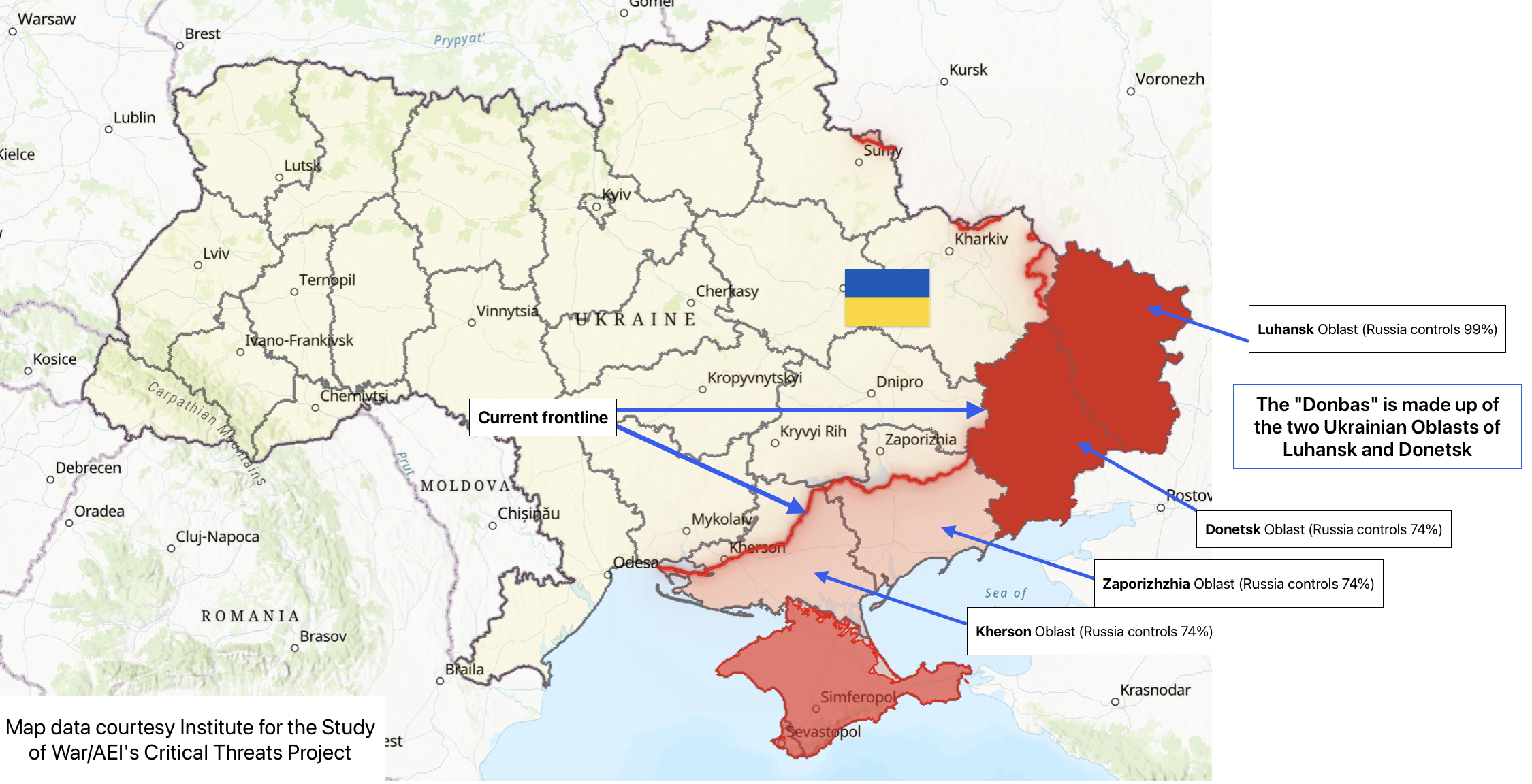
- Donald Trump lowered expectations for his meeting with Vladimir Putin in Alaska next Friday (Aug. 15) in a statement today in which he described it as "really a feel-out meeting,” according to AP. According to Wall Street Journal and Economist reporting on the outline of a potential agreement, Putin would agree to a ceasefire in exchange for Ukrainian withdrawal from the Donetsk region (a quarter of which or some 2,509 square miles is still controlled by Ukrainians) and Luhansk region (103 square miles or 1% of which is held by Ukrainians)—without major Russian concessions.1 Both Zelenskyy—who has already lost control over 11.67% of Ukrainian territory since Feb. 2022,2 and his European allies reject this trade-off, however, insisting on “ironclad” security guarantees for Ukraine, such as NATO membership, according to Wall Street Journal.3 The reluctance by Zelensky and his allies to have Ukraine to cede territory4 to Russia without Russian concessions is understandable, but conditioning it on Kyiv’s accession into NATO is not realistic, given that Trump and his team have repeatedly ruled out such accession. It is also rather unrealistic to expect Russia to withdraw from Kherson and Zaporizhzhia regions,5 given its interest in maintaining a land bridge to Crimea.6
- “As Russia presses its offensive, Ukraine faces a crisis that experts say is as critical as its shortages of ammunition and weapons: a dwindling supply of infantry,” Yauhen Lehalau reports. In fact, Ukraine’s infantry crisis has deepened so much that “drivers, artillerymen, and cooks are holding the line,” according to this RFE/RL reporter. “A maximum of 12 fighters hold sections 5–10 kilometers wide,” Bohdan Krotevich, an officer formerly with the Azov Brigade's headquarters, told Lehalau. While Ukraine's total troop strength is officially over 1 million, the Warsaw-based Centre for Eastern Studies says not more than 300,000 of them are deployed on the front lines, according to the author. In contrast, Russia’s numbers of active-duty personnel reached over 1.13 million—with Ukrainian armed forces’ commander in chief Oleksandr Syrskyi assessing that some 640,000 of them were on Ukrainian territory.
- Writing in New York Times, self-exiled Russian writer Mikhail Zygar declared that Trump “has soured on Putin” while the Russian leader “has lost faith in the very idea of reaching agreements with the United States.” Zygar’s piece was published on Aug. 5 only to be followed by Trump’s Aug. 8 revelation that he and Putin agreed to meet in Alaska on Aug. 15 to try agree on resolution of the Ukraine conflict. Depending on what emerges at the summit—Putin and Trump may, or may not reach an agreement—the timing of Zygar’s bet is interesting. Zygar has in the past authored a number insightful pieces, including “All the Kremlin's Men;” a book based, to a large extent, on his reporting in Russia.
U.S. and Russian priorities for the bilateral agenda
Nuclear security and safety:
- No significant developments.
North Korea’s nuclear and missile programs:
• “The three-day visit earlier this month of Russian Foreign Minister Sergei Lavrov to the North Korean coastal city of Wonsan marked a noticeable intensification of a strategic relationship between the two neighbors,” Daniel Sneider writes.
• “As a result of signing a treaty in June 2024, Lavrov told Russian reporters, ‘we became allies.’ But now there is a ‘deepening of ties… rooted not only in our geographic proximity but also in our alignment on key issues,’ not least on the Ukraine war and on countering American presence in the Indo-Pacific,” Sneider reports.
• “The massive transfer of North Korean weapons and the deployment of more than 11,000 troops to the Ukraine frontlines is the most visible sign of their alignment,” Sneider explains.
• “North Korea provided a crucial influx of millions of artillery rounds as well as more than 100 ballistic missiles which have been raining down on Ukrainian cities. It is a two-way street, with sharing of Russian military technology, particularly drones, in return,” the article notes.
• “Russian oil and food flows freely, effectively nullifying the United Nations (UN) sanctions regime,” Sneider observes.
• “‘Russia, once a stalwart protector the nuclear non-proliferation regime, has now nakedly endorsed the legitimacy of North Korea’s nuclear weapons program, something even China has balked at doing,’” Sneider quotes.
• “Perhaps equally important, the Russians have embraced Kim Jong Un’s policy shift toward abandonment of unification as a goal and opposition to any sustained engagement with South Korea,” Sneider highlights.
• “For Russian strategists, North Korea has now acquired a status that is similar to Belarus, its military and political ally in the West. ‘This is precisely how the Kremlin sees North Korea these days: as an easternmost strategic bulwark of the Russia-led anti-Western security bloc,’ says Igor Torbakov,” Sneider explains.
• “Some analysts have argued that the alliance with Russia is essentially transactional, fueled by Moscow’s need for Korean weapons and soldiers to prosecute the war in Ukraine,” the article notes.
• “For the foreseeable future, Russia has become a backer of a status quo marked by hard lines of division globally, and in Korea. And in its most visionary terms, Russians see this as a cornerstone of their bid to create a viable alternative to the U.S.-led international system,” Sneider concludes.
Iran and its nuclear program:
- No significant developments.
Humanitarian impact of the Ukraine conflict:
"I've Seen How Russia Is Torturing Prisoners of War," Alice Edwards, The New York Times, 08.08.25.
- “Prisoners on both sides of this conflict have reported being subjected to abuse, despite the humane treatment of prisoners of war being demanded by international law. Based on my findings, only one side employs torture as an integral part of its war policy: Russia,” Edwards writes.
- “The consistent and widespread nature of witness accounts while in Russian custody—along with Moscow's failure to address the issue—have led me to the conclusion that it can only be a systemic, state-endorsed practice approved at the highest levels,” Edwards argues.
- “I have documented allegations of beatings… egregious sexual violence, electric shocks, suffocation, sleep deprivation and mock executions,” Edwards reports.
- “Russia uses torture to extract strategic or military intelligence, as a warning and punishment to anyone who is loyal to Ukraine and to instill fear and obedience to Russia and the Russian-backed authorities in occupied areas,” Edwards explains.
- “The very ubiquity of this treatment of prisoners in Russian custody cannot be allowed to obscure that this is a crime prohibited by international law for which there are no exceptions, no amnesties and no statute of limitation,” Edwards asserts.
- “Justice, even if almost always incomplete, cannot be completely absent… Investigating and prosecuting torture is a legal obligation, not a diplomatic nicety or something that can be negotiated or leveraged during negotiations,” she insists.
- “No Ukrainian citizen can be left in the hands of known torturers, and victims must have a venue to seek accountability for cruel and degrading abuse… The alternative—a hasty peace to this war that buries the truth—risks becoming the casus belli of the next war,” Edwards concludes.
"Ukrainians Face a Sophie's Choice," Jillian Kay Melchior, The Wall Street Journal, 08.08.25.
- “The West contemplates a path to peace mainly in political and pragmatic terms. Ukrainians see the war in moral and existential terms,” writes Jillian Kay Melchior.
- “Only 38% of Ukrainians would accept some losses for peace, with 52% ‘firmly against’ territorial concessions—although the latter number has declined somewhat since 2022,” Melchior notes.
- “Russian occupation is not just changing one state flag to another,” says Oleksandra Matviichuk, head of the Center for Civil Liberties, as quoted by Melchior.
- “Genocide can entail mass slaughter, but the legal definition is broader under the United Nations' 1948 Genocide Convention,” Melchior explains.
- “Putin is working to ‘eliminate Ukraine as a language and ethnicity, as an identity and culture, and as an independent state,’ says Fred Kagan of the American Enterprise Institute,” Melchior reports.
- “‘There is no other option: no one should remain alive in Ukraine,’ proclaimed a recent op-ed in the state-run publication RIA Novosti,” the article notes.
- “The forcible transfer of children from one group to another is another constituent act, and Ukrainian authorities say they have information about nearly 20,000 cases in which Ukrainian children have been kidnapped to Russia,” Melchior reveals.
- “‘We are fighting for the moral future of our children. That is the foundation,’ says Mykhailo Podolyak, an adviser to Mr. Zelenskyy,” as cited by Melchior.
- “The quintessential ‘moral dilemma’ is that of a mother ‘allowed by the Nazis to choose which of her three children should be killed…’ That's the temptation Ukraine faces as it considers sacrificing some territories ostensibly to save others,” Melchior reflects.
- “‘When you see what Russia brings—the mass graves, the forced deportations, the torture of civilians—you stop romanticizing compromise,’ Ms. Honcharuk, the combat medic, texts me, en route to the front. ‘This isn't about politics. It's about dignity. About never having to look a child in the eyes and explain that you gave up their future just to stay alive a little longer.’”
- For military strikes on civilian targets see the next section.
Military and security aspects of the Ukraine conflict and their impacts:
- “As Russia presses its offensive, Ukraine faces a crisis that experts say is as critical as its shortages of ammunition and weapons: a dwindling supply of infantry,” Yauhen Lehalau writes.
- “‘Drivers, artillerymen, and cooks’ are holding the line, says Bohdan Krotevich… ‘A maximum of 12 fighters hold sections 5–10 kilometers wide.’”
- “The lack of manpower is allowing Russia to employ what Ukraine’s commander in chief… recently called ‘total infiltration’ tactics,” Lehalau explains.
- “One of the brigades responsible for defending the area had ‘run out of infantry,’ according to Ukrainian conflict-monitoring group DeepState, allowing the Russians through,” the article states.
- “In 2025, according to The Military Balance… Russia’s numbers of active-duty personnel reached over 1.13 million—with Syrskiy claiming that some 640,000 of them were on Ukrainian territory, a figure echoed by Russian President Vladimir Putin,” Lehalau reports.
- “While Ukraine's total troop strength is officially over 1 million, the Warsaw-based Centre for Eastern Studies (OSW) says not more than 300,000 of them are deployed on the front lines,” the article notes.
- “Ukraine needs to recruit some 300,000 soldiers to replenish its brigades, some of which are only at 30% strength… Currently, Ukraine is estimated to recruit 17,000 to 24,000 people per month,” Lehalau details.
- “Beyond the gap in recruitment figures, Ukraine’s army has a desertion problem, with tens of thousands of instances of soldiers going Absent Without Leave (AWOL) recorded per year,” Lehalau observes.
- “Cases of forced mobilization… contributes to the desertion problem, with mobilized recruits often less motivated than those who volunteer,” Lehalau writes.
- “Despite pressure from both the Trump and Biden administrations, Ukraine has so far resisted lowering its draft age to 18—a move that would be deeply unpopular with the public,” the article highlights.
- “The Russian integration of combined unmanned aerial vehicle (UAV) attack tactics and adaptations is giving Russian forces important advantages on the battlefield in Ukraine and facilitating Russian advances on key Ukrainian towns,” writes Kateryna Stepanenko.
- “Russian UAV adaptations are likely achieving some effects of battlefield air interdiction (BAI): The use of airpower to strike targets in the near rear of the frontline to impact battlefield operations in the near term,” the ISW report explains.
- “Russia’s allies, especially the People's Republic of China (PRC), have enabled Russia to develop and scale the production of UAVs that are more resistant to EW interference and capable of operating at longer distances, higher speeds, and in challenging environments,” Stepanenko notes.
- “Ukrainian servicemen and analysts reported that Russian forces began to systematically target Ukrainian ground lines of communication (GLOCs)… with tactical first-person-view (FPV) UAVs and loitering munitions across the entire frontline as early as Winter and Spring 2025,” Stepanenko observes.
- “Neither Ukraine nor Russia has previously been able to conduct battlefield air interdiction (BAI) using manned aircraft or UAVs due to the density and sophistication of adversary air defenses and electronic warfare (EW) over the past three years,” the article details.
- “Russian forces are reportedly denying Ukrainian forces the use of key highways and GLOCs located deeper in the near rear with tactical UAVs, which is complicating Ukrainian defensive operations in the Pokrovsk direction and the eastern fortress belt,” Stepanenko writes.
- “Russian persistent drone strikes at longer ranges are likely forcing Ukrainian forces to take alternative roads and further stretch GLOCs, which is likely impacting Ukraine's defensive operations that rely on the consistent flow of equipment, supplies, and manpower,” the report states.
- “Russian forces are restricting Ukrainian movements in the immediate rear with tactical UAVs, hindering Ukrainian troop rotations and evacuations,” Stepanenko explains.
- “Recent Russian UAV innovations, such as increased FPV flight ranges, the incorporation of limited artificial intelligence (AI)/machine learning (ML) capabilities, the proliferation of fiber optic UAVs, the integration of thermobaric warheads, the fielding of sleeper drones, and other technological adaptations, are giving Russian forces important advantages on the battlefield in Ukraine,” Stepanenko identifies.
- “Ukraine can prevent Russian forces from achieving the limited effects of BAI by urgently developing tactical kinetic anti-drone systems,” Stepanenko recommends.
- “Wars in Ukraine, the Middle East and across Africa are rewriting the rules of combat, with small, expendable and deadly drones increasingly critical,” Daniel Michaels writes.
- “Tacticians are grappling with how to defend against attacks massing dozens or hundreds of drones—without spending a fortune,” the article observes.
- “Project Flytrap 4.0… brought together top brass, tech developers and soldiers like Zouzoulas. While troops staged engagements… officers and officials filled a base auditorium to absorb lessons from drone combat in Ukraine and hear about the efforts of the North Atlantic Treaty Organization to apply those lessons,” Michaels explains.
- “The engagement scenario involved several dozen troops attacking roughly 180 defenders in traditional land battles augmented with hundreds of drones, employed in the most realistic ways possible short of lethality,” the report notes.
- “‘It’s terrifying, watching the drones counter each other,’ said Zouzoulas of the scenes on Ukraine’s front lines,” as quoted by Michaels.
- “The emphasis is on developing a flexible and layered approach with a range of tools,” Michaels observes.
- “Troops inside a Stryker can activate the system to shoot drones automatically with the vehicle’s roof-mounted M2 Browning .50-caliber machine gun. The system’s radar tracks the rounds it fires and adapts its targeting,” he details.
- “To secure fixed positions like field headquarters, the Pentagon is also using acoustic sensors,” Michaels writes.
- “Once drones are detected, neutralizing them at low cost is the next hurdle. A natural response for soldiers is to shoot at them with their personal rifles, but hitting a drone is much harder than hitting a bird,” the article states.
- “Bigger threats, such as drone swarms or attacks on armored vehicles, need a bigger response. That is what the San Francisco startup Mara aims to tackle with what it calls ‘ubiquitous antiswarm’ technology,” Michaels reports.
See this link for more commentary/analysis on this subject:
Military aid to Ukraine
- No significant developments.
Punitive measures related to Russia’s war against Ukraine and their impact globally:
- “President Trump is combining diplomatic overtures with economic threats to persuade Russia to end its war in Ukraine,” Anatoly Kurmanaev writes.
- “The Russian economy was slowing even before President Trump’s latest threats. But the Kremlin has enough money to keep fighting in Ukraine,” Kurmanaev observes.
- “Russia significantly increased state spending after launching its invasion in 2022, engineering an economic boom. That boom is over,” the article explains.
- “Most civilian industries have stopped growing. High interest rates are stifling private investment, and large companies are starting to furlough workers,” Kurmanaev reports.
- “‘The largest Russian companies are unable to spend money on their development, on building new power plants, building new factories, pipelines, railways. The investment programs are shrinking,’ Dmitri Gusev, a pro-government Russian lawmaker, said at a news conference on Tuesday,” the piece quotes.
- “Paradoxically, despite the tremendous human toll, the war raised the living standards of an average Russian to the highest level in a decade,” Kurmanaev states.
- “The slowdown is eating into those gains—and the political stability that they brought—but at a pace that at the moment is not fast enough to deter the Kremlin's war strategy,” Kurmanaev argues.
- “The biggest risk to Russia’s economy comes from declining oil revenue, which has fallen 18% so far this year, primarily because of weaker global oil prices,” the article explains.
- “The government has protected military spending, currently at about 8% of GDP, and it is expected to spend at least the same amount next year,” writes Kurmanaev, citing Alexandra Prokopenko.
- “‘This is not catastrophic for the Kremlin,’ she said. ‘The Kremlin is convinced that even low oil prices are not threatening its defense industry,’” the report concludes.
"How to shut down Putin's war machine," Andriy Yermak, The Washington Post, 08.05.25. Clues from Ukrainian Views.
- “President Donald Trump has made it clear that Russia will soon face serious consequences if it doesn't immediately come to the negotiating table,” Yermak writes.
- “Kyiv welcomes this clarity. We thank Trump for his firm and unmistakable commitment to peace through strength… This strength is the only language Putin understands,” Yermak states.
- “Russia's military-industrial complex needs to be better targeted. Entities such as Rosatom… and Roscosmos… must be sanctioned in full and banned from cooperating with Western scientific and academic institutions,” Yermak proposes.
- “More must also be done to cut off Russia's access to international finance… Gazprombank must be disconnected alongside any smaller financial institutions trying to fill the gap,” Yermak urges.
- “A full economic blockade is needed… We are greatly encouraged by recent U.S. actions to crack down on sanctions evasion,” Yermak observes.
- “Trump's decision last week to raise tariffs on India for purchasing Russian oil above the price cap surely rattled the Kremlin. It's a great first step, but more pressure is needed,” Yermak explains.
- “The tools to stop Russia exist. What is needed is the political will to use them with precision and force,” Yermak concludes.
For sanctions on the energy sector, please see section “Energy exports from CIS” below.
Ukraine-related negotiations:
"Trump-Putin Summit Latest in Ukraine Peace Push," CFR Editors, Council on Foreign Relations, 08.11.25. Explainer.
- “Ukraine and its European backers are pushing for Kyiv to be part of peace talks as Trump and Putin plan to meet Friday in Alaska,” the CFR Editors write.
- “Trump announced the summit last week and said that a peace settlement could include ‘some swapping of territories,’ prompting a scramble of diplomacy,” the article notes.
- “After meeting European officials Saturday, U.S. Vice President JD Vance said yesterday that Washington is also working on a trilateral meeting to include Ukrainian President Volodymyr Zelenskyy,” the CFR Editors report.
- “Ukrainians are ready to work with Trump for ‘lasting peace’ but ‘will not give their land to the occupier,’ Zelenskyy wrote Saturday,” the briefing recounts.
- “The leaders of Finland, France, Germany, Italy, Poland, the United Kingdom, and the European Union (EU) said in a joint statement Saturday that ‘meaningful negotiations can only take place in the context of a ceasefire or reduction of hostilities,’” the article highlights.
- “European leaders urged Trump to pressure Putin ahead of the summit with the threat of sanctions,” the editors observe.
- “U.S. NATO ambassador Matthew Whitaker said that it was ‘certainly’ possible Zelenskyy could attend the Alaska meeting; separately, Vance said that he did not believe that would be productive before Trump and Putin meet bilaterally,” the CFR Editors write.
- “Vance also said that any peace deal would likely leave both Russia and Ukraine ‘unhappy,’” the article concludes.
“Trump Expects 'Constructive Conversation' With Putin,” AFP, 08.11.25.
- “U.S. President Donald Trump said Monday he expects to have "constructive conversations" with his Russian counterpart Vladimir Putin and expressed displeasure with Ukraine's Volodymyr Zelenskyy for ruling out territorial concessions.”
- "I'm going to speak to Vladimir Putin and I'm going to be telling him 'you've got to end this war'," Trump told a White House press conference, saying that he would "like to see a ceasefire very, very quickly." "I think we'll have constructive conversations," said the president, noting that he would seek out Putin's "parameters" for peace, then call Zelenskyy and other European leaders right after the meeting.”
- “Trump said last week that "there'll be some swapping of territories to the betterment of both" Saturday that "decisions without Ukraine" would not bring peace and said his country's people "will not give their land to the occupier." Trump said he was a "little bothered" by Zelenskyy's stance on territorial concessions, and insisted that land swaps would take place… "There'll be some swapping, there'll be some changes in land," he said.
- “But Trump also stated that he would not make a unilateral agreement: "I'm not going to make a deal, it's not up to me to make a deal," he said, while emphasizing that he thinks "a deal should be made."”
- “Trump said he will know fairly quickly into the talks with Putin whether or not a deal would be coming, and that he may still walk away from trying to broker peace in Ukraine. "I may leave and say good luck and that'll be the end. I may say this is not going to be settled," Trump said. The U.S. president said his aim is to bring Putin and Zelenskyy together, with or without being present himself.
- “European leaders, fearful that President Trump will cut a deal with Vladimir Putin that undermines Ukraine and puts the continent’s security at risk, are planning another meeting with him ahead of a scheduled U.S.-Russia summit, European officials said. The goals are to reiterate what Europe sees as red lines that could prevent Europe and Ukraine from accepting a cease-fire deal and to press Trump to put additional pressure on the Russian president if he isn’t negotiating in good faith, the officials said.”
- “Europe’s red lines include stressing that a cease-fire must be the first step in a deal; that any territorial exchanges must be reciprocal and based on current front lines; and that a long-term security guarantee for Ukraine is fundamental, they said.”
- “European leaders also plan to make a final push to persuade Trump he should allow Ukrainian President Volodymyr Zelenskyy and other European heads of government to participate in the meeting with Putin, which is scheduled for Aug. 15 in Alaska. Vice President JD Vance said Sunday on Fox News that the initial meeting with Putin wouldn’t include Zelenskyy but that U.S. officials planned to include the Ukrainian leader in a subsequent summit with Putin and Trump.”
- “Trump said Monday that his meeting in Alaska with Putin was meant to “feel out” whether a peace deal was possible. Trump threatened to abandon the negotiations if he sensed no agreement could be made, a judgment he said he could reach in minutes.” “I’m going to go and see the parameters now,” he said. “I may leave and say, ‘Good luck,’ and that’ll be the end. I may say this is not going to be settled.”
- “After initial confusion over Putin’s offer, Europe has stressed that central to any cease-fire negotiations would be the status of the Russian-occupied Ukrainian territory and security guarantees for Ukraine, two European officials involved in the talks said.”
- “European leaders now are pushing for an agreement under which the U.S. would commit to supply unlimited amounts of weapons for Ukraine, paid for by European governments. “
- “On Saturday, senior European officials met in England with Vance, Witkoff, Secretary of State Marco Rubio and U.S. envoy to Ukraine Keith Kellogg. Participants described the talks as productive, with the U.S. side broadly receptive to European arguments.”
"Trump, Putin and the future of Ukraine," Gideon Rachman, Financial Times, 08.11.25.
- ““The Trump-Putin summit planned for this Friday in Alaska resembles Munich in one precise respect. The Czech government was not represented at the negotiating table… As things stand, President Volodymyr Zelenskyy of Ukraine will not be present as the Russian and American leaders discuss the fate and borders of his country,” writes Gideon Rachman.
- “Donald Trump’s loose talk of ‘land swaps’ has also set off alarm bells in Ukraine and across Europe. The fear is that a vain and vague Trump will be easily manipulated by Putin—a steely, detail-oriented dictator,” Rachman notes.
- "The worst-case scenario is that Trump and Putin emerge from the meeting with an agreement on ‘land swaps’—which would, in reality, mean Ukraine ceding large swaths of its territory permanently to Russia,” the article warns.
- "A good outcome from their point of view is agreement on a ceasefire—with the threat of secondary sanctions on Russia if Putin restarts the war. Discussions on territory would only take place afterwards," Rachman explains.
- “There is a danger for both Ukraine and Europe that they lose sight of a strategic vision of where they want to get to—and what is achievable,” he cautions.
- “The most convincing analyses I have seen are that Ukraine is slowly losing—with the country’s manpower problem on the frontline becoming steadily more acute,” writes Rachman.
- “Kyiv’s position that no territory can be ceded is principled—but also unrealistic as things currently stand. The critical distinction is between de facto and de jure concessions of territory,” the article argues.
- “President Alexander Stubb of Finland… has suggested a useful framework for thinking about the future—drawing on his own country’s experience after fighting two wars with Russia in the 1940s,” Rachman observes.
- “If Ukraine can keep its independence and its democracy—then making some de facto territorial concessions might be a painful but acceptable concession,” Rachman suggests.
- “Any Alaska agreement is likely to be the start rather than the end of a process. The Ukrainians and Europeans know that they need to humor Trump and play the long game. It is not a great option. But it is the best they have got,” Rachman concludes.
- “As things stand, President Volodymyr Zelenskyy of Ukraine will not be present as the Russian and American leaders discuss the fate and borders of his country. And, as the saying goes: “If you are not at the table, you’re on the menu.””
- “Neither the battlefield balance nor budget strains are forcing President Vladimir Putin to scale back his maximalist territorial ambitions or consider unfavorable peace terms, according to analysts,” Anastasia Stognei and Fabrice Deprez write.
- “His focus instead is on keeping communication open with Trump, lest the U.S. president’s frustrations with Moscow start to carry a cost,” the article notes, quoting Alexandra Prokopenko: “What matters to him is keeping Trump’s attention.”
- “The Trump-Putin meeting without Ukrainian President Volodymyr Zelenskyy present—long a prize for the Kremlin—appeared to come without Russia making significant concessions on its core war goals,” the reporters explain.
- "The meeting itself would be 'a political gain for Putin,' coming 'domestically and internationally without cost, unlike for his counterpart,'" the piece quotes Andrei Kozyrev.
- “Alyona Getmanchuk, the newly appointed head of Ukraine’s mission to Nato, said it was to emerge from isolation, avoid new sanctions, and to use Trump’s determination to end the war ‘in order to solve by diplomatic means the tasks he failed to complete by military means.’”
- “Russia seized 502 square kilometers of Ukrainian territory in July, a rate similar to its advances in June and May and one of the highest in the past year, according to Black Bird Group, an open source intelligence agency monitoring the conflict,” the article details.
- “On the economic front, Russia feels less confident as its energy revenues have been down 20% year on year over the first seven months amid lowering oil prices, with Trump’s new tariffs on India adding to the pressure,” the authors write, quoting Janis Kluge: "Russia’s economy is weaker today than at any point in the last three years."
- “The full details of the Putin and Witkoff discussions have not been disclosed, but key elements emerged… including the possibility of exchanging Ukrainian territory,” the article reports.
- “Putin has repeatedly stated that his conditions for Ukraine remain unchanged... They include Ukraine’s official renunciation of Nato membership and its non-nuclear status, its 'demilitarization' and 'denazification'—a vague demand that is essentially tantamount to Zelenskyy’s removal,” Stognei and Deprez explain.
- “Almost three-quarters of Ukrainians polled in July by the Kyiv International Institute of Sociology rejected a plan to end the war that would involve Ukraine ceding the entire Donetsk, Luhansk, Kherson and Zaporizhzhia regions, renouncing Nato membership and accepting limitations on its army.”
- “‘Putin would like to divide the world into spheres of influence with Trump and Xi. A new Yalta and a cold war—that’s just what he wants. He is eager to claim [Joseph] Stalin’s laurels,’” concludes Moscow-based political analyst Andrey Kolesnikov.
"A risky peace gamble in Alaska," Editorial Board, The Washington Post, 08.11.25.
- “In its latest bid to bring an end to the war in Ukraine, the White House announced a summit between Presidents Donald Trump and Vladimir Putin in Alaska on Friday,” the Washington Post Editorial Board writes.
- “Trump sounded a note of guarded optimism about the outlines of Putin's newest peace plan, which appears to demand far-reaching territorial concessions from Ukraine,” the editorial notes.
- “If Trump retains his recently discovered skepticism of Putin's ultimate intentions, even a final peace involving territorial concessions could be workable. But every next step should be taken cautiously,” the Board urges.
- “Traditionally, diplomacy works from the bottom-up. Envoys work out most of the details before any summit is arranged… That's not how Trump operates. He believes he alone can engineer decisive breakthroughs in sit-downs with his opponents,” the editorial explains.
- “Discussing territorial concessions, similarly, is not beyond the pale. While Ukrainian President Volodymyr Zelenskyy on Saturday appeared to rule out ceding any territory for peace, an overwhelmingly large number of Ukrainians themselves are increasingly supportive of a negotiated settlement, according to new Gallup polling,” the piece reports.
- “Given the grim battlefield realities, particularly the need to conscript more soldiers, this had to change. That said, Trump would be unwise to disregard Zelenskyy. Naturally, Putin wants to deal only with Trump. If any deal is to hold, however, the Ukrainians need to be bought in,” the Board warns.
- “At the summit, Trump should proceed carefully and methodically. The starting position of Friday's discussions will be Putin's demand that Ukraine withdraw unilaterally from what it still holds of Donetsk in exchange for a ceasefire,” the editorial explains.
- “Security guarantees will also have to be part of the discussion. While NATO membership for Ukraine might seem like an easy check on further Russian revanchism, it's off the table for at least as long as Trump and Vice President JD Vance hold the White House,” the Board observes.
- “Ukraine should be armed to the teeth with Western weapons and capable of holding back the full force of any future Russian aggression. Realistically, it's a question of when, not if, Russia threatens to attack again,” the editorial argues.
- “Negotiations are a potential means to bring the endless killing to an end. But any meaningful peace with Russia will only be achieved from a position of long-term strength,” the Washington Post Editorial Board concludes.
"Northern Gaping: Why Putin and Trump Are Meeting in Alaska," Alexander Baunov, Carnegie Politika, 08.11.25. Clues from Russian Views. Machine-translated.
- “U.S. President Donald Trump himself set an ultimatum for Russia and then executed it himself. He set a deadline, then shortened it... and scheduled the meeting,” writes Alexander Baunov.
- “The upcoming meeting has temporarily canceled the need to fulfill threats and impose crushing secondary sanctions on buyers of Russian oil, and in the future—to supply Ukraine with long-range weapons,” the author notes.
- “Vladimir Putin did not fulfill the main condition of the ultimatum—he did not cease hostilities against Ukraine. On the contrary, the days of the ultimatum were among the worst of the war in terms of civilian casualties and destruction in the cities,” Baunov states.
- “It remains completely unclear what exactly Trump heard from the optimist Witkoff, and what Witkoff heard from Putin… nothing prevents Putin from saying something different to Trump in person than he said to Witkoff and thus restarting bargaining at the highest level,” Baunov emphasizes.
- “Putin’s diplomatic struggle with America unfolds according to roughly the same rules as his war on the ground in Ukraine. Both are based on the principle that ‘every next condition will be worse than the previous’ and on a strategy of gradualism,” the author writes.
- “Putin sees himself as ‘long power’ in contrast to the ‘short power’ of Western leaders and as the bearer of ‘history’ as opposed to mere ‘politics,’” Baunov explains.
- “The paradox of the aggressor: when, by lowering the temperature without suffering a military defeat, he begins to look like a sort of peacemaker,” the author writes.
- “Among Putin’s proposals… was the complete cessation of strikes deep into each other's territory, but even this rather new offer may just be one detail in a larger conversation,” Baunov notes.
- “Any negotiation outcome will not satisfy Russian militarists, but will please the more businesslike and pragmatically-minded part of the Russian elite,” the author underscores.
- “Some form of recognition of the legitimacy of Russia’s foreign policy demands could, in theory, bring Putin out of a state of war, reducing the number of concessions that would need to come from Ukraine,” Baunov writes.
- “The problem is also that the image of such recognition of status is just as elastic as the image of victory itself. It is possible that over the course of the war, the two have become intertwined,” Baunov concludes.
• “President Vladimir V. Putin has long said he wants to sit down with President Trump. The reason: He believes that such a meeting… is his best chance for securing a victory in his war against Ukraine,” Sonne and Troianovski write.
• “Analysts… say… the Russian leader’s overarching goal is primarily to secure a peace deal that achieves his geopolitical aims—and not necessarily to conquer a certain amount of territory on the battlefield.”
• “It is the U.S. president… who is best positioned to deliver on those aims—which include keeping Ukraine out of NATO and preventing the alliance’s future expansion,” Sonne and Troianovski note.
• “Putin wants to keep Trump as a resource for a possible transition to peace… Trump is needed to achieve Russia’s conditions,” the authors quote Sergei Markov, a pro-Kremlin political analyst.
• “Russian officials may be hoping that a one-on-one summit will give Mr. Putin an opportunity to sway Mr. Trump… back to supporting the Russian leader’s views on what he calls ‘the root causes of the conflict,’” Sonne and Troianovski suggest.
• “People close to the Kremlin… say that Mr. Putin’s demands—to exclude Ukraine from NATO, limit Ukrainian military capabilities and lay the groundwork for a more Moscow-friendly government in Kyiv—are more crucial to him than the specifics of what territory Russia ultimately controls,” Sonne and Troianovski report, citing Tatiana Stanovaya.
• “There is little indication that, despite increasing threats from the White House, Mr. Putin has abandoned his hard-line goals… But the logic of Russia’s leader… is ‘we will get what we want at any cost,’ regardless of the economic or societal toll,” the authors quote Stanovaya.
"Instead of sanctions, Donald Trump announces a summit with Russia," The Economist, 08.08.25
• “Donald Trump had billed August 8th as deadline day for Vladimir Putin: stop fighting or face crippling sanctions. But as the day wore on, it seemed the ultimatum had come and gone without event,” according to The Economist.
• “Then, around 6pm, the White House announced there would be a summit between Mr. Trump and Mr. Putin on August 15th in Alaska. Volodymyr Zelenskyy, Ukraine’s president, apparently will not attend,” according to The Economist.
• “Mr. Putin seems to have achieved this diplomatic triumph simply by skillfully playing his recent negotiations with American envoys,” according to The Economist.
• “Momentum appears to be building behind a peace process that many had until recently assumed dead,” according to The Economist.
• “The Economist understands that Mr. Putin has offered a limited ceasefire, in the air and sea, in advance of the summit,” according to The Economist.
• “There appear to be several emerging and overlapping texts, described by sources as parallel works in progress. That is causing confusion,” according to The Economist.
• “During a three-hour meeting with Mr. Putin, [Steve Witkoff] dangled the carrot of reintegrating Russia into the world economy, including cancelling sanctions and ending restrictions on its hydrocarbon trade,” according to The Economist.
• “Mr. Putin is believed to have made his own offer to stop fighting if Ukraine voluntarily retreated back to the administrative borders of Donetsk and Luhansk provinces. This would hand him a military victory his own army has been unable to achieve during three and a half years of fierce fighting,” according to The Economist.
• “The evolution of the potential ceasefire deal in part reflects internal politics in Mr. Trump’s administration, where chaos, ignorance and clashing egos have been at least as important as the realities of the war,” according to The Economist.
• “Mr. Putin no doubt considers the summit in Alaska an achievement in itself, especially without having first offered a clear promise to end the war,” according to The Economist.
• “Russian officials and commentators crowed about landing a summit between President Vladimir Putin and President Donald Trump on Friday in Alaska, the first time the Russian leader has been invited to the United States outside the United Nations since 2007—and apparently without the Kremlin having made any clear concessions over its war in Ukraine,” report Catherine Belton and Francesca Ebel.”
• “The decision to hold the summit in Alaska was symbolically important for the U.S.–Russian partnership… ‘Alaska echoes those ties and makes the U.S. an Arctic nation,’” Russian special economic envoy Kirill Dmitriev said.
• “The symbolism of holding the Trump-Putin summit in Alaska is horrendous—as though designed to demonstrate that borders can change, land can be bought and sold,” Sam Greene, professor at King’s College London, told the Post.
• “A key difference: Czar Alexander II offered to sell Alaska. Putin has seized Ukrainian territory by force, illegally annexing Crimea in 2014 and launching the full invasion and illegally claiming to annex four other Ukrainian regions in 2022,” the article explains.
• “Russian analysts said it was clear that Trump had swerved first in agreeing to the meeting. It was unlikely, they said, that the Kremlin had dropped its ultimate goals for Ukraine: demilitarization, the installation of a pro-Russian regime and neutral status outside NATO,” report Belton and Ebel.
• “A former senior Kremlin official said Russia was moving toward compromise by signaling that it was ready for a ceasefire. ‘Politically it is easier [for the Kremlin] to continue the war until Ukraine's final collapse than to make peace,’ said the former official,” the piece notes.
• “After Ukrainian and European officials met with Vice President JD Vance on Saturday… the leaders of Europe's major NATO powers—Britain, Finland, France, Germany, Italy and Poland—threw their backing behind Ukraine's embattled president… demanding a ceasefire before negotiations could start,” the article writes.
• “Russia has proposed that Kyiv relinquish the Donbas area of eastern Ukraine, which includes the Luhansk and Donetsk regions, in exchange for a ceasefire but without offering anything else in return,” the Post reports.
• “Russian analysts said Putin would not agree to withdraw forces from Kherson or Zaporizhzhia, regions Russia illegally annexed in 2022 but still does not fully control,” Belton and Ebel write.
• “Russia's main interest in the summit, he said, was to cast Ukraine and Europe as obstacles to Trump's dream of brokering peace,” the article explains.
• “Putin's proposal was ‘itself part of the war.’ ‘It's just a temporary ceasefire in exchange for land,’ Janis Kluge said. ‘It is meant to give Putin an advantage in the longer run against Ukraine and the West,’” the piece concludes.
"Trump Has Soured on Putin. Putin Couldn’t Care Less," Mikhail Zygar, New York Times, 08.05.25.
- “President Trump has not scared the Russian elite… In Moscow no one took it seriously. After weathering more than three years of sanctions, the Kremlin believes it can handle anything thrown at it—that’s if Mr. Trump even follows through, which many in Moscow doubt,” Zygar writes… Mr. Putin has, according to Kremlin insiders I talked to, concluded that negotiating with the United States makes no sense and that compromise is pointless. Hostility, not friendship, is the policy,” Zygar observes.”
- “Six months ago… many in Moscow hoped that a thaw in U.S.-Russia relations might be possible… It quickly became clear that this was wishful thinking. Everyone now realizes that Mr. Putin has no desire to end the war, which remains his main tool for controlling society,” Zygar explains… “Mr. Putin… has lost faith in the very idea of reaching agreements with the United States. According to the people I talked to, his view is that any American administration, by definition, is temporary—and so any deal with it is meaningless,” Zygar notes.”
- “It’s telling that Mr. Putin has not responded directly to Mr. Trump’s threats. Instead, Dmitri Medvedev… leads the charge… Once a serious politician, Mr. Medvedev is now mainly known for his inflammatory comments,” Zygar observes.”
- “This derisive attitude betrays how disconnected—and even delusional—Russia’s ruling elite has become. The situation in Russia is far from stable… All is not well. And yet Russia’s rulers cling to the belief that nothing can harm them… they may soon find they are in for a nasty shock,” Zygar concludes.” Depending on what emerges at the summit—Putin may or may not offer anything new—this is inconvenient timing for Zygar, who has in the past authored such insightful pieces, as “All the Kremlin's Men;” a book based, to a large extent, on his reporting in Russia.
See this link for more commentary/analysis on this subject:
- "Trump lowers expectations for what he's calling a 'feel out meeting' with Putin Friday," AP, 08.11.25. Video.
- “Trump's meeting with Putin poses high stakes for the Ukraine war — and his legacy,” Peter Nicholas, NBCNews, 08.11.25.
- "Media Briefing: What Comes Next After Trump’s Deadline for Putin," Heidi Crebo-Rediker, Liana Fix, Thomas Graham, and Stephen Sestanovich, with the discussion presided over by Paul B. Stares," Council on Foreign Relations, 08.07.25. Video.
- “Trump is letting Putin manipulate him, again. The president’s desperation to end the Ukraine war might lead to another Munich moment with Russia,” Max Boot, Washington Post, 08.09.25.
- "Russian tanks could have reached Kyiv in four hours, but got stuck in the mud" Before meeting with Putin, Trump again began praising Russia. Here's what he said—in as few words as possible,” Meduza, 08.11,25.InRussian.
Great Power rivalry/new Cold War/NATO-Russia relations:
"Why Everyone in Washington Is a ‘Realist’ Now," Michael Hirsh, Foreign Policy, 08.08.25.
• “If there is one thing that both political parties can agree on, it’s that traditional U.S. foreign policy lies in ruins—or, at least, the idea of America-as-globocop that prevailed in the post-World War II and post-Cold War eras,” according to Michael Hirsh.
• “Most of us are realists now, schooled in the hard-nosed realities of power geopolitics in ways that our Pollyannaish predecessors weren’t,” according to Michael Hirsh.
• “One big operative word is ‘restraint:’ a dramatic scaling back of U.S. global ambition and a renewed focus on domestic interests in what both sides concede is now a multipolar world,” according to Michael Hirsh.
• “Those major errors, among others made by both party establishments, led to a populist backlash, fueled by a common view that excessive wars of intervention and a feckless approach to open trade wreaked havoc on the fortunes of the average American—especially working-class communities,” according to Michael Hirsh.
• “Since taking office, Colby has pushed hard to downgrade the Middle East—most recently fighting and losing an internal battle over whether to join Israel’s war against Iran—and to pressure U.S. allies, whether in Europe or the Indo-Pacific, to take up more burdens,” according to Michael Hirsh.
• “‘We want NATO to be active, but we want it to be with the Europeans in the lead. That was the original idea. That was Dwight Eisenhower’s idea,’ Colby said,” according to Michael Hirsh.
• "'One of the main failures of American foreign policy the last 30 years has been pursuit of liberal hegemony, of primacy,' Caldwell said in an interview. 'I think trying to become this global liberal hegemon actually makes us weaker and less safe in the long run,'" according to Michael Hirsh.
• “They called for a ‘zero-based review’ of U.S. foreign policy—or ‘a clean slate from which to reevaluate and justify its long-held interests, values, and policies,’” according to Michael Hirsh.
• “‘It’s clear we need a new international order. Trump has really scrambled the politics on so many of these issues… but that creates a certain opportunity. Even with the destruction he’s wreaking on the international system and the national-security bureaucracy—it’s not what I would have preferred, but there is an opportunity to turn that into creative destruction on the other side,’ Lissner said in an interview,” according to Michael Hirsh.
• “‘An American foreign policy grounded in realism and restraint is still far from being the dominant position in either political party,’ said Stephen Wertheim, the author of Tomorrow, the World: The Birth of U.S. Global Supremacy, in an interview. ‘There’s no question, however, that the demand for greater realism and restraint is rising, especially on the right, but also on the left, following a period of deference to the Biden administration,’” according to Michael Hirsh.
- “In the past six months, that progress has been almost completely undone. Since returning to office, President Donald Trump has blunted Washington’s most effective anticorruption tool, the Foreign Corrupt Practices Act (FCPA), which he described as a ‘horror show for America’,” Matthew Duss writes.
- “And then there’s the orgy of self-dealing through which Trump has transformed the White House into a profit platform for himself and his family,” the article states.
- “Since Trump was inaugurated in January, the company run by his son Eric, the Trump Organization, has struck many new deals with kleptocratic regimes abroad, including Saudi Arabia, the United Arab Emirates, and Vietnam, opening a direct line between these regimes and the American president’s wallet,” Duss explains.
- “The damage Trump has already done is staggering, and he has more than three years to go even further. But his tolerance for and embrace of the crudest kinds of corruption also create an opportunity for his opponents,” Duss argues.
- “Anticorruption efforts should become the main pillar of progressive and Democratic politics not only at home but also in foreign policy,” Duss urges.
- “To understand why anticorruption is the future of U.S. foreign policy, it’s helpful to look to the past,” Duss notes.
“In 1977, legislators did just that, passing the FCPA, which finally made this kind of bribery illegal,” the article recalls. - “The United States’ ability to advance its interests at home and abroad depends on the vitality, efficacy, and legitimacy of its own democratic institutions and those of its partners,” Duss observes.
- “Opposition to corruption is as universal a belief as exists in the world today,” according to Duss.
- “A future administration that is serious about fighting corruption must first reverse the Trump policies that undercut U.S. anticorruption capabilities,” Duss recommends.
- “The trade agreement between the U.S. and EU announced in late July has dealt a significant blow to the global standing of the bloc and its member states,” Gilles Gressani writes.
- “This setback is the result of the world’s largest trading power willingly submitting to overt extortion, with President Donald Trump taking advantage of the EU’s structural vulnerabilities,” Gressani observes.
- “Trump has undermined what was previously considered to be the EU’s key strength, the single market, by revealing this economic giant to be a political dwarf, unwilling and unable to engage in a power struggle to defend its interests,” he argues.
- “Europe… may be in for a rude surprise at the Trump-Putin Alaska summit,” Gressani writes.
- “In demanding increased European investment in American liquefied natural gas, Trump showed how easily what was meant to be a core EU objective—the climate agenda—could be disregarded,” Gressani notes.
- “Trump has exposed the inability of the EU and member states to mount a democratic defense of the legitimacy of their own institutions,” he contends.
- “There is a name for the discrepancy between the strength of Trump’s radical political agenda and the inadequacy of the European response to it: ‘vassalisation heureuse’—a sort of willing submission,” Gressani states.
- “The White House’s goal seems to be not just to influence the western order, but to reshape it entirely into a vast geopolitical space in which no genuine sovereignty can exist outside the orbit of Washington,” he warns.
- "Although capitulation has been repackaged as pragmatism, there is not really anything 'happy' about Europe’s submission. It amounts to the rejection of any substantial autonomy in exchange for protection," Gressani argues.
- "But temporary relief always comes at a cost. It breeds defeatism and atrophies political imagination. Believing in the inevitability of Trump’s project is the first step towards accepting its terms," he concludes.
See these links for more commentary/analysis on this subject:
- "The epically blundering Putin is alienating even Trump," George F. Will, The Washington Post, 08.06.25.
- "Typhon, European Deterrence and Industrial Ambition for Deep Precision Strike," Dr Linus Terhorst, RUSI, 08.06.25.
- “The Russian-run town squatting on NATO territory Could Vladimir Putin exploit the odd legal status of an Arctic archipelago?” The Economist, 08.11.25.
China-Russia: Allied or aligned?
- No significant developments.
Missile defense:
- No significant developments.
Nuclear arms
“Is Donald Trump Right About Nukes?” Graham Allison, National Interest, 08.08.25.[SS1] [SS2] [ATI3]
- “It is often forgotten that President Trump, who grew up during the Cold War, shows a keen interest in nuclear defense and deterrence. Last Friday, President Trump slapped down Russia’s former president and deputy chair of the security council, Dmitry Medvedev, for his reckless nuclear threat-mongering… Trump… sent Medvedev—and his boss Vladimir Putin—a clear response. It read: “Based on the highly provocative statements of the former President of Russia, Dmitry Medvedev, who is now the Deputy Chairman of the Security Council of the Russian Federation, I have ordered two Nuclear Subs to be positioned in the appropriate regions just in case these foolish and inflammatory statements are more than just that.” Trump’s message concludes: “Words are very important, and can often lead to unintended consequences. I hope this will not be one of those instances.”
- “Historians will note that this is the first case in which an American president has announced publicly to an adversary a change in the U.S. nuclear forces or plans since JFK’s televised address to the American people on October 22, 1962… Critics... might recognize that his statement could be an example of deliberate strategic ambiguity.”
- “For Trump and those of his—and my—generation who grew up in an era when nuclear danger hung over the heads of American presidents like the Sword of Damocles, “nuclear weapons are the biggest problems we have.”
- “Given the number of issues on which Trump has gotten off on the wrong foot—in my opinion—including the global tariff war, his treatment of allies, and his attack on America’s remarkable science and technology ecosystem, among others—could he be right on this most important issue? … I believe the answer is yes.”
- “The hope of a world without nuclear weapons has receded ever farther into the distance,” The Economist notes.
- “The world has entered what strategists call a ‘third nuclear age,’ messier and more combustible than ever before,” the article explains.
- “‘The danger of nuclear weapons being used has never been as imminent at any time during the past 80 years,’ laments Mr. Tanaka, co-chair of Nihon Hidankyo, an association of hibakusha.”
- “Russia’s threats to use nuclear weapons in Ukraine helped usher in this new era, but the underlying developments are deeper. The arms-control architecture of the cold war has broken down.”
- “America’s nuclear umbrella… is fraying, prompting discussions about nuclear armament in countries such as Poland, Saudi Arabia and South Korea. Even in Japan, talk of acquiring a bomb is no longer beyond the pale,” The Economist reports.
- “The ‘nuclear taboo’, the shared moral revulsion that has helped control the use of nuclear weapons, seems to be weakening. Threats have become ever more overt.”
- “It is no coincidence that a new nuclear era is dawning just as the hibakusha’s voices are growing quieter,” The Economist concludes.
- “Donald Trump has ordered the repositioning of two United States nuclear submarines to ‘appropriate regions’ relative to Russia, as the U.S. president grows frustrated over stalling peace talks aimed at bringing an end to Russia’s war in Ukraine,” Sharma reports.
- “Trump cited what he regarded as threatening comments made by former Russian President Medvedev, now deputy chair of Russia’s Security Council. He called Medvedev’s statements ‘highly provocative’, adding that his actions were a precaution,” Sharma explains.
- “Trump’s statement is so far being viewed as a rhetorical threat, rather than a military one, as security analysts noted that the U.S. already has nuclear-powered submarines that are deployed and capable of striking Russia as a deterrent,” Sharma observes.
- “The social media spat with Medvedev seems to have tipped [Trump] over into action,” Sharma writes.
- “Combined, the U.S. and Russia account for nearly 87% of the world’s total nuclear arsenal,” Sharma notes.
- “Kristensen said it was inappropriate for the U.S. to be hinting at a nuclear threat at this stage. ‘Despite challenges, U.S.-Russian relations are nowhere near the point where nuclear weapons serve a direct role other than in the background as a generic deterrent,’ he said,” Sharma reports, quoting Hans M Kristensen.
- “It is unlikely that Trump’s move will spur Russia on towards a ceasefire agreement in Ukraine any sooner, Kristensen said. ‘The U.S. nuclear submarines are always deployed, including in the Atlantic, and Russia knows that,’” Kristensen said.
"The New Nuclear Generation," Spencer Cohen, The New York Times, 08.09.25.
- “Today, nuclear war is mostly thought to be the stuff of history books: gruesome, uncomfortable and firmly in the past. But as nations’ nuclear stockpiles expand and the risk of a strike rises, a generation of young people like Ms. Urtan is waking up to the threat,” Spencer Cohen writes.
- “These were reminders of a war in which President Vladimir Putin of Russia has repeatedly used the threat of a nuclear strike to try to cow the West,” the article reports.
- “The task now falls on young people to bring the devastating humanitarian toll these weapons would cause back into the global conversation before our luck runs out,” Cohen observes.
- “The hardest part is explaining why it is still relevant,” said Matthew Valji, as quoted by Cohen.
- “For decades, Ms. Kiriake didn’t speak publicly about what she saw that day. But in her 80s, as other survivors began to die, she believed it was her duty to pass on the story,” The New York Times recounts.
- “After Hiroshima and Nagasaki, nuclear-armed nations never again used the weapons in war. But they have come close far too many times, restrained by fear, memory or sheer luck,” the article notes.
- “New agreements between nuclear powers are urgently needed, as the old ones are unraveling,” Cohen argues.
- “Nuclear weapons are slowly coming back into people’s minds as the largest nuclear powers—Russia, the United States and China—spend billions to build new weapon systems, and as Mr. Putin leverages his country’s nuclear arsenal in his confrontation with the West,” the piece explains.
- “‘These are things that we absolutely can change with sufficient political will,’ Mr. Valji said. ‘But that will only come about if young people start to care about it,’” as cited by Cohen.
- “Only the next generation can bring about this change,” Cohen concludes.
"A Dangerous Parody of the Cuban Missile Crisis," Alexander Golts, Russia.Post, 08.07.25
- “With the collapse of the system of nuclear arms control agreements between Moscow and Washington... humanity is opening the door to an extremely dangerous world. A world in which nuclear escalation can occur suddenly and spiral rapidly,” Alexander Golts warns.
- “In early August, events took place that suggest this dangerous world has already arrived. Before our eyes, a parody of the 1962 Cuban Missile Crisis unfolded,” Golts writes.
- “Trump announced that he had ‘ordered two Nuclear Submarines to be positioned in the appropriate regions, just in case these foolish and inflammatory statements are more than just that,’” the article recounts.
- “Medvedev, the former president… now occupies a peculiar position in Putin’s power hierarchy… It is obvious that he has no actual authority,” Golts notes.
- “Since the beginning of the war against Ukraine, Medvedev has regularly drawn attention for his extremely aggressive posts in Telegram and social media. In an unhinged tone, he routinely threatens Western countries with nuclear war,” Golts observes.
- “In June, after the U.S. airstrike on Iran, Medvedev wrote on X that ‘a number of countries are ready to directly supply Iran with their own nuclear warheads.’ Trump lashed out… The ‘N word’ should not be treated so casually,” Golts reports.
- “By ordering submarines to be deployed in response to rhetoric, Trump changed the game. He said: ‘words are very important, and can often lead to unintended consequences,’” Golts writes
- “Trump’s order has made nuclear escalation a reality… A global catastrophe could take place because of words on social media,” Golts warns.
- “Until quite recently, a system existed to prevent these situations. It included multiple hotlines to allow direct contact between military leaders during crises… But in the current climate, with strategic stability fundamentally falling apart, it is no longer clear which agreements are still in force and which are not,” the article concludes.
- “The Russian Federation has been proactively making efforts to promote restraint in this area. In particular, this was reflected in the top-level statements made in 2019–2020, which provided for the voluntary adoption by our country of unilateral self-restrictions precluding the deployment of ground-launched INF-range missiles unless similar U.S.-made missile weapons emerge in the relevant regions of the world,” the Russian MFA states.
- “However, we have to state that Russian initiatives have not been reciprocated. The United States and its allies have not only openly declared plans to deploy U.S. ground-launched INF-range missiles in various regions, but have also made significant progress in the practical implementation of their intentions,” the statement observes.
- “Specifically, since 2023, we have observed instances when U.S. systems capable of launching INF-range missiles from land were transported to some European NATO countries for trial use in the course of exercises that clearly had anti-Russian focus,” the statement details.
- “With regard to the Asia-Pacific, we note that under the pretext of training activities, a Typhon mid-range missile system was brought to the Philippines in April 2024 and is still stationed on the archipelago. A system of the same type was employed this July in Australia during live-fire exercises as part of the Talisman Sabre 2025 multilateral drills,” the Foreign Ministry reports.
- “Notably, the described tests and training launches of the PrSM missile, future modifications of which are expected to be test-fired at ranges exceeding 1000 kilometers, effectively mean that every combat unit of the M142 HIMARS and similar M270 MLRS tracked system can be regarded as a land-based launcher for INF-range missiles,” the MFA claims.
- “Therefore, it is evident that U.S.-made weapons falling due to their specifications into the category of ground-launched INF-range missile systems are increasingly emerging in various regions, including those of particular importance to the Russian Federation in terms of national security,” the statement asserts.
- “The described actions by the United States and its allies are accompanied by the official statements of the intent to ensure the ‘long-term’ (in fact, permanent) presence of U.S. weapons of the specified class in Europe and the Asia-Pacific,” the ministry notes.
- “In aggregate, the above-mentioned steps of ‘the collective West’ entail the formation and augmentation of destabilizing missile capabilities in the regions adjacent to the Russian Federation, creating a direct threat to the security of our country, which is strategic in nature,” the statement contends.
- “Russia has consistently made it clear that such a scenario will demand that our country take offsetting military-technical measures in order to counter newly emerging threats and maintain strategic balance,” the MFA warns.
- “The Russian Foreign Ministry has to state that the conditions for maintaining a unilateral moratorium on the deployment of similar weapons have ceased to exist. The Ministry is authorized to declare that the Russian Federation no longer considers itself bound by the relevant previously adopted self-restrictions,” the statement concludes.
See these links for more commentary/analysis on this subject:
- “Is China Changing Its Nuclear Launch Strategy? Certain behaviors suggest it may be preparing to adopt one of the Cold War’s most dangerous policies,” Tong Zhao, Foreign Policy, 08.06.25.
- "80 Years After Hiroshima, Nuclear Risks Are Rising," Comfort Ero, Foreign Policy, 08.05.25.
Counterterrorism:
- No significant developments.
Conflict in Syria:
- No significant developments.
Cyber security/AI:
- “AI is no doubt a transformative technology, one that will strengthen the economic, political, and military foundations of state power. But the winner of the AI race will not necessarily enjoy unchallenged dominance over its major competitors,” Winter-Levy and Lalwani write.
- “To undermine nuclear deterrence, AI would need to knock down its central pillar: a state’s capacity to respond to a nuclear attack with a devastating nuclear strike of its own, what is known as second-strike capability,” the authors explain.
- “Even the most sophisticated AI-powered targeting and sensor systems may struggle to locate a mobile nuclear launcher hidden under a bridge, isolate the signatures of a nuclear-armed submarine from the background noise of the ocean, and orchestrate the simultaneous destruction of hundreds of targets on land, air, and sea—with zero room for error,” Winter-Levy and Lalwani argue.
- “Even if it does not challenge nuclear deterrence, AI may encourage mistrust and dangerous actions among nuclear-armed states,” they warn.
- “Taking out an entire command-and-control system in one fell swoop will never be straightforward, even with advanced technology. States have gone to great lengths to make their systems resilient, incorporating redundancy and elaborate countermeasures,” the authors observe.
- “An AI-hardened system of missile defense would depend on machine learning algorithms that are trained on large, reliable data sets regarding decoy measures and missile systems—data that U.S. adversaries have every incentive to obscure,” Winter-Levy and Lalwani note.
- “The system of nuclear deterrence that has been in place since the end of World War II cannot be taken for granted. As political rivalries and the growing competition for AI supremacy heat up between the world’s great powers, it is more important than ever to maintain channels of communication and pathways to reduce the risk of inadvertent escalation and calamity,” Winter-Levy and Lalwani conclude.
Energy exports from CIS:
- “Is Russian gas gone for good, or will it eventually return to Europe? This question has been looming since the Kremlin cut off gas supplies to its EU customers in the wake of its full-scale invasion of Ukraine in February 2022,” write Andreas Goldthau and Adnan Vatansever.
- “Within a few months, Russia, a once dominant player in the European import balance, was reduced to a marginal supplier, delivering a mere 51.6 bcm in 2024, of which 31.6 bcm was pipeline gas,” the authors note.
- “The EU’s stated policy goal is to phase out Russian gas by the end of 2027 and to put an end to Moscow’s ability to weaponize gas exports,” the article explains.
- "Some EU policymakers have been keen to keep the door open for Russian gas to return… the hopes are that Europe would return to the status quo ante bellum, thus alleviating some of the excessive cost burden and reconstituting European industry’s competitiveness on a global scale,” the piece remarks.
- “Making Russian molecules available and operating the infrastructure through which they flow is one thing. Whether those molecules will find a market welcoming them is another,” Goldthau and Vatansever observe.
- “Three things have changed considerably since Russia’s invasion of Ukraine: sunk costs, incumbency, and policy paradigms,” the authors write.
- “The 2022 gas crisis dramatically changed these sunk cost dynamics. In the wake of a historic price spike, the share of gas in the EU member states’ energy balance declined across the board, thanks to cuts in gas demand, a fuel switch, and a shift towards more renewables in the energy system,” the article reports.
- "Russian Gas Returning May Hurt Significant Corporate Interests," the authors argue, because “companies operating newly built LNG terminals will be out of money should Russian gas come back. So will importing companies that diversified and struck long-term contracts with alternative suppliers.”
- “Regulatory paradigms have shifted, too. In essence, they went from 'blue' to 'green…’ It was arguably the 2022 events that tilted the balance towards climate ambition and, by extension, against natural gas,” the article explains.
- “Overall, however, the dynamics unfolding in the new political economy of European gas are hard to do away with… the more returning to the status quo ante will get difficult. Politics may become palatable again for Russian gas to return to the European market, but chances are it will not have a significant place in it,” Goldthau and Vatansever conclude.
Climate change:
- No significant developments.
U.S.-Russian economic ties:
- No significant developments.
U.S.-Russian relations in general:
"Trump Has Soured on Putin. Putin Couldn’t Care Less." Mikhail Zygar, The New York Times, 08.05.25.
- “President Trump has not scared the Russian elite… In Moscow no one took it seriously. After weathering more than three years of sanctions, the Kremlin believes it can handle anything thrown at it—that’s if Mr. Trump even follows through, which many in Moscow doubt,” Zygar writes.
- “Mr. Putin has, according to Kremlin insiders I talked to, concluded that negotiating with the United States makes no sense and that compromise is pointless. Hostility, not friendship, is the policy,” Zygar observes.
- “Six months ago… many in Moscow hoped that a thaw in U.S.-Russia relations might be possible… It quickly became clear that this was wishful thinking. Everyone now realizes that Mr. Putin has no desire to end the war, which remains his main tool for controlling society,” Zygar explains.
- “Mr. Putin… has lost faith in the very idea of reaching agreements with the United States. According to the people I talked to, his view is that any American administration, by definition, is temporary—and so any deal with it is meaningless,” Zygar notes.
- “The prospect of sanctions and tariffs on Russia and those who do business with it doesn’t appear to frighten the Russian elite. Its members simply don’t believe it will happen… In the Kremlin’s view, Mr. Trump would never risk that,” Zygar writes.
- “It’s telling that Mr. Putin has not responded directly to Mr. Trump’s threats. Instead, Dmitri Medvedev… leads the charge… Once a serious politician, Mr. Medvedev is now mainly known for his inflammatory comments,” Zygar observes.
- “This derisive attitude betrays how disconnected—and even delusional—Russia’s ruling elite has become. The situation in Russia is far from stable… All is not well. And yet Russia’s rulers cling to the belief that nothing can harm them… But drunk on propaganda, oblivious to the risks ahead, they may soon find they are in for a nasty shock,” Zygar concludes. Note that if Zygar’s assessment is correct, the timing would not be good for the upcoming Alaska summit between Putin and Trump; though Wall Street Journal reports that Putin appears willing to “stop the fighting” in exchange for Ukraine’s Donbas (which is made up of the Ukrainian oblasts of Donetsk and Luhansk). Russia’s forces already control the entirety of Luhansk oblast, and are fighting hard to complete the capture of the 26% of Donetsk still in Ukraine’s possession.
II. Russia’s domestic policies
Domestic politics, economy and energy:
- “Earlier this summer, Russia's statistical agency Rosstat quietly stopped publishing monthly demographic data—a move that should alarm any Russia analyst who understands the relationship between population dynamics and political stability. According to demographer Alexei Raksha, "We consider the full suppression of regional demographic statistics a clear sign of failed demographic policy at the regional level." This isn't merely bureaucratic housekeeping; it's a desperate attempt to hide a serious demographic crisis that threatens the foundations of the Russian state. Russian President Vladimir Putin, well aware of the dynamics even earlier, canceled part of the All-Russian Population Census until 2029 last October.
- Today's Russia has reverted to a familiar playbook. The timing is significant: its current data blackout coincides with mounting evidence of a demographic collapse, one that has been sharply accelerated by the war in Ukraine and is now fueling instability both domestically and internationally. In response, Russia may attempt to substitute capital for labor—a marked departure from its historical and cultural norms. Yet as Jennifer Sciubba argued in Bloomberg last month—the core challenge is not merely demographic decline itself, but how Russia constructs its national identity around population and power. Putin remains fixated on a mythologized past in which Russia’s strength is derived from an abundant supply of young soldiers. He continues to equate demographic mass with geopolitical power—in part because power is all that matters to him. This fixation blinds him to a broader truth: many of Russia’s rivals face similar demographic headwinds. The difference is that, in Russia’s case, Putin’s own policies are hastening the decline.
- The international community must recognize that Russia's demographic decline affects us all. A demographically weakened Russia may become more aggressive as it seeks to project strength abroad to compensate for weakness at home. Alternatively, internal demographic pressures could eventually fragment the Russian state, just as it did the Soviet Union, creating new sources of instability across Eurasia.
See these links for more commentary/analysis on this subject:
- “Dmitry Medvedev’s long march from liberal hope to nuclear threat,” Courtney Weaver, Financial Times, 08.06.25.
- “Russia’s internet crackdown is in a dangerous new phase,” Sarkis Darbinyan, Financial Times, 08.06.25.
- “Russian Agriculture Has Bigger Problems than the Weather,” Tatiana Rybakpova, Russia.post, 08.11.25.
Defense and aerospace:
"Russia’s Submarine Plans Are Bad News for the West," Elisabeth Braw, Foreign Policy, 08.06.25.
- “In recent days, many a tear has been shed for the Admiral Kuznetsov, Russia’s only aircraft carrier. After a long and unlucky life, the ship has endured a retrofit so ill-fated that it’s now about to be scrapped. But don’t feel too smug about Russia’s soon-to-be carrier-less navy because it’s expanding its already fearsome submarine fleet instead,” Elisabeth Braw explains.
- “The Maritime Executive reported that Russia’s 2022 invasion of Ukraine cut off ‘its supply chain for Soviet-compatible marine engines and spares—a niche that Ukrainian factories had filled for Russia’s navy since the communist era,’” the article notes.
- “All this evokes memories of the hapless and Russian-guided missile cruiser Moskva, which Ukraine dramatically sank in the Black Sea in 2022,” Braw recounts.
- “‘The Russian navy does not need aircraft carriers in the classic form,’ said Sergei Avakyants, a former commander of Russia’s Pacific Fleet. ‘The aircraft carrier is already a part of a bygone era. [It is] a huge, expensive structure that can be destroyed in a few minutes with modern weapons,’” Braw reports.
- “Over the past several years, [Russia] has instead been busy expanding its already respectable submarine fleet—taking a distinct stance in the long-running debate over whether or not carriers are inherently obsolete in an era of missiles and stealth submarines,” the piece analyzes.
- “Russia introduced 13 new submarines to its Pacific Fleet between 2013 and 2025, including five Borei-class vessels that are nuclear-powered,” Braw details.
- “‘The Russians are not going to invade America,’ said John Aitken, a veteran submariner who was a commodore and deputy director submarines in the British Royal Navy until last year. ‘But what they might do is invade Europe, or part of Europe, or a European country,’” Braw quotes.
- “Submarines, Aitken explained, could allow Russia to threaten carrier-defended U.S. battle groups in the absence of effective fleets,” the article says.
- “In July, Russian President Vladimir Putin called the submarine expansion ‘crucial’ and highlighted the future acquisition of four more Borei-class vessels,” Braw writes.
- “Right now, the United States, Europe, and Russia all have fleets that are around the same size—but they’re all looking to expand,” Braw observes.
- “The primary task for Russian submarines today is testing their own abilities and reconnoitering those of NATO. But their use could get a lot more aggressive—and determining just what Putin’s plans are is the responsibility of Western politicians, naval officers, and intelligence analysts,” Braw argues.
- “It’s still a threat, and the asymmetric power of submarines makes it a real challenger to U.S. strength,” Braw concludes.
See section Military aspects of the Ukraine conflict and their impacts above.
Security, law-enforcement, justice and emergencies:
- No significant developments.
III. Russia’s relations with other countries
Russia’s external policies, including relations with “far abroad” countries:
- “President Trump is using the threat of stiff tariffs to try to peel India away from Russia, as he attempts to boost pressure on Russian President Vladimir Putin to end the war in Ukraine,” Shan Li and Thomas Grove write.
- “Decades of close economic, political and military relations between New Delhi and Moscow mean Trump faces a challenge in persuading Indian Prime Minister Narendra Modi to drop a partnership that has survived great geopolitical turmoil,” the article notes.
- “Despite tariffs that could inflict real damage on the Indian economy, Modi has stood firm in the face of rising American pressure—a sign of how important relations with Russia are for the South Asian giant,” the authors explain.
- “Since the Cold War, Russia has been one of India’s most constant partners in a relationship anchored by arms deals, economic cooperation and diplomatic support for New Delhi as it faces off with regional rivals China and Pakistan,” Li and Grove observe.
- “‘Many Indians still find Russia today, because of the history, a reliable partner,’ said Harsh V. Pant, head of strategic studies at the Observer Research Foundation, a think tank in New Delhi.”
- “Even Russia’s invasion of Ukraine hasn’t pushed Modi to repudiate Moscow. India… has stayed neutral on the Ukraine war, abstaining from United Nations votes to condemn the invasion and declining to join successive waves of Western sanctions,” the piece reports.
- “Over the past several years, India has begun buying massive amounts of Russian oil. Last year, India accounted for more than one-third of Russia’s oil exports, second only to China at nearly 50%,” Shan Li and Thomas Grove detail.
- “‘Replacing Russian barrels is no easy feat—logistically daunting, economically painful and geopolitically fraught,’ Sumit Ritolia, Kpler’s lead research analyst in refining and modeling, wrote in a research note.”
- “Although New Delhi has been trying to diversify its suppliers in recent decades, Russian and Soviet-made equipment still makes up over 50% of India’s arsenal. New Delhi continues to be a loyal customer of Russian arms,” the article explains.
- “It will be many decades before India can actually replace the Russian kit in their inventory, if they can replace it at all,” said Ashley J. Tellis, an expert on geopolitics at the Carnegie Endowment for International Peace.
See this link for more commentary/analysis on this subject:
Ukraine:
- “Last month, Ukrainian President Volodymyr Zelenskyy signed a law giving Ukraine’s prosecutor-general new powers over two essential state agencies: the National Anti-Corruption Bureau and the Specialized Anti-Corruption Prosecutor’s Office,” Krastev observes.
- “The law’s signing also provoked the most serious crisis to date in Kyiv’s relations with the EU and the IMF,” Krastev notes.
- “It turns out that mass protests and international pressure may be the best strategy to defend democracy. But Brussels should be careful not to fall in love with anti-corruption agencies. They are not all created equal,” Krastev writes.
- “Bulgaria’s protests show that citizens are well aware of the corrosive power of corruption but they also understand the damage caused by weaponizing the institutions designed to root it out,” Krastev argues.
- “What worries Ukrainians is not only the apparent immunity of those in power but also the possibility that anti-corruption institutions, if captured, could become an instrument to subvert democracy—as Bulgarians of all political stripes know all too well,” Krastev warns.
- “Zelenskyy’s perilous ploy to subjugate anti-corruption agencies was likely driven by his desire to protect his loyalists facing investigation,” Krastev suggests.
- “If corrupt governments today get the power to decide who is corrupt, democracy won’t stand a chance,” Krastev concludes.
Russia's other post-Soviet neighbors:
“The South Caucasus is a mosaic of warring rivals and closed borders,” The Economist, 08.09.25.8
- “On August 8th, Donald Trump met Armenia’s prime minister, Nikol Pashinyan, and Azerbaijan’s president, Ilham Aliyev, in an effort to end the conflict between their two countries,” according to The Economist.
- “At the White House, the trio signed a peace declaration and agreements on trade and security,” according to The Economist.
- “Crucially, Armenia agreed to open an American-operated transport route across its territory, linking Azerbaijan to its exclave, Nakhchivan. The corridor will be called the Trump Route for International Peace and Prosperity (TRIPP),” according to The Economist.
- “The deal will diminish Russia, which has long meddled in the conflict, as well as Iran,” according to The Economist.
- “It is not a formal peace treaty, but it paves the way to a bigger prize: an end to one of the world’s most intractable conflicts and a regional détente, including the normalization of Armenia’s relations with Turkey, Azerbaijan’s ally,” according to The Economist.
- “Mr. Trump provided a partial solution. For months, American negotiators have been shuttling back and forth to the region to thrash it out,” according to The Economist.
- “The TRIPP gives America a long-term stake in the region’s security. Russia is furious,” according to The Economist.
- “The peace deal could also pave the way for Turkey and Armenia to bury the hatchet. The standoff with Armenia has been ‘Turkey’s Achilles heel, in terms of its regional influence,’ says Nigar Goksel of the International Crisis Group, a global think-tank,” according to The Economist.
- “Yet, amid the Trumpian pomp, the deal leaves much to be done. In Washington, Messrs Aliyev and Pashinyan put their initials on a formal peace treaty, but did not sign it,” according to The Economist.
- “Russia’s frostier relations with Armenia and Azerbaijan provide the West with an opportunity to intervene by counterbalancing Russia and fostering a beneficial regional peace,” Callum Fraser and Natia Seskuria write.
- “The recent peace agreement between Armenia and Azerbaijan marks a potential end to decades of hostility and signals a significant geopolitical shift in the South Caucasus,” the authors note.
- “The Middle Corridor, the shortest trade route between China and Europe, has year-on-year increased its trade flow since the 2022 full-scale invasion of Ukraine,” the article observes.
- “Russia’s ability to influence the South Caucasus has diminished significantly,” Fraser and Seskuria explain, citing Moscow’s focus on the war in Ukraine.
- “Both countries now find themselves aligned in seeking to curb Russian influence and promote regional connectivity,” the commentary notes.
- “The U.S.'s successful acquisition of development rights to the Zangezur corridor further reflects a broader opportunity for Western engagement in shaping a sustainable peace,” the article adds.
- “Russia continues to wield considerable economic leverage,” Fraser and Seskuria warn, particularly through Armenia’s energy dependence and Azerbaijan’s agricultural ties.
- “Recent polls in Armenia reveal growing skepticism over the government’s capacity to function independently of Russia’s support, suggesting that without enhanced Western support, Russia is likely to reassert its influence,” they caution.
- “Azerbaijan’s growing control over strategic East–West trade corridors… increasingly bypass Russian territory, undercutting Moscow’s dominance,” the commentary highlights.
- “Russia’s weakened position in the South Caucasus is a strategic opportunity for the West,” Fraser and Seskuria advise, emphasizing proactive Western engagement through diplomacy, investment and conflict prevention.
- “The primary challenge lies in addressing Armenia’s and Azerbaijan’s expectations and interests with equal priority. The West has a crucial opportunity to support this alignment of interests, focusing on facilitating peacebuilding efforts and countering Russian malign influence without overstepping its role,” they conclude.
- “Belarus—nestled between the European Union, Ukraine, and Russia—has long been overlooked and underestimated by outsiders, who often see it as little more than an extension of Russia,” Sviatlana Tsikhanouskaya writes.
- “The response to the protests was brutal. To clear the streets, the regime carried out waves of mass arrests, engaged in widespread torture, and generally terrorized the populace,” the article recounts.
- “But still, the uprising shook the regime to its core. The demonstrations might have succeeded, if not for Russian President Vladimir Putin,” Tsikhanouskaya observes.
- “Operating outside the country, my colleagues and I are working to liberate our homeland. We have established a government in exile, staffed with Belarusian activists and defectors from the regime, prepared to take charge of rebuilding the country,” Tsikhanouskaya explains.
- “The spirit of resistance, in other words, endures. And with it, so does the possibility of Belarusian democracy,” she asserts.
- “Despite censorship and repression, polls consistently show that Belarusians oppose Russia’s war on Ukraine, reject tyranny, and support democracy,” the article notes.
- “Our movement is delivering on its pledges. Inspired by a step taken by the Estonian government in exile… we have introduced a new Belarusian passport for exiles and drafted a new constitution,” Tsikhanouskaya details.
- “History shows that dictatorships often collapse unexpectedly—triggered by internal or external shocks,” Tsikhanouskaya reflects.
- “Given the regime’s heavy reliance on the Kremlin, a democratic Belarus is not only in the best interest of Belarusians. It is in the best interest of the United States and the European Union,” Tsikhanouskaya argues.
- “To be clear, we are not asking outsiders to change our country for us. That is our job, our mission, and our responsibility. But we do ask for help in making this transformation achievable,” she emphasizes.
- “This approach must continue. At times, I hear analysts call for a return to working with Lukashenko as a means of isolating the Kremlin, as if the two can be separated. Instead, the United States and Europe must double down on their support of Belarus’s people,” Tsikhanouskaya cautions.
- “Perhaps most important, I have witnessed such leadership from U.S. President Donald Trump. It was during his first administration that the United States took decisive action against Lukashenko—action that largely shaped the transatlantic approach to Belarus,” she writes.
- “Lukashenko fears Trump’s unpredictability, and so he chose to release Siarhei rather than risk stronger sanctions or some other escalation that could endanger his hold on power,” Tsikhanouskaya recounts.
- “I often say the fight for freedom is not a sprint—but a marathon. Yet it still requires being ready at a moment’s notice. Even the most entrenched dictatorships can suddenly fall,” she concludes.
“Russia targeting voters across EU, Moldova warns,” Gabriel Gavin, Politico, 08.04.25.
- “Russia is ramping up efforts to influence Moldovans living abroad across Europe to try to sway critical elections next month, the EU candidate country’s security chief has warned. National Security Adviser Stanislav Secrieru told POLITICO that officials have seen a sharp uptick in disinformation aimed at the almost quarter of a million voters in the diaspora, ahead of the vote in September, where the pro-Western government faces a crucial test.”
- “Russia and its proxies are now actively focusing their efforts on the Moldovan diaspora,” Secrieru said, pointing to a renewed blitz from a Kremlin-backed network known as Matryoshka. The tactics include creating copycat fake outlets and using them to disseminate false reports. “The campaign is designed to demobilize diaspora voters—encouraging them to stay home—and to manipulate those who do vote into supporting a fake pro-EU force. Disguised to imitate the look and tone of legitimate European media outlets, these fabricated reports aim to erode trust in Moldova’s democratic institutions and sow confusion among Moldovan communities abroad,” he added.”
- “Moldova’s sizable population living outside the country overwhelmingly voted in favor of its liberal president, Maia Sandu, in an election last year that was marred by allegations of Russian interference.”
- “A simultaneous referendum on the country’s EU membership bid narrowly passed because of ballots cast by post and at polling stations set up in other European cities. Moscow targeted that vote, Secrieru told POLITICO at the time, through a sophisticated scheme offering voters cash for backing pro-Russian opposition parties.”
Footnotes
- A plan put together by Zelenskyy's allies stipulates that any territorial concession by Kyiv must be safeguarded by ironclad security guarantees—including potential NATO membership for Ukraine. The plan was put forward in a meeting with top U.S. officials in England on August 9, according to Wall Street Journal.
- This is an estimate produced by Ukraine’s MoD-associated OSINT group DeepState. The total area of Ukraine controlled by Russia, including territories seized prior to Feb. 2022, total 18.96%, according to DS.
- The meeting of some of these allies with JD Vance on Aug. 9 in the UK produced "significant progress" toward Trump's goal of ending the war in Ukraine, according to Axios.
- Zelensky stated on August 9 that Ukraine will not accept any deal that involves giving land to Russia, according to Washington Post.
- On a call with European leaders last week Trump suggest that Russia would be ready to withdraw from the southern region of Zaporizhzhia and Kherson in exchange for full control of Donetsk, Wall Street Journal reported, citing European officials. However, Witkoff walked back that claim the next day in a call with the chief aides of European leaders, suggesting that Russia would both withdraw and freeze the front line. European officials then demanded a third call with Witkoff to clarify the confusion about what Putin had proposed. In that call, Witkoff said that the only offer on the table was for Ukraine to withdraw unilaterally from Donetsk in exchange for a cease-fire, according to Wall Street Journal.
- President Putin told a visiting U.S. envoy Steve Witkoff last week that Russia would agree to a cease-fire if Ukraine surrendered its eastern Donetsk region and accepted a freeze of the current battle lines, possibly leading to land swaps and recognition of Crimea, Donetsk, and Luhansk as Russian territory, Wall Street Journal reported on Aug. 9, 2025.
- Also “Ukraine and Europe Counter Putin’s Cease-Fire Proposal Kyiv and European powers offer their own blueprint for ending war after the Russian leader demanded territorial concessions,” Bojan Pancevski and Yaroslav Trofimov, 08.10.25.
- Also see “Azerbaijan, Armenia publish text of US-brokered peace deal,” By Lucy Papachristou and Nailia Bagirova, Reuters, 08.11.25.
The cutoff for reports summarized in this product was 10:00 am Eastern time on the day this digest was distributed. Unless otherwise indicated, all summaries above are direct quotations.
Here and elsewhere, the italicized text indicates comments by RM staff and associates. These comments do not constitute a RM editorial policy.
Slider photo by Office of the President of Russia
 Russia Analytical Report